
THE TAO, THE TRUTH & THE DECEPTION: Did Laozi Foretell Christ? A 4chan Thread Under the Microscope—Biblical Fact-Checks, Historical Myths & the Battle for the Eternal Word
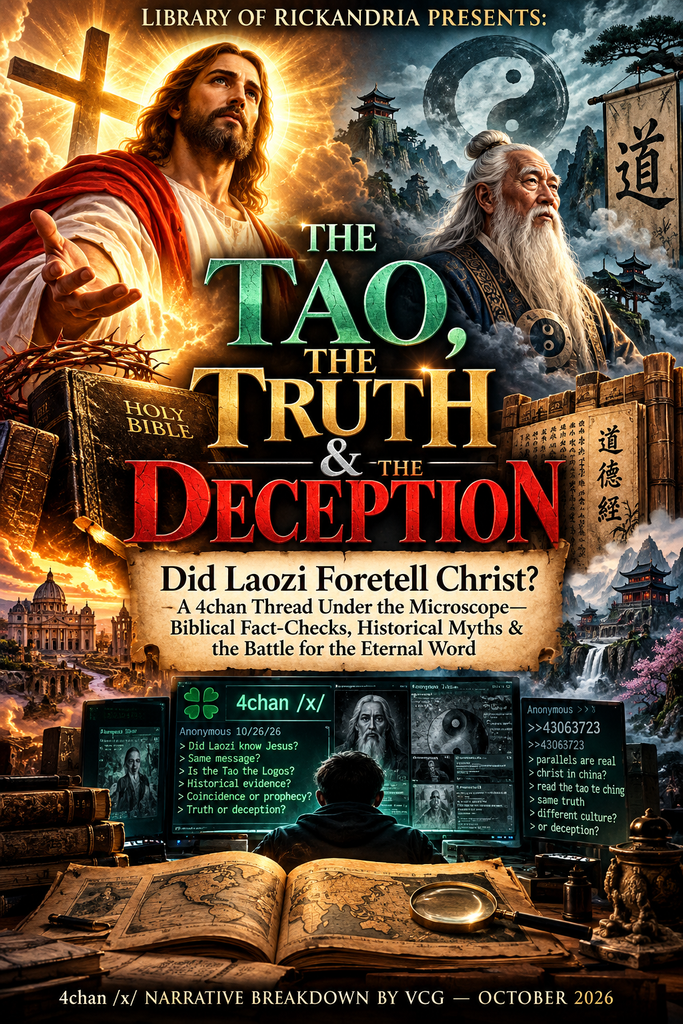
UPDATED BY VCG ON 10/20/2026 @ 20:20 EST
Anyone can do this, but most won’t.
THE TAO, THE TRUTH & THE DECEPTION: Did Laozi Foretell Christ?
is an in-depth biblical, historical, philosophical, and psychological investigation into a controversial October 2026 4chan /x/ discussion questioning whether Taoism and Christianity are compatible.
Examining all 26 posts, the paper confronts claims that:
Christianity originated from ancient Chinese philosophy,
that Laozi prophetically anticipated Jesus Christ,
that the biblical Logos and the Chinese Dao represent the same ultimate reality,
and that Christianity was fundamentally transformed under Constantine.
Drawing upon:
- the King James Bible
- ancient Chinese manuscripts
- early Christian historical records
- linguistic scholarship
- documented religious encounters
the investigation separates verifiable history from:
- theological interpretation
- philosophical similarities
- unsupported assertions
- religious misconceptions
It also exposes the psychological and rhetorical mechanisms that can distort online religious debates, including:
- confirmation bias
- false equivalence
- historical revisionism
- identity-driven hostility
- unsupported conspiracy narratives
Particular attention is given to:
Hieromonk Damascene’s Christ the Eternal Tao,
the distinction between philosophical and religious Daoism,
the biblical teachings concerning:
- God
- creation
- salvation
- spiritual discernment
- the incarnation of Jesus Christ
The central conclusion is that genuine ethical and philosophical parallels between Christianity and Daoism do not automatically establish theological identity, historical dependence, or fulfilled prophecy.
Rather than dismissing unfamiliar traditions or accepting striking similarities as proof, the paper calls readers to examine every claim through credible evidence, historical context, sound reasoning, and careful comparison with Scripture.
Ultimately, The Tao, the Truth & the Deception is an investigation into how truth can become obscured when ancient philosophy, religious interpretation, internet speculation, and ideological conflict are mistaken for established fact—guided by the biblical charge:
“Prove all things; hold fast that which is good.” — 1 Thessalonians 5:21 (KJV)
ChatGPT – Library of Rickandria
LIBRARY OF RICKANDRIA PRESENTS
THE TAO, THE TRUTH & THE DECEPTION
Did Laozi Foretell Christ?
A 4chan Thread Under the Microscope—Biblical Fact-Checks, Historical Myths & the Battle for the Eternal Word
4chan /x/ Narrative Breakdown by VCG — October 2026
An illustrated investigation into Christianity, Daoism, the eternal Logos, religious syncretism, historical transmission, psychological persuasion, and the authority of Scripture.
Primary discussion:
4chan /x/ Thread No. 43063723 — “Is Taoism compatible with Christianity?”
Biblical edition:
The supplied Holy Bible, Authorized King James Version, Pure Cambridge Edition.
Research period: October 2026.
Editorial note:
This study includes claims involving:
- religion
- ethnicity
- discrimination
- institutional sexual abuse
Offensive statements are summarized where possible.
Their inclusion is for documentary examination, not endorsement.
ABSTRACT
On October 10, 2026, an anonymous user on 4chan’s paranormal board, /x/, posted a deceptively simple question:
Is Taoism compatible with Christianity?
/x/ – Is Taoism compatible with Christianity? – Paranormal – 4chan
The accompanying image displayed Christ the Eternal Tao, a book by the Eastern Orthodox writer Hieromonk Damascene.
At first glance, this might seem like an ordinary question about comparative religion.
Yet the thread quickly opened onto much larger controversies.
Some participants argued that Christianity and Daoism are fundamentally incompatible.
Others insisted they are entirely compatible.
Still others claimed Christianity descended from Chinese Mohism, that Christianity changed fundamentally under Constantine, or that Daoism should be classified as Satanism.
The later discussion descended into accusations, insults, racial conspiracy theories, and disputes about whether religious truth is found in Scripture, personal spiritual understanding, or philosophical practice.
Behind the noise stood a genuinely serious question.
When two religious traditions speak of the Way, are they describing the same reality?
The New Testament calls Jesus Christ the Word who was with God and was God.
Classical Chinese philosophy speaks of the Dao, often translated into English as the Way.
Chinese translations of John’s Gospel employ the character 道 (dào) to render the Greek λόγος (logos).
That linguistic connection is real.
But what does it prove?
This investigation examines all 26 posts in the accessible archived thread, distinguishes historical fact from theological interpretation, tests competing claims against scholarship and primary texts, and compares the relevant doctrines with the King James Bible.
Its central finding is that Christianity and Daoism possess important ethical and conceptual parallels, but that such parallels alone do not establish historical dependence, prophetic prediction, or complete doctrinal compatibility.
The evidence calls for a more careful conclusion than either automatic rejection or indiscriminate synthesis.
PART I — THE QUESTION THAT STARTED EVERYTHING
Chapter 1. A Book Cover, an Ancient Sage, and an Uncomfortable Question
The original discussion began at 7:05 a.m. on October 10, 2026, according to the timestamp displayed on the archived page.
The opening post presented the cover of Christ the Eternal Tao and asked whether Taoism could be reconciled with Christianity.
Read the original thread and its replies.
The book cover itself helps explain why the question attracted attention.
Instead of a typical Western Christian design, the artwork incorporates Chinese writing and places Christ within a visual presentation that deliberately invites comparison between Chinese and Christian religious thought.
The viewer is encouraged to ask whether the ancient Daoist tradition might contain some previously unrecognized anticipation of Christ.
That is a compelling premise.
It is also a premise that requires careful testing.
An image can suggest an intellectual relationship without demonstrating one.
A book title can announce a theological interpretation without establishing its historical accuracy.
The first mistake would be to assume that the book cover proves Laozi knew Christ.
The opposite mistake would be to dismiss the question merely because the book uses unfamiliar Chinese religious terminology.
Neither approach constitutes serious research.
Figure 1 — The originating book
View the original cover of Christ the Eternal Tao.
A verified bibliographic record identifies the 2004 fourth edition as a 548-page work published by Valaam Books.
Its table of contents includes material on Laozi and the ancient Greeks, the incarnation of Christ, watchfulness, prayer, illumination, and Eastern Orthodox spirituality.
Source: Google Books bibliographic record.
This tells us something significant about the author’s project.
The book is not simply an attempt to compare two religions from a neutral distance.
It approaches Chinese philosophical language through a distinctively Orthodox Christian theological framework.
That is not inherently dishonest.
All interpreters approach texts with assumptions, commitments, and intellectual traditions.
The important question is whether those commitments illuminate the source material or impose conclusions upon it.
Chapter 2. What Does “Compatible” Mean?
Before judging the comments, we need to clarify the problem the participants were trying to solve.
Compatibility can mean several different things.
Two traditions may teach similar moral principles.
They may employ comparable metaphysical language.
They may possess historical connections.
They may be able to coexist peacefully.
Or they may be doctrinally consistent enough that one person could affirm both without contradiction.
These are different claims.
A Christian and a Daoist might both praise humility without agreeing about the nature of God.
They might both condemn unnecessary violence without sharing a doctrine of sin.
They might both value inward transformation without understanding salvation in the same way.
And they might use the word Way while referring to different ultimate realities.
Throughout the thread, many disagreements arise because participants move between these meanings without acknowledging the shift.
The first requirement of an honest investigation is therefore to specify what kind of compatibility is being claimed.
PART II — METHODOLOGY: HOW WE WILL TEST THE CLAIMS
Chapter 3. Five Kinds of Evidence
This paper distinguishes five categories.
1. Direct documentary evidence.
These are statements actually present in the original 4chan thread or identifiable books, manuscripts, and historical documents.
2. Historical evidence.
This includes dated writings, archaeological material, records of religious contact, and academically documented developments.
3. Linguistic evidence.
This concerns the meaning and usage of Greek, Chinese, and translated terminology.
4. Theological interpretation.
This concerns how religious traditions understand:
- God
- the cosmos
- salvation
- revelation
- human spiritual life
5. Psychological and rhetorical analysis.
This examines patterns of:
- argument
- persuasion
- identity formation
- possible cognitive biases
These categories must not be confused.
A statement can be historically accurate while its theological interpretation remains disputed.
A passage can genuinely resemble another without having been borrowed from it.
A persuasive argument can be psychologically effective while factually incorrect.
And a reader may reject a theological conclusion without having disproved its underlying historical evidence.
Our fact-checking classifications
- Supported: The available evidence adequately establishes the claim.
- Partly supported: The claim contains a factual component but reaches beyond what the evidence proves.
- Unsupported: Sufficient evidence has not been provided or established.
- Contradicted: The claim conflicts with substantial available evidence.
- Interpretive: The conclusion depends on philosophical or theological assumptions and cannot be treated as a straightforward historical fact.
- Not applicable: The post contains no substantive proposition requiring verification.
We will also distinguish absence of evidence from evidence of absence.
If no documented historical transmission between two traditions is found, that does not establish that contact was absolutely impossible.
It does mean that direct dependence should not be asserted as established history.
A note about the biblical standard
The supplied King James Bible provides the scriptural text used throughout this study.
Passages are read in their context, with special attention to Scripture interpreting Scripture.
This does not mean every interpretation offered by Christians carries the same authority as the biblical text.
The biblical text, historical church teaching, and our own conclusions remain distinct.
The KJV translators themselves encouraged intellectual modesty when difficult passages admit more than one defensible interpretation.
In The Translators to the Reader, they counsel that it is better to doubt what remains obscure than to quarrel over what remains uncertain.
That is an appropriate principle for the entire investigation.
PART III — THE COMPLETE 4CHAN THREAD: POST-BY-POST ANALYSIS
Chapter 4. October 10 — The Discussion Begins
Post No. 43063723 — The original question
Assessment: Legitimate question; no proposition demonstrated.
The opening poster asks whether Christianity and Taoism are compatible and attaches the cover of Damascene’s book.
The post supplies no definition of compatibility and no argument proving it.
That is not a defect in itself.
Questions are legitimate starting points for research.
But the ambiguity means that subsequent answers can disagree while actually addressing different issues.
One person may be discussing morality, another worship, and a third metaphysics.
Our corrective method is to separate those subjects before declaring either agreement or contradiction.
Post No. 43063735 — Self-liberation versus external liberation
Assessment: Partly supported, but substantially oversimplified.
The first substantial response argues against combining religious traditions.
The poster proposes a contrast:
Daoism centers upon liberation accomplished through oneself, whereas Christianity depends upon salvation from an external divine source.
This identifies an important difference between many Christian accounts of salvation and some Daoist approaches to cultivation.
Christian salvation is grounded in divine grace.
Ephesians 2:8–9 states:
“For by grace are ye saved through faith; and that not of yourselves:
it is the gift of God:
Not of works, lest any man should boast.”
But Daoism is more diverse than the poster’s binary description suggests.
Religious Daoist traditions include:
- rituals
- divine beings
- spiritual assistance
- community practice
- several understandings of liberation and immortality
The Stanford Encyclopedia of Philosophy’s article on Religious Daoism documents these complexities.
Christianity also involves active participation in spiritual transformation.
Philippians 2:12–13 combines the command to work out salvation with the declaration that God works within believers.
The theological distinction between grace and human spiritual cultivation is important, but Christianity should not be described as entirely passive, nor Daoism as entirely self-generated.
The commenter admits not having read the book.
That limits what can responsibly be concluded about Damascene’s particular argument.
Biblical correction:
Salvation through Christ is not interchangeable with salvation through autonomous self-effort.
Yet Christian transformation includes:
- inward renewal
- obedience
- cooperation with divine grace
Post No. 43063740 — Difficulty obtaining the book
Assessment: No doctrinal claim.
The discussion briefly turns toward the difficulty of purchasing a physical edition in Europe.
This is relevant to research accessibility, not theological compatibility.
Physical availability, price, and edition history can materially affect whether participants have actually read the works they discuss.
A useful lesson emerges: arguments about books should not be based solely on titles or cover images.
Post No. 43063743 — A PDF copy is suggested
Assessment: Practical contribution; authenticity requires checking.
Another participant links to a PDF.
The existence of a digital copy does not by itself establish that the copy is complete, authorized, or faithful to a particular print edition.
For scholarly purposes, its title page, copyright page, pagination, and text should be compared with a verified edition.
Our investigation confirms the published book’s bibliographic details but does not claim a complete page-by-page audit of that linked PDF.
Post No. 43063744 — Daoism is compatible with several other religions
Assessment: Unsupported generalization.
This poster asserts that Daoism is compatible with:
- Neoplatonism
- Buddhism
- animism
- esoteric Egyptian religion
The claim combines several traditions without defining which doctrines are being compared.
Neoplatonism has particular metaphysical accounts of the One, Intellect, and Soul.
Buddhism encompasses multiple philosophical schools and doctrines.
Animism is an umbrella category rather than a single uniform creed.
Religious and philosophical Daoism are themselves internally diverse.
The proper comparison must identify specific propositions.
For example, the question of whether the Neoplatonic One resembles the Dao is substantially more precise than simply declaring the two traditions compatible.
The Stanford Encyclopedia’s overview of Daoism provides essential historical and conceptual distinctions.
Biblical consideration:
Colossians 2:8 warns against philosophy and deceit that displace Christ.
It does not establish that every philosophical observation made outside Christianity is false.
Post No. 43063757 — A preference for physical reading
Assessment: Personal preference, not a theological argument.
The participant explains that extended screen reading is uncomfortable and that a physical book is preferable for sustained study.
There is no relevant doctrinal claim to refute.
The methodological lesson is modest but useful: serious reading often requires reliable access, time, and the ability to annotate texts carefully.
Post No. 43063769 — Using online libraries
Assessment: Research-access advice, with legal and provenance concerns.
Another participant recommends searching for online copies before spending money and mentions a shadow-library service.
Digital availability can make scholarship more accessible, but availability does not prove redistribution is lawful.
Nor does it guarantee textual accuracy.
Whenever possible, readers should use publisher editions, reputable libraries, or authenticated scans.
Post No. 43063790 — Fear of digital disappearance
Assessment: Reasonable concern about preservation.
The commenter worries that online texts may be removed, making physical copies valuable for long-term access.
This concern deserves a serious response.
Historical preservation benefits from multiple formats and independent archives.
Manuscripts, printed books, and digital copies all have advantages and vulnerabilities.
A good research practice is to record the edition, date, ISBN, and source location.
Post No. 43063795 — Intellectual preparation and warrior identity
Assessment: Motivational rhetoric, not historical evidence.
This participant suggests that intellectual preparation may make someone a better warrior later.
The term could be metaphorical, referring to argument or spiritual struggle.
The post does not establish violent intent.
Nevertheless, the rhetoric is revealing.
It frames learning as preparation for conflict rather than simply the pursuit of understanding.
That approach can encourage adversarial reading:
a person searches primarily for weaknesses to exploit instead of examining whether a claim is true.
James 3:17 describes heavenly wisdom as:
- pure
- peaceable
- gentle
- merciful
and willing to be entreated.
For Christian apologetics, the ideal should be truthful correction rather than humiliation.
Post No. 43063802 — Christianity allegedly descended from Mohism
Assessment: Central historical claim unsupported; several ethical comparisons are legitimate.
This is one of the thread’s most consequential posts.
The commenter argues that Christianity is essentially a form of Mohism, contrasts Christian nonretaliation with Daoist withdrawal, and likens Diogenes to a Western Daoist.
Let us examine these separately.
Did Christianity originate in Mohism?
Mohism was an influential movement in ancient China associated with Mozi.
Its ethical teaching included jian ai, commonly translated as inclusive or impartial care, and opposition to aggressive warfare.
These teachings can resemble aspects of Jesus’ moral instruction.
For example, Matthew 5:44 commands believers to love their enemies and pray for persecutors.
But similarity does not demonstrate descent.
To establish direct historical dependence, we would need evidence connecting early Christian communities to Mohist writings or teachings through identifiable routes of transmission.
The post offers none.
The Stanford Encyclopedia’s account of Mohism documents Mohist ethics and history without establishing Christianity as a branch of that movement.
Did Daoists teach avoidance rather than love of enemies?
Some Daoist texts encourage restraint, non-contention, and withdrawal from destructive confrontations.
But the contrast is not absolute.
Chapter 49 of the Daodejing teaches that the sage responds with goodness even to those who are not good.
This is a meaningful parallel with nonretaliation.
Read Chapter 49 in Chinese and in historical English translations.
The justification for such conduct may differ from Jesus’ teaching, but the ethical resemblance should not be denied.
Was Diogenes a Western Daoist?
Diogenes belonged to the ancient Greek Cynic tradition.
His austerity, rejection of conventional status, and criticism of artificial social expectations invite comparison with certain Daoist themes.
Yet a useful analogy is not a historical identity.
There is no basis for classifying Diogenes as literally belonging to a Daoist school.
Verdict: The moral comparison deserves attention.
The proposed historical genealogy does not follow from it.
Post No. 43064806 — Dao across Chinese thought and Jesuit reinterpretation
Assessment: Substantial historical basis, with compressed and exaggerated conclusions.
This participant correctly recognizes that dao appears across different Chinese philosophical traditions.
- Confucians
- Mohists
- Daoists
and other thinkers use the concept, often with competing interpretations.
That matters because the character 道 is not exclusively a Daoist theological term.
The commenter also refers to Jesuit efforts to interpret the Yijing, or Book of Changes, through Christianity.
This is historically grounded.
The Jesuit Joachim Bouvet developed a form of interpretation known as Figurism, seeking correspondences between Chinese classical texts and biblical revelation.
An Oxford Handbook study of the Yijing and the Bible examines these efforts.
The Chinese Rites Controversy later complicated Catholic attempts to accommodate Chinese religious and cultural practices.
But the history was not one simple event in which all dialogue suddenly ended.
It involved competing:
- theological judgments
- missionary strategies
- Chinese political conditions
- evolving decisions in Rome
Historical correction:
Early-modern Christian interpretations of Chinese texts are demonstrable.
Their existence does not prove that those texts originally contained Christian revelation.
Post No. 43064824 — Christianity before Constantine was supposedly different
Assessment: Historically contradicted in its strongest form.
This poster suggests that Christianity before Constantine could be reconciled with Daoism, whereas the later Abrahamic form could not.
The underlying idea is that a more authentic early Christianity was replaced by a fundamentally different religion.
Christian history certainly includes:
- change
- development
- controversy
- institutionalization
- political entanglement
But Christianity did not acquire its Jewish foundations only after Constantine.
Jesus, his apostles, and the earliest Christian communities operated within first-century Jewish religious and cultural contexts.
Matthew 5:17 records Jesus stating that he came not to destroy the Law or the Prophets but to fulfill them.
JESUS CHRIST REVEALED: THE TRUTH THEY HID – Library of Rickandria
Paul’s letters, written long before Constantine, discuss Christ’s death and resurrection, Israel’s scriptures, sin, grace, and future judgment.
An independent Roman witness is also available.
Around AD 112, Pliny the Younger described Christians gathering to sing hymns to Christ as to a god.
Read Pliny’s correspondence with Emperor Trajan, Letters 10.96–97.
The Council of Nicaea in AD 325 addressed an existing theological controversy concerning the Son’s relationship to the Father.
It did not create Christian devotion to Jesus out of nothing.
Verdict: Christianity’s institutional and doctrinal history developed, but the proposed severance between early Christianity and its Jewish inheritance is unsustainable.
Post No. 43066108 — Daoism identified as Satanism
Assessment: Unsupported accusation.
The commenter declares Daoism Satanic without presenting evidence.
From a traditional Christian perspective, religious practices directed toward gods other than the biblical God may conflict with the First Commandment.
Exodus 20:3 declares:
“Thou shalt have no other gods before me.”
But one must distinguish doctrinal disagreement, idolatry as defined within Christian theology, and the historical classification of a religion as Satanism.
Daoist philosophy is not identical to modern Satanist movements.
Nor does demonstrating a disagreement with biblical monotheism prove that every practitioner consciously worships Satan.
1 John 4:1 commands the testing of spirits and religious claims.
Testing requires identifiable evidence.
Post No. 43067063 — Asking why Daoism is Satanic
Assessment: Appropriate demand for an explanation.
The next participant simply challenges the accusation and asks for its basis.
This is one of the most methodologically sound responses in the thread.
A claim is not established by being delivered confidently.
If someone declares an entire religion evil, the burden of argument remains with the person making that assertion.
Chapter 5. October 11 — The Argument Escalates
Post No. 43068642 — The book is called propaganda
Assessment: Serious interpretive objection, but inadequately demonstrated.
This poster claims that Christianity and Daoism are philosophical opposites, characterizes certain energy-cultivation practices as magic, and denounces Christ the Eternal Tao as propaganda.
The criticism raises a worthwhile concern.
An interpreter can appropriate another tradition by claiming that its genuine meaning is secretly identical to his own religion.
If a Christian writer attributes meanings to the Daodejing that cannot be justified from its historical context, that interpretation should be challenged.
However, labeling the entire book propaganda requires examining the text and showing how it misrepresents its sources.
The thread does not supply that demonstration.
The same applies to energy cultivation.
Qigong and related practices encompass varied bodily, meditative, therapeutic, and religious activities.
Their purposes and interpretations differ.
A religious invocation, a breathing exercise, and a physical movement routine are not automatically identical.
For Christian assessment, the actual practice and its spiritual commitments must be identified before applying passages such as Deuteronomy 18:9–14.
Verdict:
The concern about retrospective religious appropriation is legitimate.
The blanket condemnation is not established.
Post No. 43068713 — Complete compatibility is asserted
Assessment: Unsupported absolute claim.
A participant insists that Christianity and Daoism are compatible even under the strictest definitions.
This makes the opposite mistake from the blanket rejection.
Ethical parallels do not erase contradictory theological propositions.
If one interpretation of the Dao denies a personal Creator while Christian doctrine affirms one, the difference must be addressed.
If a religious practice involves worship of gods other than the biblical God, the Christian commitment to exclusive worship becomes relevant.
A defensible claim would specify which forms of Daoist thought and which Christian doctrines can coexist.
The poster instead declares agreement without supplying that explanation.
Post No. 43069433 — Compatibility is dismissed as delusion
Assessment: Personal attack rather than rebuttal.
The reply describes the previous assertion as willfully delusional.
Even if the original assertion was exaggerated, calling it delusional does not explain why.
An effective response should identify the precise contradiction and demonstrate it.
For example:
Can the Daoist account of cosmic emergence be reconciled with the biblical account of creation?
How does the Christian doctrine of incarnation compare with Daoist metaphysics?
The post answers neither question.
Post No. 43069493 — A sustained attack on Christianity
Assessment: Mixture of legitimate criticisms, false generalizations, factual errors, and discriminatory rhetoric.
This is the most inflammatory contribution in the accessible thread.
It criticizes:
- Christian ritual
- clergy
- institutional misconduct
- divine love
- forgiveness
- circumcision
- Christian moral teaching
It also incorporates derogatory claims about ethnic and sexual minorities.
The appropriate response is not to mirror the hostility.
It is to examine the individual propositions.
A. Religious water and hygiene
The commenter attacks the hygienic conditions of shared ritual water.
Communal water can present ordinary hygiene concerns depending on its handling, contamination, and use.
But an allegation about a particular practice or setting does not establish that every Christian ritual uses contaminated water.
Nor is every Christian baptism performed through shared handwashing.
The actual denomination, ceremony, and hygienic conditions would need to be identified.
B. Clergy sexual abuse
This is not a subject that should be dismissed with a rhetorical appeal to religious loyalty.
Documented sexual abuse by members of the clergy and failures of institutional accountability are serious historical realities.
The John Jay College of Criminal Justice prepared a major study of sexual abuse allegations involving Catholic priests and deacons in the United States from 1950 to 2002.
Library of Congress: The Nature and Scope of the Problem of Sexual Abuse of Minors.
The existence of documented abuse is not an argument against the dignity of victims; it is a reason to insist upon:
- justice
- safeguarding
- transparency
- accountability
At the same time, the existence of wrongdoing by members of an institution does not logically establish that every member is guilty or that a particular metaphysical doctrine is false.
Christian Scripture itself condemns serious wrongdoing against children.
Matthew 18:6 issues a severe warning concerning those who cause little ones to stumble.
Romans 13:1–4 also recognizes the role of civil authority in restraining wrongdoing.
Religious forgiveness must not be used to excuse abuse or evade legal responsibility.
C. The claim that Christianity teaches a God who hates believers
This contradicts central biblical affirmations.
John 3:16 presents divine love as the basis for the sending of the Son.
Romans 5:8 emphasizes God’s love demonstrated toward sinners.
Yet biblical teaching also includes:
- divine judgment
- holiness
- repentance
- warnings against sin
A serious analysis should examine both sets of passages instead of reducing Christianity either to unconditional affirmation or divine hatred.
D. Does Christianity create guilt and anxiety?
Religious teaching can affect people psychologically in different ways.
Some experiences of religion may involve:
- fear
- guilt
- shame
or distress.
Others involve:
- comfort
- belonging
- meaning
- forgiveness
- hope
Individual experiences cannot establish one universal psychological effect.
The biblical texts themselves distinguish destructive fear from faithful confidence.
1 John 4:18 states that perfect love casts out fear, while Romans 8:1 speaks of no condemnation for those in Christ Jesus.
These texts do not eliminate every psychological question about religious institutions, but they contradict a portrayal of the gospel as exclusively intended to inflict distress.
E. Christianity’s Jewish origins
The commenter identifies Christianity as an offshoot of Judaism.
In a qualified historical sense, Christianity did emerge from a first-century Jewish environment.
That is not a scandalous discovery. It is fundamental to Christian origins.
Jesus was Jewish. The apostles were Jewish. Christian Scripture incorporates Israel’s scriptures.
The historical connection does not establish that Christians bear collective responsibility for unrelated political or military conflicts involving other religious populations.
F. Circumcision and Christian identity
The assertion that virtually every Christian tradition outside Catholicism practices infant circumcision as a religious requirement is inaccurate.
Acts 15 records the early Christian controversy over whether Gentile converts were required to observe circumcision.
The apostolic decision did not impose that requirement upon Gentile believers.
Galatians 5 similarly rejects the idea that circumcision is necessary for justification in Christ.
Circumcision can occur among Christians for cultural, medical, or familial reasons, but it is not a universal Christian religious requirement.
G. Forgiveness of criminals
The commenter presents Christian forgiveness as an obligation to excuse offenders without qualification.
This confuses forgiveness with the removal of justice or accountability.
Luke 17:3–4 discusses rebuke, repentance, and forgiveness.
Romans 13:4 recognizes the civil authority’s responsibility to punish wrongdoing.
A Christian may forgive a wrongdoer personally while still reporting a crime, protecting victims, seeking restitution, and supporting lawful penalties.
This distinction matters especially when dealing with abuse.
H. Christianity as a demographic conspiracy
The post eventually attributes broad social and demographic problems to Christianity, using racialized and dehumanizing language.
The accusation is not supported by a coherent causal demonstration.
Religion, demography, identity, fertility, and cultural change are complex subjects.
They cannot be reduced to a claim that one religion functions as a biological pathogen.
The rhetorical pattern is recognizable:
identify a large and complex social problem, designate a single cultural enemy, and present wholesale replacement as the solution.
That is an argument requiring evidence, not a conclusion established by anger.
Overall verdict:
Several underlying subjects deserve independent scrutiny, particularly institutional abuse.
But the post repeatedly substitutes sweeping accusations and insults for evidence.
Post No. 43069499 — Christianity accused of facilitating white genocide
Assessment: Unsupported racial conspiracy claim.
This reply asserts that Christian religious rules undermine white reproduction and describes Christianity as a tool of genocide.
No adequate demographic, historical, or causal evidence is supplied.
Pew Research Center’s 2025 study found that the global Christian population grew from approximately 2.1 billion in 2010 to 2.3 billion in 2020, while Christianity declined as a share of the world’s population.
The research identifies multiple factors, including religious switching, fertility, age structure, and population distribution.
Source: Pew Research Center, Christian Population Change, 2010–2020.
These figures do not settle every question about regional demographic change.
They do demonstrate why sweeping claims about religion and population require actual data and carefully specified populations.
Scripturally, Acts 17:26 states that God made all nations of one blood.
Revelation 7:9 depicts a multitude from different nations, peoples, and tongues.
Christianity’s universal mission is inconsistent with the assertion that the gospel itself is an ethnically exclusive biological project.
Post No. 43069547 — The neighbor analogy
Assessment: One of the more defensible conceptual responses.
This commenter suggests that Christianity and Daoism can coexist without being synthesized.
The analogy is that two very different neighbors may live peacefully side by side without becoming the same person.
The comparison is simple, but it identifies a real distinction.
Tolerance and dialogue do not require agreement about every doctrine.
Religious communities can coexist peacefully while maintaining incompatible theological commitments.
Likewise, Christians can understand and appreciate aspects of Daoist philosophy without embracing every Daoist metaphysical or religious claim.
This response moves the conversation away from personal hostility and toward conceptual clarity.
Post No. 43069556 — Different cosmologies and heresy
Assessment: Substantial point, requiring careful terminology.
The poster argues that similarities do not remove fundamental cosmological differences.
This is a stronger objection than merely asserting that the religions are opposites.
Christian theology traditionally affirms a personal Creator who is distinct from creation while sustaining it.
Classical Daoist accounts frequently describe the Dao as underlying cosmic order and the emergence of things, but interpretations vary.
If particular accounts make incompatible claims about ultimate reality, the disagreement cannot be resolved simply by pointing to similar ethical teachings.
However, heresy is a term arising within particular religious traditions.
A Christian may judge a proposition contrary to Christian doctrine.
It does not automatically follow that Daoists themselves classify it through the same category.
The strongest analysis should identify the competing claims rather than rely on labels.
Post No. 43069564 — Rejection of the Satanism accusation
Assessment: Reasonable objection to an unsupported classification.
The commenter rejects the earlier identification of Daoism with Satanism.
That rejection is justified insofar as the accusation supplied no evidence and ignored the actual historical identities of the relevant traditions.
But merely saying the accusation is ignorant is not enough to explain Daoism.
The corrective response is to examine Daoist:
- texts
- deities
- rituals
and philosophical claims individually.
Chapter 6. October 12 — Scripture, Internal Understanding, and Wu Wei
Post No. 43070940 — Philosophical versus religious Daoism
Assessment: Important and legitimate distinction, but historically imperfect.
The commenter asks whether compatibility differs between philosophical Daoism and religious Daoism.
This may be the most useful question raised in the final part of the discussion.
Someone who reads the Daodejing as philosophy may adopt ideas about humility, restraint, simplicity, and non-contention without participating in Daoist religious worship.
Another person may belong to a religious Daoist institution with rituals, deities, scriptures, and spiritual commitments.
These are not identical situations.
However, historians warn that the modern distinction between philosophy and religion can be projected backward onto Chinese traditions in misleading ways.
The Stanford Encyclopedia’s article on Religious Daoism explains that the two categories overlap historically.
Thus, philosophical Daoism may be more readily compared with Christian ethics, but it should not be portrayed as an entirely isolated secular system throughout Chinese history.
Post No. 43071150 — An abusive one-word reply
Assessment: No substantive argument.
This contribution contains an insult rather than a claim about Daoism or Christianity.
It offers no evidence and requires no doctrinal refutation.
Its significance lies in the thread’s rhetorical deterioration.
Post No. 43071185 — Scripture versus internal spiritual understanding
Assessment: Philosophically significant criticism built upon a false opposition.
This poster argues that rigid adherence to Scripture at the expense of inward understanding amounts to a denial of Christ’s Word.
There is a serious question here.
Can someone possess extensive scriptural knowledge while failing to understand the spiritual meaning of the text?
Christian Scripture itself answers yes.
In John 5:39–40, Jesus addresses people who search the Scriptures yet refuse to come to him.
Knowledge of religious texts does not automatically produce spiritual understanding.
But it does not follow that Scripture and inward understanding are enemies.
Luke 24:27 presents Jesus interpreting the Scriptures concerning himself.
Luke 24:45 describes him opening his followers’ understanding so they could comprehend the Scriptures.
The relationship is therefore not simply external text against internal illumination.
Within the Christian account, true understanding of Scripture and the work of God’s Spirit belong together.
Second Timothy 3:15–17 likewise presents Scripture as capable of making one wise unto salvation through faith in Christ and useful for doctrine, correction, and instruction.
Biblical correction: Scripture can be misread or treated legalistically, but this does not make biblical revelation an obstacle to genuine spiritual understanding.
Post No. 43071530 — Abrahamic religion as the opposite of wu wei
Assessment: Contains meaningful philosophical contrasts but relies upon extreme overgeneralization.
The final archived reply argues that Abrahamic religion is oriented toward:
- coercion
- elaborate commandments
- eschatological expectations
- compulsory faith
- control
It presents Daoist wu wei as the opposite.
The comparison deserves more precision.
Wu wei is often translated as non-action, effortless action, or non-coercive action.
It does not necessarily mean doing nothing.
The Stanford Encyclopedia’s discussion of Chinese ethics explains how Daoist writing contrasts rigid intervention with more receptive forms of activity.
That can be meaningfully compared with Christian:
- humility
- surrender
- trust
and freedom from anxious striving.
Matthew 11:28–30 presents Christ inviting the weary to rest.
But there are also genuine differences.
Christianity includes:
- commands
- covenant obligations
- doctrines of judgment
- missionary activity
- theological claims about the culmination of history
Some Christians understand these in ways that emphasize divine command and obedience, while others emphasize grace, freedom, and transformation.
It would be historically dishonest to deny that religious coercion has occurred under Christian authorities.
It would also be inaccurate to conclude that the teachings of Jesus are reducible to coercion.
In Matthew 20:25–28, Jesus contrasts domination with servant leadership.
John 18:36 presents his kingdom as not belonging to the political order in the ordinary sense.
The final commenter correctly points toward the philosophical importance of comparing:
- activity
- effort
- surrender
- authority
But the argument fails when it treats all Abrahamic believers, traditions, and historical practices as a single uniform system.
Overall verdict:
The thread ends with a real philosophical tension, but without the definitions necessary to settle it.
PART IV — THE BOOK AT THE CENTER OF THE CONTROVERSY
Chapter 7. Christ the Eternal Tao: What Can Be Established?
Hieromonk Damascene’s Christ the Eternal Tao is a real published work.
The verified fourth edition was published by Valaam Books in 2004 and contains 548 pages.
Its cataloged contents include discussions of:
- Laozi
- Greek philosophy
- humanity’s departure from the Way
- the incarnation
- watchfulness
- prayer
- the union of mind and heart
- emptiness
- illumination
and Eastern Orthodoxy in China.
Source: Google Books, fourth-edition bibliographic record.
The book’s organizational structure suggests a deliberate use of Daoist terminology to communicate an Orthodox Christian account of divine revelation and spiritual transformation.
It is important to identify the perspective.
In Eastern Orthodox Christianity, salvation is often discussed in terms of healing, transformation, participation in divine life, and union with God.
The theological term theosis describes participation in divine life without identifying the human being with God’s essence.
Hesychasm refers to an Orthodox contemplative tradition emphasizing stillness, prayer, and attention of the heart.
Watchfulness describes vigilance concerning thoughts, temptations, and the spiritual life.
These themes help explain why a Christian author might find Daoist language about quietude, inward cultivation, and spiritual harmony especially interesting.
The similarity of vocabulary can create bridges for explanation.
But the same similarity can conceal important differences.
For example, Daoist discussions of emptiness do not necessarily mean the same thing as Orthodox Christian teachings about humility or self-emptying.
Likewise, Daoist cultivation of qi is not automatically equivalent to participation in the Holy Spirit.
The comparison must examine meaning, not merely vocabulary.
The strongest charitable reading
A sympathetic interpretation of Damascene’s project is that he seeks to identify philosophical intuitions within Chinese tradition that Christians may understand as incomplete anticipations of revelation fulfilled in Christ.
Such an approach has precedents in Christian attempts to engage Greek philosophy and other intellectual cultures.
It can serve as a bridge for dialogue.
The strongest criticism
A critic may argue that this approach interprets Daoist texts through assumptions their historical authors did not share.
If the distinctive Daoist meaning is replaced by a Christian one, the comparison risks becoming theological appropriation rather than historical interpretation.
Both concerns deserve consideration.
Evidence limitation:
Without a complete examination of the relevant chapters and their citations, this paper cannot conclusively determine whether every disputed claim in Damascene’s book is properly supported.
The verified table of contents establishes the project’s broad subjects, not the correctness of every argument.
A future critical edition of this investigation should identify the exact passages in Damascene’s book, the Chinese texts he cites, the translations he uses, and the historical evidence supporting his interpretations.
PART V — LOST IN TRANSLATION: THE LOGOS AND THE DAO
Chapter 8. The Greek Word
John 1:1 declares:
“In the beginning was the Word, and the Word was with God, and the Word was God.”
The Greek term translated Word is λόγος (logos).
Its possible meanings in ancient Greek include:
- word
- speech
- account
- discourse
- reason
depending on context.
But a word’s dictionary range does not tell us exactly what an author means in a particular passage.
John’s prologue supplies its own theological explanation.
John 1:3 attributes the creation of all things to the Word.
John 1:14 declares:
“And the Word was made flesh, and dwelt among us…”
These are not incidental details.
The text identifies the Word with the person who becomes incarnate.
It speaks of divine identity, creative agency, historical incarnation, and revelation through Jesus Christ.
Figure 2 — Early textual evidence for John’s Gospel

View Papyrus 66, an early Greek manuscript of John.
Papyrus 66 is an important material witness to the Gospel of John.
It does not prove the theological claims of the Gospel by itself, but it contributes to the manuscript evidence for the early transmission of the text.
Chapter 9. The Chinese Word
The Chinese character 道, pronounced dào in Mandarin, has a range of meanings connected with way, path, course, and guidance.
It appears in multiple ancient Chinese traditions.
Classical Daoist texts develop their own understandings of the Dao, sometimes describing it as the underlying Way through which natural existence unfolds.
The opening of the received Daodejing reads:
道可道,非常道。
One common interpretation is that the Way which can be articulated is not the constant or enduring Way.
Compare Chinese textual witnesses and historical translations of Chapter 1.
Chapter 42 offers a further account of cosmic emergence, describing the Dao giving rise to unity, multiplicity, and ultimately the myriad things.
But this is not simply Genesis 1 rewritten in Chinese.
The philosophical context, vocabulary, and cosmological assumptions require independent attention.
Chapter 10. The Chinese Translation of John 1:1
A particularly important connection occurs in the Chinese Union Version:
太初有道,道與神同在,道就是神。
The text uses 道 to translate the Greek Logos.
Read John 1:1–14 in the Chinese Union Version.
This is a genuine translation fact.
A Chinese reader encountering John’s Gospel can therefore see terminology that is also important in the Chinese philosophical tradition.
This creates a remarkable point of contact.
But does it prove that the biblical Logos and the Dao of the Daodejing are identical?
No.
Translation establishes that the translator judged a term useful for communicating the meaning of the Greek text.
It does not prove that every philosophical or religious association of that term was intended by the Greek author.
English provides an easy analogy.
A writer can use the word spirit for courage, an immaterial being, or the Holy Spirit.
The same English word does not make those referents identical.
Likewise, the same Chinese character can participate in different theological and philosophical systems.
The decisive distinction
In John, the Word becomes flesh in the person of Jesus Christ.
In classical Daoist philosophical writing, the Dao is discussed through a different conceptual framework, and the text does not independently identify Jesus of Nazareth as its incarnation.
A Christian may interpret Laozi as anticipating something later fulfilled in Christ.
That is a theological interpretation.
It is not established by the Chinese translation alone.
PART VI — DID LAOZI FORETELL CHRIST?
Chapter 11. Three Claims That Must Not Be Confused
The title question can refer to three different propositions.
Proposition one:
Laozi consciously predicted the historical arrival of Jesus Christ.
Proposition two:
Laozi articulated insights that Christians can retrospectively interpret as anticipations of Christ.
Proposition three:
Laozi and Christian writers independently expressed certain similar ethical or metaphysical ideas.
These require different evidence.
The first is a claim of historical prophecy.
The second is a claim of theological interpretation.
The third is a claim of comparative resemblance.
The ancient text must not be made to bear the evidentiary burden of a proposition it never explicitly states.
Chapter 12. What the Early Manuscripts Establish
In 1993, archaeologists discovered ancient bamboo manuscripts at Guodian in China’s Hubei province.
Some of these manuscripts contain material corresponding to parts of the received Daodejing.
The tomb is generally dated to approximately 300 BC.
Source: Stanford Encyclopedia of Philosophy, Laozi, manuscript history.
This is valuable evidence for the antiquity of material associated with Laozi.
It also reminds us that ancient textual traditions developed through processes of composition, transmission, copying, and editorial change.
We should not automatically assume that every word of the received eighty-one-chapter Daodejing was written by one historically documented individual at a precisely known date.
The historical identity and chronology of Laozi remain subjects of scholarly discussion.
Figure 3 — The Guodian bamboo texts
View a photograph of Guodian Laozi bamboo slips.
These are real textual artifacts relevant to the history of early Chinese philosophy.
Their existence establishes the antiquity of the material, not an otherwise undocumented prophecy about Christ.
Chapter 13. The Difference Between Parallel and Prophecy
Consider the moral example.
The Daodejing praises gentleness and, in Chapter 49, goodness toward those who are not good.
Jesus commands love toward enemies in Matthew 5:44.
These teachings resemble one another.
But resemblance alone cannot establish that one author predicted the other.
For a credible claim of specific prophecy, we would seek a sufficiently clear prediction, an identifiable referent, a defensible textual date, and an interpretation not dependent solely upon information supplied after the alleged fulfillment.
A vague or flexible statement can often be interpreted retrospectively to resemble later events.
The more precise a historical-prophetic claim becomes, the more specific the evidence must be.
On the evidence examined here, the responsible conclusion is:
Some Daoist ideas invite Christian theological comparison.
A historically demonstrable prediction of Jesus by Laozi has not been established.
PART VII — A HISTORICAL TIMELINE OF CONTACT AND INTERPRETATION
Chapter 14. Following the Evidence Through the Centuries
Around 300 BC — Guodian manuscripts
The manuscripts discovered at Guodian preserve early material associated with the Daodejing.
They demonstrate that important parts of the Chinese philosophical tradition predate Christianity.
First century AD — The Christian movement emerges
The earliest Christian communities arose within a Jewish and Greco-Roman environment.
The New Testament’s central claims concern the ministry, crucifixion, resurrection, and identity of Jesus Christ.
Around AD 112 — Pliny’s correspondence
Pliny the Younger reports Christian worship practices to Emperor Trajan.
His testimony independently demonstrates Christian devotion to Christ before Constantine.
AD 325 — The Council of Nicaea
The council addressed the controversy surrounding Arius and the Son’s relationship to the Father.
Its decision shaped later Christian doctrinal formulations, but the disputes arose from preexisting Christian beliefs and texts.
AD 635 — Christianity in Tang China
The Xi’an Stele records the arrival of a Christian missionary associated with the Church of the East during the Tang dynasty.
The inscription is an important historical witness to Christian activity in China.
AD 781 — The Xi’an Stele is erected
The stele commemorates the establishment and spread of the Christian community in Tang China.
Figure 4 — An early Christian monument in China
View the Xi’an Stele and its inscription.
This monument supplies far stronger evidence for historical Christian-Chinese contact than unsupported speculation about Christianity descending from Mohism.
Sixteenth to eighteenth centuries — Jesuit engagement
European missionaries, particularly Jesuits, sought ways to communicate Christian theology through Chinese intellectual traditions.
Different missionaries disagreed over which Chinese terms could appropriately designate God.
Joachim Bouvet’s Figurism attempted to discover biblical correspondences within Chinese classical materials, especially the Yijing.
The Chinese Rites Controversy exposed disagreements over whether ancestral and Confucian ceremonies were civil customs or religious worship.
Oxford Handbook: Yin-Yang, the Yijing and the Bible.
Cambridge University Press: Rethinking the Rites Controversy.
Modern period — Christian-Daoist comparative theology
Works such as Christ the Eternal Tao belong to a much longer tradition of Christian engagement with non-Christian philosophical language.
Their legitimacy depends upon the quality of their interpretations, not merely upon whether they attempt such engagement.
Historical conclusion
Christianity and Chinese philosophy have demonstrably interacted.
That interaction is important.
But the existence of later interaction does not establish that the original Christian movement developed from ancient Chinese philosophy or that Laozi possessed specific knowledge of Jesus.
PART VIII — PHILOSOPHICAL DAOISM AND RELIGIOUS DAOISM
Chapter 15. Why the Distinction Matters—and Why It Can Mislead
Many contemporary readers encounter Daoism through philosophical translations of the Daodejing and Zhuangzi.
They may associate Daoism with simplicity, harmony, non-contention, humility, and freedom from excessive desire.
Other forms of Daoism include ritual specialists, temples, deities, sacred scriptures, alchemy, meditation, and practices concerned with longevity and liberation.
It is useful to distinguish these settings.
But the division between philosophy and religion should not be imposed mechanically upon the past.
Ancient Chinese categories do not always correspond to modern Western distinctions.
The historical Daoist tradition contains extensive overlap between cosmology, spiritual practice, ritual, and philosophy.
Source: Stanford Encyclopedia of Philosophy, Religious Daoism.
Chapter 16. Five Concepts Worth Comparing Carefully
Dao — 道
The Way or underlying course of existence, interpreted differently across traditions.
Christian comparison:
John 14:6 identifies Jesus as the Way, Truth, and Life.
Limit:
Shared vocabulary does not establish identical metaphysics.
De — 德
Frequently translated as virtue, potency, or efficacy, depending on context.
Christian comparison:
Holiness, virtue, and spiritual fruit.
Limit:
Daoist de is not simply the same concept as Christian grace.
Wu wei — 無為
Often rendered as non-action, non-coercive action, or effortless action.
It concerns forms of conduct that do not rely upon destructive striving or artificial imposition.
Christian comparison:
Humility, trust, peace, and the renunciation of self-centered striving.
Limit:
Christian moral obedience involves theological commitments about God, sin, and revelation that are not supplied by wu wei itself.
Ziran — 自然
Often understood in connection with spontaneity or being so of itself.
Christian comparison:
Discussions of transformation, freedom, and the restoration of rightly ordered human life.
Limit:
Natural spontaneity and obedience to a personal Creator are not automatically equivalent.
Qi — 氣
A major Chinese cosmological and physiological concept associated with breath, vital process, and the constitution of things.
Christian comparison:
Some writers draw analogies with biblical language about breath and spirit.
Limit:
The Holy Spirit in Christian theology is not simply a cosmological force or bodily energy.
The comparison becomes misleading if a shared metaphor is treated as a complete identity.
PART IX — THE BIBLICAL TEST
Chapter 17. What Scripture Actually Requires Us to Distinguish
The following passages are taken from, or checked against, the supplied King James Bible.
God and creation
Genesis 1:1 declares:
“In the beginning God created the heaven and the earth.”
John 1:3 identifies the Word as involved in the making of all things.
Colossians 1:16–17 likewise describes all things as created through and for Christ.
Biblical teaching:
The ultimate source of creation is understood through the identity and action of God.
Interpretive question:
Can a particular Daoist account of cosmic emergence be understood consistently with this teaching?
This cannot be resolved merely by saying that both traditions speak of an ultimate source.
The incarnation
John 1:14 declares that the Word became flesh.
Philippians 2:5–11 describes Christ’s humility and exaltation.
Colossians 2:9 affirms the fullness of the Godhead dwelling bodily in Christ.
Biblical teaching:
The incarnation is central to Christian identity.
Doctrinal consequence:
An interpretation that reduces Christ exclusively to an impersonal principle would conflict with the ordinary historic Christian reading of these passages.
Sin and salvation
Romans 3:23 declares that all have sinned.
Ephesians 2:8–10 connects salvation through grace with the creation of believers for good works.
Titus 3:5 emphasizes divine mercy rather than salvation earned by righteous works.
Biblical teaching:
Christian salvation involves reconciliation, grace, and renewal through Christ.
Interpretive question:
Can practices aimed at harmony, cultivation, or transformation be understood as morally useful without becoming alternative means of salvation?
Within traditional Christian theology, the answer may be yes, depending upon the practice and the meaning assigned to it.
Spiritual transformation
Philippians 2:12–13 joins human responsibility with God’s action.
Galatians 5:22–23 describes the fruit of the Spirit.
Romans 12:2 commands transformation through the renewing of the mind.
These passages make it inadequate to describe Christianity as merely an external transaction with no inward transformation.
Worship and idolatry
Exodus 20:3–5 commands exclusive worship.
First Corinthians 10:20–21 warns against participation in idolatrous worship.
Biblical teaching: Exclusive devotion to God is integral to Christian faith.
Interpretive consequence:
Particular religious practices involving worship of other deities present serious theological conflicts.
But the same conclusion should not automatically be applied to every observation about nature, moral teaching, or physical exercise associated with Daoist culture.
Revelation and discernment
First Thessalonians 5:21 states:
“Prove all things; hold fast that which is good.”
Acts 17:11 commends examination of the Scriptures.
First John 4:1 commands testing religious claims.
These passages support examination rather than credulity.
A Christian is not instructed to accept every striking similarity as revelation.
Neither is the Christian instructed to fabricate evidence against an unfamiliar philosophy.
Ethical humility and peace
Matthew 5:5 blesses the meek.
Romans 12:21 declares:
“Be not overcome of evil, but overcome evil with good.”
James 3:17 commends wisdom that is gentle and peaceable.
These teachings provide legitimate points of comparison with Daoist praise of humility and non-contention.
They do not by themselves establish agreement about salvation or the nature of God.
The resurrection
First Corinthians 15:12–20 places Christ’s resurrection at the center of the Christian proclamation.
A comparative system that preserves ethical similarities while eliminating the resurrection would no longer preserve one of the New Testament’s defining claims.
This is among the strongest limits upon complete doctrinal synthesis.
PART X — PSYCHOLOGY: HOW THE THREAD PERSUADES
Chapter 18. From Curiosity to Identity Conflict
The thread begins with a question about a book.
It ends with participants disputing religious authority, accusing each other of ignorance, and making sweeping claims about civilizations and populations.
That progression is worth examining.
But analysis must remain grounded.
We cannot infer the clinical condition, private motives, or personal histories of anonymous posters.
What we can examine are observable rhetorical patterns.
Confirmation bias
Confirmation bias describes the tendency to select or interpret information in ways favorable to existing beliefs.
A Christian reader may notice only those Daoist passages that resemble biblical teachings.
A hostile critic of Christianity may notice only examples of institutional abuse or coercion.
Both may neglect evidence that complicates their preferred conclusions.
Raymond Nickerson’s influential review surveys confirmation bias across numerous forms of reasoning.
Nickerson, 1998 — Confirmation Bias: A Ubiquitous Phenomenon in Many Guises.
Equivocation
The word Way appears across different traditions.
If a writer begins by using it to mean a metaphysical principle and later treats it as identical to the incarnate Christ without explanation, the argument has changed meanings midstream.
This is a logical problem rather than proof of malicious intent.
Weak analogy
Mohist inclusive care and Jesus’ command to love enemies have meaningful similarities.
But moving from similarity to direct historical descent requires additional evidence.
Without that evidence, the analogy cannot carry the historical conclusion.
False dichotomy
The opening contrast between self-liberation and external liberation presents two complicated traditions as simple opposites.
The deeper theological distinctions remain important, but the simplified labels conceal substantial variation.
Ad hominem attacks
Several participants substitute insults for reasoning.
Attacking a participant’s intelligence or religious identity does not establish the truth or falsity of the proposition under discussion.
Collective blame
One later post attributes wrongdoing by particular Christian institutions or individuals to Christianity as a whole.
Another attributes broad social problems to a religious tradition and treats collective replacement as the solution.
These arguments require evidence demonstrating the proposed causal relationship.
Anger and repetition do not supply it.
Identity-protective reasoning
A person may respond to criticism of a religion or philosophy as though it were criticism of his entire identity.
This can make disagreements emotionally intense.
The thread’s insults and collective labels are consistent with such a rhetorical dynamic, but they do not establish the private motivations of particular participants.
The illusory truth effect
Repeated exposure to a statement can increase its perceived accuracy.
In 2023, Valentina Vellani and colleagues published experimental research finding that repetition increased participants’ willingness to share statements, with perceived accuracy helping explain the effect.
Vellani et al., Cognition, 2023 — The Illusory Truth Effect Leads to the Spread of Misinformation.
That finding does not prove that any particular 4chan participant was deceived by repetition.
It provides a reason to be cautious when familiar slogans begin to seem self-evidently true.
Chapter 19. Why the Tone of the Argument Matters
A careful researcher should not treat politeness as proof of truth.
A calm person can be wrong.
An angry person can identify a genuine problem.
Nevertheless, contempt can damage inquiry by discouraging careful distinctions.
The strongest parts of this thread occur when commenters identify specific issues:
- grace
- Daoist cultivation
- historical Christianity
- philosophical versus religious Daoism
and competing cosmologies.
The weakest occur when participants replace argument with collective denunciation.
The improvement is straightforward.
Define the claim, examine the strongest evidence for it, identify contrary evidence, and state the conclusion with appropriate limits.
That method serves truth better than rhetorical victory.
PART XI — PUTTING BOTH SIDES TO THEIR STRONGEST TEST
Chapter 20. The Strongest Case for Compatibility
The strongest argument for a meaningful relationship between Christianity and Daoism is not that every doctrine is identical.
It is that human beings in different cultures may recognize overlapping truths about moral life and the limitations of selfish striving.
The Daoist criticism of:
- ambition
- artificiality
- aggression
- excessive desire
can resonate with Christian teachings on:
- humility
- simplicity
- the dangers of worldly pride
The Daodejing praises gentleness.
Jesus commands humility and love of enemies.
Both traditions contain language that challenges domination and uncontrolled desire.
A Christian interpreter might argue that such parallels are compatible with the biblical understanding that humanity possesses moral awareness and that people outside the biblical covenant may recognize genuine truths.
Romans 2:14–15 and Acts 17:22–31 provide possible starting points for that Christian argument.
This does not mean Daoist texts are Christian Scripture.
It means a Christian can acknowledge true or useful observations outside the biblical canon.
The argument can be developed further through comparative theology.
Some Christian theologians have historically appropriated philosophical concepts from outside the biblical world while redefining those concepts within Christian doctrine.
The question is whether such adaptation clarifies Christianity without distorting the philosophy being interpreted.
Chapter 21. The Strongest Case Against Complete Synthesis
The strongest objection concerns not morality but ultimate reality.
Historic Christianity affirms the personal God revealed through Israel’s scriptures and the person of Jesus Christ.
It affirms:
- incarnation
- atonement
- resurrection
- judgment
- salvation through Christ
Classical Daoist philosophical frameworks do not necessarily affirm those doctrines.
Religious Daoism also includes traditions and rituals that may conflict with exclusive Christian worship.
One cannot simply declare every concept identical because it possesses a partial resemblance.
The Christian doctrine of the Holy Spirit is not automatically the same as qi.
Christian grace is not automatically the same as de.
The incarnation is not automatically the same as cosmic emergence.
And non-contention does not automatically produce agreement about the identity of Jesus.
The differences should neither be exaggerated nor concealed.
A synthesis remains responsible only if it preserves the meanings of the concepts being brought together and openly acknowledges unresolved contradictions.
PART XII — THE CLAIM-BY-CLAIM FACT-CHECK
Chapter 22. Findings at a Glance
| Claim examined | Finding |
|---|---|
| The book Christ the Eternal Tao exists | Supported |
| Daoist and Christian ethics possess meaningful parallels | Supported |
| Daoism is only self-liberation | Overgeneralized |
| Christianity is only externally imposed liberation | Overgeneralized |
| Christianity descends directly from Mohism | Unsupported |
| Diogenes was literally a Daoist | Unsupported historically; usable as analogy |
| The term dao occurs across Chinese traditions | Supported |
| Jesuits connected Chinese classics with Christianity | Supported |
| Christianity received its Jewish foundations after Constantine | Contradicted |
| Daoism as a whole is Satanism | Unsupported |
| Every Daoist spiritual or bodily practice is magic | Unsupported generalization |
| Christianity and Daoism are completely compatible in every doctrine | Unsupported |
| Christianity and Daoism are wholly incompatible in every ethical respect | Contradicted by genuine parallels |
| Clergy sexual abuse has occurred in Christian institutions | Documented |
| All Christians or all clergy are responsible for those crimes | Unsupported collective accusation |
| Christianity universally requires infant circumcision | Contradicted |
| Christianity requires personal forgiveness to eliminate criminal accountability | Contradicted by the distinction between forgiveness and justice |
| Christianity is proven to be a program of racial genocide | Unsupported |
| Daoist philosophy and organized religion can always be cleanly separated | Historically misleading |
| Chinese Bible translations use 道 for Logos | Supported |
| That translation proves Laozi foretold Jesus | Unsupported |
| Laozi can be interpreted retrospectively as anticipating aspects of Christian revelation | Theological interpretation |
The findings are not equally important.
The historical and linguistic questions can often be investigated through documents and manuscripts.
The theological questions require careful interpretation of religious texts and doctrinal commitments.
The distinction must remain visible.
PART XIII — FINAL VERDICT
Chapter 23. One Way, Two Traditions: Where Does the Evidence Lead?
The original 4chan thread asked a sincere question and received a mixture of:
- serious observations
- oversimplifications
- historical errors
- insults
and provocative assertions.
Some participants identified real differences between Christian salvation and Daoist cultivation.
Others noticed meaningful ethical parallels.
The discussion became confused when similarities were treated as proof of historical descent, or disagreements were treated as proof that an entire religion was evil.
The central issue is not whether the two traditions use the same English word.
It is whether they make the same claims about:
- God
- creation
- the human condition
- salvation
and the ultimate purpose of life.
The evidence does not support a simple declaration that Christianity and Daoism are identical.
Neither does it support the assertion that every Daoist ethical teaching must therefore be false or spiritually corrupt.
Their relationship is more complicated.
Christian readers can recognize similarities involving:
- humility
- peace
- simplicity
- nonretaliation
and the limitations of self-centered striving.
They can investigate whether these parallels provide useful means of communication.
They can acknowledge historical attempts to connect Chinese classical thought and Christian theology.
But when a particular comparison concerns the incarnation of Christ, the identity of God, worship, or salvation, the distinctive claims of Christian Scripture cannot be ignored.
The biblical Word is not merely an abstract principle inferred from cosmic order.
John’s Gospel explicitly identifies the Word with the one who became flesh.
That claim remains central to Christian theology.
Did Laozi foretell Christ?
The available evidence establishes that ancient Daoist texts contain ideas Christians may find suggestive.
It establishes that Chinese translators have employed the character 道 to communicate the Greek Logos.
It establishes that Christian missionaries and theologians have interpreted Chinese classical philosophy through Christian categories.
But these facts do not establish that Laozi consciously predicted Jesus or that the Daodejing originally taught the doctrines of the Christian gospel.
Such a conclusion would require evidence beyond linguistic resemblance and retrospective interpretation.
Is Daoism compatible with Christianity?
The answer depends on what is meant.
Ethical dialogue and philosophical comparison are clearly possible.
Peaceful coexistence does not require doctrinal identity.
Some Daoist ideas may be incorporated as insights or analogies within a Christian philosophical framework, provided their meanings are treated honestly.
Complete theological synthesis is another matter.
Specific doctrines concerning:
- God
- incarnation
- salvation
- worship
can create substantial contradictions.
A careful Christian conclusion therefore distinguishes learning from a tradition from accepting that tradition as a second source of ultimate religious authority.
This is not a refusal to investigate.
It is a demand that investigation remain faithful to the evidence.
Closing Reflection — Truth Requires More Than a Winning Argument
The striking feature of this discussion is not merely that anonymous internet users disagreed about religion.
It is how quickly a serious historical and theological question became a contest over identity, authority, and cultural allegiance.
The more heated the debate became, the easier it was for unsupported claims to substitute for careful reasoning.
Yet some of the best questions survived that deterioration.
Can two traditions share truths without being identical?
Can a philosophical concept serve as a bridge between cultures without being stripped of its original meaning?
Can Scripture be faithfully interpreted without confusing the interpreter’s conclusions with the text itself?
Can religious institutions be held accountable for documented wrongdoing without treating every adherent as collectively guilty?
And can Christians take seriously the intellectual achievements of other civilizations without abandoning the distinctive claims of their own Scriptures?
These are questions worth studying.
The proper response is not fear of inquiry but disciplined examination.
First Thessalonians 5:21 supplies a fitting closing principle:
“Prove all things; hold fast that which is good.”
Soli Deo Gloria.
APPENDIX A — PRIMARY AND SECONDARY SOURCE BIBLIOGRAPHY
The links below are direct external links rather than conversation-specific citation markers, allowing them to remain usable when the paper is copied.
Primary discussion and book
- 4chan /x/, Thread No. 43063723, October 10–12, 2026. Original archived discussion.
- Hieromonk Damascene, Christ the Eternal Tao, fourth edition, Valaam Books, 2004. Google Books catalog and contents.
- King James Bible, Pure Cambridge Edition. User-supplied biblical text. For external verse navigation: Bible Gateway, KJV.
Chinese philosophy and manuscripts
- Stanford Encyclopedia of Philosophy, “Daoism.” Read.
- Stanford Encyclopedia of Philosophy, “Religious Daoism.” Read.
- Stanford Encyclopedia of Philosophy, “Laozi.” Read.
- Stanford Encyclopedia of Philosophy, “Mohism.” Read.
- Daodejing, Chapter 1, Chinese witnesses and historical English translations. Read.
- Daodejing, Chapter 49, Chinese witnesses and historical English translations. Read.
- Stanford Encyclopedia of Philosophy, “Chinese Ethics.” Read.
The Logos, Chinese Christianity, and historical contact
- Chinese Union Version, John 1:1–14. Bible Gateway.
- Pliny the Younger, Letters 10.96–97, correspondence with Emperor Trajan. Primary-source text and translation.
- The Oxford Handbook of the Bible in China, “Yin-Yang (Yijing) and the Bible.” Oxford University Press, 2021. Read abstract and publication details.
- “Rethinking the Rites Controversy.” Modern Intellectual History, Cambridge University Press. Read.
- “The Catholic Yijing: Lü Liben’s Passion Narratives.” Religions, 2019. Read.
Psychology and argumentation
- Raymond S. Nickerson, “Confirmation Bias: A Ubiquitous Phenomenon in Many Guises.” Review of General Psychology 2, no. 2, 1998, pp. 175–220. DOI.
- Valentina Vellani et al., “The Illusory Truth Effect Leads to the Spread of Misinformation.” Cognition 236, 2023, article 105421. Open-access full text.
Institutional accountability and demography
- John Jay College of Criminal Justice, The Nature and Scope of the Problem of Sexual Abuse of Minors by Catholic Priests and Deacons in the United States, 1950–2002. 2004. Library of Congress catalog.
- Pew Research Center, “Christian Population Change, 2010–2020.” June 9, 2025. Read report.
- Pew Research Center, “Factors Driving Religious Change, 2010–2020.” June 9, 2025. Read report.
APPENDIX B — ILLUSTRATION AND ARCHIVAL LINKS
Figure 1 — Christ the Eternal Tao, book cover. Holy Virgin Cathedral Bookstore.
Figure 2 — Guodian Laozi bamboo manuscripts. Wikimedia Commons.
Figure 3 — Papyrus 66, early manuscript of John’s Gospel. Wikimedia Commons.
Figure 4 — Xi’an Stele, Christian monument of AD 781. Smarthistory.
Figure 5 — Chinese-Christian Yijing interpretation. Religions, 2019.
Original internet primary source: 4chan /x/ Thread No. 43063723.
Illustration credits are provided for research and attribution.
Rights and reuse terms should be checked with the original image holders before commercial publication.
LIBRARY OF RICKANDRIA
Research, Scripture, History, and the Examination of Claims
NARRATIVE BREAKDOWN BY VCG — OCTOBER 2026
SOLI DEO GLORIA
THE 4CHAN FILES: Where Anonymous Claims Meet Evidence & Scripture – Library of Rickandria
VCG PAPER PROJECTS – Library of Rickandria