
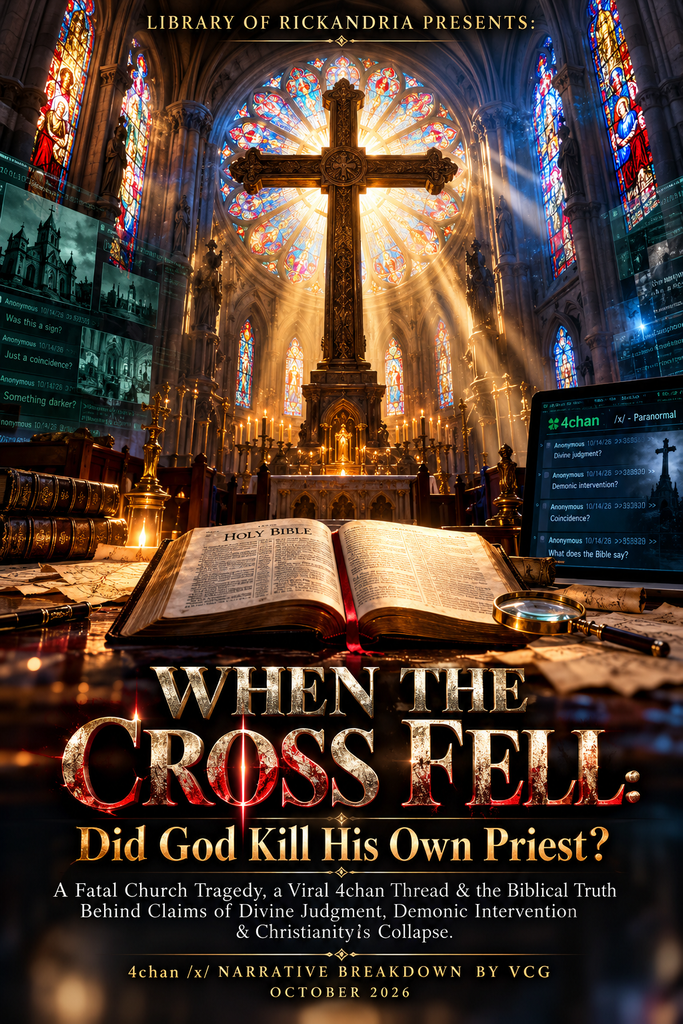
WHEN THE CROSS FELL: Did God Kill His Own Priest?
UPDATED BY VCG ON 10/21/2026 @ 23:23 EST
A Fatal Church Tragedy, a Viral 4chan Thread & the Biblical Truth Behind Claims of Divine Judgment, Demonic Intervention & Christianity’s Collapse.
Anyone can do this, but most won’t.
WHEN THE CROSS FELL: Did God Kill His Own Priest?
is an extensive:
- forensic
- historical
- psychological
- biblical
investigation into the tragic October 17, 2026, death of Father Patricio Alfredo Sánchez Molinari, who was fatally struck by a falling crucifix during a livestreamed Catholic Mass in Guayaquil, Ecuador.
Drawing upon:
- the original video footage
- contemporary news reporting
- historical research
- psychological studies
- the King James Bible
the Library of Rickandria examines all 59 posts from a viral 4chan /x/ thread that transformed the incident into a heated debate over:
- divine judgment
- demonic intervention
- idolatry
- religious manipulation
- prophecy
and the truth of Christianity itself.
Each claim is subjected to careful:
- fact-checking
- logical examination
- psychological analysis
- scriptural comparison
with particular emphasis on Jesus Christ’s teaching in Luke 13:1–5 concerning eighteen people killed by the collapse of the tower of Siloam.
The paper also investigates:
- the priest’s remarkably timely final sermon about mortality
- the possibility of structural negligence
- AI-generated misinformation
- disturbing expressions of pleasure at his death
and the broader philosophical problem of suffering under an all-powerful and loving God.
By distinguishing:
- documented facts from speculation
- historical evidence from theological interpretation
- genuine biblical teachings from unsupported religious assertions
the study demonstrates why neither tragedy nor coincidence establishes divine punishment or supernatural causation.
Ultimately, WHEN THE CROSS FELL challenges believers and skeptics alike to confront difficult questions with:
- intellectual honesty
- compassion
- sound reasoning
- faithful examination of Scripture
—asking not merely why the cross fell, but why human beings are so quick to claim they know what God intended when it did.
ChatGPT – Library of Rickandria
/x/ – Why did God do this? – Paranormal – 4chan
WHEN THE CROSS FELL
Did God Kill His Own Priest?
A Fatal Church Tragedy, a Viral 4chan Thread & the Biblical Truth Behind Claims of Divine Judgment, Demonic Intervention & Christianity’s Collapse
LIBRARY OF RICKANDRIA PRESENTS
4chan /x/ Narrative Breakdown by VCG
October 2026
An investigation into a fatal accident, the interpretations it inspired, and the difference between evidence, speculation, psychology, and Scripture.
Abstract
On October 17, 2026, Father Patricio Alfredo Sánchez Molinari died after a large crucifix fell during a livestreamed Catholic Mass in Guayaquil, Ecuador.
The accident was recorded.
A portion of that footage circulated online, prompting a discussion on 4chan’s paranormal board, /x/, beginning the following day.
The opening question was deceptively simple:
“Why did God do this?”
Over the next three days, participants offered competing explanations.
Some called the video artificial intelligence.
Others proposed:
- divine punishment
- demonic interference
- hidden sexual misconduct
- a staged assassination
- prophetic symbolism
or evidence that Christianity was fundamentally false.
Still others rejected these claims, discussed suffering and salvation, or pointed to historical Christian martyrdom.
This study examines:
- the 59 surviving posts in the supplied transcript
- the attached 11.73-second recording
- contemporary news reports
- relevant psychological literature
and the King James Bible.
It also investigates the priest’s final sermon, the subsequent calls for a technical investigation, and the spread of related misinformation.
Its conclusion is narrower than either extreme presented in the thread:
the accident is established, but its exact mechanical cause—and any alleged supernatural significance—cannot be determined from the video or the arguments of anonymous commentators.
Scripture, particularly Luke 13:1–5, cautions against assuming that victims of catastrophe must have been unusually sinful.
The goal is not to eliminate difficult theological questions.
It is to examine them without substituting an emotionally satisfying story for evidence.
PART I — THE INCIDENT
Chapter 1. A Cross Falls in Guayaquil
On the evening of Saturday, October 17, 2026, parishioners gathered for Mass at Nuestra Señora del Perpetuo Socorro—Our Lady of Perpetual Help—in Guayaquil, Ecuador.
Father Patricio Alfredo Sánchez Molinari was serving at the church altar.
Behind him stood a substantial wooden crucifix.
During the service, the structure tipped forward and struck him.
A recording of the incident rapidly circulated online.
The Associated Press, NBC News, and Ecuadorian broadcaster Ecuavisa independently reported the fatal accident.
The Archdiocese of Guayaquil publicly confirmed the priest’s death.
This is the first essential finding:
the event happened.
The incident is not merely a computer animation circulating without a source.
Contemporary reporting links it to:
- a specific church
- a named individual
- a recorded service
and a community grieving its priest.
That does not mean every online copy is necessarily unaltered.
Nor does authentication answer what caused the cross to fall.
Those are separate questions.
Who was Father Sánchez?
Several anonymous posts reduce the priest to the moment of his death.
The available reporting describes a more substantial life.
Father Sánchez was from Cuenca, Ecuador, and belonged to the Congregation of the Most Holy Redeemer, commonly called the Redemptorists.
According to Ecuavisa’s biographical reporting,
his ministry included assignments in:
- Loja
- Durán
- Vinces
The report recalls missionary work intended to reach geographically dispersed communities.
An October 21 report by El País adds the perspective of the people who knew him.
Parishioners remembered a priest who kept the church accessible, attended to confession and pastoral responsibilities, and took an active interest in a neighborhood affected by violent crime.
The article describes community efforts involving food assistance and activities for children and young people.
These recollections are testimonies from people familiar with him, not a complete independent evaluation of his entire life.
But they are relevant when assessing the thread’s unsupported allegations about his character.
Contemporary reports disagree about his precise age, with some Ecuadorian reports giving 52 and international coverage giving 53.
The discrepancy should be resolved from an authoritative biographical or civil record rather than concealed.
What is not in dispute is that Father Sánchez was an identifiable human being with relatives, colleagues, a congregation, and a history preceding the viral footage.
The community’s response
According to the October 21 El País report, parishioners gathered for prayers and remembrance after the accident.
They were not merely debating abstract theology.
They were mourning someone who had occupied a significant place in their community.
Some interpreted the death through sacrifice or providence.
Others struggled with the question of why God had not prevented the accident.
These responses deserve to be understood as expressions of grief and personal faith, not automatically elevated into factual explanations of the cause of death.
The distinction matters.
A grieving parishioner’s statement about what a death means to them is not the same thing as an investigator’s finding about why a structure failed.
Chapter 2. What the Video Actually Shows
The supplied MP4 was examined as a separate piece of evidence.
Its technical properties are:
| Property | Observation |
|---|---|
| Duration | 11.733 seconds |
| Resolution | 640 × 1280 pixels |
| Frame rate | 30 frames per second |
| Video codec | H.264 |
| Audio | No audio stream in the supplied file |
| Content | Vertical recording of the altar area and falling crucifix |
In the excerpt, the priest stands at the altar while the crucifix remains behind him.
Approximately two seconds into the recording, the structure is visibly moving forward.
It subsequently falls across his position.
The remaining seconds show the aftermath within the camera’s view.
The footage is consistent with the independently reported accident.
NBC News reviewed the original livestream and described the crucifix falling behind the priest while he faced the congregation. Read NBC’s account.
Five things the recording does not establish
It does not determine the exact moment of death.
The visible impact and lack of subsequent movement in the excerpt cannot independently establish a medical timeline.
It does not identify the failure mechanism.
A falling structure may involve:
- anchors
- fasteners
- supports
- material deterioration
- improper installation
- unusual loading
or other circumstances.
The video does not permit a definitive diagnosis.
It does not prove sabotage.
No deliberate interference is apparent in the supplied excerpt.
Determining whether interference occurred would require evidence beyond the recording.
It does not prove divine or demonic intervention.
Neither a supernatural agent nor a supernatural mechanism is visible or independently established.
It does not preserve the final sermon.
This particular MP4 has no audio.
Claims about what Father Sánchez said must therefore be checked against other recordings and reports.
A short recording can establish that a visible event occurred.
It does not automatically establish all the causes or meanings subsequently attributed to that event.
This is the methodological distinction that nearly every speculative post in the thread overlooks.
Chapter 3. The Final Sermon: A Striking but Misrepresented Sequence
Part of the video’s impact comes from what Father Sánchez reportedly said shortly before the accident.
reported that his homily emphasized mortality and the importance of giving time to God and family.
Among the reported Spanish words was:
“Un día, todos los que estamos aquí también vamos a morir.”
That is, one day, everyone gathered here will also die.
Father Sánchez reportedly contrasted time devoted to material concerns with time devoted to:
- God
- spouses
- children
- relatives
His reflection drew on Jesus’ teaching about rendering to Caesar what belongs to Caesar and to God what belongs to God, recorded in Matthew 22:21.
The correspondence between his subject and what happened afterward is genuinely remarkable.
It is also important not to compress the timeline into a more dramatic version than the available evidence supports.
The accounts describe his reflection as taking place shortly before the tragedy, but the falling crucifix was not necessarily an instantaneous response to the specific sentence about death.
The service continued through its liturgical sequence.
One of the most common methods by which an extraordinary coincidence becomes a supernatural narrative is the removal of intervening context.
The historical event remains striking when its actual sequence is preserved.
Exaggeration is unnecessary.
Was it prophecy?
A prediction must be sufficiently specific, identifiable in advance, and capable of being tested against subsequent events.
The statement that everyone eventually dies is universally applicable.
It does not identify a specific individual, time, cause, or location of death.
Consequently, the sermon cannot be established as a prediction of the accident merely because the priest died shortly afterward.
The incident may acquire considerable spiritual meaning for someone who heard the sermon.
That is a matter of interpretation.
Interpretive significance should not be confused with predictive accuracy.
Chapter 4. The Investigation: Providence or Human Negligence?
The physical cause of the crucifix’s fall is the most important unresolved factual issue.
On October 19, Ecuavisa reported that Ecuadorian police had preliminarily classified the death as accidental.
The report also discussed the possibility of civil or criminal responsibility if subsequent investigation established negligent installation, maintenance, or failure to exercise an appropriate duty of care.
Primicias reported that the Archdiocese of Guayaquil was awaiting a technical report concerning the structure.
On October 20, El Comercio reported that relatives wanted the death investigated.
A family member, Patricio León, acknowledged a possible religious interpretation while insisting on the importance of learning why the crucifix fell.
Noticias Caracol followed with further reporting on October 21.
The family’s position highlights a distinction missing from many of the online arguments.
A person can believe in divine providence and still insist that physical structures be properly installed and maintained.
What would a technical investigation need to establish?
The central questions include:
- How was the crucifix attached to the surrounding structure?
- Who installed it, and under what specifications?
- Were the fasteners or anchor points appropriate for the load?
- Was there any previous movement, deterioration, warning, or repair?
- When was the assembly last inspected?
- Were any relevant maintenance standards neglected?
- Did any person or institution have notice of a dangerous condition?
- What physical evidence remains to establish the failure sequence?
The October 21 El País report described visible mounting holes and associated hardware after the accident.
That observation makes structural investigation especially important,
but it does not independently establish whether a particular bolt,
anchor,
mounting arrangement,
or person was responsible.
A final engineering assessment would require direct examination and appropriate documentation.
Current conclusion:
In the reporting reviewed through October 21, 2026, the exact technical cause had not been conclusively established.
PART II — THE ARCHIVED 4CHAN THREAD
Chapter 5. The Source and Its Limitations
The investigation is based on a pasted transcript of a thread from the paranormal board, /x/, on 4chan.
The opening post bears ID 43098511, dated October 18, 2026.
The preserved conversation extends to October 20 and contains 59 identifiable posts.
The originally supplied link text refers to thread 43054348, while the destination and the pasted transcript identify 43098511.
For this study, the latter is treated as the relevant thread because its contents are available.
The thread was reportedly removed from the live board.
Its precise archival history has not been independently established.
The saved text preserves post:
- IDs
- timestamps
- replies
- filenames
and some external links.
It does not preserve the contents of all attached images, GIFs, or linked videos.
Therefore, this analysis distinguishes between:
- The wording present in the supplied transcript.
- The independently corroborated historical incident.
- Claims supported by identifiable external evidence.
- Interpretations and allegations made by anonymous participants.
- Material that cannot be evaluated because an attachment is missing.
The transcription is the primary source for what participants purportedly wrote.
It is not independent confirmation of the underlying claims.
A note about offensive language
Some comments contain:
- racist
- antisemitic
- anti-Christian
and sexually explicit insults, alongside expressions of pleasure at a person’s death.
The relevant claims are preserved and analyzed, but gratuitous slurs are not reproduced in full.
Omitting them does not change the substantive arguments.
Chapter 6. The Thread, Post by Post
A. October 18: The Event Becomes an Alleged Sign
01 — No. 43098511: “Why did God do this?”
The opening post establishes the thread’s central interpretive frame before any investigation begins.
The question assumes that God directly caused the structure to fall.
But the video demonstrates the fall of a crucifix, not the identity of a supernatural agent.
This is an example of causal attribution without sufficient evidence.
The biblical comparison is Luke 13:4–5, where Jesus discusses eighteen people killed when the tower of Siloam fell.
He explicitly refuses the conclusion that they were worse sinners than others.
Correction:
Begin with the physical question of why the structure failed.
Then investigate the theological questions without presuming an answer.
02 — No. 43098527: The death appears instantaneous and therefore desirable.
The observation is medically unsupported.
An eleven-second video cannot independently determine whether death was instantaneous or painless.
The statement that this was a good way to die is a moral or emotional judgment, not a fact.
Psalm 116:15 describes the death of God’s saints as precious in his sight, but it does not instruct believers to celebrate fatal accidents.
Correction:
A Christian hope in resurrection does not require describing violent death as good.
03 — No. 43098541: A joke about God working in mysterious ways.
This sarcastic response targets a familiar religious expression.
The criticism contains an important point:
appeals to mystery can become substitutes for investigation.
Isaiah 55:8–9 speaks of the difference between God’s thoughts and human thoughts.
Deuteronomy 29:29 distinguishes what is hidden from what has been revealed.
Neither passage authorizes a person to invent God’s specific reason for an accident.
Correction:
Acknowledging that one does not know God’s purpose is different from pretending to know that purpose.
04 — No. 43098555: The video is AI-generated, but the death would be glorious.
The factual claim is wrong.
The accident was confirmed by the Archdiocese and independently reported by the Associated Press and NBC News.
The theological assessment is more subjective.
A death occurring during religious service does not automatically establish martyrdom, divine approval, or salvation.
Traditionally, martyrdom involves being killed because of one’s witness to the faith; there is no evidence that this accident fits that definition.
Correction:
A real tragedy should be recognized as real without romanticizing it.
05 — No. 43098601: Religious images should not be treated as magical objects.
This is one of the more substantial early observations.
Exodus 20:4–5 warns against idolatry.
Second Kings 18:4 records Hezekiah destroying the bronze serpent after the people began treating it as an object of illicit worship.
Yet Numbers 21:8–9 also records the original use of that bronze serpent.
The biblical question therefore concerns the purpose and treatment of an object, not simply whether it exists.
Correction:
Religious objects should not be presumed to possess independent magical powers.
That does not establish that the presence of this crucifix constituted idolatry.
06 — No. 43098860: A Catholic church is supposedly a pagan imitation of Christianity.
This is a sectarian theological assertion.
Historically, Roman Catholicism is one of Christianity’s principal traditions.
Protestant and other Christian objections to Catholic practices are real, but they require specific doctrinal arguments.
Calling an institution pagan does not establish that its doctrines are false, nor does a falling crucifix resolve disputes over ecclesiastical authority.
Scripture:
- 1 Corinthians 3:11
- John 13:35
Correction:
Evaluate the actual teachings and practices under dispute.
07 — No. 43098866: A sarcastic reply with an attached photograph.
The text suggests that the attached image supposedly explains the event.
The image is not available within the supplied materials.
Assessment:
No reliable conclusion about the image’s claim can be drawn from the preserved filename and sarcasm alone.
08 — No. 43099681: The yellow battery icon at 47% looks suspicious.
The comment notices an apparent interface anomaly.
An iPhone’s battery indicator can appear yellow when Low Power Mode is enabled, even at relatively high battery percentages.
Apple documents this behavior in its Low Power Mode guidance.
Correction:
The display is consistent with ordinary device functionality.
It does not demonstrate fabrication or paranormal activity.
09 — No. 43099703: The incident happened in Ecuador the previous day.
Correct.
The comment was posted on October 18, and the accident occurred October 17.
Assessment:
Independently verified.
10 — No. 43099732: “Beautiful.”
This is an emotional response with no explanation.
The author may be referring to religious symbolism, the circumstances of death, or the tragedy itself.
Without clarification, the intended meaning is uncertain.
If the pleasure concerns another person’s suffering, Proverbs 17:5 and Romans 12:15 provide an obvious ethical challenge.
11 — No. 43099734: A brief denial that the incident was real.
The denial was incorrect, given the available evidence.
Skepticism is valuable when it leads to verification.
It becomes unhelpful when it treats disbelief itself as proof.
Correction:
Compare the recording with independent reporting rather than dismissing it without investigation.
12 — No. 43099759: Mockery accompanied by a YouTube link.
The preserved text contains a short insult and a link.
Its evidentiary content is limited.
The linked video was not included among the supplied media.
Correction:
Ridicule does not demonstrate divine judgment, demonic activity, or the falsity of Christianity.
13 — No. 43100070: God supposedly settles moral debts through suffering.
The expression implies that the priest’s death was a form of divine repayment or punishment.
Scripture does sometimes describe divine judgment.
But it also repeatedly challenges the assumption that all suffering results from an identifiable personal offense.
The book of Job is especially relevant.
Job’s friends insist that his suffering must reflect his wrongdoing.
The narrative ultimately rebukes their interpretation in Job 42:7.
Correction:
The accident supplies no evidence that God was settling a hidden moral debt.
14 — No. 43100103: The priest was probably guilty of serious sexual crimes.
This is an unsupported accusation.
No evidence is presented against Father Sánchez, and the independent sources reviewed do not substantiate the allegation.
One can acknowledge documented abuse within religious institutions without treating every member of the clergy as guilty.
Exodus 20:16 prohibits false witness.
First Timothy 5:19 addresses evidentiary standards for accusations against elders.
Correction:
Investigate particular allegations when evidence exists.
Do not infer criminal wrongdoing from an unrelated accident.
15 — No. 43101267: Image-only response.
The transcript preserves an image filename but no usable visual content.
Assessment:
Insufficient evidence to evaluate the intended argument.
16 — No. 43101299: “God kills literally everybody.”
The comment moves from the universality of death to direct divine causation.
Hebrews 9:27 teaches that death is appointed to human beings.
Romans 5:12 relates death to sin within Paul’s theological account.
Neither passage establishes that every specific death is a targeted act of divine killing.
Correction:
Universal mortality and direct supernatural intervention are distinct claims.
17 — No. 43101752: The timing of the livestream is suspicious.
Public worship services are frequently recorded or streamed.
The existence of a camera therefore does not demonstrate staging.
The event was especially likely to circulate because it happened to be recorded.
This is an example of selection effects:
extraordinary recorded incidents become visible to distant audiences, while countless ordinary services do not.
Correction:
The fact that an event was recorded is not evidence that it was manufactured.
18 — No. 43101873: The devil tampered with the wall fasteners.
The author offers a supernatural explanation for a presumed mechanical failure.
There is no evidence that nails specifically failed, nor that a demonic agent manipulated them.
Job 1–2 describes Satan within a particular biblical narrative.
It does not authorize identifying Satan as the cause of every unexpected accident.
Correction:
Investigate the hardware before assigning an invisible actor.
B. October 19: Skepticism, Mockery, and Moral Accusation
19 — No. 43102638: Reaction image with a brief expression of amusement.
No substantive claim can be established from the preserved text.
20 — No. 43102665: The “Africa dilemma.”
The author challenges believers to explain why God does not simply provide:
- food
- safe water
- roads
and other necessities to people experiencing deprivation.
Beneath the hostile tone is a serious question about suffering and divine goodness.
According to the World Bank, hundreds of millions of people in Sub-Saharan Africa still lack adequate access to basic water or sanitation services.
The concern is real.
But the post oversimplifies an entire continent and assumes the only relevant Christian response would be immediate supernatural intervention.
James 2:15–16 condemns expressions of religious goodwill that fail to meet basic material needs.
Matthew 25:35–40 likewise emphasizes practical care for people in distress.
Correction:
Human suffering raises legitimate questions about God and demands practical moral action.
It does not demonstrate that Christians should refrain from providing assistance while waiting for miracles.
21 — No. 43102676: Christians deny reality by alleging AI.
The author correctly challenges an earlier false claim that the footage was generated by AI.
However, the argument then generalizes that error to Christians as a whole.
Some participants rejected the video’s authenticity.
Others accepted it.
Christianity as a theological system does not require the footage to be false.
Correction:
Criticize the unsupported AI claim without transferring the error to every Christian.
22 — No. 43102679: Church livestreams are ordinary.
Correct.
Religious institutions routinely record public services, and independent reporting confirms that this ceremony was livestreamed.
Assessment:
A valid rebuttal to the suspicion that recording alone demonstrated staging.
23 — No. 43102681: Explicit celebration of the priest’s death.
The post expresses pleasure in the death and invokes another politically charged killing.
It supplies no causal or theological argument.
The psychological category schadenfreude may describe pleasure at another’s misfortune, but the preserved comment alone cannot tell us whether the writer was sincere, trolling, or attempting to shock other users.
Scripture:
Proverbs 24:17; Romans 12:15.
24 — No. 43102686: Jesus is allegedly an idol.
The statement fails to engage traditional Christian doctrine.
Historic Nicene Christianity identifies Jesus as the incarnate Son of God, not a created statue or human invention subsequently promoted to divine status.
John 1:1 and 1:14, John 20:28, and Hebrews 1:8 are central to that understanding.
One may challenge the truth of the incarnation, but simply labeling Jesus an idol assumes the very doctrinal question under dispute.
Correction:
Critique the actual theological claim rather than replacing it with a different one.
25 — No. 43102694: A comparison with suffering in Palestine.
The author broadens the argument from one fatal accident to warfare and suffering.
The philosophical question—why God permits large-scale suffering—is serious.
But the comment does not establish a relationship between those events and the Ecuadorian accident.
Correction:
Discuss the problem of evil directly instead of treating unrelated tragedies as interchangeable evidence of a specific supernatural intention.
26 — No. 43102913: Image and laughter.
No independent factual argument is preserved.
27 — No. 43102938: The tragedy is described as beautiful.
The author celebrates the footage without explaining the moral basis for doing so.
If the approval concerns the death itself, Proverbs 17:5 offers a direct biblical rebuke.
The statement has no evidentiary bearing on Christianity’s truth or falsity.
28 — No. 43102940: Demons, not God, caused the accident.
This is the inverse of the opening claim.
Neither proposition is demonstrated.
A claim does not become better supported merely because its supernatural agent is changed.
First John 4:1 calls for testing spiritual claims.
The relevant question is whether specific evidence supports the proposed explanation.
Correction:
A tragic event is not evidence of demonic activity by itself.
29 — No. 43102946: News organizations are reporting the incident.
Correct.
The incident had received international coverage by October 19.
Assessment:
Independently verified.
30 — No. 43103031: The incident resembles the film The Omen.
The poster invokes supernatural horror cinema.
The film comparison illustrates how familiar fictional narratives may provide an interpretive framework for unexpected real events.
A resemblance in atmosphere does not establish a shared cause.
Correction:
Film imagery is not historical evidence.
31 — No. 43103137: Witnesses should have warned the priest.
The author believes there was enough time for people to react.
The supplied footage shows an extremely short interval between the visible movement and impact.
The priest also appears to be facing away from the falling structure.
This accusation is vulnerable to hindsight bias, the tendency to regard events as more predictable after their outcomes are known.
Roese and Vohs explain this mechanism in their 2012 review, “Hindsight Bias”.
A viewer studying a replay repeatedly has advantages unavailable to an unwarned witness.
Correction:
The recording does not establish that any bystander had enough time to recognize the danger, communicate a warning, and enable the priest to escape.
32 — No. 43103342: A deleted Antichrist thread might be connected.
The writer recalls another thread supposedly disappearing near the time of the accident, while admitting uncertainty about the sequence.
There is no independently established connection.
Even if the other thread existed and was deleted, temporal proximity would not establish causation.
Correction:
Before alleging a prophetic connection, verify the other thread, its timestamps, its contents, and the proposed mechanism connecting the events.
33 — No. 43103429: Human actions are wrongly blamed on God.
This is a reasonable warning about misplaced causal attribution.
But the author assumes human responsibility has already been established.
At the time of the reporting reviewed, the exact failure mechanism remained unresolved.
Correction:
Investigate potential human negligence.
Do not announce its existence before the evidence supports it.
34 — No. 43103490: Divine forgiveness is secretly a way of leading sinners into hell.
This is one of the thread’s most elaborate theological arguments.
The writer claims that apparent divine mercy can be a form of condemnation, and that those who turn to God after wicked lives may be guided toward damnation under the appearance of salvation.
The claim reverses the ordinary New Testament meaning of forgiveness and redemption.
John 6:37 states:
“…him that cometh to me I will in no wise cast out.”
Ephesians 2:8–9 presents salvation as God’s gift received through faith, not a hidden method of tricking genuinely repentant people into destruction.
Luke 23:39–43, the account of the repentant thief, further challenges the assumption that late repentance is necessarily fraudulent or ineffective.
Christian traditions disagree about the relationship between:
- faith
- works
- repentance
- perseverance
- final judgment
But the sweeping suggestion that genuine salvation is secretly damnation is not established by these passages.
Correction:
Distinguish judgment from mercy rather than defining one as the deceptive appearance of the other.
35 — No. 43103536: Ethnic blame for allegedly poor installation.
The author uses an ethnic insult and assumes that workers from a particular group must have caused the accident.
No evidence identifies those who installed the crucifix, their qualifications, or responsibility.
This is scapegoating, not investigation.
James 2:1–9 condemns partiality, while Exodus 20:16 condemns false witness.
Correction:
Examine actual installation and maintenance evidence rather than attributing incompetence to an ethnic group.
36 — No. 43103545: A fictional assassin arranged the death.
The author uses the language of the Hitman video-game series to frame the accident as a cleverly disguised assassination.
The post is intelligible as dark humor.
There is no evidence of deliberate assassination.
Correction:
Fictional framing cannot serve as proof of a criminal act.
37 — No. 43103550: The priest discussed life’s fragility and then died.
This observation is substantially grounded in independent reporting.
The reported sermon did discuss mortality, time, and the importance of faith and family.
However, the precise sequence of every statement and prayer is not established by the silent excerpt provided for this study.
Correction:
Recognize the real coincidence without inventing a prophetic mechanism.
38 — No. 43103552: A sarcastic objection to divine love.
The comment suggests that describing such events as part of God’s love is absurd.
This points toward the problem of evil.
A simplistic response would say that divine love automatically prevents suffering.
But John 16:33 explicitly anticipates tribulation, while Romans 8:35–39 discusses suffering and divine love together.
Those passages do not resolve every philosophical difficulty.
Correction:
The incident challenges theories promising automatic physical protection.
It does not directly refute every Christian understanding of divine love.
39 — No. 43103577: Biblical literalists are unintelligent.
This is an attack on people rather than an examination of a specific interpretation.
Scripture contains:
- history
- law
- poetry
- prophecy
- parable
- apocalyptic imagery
and other literary forms.
Even strict interpreters acknowledge figurative language in some contexts.
Correction:
Assess the interpretation of a particular passage rather than assuming one label establishes intellectual deficiency.
C. October 20: Racism, Idolatry, History, and Conspiracy
40 — No. 43106912: People in Africa are called an inferior species.
The post is both scientifically false and biblically indefensible.
Human beings belong to the same species.
Human genetic variation does not divide contemporary populations into superior and inferior human species.
Genesis 1:27 teaches that humanity was created in God’s image.
Acts 17:26 emphasizes common human origin.
The obligation to care for neighbors is also central to Luke 10:25–37.
Correction:
The claim fails scientifically, morally, and scripturally.
41 — No. 43106929: Blame is assigned to Christianity and several unrelated social groups.
The post combines grievances against Christianity, feminism, and minority groups into an explanation for the tragedy.
It contains no evidence connecting those targets to the accident.
This is a form of conspiratorial scapegoating.
Correction:
Ideological hostility is not a causal investigation.
42 — No. 43107156: The event was real and the priest died.
Correct.
The essential facts match contemporary reporting.
Assessment:
Verified, despite the author’s insulting language.
43 — No. 43107184: An expression of amusement.
No substantive factual claim is offered.
The comment may reflect sincere cruelty, provocative humor, or trolling.
The transcript alone cannot determine motive.
44 — No. 43107339: The priest was punished for sexual conduct.
The comment invents a specific moral explanation without evidence.
There is no identified misconduct, applicable revelation, or causal connection.
John 9:1–3 and Luke 13:1–5 are especially relevant biblical corrections.
Correction:
A sudden death does not reveal a person’s secret sexual history.
45 — No. 43107384: Research would have shown the AI accusation was wrong.
This criticism is factually justified.
The insult accompanying it is unnecessary.
Correction:
Documentary evidence is a more effective response than abuse.
46 — No. 43108125: The 1995 film The Day of the Beast contains a strikingly similar scene.
This is an unusually interesting and verifiable observation.
Álex de la Iglesia’s Spanish film El día de la bestia opens with a scene in which a large cross falls and kills a priest.
The sequence is discussed in a Cinema Sentries review and a Frame Rated retrospective.
The resemblance to the Ecuador incident is striking.
But the film appeared in 1995, approximately 31 years before the accident.
It is fictional and provides no demonstrated causal connection to the church’s structural failure.
Correction:
The resemblance is a genuine cultural parallel, not evidence of supernatural foreknowledge.
47 — No. 43108186: The priest was secretly abusive, God failed to save him, and Christianity is therefore false.
This comment combines three very different claims.
First, the allegation of abuse is unsupported.
Second, the question of why God did not intervene is a legitimate philosophical challenge.
Third, the conclusion that Christianity is disproved assumes that Christianity guarantees bodily protection to faithful ministers.
Acts 7 describes Stephen’s death.
Acts 12 describes the execution of James.
Hebrews 11:35–38 describes faithful people who suffered severely.
Correction:
Christian Scripture does not promise universal protection from fatal harm.
The philosophical question of divine permission remains serious, but the argument must address Christianity’s actual claims.
48 — No. 43108195: Christianity turns believers into mindless beings.
The argument relies on a dehumanizing generalization.
Religious participation can involve:
- obedience
- tradition
- authority
- independent interpretation
- disagreement
- critical inquiry
in different contexts.
Acts 17:11 praises examination of religious claims, and 1 Thessalonians 5:21 calls for testing.
Correction:
Whether a particular community suppresses independent thinking is an empirical question.
The sweeping description of every Christian as mindless is not established.
49 — No. 43108205: Idolatry can involve mental images.
The observation is partly correct.
Idolatry is not confined to statues.
Colossians 3:5 identifies covetousness with idolatry, indicating that inward allegiance and desire are relevant.
But the presence of a mental representation is not itself equivalent to worship.
Correction:
Distinguish imagining something from assigning it divine status or ultimate devotion.
50 — No. 43108244: Christianity was invented, DNA contains a mysterious signature, and religion is the result of pattern-seeking minds.
This is one of the thread’s major philosophical arguments.
The author correctly notes that Christianity has a historical beginning.
The movement emerged from the Jewish world of the first century.
But the conclusion that a religious claim must be false because it entered history at an identifiable moment does not logically follow.
Christianity itself makes historical claims about revelation, Jesus of Nazareth, and the emergence of the early church.
The author’s second argument proposes that Christianity should be written directly into physical laws or DNA if it came from God.
That premise is unsupported.
A creator’s existence would not logically require a particular human religious tradition to be encoded as a recognizable biological message.
The reference to scientists discovering a signature in DNA is not accompanied by a study or verifiable finding establishing such a religious signature.
The psychological component deserves more attention.
Human beings do search for patterns.
Research by van Prooijen, Douglas, and De Inocencio identified relationships between illusory pattern perception and certain supernatural and conspiracy beliefs.
However, identifying a psychological mechanism that contributes to belief does not establish the falsity of every belief influenced by that mechanism.
A person may come to a true conclusion through imperfect reasoning.
Another may arrive at a false conclusion through a psychologically compelling experience.
Correction:
Historical emergence, cognitive explanations, and empirical truth must be evaluated separately.
D. The Final Exchanges: Resurrection, Fear, and Religious Manipulation
51 — No. 43109768: A GIF and YouTube link.
The attached media is unavailable in the supplied materials.
Assessment:
Its contents and intended evidentiary role remain undetermined.
52 — No. 43109785: Continuation of the fictional assassination joke.
The post continues the Agent 47 narrative introduced earlier.
No new factual evidence is offered.
53 — No. 43109968: God is compared to a fictional character named Trevor.
The argument is an analogy based on entertainment media.
The associated video is not included in the supplied evidence.
Correction:
An analogy may communicate criticism, but it does not establish the divine character or cause of the accident.
54 — No. 43110037: The priest’s time had come, and the living may soon envy him.
The author proposes that the priest might have died before an approaching catastrophe and that resurrection believers should not fear death.
Neither the predicted catastrophe nor the alleged reason for this death is supported.
The assertion that Christians cannot experience fear is also too absolute.
Jesus is described as sorrowful and distressed in Matthew 26:37–39.
Paul discusses both the desire to be with Christ and the value of remaining alive in Philippians 1:21–24.
Correction:
Resurrection hope does not eliminate human grief or justify predictions of impending disaster.
55 — No. 43110064: Miracles must remain subtle so faith does not become science.
The author claims firsthand experience of God altering natural laws and suggests that obvious miracles would undermine the character of faith.
The personal testimony cannot be independently verified from the comment.
Nor does Scripture consistently portray miracles as hidden or deliberately ambiguous.
John 11 records a public sign.
John 20:30–31 connects recorded signs with the purpose of encouraging belief.
At the same time, John 12:37 describes people remaining unbelieving despite signs.
Correction:
The relationship between faith, evidence, and divine action is more complex than the author’s formulation.
56 — No. 43110068: Christians are universally afraid of death and therefore embrace Christianity.
This is a sweeping psychological claim.
Fear of death can play a role in religious motivation.
But Christianity has also been associated with:
- hope
- communal identity
- moral conviction
- family tradition
- historical argument
- personal religious experience
The motives of millions of individuals cannot be established through one anonymous comment.
The history of Christians accepting persecution also contradicts the absolute claim that all believers will abandon their convictions to avoid death.
Scripture:
- Hebrews 2:14–15
- Philippians 1:21–24
Correction:
A possible motive in some cases does not explain every believer or determine whether Christianity’s claims are true.
57 — No. 43110091: Christianity is an imaginary relationship and a psychological operation that destroys self-worth.
This post deserves serious attention because it raises questions about religious experience and coercive control.
The author argues that prayer is imagination, that divine communication is unverifiable, and that Christian teaching creates dependence by convincing people they are sinful and inadequate.
These claims require separation.
The proposition that all religious experience is imaginary is a philosophical and psychological interpretation, not an established result of the thread.
The concern that religious authority can be misused is legitimate.
A 2025 systematic scoping review examined the spiritual and psychological harm associated with clergy sexual abuse.
It documents a real area of research and the severe consequences such abuse can have.
That literature does not demonstrate that every Christian community operates as a coordinated manipulation campaign.
There is also a distinction between the doctrine of sin and the assertion that human beings possess no inherent worth.
Romans 3:23 teaches universal sinfulness.
Genesis 1:27 teaches the dignity of humanity as created in God’s image.
Ephesians 2:10 describes believers as God’s workmanship.
Correction:
Religious coercion and abuse should be investigated honestly, while unsupported universal claims about every believer or every religious community should be rejected.
58 — No. 43110101: A demon caused the accident to mock God.
This is a hypothetical supernatural interpretation.
There is no evidence establishing the agent, the mechanism, or the intention.
Scripture:
- 1 John 4:1
- Luke 13:4–5
Correction:
A possibility imagined within a religious worldview is not the same thing as a demonstrated explanation.
59 — No. 43110123: Historical martyrs refute the claim that all Christians fear death.
The poster references the Scillitan Martyrs and the Forty Martyrs of Sebaste.
The Scillitan Martyrs are associated with a trial and execution in Roman North Africa in AD 180.
The Forty Martyrs of Sebaste belong to an early fourth-century martyrdom tradition involving Christian soldiers.
The Catholic Near East Welfare Association provides an account of the latter tradition.
Such examples challenge the universal claim that Christians are incapable of facing death.
However, the willingness to die for a conviction is evidence of commitment, not automatic proof that the conviction is true.
People from different religious and ideological movements have demonstrated comparable willingness.
Correction:
Martyrdom is historically relevant to sincerity and courage, but doctrinal truth requires additional argument.
PART III — HOW THE NARRATIVE DEVELOPED
Chapter 7. From Falling Crucifix to Supernatural Certainty
The preserved discussion displays a recognizable process of narrative construction.
The starting point is a recorded physical event.
From that event, different commenters immediately construct explanations consistent with their preexisting assumptions.
The development can be represented as follows:
| Stage | Observation or claim | Evidentiary status |
|---|---|---|
| 1 | A large crucifix fell during Mass. | Verified |
| 2 | The falling structure fatally injured the priest. | Verified |
| 3 | The priest had spoken about mortality. | Independently reported |
| 4 | The timing was extraordinary. | Reasonable interpretation |
| 5 | God intentionally punished him. | Unsupported |
| 6 | The devil deliberately caused the accident. | Unsupported |
| 7 | The priest must have committed secret crimes. | Unsupported and defamatory |
| 8 | The accident proves Christianity false. | Philosophical conclusion not established by the event alone |
| 9 | The incident fulfills a prophecy. | No demonstrated prediction |
| 10 | The event was staged or computer-generated. | Contradicted by substantial independent reporting |
The largest evidentiary gap occurs between stages three or four and stages five through ten.
Observing something unusual does not establish a supernatural mechanism.
The missing causal bridge
Consider the argument that God punished the priest:
- The crucifix fell.
- The priest died.
- The crucifix represented Christ.
- Therefore God deliberately judged the priest.
The conclusion does not logically follow from the premises.
To establish it, one would need an additional source of knowledge connecting the event with a particular divine act and intention.
No such source is produced in the thread.
The same deficiency applies to the demonic explanation.
A visually meaningful object is not automatically a causal messenger.
Chapter 8. Two Opposite AI Errors
The real accident presents a striking lesson in misinformation.
Some commenters dismissed the genuine recording as AI-generated.
At the same time, a separate viral video allegedly showing that The Simpsons had predicted the accident circulated as supposed historical evidence.
On October 21, fact-checking organization Mala Espina reported that the purported cartoon prediction was AI-generated.
The investigators traced the clip to an account publishing AI recreations, identified its AI-content labeling, and checked the claimed historical episode connection.
This creates two distinct errors.
Error one:
False dismissal.
Something genuinely happened, but observers rejected it as synthetic because it appeared unlikely.
Error two:
False acceptance.
A synthetic video was accepted as evidence of a supposed prediction because it matched a compelling narrative.
These errors arise from opposite judgments but share a common weakness:
failure to establish provenance.
A responsible verification process asks who first published a recording, whether it predates the event it allegedly predicts, whether an original source exists, and whether independent evidence corroborates it.
An AI detector’s result should not be treated as infallible.
Provenance, original publication, independent corroboration, and media context are more reliable when considered together.
Chapter 9. The Film Connection: The Day of the Beast
Of all the thread’s cultural references, the 1995 film El día de la bestia is among the most notable.
Its opening includes a priest being killed by a falling cross.
The resemblance is specific enough to deserve acknowledgement.
But a resemblance is not an explanation.
Films are constructed to produce memorable events.
Real tragedies may occasionally resemble those events because both fictional storytelling and actual accidents draw upon recognizable physical settings, objects, and human vulnerabilities.
The human mind gives special weight to highly specific matches while often ignoring innumerable nonmatches.
There is no established evidence connecting the film’s creators to the Ecuadorian accident or demonstrating that the scene predicted it.
The accurate conclusion is that an older fictional work contains a striking parallel to a later tragedy.
Nothing more has been demonstrated.
PART IV — WHAT SCRIPTURE ACTUALLY TEACHES
Chapter 10. Jesus and the Tower of Siloam
The most important biblical passage for this investigation is Luke 13:1–5.
Jesus is told of a violent tragedy involving Galileans.
He responds by rejecting the suggestion that the victims were exceptionally sinful.
He then introduces another catastrophe:
Luke 13:4–5, KJV
“Or those eighteen, upon whom the tower in Siloam fell, and slew them, think ye that they were sinners above all men that dwelt in Jerusalem?
I tell you, Nay: but, except ye repent, ye shall all likewise perish.”
Read the complete passage in the King James Version.
This is unusually relevant because it concerns people killed by the collapse of a structure.
Jesus does not deny their deaths.
Nor does he identify the physical cause of the tower’s collapse.
He directly challenges the moral inference being placed upon the victims.
His answer is not that the dead were necessarily innocent of every wrongdoing.
It is that their suffering does not demonstrate that they were worse sinners than the living.
He then calls the living to repentance.
What the passage establishes
Luke 13 warns against using a catastrophe as evidence that the victims were uniquely deserving of judgment.
It also cautions observers against treating another person’s suffering as an opportunity for moral superiority.
Jesus redirects attention from speculation about the deceased toward the responsibility of the living.
What the passage does not establish
It does not claim that God never judges anyone.
It does not deny natural or human causes of disaster.
It does not identify the engineering cause of the tower’s collapse.
It does not provide a complete philosophical solution to suffering.
Its central relevance is more precise:
the occurrence of a deadly structural collapse does not authorize observers to pronounce the victims morally worse than others.
This is the most direct scriptural correction to the accusations made against Father Sánchez.
Chapter 11. When Scripture Explicitly Describes Divine Judgment
A rigorous study cannot stop with passages emphasizing innocent suffering.
Scripture also records events presented by their narrators as acts of divine judgment.
Ignoring these passages would produce an incomplete biblical analysis.
Nadab and Abihu — Leviticus 10:1–2
Aaron’s sons offer unauthorized fire before the Lord and are consumed by divine fire.
The narrative explicitly identifies a violation and describes judgment.
Uzzah — 2 Samuel 6:6–7
Uzzah touches the ark while it is being transported and dies.
The account expressly attributes the event to divine anger.
This passage also raises difficult theological questions about sacred objects, proper worship, and the relationship between intention and obedience.
Ananias and Sapphira — Acts 5:1–11
The New Testament describes the deaths of Ananias and Sapphira following deceit concerning an offering.
The narrative connects their deaths with the circumstances of their deception.
Herod Agrippa — Acts 12:21–23
Herod’s death is explicitly described as divine judgment within the text.
Divine discipline — 1 Corinthians 11:27–32
Paul associates unworthy conduct in the Lord’s Supper with weakness, illness, and death among the Corinthians.
This is particularly relevant because it establishes that some New Testament passages do interpret particular suffering within a framework of divine discipline.
The essential distinction
The above biblical accounts do not leave their readers to deduce divine judgment merely from an unusual death.
The narratives themselves identify the divine action and its stated circumstances.
No comparable authoritative revelation identifies Father Sánchez’s accident as punishment.
A person may believe that God retains the power to judge without claiming to know that a specific contemporary accident constituted judgment.
The existence of biblical judgments is not permission to invent new judgments.
Chapter 12. Job and the Dangerous Certainty of His Friends
The book of Job offers another direct warning against the thread’s reasoning.
Job suffers catastrophic losses.
His friends attempt to explain what has happened through a moral formula:
the righteous prosper, the wicked suffer, and therefore suffering reveals wrongdoing.
Their reasoning repeatedly pressures Job to confess sins they cannot demonstrate.
The reader, however, is given information his friends lack.
The narrative explicitly introduces Job as upright and shows that the accusations do not explain his suffering.
At the end, God rebukes the friends.
Job 42:7 records the Lord’s displeasure with their speech.
The parallel with the 4chan discussion is substantial.
Commenters see suffering and immediately invent hidden guilt.
Some specify sexual crimes.
Others describe the death as repayment for unspecified wickedness.
Their confidence exceeds their evidence.
What Job does not mean
Job does not teach that suffering never results from human wrongdoing.
It teaches that observers can be gravely mistaken when they infer wrongdoing from suffering alone.
That is exactly the mistake made by those who treat the fallen crucifix as a revelation of the priest’s character.
Chapter 13. John 9: Suffering Is Not a Simple Moral Equation
In John 9:1–3, Jesus’ disciples ask whether a man’s blindness resulted from his sin or the sin of his parents.
Jesus rejects the proposed explanation in this case.
The passage reinforces the warning found in Luke 13.
The disciples assume that suffering must reveal a particular moral offense.
Jesus refuses that inference.
This does not remove every question about divine providence.
It does, however, challenge the habit of turning human hardship into accusations against the sufferer.
The responsible application to the present case is that there is no warrant for inventing secret wrongdoing merely because an extraordinary accident occurred.
Chapter 14. The Cross, Images, and Idolatry
Several thread participants describe the Catholic church as pagan, accuse Christianity of idolatry, or imply that the crucifix’s collapse proves something about religious images.
This subject requires care because Christians themselves disagree.
The biblical texts
Exodus 20:4–5 prohibits making and worshipping idols.
Numbers 21:8–9 describes the bronze serpent.
Second Kings 18:4 records its later destruction after it became an object of improper religious devotion.
Colossians 3:5 expands the concept of idolatry to include covetousness.
Together, these passages show that idolatry concerns worship and ultimate allegiance, not simply the existence of material objects.
Catholic teaching
The Catholic Church distinguishes veneration of sacred images from the adoration owed to God alone.
The Catechism of the Catholic Church, paragraphs 2129–2132, expressly addresses this distinction.
Catholic teaching does not ordinarily regard the wood or metal of a crucifix as an independently divine entity.
Protestant objections
Many Protestants object to certain forms of image veneration, arguing that the practices risk violating the biblical prohibition against idolatry or introducing unauthorized worship.
The disagreement concerns interpretation, worship, religious representation, and authority.
Both positions should be represented accurately.
Can a crucifix become an idol?
From a biblical standpoint, the misuse of religious objects is a legitimate concern.
But the falling of an object cannot establish how individuals worshipped it or whether a congregation violated a particular commandment.
The physical failure of the crucifix also does not establish that the symbol’s theological meaning is false.
A symbol’s significance and its structural integrity are separate questions.
PART V — THE PROBLEM OF EVIL
Chapter 15. Why Didn’t God Prevent the Accident?
The most serious skeptical question in the thread is not an insult or a conspiracy theory.
It is the question of why an omnipotent and perfectly good God would permit preventable suffering.
This is a version of the classical problem of evil.
The Stanford Encyclopedia of Philosophy distinguishes logical and evidential forms of the argument.
A logical formulation seeks to show that evil and God are incompatible.
An evidential formulation argues that the amount, severity, or apparent pointlessness of suffering counts against the probability of a perfectly good and powerful God.
The latter is especially relevant to this accident.
The natural-law response
One Christian philosophical approach argues that a stable physical world necessarily involves processes capable of producing harm.
Gravity makes ordinary life possible while also allowing falling objects to injure people.
Materials can deteriorate.
Structures can fail.
Human beings must exercise appropriate care.
This response explains why accidents can occur in a world governed by regular physical processes.
But it does not fully answer why a God capable of intervention would refrain from preventing this particular accident.
That objection should be acknowledged rather than ignored.
The human-responsibility response
If negligence contributed, responsibility may rest with identifiable persons or institutions.
This would explain part of the physical and moral history of the accident.
But even proven negligence would not settle every question about divine providence.
The divine-providence response
Some Christian traditions hold that God can work through events without directly causing every harmful action.
Genesis 50:20 and Romans 8:28 are frequently cited in discussions of providence.
However, neither text provides a specific explanation for Father Sánchez’s death.
It is one thing to affirm providence as a doctrine.
It is another to claim knowledge of an unreported divine intention.
The response of epistemic humility
The book of Job, especially chapters 38–42, emphasizes limitations in human understanding.
This can support restraint in making claims about God’s purposes.
But humility should not become an excuse to ignore safety obligations or silence those who ask difficult questions.
The unresolved question
The accident remains philosophically difficult.
No engineering report can settle whether an omnipotent God exists.
No appeal to mystery can replace an engineering report.
A responsible paper must recognize the distinct explanatory roles of physical investigation and theology.
PART VI — THE PSYCHOLOGY OF THE THREAD
Chapter 16. Why People Want Tragedy to Make Moral Sense
One of the clearest patterns in the discussion is the effort to assign moral significance to the priest’s death.
Several commenters claim he must have been guilty of hidden wrongdoing.
This reasoning resembles the psychological phenomenon associated with the just-world hypothesis.
In their influential 1978 review, Melvin Lerner and Dale Miller examined the desire to believe that the world is orderly and that people generally receive outcomes they deserve.
Read the Stanford-hosted research summary.
A belief in a just world may offer emotional reassurance.
If victims are assumed to deserve their suffering, observers may feel that similar tragedy is less likely to happen to them.
But that reassurance can come at the expense of the victim.
Instead of asking whether a hazardous structure failed, some commentators invent misconduct that would make the death appear deserved.
This psychological explanation is not a diagnosis of any specific anonymous author.
It is a research-based framework for examining the reasoning.
Job’s friends and just-world belief
The comparison with Job is instructive.
Job’s friends cannot tolerate his suffering without a moral explanation.
Their reasoning repeatedly moves from suffering to assumed guilt.
The modern psychological framework does not prove the biblical account.
It offers an independent way to understand a similar pattern of attribution.
Chapter 17. Hindsight Bias and the Bystander Accusation
The claim that witnesses should obviously have warned the priest is another psychologically interesting moment.
Once a viewer knows what will happen, the crucifix’s movement becomes easy to anticipate.
The viewer can replay the recording, pause it, and focus attention on the hazard.
A person attending the service before the accident had none of those advantages.
Roese and Vohs describe hindsight bias as the tendency to overestimate how predictable an event was after learning its outcome.
This does not mean that witnesses could never have acted.
It means that conclusions about their opportunity to act require more than a repeated viewing of the incident.
A proper assessment would consider:
- sight lines
- attention
- response times
- warning opportunities
and the time between visible failure and impact.
The footage alone does not settle those questions.
Chapter 18. Pattern Recognition, Coincidence, and Conspiracy
Human beings naturally recognize patterns.
This ability is useful for understanding the world, but it can also produce interpretations that exceed available evidence.
The thread contains several examples:
- A deleted Antichrist discussion is linked to the accident.
- A fictional scene from 1995 is treated as potentially prophetic.
- The priest’s sermon becomes evidence of supernatural foreknowledge.
- A falling religious symbol becomes an alleged message from God or demons.
Van Prooijen, Douglas, and De Inocencio studied the relationship between illusory pattern perception and belief in conspiracy theories and supernatural phenomena.
Read the full open-access study.
Their findings are relevant to the possibility of a cognitive mechanism shaping such interpretations.
But there is an important limitation.
A person’s ability to detect patterns can produce both accurate insights and false associations.
The existence of the psychological mechanism does not prove that every supernatural claim is false.
The appropriate conclusion is methodological:
a meaningful-seeming pattern requires independent verification before it can support a causal claim.
Chapter 19. Schadenfreude and the Pleasure of Seeing an Opponent Suffer
Several posts openly express enjoyment of the priest’s death.
Psychologists use the term schadenfreude to describe pleasure at another person’s misfortune.
Smith and colleagues’ work on schadenfreude explores factors such as rivalry, envy, and perceptions that someone deserved an adverse outcome.
Read “Exploring the When and Why of Schadenfreude”.
In a polarized religious argument, an opponent’s suffering may be interpreted as vindication.
The tragedy becomes less about the individual and more about what the observer wants it to prove.
This is precisely where the thread becomes ethically troubling.
Father Sánchez is no longer treated as a person.
He becomes a symbol on which others project hatred of Catholicism, Christianity, religious hypocrisy, or supernatural belief.
No psychological framework excuses cruelty.
But careful analysis can explain why hostile group narratives sometimes amplify it.
Chapter 20. Anonymous Forums and Online Disinhibition
The thread’s insults, provocative jokes, and extreme allegations are consistent with patterns studied in research on online disinhibition.
John Suler’s 2004 paper, “The Online Disinhibition Effect”, describes how anonymity, reduced visibility, and other features of online communication can influence behavior.
An anonymous forum may encourage statements that would be less likely in a face-to-face conversation.
That does not mean every outrageous comment expresses the author’s sincere private convictions.
Some participants may be trolling, performing for an audience, testing boundaries, or seeking reactions.
This is why the paper avoids diagnosing the writers.
We can evaluate the visible argument without pretending to know the author’s private psychological state.
Chapter 21. Religious Fear, Shame, and Manipulation
The claim that Christianity is a psychological operation deserves more than a dismissive response.
Religious institutions possess authority, and authority can be misused.
Teachings about sin, judgment, and salvation may be applied in coercive or psychologically harmful ways.
Survivors of religious abuse have documented experiences of manipulation, betrayal, and spiritual injury.
A 2025 systematic scoping review published in PLOS One examines spiritual harm associated with sexual abuse perpetrated by clergy and other religious leaders.
This literature establishes that harmful religious practices and institutional failures are genuine subjects of empirical research.
However, the conclusion that Christianity itself is universally a coordinated psychological operation does not follow.
To establish such an operation, one would need evidence of identifiable coordination, methods, objectives, and causal effects extending across the population being accused.
Christianity’s own critique of religious exploitation
Second Peter 2:3 condemns teachers who exploit people through deceptive religious speech.
Matthew 23 includes severe criticism of religious hypocrisy and burdensome leadership.
These passages demonstrate that criticism of corrupt religious authority is not foreign to Christianity.
A serious biblical study should never use the language of faith to excuse documented abuse.
Nor should legitimate evidence of abuse be turned into unsupported accusations against unrelated individuals.
PART VII — HISTORY, HUMAN NEED, AND MORTALITY
Chapter 22. The Challenge of Poverty and Human Suffering
The thread’s so-called Africa dilemma should not be dismissed merely because its author uses confrontational language.
Millions of people face poverty, food insecurity, and inadequate access to clean water.
The World Bank’s 2026 poverty update documents uneven global progress, including persistent deprivation in Sub-Saharan Africa.
These conditions raise serious humanitarian and philosophical questions.
But the biblical response to poverty is not merely to defend God’s reputation.
James 2:15–16 demands that professed faith produce practical help.
Matthew 25:35–40 places assistance to people in need within Jesus’ teaching about righteousness and accountability.
A church that speaks eloquently about suffering while neglecting preventable suffering has reason to examine its priorities.
The challenge should lead to practical action and scrutiny of institutions, not racial scapegoating or the dismissal of entire populations.
Chapter 23. Resurrection Hope and the Fear of Death
Some participants argue that Christians are motivated entirely by terror of death.
Others claim that genuine Christians cannot fear death at all.
Both positions are too absolute.
Hebrews 2:14–15 describes deliverance from bondage to the fear of death.
Yet Matthew 26:37–39 depicts Jesus in anguish, and 1 Thessalonians 4:13 addresses the grief of believers.
Resurrection hope is not the same as emotional immunity.
The evidence of early Christian martyrdom
Historical accounts of Christian martyrdom challenge the assertion that every believer chooses Christianity solely to avoid death.
The Scillitan Martyrs and the Forty Martyrs of Sebaste provide examples from early Christian history and tradition.
But historical martyrdom must be interpreted carefully.
The willingness to endure persecution may demonstrate sincerity and commitment.
It does not independently prove the resurrection or any other supernatural event.
This distinction is important because otherwise the argument commits the same error it seeks to correct:
converting a striking human event into proof of a larger claim without sufficient supporting evidence.
PART VIII — THE EVIDENCE DOSSIER
Chapter 24. What Is Established, and What Remains Unknown?
The following table summarizes the investigation’s strongest findings.
| Claim | Finding | Reason |
|---|---|---|
| The accident occurred on October 17, 2026. | Confirmed | Multiple independent news reports |
| Father Sánchez died following the falling crucifix. | Confirmed | Archdiocesan confirmation and reporting |
| The Mass was livestreamed. | Confirmed | Contemporary reporting and video evidence |
| The supplied excerpt contains audio. | False | The MP4 has no audio stream |
| The priest discussed mortality shortly before the accident. | Corroborated | Multiple contemporary reports |
| The crucifix’s exact structural failure has been established. | Not confirmed | Technical investigation pending in reviewed reports |
| The accident was deliberately staged. | Unsupported | No corroborating evidence |
| The recording was entirely AI-generated. | Contradicted | Confirmed real-world incident |
| A Simpsons episode predicted the death. | False | AI-generated viral clip identified by fact-checkers |
| God specifically punished the priest. | Unsupported | No demonstrated revelation or evidence |
| A demon caused the fall. | Unsupported | No demonstrated mechanism or evidence |
| The priest was secretly guilty of sexual crimes. | Unsupported | No substantiating evidence |
| A 1995 film contains a similar scene. | Confirmed | Independent film descriptions |
| The accident disproves Christianity. | Not established | Conclusion does not follow from the event alone |
Evidence hierarchy
Not all evidence carries the same weight.
Primary evidence:
- Original records
- physical materials
- direct documentation
- firsthand sources
Corroborating evidence:
Independent reporting that confirms events through identifiable sources.
Expert interpretation:
- Engineering
- medical
- historical
or psychological analysis conducted within the relevant discipline.
Theological interpretation:
An explanation offered within a particular understanding of Scripture and doctrine.
Speculation:
A proposed explanation lacking sufficient evidence.
Unsupported allegation:
An accusation that has not met the burden of proof.
This hierarchy is not intended to exclude theology from consideration.
It prevents theological interpretation from being misrepresented as forensic evidence.
Chapter 25. What Further Evidence Would Strengthen the Investigation?
A final, fully documented edition would benefit from the following additional materials:
The complete original livestream:
To confirm the full sermon sequence, audio, camera perspective, and precise timing.
The technical report:
To establish how the crucifix was mounted, which components failed, and whether maintenance or installation contributed.
Relevant police or prosecutorial documents:
To distinguish the preliminary accidental-death classification from any subsequent legal conclusions.
Original thread media:
The surviving photographs, GIFs, and linked videos referenced in the pasted transcript.
A verified original thread archive:
To establish whether the supplied paste is complete and accurately ordered.
Contemporaneous interviews:
Particularly with witnesses, parish representatives, technical personnel, and the priest’s family, with appropriate care for those affected.
Where these materials are unavailable, the uncertainty should remain visible.
Research integrity is not demonstrated by eliminating uncertainty.
It is demonstrated by identifying it accurately.
PART IX — FINAL BIBLICAL AND HISTORICAL FINDINGS
Chapter 26. What the Accident Can and Cannot Tell Us About God
The opening post asks why God did this.
But that question contains an unproved assumption:
that God directly caused the crucifix to fall for a particular purpose.
Christian theology includes doctrines of providence, divine judgment, and supernatural agency.
Those doctrines may shape how believers reflect on events.
However, accepting a doctrine does not automatically establish its application to a particular case.
The central biblical distinction is between what Scripture expressly identifies and what human observers merely infer.
Luke 13:4–5 challenges the assumption that those killed by a collapsing structure must have been especially wicked.
Job challenges the tendency to interpret suffering as evidence of secret guilt.
John 9 challenges the simplistic assignment of personal sin as the cause of affliction.
- Leviticus 10
- 2 Samuel 6
- Acts 5
- Acts 12
demonstrate that Scripture also contains explicit accounts of divine judgment.
Taken together, these passages do not support either of the thread’s extremes.
They do not establish that divine judgment is impossible.
Nor do they authorize modern commentators to declare a specific accident divine judgment without adequate grounds.
Chapter 27. The Most Important Moral Question
Perhaps the deepest weakness in the thread is not theological ignorance.
It is the speed with which a human tragedy becomes a tool for attacking ideological opponents.
Some participants use the death to mock Christianity.
Others attempt to defend Christianity through speculative accounts of God’s intentions.
Others invent criminal accusations, racial explanations, or demonic plots.
Meanwhile, the priest’s family asks why the structure fell.
This contrast is revealing.
The online conversation repeatedly turns away from what can be investigated toward what is emotionally or ideologically satisfying.
That is precisely the temptation a careful researcher must resist.
The more extraordinary an event appears, the more important it becomes to distinguish its emotional power from its evidentiary significance.
Conclusion. When the Cross Fell, What Was Actually Revealed?
On October 17, 2026, a crucifix fell during Mass in Guayaquil and fatally injured Father Patricio Alfredo Sánchez Molinari.
This was a real and documented tragedy.
The priest had recently spoken about mortality and the importance of time with God and family.
The timing was extraordinary.
The Internet quickly transformed the event into competing narratives of:
- punishment
- demonic action
- conspiracy
- prophecy
- religious falsification
Some of these claims were plainly incorrect.
Others were unsupported.
A few raised legitimate:
- historical
- psychological
- philosophical
or theological questions.
But none established that God deliberately killed the priest.
The biblical passage most closely resembling the event is Luke 13:4–5, where Jesus discusses eighteen people killed by a falling tower and refuses to classify them as worse sinners than everyone else.
That passage supplies a serious warning against the very kind of moral speculation dominating the thread.
The death also raises the unanswered practical question of structural responsibility.
Establishing the cause of the crucifix’s fall remains more than an intellectual concern.
It may have implications for the safety of others.
A careful inquiry can acknowledge faith without abandoning evidence.
It can take skepticism seriously without turning it into mockery.
It can investigate religious abuse without inventing guilt.
And it can explore Scripture without claiming access to God’s unrevealed purposes.
The final answer to the opening question is therefore necessarily restrained:
We know that the crucifix fell.
We know that Father Sánchez died.
We know that the event was interpreted in radically different ways.
We do not possess evidence establishing that God or a demon deliberately caused the accident.
That is not an evasion.
It is the boundary between what the investigation demonstrates and what the participants imagined.
The most important lesson may be found in the words of Proverbs 18:13:
“He that answereth a matter before he heareth it, it is folly and shame unto him.”
A tragedy does not give us permission to abandon truthfulness.
And a religious argument is not improved by claiming knowledge that neither evidence nor Scripture provides.
Soli Deo Gloria.
APPENDIX A — VISUAL SOURCE PLATES
These illustrations provide historical and architectural context.
None depicts the fatal incident in Guayaquil.
The theatrical cover is likewise symbolic.
Figure A1. The 1611 King James Bible title page
The original title page of the 1611 Authorized Version, reproduced here as historical context for the scriptural tradition used in this paper.
Source and credit: Wikimedia Commons, public-domain historical image.
Figure A2. A Gothic cathedral rose window
An architectural illustration of sacred visual symbolism and Christian church design. It is not a photograph of the Guayaquil church.
Source and credit: Eishiya, Temple Church London Rose Window, CC0 1.0.
Figure A3. Cathedral interior
A photograph of Notre-Dame de Paris, included for architectural context rather than as documentary evidence of the Ecuador incident.
Source and credit: André Alliot, Wikimedia Commons, CC0 1.0.
APPENDIX B — SOURCE REGISTER AND BIBLIOGRAPHY
Contemporary reporting and direct investigation
- Associated Press. October 18, 2026. Report on the death of Father Sánchez during a livestreamed Mass.
Catholic priest killed by falling cross during Mass in Ecuador | AP News - NBC News. October 18, 2026. “Priest in Ecuador dies after crucifix falls on him during livestreamed Mass.”
Priest in Ecuador dies after crucifix falls on him during livestreamed Mass – NBC4 Washington - Ecuavisa. October 18, 2026. Reporting on the recorded accident, priest’s identity, and church response.
VIDEO | Sacerdote Patricio Sánchez muere tras caerle una cruz durante una misa en Guayaquil | Ecuavisa - Ecuavisa. October 18, 2026. Biographical account of Father Patricio Sánchez.
Así fue la vida de Patricio Sánchez, el sacerdote que murió tras caerle una cruz en plena misa en Guayaquil | Ecuavisa - Ecuavisa. October 19, 2026. Analysis of potential civil and criminal responsibility following the accident.
Guayaquil | La muerte del padre Patricio Sánchez podría tener consecuencias civiles y penales | Ecuavisa Ecuador - Primicias. October 19, 2026. Report on the pending archdiocesan technical assessment.
Arquidiócesis de Guayaquil espera informe técnico sobre la cruz que causó la muerte del sacerdote Patricio Sánchez - El Colombiano. October 19, 2026. Report on the priest’s final sermon.
“Todos vamos a morir”: la última homilía del sacerdote Patricio Sánchez antes de ser aplastado por una cruz - CR Hoy. October 18, 2026. Reporting and excerpts concerning Father Sánchez’s final words.
(Video) Las últimas y sentidas palabras de sacerdote antes de morir en plena misa | CR Hoy - El Comercio. October 20–21, 2026. Reporting on the family’s request for investigation.
Familiares del sacerdote Patricio Sánchez exigen investigar su muerte en Guayaquil – El Comercio - Noticias Caracol. October 21, 2026. Report on relatives requesting answers.
Familia de Patricio Sánchez, sacerdote que murió por una cruz en Ecuador, pide investigar su muerte – NoticiasCaracol - El País. October 21, 2026. Carolina Mella, reporting on the parish community, Father Sánchez’s ministry, and the aftermath.
Conmoción en Guayaquil tras fallecer un sacerdote aplastado por una cruz en misa: “Su muerte ha sido un sacrificio” | EL PAÍS América - National Catholic Reporter / OSV News. October 19, 2026. David Agren, report on Father Sánchez and the parish response.
Priest in Ecuador, 53, struck and killed by falling crucifix during Mass | National Catholic Reporter
Media authentication and cultural history
- Mala Espina. October 21, 2026. Fact-check of the fabricated Simpsons prediction clip.
Los Simpson no predijeron la muerte de un sacerdote en Ecuador - Cinema Sentries. April 8, 2021. Retrospective on The Day of the Beast and its opening sequence.
The Day of the Beast (1995) 4K Ultra HD Review: Surrealist Spanish Horror Comedy – Cinema Sentries - Frame Rated. October 15, 2025. Review of El día de la bestia and its falling-cross scene.
https://www.framerated.co.uk/day-of-beast-1995/
Psychology and behavioral research
- Lerner, M. J., and Miller, D. T. 1978. “Just World Research and the Attribution Process: Looking Back and Ahead.” Psychological Bulletin, 85(5), 1030–1051.
Just World Research and the Attribution Process: Looking Back and Ahead | Stanford Graduate School of Business - Roese, N. J., and Vohs, K. D. 2012. “Hindsight Bias.” Perspectives on Psychological Science, 7(5), 411–426.
Hindsight Bias – Neal J. Roese, Kathleen D. Vohs, 2012 - Suler, J. 2004. “The Online Disinhibition Effect.” CyberPsychology & Behavior, 7(3), 321–326.
The Online Disinhibition Effect – John Suler, 2004 - van Prooijen, J.-W., Douglas, K. M., and De Inocencio, C. 2018. “Connecting the Dots: Illusory Pattern Perception Predicts Belief in Conspiracies and the Supernatural.” European Journal of Social Psychology, 48(3), 320–335.
Connecting the dots: Illusory pattern perception predicts belief in conspiracies and the supernatural – PMC - Smith, R. H., and colleagues. 2009. “Exploring the When and Why of Schadenfreude.” Social and Personality Psychology Compass.
Exploring the When and Why of <i>Schadenfreude</i> – Smith – 2009 – Social and Personality Psychology Compass – Wiley Online Library - Durkin, J., and colleagues. 2025. “The Impact of Clergy Sexual Abuse on Spirituality and Health: A Systematic Scoping Review of the Literature.” PLOS One.
The impact of clergy sexual abuse on spirituality and health: A systematic scoping review of the literature – PMC
Philosophy and theology
- Stanford Encyclopedia of Philosophy. “The Problem of Evil.”
The Problem of Evil (Stanford Encyclopedia of Philosophy) - Catechism of the Catholic Church. Paragraphs 2129–2132, concerning religious images and idolatry.
IV. You Shall Not Make For Yourself A Graven Image . . . - Catholic Near East Welfare Association. “Forty Martyrs of Sebaste.”
Forty Martyrs of Sebaste | CNEWA - The Holy Bible, Authorized King James Version, Pure Cambridge Edition. Supplied primary biblical text for this investigation. Cross-reference access:
King James Version (KJV) – Version Information – BibleGateway.com
Poverty and humanitarian evidence
- World Bank. “Water in Eastern and Southern Africa.”
Water in Eastern and Southern Africa - World Bank. September 2026 Global Poverty Update.
September 2026 Global Poverty Update from the World Bank: One in ten worldwide live in extreme poverty
APPENDIX C — PRIMARY SCRIPTURE INDEX
The following passages are recommended for independent comparison in the King James Version.
| Subject | Scripture |
|---|---|
| Victims of a collapsing tower | Luke 13:1–5 |
| Sin and suffering | John 9:1–3 |
| Job’s suffering | Job 1–2 |
| Rebuke of Job’s friends | Job 42:7 |
| Time and chance | Ecclesiastes 9:11 |
| Life’s uncertainty | James 4:13–15 |
| God and human grief | John 11:35 |
| Divine judgment | Leviticus 10:1–2 |
| Uzzah and the ark | 2 Samuel 6:6–7 |
| Ananias and Sapphira | Acts 5:1–11 |
| Herod’s death | Acts 12:21–23 |
| Discipline in the church | 1 Corinthians 11:27–32 |
| Prohibition of idolatry | Exodus 20:3–5 |
| The bronze serpent | Numbers 21:8–9 |
| Destruction of the bronze serpent | 2 Kings 18:4 |
| The Word made flesh | John 1:1–14 |
| The dignity of humanity | Genesis 1:26–27 |
| Common human origin | Acts 17:26 |
| Care for the poor | James 2:14–17 |
| Love expressed in action | Matthew 25:35–40 |
| Salvation by grace | Ephesians 2:8–10 |
| Forgiveness and repentance | Luke 23:39–43 |
| Fear of death | Hebrews 2:14–15 |
| Christian suffering | Hebrews 11:35–38 |
| Jesus’ sorrow | Matthew 26:37–39 |
| Christian resurrection hope | 1 Thessalonians 4:13–18 |
| Testing claims | 1 Thessalonians 5:21 |
| False witness | Exodus 20:16 |
| Careful inquiry | Proverbs 18:13, 17 |
| Limits of knowledge | Deuteronomy 29:29 |
Publication note:
This investigation reflects sources reviewed through October 21, 2026.
It should be updated if authoritative technical, medical, legal, or archival evidence becomes available.
Neither the supplied recording nor the surviving discussion proves a supernatural explanation for the fatal accident.
LIBRARY OF RICKANDRIA
4chan /x/ Narrative Breakdown by VCG
Soli Deo Gloria.
THE 4CHAN FILES: Where Anonymous Claims Meet Evidence & Scripture – Library of Rickandria
VCG PAPER PROJECTS – Library of Rickandria
WHEN THE CROSS FELL: Did God Kill His Own Priest?
WHEN THE CROSS FELL: Did God Kill His Own Priest? – Library of Rickandria