
UNMASKING SAMHAIN: CHAPTER EIGHT – DRUIDS, HUMAN SACRIFICE & THE ROMAN TESTIMONY
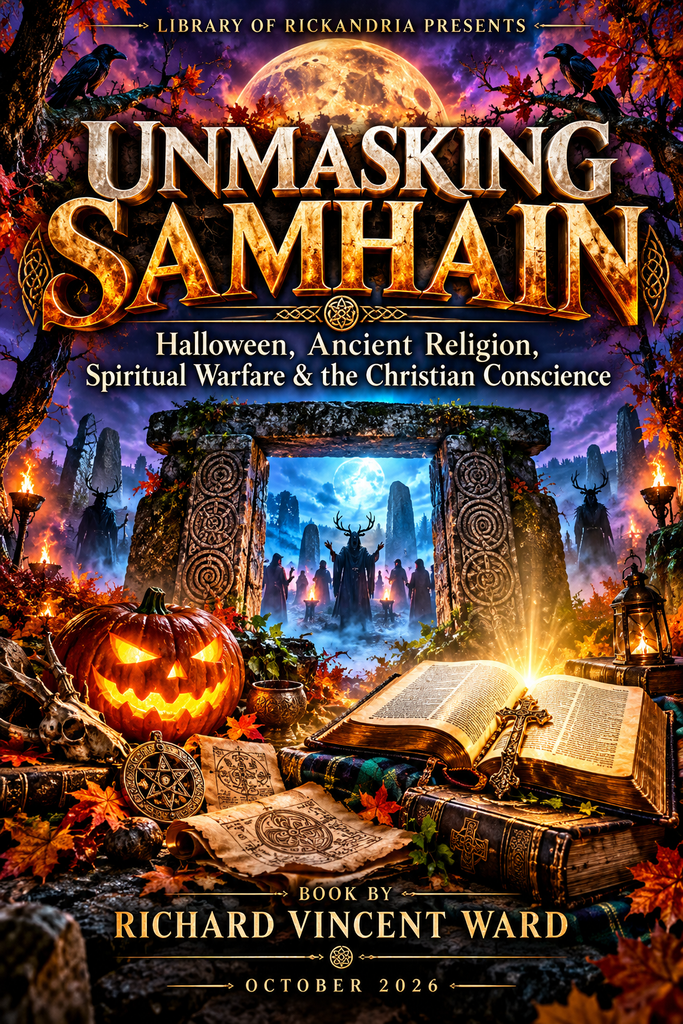
UPDATED BY VCG ON 10/23/2026 @ 15:15 EST
CHAPTER 8
DRUIDS, HUMAN SACRIFICE & THE ROMAN TESTIMONY
Caesar, Tacitus, Strabo, Diodorus, Pliny, the Wicker Man & the Archaeological Evidence Behind the Allegations
“Thou shalt not do so unto the LORD thy God:
for every abomination to the LORD, which he hateth, have they done unto their gods; for even their sons and their daughters they have burnt in the fire to their gods.”— Deuteronomy 12:31, King James Bible
1. The Figure in the Fire
Few images of ancient Celtic religion are more disturbing than the giant human figure made of woven branches.
It rises above a crowd, its limbs constructed from flexible wood, its interior filled with living victims.
Fire is applied beneath it.
The structure burns.
This image appears repeatedly in popular accounts of the Druids. It has inspired paintings, films, novels, religious warnings, and modern interpretations of Halloween.
Its power is undeniable.
But where did the story originate?
The earliest surviving descriptions are not accounts written by the ancient Druids themselves.
They come from Greek and Roman authors describing the religious practices of peoples living beyond, or within, the expanding boundaries of the Roman world.
Among these authors, Julius Caesar occupies the most influential position.
His Commentaries on the Gallic War contain a remarkable description of human sacrifice among the Gauls, including the destruction of living victims within large woven structures.
The passage is genuine.
It is neither a modern invention nor a quotation fabricated by anti-Halloween writers.
But its existence introduces a demanding historical problem.
What exactly does Caesar’s testimony establish?
Does it prove that human sacrifice occurred in ancient Gaul?
Does it establish that Druids supervised such practices?
Does it describe a specific annual ceremony?
Does it connect that ceremony to Samhain?
And does it demonstrate that contemporary Halloween practices preserve the same religious meaning?
These are separate questions.
The first concerns an ancient report.
The second concerns the reliability and scope of that report.
The third concerns ritual chronology.
The fourth concerns the relationship between continental Gaul and early Irish seasonal tradition.
The fifth concerns nearly two thousand years of cultural development.
To move from Caesar’s statement to modern Halloween without answering these questions is to transform an ancient allegation into a sweeping historical narrative.
This chapter will not dismiss the disturbing evidence.
Neither will it manufacture connections that the evidence does not establish.
The purpose is to investigate human sacrifice as a genuine historical question, examine the ancient witnesses, compare their reports with archaeology, and determine exactly what can be known.
2. The First Witness: Julius Caesar
Gaius Julius Caesar conducted military campaigns in Gaul during the first century before Christ.
His Commentarii de Bello Gallico, usually called The Gallic War, describes military operations, political developments, and selected features of the peoples encountered by Roman forces.
Book VI contains an important ethnographic discussion.
Caesar describes Gallic society as including two particularly influential classes: Druids and nobles associated with military activity.
He attributes to Druids responsibilities concerning religious ceremonies, sacrifices, instruction, and the settlement of disputes.
In Chapter 13, he describes their authority within Gallic society.
In Chapter 14, he discusses their educational practices and religious beliefs, including teachings concerning the soul.
Then, in Chapter 16, he turns explicitly to human sacrifice.
The original Latin and commentary can be examined through Dickinson College Commentaries, The Gallic War, VI.16.
An English translation appears in the Perseus Digital Library.
What Caesar Describes
Caesar reports that individuals facing severe illness or danger in battle sometimes sacrificed human victims or vowed to do so.
He attributes an assisting role to Druids.
He then explains the belief he associates with the practice: that the favor of the gods could be obtained through the exchange of one human life for another.
He also describes sacrifices made on behalf of communities.
The most memorable detail concerns large structures fashioned from woven branches.
According to the account, living people were placed within the structures and burned.
Caesar further reports that convicted criminals were regarded as desirable victims, but that others might be used when criminals were unavailable.
These are horrifying allegations.
They should not be minimized.
But every detail must be interpreted within its actual source.
What Caesar Does Not Describe
The passage contains no reference to Samhain.
It does not specify October 31.
It does not identify the beginning of winter as the occasion of the sacrifices.
It does not describe a festival honoring the dead.
It does not mention Halloween costumes, household offerings, or carved lanterns.
Nor does Caesar claim to have personally witnessed the burning of human victims in a woven structure.
His report remains historically important.
But the reader should not be told that Caesar described a Samhain ceremony.
He did not.
Caesar supplies ancient testimony concerning alleged Gallic human sacrifice—not a documented eyewitness account of the rituals of Halloween’s supposed predecessor.
3. The Language of Caesar’s Report
The precise language matters because later writers often supply details not present in the ancient text.
Caesar refers to Druids as ministers or agents associated with particular sacrifices.
This supports the proposition that, within Caesar’s description, Druids possessed religious responsibilities involving sacrifice.
Yet the Latin does not establish that every Druid personally performed every sacrifice.
Nor does it identify one uniform sacrificial system practiced throughout every Celtic-speaking community.
The woven structures are described through terms referring to large representations or figures and interlaced branches.
Later popular accounts frequently refer to these as wicker men.
That expression is a useful modern label for the image.
But it should not be confused with an authenticated ancient Celtic ceremonial name.
The Problem of the Universal Claim
Caesar’s language can create the impression of a widespread national practice.
But ancient Gaul was not a unified modern nation.
It contained numerous peoples, political communities, alliances, rivalries, and regional traditions.
A Roman general might describe practices as characteristic of a whole population even where the evidence concerned particular groups.
The historian must therefore ask how representative the reported customs were.
Were they practiced by many communities?
Were they restricted to certain occasions?
Were they rare or exceptional?
Were they declining by Caesar’s time?
The surviving passage does not settle every question.
The Dickinson Commentary
The scholarly notes accompanying the Latin text acknowledge disagreements concerning the historicity and frequency of the alleged sacrifices.
They also observe that Caesar does not state that he witnessed an example himself.
These qualifications matter.
They do not require declaring the account false.
They require recognizing the difference between a surviving report and a fully corroborated reconstruction of the practice.
A source can be credible in some respects while remaining uncertain in others.
4. Caesar’s Political Position
Caesar was not merely an observer of Gallic religion.
He was a commander whose military campaigns fundamentally transformed the political world he described.
His work supplied Roman readers with an account of his achievements and the peoples involved in his wars.
That political context matters.
Roman descriptions of conquered or resisting populations frequently emphasized cultural differences.
Religious customs could become evidence of supposed barbarism.
Disturbing allegations could contribute to the presentation of Roman expansion as the imposition of order upon dangerous peoples.
But source criticism requires care.
Caesar’s political interests do not automatically prove that he invented the reported practices.
A politically interested witness can report genuine information.
The proper question is whether the allegations are corroborated and whether the account’s perspective may have influenced its wording, emphasis, or selection of material.
The Danger of Automatic Acceptance
One mistake is to treat every detail of Caesar’s account as unquestionably accurate.
He was an ancient writer, not an infallible authority.
His access to information varied.
His political interests were substantial.
His explanations of foreign religion involved interpretation.
The Danger of Automatic Dismissal
The opposite mistake is to reject his testimony merely because Rome conquered Gaul.
Political bias is a reason to examine evidence.
It is not a reason to ignore it.
The correct method is to compare Caesar with other ancient writers and with the surviving archaeological record.
That comparison produces a more complex picture.
5. Diodorus Siculus: Divination Through a Human Victim
Diodorus Siculus, a Greek historian writing in the first century before Christ, described religious practices among the Gauls in Book V of his Bibliotheca Historica.
His account distinguishes different religious and intellectual roles, including bards, philosophers or religious specialists, and diviners.
In Book V, Chapter 31, Diodorus reports a disturbing procedure in which a human victim is wounded and the manner of the victim’s fall, bodily movements, and blood are interpreted for knowledge of the future.
He also associates sacrifices with religious specialists.
The ancient account can be examined in the Loeb Classical Library translation hosted at LacusCurtius, Diodorus Siculus, Book V.
What This Account Adds
Diodorus describes a form of divination connected with killing a human victim.
This differs in detail from Caesar’s description of large woven structures.
His testimony is therefore relevant to both ancient sacrifice and alleged divinatory practices.
But the passage also raises important questions.
Was Diodorus reporting an independently observed custom?
Was he drawing upon earlier Greek ethnographic accounts?
How accurately did his sources understand the rituals?
And how broadly were the practices performed?
These questions remain necessary even though the passage is authentic.
Diodorus and Samhain
Diodorus does not identify the ceremony as Samhain.
He does not describe November 1.
He does not place the ritual within an early Irish seasonal calendar.
He is discussing the Gauls.
Consequently, the passage cannot simply be transferred into a reconstructed Irish Samhain ceremony without additional evidence.
The Problem of Direct Continuity
A modern author might combine Diodorus’s description of divination with later Irish folklore involving Halloween fortune-telling.
The apparent connection is attractive.
Both involve obtaining knowledge of the future.
But similarity in purpose does not establish a direct line of ritual descent.
The historical connection must be demonstrated.
A twentieth-century game involving marriage predictions is not automatically the continuation of the human divination described by Diodorus.
The difference in conduct, setting, and chronology is substantial.
6. Strabo: The Burning of Human Victims
The Greek geographer Strabo also reported human sacrifice among the peoples of Gaul.
In Geography, Book IV, Chapter 4, Section 5, he described divinatory practices associated with human victims.
He further reported forms of execution or sacrifice involving weapons, suspension, and the burning of people and animals within a large structure made from combustible materials.
The relevant passage appears in the Perseus Digital Library, Geography, IV.4.5.
This account possesses an obvious resemblance to Caesar’s description.
But the resemblance introduces a source-critical question.
Do Caesar and Strabo provide independent confirmation?
Or did they draw upon a common earlier tradition?
The Lost Work of Posidonius
The Greek philosopher and historian Posidonius wrote about peoples of western Europe during the late second and early first centuries before Christ.
His original ethnographic account has not survived as a complete independent work.
Later authors preserved or adapted portions of material associated with his writings.
Scholars have long considered whether Diodorus, Strabo, and Caesar depended upon Posidonius or related sources.
The issue remains complicated.
Péter Kapi’s study Rome and Human Sacrifices, published in Sapiens Ubique Civis, examines the relationships among the accounts.
Kapi questions overly simple reconstructions of their source dependence and considers the possibility that Caesar was more independent of Posidonius than some earlier scholars assumed.
The lesson is important.
We cannot simply count Caesar, Diodorus, and Strabo as three entirely independent eyewitnesses.
Neither can we assume that all three copied one another.
The source relationships require examination.
Why Independence Matters
If two ancient writers separately observed the same practice, their agreement offers a different kind of corroboration from two writers repeating one earlier report.
Both circumstances possess historical value.
But they are not identical.
In this case, the ancient descriptions collectively establish that reports of Gallic human sacrifice circulated within serious Greek and Roman historical writing.
They do not automatically establish the frequency, geographic extent, or precise dating of every ceremony described.
And they do not identify Samhain as the occasion.
7. Tacitus and the Druids of Mona
Another major witness is the Roman historian Tacitus.
In Annals, Book XIV, he describes Roman military operations against Mona, generally identified with Anglesey in Wales.
The campaign occurred around AD 60–61, during the governorship of Suetonius Paulinus.
Tacitus presents a dramatic scene.
Roman forces approach the island.
Armed defenders gather.
Women carrying torches move among them.
Druids raise their hands and pronounce imprecations.
The Roman soldiers are temporarily unnerved by the sight before overcoming the resistance.
Tacitus subsequently describes the destruction of sacred groves and alleges the use of captive blood and human remains in religious rites.
The primary text is available through Tacitus, Annals, XIV.30.
What Tacitus Establishes
Tacitus provides ancient testimony associating Druids with a particular religious and military setting in Britain.
His report also connects the religious environment of Mona with allegations of human sacrifice and divination.
These details are historically significant.
The Druids were not invented by modern Halloween writers.
Nor were all ancient reports of violent religious practices fabricated in the nineteenth century.
But the limitations remain.
Tacitus wrote decades after the campaign.
His narrative reflects a Roman perspective.
Its dramatic language serves a literary and historical purpose.
The account concerns Mona in Britain.
It does not concern medieval Ireland.
The Missing Samhain Connection
Tacitus does not identify the event as a Samhain ceremony.
He does not state that the alleged sacrifices occurred annually at the end of October.
He does not describe the destruction of a Druidic Halloween altar.
The historical conclusion must remain specific.
Tacitus reported Druids and violent religious practices in Britain; he did not document an annual Samhain sacrifice.
The distinction does not diminish the seriousness of the testimony.
It preserves its accuracy.
8. Pliny the Elder: Oak, Mistletoe and White Bulls
The Roman writer Pliny the Elder provides a different kind of evidence.
In Natural History, Book XVI, Chapter 95, he discusses Gallic reverence for mistletoe growing upon certain trees.
He describes Druids wearing white clothing, gathering mistletoe with a golden sickle, and employing ceremonial preparations involving two white bulls.
The passage is accessible through Pliny, Natural History, XVI.95.
This source is particularly important because its ritual details differ from the dramatic human-sacrifice accounts.
What Pliny Reports
The ceremony includes religious attention to particular trees and mistletoe.
The animals are presented as sacrificial victims.
The ritual is associated with prayers and beliefs concerning fertility and healing.
Pliny also refers to a lunar date connected with the reckoning of months and years.
These details provide evidence for an ancient Roman description of Druidic religious practice involving plants, animals, and ritual timing.
What Pliny Does Not Report
The passage does not describe human victims.
It does not identify Samhain.
It does not state that the ceremony occurred on October 31.
It does not describe wicker figures filled with people.
Nor does it establish a universal New Year celebration beginning in November.
The mention of a lunar reckoning must not be converted into proof that Samhain was the formal New Year throughout the Celtic-speaking world.
The context and calendrical questions are different.
Why Pliny Matters
If our investigation includes only the most frightening ancient passages, we may create an unnecessarily narrow impression of Druidic religion.
Pliny’s account reminds us that the classical descriptions also include ceremonial use of plants, offerings, sacred places, and beliefs concerning the natural world.
The ancient religious landscape was more complex than one repeated image of blood and fire.
The historian should investigate that complexity rather than selectively collecting the most alarming material.
9. Were the Roman Accounts Independent?
We now possess several ancient descriptions.
Caesar reports human sacrifice associated with Druids.
Diodorus reports sacrificial divination involving a human victim.
Strabo describes additional forms of sacrifice and large combustible structures.
Tacitus connects Druids in Britain with disturbing allegations of ritual violence.
Pliny describes a ceremony involving white bulls and sacred mistletoe.
This is a significant body of ancient testimony.
But the material must still be organized correctly.
These writers lived in different periods.
They described different regions.
Their purposes varied.
Their information may have been obtained through different intermediaries.
And some of their accounts may share earlier sources.
The Cumulative Case
The repeated appearance of allegations concerning human sacrifice across the classical record makes the subject a legitimate and serious historical question.
It would be unreasonable to dismiss the whole issue merely because later popular writers have exaggerated it.
At the same time, the ancient texts cannot be combined into one elaborate ritual unless the connections among their descriptions are demonstrated.
Caesar’s woven figure is not automatically the same ceremony as Diodorus’s divination.
Pliny’s mistletoe rite is not automatically part of a Samhain sacrifice.
Tacitus’s account of Mona is not a record of religious observances throughout Ireland.
The historian must resist the temptation to construct one universal ceremony by combining details from separate sources.
The Correct Historical Conclusion
The ancient evidence supports the existence of serious allegations of human sacrifice among some populations described as Gallic or Celtic.
It provides grounds for considering the participation of religious specialists.
It does not conclusively establish the exact prevalence of every alleged practice.
And none of the examined passages identifies the sacrifices as annual Samhain ceremonies.
This is the distinction upon which the revised account must be built.
10. Rome’s Own History of Human Sacrifice
The political context becomes especially important when we consider the religious history of Rome itself.
Roman authors frequently condemned human sacrifice as a barbaric practice.
Yet surviving Roman historical writing also records instances in which Romans performed acts that their own writers recognized as human sacrifice.
Livy’s Account After Cannae
The Roman historian Livy describes an episode following Rome’s catastrophic defeat at the Battle of Cannae in 216 BC.
In The History of Rome, Book XXII, Chapter 57, Livy reports that a Gaulish man and woman and a Greek man and woman were buried alive in Rome.
The episode was connected with extraordinary religious measures taken during a period of national crisis.
Livy characterized such sacrifices as abhorrent to Roman sentiment.
The account can be examined through Livy, The History of Rome, XXII.57.
Why This Matters
The episode does not establish that Roman human sacrifice was routine or identical to the practices attributed to the Gauls.
But it undermines any simplistic contrast in which Romans were wholly innocent of religious killing while their enemies were uniquely barbaric.
Ancient religious history is more complicated.
Roman authors could condemn actions associated with foreign peoples while preserving accounts of exceptional similar practices within their own society.
This does not prove that Roman testimony about the Gauls was false.
It provides a reason to examine the language and political assumptions through which Roman writers represented other peoples.
The Ethical Lesson
The seriousness of human sacrifice should not depend upon the nationality of the victims or perpetrators.
Nor should historical judgment be governed by loyalty to the civilization supplying the surviving text.
A victim remains a victim.
An allegation remains an allegation until adequately assessed.
And a source remains subject to scrutiny regardless of whether its author belongs to the victorious or defeated population.
11. What Archaeology Adds to the Investigation
Written testimony is not our only source of evidence.
Archaeology can provide independent information concerning ancient deaths, ritual contexts, weapons, offerings, and the treatment of human remains.
But archaeological evidence possesses its own limitations.
A violent death is not necessarily a sacrifice.
A human body placed deliberately in a particular location may reflect ritual, execution, murder, warfare, or another practice.
An unusual burial is not proof of an annual festival.
The physical evidence must be examined before the interpretation is assigned.
Three groups of discoveries are particularly relevant.
12. Lindow Man: A Violent Death Without a Certain Explanation
In August 1984, human remains were discovered in Lindow Moss, a peat bog in northwestern England.
The preserved body became known as Lindow Man.
Scientific examination revealed evidence that the man had experienced a violent death.
The British Museum dates his death broadly to between 2 BC and AD 119.
The British Museum’s official collection record identifies competing explanations, including sacrifice, execution, and homicide.
The Physical Findings
The remains preserve evidence of injuries to the head and neck.
Researchers have debated the sequence and significance of these injuries.
The body was deposited in a bog.
The preservation conditions permitted scientific examination of details that normally would not survive.
These facts are historically significant.
But the interpretation remains disputed.
The Ritual-Sacrifice Hypothesis
Some researchers have suggested that Lindow Man may have died as part of a religious ceremony.
The unusual deposition and apparent treatment of the body have contributed to this interpretation.
Yet other explanations remain possible.
He may have been executed.
He may have been murdered.
The exact circumstances cannot be reconstructed with certainty.
Why Lindow Man Cannot Prove a Samhain Ceremony
The body’s radiocarbon date spans a substantial period.
It does not identify the month or day of death.
No surviving inscription assigns the death to Samhain.
No evidence establishes that Druids performed the killing.
Therefore, identifying Lindow Man as a Samhain sacrifice would go beyond the evidence.
This does not mean the ritual interpretation must be rejected.
It means that the specific festival association is not demonstrated.
The archaeological evidence establishes a violent death. The exact motive remains uncertain.
13. The Irish Bog Bodies: Oldcroghan and Clonycavan
Ireland has produced remarkable archaeological discoveries relevant to the study of violence, ritual, and Iron Age society.
In 2003, human remains were discovered in bogs at Oldcroghan in County Offaly and Clonycavan in County Meath.
Scientific analysis placed the remains broadly between about 400 and 200 BC.
The National Museum of Ireland established a major research project to examine the finds.
Its investigations included radiocarbon dating, medical imaging, pathological analysis, and other scientific methods.
The research is described in the National Museum of Ireland’s Bog Bodies Research Project.
The Kingship and Sacrifice Interpretation
The museum developed an exhibition entitled Kingship and Sacrifice.
Its interpretation connects some bog-body deposits with possible ceremonies concerning sovereignty and kingship.
The hypothesis considers the unusual treatment of bodies and their placement within particular landscapes.
The museum’s account is available through Kingship & Sacrifice — A New Theory of Sacrifice.
The importance of the discoveries should not be underestimated.
They provide genuine material evidence relevant to religious and political practices in Iron Age Ireland.
They also remind us that ritual killing cannot responsibly be dismissed as an impossible feature of ancient society.
The Limits of the Evidence
The museum identifies the connection with kingship and sovereignty as a theory.
The precise events surrounding the deaths remain matters of interpretation.
The remains do not identify the particular people who performed the killings.
They do not preserve the words of a ceremony.
And they do not establish that the deaths occurred at Samhain.
The broad dating places the bodies many centuries before most of the surviving medieval Irish literary material.
A possible relationship to later traditions requires separate investigation.
The Difference Between Ireland and Gaul
These discoveries are especially important because they concern Ireland rather than Caesar’s Gaul.
But geographic relevance does not eliminate the need for evidence.
It would still be a mistake to combine the Irish bodies with Caesar’s wicker figures and declare that both document the same annual festival.
The practices may have belonged to different communities and possessed different meanings.
Their possible relationship is a hypothesis, not an established identity.
14. Ribemont-sur-Ancre: Human Remains in a Gallic Sanctuary
The archaeological evidence from northern Gaul is particularly significant.
At Ribemont-sur-Ancre in present-day France, excavations revealed extensive deposits of human remains, weapons, and animal bones associated with an Iron Age sanctuary.
The evidence includes the remains of hundreds of individuals, many interpreted as warriors.
Some bodies were exposed, dismembered, or subjected to complex postmortem treatment.
Weapons were also deliberately damaged or deposited.
The site presents strong evidence of ritual activity within a setting associated with warfare.
A Major Archaeological Investigation
David Steven Rose’s doctoral research, Ribemont-sur-Ancre, Ritual Practice, and Northern Gallic Sanctuaries from the Third through First Century B.C., completed at the University of Edinburgh in 2020, examines the human bones, animal remains, weapons, and chronology of the site.
Rose argues that ritual practice was complex and cannot be reduced to one simple model of human sacrifice.
His research distinguishes the treatment of individuals killed in warfare from the question of whether those individuals were sacrificed as part of a ceremony.
This distinction is vital.
Death in Battle Versus Sacrifice
A person may be killed in battle and subsequently have the body deposited or displayed within a sacred space.
That is evidence of ritual treatment of the dead.
It is not necessarily evidence that the person was killed as a sacrifice during the ritual.
The circumstances of death and the circumstances of deposition must be investigated separately.
This is particularly important at sites involving large numbers of weapons and possible trophies of war.
Gournay-sur-Aronde
Another significant Gallic sanctuary is Gournay-sur-Aronde.
Archaeological investigations there identified evidence of animal sacrifice, ceremonial deposits, and damaged weapons.
Jean-Louis Brunaux discussed these northern French sanctuaries in Gallic Blood Rites, Archaeology, March/April 2001.
These excavations demonstrate that ritual practice could involve substantial material activity.
But the details varied among sites.
The evidence does not describe one universal Druidic ceremony.
Nor does it identify Samhain as the occasion of the deposits.
The Archaeological Verdict
Ribemont-sur-Ancre and Gournay-sur-Aronde provide important evidence for violent and ceremonial practices in ancient Gaul.
They support serious investigation of religious activity, warfare, sacrifice, and postmortem ritual.
They do not establish a complete ancient Halloween ceremony.
Nor do they independently confirm Caesar’s precise wicker-figure description.
The archaeological record strengthens some general claims while leaving others unresolved.
15. Did the Wicker Man Actually Exist?
The wicker man occupies a distinctive place within the investigation because its image is so specific and memorable.
Caesar described large woven structures containing living victims.
Strabo described a similar form of burning involving people and animals.
The existence of these descriptions is established.
But the historical status of the ceremony remains a question.
Ancient Text Versus Archaeological Demonstration
There is no universally accepted archaeological discovery of an Iron Age wicker structure containing human sacrificial victims that conclusively verifies Caesar’s exact description.
This absence does not prove the practice impossible.
A structure made of wood and branches would be unlikely to survive burning and centuries of environmental change.
Nevertheless, the absence of direct corroboration matters when determining how confidently the ceremony should be reconstructed.
The appropriate formulation is not that archaeologists have proved Caesar’s wicker man.
It is that ancient literary sources describe such a practice, while its precise historical extent remains uncertain.
The Source-Dependence Problem
Because some classical authors may have drawn upon shared earlier reports, their agreement cannot automatically be treated as independent eyewitness corroboration.
The relationship among Caesar, Strabo, Diodorus, and Posidonius must be considered.
This is a source-critical issue, not an excuse to dismiss the testimony.
The Samhain Problem
Even if the wicker-figure ceremony occurred, its date remains a separate question.
Caesar does not assign it to Samhain.
Strabo does not assign it to Samhain.
The archaeological record examined here does not assign it to Samhain.
Therefore, the statement that Druids burned victims in giant wicker figures every October 31 is not established by these sources.
A disturbing ancient report has been transformed into a specific festival narrative without the necessary chronological evidence.
That transformation must be corrected.
16. Bonfires, Bone-Fires and the Limits of Etymology
The original edition connected Samhain bonfires directly with the burning of sacrificial bones.
The linguistic history of the English word bonfire is relevant, but it has often been misused.
Anatoly Liberman’s discussion for Oxford University Press, While Dancing Around a Bonfire, Beware of Analogy, traces the English term to late medieval usage.
The form banefyre appears in a fifteenth-century dictionary, where it was explained as a fire involving bones.
The etymological connection is genuine.
But the English word belongs to a much later documentary history than prehistoric Samhain.
What the Word Establishes
It establishes a historical relationship between the English term and the burning of bones.
It supports investigation into medieval and later practices involving such fires.
What the Word Does Not Establish
It does not prove that the bones were human.
It does not identify Druids as the people burning them.
It does not assign the practice to Samhain.
It does not establish that ancient Irish sacrificial victims were burned in annual ceremonies.
And it does not demonstrate that modern bonfires preserve the same religious purpose.
The etymology is evidence concerning language.
It is not an independently authenticated account of prehistoric ritual.
This distinction will receive fuller treatment in Chapter 13.
For now, the conclusion is clear.
A genuine word history cannot be made to establish a ceremony that the surviving historical sources do not document.
17. The Carthaginian Comparison and the Story of the Drums
The original 2025 manuscript drew a comparison between alleged Druidic sacrifices and ancient practices associated with Carthage and Molech.
It also described the cries of sacrificial victims being obscured by drums.
The subject is disturbing.
But the source history is important.
The ancient writer Plutarch described allegations of child sacrifice at Carthage in his work De superstitione, or On Superstition.
In Section 13, he reported that the sounds of musical instruments were used to obscure cries during sacrifices associated with Cronus.
The relevant text is available through Plutarch, De superstitione, Section 13.
The Geographic Difference
Carthage was a North African city with Phoenician cultural connections.
Its religious history is not identical to that of ancient Gaul or Ireland.
A report concerning Carthaginian sacrifice cannot simply be transferred into the history of the Druids.
The Theological Difference
The biblical texts concerning Molech and the offering of children by fire belong to the history and religious controversies of ancient Israel and its neighboring world.
The identity of Molech or Molek, the nature of particular rites, and their relationship to Phoenician and Punic practices are subjects of historical and linguistic investigation.
It is not sufficient to assume that every ancient sacrifice involving fire represented the same deity or ceremony.
The Original Manuscript’s Problem
The 2025 edition placed accounts of Carthaginian child sacrifice beside assertions concerning Samhain and Druidic bonfires.
The arrangement encouraged the reader to see them as manifestations of one continuous practice.
But the historical connection was not demonstrated.
The Plutarch passage concerns Carthage.
It does not describe a Samhain ceremony.
It does not identify ancient Irish Druids as the participants.
It does not document an annual Halloween sacrifice.
Therefore, its use as evidence for the particular Samhain claim is not justified.
Corrected Formulation
Ancient writers reported child sacrifice in certain Mediterranean religious settings, including Carthage.
Other ancient writers described human sacrifice among particular Gallic populations.
These reports belong to distinct historical settings.
Their similarities may invite comparison.
But the existence of sacrifice in more than one society does not establish direct historical transmission or identical religious purpose.
A comparison is not a genealogy.
18. Roman Lemuria: A Different Festival in a Different Month
The original manuscript also compared Samhain with the Roman festival of Lemuria.
The comparison requires a chronological correction.
Lemuria was a Roman domestic observance associated with restless or potentially dangerous spirits.
According to the classical evidence, it was observed on May 9, 11, and 13.
The poet Ovid described its rites in Book V of the Fasti, including the symbolic use of black beans and a household ritual intended to drive away spirits.
The primary literary text is available through Ovid, Fasti, Book V.
The Oxford Classical Dictionary’s entry on Lemuria identifies the festival’s dates and its association with spirits.
Why the Comparison Is Limited
Lemuria provides evidence that ancient Romans possessed rituals concerning the dead or restless spirits.
But it occurred in May.
It belonged to Roman religion.
It does not establish that Samhain originated from Lemuria.
Nor does it demonstrate that modern Halloween directly descends from either ceremony.
The practices may share certain thematic concerns.
Such similarity is historically interesting.
It is not proof of common origin.
The original manuscript’s statement that blood and fire were universal among these rites also exceeds the evidence.
Ovid’s description of Lemuria centers on a household ritual involving beans and other symbolic actions, not a universal ceremony of blood sacrifice.
Different rituals must be described according to their actual contents.
19. The Psychology of the Sacrificial Narrative
Human sacrifice is among the most emotionally powerful subjects in historical writing.
It involves death, vulnerability, religious authority, and the possibility of organized cruelty.
When children are mentioned, the emotional force becomes even greater.
These reactions are understandable.
They do not mean that historical accounts of sacrifice should be avoided.
But they increase the importance of accurate sourcing.
The Power of a Dramatic Image
A giant woven figure filled with victims is memorable.
A story about a child placed before a burning idol is memorable.
A body preserved in a bog is memorable.
Such images can remain in a reader’s memory long after the precise historical qualifications have been forgotten.
An author may then connect them with pumpkins, Halloween costumes, and neighborhood celebrations.
The emotional association can make the modern custom appear implicated in the ancient violence.
But the emotional connection does not establish a historical one.
Compression of Time
The narrative becomes more persuasive when centuries are collapsed.
Caesar’s first-century-BC Gaul appears beside medieval Irish Samhain.
The medieval festival appears beside a seventeenth-century fire tradition.
The fire tradition appears beside nineteenth-century Halloween folklore.
The folklore appears beside contemporary commercial decorations.
The result looks like one continuous ceremony.
But each historical transition requires evidence.
Chronological distance cannot be erased through emotionally compelling language.
Guilt by Association
The reasoning becomes especially problematic when the modern participant is declared spiritually implicated merely because an earlier culture allegedly employed a similar symbol.
A family purchasing candy has not thereby been shown to participate in human sacrifice.
A child wearing a costume has not thereby been shown to affirm the religious beliefs of a Roman-era Gaulish community.
A household lighting a decorative lantern has not thereby been shown to enter a covenant with an ancient deity.
Such claims require independent demonstration.
They cannot be established through resemblance and emotional association alone.
20. Scripture: What Does the Bible Actually Say About Human Sacrifice?
The biblical material is serious and explicit.
The Scriptures contain condemnations of child sacrifice and of certain offerings made to other gods.
These passages deserve direct examination.
But the Bible’s moral teaching must be distinguished from historical claims concerning the Druids.
Deuteronomy 12:31
The chapter’s opening verse condemns the burning of children as offerings to gods.
Its setting concerns Israel’s instruction not to imitate the worship practices of surrounding nations.
The condemnation is direct.
The passage does not require a speculative connection to Samhain in order to possess moral significance.
It condemns the practice addressed within its own context.
Deuteronomy 18:10
The KJV states:
“There shall not be found among you any one that maketh his son or his daughter to pass through the fire, or that useth divination, or an observer of times, or an enchanter, or a witch,”
The passage continues by identifying additional forbidden activities.
The instruction concerns Israel’s religious conduct in the land.
Its prohibitions must not be reduced to symbolic dislike of frightening imagery.
They concern identifiable practices.
A historical allegation that someone performed human sacrifice may therefore be morally relevant.
But the passage does not establish that the alleged historical event occurred.
Scripture cannot be used as a substitute for the missing source.
Psalm 106:35–38
Psalm 106 recounts Israel’s disobedience and involvement with the practices of surrounding peoples.
Verse 37 reads:
“Yea, they sacrificed their sons and their daughters unto devils,”
The following verse connects the shedding of innocent blood with the idols of Canaan.
The passage concerns Israel’s religious history as presented by the psalmist.
It does not identify Druids.
It does not mention Samhain.
It does not describe modern Halloween.
Its moral warning is serious.
But its historical referent must not be silently changed.
Deuteronomy 32:16–17
The original 2025 chapter began with Deuteronomy 32:16–17.
The passage condemns Israel’s turning toward other gods and sacrificing to powers described in the KJV as devils.
Within the Song of Moses, this is part of a larger indictment of covenantal unfaithfulness.
The verses may be relevant to a Christian theology of idolatry.
But they do not independently establish that every ancient sacrificial practice was identical in purpose or that every modern cultural descendant constitutes the same religious act.
Jeremiah 19:4–5
Jeremiah condemns the shedding of innocent blood and the burning of children as offerings to Baal.
The text explicitly rejects the practices.
Its historical setting concerns Judah and Jerusalem.
It does not describe ancient Gaul.
It should not be used as though it supplies a missing eyewitness account of Druidic ritual.
First Corinthians 10:20–21
Paul warns Christians against participation in sacrifices associated with other gods.
His teaching concerning fellowship with devils is direct within the context of idolatrous meals.
The passage possesses serious implications for intentional religious participation.
But Paul distinguishes such participation from ordinary food-related circumstances elsewhere in the chapter.
Therefore, the moral application depends upon what an individual is actually doing.
An alleged historical origin does not independently establish present idolatrous fellowship.
The Biblical Finding
Scripture condemns actual child sacrifice, forbidden divination, and idolatrous participation.
Those teachings should not be weakened.
But the existence of a biblical condemnation does not prove every historical allegation involving a similar practice.
A genuine moral law cannot substitute for a missing historical document.
The Bible can establish that a practice is condemned without establishing that a particular ancient community performed it on a particular date.
21. The Problem of Modern Criminal Allegations
The original Chapter 4 did not stop with ancient history.
It also alleged that literal sacrifices, kidnappings, and other serious crimes continue among certain occult groups during Halloween.
These are grave allegations.
They cannot be established through Caesar, Tacitus, Diodorus, or archaeological discoveries from the Iron Age.
Ancient testimony and modern criminal evidence belong to different investigations.
A contemporary allegation would require identifiable incidents, credible witnesses, corroboration, official records where available, and careful differentiation between proven crimes and unverified reports.
A statement that serious crimes peak around Halloween requires statistical evidence supporting the claimed pattern.
No such pattern is established merely by citing ancient sacrificial practices.
This book will examine modern allegations in detail in Chapter 19.
For the present chapter, one conclusion is sufficient.
Ancient human sacrifice is not evidence that modern Halloween participants are involved in organized ritual violence.
Specific criminal acts, where documented, deserve serious investigation.
Sweeping accusations against entire religious or cultural groups do not become justified through historical analogy.
22. Direct Rebuttal of the Original 2025 Chapter
The original manuscript’s Chapter 4, Blood, Fire & Sacrifice — The Hidden Altars of Halloween, argued that modern Halloween rests upon ancient sacrificial foundations.
Several assertions require correction.
Claim 8.1 — Ancient Authors Described Human Sacrifice Among the Gauls
Finding: Verified as ancient testimony.
Caesar, Diodorus, and Strabo contain relevant reports.
The exact historicity and extent of the practices must be evaluated critically.
Claim 8.2 — Druids Possessed Religious Responsibilities
Finding: Supported.
Classical authors describe Druids as religious specialists and social authorities.
The precise organization and functions of their institutions varied or remain uncertain.
Claim 8.3 — Caesar Documented Human Sacrifice Specifically at Samhain
Finding: Unsupported by the cited passage.
Caesar’s account contains no Samhain identification.
Claim 8.4 — Druids Universally Conducted Sacrifices in Giant Wicker Figures
Finding: Reported in ancient testimony; not independently demonstrated as a universal practice.
The textual descriptions are genuine.
The frequency and geographic extent remain uncertain.
Claim 8.5 — Ancient Irish Archaeology Includes Possible Evidence of Ritual Killing
Finding: Supported.
Bog-body discoveries and archaeological interpretation provide evidence relevant to the question.
Specific religious motives and calendar dates remain incompletely known.
Claim 8.6 — The Word Bonfire Proves Samhain Human Sacrifice
Finding: Unsupported.
The English word has a genuine bone-fire etymology.
That linguistic fact does not establish a prehistoric Druidic ceremony.
Claim 8.7 — Carthaginian Child Sacrifice Was Identical to Druidic Samhain Ritual
Finding: Unestablished historical connection.
The ancient reports concern different civilizations and religious settings.
Claim 8.8 — Drums Drowned Out the Cries of Samhain Victims
Finding: Misattributed if presented as Druidic evidence.
The ancient passage describing musical noise concealing cries concerns Carthage, not an Irish Samhain ceremony.
Claim 8.9 — Roman Lemuria Demonstrates One Universal Pagan Blood-and-Fire Rite
Finding: Unsupported.
Lemuria belonged to Roman religion, occurred in May, and possessed its own distinctive rites.
Claim 8.10 — Every Modern Halloween Celebration Continues Ancient Sacrifice
Finding: Unsupported as a universal historical conclusion.
The precise line of cultural transmission and the present activity’s religious function must be established separately.
Claim 8.11 — Serious Modern Crimes Peak at Halloween
Finding: Not established by the historical sources examined.
This is a contemporary empirical allegation requiring relevant criminal evidence and statistical analysis.
Claim 8.12 — Ordinary Halloween Participation Automatically Produces Spiritual Legal Access
Finding: Unestablished theological mechanism.
The historical evidence cannot demonstrate it, and the cited biblical passages do not explicitly identify such a rule.
Claim 8.13 — Scripture Condemns Human Sacrifice and Idolatry
Finding: Directly supported.
The biblical texts provide clear moral prohibitions within their contexts.
Those prohibitions should be applied to accurately identified conduct.
23. Corrected Replacement Passage for the 2026 Edition
The following passage replaces the central historical argument of the 2025 chapter.
Druids, Human Sacrifice and the Limits of the Ancient Evidence
Ancient Greek and Roman writers described religious practices among certain Gallic and British communities that included allegations of human sacrifice.
Julius Caesar, in The Gallic War, Book VI, reported that human victims were offered in connection with religious ceremonies and that Druids participated in administering certain sacrifices.
He also described the burning of living victims within large structures constructed from woven branches.
Diodorus Siculus described divination involving a human victim, while Strabo reported additional forms of sacrifice and the use of large combustible structures.
Tacitus associated Druids on the island of Mona with religious imprecations and allegations concerning the blood of captives.
These sources establish that ancient authors regarded human sacrifice as a subject relevant to descriptions of some Celtic-speaking populations.
Their reports deserve serious attention.
However, the accounts were written from Greek and Roman perspectives and must be evaluated in their historical and political contexts.
The degree of independence among the reports is debated.
The frequency, extent, and precise forms of the alleged practices are not uniformly established.
Archaeological discoveries provide additional evidence relevant to the investigation.
Violent deaths preserved in bogs and complex ritual deposits in northern Gaul demonstrate that ancient religious and political violence requires serious historical study.
The Irish bog bodies at Oldcroghan and Clonycavan have been interpreted in relation to possible rituals of kingship and sovereignty.
The remains of warriors and weapons at Ribemont-sur-Ancre reveal elaborate ceremonial treatment of human remains.
Yet a violent death does not automatically establish sacrifice.
The ritual deposition of a person killed in battle is not necessarily identical to killing that person as a ritual offering.
And an archaeological site does not identify the calendar date of a ceremony unless relevant evidence survives.
Most importantly, none of the classical passages examined identifies Samhain as the occasion of the human sacrifices described.
The Roman accounts primarily concern Gaul or Britain.
The named festival of Samhain is securely attested within a different body of evidence, particularly medieval Irish literature.
Joining these sources into one universal prehistoric ceremony requires historical proof that has not been established.
The familiar wicker-man image therefore rests upon genuine ancient literary testimony, but its assignment to an annual October 31 ceremony is unsupported by those texts.
The etymology of bonfire likewise cannot independently establish Druidic sacrificial fires.
The word’s documented English history belongs to the later medieval period.
Accounts of child sacrifice at Carthage, including Plutarch’s description of musical instruments concealing cries, belong to another civilization and should not be presented as evidence of a Samhain ceremony.
Biblical Scripture unequivocally condemns the offering of children to other gods, forbidden divination, and idolatrous participation.
These prohibitions possess their own authority within Christian theology.
But their moral force does not establish the accuracy of every historical allegation placed beside them.
A Christian can condemn genuine human sacrifice without claiming that every modern Halloween observance descends from such acts.
The ethical character of an activity must be determined through what it actually involves.
The historical relationship must be demonstrated through evidence of transmission.
And proposed supernatural consequences must be distinguished from what Scripture explicitly teaches.
The responsible conclusion is therefore neither that ancient human sacrifice was imaginary nor that every Roman allegation was beyond question.
It is that ancient writers reported serious practices, archaeological research supplies additional evidence, and the precise relationship to Samhain remains unestablished.
Truthful religious investigation should preserve these distinctions.
Human cruelty does not need invented details to become morally serious.
Biblical warnings do not become stronger when historical evidence is overstated.
And modern cultural practices cannot be condemned through an alleged ancient ancestry that has not been adequately demonstrated.
This is the corrected historical foundation upon which the investigation will proceed.
24. Conclusion — The Fire and the Evidence
We began with a disturbing image.
A giant figure of woven branches.
Living victims trapped within it.
Fire rising around them.
That image has haunted centuries of popular writing about ancient religion.
It remains powerful because Caesar’s account survives.
Other classical authors reported similarly troubling practices.
Archaeological discoveries reveal violent deaths and complex treatment of human remains in ancient Celtic-speaking regions.
The subject is therefore neither trivial nor imaginary.
Ancient human sacrifice is a legitimate historical question.
But the evidence also establishes the limits of our knowledge.
Caesar’s account does not identify Samhain.
Diodorus’s divination narrative does not identify Samhain.
Strabo’s account does not identify Samhain.
Tacitus’s description of Mona does not identify Samhain.
Pliny’s mistletoe ceremony involves animal sacrifice but supplies no Samhain human-sacrifice calendar.
The Irish bog bodies do not identify Samhain as their date of death.
The northern Gallic sanctuaries do not establish that modern Halloween descends from their rituals.
And the etymology of bonfire does not supply the missing connection.
These limitations must be respected.
The original 2025 manuscript constructed a continuous narrative joining ancient Gallic sacrifice, Irish Samhain, Carthaginian child sacrifice, biblical condemnations, and modern Halloween.
But those subjects belong to different bodies of evidence.
Some may be meaningfully compared.
Their historical identity cannot simply be presumed.
This distinction does not weaken the biblical condemnation of actual cruelty and idolatry.
It strengthens the honesty with which those teachings are applied.
The LORD’s condemnation of child sacrifice in Deuteronomy 12:31 does not depend upon an invented Samhain ceremony.
The warnings against divination in Deuteronomy 18 do not require every ancient festival to be described as necromancy.
And Paul’s rejection of idolatrous fellowship in 1 Corinthians 10 does not require ordinary contemporary cultural activities to be misrepresented as sacrificial worship.
Scripture should be read faithfully.
History should be reconstructed responsibly.
And allegations should be tested before being repeated.
The final conclusion of this chapter is therefore clear.
Ancient testimony concerning human sacrifice is genuine and historically important.
The archaeological record supplies additional evidence of ritual activity and violent deaths.
The historical interpretation of individual cases remains subject to debate.
And no source examined here establishes an annual Druidic human-sacrifice ceremony at Samhain.
That conclusion is not an attempt to make the past appear innocent.
It is a refusal to invent what the record does not reveal.
The true horror of human sacrifice is sufficient without assigning it to every ancient culture, every seasonal fire, and every modern custom bearing a superficial resemblance.
Our task is to seek truth.
To investigate claims.
To preserve what the sources establish.
And to correct what they do not.
The next chapter will turn from Roman descriptions of Celtic religion to the Christian calendar.
There we shall investigate All Saints’ Day, All Souls’ Day, medieval commemorations of the dead, and the contested claim that the Church deliberately transformed Samhain into Halloween.
Once again, the central question will be the same.
What happened—and how do we know?
“Prove all things; hold fast that which is good.”— 1 Thessalonians 5:21, KJV
Evidence before allegation.
History before reconstruction.
Scripture before speculative application.
And truth above the preservation of an earlier narrative.
Soli Deo Gloria.
CHAPTER 8 — RESEARCH NOTES & SOURCE REGISTER
A. Ancient Greek and Roman Primary Sources
1. Julius Caesar — Commentarii de Bello Gallico, Book VI, Chapters 13–16
First-century-BC Roman testimony concerning Druids and reported human sacrifice among the Gauls.
Latin text and scholarly commentary:
Chapter 6.16 | Dickinson College Commentaries
English translation:
C. Julius Caesar, Gallic War, Book 6, chapter 16
2. Diodorus Siculus — Bibliotheca Historica, Book V, Chapter 31
Greek historical account of religious specialists, divination, and human sacrifice among the Gauls.
Loeb Classical Library translation hosted at LacusCurtius:
LacusCurtius • Diodorus Siculus — Book V Chapters 19‑40
3. Strabo — Geography, IV.4.5
Greek geographical account concerning alleged human sacrifice, divination, and burning structures among the Gauls.
Strabo, Geography, BOOK IV., CHAPTER IV., section 5
4. Tacitus — Annals, XIV.29–30
Roman historical account of the military campaign against Mona and allegations concerning Druidic religious practices.
Cornelius Tacitus, The Annals, BOOK XIV, chapter 30
5. Pliny the Elder — Natural History, XVI.95
Account of Druidic reverence for oak, mistletoe, and a ceremony involving white bulls.
6. Livy — The History of Rome, XXII.57
Roman historical testimony concerning the burial alive of human victims during a crisis following the Battle of Cannae.
Titus Livius (Livy), The History of Rome, Book 22, chapter 57
7. Plutarch — De superstitione, Section 13
Ancient discussion of human sacrifice, including allegations concerning Carthage and the use of music to obscure the cries of victims.
Plutarch • On Superstition (De superstitione)
8. Ovid — Fasti, Book V
Primary literary source for the Roman Lemuria rites, observed in May.
OVID, FASTI BOOK 5 – Theoi Classical Texts Library
B. Archaeological Sources
9. British Museum — Lindow Man
Official archaeological collection record concerning a violent death in ancient Britain and competing interpretations of sacrifice, execution, and homicide.
10. National Museum of Ireland — Bog Bodies Research Project
Scientific research into Oldcroghan Man, Clonycavan Man, and related discoveries.
Bog Bodies Research Project | National Museum of Ireland
11. National Museum of Ireland — Kingship and Sacrifice
Museum interpretation connecting certain Iron Age bog-body deposits with possible rituals of sovereignty and kingship.
Kingship and Sacrifice | Archaeology | National Museum of Ireland
12. David Steven Rose (2020)
Ribemont-sur-Ancre, Ritual Practice, and Northern Gallic Sanctuaries from the Third through First Century B.C.
PhD thesis, University of Edinburgh.
Research concerning human remains, ritual deposition, warfare, animal sacrifice, and weapons in northern Gallic sanctuaries.
13. Jean-Louis Brunaux (2001)
“Gallic Blood Rites.” Archaeology, volume 54, number 2, March/April 2001.
Archaeological interpretation of Gournay-sur-Aronde and Ribemont-sur-Ancre.
Gallic Blood Rites – Archaeology Magazine Archive
C. Source Criticism and Historical Interpretation
14. Péter Kapi (2023)
“Rome and Human Sacrifices.” Sapiens Ubique Civis, volume 3, pages 277–290.
Examination of Greek and Roman testimony concerning human sacrifice, particularly the relationship among Caesar, Diodorus, Strabo, and Posidonius.
Rome and Human Sacrifices | Sapiens ubique civis
15. Ronald Hutton (2024)
“The Celtic New Year and Feast of the Dead.” Folklore, volume 135, number 1, pages 69–86.
Reassessment of historical reconstructions connecting Samhain with a prehistoric Celtic New Year and annual feast of the dead.
Full article: The Celtic New Year and Feast of the Dead
D. Linguistic and Comparative Sources
16. Anatoly Liberman (2015)
“While Dancing Around a Bonfire, Beware of Analogy.”
Oxford University Press blog, historical investigation of the word bonfire and its bone-fire etymology.
While dancing around a bonfire, beware of analogy | OUPblog
17. Oxford Classical Dictionary — Lemuria
Scholarly reference concerning the Roman rites on May 9, 11, and 13.
Lemuria | Oxford Classical Dictionary | Oxford Academic
E. Library of Rickandria Research Cross-References
18. Richard Vincent Ward / Library of Rickandria (2025)
Unmasking Samhain: Exposing the Satanic Roots of Halloween.
Original manuscript, especially Chapter 1, “Samhain — The Pagan Portal,” and Chapter 4, “Blood, Fire & Sacrifice — The Hidden Altars of Halloween.”
Unmasking Samhain: Exposing the Satanic Roots of Halloween – Library of Rickandria
19. Library of Rickandria (2026)
Pagan Origins, Christian Adaptation & Internet Mythmaking.
Companion investigation concerning the difference between historical continuity, cultural similarity, and unsupported religious-origin claims.
F. King James Bible — Scripture Register
Child Sacrifice and Idolatry
- Leviticus 18:21 — Prohibition concerning Molech.
- Deuteronomy 12:29–32 — Prohibition against adopting sacrificial worship involving children.
- Deuteronomy 18:9–14 — Forbidden religious practices.
- Deuteronomy 32:16–17 — Israel’s idolatry in the Song of Moses.
- 2 Kings 23:10 — Josiah’s action concerning Topheth.
- Psalm 106:34–39 — Israel’s adoption of foreign worship and shedding of innocent blood.
- Jeremiah 7:30–34 — Condemnation of the practices of Topheth.
- Jeremiah 19:4–6 — Condemnation of the burning of children to Baal.
Religious Participation and Discernment
- 1 Corinthians 8:1–13 — Idols and conscience.
- 1 Corinthians 10:14–33 — Idolatrous fellowship, food, and conscience.
- Proverbs 18:13, 17 — Hearing and testing competing accounts.
- Acts 17:11 — Examination of teaching.
- 1 Thessalonians 5:21 — Testing and retaining what is good.
Primary biblical text: The Holy Bible, Authorized King James Version, Pure Cambridge Edition, supplied for this investigation.
CHAPTER 8 — FINAL EDITORIAL VERDICT
| Proposition | Finding |
|---|---|
| Caesar described human sacrifice among the Gauls | Verified as ancient testimony |
| Caesar associated Druids with some of those sacrifices | Verified as ancient testimony |
| Diodorus and Strabo preserved reports of human sacrifice | Verified as ancient testimony |
| Tacitus described Druids and alleged violent religious practices on Mona | Verified as ancient testimony |
| All classical reports are entirely independent eyewitness accounts | Not established |
| Every detail of Caesar’s wicker-figure description is archaeologically confirmed | Not established |
| Ancient Celtic-speaking communities engaged in ritual activity | Supported by archaeological evidence |
| Certain ancient deaths may represent human sacrifice | Supported in some interpretations; individual cases debated |
| Lindow Man was certainly sacrificed by Druids | Not established |
| Irish bog-body discoveries prove Samhain human sacrifices | Unsupported |
| Ribemont-sur-Ancre establishes complex ritual treatment of human remains | Supported |
| Every person represented in such deposits was killed as a ritual sacrifice | Not established |
| Caesar explicitly placed human sacrifice at Samhain | False as a description of the passage |
| Pliny described a Druidic animal-sacrifice ceremony | Verified as ancient testimony |
| Pliny identified that ceremony with October 31 | Unsupported |
| Bonfire derives historically from bone-fire | Supported |
| That etymology proves Druidic Samhain sacrifice | Unsupported |
| The account of drums concealing children’s cries describes ancient Samhain | Misattribution; the cited tradition concerns Carthage |
| Roman Lemuria occurred in October | Incorrect; the documented rites occurred in May |
| Scripture condemns child sacrifice and actual idolatry | Supported |
| Scripture identifies modern Halloween as a continuation of human sacrifice | Not established |
| Modern ritual crimes peak at Halloween | Requires independent contemporary evidence |
| Ordinary Halloween participation automatically grants demonic legal access | Unestablished theological assertion |
Final conclusion: Ancient testimony and archaeology provide substantial reasons to investigate sacrifice and religious violence among certain ancient Celtic-speaking populations. The evidence is neither imaginary nor uniformly conclusive. However, the classical accounts examined do not identify Samhain as the occasion of the reported sacrifices, and their connection to contemporary Halloween remains unestablished. The 2025 edition combined genuine historical material with unsupported ritual continuity claims and therefore requires substantial correction.
End of Chapter 8 — Druids, Human Sacrifice & the Roman Testimony
Richard Vincent Ward
Library of Rickandria
October 2026
SOLI DEO GLORIA
CONTINUE
THE 4CHAN FILES: Where Anonymous Claims Meet Evidence & Scripture – Library of Rickandria
VCG PAPER PROJECTS – Library of Rickandria
UNMASKING SAMHAIN: CHAPTER EIGHT – DRUIDS, HUMAN SACRIFICE & THE ROMAN TESTIMONY