
UNMASKING SAMHAIN: CHAPTER TEN – FROM MEDIEVAL FOLKLORE TO MODERN HALLOWEEN
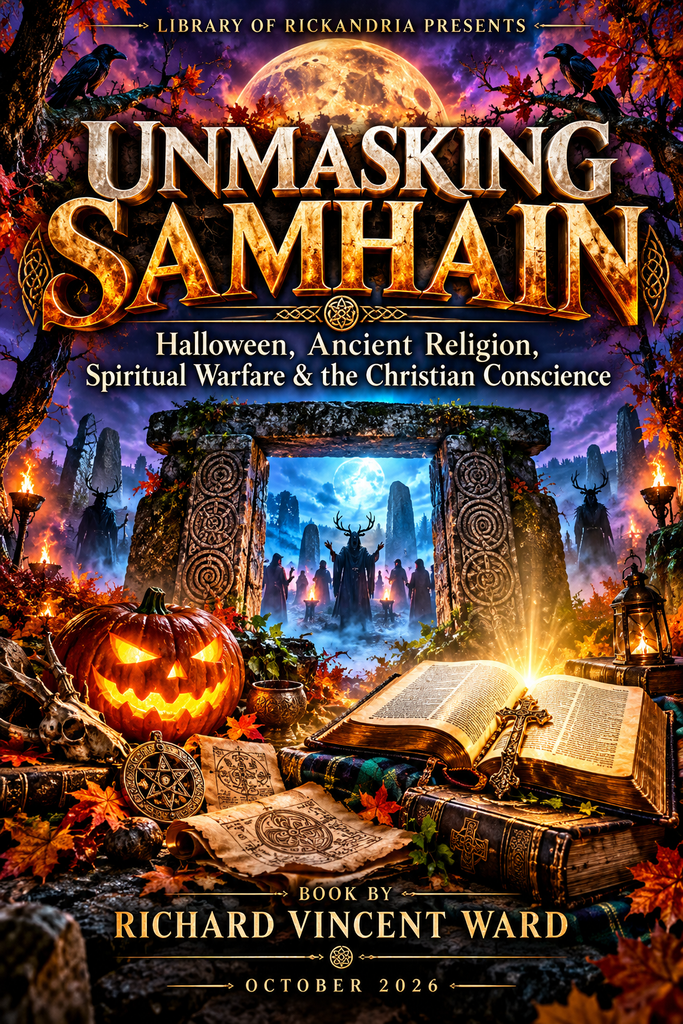
image.png
UPDATED BY VCG ON 10/23/2026 @ 15:15 EST
CHAPTER 10
FROM MEDIEVAL FOLKLORE TO MODERN HALLOWEEN
Souling, Guising, Jack-o’-Lanterns, Mischief, Migration, Trick-or-Treating & the Making of a Modern Holiday
“Prove all things; hold fast that which is good.”— 1 Thessalonians 5:21, King James Bible
1. The Night Crosses the Atlantic
Imagine an October evening in a North American neighborhood.
The year is 1955.
The streets are quieter than those of the twenty-first century. Television has entered many homes, suburban neighborhoods are expanding, and families are establishing new customs around the lives of their children.
A porch light glows.
A small group approaches the front door.
One child wears a cardboard mask. Another is dressed as a cowboy. A third carries a bag for sweets.
The door opens.
The children call out a familiar phrase.
The homeowner reaches for a bowl of candy.
The exchange is brief.
The children depart for the next house.
This familiar scene would be recognizable to millions of Americans today.
But it would not be recognizable in the same form to a first-century Roman describing Druids, a medieval Irish author writing about Samhain, or an English parishioner participating in prayers for the dead.
The similarities are not nonexistent.
The date is significant.
Disguise has historical precedents.
Doorstep customs have older European counterparts.
Food exchange and supernatural imagery have long associations with the season.
Yet the twentieth-century practice also emerged through developments that did not exist in the ancient Celtic world.
Industrial candy production.
Commercial costume manufacturing.
Modern public schooling.
Urban and suburban neighborhoods.
Radio.
Television.
Advertising.
Organized efforts to discourage vandalism.
And changing ideas about childhood recreation.
To understand modern Halloween, we must examine these developments rather than treating them as irrelevant additions to an unchanged prehistoric ceremony.
The central historical question is no longer merely what Samhain meant in early Irish tradition.
It is how different customs, originating in different settings, came together to form the holiday recognizable today.
Modern Halloween is not one ancient ceremony preserved intact. It is a developing cultural occasion with multiple documented historical influences.
That conclusion does not establish that every present activity is morally appropriate.
It establishes that each activity must be understood within its actual history before its moral meaning can be assessed.
This chapter will follow the evidence from medieval Christian observances through later Scottish, Irish, and English folklore into modern North America.
Along the way, it will identify which historical relationships are documented, which remain plausible but uncertain, and which assertions from the 2025 edition require correction.
2. The Medieval World Was Not the Prehistoric World
Our investigation begins with a necessary chronological distinction.
The historical festival of Samhain appears prominently in medieval Irish literature.
The Christian observances of All Saints’ Day and All Souls’ Day developed through ecclesiastical and monastic history.
Later Halloween customs emerged within European communities shaped by Christianity, older seasonal traditions, local folklore, social change, and regional circumstances.
These periods overlap through historical transmission.
They are not identical.
A custom documented in a fifteenth-century English parish cannot automatically be transferred into a prehistoric Irish grove.
A Scottish game recorded in the eighteenth century cannot establish what every Druid practiced in the first century before Christ.
And a North American Halloween activity that became popular in the 1950s cannot be described as a precisely documented prehistoric ritual merely because it contains older symbolic elements.
The question is not whether influence is possible.
Influence frequently occurs.
The question is whether the particular connection can be established.
Three Different Historical Problems
We must distinguish the origin of a custom, the development of a custom, and its meaning to contemporary participants.
These are different subjects.
A household visiting tradition may emerge within a religious setting.
Its participants may later treat it primarily as recreation.
Still later, the same form may become associated with commercial products.
The outward action can display continuity while its purpose changes.
Conversely, people may intentionally revive a religious meaning that had previously been absent or forgotten.
Thus, historical ancestry does not automatically determine the present activity’s religious function.
The argument must identify what survived, what changed, and what the participants are actually doing.
This distinction will become particularly important when we examine the claim that children receiving candy are unknowingly entering an ancient spiritual transaction.
3. Souling: Food, Charity and Prayer for the Departed
One of the strongest documented antecedents of later Halloween doorstep customs is souling.
The practice was associated with medieval and early modern England.
During the period surrounding All Saints’ and All Souls’ Days, poorer members of a community could visit the homes of better-off neighbors and request charitable gifts.
These gifts sometimes included small cakes, commonly called soul cakes.
In return, visitors might offer prayers for the deceased relatives and friends of the household.
This custom belonged to a Christian religious world in which prayers for the departed were understood as acts of charity.
The Historical Sources
English Heritage historian Dr Michael Carter examines the evidence in What Are Soul Cakes and What’s Their Link with Halloween?.
Carter identifies evidence for soul cakes from approximately 1400.
He discusses the English cleric John Mirk, whose writing refers to an established custom of baking and distributing bread in remembrance of Christian souls.
A later example appears in Thomas Blount’s Glossographia, published in 1674, which describes the distribution of oat cakes to poorer neighbors and the reciprocal offering of prayers.
The practice also appears in accounts collected by John Aubrey and in later regional folklore.
These references matter because they provide identifiable texts associated with particular historical periods.
We do not have to imagine the custom solely through a proposed prehistoric origin.
We can study what surviving sources actually record.
What Souling Meant
Souling could combine charity, religious obligation, remembrance, hospitality, and social exchange.
The recipient benefited materially.
The giver participated in an activity understood as spiritually beneficial for departed relatives.
The practice could strengthen relationships within a community divided by differences in wealth.
It also reflected theological beliefs that many Protestant traditions would later dispute.
The historical fact that the exchange possessed a Christian religious function does not settle whether that function was biblically correct.
It establishes how the custom was understood.
What Souling Does Not Establish
Souling does not prove that modern trick-or-treating descends exclusively from medieval Christian charity.
Other traditions contributed to the development of the modern custom.
Nor does souling prove that every modern exchange of candy carries the theological meaning once associated with prayers for the departed.
The modern participant must not automatically be assigned the intentions of the medieval participant.
But the practice poses a significant challenge to an oversimplified historical account.
The original 2025 Unmasking Samhain described Halloween doorstep exchange primarily as the continuation of ancient offerings made to appease dangerous spirits.
Souling provides a documented alternative historical influence involving charity, remembrance, and medieval Christian belief.
That influence must be incorporated into any responsible account of Halloween’s development.
4. Guising: Disguise, Performance and the Doorstep
A second important tradition is known as guising.
The term is connected with disguise.
Within later Scottish tradition, children or other participants dressed in unusual clothing or costumes and visited neighbors.
Visitors might perform a song, recite a poem, tell a joke, or offer another form of entertainment.
They could then receive fruit, nuts, sweets, or other gifts.
This tradition bears a recognizable resemblance to aspects of modern trick-or-treating.
But resemblance is only the beginning of historical understanding.
The Scottish Evidence
Scotland.org’s Halloween Traditions describes traditional Scottish guising as an activity in which children visited neighbors while disguised and performed songs, jokes, stories, or tricks in return for gifts.
The important element is that the exchange could include performance.
The visitors were not necessarily demanding payment under threat of harm.
They might be expected to entertain the household.
Such behavior belongs to a social tradition involving hospitality, disguise, and neighborhood relationships.
The Date of the Custom
Popular summaries sometimes assert that the complete modern form of Halloween guising was practiced in Scotland and Ireland as early as the sixteenth century.
But the documentation of specific customs must be distinguished from the broader historical existence of masking or festive visiting.
Evidence for later Scottish guising is much clearer than evidence proving that every element of the modern custom existed in the same form during the sixteenth century.
A careful researcher should therefore avoid assigning one precise origin date to the entire practice without identifying a corresponding source.
Disguise traditions existed in different European settings.
The history of Halloween guising developed through particular regional customs.
But the chronology of each element requires examination.
Guising and Souling Were Not Identical
Souling could involve prayer for the departed.
Guising could involve entertainment by disguised visitors.
The two practices share certain outward features.
Both may involve visiting households.
Both may involve receiving gifts.
Both occurred within seasonal traditions associated with late October or early November.
But their documented purposes were not necessarily the same.
The difference matters.
An exchange involving prayer is not automatically identical to an exchange involving a song.
A modern child receiving candy is not necessarily performing either original religious function.
The Question of Ritual Continuity
To prove that guising was a direct survival of prehistoric Samhain disguise, a historical account would need to establish a line of transmission connecting the two.
An ancient belief involving supernatural beings might provide a possible background.
Later folklore concerning spirits might strengthen the comparison.
But those observations do not independently establish an unchanged ceremonial practice across the intervening centuries.
The responsible conclusion is narrower.
Later Scottish guising is a documented historical antecedent relevant to modern Halloween costumes and doorstep visiting. Its precise prehistoric ritual ancestry remains less securely established.
5. Robert Burns and the Halloween of Eighteenth-Century Scotland
One of the most valuable historical witnesses to later Scottish Halloween customs is the poet Robert Burns.
Burns composed his poem Halloween in 1785, and it appeared in his 1786 collection Poems, Chiefly in the Scottish Dialect.
The poem describes an evening of games, courtship, superstition, and attempts to predict the future.
Its details reflect traditions associated with the Ayrshire countryside.
The original edition and Burns’s explanatory notes can be consulted through the Eighteenth-Century Poetry Archive.
The National Trust for Scotland also preserves manuscript evidence and historical commentary concerning the poem.
The Customs Burns Described
Participants engaged in games involving nuts, vegetables, and symbolic acts interpreted as predicting future marriage.
Some of the activities involved choosing plants or manipulating household objects.
Others involved attempts to glimpse a future spouse.
The poem combines humor, courtship, social gathering, and supernatural expectation.
Burns also described local beliefs concerning fairies and other extraordinary beings believed to be especially active during the season.
These accounts are relevant historical evidence.
They demonstrate that eighteenth-century Scottish Halloween could possess supernatural associations.
They also show that the occasion was not reducible to one standardized religious ceremony.
A Serious Biblical Question
Some of the activities described were explicitly connected with attempts to obtain knowledge of the future.
A Christian evaluating deliberate fortune-telling may reasonably turn to Deuteronomy 18 and related biblical passages.
But the nature of each activity must still be examined.
A participant may regard a practice as genuine divination.
Another may participate as a game without believing that the result possesses supernatural authority.
This difference does not automatically settle every moral issue.
It does establish that historical description should identify the actual activity and the participant’s understanding where evidence permits.
What Burns Does Not Prove
The poem does not establish that Druids performed identical games two thousand years earlier.
It does not demonstrate that every Halloween participant was engaged in spirit worship.
Nor does it establish the existence of a literal supernatural gateway.
It provides substantial evidence concerning the customs and beliefs of a particular later Scottish setting.
That is valuable evidence.
It should be used according to its actual scope.
6. The Irish Folklore Record: Apples, Barmbrack and Household Games
Irish folklore collections reveal another important dimension of Halloween history.
During the 1930s, the Irish Folklore Commission’s Schools’ Collection recorded local traditions supplied by children, families, and community informants.
The material is available through Dúchas.ie, the National Folklore Collection.
These records preserve accounts of household activities, seasonal food, games, beliefs, and stories.
They provide direct evidence of what people in particular communities remembered or reported during the twentieth century.
Snap-Apple and Apple Games
Several accounts describe games involving apples suspended on strings or placed in water.
Participants attempted to catch an apple with their mouths, usually without using their hands.
These games could create humor and competition.
Some were accompanied by beliefs about future events.
Others appear primarily recreational in the way informants described them.
Barmbrack
Another familiar Irish tradition involved barmbrack, a bread or cake containing objects understood as signs of future circumstances.
A ring might be associated with marriage.
Other objects could represent different fortunes.
The exact objects and their meanings varied among local accounts.
The Schools’ Collection transcripts concerning Halloween customs demonstrate this variation.
The variability is important.
It cautions against presenting one household practice as a universal ceremony possessed of one unchanging religious meaning.
Food and Fellowship
Many records describe nuts, apples, cakes, tea, and household gatherings.
They also refer to seasonal mischief and extraordinary stories.
The evidence therefore reveals an occasion combining multiple social purposes.
Some customs involved fortune-telling.
Some were recreational.
Some preserved supernatural beliefs.
Others concerned food and hospitality.
The material should not be flattened into one category.
What the Folklore Does Not Establish
A custom recorded in the 1930s may have been practiced for generations.
But the record does not automatically establish the exact custom in prehistoric Ireland.
The historian must examine the transmission and earliest available documentation.
The same principle applies to any claimed religious origin.
The existence of a later custom is not sufficient to prove every proposed ancient interpretation.
7. The Turnip Lantern: A Genuine Historical Object
Few Halloween symbols are more recognizable than the carved pumpkin.
But the American pumpkin lantern developed from traditions in which other vegetables were used.
In Ireland, turnips could be hollowed out, carved with frightening faces, and illuminated.
This is not merely a modern story invented to give pumpkins an exotic origin.
There is museum evidence.
The National Museum of Ireland’s Ghost Turnip
The National Museum of Ireland’s Ghost Turnip collection record describes a turnip lantern associated with Fintown, County Donegal.
In 1943, a schoolteacher provided information and a turnip lantern representing a form used locally around 1900.
The museum’s surviving display object is a plaster model based upon that tradition.
The record explains that candles were placed inside carved turnips and that the lanterns could be used to frighten people on October 31.
This is a particularly useful historical source because it connects an identifiable object, place, and reported period.
The Historical Meaning of the Lantern
The lantern could function as a frightening image.
It could be associated with folklore.
It could be used for pranks.
It could serve a decorative or theatrical purpose.
The museum’s record supports the tradition of frightening people with illuminated turnips.
It does not establish that every lantern was a sacrificial offering.
Nor does it document a universal Druidic ceremony in which carved vegetables housed actual spirits.
From Turnips to Pumpkins
Pumpkins became especially important within North American Halloween traditions.
They were available in the agricultural environment and could be carved into large illuminated faces.
The Smithsonian Gardens’ Ghosts of Pumpkins Past documents the development of carved pumpkin lanterns in the United States during the nineteenth century.
The Smithsonian also preserves a photograph of jack-o’-lanterns dating to 1912.
This provides a documented stage in the development of the familiar modern object.
The relationship between turnip lanterns and pumpkin lanterns is historically meaningful.
But it is a relationship involving material adaptation.
A new vegetable became associated with an older form of lantern-making.
That development does not establish that every lantern possesses the same supernatural function.
The Stingy Jack Tradition
Irish folklore concerning a wandering figure called Jack is often linked with the name jack-o’-lantern.
In popular versions, Jack is denied entry to both heaven and hell and wanders with a light.
This is a folkloric explanation.
It should not be treated as a verified event.
Nor should every detail of the modern story be projected backward into prehistoric religion.
The legend is evidence of storytelling.
The carved lantern is evidence of material culture.
Their relationship can be investigated without claiming that the lantern automatically creates a supernatural covenant.
8. The Pumpkin in the Original 2025 Manuscript
The first edition stated:
“The jack-o’-lantern, originally carved from turnips and later pumpkins, was not decorative but sacrificial.”
The first part of this statement possesses a genuine historical foundation.
Turnip lantern traditions are documented.
Pumpkin carving developed prominently in North America.
But the second part requires independent evidence.
The mere existence of a carved lantern does not establish that its principal historical function was sacrifice.
A later account of its use to frighten people is not evidence that living beings were sacrificed through the object.
The original manuscript continued by assigning the lantern the meaning of a trapped spirit and describing placement outside a household as a spiritual pact.
These are additional theological assertions.
They cannot be established through the museum’s turnip-lantern record.
They also cannot be established merely by citing ancient Roman accounts of human sacrifice.
A carved vegetable and a sacrificial ceremony are different kinds of evidence.
The relationship must be demonstrated.
Editorial correction: The revised edition will recognize turnip lanterns, the Stingy Jack tradition, and American pumpkin carving while refusing to present the lantern as a universally established sacrificial object or automatic spiritual contract.
The full history of the lantern will be examined in Chapter 15.
9. Halloween Mischief: A History of Tricks Before Treats
Modern trick-or-treating is strongly associated with sweets.
But earlier North American Halloween celebrations frequently involved mischief.
Some of that mischief was relatively harmless.
Other examples included harassment, property damage, and dangerous acts.
This history is important because it helps explain why organized community celebrations and candy distribution became increasingly common.
The Nineteenth-Century Record
Historical newspaper accounts describe Halloween pranks across different North American communities.
Young people moved objects, interfered with property, frightened neighbors, and played practical jokes.
The scale and severity varied.
The behavior could be tolerated as seasonal mischief.
It could also provoke serious public complaints.
Lesley Bannatyne’s historical account, When Halloween Was All Tricks and No Treats, published by Smithsonian Magazine in 2017, documents this history through newspaper examples.
Her discussion identifies a transformation from relatively localized pranks to more serious forms of disorder within some urban settings.
Social Change
The United States and Canada underwent major changes during the nineteenth and twentieth centuries.
Urban populations expanded.
Neighborhoods became more densely inhabited.
Public institutions developed new approaches to children and youth.
Communities increasingly sought organized forms of recreation.
These circumstances helped reshape Halloween.
A prank that might have been tolerated within a small rural community could become dangerous or destructive in a crowded urban environment.
The development of supervised celebrations was partly a response to these concerns.
The Important Distinction
The history of pranks provides a documented explanation for the trick element of the modern phrase trick or treat.
A request for sweets could be accompanied by a joking threat of mischief.
But this does not establish that the speaker was reenacting an ancient offering to spirits.
The phrase possesses a recognizable social and linguistic history within modern North America.
Its earlier forms can be examined directly.
10. The Earliest Documented “Trick or Treat” Expressions
This is one of the most important chronological corrections in the present chapter.
Many popular histories identify a 1927 Alberta newspaper report as the earliest recorded use of the phrase trick or treat.
That account is influential because the report uses the exact wording familiar today.
But more recent dictionary research has identified earlier printed variants.
The Dictionary of Canadianisms
The University of British Columbia’s Dictionary of Canadianisms on Historical Principles, Third Edition (2025), provides an unusually valuable source.
Its entry traces printed Halloween expressions involving tricks and treats through Canadian newspapers.
The dictionary identifies attested variants from 1917.
A report from Sault Ste. Marie, Ontario, uses the plural expression tricks or treats.
Another 1917 Ontario report records treat or trick.
The dictionary also identifies later examples from 1921 and 1924.
By 1927, the exact phrase trick or treat appears in a report concerning Blackie, Alberta.
This distinction is crucial.
1917 Versus 1927
The 1927 report remains an important early example of the exact modern wording.
But it is not the earliest known printed evidence of the broader chant.
The 1917 variants demonstrate that the essential exchange formula was already in circulation.
A careful historical account must therefore distinguish the earliest documented variant from the earliest documented exact modern form.
Even these dates should be understood as the earliest attestations currently identified by the relevant research, not as proof of the precise moment the custom was invented.
An activity may exist before it appears in surviving print.
What the Reports Reveal
The early Canadian accounts describe neighborhood visiting, treats, and the threat or possibility of mischief.
They belong to the social world of twentieth-century North America.
Their surviving wording provides direct evidence of how participants and observers understood the exchange.
The reports do not describe Druids.
They do not identify Samhain as the purpose of the visits.
They do not mention an occult covenant.
The threatening language concerns practical jokes or damage.
That is what the sources establish.
Why This Matters for the Original Book
The 2025 edition asserted:
“Today’s trick-or-treating reenacts this exact ritual.”
It was referring to a proposed ancient ceremony in which food was left outside to appease spirits.
But the documented history of the modern phrase reveals a different immediate context.
The surviving early reports concern children, neighbors, treats, and mischief.
That evidence cannot prove there was no distant cultural influence from earlier traditions.
But it does not establish the precise ancient ritual continuity alleged in the original book.
The phrase’s documented history is modern and social; an unchanged prehistoric spiritual mechanism has not been demonstrated.
11. The 1927 Alberta Newspaper Report
The 1927 example deserves particular attention.
A report published by The Lethbridge Herald described Halloween activities in Blackie, Alberta.
Children went to households demanding edible gifts through the phrase trick or treat.
The report also described pranks involving movable objects and neighborhood property.
This is direct historical evidence concerning the expression’s use.
It connects the formula with the already established culture of seasonal mischief.
The Meaning of the Threat
The expression contains a conditional structure.
A treat is requested.
A trick is the alternative.
The joking threat may have possessed different degrees of seriousness in different communities.
Some children may have meant only harmless mischief.
Others may have participated in genuinely destructive conduct.
The ethical evaluation of threats, vandalism, or coercion should therefore be based upon actual behavior.
But the linguistic meaning does not automatically establish a supernatural exchange.
A human demand for sweets is not inherently an offering to a spirit.
The historical connection would require additional evidence.
A Modern Development Rather Than an Ancient Quotation
The documented phrase belongs to twentieth-century English-speaking North America.
Its precise wording should not be attributed to ancient Druids.
Neither should a hypothetical ancient practice be described as though it contained the modern phrase.
This is a basic principle of chronology.
A modern expression may reflect older social patterns.
But the expression’s historical record must be distinguished from speculative ancient ancestry.
12. The American Transformation of Halloween
By the early twentieth century, Halloween was undergoing substantial change in the United States.
Immigration, urban growth, organized recreation, commercial advertising, and new media helped reshape the occasion.
Irish and Scottish communities contributed customs and seasonal traditions.
But the modern festival did not emerge simply through the unchanged transplantation of one European practice.
It developed within North American circumstances.
The Rise of Organized Parties
Communities arranged celebrations for children and young people.
Schools and civic groups organized parties.
Households hosted seasonal gatherings.
Costumes, games, and decorations became increasingly familiar.
Some of these activities were intended to replace disorderly pranking with supervised entertainment.
The National Museum of American History documents the movement toward community-centered celebrations during the 1940s and 1950s.
Household Entertainment
Games involving apples, suspense, practical jokes, and frightening storytelling became part of domestic recreation.
The National Endowment for the Humanities has highlighted such customs through its discussion of the Library of Congress’s historical newspaper collections.
See Superstitions and Celebrations: Halloween History in Chronicling America.
These newspapers permit historians to examine the development of particular practices in specific decades.
They are stronger evidence for twentieth-century American Halloween than an unsupported assertion about prehistoric ritual continuity.
The Great Depression and Community Celebrations
The economic difficulties of the 1930s affected communities across North America.
Organized Halloween entertainment could offer an accessible form of recreation.
Some communities developed haunted attractions or decorated spaces for children.
Others sponsored parades and supervised activities.
The precise practices varied.
But the general pattern demonstrates the influence of modern social organization upon the holiday.
The Halloween of the twentieth century cannot be reconstructed solely through ancient Celtic religion.
Its development was shaped by the concerns and opportunities of modern communities.
13. The Rise of the Haunted House
The modern haunted attraction is another example of cultural development.
Older stories of supernatural danger and allegedly haunted places are widespread.
But the commercial and community haunted house recognizable today emerged through more recent forms of entertainment.
Early Community Attractions
The Smithsonian’s A Brief History of the Haunted House discusses Halloween attractions emerging during the Great Depression.
Parents and communities developed controlled frightening experiences as alternatives to unsupervised seasonal mischief.
Some involved decorated basements.
Others involved staged experiences designed to surprise or frighten participants.
By the middle decades of the twentieth century, such attractions were becoming increasingly recognizable.
Entertainment and Religious Meaning
A staged haunted house can depict ghosts, monsters, witches, or violent fictional scenes.
But the historical existence of such imagery does not establish that the attraction constitutes an actual religious ritual.
Some performances may contain material that Christians find morally objectionable.
Others may be understood primarily as theatrical entertainment.
The distinction depends upon the activity.
A realistic portrayal of a crime is not necessarily the commission of the crime.
A dramatic representation of necromancy is not automatically an attempt to communicate with the dead.
Nevertheless, representation can still raise ethical questions involving content, sensitivity, conscience, and the influence of entertainment.
These questions require separate psychological and theological examination.
The Historical Verdict
Modern haunted attractions possess identifiable twentieth-century developments.
Their existence cannot simply be explained as an unchanged annual Druidic ceremony.
That claim would require evidence not supplied by the mere presence of supernatural imagery.
14. Commercial Costumes and the Modern Imagination
Costumes provide another important example.
Masks and disguises have histories extending across many cultures.
But the commercial Halloween costume industry developed through modern manufacturing, marketing, entertainment, and children’s culture.
The Museum Record
The Smithsonian’s National Museum of American History preserves Halloween masks and costumes from the twentieth century.
Its collections include witch and devil masks dated broadly between 1930 and 1950.
The museum also documents commercial costume producers such as Ben Cooper, Inc., founded in Brooklyn in 1937.
Such companies manufactured costumes distributed through large retailers.
They increasingly used characters drawn from films, television, comics, and popular entertainment.
From Homemade Disguise to Licensed Characters
A child in one period might wear old clothing and a homemade mask.
A child in another might purchase a commercially manufactured costume based upon a television character.
These changes affect both appearance and meaning.
A superhero costume is not a reconstruction of an ancient spirit disguise merely because it is worn on Halloween.
A science-fiction character is not an ancient Celtic deity.
A fictional princess is not evidence of Druidic possession.
The modern costume market reflects commercial licensing and imaginative identification with media characters.
That does not settle every moral concern about costume choices.
But it provides an essential historical explanation that cannot be ignored.
The Original Manuscript’s Error
The 2025 edition asserted that Halloween costumes continue ancient ritual mimicry and could create spiritual access even where participants were unaware of it.
The modern history of commercial costumes does not establish such a mechanism.
The relationship between outward representation and religious participation requires theological argument.
It cannot simply be inferred from the word costume.
The subject will receive fuller treatment in Chapter 14.
15. Why Candy Became Central
The modern Halloween candy industry represents one of the most dramatic transformations of the holiday.
Candy is so closely associated with trick-or-treating that many people assume the practice has always centered upon wrapped confectionery.
But that assumption is historically incorrect.
Earlier Treats
Early North American Halloween visitors might receive apples, nuts, coins, homemade baked goods, or other small gifts.
Candy was not the sole or universal reward.
The Smithsonian’s National Museum of American History documents this variety.
The Mid-Twentieth-Century Change
During the 1950s, candy companies increasingly promoted packaged sweets specifically for Halloween.
Mass production and individually wrapped products made distribution more convenient.
Commercial advertising helped establish candy as the expected reward.
Suburban trick-or-treating routes brought larger numbers of children to participating households.
A commercially standardized product suited the developing custom.
The 1954 Mars Advertisement
The Smithsonian identifies a Mars advertisement for Milky Way appearing in Life magazine on October 25, 1954.
The advertisement connected the candy directly with Halloween themes.
This is a specific example of commercial adaptation.
Its historical importance lies not in an ancient religious meaning but in the development of a modern consumer practice.
Packaging and Trust
The increased popularity of individually wrapped products also reflected convenience and changing expectations concerning food safety.
By the 1970s, concern about homemade treats was influencing parental preferences.
The commercial product became increasingly dominant.
Thus, the familiar bag of branded candy is substantially a product of twentieth-century manufacturing, marketing, and social change.
Its history cannot honestly be presented as one unchanged prehistoric offering.
16. Candy, Rumor and the Difference Between Danger and Allegation
Food safety concerns deserve serious attention.
Parents have legitimate reasons to inspect unfamiliar food, consider allergies, and supervise younger children.
But physical safety questions must be distinguished from supernatural allegations.
The original manuscript asserted that some candy had been ritually dedicated and could transmit spiritual harm.
That is a specific claim requiring evidence.
The historical development of commercial Halloween candy does not establish the alleged mechanism.
Nor does the existence of actual religious rituals elsewhere prove that ordinary packaged confectionery constitutes an involuntary spiritual transaction.
The History of Halloween Candy Rumors
Sociologist Joel Best has investigated fears concerning deliberately contaminated Halloween treats.
Historical accounts show that rumors of poison, hidden sharp objects, and malicious strangers became prominent during the latter twentieth century.
Some incidents of tampering or harm have been documented, while many widely repeated allegations have lacked adequate corroboration.
The history of these fears is discussed in How Americans Became Convinced Their Halloween Candy Was Poisoned.
These questions require careful differentiation.
A rare incident is not proof of a widespread pattern.
An unverified rumor is not a documented crime.
A physical contaminant is not the same thing as a claimed supernatural curse.
Appropriate Caution
A responsible parent may prefer sealed food.
A parent may avoid treats whose origin is uncertain.
Such decisions concern identifiable practical risks.
But the existence of sensible precautions does not justify telling children that ordinary candy automatically contains a demonic assignment.
That further assertion requires evidence.
The difference between reasonable caution and unsupported fear must remain clear.
17. Halloween and the Growth of Mass Media
The twentieth century brought another transformation: Halloween became a subject of national entertainment.
Radio shows, animated films, television programs, advertising, and mass-produced decorations helped establish recognizable holiday imagery.
The 1952 Trick or Treat Cartoon
Disney released the animated short Trick or Treat in 1952.
The story involves Donald Duck, Huey, Dewey, Louie, and the fictional witch Hazel.
Its plot centers on Halloween, pranks, costumes, and candy.
The significance of such media lies partly in their national reach.
A local or regional custom could become familiar to children living far beyond the communities in which it first developed.
The Smithsonian’s history of Halloween mischief identifies television, radio, and popular animation as important forces in the spread of trick-or-treating.
Commercial Standardization
Mass media could make Halloween customs appear uniform across the country.
Children encountered similar characters.
Retailers sold similar costumes.
Advertising promoted similar decorations and sweets.
What had once been a collection of regional practices became increasingly standardized.
This process is central to the history of the modern holiday.
A New Kind of Cultural Continuity
The transmission of a custom through television is historically different from its transmission through medieval religious institutions.
Both may produce continuity.
But their mechanisms differ.
A fictional witch portrayed in a cartoon does not necessarily represent the same activity as a historical religious practitioner.
Likewise, a modern costume inspired by that cartoon cannot automatically be assigned the religious purpose of an alleged ancient Druidic disguise.
The history of media matters because it supplies identifiable reasons why symbols spread and acquire new meanings.
18. The UNICEF Example: A Halloween Custom Used for Charity
One particularly important modern development challenges any argument that every Halloween doorstep exchange possesses one fixed and unchangeable religious function.
In 1950, children in the Philadelphia area collected donations for UNICEF during Halloween.
The initiative was associated with Mary Emma Allison, an educator, and her husband Clyde Allison, a Presbyterian minister.
Their aim was to encourage children to help other children affected by hardship.
The campaign developed into Trick-or-Treat for UNICEF.
An Identifiable Beginning
UNICEF’s own history documents the campaign.
In Trick-or-Treat for UNICEF: History & Impact, published September 9, 2026, the organization traces the effort to the Allisons’ work with children during the late 1940s and the first UNICEF coin collection in 1950.
That initial collection raised $17.
The campaign subsequently expanded substantially.
Why This Example Matters
The Allisons did not need to invent a new calendar date or a new form of neighborhood visiting.
They adapted an existing contemporary custom toward charitable purposes.
The same basic doorstep movement could be used to collect money for humanitarian assistance.
This is direct evidence of a modern practice being intentionally repurposed.
What the Example Does Not Prove
The UNICEF campaign does not establish that every form of Halloween participation is morally acceptable.
The theological evaluation of a particular activity still requires examination.
Neither does it prove that an activity’s prior associations are automatically irrelevant.
But it does challenge the assertion that every doorstep exchange necessarily possesses one fixed supernatural meaning regardless of the participant’s intention and conduct.
A child collecting donations for other children is performing an identifiable charitable activity.
To describe that activity as a literal reenactment of ancient Druidic spirit appeasement requires evidence not supplied by the calendar date alone.
An Important Christian Historical Detail
The campaign’s origins involved a Christian minister and an educator motivated by concern for vulnerable children.
This is a documented fact about the modern history of trick-or-treating.
It should not be omitted from a book that investigates how Christians have responded to Halloween.
The full question of church-sponsored alternatives will receive separate attention in Chapter 17.
19. A Documentary Timeline of Modern Halloween
The surviving evidence permits a useful chronological reconstruction.
| Date or period | Documented development | Historical significance |
|---|---|---|
| Around 1400 | English references to soul cakes and charity associated with Allhallowtide | Evidence for Christian doorstep food distribution |
| Seventeenth century | Additional English accounts of souling | Continued regional religious and social practice |
| 1785–1786 | Robert Burns composes and publishes Halloween | Detailed evidence for Scottish folklore and seasonal games |
| Nineteenth century | Irish and Scottish traditions influence North American celebrations | Migration and cultural adaptation |
| Nineteenth century | Pumpkin lanterns become part of American Halloween custom | Material and agricultural change |
| 1898 | Newspaper evidence of disguised Halloween household visits in Vancouver | Early North American documentation |
| Around 1900 | Turnip lanterns used in parts of Ireland, according to later museum testimony | Evidence for regional lantern custom |
| 1917 | Canadian newspapers document tricks or treats and treat or trick variants | Earliest variants identified in the 2025 Canadian dictionary study |
| 1927 | Alberta report uses the exact phrase trick or treat | Early attestation of the familiar wording |
| 1930s | Commercial costumes and organized community celebrations expand | Modern manufacturing and civic influence |
| 1940s–1950s | Trick-or-treating spreads more widely in North America | Emergence of the familiar neighborhood practice |
| 1950 | First Trick-or-Treat for UNICEF fundraising campaign | Documented charitable adaptation |
| 1952 | Disney releases Trick or Treat | National popularization through entertainment |
| 1950s onward | Packaged candy increasingly dominates distribution | Commercial standardization |
| Later twentieth century | Licensed costumes, haunted attractions, television specials, and major retail promotion expand | Halloween becomes a major consumer occasion |
The timeline does not establish that every custom originated on the earliest date listed.
It identifies documented stages in development.
A practice may have existed before its surviving record.
But a hypothetical earlier existence must not be treated as demonstrated fact.
The Historical Pattern
The modern festival emerged through overlapping influences rather than one unchanged line of ritual descent.
The European record supplies souling, guising, lanterns, folklore, and seasonal games.
The North American record supplies extensive evidence of pranking, community organization, commercial candy, licensed costumes, and modern popular media.
The relationship among these developments can be studied.
They should not be collapsed into a single prehistoric ceremony.
20. The Original 2025 Book’s Theory of Doorstep Exchange
We can now examine the central claim of Chapter 6 in the 2025 edition, entitled Trick-or-Treat — The Ritual of Demonic Exchange.
The original manuscript asserted that trick-or-treating was a spiritual continuation of ancient offerings intended to appease dangerous beings.
Its argument included the claim:
“But the spiritual mechanics remain.”
This sentence is especially important because it goes beyond a historical comparison.
It asserts the continued operation of a particular invisible mechanism.
The Historical Premise
The manuscript described ancient villagers placing food outside their doors to prevent harm from spirits.
Some later traditions do involve offerings or hospitality associated with supernatural beings.
But the original account did not adequately establish the complete ancient ceremony as a universal Druidic practice.
Nor did it demonstrate the precise transmission of that practice into twentieth-century North American trick-or-treating.
The Modern Evidence
The historical record supplies identifiable developments involving souling, guising, neighborhood mischief, Canadian newspaper expressions, commercial candy, and organized children’s recreation.
These sources explain important elements of the modern practice.
They do not demonstrate that children unknowingly make offerings to spirits through ordinary candy exchanges.
The Theological Assertion
The claim that spiritual consequences persist regardless of conscious intention is a theological proposition.
It cannot be established merely by identifying symbolic similarities.
The biblical passages invoked must support the specific mechanism.
If they do not, the author must distinguish the proposed inference from direct scriptural teaching.
The Necessary Correction
A responsible manuscript may say that modern trick-or-treating possesses historical antecedents involving seasonal visiting, gift exchange, disguise, mischief, and religious customs.
It may investigate whether particular earlier forms were connected with spiritual beliefs.
It may also discuss whether specific contemporary behavior raises ethical concerns.
But it should not declare that ordinary participation automatically constitutes an ancient ritual of demonic exchange without demonstrating the historical and theological connections.
21. Scripture and the Actual Conduct of Modern Halloween
We now turn to the biblical question.
The relevant Scriptures do not directly discuss twentieth-century trick-or-treating.
Their application therefore requires identifying the modern conduct and examining the appropriate moral principles.
Proverbs 10:22 — The Blessing of the LORD
The 2025 trick-or-treat chapter opened with Proverbs 10:22:
“The blessing of the LORD, it maketh rich, and he addeth no sorrow with it.”
The proverb concerns divine blessing.
It does not describe Halloween candy.
It does not define the modern phrase trick or treat as a spiritual covenant.
Nor does it establish that a gift received during a holiday is automatically morally corrupt.
A writer may contrast generous giving with selfish demands.
That may be a legitimate moral discussion.
But the proverb should not be presented as though it directly identifies a contemporary doorstep custom as demonic.
Leviticus 19:11 — Theft and False Dealing
The KJV reads:
“Ye shall not steal, neither deal falsely, neither lie one to another.”
The command directly concerns dishonest and wrongful conduct.
If Halloween mischief involves theft or deception, the moral principle is plainly relevant.
Vandalism and harassment may also raise biblical concerns.
But an ordinary child politely requesting a gift is not automatically stealing.
The conduct must be evaluated.
The word trick does not prove that a child intends to damage property.
Nor does the absence of wrongdoing prove that all possible Halloween activities are morally acceptable.
The actual action matters.
Second Timothy 1:7 — Fear and Sound Judgment
Paul wrote:
“For God hath not given us the spirit of fear; but of power, and of love, and of a sound mind.”
The verse concerns encouragement in the face of difficulties associated with Christian faith and ministry.
It does not identify recreational Halloween activities.
Its emphasis upon love and disciplined judgment may inform broader ethical reflection.
But the specific conclusion that trick-or-treating operates through demonic fear must be argued separately.
First Corinthians 10:14–33 — Idolatrous Participation and Ordinary Food
This is perhaps the most important New Testament passage for evaluating claims involving Halloween food.
Paul commands Christians to flee idolatry.
He rejects participation in sacrificial fellowship associated with idols.
But he also discusses the ordinary purchase and consumption of food.
In verse 25, he writes:
“Whatsoever is sold in the shambles, that eat, asking no question for conscience sake:”
The passage distinguishes religious fellowship from other circumstances involving food.
It also considers the conscience of another person when a sacrificial association is specifically identified.
This does not automatically settle every hypothetical scenario involving occult rituals.
But it prevents the blanket assumption that every material or historical association constitutes the same act of worship.
For a Christian, the relevant question is whether the activity actually involves idolatrous participation or other prohibited conduct.
An ordinary candy exchange cannot simply be assigned that meaning without evidence.
Romans 14 — Conscience and Disputed Practices
Romans 14 addresses disagreements among believers concerning food and days.
Its application to modern Halloween remains a matter of theological interpretation.
The chapter cannot be used to excuse actual idolatry.
But it does require serious consideration of conscience, judgment, and disagreement within the scope of practices that Scripture leaves disputable.
A Christian may abstain from Halloween because of conscience.
Another may distinguish particular recreational practices from forbidden religious acts.
Those positions should be examined fairly.
A person’s participation cannot automatically reveal an occult intention that the available evidence does not establish.
First Corinthians 10:31 — The Governing Ethical Principle
Paul writes:
“Whether therefore ye eat, or drink, or whatsoever ye do, do all to the glory of God.”
This supplies a broad and demanding Christian principle.
A believer should evaluate conduct according to faithfulness, conscience, love, moral content, and its relationship to honoring God.
But the broadness of the principle does not authorize unsupported factual claims.
To do all to God’s glory is not permission to misrepresent history.
The Christian responsibility to truthful speech applies to warnings about Halloween as surely as it applies to conduct during Halloween.
22. The Psychology of Cultural Memory
There is a psychological reason that a complex history often becomes a simple origin story.
Human beings prefer narratives that are memorable and coherent.
A story connecting ancient Druids, spirits, masks, lanterns, and candy provides one explanation for many familiar objects.
It is easier to remember than a detailed account involving several centuries of social and commercial change.
The Origin-Story Shortcut
A modern custom may have several antecedents.
But an origin story often identifies one supposedly decisive event.
The explanation becomes more dramatic and easier to communicate.
The risk is that historical diversity disappears.
A lantern becomes a single religious symbol.
A costume becomes a single ritual act.
A candy exchange becomes one spiritual transaction.
The result is psychologically compelling but historically inadequate.
Similarity and Assumed Causation
A carved lantern resembles a frightening face.
A mask conceals identity.
A ghost story concerns the dead.
A candy exchange resembles an offering.
These observations may be accurate.
But the proposed causal relationships require evidence.
Similarity cannot substitute for documentation of historical transmission.
The Problem of Retrospective Meaning
Once a person believes that Halloween is one continuous occult system, every modern custom may be interpreted through that theory.
The theory supplies the meaning before the particular history is examined.
The resulting argument becomes circular.
The custom is called occult because Halloween is occult.
Halloween is called occult because its customs are occult.
But the independent evidence supporting each proposition may remain unexamined.
The solution is to investigate the specific custom before assigning its religious meaning.
23. The Claim That Halloween Was Deliberately Designed to Recruit Children
The original manuscript described Halloween as a spiritual strategy targeting children.
The allegation deserves direct attention because it concerns intention and agency.
To claim that a practice was deliberately designed for recruitment, an investigator must identify who designed it, what purpose they pursued, and what evidence supports the alleged intention.
The historical record of modern Halloween does not reveal one controlling organization responsible for all its forms.
Instead, it includes parents, local communities, religious groups, schools, retailers, entertainment companies, and ordinary participants.
Their purposes differ.
Some seek recreation.
Some seek profit.
Some seek religious observance.
Some seek charity.
Some seek community fellowship.
Some criticize or avoid the occasion entirely.
This diversity does not prove that no individual ever uses Halloween for a manipulative purpose.
It means that the universal claim of one coordinated hidden agenda has not been established.
A Distinction Between Influence and Recruitment
Children can be influenced by entertainment and social expectations.
Commercial advertising can shape their preferences.
Repeated experiences can affect what they regard as normal.
Parents may therefore have legitimate reasons to examine Halloween activities.
But influence is not automatically recruitment into a specific religion or organization.
Nor does the presence of frightening imagery prove that a child has undergone an occult initiation.
Such conclusions require independent evidence.
The Role of Intention
The intention of a participant does not settle every ethical issue.
A person may cause harm without intending it.
An activity may contain morally objectionable elements despite innocent motives.
Nevertheless, intention remains relevant when determining whether an action constitutes deliberate religious participation.
A child pretending to be a fictional character is not automatically performing the same action as an adult intentionally invoking a spiritual being.
Those distinctions should not be erased.
24. Direct Rebuttal: The 2025 Manuscript
Our historical findings now permit a more detailed correction register.
Claim 10.1 — Medieval Souling Involved Doorstep Exchange
Finding: Verified.
Historical sources describe charitable gifts and prayers for the dead.
The practice is a legitimate antecedent relevant to later Halloween customs.
Claim 10.2 — Scottish Guising Involved Disguise and Household Visits
Finding: Supported by documented regional tradition.
Performance, humor, and gifts formed part of the practice.
The precise earliest date of each element requires careful sourcing.
Claim 10.3 — Modern Trick-or-Treating Is an Unchanged Prehistoric Druidic Ceremony
Finding: Unsupported.
The surviving historical record demonstrates multiple intervening developments and does not establish the proposed direct continuity.
Claim 10.4 — The Expression “Trick or Treat” Is an Ancient Ritual Formula
Finding: Contradicted as a documented origin claim.
The expression’s known printed history belongs to modern North America.
Canadian newspapers preserve variants from 1917 and the familiar wording from 1927.
Claim 10.5 — Halloween Pranks Influenced Modern Treat Distribution
Finding: Supported.
Historical research connects the growth of community celebrations and treat distribution with efforts to redirect seasonal mischief.
This was not necessarily the sole influence.
Claim 10.6 — Turnip Lanterns Were Used in Ireland
Finding: Verified.
The National Museum of Ireland preserves relevant collection evidence.
Claim 10.7 — American Pumpkins Became Halloween Lanterns
Finding: Verified.
Nineteenth- and twentieth-century evidence documents the practice.
Claim 10.8 — Every Jack-o’-Lantern Is a Sacrificial Altar
Finding: Unsupported.
The historical evidence does not establish a universal sacrificial function.
Claim 10.9 — Wearing a Halloween Costume Automatically Produces a Spiritual Contract
Finding: Unestablished theological assertion.
The documented history of costume use does not demonstrate the proposed mechanism.
Relevant biblical passages require contextual interpretation.
Claim 10.10 — Modern Halloween Candy Distribution Developed Through Twentieth-Century Commercialization
Finding: Supported.
Museum records document the growing role of individually packaged sweets and advertising during the 1950s and afterward.
Claim 10.11 — Every Candy Exchange Is a Demonic Transaction
Finding: Unsupported.
The historical record supplies different purposes and contexts for such exchanges.
The alleged supernatural mechanism is not established.
Claim 10.12 — The Modern Practice Was Adapted for Charity
Finding: Verified.
Trick-or-Treat for UNICEF began in 1950 through a documented campaign involving the Allisons and participating children.
Claim 10.13 — Halloween Activities Can Raise Legitimate Questions About Vandalism, Frightening Content, or Conscience
Finding: Supported as a reasonable subject for ethical examination.
Individual activities must be identified and evaluated rather than universally condemned or approved.
Claim 10.14 — Scripture Explicitly Names Trick-or-Treating as Idolatry
Finding: Unsupported.
The modern activity is not identified by name in Scripture.
Any application must be reasoned from relevant passages.
Claim 10.15 — A Christian Household Must Accept One Universal Decision About Every Halloween Activity
Finding: Not established by the historical evidence or the cited biblical passages alone.
Different practices may raise different ethical issues.
The treatment of conscience and Christian liberty requires fuller analysis in Part V.
25. Corrected Historical Reconstruction for the 2026 Edition
The following passage replaces the original manuscript’s account of Halloween’s development.
From European Custom to the Modern Holiday
Modern Halloween developed through the interaction of several historical traditions.
Its name derives from All Hallows’ Eve, the evening preceding the Christian commemoration of All Saints’ Day.
European customs associated with the surrounding season included religious remembrance, household hospitality, supernatural folklore, disguise, seasonal games, and communal festivities.
Medieval English souling provides documented evidence for doorstep exchanges involving food and prayers for the departed.
Later Scottish guising involved disguised visitors who could perform songs, stories, or jokes in exchange for gifts.
Irish folklore records seasonal games, foods, supernatural beliefs, and traditions involving carved turnip lanterns.
These practices possessed different purposes.
They cannot responsibly be reduced to one unchanged prehistoric Druidic ceremony.
During the nineteenth and twentieth centuries, immigration and cultural exchange helped introduce and reshape Halloween customs in North America.
Neighborhood pranks became prominent in some communities.
Local organizations developed supervised celebrations.
Disguised household visiting became increasingly familiar.
Canadian newspapers record Halloween expressions involving tricks and treats as early as 1917, while the exact familiar phrase appears in an Alberta report from 1927.
The modern practice expanded substantially during the following decades.
Commercial costumes, packaged candy, radio, television, popular entertainment, and suburban development contributed to its familiar form.
By the 1950s, trick-or-treating had become increasingly associated with children visiting neighboring households to receive sweets.
The practice was also adapted for charitable purposes, notably through the establishment of Trick-or-Treat for UNICEF in 1950.
This history demonstrates substantial cultural change.
It does not establish that every older religious influence disappeared.
Some modern practitioners intentionally attach religious meaning to Samhain and Halloween.
Other participants regard the occasion primarily as recreation, social interaction, or commercial entertainment.
Those differences must be recognized.
Christian Scripture contains serious prohibitions against actual idolatry, necromancy, and forbidden divination.
It also calls believers to holiness, truthful conduct, love, and conscientious judgment.
Applying these teachings to particular Halloween activities requires examining what the activity actually involves.
A historical association with an earlier religion does not automatically establish that every later use constitutes identical worship.
Nor does a participant’s innocent intention automatically excuse genuinely wrongful conduct.
The moral evaluation must be specific.
The historical evidence therefore supports neither a blanket declaration that all Halloween activity is harmless nor an assertion that every modern custom is an occult covenant.
The responsible approach distinguishes documented history, contemporary practice, personal intention, biblical teaching, and disputed theological inference.
This is the historically and biblically defensible foundation for examining Halloween’s symbols and rituals.
26. Conclusion — A Holiday Made by Centuries
We began this chapter on a North American street in the middle of the twentieth century.
We then traveled backward through medieval Christian charity, Scottish disguise traditions, Irish folklore, and the history of seasonal mischief.
We examined carved turnips.
We encountered Robert Burns and his account of Scottish Halloween games.
We studied soul cakes and prayers for the dead.
We traced Canadian newspaper references to tricks and treats.
We followed the growing influence of organized celebrations, commercial candy, licensed costumes, and mass entertainment.
And we examined a documented charitable adaptation created through the efforts of a Presbyterian minister, an educator, and participating children.
The resulting history is considerably more complex than the narrative presented in the 2025 edition.
There are genuine historical relationships between Halloween and older European customs.
Some involve Christian religious observance.
Some involve folklore and supernatural belief.
Some involve social visiting and disguise.
Some involve mischief.
Others involve the modern development of commercial entertainment.
These elements came together through historical change.
They did not remain frozen in one prehistoric form.
That conclusion does not settle the theological question of whether a Christian should participate in Halloween.
A believer may object to particular imagery.
A parent may regard certain entertainment as inappropriate for a child.
A Christian may refuse any association with a festival considered religiously troubling.
Another may distinguish an ordinary neighborhood activity from intentional spirit consultation.
Those questions deserve serious biblical analysis.
But the historical basis for the judgment must be accurate.
We should not tell a family that a modern candy exchange is an ancient Druidic ceremony unless we can establish that relationship.
We should not describe a museum-documented turnip lantern as an altar of human sacrifice without evidence.
We should not identify twentieth-century newspaper language as a prehistoric ritual formula.
And we should not claim that modern manufactured costumes automatically create invisible spiritual contracts merely because masking has sometimes possessed religious meaning.
Those assertions require proof.
The biblical prohibition against actual necromancy remains serious.
The command to flee idolatry remains serious.
The responsibility to protect children remains serious.
And the obligation to speak truthfully remains equally serious.
Historical investigation does not weaken Christian conscience.
It supplies the information necessary for conscience to operate responsibly.
The original Unmasking Samhain recognized that Halloween contains historical religious associations.
That insight deserves further study.
But the original manuscript treated multiple customs as expressions of one continuing system of demonic exchange without demonstrating the required connections.
The revised evidence does not support that universal conclusion.
Instead, we find a developing holiday shaped by centuries of religious, social, artistic, economic, and commercial influences.
The history is real.
The changes are real.
And the differences matter.
Part II has now established an essential foundation.
The ancient Celtic world was diverse.
Samhain was an important early Irish seasonal festival.
Its supernatural literary associations were genuine.
The familiar prehistoric New Year and feast-of-the-dead theories require substantial qualification.
Roman allegations of human sacrifice do not establish a documented Samhain ceremony.
The Christian November calendar developed through multiple historical stages.
And modern Halloween acquired recognizable forms through later folklore, migration, community practices, and commercialization.
We have therefore reached a necessary conclusion:
The religious meaning of a modern Halloween activity cannot be established simply by assigning it one disputed ancient origin.
The activity itself must be examined.
Its historical evidence must be traced.
Its contemporary purpose must be identified.
And its moral evaluation must be argued from Scripture within context.
The next portion of this book will undertake that task.
We shall investigate the symbols individually.
Spirits.
Witchcraft.
Fire.
Sacrifice.
Masks.
Lanterns.
Candy.
Household visiting.
And church-sponsored alternatives.
Some historical connections may survive.
Others may require correction.
And some popular claims may prove unsupported.
But none will be accepted merely because it is familiar, frightening, or rhetorically effective.
The guiding principle remains unchanged:
“Prove all things; hold fast that which is good.”— 1 Thessalonians 5:21, KJV
The record has been examined.
The chronology has been restored.
The differences have been identified.
And the investigation must now move from the festival’s history to the meaning of its symbols.
Soli Deo Gloria.
CHAPTER 10 — RESEARCH NOTES & SOURCE REGISTER
A. Medieval and Early Modern Customs
1. English Heritage — Dr Michael Carter
What Are Soul Cakes and What’s Their Link with Halloween?
Research concerning medieval souling, charitable food distribution, John Mirk, Thomas Blount, John Aubrey, and the historical relationship to later doorstep customs.
What are soul cakes and what’s their link with Halloween? | English Heritage
2. Scotland.org
Halloween Traditions.
Overview of Scottish guising, seasonal folklore, turnip lanterns, and the performance of songs, jokes, or stories in return for gifts.
Halloween Traditions | Scotland.org
3. Robert Burns (1785; published 1786)
Halloween.
An important primary literary witness to eighteenth-century Scottish Halloween games, folklore, divination customs, and social gatherings.
Eighteenth-Century Poetry Archive:
Eighteenth-Century Poetry Archive / Works / HALLOWEEN. (Robert Burns)
4. National Trust for Scotland
Halloween, a Scotch Poem.
Manuscript collection record and historical commentary concerning Burns’s work.
B. Irish Folklore and Lanterns
5. National Folklore Collection, University College Dublin
The Schools’ Collection.
Irish folklore recorded during the 1930s, including Halloween games, food, supernatural beliefs, and household traditions.
Schools · The Schools’ Collection | dúchas.ie
Halloween transcript search:
Transcripts · The Schools’ Collection | dúchas.ie
6. National Museum of Ireland
Ghost Turnip, collection F1943.350.
Museum evidence concerning a turnip lantern tradition reported from County Donegal around 1900.
Ghost turnip | National Museum of Ireland
7. Smithsonian Gardens
Ghosts of Pumpkins Past.
Historical account of pumpkin jack-o’-lanterns and their development within American Halloween tradition.
C. Trick-or-Treating and North American Newspaper Evidence
8. Dictionary of Canadianisms on Historical Principles, Third Edition (2025)
“Trick or Treat.”
University of British Columbia.
Historical dictionary entry identifying printed variants from 1917, a 1927 use of the familiar phrase, and additional twentieth-century examples.
9. Oxford County Archives
History of Halloween in Canada.
Regional archival overview discussing nineteenth-century disguised visiting, twentieth-century trick-or-treating, and Canadian seasonal customs.
History of Halloween in Canada – Oxford County
10. Lesley Bannatyne (2017)
“When Halloween Was All Tricks and No Treats.”
Smithsonian Magazine.
Historical discussion of mischief, vandalism, community celebrations, and the growth of treat distribution.
When Halloween Was All Tricks and No Treats
11. National Endowment for the Humanities (2015)
Superstitions and Celebrations: Halloween History in Chronicling America.
Overview of historical American newspaper materials relating to Halloween games, costumes, and commercial development.
D. Commercial Development and Entertainment
12. Smithsonian National Museum of American History (2014)
From Homemade Halloween Treats to Colorfully Packaged Candies.
Historical account of the transition from homemade gifts to commercial Halloween candy, particularly during the twentieth century.
From homemade Halloween treats to colorfully packaged candies | National Museum of American History
13. Smithsonian National Museum of American History
Halloween Highlights Arise from the Museum Vaults.
Museum records concerning commercial costumes, masks, decorations, and twentieth-century Halloween material culture.
Halloween highlights arise from the museum vaults | National Museum of American History
14. Smithsonian Magazine (2016)
A Brief History of the Haunted House.
Historical examination of the development of community and commercial haunted attractions.
A Brief History of the Haunted House
15. Smithsonian Magazine (2010)
A Cultural History of Candy.
Interview with candy historian Samira Kawash concerning the emergence of Halloween as a major candy holiday.
E. Charitable Adaptation
16. UNICEF USA (2026)
Trick-or-Treat for UNICEF: History & Impact.
Official institutional history documenting the work of Clyde and Mary Emma Allison and the 1950 campaign.
Trick-or-Treat for UNICEF: History & Impact | UNICEF USA
17. UNICEF USA
Trick-or-Treat for UNICEF — History.
Firsthand family account and organizational history.
How Trick-or-Treat for UNICEF Turned Kids into Global Citizens | UNICEF USA
F. Halloween Rumors and Food Safety
18. Erin Blakemore
How Americans Became Convinced Their Halloween Candy Was Poisoned.
HISTORY.
Historical overview of poisoned-candy rumors and the research of sociologist Joel Best.
How Americans Became Convinced Their Halloween Candy was Poisoned | HISTORY
G. Historical Synthesis
19. Nicholas Rogers (2002)
Halloween: From Pagan Ritual to Party Night.
Oxford University Press.
A substantial scholarly study of the historical transformation of Halloween, including immigration, social practices, and North American development.
Publisher record:
Page Not Found – Oxford University Press
20. Ronald Hutton (2024)
“The Celtic New Year and Feast of the Dead.” Folklore, 135(1), 69–86.
A necessary corrective to simplified claims concerning Samhain’s prehistoric religious meaning.
Full article: The Celtic New Year and Feast of the Dead
H. Library of Rickandria Primary and Companion Sources
21. Richard Vincent Ward / Library of Rickandria (2025)
Unmasking Samhain: Exposing the Satanic Roots of Halloween.
Original manuscript under revision, especially Chapters 1, 4, 5, 6, 7, and 9.
Unmasking Samhain: Exposing the Satanic Roots of Halloween – Library of Rickandria
22. Library of Rickandria (2026)
Pagan Origins, Christian Adaptation & Internet Mythmaking.
Companion investigation concerning historical transmission, cultural adaptation, and unsupported religious-origin narratives.
I. King James Bible — Scripture Register
Truth, Discernment and Speech
- Proverbs 18:13, 17 — Examining evidence before judgment.
- Acts 17:11 — Testing religious teaching.
- 1 Thessalonians 5:21–22 — Discernment and abstaining from evil.
- James 3:1–18 — Responsibility in teaching and speech.
Honesty and Moral Conduct
- Leviticus 19:11 — Theft, false dealing, and dishonesty.
- Proverbs 10:22 — The blessing of the LORD.
- Proverbs 21:27 — The sacrifice of the wicked.
- Ephesians 5:1–11 — Moral conduct and works of darkness.
- 2 Timothy 1:7 — Power, love, and a sound mind.
Idolatry and Religious Participation
- Deuteronomy 12:29–32 — Avoiding idolatrous worship.
- Deuteronomy 18:9–14 — Forbidden divination and spirit consultation.
- 1 Corinthians 8:1–13 — Idols, knowledge, and conscience.
- 1 Corinthians 10:14–33 — Religious fellowship, food, and responsibility.
Conscience and Christian Liberty
- Romans 14:1–23 — Conscientious disagreements.
- 1 Corinthians 10:23–33 — Freedom, conscience, and the glory of God.
- Colossians 2:16–23 — Religious regulations and calendar judgment.
Primary English biblical text: The Holy Bible, Authorized King James Version, Pure Cambridge Edition, supplied for this project.
CHAPTER 10 — FINAL EDITORIAL VERDICT
| Historical or theological proposition | Finding |
|---|---|
| Medieval English souling involved food distribution and prayer for the departed | Verified |
| Later Scottish guising involved disguise, entertainment, and gifts | Supported |
| Robert Burns documented Scottish Halloween games and supernatural folklore | Verified |
| Irish Halloween traditions included apples, barmbrack, games, and fortune-telling | Verified in recorded folklore |
| Turnip lanterns were used in parts of Ireland | Verified |
| Pumpkin jack-o’-lanterns became prominent in North America | Verified |
| Every lantern served as a sacrificial altar | Unsupported |
| North American Halloween included extensive seasonal mischief | Verified |
| The earliest known printed trick or treat variant dates only to 1927 | Incorrect; 1917 variants are documented |
| The familiar wording trick or treat appears in a 1927 Alberta report | Verified |
| Trick-or-treating’s development was influenced by efforts to discourage pranks | Supported |
| Modern packaged Halloween candy became prominent through twentieth-century commercialization | Supported |
| Commercial costumes increasingly reflected film, television, and popular culture | Verified |
| Trick-or-Treat for UNICEF began in 1950 | Verified |
| The modern practice has one exclusively prehistoric Druidic origin | Unsupported |
| Every doorstep candy exchange constitutes an occult offering | Unsupported |
| Children who say trick or treat automatically enter a spiritual contract | Unestablished theological assertion |
| Every costume represents intentional worship of an ancient spirit | Unsupported generalization |
| Some Halloween activities may raise legitimate ethical questions | Supported as a matter for specific moral examination |
| Scripture explicitly identifies ordinary trick-or-treating as idolatry | Not established |
| Christian conscience may require careful decisions about particular activities | Supported, with interpretive disagreement |
Final finding: The modern holiday developed through overlapping Christian, folkloric, social, commercial, and recreational traditions. Its individual customs possess different historical trajectories. The original 2025 edition correctly recognized that older religious associations are relevant to Halloween’s history, but treated modern activities as direct, spiritually unchanged repetitions of ancient rites without establishing the required historical or biblical connections. The revised edition must replace that universal narrative with a documented chronology and a practice-specific approach to moral evaluation.
End of Chapter 10 — From Medieval Folklore to Modern Halloween
End of Part II — Samhain in the Historical Record
Richard Vincent Ward
Library of Rickandria
October 2026
SOLI DEO GLORIA
CONTINUE
THE 4CHAN FILES: Where Anonymous Claims Meet Evidence & Scripture – Library of Rickandria
VCG PAPER PROJECTS – Library of Rickandria
UNMASKING SAMHAIN: CHAPTER TEN – FROM MEDIEVAL FOLKLORE TO MODERN HALLOWEEN
UNMASKING SAMHAIN: CHAPTER TEN – FROM MEDIEVAL FOLKLORE TO MODERN HALLOWEEN – Library of Rickandria