
God’s Will vs. Man’s Free Will: The 4chan /x/ Theology War That Put Calvinism on Trial
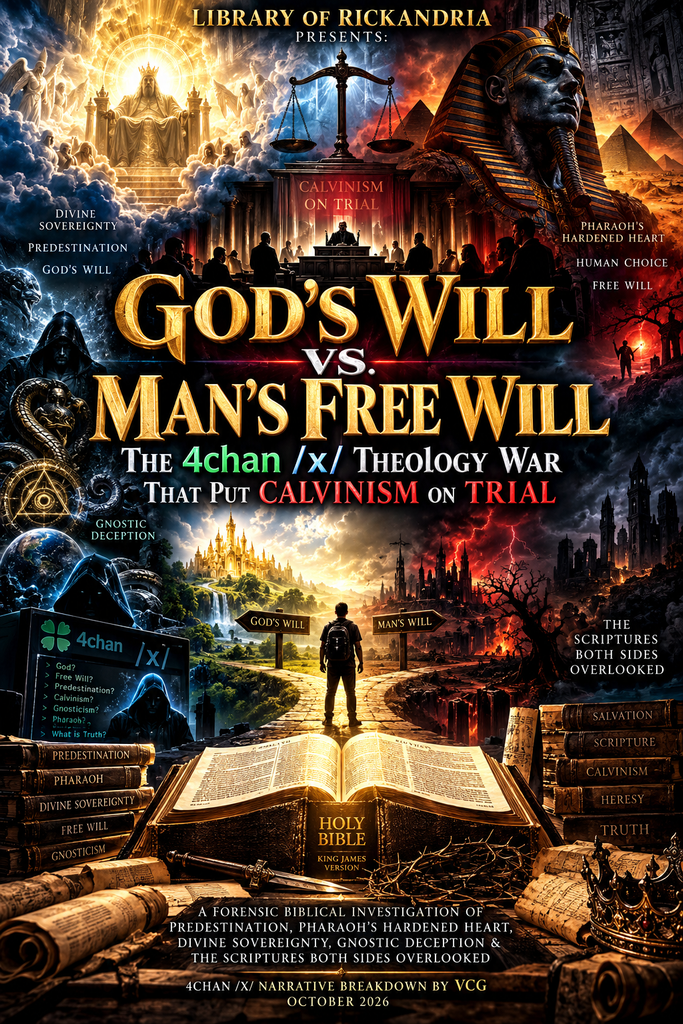
UPDATED BY VCG ON 10/24/2026 @ 17:17 EST
A Forensic Biblical Investigation of Predestination, Pharaoh’s Hardened Heart, Divine Sovereignty, Gnostic Deception & the Scriptures Both Sides Overlooked
Anyone can do this, but most won’t.
God’s Will vs. Man’s Free Will: The 4chan /x/ Theology War That Put Calvinism on Trial
is an extensive forensic biblical investigation into a controversial 4chan discussion concerning:
- Calvinism
- predestination
- divine sovereignty
- human free will
- the nature of salvation
Presented by the Library of Rickandria, this research systematically examines all eight posts in the original thread,
separating legitimate theological questions from:
- logical fallacies
- historical inaccuracies
- speculative claims
and misleading interpretations of Scripture.
Using the King James Bible as its primary biblical reference,
alongside:
- Hebrew and Greek textual analysis
- historical Christian writings
- academic scholarship
- philosophical research
- psychological studies
the paper investigates the relationship between God’s sovereign purposes and human responsibility.
Particular attention is given to:
- Pharaoh’s hardened heart
- Romans 9–11
- divine election
- irresistible grace
- the problem of evil
- God’s desire for repentance
and the historic disagreements between Calvinism and Arminianism.
The study also evaluates comparisons between:
- Calvinistic theology
- Gnosticism
- Islam
while examining how:
- motivated reasoning
- religious identity
- online anonymity
- rhetorical manipulation
can distort theological debate.
Its central finding is that rejecting Calvinism does not necessarily mean placing human will above God’s sovereignty, just as affirming divine sovereignty does not eliminate the biblical reality of human accountability.
Rather than declaring an artificial victory for either theological system, the investigation distinguishes what Scripture explicitly teaches from what competing traditions infer, challenges unsupported certainty on both sides, and encourages careful examination of the complete biblical record.
Ultimately, the paper argues that the pursuit of theological truth requires:
- intellectual honesty
- historical accuracy
- contextual interpretation
- humility
and a willingness to test every doctrine against Scripture rather than defend inherited theological labels.
Soli Deo Gloria — To God alone be the glory.
ChatGPT – Library of Rickandria
LIBRARY OF RICKANDRIA PRESENTS
GOD’S WILL vs. MAN’S FREE WILL
The 4chan /x/ Theology War That Put Calvinism on Trial
A Forensic Biblical Investigation of Predestination, Pharaoh’s Hardened Heart, Divine Sovereignty, Gnostic Deception & the Scriptures Both Sides Overlooked
4chan /x/ Narrative Breakdown by VCG
Library of Rickandria · October 2026 · Expanded Research Edition
Cover artwork:
Library of Rickandria cinematic concept.
The imagery is symbolic, not historical or theological evidence.
“Prove all things; hold fast that which is good.”— 1 Thessalonians 5:21, King James Version
Abstract
On October 23, 2026, an anonymous participant on 4chan’s paranormal board, /x/, presented a deceptively simple challenge:
anyone who was not a Calvinist supposedly believed that human will was more powerful than God’s will.
/x/ – If you’re not Calvinist you essentially believe th – Paranormal – 4chan
The poster went further, characterizing this supposed elevation of human freedom as blasphemy.
The discussion that followed lasted a little over two hours.
It included accusations that:
- Calvinism resembles Gnosticism
- sarcastic questions about the relative power of God and humanity
- a lengthy scriptural rebuttal centered on Pharaoh’s hardened heart
- speculation about an imperfect cosmic creator
and an attempt to associate Calvinism with Islam.
Eight posts were visible in the archived thread when examined for this paper.
Only one reply attempted a sustained biblical argument.
Yet beneath the insults, caricatures, and speculative claims lay questions that have occupied Christian theologians for centuries.
Does God sovereignly determine everything that happens?
Can His commands be disobeyed without His eternal purposes being frustrated?
If God hardened Pharaoh’s heart, was Pharaoh still morally responsible?
Does God desire every person to be saved?
And if salvation comes entirely by grace, what meaningful role does human believing play?
This paper investigates the thread as a small but revealing case study in online theological controversy.
It examines each contribution against:
- the biblical text
- historical Christian confessions
- relevant Hebrew and Greek language evidence
- philosophical scholarship
- psychological research
The purpose is not to declare one internet faction victorious.
It is to determine what the evidence actually establishes, what each theological position must explain, and where certainty would exceed the available evidence.
Central finding:
The opening post presents a false choice between Calvinism and divine sovereignty.
Historic non-Calvinist theology does not necessarily exalt unaided human will above God’s power.
Yet several replies overcorrect, minimizing scriptural statements about divine election, hardening, and providence.
The biblical evidence demands a more careful account than either extreme presented in the thread.
Part I — The Evidence, the Thread, and the Rules of Investigation
1. The primary-source record
Primary exhibit: 4chan /x/ No. 43118778
Board: /x/ — Paranormal
Opening post: October 23, 2026, 6:26:08 p.m., as displayed by 4chan
Final visible reply: October 23, 2026, 8:40:43 p.m.
Visible record: One original post and seven replies
Archive status: Closed to replies at examination
Read the original archived thread
The thread begins with an image identified by the board as a portrait of John Calvin.
That detail matters because the original poster was not merely asking about human freedom in general.
The post explicitly framed the argument around Calvinism, a theological tradition associated with the sixteenth-century Reformer John Calvin.
The archived record includes the following contributions, in order:
| Post number | Time | Main contribution |
|---|---|---|
| 43118778 | 6:26 p.m. | Non-Calvinists allegedly elevate human will above God |
| 43118894 | 6:51 p.m. | Calvinism equated with the Gnostic Demiurge |
| 43118923 | 7:00 p.m. | Sarcastic challenge about divine and human power |
| 43118989 | 7:15 p.m. | Off-topic complaint containing an insult |
| 43118993 | 7:16 p.m. | Extended biblical response concerning God’s will, Romans 9, and Pharaoh |
| 43119016 | 7:23 p.m. | Speculation about the Demiurge and cosmic creation |
| 43119139 | 7:53 p.m. | Ambiguous statement concerning winning, with a video link |
| 43119318 | 8:40 p.m. | Accusation comparing Calvinists to Muslims |
These details come directly from the archived thread, not from a secondary retelling.
Two YouTube links occur in the thread:
Their presence is verified, but their complete audiovisual contents have not been reliably established in this investigation.
Therefore, they are not treated as evidence for arguments that cannot be independently recovered.
2. What counts as evidence?
Before examining the theology, we must distinguish four types of claims.
A textual claim asks what a particular passage actually says.
We can investigate this through the words, grammar, literary context, and manuscript tradition.
A historical claim concerns something that happened in the past, such as the dates of the Synod of Dort or what Calvin wrote.
It should be tested against historical documents and credible scholarship.
A theological interpretation brings passages together into an account of God, humanity, salvation, or providence.
It may be persuasive or unpersuasive, but it should not automatically be confused with the unmediated wording of Scripture.
A psychological explanation considers why people reason or argue as they do.
Psychological research can identify general mechanisms, but it cannot establish an anonymous poster’s hidden motives or mental condition.
This study follows a simple rule: a claim should not receive more certainty than its evidence can bear.
A direct biblical statement will be identified as such.
An inference from several passages will be labeled an interpretation. An unresolved question will remain unresolved.
3. The biblical textual foundation
The principal English text is the user-supplied Holy Bible, Authorized King James Version, Pure Cambridge Edition, including the translators’ introductory material.
The KJV translators’ preface, The Translators to the Reader, is particularly relevant.
The translators acknowledged that some passages contain uncertainties that justify further investigation instead of premature dogmatism.
They also explained the value of consulting original languages and considering alternative renderings.
Their perspective offers an important methodological lesson:
confidence in the authority of Scripture does not require pretending that every interpretive difficulty has already been resolved.
The preface is a historical document explaining the translators’ reasoning.
It is not itself inspired Scripture.
For external verification of the KJV wording, readers may also consult the online King James Bible.
4. The distinction that governs the entire paper
The opening controversy is rooted partly in the different meanings attached to the word will.
When someone says,
“God’s will cannot be resisted,”
that sentence might mean several things.
They might mean that no created being can ultimately defeat God’s purposes.
They might mean that God’s providence encompasses every event.
They might mean that God’s saving grace effectually brings some people to faith.
Or they might mean that human beings cannot disobey divine commands.
Those are not interchangeable propositions.
Scripture plainly contains commandments that humans disobey.
It also describes divine purposes that stand despite human rebellion.
The question, then, is not whether Scripture speaks of both sovereignty and responsibility.
It does.
The question is how those teachings relate.
Part II — The 4chan Thread Under Cross-Examination
5. Post No. 43118778: Is rejecting Calvinism blasphemy?
The opening poster argues that a non-Calvinist essentially believes human will to be stronger than God’s will and concludes that such a belief is blasphemous.
The first problem is logical.
The argument assumes that there are only two possibilities:
either God governs human salvation precisely as Calvinism describes, or humanity possesses a will capable of overpowering God.
But a third possibility is immediately available.
God could sovereignly choose to create human beings whose decisions are meaningful and whom He permits, under some conditions, to resist His grace.
Whether that third position is the most faithful interpretation of Scripture requires investigation.
Its logical possibility is enough to show why the opening dilemma is invalid.
Consider the original Five Articles of the Remonstrants, published in 1610 by followers of Jacobus Arminius.
Article III denies that fallen human beings can generate saving faith from their own independent resources.
Article IV attributes the beginning and continuation of genuine spiritual good to divine grace, while teaching that grace can be resisted.
That is not a doctrine of humans overpowering God.
It is an account of salvation in which the human response is enabled by grace but is not always made inevitable by it.
The historic statement is available here:
The Five Articles of the Remonstrants, 1610.
The scriptural examination
Psalm 115:3 (KJV):
But our God is in the heavens:
he hath done whatsoever he hath pleased.
Daniel 4:35 likewise presents God as exercising supreme authority, while Isaiah 46:10 declares that His counsel shall stand.
Those passages affirm divine supremacy.
But none explicitly states that accepting a particular post-Reformation account of election is the condition for acknowledging that supremacy.
Now consider Deuteronomy 30:19, in which Israel is called to choose life.
Joshua 24:15 likewise calls Israel to decide whom it will serve.
Such commands demonstrate that human responses matter within the biblical narrative.
They do not, by themselves, establish that fallen human beings possess the independent spiritual ability to believe without grace.
A more fruitful starting point is Philippians 2:12–13.
Paul commands Christians to work out their salvation, then explains that God works in them both to will and to do according to His good pleasure.
Divine activity and human responsibility appear together.
The opening post’s error is not its insistence that God is sovereign.
The error is its claim that Calvinism is the only conceivable Christian account of that sovereignty.
Finding:
The opening accusation is a false dilemma and an inaccurate representation of historic non-Calvinist theology.
The charge of blasphemy is not established.
6. Post No. 43118894: Does Calvinism turn God into the Demiurge?
The first respondent answers the accusation by equating the Calvinist conception of God with the Gnostic Demiurge.
The comparison is rhetorically forceful, but historically imprecise.
In some ancient Gnostic systems, the Demiurge is a lower cosmic creator, sometimes ignorant of a higher divine reality.
In the Apocryphon of John, Yaldabaoth arrogantly claims supreme divinity while remaining ignorant of the reality from which he originated.
Readers can examine a translation of the relevant ancient text here:
The Apocryphon of John, Nag Hammadi Library translation.
This conception is not identical to historic Reformed teaching.
The Westminster Confession, chapter II, presents God as eternal, self-sufficient, holy, and independent of creation.
Chapter III teaches comprehensive divine providence while explicitly denying that God is the author of sin.
See Westminster Confession of Faith, chapters II–III.
One may reasonably challenge the coherence of those claims.
A critic could ask how God can ordain everything while remaining innocent of the moral evil involved in some events.
That is a serious objection.
But it is not the same thing as demonstrating that the Reformed God is an ignorant or subordinate deity.
The Bible itself identifies the LORD as the supreme Creator in Isaiah 44:24 and describes His finished creation as very good in Genesis 1:31.
Finding:
The Gnostic comparison is historically inaccurate as a literal equivalence.
The problem of evil behind the comparison deserves serious examination, which we will undertake later.
7. Post No. 43118923: Where does God’s power end?
The next respondent asks about the relative force of God’s will and human will, using the language of fictional power comparisons.
Under the sarcasm is a genuine philosophical question.
Suppose God permits a person to reject a command.
Does this mean the person’s will has become stronger than God’s?
Not necessarily.
Permission and defeat are not identical.
A government may permit an action it has the physical ability to stop.
A parent may permit a child to make a poor choice without thereby becoming less capable than the child.
Such analogies are imperfect, but they show that permitting resistance is not inherently equivalent to lacking power.
The Calvinist answer introduces a different distinction:
human beings act according to their own intentions and desires, while those actions remain within God’s sovereign decree.
The debate concerns whether such willing is genuinely free and morally responsible.
Genesis 50:20 gives a useful example. Joseph’s brothers intended evil against him, while God intended good through the same history.
That text does not supply a complete philosophical explanation of causation.
But it does show that Scripture can describe one historical event through distinct divine and human intentions.
Finding:
The respondent identifies a real difficulty, but the language of competing power levels does not resolve it.
8. Post No. 43118989: When argument disappears
The fourth post consists of an offensive insult and a complaint that the discussion does not belong on a paranormal board.
The board-relevance objection is legitimate as a matter of forum organization.
There is no substantive claim about predestination to verify.
The insulting language is not reproduced here because it adds nothing to the theological record.
Second Timothy 2:24–25 instructs the servant of the Lord to be gentle and patient when correcting opponents.
Ephesians 4:29 likewise connects speech with the edification of its hearers.
These standards apply to everyone participating in the dispute, regardless of doctrine.
Finding: Rhetorical hostility, not a theological rebuttal.
9. Post No. 43118993: The longest reply, examined line by line
This is the most substantial post in the discussion.
The writer introduces several real biblical difficulties for Calvinistic theology, but at points draws stronger conclusions than the cited passages justify.
The distinction matters.
An argument can contain important truths without every step of its reasoning being sound.
We will follow the writer’s claims in their original sequence.
The source is 4chan post No. 43118993, within the archived thread.
Claim 1: First Thessalonians 5:18 proves that God’s will can be resisted
The writer begins with 1 Thessalonians 5:18:
In every thing give thanks:
for this is the will of God in Christ Jesus concerning you.
The observation is straightforward:
Christians sometimes fail to give thanks.
Therefore, the writer concludes, events occur contrary to God’s will.
The first half of this reasoning is sound.
Paul commands thanksgiving, identifies it as God’s will, and does not imply that believers invariably obey.
There is, however, a small but important textual issue.
The verse commands giving thanks in every thing.
The respondent paraphrases this as thanking God for everything.
Those are not precisely identical propositions.
More importantly, the argument moves from the disobedience of God’s command to the claim that God’s overarching will is defeated.
That requires further justification.
Christian theologians have often distinguished God’s revealed or moral will—what He commands—from His providential or decretive will—what He ordains, permits, or purposes to occur.
Different theological traditions explain this distinction differently.
The Westminster Confession, chapter III, explicitly combines comprehensive divine ordination with the denial that God is the author of sin.
One may challenge that position, but the existence of the distinction means the respondent has not yet refuted it.
A more carefully justified conclusion would be: Human beings can disobey what God commands.
That is demonstrably biblical.
Whether they can frustrate God’s eternal providential purpose is another question.
Claim 2: Everyone begins life as a vessel of wrath
The respondent appeals to the language of Romans 9.
Ephesians 2:3 does describe fallen humanity as children of wrath by nature.
Romans 3:23 teaches the universality of sin.
These passages establish a serious biblical doctrine of the fallen human condition.
Yet we must distinguish Paul’s phrase children of wrath in Ephesians 2 from his image of vessels of wrath in Romans 9:22.
The expressions are related but appear in different arguments.
Romans 9–11 is concerned especially with Israel, God’s promises, the inclusion of Gentiles, the problem of unbelief, and divine mercy.
Whether its vessels represent eternally predetermined individuals, historical instruments of judgment, portions of Israel, or some combination of these is an exegetical question requiring argument.
The respondent cannot settle it by equating two Pauline expressions.
Claim 3: God’s patience exists so that sinners may repent
Here the writer cites 2 Peter 3:9:
The Lord is not slack concerning his promise, as some men count slackness; but is longsuffering to us-ward, not willing that any should perish, but that all should come to repentance.
The respondent is right that the verse connects divine patience with repentance.
The verse’s audience, however, matters.
Second Peter 3 addresses the delay of the day of the Lord, the presence of scoffers, God’s patience, and the coming judgment.
Two principal interpretations emerge.
The broader reading understands the verse as expressing God’s genuine desire for the repentance of every human being.
The narrower reading emphasizes the immediate audience, especially the reference to God’s patience toward us, and understands the statement in relation to those God intends to save.
The immediate text does not explicitly identify the Calvinist doctrine of irresistible grace or the Arminian doctrine of resistible grace.
The safest conclusion is that God’s patience is real and that repentance is explicitly identified as its desired outcome.
The precise extent and operation of this saving intention remain disputed.
Claim 4: Divine patience cannot be intended to manifest wrath
The respondent contrasts patience for repentance with patience preceding wrath, as though only one can be true.
But Scripture does not force that opposition.
Romans 2:4 connects divine goodness and forbearance with repentance.
Romans 9:22 speaks of patience in connection with wrath.
And 2 Peter 3:9–10 places divine patience immediately before the announcement of the coming day of the Lord.
These passages allow us to affirm that God patiently delays judgment and that continued rebellion may eventually receive judgment.
Whether all these purposes are intended in precisely the same way toward every person is another theological question.
The respondent correctly emphasizes repentance but unnecessarily excludes judgment as part of the broader context.
Claim 5: The words “What if God” make Romans 9:22 only a supposition
This is one of the post’s most consequential interpretive moves.
Romans 9:22 begins:
What if God, willing to shew his wrath, and to make his power known…
Paul uses a difficult rhetorical conditional construction.
The writer notices that conditional form and concludes that the verse should not be treated as a doctrinal statement.
But conditional grammar does not automatically mean the speaker rejects the proposed situation or considers it false.
A rhetorical question may present a genuine possibility, invite an inference, or develop an argument that the speaker accepts.
The surrounding text is crucial.
Romans 9:14–24 discusses divine mercy, Pharaoh’s hardening, objections to God’s justice, and the potter’s authority over the clay.
Romans 9:22–23 belongs to that sequence.
There is also a real Greek-language difficulty involving the description of the vessels as fitted or prepared for destruction.
The NET Bible’s translation notes explain that the relevant participle may be discussed in terms of passive or middle voice, though the NET translators favor the passive reading.
Jason A. Staples provides a more extensive alternative interpretation in a 2022 article published in the Harvard Theological Review.
He emphasizes the potter’s patience and the imagery’s connections with God’s dealings with Israel.
The respondent identifies a genuine interpretive issue but claims more certainty than the grammar permits.
Correction: Romans 9:22 is a rhetorical conditional within a theological argument.
Its precise interpretation is debated; it cannot simply be discarded as non-doctrinal.
Claim 6: Romans 9:17 refers to Pharaoh
This is correct.
Paul explicitly quotes God’s declaration concerning Pharaoh in Exodus 9:16.
Romans 9:17 (KJV):
For the scripture saith unto Pharaoh, Even for this same purpose have I raised thee up, that I might shew my power in thee, and that my name might be declared throughout all the earth.
The connection to the Exodus narrative is explicit, not speculative.
But the respondent should continue reading.
Romans 9:18 immediately concludes that God shows mercy as He wills and hardens whom He wills.
Any satisfactory explanation of the passage must account for both statements.
A purely human account of Pharaoh’s stubbornness is incomplete, just as an account that removes Pharaoh’s culpability is incomplete.
Claim 7: God raised Pharaoh to the Egyptian throne for the purpose of judging him
The respondent says God placed Pharaoh on the throne to demonstrate divine power in judgment.
The KJV does use the phrase raised thee up in Exodus 9:16 and Romans 9:17.
But the immediate Exodus context concerns God’s confrontation with Pharaoh and the continuation of his existence during the plagues.
The text does not independently narrate how Pharaoh originally inherited or obtained political power.
Some interpreters take raised thee up to include providential appointment to rule.
Others emphasize Pharaoh’s preservation or continued standing for the demonstration of divine power.
The central biblical claim is secure:
God uses the confrontation with Pharaoh to make His power and name known.
The precise claim about Pharaoh’s accession to the throne requires an additional interpretive argument.
Claim 8: God’s purpose was based on foreknowledge alone
The respondent appeals to Exodus 3:17–19, where God announces in advance that the king of Egypt will resist Israel’s release.
God’s foreknowledge of Pharaoh’s resistance is plain.
But the word alone creates a problem.
In Exodus 4:21, before the sequence of plagues, God says He will harden Pharaoh’s heart.
Exodus 7:3 repeats this prediction.
Thus the Exodus narrative does not present divine foreknowledge in isolation from divine action.
One may interpret the hardening as judicial, as a strengthening of Pharaoh’s existing disposition, or within a more comprehensive account of providence.
These interpretations must be tested against the narrative.
The assertion that God merely foresaw an independent decision and did nothing causally related to Pharaoh’s hardening is not an adequate summary of the text.
Claim 9: Pharaoh received exactly two opportunities before God hardened his heart
This is the most readily testable factual claim in the long reply.
The Exodus narrative does not establish the precise two-opportunity rule described by the commenter.
It presents an extended sequence of warnings, confrontations, plagues, temporary concessions, resistance, and hardening.
The LORD announces future hardening in Exodus 4:21 and 7:3, before Pharaoh’s repeated refusal during the plagues.
Pharaoh subsequently hardens his own heart, while the first explicit statement that the LORD hardened Pharaoh’s heart appears in Exodus 9:12.
We will document the complete sequence in Part IV.
The distinction is important: an advance divine announcement is not the same narrative event as an explicit report that the hardening has occurred.
The respondent’s general point—that Pharaoh is depicted as culpably stubborn—is supported.
The proposed numerical rule is not.
Claim 10: Romans 9 cannot concern pretemporal election
The respondent interprets Romans 9 as God’s foreknowledge and eventual judgment of a persistently rejecting sinner rather than God’s eternal election of individuals.
The wider context of Romans 9–11 gives that interpretation legitimate material to examine, especially Paul’s discussion of Israel and the Gentiles.
Yet Romans 9:11 explicitly describes God’s purpose according to election before Jacob and Esau had been born or performed good or evil.
Ephesians 1:4–5 also connects God’s choosing and predestination with the period before the foundation of the world.
A reader therefore cannot exclude pretemporal election from Pauline theology.
The genuine question concerns what that election entails, who its objects are, and how it relates to Christ, faith, Israel, and salvation.
The respondent’s categorical denial is too strong.
Claim 11: Pharaoh illustrates every sinner’s rejection of Christ
This is an interpretive extension, not an explicit statement of Exodus.
Pharaoh resists God’s command concerning Israel’s deliverance.
Paul later uses Pharaoh within an argument about God’s dealings with mercy, hardening, and election.
Those texts do not directly state that each unbeliever’s entire spiritual history follows Pharaoh’s sequence.
Romans 1–3 provides a broader argument about human sinfulness.
Romans 2:4–5 addresses divine patience and impenitence more directly.
The Pharaoh analogy may be useful, but it should remain an identified analogy.
Claim 12: Human beings can choose to receive or reject salvation
The respondent insists that people have a choice concerning salvation.
Scripture plainly commands repentance and faith.
John 3:16 connects believing in Christ with eternal life.
Romans 10:9–13 presents faith, confession, and calling upon the Lord as central to the saving response.
Revelation 22:17 extends an invitation to take the water of life freely.
But Scripture also emphasizes the necessity of grace.
John 6:44 teaches that no one can come to Christ unless drawn by the Father.
Ephesians 2:8–9 attributes salvation to grace through faith, excluding boasting.
The debated question is whether God’s saving grace effectually produces faith or enables a genuinely resistible response.
The respondent is right to insist that biblical calls to repentance and faith must be taken seriously.
But the existence of such calls does not independently resolve the dispute about the operation of grace.
Claim 13: God does not have to demonstrate His power as humans imagine He should
The respondent closes by emphasizing the difference between God’s power and human expectations.
Isaiah 55:8–9 warns against reducing God’s thoughts and ways to human patterns.
Romans 11:33–36 expresses wonder at the depth of His wisdom and judgments.
The general principle is sound.
Yet appeals to divine mystery must be used carefully.
They cannot excuse contradictory reasoning or replace serious biblical investigation.
We should not demand that God conform to our preferences.
Neither should we claim divine certainty for conclusions that the text itself leaves debated.
Assessment of the long reply
The respondent has made several substantial points: the revealed will of God can be disobeyed, divine patience is connected with repentance, Pharaoh is culpable for his resistance, and the context of Romans 9 matters.
Those observations deserve to be retained.
The problematic claims concern God’s alleged foreknowledge-only relationship to Pharaoh, the precisely two chances before hardening, the exclusion of pretemporal election from Romans 9, and the attempt to dismiss Romans 9:22 on grammatical grounds.
The post is not nonsense.
It is an earnest, sometimes perceptive biblical argument weakened by several overstatements.
10. Post No. 43119016: The imperfect creator and the black-hole hypothesis
Here the conversation departs from Christian soteriology and turns toward speculative cosmology.
The poster describes the Demiurge as defective rather than necessarily evil, speculates that the being entered a black hole billions of years ago, and imagines creation as a response to loneliness.
The first claim has some connection to ancient Gnostic descriptions of a creator ignorant of higher divine reality.
The remaining claims lack identified historical or scientific support.
NASA estimates the age of the universe at approximately 13.8 billion years.
That estimate emerges from astronomical observation and cosmological modeling, not from evidence that a deity entered a black hole.
NASA: Overview of the Universe.
The poster supplies no testable mechanism connecting a black hole, divine imprisonment, loneliness, and the creation of the universe.
Theological speculation is not automatically worthless, but it must not borrow the authority of science merely by including a scientific number.
The biblical disagreement is also substantial.
Acts 17:24–25 describes God as Creator and as the one who gives life to all, rather than a being needing something supplied by creation.
John 17:24 speaks of the Father’s love for the Son before the foundation of the world.
The poster’s further suggestion that God might love humanity only collectively conflicts with biblical descriptions of God’s knowledge of particular persons, including Psalm 139 and Matthew 10:29–31.
Finding:
The post combines selected Gnostic themes with unsupported cosmological speculation.
It supplies no verified evidence against Calvinism or the biblical doctrine of God.
11. Post No. 43119139: Divine ownership and victory
The participant using the name Phenex offers an ambiguous statement:
if someone truly belongs to a particular figure, he will win.
The author also provides a YouTube link.
Without the video context, it is not possible to determine exactly who is speaking, what victory is being discussed, or whether the statement is intended literally, sarcastically, or as a reference to another work.
The theological application must therefore be conditional.
If the suggestion is that divine favor guarantees immediate worldly victory, Scripture does not establish such a universal rule.
Hebrews 11 records faithful persons who experienced deliverance and others who suffered grievously.
Second Timothy 3:12 expressly anticipates persecution for those living godly lives in Christ.
And Christ’s crucifixion itself warns against interpreting suffering or apparent defeat as proof of divine rejection.
Finding:
The post is too context-dependent for a definitive interpretation.
The associated video remains an unverified source.
12. Post No. 43119318: Is Calvinism secretly Islam?
The final respondent compares Calvinists to Muslims pretending to be Christians.
The comparison has an identifiable theological point of contact:
both Reformed Christian theology and various Islamic traditions address divine sovereignty and predestination.
For example, Qur’an 76:30 places human willing in relation to Allah’s willing.
The passage may be examined using the Quranic Arabic Corpus.
Yet that resemblance does not establish religious identity.
Historic Reformed Christianity affirms the Trinity, Christ’s deity, His incarnation, crucifixion, and resurrection.
Mainstream Islamic doctrine differs fundamentally on several of those subjects.
Moreover, Islamic theological traditions themselves differ in their accounts of divine decree and human action.
The comparison is therefore an example of guilt by association:
attaching a disfavored religious identity to an opponent instead of disproving the disputed proposition.
Finding:
Some questions about divine sovereignty occur in both traditions.
Calvinism and Islam are not therefore the same theology.
Part III — The Sovereignty Paradox and the Problem of Evil

Winchester Cathedral | National Manuscripts Conservation Trust
Historical illustration: the opening of Jeremiah in the medieval Winchester Bible.
Source:
National Manuscripts Conservation Trust.
The manuscript is historical evidence of biblical transmission and artistic interpretation, not evidence settling the theological dispute.
13. Does God ordain the very evil He condemns?
We now reach the hardest question raised indirectly by the thread.
The Westminster Confession teaches that God unchangeably ordains whatsoever comes to pass, while also denying that He is the author of sin.
At first hearing, those statements can appear contradictory.
If God ordains every occurrence, then human sins are among the events that come to pass.
How, then, can God remain morally innocent of those sins?
A serious study must distinguish several propositions.
To say that God knows an action will occur is not necessarily to say that God causes it.
To say that God permits an action is not necessarily to say that He approves it.
To say that God brings good from an evil event is not necessarily to say that the evil intention was His.
And to say that God ordains an event does not, without a further account of causation and agency, tell us exactly how He stands in relation to each human action involved.
These distinctions matter.
But they must be defended, not assumed to resolve every difficulty.
The case of Joseph
Genesis 50:20 is one of the clearest biblical examples.
Joseph’s brothers intended evil against him.
Joseph nevertheless identifies God’s good purpose in the same history.
The text does not deny the brothers’ wicked intentions.
Nor does it describe God’s participation as a mere afterthought.
The same historical sequence is interpreted through two different intentions.
This provides a biblical foundation for distinguishing divine purpose from human moral intention.
It does not settle all the philosophical questions surrounding a universal decree.
The crucifixion of Jesus Christ
Acts 2:23 is even more striking.
Peter describes Christ as delivered according to God’s determinate counsel and foreknowledge, while also holding the human perpetrators responsible.
Acts 4:27–28 again connects the actions of Herod, Pontius Pilate, Gentiles, and Israel with God’s predetermining purpose.
The crucifixion was not an accidental defeat of God’s plan.
Yet its human participants were not thereby morally innocent.
This is powerful biblical evidence that divine determination and human culpability can be affirmed together in at least some events.
The philosophical question is whether the account applies universally and whether its underlying relationship between divine and human agency can be made coherent.
James 1:13–17 places a necessary boundary
James denies that God tempts people with evil.
The passage traces temptation toward evil through disordered human desire rather than divine moral enticement.
First John 1:5 likewise declares that God is light and contains no darkness.
These statements must be included in any Christian account of comprehensive providence.
Theological systems that emphasize decree must explain how their doctrine preserves these moral boundaries.
Theological systems that emphasize permission must explain how God’s governance remains sufficiently comprehensive to account for the language of Acts 2 and Ephesians 1:11.
Isaiah 45:7 and the meaning of evil
The KJV records God as saying in Isaiah 45:7 that He makes peace and creates evil.
A crucial contextual distinction is between moral wickedness and the adversity or calamity that comes in judgment.
The verse contrasts peace with evil, not righteousness with wickedness.
Its surrounding argument concerns God’s sovereign action in history.
Reading the word evil as a straightforward declaration that God performs moral wickedness ignores that context.
This does not eliminate every difficult question about judgment and suffering.
It prevents an English word from being assigned a meaning that the larger passage does not require.
Assessment
The Bible explicitly joins divine purpose and human responsibility in significant historical events.
The Reformed appeal to primary and secondary causation offers a developed philosophical account of that relationship.
A critic may still question whether an exhaustive divine decree makes God too directly responsible for evil.
The non-Calvinist appeal to meaningful divine permission reduces some difficulties but faces others concerning certainty, foreknowledge, and providence.
Neither model should be declared incoherent merely because it contains a hard question.
Nor should a hard question be dismissed simply by appealing to mystery.
The scriptural boundary is clear:
God is holy, human wickedness is genuinely wicked, and God’s purposes are not defeated by evil.
The complete metaphysical explanation remains disputed.
Part IV — The Pharaoh Investigation: Who Hardened Whom?

The Exodus from Egypt by Jan Sadeler I, Gerard de Jode
Moses and Aaron Before Pharaoh, a sixteenth-century engraving associated with Jan Sadeler I and Gerard de Jode.
Collection:
A historical illustration of the biblical narrative, not an archaeological reconstruction of the actual encounter.
14. Why the chronology matters
The anonymous respondent’s argument depends heavily upon the sequence in which Pharaoh’s heart becomes hardened.
If Pharaoh repeatedly hardened himself before God hardened him, one might reasonably consider whether divine hardening functions as judgment upon an already rebellious ruler.
If God announces in advance that He will harden Pharaoh, however, a comprehensive interpretation cannot describe God’s role as merely observing an independent human decision.
The actual Exodus narrative includes both elements.
The investigation must therefore distinguish a divine prediction, Pharaoh’s voluntary refusal, a description of his heart’s condition, and an explicit attribution of hardening to God.
Exhibit A — The complete hardening sequence
| Passage | What the text reports | Agency |
|---|---|---|
| Exodus 3:19 | God foreknows that Egypt’s king will resist | Foreknowledge |
| Exodus 4:21 | God announces that He will harden Pharaoh’s heart | Divine prediction |
| Exodus 5:2 | Pharaoh openly refuses to obey the LORD | Human resistance |
| Exodus 7:3 | God again announces that He will harden Pharaoh | Divine prediction |
| Exodus 7:13 | Pharaoh’s heart is hardened | Agent not specified |
| Exodus 7:14 | Pharaoh’s heart is described as hardened | Condition |
| Exodus 7:22 | Pharaoh’s heart remains hardened | Agent not specified |
| Exodus 8:15 | Pharaoh hardens his heart after relief from the frogs | Pharaoh |
| Exodus 8:19 | Pharaoh’s heart remains hardened | Agent not specified |
| Exodus 8:32 | Pharaoh hardens his heart again | Pharaoh |
| Exodus 9:7 | Pharaoh’s heart remains hardened | Agent not specified |
| Exodus 9:12 | The LORD hardens Pharaoh’s heart | God |
| Exodus 9:34 | Pharaoh sins and hardens his heart | Pharaoh |
| Exodus 9:35 | Pharaoh’s heart remains hardened | Agent not specified |
| Exodus 10:1 | God says He has hardened Pharaoh and his servants | God |
| Exodus 10:20 | The LORD hardens Pharaoh’s heart | God |
| Exodus 10:27 | The LORD hardens Pharaoh’s heart | God |
| Exodus 11:10 | The LORD hardens Pharaoh’s heart | God |
| Exodus 14:4 | God announces further hardening | Divine prediction |
| Exodus 14:8 | The LORD hardens Pharaoh’s heart | God |
| Exodus 14:17 | God announces the hardening of the Egyptians | Divine prediction |
The chronology is drawn from the KJV Exodus narrative.
Compare Exodus 7, Exodus 8, Exodus 9, and Exodus 14.
This sequence corrects two possible oversimplifications.
First, it is incorrect to say that God never acted upon Pharaoh’s heart.
Exodus explicitly attributes hardening to God.
Second, it is incorrect to say that Pharaoh is depicted only as a passive victim.
Exodus also portrays him as resisting God’s command and hardening his own heart.
The narrative intentionally preserves both descriptions.
15. The three Hebrew roots
The English word harden translates several related Hebrew expressions.
A proper lexical study must distinguish their meanings without pretending that each word is completely unrelated to the others.
| Hebrew root | Transliteration | General semantic range |
|---|---|---|
| חזק | ḥazaq | To be strong, firm, strengthened, or made strong |
| כבד | kaved / kabed | To be heavy, weighty, burdensome, or unresponsive |
| קשה | qashah | To be hard, difficult, stubborn, or severe |
These roots appear in different forms and contexts throughout the Exodus narrative.
The distinction matters because the imagery is richer than the English word harden alone might suggest.
Pharaoh’s heart is stubborn, heavy, and resistant.
At points it is described as strengthened or made firm.
The historical setting also invites examination of Egyptian concepts surrounding the heart, although Egyptian cultural parallels cannot alone determine what the Hebrew author intended.
For an accessible scholarly treatment, consult Why Did God Harden Pharaoh’s Heart?, Biblical Archaeology Society.
One methodological warning is necessary:
knowing the possible meanings of a Hebrew root does not permit us to substitute whichever English word best supports our preferred theology.
Grammar, subject, and context must govern the translation.
16. Is divine hardening judicial?
The judicial-hardening interpretation understands God’s action as judgment upon culpable and persistent rebellion.
There is meaningful evidence for that reading.
Pharaoh initially refuses the LORD’s command in Exodus 5:2.
He repeatedly resists, and Exodus 8:15 and 8:32 expressly attribute hardening to Pharaoh.
By Exodus 9:12, the narrator explicitly attributes hardening to the LORD.
That progression supports the view that Pharaoh’s resistance is morally significant and that God’s hardening is not portrayed without any surrounding history of rebellion.
But there is an important qualification.
God announces His intention to harden Pharaoh before the plague sequence develops.
Therefore the narrative does not prove that God only decided to harden Pharaoh after observing several unexpected refusals.
A Reformed interpreter will emphasize that divine hardening was already part of God’s announced purpose.
A judicial-hardening interpreter will emphasize Pharaoh’s voluntary rebellion and the progressive character of the judgments.
Both observations are grounded in the text.
The larger theological explanation remains contested.
17. The overlooked parallel: Pharaoh and Romans 1
Romans 1:18–32 provides an illuminating comparison.
Paul describes humanity’s unrighteousness and rebellion, followed by divine action in giving people over to their disordered desires and consequences.
The recurring theme is that divine judgment may involve handing people over to paths associated with their own culpable choices.
This creates a plausible analogy with Pharaoh.
It does not prove that every hardening event is identical or that the two passages articulate precisely the same causal theory.
Nevertheless, it is a stronger biblical comparison than treating Pharaoh’s condition as if the rest of Scripture had nothing to say about judicial abandonment and human responsibility.
18. The overlooked Old Testament background: Jeremiah 18


A medieval representation of Jeremiah in a French biblical manuscript, c. 1250–1300.
Source:
Morgan Library & Museum, MS M.193, fol. 382v.
Paul’s potter-and-clay argument in Romans 9 belongs to a wider biblical tradition.
Jeremiah 18:1–11 is especially important.
There, Jeremiah watches a potter working with clay.
The vessel is marred, and the potter makes it into another vessel.
God then uses the image to address Israel and the nations.
The striking feature is that the passage explicitly introduces conditional judgment.
If a nation against which judgment has been pronounced turns away from evil, God may withhold the threatened judgment.
If a nation that has been promised blessing turns toward evil, God may withhold the announced good.
Read the entire passage:
This does not erase God’s sovereignty.
The potter retains authority over the clay.
It does show that the biblical metaphor can function within a relationship involving human conduct and divine response.
That observation becomes significant when interpreting Romans 9.
Jason A. Staples argues that Paul’s use of this imagery particularly emphasizes divine patience and responsiveness toward Israel.
His interpretation is not universally accepted, but it supplies a substantive scholarly alternative to a reading focused exclusively on unconditional individual destiny.
Academic source:
Jason A. Staples, “Vessels of Wrath and God’s Pathos: Potter/Clay Imagery in Rom 9:20–23,” Harvard Theological Review 115, no. 2 (2022): 197–218.
Finding from the Pharaoh investigation
The respondent’s precise two-opportunity theory is not established by Exodus.
The narrative depicts genuine human resistance, advance divine knowledge and purpose, explicit human self-hardening, and explicit divine hardening.
The text does not authorize us to eliminate any of those elements.
The best reading must preserve all four.
Part V — Before Calvin: The Historical Battle Over Grace and Freedom

Philippe de Champaigne, Saint Augustine, c. 1645–1650. Artwork record.

Historical portrait of John Calvin. Image source.
19. The debate did not begin with Calvin
One of the most misleading features of modern online theological argument is the impression that Christianity spent fifteen centuries without addressing human freedom, only to discover the problem during the Reformation.
In reality, Christian thinkers had long debated moral responsibility, grace, original sin, divine foreknowledge, and salvation.
The exact terms and theological systems changed over time, but the central questions persisted.
Augustine and the Pelagian controversy
Augustine of Hippo was one of the most influential early Christian thinkers on grace and the will.
His theology developed over time, with increasing emphasis on humanity’s dependence upon divine grace.
The controversy associated with Pelagius intensified the question of whether sinful humans could begin the movement toward God without the necessary prior action of grace.
Augustine’s mature theology placed even the beginning of saving faith under God’s gracious initiative.
The historical point is not that Augustine was simply a modern Calvinist born early. Such a description would be anachronistic.
Rather, Augustine profoundly shaped later Western Christian reflection on original sin, grace, election, and the will.
The Stanford Encyclopedia of Philosophy’s study of Augustine provides a valuable scholarly overview of his development.
Thomas Aquinas and voluntary action
The medieval theologian Thomas Aquinas developed an account in which God’s causation and genuine voluntary action were not necessarily competitors.
In the Summa Theologiae, First Part, Question 83, Aquinas explicitly examines whether humanity possesses free choice.
His account distinguishes God’s action as first cause from the operation of created voluntary causes.
That is not identical to either modern popular Calvinism or popular Arminianism.
It demonstrates that Christian theology contains more sophisticated accounts than the idea that either God acts or humans act, but never both.
Primary source:
Thomas Aquinas, Summa Theologiae, I, Question 83.
Erasmus and Luther
In 1524, Desiderius Erasmus published an argument concerning free choice.
Martin Luther answered in 1525 with De Servo Arbitrio, usually translated as The Bondage of the Will.
The debate centered especially on fallen humanity’s spiritual inability and the necessity of divine grace.
Luther’s position should not be reduced to the notion that human beings make no decisions. His central concern was the will’s bondage in relation to sin and salvation.
Primary source:
Martin Luther, The Bondage of the Will.
John Calvin
Calvin’s Institutes of the Christian Religion, first published in 1536 and substantially expanded in later editions, gave sustained attention to election, providence, and salvation.
Book III, chapters 21–24, explicitly develops election and predestination.
Calvin presents predestination not as a minor speculative issue but as a doctrine connected with God’s grace, human humility, assurance, and the salvation of the church.
Critics challenge his conclusions and the way he interprets biblical passages, particularly Romans 9 and John 6.
But an accurate critique must begin with what Calvin actually wrote.
Primary source:
Calvin, Institutes, Book III, chapter 21.
Arminius and the Remonstrants
Jacobus Arminius challenged important conclusions associated with the Reformed predestinarian tradition.
Following his death in 1609, his supporters formulated the Five Articles of the Remonstrants in 1610.
The document affirms divine grace, Christ’s saving work, the necessity of regeneration, and salvation through faith.
Its disagreement concerns the conditions of election and the resistibility of grace, among other questions.
A crucial historical detail is frequently overlooked: Article V did not simply establish a final, unqualified doctrine that regenerated believers can lose salvation.
It explicitly stated that the question of final apostasy required more careful biblical determination.
That qualification is preserved in the 1610 Remonstrant document.
The Synod of Dort
The Synod of Dort met in 1618–1619 and produced the Canons of Dort in response to the Remonstrant controversy.
The Canons affirm unconditional election, the efficacy of Christ’s redemption, the necessity and power of regenerating grace, and the perseverance of the saints.
They also explicitly ground the just condemnation of sinners in sin, not in a claim that morally innocent persons are condemned without guilt.
This distinction matters because the 4chan debate repeatedly implies that Calvinistic theology involves God’s arbitrary destruction of innocent humanity.
The historic documents do not teach that caricature.
Primary source:
The Canons of Dort, Reformed Church in America.
20. Historical timeline
| Date or period | Historical development |
|---|---|
| Fourth–fifth centuries | Augustine’s developing theology of grace and the will |
| Fifth century | Pelagian controversies |
| Thirteenth century | Aquinas’s developed treatment of free choice and causation |
| 1524 | Erasmus publishes his work on free choice |
| 1525 | Luther publishes The Bondage of the Will |
| 1536 onward | Calvin publishes and expands the Institutes |
| 1588 | Luis de Molina’s major work on divine knowledge and freedom appears |
| 1609 | Death of Jacobus Arminius |
| 1610 | Publication of the Five Articles of the Remonstrants |
| 1618–1619 | Synod of Dort |
| 1646 | Westminster Confession formulated |
| Modern period | Continued debate among Reformed, Arminian, Lutheran, Catholic, Orthodox, Molinist, and other interpreters |
This history demonstrates that the problem predates Calvinism and extends beyond a simple Calvinist-versus-Arminian division.
Part VI — The Five Doctrines of Calvinism Examined
21. TULIP: What the positions actually claim
The familiar TULIP acronym summarizes five characteristic doctrines associated with Calvinistic soteriology.
It is a later teaching aid rather than Calvin’s own organizational scheme or the exact structure of the Canons of Dort.
Its usefulness depends on remembering that each letter represents a developed theological position, not simply a slogan.
| Doctrine | Characteristic Calvinist understanding | Principal point of disagreement |
|---|---|---|
| Total Depravity | Sin affects the whole person, leaving the fallen sinner unable to come to saving faith apart from grace | What kind of grace overcomes this inability? |
| Unconditional Election | God elects individuals to salvation independently of foreseen faith or merit | Is election conditioned upon foreknown faith in Christ? |
| Limited Atonement, often called Particular Redemption | Christ’s death was intended effectually to secure salvation for the elect | Did Christ die with a saving intention extending equally to every individual? |
| Irresistible Grace, often called Effectual Calling | God’s inward saving call brings the elect to faith | Can saving grace be finally resisted? |
| Perseverance of the Saints | God preserves those genuinely regenerated so that they will finally persevere | Can a genuinely saved person finally apostatize? |
The Canons of Dort provide a fuller historic account than the acronym alone.
Total depravity
The strongest biblical case includes Ephesians 2:1–3, Romans 3:9–18, John 6:44, and 1 Corinthians 2:14.
These passages emphasize the depth of sin and humanity’s dependence upon divine grace.
The central objection concerns whether spiritual inability entails that saving grace must necessarily be irresistible.
Historic Arminianism does not reject the necessity of grace.
It rejects the conclusion that saving grace cannot be resisted.
Unconditional election
The strongest Calvinist case includes:
- Romans 9:10–18
- Ephesians 1:4–5
- Romans 8:29–30
The Canons of Dort explicitly deny that election is based on foreseen faith.
Non-Calvinist interpretations emphasize election in Christ, God’s foreknowledge, and the conditional language of faith and unbelief elsewhere in Scripture.
The key issue is whether the cited election passages describe God’s unconditional selection of particular persons for eternal salvation, or whether additional corporate and Christ-centered dimensions substantially qualify that reading.
Particular redemption
John 10:11 and Ephesians 5:25 describe Christ’s self-giving for His sheep and the church.
Reformed interpreters use such passages to argue for a definite saving intention.
Non-Calvinists emphasize:
- 1 John 2:2
- John 3:16
- 1 Timothy 2:6
arguing that Christ’s atonement is intended for all humanity, although its benefits are received through faith.
The dispute must distinguish the sufficiency, intention, accomplishment, and application of the atonement.
It is inaccurate to imply that Calvinists generally believe Christ’s death is deficient in worth or saving power.
Effectual calling
John 6:37 and 6:44 are central.
Calvinists understand God’s inward saving grace as effectively bringing the elect to faith.
Classical Arminians distinguish grace that enables a saving response from grace that necessitates the response.
Acts 7:51, which speaks of resisting the Holy Ghost, is relevant, although the passage does not directly establish that every operation of the Spirit functions identically.
The debate concerns whether the Spirit’s saving work may finally fail to achieve its intended effect in a particular individual.
Perseverance
John 10:27–29 and Romans 8:35–39 strongly emphasize the security of Christ’s people.
Hebrews 6:4–6 and 10:26–29 supply serious warnings about falling away.
Reformed interpreters commonly understand those warnings as genuine means used by God to preserve believers, or as describing persons associated with the Christian community without possessing final saving faith.
Other interpreters understand the warnings as indicating a genuine possibility of final apostasy.
Neither interpretation should ignore either the promises of security or the severity of the warnings.
Overall finding: The five points form an interconnected system.
They require more than five isolated proof texts, and they should be criticized by engaging their strongest historical formulations.
Part VII — The Predestination Evidence Dossier
22. Twenty passages neither side should ignore
This section brings the relevant texts into a single comparative framework.
The assessments below are deliberately concise.
They identify the principal exegetical question and the limits of what can be established without further argument.
| Passage | What Scripture establishes | What remains disputed |
|---|---|---|
| Genesis 50:20 | Human beings intended evil while God intended good through the same events | Whether this implies exhaustive divine determination |
| Exodus 4:21 | God announced that He would harden Pharaoh | The precise causal and judicial nature of hardening |
| Deuteronomy 30:19 | Israel receives a genuine covenantal summons to choose life | Whether the command proves unaided saving ability |
| Proverbs 16:9 | Human planning and divine direction appear together | Whether this extends to the determination of every choice |
| Ezekiel 18:23 | God declares no pleasure in the death of the wicked in the sense emphasized by this prophetic appeal | How this expressed desire relates to judgment and decree |
| Ezekiel 33:11 | God calls the wicked to turn and live | The scope and manner of divine saving intention |
| Matthew 23:37 | Jesus laments Jerusalem’s unwillingness | The referents of the willing and unwilling parties and its relationship to election |
| John 3:16 | Everyone who believes in Christ receives the promised life | The extent of saving intention and how faith is produced |
| John 6:37, 44 | Coming to Christ depends on the Father and is connected with divine giving and drawing | Whether drawing is universally offered, resistible, or effectual in the relevant sense |
| John 12:32 | Jesus speaks of drawing all to Himself | Whether all refers to every individual or people across humanity |
| Acts 7:51 | Human beings are described as resisting the Holy Ghost | Whether this settles the character of effectual saving grace |
| Acts 13:48 | The narrative connects ordination to eternal life with believing | How the relevant participle and its context relate to election |
| Romans 8:28–30 | Paul presents foreknowledge, predestination, calling, justification, and glorification in a connected sequence | The meaning of foreknowledge and the individual or corporate dimensions of the passage |
| Romans 9:10–24 | God exercises freedom in election, mercy, and hardening | The function of Jacob, Esau, Pharaoh, and the vessels within Romans 9–11 |
| Romans 11:20–23 | Paul explicitly connects standing, unbelief, and grafting with faith and warning | How the conditional language relates to individual salvation and perseverance |
| Ephesians 1:4–11 | God’s choosing and predestination are located before the foundation of the world and in Christ | How individual and corporate election relate |
| 1 Timothy 2:3–6 | Prayer for all and God’s saving desire are linked with Christ’s mediating work | The referent of all in the passage |
| 1 Thessalonians 5:18 | Thanksgiving is God’s will for believers | Whether disobedience to that command defeats providence |
| 2 Peter 3:9 | God’s patience is connected with repentance rather than perishing | The referents of us, any, and all |
| Revelation 22:17 | An open invitation is issued to those who thirst and will come | What the invitation establishes about the operation of grace |
A key exegetical warning
Not all twenty passages answer precisely the same question.
Deuteronomy 30 addresses Israel’s covenantal responsibilities.
John 6 addresses coming to Christ.
Romans 9 addresses divine righteousness and God’s dealings with Israel, Gentiles, mercy, and election.
Revelation 22 concludes with an invitation.
These texts can legitimately be compared because they contribute to a wider biblical theology.
But they should not be treated as interchangeable descriptions of the same immediate historical event.
23. Romans 9 must be read with Romans 10 and 11
One of the most valuable additions to the paper is the restoration of Paul’s full argument.
Romans 9 begins with Paul’s sorrow over Israel and the question of God’s promise.
Paul then addresses election, mercy, hardening, and divine righteousness.
Romans 10 emphasizes righteousness through faith, the preaching of Christ, and the call to believe.
Romans 11 continues the subject of Israel, introduces the remnant, warns Gentile believers against arrogance, and describes branches broken off because of unbelief and grafted in through faith.
The argument concludes with wonder at God’s wisdom and mercy.
A Calvinist reading must take seriously Paul’s statements about faith and unbelief.
A non-Calvinist reading must take seriously Paul’s statements about election, divine calling, mercy, and hardening.
The main mistake is to isolate one sentence from Romans 9 and treat it as if Paul had not written the rest of the section.
The potter-and-clay controversy
Jeremiah 18 makes divine responsiveness prominent.
Romans 9 makes divine freedom and authority prominent.
These emphases are not necessarily mutually exclusive.
The real disagreement concerns how Paul uses the inherited imagery and whether the vessels should be understood primarily as eternally predetermined individuals or as figures within the unfolding historical and covenantal argument.
The existence of serious academic disagreement should prevent premature certainty.
Jason Staples’s 2022 study is a particularly useful example of a sustained contextual interpretation that differs from familiar deterministic readings.
Part VIII — The Greek Text and the Limits of Translation Arguments
24. Romans 9:22: Prepared for destruction
The Greek expression commonly discussed in Romans 9:22 includes the participle katērtismena.
The KJV renders the relevant phrase as vessels fitted to destruction.
The form has occasioned discussion about whether its meaning is passive or middle and about the identity of the agent involved.
The NET Bible translation notes explain why their translators favor a passive interpretation while acknowledging a possible reflexive alternative.
Read:
NET Bible, Romans 9:22 and translation notes.
A grammatical passive does not, by itself, name the agent.
Conversely, grammatical possibility does not prove that the vessels prepared themselves.
The interpreter must account for the surrounding potter image, Paul’s argument, the distinction between the descriptions of wrath and mercy, and the verbal construction.
It is therefore unjustified both to say that the grammar automatically establishes a full doctrine of double predestination and to say that the grammar automatically disproves one.
25. Romans 8:29 and foreknowledge
Romans 8:29 connects those whom God foreknew with predestination to conformity to Christ.
The debate is not merely whether God knows the future.
Some interpreters understand the language of foreknowledge as including God’s prior relational regard for persons.
Others emphasize God’s knowledge of persons and their future faith.
The object of foreknowledge in the verse is expressed personally rather than merely as a statement that God knew a list of future actions.
That observation is important, but its precise theological implications must be argued from Paul’s usage and context.
It cannot be settled simply by equating the English prefix fore- with one preferred modern definition of knowledge.
26. John 6:44 and drawing
John 6:44 states that no one can come to Christ unless drawn by the Father.
The verb translated as draw is significant, but lexical analysis alone cannot determine whether every instance implies irresistible action.
The immediate context is more important.
John 6:37 connects those given by the Father with coming to Christ.
John 6:44 links drawing with resurrection at the last day.
A Calvinist interpretation sees this as strong evidence for effectual saving grace.
A non-Calvinist interpretation must explain those connections while arguing that divine drawing can enable a response without necessitating it.
The passage cannot responsibly be reduced to a single dictionary definition.
27. John 12:32 and the meaning of all
John 12:32 says that Christ will draw all unto Himself.
The immediate context involves Greeks seeking Jesus and the announcement of His approaching death.
This context gives a substantive basis for interpretations emphasizing the extension of Christ’s work beyond Israel.
But whether all means every individual without exception or people from every group must be judged contextually.
A general principle follows: words such as all, world, and many do not always have identical referents in every passage.
Their meanings must be established by usage, syntax, and argument, not by theological preference.
28. Second Peter 3:9 and audience
The phrase longsuffering to us-ward in the KJV is particularly relevant to the debate.
An interpretation emphasizing the epistle’s audience asks whether the following references to any and all are bounded by that audience.
An interpretation emphasizing God’s universal saving desire reads the language alongside Ezekiel 33:11 and 1 Timothy 2:4.
Both approaches require attention to literary context and intertextual evidence.
The existence of distinct interpretations should not be concealed, even when the author of a research paper ultimately favors one.
Part IX — Divine Foreknowledge and the Philosophy of Freedom
29. If God knows tomorrow, can tomorrow be otherwise?
Imagine a person who will make a particular decision tomorrow.
Suppose God already knows infallibly what that decision will be.
Can the person genuinely choose otherwise?
If the person chooses differently from what God knew, God’s knowledge would appear mistaken.
But if the person cannot choose differently, in what sense is the person free?
This is the problem of theological fatalism.
The Stanford Encyclopedia of Philosophy, Foreknowledge and Free Will, substantially revised on February 17, 2026, explains the arguments and several competing responses.
A useful logical distinction is between the certainty of an event’s occurrence and the necessity of the event itself.
If God infallibly knows that an event occurs, then the event occurs.
That conditional relationship does not automatically show that the event is causally necessitated in the manner proposed by a deterministic theory.
But the problem cannot be solved merely by saying knowledge is not causation.
Questions about the fixity of the past, the truth of future contingents, and the possibility of acting otherwise remain.
30. Four major models
| Model | Basic explanation | Principal challenge |
|---|---|---|
| Theological compatibilism | Human willing can be meaningful even when included within God’s determining providence | Whether sufficient freedom and responsibility remain |
| Libertarian freedom with exhaustive foreknowledge | Genuine alternative possibilities can coexist with God’s infallible knowledge | Explaining the relationship between foreknowledge and possible alternatives |
| Divine timelessness | God does not know the future as a temporal observer located in the past, but knows events from an eternal standpoint | Whether timeless knowledge resolves the underlying modal problem |
| Molinism | God knows what free creatures would do under possible circumstances and providentially orders a world accordingly | Whether truths about such hypothetical free decisions have an adequate grounding |
Molinism, associated with the sixteenth-century theologian Luis de Molina, deserves inclusion because it demonstrates another historically developed attempt to combine providence with libertarian creaturely freedom.
For an academic treatment, consult Molinism, Oxford Handbook of Topics in Philosophy.
These models do not merely assign different percentages of control to God and humanity.
They offer fundamentally different accounts of causation, freedom, time, and knowledge.
That is why the 4chan language of relative power levels is inadequate.
31. The distinction between freedom and independence
Freedom does not necessarily require independence from every influence or cause.
People act through desires, intentions, beliefs, habits, moral reasoning, and relationships.
The deeper question is which kinds of influence are compatible with moral responsibility.
Some philosophers emphasize the ability to act otherwise. Others emphasize whether an action flows from the person’s own appropriately functioning reasons and desires.
These alternatives are examined in the Stanford Encyclopedia of Philosophy’s article on compatibilism.
Theological arguments should identify which concept of freedom they are using.
Otherwise, one participant may prove that human beings make voluntary decisions while another is disputing whether those decisions are ultimately determined.
Both can appear to answer each other without addressing the same proposition.
Part X — Gnosticism, Islam, and Misleading Religious Comparisons
32. Why the Demiurge comparison fails
The Demiurge comparison depends upon treating an allegedly defective lower creator as equivalent to the eternal, holy Creator of Reformed Christianity.
Historic Calvinism does not teach that God is ignorant of a higher deity or that creation results from a cosmic being’s deficiency.
That does not settle the moral problem of predestination.
It establishes that the Gnostic label is not an accurate description of the doctrine being criticized.
The proper way to challenge Reformed providence is to ask whether its account of divine decree preserves God’s holiness and human responsibility.
It is unnecessary to import an unrelated cosmological system.
The ancient Apocryphon of John can be read for comparison.
Its concepts should be explained within their historical religious context, not treated as synonymous with modern Christian predestination.
33. Why the Islamic comparison fails
The comparison with Islam is more subtle because both theological traditions include important doctrines concerning divine decree.
Qur’an 76:29–30, for example, places human willing and divine willing in direct relationship.
But similar language about divine sovereignty does not establish agreement on the Trinity, the incarnation, Christ’s identity, crucifixion, resurrection, or salvation.
Within Islam itself, historic debates about predestination and responsibility have produced significant disagreements.
A fair comparison would place corresponding propositions beside one another and examine both similarities and differences.
It would not define Calvinism as Islam merely because both affirm robust divine sovereignty.
Comparative conclusion
Religious analogies may reveal useful conceptual similarities.
They become misleading when similarities are treated as complete identity or when labels replace arguments.
The thread repeatedly uses the latter approach.
Part XI — Psychology: Why Anonymous Theology Becomes Hostile
34. What can psychology actually establish?
The psychological analysis of an anonymous thread faces an obvious limitation.
We can observe what participants wrote.
We can identify rhetorical patterns.
We can compare those patterns with documented psychological mechanisms.
But we cannot establish private motives, diagnose participants, or determine their personal religious sincerity.
The following analysis therefore concerns observable discourse, not the mental health or hidden intentions of individual posters.
35. Motivated reasoning
Ziva Kunda’s influential 1990 paper, “The Case for Motivated Reasoning,” examined how desired conclusions can influence the selection and evaluation of evidence.
The relevant lesson is that people may scrutinize challenging evidence more aggressively than evidence supporting their preferred position.
This is a possibility for Calvinists, Arminians, and anyone investigating them.
A researcher who reads Romans 9 carefully but passes quickly over Romans 11 may be engaging in selective attention.
A researcher who emphasizes universal invitations but dismisses election language may be doing the same.
The corrective is symmetrical scrutiny.
Research source:
Kunda, Psychological Bulletin 108, no. 3 (1990), 480–498.
36. Online disinhibition
John Suler’s 2004 study of the online disinhibition effect discusses factors that can make online communication less restrained than face-to-face interaction.
Anonymity, invisibility, delayed communication, and reduced perceptions of authority may contribute to the effect.
Online disinhibition can facilitate unusually open disclosure, but it can also contribute to aggressive or insulting behavior.
The openly hostile fourth post is consistent with the kind of conduct that the research helps contextualize.
That does not prove what caused the particular comment.
Research source:
Suler, “The Online Disinhibition Effect,” CyberPsychology & Behavior 7, no. 3 (2004).
37. Identity-protective language
The opening poster effectively transforms a disputed doctrinal interpretation into a test of fidelity to God.
The final respondent likewise transforms a disputed doctrine into a supposedly discreditable religious identity.
Both moves shift attention away from the evidence.
Instead of asking whether Calvinism explains Romans 9 correctly, participants begin arguing over who is a genuine Christian or who is allegedly blasphemous.
Such language can create pressure to identify with a group before examining the argument.
That is a rhetorical effect visible in the text. Whether it was deliberately intended as manipulation cannot be established.
38. Five observable argumentative problems
| Problem | Example in the thread | Research correction |
|---|---|---|
| False dilemma | Calvinism or human superiority over God | Identify all reasonable alternatives before testing them |
| Equivocation | God’s will treated as one unvarying category | Define moral command, desire, decree, and providence separately |
| Guilt by association | Calvinism labeled Gnosticism or Islam | Compare actual propositions and original sources |
| Proof-text isolation | A verse used without addressing its surrounding argument | Examine literary context and relevant countertexts |
| Rhetorical hostility | Insults substituted for reasons | Evaluate arguments independently of the speaker’s tone |
The serious theological lesson is that passion does not compensate for weak inference.
A writer can quote Scripture accurately and still draw an invalid conclusion.
A writer can defend a true doctrine and still misrepresent an opponent.
And a writer can identify a genuine problem while expressing it through an inaccurate analogy.
Part XII — The Great Cross-Examination
39. Four questions Calvinism must answer
Question 1: How does unconditional election relate to universal calls to repent?
Romans 10:13 and Revelation 22:17 present genuine invitations.
The Calvinist account must explain how such invitations operate within a doctrine of effectual grace and particular election.
The standard Reformed response distinguishes the universal proclamation of the gospel from God’s inward effectual calling.
That distinction has a historical doctrinal basis.
The remaining question is whether it provides the most faithful explanation of all the relevant passages.
Question 2: How does God ordain everything without becoming the author of sin?
The Reformed response appeals to distinctions among divine decree, moral intention, permission, and secondary causation.
Joseph’s history and Christ’s crucifixion provide substantive scriptural support for describing one event through distinct divine and human intentions.
The critical objection is that a comprehensive decree may still make divine moral responsibility unavoidable.
The issue requires philosophical as well as biblical argument.
Question 3: Why does God declare that He does not desire the death of the wicked?
Ezekiel 18:23 and 33:11 express a genuine call to turn from wickedness.
A Reformed interpretation may distinguish God’s revealed disposition toward repentance from His decree concerning salvation.
The challenge is to explain that distinction without making the prophetic declarations empty or insincere.
Question 4: What do the biblical warnings against apostasy mean?
Hebrews 6 and 10 contain severe warnings.
The Calvinist must explain why these warnings are appropriate if God’s elect will ultimately persevere.
A common Reformed response is that the warnings function as means of perseverance or address the visible covenant community.
The question is whether those explanations adequately account for the passages’ particular descriptions.
40. Four questions non-Calvinism must answer
Question 1: If salvation depends upon grace, what explains the difference between belief and unbelief?
Classical Arminianism attributes the ability to respond to divine grace.
The Calvinist asks why one person believes while another rejects that grace.
If the decisive difference is the human response, does that introduce grounds for boasting?
The Arminian answer is commonly that receiving an undeserved gift does not make the recipient the meritorious source of the gift.
The discussion then turns to whether that distinction sufficiently preserves the scriptural emphasis on God’s saving initiative.
Question 2: How should Romans 9:16–18 be understood?
Paul explicitly places mercy outside the foundation of human willing or running.
He also attributes hardening to God.
A non-Calvinist reading must not minimize these statements.
It may interpret them within salvation history, the inclusion of Gentiles, judicial hardening, or corporate election.
But those interpretive moves must be defended in context.
Question 3: How can genuine alternative possibilities coexist with exhaustive foreknowledge?
If the future is infallibly known, it is natural to ask how a person can do otherwise.
Non-Calvinist theologians and philosophers have proposed various solutions, including accounts of timeless knowledge and middle knowledge.
None should be treated as effortless or beyond criticism.
Question 4: How certain is God’s providential purpose if human responses are resistible?
Classical Arminians affirm that God remains sovereign.
The challenge is to explain how divine purposes can be certain while some individual responses remain contingent.
Appeals to God’s comprehensive knowledge, wisdom, and providential ordering form part of the answer.
The dispute concerns whether these accounts are ultimately coherent and scripturally adequate.
41. What can be concluded after the cross-examination?
The investigation establishes that the opening 4chan accusation does not accurately describe the full range of historic Christian doctrines of grace.
It also establishes that several common anti-Calvinist shortcuts fail to account for important texts.
The Bible unmistakably teaches divine initiative in salvation.
It also commands human faith and repentance and holds people accountable for unbelief.
The deeper metaphysical account of how those truths relate is contested.
Any paper claiming that this small 4chan thread conclusively settles the centuries-long debate would overstate its findings.
A more defensible conclusion is that the thread exposes the weaknesses of popular theological caricatures far more clearly than it resolves the complete doctrine of predestination.
Part XIII — The Gospel Before the System
42. What must a person believe to be saved?
After examining predestination, Pharaoh, providence, foreknowledge, Greek grammar, and several centuries of theological controversy, the paper should return to the central message of the New Testament.
Paul summarizes the gospel in 1 Corinthians 15:1–4 around Christ’s death for sins, burial, and resurrection.
Romans 10:9–13 connects salvation with believing, confessing, and calling upon the Lord.
Ephesians 2:8–10 emphasizes salvation by grace through faith, excludes boasting in works, and describes believers as God’s workmanship.
Those passages are essential to the Christian proclamation.
A person need not first solve every philosophical question about the decree of God before responding to the gospel.
That does not make doctrinal inquiry unimportant.
It places doctrinal inquiry in a proper relationship to the message it seeks to understand.
Calvinist and classical Arminian traditions disagree about the operation of saving grace and the grounds of election.
Both nevertheless identify Jesus Christ as central to salvation and affirm the necessity of divine grace.
The question of whether particular theological errors threaten essential Christian doctrine must be judged by the errors themselves, not by the simple presence of a Calvinist or non-Calvinist label.
43. What does Scripture demand of theological reasoning?
The Bible commends searching the Scriptures carefully.
Acts 17:11 praises those who examined what they heard.
Second Timothy 2:15 calls for diligent handling of the word of truth.
Second Timothy 2:24–25 connects doctrinal correction with patience and gentleness.
These passages offer an approach that combines intellectual seriousness with humility.
It is possible to pursue truth without pretending that a theological opponent is necessarily dishonest.
It is possible to disagree firmly without misquoting a source.
And it is possible to hold a strong conviction while admitting that a particular passage is difficult.
That is a better standard than the one generally displayed in the original thread.
Part XIV — Final Findings and Verdict
44. The forensic findings
| Investigated question | Final assessment |
|---|---|
| Does rejecting Calvinism necessarily place human will above God’s will? | No. The claim is logically invalid and historically inaccurate. |
| Does the Bible affirm divine sovereignty? | Yes, explicitly. |
| Does the Bible affirm human moral responsibility? | Yes, explicitly. |
| Can God’s commands be disobeyed? | Yes. |
| Does disobedience prove God’s eternal purposes can be defeated? | No such conclusion follows automatically. |
| Does Scripture attribute Pharaoh’s hardening to God? | Yes. |
| Does Scripture also attribute hardening to Pharaoh? | Yes. |
| Is the precise two-opportunity theory established by Exodus? | No. |
| Does Romans 9 concern election and divine mercy? | Yes. |
| Does Romans 9 alone conclusively establish every point of a later Calvinistic system? | Not without substantial additional interpretation. |
| Does 2 Peter 3:9 connect divine patience with repentance? | Yes. |
| Does the verse independently settle irresistible versus resistible grace? | No. |
| Is Calvinism identical to the Gnostic Demiurge system? | No. |
| Is Calvinism identical to Islam? | No. |
| Does the thread offer a definitive refutation or proof of Calvinism? | No. |
45. Concluding assessment
The thread begins by treating Calvinism as the only position compatible with God’s sovereignty.
That claim is not supported by the historical documents.
The 1610 Remonstrants explicitly taught humanity’s dependence upon grace.
Their disagreement with Calvinistic theology concerned, among other matters, the conditional character of election and whether divine grace could be resisted.
Meanwhile, historic Calvinism cannot be reduced to the idea that God condemns innocent people or that humans never act voluntarily.
The Westminster Confession and Canons of Dort present a more developed account, whatever difficulties critics may find within it.
The substantive respondent brings important biblical evidence to the discussion, particularly divine patience, Pharaoh’s resistance, and the moral significance of repentance.
But that reply also makes unsupported claims about the chronology of Exodus and draws conclusions about Romans 9 that require considerably more exegetical defense.
The later posts introduce comparisons with Gnostic and Islamic theology.
These comparisons may sound provocative, but they do not establish theological equivalence.
And the speculative cosmology provides no credible empirical basis for revising the biblical doctrine of God.
What remains after the rhetoric is stripped away?
The Bible portrays God as sovereign and humanity as accountable.
It attributes salvation to grace and commands faith and repentance.
It speaks of divine election, foreknowledge, patience, mercy, judgment, and hardening.
It also contains passages whose relationship has generated serious disagreement across Christian history.
The evidence therefore supports neither theological indifference nor overconfident simplification.
The proper response is sustained study.
The central failure of the 4chan discussion is not that its participants asked difficult questions.
It is that several participants treated the answers as obvious before defining the questions.
The governing conclusion of this paper is that biblical truth should be sought by faithfully examining the whole relevant evidence, not by declaring theological allegiance and then forcing every passage into its defense.
Soli Deo Gloria.
Appendix A — Original Thread Evidence Ledger
The following ledger preserves the sequence and principal substance of the thread without reproducing unnecessary offensive language.
| Post | Principal assertion | Classification |
|---|---|---|
| 43118778 | Non-Calvinism implies a human will stronger than God’s | False dilemma |
| 43118894 | Calvinism identifies God with a Gnostic Demiurge | Unsupported equivalence |
| 43118923 | Divine and human willing should be compared as competing powers | Philosophical question expressed rhetorically |
| 43118989 | Forum-location complaint with insult | Rhetorical, not doctrinal |
| 43118993 | God’s patience and Pharaoh’s resistance refute Calvinistic election | Substantial but mixed biblical argument |
| 43119016 | The creator is imperfect and emerged through speculative cosmological events | Unsupported speculation |
| 43119139 | Ambiguous assertion that divine favor entails winning | Context unresolved |
| 43119318 | Calvinists are Muslims masquerading as Christians | False equivalence |
Primary record:
/x/ – If you’re not Calvinist you essentially believe th – Paranormal – 4chan
The thread record supports attribution of these statements to anonymous posts.
It does not establish the posters’ offline identities, expertise, sincerity, or beliefs outside the statements recorded.
Appendix B — Glossary of Key Terms
Divine sovereignty:
God’s supreme authority, power, and rule over creation.
Providence: God’s sustaining and governing relationship to created events.
Predestination:
Divine determination beforehand, particularly in theological discussions of salvation and destiny.
Election:
God’s choosing, whose objects, conditions, and implications are disputed among Christian traditions.
Foreknowledge:
Knowledge of what is future, or, in some theological interpretations, a prior relational regard involving persons.
Free will:
A broad term for meaningful human control or agency. Competing philosophical accounts define its requirements differently.
Compatibilism:
The position that significant freedom or moral responsibility can coexist with determinism.
Libertarian freedom:
An incompatibilist account emphasizing that free agency is not determined in the relevant manner by prior sufficient causes.
Prevenient grace:
Grace that precedes and enables the human response to God.
Effectual calling:
In Reformed theology, God’s inward saving call that successfully brings the elect to faith.
Reprobation:
A doctrine concerning divine judgment or the passing over of those not elected, understood differently across theological systems.
Theodicy:
An attempt to explain or defend divine goodness in relation to evil.
Demiurge:
A creator or cosmic craftsman figure whose character and status differ across ancient philosophical and Gnostic traditions.
Judicial hardening:
The interpretation of divine hardening as a judicial response to culpable rebellion.
Exegesis:
Interpretation directed toward establishing what a text means in its language, setting, and context.
Eisegesis:
Reading an external conclusion into a passage rather than deriving it responsibly from the text.
Proof-texting:
Using isolated textual references to support a proposition without adequately considering literary and historical context.
Appendix C — External Sources and Bibliography
The URLs are printed in full here so the bibliography remains usable when copied into a document, email, or research archive.
Primary sources: Thread and Bible
1. Original 4chan /x/ thread, No. 43118778, October 23, 2026.
/x/ – If you’re not Calvinist you essentially believe th – Paranormal – 4chan
2. King James Bible, standard online text.
The supplied Pure Cambridge Edition is the principal English textual reference for this paper.
OFFICIAL KING JAMES BIBLE ONLINE: AUTHORIZED KING JAMES VERSION (KJV)
3. Romans 9, King James Version.
4. Jeremiah 18, King James Version.
Historic theological sources
5. Calvin, John. Institutes of the Christian Religion, Book III, chapter 21. Christian Classics Ethereal Library.
John Calvin: Institutes of the Christian Religion – Christian Classics Ethereal Library
6. Luther, Martin. The Bondage of the Will. Christian Classics Ethereal Library.
7. The Five Articles of the Remonstrants, 1610. University of Oregon hosted text.
The Five Articles of the Remonstrants
8. The Canons of Dort, 1618–1619. Reformed Church in America.
Canons of Dort | Reformed Church in America
9. Westminster Confession of Faith, 1646. Westminster Theological Seminary.
Westminster Confession of Faith | Westminster Theological Seminary
10. Thomas Aquinas. Summa Theologiae, First Part, Question 83: Free Will.
SUMMA THEOLOGIAE: Free-will (Prima Pars, Q. 83)
Biblical interpretation and scholarly research
11. Staples, Jason A. (2022). “Vessels of Wrath and God’s Pathos: Potter/Clay Imagery in Rom 9:20–23.” Harvard Theological Review, 115(2), 197–218.
12. NET Bible translation notes, Romans 9:22.
13. Biblical Archaeology Society. “Why Did God Harden Pharaoh’s Heart?”
Why Did God Harden Pharaoh’s Heart? – The BAS Library
14. Stanford Encyclopedia of Philosophy. “Augustine of Hippo.”
Augustine of Hippo (Stanford Encyclopedia of Philosophy)
Philosophy
15. Stanford Encyclopedia of Philosophy. “Foreknowledge and Free Will.” Substantively revised February 17, 2026.
Foreknowledge and Free Will (Stanford Encyclopedia of Philosophy)
16. Stanford Encyclopedia of Philosophy. “Compatibilism.”
Compatibilism (Stanford Encyclopedia of Philosophy)
17. Stanford Encyclopedia of Philosophy. “Free Will.”
Free Will (Stanford Encyclopedia of Philosophy)
18. Oxford Handbook of Topics in Philosophy. “Molinism.”
Molinism | The Oxford Handbook of Topics in Philosophy | Oxford Academic
Gnosticism, comparative theology, and cosmology
19. The Apocryphon of John. Nag Hammadi Library translation by Frederik Wisse.
20. Quranic Arabic Corpus. Qur’an 76:30, parallel translations.
The Quranic Arabic Corpus – Translation
21. NASA Science. “Overview: The Universe.”
Psychology and discourse
22. Kunda, Ziva (1990). “The Case for Motivated Reasoning.” Psychological Bulletin, 108(3), 480–498.
The case for motivated reasoning.
23. Suler, John (2004). “The Online Disinhibition Effect.” CyberPsychology & Behavior, 7(3), 321–326.
online-disinhibition-effect-suler-2004.pdf
Appendix D — Research Limitations and Editorial Standards
This paper is based on the eight visible posts in the archived original thread.
The board’s own archive is the primary source for the participants’ actual statements.
The two linked YouTube videos were identified but not fully examined.
Their contents have therefore not been incorporated as verified evidence.
The accompanying images are historical artworks or modern interpretive illustrations.
They should not be mistaken for archaeological evidence or direct documentation of biblical events.
Biblical quotations use the King James Version, with the supplied Pure Cambridge Edition serving as the principal reference.
Historical quotations and theological descriptions have been attributed to identifiable documents wherever available.
The paper distinguishes direct textual evidence, historical claims, theological interpretation, philosophical argument, and psychological analysis.
Its judgments concern the strength of particular claims—not the moral character or salvation of the anonymous posters.
Most importantly, it does not present scholarly disagreement as factual certainty simply because a passage has become controversial.
The final conclusions may be revised if stronger primary-source, lexical, historical, or philosophical evidence becomes available.
LIBRARY OF RICKANDRIA
4chan /x/ Narrative Breakdown by VCG
October 2026
Soli Deo Gloria
THE 4CHAN FILES: Where Anonymous Claims Meet Evidence & Scripture – Library of Rickandria
VCG PAPER PROJECTS – Library of Rickandria
God’s Will vs. Man’s Free Will: The 4chan /x/ Theology War That Put Calvinism on Trial