
UNMASKING SAMHAIN: CHAPTER 18 — MODERN PAGANISM, WICCA & SATANISM
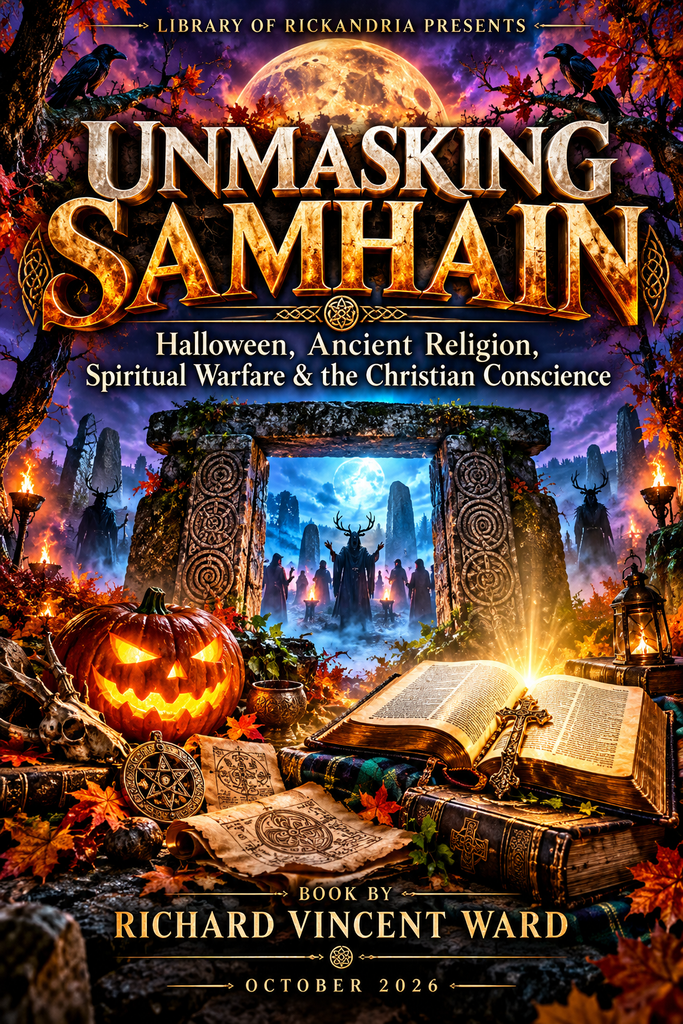
UPDATED BY VCG ON 10/27/2026 @ 16:16 EST
UNMASKING SAMHAIN
Halloween, Ancient Religion, Spiritual Warfare & the Christian Conscience
PART IV — THE MODERN CONTROVERSY
Satanism, Allegations, Psychology, Children & Cultural Influence
CHAPTER 18
MODERN PAGANISM, WICCA & SATANISM
New Religious Movements, the Modern Wheel of the Year, Contemporary Samhain, LaVeyan Satanism, The Satanic Temple, Religious Symbolism & the Difference Between Theological Judgment and Historical Fact
“But sanctify the Lord God in your hearts:
and be ready always to give an answer to every man that asketh you a reason of the hope that is in you with meekness and fear:”— 1 Peter 3:15, King James Bible
1. Three Gatherings on the Same Night
Imagine three gatherings taking place on October 31.
The first occurs in a private home.
A small group gathers around candles, seasonal greenery, photographs, and a table prepared with food.
The participants describe themselves as contemporary Pagans.
They speak about the changing seasons, the approach of winter, and the memory of deceased relatives.
Some understand the evening as a religious festival.
Their ceremony includes prayer, reflection, or offerings according to the particular tradition they follow.
The second gathering takes place in another setting.
Its organizers identify with modern Satanism.
They use the image of Satan as a symbol of individual freedom, rebellion against perceived religious authority, or resistance to oppressive institutions.
Some participants regard supernatural belief as mistaken.
Their activities may include speeches, artistic performances, or symbolic ceremonies.
The third gathering takes place in a suburban neighborhood.
Children move between houses.
Their costumes represent animals, fictional heroes, monsters, and popular entertainment characters.
They receive sweets.
The families describe the occasion as recreation.
All three gatherings occur on the same date.
Some may display similar colors or symbols.
Some may use the word Halloween.
Others may call the occasion Samhain.
But it would be historically inaccurate to declare that all participants belong to one religion.
It would also be inaccurate to assume that they share the same understanding of spiritual beings.
The first group may believe in gods or spirits.
The second may reject their existence.
The third may not regard the event as religious at all.
A Christian may disagree with the practices or beliefs of the first two groups.
A Christian may also object to aspects of the third.
But those evaluations must be grounded in what the participants actually do.
The original 2025 edition of Unmasking Samhain presented a very different picture.
It argued that Halloween constituted the modern continuation of an ancient system involving Druids, blood sacrifice, spirit communication, demonic activity, and Satanic influence.
Its narrative treated apparently different practices as expressions of one underlying spiritual power.
The distinction between modern Pagan religion and modern Satanism was insufficiently developed.
The distinction between theistic and nontheistic Satanism was largely absent.
The distinction between intentional religious observance and ordinary cultural recreation was repeatedly disregarded.
And serious allegations concerning ritual violence were presented without adequate corroboration.
This chapter must therefore examine the contemporary movements themselves.
It is not enough to ask what an outside critic believes a religion means.
We must also identify what its adherents say they believe.
We must study the movement’s documented history.
We must examine the practices actually associated with it.
And we must distinguish theological disagreement from allegations of criminal conduct.
The central question is not whether Christianity and modern Paganism teach the same religion.
They do not.
The central question is whether the historical and theological claims being made about these movements are accurate.
A religious disagreement can be genuine without every accusation against the other religion being true.
That is where the investigation begins.
2. What Does “Pagan” Mean?
The word pagan has possessed several meanings across history.
In ancient and medieval Christian usage, terms translated or understood as pagan could refer broadly to people outside Christianity or other monotheistic traditions.
The term acquired associations with older religious practices, rural customs, and the worship of multiple gods.
In modern usage, however, Paganism often refers to a family of contemporary religious movements.
The distinction between ancient and modern usage is essential.
An Umbrella Rather Than One Church
Modern Paganism includes religious traditions that differ in theology, ritual, history, and organization.
Some participants describe themselves as Wiccan.
Others identify as Druids.
Others follow forms of Heathenry or Ásatrú.
Some reconstruct ancient Greek or Roman religious practices.
Others develop eclectic forms of spirituality inspired by nature, mythology, or older religious traditions.
There is no single governing organization representing all contemporary Pagans.
Nor is there one universal Pagan creed.
The Scholarly Definition
Religious studies scholar Sabina Magliocco, in The Cambridge Companion to New Religious Movements, describes Neopaganism as an umbrella category encompassing movements that revive, reinterpret, or experiment with pre-Christian religious traditions.
See Magliocco, “Neopaganism” (2012).
More recent scholarship by Ethan Doyle White emphasizes that modern Paganism arose through several historical developments, especially nineteenth-century Romanticism, esotericism, and subsequent religious reconstruction.
See Doyle White, “Modern Paganism” (2026).
These sources do not describe one unchanged prehistoric religion.
They describe a family of modern religious movements drawing upon older materials.
What Practitioners Say
The Pagan Federation International’s explanation of Paganism emphasizes the diversity of contemporary traditions.
It describes nature, seasonal cycles, and spiritual experience as important to many practitioners.
Its definition strongly emphasizes polytheistic and pantheistic traditions.
Academic research, however, also recognizes practitioners whose beliefs are less conventionally theistic.
Therefore, the organization’s presentation is an important firsthand description, but it should not be treated as the only possible definition.
The Historical Conclusion
Modern Paganism is not one organization.
It is not necessarily identical to Wicca.
It is not automatically Satanism.
And its existence does not prove an uninterrupted institutional lineage from prehistoric Samhain.
Each tradition must be studied according to its own sources.
3. Revival, Reconstruction and Historical Continuity
Many contemporary Pagans regard older religious traditions as sources of spiritual inspiration.
Some describe their practices as a revival of pre-Christian religion.
Others openly acknowledge reconstruction.
Still others combine older myths with newer forms of spirituality.
These distinctions are important.
Revival
A revival attempts to restore a practice or tradition regarded as having existed in the past.
The participants may consider themselves spiritually connected to earlier believers.
Reconstruction
A reconstruction uses historical texts, archaeology, folklore, and comparative scholarship to develop a contemporary practice.
The participants may recognize that complete continuity is unavailable.
Modern Synthesis
A modern religious synthesis draws upon several traditions and creates a new form.
It may possess genuine historical influences without reproducing any earlier system exactly.
The Problem of Ancient-Lineage Claims
Some practitioners claim direct continuity with ancient priesthoods or secret traditions.
Such claims deserve investigation.
A contemporary claim of lineage does not establish the lineage simply because it is meaningful to the person making it.
Likewise, the absence of an uninterrupted institution does not mean that all older cultural influences disappeared.
Historical influence can survive without institutional continuity.
The Relevance to Samhain
A modern religious ceremony may be sincerely understood as a revival of ancient Samhain.
It may contain practices derived from medieval Irish literature, later folklore, and modern religious innovation.
But the ceremony itself is evidence of contemporary belief and practice.
It is not automatically an eyewitness reconstruction of prehistoric Ireland.
The modern religious meaning of Samhain may be genuine to its participants even when a particular claim of prehistoric continuity remains historically uncertain.
4. The Modern Wheel of the Year
Many contemporary Pagan traditions organize their religious calendars around seasonal festivals.
A familiar system is known as the Wheel of the Year.
It commonly contains eight observances.
Four are associated with seasonal turning points such as solstices and equinoxes.
Four are commonly identified through festivals such as Samhain, Imbolc, Beltane, and Lughnasadh or Lammas.
A Modern Religious Calendar
The eightfold arrangement became especially influential through the development of modern Wicca and related twentieth-century Pagan movements.
Its components draw upon older cultural and religious materials.
But the familiar complete arrangement should not simply be projected unchanged into prehistoric Ireland.
The historical ancestry of individual festivals differs.
Practitioner Evidence
The Pagan Federation’s description of Witchcraft and Wicca explains the celebration of eight seasonal Sabbats.
It describes such observances as occasions for religious practice, appreciation of nature, and reflection upon seasonal change.
This is direct evidence of contemporary religious observance.
An Important Distinction
The modern Wheel of the Year may incorporate an ancient festival name.
That does not establish that every ancient community used the same complete eight-festival calendar.
The modern arrangement reflects historical selection and adaptation.
The Christian Question
A Christian may object to participation in ceremonies involving the worship of other gods.
That theological concern can be examined through Scripture.
But the historical description should remain accurate.
The ceremony should not be presented as an unchanged Druidic rite merely because a modern practitioner understands it as connected with ancient religion.
5. Samhain in Contemporary Pagan Practice
Samhain remains important within many modern Pagan traditions.
Some practitioners regard it as the beginning of a religious new year.
Others understand it as a seasonal threshold.
Some focus upon mortality, grief, ancestry, or remembrance.
Others emphasize the approach of winter, divination, or contact with spiritual beings.
The practices vary.
A Contemporary Druidic Account
The Order of Bards, Ovates and Druids publishes material concerning Samhain and its place within modern Druidic practice.
Its account discusses the seasonal transition, the Otherworld, traditional divination customs, and the symbolic importance of apples and nuts.
It also reflects the movement’s modern religious and philosophical interpretation.
The article is important evidence concerning contemporary Druidry.
It should not be confused with a first-century eyewitness account of Druids in Roman Gaul.
Remembrance of Ancestors
Some modern Samhain observances include photographs or names of deceased family members.
Participants may light candles or offer food.
Such actions may be understood as remembrance, communication, devotion, or symbolic reflection, depending upon the tradition.
A responsible writer must identify the particular purpose.
Divination
Some practitioners intentionally use divinatory methods as part of their religious life.
This creates a direct point of Christian theological disagreement.
Deuteronomy 18 and related passages address forbidden forms of divination.
A Christian may interpret such practices as incompatible with biblical faith.
But that is a judgment concerning actual conduct.
It does not establish that every person eating candy on October 31 is performing divination.
The Historical Finding
Contemporary Pagan Samhain observances are real.
Some contain genuine religious ritual.
Some involve beliefs concerning ancestors or supernatural beings.
Others focus upon seasonal or philosophical themes.
The specific practices must be described accurately.
The existence of modern religious Samhain does not establish that all modern Halloween celebrations are religious Samhain observances.
6. Wicca: A Twentieth-Century Religion with Older Influences
Wicca is one of the best-known modern Pagan traditions.
Its public emergence is strongly associated with Gerald Gardner.
Gardner was born in 1884 and died in 1964.
His writings and ritual activities became influential within modern Pagan witchcraft.
The Historical Development
Gardner published High Magic’s Aid in 1949.
His book Witchcraft Today appeared in 1954.
The public development of Wicca was shaped by Gardner, Doreen Valiente, and other practitioners.
Valiente made major contributions to its liturgical and poetic traditions.
Later writers and practitioners established additional forms.
Modern Scholarship
Ronald Hutton’s The Triumph of the Moon remains an important study of the emergence of modern Pagan witchcraft.
John Callow’s Gerald Gardner and the Creation of Wicca provides a more recent examination of Gardner and his historical environment.
Cambridge University Press also published Ethan Doyle White’s The New Witches of the West in 2024, discussing the development of modern religious witchcraft.
These works distinguish modern Wicca from the alleged organized witch religion supposedly exposed by early modern witch trials.
A Difficult Lineage Question
Gardner claimed access to a surviving witch tradition.
The precise history of that claim is disputed.
Modern Wicca undeniably incorporates older material and religious influences.
But its complete institutional descent from a prehistoric Druidic religion has not been established.
The Necessary Conclusion
Wicca possesses a modern documented history.
Its practitioners may regard their religious inheritance as ancient.
That belief deserves accurate description.
But the historical record should not be presented as demonstrating more continuity than the evidence supports.
7. What Do Wiccans Believe?
Wicca is not one perfectly uniform theological system.
Some traditions emphasize a Goddess and a God.
Others focus upon different understandings of divinity.
Some participants are polytheistic.
Others approach divine language more symbolically.
Some work within initiatory covens.
Others practice alone.
The Pagan Federation’s Description
The Pagan Federation presents Wicca as a religion involving seasonal ritual, nature, spiritual development, and magical practice.
It emphasizes religious experience and the relationship between human life and the sacred natural world.
It does not describe Wicca as a branch of the Church of Satan.
Magic Within Wicca
Many Wiccans use the term magic positively.
It may describe ritual action, intention, spiritual transformation, prayer-like practice, or attempts to influence circumstances.
Different traditions understand its mechanism differently.
Some believe supernatural powers are involved.
Others use more psychological explanations.
The investigator must not assume that every use of the word identifies the same action.
A Christian Theological Difference
Christian Scripture contains prohibitions concerning particular forms of sorcery, divination, and religious invocation.
A Christian may regard some Wiccan practices as incompatible with biblical faith.
That disagreement is real.
But a Christian critique should identify the particular practice and biblical argument.
It should not begin by falsely claiming that every Wiccan worships the Christian Devil.
8. Wicca and Satanism Are Not Synonyms
This distinction must be stated plainly.
Mainstream Wicca is not ordinarily organized around worship of Satan.
Many Wiccans do not believe in the Christian figure of Satan.
Some explicitly reject the identification of their religion with Satanism.
Why the Confusion Developed
The European witch trials often portrayed alleged witches as servants of the Devil.
Later popular culture preserved the connection.
Modern Christians encountering a religion that positively uses the word witchcraft may therefore associate it with the early modern accusation.
But the historical chain contains a serious gap.
The early modern category of a witch as a diabolical conspirator was not the same as the religious identity developed within twentieth-century Wicca.
Theological Evaluation Versus Self-Description
A Christian theologian may interpret worship directed toward other deities through the framework of biblical idolatry.
First Corinthians 10:20 may be relevant to that argument.
But the resulting theological judgment should not be presented as the practitioner’s own profession of Satan worship.
Those are different claims.
An Example of Accurate Disagreement
A Christian could say:
“Your tradition identifies its objects of worship differently from the God revealed in Christian Scripture.
On the basis of my reading of Scripture, I cannot participate in that worship.”
That statement expresses a genuine theological disagreement.
It does not require claiming:
“You secretly worship Satan and have admitted to performing crimes.”
The second allegation would require evidence.
Accuracy is not a compromise of conviction.
It is a responsibility of conviction.
9. Druidry, Heathenry and Other Modern Pagan Traditions
The original 2025 edition often used the word Druid as a general designation for occult religious power.
But contemporary Druidry has its own history.
The modern movement is not identical to the Druidic institutions described by Roman writers.
Likewise, Heathenry is not simply another name for Wicca.
Contemporary Druidry
Modern Druidic organizations draw inspiration from Celtic literature, the natural world, seasonal cycles, and differing philosophical or spiritual traditions.
Some are religious.
Others include people whose outlook is less conventionally theistic.
Their ceremonial practices vary.
Heathenry
Modern Heathenry draws inspiration especially from pre-Christian Germanic and Scandinavian religion.
Its calendars, myths, and religious figures differ from those associated with Irish Samhain.
Not every Heathen tradition treats October 31 as a principal religious occasion.
Reconstructionist Traditions
Other Pagans attempt to reconstruct religious practices associated with ancient Greece, Rome, or different cultures.
Their approaches may be text-based, archaeological, devotional, or eclectic.
The Historical Problem
A book that treats all these movements as one ancient Druidic system erases their distinctions.
It also risks attributing practices to people who do not perform them.
The Correct Conclusion
Modern Paganism is a broad field of related and sometimes competing religious identities.
The existence of a shared interest in pre-Christian religion does not establish identical beliefs or practices.
10. The Word “Satanism” Requires Its Own Investigation
The discussion changes when we turn to modern Satanism.
The term has a long history as an accusation.
Religious opponents could accuse others of serving Satan even when those accused did not identify with that figure.
The emergence of organized groups willingly adopting the name belongs primarily to modern history.
The Importance of Self-Identification
Someone accused of Satanism is not necessarily a Satanist.
Someone who deliberately identifies as a Satanist may belong to one of several modern traditions.
Some regard Satan as a literal supernatural being.
Others explicitly deny his existence.
Some employ ceremonial ritual.
Others are primarily philosophical or political.
The Scholarly Record
Jesper Aagaard Petersen examines these variations in “Modern Religious Satanism: A Negotiation of Tensions,” published in The Oxford Handbook of New Religious Movements: Volume II.
Petersen describes modern Satanism as a field in which Satan functions as a figure of opposition, individualism, or religious critique, while different groups disagree over how that symbol should be understood.
The distinction is foundational.
A person may use Satanic symbolism without believing that Satan objectively exists.
That fact does not determine whether a Christian approves of the symbolism.
It determines how the person’s beliefs should be described.
11. Anton LaVey and the Church of Satan
One of the most historically important modern Satanist organizations is the Church of Satan.
It was founded by Anton Szandor LaVey in San Francisco on April 30, 1966.
The date is associated with Walpurgisnacht.
LaVey published The Satanic Bible in 1969.
The book codified important aspects of his philosophy and ritual framework.
These facts are documented in the organization’s official history and in independent scholarship.
The Church’s Self-Description
The Church of Satan’s official explanation of its beliefs identifies its philosophy as atheistic.
Its members do not generally affirm the literal existence of Satan.
The organization presents Satan as a symbol of individualism, pride, liberty, and resistance to religious authority.
Its emphasis upon the self differs sharply from Christian teachings concerning worship of God.
But the distinction between literal belief and symbolism remains historically important.
Ritual Practice
The Church of Satan includes ritual within its tradition.
However, its official materials describe such rituals primarily in psychological and theatrical terms.
The organization interprets them as means of emotional expression or self-directed transformation rather than worship of a literal Devil.
See F.A.Q. Replies for Atheists.
A Christian Disagreement
A Christian may reject the philosophy’s understanding of human autonomy, religion, and moral authority.
A Christian may also object to the deliberate appropriation of Satanic language and imagery.
Those objections can be articulated.
But the organization should not be described as publicly teaching worship of a literal Devil when its official position explicitly denies that belief.
The Historical Finding
The Church of Satan is a documented modern religious organization.
Its 1966 founding does not establish an uninterrupted institutional lineage from ancient Samhain.
Its specific doctrines should be evaluated according to its publications rather than popular stereotypes alone.
12. Does the Church of Satan Celebrate Halloween?
This question can be answered directly from the organization’s own materials.
Its official F.A.Q. Holidays identifies the individual’s birthday as the most important personal celebration.
It also recognizes seasonal turning points.
The organization describes April 30, Walpurgisnacht, as especially significant because of its founding anniversary.
It also identifies Halloween, October 31, as a seasonal occasion members may celebrate.
The Meaning Given to Halloween
The Church describes Halloween as an occasion for self-expression through costume or remembrance of deceased individuals who were important in one’s life.
It does not prescribe one universal Halloween ceremony.
Its official explanation emphasizes individual choice.
What This Establishes
Some Satanists deliberately regard Halloween as significant.
That is a genuine fact.
A Christian author need not pretend otherwise.
What It Does Not Establish
The organization’s recognition of Halloween does not prove that every person who celebrates Halloween belongs to the Church of Satan.
It does not establish that the organization controls the holiday.
It does not demonstrate that ordinary neighborhood trick-or-treating is a Church of Satan initiation.
And it does not establish a universal rule requiring members to sacrifice humans or animals.
The actual official claims must be distinguished from allegations about hidden conduct.
13. Sacrifice and the Church of Satan’s Published Position
The original 2025 manuscript claimed that literal sacrifices continued among contemporary occult groups during Halloween.
That allegation should be compared with relevant primary sources.
The Church of Satan explicitly rejects human and animal sacrifice.
Its official F.A.Q. Ritual and Ceremony states that its atheistic philosophy provides no reason to sacrifice living beings to supernatural entities.
The organization also rejects sexual activity involving children and describes serious abuse as grounds for membership exclusion.
What an Official Denial Establishes
It establishes the organization’s public doctrine and rules.
It is important evidence of institutional self-description.
What an Official Denial Does Not Establish
An organization’s stated rules cannot prove that no individual member has ever committed wrongdoing.
That would require examining particular incidents.
What an Accusation Requires
Conversely, an allegation that the organization systematically engages in human sacrifice requires independent evidence.
The organization’s Satanic name does not establish the crime.
A dramatic ritual image does not establish the crime.
A rumor repeated in Christian literature does not establish the crime.
The Correct Historical Standard
Official sources should be used to describe official teaching.
Independent investigations should be used to evaluate alleged conduct.
Neither category should be substituted for the other.
This principle applies equally to Christian, Pagan, Satanist, and other religious organizations.
14. The Satanic Temple: A Different Movement
A second major contemporary organization is The Satanic Temple.
It was founded in 2013 by Lucien Greaves and Malcolm Jarry.
Its history, philosophy, and institutional strategy differ substantially from those of the Church of Satan.
The two organizations are not interchangeable.
The Satanic Temple’s Stated Philosophy
The Satanic Temple’s official materials emphasize compassion, bodily autonomy, reason, religious pluralism, and opposition to forms of authority it regards as unjust.
Its Seven Fundamental Tenets articulate these commitments.
Nontheistic Religion
The organization identifies itself as nontheistic and nonsupernaturalist.
It does not require belief in a literal Satan.
Its use of Satanic imagery draws substantially upon literary and philosophical traditions in which Satan represents rebellion against authority.
The Academic Context
Joseph P. Laycock’s Speak of the Devil: How The Satanic Temple Is Changing the Way We Talk About Religion examines the organization’s emergence and its approach to religious identity.
Laycock places the movement within a history of American religious pluralism, public controversy, and competition over religious symbols.
A Genuine Difference from the Church of Satan
The Satanic Temple has placed considerable emphasis upon public advocacy, legal disputes, and religious equality.
The Church of Satan has criticized that approach and maintains a different institutional philosophy.
These differences matter.
A theological critique should not treat two competing organizations as though they possess identical doctrines.
15. Does The Satanic Temple Celebrate Halloween?
Yes.
The organization lists Halloween among its recognized holidays.
Its official Holidays of The Satanic Temple identifies October 31 with indulgence, the aesthetics of darkness, costumes, sweets, and confronting fear.
The holiday appears alongside several other observances.
These include Lupercalia, Hexennacht, Unveiling Day, and Sol Invictus.
The Significance
The Satanic Temple’s recognition of Halloween is genuine religious evidence.
It demonstrates that the date has meaning within this modern organization.
The Limitation
The organization’s holiday explanation does not establish that everyone who observes Halloween shares its philosophy.
Nor does it prove that the holiday originated with this organization.
Halloween substantially predates its founding.
A Common Logical Error
If one group adopts an existing public occasion, it does not follow that the group created or controls the occasion.
A modern religious community may attach a new meaning to a date already observed by others.
That meaning should be documented.
It should not be retroactively imposed upon every participant.
The Satanic Temple’s celebration of Halloween establishes its own observance—not a secret religious identity shared by every household distributing candy.
16. Satanic Temple Rituals and the Allegation of Violence
The Satanic Temple also describes rituals.
Its public materials indicate that ritual participation is not required for every member.
The ceremonies are described as symbolic and personally meaningful.
The organization’s official FAQ states that its rituals should be consensual and should not involve animals or the promotion of suffering.
What the Source Establishes
It establishes the organization’s stated standards.
It provides direct evidence of how the organization wishes its practices to be understood.
The Christian Perspective
A Christian may object to the use of Satanic imagery within religious ritual even when the participants understand it symbolically.
A Christian may also disagree with the movement’s underlying philosophy.
Those are legitimate theological disagreements.
What Remains Unestablished
The existence of symbolic Satanic rituals does not prove that participants engage in human sacrifice.
The use of an altar does not establish bloodletting.
The presence of candles does not establish criminal violence.
A theatrical ceremony is not, without further evidence, proof of an assault.
The Necessary Distinction
Religious symbolism, theological disagreement, and criminal misconduct are three different questions.
A responsible book must not merge them.
17. What About Theistic Satanism?
Not all people who identify as Satanists are atheists.
Some individuals or smaller traditions understand Satan or a related figure as a real supernatural being.
Their beliefs differ from the official philosophies of the Church of Satan and The Satanic Temple.
A Disputed Definition
The Church of Satan rejects the designation theistic Satanism as a legitimate description of its own religion.
But academic scholarship uses broader classifications to describe people who do employ Satanic identity within supernatural belief systems.
The existence of this definitional dispute should be disclosed.
Theological Diversity
Some theistic practitioners understand Satan as a deity.
Others identify with Lucifer, Set, or related figures understood through esoteric or religious frameworks.
Their theological systems are not necessarily identical.
The Christian Evaluation
Intentional worship of a being identified as Satan raises an obvious Christian theological objection.
A Christian may regard such worship as directly incompatible with biblical faith.
That objection does not require denying that other self-identified Satanists are nontheistic.
The Historical Limitation
The existence of theistic Satanist groups does not prove that all Wiccans worship Satan.
It does not establish that every Halloween gathering involves literal invocation.
And it does not demonstrate that all participants in ordinary secular Halloween activities share the same religion.
The particular group and practice must be identified.
18. “Satan” as a Religious Being and as a Cultural Symbol
This chapter requires an important distinction between biblical theology and modern religious self-description.
In the Christian Scriptures, Satan is not merely a metaphor for social independence.
He is portrayed within a theological narrative concerning temptation, opposition, deception, accusation, and judgment.
Modern nontheistic Satanists often use the name differently.
They may regard the figure as literary or symbolic.
Two Different Claims
A Christian may assert:
“Scripture portrays Satan as a real adversarial spiritual being.”
A nontheistic Satanist may assert:
“I use the name Satan symbolically and do not believe such a being exists.”
These statements are incompatible as metaphysical descriptions.
But the disagreement does not permit the investigator to falsify either person’s stated position.
The Christian Theological Judgment
A Christian may regard the symbolic celebration of Satan as morally objectionable even when the symbol is understood metaphorically by its user.
That argument concerns the moral meaning of deliberately employing a biblical adversarial figure.
It should be made directly.
The Historical Error to Avoid
It would be incorrect to write that every symbolic Satanist secretly believes in a literal Devil.
That claim concerns an undisclosed psychological or theological position.
It requires evidence.
The stated disbelief of an entire organization cannot simply be discarded because a critic interprets the symbolism differently.
An Honest Distinction
The Christian may reject the practice.
The historian must describe it accurately.
Both can occur without contradiction.
19. Baphomet and the Problem of Symbolic Genealogy
One of the most recognizable modern Satanic images is the goat-headed figure commonly called Baphomet.
But the image possesses a complicated history.
The modern goat-headed depiction is strongly associated with the nineteenth-century occult writer Éliphas Lévi.
Later Satanist movements adapted similar imagery.
The Church of Satan developed a distinctive sigil involving a goat’s head within an inverted pentagram.
The Satanic Temple commissioned a modern Baphomet statue and unveiled it in 2015.
Different Historical Stages
The word Baphomet predates Lévi’s famous image.
The goat-headed figure developed through later occult symbolism.
The Church of Satan adopted a particular design.
The Satanic Temple created a separate sculptural representation for its own public purposes.
The stages are related.
They are not identical.
Why This Matters
A symbol’s appearance within different traditions does not establish that those traditions share every doctrine.
A contemporary organization may deliberately adopt an older image.
Its meaning may change.
The Original Manuscript’s Methodological Error
The original edition treated similar images as evidence of one continuous occult power.
But visual resemblance is not the same as documentary proof of an uninterrupted religious institution.
The historical transmission must be demonstrated.
The Christian Question
A believer may object to the deliberate display of Baphomet or inverted religious symbols.
Such concerns can be discussed through biblical principles concerning worship, allegiance, and conscience.
But the objection should not depend upon an invented history of one unchanging prehistoric ritual.
20. Contemporary Paganism Is Not Automatically Satanism
We now return to the central distinction.
Modern Paganism and modern Satanism are separate fields of religious identification.
Some people employ imagery or practices associated with both.
Some movements overlap intellectually or culturally.
But the categories are not universally identical.
A Wiccan Samhain Ceremony
A Wiccan group may honor a Goddess and God, remember ancestors, or mark the seasonal transition.
Its participants may reject Satanic identity.
A Satanic Temple Halloween Observance
A group may celebrate freedom, symbolism, or the aesthetics of darkness while rejecting supernatural belief.
Its participants may not recognize Wiccan theology.
A Theistic Satanist Ceremony
Another group may intentionally invoke a being understood as Satan.
That activity possesses a different theological object.
A Secular Halloween Party
Participants may gather for costumes, games, music, or sweets without performing any religious ceremony.
The Historical Finding
These situations may occur during the same season.
They are not therefore one religious act.
The Theological Responsibility
A Christian may object to several of them for different reasons.
But those reasons should be identified separately.
One does not strengthen a biblical objection by erasing the differences among the people being criticized.
21. Halloween Is Not Owned by One Religion
The modern holiday developed through many historical influences.
Previous chapters traced medieval Christian observances, later folklore, migration, North American mischief, commercial costumes, lanterns, and candy.
Contemporary Pagan and Satanist movements participate in the same broader cultural environment.
Some intentionally claim Halloween or Samhain as religiously significant.
Others reject such interpretations.
A Shared Date Is Not Shared Membership
Several traditions can observe the same date.
Their reasons may differ.
A Christian congregation may hold an All Saints’ service.
A Pagan community may celebrate Samhain.
A Satanist organization may observe Halloween.
A secular family may host a costume party.
The date does not make the participants members of one organization.
A Common Symbol Is Not Shared Theology
Candles may appear in different religions.
Masks may appear in theater and ritual.
Food may be offered in worship or shared through hospitality.
Darkness may symbolize mystery or danger.
The object or image does not determine one universal meaning.
The Correct Historical Conclusion
Halloween is a culturally complex occasion.
It has religious meanings for some participants.
It has other meanings for others.
No single organization can be assumed to define every modern observance.
22. How Many People Actually Belong to These Movements?
The public visibility of a movement can create misleading impressions about its size.
A group may receive extensive media attention while possessing comparatively few members.
A symbol may appear in entertainment far more often than it appears in actual religious practice.
The Pew Research Evidence
Pew Research Center’s 2023–2024 Religious Landscape Study places those identifying as Pagan or Wiccan within a category accounting for less than 1% of American adults.
See Pew Research Center, Religious Landscape Study.
This is a survey finding, not a complete census of every contemporary Pagan.
Its meaning depends upon sampling, question wording, and the classification system used.
Satanist Membership
Reliable population estimates are more difficult.
Some organizations do not publish independently audited membership totals.
Online supporters, mailing-list subscribers, formal members, and active participants are not necessarily equivalent categories.
A headline claiming millions of followers may therefore require careful scrutiny.
The Historical Lesson
The presence of a religious image in popular culture does not prove that the corresponding religion has become dominant.
The prevalence of witches in movies does not establish the number of practicing Wiccans.
The appearance of Satanic imagery in advertising does not establish membership in the Church of Satan or The Satanic Temple.
And the commercial success of Halloween does not measure the number of intentional occult ceremonies.
The categories must remain separate.
23. The Original 2025 Manuscript’s Claim of Ritual Violence
We now approach the most serious allegations.
The original edition declared:
“But in many occult sects, literal sacrifices still occur on this night.”
This is a factual allegation about contemporary conduct.
It is not merely a theological judgment.
The manuscript also referred to testimonies involving kidnappings, animal deaths, bloodletting, and alleged ritual abuse.
It described such accounts as evidence that the ancient sacrificial system remained active.
These statements require a substantially higher evidentiary standard than claims concerning symbolic imagery.
The First Question: What Is the Alleged Crime?
Human sacrifice, kidnapping, abuse, and trafficking are serious crimes.
They must be investigated as concrete events.
The Second Question: Who Is Accused?
An allegation against an identifiable person differs from a claim against an entire religious population.
The first may be investigated through specific evidence.
The second requires reliable evidence supporting the proposed generalization.
The Third Question: What Corroboration Exists?
Relevant evidence may include testimony, physical findings, records, lawful investigative results, and other independently verifiable material.
A person’s religious label is not sufficient.
The Fourth Question: Is the Halloween Connection Established?
A crime committed during October does not automatically constitute a Samhain rite.
A crime committed on October 31 does not automatically establish a Satanist organization.
The motive and circumstances must be investigated.
The Necessary Finding
The historical sources examined in Parts II and III do not establish that contemporary Pagan or Satanist organizations routinely commit human sacrifice at Halloween.
That claim requires specific modern evidence.
The original manuscript did not provide sufficient corroboration for the broad allegation.
24. The 1992 FBI Examination of Ritual-Abuse Allegations
The United States Department of Justice preserves a relevant study from 1992.
Kenneth V. Lanning, associated with the FBI’s National Center for the Analysis of Violent Crime, authored Investigator’s Guide to Allegations of “Ritual” Child Abuse.
The report is catalogued by the Office of Justice Programs.
The Investigation’s Concern
Lanning examined allegations that organized Satanic groups were committing extensive ritual abuse.
He emphasized the need for careful investigation.
He also considered alternative explanations for some reports and the difficulties involved in corroborating widespread conspiracy allegations.
The Main Finding
The report did not establish the existence of the widespread organized Satanic abuse system described in many sensational claims of the period.
It called for investigation grounded in evidence rather than assumptions.
What This Does Not Mean
It does not prove that no criminal has ever employed ritual language or symbols.
It does not justify dismissing a specific allegation without investigation.
It does not establish that every person reporting abuse is dishonest.
Victims may describe genuine harm while some details, explanations, or alleged organizational connections remain uncertain.
The Proper Standard
An allegation should be investigated according to its evidence.
The presence or absence of occult imagery should not replace ordinary investigative standards.
This subject will receive sustained treatment in Chapter 19.
For the present chapter, the lesson is clear.
Serious allegations deserve serious investigation—not automatic acceptance and not automatic dismissal.
25. An Official Denial Is Relevant but Not Conclusive
The Church of Satan and The Satanic Temple publicly reject human or animal sacrifice.
Those statements are relevant.
They establish institutional policy.
But a responsible investigator should avoid an overly simple conclusion.
Organizations can contain individuals who violate their stated principles.
A member of any religion may commit a crime.
The existence of an official prohibition does not make misconduct impossible.
The Opposite Error
It is equally wrong to assume that members are guilty because the organization uses controversial religious imagery.
One cannot establish criminal conduct from a name.
The Correct Evidentiary Approach
Describe the official teaching accurately.
Investigate specific allegations independently.
Avoid transferring an individual’s alleged conduct to an entire religious community without evidence of organizational involvement.
Preserve the difference between an allegation, a charge, a conviction, and independently established facts.
The Christian Ethical Dimension
Exodus 23:1 prohibits false reports.
A Christian warning about evil must therefore avoid manufacturing accusations.
Religious disagreement is not an exemption from truthful speech.
26. The Problem of “Ex-Satanist” Testimony
The original manuscript appealed to claims attributed to former Satanists or occult practitioners.
Testimony can be important evidence.
But not all testimony possesses equal reliability.
A Testimony Is a Report
A person may sincerely describe past religious involvement.
That report may be relevant to the person’s experiences.
A Testimony May Also Contain Interpretation
The person may explain events through a theological framework adopted later.
The explanation may differ from what occurred.
Corroboration Matters
Claims concerning identifiable ceremonies, crimes, organizations, or dates should be checked against other evidence where possible.
The Problem of Repetition
One extraordinary claim may circulate through books, sermons, interviews, and social media.
Its repetition may create the appearance of many independent witnesses.
But the later accounts may all derive from the same original story.
The number of repetitions is not the same thing as the number of independent sources.
The Responsible Conclusion
Former-practitioner testimony should not be dismissed merely because it is inconvenient.
Neither should it be accepted as proof of every historical or supernatural claim made.
It requires the same careful evaluation applied to other evidence.
The original manuscript did not consistently maintain that distinction.
27. Does Modern Satanic Recognition of Halloween Prove an Ancient Satanic Origin?
This is a central historical question.
The Church of Satan recognizes Halloween.
The Satanic Temple recognizes Halloween.
Both are genuine contemporary facts.
But the organizations were founded in 1966 and 2013 respectively.
Modern Halloween customs substantially predate both organizations.
Chronology Cannot Be Reversed
A movement may adopt an existing date.
Its adoption does not establish that the movement founded the occasion.
A later religious meaning cannot automatically be projected backward into every earlier celebration.
The Same Problem Appears with Samhain
Modern Wiccan and Druidic groups may celebrate Samhain.
Their contemporary rituals are evidence of modern religious practice.
They do not automatically establish the precise form of prehistoric Irish ceremony.
The Original Manuscript’s Argument
The 2025 edition described modern Satanist activity as proof that Halloween had always possessed one Satanic spiritual identity.
But that argument assumes the conclusion.
Modern participation does not establish ancient origin.
The Corrected Finding
The fact that modern Satanists celebrate Halloween is historically relevant.
It should be retained.
But it does not demonstrate that all historical Halloween customs were Satanic or that secular participants today belong to Satanism.
28. The Biblical Satan and the Modern Symbol
We now turn more directly to Scripture.
The Christian Scriptures portray Satan as an adversary associated with temptation, accusation, deception, and opposition.
This biblical understanding differs from the nontheistic interpretation of Satan as a symbol of freedom or autonomy.
The theological disagreement is substantial.
First Peter 5:8
The KJV states:
“Be sober, be vigilant; because your adversary the devil, as a roaring lion, walketh about, seeking whom he may devour:”
The passage belongs to Peter’s exhortation concerning vigilance and steadfast faith.
A Christian may understand it as a serious warning about spiritual opposition.
The Difference in Worldview
A modern nontheistic Satanist does not necessarily accept Peter’s understanding of Satan.
The person may regard the symbol in literary or philosophical terms.
A Christian Response
A Christian may reject that symbolism on biblical grounds.
But the response should explain the disagreement rather than pretending that the Satanist professes the Christian metaphysical framework.
The Historical Limitation
First Peter does not mention Halloween.
It does not identify every modern costume as spiritual allegiance to Satan.
Nor does it establish the conduct of any contemporary religious organization.
The verse concerns Christian spiritual vigilance.
Its application requires careful reasoning.
29. Second Corinthians 11:14 — Deception and Its Proper Object
The KJV states:
“And no marvel; for Satan himself is transformed into an angel of light.”
The passage occurs within Paul’s warning concerning false apostles and deceitful workers.
He describes religious teachers whose outward presentation does not correspond to their actual conduct.
The Biblical Point
Religious claims can be deceptive.
Appearance alone is insufficient.
The Christian community must exercise discernment.
The Original Manuscript’s Extension
The earlier edition applied such texts to claim that all modern Pagan and Satanist movements operated through one hidden strategy.
But the passage does not document the beliefs or actions of particular contemporary organizations.
A More Faithful Application
A Christian should test claims.
That includes claims made by religious outsiders.
It also includes claims made by Christian authors.
If a Christian book falsely attributes human sacrifice to an organization, the book itself requires correction.
The command to discern cannot be applied only to one’s opponents.
Truthfulness must govern the investigation of all religious claims—including the claims made in this book.
30. First Corinthians 10:20 — A Serious Christian Theological Question
One of the strongest New Testament passages concerning idolatrous worship is First Corinthians 10:20.
The KJV reads:
“But I say, that the things which the Gentiles sacrifice, they sacrifice to devils, and not to God:
and I would not that ye should have fellowship with devils.”
The verse is important.
It cannot be disregarded simply because modern Pagans or Satanists interpret their practices differently.
The Immediate Context
Paul discusses sacrificial fellowship.
He warns Christians against participating in worship associated with idols.
The passage concerns actual religious participation.
The Christian Interpretation
A Christian may conclude that worship directed toward other deities is incompatible with loyalty to the God revealed in Scripture.
The passage supplies a serious theological basis for that objection.
The Necessary Distinction
This is not the same kind of claim as saying that a contemporary Wiccan personally professes Satan worship.
Paul’s statement is a Christian theological evaluation of idolatrous sacrifice.
The modern practitioner’s self-description may differ.
Both should be identified accurately.
The Limit of the Passage
The verse does not establish that every activity occurring on October 31 constitutes sacrifice.
It does not identify ordinary candy exchanges as religious fellowship.
And it does not demonstrate that every modern religious ceremony involves criminal violence.
Those claims require separate evidence.
31. Deuteronomy 18 and Actual Divination
Deuteronomy 18:9–14 contains prohibitions concerning several forms of divination and spirit consultation.
The text is directly relevant when examining modern practices that intentionally seek supernatural guidance.
A Contemporary Example
A practitioner may attempt to contact the dead.
Another may conduct divination to obtain hidden knowledge.
A group may invoke a spiritual being as part of religious ceremony.
These actions can be examined through the biblical categories.
The Need for Specificity
Not every modern Pagan performs these activities.
Not every ritual includes communication with the dead.
Not every use of a candle or altar constitutes divination.
Not every secular Halloween participant engages in religious invocation.
The Christian Responsibility
The Christian may reject practices judged incompatible with Scripture.
But the activity must first be identified correctly.
The command should not be applied indiscriminately to an entire population through guilt by association.
32. Romans 14 and Religious Disagreement
Romans 14 discusses conscientious disagreements among believers concerning food and days.
Its application to Halloween requires care.
The chapter cannot be used to excuse actual idolatry.
But it does warn against contempt and wrongful judgment in matters where Christian conscience differs.
The Distinction
A believer who intentionally participates in the worship of another deity presents one theological issue.
A believer who distributes candy to neighborhood children presents another.
The two should not be declared identical without argument.
The Responsibility of Conscience
A Christian may abstain from Halloween because of religious associations.
Another may regard some secular activities as morally distinguishable from those associations.
Those disagreements require patient discussion.
The Danger of Automatic Accusation
The original manuscript treated ordinary participation as evidence of spiritual compromise regardless of actual conduct.
But a person’s religious allegiance cannot be established solely by observing a seasonal custom.
The relevant biblical teaching must be applied to the identifiable action.
33. How Christians Should Speak About Other Religions
The final chapters of this book will examine Christian witness in greater detail.
But the subject cannot be avoided here.
A Christian may believe that another religion is theologically mistaken.
That conviction does not authorize dishonesty.
First Peter 3:15
The chapter’s opening text calls for readiness to explain Christian hope.
It also specifies meekness and fear, commonly understood in this setting as reverent seriousness.
The mode of explanation matters.
Second Timothy 2:24
The KJV states:
“And the servant of the Lord must not strive; but be gentle unto all men, apt to teach, patient,”
The surrounding passage concerns the correction of those who oppose.
Its language does not support abusive or threatening conduct.
The Importance of Accurate Description
A Christian should distinguish Wicca from Satanism.
A Christian should distinguish theistic from nontheistic Satanism.
A Christian should distinguish religious ritual from fictional performance.
And a Christian should not accuse people of crimes merely because their symbols are controversial.
Religious Liberty
People may possess the freedom to practice religions with which Christians disagree.
A Christian may advocate theological convictions while respecting lawful religious freedom and the safety of others.
Disagreement does not require intimidation.
Witness should not depend upon falsehood.
34. The Original 2025 Edition: What Must Be Retained?
A fair audit should identify not only errors but also genuine observations.
The earlier manuscript was correct in recognizing that some contemporary Pagan traditions celebrate Samhain religiously.
It was also correct that some Satanist organizations acknowledge Halloween.
It correctly identified biblical passages that Christians commonly interpret as prohibiting idolatry, sorcery, or spirit consultation.
It recognized that modern culture includes actual religious practices as well as secular entertainment.
These are relevant points.
They should not be discarded merely because the original narrative overstated other claims.
Genuine Religious Difference
Christianity and modern Pagan religions may disagree over the identity of God, the status of other deities, the nature of worship, and the legitimacy of divination.
Those disagreements are substantive.
Genuine Satanic Symbolism
Modern Satanist organizations deliberately use imagery that many Christians regard as religiously offensive or contrary to biblical faith.
That is a real cultural and theological issue.
Genuine Halloween Observances
Some modern religious groups intentionally observe October 31.
That fact deserves recognition.
The Necessary Limitation
None of these observations establishes that every modern Halloween activity belongs to the same religion.
Nor do they prove allegations of human sacrifice, organized abuse, or automatic spiritual contamination.
The valid observations must be separated from the unsupported conclusions.
35. The Original 2025 Edition: What Must Be Corrected?
Several core assertions require correction.
First, the earlier edition treated modern Paganism, Wicca, and Satanism as though they shared one religious identity.
Second, it presented an uninterrupted historical line from ancient Druids to contemporary occult movements without adequately demonstrating the transmission.
Third, it treated all Satanists as literal Devil worshippers, ignoring major nontheistic organizations.
Fourth, it attributed violent ritual conduct to contemporary occult sects without providing sufficient corroboration.
Fifth, it interpreted modern Halloween participation as automatic spiritual allegiance regardless of intention or actual practice.
Sixth, it connected contemporary crime allegations with ancient history through symbolic resemblance rather than independently verified evidence.
These errors are not merely stylistic.
They affect the factual foundation of the book.
The Need for a Revised Method
The correction must distinguish institutional history, doctrinal self-description, theological critique, and criminal allegation.
A firsthand organizational statement may establish what a group officially teaches.
A scholarly source may establish the movement’s development.
A biblical passage may establish a Christian moral principle.
An investigative record may establish facts concerning a particular alleged crime.
No one category should be substituted for another.
36. Claim-by-Claim Editorial Findings
Claim 18.1 — Modern Paganism Includes Several Distinct Religious Traditions
Finding: Verified.
Academic and practitioner sources identify diversity among Wiccans, Druids, Heathens, reconstructionists, and other groups.
Claim 18.2 — All Modern Pagans Worship Satan
Finding: Incorrect as a universal description of practitioner beliefs.
Many modern Pagan traditions do not include Satan within their religious framework.
Claim 18.3 — Modern Wicca Emerged Publicly During the Twentieth Century
Finding: Verified.
Gerald Gardner and other figures were central to its documented development.
Claim 18.4 — Wicca Has an Uninterrupted Institutional History Extending Directly to Prehistoric Druids
Finding: Not established.
The religion draws upon older influences, but complete institutional continuity remains unsupported.
Claim 18.5 — Modern Wiccans Observe Samhain
Finding: Supported.
Many Wiccan traditions regard it as an important seasonal festival.
Claim 18.6 — Every Wiccan Performs the Same Samhain Ritual
Finding: Incorrect.
Contemporary practice varies across traditions and individuals.
Claim 18.7 — Modern Pagans May Practice Divination or Spiritual Invocation
Finding: Supported in particular traditions.
Such practices should be identified specifically rather than attributed universally.
Claim 18.8 — Every Modern Pagan Ceremony Involves Human or Animal Sacrifice
Finding: Unsupported.
The allegation does not follow from Pagan identity.
Claim 18.9 — The Church of Satan Was Founded in 1966
Finding: Verified.
Anton LaVey established the organization in San Francisco.
Claim 18.10 — The Church of Satan Officially Worships a Literal Devil
Finding: Contrary to its stated doctrine.
The organization identifies its philosophy as atheistic and symbolic.
Claim 18.11 — The Church of Satan Recognizes Halloween
Finding: Verified.
Its official materials identify October 31 as a possible observance.
Claim 18.12 — The Church of Satan Requires Human or Animal Sacrifice at Halloween
Finding: Contrary to its published rules and unsupported as an institutional allegation.
Specific allegations of misconduct would require independent evidence.
Claim 18.13 — The Satanic Temple Was Founded in 2013
Finding: Verified.
Its founders were Lucien Greaves and Malcolm Jarry.
Claim 18.14 — The Satanic Temple Is Identical to the Church of Satan
Finding: Incorrect.
The organizations possess different histories, philosophies, and institutional approaches.
Claim 18.15 — The Satanic Temple Identifies as Nontheistic
Finding: Verified.
Its official materials reject supernatural explanations as part of its institutional philosophy.
Claim 18.16 — The Satanic Temple Observes Halloween
Finding: Verified.
Its holiday materials identify October 31 as a recognized occasion.
Claim 18.17 — The Satanic Temple Officially Prescribes Human Sacrifice
Finding: Unsupported and contrary to its published standards.
Its official materials reject animal harm and involuntary suffering in rituals.
Claim 18.18 — Some Self-Identified Satanists Are Theistic
Finding: Supported.
Academic descriptions recognize forms of Satanic belief that differ from major nontheistic organizations.
Claim 18.19 — Every Satanist Understands Satan in the Same Way
Finding: Incorrect.
The term encompasses competing interpretations.
Claim 18.20 — Modern Satanic Recognition of Halloween Proves the Holiday Was Founded by Satanists
Finding: Chronologically unsupported.
Modern Halloween predates the relevant organizations.
Claim 18.21 — Every Secular Halloween Participant Shares Satanist Religious Allegiance
Finding: Unsupported.
Shared cultural participation does not establish shared religious identity.
Claim 18.22 — Historical Pagan Religion and Modern Pagan Reconstruction May Possess Genuine Connections
Finding: Supported.
The nature and extent of the connections must be established individually.
Claim 18.23 — Shared Symbols Prove an Unchanged Prehistoric Religious Organization
Finding: Unsupported.
Symbolic transmission and institutional continuity are different historical claims.
Claim 18.24 — Organized Ritual Abuse by Satanic Groups Is Widespread and Peaks at Halloween
Finding: Not established by the examined evidence.
The allegation requires reliable contemporary criminal and statistical evidence.
Claim 18.25 — Every Ritual-Abuse Allegation Should Be Dismissed Without Investigation
Finding: Rejected.
Specific allegations of harm deserve appropriate safeguarding and evidence-based investigation.
Claim 18.26 — Official Organizational Rules Establish What a Group Publicly Teaches
Finding: Supported.
They do not prove that no individual ever violates those rules.
Claim 18.27 — Scripture Condemns Actual Idolatrous Worship
Finding: Directly supported.
Deuteronomy 12, First Corinthians 10, and other passages are relevant.
Claim 18.28 — Scripture Identifies Every Modern Pagan or Satanist Practice by Name
Finding: Not established.
Application requires contextual interpretation.
Claim 18.29 — Christians May Reject Non-Christian Religious Worship on Biblical Grounds
Finding: Supported as a Christian theological position.
The argument should identify the practice accurately.
Claim 18.30 — Christians May Accuse Religious Minorities of Crimes Without Evidence
Finding: Contrary to the biblical responsibility to avoid false witness.
Religious disagreement does not justify defamatory allegations.
37. Corrected Replacement Passage for the 2026 Edition
Contemporary Paganism, Wicca and Satanism
Modern Paganism encompasses a range of contemporary religious movements inspired by older pre-Christian traditions.
These include Wicca, modern Druidry, Heathenry, and various reconstructionist or eclectic spiritual paths.
Their histories, beliefs, and rituals differ.
Some traditions emphasize the worship of several deities.
Others interpret religious language more symbolically.
Some involve offerings, divination, or spiritual invocation.
Others focus on seasonal observance, philosophical reflection, or community identity.
Modern Paganism should therefore not be described as one uniform religion.
Nor should it automatically be identified with Satanism.
Wicca emerged publicly during the mid-twentieth century.
Gerald Gardner was a central figure in its development, alongside important contributors such as Doreen Valiente.
Although Wicca draws upon older folklore, religious texts, and esoteric traditions, its complete uninterrupted institutional descent from prehistoric Druidic religion has not been established.
Many contemporary Wiccans observe Samhain as a significant seasonal festival.
Some associate it with the beginning of winter, remembrance of the dead, or the turning of a religious year.
Others emphasize different meanings.
The precise practices vary.
Modern Druidic organizations also recognize Samhain, often drawing upon Celtic literature and seasonal symbolism.
Their contemporary observances should be described as contemporary religious practices rather than automatic evidence of every alleged prehistoric ceremony.
Modern Satanism belongs to a separate historical field.
The Church of Satan was founded by Anton Szandor LaVey in 1966.
Its official philosophy is atheistic and uses Satan as a symbol associated with individualism, liberty, and self-directed values.
It recognizes Halloween as a possible seasonal observance.
Its official materials reject human and animal sacrifice.
The Satanic Temple was founded in 2013 by Lucien Greaves and Malcolm Jarry.
It identifies as nontheistic and nonsupernaturalist and employs Satanic imagery as part of a philosophy emphasizing autonomy, reason, and religious pluralism.
It also recognizes Halloween among its holidays.
Its published standards reject involuntary suffering and animal harm in ritual.
These two organizations differ substantially in philosophy and practice.
Neither should be described as identical to the other.
Other self-identified Satanist traditions include people who understand Satan or related figures as literal supernatural beings.
Thus, modern Satanism encompasses different interpretations of the figure’s meaning.
Christian theology may reject Satanic symbolism and non-Christian worship.
Such disagreement is legitimate within the Christian religious framework.
But theological judgment should be distinguished from factual description.
A Christian may believe that worship directed away from the biblical God is spiritually wrong.
That conviction does not establish that every Wiccan personally worships Satan.
Nor does it establish that every nontheistic Satanist secretly believes in a literal Devil.
Likewise, the existence of modern Pagan and Satanist observances on October 31 does not prove that all contemporary Halloween activities constitute religious participation.
Secular families, Christian congregations, Pagan practitioners, and Satanist organizations may observe the same date for different reasons.
Their purposes must be distinguished.
The original 2025 edition correctly recognized that Samhain is celebrated within modern Pagan religion and that Halloween possesses significance for some contemporary Satanists.
It also identified relevant biblical prohibitions concerning idolatry and divination.
However, the earlier manuscript treated distinct modern movements as expressions of one continuous demonic institution without establishing the necessary historical connections.
It also made serious claims concerning human sacrifice and ritual abuse without adequate corroboration.
The revised edition must correct those claims.
Official organizational materials should be used to establish published doctrine.
Independent scholarship should be used to reconstruct history.
Specific allegations of crimes should be examined through credible evidence and lawful investigative findings.
Biblical texts should be interpreted within their contexts.
No one evidentiary category should be substituted for another.
The Christian Scriptures contain substantial teaching concerning idolatry, forbidden divination, spiritual deception, holiness, and the obligation to worship God faithfully.
Christians may apply these teachings to modern religious practices.
But such application should be accurate, proportionate, and explicit about the interpretive steps involved.
Religious disagreement does not justify false accusations.
And the duty to avoid false witness applies to the description of Pagan and Satanist neighbors as surely as it applies to any other person.
The revised edition therefore rejects the universal identification of Paganism, Wicca, Satanism, and secular Halloween.
It preserves the distinction between intentional religious ceremony and ordinary cultural recreation.
It recognizes genuine contemporary religious observances.
It refuses to transform unverified allegations of ritual crime into established fact.
And it calls for a Christian response grounded in Scripture, truthfulness, discernment, and respectful conduct.
This is the responsible historical and theological foundation for evaluating the modern controversy.
38. Conclusion — The Names Behind the Symbols
We began with three gatherings.
One involved contemporary Pagan religion.
Another involved modern Satanic symbolism.
The third involved ordinary neighborhood recreation.
The shared date was obvious.
The differences were equally important.
Our investigation has now identified several genuine contemporary religious movements.
Modern Paganism includes diverse traditions inspired by older religions.
Wicca developed publicly during the twentieth century.
Modern Druidry and Heathenry possess distinct historical relationships to earlier European cultures.
Some practitioners celebrate Samhain religiously.
Some engage in divination or spiritual invocation.
Other practices emphasize seasonal reflection, ancestors, or community.
These are contemporary religious realities.
They should not be dismissed as imaginary.
But neither should they be rewritten as one unchanging prehistoric institution.
The same principle applies to modern Satanism.
The Church of Satan was founded in 1966.
The Satanic Temple was founded in 2013.
Both organizations recognize Halloween.
Both publicly describe their beliefs.
Both differ from one another.
And both reject the universal ritual violence attributed to Satanist organizations within some sensational accounts.
These facts must be accurately represented.
A Christian may reject the philosophies involved.
A Christian may object to the symbolism.
A Christian may regard intentional religious invocation as incompatible with biblical faith.
Those objections can be articulated through Scripture.
But the objections should not require inventing beliefs the participants deny holding.
They should not require accusing people of crimes without evidence.
And they should not depend upon claiming that every Halloween costume or candy exchange is an act of Satanist worship.
The original 2025 edition failed to maintain those distinctions.
It recognized genuine religious associations.
But it extended them into a universal theory of spiritual continuity and criminal ritual activity that the cited evidence did not adequately establish.
The revised investigation must go further.
It must distinguish what can be known historically from what is believed theologically.
It must distinguish official religious doctrine from individual misconduct.
It must distinguish ritual symbolism from physical harm.
And it must distinguish a real religious disagreement from an unsupported accusation.
This is especially important because the subject concerns identifiable people.
A Wiccan neighbor is not a symbolic abstraction.
A Satanist who rejects supernatural belief is not accurately described as secretly affirming a literal Devil merely because a Christian theologian interprets the symbol differently.
A Christian who rejects Pagan worship should likewise be represented according to the actual teachings of that tradition.
Historical and religious study requires the same standard of truthfulness for everyone.
The Biblical Standard
First Corinthians 10 presents a serious warning against idolatrous fellowship.
Deuteronomy 18 contains prohibitions concerning divination and spirit consultation.
Ephesians 6 addresses spiritual warfare.
First Peter 3:15 instructs believers concerning the manner in which they explain their hope.
Second Timothy 2 emphasizes patience and gentleness.
These passages should be considered together.
Biblical conviction and truthful speech are not opposing responsibilities.
They belong together.
The Christian does not need to claim that every modern Pagan is a Satanist in order to reject Pagan worship.
The Christian does not need to claim that every nontheistic Satanist believes in a literal Devil in order to criticize Satanic imagery.
And the Christian does not need to claim that widespread human sacrifice occurs at Halloween without proof in order to take actual abuse seriously.
The strongest warning is not the one containing the greatest number of allegations.
It is the one supported by the clearest evidence and the soundest interpretation of Scripture.
The final conclusion of this chapter is therefore precise.
Modern Paganism is religiously diverse.
Wicca is a modern religion with older influences, not a proven unchanged prehistoric institution.
Some modern Pagans intentionally celebrate Samhain.
Modern Satanism includes distinct theistic and nontheistic interpretations.
The Church of Satan and The Satanic Temple both recognize Halloween but describe different philosophies.
Their religious symbolism does not establish criminal ritual violence.
And the existence of these religious observances does not transform every secular Halloween activity into an act of worship.
The theological questions remain serious.
But the factual distinctions must not be erased.
The next chapter will examine the most disturbing allegations associated with the modern controversy.
Satanic ritual abuse.
Claims of organized sacrifice.
Historical investigations.
Recovered-memory disputes.
Rumors.
False accusations.
And the responsibility to protect actual victims without accepting unsupported conspiracy narratives.
The investigation will not proceed by dismissing every report.
Neither will it proceed by treating every allegation as established.
It will examine the evidence.
It will identify the limits of the record.
And it will distinguish genuine harm from explanations that have not been corroborated.
For now, the guiding principle remains unchanged.
“Prove all things; hold fast that which is good.”— 1 Thessalonians 5:21, KJV
The purpose of discernment is not to create enemies where none have been demonstrated.
It is to understand what is true.
A Christian may reject a religious doctrine.
A Christian may refuse participation in a ritual.
A Christian may explain a biblical objection.
But a Christian must also refrain from bearing false witness.
That responsibility does not diminish spiritual seriousness.
It gives seriousness moral integrity.
Let the sources be examined.
Let the religions be described accurately.
Let the biblical distinctions remain intact.
Let genuine harm be investigated.
And let truth govern every judgment.
Soli Deo Gloria.
CHAPTER 18 — RESEARCH NOTES & SOURCE REGISTER
A. The Original Manuscript Under Review
1. Richard Vincent Ward / Library of Rickandria (2025)
Unmasking Samhain: Exposing the Satanic Roots of Halloween.
Primary source for the original allegations concerning Samhain, Satanic influence, ritual activity, sacrifice, modern Halloween, and spiritual access.
Particularly relevant: the prologue, Chapters 1, 3, 4, 7, and 8.
Unmasking Samhain: Exposing the Satanic Roots of Halloween – Library of Rickandria
B. Modern Paganism and Religious Diversity
2. Ethan Doyle White (2026)
“Modern Paganism.”
Oxford Research Encyclopedia of Religion.
Scholarly overview of the diverse contemporary Pagan field, its historical influences, theological variation, ritual practices, and modern development.
Modern Paganism | Oxford Research Encyclopedia of Religion | Oxford Academic
3. Sabina Magliocco (2012)
“Neopaganism.”
In The Cambridge Companion to New Religious Movements.
Scholarly account of Paganism as a diverse family of modern religious movements inspired by older traditions.
Neopaganism (Chapter 9) – The Cambridge Companion to New Religious Movements
4. Chas S. Clifton (2016)
“Contemporary Pagan, Wiccan, and Native Faith Movements.”
Oxford Research Encyclopedia of Religion.
Examines Pagan religious history and modern Wiccan development.
5. Pagan Federation International
What Is Paganism?
Practitioner-oriented description emphasizing nature, contemporary religious diversity, and forms of Pagan belief.
What is Paganism? – Pagan Federation International
C. Wicca and Druidry
6. Ronald Hutton (1999)
The Triumph of the Moon: A History of Modern Pagan Witchcraft.
Oxford University Press.
Major scholarly history of the development of modern Pagan witchcraft and its intellectual background.
7. John Callow (2025)
Gerald Gardner and the Creation of Wicca.
Cambridge University Press.
Research concerning Gardner and the historical formation of Wicca.
8. Ethan Doyle White (2024)
The New Witches of the West: Tradition, Liberation, and Power.
Cambridge University Press.
Scholarly account of the different identities and traditions associated with modern religious witchcraft.
9. The Pagan Federation
Witchcraft & Wicca.
Practitioner description of Wiccan worship, magic, seasonal festivals, and religious diversity.
Witchcraft & Wicca – The Pagan Federation
10. Order of Bards, Ovates and Druids
Samhain / Samhuinn — Rituals and Traditions.
Contemporary Druidic interpretation of Samhain, seasonal transitions, folklore, and divination.
Samhain / Samhuinn – Rituals & Traditions | Halloween | OBOD
D. The Church of Satan
11. Church of Satan
History.
Official account identifying Anton LaVey and the organization’s founding in 1966.
12. Church of Satan
F.A.Q. Fundamental Beliefs.
Official explanation of atheistic Satanism, symbolic interpretation of Satan, and rejection of human and animal sacrifice.
F.A.Q. Fundamental Beliefs – Church of Satan
13. Church of Satan
F.A.Q. Holidays.
Official description of birthdays, Walpurgisnacht, Halloween, and seasonal observances.
F.A.Q. Holidays – Church of Satan
14. Church of Satan
F.A.Q. Ritual and Ceremony.
Official statements concerning ceremonial practice and the prohibition of human or animal sacrifice.
F.A.Q. Ritual and Ceremony (Baptism/Wedding/Funeral) – Church of Satan
15. Church of Satan
F.A.Q. Replies for Atheists.
Official discussion of ritual as psychological or theatrical practice rather than supernatural worship.
F.A.Q. Replies for Atheists – Church of Satan
16. Church of Satan
F.A.Q. Literature.
Bibliographic overview of LaVey’s 1969 The Satanic Bible and subsequent writings.
F.A.Q. Literature – Church of Satan
E. The Satanic Temple
17. The Satanic Temple
About Us.
Official mission statement and Seven Fundamental Tenets.
The Satanic Temple – About us – TST
18. The Satanic Temple
Frequently Asked Questions.
Official explanation of nontheistic beliefs, membership, ritual standards, and distinctions from Wicca and related religions.
Answers to the most common questions about The Satanic Temple – TST
19. The Satanic Temple
Holidays of The Satanic Temple.
Official list of contemporary Satanic Temple observances, including Halloween on October 31.
Holidays of The Satanic Temple – TST
20. Lucien Greaves / The Satanic Temple
Church of Satan vs. Satanic Temple.
Firsthand institutional account of the organizations’ disagreements and separate histories.
CHURCH OF SATAN VS. SATANIC TEMPLE – TST
21. Joseph P. Laycock (2020)
Speak of the Devil: How The Satanic Temple Is Changing the Way We Talk About Religion.
Oxford University Press.
Scholarly analysis of the emergence, religious identity, and public controversies of The Satanic Temple.
F. Academic Research on Satanism
22. Jesper Aagaard Petersen (2016)
“Modern Religious Satanism: A Negotiation of Tensions.”
In The Oxford Handbook of New Religious Movements: Volume II.
Study of modern Satanic identity, competing organizations, philosophy, symbols, and religious marginality.
23. Jesper Aagaard Petersen (2004)
“Modern Satanism: Dark Doctrines and Black Flames.”
In Controversial New Religions.
Scholarly examination of Satanic movements, ritual, individualism, and competing definitions.
Modern Satanism: Dark Doctrines and Black Flames | Controversial New Religions | Oxford Academic
24. Fredrik Gregorius and Manon Hedenborg White (2023)
“Lucien Greaves (The Satanic Temple), ‘Church of Satan vs. Satanic Temple’ (2017).”
In Satanism: A Reader. Oxford University Press.
Scholarly presentation and analysis of competing Satanist identities.
G. Religious Demography and Public Evidence
25. Pew Research Center
2023–2024 Religious Landscape Study.
United States religious affiliation data, including a small Pagan or Wiccan category.
U.S. adults | Religious Landscape Study (RLS) | Pew Research Center
The survey should not be treated as an exhaustive census of all contemporary Pagan or Satanist organizations.
H. Ritual Abuse Allegations and Investigation
26. Kenneth V. Lanning (1992)
Investigator’s Guide to Allegations of “Ritual” Child Abuse.
FBI National Center for the Analysis of Violent Crime; National Criminal Justice Reference Service, NCJ 136592.
Research and investigative guidance distinguishing corroborated abuse from unestablished widespread ritual conspiracy claims.
Investigator’s Guide to Allegations of “Ritual” Child Abuse | Office of Justice Programs
27. James R. Lewis, editor (2008)
The Oxford Handbook of New Religious Movements.
Oxford University Press.
Contains academic treatments of Satanism, ritual-abuse controversies, contemporary Paganism, and the social interpretation of new religious movements.
The Oxford Handbook of New Religious Movements | Oxford Academic
I. King James Bible — Scripture Register
Satan and Spiritual Opposition
- Genesis 3:1–15 — The serpent and the Fall.
- Job 1–2 — The adversary in the divine council narrative.
- Matthew 4:1–11 — The temptation of Jesus.
- Luke 10:17–20 — Spiritual authority and discipleship.
- John 8:44 — The devil, falsehood, and deception.
- 2 Corinthians 11:13–15 — Deceptive religious appearances.
- Ephesians 6:10–18 — Spiritual warfare.
- 1 Peter 5:8–9 — Sobriety and vigilance.
- Revelation 12:7–12 — The dragon and the conflict portrayed in Revelation.
Idolatry and Forbidden Divination
- Exodus 20:1–6 — Other gods and forbidden images.
- Deuteronomy 12:29–32 — Religious imitation.
- Deuteronomy 18:9–14 — Divination and spirit consultation.
- 1 Corinthians 8:1–13 — Idolatry and conscience.
- 1 Corinthians 10:14–33 — Sacrificial fellowship and ordinary food.
- Galatians 5:19–23 — Sorcery and works of the flesh.
Truthful Judgment and Religious Witness
- Exodus 20:16 — False witness.
- Exodus 23:1 — False reports.
- Proverbs 18:13, 17 — Examining allegations.
- Matthew 5:43–48 — Love toward enemies.
- Acts 17:16–34 — Paul’s encounter with Athenian religion.
- Romans 12:17–21 — Peaceable conduct.
- 2 Timothy 2:24–26 — Gentleness and correction.
- 1 Peter 3:15–16 — Explanation of Christian hope with meekness.
- 1 Thessalonians 5:21 — Testing all things.
Conscience and Christian Liberty
- Romans 14:1–23 — Disputed practices and conscience.
- 1 Corinthians 9:19–23 — Missionary adaptation.
- 1 Corinthians 10:23–33 — Freedom and the consideration of others.
- Colossians 4:5–6 — Wisdom and gracious speech.
Primary biblical text: The Holy Bible, Authorized King James Version, Pure Cambridge Edition, supplied for the present manuscript.
CHAPTER 18 — FINAL EDITORIAL VERDICT
| Proposition | Finding |
|---|---|
| Modern Paganism includes distinct religious traditions | Verified |
| All Pagans follow one creed or organization | Incorrect |
| Wicca developed publicly during the twentieth century | Verified |
| Wicca is an unchanged prehistoric Druidic institution | Not established |
| Many contemporary Pagans celebrate Samhain | Verified |
| All Samhain observances involve the same rituals | Unsupported |
| Some contemporary Pagan practices involve divination or invocation | Supported |
| Every Pagan worships Satan | Incorrect as a universal factual description |
| The Church of Satan was founded in 1966 | Verified |
| The Church of Satan identifies as atheistic | Verified |
| The Church of Satan recognizes Halloween | Verified |
| The Church of Satan officially requires human sacrifice | Contrary to its published doctrine |
| The Satanic Temple was founded in 2013 | Verified |
| The Satanic Temple identifies as nontheistic | Verified |
| The Satanic Temple recognizes Halloween | Verified |
| The Satanic Temple officially prescribes animal or human sacrifice | Contrary to its published standards |
| All modern Satanists hold identical beliefs | Incorrect |
| Some self-identified Satanists hold theistic beliefs | Supported |
| Modern Satanic observances establish the prehistoric origin of Halloween | Unsupported |
| Satanist observance of Halloween proves all participants are Satanists | Unsupported |
| Widespread organized ritual sacrifice at Halloween is established | Not demonstrated by the examined evidence |
| Specific allegations of abuse deserve investigation | Supported |
| Accusations against religious groups may be made without corroboration | Rejected |
| Scripture condemns actual idolatry and forbidden divination | Supported |
| Scripture identifies every Halloween custom as Satanist worship | Not established |
| Christians may disagree with other religions without misrepresenting them | Supported |
Final conclusion:
Contemporary Paganism, Wicca, and Satanism encompass distinct religious movements with documented modern histories.
Some intentionally celebrate Samhain or Halloween.
Some engage in religious rituals that Christians may reject on biblical grounds.
But the movements cannot be collapsed into one uninterrupted prehistoric institution, and their existence does not establish widespread ritual violence or automatic Satanic participation by secular Halloween observers.
The original 2025 manuscript preserved genuine religious concerns but repeatedly exceeded the evidence through categorical historical, theological, and criminal allegations.
The revised edition must distinguish verified institutional history, actual practice, theological interpretation, and uncorroborated accusation.
End of Chapter 18 — Modern Paganism, Wicca & Satanism
Richard Vincent Ward
Library of Rickandria
October 2026
SOLI DEO GLORIA
THE 4CHAN FILES: Where Anonymous Claims Meet Evidence & Scripture – Library of Rickandria
VCG PAPER PROJECTS – Library of Rickandria
UNMASKING SAMHAIN: CHAPTER 18 — MODERN PAGANISM, WICCA & SATANISM
UNMASKING SAMHAIN: CHAPTER 18 — MODERN PAGANISM, WICCA & SATANISM – Library of Rickandria