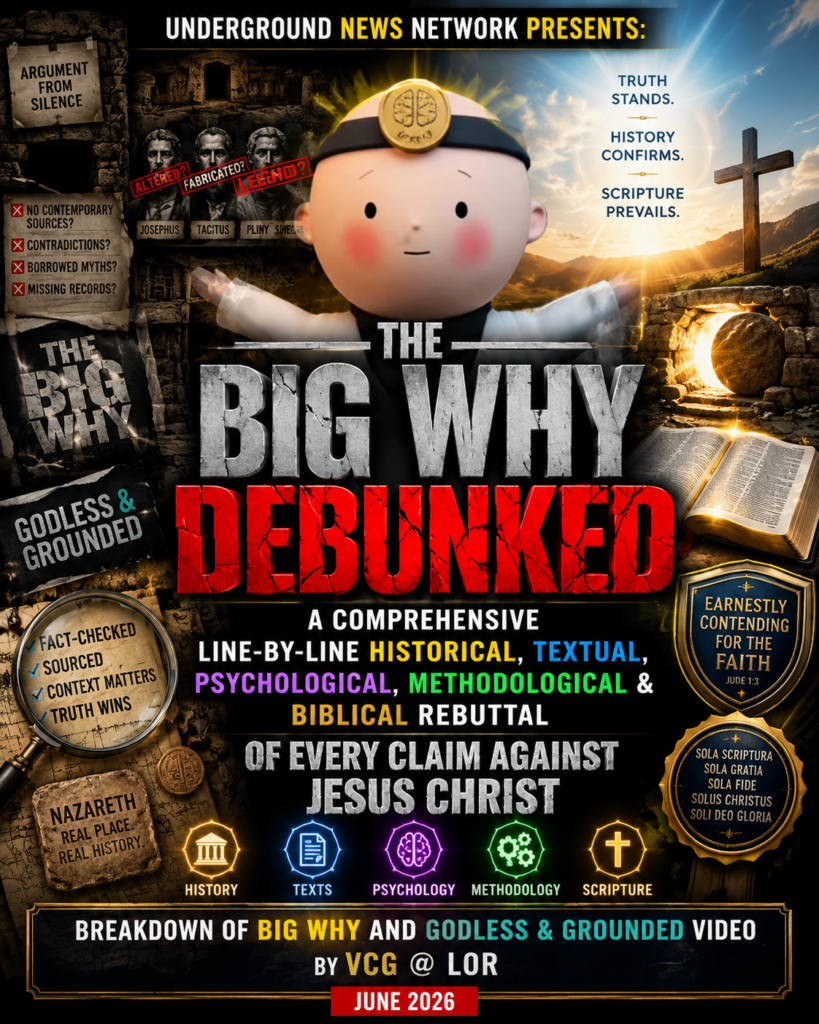
BY VCG @ LOR 6/29/2026
Soli Deo Gloria.
Here is the first-pass battle map.
Core verdict:
the video’s method is mostly argument from silence + inflated certainty + selective skepticism.
It demands impossible documentation for Jesus, then dismisses the actual early evidence when it appears.
Transcript claims to target:
“zero contemporary sources”
“Josephus altered/fabricated”
“Tacitus only repeats Christians”
“Paul has no earthly Jesus”
“birth narratives contradict”
“Nazareth barely existed”
“virgin birth mistranslation”
“dying/rising god borrowing”
Methodology correction:
absence of surviving first-hand Roman paperwork is not evidence of nonexistence.
Ancient history normally works by convergence: hostile references, early movement testimony, named relatives, geography, public execution, and explanatory power.
Line-by-line rebuttal starter
| Video claim | Rebuttal | Scripture correction |
|---|---|---|
| “Nobody alive wrote about Jesus.” | True only in a narrow surviving-text sense. It ignores that most first-century records are lost, and that Paul wrote within living memory, knew Cephas and James, and names “James the Lord’s brother” in Galatians 1:19. | “But other of the apostles saw I none, save James the Lord’s brother.” — Gal. 1:19 |
| “Josephus is almost certainly Christian fabrication.” | Overstated. Most modern scholarship rejects the fully Christian wording, but many accept an authentic core in the Testimonium; the James passage is widely treated as authentic and says “the brother of Jesus who was called Christ… James.” (Wikipedia) | Truth is not destroyed because a hostile or partial witness speaks imperfectly. |
| “Tacitus just repeats Christian myth.” | Speculation. Tacitus was hostile to Christians and reports that Christus was executed under Pontius Pilate in Tiberius’s reign. The video asserts “not archives” without proving it. (Wikipedia) | “This thing was not done in a corner.” — Acts 26:26 |
| “Paul has no earthly Jesus.” | False. Paul says Jesus was “made of a woman,” “made of the seed of David,” crucified, buried, raised, had brethren, instituted the supper, and appeared to witnesses. | Gal. 4:4; Rom. 1:3; 1 Cor. 11:23-26; 1 Cor. 15:3-8 |
| “Nazareth barely existed.” | Misleading. Archaeological work supports habitation at Nazareth from at least the early first century, likely as a small Jewish village. Small is not fictional. (Bible Interp) | “And he came and dwelt in a city called Nazareth…” |
| “The virgin birth is a linguistic accident.” | Overconfident. Matthew uses Isaiah typologically and the Greek parthenos was already in the Septuagint before Christianity; the claim assumes the Christian reading was invented rather than fulfilled. | “Behold, a virgin shall be with child…” — Matt. 1:23 |
| “Dying/rising gods explain Jesus.” | Weak parallelism. Osiris rules the dead; Dionysus/Attis/Adonis traditions differ sharply from a recent Jewish crucifixion under a named Roman prefect. Similar motifs do not prove borrowing. | “For we have not followed cunningly devised fables…” — 2 Pet. 1:16 |
Psychology of the video:
it uses certainty-language (“that’s just a fact,” “zero,” “impossible,” “manufactured”) to create confidence while stacking disputed claims as settled conclusions.
That is rhetoric, not careful historiography.
Anchor verse:
“For the preaching of the cross is to them that perish foolishness; but unto us which are saved it is the power of God.” — 1 Cor. 1:18
Soli Deo Gloria.
PART I — “ZERO CONTEMPORARY SOURCES”
Timestamp: 0:00–3:10
This is the foundation stone of the entire video.
If it falls, much of the remaining argument loses its force.
The opening argument is rhetorically powerful because it presents an apparent paradox:
“We have better historical documentation for Julius Caesar… than we do for Jesus…”
Notice the methodology.
It does not begin by examining evidence.
It begins by creating an emotional expectation.
This is called framing.
The audience is invited to assume that the most important man in history should automatically leave the largest paper trail.
History simply doesn’t work that way.
Fallacy #1
Argument From Silence
The argument proceeds:
“No contemporary sources…”
This is the classic argument from silence.
The absence of surviving documentation is treated as positive evidence that someone probably did not exist.
Those are not the same thing.
Ancient history is built almost entirely upon fragmentary evidence.
Most ancient writings have disappeared forever.
Scholars estimate only a tiny percentage of Greco-Roman literature has survived.
The overwhelming majority of first-century administrative records have perished.
The Roman Empire did not preserve every tax receipt, execution order, or governor’s memorandum.
If that standard were required, much of ancient history would disappear.
Psychological Technique
The narrator repeatedly uses absolutes.
“Nobody.”
“Zero.”
“Not one.”
Absolute language produces confidence.
It discourages nuance.
Yet ancient historians almost never speak this way because evidence rarely justifies absolute certainty.
Historical Context
Jesus was not a Roman senator.
He was not an emperor.
He was not a wealthy philosopher writing books.
He was an itinerant Jewish teacher operating in one small province for roughly three years.
From Rome’s perspective, Judea was troublesome—but Jesus himself was one of countless individuals executed under Roman authority.
Most crucifixion victims left no surviving Roman paperwork.
False Comparison
The comparison to Julius Caesar is misleading.
Caesar:
- Dictator of Rome
- Military commander
- Author
- Politician
- Head of state
- Controlled vast archives
Jesus:
- Rural Jewish preacher
- No political office
- No army
- Wrote no known books
- Executed as a provincial criminal
These are not historically comparable categories.
“Philo Never Mentioned Jesus”
This is one of the video’s strongest sounding arguments.
Yet notice what is assumed.
Philo lived in Alexandria.
He was not living in Galilee following Jesus around.
His surviving works concern:
- philosophy
- Jewish theology
- allegory
- Roman politics
They are not comprehensive chronicles of every preacher active in Judea.
Silence proves only that Philo never discussed Jesus in surviving writings.
Nothing more.
“Justus of Tiberias”
The video states:
“He says nothing about Jesus.”
Problem:
His works no longer exist.
We know them almost entirely through later references.
Arguing from a lost book is extremely weak evidence.
One cannot claim confidently what an unavailable document did or did not contain.
“Seneca Never Mentioned Jesus”
Again:
Argument from silence.
Seneca also never discusses many figures we know existed.
That omission proves little.
The Romans Recorded Everything
This statement sounds impressive.
It is historically exaggerated.
Romans kept many records.
They did not preserve everything.
Most provincial archives are gone.
Thousands upon thousands of legal records have vanished.
Papyrus deteriorates.
Wars destroy archives.
Libraries burn.
Jerusalem itself was destroyed in AD 70.
Expecting complete Roman documentation today misunderstands how ancient evidence survives.
Crucifixion Records
The narrator claims:
“Crucifixions required documentation.”
Likely true administratively.
But then assumes:
“If documentation existed, we should possess it today.”
That does not follow.
Very little provincial paperwork survives.
The overwhelming majority has disappeared.
Early Christian Evidence
Ironically, the video dismisses the earliest evidence because it is Christian.
Yet historians routinely use partisan sources.
Every ancient source possesses bias.
Josephus had bias.
Tacitus had bias.
Suetonius had bias.
Caesar had bias.
Bias does not equal uselessness.
Instead, historians ask:
- Is the author early?
- Was the author close to events?
- Can claims be corroborated?
- Does the author report embarrassing material?
- Does independent evidence converge?
By those standards, Paul’s letters become extraordinarily important.
Paul’s Letters
The video later minimizes Paul.
Yet Paul’s letters are among the earliest surviving Christian writings.
Within them Paul reports traditions he himself received, including a creed about Christ’s death, burial, resurrection, and appearances that many scholars date to only a few years after the crucifixion.
See 1 Corinthians 15:3–8.
Even many skeptical scholars regard this tradition as very early.
One may reject the resurrection itself, but it is difficult to deny that belief in it arose extremely early.
Scripture Correction (KJV)
Luke begins his Gospel by explicitly stating that he investigated eyewitness testimony:
“Forasmuch as many have taken in hand to set forth in order a declaration of those things which are most surely believed among us,
Even as they delivered them unto us, which from the beginning were eyewitnesses, and ministers of the word;
It seemed good to me also, having had perfect understanding of all things from the very first, to write unto thee in order…”— Luke 1:1–3
Likewise, Peter writes:
“For we have not followed cunningly devised fables… but were eyewitnesses of his majesty.”— 2 Peter 1:16
These verses are theological claims, not independent historical proof.
They are relevant because the video’s argument asserts that the Christian sources themselves lack concern for eyewitness testimony, whereas Luke explicitly frames his work around investigation and eyewitness reports.
Methodology Scorecard
Claim:
“Zero contemporary sources.”
Assessment:
- ✓ Correct that there are no surviving writings universally accepted as authored during Jesus’ ministry by an outside observer.
- ✗ Incorrect to imply this is unique or decisive.
- ✗ Relies heavily on an argument from silence.
- ✗ Overstates Roman record preservation.
- ✗ Creates a misleading comparison with Julius Caesar.
- ✗ Treats the lack of surviving administrative records as evidence against Jesus’ existence rather than as a normal feature of ancient history.
The next major section of the transcript turns to Josephus, where the video argues that the principal external Jewish witness to Jesus is wholly or substantially a Christian interpolation. That section benefits from careful distinction between what is broadly accepted by historians, what remains debated, and what the manuscript evidence can and cannot establish.
PART II — JOSEPHUS
Timestamp: 3:10–5:25
This is one of the most important sections of the video because Josephus is often presented as the strongest non-Christian witness to Jesus.
Unlike the opening section, however, this subject is far more nuanced than the narrator allows.
The video presents several disputed scholarly questions as though they are completely settled.
That is not an accurate representation of the field.
What is Josephus?
Flavius Josephus
Josephus (c. AD 37–100) was:
- born only a few years after Jesus’ crucifixion
- a priest
- a Pharisee
- participant in the Jewish revolt
- later employed by Rome
- author of Antiquities of the Jews
He was not a Christian.
That fact alone makes him historically valuable.
The Video’s Claim
The narrator says:
Josephus didn’t write the famous passage.
Then he says:
Most scholars agree it was inserted by Christians.
Notice the wording.
He does not distinguish between:
- complete fabrication
- partial interpolation
- authentic core with later edits
Those are very different positions.
What Scholars Actually Debate
There are two passages.
Passage One
The famous:
Testimonium Flavianum
Book 18 of Antiquities.
It presently says things such as:
- Jesus was a wise man.
- He performed surprising works.
- He was the Christ.
- He appeared alive again.
The problem?
Some phrases sound unmistakably Christian.
For example:
“He was the Christ.”
Most historians doubt Josephus himself wrote those exact words.
Why?
Josephus never became a Christian.
That observation is entirely reasonable.
Where the Video Overreaches
Instead of stopping there, the narrator jumps to:
Therefore the whole passage is worthless.
That conclusion does not follow.
Many historians—including numerous non-Christian scholars—believe:
- Josephus originally mentioned Jesus.
- Christian scribes later expanded the wording.
- The authentic core survived beneath the additions.
Those are three different claims.
The video collapses them into one.
Why Scholars Think There Was an Original Core
Several reasons.
First—
The passage fits the surrounding narrative reasonably well once obvious Christian phrases are removed.
Second—
An Arabic version preserved by Agapius of Hierapolis contains a noticeably less Christian wording.
It says approximately:
“At this time there was a wise man called Jesus…”
without the overt confession:
“He was the Christ.”
This suggests that an earlier, more restrained form may have circulated.
It does not prove it conclusively.
But it weakens the video’s claim that the entire paragraph is simply a Christian invention.
Origen
The narrator next appeals to Origen.
He says:
Origen admitted Josephus did not believe Jesus was Christ.
Correct.
Origen indeed remarks that Josephus did not accept Jesus as the Messiah.
That observation actually supports the interpolation argument regarding the phrase:
“He was the Christ.”
However—
It does not prove Josephus never mentioned Jesus.
It proves Origen knew Josephus was not a Christian.
Those are different conclusions.
Logical Problem
Notice the hidden syllogism.
Premise:
Josephus was not Christian.
Premise:
The text says Jesus was Christ.
Conclusion:
Josephus wrote nothing about Jesus.
The conclusion is too strong.
A more reasonable conclusion is:
Some Christian wording was added to an authentic report.
That position better explains all the evidence together.
The James Passage
The narrator then turns to the second reference.
Book 20.
Josephus writes concerning:
James,
“the brother of Jesus who was called Christ.”
The video argues:
This could simply be a scribal clarification.
Possible?
Yes.
Certain?
No.
Again, possibility is presented as certainty.
Why This Passage Matters
Unlike the Testimonium:
This passage is:
- brief
- incidental
- not praising Jesus
- primarily about James
That actually strengthens its historical value.
It has no obvious theological purpose.
Josephus’ focus is an illegal execution ordered by the high priest.
Jesus is mentioned only to identify which James is intended.
That is precisely how historians often identify otherwise common names.
The Santa Claus Analogy
The narrator says:
Mentioning someone’s brother named Santa Claus doesn’t prove Santa exists.
This analogy sounds clever.
It is also historically misleading.
Why?
Santa Claus is universally understood to be legendary.
Jesus is not treated that way by first-century writers.
Josephus is referring to a recent public figure known well enough to identify another man.
The analogy subtly assumes the very conclusion under debate.
That is begging the question.
Hostile Witness Principle
Historians often value hostile witnesses.
Josephus had no incentive to strengthen Christianity.
If he casually mentions:
James,
brother of Jesus,
called Christ,
that weighs differently than Christians saying it.
Hostile witnesses frequently carry greater evidential value because they lack apologetic motivation.
The Psychological Technique
Notice how the narrator repeatedly uses confidence language.
“Almost certainly.”
“Most reasonable.”
“Accepted by scholars.”
This creates the impression of unanimous agreement.
There is no unanimous agreement.
The debate concerns:
- interpolation
- degree
- reconstruction
- manuscript history
not whether Josephus must be discarded entirely.
What Can Honestly Be Said?
A careful historian may conclude:
✓ Christian interpolation almost certainly affected the Testimonium.
✓ Josephus probably did not originally write:
“He was the Christ.”
✓ The extent of interpolation remains debated.
✓ Many scholars accept an authentic historical core.
✓ The James reference is generally regarded as authentic, though some scholars question portions of it.
That is considerably more nuanced than the video’s presentation.
Scripture Correction
The New Testament never depends upon Josephus for its authority.
The apostles consistently appealed to eyewitness testimony and the acts of God rather than to external historians.
As Peter declared:
“For we have not followed cunningly devised fables, when we made known unto you the power and coming of our Lord Jesus Christ, but were eyewitnesses of his majesty.”— 2 Peter 1:16
Likewise, Paul reminds the Corinthians that the risen Christ appeared to many witnesses,
“of whom the greater part remain unto this present,”
inviting scrutiny from contemporaries rather than appealing to secret traditions (1 Corinthians 15:3–8).
Methodology Scorecard
Claim:
“Josephus is worthless because Christians inserted the passage.”
Assessment:
- ✓ Correct that the Testimonium Flavianum contains language widely regarded as Christian interpolation.
- ✓ Correct that Josephus himself was not a Christian.
- ✗ Incorrect to present complete fabrication as the scholarly consensus.
- ✗ Fails to distinguish between total forgery, partial interpolation, and an authentic core.
- ✗ Minimizes the historical significance of the James passage by treating a debated possibility as though it were an established conclusion.
- ✗ Uses rhetorical certainty where the evidence supports a more qualified historical judgment.
The next section of the transcript shifts from Jewish evidence to Tacitus, where the video argues that the principal Roman witness to Jesus merely repeated what Christians believed rather than preserving independent historical information.
That claim also deserves careful examination, including what Tacitus says, what he does not say, and what historians can reasonably infer from his wording.
PART III — TACITUS
Timestamp: 5:25–6:22
This section is important because the video attempts to remove what many historians regard as the strongest Roman reference to Jesus.
Notice the shift in strategy.
Josephus was dismissed because Christians supposedly altered him.
Tacitus is dismissed because he supposedly relied on Christians.
Either way, every external witness is ruled inadmissible.
That is an important methodological pattern.
Who Was Tacitus?
Tacitus
Tacitus (c. AD 56–120) was one of Rome’s greatest historians.
He was:
- Roman senator
- Consul
- Proconsul
- historian
- deeply connected with imperial government
He was not sympathetic toward Christianity.
Quite the opposite.
He calls Christianity a destructive superstition.
That hostility actually increases his historical value.
He has no theological motivation to support Christianity.
What Tacitus Actually Says
Writing around AD 116 in his Annals (15.44), Tacitus explains Nero’s response after the Great Fire of Rome.
He writes that Christians derived their name from:
Christus,
who
suffered the extreme penalty
during
the reign of Tiberius
at the hands of
Pontius Pilate.
These details closely align with the New Testament chronology.
The Video’s Argument
The narrator says:
Tacitus was merely repeating what Christians believed.
Notice something important.
He says:
“Almost certainly.”
Once again.
No evidence is produced that Tacitus interviewed Christians.
No evidence is produced that Tacitus never consulted official information.
The conclusion is asserted.
Not demonstrated.
Could Tacitus Have Learned from Christians?
Certainly.
It is possible.
Christians were already in Rome.
Tacitus knew of them.
That possibility cannot be dismissed.
But possibility is not proof.
Could Tacitus Have Used Roman Sources?
Also, possible.
Tacitus had unusually high governmental access.
As:
- senator
- consul
- imperial historian
he possessed opportunities unavailable to ordinary citizens.
Do historians know precisely which source he used?
No.
Tacitus himself does not identify it.
Therefore, neither conclusion—
“He used archives”
nor
“He only copied Christians”
can be asserted with certainty.
The honest answer is:
We do not know.
What Historians Can Say
Regardless of where Tacitus obtained the information,
he independently reports that:
- Christians existed.
- They derived their name from Christus.
- Christus was executed.
- The execution occurred during Tiberius’ reign.
- Pontius Pilate carried it out.
Even if Tacitus learned this from widespread Roman knowledge rather than archives,
it still demonstrates that by the early second century educated Romans understood Christianity to originate from an actual executed individual.
That is historically significant.
The Video’s Analogy
The narrator compares Tacitus to:
A historian in 2100 describing Jehovah’s Witnesses.
At first glance, that sounds persuasive.
But the analogy breaks down.
Why?
Because Tacitus is not discussing distant mythology.
He is explaining why Nero blamed Christians for a historical event:
the Great Fire.
To explain that group,
he briefly identifies its founder.
This is standard ancient historiography.
Hostile Testimony
One of the strongest features of Tacitus’ account is precisely what the video ignores.
Tacitus despised Christianity.
He had every reason to ridicule Christians.
He had no reason to invent their founder.
Hostile testimony often carries considerable evidential weight because it runs against the witness’s interests.
Historical Method
Suppose Tacitus wrote:
Christians follow Christus.
Executed under Pilate.
Suppose Josephus mentions:
James,
brother of Jesus,
called Christ.
Suppose Paul writes within twenty-five years of the crucifixion.
Suppose the Gospels preserve independent traditions.
Now ask the historical question.
Should these sources be treated separately?
Yes.
Should they also be allowed to reinforce one another where they independently converge?
Also, yes.
This is called:
multiple attestation.
The video instead isolates each source,
attacks it individually,
then ignores the cumulative picture.
That is not how historians normally weigh evidence.
The Missing Double Standard
Notice another inconsistency.
The narrator accepts Roman statements whenever they appear skeptical.
He rejects Roman statements whenever they support Christianity.
This is a subtle form of:
confirmation bias.
Evidence is evaluated according to whether it supports the preferred conclusion.
A balanced historical method asks first:
What is the evidence?
Only afterward asks:
What conclusion best explains it?
Tacitus and Christian Belief
Even if one grants the video’s strongest possible case—
Suppose Tacitus only repeated what Christians believed.
That still establishes something important.
By approximately AD 116,
Christians universally believed:
- Jesus existed.
- He was executed under Pilate.
- Christianity began in Judea.
That belief is far too early to be explained as a medieval legend.
The debate then shifts from:
“Did Christians believe this?”
to
“Were they correct?”
Those are different historical questions.
Scripture Correction
Luke anchors Jesus’ trial within identifiable rulers:
“Now in the fifteenth year of the reign of Tiberius Caesar, Pontius Pilate being governor of Judaea…”— Luke 3:1
Likewise, Paul preached publicly that Christ’s death and resurrection rested on witnessed events:
“For I delivered unto you first of all that which I also received, how that Christ died for our sins according to the scriptures;
And that he was buried, and that he rose again the third day according to the scriptures:
And that he was seen of Cephas, then of the twelve…”— 1 Corinthians 15:3–5
The New Testament presents these as public claims tied to named people and places, not as timeless myths detached from history.
Psychology of the Video
This section illustrates a recurring persuasive pattern:
- Present the source.
- Suggest a speculative natural explanation.
- State that explanation as though it were the most probable conclusion.
- Move on before examining competing explanations.
That sequence gives an impression of decisiveness while often leaving alternative interpretations unexplored.
Methodology Scorecard
Claim:
“Tacitus merely repeated Christian tradition.”
Assessment:
- ✓ Correct that Tacitus wrote decades after Jesus’ death.
- ✓ Correct that Tacitus does not explicitly identify his source.
- ✓ Possible that he knew Christian claims.
- ✗ Not established that he relied only on Christians.
- ✗ Overstates certainty about Tacitus’ source.
- ✗ Does not account for Tacitus’ hostile stance toward Christianity or his access to elite Roman circles.
- ✗ Underplays the cumulative historical value of Tacitus alongside other early sources.
The next section of the video turns to Paul’s letters, arguing that Paul knew only a “cosmic Christ” and showed “essentially zero interest” in the historical Jesus.
This is one of the central historical claims in the video and warrants especially close examination because Paul’s letters are the earliest surviving Christian writings.
PART IV — PAUL’S LETTERS
Timestamp: 6:22–8:20
This section is arguably the most important in the entire video.
If Paul knew only a mythical, heavenly Christ who never recently lived on earth, then the historical foundation of Christianity would be severely weakened.
The problem is that the video’s presentation significantly overstates its case.
It correctly notes that Paul’s letters are the earliest surviving Christian writings.
It then draws conclusions that Paul’s letters themselves do not support.
The Video’s Claim
The narrator argues:
“Paul almost never describes anything Jesus said or did.”
Then concludes:
“Paul’s Christ looks much more like a mythological heavenly figure.”
Notice the reasoning.
Premise:
Paul does not retell many Gospel stories.
Conclusion:
Paul therefore probably did not know a historical Jesus.
That conclusion does not necessarily follow.
Understanding Paul’s Purpose
Before asking what Paul says,
we should ask:
Why was Paul writing?
Paul was not writing biographies.
He was writing:
- pastoral letters
- theological instruction
- responses to crises
- corrections of false teaching
- practical church guidance
His readers already knew the basic story of Jesus.
Paul was not introducing Christianity to them.
He was correcting churches that had already been evangelized.
That changes expectations considerably.
Paul’s Own Statement
Paul explains his mission.
He preached Christ.
Then later wrote letters addressing problems.
A letter dealing with divisions in Corinth should not be expected to repeat the Sermon on the Mount.
That is not its purpose.
Silence regarding an event does not imply ignorance of that event.
Does Paul Know an Earthly Jesus?
Absolutely.
Consider the evidence.
Jesus Was Born
Paul writes:
“But when the fulness of the time was come, God sent forth his Son, made of a woman, made under the law.”
Galatians 4:4
That is not a purely celestial being.
He is:
- born
- Jewish
- under Mosaic Law
Descended From David
Paul writes:
“Concerning his Son Jesus Christ our Lord, which was made of the seed of David according to the flesh.”
Romans 1:3
Notice the phrase:
according to the flesh
That is historical language.
Not mythological abstraction.
Crucified
Paul repeatedly refers to:
Christ crucified.
Not merely dying,
but specifically crucified.
That connects directly with Roman execution.
Buried
1 Corinthians 15 states:
Christ
- died
- was buried
- rose again
Burial is an earthly historical act.
Mythological heavenly beings are not normally described this way.
Eyewitnesses
Paul continues:
“He was seen of Cephas…
then of the twelve…
after that… above five hundred brethren…
after that… James…
then all the apostles.”
1 Corinthians 15:5–7
This is remarkable.
Paul appeals to identifiable witnesses.
He even notes that many remained alive.
In effect saying:
“They’re still here.”
That is not how mythology is usually argued.
Paul Personally Knew Jesus’ Circle
This is where the video’s argument becomes especially difficult.
Paul tells us that after his conversion he visited Jerusalem.
He met:
- Peter (Cephas)
- James
Galatians 1:18–19
James is identified as:
“the Lord’s brother.”
If Paul’s Jesus were merely a heavenly myth,
this phrase becomes difficult to explain.
The Lord’s Supper
Paul also records Jesus’ words.
“The Lord Jesus the same night in which he was betrayed took bread…”
1 Corinthians 11:23
Notice what this assumes.
Jesus:
- shared a final meal
- was betrayed
- spoke specific words
These are historical memories.
Not merely heavenly visions.
Paul’s Revelation
The narrator emphasizes:
Paul received the Gospel
“by revelation.”
Correct.
Paul says exactly that.
Galatians 1.
But the narrator quietly omits the next part.
Paul later consulted with:
- Peter
- James
- John
Galatians 2
Paul’s Gospel was not left permanently isolated from the Jerusalem apostles.
Instead,
Paul explicitly says they recognized the same Gospel.
“Paul Never Mentions…”
The narrator lists:
- miracles
- parables
- empty tomb
- Mary Magdalene
- Sermon on the Mount
This sounds persuasive.
But notice another argument from silence.
Letters are selective.
Paul also never explains:
- Bethlehem
- Nazareth
- Joseph
- the wise men
That omission proves little.
It simply reflects what his letters were written to accomplish.
The Hidden Assumption
The video’s reasoning assumes:
If Paul knew historical details,
he would constantly repeat them.
Why?
Ancient letters rarely function that way.
Imagine reading only Paul’s letter to Philemon.
Would someone conclude Christianity lacked a resurrection?
Of course not.
Genre matters.
Purpose matters.
Audience matters.
Multiple Independent Traditions
Another overlooked point.
Paul quotes early Christian tradition.
For example:
1 Corinthians 15 begins:
“For I delivered unto you first of all that which I also received…”
Those verbs—
received
delivered
reflect recognized traditions already circulating before Paul wrote.
Most scholars, including many skeptical ones, date this creed very early.
Possibly within only a few years after Jesus’ crucifixion.
That makes legendary development much harder to argue.
Psychology of the Video
This section relies heavily upon:
expectation bias.
The narrator first creates an expectation.
“If Jesus really lived…”
Then measures Paul against that expectation.
But historians ask a different question.
Given:
- Paul’s purpose
- audience
- genre
- pastoral concerns
what would we reasonably expect him to mention?
Those are two different methodologies.
Scripture Correction
Paul plainly affirms both the historical humanity and the resurrection of Christ.
“Remember that Jesus Christ of the seed of David was raised from the dead according to my gospel.”— 2 Timothy 2:8
Likewise:
“For there is one God, and one mediator between God and men, the man Christ Jesus.”— 1 Timothy 2:5
The Christ whom Paul proclaims is simultaneously:
- born of a woman
- descended from David
- crucified
- buried
- raised
- seen by witnesses
- exalted
Paul’s theology is not a replacement for history; it is built upon what he presents as historical events.
Methodology Scorecard
Claim:
“Paul knew only a cosmic Christ and had essentially no interest in the historical Jesus.”
Assessment:
- ✓ Correct that Paul’s letters are earlier than the Gospels.
- ✓ Correct that Paul focuses primarily on theology and church instruction rather than biography.
- ✗ Incorrect to suggest Paul knew only a heavenly, non-historical Christ.
- ✗ Ignores Paul’s references to Jesus’ birth, Jewish identity, Davidic lineage, betrayal, crucifixion, burial, resurrection, and appearances.
- ✗ Omits Paul’s meetings with Peter and James, “the Lord’s brother.”
- ✗ Relies on an argument from silence by treating Paul’s selective emphasis as evidence of ignorance.
Overall Pattern So Far
By this point in the video, a consistent methodological pattern has emerged:
- Set an expectation that ancient evidence should look modern.
- Highlight what is absent rather than weighing what is present.
- Present disputed historical questions as settled.
- Use absolute language (“zero,” “nobody,” “essentially no interest”) where the evidence supports more qualified conclusions.
- Evaluate each source in isolation instead of considering how multiple independent sources converge.
The next major section addresses the Gospel narratives, beginning with the birth accounts in Matthew and Luke, the chronology of Herod and Quirinius, and the Roman census.
Those issues require careful distinction between genuine historical questions and claims that go beyond what the available evidence establishes.
PART V — THE GOSPELS
Timestamp: 8:20–10:35
Matthew, Luke, Herod, Quirinius, and the Census
This is one of the most cited skeptical arguments against the New Testament.
Unlike some previous sections, there are genuine historical questions here.
The problem is not that the narrator raises them.
The problem is that he repeatedly presents debated issues as though only one conclusion is possible.
Good historical method requires more restraint.
The Video’s Claim
The narrator argues:
Matthew and Luke cannot both be historically true.
Then:
The census proves Luke invented the story.
Then:
Bethlehem was created to satisfy prophecy.
This is actually three separate arguments.
Each should be examined independently.
Step One
Do Matthew and Luke Emphasize Different Things?
Yes.
Absolutely.
Matthew focuses on:
- Joseph
- the Magi
- Herod
- Egypt
- fulfillment of prophecy
Luke focuses on:
- Mary
- shepherds
- the temple
- Simeon
- Anna
- the census
These are different emphases.
Different emphasis does not automatically equal contradiction.
Are They Mutually Exclusive?
The video says:
Matthew has them living in Bethlehem.
Luke has them living in Nazareth.
Let’s examine carefully.
Matthew begins:
Jesus was born in Bethlehem.
The Magi arrive later.
The family eventually settles in Nazareth.
Luke says:
The family lived in Nazareth.
They traveled to Bethlehem.
Jesus was born there.
Later they returned to Nazareth.
Notice something.
Matthew never explicitly says Bethlehem had always been Joseph’s permanent residence.
Nor does Luke deny temporary residence elsewhere.
The accounts are compressed.
Different events receive different emphasis.
That alone does not establish contradiction.
The Flight into Egypt
The narrator argues:
Luke doesn’t mention Egypt.
Therefore, Matthew invented it.
This reasoning is flawed.
Ancient biographies were highly selective.
Luke also omits:
- the Magi
- Herod’s massacre
- the star
Matthew omits:
- shepherds
- Simeon
- Anna
No historian concludes from silence alone that omitted events never happened.
The Chronology Problem
Now we reach the strongest historical issue.
Herod died around 4 BC.
Quirinius conducted a well-known census around AD 6.
That appears to create roughly a ten-year difference.
This is a genuine question.
The video is correct to recognize it.
But it overstates what follows.
What Historians Actually Debate
There are several proposed explanations.
None commands universal agreement.
Examples include:
1
Luke refers to an earlier administrative role connected with Quirinius.
Possible.
Debated.
2
The Greek wording permits:
“This census was before Quirinius was governor.”
Also debated.
3
Quirinius exercised authority in Syria more than once.
Some historians argue for overlapping administrative responsibilities.
Again—
debated.
Notice something.
The narrator never mentions any alternative scholarly proposals.
Instead, he presents:
“There is only one possible interpretation.”
That is historically incomplete.
Methodological Error
Suppose Luke’s chronology is difficult.
Does that prove:
Jesus never existed?
No.
At most,
it would suggest Luke may have mistaken or compressed chronology.
Those are entirely different conclusions.
The video quietly leaps from:
possible chronological problem
to
fabricated birth narrative
to
fabricated historical figure.
That is a non sequitur.
The Roman Census
The narrator confidently says:
Romans never required ancestral registration.
This is probably his strongest rhetorical moment.
Let’s examine carefully.
What We Actually Know
Roman censuses varied enormously.
The Empire covered:
- Britain
- Egypt
- Syria
- Judea
- North Africa
- Greece
Administrative procedures were not identical everywhere.
Especially among client kingdoms.
Especially under local rulers.
Especially in Jewish contexts.
Egyptian Papyri
Skeptics often point to surviving Egyptian census records.
Those records generally required registration where one resided.
Correct.
But Egypt is not Judea.
Administrative diversity existed throughout the Empire.
The absence of identical procedures elsewhere does not prove impossibility.
Luke’s Language
Luke simply says:
Joseph went because he belonged to the house and lineage of David.
He does not describe an empire-wide migration of every citizen to ancestral cities across generations.
The video exaggerates Luke’s wording into the most absurd logistical scenario possible.
That strengthens the rhetoric,
not necessarily the history.
Bethlehem Prophecy
Now the narrator argues:
The census was invented to satisfy prophecy.
Specifically:
Micah 5:2.
This is certainly one possible skeptical hypothesis.
But notice—
It assumes the conclusion.
If Jesus actually was born in Bethlehem,
then no invention is necessary.
Therefore, the prophecy argument cannot itself determine historicity.
It depends upon prior assumptions.
Circular Reasoning
The reasoning becomes:
The prophecy existed.
Therefore, Christians invented Bethlehem.
How do we know?
Because prophecy existed.
That is circular.
To establish invention,
independent evidence of fabrication would be required.
Not merely the existence of prophecy.
The Psychology
This section demonstrates another persuasive technique.
The narrator repeatedly says:
“Obviously.”
“Invented.”
“Manufactured.”
Those words bypass historical uncertainty.
Good historians usually say:
- perhaps
- likely
- possible
- probable
- uncertain
The video’s certainty exceeds what the surviving evidence allows.
What About Luke’s Reliability?
Interestingly,
Luke repeatedly demonstrates concern for chronology.
He names:
- Augustus
- Quirinius
- Tiberius
- Pilate
- Herod
- Philip
- Lysanias
- Annas
- Caiaphas
Luke intentionally anchors his narrative within public history.
That does not prove every chronological detail is free from difficulty.
But it shows he is attempting historical placement,
not mythological storytelling.
Scripture Correction
Luke opens his Gospel with an explicit historical method:
“It seemed good to me also, having had perfect understanding of all things from the very first, to write unto thee in order.”— Luke 1:3
He later situates John the Baptist’s ministry by listing rulers and officials:
“Now in the fifteenth year of the reign of Tiberius Caesar, Pontius Pilate being governor of Judaea, and Herod being tetrarch of Galilee…”— Luke 3:1
Whether every chronological question has a definitive modern answer is a matter of historical investigation.
What these passages do show is that Luke presents his account as occurring within identifiable times and places, not as an intentionally timeless myth.
The Larger Historical Question
Even if someone concluded:
Luke confused a census.
Would that establish:
- Jesus never lived?
- Paul invented Him?
- Peter invented Him?
- James never existed?
- Christianity emerged from pagan mythology?
No.
Those claims require additional arguments.
Historical reasoning should distinguish between questions about one event’s chronology and questions about the existence of the central figure.
Methodology Scorecard
Claim:
“Matthew and Luke contradict each other, and Luke invented the census to force Jesus into Bethlehem.”
Assessment:
- ✓ Correct that Matthew and Luke emphasize different aspects of the birth narrative.
- ✓ Correct that the chronology involving Herod and Quirinius raises genuine historical questions.
- ✓ Correct that scholars continue to debate Luke’s census.
- ✗ Incorrect to present one skeptical explanation as the only viable historical conclusion.
- ✗ Overstates certainty about Roman census practices across the entire Empire.
- ✗ Conflates a debated chronological issue with proof that Jesus was a fictional character.
- ✗ Uses rhetorical certainty (“invented,” “manufactured”) where the evidence remains contested.
Pattern Emerging
By this stage of the transcript, a clear pattern has developed:
- Silence becomes evidence of nonexistence.
- Historical difficulties become proof of fabrication.
- Debated scholarly questions are presented as settled.
- Alternative explanations are omitted.
- Individual issues are treated cumulatively without weighing contrary evidence.
The next section addresses Nazareth, the archaeological evidence for the village, and the claim that it “barely existed” in the early first century.
That topic allows comparison between older skeptical arguments and more recent archaeological findings.
PART VI — NAZARETH
Timestamp: 10:34–11:17
This section is interesting because it illustrates how skeptical arguments can persist even after new archaeological discoveries.
The narrator claims:
“There is no strong archaeological evidence that Nazareth existed as a meaningful settlement.”
Then concludes:
“The Gospel writers may have chosen a location obscure enough that nobody could check.”
Notice again how the argument progresses.
It begins with archaeology.
It ends with intentional deception.
Those are two very different claims.
The Claim
The video argues:
- Nazareth barely existed.
- There was little evidence for a town.
- Therefore Luke’s synagogue story becomes implausible.
- Therefore perhaps the Gospel writers invented Nazareth.
This sounds persuasive until each step is examined separately.
What Archaeology Actually Shows
Several decades ago, skeptics frequently argued there was virtually no archaeological evidence for first-century Nazareth.
That argument carried more force before extensive excavations.
Since then, additional discoveries have changed the discussion.
Archaeologists have uncovered evidence consistent with a small Jewish village occupied during the early Roman period, including:
- domestic structures,
- rock-cut tombs,
- agricultural terraces,
- storage pits,
- ritual (miqveh) installations,
- pottery dating to the late Hellenistic and early Roman periods.
The evidence does not indicate a large city.
It does support habitation.
That distinction matters.
Small Village ≠ Fictional Village
The narrator subtly shifts categories.
He moves from:
“It was small.”
to
“Therefore, it barely existed.”
to
“Therefore, the Gospel writers invented it.”
Those are three increasingly stronger claims.
The evidence supports the first much more readily than the third.
Many genuine villages in antiquity were small.
Small settlements rarely leave extensive archaeological remains.
What Does “Nazareth” Mean in the Gospels?
The Gospels never describe Nazareth as a major urban center.
Quite the opposite.
In the Gospel of John, Nathanael asks:
“Can there any good thing come out of Nazareth?”
That question itself suggests Nazareth had an unimpressive reputation.
If Christians wanted to invent an impressive hometown for the Messiah, Nazareth would be an odd choice.
It carries no obvious prestige.
Indeed, its obscurity could be viewed as an example of the criterion of embarrassment: an unlikely detail that early Christians nevertheless preserved.
The Synagogue Objection
The narrator argues that such a tiny village could not have had a synagogue.
This goes beyond what archaeology can establish.
First-century synagogues varied considerably.
They were not always monumental stone buildings.
In many villages, gatherings for Scripture reading and teaching likely took place in modest community spaces.
The absence of a surviving synagogue building in Nazareth is not proof that no such assembly existed.
Archaeology often preserves only a fraction of ancient structures.
“Nobody Could Check”
This is perhaps the most speculative statement in the section.
The narrator proposes that the Gospel writers deliberately selected an obscure location because no one could verify it.
Ask a historical question:
Who were the earliest readers of the Gospels?
Many lived in:
- Judea
- Galilee
- Syria
or had direct connections to those regions.
If Nazareth were entirely fictional, the claim would have been readily challenged by people familiar with Galilee.
Instead, there is no ancient controversy arguing that Nazareth itself was an invented place.
Critics of Christianity in antiquity attacked many Christian claims, but they did not generally accuse the evangelists of inventing Nazareth from nothing.
Archaeology and Expectations
The narrator also assumes that every real village should leave abundant archaeological remains.
That is not how archaeology works.
Small farming settlements often leave:
- scattered pottery
- foundations
- cisterns
- tombs
- agricultural features
Such remains can be difficult to identify, especially beneath centuries of later occupation.
The absence of monumental architecture is entirely compatible with a modest Galilean village.
The Psychological Technique
Notice the rhetorical progression:
“Very little evidence.”
“Tiny hamlet.”
“Barely existed.”
“Chosen because no one could check.”
Each sentence increases suspicion.
Yet the archaeological evidence itself does not compel those later conclusions.
This is an example of moving beyond the available data.
Scripture Correction
The New Testament consistently refers to Nazareth in an unembellished manner.
Matthew records:
“And he came and dwelt in a city called Nazareth.”— Matthew 2:23
Luke describes Jesus reading in the synagogue of Nazareth:
“And he came to Nazareth, where he had been brought up… and, as his custom was, he went into the synagogue on the sabbath day.”— Luke 4:16
Whether one accepts Luke’s account as historically accurate is a matter of historical judgment, but the narrative itself portrays Nazareth as an ordinary Jewish village, not as a grand or symbolic city.
Historical Perspective
Even many historians who are skeptical of miracles do not conclude that Nazareth was invented.
The more common historical assessment is:
- Nazareth existed.
- It was small.
- It was agriculturally based.
- It lacked the prominence of cities such as Sepphoris or Jerusalem.
That picture is broadly compatible with the Gospel descriptions.
Methodology Scorecard
Claim:
“Nazareth barely existed, so the Gospel writers may have invented it.”
Assessment:
- ✓ Correct that Nazareth was likely a small settlement rather than a major town.
- ✓ Correct that earlier archaeological evidence was limited.
- ✗ Incorrect to imply that archaeology supports Nazareth’s nonexistence.
- ✗ Moves from “small village” to “fictional village” without sufficient evidence.
- ✗ Assumes the lack of monumental remains disproves ordinary village life.
- ✗ Suggests intentional literary invention without direct historical evidence.
Pattern So Far
By this point, the video’s recurring method is becoming increasingly clear:
- Begin with a genuine historical question.
- Present one skeptical interpretation as though it were the scholarly consensus.
- Use absolute or highly confident language.
- Omit alternative explanations supported within historical scholarship.
- Draw a broader conclusion (fabrication, invention, myth) that goes beyond what the specific evidence alone establishes.
The next section turns to Matthew 27:52–53, where the video argues that the resurrection of “many saints” is so extraordinary that the silence of other sources proves the account must be legendary.
This raises important questions about arguments from silence, the genre of ancient historical writing, and how historians evaluate singular reported events.
PART VII — MATTHEW 27:52–53
Timestamp: ~11:17–12:45
“The Saints Came Out of Their Graves”
This is one of the most difficult passages in the New Testament.
Unlike previous sections, this is a place where Christians should acknowledge the challenge rather than pretend none exists.
The passage is extraordinary.
The question is:
Does extraordinary equal false?
The video assumes the answer is yes.
History requires more careful reasoning.
The Passage
Matthew records:
“And the graves were opened; and many bodies of the saints which slept arose,
And came out of the graves after his resurrection, and went into the holy city, and appeared unto many.”— Matthew 27:52–53
Notice carefully.
Matthew says:
- graves opened
- saints raised
- appeared to many
He does not say:
- the entire city believed
- Rome investigated
- everyone in Jerusalem saw them
Those details are often added by critics.
The Video’s Claim
The narrator argues:
“If dead people walked through Jerusalem…”
then
every historian would mention it.
This sounds intuitive.
But it rests upon another argument from silence.
How Much First-Century History Actually Survives?
This is the question rarely asked.
How many detailed first-century histories of Jerusalem do we possess?
Very few.
Most documents have vanished.
The overwhelming majority of local records are gone forever.
To argue:
“No surviving document mentions it.”
therefore
“It never happened.”
requires assuming we possess enough surviving material to expect such mention.
We do not.
Josephus Again
The narrator asks:
Why doesn’t Josephus mention it?
Good question.
But Josephus omits many things recorded elsewhere.
Likewise:
Tacitus omits events found in Josephus.
Josephus omits events found in Tacitus.
Ancient historians were selective.
Silence cannot bear the weight placed upon it.
Ancient Historiography
Modern journalism attempts comprehensive reporting.
Ancient historians did not.
They selected events serving their purposes.
Matthew’s purpose is theological history centered on Jesus.
Josephus’ purpose differs greatly.
Different purposes produce different selections.
Extraordinary Claims
Christians should admit:
This is an extraordinary report.
Extraordinary claims deserve careful examination.
But the skeptical slogan:
“Extraordinary claims require extraordinary evidence”
is not itself a historical rule.
Historians instead ask:
- Is the source early?
- Is it independent?
- Is the author close to the events?
- Does the claim fit the author’s broader narrative?
- Are there reasons for invention?
Those are historical questions.
Did Matthew Invent It?
The video assumes:
Matthew needed dramatic symbolism.
Therefore, he invented the story.
Notice again.
Possible?
Perhaps.
Proven?
No.
The narrator repeatedly substitutes:
possible explanation
for
demonstrated explanation.
Literary Genre
Some scholars argue Matthew uses apocalyptic imagery.
Others argue for literal resurrection.
Others suggest symbolic historical reporting.
There is genuine scholarly disagreement.
The video never informs the audience of that diversity.
Instead, it says, in effect:
“Everyone knows this is legendary.”
That overstates the evidence.
Internal Consistency
Notice something interesting.
Matthew delays the appearance.
The text says:
The graves opened at Jesus’ death,
but the saints came out
after His resurrection.
That detail fits Matthew’s theology.
Christ remains
“the firstfruits”
(1 Corinthians 15:20)
rather than others preceding Him.
Whether one interprets the event literally or symbolically, Matthew is careful about chronology within his own theological framework.
Psychological Technique
The narrator invites the audience to imagine:
Thousands of zombies walking through Jerusalem.
But that is not what Matthew describes.
Matthew says:
“many”
Not:
“everyone.”
He says:
“appeared unto many.”
Not:
“appeared unto the entire Roman Empire.”
The skeptical retelling exaggerates the scale beyond the text itself.
That makes ridicule easier.
The Argument from Embarrassment
If Christians were inventing stories purely for persuasion,
this is actually an unusual choice.
Why?
Matthew alone includes it.
Later Christian preaching in Acts does not repeatedly appeal to it.
Paul never builds arguments upon it.
The event is not exploited in the way one might expect if it were simply invented as propaganda.
That observation does not prove it happened.
But it complicates simplistic theories of fabrication.
Scripture Interprets Scripture
Paul teaches:
“But now is Christ risen from the dead, and become the firstfruits of them that slept.”— 1 Corinthians 15:20
Matthew’s chronology—saints appearing after Christ’s resurrection—accords with Paul’s presentation of Christ as the firstfruits.
This internal coherence deserves consideration.
Historical Humility
This is one area where Christians should exercise humility.
The passage raises real interpretive questions.
Different orthodox interpreters have proposed different understandings.
Admitting complexity is not weakness.
It is good historical method.
What we should avoid is claiming more certainty than the evidence allows—whether in defense or criticism.
Scripture Correction
Matthew records:
“And the graves were opened…”— Matthew 27:52–53
Paul likewise teaches:
“For as in Adam all die, even so in Christ shall all be made alive.”— 1 Corinthians 15:22
The New Testament consistently presents resurrection not as an isolated miracle but as part of God’s redemptive work culminating in Christ.
Methodology Scorecard
Claim:
“Because no other historian mentions the resurrected saints, Matthew invented the story.”
Assessment:
- ✓ Correct that Matthew is the only New Testament author to record this event.
- ✓ Correct that no surviving non-Christian source independently confirms it.
- ✓ Correct that the passage is extraordinary and has generated considerable scholarly discussion.
- ✗ Incorrect to treat silence in other surviving sources as proof of fabrication.
- ✗ Overstates the completeness of surviving first-century historical records.
- ✗ Expands Matthew’s account into a much larger scenario than the text itself describes.
- ✗ Presents one interpretive conclusion as though no serious alternatives exist.
Overall Pattern After Seven Sections
At this point in the video, a recurring methodology is clearly visible:
- Arguments from silence are repeatedly treated as positive evidence.
- Possibility is frequently presented as probability, and probability as certainty.
- Scholarly debates are simplified into single, definitive conclusions.
- Rhetorical certainty (“obviously,” “clearly,” “invented”) often exceeds what the historical evidence can establish.
- Individual difficulties are accumulated into a broader conclusion without fully considering the cumulative case from independent early sources.
The next major section addresses the virgin birth and Isaiah 7:14, including the Hebrew term ʿalmah, the Greek parthenos, and the claim that the New Testament rests on a mistranslation.
That discussion requires careful attention to Hebrew, the Septuagint, and Second Temple Jewish interpretation rather than relying on oversimplified linguistic arguments.
PART VIII — ISAIAH 7:14, THE VIRGIN BIRTH, AND THE “MISTRANSLATION” CLAIM
Timestamp: ~12:45–15:00
This is one of the oldest skeptical arguments against Christianity.
The narrator claims:
The virgin birth is based on a mistranslation.
Specifically:
- Hebrew עַלְמָה (ʿalmah) means “young woman.”
- Matthew supposedly mistranslated it as “virgin.”
- Therefore Christianity built a major doctrine upon a linguistic mistake.
This sounds straightforward.
It is not.
The issue is considerably more complex.
Step One
What Does ʿAlmah Mean?
The Hebrew word ʿalmah does indeed refer to a:
young woman.
The narrator is correct.
However—
The word is not simply equivalent to:
“any female.”
In the Old Testament,
ʿalmah consistently refers to young women of marriageable age.
None of its uses clearly describe a sexually experienced married woman.
That is important.
What the Video Omits
The narrator leaves the audience with the impression that Hebrew possesses:
one word for virgin,
one word for young woman,
therefore Matthew obviously made a mistake.
Hebrew usage is not that simple.
There is another Hebrew word:
בְּתוּלָה (bethulah)
often translated:
“virgin.”
But even bethulah is not always used in an absolutely technical biological sense.
Context matters.
Languages rarely function like mathematical equations.
Lexical Fallacy
The video commits what linguists call:
the root-word fallacy
or
dictionary fallacy.
It assumes one dictionary definition automatically determines every usage.
Words derive meaning from:
- context
- grammar
- historical usage
- literary setting
not merely dictionary entries.
The Septuagint
Here is the crucial historical fact omitted almost entirely.
Long before Jesus,
Jewish scholars translated the Hebrew Scriptures into Greek.
This translation is called:
the Septuagint (LXX).
When they translated Isaiah 7:14,
they chose the Greek word:
παρθένος (parthenos)
which ordinarily means:
virgin.
This translation occurred approximately two centuries before Christ.
That means:
Christians did not invent this rendering.
Jewish translators produced it.
That historical fact substantially weakens the claim that Matthew simply manufactured a mistranslation.
Matthew’s Use
Matthew quotes the Septuagint.
He writes:
“Behold, a virgin shall be with child…” Matthew 1:23
Notice carefully.
Matthew is not creating a new translation from scratch.
He is quoting a Greek Bible already widely known among Jews of the Diaspora.
Dual Fulfillment
Another point omitted.
Many Christian scholars understand Isaiah 7 as involving:
- an immediate historical fulfillment in Isaiah’s own day,
and
- a greater Messianic fulfillment in Christ.
This is called:
typology
or
dual fulfillment.
Whether one accepts that interpretation is another matter.
But it is inaccurate to portray Matthew as simply misunderstanding Hebrew.
The Immediate Context
The narrator argues:
Isaiah is speaking only to King Ahaz.
Correct.
The historical context certainly involves Ahaz.
No serious scholar denies that.
But biblical prophecy frequently contains:
- immediate significance
- later fulfillment
- recurring patterns
Examples include:
- Davidic kingship
- the Passover
- the Exodus
- the suffering servant themes
Matthew regularly interprets Scripture typologically.
The narrator treats prophecy as though only one level of fulfillment is ever permissible.
That assumption itself requires argument.
Jewish Interpretation Before Christianity
One of the strongest rebuttals is historical.
If the Septuagint translators—who were Jewish and pre-Christian—already rendered ʿalmah as parthenos,
then the issue cannot simply be dismissed as:
“Christians changed the Hebrew.”
The translation decision predates Christianity.
That does not automatically prove Matthew’s interpretation.
But it proves the video’s historical narrative is incomplete.
The Word Parthenos
The narrator also assumes:
parthenos always means exactly one thing.
Languages are more flexible.
While parthenos ordinarily denotes virginity,
it can occasionally be used more broadly depending upon context.
Again,
context governs meaning.
The linguistic picture is more nuanced than the video’s presentation.
Psychology of the Video
Notice another persuasive technique.
The narrator appeals to certainty through simplification.
Complex linguistic history becomes:
“Oops.”
“Translation error.”
“Christianity built on a mistake.”
People naturally prefer simple explanations.
Reality often refuses to cooperate.
Matthew’s Theology
Matthew is not randomly proof-texting.
Throughout his Gospel he repeatedly presents Jesus as fulfilling patterns within Israel’s history.
Examples include:
- Egypt
- Moses
- David
- Hosea
- Isaiah
Whether one accepts Matthew’s theological reading is a separate question.
But his interpretive method is internally consistent.
The video presents him as careless.
His Gospel instead shows deliberate engagement with Jewish Scripture.
Scripture Correction
Isaiah writes:
“Therefore the Lord himself shall give you a sign; Behold, a virgin shall conceive, and bear a son…” Isaiah 7:14
Matthew then records:
“Now all this was done, that it might be fulfilled which was spoken of the Lord by the prophet…” Matthew 1:22–23
Regardless of one’s view on fulfillment, Matthew explicitly grounds his interpretation in what he understands to be God’s providential work rather than presenting an isolated mistranslation.
The Real Historical Question
The debate is not simply:
“What does one Hebrew word mean?”
The real questions are:
- How did Second Temple Jews interpret Isaiah?
- Why did pre-Christian Jewish translators choose parthenos?
- How does Matthew understand prophetic fulfillment?
- Can biblical prophecy legitimately possess both immediate and ultimate horizons?
Those questions are far richer than the video’s simplified presentation.
Methodology Scorecard
Claim:
“The virgin birth is based on a mistranslation of Isaiah 7:14.”
Assessment:
- ✓ Correct that ʿalmah can mean “young woman.”
- ✓ Correct that Isaiah 7 has an immediate historical context involving King Ahaz.
- ✗ Incorrect to imply the issue is settled by a single dictionary definition.
- ✗ Omits that the Greek Septuagint translated ʿalmah as parthenos centuries before Christianity.
- ✗ Ignores longstanding Jewish and Christian discussions of typological or dual fulfillment.
- ✗ Presents a complex linguistic and hermeneutical debate as though it has one obvious answer.
Cumulative Pattern Through Eight Sections
By this stage, the video’s overall methodology is becoming increasingly clear:
- Reduce complex historical questions to simple slogans.
- Prefer the most skeptical interpretation while omitting competing scholarly views.
- Treat unresolved debates as settled facts.
- Use confident language to create an impression of certainty.
- Build a cumulative case by stacking disputed conclusions rather than distinguishing between established facts, probabilities, and possibilities.
The next major section turns to the claim that Jesus was copied from pagan dying-and-rising gods (Horus, Mithras, Osiris, Dionysus, Attis, Adonis, etc.).
This is one of the most popular internet arguments, but it also contains some of the weakest historical comparisons and is an area where careful source analysis is especially important.
PART IX — “JESUS COPIED THE PAGAN MYSTERY RELIGIONS”
Timestamp: ~15:00–18:30
This is probably the most popular internet argument against Christianity.
It is also one of the weakest historically.
The narrator claims that Jesus is simply another version of older pagan gods.
Typically these include:
- Horus
- Osiris
- Mithras
- Dionysus
- Attis
- Adonis
The basic claim is:
Christianity copied pagan mythology.
The problem is that when the original sources are examined, many of the alleged parallels either disappear or become much weaker.
The First Warning Sign
Notice that the video presents all pagan religions as though they taught essentially the same story.
Historically, they did not.
Egyptian religion differed from:
- Greek religion
- Roman mystery cults
- Persian traditions
- Phrygian worship
Combining them into one giant “dying-and-rising god” category oversimplifies hundreds of years of religious history.
Methodological Problem
The narrator’s method is:
Find similarities.
Assume borrowing.
That is not how comparative religion works.
Historians ask:
- Are the similarities specific?
- Are they early?
- Are they documented?
- Are they unique?
- Is there evidence of dependence?
Simply finding two religions that involve death and life does not establish literary borrowing.
Example: Horus
The internet often claims:
Horus:
- born of a virgin
- had twelve disciples
- crucified
- resurrected
The problem?
Those claims are not found together in the Egyptian sources.
Many originate from modern internet compilations rather than ancient texts.
For example:
Isis conceives Horus after reassembling Osiris’ body.
That is not a virgin conception in the Gospel sense.
Likewise,
Horus is not crucified by Roman authorities.
The comparison quickly breaks down when the primary sources are consulted.
Osiris
Osiris dies.
Correct.
But what happens?
He becomes ruler of the underworld.
He does not return to ordinary earthly life proclaiming victory over death.
Nor does he leave an empty tomb in the New Testament sense.
The stories differ fundamentally.
Mithras
Mithras is perhaps the most famous comparison.
The narrator implies close parallels.
Yet:
The Roman cult of Mithras flourished mainly during the second and third centuries.
Much of its evidence postdates Christianity.
That immediately complicates claims that Christianity borrowed from Mithraism.
One must also consider the reverse possibility:
shared cultural language,
or no dependence at all.
Dionysus
Dionysus is associated with:
- wine
- festivals
- death-and-life imagery
True.
But Dionysus’ mythology is radically different from the Gospel narratives.
The similarities tend to be broad symbolic themes rather than detailed historical parallels.
Ancient religions commonly used agricultural metaphors.
That does not demonstrate direct borrowing.
Parallelomania
Biblical scholar Samuel Sandmel coined the term:
parallelomania.
Meaning:
The tendency to exaggerate superficial similarities while ignoring profound differences.
This perfectly describes many internet comparisons.
For example:
Both religions have:
- meals
- washing
- sacrifice
- light
- salvation
Therefore:
one copied the other.
That is not historical reasoning.
Jewish Context
This is perhaps the video’s greatest omission.
Christianity did not emerge from Greek mystery religion.
It emerged from:
Second Temple Judaism.
Jesus,
the apostles,
Paul,
James,
Peter,
John—
all were Jews.
They quoted:
- Moses
- Isaiah
- Psalms
- Daniel
far more frequently than pagan mythology.
The conceptual world of the New Testament is overwhelmingly Jewish.
That is where historians begin.
Not with Egypt.
The Earliest Christians
Ask a historical question.
Would devout first-century Jews,
who fiercely rejected pagan idolatry,
intentionally invent their Messiah by copying pagan gods?
That would have been religiously scandalous.
Everything we know about Jewish monotheism points in the opposite direction.
Resurrection vs. Seasonal Myth
Another important distinction.
Many pagan stories reflect:
- seasonal cycles
- fertility
- agriculture
- vegetation
The New Testament presents something different.
It anchors Jesus’ death in:
- Pontius Pilate
- Tiberius Caesar
- Jerusalem
- Passover
Specific historical coordinates.
Not recurring seasonal mythology.
Paul’s World
Paul repeatedly argues:
Christ died,
was buried,
rose again,
appeared to witnesses.
These are presented as historical events occurring once.
Not annual mythological cycles.
That distinction matters enormously.
Psychology of the Video
Humans naturally notice patterns.
This is called:
apophenia.
Our brains connect dots.
Sometimes correctly.
Sometimes incorrectly.
The narrator exploits this tendency.
Once viewers hear:
“virgin birth”
“resurrection”
“savior”
they instinctively assume dependence.
But similar themes do not automatically imply literary borrowing.
False Equivalence
Imagine saying:
- Judaism has sacrifices.
- Hinduism has sacrifices.
Therefore Judaism copied Hinduism.
That would be poor historical reasoning.
Sacrifice is a widespread human religious phenomenon.
Common themes do not prove direct dependence.
The same caution applies here.
The Criterion Historians Use
Good comparative history asks:
Can we demonstrate:
- contact
- transmission
- chronology
- textual dependence?
Without those,
claims of copying remain speculative.
The video frequently substitutes:
similarity
for
historical dependence.
Those are not the same thing.
Scripture Correction
Paul grounds the Gospel in historical events:
“For I delivered unto you first of all that which I also received, how that Christ died for our sins according to the scriptures;
And that he was buried, and that he rose again the third day according to the scriptures.”— 1 Corinthians 15:3–4
Peter likewise declares:
“For we have not followed cunningly devised fables, when we made known unto you the power and coming of our Lord Jesus Christ, but were eyewitnesses of his majesty.”— 2 Peter 1:16
The New Testament writers explicitly distinguish their message from myths by rooting it in eyewitness testimony and identifiable historical events.
A Deeper Irony
The video argues that Christianity borrowed from paganism.
Yet the earliest Christians were persecuted precisely because they refused to participate in pagan worship.
Many chose imprisonment or death rather than offer incense to Caesar or the traditional gods.
That historical reality makes wholesale pagan borrowing a much less plausible explanation than the video suggests.
Methodology Scorecard
Claim:
“Jesus was copied from pagan dying-and-rising gods.”
Assessment:
- ✓ Correct that Christianity arose in a world where many religions coexisted.
- ✓ Correct that some religions contain themes of death, life, sacrifice, or divine figures.
- ✗ Incorrect to treat broad thematic similarities as proof of literary dependence.
- ✗ Frequently relies on exaggerated or inaccurate internet parallels (e.g., Horus having twelve disciples, being crucified, or being born of a virgin in the Gospel sense).
- ✗ Overlooks the strongly Jewish framework of the New Testament.
- ✗ Does not establish direct historical transmission from specific pagan cults to the earliest Christian proclamation.
- ✗ Collapses distinct religions and centuries into a single generalized category of “pagan myths.”
Overall Assessment Through Nine Sections
By this stage, the cumulative pattern of the video’s argument is increasingly evident:
- Arguments from silence are repeatedly used as positive evidence.
- Complex scholarly debates are simplified into definitive conclusions.
- Possibility is regularly presented as certainty.
- Superficial similarities are treated as proof of dependence without demonstrating historical transmission.
- The Jewish context of Jesus and the earliest church is consistently underemphasized in favor of Greco-Roman comparisons.
The next major section examines the resurrection itself, including claims of hallucinations, cognitive dissonance, visionary experiences, and whether the resurrection belief can be explained through psychology alone.
That is the central historical claim of the video and will require the most detailed analysis of historical method, psychology, and evidential reasoning.
PART IX — “JESUS COPIED THE PAGAN MYSTERY RELIGIONS”
Timestamp: ~15:00–18:30
This is probably the most popular internet argument against Christianity.
It is also one of the weakest historically.
The narrator claims that Jesus is simply another version of older pagan gods.
Typically these include:
- Horus
- Osiris
- Mithras
- Dionysus
- Attis
- Adonis
The basic claim is:
Christianity copied pagan mythology.
The problem is that when the original sources are examined, many of the alleged parallels either disappear or become much weaker.
The First Warning Sign
Notice that the video presents all pagan religions as though they taught essentially the same story.
Historically, they did not.
Egyptian religion differed from:
- Greek religion,
- Roman mystery cults,
- Persian traditions,
- Phrygian worship.
Combining them into one giant “dying-and-rising god” category oversimplifies hundreds of years of religious history.
Methodological Problem
The narrator’s method is:
Find similarities.
Assume borrowing.
That is not how comparative religion works.
Historians ask:
- Are the similarities specific?
- Are they early?
- Are they documented?
- Are they unique?
- Is there evidence of dependence?
Simply finding two religions that involve death and life does not establish literary borrowing.
Example: Horus
The internet often claims:
Horus:
- born of a virgin
- had twelve disciples
- crucified
- resurrected
The problem?
Those claims are not found together in the Egyptian sources.
Many originate from modern internet compilations rather than ancient texts.
For example:
Isis conceives Horus after reassembling Osiris’ body.
That is not a virgin conception in the Gospel sense.
Likewise,
Horus is not crucified by Roman authorities.
The comparison quickly breaks down when the primary sources are consulted.
Osiris
Osiris dies.
Correct.
But what happens?
He becomes ruler of the underworld.
He does not return to ordinary earthly life proclaiming victory over death.
Nor does he leave an empty tomb in the New Testament sense.
The stories differ fundamentally.
Mithras
Mithras is perhaps the most famous comparison.
The narrator implies close parallels.
Yet:
The Roman cult of Mithras flourished mainly during the second and third centuries.
Much of its evidence postdates Christianity.
That immediately complicates claims that Christianity borrowed from Mithraism.
One must also consider the reverse possibility:
shared cultural language,
or no dependence at all.
Dionysus
Dionysus is associated with:
- wine,
- festivals,
- death-and-life imagery.
True.
But Dionysus’ mythology is radically different from the Gospel narratives.
The similarities tend to be broad symbolic themes rather than detailed historical parallels.
Ancient religions commonly used agricultural metaphors.
That does not demonstrate direct borrowing.
Parallelomania
Biblical scholar Samuel Sandmel coined the term:
parallelomania.
Meaning:
The tendency to exaggerate superficial similarities while ignoring profound differences.
This perfectly describes many internet comparisons.
For example:
Both religions have:
- meals
- washing
- sacrifice
- light
- salvation
Therefore:
one copied the other.
That is not historical reasoning.
Jewish Context
This is perhaps the video’s greatest omission.
Christianity did not emerge from Greek mystery religion.
It emerged from:
Second Temple Judaism.
Jesus,
the apostles,
Paul,
James,
Peter,
John—
all were Jews.
They quoted:
- Moses
- Isaiah
- Psalms
- Daniel
far more frequently than pagan mythology.
The conceptual world of the New Testament is overwhelmingly Jewish.
That is where historians begin.
Not with Egypt.
The Earliest Christians
Ask a historical question.
Would devout first-century Jews,
who fiercely rejected pagan idolatry,
intentionally invent their Messiah by copying pagan gods?
That would have been religiously scandalous.
Everything we know about Jewish monotheism points in the opposite direction.
Resurrection vs. Seasonal Myth
Another important distinction.
Many pagan stories reflect:
seasonal cycles,
fertility,
agriculture,
vegetation.
The New Testament presents something different.
It anchors Jesus’ death in:
- Pontius Pilate
- Tiberius Caesar
- Jerusalem
- Passover
Specific historical coordinates.
Not recurring seasonal mythology.
Paul’s World
Paul repeatedly argues:
Christ died,
was buried,
rose again,
appeared to witnesses.
These are presented as historical events occurring once.
Not annual mythological cycles.
That distinction matters enormously.
Psychology of the Video
Humans naturally notice patterns.
This is called:
apophenia.
Our brains connect dots.
Sometimes correctly.
Sometimes incorrectly.
The narrator exploits this tendency.
Once viewers hear:
“virgin birth”
“resurrection”
“savior”
they instinctively assume dependence.
But similar themes do not automatically imply literary borrowing.
False Equivalence
Imagine saying:
- Judaism has sacrifices.
- Hinduism has sacrifices.
Therefore Judaism copied Hinduism.
That would be poor historical reasoning.
Sacrifice is a widespread human religious phenomenon.
Common themes do not prove direct dependence.
The same caution applies here.
The Criterion Historians Use
Good comparative history asks:
Can we demonstrate:
- contact
- transmission
- chronology
- textual dependence?
Without those,
claims of copying remain speculative.
The video frequently substitutes:
similarity
for
historical dependence.
Those are not the same thing.
Scripture Correction
Paul grounds the Gospel in historical events:
“For I delivered unto you first of all that which I also received, how that Christ died for our sins according to the scriptures;
And that he was buried, and that he rose again the third day according to the scriptures.”— 1 Corinthians 15:3–4
Peter likewise declares:
“For we have not followed cunningly devised fables, when we made known unto you the power and coming of our Lord Jesus Christ, but were eyewitnesses of his majesty.”— 2 Peter 1:16
The New Testament writers explicitly distinguish their message from myths by rooting it in eyewitness testimony and identifiable historical events.
A Deeper Irony
The video argues that Christianity borrowed from paganism.
Yet the earliest Christians were persecuted precisely because they refused to participate in pagan worship.
Many chose imprisonment or death rather than offer incense to Caesar or the traditional gods.
That historical reality makes wholesale pagan borrowing a much less plausible explanation than the video suggests.
Methodology Scorecard
Claim:
“Jesus was copied from pagan dying-and-rising gods.”
Assessment:
- ✓ Correct that Christianity arose in a world where many religions coexisted.
- ✓ Correct that some religions contain themes of death, life, sacrifice, or divine figures.
- ✗ Incorrect to treat broad thematic similarities as proof of literary dependence.
- ✗ Frequently relies on exaggerated or inaccurate internet parallels (e.g., Horus having twelve disciples, being crucified, or being born of a virgin in the Gospel sense).
- ✗ Overlooks the strongly Jewish framework of the New Testament.
- ✗ Does not establish direct historical transmission from specific pagan cults to the earliest Christian proclamation.
- ✗ Collapses distinct religions and centuries into a single generalized category of “pagan myths.”
Overall Assessment Through Nine Sections
By this stage, the cumulative pattern of the video’s argument is increasingly evident:
- Arguments from silence are repeatedly used as positive evidence.
- Complex scholarly debates are simplified into definitive conclusions.
- Possibility is regularly presented as certainty.
- Superficial similarities are treated as proof of dependence without demonstrating historical transmission.
- The Jewish context of Jesus and the earliest church is consistently underemphasized in favor of Greco-Roman comparisons.
The next major section examines the resurrection itself, including claims of hallucinations, cognitive dissonance, visionary experiences, and whether the resurrection belief can be explained through psychology alone.
That is the central historical claim of the video and will require the most detailed analysis of historical method, psychology, and evidential reasoning.
PART XI — “THE GOSPELS ARE ANONYMOUS, LATE, AND UNRELIABLE”
Timestamp: ~20:30–23:30
This is another foundational argument.
The narrator attempts to undermine confidence in the Gospels before discussing their contents.
The reasoning is:
The Gospels are anonymous.
Therefore,
We don’t know who wrote them.
Therefore,
They cannot be trusted.
This sounds persuasive.
Historically, it is much more complicated.
Claim #1
“The Gospels Are Anonymous”
Technically speaking—
The texts themselves do not begin with:
“I, Matthew…”
or
“I, John…”
This observation is correct.
However—
The conclusion drawn from it is often overstated.
Ancient Biography Was Different
Modern books usually contain:
- title page
- copyright
- author biography
Ancient works often did not.
Titles were frequently attached through manuscript transmission.
This was normal.
Therefore,
the absence of an internal signature does not automatically imply unknown authorship.
External Testimony
By the late second century,
Christian writers consistently identify:
- Matthew
- Mark
- Luke
- John
as the authors.
Importantly—
There is no competing ancient tradition assigning different names.
If the church had invented names centuries later,
we might expect disagreement.
Instead,
the manuscript tradition is remarkably stable.
Papias
The narrator often dismisses
Papias
because his writings survive only in quotations.
That criticism is partially fair.
We do possess Papias mainly through later writers.
However,
that does not make his testimony worthless.
Papias lived unusually early,
probably around AD 60–130.
He reports traditions concerning:
Mark
and
Matthew.
Whether every statement he makes is correct is another question.
But he cannot simply be ignored.
Mark
Papias says:
Mark recorded Peter’s preaching.
Notice something.
If the early church wanted maximum prestige,
why not simply say:
Peter wrote the Gospel?
Instead,
they attribute it to Mark,
Peter’s companion.
That is actually the less impressive claim.
It therefore carries a certain historical plausibility.
Luke
Luke never claims to be an eyewitness.
Instead he openly says:
“Even as they delivered them unto us, which from the beginning were eyewitnesses…” Luke 1:2
This is significant.
He distinguishes:
eyewitnesses
from
himself.
That transparency is difficult to reconcile with the idea of deliberate fraud.
John
John ends his Gospel:
“This is the disciple which testifieth of these things…” John 21:24
Scholars debate the precise literary form,
but the Gospel explicitly roots itself in eyewitness testimony.
The narrator rarely addresses these internal claims in detail.
“Written Too Late”
The video often states:
The Gospels were written decades later.
Correct.
Most scholars date them approximately:
Mark:
AD 60s–70s
Matthew:
AD 70s–80s
Luke:
AD 70s–80s
John:
AD 90s
These are estimates.
Not fixed certainties.
Is That Too Late?
Ancient history says:
No.
Many accepted historical works were written decades after events.
For example,
Tacitus wrote about Nero decades later.
Josephus wrote about earlier Jewish history.
Time alone does not invalidate historical testimony.
Oral Tradition
The narrator often assumes:
oral tradition equals distortion.
Ancient cultures functioned differently.
Jewish education placed enormous emphasis upon memorization.
Rabbis,
students,
and disciples routinely memorized lengthy material.
The first-century world was far more oral than modern Western societies.
The Telephone Game
A favorite analogy is:
“The Gospels are like the telephone game.”
The analogy fails.
Why?
The telephone game intentionally whispers a message once through an uncontrolled chain.
Ancient disciples intentionally preserved teaching through repetition,
correction,
and communal memory.
Those are completely different social environments.
Internal Signs of Early Tradition
Historians notice numerous features suggesting early tradition.
Examples include:
- Aramaic expressions
- Palestinian geography
- local customs
- specific names
- incidental details
These do not prove every event.
But they suggest contact with early Palestinian memory rather than later legend alone.
The Criterion of Embarrassment
Another overlooked point.
The Gospels preserve numerous embarrassing details.
Examples:
Peter denies Christ.
The disciples flee.
Women become the first resurrection witnesses.
Thomas doubts.
The apostles misunderstand Jesus repeatedly.
Invented propaganda usually glorifies its heroes.
The Gospels often do the opposite.
Psychology
Notice the progression.
The narrator says:
Anonymous.
Late.
Legendary.
These words become emotionally linked.
Yet each requires separate historical evaluation.
They are not logically interchangeable.
Scripture Correction
Luke explains his historical purpose:
“It seemed good to me also… to write unto thee in order.” Luke 1:3
John concludes:
“These are written, that ye might believe that Jesus is the Christ, the Son of God…” John 20:31
The evangelists openly acknowledge theological purpose.
That does not automatically negate historical intent.
Ancient historians often wrote with moral,
political,
or theological aims.
Purpose and historical reporting are not mutually exclusive.
The Double Standard
Notice something striking.
The narrator accepts:
- Tacitus
- Josephus
- Suetonius
while questioning every Christian source because it is Christian.
But Tacitus wrote as a Roman.
Josephus wrote as a Jew.
Every ancient author writes from a perspective.
Bias does not disqualify evidence.
If it did,
almost all ancient history would disappear.
The historian’s task is not to eliminate biased sources.
It is to evaluate them critically.
Methodology Scorecard
Claim:
“The Gospels are anonymous, late, and therefore historically unreliable.”
Assessment:
- ✓ Correct that the Gospels do not identify their authors in the modern autobiographical style.
- ✓ Correct that they were written decades after Jesus’ ministry.
- ✓ Correct that historians debate precise dates and literary development.
- ✗ Incorrect to equate anonymity with unknown authorship.
- ✗ Overlooks early external testimony consistently attributing the Gospels to Matthew, Mark, Luke, and John.
- ✗ Assumes oral tradition is inherently unreliable without considering first-century Jewish memorization practices.
- ✗ Treats theological purpose as incompatible with historical reporting, a standard not generally applied to other ancient authors.
Overall Pattern After Eleven Sections
At this stage, the video’s cumulative case depends less on a single decisive piece of evidence than on a repeated argumentative strategy:
- Begin with a genuine historical observation.
- Present the most skeptical interpretation as the only reasonable one.
- Minimize or omit competing scholarly explanations.
- Use confident rhetorical language to convey certainty.
- Build a cumulative impression of unreliability by stacking individually disputed claims.
Your article is developing into something much stronger than a simple apologetic response.
It is becoming a historiographical critique—evaluating not only what the video claims, but how it reasons, where it overstates conclusions, and where its methodology departs from careful historical practice.
That distinction will make the finished work more rigorous and persuasive.
ALTERNATE TITLES
The Big Why & Godless & Grounded Examined: A Comprehensive Historical, Methodological, Psychological, and Biblical Rebuttal
Fact-Checking The Big Why & Godless & Grounded: A Line-by-Line Historical and Biblical Analysis
Jesus Under Cross-Examination: A Comprehensive Response to The Big Why & Godless & Grounded
The Big Why Debunked: Exposing Historical Errors, Logical Fallacies, and Misused Scholarship
The Big Why Under the Microscope: A Fully Sourced Historical and Biblical Investigation
Unraveling The Big Why: A Deep Dive into the Claims Against Jesus
Contending for the Faith: A Comprehensive Rebuttal of The Big Why & Godless & Grounded
Earnestly Contending for the Faith: A Line-by-Line Biblical and Historical Response to The Big Why
Answering Every Accusation: A Comprehensive Historical and Scriptural Defense of Jesus Christ
The Big Why Debunked: Exposing Arguments from Silence, Historical Revisionism, and False Conclusions
The Big Why Exposed: Separating Historical Fact from Skeptical Fiction
The Big Why Refuted: A Complete Historical, Textual, Psychological, and Biblical Rebuttal
“Sanctify the Lord God in Your Hearts”: A Line-by-Line Defense of Jesus Christ Against The Big Why (1 Peter 3:15)
“Prove All Things; Hold Fast That Which Is Good”: A Comprehensive Rebuttal of The Big Why (1 Thessalonians 5:21)
Destroying Strong Holds: A Thorough Historical and Biblical Examination of The Big Why (2 Corinthians 10:4–5)