
Truth Beyond the Feud: Media Framing, Psychology & Biblical Discernment in the Musk–Altman Controversy
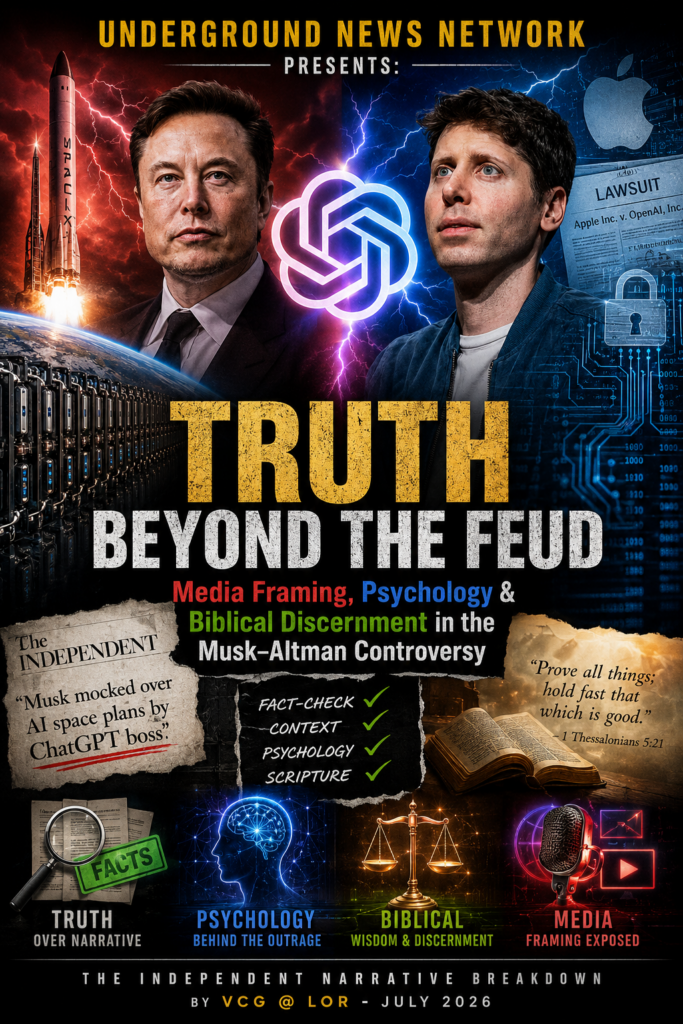
VCG @ LOR 7/14/2026
Soli Deo Gloria.
The article is genuine and was published by The Independent on July 13, 2026.
Musk mocked over AI space plans by ChatGPT boss
Its basic chronology is largely accurate, but several sentences compress complicated matters, blur allegations with established facts, or use adversarial framing that encourages readers to judge personalities before evidence. (The Independent)
Executive verdict
Overall factual reliability: moderately high, but rhetorically shallow.
The article correctly reports:
- the Musk–Altman exchange
- SpaceX’s orbital-compute proposal
- Apple’s July 10, 2026 lawsuit
- the broad history of OpenAI’s restructuring
- Musk’s 2024 litigation and the May 18, 2026 statute-of-limitations result
Its principal weaknesses are:
- The headline overstates Altman’s argument. Altman mocked Musk and insinuated investor deception; he did not present evidence disproving orbital data centers.
- Several accusations are reported without enough legal qualification. Apple’s claims are allegations, not findings.
- “OpenAI became a for-profit venture” is imprecise. A nonprofit-controlled for-profit subsidiary was created in 2019; later restructuring produced a public-benefit corporation still governed through the nonprofit foundation.
- The lawsuit paragraph risks implying that Musk’s underlying allegations were adjudicated and disproved. The decisive ruling was timeliness, not a full merits determination.
- The article contains almost no technical analysis of orbital computing. Readers are given a quarrel, not an engineering assessment.
- The closing promotional paragraph is institutional marketing, not evidence.
I. Fact-checking methodology
I used five distinct evidentiary categories.
Primary records:
- court dockets
- complaints
- official corporate descriptions
- SpaceX’s own project materials
Contemporaneous reporting:
- Reuters
- AP
- The Independent
- specialist reporting
used mainly to establish:
- dates
- quotations
- procedural events
Scientific literature:
- peer-reviewed research concerning moral outrage
- social-media engagement
- ad hominem rhetoric
- audience perception
Logical analysis:
whether a conclusion actually follows from the evidence presented.
Scriptural analysis:
what biblical principles bear upon:
- speech
- accusation
- partiality
- truth
- pride
- wealth
- judgment
Scripture is not used as evidence that a satellite architecture will or will not work.
That distinction matters.
The Bible can judge the morality of:
- dishonest promotion
- slander
- greed
- rash accusation
- proud contention
It does not provide orbital thermal-management calculations.
II. Line-by-line examination
1. Headline: “Musk mocked over AI space plans by ChatGPT boss”
Factual content
This is substantially true. Altman publicly mocked Musk’s proposed near-term orbital data centers. (The Independent)
Framing problem
The passive construction makes Musk the object of ridicule and identifies Altman through the immensely recognizable “ChatGPT” brand. The headline sells conflict rather than explaining the dispute.
It also subtly suggests that the mockery itself is newsworthy evidence against the plan. It is not. Ridicule can accompany a sound criticism, but ridicule is not a technical refutation.
Better wording
Sam Altman questions SpaceX’s near-term orbital AI data-center claims during renewed dispute with Elon Musk.
Psychological mechanism
Conflict-centered headlines exploit attentional bias. Human beings naturally attend to status contests, humiliation, danger, and interpersonal conflict. Social-media research also shows that antagonism toward an opposing group can generate disproportionate engagement. (PNAS)
Scriptural correction
“He that answereth a matter before he heareth it, it is folly and shame unto him.”— Proverbs 18:13, KJV
Readers should examine the engineering and financial evidence before treating mockery as a verdict.
2. “OpenAI boss Sam Altman has mocked Elon Musk’s plan to place artificial intelligence data centers into orbit by 2027.”
Verdict: substantially accurate
The quotation attributed to Altman was real, and Musk indicated that SpaceX expected to begin flying such systems the following year. SpaceX publicly describes Starmind as an effort to use solar energy in space for AI computation. (SpaceX)
Necessary qualification
“Place artificial intelligence data centers into orbit”
is popular shorthand. It may refer to distributed compute satellites rather than conventional terrestrial-style buildings somehow transferred into space.
“By 2027” should be understood as a stated deployment target, not evidence that a commercially useful network will be operating at scale by then.
A demonstration satellite, an initial constellation, and an economically competitive data-center system are three very different milestones.
Missing technical questions
A responsible technical article would examine:
- launch cost per kilogram
- compute performance per satellite
- radiation hardening
- heat rejection in vacuum
- solar-array area and storage during eclipse
- optical or radio inter-satellite networking
- downlink latency and bandwidth
- maintenance and replacement rates
- collision and debris risk
- regulatory approval
- manufacturing throughput
- whether the target workload can tolerate communication delay
The article evaluates none of these.
Scriptural correction
“For which of you, intending to build a tower, sitteth not down first, and counteth the cost, whether he have sufficient to finish it?”— Luke 14:28, KJV
This principle applies equally to Musk’s promise and Altman’s dismissal. Grand projects should be costed; grand dismissals should be demonstrated.
3. “Mr. Altman claimed that SpaceX’s planned Starmind project of launching 100,000 AI satellites were designed to mislead investors…”
Verdict: partly accurate, but interpretively inflated
Altman wrote that Musk was “selling public market investors on short-term space datacenters.” That is plainly accusatory. But the article turns his terse insult into the more explicit claim that the project was “designed to mislead investors.”
“Selling investors on” can imply hype, overstatement, or an unrealistic pitch. “Designed to mislead” imputes deliberate intent. Those are not identical propositions.
Critical correction
There are at least four possible claims:
- Musk sincerely believes the plan is feasible.
- Musk sincerely believes it is feasible but overstates the schedule.
- Musk knows the schedule is doubtful but speaks optimistically.
- Musk intends to deceive investors.
The quoted post alone does not establish which is true.
Intent requires evidence. A journalist should not silently strengthen an insinuation into a settled motive.
Number discrepancy
The reporting environment distinguishes between different proposed satellite systems and very large constellation figures. SpaceX materials describe Starmind, while reporting has referenced proposals ranging from 100,000 Gen3 spacecraft to as many as one million orbital-compute satellites. The article should have explained which filing or project the 100,000 figure referred to. (Space)
Logical issue
This is a form of motive attribution. Even proving that a proposal is technically overoptimistic would not by itself prove securities fraud or deliberate deception.
Scriptural correction
“He that is first in his own cause seemeth just; but his neighbour cometh and searcheth him.”— Proverbs 18:17, KJV
Altman’s accusation is evidence that Altman accused Musk. It is not evidence that the accusation is true.
4. “…in the company’s recent IPO, which saw it reach a valuation of more than $2 trillion.”
Verdict: requires exact financial sourcing
This is the sort of statement that should be tied directly to an offering document, exchange record, or reliable market-data source. The article provides no supporting detail in the supplied text.
A market valuation is not the same as:
- money raised by the company
- enterprise value
- the amount investors paid for the newly issued shares
- the value of the orbital-compute business
- evidence that the stated project influenced investor decisions
Missing causal evidence
Even assuming the valuation is correct, the sentence implicitly connects Starmind promotion with the IPO valuation.
To establish that connection, one would need evidence such as:
- prominent treatment in the prospectus
- investor presentations
- analyst reports identifying Starmind as a valuation driver
- management forecasts
- investor testimony
- abnormal market movement following the announcement
The article supplies none.
Scriptural correction
“A false balance is abomination to the LORD:
but a just weight is his delight.”— Proverbs 11:1, KJV
That condemns false financial representation. It also obliges critics to use fair measurements and prove deception rather than infer it from wealth or ambition.
5. “His remarks followed a series of posts from Mr. Musk about a newly filed lawsuit from Apple…”
Verdict: accurate chronology
Apple filed the federal action on July 10, 2026, and Musk’s posts followed publicity surrounding it. The case is Apple Inc. v. Liu, filed in the Northern District of California. (CourtListener)
Better precision
The action was not merely “a lawsuit from Apple.” It named multiple defendants, including OpenAI entities, io Products, Tang Yew Tan, and Chang Liu. The claims include trade-secret misappropriation and breach of contract. (CourtListener)
6. “…alleging that OpenAI stole the iPhone maker’s intellectual property to develop its own hardware.”
Verdict: fair summary of Apple’s allegation, but legally imprecise
Apple alleges misappropriation of trade secrets and confidential information. “Intellectual property” is broader and may include patents, copyrights, trademarks, and trade secrets. The article should identify the particular category.
“OpenAI stole” must remain grammatically attached to “alleging.” It is not an adjudicated fact.
Legal distinction
At this stage:
- Apple has made allegations.
- OpenAI has denied wrongdoing.
- No liability finding has been reported.
- The complaint presents one side’s factual narrative.
- Some allegations may later be admitted, dismissed, disproved, settled, or found true.
A complaint is not neutral evidence. It is advocacy submitted under procedural rules and ethical obligations.
Scriptural correction
“One witness shall not rise up against a man for any iniquity, or for any sin…”— Deuteronomy 19:15, KJV
Modern civil litigation is not governed directly by Israel’s criminal evidentiary code, but the moral principle remains:
serious accusations require corroboration and examination.
7. Musk: “Scam Altman strikes again… He might literally love scamming more than any human alive!”
Verdict: quotation accurately reported; substantive claim unsupported here
The statement is invective, not proof.
Logical classification
It contains:
- name-calling: “Scam Altman”;
- character attack: portraying Altman as habitually fraudulent;
- hyperbole: “more than any human alive”;
- mind-reading: claiming knowledge of what Altman “loves”;
- generalization: moving from a current allegation to a total judgment of character.
Even where character is legally or morally relevant, evidence must be particularized. “He is a scammer” cannot substitute for identifying a representation, proving its falsity, showing knowledge or recklessness, establishing reliance, and demonstrating harm.
Psychological function
The language converts a difficult evidentiary dispute into a simple moral identity: villain versus exposer. That reduces cognitive effort and invites the audience to join a camp.
Research indicates that ad hominem attacks can reduce perceived credibility even when they do not address the empirical basis of a claim. (PMC)
Important caution
We should not diagnose Musk from a post. The language may reflect anger, deliberate branding, competitive strategy, humor, impulsivity, or some combination. Psychology can describe the communication pattern; it cannot ethically infer a clinical condition from public insults.
Scriptural correction
“Whoso privily slandereth his neighbour, him will I cut off…”— Psalm 101:5, KJV
“Speak not evil one of another, brethren.”— James 4:11, KJV
“Wherefore putting away lying, speak every man truth with his neighbour…”— Ephesians 4:25, KJV
Calling wrongdoing by its proper name is biblical when established. Recklessly assigning a corrupt identity to a person is not.
8. Altman: “Homeboy you’re the one selling public market investors on short-term space datacenters.”
Verdict: genuine quotation; argument incomplete
This is a tu quoque-style counterattack: instead of directly answering Musk’s Apple-related accusation, Altman redirects attention to Musk’s investor representations.
That does not prove Musk’s accusation true or false.
It may identify relevant hypocrisy, but hypocrisy and truth are logically separable. A hypocrite can make a true accusation; an innocent man can make a false one.
What evidence would be required?
Altman’s claim would need:
- the exact investor representations
- evidence of technical or economic infeasibility
- evidence Musk knew or recklessly ignored the problem
- proof that the representations were material
- proof investors were likely to be misled
Without those elements, the post remains an accusation.
Scriptural correction
“Answer not a fool according to his folly, lest thou also be like unto him.”— Proverbs 26:4, KJV
The following verse says there are circumstances in which folly should be answered. The combined wisdom is situational: refute error when needed, but do not imitate the offender’s corrupt manner.
Altman answered personal attack with counter-accusation, not patient evidence.
9. Musk: “We start flying them next year.”
Verdict: a testable forecast, not a present fact
This is comparatively clear.
It creates a near-term benchmark:
- What exactly will fly?
- How many units?
- With what compute capability?
- Will it be a prototype, demonstration, or commercial service?
- What launch date and regulatory permissions apply?
The statement should be preserved and checked in 2027 against defined milestones.
Methodological correction
Forecasts should be converted into measurable propositions before success is claimed.
Otherwise, moving goalposts become easy:
“Flying one experimental payload”
may later be presented as fulfilling a promise that audiences understood to mean deploying practical orbital data centers.
Scriptural correction
“Let your communication be, Yea, yea; Nay, nay…”— Matthew 5:37, KJV
Public forecasts ought to be specific enough to be honestly verified.
10. “Maybe you can come see them if your parole officer approves.”
Verdict: insult without evident factual relevance
Unless Altman was actually subject to parole—which the article neither claims nor substantiates—this is figurative criminalization.
Rhetorical function
It insinuates guilt and criminality without making a legally testable accusation.
This is often effective because implication can stain a person while preserving deniability:
“It was only a joke.”
Biblical correction
“The words of a talebearer are as wounds…”— Proverbs 18:8, KJV
Humor does not automatically neutralize false implication. Scripture repeatedly treats words as morally consequential.
11. “After stealing an open source AI charity…”
Verdict: polemical compression, not a neutral description
OpenAI was founded in 2015 as a nonprofit whose mission concerned ensuring that artificial general intelligence benefits humanity. It later formed a nonprofit-controlled capped-profit subsidiary in 2019. Its present structure includes the OpenAI Foundation and OpenAI Group PBC. OpenAI states that the foundation governs the PBC. (OpenAI)
Three separate claims are being fused
“Stealing”
This implies unlawful taking or conversion. Musk litigated related claims, but the 2026 result turned on limitations. It did not produce a merits ruling establishing theft. (Reuters)
“Open source”
The founding announcement used “open” language and emphasized broad benefit, but whether OpenAI made a legally enforceable promise that all future models, weights, code, or research would remain open is a separate contractual and historical question.
“Open source” has a technical meaning. It should not be inferred merely from the organization’s name.
“AI charity”
OpenAI began as a nonprofit, but “charity” in ordinary language can obscure the actual corporate and tax structure. Nonprofit status does not necessarily mean a conventional grant-making charity.
Fair corrected statement
Musk alleges that Altman and others diverted an organization founded as a nonprofit and publicly associated with openness into a commercially oriented structure contrary to its original commitments. OpenAI disputes that characterization and says its nonprofit mission and control continue.
That wording preserves the actual dispute.
Scriptural correction
“Thou shalt not steal.”— Exodus 20:15, KJV
But Scripture also forbids false accusation. The commandment cannot be used as a rhetorical shortcut to declare theft before proving it.
12. “…you then stole all of Apple’s phone technology!”
Verdict: major exaggeration
Apple’s complaint alleges misappropriation of identified confidential information and trade secrets relating to hardware development. That is not the same as “all of Apple’s phone technology.” (AP News)
“All” is plainly hyperbolic unless literally supported by the complaint, which the available accounts do not suggest.
Why exaggeration matters
Exaggeration can weaken a valid concern. Apple may possess serious evidence. Inflating its case into “all Apple technology” makes it easier for defenders to dismiss legitimate allegations as partisan spectacle.
Scriptural correction
“A faithful witness will not lie:
but a false witness will utter lies.”— Proverbs 14:5, KJV
Faithful testimony preserves proportion. It neither minimizes nor magnifies.
13. “The exchange … reignited a feud between the former friends, who co-founded OpenAI in 2015 alongside nine others.”
Verdict: broadly accurate, with loose terminology
Musk and Altman were founding figures in OpenAI. “Friends” is a journalistic characterization that may be supported by their former cooperation, but friendship is more subjective than partnership.
“Alongside nine others” should be checked against the exact criterion used:
- initial announced backers
- founding board members
- incorporated founders
- early research staff
- persons named in the launch announcement
Different sources may produce different counts.
Framing issue
“Feud” is fair shorthand, but it encourages entertainment framing. The conflict also concerns corporate governance, nonprofit law, intellectual property, competition, capital formation, and AI control.
14. “Their relationship broke down in 2018 when Mr. Altman reportedly blocked Mr. Musk’s attempt to take charge…”
Verdict: oversimplified
Evidence and trial reporting indicate that Musk sought substantially greater control and discussed structures that would have placed him or Tesla in a dominant position. OpenAI’s side portrayed those proposals as incompatible with the organization’s desired governance. (Reuters)
But “Altman blocked Musk” personalizes a multi-party organizational dispute. Governing boards, other founders, proposed equity allocations, financing needs, and disagreements over strategy all mattered.
Better wording
Their relationship deteriorated during 2017–2018 negotiations over OpenAI’s financing and control, including proposals that would have given Musk a dominant role.
Scriptural correction
“Only by pride cometh contention:
but with the well advised is wisdom.”— Proverbs 13:10, KJV
This does not permit us to declare which man was proud in which moment. It identifies a danger that applies to both—and to the audience taking sides.
15. “OpenAI subsequently became a for-profit venture…”
Verdict: materially incomplete
In 2019 OpenAI created a for-profit subsidiary under nonprofit control. It did not simply abolish the nonprofit and transform the entire entity into an ordinary for-profit corporation. OpenAI later adopted a structure involving OpenAI Group PBC and the OpenAI Foundation, with the foundation retaining governance authority according to OpenAI’s official account. (OpenAI)
Why this distinction matters
The central controversy is precisely whether formal nonprofit control meaningfully protects the mission or whether commercial incentives dominate in practice.
Saying “became a for-profit” prematurely resolves that controversy through imprecise wording.
Correct formulation
OpenAI created a for-profit subsidiary in 2019 while retaining formal nonprofit control; it later reorganized the commercial arm as a public-benefit corporation governed through the OpenAI Foundation.
That does not settle whether the arrangement is wise, faithful, or effective.
16. “…having previously operated solely as a non-profit entity with the sole goal of ensuring that artificial intelligence ‘benefits all of humanity’.”
Verdict: close but imprecise
OpenAI’s formal mission concerns ensuring that artificial general intelligence benefits all humanity. Replacing “AGI” with all “artificial intelligence” broadens the mission.
“Sole goal” is also stronger than necessary. A corporation can have a stated mission alongside multiple operational objectives.
OpenAI’s official structure page confirms the 2015 nonprofit origin and mission language. (OpenAI)
Scriptural observation
“Benefits all humanity” is a noble universal claim, but it is not self-validating. Scripture instructs us to test claims by conduct and fruit:
“Wherefore by their fruits ye shall know them.”— Matthew 7:20, KJV
That principle should be applied carefully. It is not permission to judge hidden salvation; it is permission to examine visible conduct and consequences.
17. “In 2024, Mr. Musk sued Mr. Altman and his company, accusing them of betraying OpenAI’s founding mission.”
Verdict: substantially correct
The operative federal action began in August 2024 after Musk had filed and withdrawn an earlier state action. The litigation accused Altman, other defendants, and OpenAI-related entities of violating or diverting the founding nonprofit purposes. (CourtListener)
Missing context
Musk had by then founded xAI, a competitor. That conflict of interest does not disprove his allegations, but it is relevant context.
Likewise, OpenAI’s commercial interests do not disprove its defense.
Both sides had incentives. Incentives are grounds for scrutiny, not automatic proof of dishonesty.
18. “The legal battle culminated in a three-week trial earlier this year…”
Verdict: accurate
Contemporaneous coverage describes a three-week trial ending May 18, 2026. (Reuters)
19. “…in which a jury found that Mr. Musk’s allegations were barred by the statute of limitations.”
Verdict: substantially accurate, but crucially incomplete
The jury was advisory, and Judge Yvonne Gonzalez Rogers accepted its conclusion. The claims were rejected as untimely. (CourtListener)
Essential correction
A statute-of-limitations ruling ordinarily means the claimant waited too long.
It does not necessarily mean:
- every factual allegation was false
- OpenAI fully honored every moral promise
- Altman’s conduct was vindicated on every issue
- Musk proved nothing of public importance
- the court approved OpenAI’s structure as ethically ideal
Likewise, the absence of a merits judgment does not mean Musk’s allegations were true.
The proper conclusion is narrow:
The court disposed of the relevant claims because they were filed outside the legally permitted period, after determining when Musk knew or should have known enough to act.
Reuters reported that OpenAI’s lawyers argued Musk had known years earlier about the relevant commercialization plans. (Reuters)
Article’s framing risk
Placed after the narrative of “betrayal,” the sentence may leave casual readers with the impression that a jury investigated the merits and exonerated OpenAI. That is too broad.
Scriptural correction
“Doth our law judge any man, before it hear him, and know what he doeth?”— John 7:51, KJV
The legal proceeding heard extensive evidence, but its final disposition must still be described according to what was actually decided.
20. “The latest lawsuit brought about by Apple…”
Style correction
“Brought about by Apple” is awkward. Apple brought or filed the lawsuit.
21. “…comes after OpenAI announced plans to build an AI device…”
Verdict: accurate in broad terms
OpenAI has pursued consumer hardware through its relationship with io Products and Jony Ive’s design operation. Apple’s case concerns alleged use of confidential information in that effort. (AP News)
Missing distinction
The temporal phrase “comes after” does not prove causation. Apple did not sue merely because OpenAI announced a device; Apple alleges particular acts involving employees, files, suppliers, and confidential materials.
22. Altman claims it will be “the greatest technological revolution of our lifetimes.”
Verdict: promotional prediction, not fact
This is superlative marketing.
It lacks:
- a defined comparison class
- measurable criteria
- a specified time horizon
- a publicly inspectable product
- evidence that the device will outperform smartphones, the internet, personal computing, gene editing, or other transformative technologies
Psychological function
Superlatives manufacture anticipation and social proof. They invite fear of missing out: investors, employees, developers, and consumers may fear being left behind.
Scriptural correction
“Let another man praise thee, and not thine own mouth; a stranger, and not thine own lips.”— Proverbs 27:2, KJV
A product should be judged after evidence and use, not canonized before release.
23. “According to Apple, OpenAI employees have taken ‘secret and confidential information’…”
Verdict: accurate attribution
The phrase “According to Apple” properly marks the statement as an allegation.
Needed qualification
The article should immediately add:
OpenAI denies seeking or using Apple’s trade secrets, and the allegations have not been adjudicated.
It eventually includes OpenAI’s denial, but several paragraphs later. Readers often form judgments before reaching the rebuttal.
This is an example of ordering effect or primacy effect: early information can disproportionately shape interpretation of later information.
24. Apple’s quoted allegation: “At every level … OpenAI has been stealing Apple’s trade secrets…”
Verdict: accurately represents Apple’s pleaded position
Court records confirm the filing and defendants. Reporting describes allegations involving recruitment, retained access, internal files, interviews, and suppliers. (CourtListener)
Evidentiary caution
The quote is forceful advocacy. Terms such as “stealing,” “at every level,” and “in coordination” are propositions Apple must prove.
A complaint can contain documentary evidence, detailed allegations, and information pleaded on belief.
Readers should inspect:
- attached exhibits
- access logs
- file-transfer records
- employment agreements
- communications
- provenance of disputed designs
- witness testimony
- whether the claimed secrets were actually secret
- whether reasonable measures protected them
- whether defendants used or disclosed them
- whether independent development occurred
Legal elements generally at issue
A trade-secret plaintiff normally must establish, among other things:
- existence of information qualifying as a trade secret
- reasonable efforts to preserve secrecy
- improper acquisition, disclosure, or use
- causation and legally cognizable harm
The article does not explain these elements.
Scriptural correction
“Moreover if thy brother shall trespass against thee, go and tell him his fault between thee and him alone…”— Matthew 18:15, KJV
That passage governs church and interpersonal correction, not every corporate lawsuit. It nevertheless teaches that accusation should aim at truthful resolution, not spectacle. Civil authorities and courts also have legitimate roles in adjudicating wrongs.
25. “The lawsuit, which was filed on Friday…”
Verdict: correct
July 10, 2026, was a Friday, and the federal docket records the complaint on that date. (CourtListener)
This is a good example of a simple verifiable detail.
26. OpenAI: “We have no interest in other companies’ trade secrets…”
Verdict: accurately reports OpenAI’s denial
But this is a public-relations statement, not evidence of innocence.
It should be treated symmetrically with Apple’s public accusation:
- Apple’s statement does not prove liability.
- OpenAI’s statement does not prove innocence.
Wording issue
“We have no interest” is narrower than:
- no employee acquired confidential information
- no employee retained Apple files
- no OpenAI manager requested such information
- no disputed material was used
- appropriate remediation occurred
An organization could lack an official “interest” while still being legally responsible for employee conduct. Conversely, improper-looking conduct may prove unauthorized or irrelevant.
Scriptural correction
“The simple believeth every word:
but the prudent man looketh well to his going.”— Proverbs 14:15, KJV
Neither corporate press release should be accepted uncritically.
27. “We remain focused on building innovative technology that empowers people everywhere.”
Verdict: non-falsifiable public-relations language
This does not answer the allegations.
“Empowers,” “innovative,” and “everywhere” are positive but vague. The sentence functions as virtue framing: associating the institution with progress and universal benefit without addressing the disputed conduct.
Better response would include
- whether the named employees possessed Apple materials
- whether OpenAI investigated
- whether devices and repositories were preserved
- whether supplier contacts occurred
- what safeguards govern incoming employees
- whether disputed information was quarantined
- whether independent-development records exist
Scriptural correction
“My little children, let us not love in word, neither in tongue; but in deed and in truth.”
— 1 John 3:18, KJV
Institutional mission language should be tested against concrete practices.
28. The Independent promotional paragraph
“The Independent is the world’s most free-thinking news brand…”
Verdict: advertising, not reporting
This paragraph should be separated mentally from the article’s evidence.
Claims such as:
“world’s most free-thinking”
“trusted voice”
“commitment to positive change”
“making change happen”
are brand assertions. No methodology or comparative metric is supplied.
Psychological function
The publication invokes identity: the ideal reader is “independently minded.” Accepting the brand may therefore feel like evidence of one’s own independence.
This is a subtle persuasive technique. People may adopt a message because it affirms their desired identity.
Internal tension
A publication claiming independence should encourage readers to distinguish:
- verified event
- quoted accusation
- legal allegation
- technical feasibility
- corporate promotion
- editorial framing
This article does some of that, but not enough.
Scriptural correction
“For not he that commendeth himself is approved, but whom the Lord commendeth.”
— 2 Corinthians 10:18, KJV
Self-praise is not independent verification.
III. What the article proves—and what it does not
Established with reasonable confidence
- Musk and Altman exchanged the quoted insults.
- SpaceX is publicly promoting orbital AI computation.
- Apple filed a trade-secret lawsuit on July 10, 2026.
- OpenAI denies the allegations.
- OpenAI began as a nonprofit and later developed commercial subsidiaries and a PBC structure.
- Musk’s federal case ended adversely to him on statute-of-limitations grounds after a lengthy trial.
Not established by this article
- That Starmind is technically impossible.
- That Starmind will be commercially viable.
- That Musk knowingly misled IPO investors.
- That Altman or OpenAI “stole” OpenAI from its nonprofit mission.
- That OpenAI stole Apple’s trade secrets.
- That Apple’s allegations are fabricated.
- That Musk’s underlying concerns were disproved at trial.
- That OpenAI’s current governance practically fulfills its founding mission.
- That either executive’s insults reveal a diagnosable psychological disorder.
- That one man is morally trustworthy merely because the other behaves badly.
IV. Technical assessment of orbital AI data centers
The article offers no serious technical rebuttal, so the issue must be separated into:
- physical possibility
- engineering feasibility
- economic viability
Potential advantages
Abundant solar energy
Space-based systems can receive strong solar input without weather and, depending on orbit, with reduced night interruption.
Reduced terrestrial land and water use
Some terrestrial data centers consume substantial electricity, land, and cooling resources. Orbital systems could shift some burdens away from populated regions.
Proximity to space-generated data
For Earth observation, astronomy, communications, or defense, processing data in orbit could reduce the need to transmit raw datasets to Earth.
Rapid global connectivity
A linked constellation could theoretically route compute output globally.
Severe obstacles
Waste heat
Space is cold in a colloquial sense but provides no air for convection. Nearly all electrical energy used by processors becomes heat. That heat must be radiated.
Radiative power follows approximately:
[
P=\epsilon\sigma A T^4
]
where:
- (P) is radiated power
- (\epsilon) is emissivity
- (\sigma) is the Stefan–Boltzmann constant
- (A) is radiator area
- (T) is absolute temperature
At temperatures suitable for electronics, removing megawatts requires enormous radiator surfaces. Heat rejection, not sunlight alone, is one of the central constraints.
Mass and launch economics
Compute hardware, shielding, solar arrays, batteries, radiators, structure, propulsion, communications, and redundancy all add mass.
A dramatic reduction in reusable-launch cost could change the economics, but optimistic launch prices must be demonstrated at the necessary flight rate.
Radiation
High-energy particles can cause bit flips, degradation, and component failure. Radiation-hardened hardware often trails the performance and efficiency of cutting-edge terrestrial accelerators.
Hardware obsolescence
AI accelerators evolve rapidly. Terrestrial data centers can replace boards. Orbital replacement may require deorbiting or abandoning thousands of expensive units.
Network bottlenecks
AI training requires extremely fast, low-latency links among accelerators. Terrestrial clusters use dense electrical and optical interconnects. Distributing accelerators across moving satellites creates a formidable networking problem.
Inference workloads may be more plausible than tightly coupled frontier-model training.
Servicing
Failures that would require a technician, cable replacement, coolant repair, or power-supply swap on Earth may mean total loss in orbit.
Orbital congestion
A constellation numbering tens or hundreds of thousands would create substantial coordination, collision-avoidance, debris, astronomy, atmospheric-reentry, and regulatory issues.
Balanced conclusion
Orbital computation is not inherently absurd. Specialized in-space processing already has logical use cases. But a near-term system competitive with the largest terrestrial AI clusters requires extraordinary progress in launch cadence, thermal design, optical networking, radiation tolerance, manufacturing, autonomy, and cost.
Therefore:
- Musk’s forecast should not be dismissed merely because it sounds futuristic.
- It should not be believed merely because SpaceX has achieved previous difficult feats.
- Altman’s sarcasm is not an engineering analysis.
- SpaceX’s promotional materials are not proof of commercial viability.
V. Psychology and media dynamics
1. Moral outrage as an engagement engine
Research shows that moral-emotional language spreads effectively online, and that outrage can be amplified through social learning and platform incentives. (PNAS)
The Musk–Altman exchange contains highly transmissible ingredients:
- accusations of theft
- accusations of fraud
- criminal insinuations
- billionaire rivalry
- futuristic technology
- public humiliation
- tribal alignment
This does not mean either accusation is false. It means the communication environment rewards emotional certainty faster than careful verification.
2. Out-group hostility
Research has found that posts attacking political out-groups receive more engagement than many positive in-group messages. Although Musk and Altman are not merely political out-groups, the same coalitional mechanism can operate around competing technology communities. (PNAS)
Audiences may divide into:
- Musk as visionary truth-teller versus establishment corruption
- Altman as pragmatic builder versus reckless billionaire
- open-source advocates versus centralized AI companies
- space optimists versus terrestrial infrastructure advocates
Once identities harden, new facts are filtered through loyalty.
3. Ad hominem contamination
Experimental work indicates that personal attacks can undermine perceptions of a claim’s credibility even when the attack does not challenge the underlying evidence. (PMC)
Thus “Scam Altman” may lower confidence in OpenAI independently of the Apple evidence, while Altman’s investor accusation may lower confidence in Starmind independently of the engineering.
4. Overperception of hostility
Online users may overestimate how hostile others are because highly outraged expressions are more visible. Reviews of the literature note that social platforms can amplify outrage expression and perceptions of intergroup hostility. (Annual Reviews)
A reader can mistakenly infer:
Everyone agrees one of these men is a criminal.
In reality, visibility is not consensus.
5. Outrage and misinformation
Research published in Science found a relationship between moral outrage and the spread of misinformation: outrage-laden misinformation can be especially shareable, while users may share without carefully reading or verifying. (Science)
Again, that finding does not classify this article as misinformation. It explains why exaggerated summaries such as “stole all Apple technology” can outrun the nuanced complaint.
VI. Biblical assessment of both sides
The biblical response should not be partisan.
Musk’s words
His posts exhibit apparent railing, exaggeration, motive attribution, and potentially slanderous implication unless supported by evidence.
Relevant texts:
“Thou shalt not bear false witness against thy neighbour.”— Exodus 20:16
“Let no corrupt communication proceed out of your mouth…”— Ephesians 4:29
“The discretion of a man deferreth his anger; and it is his glory to pass over a transgression.”— Proverbs 19:11
Even when confronting genuine wrongdoing, Christians are not authorized to invent, exaggerate, or degrade.
Altman’s words
His response avoids the Apple allegation and retaliates with a separate accusation regarding investors.
Relevant texts:
“A soft answer turneth away wrath:
but grievous words stir up anger.”— Proverbs 15:1
“But if ye have bitter envying and strife in your hearts, glory not, and lie not against the truth.”— James 3:14
“For where envying and strife is, there is confusion and every evil work.”— James 3:16
His counterattack may be true, false, or partly true. The moral defect is that sarcasm substitutes for substantiation.
Apple’s accusation
Apple has a right to seek lawful relief if trade secrets were taken. Scripture recognizes property, restitution, witnesses, and civil judgment.
But accusations must be proved.
“In the mouth of two or three witnesses shall every word be established.”— 2 Corinthians 13:1
This does not prescribe the exact evidentiary rules for a modern trade-secret case, but it strongly rejects condemnation by unsupported allegation.
OpenAI’s denial
OpenAI is entitled to deny wrongdoing and defend itself. But mission language is not a substitute for forthright answers.
“Providing for honest things, not only in the sight of the Lord, but also in the sight of men.”— 2 Corinthians 8:21
Institutional integrity includes transparent procedures capable of demonstrating independent development and responsible handling of former employers’ information.
The reader’s duty
“Prove all things; hold fast that which is good.”— 1 Thessalonians 5:21
“Judge not according to the appearance, but judge righteous judgment.”— John 7:24
“Judge not” does not prohibit discernment. Christ commands righteous judgment: informed, impartial, proportionate, and truthful.
VII. A corrected version of the article’s central claim
A factually disciplined summary would read:
OpenAI chief executive Sam Altman and SpaceX leader Elon Musk renewed their public dispute after Apple filed a federal lawsuit accusing OpenAI and several associated individuals and entities of trade-secret misappropriation connected to OpenAI’s hardware program. OpenAI denies the allegations, which have not been adjudicated.
Musk responded by accusing Altman of habitual fraud and of improperly converting OpenAI from its nonprofit origins. Altman countered by suggesting that Musk was promoting near-term orbital AI data centers to public investors. Neither executive substantiated those accusations in the social-media exchange.
SpaceX has publicly described its Starmind initiative as space-based AI computation powered by solar energy. Musk said initial systems would fly in 2027. The technical possibility of orbital computation is real, but the economic viability and proposed deployment schedule remain unproven.
Musk’s previous federal claims against OpenAI concluded on May 18, 2026, after an advisory jury and the presiding judge determined that the relevant claims were barred by the statute of limitations. That disposition did not constitute a complete adjudication of every underlying ethical or historical allegation concerning OpenAI’s mission.
Final judgment
The article is not fabricated, and most of its event reporting is accurate. Its deeper problem is epistemic: it presents a consequential technological, legal, and corporate-governance dispute primarily as a celebrity feud.
The responsible conclusion is neither “Musk exposed Altman” nor “Altman exposed Musk.”
It is:
- Apple’s allegations require adjudication.
- OpenAI’s denial requires evidentiary support.
- Musk’s “theft” and “scam” language exceeds what this article proves.
- Altman’s investor accusation exceeds what his post demonstrates.
- SpaceX’s orbital-compute schedule requires measurable technical validation.
- OpenAI’s nonprofit mission should be evaluated through its legal structure, governance, incentives, and conduct—not slogans alone.
- Christians should refuse partisan false witness, even against persons they distrust.
“Buy the truth, and sell it not; also wisdom, and instruction, and understanding.”— Proverbs 23:23, KJV