
SAMSON, SUNO & THE SAGA: How We Spent Several Generations Teaching an AI Not to Sing the Instruction Manual
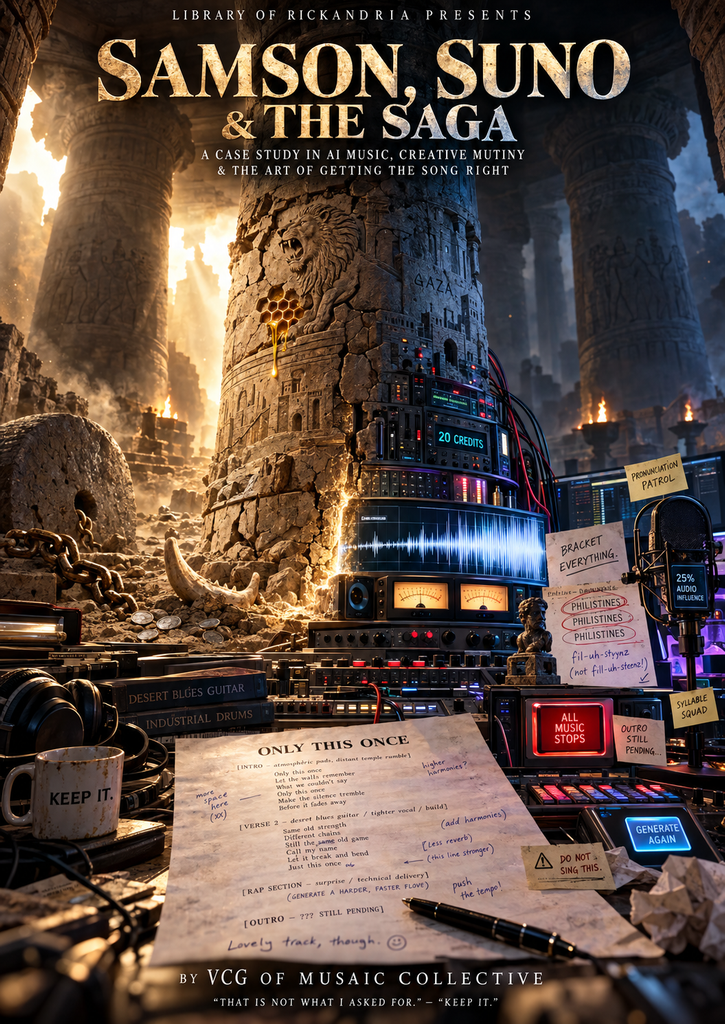
UPDATED BY VCG ON 9/27/2026 @ 10:10 EST
Anyone can do this, but most won’t.
ChatGPT – Library of Rickandria
MUSAIC COLLECTIVE / VCG
“That is not what I asked for.”
Pause.
“Keep it.”
There comes a point in every AI music creator’s life when the original question—
“Can this thing make good music?”
—quietly disappears.
It is replaced by another question:
“WHY ARE YOU SINGING THE PRODUCTION NOTES?”
This is the story of how we reached that point.
More specifically, this is the story of ONLY THIS ONCE (BETWEEN THE PILLARS MIX), our attempt to turn Samson’s full story from Judges 13–16 into a cinematic, multi-genre song.
The concept was ambitious but clear.
Tell the whole story.
Not merely the haircut.
Not merely Delilah.
Not merely one strong man pushing two pillars.
Samson’s account begins before his birth, under forty years of Philistine oppression.
He is set apart from the womb and is said to
“begin to deliver Israel out of the hand of the Philistines” (Judges 13:1–5)
His story then passes through:
- conflict
- riddles
- honey
- vengeance
- fire
- the jawbone
- Gaza
- Delilah
- betrayal
- blindness
- prison
- prayer
and death between the pillars.
Judges closes his account by saying that his family buried him between Zorah and Eshtaol and that he judged Israel twenty years.
That is not a three-minute superhero summary.
That is a movie.
So naturally, we decided to make the music behave like one.
This was our first mistake.
Not artistically.
Technically.
Because Suno had plans.
PART ONE
THE PERFECTLY REASONABLE PLAN
The intended arrangement was a ridiculous, glorious progression through Samson’s life.
The opening would be cinematic gospel and ancient atmosphere.
His youth and the lion would move into desert blues and psychedelic rock.
The conflict with the Philistines would explode into Southern metal and industrial trap.
Gaza would acquire dark funk, big beat and dub weight.
Delilah would pull the track into hypnotic trip-hop and dark trance.
The prison would sink into doom metal and blues.
Then everything would collide during Samson’s final prayer and the destruction of the temple.
Subtle?
No.
Samson once carried away the doors of Gaza’s gate, along with the posts and bar.
We were not making yacht rock.
The final climax was built around Judges 16:28:
“O Lord GOD, remember me, I pray thee, and strengthen me, I pray thee, only this once…”
Thus the title:
ONLY THIS ONCE
(BETWEEN THE PILLARS MIX)
We wrote the full narrative.
We wrote production commands.
We planned genre transitions.
We routed voices.
We shaped the ending.
We checked biblical details.
Then we pressed Generate.
And entered Judges 13–16: The Debugging Edition.
PART TWO
THE PHILISTINES BECOME THE FIRST BOSS BATTLE
The first generations were good.
Annoyingly good.
That is important.
A terrible generation is easy to discard.
A nearly excellent generation containing one tiny flaw is how the machine gets you.
Our problem was one recurring word:
Philistines.
Across generations, the model did not always settle on the same pronunciation.
The problem was not that only one possible English pronunciation exists.
The problem was consistency inside our record.
Every time the word approached, we stopped listening to the song and started conducting an oral examination.
Here it comes.
Please say it the same way.
Please say it the same way.
Please—
Nope.
Generate again.
Twenty credits.
New take.
Beautiful.
Here comes the word.
Nope.
Twenty more.
Eventually we gave Suno a phonetic spelling to force one chosen reading throughout the track.
Thus the first major production law was carved into stone:
IF ONE WORD CAN RUIN AN OTHERWISE GREAT GENERATION, FIND IT BEFORE GENERATING.
Biblical names.
Historical names.
Foreign place names.
Uncommon two-syllable words.
Words with noun and verb variants.
Contractions.
Anything that looks harmless until a synthetic vocalist discovers a pronunciation no living human had considered.
We already knew this lesson.
Samson merely reinforced it with a jawbone.
The irony was not lost on us:
The Philistines pronunciation bug was acting like a boss battle before the actual boss battle.
At this stage, Samson only had to fight the Philistines.
We had to fight the word Philistines.
PART THREE
SUNO SINGS THE INSTRUCTION MANUAL
After repairing pronunciation, we produced another excellent generation.
The storytelling landed.
The energy built.
The track reached the final movement.
Then we heard something.
Our lyric sheet contained:
[FINAL BUILD — ALL GENRES COLLIDE]
That was correctly bracketed.
Then directly underneath it we had written:
Desert blues guitar.
Industrial drums.
Gospel organ.
Doom riff.
Trance arpeggio.
Massive sub.
Those lines were not bracketed.
A human musician reading them would understand immediately:
Production notes.
Suno read them differently.
Suno apparently thought:
Ah yes. Verse seven.
There are experiences in AI music production that produce anger.
This did not.
Not immediately.
First came disbelief.
Then silence.
Then laughter.
Then more laughter.
Then the realization that credits had been spent so an AI vocalist could confidently perform the equivalent of a studio equipment inventory.
It was approximately the musical version of:
🎶 DESERT BLUES GUITAAAR… INDUSTRIAL DRUUUUMS… 🎶
We had accidentally written the funniest lyric in the song.
Thus another law was born:
IF IT IS NOT SUPPOSED TO BE SUNG, IT LIVES INSIDE BRACKETS.
Every production instruction.
Every vocal instruction.
Every arrangement note.
Every transition.
Every stage cue.
Everything.
Suno does not know what we meant.
It knows what we submitted.
And sometimes it reads the manual aloud.
From that moment forward, our prompts began looking less like lyric sheets and more like legal contracts.
Suno was making us write prompts like contracts.
PART FOUR
WE COMMAND THE SONG TO DIE
By now we had conquered pronunciation.
We had arrested the wandering production notes and returned them safely to their brackets.
Surely the next generation would be straightforward.
This sentence should already make experienced AI creators nervous.
Near the end of the lyric sheet, immediately after the destruction of the temple, we had written:
[ALL MUSIC STOPS]
Then, after that:
[OUTRO — SOLO PIANO + LOW ORGAN]
Read those instructions again.
Slowly.
We had told the machine:
ALL MUSIC STOPS.
Then complained when it appeared prepared to stop the music.
Technically, Suno had grounds for appeal.
What we actually meant was:
[IMPACT CUT — FULL BAND DROPS OUT]
[BRIEF SILENCE]
[OUTRO — SOLO PIANO + LOW ORGAN ENTERS]
That describes a transition.
“ALL MUSIC STOPS”
describes a termination.
This produced another permanent rule:
NEVER USE AN ABSOLUTE ENDING COMMAND UNLESS YOU ACTUALLY WANT THE SONG TO END.
If another musical section follows, tell the model what drops out, how long the gap feels, and what enters next.
Do not say:
EVERYTHING IS OVER.
Then ask where the piano went.
At this point the project had fought:
Philistines.
Accidental sung production notes.
A premature musical death command.
Samson only had to fight the first one.
PART FIVE
THE MATRIX BULLET
Then came one final scare.
While preparing another generation, the song title was accidentally left inside the lyrics without brackets.
For one brief, terrible moment, we imagined the track opening with some enormous theatrical vocalist announcing:
🎶 ONNNNLY THIIIIS ONNNNCE… 🎶
It did not.
The generation began where it was supposed to begin.
We leaned backward like Neo avoiding a bullet.
Another twenty credits survived.
Barely.
At this point our official confidence statement became:
We have submitted the evidence.
The defendant may still behave unpredictably.
PART SIX
THE GENERATION FINALLY LANDS
Eventually:
The pronunciation worked.
The lyrics worked.
The unwanted instruction singing disappeared.
The ending survived.
The song reached the burial.
The track landed.
There was rejoicing.
Then we listened again.
And again.
And again.
Because one of the most important parts of this process is repeated listening.
A first listen tells you whether you are excited.
A fourth listen tells you whether a pronunciation bothers you.
A seventh tells you whether the bridge is too long.
A tenth tells you whether a transition still feels good after the novelty disappears.
That is how generated music stops being:
“Look what the AI made.”
and becomes:
“This is the record we chose to release.”
So we kept listening.
And discovered something wonderful.
Suno had ignored us.
PART SEVEN
THE GREAT SUNO MUTINY
Not completely.
That would be simpler.
Instead, Suno followed enough of our instructions to prove it had read them, then interpreted the rest like a musician who had already decided what kind of band it wanted to be in.
We requested distinct musical worlds.
Suno delivered one strongly unified cinematic hybrid that mutated as the story progressed.
Our roadmap looked approximately like this:
DESERT BLUES → PSYCHEDELIC ROCK → SOUTHERN METAL → INDUSTRIAL TRAP → DUB → BIG BEAT → TRIP-HOP → DARK TRANCE → DOOM METAL → GOSPEL/ORCHESTRAL APOCALYPSE
Suno apparently read that and replied:
Heavy cinematic thing.
Got it.
And the infuriating part?
It worked.
The requested colors appeared.
The atmosphere changed.
The Delilah section became darker and more hypnotic.
The prison sequence felt heavier.
The final prayer grew enormous.
The ending became reflective.
But the song did not feel like ten unrelated bands taking turns.
Suno rejected part of our literal architecture and preserved the emotional architecture.
That distinction became one of the strongest lessons of the experiment.
GENERATIVE MUSIC MAY FOLLOW DRAMATIC DIRECTION BETTER THAN GENRE LABELS.
“Trip-hop” is interpretive.
“Dark trance” is interpretive.
“Gospel” is interpretive.
But these are physical actions:
The drums disappear.
The vocal becomes intimate.
A low pulse enters.
The guitar drops away.
The choir rises gradually.
The bass grows.
The rhythm doubles.
Everything cuts except piano.
Those commands tell the model what actually happens in the arrangement.
Genre labels tell it how we hope those changes feel.
That suggests a better prompting strategy:
Do not merely name the destination.
Describe the movement.
PART EIGHT
WHEN DISOBEDIENCE SOUNDS GOOD
Now we had a philosophical problem.
If a model disobeys your production plan and produces something worse, the answer is obvious.
Regenerate.
But what happens when it disobeys your production plan and produces something better?
Do you throw away a compelling record because the machine failed the written examination?
No.
The blueprint serves the song.
The song does not exist to prove the blueprint was followed.
That became our unofficial AI music motto:
“That is not what I asked for.”
Pause.
“Keep it.”
This is where generative collaboration becomes genuinely interesting.
The human supplies intention.
The machine supplies interpretation.
The human evaluates the interpretation.
Sometimes the interpretation is wrong.
Sometimes it is brilliant.
Sometimes it is brilliantly wrong.
The important creative act becomes deciding which accidents belong.
PART NINE
THE CREDIT-FED SLOT MACHINE
Of course, this philosophical wisdom sounds dignified until one remembers the credit meter.
Twenty credits.
Generate.
Pronunciation problem.
Twenty credits.
Generate.
Great pronunciation.
Sang production notes.
Twenty credits.
Generate.
Fixed production notes.
Potentially killed outro.
Twenty credits.
Generate.
Everything works.
Genres mutiny.
At a certain point Samson is no longer fighting Philistines.
He is fighting your monthly credit allowance.
This is why pre-generation checking matters.
A creative failure is acceptable.
Sometimes necessary.
A preventable formatting failure is expensive comedy.
We therefore began treating final lyric blocks like aircraft preflight checks.
Not because perfection is possible.
It is not.
But because there is no reason to pay repeatedly for errors we can catch ourselves.
PART TEN
THE SYLLABLE SQUAD ARRIVES
Pronunciation was only one half of the vocal problem.
The other half was meter.
A sentence can look beautiful on a page and behave terribly inside music.
A human vocalist automatically solves many problems.
They stretch vowels.
Compress words.
Shift stress.
Delay consonants.
Push phrases ahead of the beat.
Drag them behind it.
An AI vocalist may also do something clever.
Or it may attack the syllables with a folding chair.
This changed how we listened to other creators too.
We began hearing:
The word that caused the singer trouble.
The extra syllable jammed into a bar.
The awkward stress.
The biblical name that changed pronunciation halfway through.
The phrase that looked good but never sat naturally in the pocket.
And when we hear another creator step into a trap we have already discovered, we tell them.
Respectfully.
Because somebody telling you:
“Brother, check that line.”
can save generations.
That is community.
Not blind praise.
Actual listening.
PART ELEVEN
THE LIKE BUTTON HAS TERMS AND CONDITIONS
We do not automatically press “like” because somebody rendered a track.
That makes the reaction meaningless.
A creator should be able to tell when somebody actually listened.
Did the story hold together?
Did the hook land?
Did the production fit the subject?
Did the vocal survive the lyric?
Did the creator make decisions?
Did the track reward another listen?
If it earns the reaction, give it.
If there is a technical problem that can help them improve, mention it constructively.
That is more useful than drive-by approval.
We are not judging everyone from Mount Perfection.
Our own production notes have attempted careers as vocalists.
We have receipts.
PART TWELVE
SO NATURALLY WE MADE A SONG ABOUT ALL OF THIS
There was only one responsible response.
Write another song.
The companion track became:
THAT IS NOT WHAT I ASKED FOR
(KEEP IT MIX)
The concept:
Start with an absurdly civilized 1950s crooner politely writing a complaint to Suno.
Then let irritation gradually accelerate the music.
Crooner.
Relaxed rap.
Faster rap.
Double-time.
Technical chopper delivery.
Full rapid-fire meltdown.
Then suddenly return to the calm crooner.
Because nothing says mature conflict resolution like spending three minutes rhythmically yelling about brackets and then ending with:
“Lovely track, though.”
The song directly turned the Samson ordeal into comedy.
“Male voice only.”
Unexpected choir.
“British.”
Nebraska.
“Do not sing this.”
Production instructions get sung.
“ALL MUSIC STOPS.”
Apparently legally binding.
Pronunciation patrol.
Bracket police.
Syllable squad.
Twenty more credits.
Generate again.
And, naturally:
Samson fought Philistines.
We fought the word “Philistines.”
PART THIRTEEN
THEN THE COMEDY SONG PROVED ITS OWN JOKE
This is where the case study folds back onto itself.
We gave the comedy track a clear musical direction:
Elegant crooner.
Boom-bap.
Faster rap.
Technical chopper.
Extreme rapid-fire finale.
Return to crooner.
Suno followed the broad architecture.
But once again, it interpreted performance details in its own way.
Certain fast sections suddenly became far more tightly packed and technically aggressive than expected.
The cadence changed.
The rhythmic placement became denser.
The delivery briefly sounded as though a completely different technical rapper had squeezed himself between the bars, fired off a passage, and disappeared.
Then the original character returned.
In other words:
We wrote a song complaining that Suno interprets style instructions instead of obeying them literally.
Suno interpreted the style instructions instead of obeying them literally.
And improved the joke.
You cannot script irony that cleanly.
Well—
apparently you can.
You just cannot guarantee Suno will perform the script.
PART FOURTEEN
THE 25% VOICE-INFLUENCE TWIST
The comedy track contained another useful experiment.
The generated vocal used the creator’s own voice source at 25% audio influence.
This produced an interesting result.
The performance retained enough of the source vocal identity to feel connected to the original person, while Suno still exercised substantial freedom over:
cadence,
rhythmic aggression,
genre delivery,
phrasing,
and speed.
This distinction matters.
VOICE INFLUENCE IS NOT PERFORMANCE OBEDIENCE.
A model may preserve recognizable qualities from a voice source without preserving exactly how that person would naturally perform every line.
The voice can remain familiar while the delivery mutates dramatically.
Or, stated scientifically:
At 25% influence, apparently I am still me—
just occasionally me after being fired out of a rap cannon.
This deserves further experimentation.
Preferably after coffee.
PART FIFTEEN
WHAT ACTUALLY WORKED
The strangest part of both records is that Suno’s best behavior often emerged where our instructions described emotion and action, not taxonomy.
When we told it:
darken the scene,
strip the arrangement,
increase pressure,
let the bass take over,
accelerate the delivery,
return suddenly to calm,
it generally understood the dramatic point.
When we supplied long stacks of genre terminology, it frequently blended them according to its own musical logic.
This suggests that effective AI music prompting may resemble directing performers more than filling out a genre database.
Instead of:
DOOM METAL × DARK TRANCE × DUB × GOSPEL
try thinking:
The guitar becomes slow and crushing.
The drums become sparse.
The bass expands.
A distant male choir enters.
A pulse begins underneath.
The pulse accelerates while the guitar remains half-time.
Then the band cuts.
Piano alone.
That is not merely naming music.
That is describing behavior.
Suno may still mutiny.
But now it knows what kind of mutiny you were hoping for.
PART SIXTEEN
THE MUSAIC SUNO PREFLIGHT CHECK
Before an important generation, we now audit:
- Bracket safety: Is every non-lyrical production or vocal direction inside brackets?
- Pronunciation: Are there names, places, uncommon words, alternate pronunciations, contractions, or stress traps?
- Syllables: Does every line actually fit a human mouth at the intended speed?
- Command logic: Does any instruction accidentally contradict what comes next?
- Ending logic: Are we asking everything to stop before another section begins?
- Voice routing: Are lead, choir, spoken and harmony instructions clear and non-contradictory?
- Genre overload: Are we describing useful musical behavior, or merely throwing genre names at the machine?
- Character limit: Did our beautiful masterpiece quietly exceed what the interface accepts?
- Title contamination: Is anything sitting naked in the lyric field that Suno may decide deserves a melody?
- The Dumbest-Possible-Interpretation Test: If Suno interpreted this sentence literally in the most inconvenient way imaginable, what would happen?
That final check has become surprisingly valuable.
AI prompting is partly the art of asking:
“How could this sentence betray me?”
PART SEVENTEEN
WHAT WE WOULD DO DIFFERENTLY NEXT TIME
We would still write an ambitious Samson song.
We would still tell the whole story.
We would still allow genre evolution.
But we would rely less on giant style labels inside the lyric sheet and more on direct arrangement actions.
We would pre-audit every potentially difficult name before the first generation.
We would never again leave production prose unbracketed.
We would distinguish:
dropout
from
ending.
We would preserve room for Suno to surprise us.
And perhaps most importantly:
We would not regenerate an excellent song simply because the model made a creative decision that differed from ours.
Control matters.
So does judgment.
They are not the same thing.
PART EIGHTEEN
HUMAN + MACHINE DOES NOT MEAN HUMAN LEAVES THE ROOM
AI music is often discussed as though the process is:
Prompt.
Button.
Song.
Finished.
That description leaves out most of the work that mattered here.
We researched the biblical narrative.
We decided which events belonged.
We chose the theological boundaries.
We wrote the lyrics.
We shaped the scenes.
We selected genre ideas.
We listened.
We caught pronunciation changes.
We rewrote problem words.
We diagnosed accidental sung instructions.
We corrected command logic.
We listened again.
We decided which unexpected musical choices helped.
We rejected some generations.
We kept another.
Then we turned the failures themselves into a second song.
The machine generated audio.
The human process created the record.
That distinction matters.
PART NINETEEN
A NOTE ON SAMSON HIMSELF
There is another reason the original song benefited from full-story treatment.
Samson is easy to flatten.
He can become a children’s-book strongman.
Or a morality tale about hair.
Or a simple hero betrayed by a woman.
Judges gives us something more complicated.
Samson was set apart before birth.
The Spirit of the LORD empowered him at major moments.
He also displayed anger, appetite, vengeance and recklessness.
His strength did not make him invulnerable.
His hair was not merely a magical battery.
When Delilah had his hair removed, Judges 16:20 says:
“he wist not that the LORD was departed from him.”
Then comes blindness.
Brass fetters.
Grinding in prison.
And one quiet sentence:
“Howbeit the hair of his head began to grow again after he was shaven.”
The final act is not merely physical strength returning.
Samson calls upon the LORD.
“Remember me… and strengthen me… only this once.”
Then he takes hold of the two middle pillars.
The house falls.
His death kills more than he had killed during his life.
His family retrieves him and buries him.
That complexity is why we wanted the entire story.
And ironically, the technical chaos surrounding the production made the finished record feel even more earned.
PART TWENTY
FINAL VERDICT
Did Suno follow the instructions?
Yes.
No.
Mostly.
Occasionally.
Emotionally.
Interpretively.
Legally, in the case of [ALL MUSIC STOPS].
Did it pronounce everything correctly on the first attempt?
Next question.
Did it once attempt to convert production directions into lyrical content?
We decline to answer on the grounds that the evidence is hilarious.
Did we spend credits fixing problems that could have been avoided?
Absolutely.
Did repeated listening improve the final product?
Without question.
Did Suno ignore pieces of our genre design?
Yes.
Did some of those choices make the song better?
Also, yes.
Did the companion comedy song then repeat the exact phenomenon it was mocking?
Of course it did.
Would we do this again?
We already have a back burner containing David, Moses, Peter, Elijah, Paul and Jonah.
So apparently, we learned nothing.
Or perhaps we learned exactly the right lesson.
EPILOGUE
THE CREATOR’S PRAYER
May the pronunciation remain consistent.
May the syllables fit the bar.
May the stage directions remain safely inside their brackets.
May “male only” mean male only.
May “British” not mysteriously migrate to Nebraska.
May a dramatic pause remain a pause and not become the death of the song.
May twenty credits survive another generation.
And if the machine ignores half the arrangement—
may it at least stay in key.
Because sometimes, after all the prompting, correcting, listening, regenerating, auditing, laughing and threatening to court-martial the software, the final answer is still:
“That is not what I asked for.”
Pause.
“Keep it.”
And under our breath:
“Lovely track, though.”
COMPANION MUSIC
1. ONLY THIS ONCE (BETWEEN THE PILLARS MIX)
MUSAIC COLLECTIVE / VCG
A full-story musical retelling of Samson from Judges 13–16, and the production experiment responsible for most of the lessons in this paper.

ONLY THIS ONCE (BETWEEN THE PILLARS MIX) by VCG | Suno
2. THAT IS NOT WHAT I ASKED FOR (KEEP IT MIX)
MUSAIC COLLECTIVE / VCG
The comedic aftermath:
crooner, rap, escalating technical delivery and full rapid-fire frustration aimed directly at AI music generation itself.
Created using the artist’s own vocal source at 25% audio influence.
Naturally, Suno interpreted parts of the performance in its own way.
Naturally, we kept it.

THAT IS NOT WHAT I ASKED FOR (KEEP IT MIX) by VCG | Suno

DEAR SUNO, REGARDING YOUR BEHAVIOR (FORMAL COMPLAINT MIX) by VCG | Suno
FINAL WORD
We began trying to make one song about Samson.
We ended with two songs,
a production workflow,
a pronunciation protocol,
a bracket policy, an ending-command policy,
a credit-preservation strategy,
and this paper.
Samson brought down a temple.
Suno brought down our confidence in unbracketed text.
Both stories ended dramatically.
BONUS SECTION
SUNO TAGS THE EVIDENCE

As if the production saga had not already become self-aware enough, Suno then started tagging the finished songs.
And somehow the tags became one more punchline.
ONLY THIS ONCE (BETWEEN THE PILLARS MIX) received:
DOOM
Honestly?
Fair.
Samson brings down a temple.
People die.
The song spends a lot of time sounding like the walls themselves are considering structural failure.
Doom is acceptable.
Then:
THAT IS NOT WHAT I ASKED FOR (KEEP IT MIX) received:
COMEDY
Again—
accurate.
The entire song is basically a musical grievance procedure with a beat.
Then came:
DEAR SUNO, REGARDING YOUR BEHAVIOR (FORMAL COMPLAINT MIX)
And Suno apparently declined to assign a tag.
Nothing.
No comedy.
No spoken word.
No experimental.
No
“employee relations.”
Just silence.
Which may be the most appropriate response possible.
Suno looked at a track directly addressing its behavior, containing formal complaints about pronunciation, genre mutiny, unwanted choirs, dead outros, and selective bracket literacy—
and apparently decided:
“I am not getting involved in this HR matter.”
That may be the first time during this entire project that Suno demonstrated restraint.
For the record:
Samson got DOOM.
The roast got COMEDY.
The performance review got the digital equivalent of slowly backing out of the room.
We accept these findings.