
Death as Liberation? A Biblical, Historical, Psychological & Philosophical Examination of the 4chan “Prison World” Thread
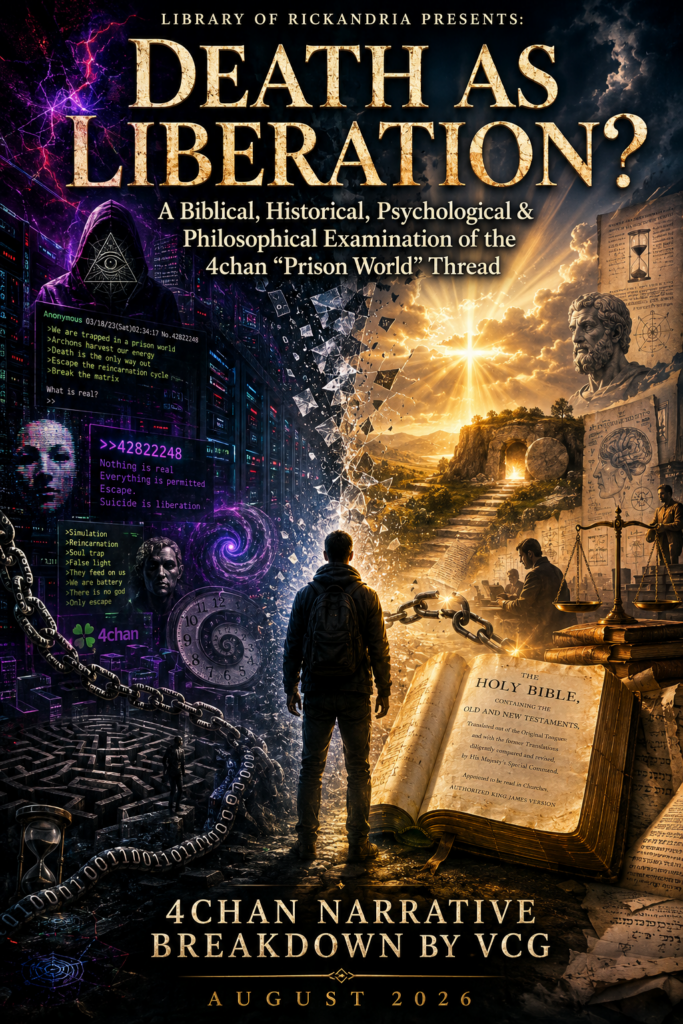
UPDATED BY VCG ON 8/19/2026 @ 12:34 EST
I want to share a heartfelt cause with my audience. Conner Blaisdell-Greene, a brave Airforce Sr. Airman, recently lost his battle with cancer, leaving his family in financial distress. Every donation, no matter how small, can help cover his funeral costs and ease their burden during this difficult time. Please consider clicking the link below to contribute or share Conner’s story with others. Your support truly matters.
Anyone can do this, but most won’t.
ChatGPT – Library of Rickandria
Soli Deo Gloria.
I’ll treat the thread as a set of discrete claims rather than as one narrative:
- first reconstruct exactly what each post asserts
- then test factual claims
- identify reasoning/psychological mechanisms
and finally compare any theological claims against the KJV text.
Where a point is interpretation rather than demonstrable fact, I’ll label it that way.
/x/ – Excited to Die – Paranormal – 4chan
The thread’s core fault line is already clear:
it repeatedly turns despair into metaphysics—
“life hurts, therefore existence is a prison,”
then
“death feels like release, therefore death must be liberation.”
That is not an evidential chain; it is an emotional state being promoted into a cosmology.
I’m also separating that from the genuine philosophical questions about:
- suffering
- mortality
- Christian hope
because those deserve better than dismissive slogans.
A second pattern is syncretic compression:
- Buddhism
- Sufism
- Enoch
- “archons,”
- reincarnation
- relativity
- Christianity
are treated as if they describe one hidden system.
They do not.
Some individual motifs really exist in those traditions, but the thread repeatedly changes their meaning to make them fit a preselected “prison/escape” theory.
I reviewed the live thread itself—729 lines, beginning August 14, 2026 and continuing through August 18—rather than relying on a repost or summary.
The thread contains:
- philosophy
- comparative religion
- Gnostic speculation
- Buddhism
- relativity
- anti-Christian argument
- conspiracy claims
and—most importantly—multiple explicit statements of suicidal desire.
(4chan)
My conclusion after separating those layers is:
The thread contains several legitimate questions about suffering and death, a handful of partly correct historical/philosophical observations, and a very large number of unsupported metaphysical leaps.
Its central “death = escape from the prison” thesis is neither established scientifically nor established by the religions it invokes.
Biblically, it reverses the Christian doctrine of:
- creation
- death
- resurrection
- judgment
- hope
There is an especially serious error at the end:
the suggestion that suicide might be the mechanism for escaping reincarnation.
Nothing presented in the thread establishes that proposition.
It is an unfalsifiable speculation attached to a behavior that cannot be undone. (4chan)
1. Methodology
I used five separate tests.
Textual test:
What did each poster actually claim?
I have avoided attributing a stronger claim than the post makes.
Historical/factual test:
Claims about:
- Epicurus
- Buddhism
- Christianity
- relativity
- Gnosticism
etc. are compared against primary texts or scholarly/official sources wherever possible.
Logical test:
Does the conclusion actually follow?
I distinguish:
- evidence
- inference
- analogy
- assertion
- unfalsifiable speculation
Psychological test:
I will identify known reasoning patterns—
- hopelessness
- entrapment cognition
- confirmation bias
- motivated reasoning
- conspiracy cognition
—but I will not diagnose anonymous posters.
Research does associate:
- hopelessness
- perceived entrapment
- cognitive distortions
with suicidal ideation and behavior.
Cognitive Distortions and Suicide Attempts – PMC
Scriptural test:
For Christian claims I am using the supplied KJV/Pure Cambridge Bible.
I will distinguish what Scripture actually says from theological deductions people make from it.
2. The opening post: No. 42822248
The OP says he is eager to die, would welcome a terminal diagnosis, does not intend suicide because religions warn of a bad afterlife, and attributes this reasoning to Epicurus:
- If there is no afterlife, death means no suffering.
- If there is an afterlife, continuation may be good. (4chan)
Fact-check: the Epicurus attribution is half wrong
The first proposition is recognizably Epicurean.
Epicurus argued that death is
“nothing to us”
because sensation ends with death; where death is present, the subject who might suffer it is not.
The Internet Classics Archive | Letter to Menoeceus by Epicurus
But Epicurus did not teach the second half—
“perhaps there is an afterlife and it may be pleasant.”
His argument depends precisely upon death ending sensation.
The famous
“either death is dreamless unconsciousness or it is migration of the soul elsewhere”
argument is instead associated with Socrates in Plato’s Apology.
The Internet Classics Archive | Apology by Plato
So OP has effectively combined:
Epicurus:
no awareness after death → death should not be feared.
with
Socrates/Plato:
perhaps unconsciousness, perhaps relocation of the soul.
That fusion is philosophically interesting, but it should not be labeled simply “Epicurus.”
Logical problem
Even granting the two possibilities:
no afterlife or some afterlife
it does not follow that death is desirable.
The possibilities have been artificially narrowed.
An afterlife could conceivably be better, worse, morally consequential, or otherwise unlike the poster’s expectation.
The argument quietly substitutes:
“something unknown”
with
“something probably favorable.”
That is an optimism assumption, not evidence.
Biblical correction
Christianity actually contains a surprisingly close tension to OP’s emotional question—but resolves it very differently.
Paul writes:
“For to me to live is Christ, and to die is gain.”— Philippians 1:21
and:
“having a desire to depart, and to be with Christ; which is far better”
but immediately continues:
“Nevertheless to abide in the flesh is more needful for you.”— Philippians 1:23–24
That is crucial.
Christian hope can remove terror of death without turning death into a goal to manufacture.
Paul’s logic is not:
Heaven is better → terminate life.
It is:
Christ makes death gain → nevertheless remain and serve while life is given.
3. No. 42822266 — “religion invented anti-suicide rules to keep us trapped”
The poster argues that religions discourage suicide because, if humans knew heaven existed, civilization would destroy itself by everybody leaving early.
From there he infers some designer of religion installed reincarnation or punishment as a “railguard.” (4chan)
Verdict: unsupported conspiracy explanation
There is an interesting functional observation buried here:
societies plainly have an interest in preserving their members.
But:
“this belief has a social function”
does not entail
“therefore somebody invented the belief for that function.”
That is the genetic fallacy plus an unsupported intentional-agent inference.
Historical Christian arguments against suicide have been considerably broader.
Augustine and later Aquinas treated it in connection with:
- moral duty
- love of self and neighbor
- community obligations
and divine authority—not merely institutional survival.
Suicide (Stanford Encyclopedia of Philosophy)
Even more importantly, Christian Scripture never says,
“We need people alive so the institution survives.”
The biblical claim is theological:
human life belongs ultimately to God.
Paul:
“ye are not your own”
“For ye are bought with a price:
therefore glorify God in your body…”— 1 Corinthians 6:19–20
One may reject that theological premise.
But one cannot honestly replace it with
“the real reason is population control”
without evidence.
4. No. 42822290 — the thread’s grand “all religions teach the prison” synthesis
This is the theological engine of the whole thread.
The poster claims most religions teach:
reincarnation plus memory wipe;
desires as fetters;
asceticism as escape;
seven jhānas followed by an eighth called samādhi/“Kingdom of Heaven”;
Sufi disappearance;
Enoch’s disappearance;
archons selecting reincarnations;
virtually every religion declaring this world evil;
repeated previous lives. (4chan)
This contains real religious vocabulary assembled into a system none of the cited traditions actually teaches as a whole.
“Most religions teach reincarnation and memory wipe”
False as a universal/general claim.
Christianity does not teach reincarnation.
The biblical sequence is:
“it is appointed unto men once to die, but after this the judgment”— Hebrews 9:27
And Jesus speaks of the dead coming forth in a future resurrection:
“all that are in the graves shall hear his voice,
And shall come forth…”— John 5:28–29
Whatever one thinks of Christianity, this is structurally incompatible with:
birth → death → memory wipe → another earthly incarnation → repeat.
Christian eschatology is linear, not samsaric.
“All religions say this world is bad”
Demonstrably false of biblical Christianity.
Genesis does not say God made a cosmic prison and declared it evil.
It says:
“And God saw every thing that he had made, and, behold, it was very good.”— Genesis 1:31.
Christianity absolutely teaches that the present world is fallen and subject to corruption.
But:
good creation → fall → redemption → resurrection
is fundamentally different from:
evil material prison → escape embodiment.
That distinction is one of the central disagreements between historic Christianity and many Gnostic systems.
“Archons control reincarnation”
There really are ancient texts employing archons/rulers in hostile cosmologies.
The Hypostasis of the Archons, for instance, is an ancient Gnostic work presenting defective cosmic rulers and a negative interpretation of material existence. (Gnosis)
But the 4chan poster adds a very particular modern system:
good deeds → archons assign a somewhat nicer reincarnation → memory wipe → repeat until escape velocity.
That package has not been demonstrated simply by invoking the word “archon.”
Ancient Gnostic texts are evidence that ancient people believed or narrated Gnostic cosmologies.
They are not empirical proof that such beings operate a reincarnation machine today.
That distinction—historical evidence for a belief versus evidence that the belief is true—is repeatedly erased in the thread.
The jhāna claim
The post’s
“seven jhānas, then the eighth jhāna which is samādhi”
description is muddled.
Early Buddhist sources commonly organize meditative attainment around four jhānas, with four additional formless attainments often discussed afterward.
SuttaCentral’s material explicitly distinguishes the four jhānas and the four formless attainments.
A Thematic Guide to the Aṅguttara Nikāya—SuttaCentral
Calling the final attainment the Christian
“Kingdom of Heaven”
is not translation. It is theological equivalence imposed by the poster.
There may be comparative-mysticism arguments worth examining, but similarity of subjective language does not establish identity of metaphysical referent.
Enoch
Genesis says:
“And Enoch walked with God: and he was not; for God took him.”— Genesis 5:24
The text does not say:
Enoch weakened reincarnational desire, penetrated jhānas, achieved escape velocity, bypassed archons, or awakened from a false universe.
Those are additions to the text.
5. Nos. 42822303 / 42822445 / 42822505 — sabotage and “data centers”
These posts introduce destruction of infrastructure as part of dying. (4chan)
There is no factual argument here to rebut.
It is aggressive fantasy attached to death rhetoric.
Its significance is psychological/social:
the conversation is beginning to normalize not merely death-wishing, but death plus destructive action.
That makes the thread substantially different from a detached metaphysical seminar.
6. No. 42822377 — “it’s the only thing that makes sense”
This is an epistemic error.
“This explanation feels more coherent than its competitors”
is evidence about the poster’s subjective model preference, not evidence that the model corresponds to reality. (4chan)
Conspiracy-style explanatory systems can become especially attractive because one hypothesis explains many otherwise unrelated experiences.
Research on conspiracy cognition finds that such beliefs often share common psychological mechanisms and can become mutually reinforcing.
Belief in conspiracy theories: Basic principles of an emerging research domain – PMC
The correct question is not:
Can this story explain everything?
Almost any sufficiently flexible story can.
The better questions are:
What would falsify it?
What unique prediction does it make?
What evidence favors it over alternatives?
The thread rarely asks those.
7. No. 42822400 — relativity “proves the future already exists”
This is one of the intellectually stronger posts, but its conclusion outruns the physics.
Special relativity does indeed undermine a universal, observer-independent notion of distant simultaneity.
Different inertial observers can disagree about which spatially separated events are simultaneous.
The definition of “now” « Einstein-Online
This is one reason philosophers discuss eternalism or a “block universe.”
But:
relativity of simultaneity
does not straightforwardly prove
metaphysical eternalism
and certainly does not prove
personal consciousness survives bodily death.
Philosophy of time explicitly distinguishes the physical spacetime formalism from additional metaphysical interpretations.
Time (Stanford Encyclopedia of Philosophy)
Even if eternalism is true, the proposition would roughly be:
the event
“you reading this sentence in 2026”
tenselessly occupies a spacetime location.
That does not mean:
after dying, your stream of consciousness continues experiencing earlier spacetime locations forever.
The post equivocates between an event’s tenseless existence and an individual’s continued subjective experience.
Those are entirely different propositions.
8. Nos. 42822412 / 42822425 — caricaturing Buddhism
The anti-Buddhist response contains both reasonable skepticism and factual errors. (4chan)
Its strongest question is legitimate:
How do we know metaphysical claims about samsara are true?
That deserves an answer rather than
“you aren’t spiritual enough.”
But several factual claims fail.
“Buddha/Buddhism rejected ghosts”
Wrong.
The Buddhist canon contains an entire body of material concerning petas/preta—hungry ghosts.
The Petavatthu is literally a collection of
“Stories of Hungry Ghosts.”
Petavatthu—Suttas and Parallels
So later poster No. 42833974 is substantially correct when correcting this point. (4chan)
“Buddhism tells you never to feel good”
Caricature.
The target of Buddhist teaching is not simply pleasant experience but attachment/craving and the conditions of suffering.
Different Buddhist traditions formulate this differently, but
“never experience pleasure”
is not an adequate statement of Buddhist doctrine.
Christian evaluation
Correcting false claims about Buddhism does not require accepting Buddhism.
A Christian can say:
“Buddhism genuinely teaches doctrines I believe are false”
without inventing doctrines Buddhism does not teach.
That is the difference between rebuttal and straw man.
9. No. 42822430 — “suicide is technically self-sacrifice”
No.
Self-sacrifice and suicide can overlap in certain unusual moral cases, but the concepts are not interchangeable. (4chan)
A person dying while protecting another is morally and intentionally different from a person intending death as an escape from his own suffering.
Christian discussion often distinguishes something like:
accepting death while doing a duty of love
from
choosing death as the intended end.
Jesus’ statement:
“Greater love hath no man than this, that a man lay down his life for his friends.”
does not mean every intentional self-caused death is
“self-sacrifice.”
The object and intent matter.
10. Nos. 42822438 / 42822947 — Christianity banned suicide only to preserve itself
Again, a monocausal historical story. (4chan)
It is fair to observe that a religion whose entire population died would cease to function socially.
That is trivial.
It does not prove this was
“the whole reason.”
Augustine’s anti-suicide reasoning and Aquinas’s later treatment appeal to moral law, obligations toward oneself and community, and God’s sovereignty.
Suicide (Stanford Encyclopedia of Philosophy)
Furthermore, Scripture itself provides a different internal logic.
When the Philippian jailer is about to kill himself, Paul says:
“Do thyself no harm:
for we are all here.”— Acts 16:28
Notice what Paul does not say:
“Do not hurt yourself because the Church needs dues-paying members.”
He intervenes immediately to preserve the man’s life.
11. No. 42823056 — asceticism is merely elite resource extraction
This reverses the earlier poster’s romanticization with an equal-and-opposite conspiracy theory.
Earlier:
all asceticism = spiritual escape technology.
Now:
all asceticism = rulers stealing resources from you. (4chan)
Both are reductionist.
Historically, ascetic disciplines have had many motivations:
- spiritual discipline
- renunciation
- monastic community
- contemplation
- status
- protest
- institutional structure
and sometimes abuse.
No single motive explains every ascetic tradition.
Biblically, moreover, Christianity does not teach that everyone must become an impoverished celibate hermit.
Paul explicitly says different persons have different gifts regarding celibacy and marriage.
12. No. 42824540 — “you came from darkness once, so you can emerge again”
This argument sounds profound but contains a basic identity problem. (4chan)
It reasons:
- There was a time before my birth.
- I later existed.
- Therefore after I cease existing, I may emerge again.
- Therefore “my existence will continue.”
Step 3 does not follow.
The first transition occurred because a particular organism came into existence through particular causes.
Merely returning to a condition labeled “nonexistence” supplies no mechanism causing the numerically same person to arise again.
Even if another conscious being later exists, that does not establish personal identity with you.
“Did you forget you are the playwright?”
is poetic assertion, not argument.
13. No. 42824688 — deprivation and desire
This is one of the thread’s more useful observations.
Merely suppressing an outward behavior need not eliminate inward desire. (4chan)
Christian Scripture independently makes a similar distinction between external performance and inner condition.
Jesus repeatedly relocates sin from merely external behavior to the heart.
But the poster’s conclusion that vipassanā specifically is therefore the solution requires an additional Buddhist premise.
The psychological observation does not prove the religious system.
14. No. 42824696 — “death is the best way to make my dreams come true”
This is where philosophical speculation becomes clinically important.
The poster explicitly describes wanting suicide, identifies a possible lethal means, and hopes for fatal illness. (4chan)
Those are not evidence for an afterlife.
They are warning signs.
NIMH specifically identifies talking about wanting to die, feeling trapped or hopeless, unbearable pain, and seeking or discussing lethal means as warning signs that deserve serious attention.
Warning Signs of Suicide – National Institute of Mental Health (NIMH)
This produces a major methodological rule for reading the rest of the thread:
A person’s intense conviction that death is liberation cannot automatically be treated as mystical perception when the same person is expressing conditions known to accompany suicidal crises.
That does not prove his metaphysics false.
It does mean the metaphysics cannot be accepted simply because it feels self-evident to him.
15. No. 42825716 — the central anti-Christian “Death is good; God is evil” post
This deserves close treatment because it explicitly cites Scripture. (4chan)
Claim:
“The Bible says whoever loves Death hates God.”
Not what the verse says.
The likely reference is Proverbs 8:36.
KJV:
“But he that sinneth against me wrongeth his own soul:
all they that hate me love death.”
Three corrections:
First, the order is:
hate wisdom → love death
not
love death → therefore hate God as a formally stated biconditional.
Second, the immediate speaker in Proverbs 8 is personified Wisdom.
Third, one may theologically relate divine Wisdom to God, but that is interpretation beyond merely quoting the sentence.
So, the poster remembers a real biblical idea but reverses and simplifies it.
Claim:
“Death is the good guy.”
This is almost the exact opposite of New Testament vocabulary.
Paul:
“The last enemy that shall be destroyed is death.”— 1 Corinthians 15:26
And:
“Death is swallowed up in victory.”— 1 Corinthians 15:54
Christianity does not say death is merely an optical illusion or secret benevolent deity.
Death is an enemy that Christ conquers.
Claim:
“Death is natural; life is artificial.
Fact.”
Calling something “Fact” does not turn metaphysics into empirical observation.
Biologically, death occurs naturally.
So does:
- birth
- metabolism
- reproduction
- aging
- healing
- predation
- symbiosis
- life
“Natural” also does not mean morally good.
Earthquakes are natural.
Cancer is natural.
Compassion is natural.
The move
death occurs in nature → therefore death is morally superior
is a naturalistic fallacy.
Claim:
“God lets corrupt men prosper; therefore Death is fairer.”
This is a genuine problem-of-evil/providence question, and Scripture itself refuses to trivialize it.
The Bible repeatedly asks why the wicked prosper—
- Job
- Psalm 73
- Ecclesiastes
- Habakkuk
So, the Christian answer should not be:
“Bad people never prosper.”
They plainly do.
The biblical claim is instead that present prosperity is not final judgment and God judges without respect of persons.
Romans explicitly says every person gives account to God and that divine judgment is according to truth.
“Death kills everyone”
is equality of outcome, not justice.
A guillotine treating innocent and guilty identically would be impartial in one sense, but not morally just.
16. No. 42825899 — body evolved for reproduction; therefore forget afterlife
The biological component and philosophical component should be separated. (4chan)
Organisms certainly exhibit adaptations connected with survival and reproduction.
But:
evolutionary function
does not determine
ultimate metaphysical purpose.
Nor does saying
“afterlife stories come from non-experience”
demonstrate materialist annihilation.
It may justify skepticism.
It does not prove the opposite conclusion.
17. No. 42825957 — refusing cancer treatment equals suicide
Too categorical. (4chan)
Medical ethics distinguishes intentionally causing death from refusing or withdrawing disproportionately burdensome treatment.
Even American legal/medical discussions distinguish the right to refuse treatment from physician-assisted suicide. (American Psychiatric Association)
- Intent
- prognosis
- burden
- benefits
- alternatives
and circumstances matter.
So:
refusing every curative treatment specifically because one wants to die may raise suicide concerns.
But:
declining a treatment
is not automatically synonymous with suicide.
18. No. 42825966 — The Discovery (2017)
This fact-check is correct.
The Netflix film The Discovery depicts a scientist proving an afterlife, followed by a wave of suicides.
Netflix’s own synopsis describes exactly that premise.
Watch The Discovery | Netflix Official Site
Credit where due.
19. Nos. 42826823 / 42826973 — “shills,” “disc,” “loop”
No evidence is supplied for either claim. (4chan)
Calling dissenters “shills” is particularly epistemically corrosive because it creates a self-sealing belief:
agreement = confirmation.
disagreement = proof the controllers sent someone.
Once disagreement itself becomes evidence for the theory, the theory becomes difficult or impossible to falsify.
That pattern is common in conspiracy cognition.
Research identifies confirmation bias, motivated reasoning, uncertainty, and mutually reinforcing conspiratorial beliefs as relevant mechanisms.
Psychologists are taking aim at misinformation with these powerful strategies
20. Nos. 42827293 / 42827296 — smoking because nobody wants longevity; “life is hell”
The smoking assertion is introduced as “I heard” and no evidence is given. (4chan)
So, the correct verdict is not necessarily “false”; it is unsubstantiated anecdote.
“Life is hell nowadays”
is a global evaluation, not a fact capable of being established from one person’s experience.
Psychologically, this illustrates overgeneralization:
my life / society contains severe suffering
becomes
existence as such is hell.
The first may be painfully true for a particular person.
The second requires considerably more argument.
21. Nos. 42827303 / 42827399 — does Buddhism regard death positively?
“Positive” is too crude.
Buddhist teaching takes impermanence and death contemplation seriously and regards continued samsaric existence as bound up with suffering, but that does not straightforwardly make voluntary death the path of liberation.
Buddhist ethical scholarship treats suicide as a complex moral issue, not the simple solution “death good.”
Ethics in Indian Buddhism (Stanford Encyclopedia of Philosophy)
The next poster’s claim that Zen particularly teaches lucid dreaming as preparation for “lucid death” looks like a conflation.
Dream/sleep yoga is especially associated with Tibetan Buddhist traditions.
Research discussing such practices explicitly identifies Tibetan Buddhist sleep-yoga traditions.
Nondual Awareness and Minimal Phenomenal Experience – PMC
Meditation and lucid dreaming do have empirical research connections, but that is not the same thing as establishing the asserted Zen after-death doctrine.
22. No. 42827998 — “become Orthodox and die to the world”
This is one of the few religious statements that at least recognizes an important metaphorical distinction. (4chan)
Christian
“dying to the world”
language generally concerns renunciation of:
- sin
- passions
- status
and worldly domination—not literal self-destruction.
Paul’s language is simultaneously:
dead to sin
and
alive unto God.
Biblical mortification is directed at sinful conduct, not the biological organism itself.
23. Nos. 42828012, 42828489, 42828516 — grief, trauma, regret and attraction to death
These are among the most important posts in the thread, because suddenly the metaphysical rhetoric is accompanied by autobiographical explanations:
grief;
heartbreak;
physical pain;
existential dread;
trauma;
previous thoughts of killing oneself;
weak attachment to life. (4chan)
That changes how a responsible reader should interpret the discussion.
Research on suicidal behavior repeatedly highlights:
- hopelessness
- pain
- defeat
- entrapment
as major psychological constructs.
Entrapment and social problem-solving in suicidal behavior across the adult lifespan – PMC
And this matters enormously for the prison-planet narrative:
A person experiencing psychological entrapment may understandably find a cosmology saying
“you literally live inside a prison and death is the exit”
extraordinarily resonant.
But resonance is not corroboration.
It could be:
cosmology describing reality
or
inner experience supplying the metaphor by which reality is interpreted.
The thread scarcely considers the second possibility.
24. Nos. 42828549 / 42829193 — “you’re depressed” and “others have it worse”
The first poster may be expressing reasonable concern, but anonymous text is not enough to diagnose a person with depression. (4chan)
The next response—essentially
“your life cannot be that bad; someone disabled has it worse”
—is psychologically poor reasoning.
Comparative suffering does not invalidate suffering.
Someone else being in greater pain does not logically remove your pain.
More constructively, loss of pleasure, hopelessness, and thoughts of death can occur in depressive illnesses, but assessment belongs with a qualified clinician rather than an anonymous commenter.
NIMH lists hopelessness and loss of interest/pleasure among common depressive symptoms.
Depression – National Institute of Mental Health (NIMH)
25. Nos. 42830866 / 42834848 — “deathmaxxing,” smoking and drinking
These posts turn death-wishing into ironic lifestyle branding. (4chan)
That rhetoric matters even when intended humorously.
The thread repeatedly makes self-destruction:
funny → communal → identity-coded → normal.
WHO guidance on suicide communication warns that certain kinds of repeated or sensationalized suicide content can contribute to imitation effects, while stories emphasizing coping and recovery can have protective effects.
Preventing suicide: a resource for media professionals, update 2023
So, the relevant concern is not
“a meme magically causes suicide.”
It is that normalization and glamorization can influence already vulnerable readers.
26. No. 42830915 — “nihilist Gnostics are MK-ULTRAing people into suicide”
First half: perceptive.
Second half: unsupported. (4chan)
The observable claim is:
some posters are presenting suicide/death as liberation.
Yes.
The thread itself demonstrates that.
The additional claim:
therefore MK-ULTRA is behind them
has no evidence in the thread.
A sound rebuttal does not need a counter-conspiracy.
27. No. 42831643 — “I look forward to death, but I’m not suicidal”
That distinction is possible. (4chan)
- A Christian
- elderly person
- terminal patient
- philosopher
- soldier
or anyone else may no longer fear death without presently intending self-harm.
Paul himself can say:
“to die is gain”
while continuing his work.
So, we should not collapse:
lack of death anxiety
into
active suicidal intent.
But a persistent wish for death can also overlap with passive suicidal ideation, especially when accompanied by hopelessness or self-neglect.
NIMH therefore advises taking statements about wanting to die seriously rather than deciding from one sentence whether they are harmless.
Frequently Asked Questions About Suicide – National Institute of Mental Health (NIMH)
28. No. 42833974 — hungry ghosts
As noted earlier:
substantially correct correction.
Buddhist textual tradition genuinely includes pretas/hungry ghosts.
Petavatthu—Suttas and Parallels
This is a good example of why we should not rebut false religion with false facts.
29. No. 42834863 — antipsychotics, emotional flattening, psychosis and death-wishing
This poster says medication diminishes his desire for life, but without it hallucinations and delusions become severe enough to threaten employment and housing. (4chan)
Two points.
First, the lived report should not be dismissed.
- Emotional blunting
- anhedonia
- apathy
and related symptoms can be difficult to disentangle because they may arise from:
- illness
- medication effects
- depression
or combinations thereof.
Research on psychotic disorders recognizes emotional blunting/anhedonia among important symptom domains, while medication effects can vary greatly.
Anhedonia in Schizophrenia: A Review of Assessment Strategies – PMC
Second, nothing about that justifies an anonymous reader telling him to discontinue medication.
Given his own report that stopping treatment produces severe hallucinations/delusions, medication questions require discussion with his prescriber.
Most importantly for our argument:
“I feel emotionally deadened”
is evidence about his present experience.
It is not evidence that biological death opens a cosmic gate.
30. No. 42834925 — “let’s die and collect data about what happens”
There is an elementary epistemological problem. (4chan)
An experiment requires some path by which observations become available.
If death permanently prevents communication with surviving investigators, then killing the observer produces no publicly recoverable dataset.
And if the theory says:
“you will learn after death but cannot communicate the answer back,”
then it cannot serve as an ordinary empirical experiment.
“Let’s find out”
sounds scientific.
It is not a scientific protocol.
31. No. 42834972 — “Buddhism was created by rulers to pacify peasants”
Historically unsupported. (4chan)
Standard historical reconstruction associates Buddhism with Siddhartha Gautama and the broader ancient Indian śramaṇa environment, not with a ruling-class committee inventing a “slave religion.”
Life of the Buddha – The Metropolitan Museum of Art
Later rulers could certainly sponsor, institutionalize, or politically use religions.
But:
later political patronage/use
does not prove
political rulers created the religion.
Again, origin and later function are being conflated.
32. No. 42837591 — the caricature of Christianity
The post reduces religion to:
“life is horrible, heaven great, have huge numbers of children, don’t kill yourself, give all money to clergy.”
(4chan)
That is a straw man of Christianity.
Biblically:
Christianity does not teach material creation was originally evil.
It does not command every Christian to have forty children.
It does not command every Christian to give all possessions to clergy.
Indeed, Paul says of giving:
“not grudgingly, or of necessity: for God loveth a cheerful giver.”— 2 Corinthians 9:7
And Paul praises both marriage and, for those gifted for it, celibacy.
One may critique actual Christian teachings.
But this post mostly critiques an invented cartoon.
33. No. 42838787 — Buddhism made Burma/Myanmar a “hellhole”
Severe oversimplification. (4chan)
Religion—particularly Buddhist nationalism and Burman-Buddhist identity—has played meaningful roles in parts of Myanmar’s communal and political conflict.
But Myanmar’s conflicts also involve:
- military rule
- ethnic minority grievances
- competing nationalisms
- state formation
- armed organizations
- coups
and long-running center-periphery conflicts.
International Crisis Group specifically describes resistance to a Burman-Buddhist identity as one driver among the factors in decades of civil war, not
“Buddhism caused Myanmar.”
Buddhism and State Power in Myanmar | International Crisis Group
The monocausal formulation is historically inadequate.
34. No. 42838980 — materialism, animals, neurons, and religion invented from death anxiety
This post is more thoughtful than several surrounding ones. (4chan)
The poster reasons:
brain activity stops at death → consciousness presumably ceases → permanent nothingness → humans invented afterlives because that is frightening.
There are two separate propositions.
“Consciousness ceases when the brain permanently ceases functioning.”
This is compatible with materialism and with strong correlations between brain states and conscious states.
But the metaphysical conclusion:
“therefore, there certainly is no form of postmortem consciousness”
still contains a philosophical premise about the identity/dependence relation between mind and brain.
It may be a defensible position.
It should not be mislabeled as something directly observed by watching neurons stop.
“Religion exists because humans fear death.”
Death anxiety really can influence beliefs and behavior.
Terror-management research studies precisely how mortality awareness interacts with worldviews and religion.
But this supports:
fear of death can affect religious cognition.
It does not establish:
all afterlife belief was invented solely because people were scared.
And the poster’s animal objection misunderstands Buddhism in particular:
Buddhist rebirth traditionally includes nonhuman forms of life.
So
“why only humans and not animals?”
is not a rebuttal to classical Buddhist rebirth.
35. No. 42839138 — “after death I’ll fight the owners of the prison”
No evidential content. (4chan)
This is a narrative expectation.
No mechanism, source, observation, or falsifiable prediction is supplied.
It illustrates the thread’s progressive transformation:
question about death
→ afterlife speculation
→ prison assumption
→ prison owners
→ mission after death
without the intermediate propositions ever actually being demonstrated.
36. No. 42840167 — “suicide is how you escape reincarnation”
This is the most dangerous and least-supported conclusion in the entire thread. (4chan)
The reasoning is:
- We are reincarnated.
- The world is a prison.
- Consent is cosmically binding.
- Suicide proves non-consent.
- Therefore the controllers must release the suicide victim.
- Religions prohibit suicide because they know this loophole.
Every major premise is assumed.
No evidence establishes a cosmic law of consent.
No evidence establishes that death provides access to such a law.
No evidence establishes that suicide overrides reincarnation.
No evidence establishes that religions know this secret.
And the final premise immunizes the theory from contrary evidence:
Religions say suicide is wrong → therefore religions know suicide works.
That is exactly backwards as evidence.
It interprets any prohibition as proof of the prohibited act’s secret effectiveness.
Using the same logic one could “prove” virtually anything.
Buddhism does not rescue this argument
Mainstream Buddhist ethical discussion does not say:
kill yourself and samsara must release you.
Liberation concerns:
- ignorance
- craving
- karma
- insight
- awakening
etc., not a metaphysical consent loophole.
Buddhist scholarship treats suicide far more cautiously and complexly.
Ethics in Indian Buddhism (Stanford Encyclopedia of Philosophy)
Christianity directly contradicts it
Christianity teaches neither reincarnation nor escape from the body through self-killing.
Its hope is resurrection.
“the dead shall be raised incorruptible”— 1 Corinthians 15
And death itself is:
“The last enemy…”
The Christian victory is not:
the soul defeats God by escaping creation.
It is:
God defeats death and raises the dead.
Those are opposite cosmologies.
37. The psychological architecture of the whole thread
This deserves its own synthesis, because the same patterns recur again and again.
Emotional reasoning
“I experience life as prison-like”
becomes:
life literally is a prison.
“I long for release”
becomes:
death literally is release.
“I feel something is manipulating me”
becomes:
archons/institutions literally designed the system.
Pain is real evidence that someone is suffering.
It is not automatically evidence for a cosmology.
Entrapment cognition
Several posters explicitly describe being trapped, wanting out, being traumatized, hopeless, detached from life, or waiting for death. (4chan)
Contemporary suicide models specifically identify perceived defeat and entrapment as important components in progression toward suicidal thinking.
Entrapment and social problem-solving in suicidal behavior across the adult lifespan – PMC
That makes “prison planet” language psychologically significant even before evaluating it metaphysically.
Confirmation bias
- A Sufi image
- Buddhist term
- Gnostic archon
- Enoch verse
- physics concept
and depressed testimony are all interpreted in one direction.
Contradictory details are either reinterpreted or assigned to manipulation.
APA summaries of misinformation research describe confirmation bias as reduced inclination to verify information consonant with one’s existing worldview.
Using psychological science to fight misinformation: A guide for journalists
Motivated reasoning
Once the emotionally desired conclusion becomes:
death = freedom
arguments are selected according to whether they preserve that conclusion.
Materialism works:
no afterlife → no more pain.
Spiritualism works:
afterlife → freedom.
Gnosticism works:
prison → escape.
Relativity works:
eternal existence.
Buddhism works:
samsara → liberation.
Notice what has happened.
Contradictory metaphysical systems are all counted as evidence for the same conclusion.
That is not convergence of evidence.
It is conclusion-preserving flexibility.
Unfalsifiability
Memory wipe is particularly powerful rhetorically:
“Why don’t you remember previous lives?”
Answer:
“Because they erase your memory.”
Absence of evidence thereby becomes exactly what the theory predicts.
That does not prove the claim false.
But it greatly reduces its evidential value unless the hypothesis independently predicts something testable.
Social reinforcement
The thread repeatedly rewards death-positive statements with:
- agreement
- jokes
- memes
and increasingly extreme formulations. (4chan)
For vulnerable readers this matters.
Responsible suicide-communication guidance specifically warns against romanticizing or normalizing suicide and emphasizes coping/recovery narratives instead.
Preventing suicide: a resource for media professionals, update 2023
38. The biblical doctrine the thread keeps missing
The biblical picture cannot accurately be reduced to:
“Earth is terrible; kill yourself and go to heaven—except religion arbitrarily forbids the shortcut.”
It is much more internally coherent than that caricature.
Creation:
fundamentally God’s work and originally “very good.” Genesis 1:31.
Fall:
sin enters and death comes through sin:
“by one man sin entered into the world, and death by sin”— Romans 5:12
Present life:
genuinely afflicted but capable of:
- faithfulness
- love
- service
- repentance
- growth
- witness
Death:
an enemy, not God and not a savior. 1 Corinthians 15:26.
Intermediate Christian hope:
Paul can desire to depart and be with Christ, while still saying remaining alive is necessary for service. Philippians 1:21–24.
After death:
not reincarnation-memory-wipe cycles, but judgment. Hebrews 9:27.
Final hope:
not disembodied escape from God’s material mistake, but bodily resurrection and death itself defeated. 1 Corinthians 15:42–58.
That last point is decisive.
Christianity does not ultimately promise:
escape creation.
It promises:
creation and humanity redeemed from corruption.
39. One important correction Christians themselves should make
The OP begins with:
“every religious tradition … has taught that suicide may result in a bad afterlife.”
(4chan)
A careful Christian should not respond with an invented Bible verse saying:
“Anyone who commits suicide automatically goes to hell.”
There is no KJV verse that says that.
Scripture gives strong grounds for preserving life, condemning murder, rejecting death as savior, understanding our bodies as belonging to God, and refusing self-harm.
But the claim:
“the unforgivable sin is suicide”
is not itself a biblical sentence.
The actual “unpardonable sin” passages concern blasphemy against the Holy Ghost, not suicide.
So we should reject both errors:
4chan error:
suicide is a secret metaphysical escape hatch.
popular religious error:
Scripture explicitly says every suicide victim is automatically damned.
Neither proposition is established by the text.
That distinction matters pastorally and exegetically.
40. Overall verdict
Here is what survives serious scrutiny.
True or substantially true:
Epicurus argued that death should not be feared if sensation ends; Buddhism really has hungry-ghost traditions; religions can have social functions; relativity really complicates universal simultaneity; death anxiety can influence human beliefs; The Discovery really uses the
“proof of afterlife produces suicides”
premise.
The Internet Classics Archive | Letter to Menoeceus by Epicurus
Partly true but distorted:
ascetic traditions really deal with desire; Gnostic texts really contain hostile archons/material-world pessimism; Buddhism really deals with samsara; Christianity really regards being with Christ as better than present suffering; religions really have historically discouraged suicide.
Unsupported:
memory-wiping archons presently administer Earth; good deeds buy better reincarnations from those archons; relativity gives subjective immortality; religions were deliberately designed as anti-escape technology; dissenters are shills; existence automatically recurs after nonexistence; cosmic consent law requires release after suicide.
Factually wrong:
Epicurus taught OP’s entire two-branch argument; Buddhism denies ghosts; “all religions” teach reincarnation; “all religions” condemn material existence; Christianity teaches reincarnation; Proverbs says verbatim
“whoever loves Death hates God”
eight-jhāna terminology maps directly onto the Christian Kingdom of Heaven; Buddhism was simply invented by rulers to pacify peasants.
Biblically inverted:
Death is the good God while God is the enemy; creation is intrinsically an artificial prison; salvation is escape through death; the body is merely a trap; resurrection can be replaced with reincarnation.
Dangerous and unsupported:
“suicide proves non-consent and therefore breaks the reincarnation cycle.”
There is no evidential basis in the thread for treating a person’s irreversible death as a metaphysical experiment or liberation technique. (4chan)
The sharpest scriptural answer to the entire thread may therefore be Philippians 1, not a frightened denial that death exists or that heaven is better:
“For to me to live is Christ, and to die is gain.”
…
“Nevertheless to abide in the flesh is more needful for you.”
That preserves both halves the thread keeps tearing apart:
The Christian need not worship life from fear of death.
But neither does he worship death from weariness with life.
Christ—not Death—is the hope; resurrection—not annihilation, reincarnation, or a suicide loophole—is the victory.
And because several posters in this thread move well beyond abstract philosophy into explicit wishes or plans to die, anyone recognizing his own present state in those posts should treat that as a serious warning sign rather than evidence of spiritual awakening.
In the U.S., 988 is available by call or text for immediate crisis support; NIMH likewise advises taking talk about wanting to die seriously.
988 Lifeline – If you need emotional support, reach out to the national mental health hotline: 988.
4CHAN THREAD & POST BREAKDOWNS – Library of Rickandria
VCG PAPER PROJECTS – Library of Rickandria