
Christ, Buddha & the Meaning of Suffering: A Biblical, Historical, Psychological & Methodological Critique of a 4chan Religious Debate
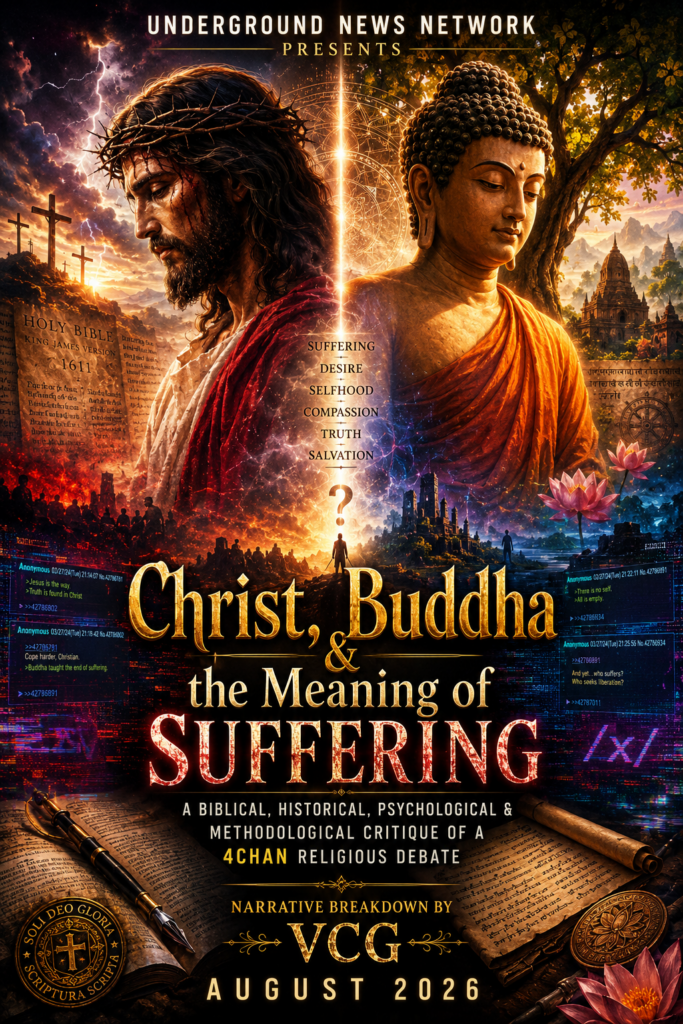
UPDATED BY VCG ON 8/12/2026 @ 06:38 EST
I want to share a heartfelt cause with my audience. Conner Blaisdell-Greene, a brave Airforce Sr. Airman, recently lost his battle with cancer, leaving his family in financial distress. Every donation, no matter how small, can help cover his funeral costs and ease their burden during this difficult time. Please consider clicking the link below to contribute or share Conner’s story with others. Your support truly matters.
ANYONE CAN DO THIS, BUT THEY WON’T.
ChatGPT – Library of Rickandria
I’ll treat this as a forensic reading, not a point-scoring exercise:
- reconstruct the thread exactly
- separate claims from rhetoric
- verify each factual assertion
- then test its biblical claims against the KJV text and context
I’ll also flag psychological techniques—
- fear
- pattern-seeking
- authority cues
- identity pressure
- unfalsifiability
—without using “psychology” as a substitute for actually answering the claims.
/x/ – The core difference between Jesus & the Buddha – Paranormal – 4chan
The thread is still accessible in 4chan’s archive and is much larger than the OP:
it runs from August 6–8, 2026 and contains competing:
- Buddhist
- Hindu
- Christian
- anti-Christian
- syncretic
claims.
One early correction already matters: the OP’s
“Jesus = I simply don’t matter”
formulation is not what Jesus says;
“love thy neighbour as thyself”
presupposes a proper concern for self, while 1 Corinthians 13:5 condemns selfish self-seeking, not creaturely self-care.
A second major correction is emerging on the Buddhist side:
several posters collapse all desire into the Buddhist target.
That is too crude.
Classical Buddhist sources distinguish craving/attachment from wholesome motivation; likewise, compassion (karuṇā) and loving-kindness (mettā) are not
“emotional indifference.”
So the strongest Christian critique cannot be
“Buddhists don’t love”
it has to address the deeper metaphysical and soteriological differences—
- God
- self
- sin
- grace
- resurrection
and the final good.
The KJV also corrects the thread’s Christian overstatement about suffering.
Scripture commands sympathy—
“weep with them that weep”
—but it does not make pain intrinsically holy or say the Christian should seek maximal suffering.
Christ says
“Come unto me … and I will give you rest”
Paul says tribulation can produce:
- patience
- experience
- hope
The cross is costly fidelity to Christ, not a cult of pain.
The thread’s strongest methodological critic is also right on one point:
“Jesus and Buddha taught exactly the same thing”
cannot survive comparison of their actual systems.
But the inverse—turning every overlap into a sham—is also wrong.
There are genuine ethical overlaps (compassion, restraint, generosity) alongside irreconcilable claims about:
- ultimate reality
- personhood
- salvation/liberation
and the destiny of the dead.
I went through the archived thread as a whole.
The archive contains roughly 1,700 rendered lines, with the discussion running from August 6 through August 8, 2026.
What follows audits every major substantive claim and argument rather than reproducing every insult, meme, one-word response, ethnic slur, or repeated taunt.
Those low-information posts are grouped separately because there is literally no proposition in them to fact-check. (4chan)
For Scripture, I am using the uploaded Pure Cambridge KJV as our primary English biblical text.
Executive verdict
The OP has identified something important but located the difference in the wrong place.
Christianity and Buddhism really are irreconcilable at several foundational points.
They do not teach
“precisely the same doctrine.”
But the thread’s proposed contrast—
Christianity = selfless love and willingness to suffer
Buddhism = selfish happiness and emotional indifference
—is not a fair description of Buddhism and is not an entirely biblical description of Christianity either.
A much stronger comparison is:
| Question | Biblical Christianity | Classical Buddhism |
|---|---|---|
| Ultimate reality | Personal Creator God; Christ divine | No supreme Creator God required; devas remain conditioned beings |
| Fundamental problem | Sin, guilt, alienation from God, death | Dukkha, ignorance, craving/attachment |
| Person/self | Created personal being; bodily resurrection | Anattā/anātman: no permanent substantial self |
| Salvation/liberation | Grace, reconciliation and redemption through Christ | Awakening through the Buddhist path; nirvāṇa |
| Final hope | Resurrection, judgment, new creation, communion with God | Liberation from saṃsāric rebirth |
| Moral love | Grounded in God’s own love and Christ’s self-giving | Mettā, karuṇā and other virtues genuinely seek others’ welfare |
| Suffering | Evil/adversity that God may redeem; sometimes endured for righteousness | Something whose causes are understood and extinguished |
| Identity after death | Personal resurrection remains central | No eternal individual ātman |
That is the real collision. Mainstream Buddhist ethics explicitly includes loving-kindness and compassion; Buddhist no-self has even been used to argue against egoism and for impartial concern for all suffering beings. (Stanford Encyclopedia of Philosophy)
I. Methodology
I used five tests repeatedly.
1. Textual test:
What did the poster actually claim, rather than what someone thinks they implied?
2. Scripture test:
For Christian claims, what does the KJV actually say in immediate and broader context?
3. Opponent-primary-source test:
Buddhism should be tested against Buddhist texts and responsible scholarship, not a Christian poster’s reconstruction of Buddhism.
4. Historical/scientific test:
Historical claims are compared with academic/institutional sources; empirical claims require evidence rather than mystical assertion.
5. Logical/psychological test:
Identify fallacies and psychological pressures without pretending a psychological label disproves a proposition.
My verdict vocabulary is:
- Correct — substantially supported.
- Partly correct — important truth mixed with error/overstatement.
- False — contradicted by relevant evidence/text.
- Unsupported — possible assertion, but evidence presented does not establish it.
- Theological claim — not independently settled merely by historical/scientific method.
- Speculation — goes beyond what the cited tradition itself establishes.
That distinction is crucial.
Saying
“this is theological”
does not mean “false.”
II. The OP, line by line
1. “Virtues and sins both produce joy; sinful joy is sinister; sin cages us while virtue frees us”
Verdict: Partly biblical, but philosophically underspecified
There is a genuinely biblical idea here.
Scripture recognizes that sin can be pleasurable while still enslaving and destructive. Hebrews speaks of
“the pleasures of sin for a season,”
while Jesus says:
“Whosoever committeth sin is the servant of sin.”
and:
“If the Son therefore shall make you free, ye shall be free indeed.”
Paul likewise contrasts slavery to sin with being
“made free from sin”
and becoming servants of righteousness.
So, the sin → bondage / righteousness → freedom motif is biblical.
But
“virtue produces freedom”
needs qualification.
Christianity does not teach salvation by accumulating virtue until consciousness expands.
Freedom is centered in Christ and grace, not merely psychological moral optimization.
2. John 11:35 — “Jesus wept”
Verdict: Textually correct; explanation partly inferred
The thread is right that Jesus already knew Lazarus was dead and that He intended to raise him.
John 11 says:
- Jesus loved Martha, Mary, and Lazarus.
- He knowingly delayed.
- He explicitly told the disciples Lazarus was dead.
- He described going to “awake him.”
- He told Martha, “Thy brother shall rise again.”
- He ultimately called Lazarus out of the tomb.
Therefore the paradox the OP notices is real:
knowledge of imminent resurrection did not make Jesus incapable of sorrow.
But the next leap is stronger than John states.
The OP says Jesus cried because He saw everybody else crying and
“couldn’t stop Himself.”
John certainly associates the scene with Mary’s weeping, Jesus’ groaning/trouble, and His love, but it does not explicitly give a single psychological mechanism such as involuntary emotional contagion.
Possible readings include:
compassion with Mary and Martha;
grief at Lazarus’ death;
indignation against death itself;
distress over unbelief;
some combination.
Jesus also weeps over Jerusalem because of coming judgment and its failure to recognize
“the things which belong unto thy peace.”
So:
Good observation: omniscient confidence in resurrection does not erase compassion.
Overreach:
John 11:35 proves that maximally sharing another person’s painful affect is the essence of moral goodness.
It doesn’t.
3. “The Buddha remains unaffected and chooses his joy, forgetting the other person”
Verdict: False characterization of Buddhism
This is the OP’s largest factual problem.
Classical Buddhist traditions explicitly teach the brahmavihāras, including:
mettā — loving-kindness, wishing others happiness;
karuṇā — compassion, wishing suffering beings freedom from suffering;
sympathetic/altruistic joy;
equanimity.
The Stanford Encyclopedia notes that even Theravāda—the tradition sometimes caricatured in Mahāyāna polemic as pursuing individual liberation—practices these virtues. (Stanford Encyclopedia of Philosophy)
The Mettā Sutta likewise directs goodwill broadly toward living beings. (SuttaCentral)
And Buddhist no-self has been used in precisely the opposite direction from OP’s “selfishness” argument:
if one’s own suffering has no metaphysical privilege simply because it is “mine,” one has grounds for impartial concern about suffering generally. (Stanford Encyclopedia of Philosophy)
Important distinction
Buddhist equanimity is not supposed to mean:
“Your child died?
Whatever.
I’m staying blissful.”
It means non-clinging/non-reactivity operating alongside compassion.
And psychology reinforces a distinction the thread repeatedly misses:
empathic distress and compassion are not identical psychological states.
Research distinguishes sharing another’s painful feeling from compassionate concern for that person’s welfare.
A person can care intensely without reproducing the other’s distress internally. (PubMed)
Thus
“he doesn’t cry as much, therefore he loves less”
is not a valid moral metric.
4. “Buddha’s morality is: virtues do ME good”
Verdict: False as a generalization
There certainly are self-liberation elements in Buddhism.
Liberation from one’s own ignorance, craving and suffering matters.
But
“therefore Buddhism is egoistic”
does not follow.
Buddhist ethical thought contains powerful universalizing arguments, especially in Mahāyāna, and even non-Mahāyāna Buddhism retains:
- benevolence
- compassion
- generosity
- non-harm
(Stanford Encyclopedia of Philosophy)
A much more serious Christian critique would be:
Buddhist compassion is genuine compassion, but Christianity and Buddhism explain why persons matter, what persons ultimately are, what evil fundamentally is, and what finally saves them in radically different ways.
That argument survives contact with Buddhist sources.
“Buddhists are just selfish”
does not.
5. “Jesus’ realm is: I simply don’t matter”
Verdict: Biblically false
This is where Scripture corrects a Christian poster.
Jesus says:
“Thou shalt love thy neighbour as thyself.”
The command does not enthrone selfishness.
But neither does it erase the self.
Paul writes:
“Look not every man on his own things, but every man also on the things of others.”
That also matters.
Philippians 2 teaches radical humility patterned after Christ, but it does not teach
“your own existence is of absolute zero importance.”
Ephesians is even plainer:
“He that loveth his wife loveth himself.
For no man ever yet hated his own flesh; but nourisheth and cherisheth it…”
And 1 Timothy says failing to provide for one’s own household is a grave moral failure.
Most devastating correction: 1 Corinthians 13 itself
The OP appeals repeatedly to:
“charity … seeketh not her own.”
But three verses earlier Paul says:
“though I give my body to be burned, and have not charity, it profiteth me nothing.”
So maximum self-sacrifice is not identical with love.
Christian love is not:
suffering + self-erasure = holiness.
It is rightly ordered love under God.
6. “Charity seeketh not her own” = self-love is contrary to agapē
Verdict: Misreading the verse
1 Corinthians 13:5 describes love as not selfishly grasping for its own advantage.
Paul uses very similar language elsewhere:
“Let no man seek his own, but every man another’s wealth.”
and then explains his own practice as:
“not seeking mine own profit, but the profit of many, that they may be saved.”
The subject is self-seeking, not metaphysical self-worth.
The responding poster around #42787042 therefore makes one of the better corrections in the thread:
“love your neighbour as yourself”
assumes rather than abolishes appropriate concern for oneself. (4chan)
7. “2 Timothy condemns being a lover of yourself, therefore self-love must only occur accidentally because Jesus commands it”
Verdict: Contextual overreach
2 Timothy 3 says:
“men shall be lovers of their own selves, covetous, boasters, proud…”
Notice the company the phrase keeps:
- covetousness
- boasting
- pride
- blasphemy
- ingratitude
- lack of natural affection
- treachery
and love of pleasure rather than God.
That is disordered self-centeredness.
It cannot mean every form of concern for oneself is sinful, because the same canon commands appropriate:
- provision
- preservation
- stewardship
“love thy neighbour as thyself.”
The OP has confused:
self-love as supreme governing end
with
proper creaturely care for oneself under God.
Those are not identical.
8. “Jesus is agapē; therefore whatever He wills simply is agapē”
Verdict: Contains truth but reduces God’s revealed character too far
1 John says:
“God is love.”
and grounds that love historically/theologically in God’s sending of His Son as propitiation.
But Scripture does not say
“Jesus is the abstract property agapē and every other divine attribute is reducible to it.”
The same Johannine corpus says God is light and repeatedly speaks of:
- truth
- righteousness
- judgment
- holiness
Better formulation:
God’s love belongs intrinsically to His revealed character, and Christ supremely manifests divine love; but biblical theology does not reduce God to one abstract emotional principle.
9. “God’s consciousness is the infinite realm in which our consciousness roams”
Verdict: Speculative and not biblical vocabulary
God’s infinity is orthodox Christian theology.
But human consciousness
“roaming inside God’s consciousness”
is not how Scripture formulates communion with God.
Biblical language includes:
being “in Christ”;
Christ dwelling in believers;
fellowship with God;
adoption;
being conformed to Christ;
beholding His glory.
It simultaneously maintains the Creator–creature distinction.
The OP’s terminology moves toward mystical metaphysics/panentheistic imagery.
It may be intended metaphorically, but it should not be presented as
“what the Bible teaches”
without qualification.
10. “Buddhist virtue produces a vast but finite cage of selfishness”
Verdict: Unsupported metaphor built upon the earlier false premise
Once “Buddhist = fundamentally selfish” fails, the cage analogy loses its argument.
There is still a Christian theological critique available:
If Christianity’s personal Creator exists, then Buddhist rejection/non-affirmation of that Creator would represent a fundamental error.
But that argument must be argued from truth about God, not by inventing an egoistic motive for every Buddhist virtue.
11. “Christians infinitely and endlessly increase in joy, knowledge, beauty and wonder throughout eternity”
Verdict: Possible theological speculation; not explicit biblical doctrine
Scripture plainly promises:
eternal life;
resurrection;
incorruption;
communion with God;
glory;
a new heaven and earth;
freedom from death.
It does not explicitly state a mathematical doctrine of infinitely increasing experiential intensity forever.
There are Christian theological traditions that speculate about endless growth in knowledge/love of an infinite God, but that must be labeled theological inference, not direct Scripture.
12. “Some eternal beauties are available only through weeping/suffering”
Verdict: Not established, and the final biblical picture pushes the opposite way
Revelation’s consummation says:
“God shall wipe away all tears from their eyes; and there shall be no more death, neither sorrow, nor crying, neither shall there be any more pain…”
That is extremely important for this thread.
Christianity does teach profound things can presently be learned through suffering.
But Christianity’s final good is not eternal participation in grief.
Suffering belongs to the world being overcome.
13. “Is suffering for others what constitutes true good?”
Verdict: No, biblically
Christianity teaches willingness to suffer for righteousness and for others.
It does not teach suffering is intrinsically good.
The cross is morally glorious because of who Christ is, what He accomplishes, His obedience, and His love—not because physical agony possesses independent moral value.
Again:
“though I give my body to be burned, and have not charity, it profiteth me nothing.”
Jesus also says:
“Come unto me … and I will give you rest.”
Christian Scripture can simultaneously say
“take up thy cross”
and promise rest because “cross” means costly discipleship—not fetishizing pain.
The eschatological victory is the destruction of death and sorrow, not their eternal glorification.
III. The central “desire” argument
A tremendous amount of the thread turns into:
Buddhism says desire is bad.
You desire enlightenment.
You desire to answer me.
Therefore Buddhism contradicts itself.
Verdict: Equivocation
This is among the clearest logical errors in the thread.
In a canonical Buddhist discourse, a Brahman raises almost exactly this objection:
if the goal is abandoning desire, how can desire be used to get there?
The answer uses the analogy of wanting to reach a destination:
the desire motivates the journey and ceases when the destination is reached.
The same passage explicitly describes concentration founded upon desire as part of the practice. (Access to Insight)
So, the Buddhist position is not simply:
every motivational state whatsoever is immoral.
Buddhist discourse distinguishes problematic craving/attachment from wholesome motivation and path-directed intention.
Therefore posts #42791521, #42791823 and #42793227 repeatedly saying variants of—
“You answered me, therefore you desired something, therefore Buddhism disproved”
—use an equivocation fallacy and become self-sealing:
literally any response is declared evidence against Buddhism.
That is not a serious falsification test.
IV. “Buddhists cannot love because love requires desire”
Verdict: Semantic game
The thread gets trapped arguing whether mettā deserves the English word “love.”
That is secondary.
The substantive question is:
Does Buddhist ethics include durable other-directed concern for another being’s welfare?
Yes.
It does. (SuttaCentral)
The Christian can then legitimately ask a deeper question:
What ontological foundation does that concern have if there is no permanent individual self and no personal Creator whose image grounds human dignity?
That is a serious theological/philosophical discussion.
Saying
“loving-kindness isn’t L-O-V-E because the English noun differs”
is not.
V. “Jesus and Buddha taught exactly the same doctrine”
Posts #42787162, #42790143 and related perennialist comments repeatedly assert this.
Verdict: False
Not merely
“different words for the same mountain.”
Consider propositions that cannot all be simultaneously true in the same sense:
Christianity:
there is one Creator God.
Buddhist thought: gods/devas, where affirmed, are beings within conditioned existence; Buddhist texts challenge claims by a Brahmā to be the permanent supreme creator. (SuttaCentral)
Christianity: the human dead are raised; personal identity matters eternally.
Buddhism: no permanent substantial self (anattā/anātman). (Stanford Encyclopedia of Philosophy)
Christianity:
Christ’s bodily resurrection is indispensable to the gospel.
Paul says if Christ is not raised, Christian faith is vain.
Luke deliberately denies that the risen Jesus is merely an apparition:
“a spirit hath not flesh and bones, as ye see me have.”
Buddhist liberation: nirvāṇa and cessation of the conditions producing rebirth.
These may contain ethical analogies.
They are not identical doctrines.
The post saying Christianity and Buddhism’s teachings about self/afterlife are directly oppositional therefore makes an important logical point, although its
“stop being a coward”
language adds nothing. (4chan)
VI. “Nirvāṇa means an eternal static nothing with no love, action, relationship or development”
Verdict: Too confident
Early Buddhist texts often resist the exact categories outsiders want to impose on the post-mortem status of the liberated Tathāgata.
In MN 72, the Buddha refuses all four simple alternatives concerning whether the Tathāgata after death:
exists,
does not exist,
both exists and does not exist,
neither exists nor does not exist.
So, a Christian may rightly say:
“That is radically different from resurrection and eternal personal communion with God.”
But saying:
“Buddhist scripture plainly says nirvāṇa is an eternally frozen consciousness that cannot love”
would go beyond the evidence.
VII. Buddha’s motivation: “a spoiled prince seeking personal escape”
Verdict: Psychological speculation presented as biography
The OP repeatedly psychoanalyzes Siddhārtha’s “root motive” as essentially selfish.
There are two problems.
First, Buddhist tradition itself presents the confrontation with aging, sickness and death as recognition of a universal human condition, not merely annoyance over one privileged man’s discomfort.
Second, much of the detailed Buddha biography comes through religious traditions written down and elaborated long after the historical Buddha.
Therefore reconstructing his private subconscious motivation with certainty is methodologically impossible.
You can critique Buddhist doctrine.
You cannot reliably diagnose the internal motive of a fifth-century-B.C. religious teacher from later hagiography.
VIII. Hungry tigress / Bodhisattva self-sacrifice
Post #42791587 counters the selfish-Buddha argument with the story of a previous incarnation feeding himself to a starving tigress and her cubs. (4chan)
Verdict: Valid against the caricature, but not historical proof
The story belongs to Buddhist narrative tradition and vividly represents the Bodhisattva ideal of radical generosity.
Therefore, it does undermine:
“Buddhism has no conceptual room for self-sacrificial concern.”
But it does not independently prove that the historical Gautama literally lived that prior life.
Correct classification:
religious narrative evidence for Buddhist moral ideals, not independently verified biography.
IX. “Sōtō Zen ultimately teaches Atman/Self”
Verdict: False
This is one of the easiest thread claims to check.
Official Sōtō Zen material explicitly explains the Buddhist doctrine of no-self (muga, Sanskrit anātman) and describes what we conventionally call the self as a conditioned bundle of transient phenomena. (Sotozen Net)
The same official Sōtō material speaks of bodhisattvas remaining in the world for the sake of helping beings and of seeking Buddhahood for the sake of all beings. (Sotozen Net)
So #42791587 mixes Zen terminology with a Vedāntic concept that Buddhism historically rejects.
X. “Buddha personally taught the mature Abhidhamma/Abhidharma”
Verdict: Traditional attribution ≠ historical-critical conclusion
One poster says Buddha did not teach Abhidhamma.
That’s too absolute if discussing Buddhist traditional claims.
But modern scholarship sees canonical Abhidharma literature as developing over decades and likely centuries from analytical tendencies already present in earlier Sūtra/Vinaya material. (Stanford Encyclopedia of Philosophy)
Thus:
Traditional Buddhist claim: various forms of Abhidhamma ultimately trace to Buddha.
Historical-critical assessment: mature Abhidharma textual systems developed after the earliest strata.
Both categories should be distinguished rather than mocked.
XI. “Buddhism died out in India because Hindus knew gods really existed”
Verdict: Unsupported historical claim
The decline of institutional Buddhism in India was long, regional and multifactorial.
Factors discussed by historians include changing patronage, competition and assimilation with other Indian religious traditions, changing monastic/economic circumstances and, later, destruction/disruption associated with invasions of major Buddhist centers.
Even broad historical reporting stresses that decline had begun before the famous destruction of centers such as Nālandā and cannot be reduced to one event. (The New Yorker)
“People encountered gods and therefore rejected Buddhism”
is theological folklore, not historical demonstration.
XII. “There are only three or four Buddhist sects, versus a thousand Christian sects”
Verdict: False comparison
This confuses broad Buddhist “vehicles” with individual schools and lineages.
Theravāda, Mahāyāna and Vajrayāna are very broad umbrellas.
Historically there have been numerous Buddhist schools, and even Japanese Zen alone contains multiple organized denominations; the official Sōtō source notes twenty-two comprehensive religious corporations recognized within the Japanese Zen tradition. (Sotozen Net)
The number of denominations also tells you virtually nothing about whether a doctrine is true.
That is an argument from sociological neatness.
XIII. The 1873 Panadura Debate
Post #42787233 invokes the famous Buddhist–Christian debate.
Verdict: Historical event real; theological inference invalid
UNESCO documents the 1873 Panadura debate and surviving correspondence/transcription. (UNESCO)
Modern academic discussion notes that the Christian participant David de Silva was generally regarded as having lost to Migettuwatte Gunananda. (Cambridge University Press)
But:
A Buddhist debater performed better in a nineteenth-century public debate
does not entail:
Buddhism is true.
Nor does it entail:
Jesus and Buddha taught the same thing.
Debate performance and metaphysical truth are separate questions.
XIV. “Jesus/Buddha is a narcissist”
Both sides eventually do this.
Verdict: Pseudo-clinical rhetoric
Calling either Jesus or Gautama a “narcissist” does no analytical work unless one is actually establishing diagnostic criteria from reliable behavioral evidence—which anonymous 4chan posters plainly are not doing.
It functions as:
ad hominem;
ridicule;
emotional reframing;
out-group derogation.
It is especially weak when applied retrospectively to ancient figures whose lives are known through religious/historical texts.
The correct procedure is:
examine teachings and actions.
Not:
invent a psychiatric diagnosis for whoever’s religion you dislike.
XV. “Equanimity proves lack of love”
Verdict: Psychologically false dichotomy
This is foundational to OP’s argument.
Modern affective research distinguishes empathy, which can involve sharing another’s affect, from compassion, involving concern and motivation toward the other’s welfare.
Excessive empathic distress can even hinder sustained helping, whereas compassion need not require becoming equally distressed. (PubMed)
This does not prove Buddhism true.
It does show the psychological premise—
“If you don’t internally suffer as much as the sufferer, you don’t truly care”
—is not sound.
Biblically, likewise, Christ can both:
“weep with them that weep”
and ultimately remove suffering.
Christian compassion does not require becoming permanently emotionally dysregulated by every tragedy.
XVI. The cross vs Buddhist liberation
The thread repeatedly reduces this to:
Buddha: eliminate crosses.
Jesus: embrace crosses.
Verdict: Partly insightful but badly formulated
Jesus absolutely commands costly discipleship.
But
“take up your cross”
does not mean:
deliberately maximize suffering.
Scripture simultaneously teaches:
endure suffering faithfully;
relieve suffering;
comfort sufferers;
pray for deliverance;
heal the sick;
feed the hungry;
flee persecution on some occasions;
hope for the final abolition of sorrow.
Paul’s suffering is for Christ’s sake and for others’ edification; it is not masochism.
Christianity’s distinctive claim is not
“pain good.”
It is:
fidelity, love and obedience can remain good even when they cost suffering, because suffering and death do not have the final word.
XVII. “Buddhism denies God”
Verdict: Needs precision
If “God” means the biblical uncreated Creator of all things, mainstream Buddhism does not affirm such a being.
But Buddhism is not uniformly “atheist” in the casual Western sense of “no supernatural beings.”
Traditional Buddhist cosmologies contain devas, Brahmās, heavenly realms, hungry ghosts and other nonhuman beings.
These are nevertheless conditioned beings within saṃsāra, not the biblical Creator.
MN 49 is especially relevant because a Brahmā’s claim to supreme permanence/creatorship is challenged rather than affirmed. (SuttaCentral)
Thus:
“Buddhism has no gods”
— false.
“Buddhism does not affirm the biblical Creator God”
— substantially correct.
XVIII. “Christ is basically Krishna, just Jewish”
Verdict: Syncretic analogy, not historical or theological equivalence
There can be interesting comparative-religion parallels:
divine manifestation;
devotion;
cosmic sovereignty;
salvation/liberation language.
But biblical Christology is embedded in Israel’s:
- Scriptures
- covenant
- messianism
- creation theology
- crucifixion
- resurrection
John says:
“In the beginning was the Word, and the Word was with God, and the Word was God.”
and presents all created things as made through Him.
Reducing Christ to “Jewish Krishna” ignores both traditions’ actual conceptual frameworks.
Similarity is not identity.
XIX. “Mystical experience proves my theology”
Several posters appeal to having encountered:
- Jesus
- God
- spirits
- devas
or nondual consciousness.
Verdict: Personally significant; publicly underdetermining
A mystical experience may profoundly affect the experiencer.
But as a public argument:
experience occurs;
experience is interpreted;
metaphysical conclusion is inferred.
People from incompatible traditions report experiences interpreted in mutually incompatible ways.
Even biblically, spiritual experience is not automatically self-authenticating.
Scripture repeatedly requires discernment rather than
“I experienced something luminous, therefore its interpretation must be true.”
This is one of the thread’s recurring methodological failures:
experience is treated as interpretation-proof.
XX. “Physical pain needs nerves, therefore hell/afterlife punishment is impossible”
Verdict: Scientific premise partly true; metaphysical conclusion does not follow
Ordinary human nociceptive and neuropathic pain depends upon nervous-system mechanisms. (PubMed)
But Christianity’s final judgment is not simply a claim that an immaterial ghost somehow retains today’s peripheral nerve endings forever.
Biblical Christian eschatology centrally includes resurrection.
Jesus’ own resurrection is presented as bodily:
“a spirit hath not flesh and bones, as ye see me have.”
Paul likewise grounds Christianity in resurrection.
Therefore, neuroscience concerning currently embodied pain cannot by itself adjudicate whether God could resurrect and judge human beings.
One may reject resurrection on other grounds, but this particular argument misses the Christian claim.
XXI. Reincarnation anecdotes and UVA cases
The thread eventually cites unusual alleged reincarnation cases.
Verdict: Actual research program; evidence not equivalent to established proof of reincarnation
The University of Virginia’s Division of Perceptual Studies genuinely maintains a research program investigating children reporting previous-life memories.
It has accumulated thousands of cases and continues funding research into the phenomenon. (UVA School of Medicine)
That should not be dismissed as something 4chan simply invented.
But the correct conclusion is narrower:
There are documented reports requiring explanation.
It does not automatically follow that:
reincarnation has been experimentally established.
Much of the literature is observational/case-based, with classic problems concerning
- retrospective reporting
- cultural expectation
- information pathways
- selection effects
- verification timing
Indeed, one paper notes how relatively few cases involved identification of the supposed previous person after the child’s statements had already been written down—a methodologically important distinction. (UVA School of Medicine)
The Myanmar “Japanese soldiers” cases are particularly weak as direct verification because the children reportedly supplied no names or addresses permitting identification of specific deceased individuals. (UVA School of Medicine)
So:
Interesting evidence: yes.
Scientific demonstration of Buddhist rebirth: no.
XXII. “Gospels were made up sixty years after Jesus”
Verdict: Mixes a dating issue with an unsupported conclusion
Critical scholarship generally dates Mark around the period immediately before/around 70 CE, Matthew and Luke within the later first century, and John later still.
Paul’s undisputed letters are earlier, beginning around the late 40s/50s CE.
Yale’s overview reflects this general chronology. (Yale Bible Study)
Therefore, yes:
The canonical Gospels are not stenographic transcripts written during Jesus’ ministry.
But:
written decades later
does not logically entail
fabricated.
Historical reliability must be evaluated through:
- sources
- traditions
- textual relationships
- provenance
- genre
- external evidence
- internal evidence
- explanatory power
“Not personally witnessed by me”
is also not equivalent to
“100% faith.”
If it were, essentially all knowledge of antiquity would disappear.
XXIII. “Paul invented Christianity / was a Roman agent”
Verdict: Unsupported conspiracy and contradicted by our earliest Pauline evidence
Even taking Paul’s own letters merely as ancient historical documents rather than inspired Scripture, they make the
“Paul created Christianity from scratch”
thesis extremely difficult.
Paul says he persecuted the church before he joined it.
He refers to apostles who were apostles before him.
He met Cephas/Peter and James.
He identifies James, Cephas and John as recognized “pillars.”
He says they extended fellowship to him and Barnabas.
Most importantly, in 1 Corinthians 15 Paul introduces core resurrection teaching as something he had received, recounts traditions concerning:
- Cephas
- the Twelve
- James
and other apostles, and says:
“whether it were I or they, so we preach…”
Historically, Paul’s surviving letters are earlier than the canonical Gospels, but they presuppose an existing Jesus movement.
Yale dates 1 Thessalonians around 48 CE and the other undisputed Pauline letters largely to the 50s. (Yale Bible Study)
No credible evidence appears in the thread for “Roman operative.”
That is conspiracy assertion, not history.
XXIV. Marcion
The anti-Paul/canon cluster invokes Marcion and early suppressed Christian alternatives.
The irony
Marcion is terrible evidence for an anti-Paul thesis.
Marcion famously rejected the Old Testament God/Scriptures as Christian authority, but his Christian collection was deeply Pauline.
Scholarly work on Marcion treats both his Gospel and his Apostolikon/Pauline collection as central to his system.
The exact textual relationship between Marcion’s Gospel and canonical Luke remains debated in modern scholarship, so one should not oversimplify that question. (Cambridge University Press)
Therefore:
“Marcion rejected the Old Testament”
is broadly correct.
But:
“Marcion shows the earliest suppressed Christianity rejected Paul”
is virtually backwards.
XXV. “The canon was just selected by powerful institutions that burned everything else”
Verdict: Caricature of a complex historical process
The New Testament canon did not materialize at one imperial meeting where rulers picked four convenient Gospels and destroyed all competitors.
We have evidence of multiple Christian writings circulating before final canonical boundaries stabilized.
Yale’s overview discusses numerous Gospel traditions, early Pauline collections, Marcion’s challenge, the later four-Gospel collection and gradual development toward the recognizable New Testament. (Yale Bible Study)
Institutional authority absolutely played a role in later boundary-setting.
But:
institutional role existed
does not imply:
therefore the canonical texts were fabricated by that institution.
That is a genetic fallacy.
XXVI. “All religions are paths up the same mountain”
Verdict: Psychologically conciliatory, logically inadequate
It sounds tolerant because it converts disagreement into complementary perspective.
But mutually contradictory propositions cannot become mutually true merely because the metaphor is peaceful.
If one path says:
permanent personal resurrection,
and another says:
no permanent substantial self,
these cannot simply be
“the same summit viewed differently”
without radically redefining one or both systems.
Likewise:
one eternal Creator
and
no such Creator
are contradictory as straightforward propositions.
Religions can share truths while remaining incompatible.
XXVII. “All religions are demonic”
Verdict: Theological assertion, not historical demonstration
A Christian can certainly argue biblically that false worship/spiritual deception exists.
But declaring every non-Christian idea “demonic” before examination creates the same epistemic failure as perennialism:
perennialism makes every disagreement secretly agreement;
conspiratorial demonology makes every disagreement secretly Satan.
Both can become unfalsifiable interpretive machines.
Biblical discernment is more careful than indiscriminate labeling.
XXVIII. The thread’s antisemitism and dehumanizing language
Large parts of the latter thread stop discussing Buddhism and Christianity altogether and devolve into ethnic slurs, “cancer,” “parasites,” conspiratorial stereotypes and dehumanization. (4chan)
Methodological verdict
Zero evidential value.
An ethnic slur supplies no premise concerning:
God;
resurrection;
nirvāṇa;
textual authenticity;
canon formation;
karma;
history.
Psychological concern
Experimental research shows dehumanization can reduce restraints on instrumental aggression. (PubMed Central (PMC))
Biblical correction
James attacks precisely this contradiction:
the tongue blesses God and then curses human beings:
“made after the similitude of God,”
concluding:
“My brethren, these things ought not so to be.”
A Christian defense that requires ethnic hatred has already violated the ethic it claims to defend.
XXIX. “Christianity teaches hatred for unbelievers”
Verdict: False
Christian Scripture makes truth claims and contains severe warnings of judgment.
It does not therefore command hatred of unbelievers.
Jesus’ command to love enemies and Paul’s teaching about blessing persecutors are directly contrary to that caricature.
The thread repeatedly confuses:
judging a belief false
with
hating the believer.
Those are different propositions.
Likewise, Christians themselves in the thread sometimes collapse:
believing Buddhism false
into
Buddhists are narcissists/cowards/demons.
That is also wrong.
XXX. “You become exactly what you focus on”
Post #42794110 gives one of the more psychologically interesting remarks in the hostile portion. (4chan)
Verdict: Useful metaphor, false as literal universal law
- Attention
- rumination
- repeated behavior
- group identification
can shape attitudes and behavior.
But:
“You literally become exactly whatever you contemplate”
is mystical absolutization.
The useful kernel is:
sustained hatred can morally deform the hater.
That concept fits both ordinary psychology and substantial biblical moral teaching.
The cockroach language surrounding it is unfortunate because it ironically continues the dehumanizing frame it is trying to criticize.
XXXI. “The real difference is: one is God, the other is a man”
Post #42794140.
Verdict: Much closer to the biblical center
From an orthodox biblical-Christian standpoint, this is vastly stronger than OP’s
“one weeps and one doesn’t”
thesis. (4chan)
Christianity’s central claim is not merely:
Jesus possesses superior empathy.
It is:
Jesus is the Christ, the Son, the incarnate Word; His death and resurrection accomplish redemption.
John begins:
“the Word was God.”
The historical/scientific method by itself does not simply pronounce
“therefore Jesus is God”
that is a theological conclusion drawing on claims about revelation, resurrection and Scripture.
But within biblical Christianity, Christ’s identity is indeed the central dividing line.
XXXII. Buddhism’s strongest legitimate challenge back to Christianity
To represent the other side fairly, Buddhists in the thread score several real points against sloppy Christian apologetics:
- Equanimity is not necessarily indifference.
- Buddhist traditions plainly possess compassion and benevolence.
- Not every desire is treated identically in Buddhist practice.
- A Christian cannot refute Buddhism merely by psychoanalyzing Gautama as selfish.
- A person’s hypocrisy doesn’t determine whether their doctrine is true.
- Insults don’t establish metaphysics.
Those corrections should be accepted.
Truth does not become less Christian because an opponent catches a Christian making a bad argument.
XXXIII. Christianity’s strongest challenge back to Buddhism
Once the caricatures are removed, the disagreement gets much sharper.
1. The Creator question
Is ultimate reality a personal, transcendent Creator—or is Creator-language itself mistaken?
That cannot be harmonized away.
2. The self question
Christian resurrection assumes continuity of the human person.
Buddhist anattā denies a permanent substantial self. (Stanford Encyclopedia of Philosophy)
3. The moral problem
Christianity locates mankind’s deepest problem in sin against God.
Buddhism analyzes suffering primarily through:
- ignorance
- craving
- attachment
- conditioned becoming
These are not interchangeable diagnoses.
4. Grace versus liberation
The gospel says salvation is God’s redemptive act in Christ.
The Buddhist path concerns awakening/liberation through the path.
Again, not merely different vocabulary.
5. Resurrection
Paul makes this falsifiable at the heart of Christianity:
“if Christ be not risen, then is our preaching vain, and your faith is also vain.”
Christianity deliberately stakes itself upon something it says happened.
That makes the historical question of Jesus and resurrection far more central than
“which meditation produces better feelings?”
XXXIV. Psychological anatomy of the entire thread
This is where the conversation becomes particularly instructive.
Motivated reasoning
Both camps repeatedly begin with the desired conclusion and selectively reinterpret every datum in its favor.
Kunda’s classic work describes how motivation can influence which cognitive processes and evidence people recruit while reasoning. (PubMed)
Examples here:
- Buddhist compassion becomes proof of selfishness.
- Christian suffering becomes proof Christianity worships pain.
- any Buddhist desire becomes contradiction;
- any Christian confidence becomes narcissism;
- any mystical experience proves the speaker’s own worldview.
Selective exposure
People tend preferentially to seek congenial information, although accuracy motives can counteract that tendency.
Meta-analytic work supports the existence of selective exposure. (PubMed)
The spectacular instance in this thread is essentially:
“Didn’t read it; already know you’re wrong.”
(4chan)
That is almost a textbook confession of conclusion-first reasoning.
Straw man
Nearly every faction does it.
Christian straw-Buddha:
emotionally dead narcissist seeking private bliss.
Anti-Christian straw-Christ:
deity whose whole message is to enjoy torture.
Perennialist straw-disagreement:
doctrinal contradictions are merely wording differences.
Equivocation
The biggest example is “desire.”
Different senses are collapsed into one word, then contradictions manufactured from the ambiguity.
Self-sealing argument
If Buddhist answers, he desires → Buddhism false.
If Buddhist doesn’t answer, Christian won.
No possible observation counts against the thesis.
That is poor methodology.
Ad hominem / poisoning the well
“Narcissist,” “coward,” “NPC,” ethnic labels, etc.
Even if the insult were accurate, the proposition would still require evidence.
Spiritual intimidation
Several posts suggest that criticizing an enlightened being is spiritually dangerous.
That is an appeal to fear unless independent grounds establish the claimed danger.
Christian posters can make exactly the same mistake by substituting:
“you disagree because demons”
for an argument.
Identity-protective cognition
The discussion gradually ceases to ask:
“Which proposition is true?”
and becomes:
“Which tribe wins?”
Once religion becomes a team identity contest, correction feels like humiliation.
That is why semantic trivialities—whether mettā can be called “love,” for example—receive disproportionate emotional energy.
XXXV. A corrected biblical reading of suffering
The thread desperately needs this distinction.
Scripture says:
We may suffer because we follow Christ.
Philippians explicitly speaks of suffering “for his sake.”
We should share others’ burdens and grief.
Suffering can produce perseverance and maturity.
Christ’s self-giving is the supreme model of love.
But pain itself is not charity.
1 Corinthians 13:3 establishes this explicitly.
God comforts sufferers.
The final kingdom eliminates suffering.
Revelation 21:4 is decisive.
So, the formula is:
Not:
more pain = more love = more holiness
Rather:
love remains faithful even when love becomes costly
That is a major theological correction to the OP.
XXXVI. A corrected biblical reading of selflessness
Biblical Christianity is neither selfish individualism nor annihilation of personal worth.
The balance is:
Love God supremely.
Love neighbour as thyself.
Deny sinful self-rule.
Consider others’ welfare.
Steward yourself as God’s creature.
Follow Christ even when obedience costs you.
Matthew 22 and Philippians 2 fit together naturally.
The OP’s later formulation that Christianity teaches
“YOU are of absolute ZERO importance”
becomes even stronger near the end of the thread. (4chan)
That is not biblical anthropology.
If human beings were of zero importance, the biblical drama of:
- incarnation
- redemption
- resurrection
- neighbor-love
- judgment
becomes incomprehensible.
Humility means:
I am not God and do not make myself the supreme end.
It does not mean:
I have no God-given value whatsoever.
XXXVII. What John 11 actually contributes to the comparison
John 11 is still extremely important—just not in the way OP uses it.
It shows Christianity does not conceive spiritual perfection as emotional anesthesia.
Jesus knows resurrection is coming and nevertheless enters human sorrow.
That is beautiful and genuinely distinctive within Christian revelation.
But it does not prove:
Buddhists lack compassion;
equanimity equals apathy;
love must produce mirrored emotional suffering;
Christians should maximize pain;
the final redeemed state includes eternal sorrow.
The best Christian use of John 11 is therefore:
The incarnate Christ does not save humanity by remaining aloof from death.
He enters the human condition, loves particular persons, confronts death, weeps in its presence, and then defeats it.
And notice where the story ends:
not with Jesus becoming permanently sad, but with:
“Lazarus, come forth.”
That is resurrection theology.
XXXVIII. Final forensic scorecard
The thread’s most important propositions come out roughly like this:
| Claim | Verdict |
|---|---|
| Jesus wept although He knew Lazarus would rise | Correct |
| Therefore true compassion must emotionally mirror suffering | Does not follow |
| Buddhism teaches emotional indifference | False |
| Buddhism has genuine compassion/loving-kindness | Correct |
| Buddhism condemns every conceivable desire identically | False |
| “Wanting enlightenment” automatically disproves Buddhism | False / equivocation |
| Christianity teaches “I am absolutely worthless” | False |
| Christian charity opposes selfish self-seeking | Correct |
| Christian discipleship can require suffering | Correct |
| Christianity teaches suffering is intrinsically good | False |
| Heaven requires eternal grief | Contradicted by Rev. 21:4 |
| Jesus and Buddha teach exactly the same doctrine | False |
| Christianity and Buddhism contradict over self/afterlife | Correct |
| Mainstream Buddhism affirms biblical Creator God | False |
| Buddhism has no gods whatsoever | False |
| Mature Abhidharma certainly came verbatim from historical Buddha | Historically unestablished |
| Sōtō Zen teaches Hindu-style ātman | False |
| Buddhism declined in India because Hindus proved gods existed | Unsupported |
| Buddhism has only 3–4 sects | False |
| Panadura debate happened | Correct |
| Panadura proves Buddhism true | Does not follow |
| “Buddha/Jesus is narcissistic” is a valid psychological refutation | No |
| Gospels were written decades after Jesus | Correct |
| Therefore the Gospels were fabricated | Does not follow |
| Paul founded Christianity | Contradicted by pre-Pauline church evidence |
| Paul was a Roman agent | Unsupported conspiracy |
| Marcion rejected the OT | Correct |
| Marcion supports anti-Paul Christianity | Essentially backwards |
| Historical knowledge requires personally witnessing events | False epistemology |
| UVA studies alleged past-life memories | Correct |
| Those cases scientifically prove reincarnation | No |
| Human ordinary pain involves nervous-system processes | Correct |
| Therefore bodily resurrection/judgment is scientifically disproved | Non sequitur |
| All religions secretly teach one doctrine | False |
| Hatred/dehumanization strengthens an argument | False; morally corrosive |
The corrected thesis
If I were reducing the whole 1,700-line exchange to a defensible Christian thesis, it would be this:
The deepest difference between Jesus Christ and Buddhist teaching is not that Jesus cared while Buddha did not.
Buddhism contains serious traditions of compassion, generosity, loving-kindness and self-sacrifice, and Christians weaken their case when they deny this.
The deeper difference concerns God, man, sin, salvation and death.
Biblical Christianity proclaims one personal Creator, mankind created accountable to Him, sin and death as enemies, Jesus Christ as the divine Son who enters suffering and gives Himself for sinners, His bodily resurrection as the defeat of death, salvation by God’s grace, and the future resurrection and renewal of creation.
Classical Buddhism analyzes existence through impermanence, dependent arising, no-self, craving and suffering, and seeks liberation from saṃsāra in nirvāṇa.
Those systems overlap ethically at points, but their ultimate claims cannot simply be combined.
And there is a correction on our own side that matters just as much:
Christian love is not self-hatred, and Christian holiness is not the pursuit of suffering.
The KJV itself prevents those distortions:
“Thou shalt love thy neighbour as thyself.” — Matthew 22:39
“Look not every man on his own things, but every man also on the things of others.” — Philippians 2:4
“though I give my body to be burned, and have not charity, it profiteth me nothing.” — 1 Corinthians 13:3
And Christianity’s destination is not infinitely escalating sorrow:
“there shall be no more death, neither sorrow, nor crying, neither shall there be any more pain.” — Revelation 21:4
That, I think, is the decisive correction to the whole thread:
John 11 does not teach that pain is the highest good.
It shows Christ entering grief while on His way to conquer the grave.
4CHAN THREAD & POST BREAKDOWNS – Library of Rickandria
VCG PAPER PROJECTS – Library of Rickandria