
The Conspiracy That Explains Everything—But Proves Nothing- We Put a Viral 4chan /x/ Thread on Trial: A Line-by-Line Investigation Through History, Psychology & the King James Bible
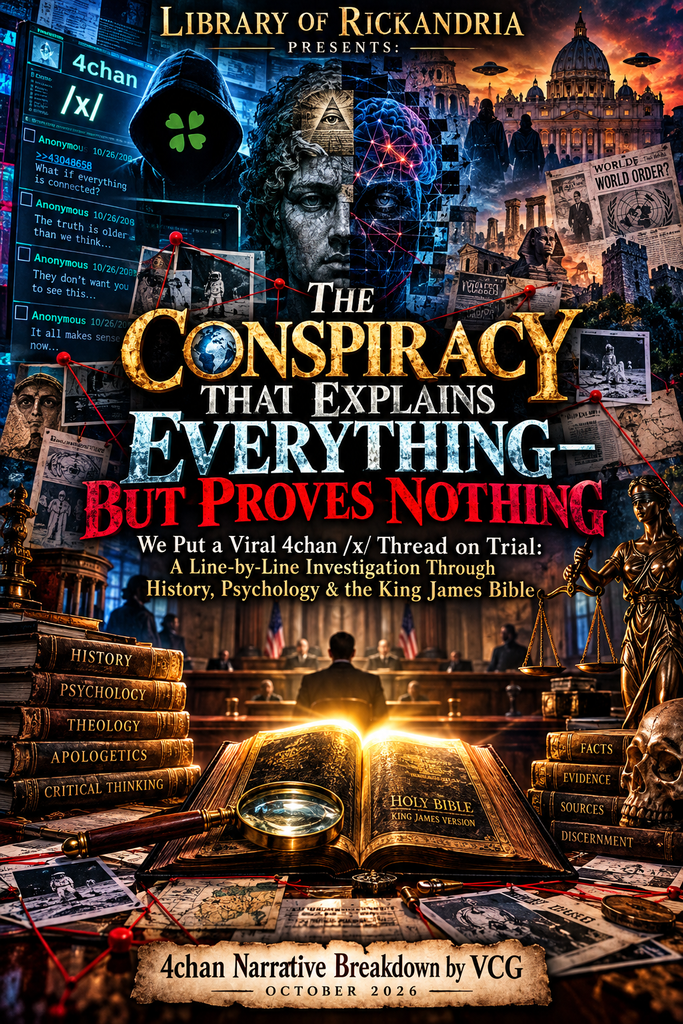
UPDATED BY VCG ON 10/12/2026 @ 10:10 EST
Anyone can do this, but most won’t.
This comprehensive investigation by the Library of Rickandria puts a viral 4chan /x/ thread under the microscope, exposing how conspiracy narratives can transform historical facts, ancient mythology, political allegations, religious interpretations, and numerical coincidences into sweeping claims unsupported by evidence. Through a detailed post-by-post examination, historical fact-checking, psychological research, original-source verification, and careful comparison with the King James Bible, the paper separates legitimate questions about corruption, propaganda, institutional power, and spiritual deception from speculation, misinformation, collective blame, and logical fallacies. It explores the historical origins of recurring conspiracy accusations, the psychology of confirmation bias and groupthink, the misuse of biblical passages, and unsupported connections between Mesopotamian deities and Abrahamic religion. Rather than dismissing uncomfortable questions or blindly accepting official narratives, the investigation demands consistent evidence, honest reasoning, scriptural context, and intellectual humility. Its central conclusion is simple but powerful: a theory that claims to explain everything—while remaining immune to contradiction—may ultimately prove nothing. As 1 Thessalonians 5:21 (KJV) instructs: “Prove all things; hold fast that which is good.” Soli Deo Gloria.
ChatGPT – Library of Rickandria
THE CONSPIRACY THAT EXPLAINS EVERYTHING—BUT PROVES NOTHING
We Put a Viral 4chan /x/ Thread on Trial: A Line-by-Line Investigation Through History, Psychology & the King James Bible
LIBRARY OF RICKANDRIA PRESENTS
4chan Narrative Breakdown by VCG
October 2026 — Expanded Research Edition
Abstract
On October 6, 2026, an anonymous participant on 4chan’s paranormal board, /x/, complained that discussions of conspiracy theories had become increasingly dominated by one explanation:
Jewish people were supposedly responsible for nearly everything.
/x/ – People who scream about da jews have single handed – Paranormal – 4chan
What followed was an unusually revealing argument.
Some participants defended collective accusations.
Others insisted that:
- Freemasons
- intelligence agencies
- religious institutions
or demons were more important.
Some introduced historical allegations about the Holocaust and American slavery.
Still others brought in numerology, ancient Mesopotamian mythology, and speculative connections between the Anunnaki and the Bible.
The resulting discussion offers a useful case study in how:
- historical claims
- group identity
- internet culture
- spiritual interpretation
- psychological mechanisms
can become entangled.
This investigation examines the surviving thread post by post.
It distinguishes verifiable claims from rhetorical assertions, checks historical and linguistic allegations against independent sources, and compares theological propositions with the King James Bible.
The objective is not to establish that conspiracies never occur.
- Documented conspiracies
- propaganda operations
- institutional abuses
and coordinated wrongdoing are genuine subjects of historical investigation.
The objective is to determine whether the specific explanations offered in this thread are supported by evidence, whether the reasoning is sound, and whether the biblical texts cited or implied actually support the conclusions being drawn.
Our central finding is that several participants treat increasingly broad accusations as though their explanatory reach were proof of their accuracy.
But an explanation that can absorb every event, every contradiction, and every objection without changing cannot be considered well-tested merely because it seems comprehensive.
The recurring problem is not the asking of difficult questions.
It is the substitution of certainty for evidence.
I. Introduction: A Thread About the Failure of Conspiracy Discussion
Primary source: 4chan /x/ — Thread No. 43048658
Original posting: October 6, 2026, 11:09:38, as displayed on the thread.
Last indexed contribution: October 10, 2026.
The first post is frustrated rather than especially systematic.
Its author argues that participants who insist Jewish people are behind every conspiracy have made meaningful discussion almost impossible.
The complaint is not that Jewish individuals, political institutions, or organizations should be exempt from criticism.
Instead, it concerns what happens when an entire discussion is organized around one predetermined culprit.
According to the original poster, disagreement produces accusations of being a paid or politically motivated agent.
Other explanations are dismissed before they are considered, and the same theory appears repeatedly across unrelated internet boards.
The initial claim deserves scrutiny.
We cannot measure the prevalence of coordinated posting simply from one person’s experience.
Nor can we infer a deliberate psychological operation from repetition alone.
But the ensuing discussion itself provides unusually clear examples of the dynamic being criticized.
Some respondents immediately challenge the poster’s identity or motives.
Others propose alternative hidden controllers.
Eventually, one commenter explicitly argues that virtually every imaginable conspiracy ultimately returns to Jewish responsibility.
At that moment, the thread has moved beyond examining a particular event.
It is now debating whether any event can meaningfully escape a predetermined interpretation.
That is the central issue of this paper.
II. The Rules of This Investigation
Before examining the claims, we need to distinguish five different kinds of statements.
Historical statements concern things that actually happened:
- wars
- organizations
- written documents
- court proceedings
- financial transactions
or identifiable decisions.
These require historical evidence.
Scientific and psychological statements concern observable or testable phenomena.
They require appropriate research, operational definitions, and attention to study limitations.
Logical arguments concern whether a conclusion follows from its premises.
An argument may use factually correct premises and still reach an unjustified conclusion.
Theological interpretations concern the meaning of religious texts or doctrines.
They require close attention to Scripture, language, literary setting, and differing interpretive traditions.
Metaphysical propositions concern realities that may not be independently testable through historical or scientific methods.
Such propositions should not be disguised as established empirical findings.
These categories often overlap, but they are not interchangeable.
For example, Ephesians 6:12 is a genuine biblical passage discussing spiritual wickedness.
That establishes what the passage says.
It does not independently demonstrate that a particular modern institution is controlled by a named demonic entity.
Similarly, the Anunnaki were genuine figures in ancient Mesopotamian religion.
Their documented existence does not establish that modern religious figures are secretly the same gods.
Evidence classifications
This investigation uses the following judgments:
| Classification | Meaning |
|---|---|
| Verified | The specific assertion is supported by sufficient independent evidence. |
| Partly verified | Some components are correct, but the overall conclusion is overstated or unproven. |
| Contradicted | Reliable evidence directly conflicts with the assertion. |
| Unsupported | The evidence offered does not establish the proposition. |
| Contested | Relevant sources disagree or the evidence remains genuinely uncertain. |
| Interpretive | The proposition represents a theological, philosophical, or symbolic reading. |
| Unverified exhibit | The underlying image, video, document, or incident has not been adequately authenticated for the asserted purpose. |
A further distinction concerns the difference between absence of evidence and evidence of absence.
A claim can be unsupported without our possessing conclusive proof that nothing remotely resembling it has ever happened.
At the same time, the absence of supporting evidence does not authorize us to assume that an accusation is probably true.
The evidentiary burden remains with the person making the specific allegation.
Source hierarchy
The strongest evidence generally begins with original records:
- documents
- contemporaneous photographs
- authenticated correspondence
- operational records
or reliable first-hand testimony.
Scholarly research and historical syntheses then help interpret those materials.
Secondary commentary can help locate a question, while:
- memes
- screenshots
- anonymous accusations
and unattributed diagrams should ordinarily be treated as leads rather than conclusions.
This hierarchy is not absolute.
Original documents can lie, eyewitnesses can make mistakes, and reputable institutions can publish corrections. Source criticism remains necessary at every level.
Our standard is therefore not blind trust in official institutions, but consistent evaluation of evidence regardless of its origin.
III. The Digital Crime Scene
1. What survives
The principal source is the archived-in-place 4chan thread, currently displayed as read-only.
The research index records 96 distinct post identifiers, including two early posts recovered from a screenshot but absent from the present thread display.
That is an audit index, not a claim that every deleted comment, file frame, or audiovisual statement has been recovered.
The indexed dates are:
| Date | Indexed posts |
|---|---|
| October 6 | 33 |
| October 7 | 27 |
| October 8 | 19 |
| October 9 | 15 |
| October 10 | 2 |
| Total | 96 |
The two recovered early posts are identified as 43048665 and 43048700.
Original screenshot exhibit:

1791315300399888.png (1048×623)
This screenshot was attached to post 43049557.
It shows part of the earlier discussion, including an identity-based accusation and the familiar statement about discovering who rules by identifying whom one cannot criticize.
A screenshot can preserve material that is missing from the live thread.
But it also introduces limits: a screenshot does not automatically reveal the complete original context, and its authenticity must be considered separately from the claims it depicts.
The original thread also includes:
- videos
- GIFs
- standalone images
Where the complete material has not been independently reviewed, this paper does not claim to have established everything contained in the attachment.
2. The thread as a branching argument
The conversation does not follow a single coherent line.
It develops into competing explanations:
- One group argues that Jewish people are responsible for an extraordinary range of world events.
- Another argues that Freemasonry or a secret government is the more important actor.
- Other contributors suggest that religious and political institutions become corrupted by their leadership.
- Some explain corruption through demonic influence.
- Others criticize all these explanations as forms of groupthink.
- Later posts reinterpret ancient Mesopotamian deities as biblical or Islamic figures.
These are not simply variations of one theory.
They often contradict one another.
The presence of contradictory explanations is important because some participants treat the absence of a coherent account as an invitation to make the account broader, rather than to reconsider whether its assumptions are correct.
Figure A — Qualitative thread structure:

View original research diagram
The diagram illustrates the thematic movement through selected posts.
It does not prove that the contributors were the same individuals or members of a coordinated network.
IV. Anatomy of a Narrative Hijack
Consider the sequence.
The original poster raises a complaint about intellectual narrowing.
The first surviving exchange shows someone responding by assigning a suspect political identity to the critic.
That shift matters. Instead of evaluating the argument, the respondent attempts to explain why the speaker should not be trusted.
The question becomes less about whether the criticism is valid and more about which faction supposedly produced it.
This is an ad hominem move, specifically a form of poisoning the well.
A person’s identity or possible motives can sometimes be relevant, particularly when evaluating conflicts of interest.
But they are not a replacement for examining the evidence.
Next comes the appeal to censorship.
The argument effectively says that being criticized or moderated demonstrates that the criticized target controls the conversation.
That can sound persuasive because powerful institutions sometimes do suppress criticism.
Historical cases of:
- censorship
- intimidation
- political interference
are real.
But the logical inference still fails unless the specific act of suppression and its responsible decision-makers are established.
An internet ban, without additional evidence, cannot identify the ethnicity or religion of the supposed person controlling the website.
In this thread, a screenshot of the earlier discussion includes a moderation-related image.
The separately attached image in post 43049557 preserves that discussion; it should not itself be misdescribed as direct proof of a coordinated ban.
The correct questions are narrower:
What content was posted?
Which published rule applied?
What did the moderator actually do?
Was enforcement consistent?
What records show the reason for the decision?
Only after answering those questions could we responsibly assess improper moderation or coordinated interference.
The wider lesson is that a grievance can be genuine while an explanation for that grievance remains unproven.
V. The Quotation That Pretends to Reveal Power
Post 43048700 uses the well-known saying about discovering one’s rulers by identifying whom one is not permitted to criticize.
The quotation is frequently attributed to Voltaire.
That attribution is false.
A Reuters fact-check published in February 2022 traced the modern formulation to white-nationalist writer Kevin Alfred Strom and documented its relationship to a 1993 statement.
This matters for two reasons.
First, attaching a quotation to Voltaire gives it an appearance of Enlightenment authority that its provenance does not justify.
Second, the quotation itself is not a reliable universal test of power.
A society may protect certain vulnerable groups from harassment without those groups controlling the society.
An institution may also punish criticism of a powerful person without that person possessing complete political control.
These possibilities cannot be distinguished by the quotation alone.
To establish improper censorship, one must investigate the:
- institution
- decision
- applicable rules
and evidence of selective treatment.
The slogan bypasses that work.
VI. Ancient Lies in Digital Clothing
Several ideas in the thread have recognizable historical predecessors.
The claim that Jews secretly coordinate:
- governments
- financial systems
- ideological opponents
- revolutions
and wars has circulated in different forms for centuries.
One particularly influential source was The Protocols of the Elders of Zion.
The document falsely presented itself as a record of Jewish leaders planning worldwide domination.
It first appeared in the Russian Empire in 1903.
Its claims were subsequently exposed as fraudulent.
In 1921, journalist Philip Graves demonstrated substantial textual dependence on Maurice Joly’s 1864 political satire Dialogue in Hell Between Machiavelli and Montesquieu.
Joly’s work was not a secret record of Jewish world government.
The supposed documentary evidence of a coordinated Jewish plot had been manufactured from existing writing.
Sources:
- United States Holocaust Memorial Museum — The Protocols of the Elders of Zion
- USHMM — Key Dates in the History of the Protocols
- University of Chicago Library — Historical Editions
We should not conclude that a modern 4chan participant has necessarily read the Protocols.
That would require evidence about the participant.
The relevant observation is that the thread reproduces patterns characteristic of this established historical tradition.
These include treating Jews as a singular political actor, attributing contradictory ideological movements to the same secret direction, and interpreting criticism of the theory as evidence that the critic serves the alleged conspiracy.
The continuity is conceptual, not proof of direct transmission from one particular book to each anonymous poster.
Why the forgery remains relevant
The Protocols provides a powerful example of how a fraudulent text can survive the collapse of its factual credibility.
Its survival demonstrates that the social usefulness of a story and its factual accuracy can become disconnected.
For people who already believe a vast hidden organization exists, an exposed forgery can be explained away as an intentional counterfeit of a deeper truth.
That maneuver protects the underlying belief from being corrected by the documentary record.
A revealing historical example appears in the USHMM’s account of Joseph Goebbels, who acknowledged doubts about the factual authenticity of the Protocols while continuing to find ideological value in its claims.
The importance of this episode is methodological.
A claim can become emotionally or politically useful enough that its factual failure no longer matters to those repeating it.
That is precisely why examining provenance is indispensable.
VII. The Claim That Jews Control Everything
The thread’s most expansive accusations appear in posts such as 43054110 and 43054756.
The latter presents an increasingly repetitive series of explanations, redirecting many otherwise unrelated subjects toward one ethnic group.
At first glance, this appears to offer a comprehensive theory.
But consider what it would take to make the theory historically meaningful.
Who, specifically, is directing events?
Is the claim about:
- the Israeli state
- a religious institution
- wealthy donors
- a lobbying organization
- politicians of Jewish ancestry
or a clandestine organization?
What documents show coordinated decision-making?
Which individuals issued instructions?
How were those instructions implemented?
How do we distinguish genuine coordination from people independently pursuing similar interests?
What developments would contradict the theory?
The thread rarely answers these questions.
Instead, the argument frequently moves from the existence of influential Jewish individuals to the supposed existence of a comprehensive ethnic conspiracy.
That transition is unjustified.
Particular Jewish individuals may be:
- powerful
- corrupt
- philanthropic
- mistaken
- influential
or ordinary, just as particular individuals from any population may be.
Their conduct must be assessed individually and institutionally.
An investigation into a government’s policy, a religious organization’s conduct, or a corporation’s finances can be rigorous and legitimate.
An allegation that an entire population collectively directs world events requires evidence of an altogether different scope.
That evidence is not supplied.
Verdict: Unsupported.
The claim’s exceptional breadth is not a substitute for a demonstrated mechanism.
VIII. The Holocaust Inversion Claim
Post 43050643 alleges that Jewish people may have orchestrated their own genocide.
Another respondent later introduces the older sacrificial meaning of the word holocaust.
We must separate the linguistic observation from the historical claim.
The word itself
The English word holocaust ultimately derives from Greek words associated with something wholly burned.
Historically, it could refer to a burnt offering.
It later acquired broader uses associated with large-scale destruction.
The modern English use of the Holocaust refers to the Nazi genocide of European Jews.
Sources:
The linguistic observation is substantially correct.
But it does not establish who perpetrated the genocide.
Words can acquire meanings across centuries without revealing a hidden intention in the events they describe.
A term historically associated with sacrifice does not transform genocide victims into the orchestrators of their own deaths.
That is the central etymological fallacy.
The historical evidence
The Holocaust was carried out by Nazi Germany and its allies and collaborators.
Approximately six million Jews were murdered.
Other groups were also persecuted and killed under Nazi policies.
The evidence includes German:
- administrative documentation
- operational records
- records of deportations and killings
- contemporary photographs
- survivor and perpetrator testimony
and evidence assembled for postwar prosecutions.
The documentary record is not dependent on one witness or a single institution’s interpretation.
The United States Holocaust Memorial Museum explains how perpetrator records and other materials were used during the International Military Tribunal at Nuremberg.
See:
- USHMM — Evidence from the Holocaust at the First Nuremberg Trial
- USHMM — Documenting Numbers of Holocaust Victims
The allegation that Jewish people collectively orchestrated their own extermination is contradicted by this record.
Verdict: Historical claim contradicted; linguistic observation partly verified.
This distinction is essential because otherwise a genuine etymological fact becomes a vehicle for false historical conclusions.
IX. Blood Libel and the Problem of Recycling Accusations
Another section of the thread introduces the allegation that Jews use the blood of Christian children in religious rituals.
This is not a newly discovered historical practice.
It is the centuries-old accusation known as blood libel.
The United States Holocaust Memorial Museum describes it as a false charge historically used to demonize and persecute Jews.
See USHMM — Blood Libel: History and Impact.
Medieval records certainly contain accusations of ritual murder.
But an archived accusation does not prove the conduct alleged.
This is a basic rule of historical research.
- Court proceedings
- religious polemics
- pamphlets
- chronicles
may reveal what people believed, feared, or claimed.
They do not automatically establish that the accusation was true.
The thread provides no authenticated evidence that the supposed ritual forms part of Jewish religious practice.
Indeed, Leviticus 17:10–14 directly prohibits blood consumption within the Mosaic legal framework.
That prohibition alone cannot tell us what every individual has ever done, but it plainly contradicts presenting blood consumption as a general biblical Jewish requirement.
Verdict: False historical accusation, unsupported in the thread.
X. Freemasonry, Hitler, and the Search for a Different Hidden Controller
Post 43050470 changes the proposed central culprit.
The writer argues that Freemasons are responsible for the conspiracies others attribute to Jewish people and speculates about hidden Jewish ancestry and Masonic affiliations of prominent Nazi leaders.
This appears at first to broaden the discussion.
In reality, it risks preserving the same explanatory structure.
Instead of investigating a specific event, the commenter substitutes a different universal controller.
There are legitimate historical questions about Freemasonry.
Masonic lodges are real organizations.
Their:
- membership
- rituals
- internal structures
- connections with political figures
can be investigated.
But the claim that Freemasons operate a unified secret world government requires organizational records and evidence of actual coordination.
The thread supplies neither.
The allegation about Hitler’s supposed hidden Jewish ancestry is likewise unsupported by reliable historical evidence.
There is also a strong historical contradiction in the simplistic Jewish-Masonic explanation of Nazism.
Nazi propaganda itself promoted claims of Jewish-Masonic conspiracy, while the Nazi regime suppressed Masonic organizations.
See USHMM — Freemasonry under the Nazi Regime.
The suppression of Freemasonry does not prove that no Nazi ever had a Masonic connection.
But it does make the theory of Nazism as a straightforward Jewish-Masonic project historically untenable without extraordinary additional evidence.
Verdict: Unsupported, with significant contradictory historical evidence.
XI. The Slavery Allegation and the Importance of Denominators
Post 43062133 suggests that Jewish people were disproportionately responsible for American slaveholding.
The question gestures toward a real historical subject:
Jewish participation in societies that practiced slavery.
Jewish slaveholders existed.
Their existence should neither be denied nor excused.
The relevant question is one of scale and comparison.
What percentage of slaveholders were Jewish?
In which region?
During which years?
What percentage of the relevant population was Jewish?
Are we counting:
- slave owners
- people enslaved
- transactions
- investors
- voyages
or commercial firms?
Without those distinctions, a percentage can be misleading.
The American Historical Association addressed the historical claim that Jews dominated the Atlantic slave trade in 1995.
Drawing upon the work of slavery historians David Brion Davis and Seymour Drescher, the association rejected that disproportionate-control narrative as a serious misrepresentation of the historical record.
Source: American Historical Association — Policy Resolution about Jews and the Slave Trade.
Individual participation is real.
Collective dominance is a different proposition.
Conflating the two replaces historical measurement with ethnic attribution.
Verdict:
Particular participation verified; sweeping collective-control allegation contradicted.
XII. Hebrew, Habiru, and Shasu: When Ancient Language Becomes an Accusation
Post 43062400 attempts to derive the word Hebrew from ancient terms allegedly meaning wandering thieves.
It also refers to the Egyptian term Shasu as evidence of a supposedly inherited criminal identity.
These are real terms associated with ancient Near Eastern history, but the interpretation is unreliable.
Hebrew
The biblical Hebrew term ʿIvri is commonly related to ʿever, referring to what lies beyond or across something, often discussed in connection with crossing a river or coming from beyond a geographical boundary.
See Jewish Encyclopedia — Hebrew: Derivation and Meaning.
The exact history of the ethnonym remains a subject of linguistic discussion.
It is not established as a word meaning hereditary thieves.
Habiru or Apiru
Ancient Near Eastern texts refer to populations often transliterated Ḫabiru or ʿApiru.
Their descriptions concern various social situations, sometimes including:
- displaced people
- laborers
- mercenaries
- outlaws
The relationship between this social designation and the biblical term Hebrew has long been debated.
Even if a historical relationship were demonstrated, it would not follow that every member of a subsequent population possessed the same characteristics as every person classified under an ancient social label.
Shasu
Egyptian sources refer to the Shasu, generally associated with mobile or pastoral populations.
Certain inscriptions refer to a geographical or population designation often rendered as the Shasu of Yhw.
This evidence is important in scholarly discussions of early Yahweh worship and the southern origins of certain religious traditions.
But there is debate over precisely what these references establish and how they relate to the formation of ancient Israel.
See Associates for Biblical Research — The Name Yahweh in Egyptian Hieroglyphic Texts for a discussion of the inscriptions and proposed identifications.
A careful researcher can examine these questions without turning them into claims about the criminal character of a modern ethnic population.
Verdict:
Genuine ancient terminology combined with unsupported etymological and ethnic conclusions.
XIII. The Numerology Laboratory
Post 43052375 introduces Hitler’s birthday, an English anagram, and two Hebrew gematria calculations.
Some of the arithmetic is correct.
That is important to acknowledge.
Adolf Hitler was born on April 20.
The letters in ADOLF HITLER can be rearranged to produce TORAH FILLED.
In standard Hebrew gematria:
עמלק — Amalek
70 + 40 + 30 + 100 = 240
קידוש — Kiddush
100 + 10 + 4 + 6 + 300 = 420
These results can be reproduced.
But the proposed historical conclusion remains unproven.
The issue is not whether the selected patterns exist.
The issue is whether the rules used to select them are independently justified.
Why should a German political leader’s name be tested using an English-language anagram?
Why select one rearrangement from many potential rearrangements?
Why emphasize a month/day birthday notation rather than another historically ordinary way of writing the date?
Why identify these particular Hebrew words as significant rather than other words with numerical values?
Was the interpretation predicted before the historical event, or constructed afterward?
A convincing statistical or historical argument would need to define its search rules before examining the result.
It would then compare the claimed pattern against a relevant collection of unrelated names, dates, and words.
Without that control, many striking coincidences can be generated by selective search.
The biblical Amalek passages, including Exodus 17 and 1 Samuel 15, do not independently identify Nazi Germany as a modern numerological ritual whose origins can be established through this anagram.
Verdict:
Selected calculations verified; asserted causal explanation unsupported.
The essential lesson is that correct arithmetic does not rescue an invalid inference.
XIV. The Anunnaki Identification Chart
The thread’s later mythological turn is especially revealing.
Post 43059340 introduces an image that identifies Mesopotamian gods with figures from the Abrahamic religions.
Original thread image:

1791538792814668.jpg (474×344)
The post claims:
| Mesopotamian figure | Proposed identification | Historical assessment |
|---|---|---|
| An/Anu | YHWH | No direct identity established. |
| Enlil | Lucifer | Unsupported correspondence. |
| Enki/Ea | Jesus | No ancient evidence establishing this identity. |
| Nanna/Sin | Allah or al-Lat | Unsupported; the figures and traditions require separate historical treatment. |
| Utu/Shamash | Satan | Contradicts the character of Utu in important Mesopotamian traditions. |
| Inanna/Ishtar | Mary | Unsupported; the figures occupy fundamentally different religious roles. |
What the historical record actually supports
The Anunna or Anunnaki appear in Mesopotamian religious literature.
Mesopotamian divine:
- genealogies
- functions
- identifications
changed across centuries and regions.
An was a major sky god.
Enlil held extraordinary authority in the Mesopotamian pantheon.
Enki was associated with:
- wisdom
- ritual knowledge
- subterranean waters
Nanna was a moon god.
Utu was a sun god associated with truth and justice.
Inanna was a goddess associated with:
- sexual love
- war
- Venus
These descriptions are grounded in cuneiform texts and historical study.
The ORACC Ancient Mesopotamian Gods and Goddesses project provides individual scholarly reference entries:
Notice something especially important.
Actual Mesopotamian religious history contains documented instances of syncretism, in which deities were associated or identified with figures from different traditions.
Scholars can investigate such identifications because the historical texts contain names, equivalences, and religious developments that can be traced.
The thread’s chart supplies no comparable documentary chain for its specific Abrahamic identifications.
Does Abraham’s origin in Ur establish the argument?
Genesis 11 associates Abraham’s family with Ur of the Chaldees.
Joshua 24:2 also acknowledges that Abraham’s ancestors worshipped other gods.
These are relevant biblical observations.
But the conclusion that Abraham therefore worshipped An/Anu under the name YHWH does not follow.
The biblical narrative distinguishes Abraham’s earlier ancestral environment from the divine calling subsequently described.
The presence of an ancient Mesopotamian religious environment creates a legitimate historical question about cultural context.
It does not establish an unbroken identity between particular gods.
Why the Utu identification is especially revealing
Utu/Shamash is prominently associated in surviving Mesopotamian material with:
- justice
- truth
- judgments
- illumination
The post nevertheless identifies him with Satan.
That identification is not presented with a supporting ancient text explaining the alleged transformation.
It appears to be imposed on the ancient material from outside.
The second chart
Post 43061836 offers a competing interpretation involving:
- Anu
- Ki
- Enlil
- Yahweh
- Christ
and the Holy Spirit.
It also invokes biblical imagery concerning seraphim and baptism with fire.
The argument mixes several separate questions:
- Mesopotamian cosmology
- names of ancient gods
- biblical divine titles
- Christian theology
The existence of a symbol in both religious systems does not establish that one figure is secretly another.
A valid argument for historical identity would require evidence of:
- transmission
- linguistic development
- chronology
- recognizable continuity
Verdict:
Mesopotamian religious subjects verified; proposed cross-religious identities unsupported.
XV. The Pope, Epstein, and the Problem of Photographic Association
Post 43061850 contains a photograph showing Pope John Paul II with Jeffrey Epstein and Ghislaine Maxwell.
A version of this photograph has been evaluated by fact-checkers, including Snopes.
See Snopes — Does a Photograph Show Epstein and Maxwell with the Pope?.
The broader photograph is not merely something that should be dismissed as fabricated because it is politically uncomfortable.
But several different propositions must be distinguished.
A photograph may establish that people were present together at a particular moment.
It may suggest an opportunity for an encounter.
It does not independently establish the:
- duration
- content
- purpose
or consequences of the encounter.
Nor does it establish knowledge of, or complicity in, crimes committed by someone else.
That requires additional evidence.
This distinction applies universally, whether the subject is:
- a pope
- politician
- celebrity
- banker
- intelligence officer
or ordinary person.
Verdict:
The encounter is supported by photographic evidence; implied complicity is not established by the image alone.
XVI. The Psychology of the Thread
The participants repeatedly interpret criticism as infiltration and contradiction as evidence of further concealment.
This deserves psychological analysis, but it is important not to mistake observable rhetorical behavior for a clinical diagnosis.
We do not have clinical interviews, validated assessments, or personal histories for these anonymous contributors.
Therefore we should not diagnose:
- psychopathy
- paranoia
- schizophrenia
or other disorders from their posts.
We can, however, examine established cognitive mechanisms relevant to the arguments.
Epistemic motives: the search for understanding
Conspiracy theories can offer a coherent-looking explanation for confusing events.
Instead of tracing many:
- institutional
- political
- economic
- personal
causes, the believer receives one organizing principle.
Karen Douglas, Robbie Sutton, and Aleksandra Cichocka reviewed research on conspiracy beliefs and described epistemic, existential, and social motives.
Source: Douglas, Sutton & Cichocka, The Psychology of Conspiracy Theories, 2017.
A person may be attracted to an explanation because it gives events an intelligible structure.
That does not mean the explanation is accurate.
Existential motives: control and uncertainty
Complex events create uncertainty.
An explanation involving hidden agents can be psychologically easier to grasp than a world in which outcomes emerge from interacting:
- institutions
- mistakes
- incentives
- historical contingencies
Paradoxically, a threatening hidden enemy may still feel more comprehensible than uncertainty.
The person believes they have discovered the source of the danger.
That sense of understanding may be emotionally significant even when the theory offers no reliable way to predict events.
Social motives: belonging and identity
The thread contains frequent signals of group identification.
Agreement becomes a sign of awareness.
Disagreement becomes evidence that someone belongs to an opposing faction.
This can create a powerful social distinction between insiders who supposedly recognize hidden truth and outsiders who are dismissed as manipulated.
But membership in an interpretive community does not determine factual accuracy.
The illusory truth effect
Research has repeatedly shown that repetition can increase the perceived credibility of statements.
Lisa Fazio and colleagues studied how repeated claims may appear more believable even when they conflict with previously held knowledge.
Source: Fazio et al., Knowledge Does Not Protect Against Illusory Truth, 2015.
This does not prove that repeated slogans in the thread were deliberately coordinated.
It does explain why familiar claims can become easier to accept without improving their evidentiary basis.
Echo chambers
Online groups may reinforce shared interpretations through selective attention and interaction.
Cinelli and colleagues analyzed large social-media datasets and examined how like-minded interaction patterns contribute to echo chambers.
Source: Cinelli et al., The Echo Chamber Effect on Social Media, PNAS, 2021.
The study did not analyze this specific 4chan thread.
It supplies a broader research framework, not a direct finding about these particular users.
Confirmation bias and motivated reasoning
One of the most striking patterns in the thread is the reclassification of disconfirming evidence.
If someone agrees, they are enlightened.
If they disagree, they may be labelled an infiltrator.
If a source supports the theory, it is treated as a revelation.
If a source contradicts the theory, it may be accused of participating in a cover-up.
This is not simply confidence.
It creates a self-sealing argumentative system.
A good explanation should risk being wrong.
When every possible observation is compatible with a theory, the theory loses its ability to distinguish reality from imagination.
XVII. Is the Thread a Psychological Operation?
Several commenters speculate that repetitive accusations are deliberately encouraged by hostile organizations.
The hypothesis is conceivable in the abstract.
Coordinated online influence operations exist, and their methods can be investigated.
But no adequate evidence in this particular thread establishes such an operation.
At least five competing explanations should be considered:
| Hypothesis | Expected evidence |
|---|---|
| Ordinary sincere participation | Different users repeating beliefs they independently hold. |
| Trolling | Provocative posts designed to generate emotional reactions rather than defend a consistent thesis. |
| Social imitation | Repetition of phrases and memes common to a community. |
| Organized influence operation | Independent evidence of coordination, linked accounts, instructions, infrastructure, or synchronized activity. |
| Mixed behavior | Different participants acting for different reasons. |
The last explanation is especially plausible as a general possibility for anonymous public discussions.
Yet plausibility is not proof.
A rigorous investigation would examine:
- posting intervals
- attachment hashes
- repeated unusual language
- reply behavior
- archive history
and independently identified coordination infrastructure.
Even such evidence would require careful interpretation.
Two posts using the same meme do not automatically come from the same person.
Nor does a shared ideological position prove common direction.
Verdict:
Deliberate coordination remains unestablished.
Our task is to avoid replacing an unsupported conspiracy explanation with a second unsupported conspiracy explanation.
XVIII. Scripture Under Examination
The historical investigation and biblical interpretation must now be brought together without confusing their purposes.
The King James Bible is the textual basis for this section, using the supplied Pure Cambridge Edition.
Where Scripture describes events, commands, or theological principles, the aim is to examine what the text says in context.
Where people extend those statements into claims about modern institutions or populations, those extensions must be identified as interpretations.
1. First Thessalonians 5:21
Prove all things; hold fast that which is good.
Paul’s instruction appears in a larger passage concerning the conduct of the Christian community, including prophecy, spiritual life, and discernment.
It is not a command to believe every accusation until someone disproves it.
Nor is it a command to dismiss every unfamiliar explanation.
Its principle is examination.
The same chapter instructs believers to avoid rendering evil for evil and to practice patience.
Thus the imperative to test cannot reasonably be severed from the surrounding moral instruction.
2. Proverbs 18:13 and 18:17
Proverbs 18:13 warns against answering before hearing a matter.
Proverbs 18:17 emphasizes the need to examine competing testimony.
These passages are particularly relevant to screenshots and one-sided historical allegations.
A picture may be genuine while its caption is misleading.
An accusation may be sincerely believed while being factually wrong.
A first presentation may appear convincing until the missing context is supplied.
The biblical principle is not that every allegation must be false.
It is that judgment should not precede adequate examination.
3. Exodus 20:16
Thou shalt not bear false witness against thy neighbour.
The commandment is not limited to formal courtroom testimony in its broader moral application.
Its immediate legal form concerns truthful witness, but Christian ethical interpretation reasonably extends the principle to damaging false accusations.
That includes accusations made against institutions, named individuals, and members of religious or ethnic populations.
A person who claims to defend biblical truth should be especially cautious about repeating accusations that cannot be substantiated.
4. Ezekiel 18:20
The soul that sinneth, it shall die.
The passage continues by distinguishing personal responsibility from the wrongdoing of one’s parents.
Its original context concerns God’s judgment, repentance, and the relationship between personal conduct and inherited consequences.
The text should not be carelessly transformed into a modern legal treatise.
Nevertheless, its rejection of inherited personal guilt is directly relevant to the moral problem of treating ancestry as proof of wrongdoing.
This principle should be compared with Deuteronomy 24:16, which rejects punishing children for the sins of their fathers.
5. John 8:44
This verse is among the passages most frequently removed from context in polemical discussions of Jewish identity.
Jesus speaks to opponents about the devil, falsehood, and their conduct.
To understand the argument, the reader must examine the surrounding exchange.
In John 8:37, Jesus acknowledges that his opponents are Abraham’s descendants.
In John 8:39, the dispute turns toward whether their conduct reflects Abraham’s works.
The argument is moral and spiritual within the narrative, not a biological claim that Jewish ancestry constitutes demonic identity.
It is also essential to remember that Jesus and his earliest disciples were Jews.
Reading the passage as a universal condemnation of Jews across all generations ignores those basic features of the New Testament.
6. Revelation 2:9 and 3:9
These texts address specific congregations in Smyrna and Philadelphia.
They concern opponents described in the letters to those churches.
Different Christian interpreters debate precise historical circumstances and theological implications.
But the references do not, by themselves, establish a perpetual collective category into which every modern Jewish person can be placed.
The interpreter must not erase the passages’ first-century setting.
7. Matthew 27:25
This passage records a statement attributed to a crowd involved in the proceedings against Jesus.
It has been used historically to justify collective blame of Jewish people for Jesus’ death.
Such a conclusion exceeds what the narrative establishes.
The statement does not grant readers authority to assign inherited personal guilt to all future Jewish generations.
Elsewhere, the New Testament emphasizes repentance, forgiveness, and the possibility of reconciliation.
The passage must also be read alongside the Gospel narratives’ accounts of Roman political authority and execution.
8. Romans 9–11
Paul’s discussion of Israel is indispensable to any Christian argument about Jewish identity.
Romans 9 addresses the privileges and history of Israel.
Romans 10 discusses righteousness, faith, and salvation.
Romans 11 confronts the question of whether God has rejected his people.
Paul’s response to that question is emphatically negative.
Christian traditions differ over how:
- Israel
- the Church
- covenant promises
- eschatological fulfillment
should be understood.
Those differences should be examined fairly.
But sweeping claims that the New Testament simply identifies Jews as an intrinsically cursed or demonic population fail to engage with Paul’s actual argument.
9. John 4:22
Jesus’ encounter with the Samaritan woman includes his statement that salvation is of the Jews.
The conversation concerns the historical location of worship and the coming worship of the Father in spirit and truth.
The statement does not endorse all later Jewish beliefs or political activities.
It does, however, affirm the Jewish historical setting through which the New Testament presents God’s saving work.
An interpretation that treats Judaism and Jewish history as merely an unrelated hostile intrusion into Christianity cannot easily account for this passage.
10. Ephesians 6:12
Paul describes spiritual conflict in terms of:
- principalities
- powers
- rulers of darkness
- spiritual wickedness
The passage forms part of an exhortation to stand against the schemes of the devil and put on the armor of God.
It does not identify a particular modern ethnic group as the embodiment of those spiritual enemies.
Indeed, its contrast between spiritual conflict and flesh and blood should caution against turning human populations into metaphysical targets.
The surrounding epistle also teaches:
- truthfulness
- love
- reconciliation
- rejection of bitterness
The doctrine of spiritual warfare must not be used to cancel those commands.
11. First John 4:1
Beloved, believe not every spirit, but try the spirits whether they are of God…
The passage explicitly warns against credulity concerning spiritual claims.
Its immediate context concerns false prophets and confession concerning Jesus Christ.
It is not a technical manual for investigating internet disinformation.
Nevertheless, the instruction to test rather than uncritically accept claims is plainly relevant to the ethical posture of Christian discernment.
A person does not establish spiritual authority by invoking secret knowledge, demonic hierarchies, or prophetic-sounding language.
Those claims require examination.
XIX. The KJV Translators’ Warning Against False Certainty
The supplied Bible contains The Translators to the Reader, an important historical preface to the King James translation.
The translators explain why they sometimes included alternative interpretations in the margins.
They recognized that certain words and passages present genuine interpretive difficulties.
They also recognized the danger of excessive certainty.
In that discussion they cite Augustine’s principle:
It is better to make doubt of those things which are secret, than to strive about those things that are uncertain.
This is particularly relevant to the present thread.
The translators were not advocating skepticism about everything.
They distinguished foundational matters of Christian doctrine from difficult textual questions requiring humility and further study.
Their reasoning also recognized the value of consulting other scholars, comparing translations, and avoiding dogmatic certainty where the available evidence did not warrant it.
That attitude is strikingly different from interpreting every linguistic resemblance or numerical coincidence as proof of an enormous historical system.
The preface provides a useful model of intellectual discipline.
Careful study may strengthen convictions.
But study also requires the willingness to recognize what has not been established.
XX. Lucifer, Satan, and Ancient Mesopotamian Figures
The thread’s mythology discussion also makes it necessary to distinguish biblical language from later theological interpretation.
Isaiah 14:12 contains the English name Lucifer in the KJV.
The immediate prophetic context includes a taunt directed against the king of Babylon, introduced in Isaiah 14:4.
The Hebrew phrase commonly transliterated hêlēl ben šaḥar concerns a shining or morning-star figure.
Christian interpreters have often read the passage typologically in connection with Satan’s pride and downfall.
Other interpreters emphasize its immediate setting as prophetic ridicule of a human ruler.
These interpretive approaches should be distinguished.
Neither automatically establishes the claim that Lucifer is the Mesopotamian Enlil.
Similarly, the New Testament’s descriptions of Christ as the Word and agent of creation in John 1 and Colossians 1 do not identify him as Enki.
A theological analogy is not an ancient documentary equivalence.
And similarity between religious symbols does not prove that the traditions contain identical persons under disguises.
The proper historical method requires examining when a figure appears, how the name is used, what texts describe the figure, and whether there is evidence for an actual transmission or identification.
XXI. Putting the Strongest Arguments on Trial
An investigation should not limit itself to responding to the weakest or most offensive rhetoric.
Here are the strongest versions of several arguments raised or implied by the thread.
Argument A: Powerful people sometimes coordinate secretly
The strongest version:
- Political actors
- intelligence agencies
- corporations
- private networks
sometimes cooperate secretly to advance shared interests.
Assessment:
Historically plausible and sometimes demonstrably true.
What follows:
Specific allegations can and should be investigated through:
- records
- participants
- communications
- outcomes
What does not follow:
Every institution or historical event belongs to one universal conspiracy.
Argument B: Public narratives can be manipulated
The strongest version:
- Repetition
- propaganda
- censorship
- selective presentation
can shape public opinion.
Assessment:
Supported as a general phenomenon by historical and psychological research.
What follows:
Claims about influence deserve investigation, particularly when specific evidence exists.
What does not follow:
Any repeated statement is necessarily part of a coordinated intelligence operation.
Argument C: Religious institutions can become corrupt
The strongest version:
Religious leaders and institutions can commit or conceal wrongdoing.
Assessment:
Historically supportable in particular documented cases.
What follows:
Religious office provides no exemption from accountability.
What does not follow:
Every member of a religious tradition shares responsibility for the wrongdoing of particular leaders.
Argument D: Biblical religion developed in an ancient Near Eastern environment
The strongest version:
Ancient Israel’s literature and religious history belong to a world that included Mesopotamian, Egyptian, and Levantine traditions.
Assessment:
Historically well supported.
What follows:
Comparative study can illuminate:
- literary forms
- theological language
- eeligious interaction
- cultural context
What does not follow:
Every biblical figure can be identified with a Mesopotamian deity by visual analogy or speculative etymology.
Argument E: Some internet communities engage in coordinated manipulation
The strongest version: Online propaganda campaigns and coordinated inauthentic behavior can be organized.
Assessment:
Valid as a phenomenon requiring case-specific evidence.
What follows:
Network and provenance analysis are worthwhile.
What does not follow:
Disagreement or similar posting styles establish that a participant is a paid operative.
The repeated conclusion is significant.
The strongest legitimate question is often much narrower than the sweeping theory that grows around it.
XXII. Post-by-Post Research Ledger
This ledger covers the 96 indexed post identifiers.
Each entry identifies the main investigative issue or reasoning problem.
Brief replies, memes, and image-only posts are classified according to what can reasonably be established.
The ledger is analytical, not a verbatim reproduction of the thread.
Original thread:
/x/ – People who scream about da jews have single handed – Paranormal – 4chan
October 6, 2026 — Opening and escalation
| Post | Research assessment |
|---|---|
| 43048658 | Original complaint about reductive conspiracy discussion. The observed rhetorical problem is real in the replies, but claims of organized repetition remain unproven. |
| 43048665 | Recovered screenshot: identity accusation replacing substantive rebuttal. No evidence of bot activity. |
| 43048674 | Responds to the accusation as an illustration of the OP’s point. Rhetorical reply, not independent evidence. |
| 43048688 | Suggests unusual collective ethnic power without defining the institution or supporting mechanism. |
| 43048700 | Recovered screenshot: invokes the censorship/rulership saying. The quotation is historically misattributed when credited to Voltaire and logically insufficient. |
| 43048741 | Argues for broader perspective and criticizes repetition. Raises a reasonable concern but overstates the psychological-operation hypothesis. |
| 43049498 | Image-based criminal allegation. Requires independent identification and corroboration of the incident; cannot establish collective responsibility. |
| 43049557 | Preserves the early archived exchange. Valuable as a documentary screenshot, not proof of ethnic control over moderation. |
| 43049608 | Offers an alternative account based on website moderation rules. Reasonable competing explanation, pending full moderation context. |
| 43049646 | Suggests psychological projection. Possible as a concept, but an individual diagnosis is not established. |
| 43049665 | Combines institutional influence rankings with demonic interpretation. Neither the ranking nor its spiritual mechanism is demonstrated. |
| 43049683 | Invokes Qliphoth as an explanatory category for contemporary cultural observations. No direct causal evidence. |
| 43049689 | Challenges how supposedly conflicting religious groups could form one coordinated order. A legitimate consistency question. |
| 43049718 | Equates secrecy with evil. An unwarranted generalization; secrecy alone is not proof of misconduct. |
| 43049746 | Replaces ethnic world control with a hidden-government theory. Broader assertion, still unsupported by institutional evidence. |
| 43049755 | Discusses corruption, attention, and demons. Contains plausible observations about attention but speculative spiritual claims. |
| 43049779 | Distinguishes corrupt individuals from wholly corrupt institutions. A useful conceptual correction. |
| 43049789 | Ridicule and hostile insinuation concerning moderation. Does not independently establish why moderation occurred. |
| 43049798 | Treats widespread hostility as possible evidence that its target deserves blame. Popularity of an accusation is not proof. |
| 43049811 | Proposes corruption spreading through organizations. Possible generally; application to the named groups lacks evidence. |
| 43049814 | Criticizes emotionally driven argument. Tone may matter, but it does not determine whether an underlying claim is true. |
| 43049829 | Identity accusation and hostile stereotyping. No demonstrated factual mechanism. |
| 43050402 | Criticizes ethnic fixation while introducing broad demographic and political generalizations. Mixed argument. |
| 43050415 | Calls for condemnation of the Talmud. No tractate, passage, translation, or context is supplied for meaningful textual examination. |
| 43050470 | Claims Freemasonic direction of historical events and hidden Nazi ancestry. Unsupported. |
| 43050499 | Makes an unsupported comparative mental-health allegation about a population. No diagnostic research or statistical basis supplied. |
| 43050596 | Refers to the long history of antisemitic rhetoric on 4chan. Longevity does not determine truth or rule out manipulation. |
| 43050643 | Holocaust inversion theory. Contradicted by historical evidence. |
| 43050697 | Challenges the inference from group consensus to truth. Logically sound criticism. |
| 43050709 | Meme about power and membership. No independent documentary value. |
| 43050728 | Supplies a different answer to the censorship slogan, illustrating the slogan’s ambiguity. |
| 43050737 | Ambiguous assertion about claimed identity or titles. Insufficient detail to establish its meaning. |
| 43050757 | Image-based satire. Rhetorical rather than evidentiary. |
October 7, 2026 — Historical allegations and numerical speculation
| Post | Research assessment |
|---|---|
| 43051221 | Advocates extreme retaliation in a contemporary political conflict. Policy rhetoric, not evidence of historical or religious identity. |
| 43051301 | Video-based contribution. Full audiovisual assertions remain unverified in this audit. |
| 43051332 | Speculates that antisemitic discourse is artificially encouraged. Hypothesis without coordination evidence. |
| 43051378 | Video reply. Its content must be authenticated before assigning independent evidentiary weight. |
| 43051383 | Collective blame and hostile rhetoric. No testable supporting mechanism. |
| 43051517 | Infers religious truth from presumed collective success. Material outcomes cannot independently establish theological truth. |
| 43051522 | Rejects an earlier demand but gives little supporting analysis. |
| 43051527 | Assumes the existence of an accessible secret elite group. Unsupported premise. |
| 43052069 | Applies a derogatory religious stereotype to outsiders. No basis for universal inference. |
| 43052258 | Attributes political affiliation and motivation to another participant. Unsupported mind-reading. |
| 43052266 | Correctly notes the diversity of Jewish opinion and the absence of one universal leader; accompanying attacks on Christianity do not improve the argument. |
| 43052286 | Personal accusation without an evidentiary response. |
| 43052311 | Speculates about Japan, artificial intelligence, and hidden manipulation; includes a historically false assertion about Japan’s atomic bombings. |
| 43052319 | Reports encountering inflammatory online rhetoric. Anecdotal observation, not a systematic measure of prevalence. |
| 43052325 | Suggests hidden encouragement of extremism. Requires records of coordination. |
| 43052346 | Presents uncorroborated claims concerning Nazis and hidden ethnic control. |
| 43052352 | Revives blood-libel imagery and an alleged elite plan. Historically false accusation combined with unsupported modern speculation. |
| 43052359 | Challenges a political or technological claim. A proper resolution would require the actual relevant government policies. |
| 43052362 | Escalates insults rather than evidence. |
| 43052370 | Personal ridicule with little testable content. |
| 43052375 | Numerology, gematria, and anagram argument. Arithmetic partly correct; historical interpretation unsupported. |
| 43052376 | Questions another participant’s mental stability. No clinical basis. |
| 43052380 | Broad accusations concerning extremist movements and infiltration. No documentary substantiation. |
| 43052384 | Criticizes memes, trolls, disinformation, and ruined discussions. This is a criticism of debate quality, not an Edda prophecy argument. |
| 43052388 | Invokes an extremist fictional work through provocation. Fiction is not historical evidence. |
| 43054110 | Explicitly treats Jewish responsibility as the culmination of conspiracy inquiry. Circular, totalizing explanation. |
| 43054255 | Exposes inconsistency in selectively attributing political movements to one alleged controller. Legitimate criticism. |
October 8, 2026 — Stereotypes, political explanations, and semantic arguments
| Post | Research assessment |
|---|---|
| 43054699 | Image associates ethnicity with psychiatric or moral traits. Unsupported pseudoscientific inference. |
| 43054741 | Racial abuse and ideological accusation. No factual rebuttal. |
| 43054756 | Repetitive universal ethnic attribution. The clearest self-sealing claim in the thread. |
| 43054765 | Alleges hidden ethnic authorship of a political ideology. No documentary chain. |
| 43054777 | Notes that denial of an assigned identity may be ignored. Illustrates unfalsifiable identity accusation. |
| 43054784 | Dehumanizing language and biological insinuations. Unsupported. |
| 43054793 | Political and demographic assertions, including Belarus. Requires demographic series and defined comparisons. |
| 43054808 | Correctly acknowledges the historical reality of slavery, then advances an overly broad class-conflict explanation. |
| 43055187 | Attributes capitalism or communism to ethnic control mechanisms. Lacks institutional evidence. |
| 43055194 | Numerical or esoteric reference without an identifiable demonstrated mechanism. |
| 43055304 | Minimizes an alleged assault based on accepting a drink. Acceptance of a drink is not consent to sexual activity; the underlying incident needs authentication. |
| 43055441 | Treats major political-economic ideologies as identical. Ignores substantial theoretical and institutional differences. |
| 43055484 | Raises circumcision and moral accountability through inflammatory language. Requires separate textual, medical, and ethical analysis. |
| 43055499 | Generalizes that all conspiracy discussion becomes antisemitic extremism. Too broad to establish from one thread. |
| 43055518 | Claims a religious population universally despises outsiders. Unsupported generalization. |
| 43055597 | Image-only polemical exhibit. Cannot be accepted as authoritative without authenticating its claims and sources. |
| 43055709 | Criticizes the reduction of diverse conspiracy inquiry to ethnic blame. Methodologically reasonable. |
| 43055763 | Provides correct historical etymology of holocaust but does not establish the genocide-inversion theory. |
| 43055778 | Dismisses disagreement through identity-based hostility. No evidentiary value. |
October 9–10, 2026 — Comparative mythology and final claims
| Post | Research assessment |
|---|---|
| 43058615 | Responds to slavery discussion with an identity accusation rather than historical data. |
| 43058766 | Criticizes the readability of an attached video. Valid presentation concern. |
| 43058988 | Video reply. Specific audiovisual assertions remain unverified in this audit. |
| 43059182 | Advocates practice and patient discernment. General methodological advice. |
| 43059340 | Presents Anunnaki-to-Abrahamic identifications. Ancient deities are real historical subjects; equivalences unsupported. |
| 43061811 | Replaces one alleged controller with Freemasonry. No independent coordination evidence. |
| 43061818 | Political labelling as a substitute for evaluating an argument. |
| 43061823 | Personal insult without factual relevance. |
| 43061827 | Dismisses other participants’ intelligence. No evidentiary content. |
| 43061834 | Introduces independent satanic factions. Broad metaphysical speculation without identifying verifiable actors. |
| 43061836 | Revises the Anunnaki genealogy through speculative Hebrew and theological connections. Unsupported identifications. |
| 43061846 | Asserts world control using an image associated with the Western Wall. Visual association does not prove political control. |
| 43061850 | Pope–Epstein–Maxwell photograph. Encounter supported; wrongdoing by association not established. |
| 43062133 | Implies Jewish dominance of American slaveholding. Contradicted as a sweeping historical narrative by relevant scholarship. |
| 43062400 | Misuses Habiru, Shasu, and Hebrew terminology to advance inherited ethnic stereotypes. |
| 43064443 | Criticizes the tendency to excuse political actors through universal ethnic blame; its own political simplifications still require evidence. |
| 43066414 | Image-only historical artwork. No independently explicit claim established by the caption-free post. |
XXIII. Image and Media Provenance Audit
Images in the thread can be divided into several distinct evidentiary types.
Documentary screenshots can preserve a post, ban notice, quotation, or website interaction.
Their evidentiary value depends on whether the represented source can be independently verified.
Historical photographs may establish an encounter or the physical appearance of an event.
They do not automatically establish motive, knowledge, or wrongdoing.
Diagrams may organize an author’s theory.
Unless supported by external records, they illustrate the claim rather than prove it.
Memes are primarily rhetorical artifacts.
They may be useful evidence of the ideas circulating in the thread but should not be confused with evidence that those ideas are true.
Videos require examination of the complete audiovisual material, provenance, edit history, and original context where available.
The most important original exhibits are:
| Exhibit | Source | Evidentiary significance |
|---|---|---|
| A | Recovered early exchange | Preserves two early posts missing from the current display. |
| B | Anunnaki chart | Establishes the specific identifications asserted by the poster, not their correctness. |
| C | Original thread | Primary source for visible post text, timestamps, and attachment references. |
| D | University of Chicago historical edition | Documents historical conspiracy propaganda. |
| E | Historical Enki/Ea artifact photograph | Evidence of Mesopotamian religious iconography, not evidence for the chart’s religious identifications. |
The photograph of Ea/Enki is credited to Osama Shukir Muhammed Amin and distributed through Wikimedia Commons under CC BY-SA 4.0, as indicated on its source page.
The original analytical diagrams for this paper are:
Figure A — Thread Structure

Figure B — Evidence Ladder

Figure C — Indexed Posts by Date

These figures are explanatory illustrations rather than independently discovered historical artifacts.
XXIV. Quantitative Audit: What the Numbers Can and Cannot Tell Us
Our manual index contains 96 identifiable post numbers.
That count is useful for describing the scope of the reviewed material.
It is not the number of unique participants.
Anonymous boards make participant identity difficult to establish, and even repeated aliases or recognizable phrases do not independently establish common authorship.
The 96 posts also do not support a claim about the prevalence of these beliefs across all 4chan users, the internet, or conspiracy communities generally.
This is a single discussion.
It is valuable as a case study, not as a representative opinion poll.
Coding framework
For a reproducible quantitative study, each post should be independently coded for:
- Primary topic: historical claim, political allegation, theology, psychology, moderation, image, or personal attack.
- Evidence type: primary record, secondary source, anecdote, meme, assertion, or no evidence.
- Argumentative form: direct rebuttal, identity accusation, rhetorical question, analogy, numerical argument, or other.
- Target of attribution: individual, organization, institution, political movement, ethnic group, religious group, or unspecified actor.
- Relationship to the original post: direct engagement, topic extension, contradiction, or unrelated contribution.
- Verifiability: testable, partly testable, interpretive, or insufficiently specified.
Some posts belong in more than one category.
A coding protocol must therefore define whether multiple labels are permitted and how a primary category is selected.
Ideally, two independent readers would code the material and compare their results before producing substantive percentages.
This edition reports the verified manual index by date but does not invent unmeasured category frequencies or statistical claims about coordinated posting.
The qualitative evidence is sufficient to identify major recurring argumentative patterns.
It is not sufficient to estimate population-wide belief or hidden coordination.
XXV. The Reader’s Discernment Field Manual
The broader purpose of this investigation is to provide a method that can be applied to other claims.
Test 1: Identify the precise assertion
Avoid beginning with vague references to unnamed groups.
Ask who allegedly did what, when, where, and through which mechanism.
A claim that cannot identify its subject or action is difficult to investigate.
Test 2: Separate the observation from its explanation
A photograph, document, historical event, or numerical coincidence may be genuine.
The explanation attached to it may nevertheless be false.
Write down the observation and proposed conclusion separately.
Test 3: Authenticate the source
Locate the earliest available version.
Compare captions, dates, translations, cropping, and historical context.
A screenshot of a quotation is not sufficient to authenticate its alleged author.
Test 4: Check the full historical record
Consult primary documents and qualified scholarship.
Ask whether the source supports the specific conclusion being drawn.
Avoid selecting only the portion of a record compatible with the desired theory.
Test 5: Examine the reasoning
Does the conclusion follow?
Is an individual’s conduct being attributed to a population?
Is symbolic resemblance being converted into historical identity?
Is an association being treated as proof of coordination?
Are alternative explanations considered?
Test 6: Apply the falsifiability question
What evidence would cause the proponent to abandon or substantially revise the theory?
If there is no possible answer, the claim may be insulated against correction.
Test 7: Restore biblical context
For scriptural arguments, identify the speaker, audience, literary setting, historical context, and purpose.
Read surrounding verses.
Compare relevant passages.
Distinguish a direct statement of Scripture from a later theological interpretation.
Test 8: State the appropriate level of certainty
There is no dishonor in concluding that something remains uncertain.
A claim should not be presented with greater confidence than the evidence warrants.
XXVI. Study Limitations and Corrections Register
This edition makes several deliberate corrections and qualifications to the preliminary investigation.
First:
Post 43049557 should be understood primarily as preserving an early archived exchange.
The earlier shorthand description that treated it simply as a moderation-ban screenshot was imprecise.
Second:
Post 43052384 criticizes trolls, memes, and disinformation.
The earlier description associating it with an Edda prophecy argument was incorrect.
Third:
The retrieved thread and its recovered screenshot establish individual post statements, not the actual identities or organizational affiliations of their authors.
Fourth:
Images and audiovisual attachments are not all equally verified.
Where full provenance or content remains unavailable, this edition preserves that uncertainty.
Fifth:
A historically documented religious practice, person, organization, or symbol does not automatically establish a modern conspiracy theory that mentions it.
Sixth: The paper distinguishes between the existence of antisemitic accusations and evidence supporting those accusations.
Historical documentation of an accusation can prove the accusation circulated without proving that it was true.
Seventh:
Psychological research describes possible mechanisms relevant to conspiracy beliefs but cannot determine the motives or mental health of specific anonymous contributors.
Eighth:
The biblical analysis is textual and interpretive.
It does not claim independent supernatural authority or scientific verification of spiritual propositions.
These limitations are part of the investigation’s credibility, not weaknesses to be concealed.
XXVII. Final Findings
Several conclusions emerge from the record.
The original poster raised a legitimate problem:
discussions can lose their investigative value when one explanation is repeatedly imposed upon unrelated events.
The subsequent replies provide substantial illustrations of that problem.
Historical claims are asserted without primary evidence.
Counterarguments are answered through allegations of infiltration.
Numerical coincidences are assigned causal significance.
Ancient religious figures are equated without the necessary textual chain.
Photographs are used to imply more than they directly demonstrate.
And the same explanation is repeatedly made broad enough to accommodate nearly any contradictory observation.
The thread also contains worthwhile questions.
Institutions can become corrupt.
Influence can be hidden.
Political and religious organizations should be accountable.
Propaganda can exploit emotion.
Historical texts can be misrepresented.
Spiritual beliefs can affect how people interpret events.
Those questions deserve investigation rather than dismissal.
But an argument is not strengthened merely by its willingness to accuse more people or incorporate more subjects.
A serious explanation becomes stronger when it identifies its limits, survives comparison with other hypotheses, and accounts accurately for the available evidence.
The most striking failure in the thread is not curiosity.
It is a repeated reluctance to distinguish what has been observed from what has been inferred.
The biblical conclusion
The King James Bible repeatedly calls for truthfulness, discernment, examination, and responsibility.
Those obligations are not suspended when the accusation concerns a person or institution the reader already distrusts.
False witness remains false witness.
Unsupported certainty remains unsupported certainty.
And the recognition of spiritual evil does not authorize attributing guilt to entire human populations without evidence.
The KJV translators themselves recognized that responsible interpretation sometimes requires humility before uncertainty.
That is a suitable concluding principle for this investigation.
The task of the careful reader is not to believe everything, nor to dismiss everything.
It is to distinguish the demonstrable from the speculative, examine claims fairly, and avoid confusing an interpretation with proof.
A theory that explains everything may feel powerful.
But unless it can be tested, corrected, and constrained by evidence, its breadth may be the very reason it proves so little.
Soli Deo Gloria.
Research Bibliography and External Source Register
The following links are included in full so the manuscript remains independently traceable when copied.
Primary sources and source criticism
1. 4chan /x/. Thread No. 43048658, October 6–10, 2026.
/x/ – People who scream about da jews have single handed – Paranormal – 4chan
2. Original screenshot attached to post 43049557, preserving early replies.
3. Original Anunnaki chart attached to post 43059340.
4. Reuters Fact Check. To Learn Who Rules Over You Quote Wrongly Attributed to Voltaire. February 2022.
Fact Check: ‘To learn who rules over you’ quote wrongly attributed to Voltaire | Reuters
Historical documentation
5. United States Holocaust Memorial Museum. The Protocols of the Elders of Zion.
An Antisemitic Conspiracy: The Protocols of the Elders of Zion | Holocaust Encyclopedia
6. United States Holocaust Memorial Museum. Protocols of the Elders of Zion: Key Dates.
Protocols of the Elders of Zion: Key Dates | Holocaust Encyclopedia
7. University of Chicago Library. The Protocols of the Elders of Zion, historical collection.
The Protocols of the Elders of Zion – Red Press – The University of Chicago Library
8. United States Holocaust Memorial Museum. Evidence from the Holocaust at the First Nuremberg Trial.
Evidence from the Holocaust | Holocaust Encyclopedia
9. United States Holocaust Memorial Museum. Documenting Numbers of Victims of the Holocaust and Nazi Persecution.
How Many People did the Nazis Murder? | Holocaust Encyclopedia
10. United States Holocaust Memorial Museum. Blood Libel.
Blood Libel: History and Impact | Holocaust Encyclopedia
11. United States Holocaust Memorial Museum. Freemasonry under the Nazi Regime.
Freemasonry under the Nazi Regime | Holocaust Encyclopedia
12. American Historical Association. AHA Council Issues Policy Resolution about Jews and the Slave Trade. March 1995.
AHA Council Issues Policy Resolution about Jews and the Slave Trade – AHA
Linguistics and ancient history
13. American Heritage Dictionary. Holocaust.
American Heritage Dictionary Entry: holocaust
14. Online Etymology Dictionary. Holocaust.
Holocaust – Etymology, Origin & Meaning
15. Jewish Encyclopedia. Hebrew: Derivation and Meaning.
HEBREW – JewishEncyclopedia.com
16. Associates for Biblical Research. The Name Yahweh in Egyptian Hieroglyphic Texts.
The Name Yahweh In Egyptian Hieroglyphic Texts | Associates For Biblical Research
17. ORACC / Ancient Mesopotamian Gods and Goddesses. List of Deities.
Ancient Mesopotamian Gods and Goddesses – List of deities
18. ORACC. An/Anu.
Ancient Mesopotamian Gods and Goddesses – An/Anu (god)
19. ORACC. Enlil.
Ancient Mesopotamian Gods and Goddesses – Enlil/Ellil (god)
20. ORACC. Enki/Ea.
Ancient Mesopotamian Gods and Goddesses – Enki/Ea (god)
21. ORACC. Nanna/Suen/Sin.
Ancient Mesopotamian Gods and Goddesses – Nanna/Suen/Sin (god)
22. ORACC. Utu/Shamash.
Ancient Mesopotamian Gods and Goddesses – Utu/Šamaš (god)
23. ORACC. Inanna/Ishtar.
Ancient Mesopotamian Gods and Goddesses – Inana/Ištar (goddess)
Psychology and communication
24. Douglas, Karen M., Robbie M. Sutton, and Aleksandra Cichocka. The Psychology of Conspiracy Theories. Current Directions in Psychological Science 26, no. 6 (2017).
25. Fazio, Lisa K., et al. Knowledge Does Not Protect Against Illusory Truth. Journal of Experimental Psychology: General 144, no. 5 (2015).
Knowledge does not protect against illusory truth – PubMed
26. Cinelli, Matteo, et al. The Echo Chamber Effect on Social Media. Proceedings of the National Academy of Sciences 118, no. 9 (2021).
The echo chamber effect on social media | PNAS
Image verification and visual sources
27. Snopes. Does Pic Show Jeffrey Epstein and Ghislaine Maxwell with Pope John Paul II?
Does Pic Show Jeffrey Epstein and Ghislaine Maxwell with the Pope? | Snopes.com
28. Wikimedia Commons. God Ea (Sumerian Enki) Flanked by Fish-Cloaked Apkallus, photograph and license information.
Biblical primary text
29. The Holy Bible, King James Version, Pure Cambridge Edition. User-supplied PDF, including The Translators to the Reader. Principal passages examined: Genesis 11; Exodus 17 and 20; Leviticus 17; Deuteronomy 24; Joshua 24; Proverbs 18; Isaiah 14; Ezekiel 18; Matthew 27; John 4 and 8; Romans 9–11; Ephesians 4 and 6; Colossians 1; 1 Thessalonians 5; 1 John 4; Revelation 2 and 3.
Library of Rickandria — October 2026
End of Research Manuscript
THE 4CHAN FILES: Where Anonymous Claims Meet Evidence & Scripture – Library of Rickandria