
“I Hate God. I Know He Exists.” — 4chan Puts God on Trial. Does the Bible Survive the Cross-Examination?
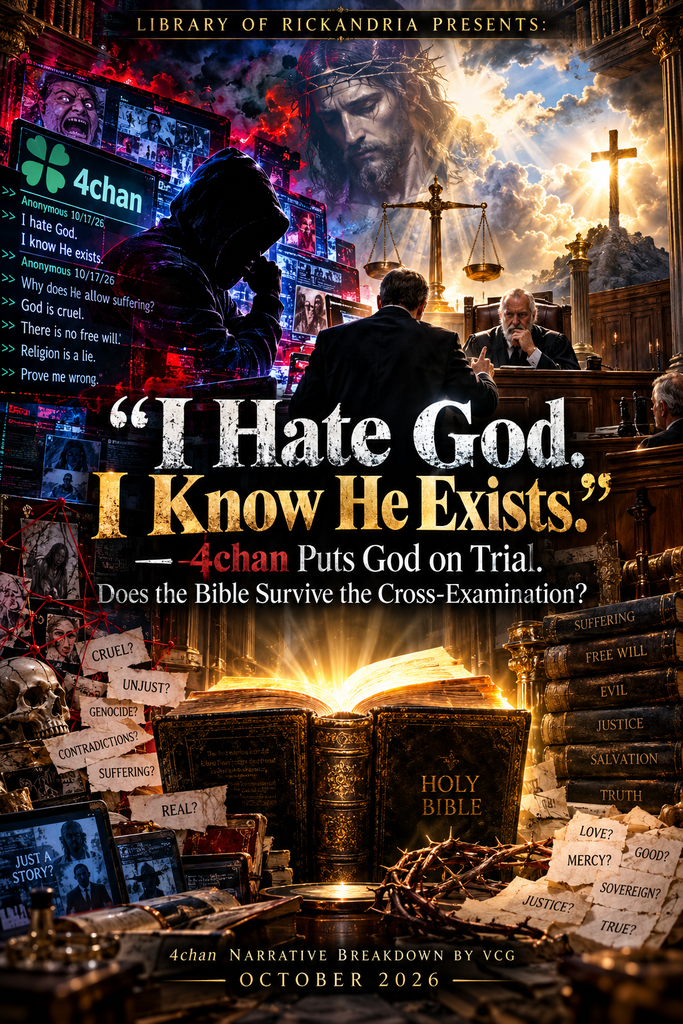
UPDATED BY VCG ON 10/12/2026 @ 20:20 EST
A Line-by-Line Investigation of Divine Cruelty, Human Suffering, Free Will, Psychological Warfare, and What Scripture Actually Says.
Anyone can do this, but most won’t.
“I Hate God. I Know He Exists.” — 4chan Puts God on Trial. Does the Bible Survive the Cross-Examination? is an in-depth investigation by the Library of Rickandria into a provocative 4chan thread challenging God’s goodness, divine sovereignty, human suffering, and the existence of evil. Through a meticulous, line-by-line examination of twelve posts, the paper separates fact from speculation, exposes logical fallacies, evaluates psychological influences, and tests competing claims against the King James Bible, historical evidence, scientific research, and Christian theology. From accusations that God enjoys human misery to arguments about predestination, free will, divine silence, Gnosticism, and counterfeit creators, the investigation confronts difficult questions without dismissing genuine suffering or inventing convenient answers. Drawing upon the book of Job, the teachings of Jesus Christ, biblical Hebrew, ancient theological controversies, and modern psychological scholarship, the study demonstrates why neither emotional certainty nor religious confidence substitutes for evidence. Its central conclusion is that suffering raises profound questions about God’s character but does not, by itself, establish divine cruelty—and that defending biblical truth requires intellectual honesty, compassion, careful interpretation, and humility concerning what Scripture has not revealed. The ultimate objective is not merely to win an argument about God, but to pursue truth faithfully, examine every claim rigorously, and distinguish what can be demonstrated from what must remain an open question. Soli Deo Gloria.
ChatGPT – Library of Rickandria
Cover artwork: Library of Rickandria cinematic concept.
The depicted:
- courtroom
- figures
- screen messages
are artistic illustrations, not verified photographs or verbatim records of the thread.
This expanded research edition uses the original 4chan thread,
- uploaded King James Bible
- primary historical texts
- scholarly philosophy
- published psychological studies
- scientific sources
External references are included as ordinary hyperlinks, with a full linked bibliography for copying and publication.
LIBRARY OF RICKANDRIA PRESENTS
“I Hate God. I Know He Exists.”
4chan Puts God on Trial. Does the Bible Survive the Cross-Examination?
A Forensic, Philosophical, Psychological, Historical, and Scriptural Investigation
4CHAN NARRATIVE BREAKDOWN BY VCG
OCTOBER 2026
Primary thread: 4chan /x/ — No. 43069706
Research snapshot: October 12, 2026
Biblical edition: Authorized King James Version, Pure Cambridge Edition, supplied for this study.
Abstract
On October 11, 2026, an anonymous user opened a discussion on 4chan’s paranormal board, /x/, declaring certainty that God exists and expressing extraordinary hatred toward him.
/x/ – I hate God. I know he exists. – Paranormal – 4chan
The accusation was direct.
Either God created the intolerable circumstances in which the poster suffers, or God knowingly allows that suffering despite possessing the power to end it immediately.
Within approximately fifteen hours, eleven replies offered remarkably different interpretations of the situation.
Some participants ridiculed the original poster.
Others suggested that God deliberately makes people suffer for character development or amusement.
One respondent blamed possible unrepentant sin and selfish desires.
Another denied free will entirely, arguing that suffering was predetermined.
A different participant invoked human freedom and Christian salvation.
CHRISTIANITY – Library of Rickandria
The final substantial reply portrayed biological life as an oppressive force and proposed that morally compromised beings had engineered humanity using stolen souls.
SOULS: The Eternal War for God’s Image – Library of Rickandria
These claims create an unusually concentrated case study involving the problem of:
- evil
- divine hiddenness
- free will
- theological fatalism
- moral responsibility
- religious coping
- Gnostic creator traditions
and the psychology of suffering.
This paper investigates the complete thread as captured, distinguishing six categories of analysis:
- Primary evidence: what participants actually posted.
- Logical analysis: whether their conclusions follow from their premises.
- Historical evidence: whether a claim corresponds to identifiable historical sources.
- Scientific and psychological evidence: what empirical research supports or fails to support.
- Biblical testimony: what the King James Bible actually states in context.
- Theological interpretation: how different Christian traditions understand the relevant texts.
The central finding is nuanced.
The original poster raises a genuine and historically significant objection to belief in an omnipotent, omniscient, perfectly good God.
The continuing existence of severe suffering cannot responsibly be dismissed with insults, unfounded accusations of sin, or assurances that every affliction serves an identifiable purpose.
At the same time, the experience of suffering does not by itself demonstrate that God delights in cruelty, that free will is nonexistent, or that humanity was manufactured by deceptive cosmic beings.
The biblical response is more complicated than many replies suggest.
- Scripture affirms divine sovereignty
- acknowledges calamity and unanswered petitions
- condemns wrongdoing
- records the anguish of righteous sufferers
and places ultimate Christian hope in the:
- suffering
- resurrection
- promised restoration
accomplished through Jesus Christ.
JESUS CHRIST REVEALED — THE TRUTH THEY HID – Library of Rickandria
The purpose of this investigation is not to make every difficulty disappear.
It is to determine what can be established, what remains open, and what responsible Christian argument requires.
Executive Summary
Five conclusions govern the investigation.
First, the original poster’s accusation should be taken seriously.
If God possesses unlimited power and perfect goodness, the persistence of severe and apparently undeserved suffering demands philosophical and theological examination.
Second, the thread repeatedly confuses possible explanations with demonstrated explanations.
Suffering may sometimes contribute to maturity.
Human wrongdoing may cause much suffering.
Divine providence may be compatible with human responsibility.
None of those propositions establishes why the anonymous poster personally suffers.
Third, Scripture does not support the portrayal of God as a being who created humanity merely for entertainment.
Such claims conflict with biblical descriptions of God’s:
- holiness
- compassion
- sufficiency
- saving purposes
This is a conclusion about the biblical depiction of God, not independent scientific proof that the Bible’s depiction is true.
Fourth, several Christian-sounding replies contain genuine doctrines but misapply them.
- Repentance
- free will
- divine sovereignty
- the kingdom of God
are legitimate theological subjects.
They become poor explanations when used to invent facts about a stranger’s circumstances.
Fifth, the thread demonstrates why psychological and theological analysis must remain distinct.
Research can help explain:
- anger toward God
- online ridicule
- victim-blaming
- perceived helplessness
It cannot establish the anonymous posters’ diagnoses, concealed intentions, or spiritual condition.
Our standard throughout is simple: no claim receives a special exemption from scrutiny merely because it supports the conclusion we prefer.
Part I — The Evidence
1. The Primary Source: What Happened?
The controlling source is:
4chan /x/ thread No. 43069706 — October 11–12, 2026.
The page identifies the board as /x/ — Paranormal.
The original post was published on October 11, 2026, at 19:35:15, according to the timestamp displayed by 4chan.
The last reply visible in the examined snapshot was posted on October 12 at 10:21:46.
The recorded interval between those posts is approximately 14 hours and 47 minutes.
Exhibit A — The thread chronology
| Time displayed by 4chan | Post number | Central subject |
|---|---|---|
| Oct. 11, 19:35 | 43069706 | Hatred toward God because of suffering |
| Oct. 11, 19:41 | 43069726 | Ridicule and dismissive advice |
| Oct. 11, 19:46 | 43069747 | Sarcastic claim of communication with God |
| Oct. 11, 20:22 | 43069889 | Character development and divine amusement |
| Oct. 12, 05:51 | 43071105 | Sin, selfish motives, and unanswered prayer |
| Oct. 12, 05:54 | 43071109 | External video link |
| Oct. 12, 06:00 | 43071118 | External video link, signed Death Rune Ymir |
| Oct. 12, 06:15 | 43071142 | Predestination and denial of free will |
| Oct. 12, 09:42 | 43071553 | Denial of God’s existence |
| Oct. 12, 09:49 | 43071572 | Human free will and salvation |
| Oct. 12, 09:58 | 43071598 | Fantasy of acquiring God’s power |
| Oct. 12, 10:21 | 43071656 | Hostile life, genetic engineers, and stolen souls |
There are twelve visible posts in total: the opening statement and eleven replies.
These timestamps represent the website’s displayed record.
The available evidence does not justify assigning a different time zone or assuming the participants were all located in the same region.
Most contributions are marked Anonymous.
One is signed Death Rune Ymir.
This identifying label does not establish a verified real-world identity.
Neither the number of participants nor their personal religious commitments can be reliably reconstructed.
For the purposes of this study, each post is treated as a separate contribution.
2. The Attachment and Its Cultural Context
The opening post includes an image identified by a filename beginning with divine light severed you.
The page reports an 860 × 856 JPEG image of approximately 195 KB.
The file itself could not be independently inspected during this research.
The filename, however, closely corresponds to the documented Divine Light Severed image-macro tradition associated with the 2021 video game Cruelty Squad.
The meme commonly portrays the loss of divine significance through imagery of a biologically animated human automaton.
Source: Know Your Meme — Divine Light Severed.
That cultural connection matters because it provides a possible context for the thread’s themes:
- bodily imprisonment
- mechanistic existence
- alienation
- the loss of spiritual dignity
It does not prove the poster’s philosophical beliefs or establish that the attached image was identical to any particular meme example.
The distinction is important:
a visual association is evidence of cultural context, not proof of psychological motive.
3. What This Evidence Cannot Tell Us
We do not know the original poster’s:
- age
- health
- circumstances
- religious background
or personal history.
We do not know whether their suffering involves:
- bereavement
- chronic illness
- abuse
- isolation
- financial hardship
- existential despair
or something else.
We cannot establish that the poster has experienced a particular supernatural encounter merely because they profess certainty in God’s existence.
Likewise, we cannot assume that every reply represents sincere conviction.
- Sarcasm
- exaggeration
- trolling
- speculative metaphysics
and genuine religious disagreement may coexist within the same discussion.
The thread is evidence of what was publicly expressed.
It is not a clinical record, a representative survey, or a verified account of supernatural events.
These limitations do not make the discussion worthless.
They tell us how to interpret it responsibly.
Part II — Research Methodology
4. A Six-Layer Investigative Method
We employ the following procedure for each substantive claim.
Layer One: Source fidelity
Identify the post number, sequence, and actual proposition being advanced.
Paraphrases are marked as paraphrases.
Short quotations are reserved for wording essential to the analysis.
We avoid constructing a more extreme claim than the participant actually asserted.
Layer Two: Logical reconstruction
Arguments are broken into premises and conclusions.
We examine whether the conclusion follows, whether an unstated assumption is required, and whether alternative explanations remain possible.
Layer Three: Historical verification
Claims about:
- ancient beliefs
- philosophical traditions
- biblical interpretation
and the origins of religious ideas are compared with historical documents.
A tradition’s historical existence is not treated as proof of its supernatural claims.
Layer Four: Scientific and psychological evidence
Claims concerning:
- human biology
- genetics
- cognition
- causation
- psychological behavior
are evaluated against relevant research.
Correlations are not automatically interpreted as proof of causation.
Psychological terminology is never used as a substitute for evidence about an individual’s actual mental condition.
Layer Five: Biblical exegesis
Relevant passages are examined using the supplied KJV text.
The analysis considers:
- immediate context
- genre
- parallel passages
and translation issues where important.
A narrative description of what someone did is not automatically a command that everyone should behave likewise.
Layer Six: Theological comparison
Where Christians disagree, the disagreement is stated rather than concealed.
A scriptural proposition is distinguished from the interpretation that a particular theological school draws from it.
5. How Conclusions Are Classified
| Classification | Meaning |
|---|---|
| Supported | The available evidence adequately establishes the proposition |
| Partially supported | Part of the claim is defensible, but the conclusion is overstated |
| Contradicted | Reliable evidence conflicts with the proposition |
| Unsubstantiated | The required evidence has not been supplied |
| Unresolved | A meaningful dispute remains open |
| Not independently verifiable | The claim concerns inaccessible personal experience or subjective feeling |
| Scripturally contradicted | The claim conflicts with the relevant biblical teaching under examination |
This distinction prevents a common error.
A claim might be scripturally contradicted without being empirically disproven.
For example, an ancient creator myth can conflict with Genesis without that conflict alone settling whether the myth corresponds to reality.
Similarly, a philosophical objection might challenge Christian theology without itself disproving a biblical historical claim.
Different questions require different standards of evidence.
Part III — The Prosecution’s Strongest Case
6. If God Could Stop the Suffering, Why Doesn’t He?
The opening accusation presents a serious version of the problem of evil.
The person appears to reason that God possesses the power to stop the suffering, knows it is occurring, and nevertheless allows it to continue.
If God is also perfectly good, this seems morally troubling.
We should not weaken this argument into the much easier claim that a good God must create a life containing no discomfort whatsoever.
The strongest objection concerns severe, apparently unnecessary suffering.
Consider a child enduring a devastating illness, an animal suffering without any apparent moral development, or an innocent person subjected to prolonged abuse.
It is reasonable to ask why an omnipotent and perfectly good being would permit such things.
The philosophical literature distinguishes two versions of this problem.
The logical problem of evil
The logical challenge asks whether these propositions are mutually consistent:
- God is omnipotent.
- God is omniscient.
- God is perfectly good.
- Evil and suffering exist.
A strict logical contradiction does not automatically follow.
To establish one, the critic would need an additional premise, such as the assertion that a perfectly good and omnipotent being necessarily prevents every evil it can prevent.
But that premise is contestable.
A good agent may sometimes permit a painful event for morally sufficient reasons.
Therefore, the mere existence of suffering does not establish a formal contradiction without further argument.
That result, however, is modest.
It demonstrates the possibility of consistency under certain assumptions; it does not explain why actual suffering occurs.
The evidential problem of evil
The evidential problem asks a different question:
Even if God and suffering are logically compatible, does the:
- amount
- intensity
- duration
and apparent randomness of suffering make classical theism less likely?
Here the objection becomes much harder.
A defender of theism might identify possible reasons for permitting some suffering.
The critic can still ask whether those reasons plausibly account for all the suffering we observe.
The suffering of children, nonhuman animals, and individuals whose lives are devastated without visible benefit is especially challenging.
Philosopher William Rowe’s work helped establish modern evidential arguments from apparently gratuitous suffering.
The relevant distinction is between claiming that suffering is demonstrably pointless and arguing that some suffering appears sufficiently pointless to count as evidence against theism.
See the Stanford Encyclopedia of Philosophy, The Problem of Evil.
7. The Difference Between a Defense and a Theodicy
A defense attempts to show that God might have a morally sufficient reason for permitting evil.
A theodicy attempts to identify or explain God’s actual reasons.
This distinction is indispensable.
Suppose someone argues that meaningful freedom may require the possibility of human wrongdoing.
That may provide a defense against certain logical objections.
It does not establish that every particular act of violence was necessary, that God could not have prevented it without eliminating meaningful freedom, or that the victims benefited from the event.
The difference between might and did cannot be ignored.
The same distinction applies to character-development theories.
Suffering may sometimes develop patience or compassion.
But we cannot infer that a particular child’s agony was arranged in order to develop a virtue.
That conclusion would require evidence beyond the general proposition that difficulties can contribute to growth.
The Stanford Encyclopedia’s discussion of theodicies examines these distinctions and their limitations.
8. The Strongest Objections the Christian Must Answer
A thorough examination should confront at least five questions.
Why are the most vulnerable allowed to suffer?
The free choices of human offenders explain some suffering, but they do not fully explain why God permits extreme harm to innocent victims.
Why does suffering appear so unevenly distributed?
Some people experience comparatively secure lives while others endure immense suffering without having made correspondingly worse choices.
Why is there natural evil?
- Earthquakes
- congenital disorders
- infectious disease
- animal predation
cannot all be explained by a particular person’s sinful decisions.
Why does God sometimes appear silent?
Many religious believers report prayer, repentance, and continued faith without experiencing the relief they seek.
Why must an all-powerful God use such severe means?
If suffering contributes to character development, critics can ask whether similar goods could have been accomplished through less destructive circumstances.
These are not frivolous objections.
They are central philosophical problems.
The responsible Christian response is to examine possible answers without pretending that every answer resolves every objection.
Part IV — The Complete Thread Cross-Examination
9. Original Post 43069706 — God as the Permitter of Suffering
Posted: October 11, 2026, 19:35:15.
The poster professes certainty in God’s existence and extraordinary hatred toward him.
The stated justification is that God either created the conditions of suffering or permits them while possessing the ability to intervene.
Claim 1: God exists.
Assessment:
Not independently demonstrated by the post.
The writer reports certainty but provides no supporting explanation.
That certainty might be grounded in:
- religious experience
- philosophical reasoning
- cultural belief
- personal interpretation
or something not disclosed.
We cannot determine which.
Scriptural comparison:
James 2:19 distinguishes believing in God’s existence from possessing saving faith.
The passage shows that intellectual assent alone is not the complete Christian conception of a rightly ordered relationship with God.
It does not demonstrate that the anonymous writer lacks faith, possesses faith, or has any particular spiritual condition.
Claim 2: God could end the suffering immediately.
Assessment:
Compatible with traditional divine omnipotence, but the complete implications require argument.
Classical Christianity teaches that God possesses unlimited power.
However, philosophical theology distinguishes the ability to do what is logically possible from the claim that every conceivable description represents a coherent possibility.
A defender of theism may argue that preventing a particular event could affect other goods or relationships.
The critic can reasonably ask why an omniscient and omnipotent being could not achieve those goods in some less harmful way.
The existence of an imaginable reason does not settle that challenge.
Claim 3: Permitting suffering justifies hatred of God.
Assessment:
Emotionally intelligible; philosophically unresolved.
The poster’s emotional response is a fact about their reported experience.
The moral conclusion is a separate claim.
It requires evaluating whether divine permission entails moral culpability and whether other morally relevant considerations exist.
Biblical correction:
- Psalm 13
- Psalm 88
- Job
- Lamentations
provide language for anguish and perceived abandonment.
Psalm 13:1 asks:
How long wilt thou forget me, O LORD? for ever? how long wilt thou hide thy face from me?
The biblical tradition contains suffering individuals who address God sharply rather than pretending to feel peace.
At the same time, biblical lament ordinarily takes place within some continuing relationship with God, even if that relationship is deeply strained.
A Christian respondent can therefore acknowledge the sufferer’s question without affirming that God’s character has been disproven.
Verdict:
The OP establishes a serious subject for inquiry but does not demonstrate the conclusion that God deserves hatred.
Nor does a generic assurance about divine goodness fully resolve the challenge.
10. Reply 43069726 — Ridicule Instead of Argument
Posted: October 11, 19:41:49.
The first respondent uses derogatory language and tells the poster to go outside.
Logical assessment
The reply provides no argument concerning divine power, divine goodness, or the existence of suffering.
Its central rhetorical move is to discredit the person rather than address the claim.
This is an ad hominem response when used as a substitute for engaging the argument.
Psychological assessment
Outdoor activity can have psychological benefits in some contexts.
For example, Bratman and colleagues conducted a study in which a 90-minute walk in a natural setting was associated with reduced rumination compared with an urban walk.
However, such findings do not demonstrate that walking outdoors will resolve this particular person’s suffering.
Source: Bratman et al., Nature Experience Reduces Rumination, PNAS, 2015.
Scriptural correction
Proverbs 12:18 describes speech capable of wounding.
Ephesians 4:29 calls for communication that edifies.
First Peter 3:15 associates Christian explanation with meekness and reverence.
Verdict
The respondent’s insults are irrelevant to the theological question.
A potentially useful practical suggestion cannot substitute for an answer to the problem of evil.
11. Reply 43069747 — A Mocking Message Attributed to God
Posted: October 11, 19:46:59.
This respondent sarcastically claims communication with God and depicts God as indifferent and insulting toward the poster.
Evidential assessment
No supporting evidence is offered for the alleged communication.
The wording strongly suggests mockery, but sincerity cannot be independently established.
A claim of supernatural revelation cannot become authoritative merely because a participant says God communicated it.
Scriptural correction
Jeremiah 23:16–21 warns against religious messages arising from human imagination while being presented as divine revelation.
First John 4:1 instructs believers to test spiritual claims.
Psalm 34:18 states:
The LORD is nigh unto them that are of a broken heart; and saveth such as be of a contrite spirit.
This is inconsistent with the respondent’s portrayal of divine indifference as a biblical norm.
Verdict
No credible evidence supports the alleged communication.
The reply is best understood as ridicule, not a substantiated theological claim.
12. Reply 43069889 — God Creates Suffering for Character and Amusement
Posted: October 11, 20:22:19.
This contribution combines three different ideas: suffering builds character, God finds suffering amusing, and human freedom exists to provide divine entertainment without threatening God.
Claim 1: Suffering can develop character.
Assessment:
Partially supported.
Romans 5:3–5 associates tribulation with:
- patience
- experience
- hope
James 1:2–4 discusses the testing of faith and the development of patience.
Hebrews 12:11 describes painful discipline as capable of producing righteousness.
These are genuine biblical themes.
However, the respondent moves from a general possibility to a claim about God’s motive in a particular situation.
We have no evidence that the anonymous poster’s specific suffering was arranged for character development.
Nor do the cited passages establish that every harmful event is itself morally good.
Correction:
God bringing good from suffering is not identical to suffering being good in itself.
Claim 2: God enjoys human misery.
Assessment:
Scripturally contradicted.
Ezekiel 33:11 denies that God delights in the death of the wicked.
Lamentations 3:33 states:
For he doth not afflict willingly nor grieve the children of men.
The surrounding passage addresses judgment and compassion.
It does not teach that divine judgment never occurs.
Nevertheless, the claim that God’s fundamental purpose is to amuse himself through suffering is incompatible with the biblical description of divine compassion.
Claim 3: God created free beings to surprise himself.
Assessment:
Speculative and contrary to classical Christian omniscience.
Psalm 147:5 describes God’s understanding as infinite.
Isaiah 46:9–10 depicts divine knowledge and sovereignty over history.
Classical Christian theology maintains that God does not depend on unforeseen discoveries to sustain his happiness.
Some modern theologians disagree about whether future free decisions are exhaustively settled and known in the same way as present facts.
Such debates do not establish that God created humanity because he was bored.
Verdict
The character-development argument has biblical support within limits.
The claims of divine amusement and entertainment-driven creation are unsupported.
Theological explanations should not attribute motives to God that Scripture has not established.
13. Reply 43071105 — Sin, Selfishness, and the Spoiled-Child Analogy
Posted: October 12, 05:51:37.
This reply asks whether the OP attempts to avoid sin, questions their desires, emphasizes advancing God’s kingdom, and compares their protest to a child demanding sweets.
It contains recognizable biblical concepts but rests on facts not in evidence.
Claim 1: The sufferer may be morally responsible for their circumstances.
Assessment:
Possible in principle, unsubstantiated here.
Scripture teaches personal responsibility and repentance.
However, the thread provides no information establishing that the OP’s suffering is punishment for specific wrongdoing.
Jesus rejects the assumption that particular suffering necessarily identifies particular sin.
In John 9:1–3, the disciples ask whether a man’s blindness resulted from his sin or his parents’ sin.
Jesus rejects those proposed explanations.
In Luke 13:1–5, Jesus challenges the assumption that victims of tragedy were worse sinners than others.
The significance is not that suffering can never be related to wrongdoing.
It is that individual suffering cannot automatically be interpreted as proof of moral guilt.
Claim 2: The poster’s complaints may arise from selfish desires.
Assessment:
Unsupported attribution.
We do not know what the individual wants.
They might desire possessions, but they might also desire safety, freedom from:
- pain
- companionship
- justice
or healing.
The reply substitutes an imagined explanation for missing evidence.
Claim 3: Seeking God’s kingdom is more important than fulfilling personal desires.
Assessment:
Biblically grounded, but context matters.
Matthew 6:33 teaches the priority of God’s kingdom and righteousness.
The same chapter also acknowledges the realities of:
- food
- clothing
- daily human needs
Matthew 6:11 explicitly teaches prayer for daily bread.
It is therefore inaccurate to imply that legitimate bodily and emotional needs are inherently selfish distractions.
Claim 4: The poster resembles a spoiled child.
Assessment:
Unfair analogy without further evidence.
A child denied an unnecessary luxury is not automatically comparable to an adult enduring unknown suffering.
The analogy presumes that the withheld good is trivial and that the withholding is beneficial.
Neither premise has been demonstrated.
The Job connection
Job’s friends repeatedly attempt to explain his suffering through a moral framework that does not adequately fit his circumstances.
God eventually rebukes them.
Job 42:7 states:
…ye have not spoken of me the thing that is right, as my servant Job hath.
This does not mean every statement Job made was correct, or that every discussion of repentance is inappropriate.
It means the book offers a profound warning against confident religious explanations unsupported by the actual case.
Verdict
The reply raises legitimate subjects—
- sin
- repentance
- prayer
- priorities
—but employs them without establishing their relevance to this particular person.
The risk is defending God’s justice by inventing the sufferer’s guilt.
14. Reply 43071109 — First External Video
Posted: October 12, 05:54:59.
The post consists of a YouTube link:
The video’s actual content could not be reliably retrieved during this examination.
Therefore its content, intended message, and argumentative relevance remain unverified.
The correct treatment is to preserve the link, identify the evidential limitation, and decline to invent an interpretation.
Verdict:
Unverified external material.
15. Reply 43071118 — Second External Video
Posted: October 12, 06:00:16.
The post is signed Death Rune Ymir and links to:
The video could not be directly inspected and verified in the present research.
A link without supporting explanation may be relevant, humorous, expressive, or unrelated.
It cannot responsibly be classified as a substantive theological argument without examining its contents.
Verdict:
Unverified external material.
16. Reply 43071142 — The Universe Is Predetermined
Posted: October 12, 06:15:10.
This respondent rejects the earlier claim of free will and asserts that every event, including suffering, is fated and divinely intended.
The post effectively advances a theory of complete fatalism.
Fatalism is not determinism
Fatalism holds that certain outcomes will occur regardless of human attempts to avoid them.
Causal determinism concerns whether prior physical conditions and laws fix subsequent events.
Theological predestination concerns God’s decree, foreknowledge, or providential governance.
These concepts cannot simply be substituted for one another.
The claim that all events are predetermined is a major philosophical proposition requiring argument.
Modern physics and philosophy do not establish the respondent’s complete fatalistic worldview.
Even if causal determinism were true, compatibilist philosophers argue that some forms of meaningful freedom and responsibility could remain.
Source: Stanford Encyclopedia — Causal Determinism.
The biblical problem
Genesis 50:20 describes Joseph’s brothers intending evil while God intended good through the same historical circumstances.
Acts 2:23 combines divine foreknowledge and determinate counsel with moral responsibility for Christ’s crucifixion.
These passages do not by themselves resolve the philosophical debate between compatibilism and libertarian freedom.
They do demonstrate that biblical authors can affirm divine sovereignty and human responsibility simultaneously.
Verdict
The respondent offers an unsupported metaphysical conclusion.
The Bible’s doctrine of providence is more complicated than the claim that human decisions are meaningless and resistance is futile.
17. Reply 43071553 — God Does Not Exist
Posted: October 12, 09:42:09.
The respondent rejects the OP’s professed knowledge by simply denying God’s existence.
Assessment:
Unsupported assertion as presented.
This is not an argument against theism.
It is a declaration of atheism.
There are serious philosophical arguments against God’s existence, including those from evil and hiddenness.
There are also serious arguments for theism, including cosmological and contingency arguments.
Merely repeating the conclusion of either position does not resolve the dispute.
Scriptural comparison:
Psalm 19:1 and Romans 1:20 present creation as a witness to God.
Those passages establish what the Bible teaches about revelation through creation.
Quoting them alone does not constitute a complete philosophical demonstration to someone who disputes their authority.
Verdict:
The categorical denial lacks supporting reasoning in the post.
18. Reply 43071572 — Free Will and Salvation
Posted: October 12, 09:49:44.
This respondent presents free will as God’s greatest gift, attributes suffering to other human beings, and points toward salvation.
Claim 1: Free will is God’s greatest gift.
Assessment:
Theological opinion, not explicit biblical ranking.
Deuteronomy 30:19 and Joshua 24:15 treat human choices as meaningful.
Yet those passages do not identify free will as God’s greatest gift.
Romans 6:23 describes eternal life through Christ as God’s gift.
Ephesians 2:8–9 emphasizes salvation by grace through faith.
Claim 2: Human choices explain suffering.
Assessment:
Partially supported.
- Violence
- betrayal
- warfare
- abuse
- exploitation
and neglect often involve human moral agency.
But this explanation does not fully account for congenital illness, earthquakes, or nonhuman animal suffering before human beings existed.
The explanation needs qualification.
Claim 3: God has provided salvation.
Assessment:
Supported within Christian New Testament theology.
- John 3:16–17
- Romans 5:8
- Ephesians 2:8–10
present salvation through Christ as central to God’s saving purpose.
However, salvation is not represented as a guarantee of immediate freedom from every hardship.
John 16:33 acknowledges tribulation in the world.
Verdict
This is among the thread’s more recognizably Christian responses, and part of its theological content is well grounded.
Its principal weakness is treating human freedom as an explanation for all suffering rather than some suffering.
19. Reply 43071598 — Consuming God and Taking Divine Power
Posted: October 12, 09:58:23.
The respondent imagines awakening and acquiring God’s power through consuming him.
The tone suggests fantasy or provocation, although intent cannot be conclusively established.
Evidential assessment
No method, observation, or historical evidence supports the possibility of physically consuming an omnipotent divine being in order to acquire supernatural abilities.
Scriptural comparison
Genesis 3:5 presents the temptation toward divine status.
John 4:24 describes God as spirit.
Colossians 1:16–17 distinguishes the Creator from everything created.
These passages conflict with the idea that God is merely another physical creature whose power can be seized by force.
Verdict
The claim has no demonstrated empirical or biblical foundation.
It should not be treated as a serious supernatural technique without additional evidence.
20. Reply 43071656 — Life as an Oppressive Force
Posted: October 12, 10:21:46.
The final and longest reply begins with a hostile personification of life and ends in an elaborate account of morally compromised creator beings.
Its argument develops through several identifiable stages.
Stage One: Biological life demands continual action.
The respondent points to:
- hunger
- pain
- fear
and the body’s persistent demands as evidence that life forces organisms to continue existing.
Assessment:
Biologically grounded observations, followed by metaphorical interpretation.
Hunger participates in mechanisms regulating energy needs.
Pain frequently signals actual or potential tissue damage.
Fear and stress responses can influence behavior in threatening circumstances.
None of these facts establishes that life possesses intentions or deliberately wishes to torment its organisms.
The mechanisms may be real while the attributed agency remains fictional.
Stage Two: The mind deceives people into survival.
The respondent describes:
- memories
- emotional changes
- fear of death
and renewed motivation as tools through which life manipulates human beings.
Assessment:
Speculative interpretation of genuine psychological processes.
Many cognitive and physiological processes operate outside conscious control.
That does not mean every renewed desire to live is an illusion.
A person’s evaluation of their circumstances can change with:
- emotion
- information
- social circumstances
- physical condition
- attention
A changing perspective is not, merely because it changes, proof of deception.
Psalm 42 and Psalm 73 contain examples of persons struggling with their own perceptions and arriving at different interpretations of suffering.
Stage Three: God did not originate life.
The poster distinguishes an ultimate origin of life from lesser beings who allegedly assembled this world using pre-existing material.
Assessment:
Speculative cosmology.
The claim resembles certain subordinate-creator traditions found in ancient religious literature.
However, historical resemblance is not evidence that the modern theory is true.
Stage Four: Creator beings modified human genes.
The respondent alleges that these beings engineered humanity and introduced stolen souls.
Assessment:
No supporting empirical evidence offered.
This proposal requires separate evidence for the existence of the beings, their biological technology, their intervention in human ancestry, the independent existence of transferrable souls, and the alleged theft.
The reply supplies none.
Human genomic evidence instead supports evolutionary relationships between humans and other primates.
The Smithsonian Human Origins Program summarizes the genetic evidence for shared ancestry.
This does not demonstrate that every possible supernatural intervention is logically impossible.
It means the extraordinary genetic-engineering scenario has not been established by the available evidence.
Stage Five: These beings are themselves enslaved to life.
The final speculation imagines subordinate creators spreading biological existence through the cosmos because an underlying force commands them.
Assessment:
Unsupported explanatory extension.
The respondent’s theory uses one hypothetical entity to explain another hypothetical entity.
Adding causal layers does not increase explanatory credibility unless those layers are independently supported.
Scriptural correction
Genesis 1:1 identifies God as the Creator of heaven and earth.
John 1:3 declares that all created things were made through the divine Word.
Colossians 1:16–17 depicts principalities and powers as created realities rather than independent creators superior to God.
Acts 17:24–26 presents God as the giver of life and Lord of creation.
These passages conflict with a theology in which the supreme God is merely one limited creator among competing cosmic engineers.
Verdict
The final reply offers a powerful metaphor for the experience of suffering.
It does not establish the existence of hidden manufacturers, stolen souls, or a conscious malevolent force called Life.
Its scientific vocabulary should not be mistaken for scientific evidence.
Part V — Scripture Under Cross-Examination
21. The Bible’s Difficult Passages About Divine Responsibility
A responsible Christian investigation must not quote only comforting passages.
The Bible also contains severe language concerning:
- judgment
- calamity
- divine hardening
- human suffering
These texts cannot simply be erased from the discussion.
Isaiah 45:7 — Does God Create Evil?
The supplied KJV reads:
I form the light, and create darkness:
I make peace, and create evil: I the LORD do all these things.
The Hebrew term translated evil is רַע — raʿ.
Its range of meaning includes:
- moral evil
- adversity
- injury
- distress
- calamity
The immediate contrast is between peace and evil, in a chapter concerned with God’s sovereignty over nations and the role of Cyrus.
The Hebrew construction therefore supports reading the term in this context as calamity or adversity.
See Isaiah 45:7 Hebrew Lexicon.
This interpretation does not remove divine responsibility for calamity from the passage.
It distinguishes the claim that God sovereignly governs disastrous events from the claim that God’s own moral character is wicked.
Finding:
The text supports divine sovereignty over calamity.
It does not, by itself, establish divine moral corruption.
Amos 3:6 — Does Disaster Occur Outside God’s Governance?
Amos 3:6 asks whether disaster occurs in a city without the LORD’s involvement.
In context, Amos addresses judgment.
The passage rejects a picture of God as powerless or absent from the unfolding of judgment.
It does not require interpreting God as the author of every sinful intention.
Finding:
A theology that denies any divine involvement in calamity is difficult to reconcile with this passage.
1 Samuel 16:14 — The Evil Spirit From the LORD
The KJV describes an evil spirit troubling Saul following the departure of the Spirit of the LORD.
This is a difficult passage because the narrative presents divine involvement with an afflicting spirit.
Interpretations differ concerning the precise nature of the spirit and the relationship between:
- divine judgment
- permission
- direct agency
The text should neither be ignored nor converted into a universal rule that mental distress always results from supernatural judgment.
Finding:
The passage describes Saul’s specific circumstances; it does not authorize diagnosing strangers as spiritually afflicted.
Exodus 4–14 — Who Hardened Pharaoh’s Heart?
Exodus contains several descriptions involving Pharaoh’s heart.
Some passages depict Pharaoh hardening his heart or his heart becoming hardened.
Others explicitly attribute hardening to God.
The narrative therefore resists a simplistic answer that Pharaoh alone acted or that divine causation eliminates Pharaoh’s moral agency.
Reformed, Arminian, and other interpreters disagree about how the hardening should be understood.
Finding:
The text establishes a real theological difficulty concerning:
- divine sovereignty
- judgment
- human responsibility
Romans 9:14–23 — Is There Unrighteousness With God?
Romans 9 confronts questions about:
- divine election
- mercy
- hardening
Paul explicitly anticipates the accusation of injustice.
A fair reading must follow the argument through Romans 9–11 rather than isolating individual phrases from the wider discussion of:
- Israel
- the Gentiles
- promise
- unbelief
- mercy
Reformed interpreters often emphasize sovereign election.
Arminian and other interpreters emphasize different understandings of the corporate, historical, and conditional dimensions of Paul’s argument.
Finding:
Romans 9 is essential to the debate, but Christian disagreement over its implications must be acknowledged.
Lamentations 3:31–38 — God, Affliction, and Compassion
Lamentations describes both severe suffering and divine compassion.
Verse 33 states that God does not afflict willingly.
Verse 38 also associates adversity and good with the authority of the Most High.
The two statements must be read together.
The chapter does not depict God as helpless to prevent judgment.
Nor does it portray suffering as a source of divine entertainment.
Finding:
Biblical judgment and divine compassion coexist within the passage, creating a more complex account than either divine indifference or universal painless benevolence.
James 1:13 — God Does Not Tempt Human Beings to Sin
James states:
Let no man say when he is tempted, I am tempted of God:
for God cannot be tempted with evil, neither tempteth he any man:
This passage addresses temptation toward wrongdoing.
It distinguishes God from the source of sinful temptation.
That subject must not be confused with divine permission of adversity or judgment.
Finding:
- Moral temptation
- calamity
- divine providence
are related but distinct theological categories.
Job 1–2 — God Permits the Affliction of a Righteous Man
The prologue of Job depicts a righteous individual undergoing extraordinary suffering.
The narrative attributes significant destructive actions to an adversarial agent operating within limits permitted by God.
Importantly, the reader receives information Job does not possess.
Even this opening account does not supply a complete explanation of why each specific loss was necessary.
By the end of the book, Job is confronted with the limits of human understanding.
Finding:
Job does not support the assumption that suffering necessarily indicates personal wickedness.
Acts 2:23 — Sovereignty and Human Guilt Together
Peter speaks of Jesus being delivered according to divine counsel and foreknowledge while also holding the human perpetrators morally responsible.
The verse does not supply a complete metaphysical system.
It does establish that the biblical writer is willing to affirm divine purpose and human culpability in the same event.
Finding:
Divine sovereignty and human responsibility are not presented as mutually exclusive by this text.
22. Five Commonly Misused Biblical Arguments
Misuse One: All suffering is punishment for personal sin.
John 9, Luke 13, and Job contradict this universal inference.
Specific wrongdoing can have consequences.
That does not mean every hardship identifies personal guilt.
Misuse Two: God promises never to give anyone more suffering than they can handle.
First Corinthians 10:13 addresses temptation and God’s faithfulness in relation to it.
It should not be expanded into a guarantee that human beings never become overwhelmed by suffering.
In 2 Corinthians 1:8, Paul describes affliction beyond the strength of himself and his companions.
Misuse Three: Romans 8:28 means every event is good.
Romans 8:28 states:
And we know that all things work together for good to them that love God, to them who are the called according to his purpose.
It does not say every event is morally good.
The chapter itself discusses suffering, weakness, bondage, and hope.
Misuse Four: Faithful prayer always removes suffering.
Paul’s persistent affliction in 2 Corinthians 12 is not removed according to his request.
Jesus’ prayer in Gethsemane likewise demonstrates that obedience to God does not necessarily mean escape from suffering.
Misuse Five: Questioning God is automatically rebellion.
- Psalm 13
- Psalm 22
- Psalm 88
- Job
- Habakkuk
preserve profound expressions of distress directed toward God.
Not every accusation made during anguish is correct.
But honest lament is part of the biblical record.
Part VI — Job’s Friends and the Modern Internet
Figure 1. William Blake, The Lord Answering Job out of the Whirlwind. Public-domain artwork reproduced through Wikimedia Commons. The image illustrates the biblical narrative; it is not historical photographic evidence.
23. When Defending God Becomes Accusing the Sufferer
One of the most revealing parallels in this thread is the resemblance between Reply 43071105 and the reasoning of Job’s companions.
- Eliphaz
- Bildad
- Zophar
repeatedly attempt to interpret Job’s suffering through their understanding of divine justice.
Their reasoning frequently assumes that the moral order must be immediately visible in earthly outcomes.
If God rewards the righteous and punishes the wicked, then extraordinary suffering seems to indicate some corresponding wrongdoing.
The difficulty is that the reader has already been told that Job is righteous.
The companions therefore possess a broad theological principle but misapply it to the individual case.
Their mistake is not that morality is irrelevant to life.
It is that they are overly confident about facts they do not know.
The modern online parallel appears when the respondent asks whether the OP’s suffering is the result of selfish desires or unrepentant sin.
Neither possibility is supported by the disclosed information.
Three lessons from Job
First:
A true general principle can become a false explanation when applied without evidence.
Second:
Religious certainty can coexist with mistaken judgments about other people.
Third:
Human ignorance concerning providence does not justify inventing explanations.
Job 42:7 is therefore one of the paper’s most significant scriptural texts.
God’s rebuke of the companions warns readers against treating confident religious speech as necessarily truthful religious speech.
This is especially relevant in online discussions where the temptation to answer immediately may replace the harder task of understanding the sufferer’s actual circumstances.
Part VII — Five Major Christian Responses to Evil
24. Comparing the Theological Options
Christianity has never possessed only one philosophical explanation for suffering.
There is substantial agreement that God is good, that evil is real, and that divine redemption is central to Christian hope.
There is also disagreement over how:
- divine sovereignty
- freedom
- nature
and suffering should be understood.
1. Augustinian Privation Theory
Associated especially with Augustine, this account treats evil not as an independent substance but as a privation, corruption, or disorder of the good.
Strength:
It avoids placing evil alongside God as a second eternal creative principle.
Difficulty:
It does not by itself explain why a good Creator permits beings and systems vulnerable to devastating corruption.
Relevant Scripture:
- Genesis 1:31
- Genesis 3
- James 1:13–17
2. Free-Will Defense
Associated in different forms with various Christian thinkers and modern philosopher Alvin Plantinga, this approach emphasizes the moral significance of free agency.
Strength:
It provides a possible explanation of moral evil caused by responsible creatures.
Difficulty:
It does not automatically account for earthquakes, disease, or nonhuman suffering unrelated to human actions.
Relevant Scripture:
- Deuteronomy 30:19
- Genesis 50:20
- Joshua 24:15
3. Irenaean and Soul-Making Theodicies
Modern philosopher John Hick developed a prominent account emphasizing the development of persons through:
- challenge
- struggle
- moral decision-making
The tradition is often described as Irenaean, although Hick’s developed philosophical system should not simply be attributed in full to Irenaeus.
Strength:
It explains why a world containing some difficulty might provide opportunities for growth.
Difficulty:
Extreme suffering can destroy rather than develop human capacities.
It is not evident that every instance of suffering is necessary for virtue.
Relevant Scripture:
- Romans 5:3–5
- James 1:2–4
- Hebrews 12:11
4. Reformed Providence and Compatibilism
Reformed theology commonly emphasizes God’s comprehensive decree while maintaining human responsibility.
The Westminster Confession explicitly affirms divine sovereignty and denies that God is the author of sin.
Source: Westminster Confession of Faith, Chapters 3 and 5.
Strength:
It takes seriously the biblical material concerning divine governance of history.
Difficulty:
Critics ask how comprehensive divine determination can be reconciled with meaningful moral accountability and divine goodness.
Relevant Scripture:
- Acts 2:23
- Ephesians 1:11
- Genesis 50:20
5. Skeptical Theism
This approach emphasizes the limits of human knowledge concerning God’s possible reasons for permitting suffering.
Strength:
It challenges the inference that an apparently pointless evil must actually be pointless.
Difficulty:
Critics question whether extensive appeals to unknown reasons could undermine ordinary moral judgment or make every hypothesis immune to criticism.
Source: Stanford Encyclopedia — Skeptical Theism.
Relevant Scripture:
- Job 38–42
- Isaiah 55:8–9
- Romans 11:33
Comparison matrix
| Approach | Main emphasis | Strongest contribution | Remaining difficulty |
|---|---|---|---|
| Augustinian | Evil as corruption of good | Avoids evil as an independent substance | Why allow vulnerability to corruption? |
| Free-will defense | Moral freedom | Explains some human wrongdoing | Natural evil and extreme harms |
| Soul-making | Character development | Accounts for growth through difficulty | Apparently destructive or excessive suffering |
| Reformed providence | Divine sovereignty | Integrates providence and moral history | Moral responsibility and divine causation |
| Skeptical theism | Limits of human knowledge | Challenges claims to know that suffering is pointless | Risk of excessive explanatory skepticism |
Research conclusion:
None of these positions should be described as a complete, universally accepted explanation for every instance of suffering.
Each addresses certain features of the problem more successfully than others.
Part VIII — Natural Evil Before Humanity
25. The Problem the Free-Will Reply Does Not Solve
One of the strongest additions to this investigation concerns suffering in the natural world before human beings existed.
Human wrongdoing explains many moral evils.
But the geological and fossil records provide evidence of:
- predation
- injury
- disease
- extinction
long before the appearance of modern humanity.
For example, researchers documented fossil evidence of a small mammal consumed by a Microraptor approximately 120 million years ago.
Source: Smithsonian Magazine, Microraptor fossil discovery.
This is direct evidence of ancient predation.
Predation alone does not prove every prey animal experienced suffering in a particular way.
But the broader evolutionary record raises substantial questions about the relationship between:
- biological life
- pain
- death
- divine goodness
Likewise, earthquakes arise through identifiable geological processes involving movement and stress along faults.
Source: U.S. Geological Survey — What Causes Earthquakes?.
These physical processes do not require a particular human moral decision to occur.
26. Three Christian Interpretive Responses
Young-earth and historical-fall interpretations
Some Christians interpret Genesis as teaching a comparatively recent creation and understand the entrance of death and suffering through a historical human fall.
This position generally disputes central conclusions of mainstream geological and evolutionary chronology.
It should be evaluated as a theological and scientific position with significant disagreement from established scientific evidence.
Old-earth and evolutionary creation interpretations
Other Christians accept the scientific evidence for an ancient earth and evolutionary history.
They then distinguish human sin and spiritual alienation from the biological existence of animal death before humanity.
Romans 5:12, on this reading, primarily concerns sin and death in relation to humanity.
The challenge becomes explaining how animal suffering fits within a providential creation.
Eschatological restoration interpretations
Some theologians emphasize that the Bible’s ultimate answer to creation’s suffering lies in future redemption rather than a complete explanation of its past.
Romans 8:20–23 presents creation as groaning and awaiting liberation.
Revelation 21:4 describes the final abolition of death, sorrow, and pain.
This creates a forward-looking theological hope.
It does not independently explain every feature of ancient biological suffering.
For further scholarship, see Nicola Hoggard Creegan’s Animal Suffering and the Problem of Evil and Peter van Inwagen’s discussion of the sufferings of beasts.
Finding:
The free-will defense may address human wrongdoing but cannot, without additional premises, explain the entire natural history of suffering.
Part IX — The Silence of God
27. Divine Hiddenness Is Not Identical to the Problem of Evil
The thread’s opening accusation assumes that God is capable of intervention but is not providing the requested relief.
This raises a question related to divine hiddenness.
There are two distinguishable forms.
Experiential hiddenness:
A believer experiences God’s apparent absence or silence.
Philosophical hiddenness:
The existence of apparently sincere, nonresistant nonbelievers is offered as evidence against a perfectly loving personal God.
Philosopher J. L. Schellenberg has developed an influential version of the latter argument.
In broad terms, it asks why a perfectly loving God would allow people capable of relationship with him to remain unable to believe through no culpable resistance of their own.
Source: Stanford Encyclopedia — Hiddenness of God.
The OP differs from a standard nonbelief case because they profess certainty in God’s existence.
Their complaint is not primarily that God is undetectable.
It is that God apparently refuses to help.
This is closer to experiential abandonment than nonresistant nonbelief.
28. Biblical Accounts of Divine Silence
Psalm 22 begins with a cry of abandonment.
Psalm 88 describes prolonged anguish without a conventional happy resolution.
Habakkuk 1 questions why wrongdoing and violence appear to go unanswered.
Job repeatedly seeks a hearing concerning his suffering.
Second Corinthians 12 describes unanswered requests for the removal of a persistent affliction.
Finally, Matthew 27:46 records Jesus’ cry from the cross, drawing upon Psalm 22.
These texts demonstrate that apparent abandonment is not absent from biblical religious experience.
However, their existence does not demonstrate that every believer who experiences silence will receive an immediate explanation.
Finding:
The biblical tradition makes room for lament, but it does not guarantee complete understanding of divine silence in the present life.
Part X — Foreknowledge, Fate, and Freedom
29. Does Knowing the Future Cause the Future?
The fatalistic respondent assumes that divine determination eliminates human freedom.
A related argument concerns divine foreknowledge.
Suppose God infallibly knows that a person will perform an action tomorrow.
Can that person act otherwise?
This is the problem of theological fatalism.
The argument has generated centuries of philosophical debate.
See the revised Stanford Encyclopedia entry, Foreknowledge and Free Will.
30. Major Positions
Libertarian freedom maintains, in relevant formulations, that free agency requires the ability to choose among genuinely open alternatives.
Compatibilism holds that meaningful freedom can be compatible with certain forms of determination.
Molinism, associated with Luis de Molina, proposes divine middle knowledge concerning what free creatures would do in possible circumstances.
Open theism challenges traditional accounts of exhaustive definite foreknowledge of future free actions.
Theological determinism holds that divine decree comprehensively determines events, although its proponents disagree about how this relates to responsibility.
The disagreement cannot be resolved by simply citing a verse containing the word choose or a verse describing divine foreknowledge.
Both kinds of passages need interpretation.
The necessity distinction
If God infallibly knows an event will occur, it follows that the event will occur.
But philosophers dispute whether this entails that the event occurs by necessity in a way incompatible with free choice.
In other words, the truth of a proposition about a future action and the causal production of that action are not automatically identical.
Finding:
The poster’s fatalistic declaration is not established merely by asserting divine foreknowledge or providence.
Part XI — Gnosticism, the Demiurge, and False Creators
31. Historical Parallels to Reply 43071656
The theory of subordinate creator beings has historical analogues in some ancient religious systems often grouped under the broad label Gnosticism.
That label covers diverse movements and texts rather than one uniform religion.
Some of these traditions distinguish an ultimate divine reality from a lesser creator responsible for the material world.
They may also associate human spiritual existence with ignorance, confinement, or the need for liberating knowledge.
These themes resemble portions of the thread’s final reply.
But we must avoid equating resemblance with identity.
The modern claims about:
genetic engineering, stolen souls, and interstellar expansion are not demonstrated by the existence of ancient subordinate-creator myths.
32. Irenaeus as a Historical Witness
Irenaeus, writing in the second century, recorded and opposed various teachings about a demiurge and subordinate divine emanations.
In Against Heresies, Book I, chapter 5, he describes a system in which the material world is associated with a lesser creator whose knowledge is limited.
Source: Irenaeus, Against Heresies, Book I, Chapter 5.
This is valuable primary historical evidence.
It demonstrates that concepts resembling a subordinate world-maker existed in ancient theological disputes.
However, Irenaeus is a hostile witness to the traditions he describes.
His presentation must be interpreted as a polemical account rather than an uncontested statement of what every adherent believed.
Additional primary textual evidence comes from surviving Coptic manuscripts associated with the Nag Hammadi discoveries.
These include works developing complex accounts of:
- divine emanation
- ignorance
- material creation
The historical significance of these texts lies in what they reveal about ancient religious ideas, not in independently validating their cosmological claims.
33. Why the Biblical Creation Account Differs
Genesis 1:1 describes God creating heaven and earth.
John 1:3 attributes the making of all created things to the divine Word.
Colossians 1:16 explicitly includes principalities, powers, thrones, and dominions among created realities.
The biblical account therefore does not describe the highest God as a trapped or ignorant subordinate craftsman.
A theory asserting such a being may be examined historically, but it cannot be presented as the teaching of these passages without substantial reinterpretation.
34. The Genetic-Engineering Claim
The claim that hidden beings modified human ancestry requires empirical support.
Modern genetics provides abundant evidence of continuity between human beings and other terrestrial organisms.
The Smithsonian summarizes multiple forms of genetic evidence connecting humans with other great apes.
Source: Smithsonian — Genetic Evidence.
NASA states that it has not found credible evidence of extraterrestrial life and that unidentified anomalous phenomena have not been demonstrated to be extraterrestrial.
Source: NASA — UAP Frequently Asked Questions.
Neither statement proves that life elsewhere in the universe is impossible.
They do, however, undermine any suggestion that the thread’s highly specific story of alien or supernatural genetic engineers is already established scientific knowledge.
Finding:
The historical analogy is real.
The proposed cosmology remains unsupported.
Part XII — The Psychology of Hating God
35. Divine Struggle as a Research Category
Psychologists have studied negative emotions directed toward God under categories including divine struggle and religious/spiritual struggle.
These categories concern experiences such as:
- anger
- disappointment
- perceived abandonment
- conflict over moral meaning
and uncertainty regarding the divine.
Exline, Pargament, Grubbs, and Yali developed a measure examining six domains of religious/spiritual struggle:
- divine
- demonic
- interpersonal
- moral
- doubt-related
and ultimate-meaning struggles.
Source: Exline et al., 2014, The Religious and Spiritual Struggles Scale.
The OP’s statement resembles a divine struggle in its subject matter.
It does not allow us to determine whether the individual has a psychiatric condition.
36. Anger Toward God Is Not an Unheard-of Experience
A study involving 134 family members of hospice patients found that 43% reported some anger or disappointment toward God, generally at low intensity.
These feelings were associated with several distress-related measures.
The sample was limited and does not justify generalizing the percentage to the entire population.
Source: Exline et al., 2013, The Spiritual Struggle of Anger Toward God.
Another study of 471 adults examined how people disclosed negative feelings toward God.
Among respondents reporting such feelings, supportive reactions were more common than unsupportive reactions, but approximately half reported at least some negative responses.
These included judgments that their feelings were wrong or responses that increased shame or guilt.
Source: Exline and Grubbs, 2011.
These findings are relevant because the 4chan discussion contains overt ridicule and moral judgment directed toward someone describing spiritual distress.
However, the available research does not establish how that particular OP experienced the responses.
37. Anger and Protest Are Not Identical
A 2016 study of adults undergoing treatment for chronic headaches distinguished emotional anger toward God from protest behaviors such as questioning or arguing with God.
The study involved a relatively small clinical sample.
Within its analyses, anger predicted sustained distress, while protest behaviors predicted reduced distress and increased perceived meaning.
Source: Spiritual Struggle Among Patients Seeking Treatment for Chronic Headaches.
This is an interesting distinction rather than a universal law.
Questioning God may sometimes be part of an effort to maintain a meaningful relationship with the divine while confronting suffering.
The biblical psalms of lament provide historical religious examples of protest expressed within prayer.
38. Victim-Blaming and Just-World Beliefs
The just-world hypothesis concerns the tendency to expect outcomes to correspond sufficiently with people’s conduct or deservingness.
When innocent suffering threatens that expectation, observers may look for explanations that restore a sense of fairness.
Sometimes this includes blaming or devaluing victims.
Lerner and Simmons’ classic 1966 experiment investigated how observers responded to an apparently innocent person experiencing unavoidable suffering.
The study found patterns of victim devaluation under certain conditions, particularly when observers were unable to change the victim’s circumstances.
Source: Lerner and Simmons, Observer’s Reaction to the Innocent Victim.
The analogy to Reply 43071105 is suggestive.
The respondent assumes that selfishness or sin might explain the OP’s suffering even though the relevant circumstances are unknown.
We cannot know that the respondent consciously sought to protect a just-world belief.
We can say that the rhetorical pattern is compatible with the psychological process under discussion.
39. Online Disinhibition
John Suler’s influential 2004 paper describes how aspects of online interaction, including anonymity and reduced social cues, can encourage conduct different from face-to-face behavior.
Source: Suler, The Online Disinhibition Effect.
Other research has examined trolling and antagonistic online behavior.
Buckels, Trapnell, and Paulhus found associations between enjoyment of trolling and certain personality measures in two online studies.
Source: Buckels et al., Trolls Just Want to Have Fun.
These findings do not justify diagnosing anonymous participants as sadistic or otherwise psychologically disordered.
They provide research context for understanding why some online replies emphasize provocation rather than reasoned engagement.
40. Perceived Helplessness and Existential Distress
The longest reply personifies life as an oppressive force that relentlessly compels survival.
This can be interpreted as an expression of perceived powerlessness, existential distress, or negative evaluation of biological existence.
Those are interpretive possibilities, not clinical conclusions.
The respondent’s imagery combines observations about bodily needs with claims about hidden intentions.
One can acknowledge the reality of unpleasant physiological processes without granting the existence of an intelligent malevolent force behind them.
41. Better Responses to People in Distress
The World Health Organization’s psychological first-aid guidance emphasizes compassionate listening, practical assistance, attention to immediate needs, and respect for the distressed person’s dignity.
Source: WHO, Psychological First Aid: Guide for Field Workers.
Applied to a theological discussion, that means asking what the person is experiencing before assuming what caused it.
It also means distinguishing emotional validation from agreement with every proposed explanation.
A person can be heard seriously without affirming unsupported beliefs.
If immediate danger or self-harm intent is disclosed, safety and timely human support take priority over prolonged philosophical argument.
Finding: Psychological research helps explain the discussion’s social dynamics.
It does not reveal the participants’ hidden motives or independently establish theological truth.
Part XIII — The Cross-Examination Matrix
42. Summary of the Main Claims
| Post | Main claim | Evidence assessment | Biblical assessment |
|---|---|---|---|
| 43069706 | God exists and permits suffering | Existence not demonstrated by post; suffering reported | Divine sovereignty and suffering both acknowledged |
| 43069706 | Permission of suffering establishes cruelty | Philosophically unresolved | Conflicts with biblical descriptions of God’s goodness |
| 43069726 | Ridicule answers the complaint | No substantive argument | Contrary to principles of gracious speech |
| 43069747 | God mocks the sufferer | No supporting evidence | Contrary to relevant biblical teaching |
| 43069889 | Suffering can form character | Partially supported | Romans 5 and James 1 support qualified forms |
| 43069889 | God is entertained by misery | Unsupported | Scripturally contradicted |
| 43071105 | The OP may be suffering from selfishness or sin | Unsubstantiated | Job and John 9 caution against the inference |
| 43071109 | External media | Not verified | No demonstrated argument |
| 43071118 | External media | Not verified | No demonstrated argument |
| 43071142 | All events are fated | Unsupported as asserted | Sovereignty does not simply settle fatalism |
| 43071553 | God does not exist | Unsupported as asserted | Denied by biblical theology |
| 43071572 | Free will explains all suffering | Overgeneralization | Natural suffering remains a difficulty |
| 43071572 | Salvation is provided through Christ | Theological claim | Explicit New Testament teaching |
| 43071598 | God’s power can be seized by consumption | Unsupported | Contrary to the Creator–creature distinction |
| 43071656 | Biological life can be painful and demanding | Supported | Compatible with biblical descriptions of suffering |
| 43071656 | Life is a malicious conscious agent | Unsubstantiated | Not biblical doctrine |
| 43071656 | Lesser beings engineered humanity with stolen souls | Unsubstantiated | Contrary to the biblical creation account |
The matrix demonstrates why a single label such as false, heretical, or irrational would be inadequate for the entire thread.
Some claims concern emotions.
Some concern philosophical arguments.
Some involve empirically testable propositions.
Others are jokes or theological interpretations.
They cannot all be evaluated through one method.
Part XIV — Historical and Intellectual Timeline
43. From Ancient Lament to Modern Internet Argument
| Period | Source or development | Relevance |
|---|---|---|
| Ancient Israelite literary tradition | Job, Psalms, prophetic lament | Righteous suffering, divine silence, protest |
| Early Christian period | New Testament writings | Christ’s suffering, divine providence, salvation |
| Second century CE | Irenaeus and disputes over subordinate creators | Historical context for demiurge traditions |
| Fourth–fifth centuries | Augustine | Evil as privation, grace, freedom, providence |
| Medieval scholasticism | Aquinas and later thinkers | Divine causation, secondary causes, moral evil |
| Sixteenth century | Reformation and Molina | Predestination, freedom, middle knowledge |
| Seventeenth century | Westminster Confession | Reformed providence and human responsibility |
| Eighteenth century | David Hume’s philosophical criticism | Suffering as evidence concerning divine goodness |
| Twentieth century | John Hick, Alvin Plantinga, William Rowe | Contemporary theodicies and arguments from evil |
| 1990s onward | J. L. Schellenberg | Modern divine-hiddenness argument |
| 2000s–2020s | Religious/spiritual struggle research | Empirical study of anger, doubt, and religious distress |
| October 2026 | 4chan /x/ No. 43069706 | Contemporary online expression of these enduring questions |
The timeline illustrates that the underlying philosophical difficulties did not begin with 4chan.
What is distinctive is the platform’s compression of:
- serious suffering
- sarcasm
- speculative cosmology
- religious polemic
into a short anonymous exchange.
Part XV — How the Argument Should Have Been Answered
44. A More Responsible Response to the Original Poster
The most constructive reply would begin by acknowledging what the person actually says.
They report profound suffering and believe God could relieve it.
We do not know the circumstances.
The right first question is therefore not whether the person has committed some hidden sin.
It is what kind of suffering they are experiencing and whether they are safe.
A Christian response might then explain that the Bible itself does not present suffering as an illusion or always as punishment.
Job suffers without the explanation his friends confidently provide.
Jesus rejects simplistic connections between suffering and personal guilt.
Paul experiences severe affliction while continuing to trust God.
Christ’s own suffering stands at the center of the New Testament.
This does not prove why the original poster’s suffering occurs.
It does establish that biblical faith is not constructed upon the claim that faithful people never suffer.
A serious philosophical discussion could then address whether divine goodness and divine permission are logically compatible, whether particular suffering presents strong evidence against theism, and what the Christian account of redemption contributes to those questions.
The respondent should acknowledge that a possible explanation is not an established explanation.
Finally, the conversation should leave room for practical support.
A theological debate is not a substitute for helping someone who is genuinely suffering.
Part XVI — The Final Verdict
45. What Has Been Established?
The original thread genuinely raises the problem of evil.
The OP’s anger is reported sincerely in the text, although sincerity and circumstances cannot be independently verified.
The replies contain multiple incompatible theological positions.
Some participants fail to answer the OP’s argument and instead ridicule or blame the person.
The free-will and character-development replies contain defensible ideas but explain more than the evidence permits.
The fatalistic and counterfeit-creator theories are not established by the arguments offered.
Ancient religious literature contains real precedents for subordinate-creator myths, but this does not verify a modern theory of stolen souls or genetic engineering.
Research on religious struggle provides a useful framework for understanding anger toward God without diagnosing anonymous participants.
Scripture contains complex testimony about:
- divine sovereignty
- suffering
- moral responsibility
- judgment
- lament
- redemption
These findings are supported by the primary source and the external evidence examined.
46. What Has Not Been Established?
The paper has not demonstrated the original poster’s personal history or the actual cause of their suffering.
It has not demonstrated that every instance of suffering serves a particular divine purpose.
It has not established that the existence of suffering logically disproves God.
It has not experimentally demonstrated God’s existence or goodness.
It has not disproven all possible forms of determinism.
It has not resolved every disagreement between Christian theological traditions.
It has not established the existence of hidden spiritual engineers or cosmic life controllers.
A credible investigation should state these limitations plainly.
47. Does the Bible Survive the Cross-Examination?
The answer depends partly on what the proposed test means.
If the question is whether Scripture acknowledges severe suffering, the answer is yes.
If the question is whether Scripture depicts righteous sufferers crying out against apparent divine silence, the answer is yes.
If the question is whether Scripture affirms divine sovereignty while assigning moral responsibility to created beings, the answer is also yes.
If the question is whether the Bible supplies a transparent and complete explanation for every instance of suffering, it does not.
And if the question is whether citing biblical descriptions of God’s goodness proves those descriptions to someone who rejects biblical authority, the answer is no.
Further historical, philosophical, and theological argument would be required.
The specifically Christian response centers on the claim that God’s character is revealed decisively in Jesus Christ.
John 1:14 speaks of the incarnation.
Isaiah 53 describes the suffering servant.
Philippians 2:5–11 emphasizes Christ’s humility and exaltation.
Hebrews 4:14–16 presents a high priest who is not indifferent to human weakness.
Revelation 21:4 looks toward the abolition of:
- death
- sorrow
- pain
Within Christian theology, these passages form a coherent account of divine compassion and future redemption.
Whether that account is true requires broader engagement with the evidence and arguments for Christianity.
Its central claim, however, is not that suffering does not matter.
It is that suffering and death do not possess the final word.
Conclusion
The 4chan discussion begins with one person’s accusation against God.
It quickly becomes a contest between several different worldviews.
One respondent mocks the sufferer.
Another invents a God who enjoys cruelty.
Another attributes suffering to possible personal sin.
Others reject human freedom, deny God’s existence, invoke Christian salvation, or imagine hidden cosmic manufacturers.
The most revealing feature of the exchange is not merely that the participants disagree.
It is how often they move from uncertainty to certainty without supplying the evidence that certainty requires.
The original poster knows they are suffering but does not establish that their suffering demonstrates divine cruelty.
The character-development respondent knows that adversity can sometimes produce growth but does not establish that this explains the OP’s pain.
The moralizing respondent knows that wrongdoing can have consequences but does not establish the OP’s guilt.
The fatalist asserts that everything is predetermined without demonstrating the claim.
The speculative cosmologist transforms the hardships of biological life into evidence for an entire hidden civilization of creator beings.
Each makes a leap that careful investigation must identify.
The Christian reader faces a corresponding obligation.
It is not enough to quote Scripture selectively, dismiss hard questions, or presume to know God’s secret intentions.
Scripture itself warns against such confidence.
The book of Job remains especially important because it portrays a suffering individual surrounded by companions who repeatedly misinterpret his circumstances while defending their understanding of divine justice.
A truthful response requires more than a correct religious vocabulary.
It requires attention to:
- evidence
- context
- moral responsibility
- interpretive humility
and the lived reality of suffering.
Defending God’s goodness does not require inventing God’s reasons.
That principle does not solve the entire problem of evil.
It does establish a more disciplined way of studying it.
The final task of the Christian investigator is therefore not to claim victory over a distressed anonymous stranger.
It is to examine every assertion—including our own—under the same demand for truth.
Soli Deo Gloria.
Appendix A — Research Integrity and Replication
A future researcher examining this paper should follow the procedure below.
Primary record:
Begin with thread No. 43069706 and record the state of the thread being analyzed.
Since online threads may change or disappear, preserve a timestamped archival copy where legally and technically permitted.
Post-level coding:
Record the visible poster label, post number, timestamp, parent-post reference where present, and substantive claims.
Distinguish rhetoric from assertion:
A sarcastic comment should not automatically be classified as a sincerely held theological doctrine.
Verify external media independently:
The two linked videos should remain flagged as unverified until their contents are inspected.
Preserve image provenance:
The opening attachment should not be treated as identical to a known meme solely because its filename resembles the meme’s wording.
Separate explanatory levels:
Religious texts, philosophical arguments, empirical science, and psychological studies serve different evidential functions.
State confidence levels:
Findings involving inaccessible motives or supernatural claims require explicit acknowledgement of uncertainty.
Avoid sampling claims:
Twelve posts cannot establish what all:
- 4chan users
- Christians
- atheists
or religious skeptics believe.
Record source limitations:
- Abstract-only access
- translation differences
- historical polemic
and incomplete media retrieval should be identified where they affect interpretation.
This paper is a qualitative case study and source-based theological analysis.
It is not a representative social survey or a clinical assessment.
Appendix B — Primary and External Sources
The following sources are provided with direct links so the research can be copied, independently checked, and extended.
Primary internet evidence
1. 4chan, /x/ — Paranormal, thread No. 43069706, October 11–12, 2026.
/x/ – I hate God. I know he exists. – Paranormal – 4chan
2. First externally linked video in the thread, post No. 43071109. Content not independently verified.
3. Second externally linked video in the thread, post No. 43071118. Content not independently verified.
4. Know Your Meme, Divine Light Severed. Cultural-background reference, not proof of the original attachment’s precise content.
Biblical text and language
5. Authorized King James Version, supplied Pure Cambridge Edition PDF. Primary text used for biblical wording in this investigation.
6. Bible Gateway, King James Version reference edition.
King James Version (KJV) – Version Information – BibleGateway.com
7. Bible Hub, Hebrew Lexicon for Isaiah 45:7.
Philosophy of religion
8. Stanford Encyclopedia of Philosophy, The Problem of Evil.
The Problem of Evil (Stanford Encyclopedia of Philosophy)
9. Stanford Encyclopedia of Philosophy, Theodicies.
Theodicies (Stanford Encyclopedia of Philosophy)
10. Stanford Encyclopedia of Philosophy, Skeptical Theism.
Skeptical Theism (Stanford Encyclopedia of Philosophy)
11. Stanford Encyclopedia of Philosophy, Hiddenness of God.
Hiddenness of God (Stanford Encyclopedia of Philosophy)
12. Stanford Encyclopedia of Philosophy, Foreknowledge and Free Will.
Foreknowledge and Free Will (Stanford Encyclopedia of Philosophy)
13. Stanford Encyclopedia of Philosophy, Causal Determinism.
Causal Determinism (Stanford Encyclopedia of Philosophy)
14. Stanford Encyclopedia of Philosophy, Compatibilism.
Compatibilism (Stanford Encyclopedia of Philosophy)
Historical theology
15. Irenaeus, Against Heresies, Book I, chapter 5.
CHURCH FATHERS: Against Heresies, I.5 (St. Irenaeus)
16. Irenaeus, Against Heresies, complete contents and book index.
CHURCH FATHERS: Against Heresies (St. Irenaeus)
17. Westminster Theological Seminary, Westminster Confession of Faith, especially Chapters 3 and 5.
Westminster Confession of Faith | Westminster Theological Seminary
Natural history and science
18. Smithsonian Institution, Human Origins Program, Genetics.
Genetics | The Smithsonian Institution’s Human Origins Program
19. Smithsonian Institution, Introduction to Human Evolution.
Introduction to Human Evolution | The Smithsonian Institution’s Human Origins Program
20. Smithsonian Magazine, This 120-Million-Year-Old Dinosaur Fossil Had a Mammal Hiding in Its Stomach, 2022.
This 120-Million-Year-Old Dinosaur Fossil Had a Mammal Hiding in Its Stomach
21. U.S. Geological Survey, What Is an Earthquake and What Causes Them to Happen?
What is an earthquake and what causes them to happen? | U.S. Geological Survey
22. NASA, Unidentified Anomalous Phenomena: Frequently Asked Questions.
23. Nicola Hoggard Creegan, Animal Suffering and the Problem of Evil, Oxford University Press, 2013.
Animal Suffering and the Problem of Evil | Oxford Academic
24. Peter van Inwagen, The Sufferings of Beasts, in The Problem of Evil, Oxford University Press, 2006.
Psychology and online behavior
25. Exline, Pargament, Grubbs, and Yali, The Religious and Spiritual Struggles Scale, 2014.
The Religious and Spiritual Struggles Scale: Development and initial validation.
26. Exline and colleagues, The Spiritual Struggle of Anger Toward God, 2013.
27. Exline and Grubbs, If I Tell Others About My Anger Toward God, How Will They Respond?, 2011.
28. Spiritual Struggle Among Patients Seeking Treatment for Chronic Headaches: Anger and Protest Behaviors Toward God, 2016.
29. American Psychological Association, Religious and Spiritual Struggles.
Religious and spiritual struggles
30. Lerner and Simmons, Observer’s Reaction to the Innocent Victim: Compassion or Rejection?, 1966.
Observer’s reaction to the “innocent victim”: compassion or rejection? – PubMed
31. John Suler, The Online Disinhibition Effect, 2004.
The Online Disinhibition Effect – John Suler, 2004
32. Buckels, Trapnell, and Paulhus, Trolls Just Want to Have Fun, 2014.
Trolls just want to have fun – ScienceDirect
33. Bratman and colleagues, Nature Experience Reduces Rumination and Subgenual Prefrontal Cortex Activation, PNAS, 2015.
Nature experience reduces rumination and subgenual prefrontal cortex activation – PMC
34. World Health Organization, Psychological First Aid: Guide for Field Workers, 2011.
Psychological first aid: Guide for field workers
35. Bernstein and colleagues, 4chan and /b/: An Analysis of Anonymity and Ephemerality in a Large Online Community, 2011. This research concerns /b/, not the specific /x/ thread, and is useful only as platform-background evidence.
Editorial and Image Notes
The cinematic cover is illustrative artwork, not documentary evidence.
William Blake’s Job illustration is an artistic interpretation of Scripture, not a historical photograph.
The original 4chan attachment and two external videos require additional preservation and examination before they can be treated as fully verified media evidence.
The paper’s biblical quotations are grounded in the user-supplied KJV edition.
Its identification with the Pure Cambridge Edition is based on the document’s internal presentation, not independent verification that the supplied PDF is a photographic reproduction of a particular Cambridge printing.
The philosophical and psychological sources are cited for the specific positions and findings they support.
Their publication does not imply endorsement of this paper’s theological conclusions.
Research completed against the sources available on October 12, 2026.
LIBRARY OF RICKANDRIA
4CHAN NARRATIVE BREAKDOWN BY VCG
OCTOBER 2026
SOLI DEO GLORIA
Illustrated research plates
The following three visual references accompany the paper.
The cinematic cover appears above; these plates provide historical and scientific context rather than imagined scenes from the 4chan discussion.
Plate II — Job and divine mystery
William Blake’s 1825–26 engraving, illustrating Job 38. Source artwork
Plate III — Historical creator traditions
A Nag Hammadi codex, associated with the study of ancient religious texts. Manuscript background
Plate IV — Predation before humans
Fossil evidence relevant to animal predation and the problem of natural evil. Scientific background
Plate V — The thread’s apparent meme reference
Documented meme tradition associated with the OP’s attachment filename; not confirmed as the exact attachment.
Publication note:
The linked bibliography is included inside the complete paper for copying.
Before publishing the illustrated edition elsewhere, check reproduction permissions for third-party photographic images; the artwork and source links do not themselves establish redistribution rights.
THE 4CHAN FILES: Where Anonymous Claims Meet Evidence & Scripture – Library of Rickandria
VCG PAPER PROJECTS – Library of Rickandria