
UNDERSTANDING DEMONS: Spiritual Warfare, Modern Myths & Biblical Discernment
UPDATED BY VCG ON 10/26/2026 @ 15:51 EST
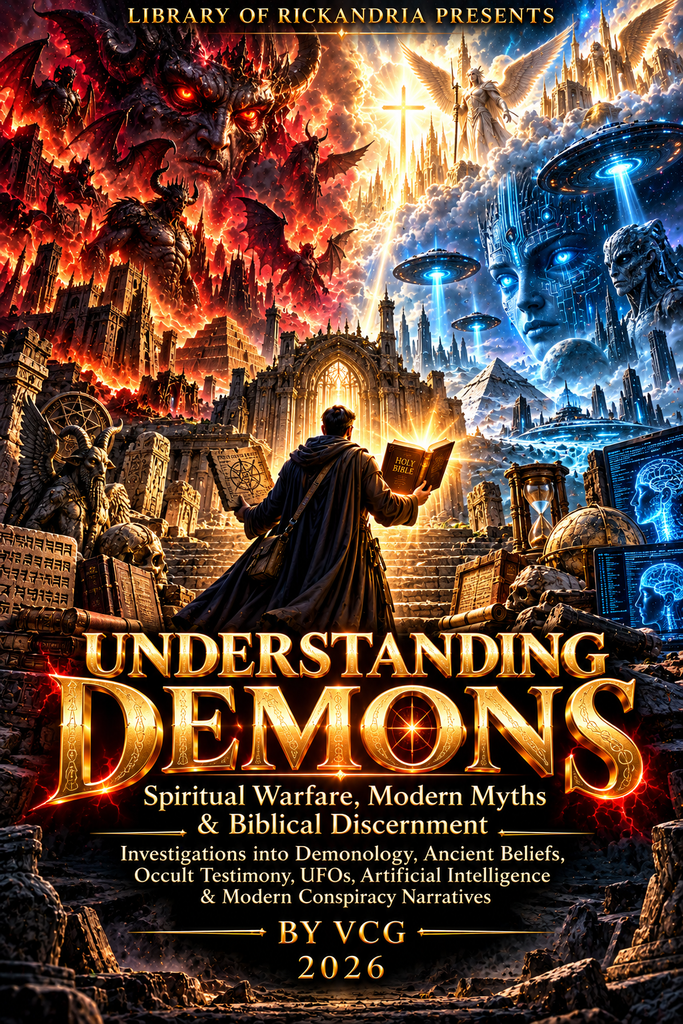
UNDERSTANDING DEMONS
LIBRARY OF RICKANDRIA PRESENTS
Spiritual Warfare, Modern Myths & Biblical Discernment
Investigations into Demonology, Ancient Beliefs, Occult Testimony, UFOs, Artificial Intelligence & Modern Conspiracy Narratives
Research & Investigations by VCG | 2026
“Prove all things; hold fast that which is good.” — 1 Thessalonians 5:21, KJV
Introduction: What Does It Mean to Understand Demons?
Demons appear in the New Testament as evil or unclean spirits, and the Bible speaks seriously about:
- temptation
- idolatry
- spiritual deception
- Christ’s authority
Across history, however, the word demon has also been attached to:
- pagan deities
- nightmares
- illnesses
- unusual perceptions
- unfamiliar technology
- folklore
and accusations against other human beings.
Those claims are not all equivalent.
A biblical passage can establish what Scripture says; a historical source can document what people believed; a testimony can report an experience; and scientific evidence can investigate natural mechanisms.
None of these, by itself, verifies every explanation someone may attach to a disturbing event.
The Library of Rickandria’s Understanding Demons research hub brings together 14 linked works by VCG:
a substantial demonology manual,
historical and theological critiques,
investigations of anonymous discussions about:
- occultism
- UFOs
- AI
- alleged shapeshifters
- skinwalkers
- Neanderthals
- organized persecution
Our purpose is to read carefully, compare Scripture with Scripture, distinguish interpretation from fact, and refuse to use the language of spiritual warfare to frighten or falsely accuse others.
The Biblical Foundation: What Is Actually Written?
Evil spirits and Christ’s authority
The Gospels portray Jesus commanding unclean spirits (Mark 1:23–27; Luke 4:33–36).
They also distinguish people afflicted by diseases from people described as possessed with devils (Matthew 4:24).
These are claims made by the biblical texts, not a license to attribute every medical condition or frightening experience to demons.
Spiritual conflict is not a war against other people
“For we wrestle not against flesh and blood, but against principalities, against powers, against the rulers of the darkness of this world, against spiritual wickedness in high places.” — Ephesians 6:12, KJV
The phrase:
“not against flesh and blood”
matters.
It does not authorize identifying disliked neighbors, religious groups, ethnic communities, or strangers on the internet as nonhuman enemies.
Test claims rather than fear them
“Beloved, believe not every spirit, but try the spirits whether they are of God…” — 1 John 4:1, KJV
In context, John addresses the testing of religious claims and teachers, especially confession concerning Jesus Christ.
The passage is not a forensic guide for diagnosing strangers or detecting supposed reptilian bloodlines.
Ancient demonology and the Nephilim are not identical topics
Genesis 6:1–4 speaks of the “sons of God,” “daughters of men,” and giants.
Christian interpreters disagree about the passage.
It does not expressly state that all demons are the spirits of deceased Nephilim.
That account appears in ancient Enochic literature and later traditions.
It should be identified as an interpretation, not quoted as though it were a verse from Genesis.
The same boundary applies to the Ars Goetia, the Testament of Solomon, medieval grimoires, and other writings:
they can document traditions about demons, but their existence does not prove the claimed entities or rituals.
THE 14 FEATURED INVESTIGATIONS
PART I — SCRIPTURE, ANCIENT BELIEFS & THE HISTORY OF DEMONOLOGY
01. DEMONOLOGY: The Hidden History of Hell’s War on Mankind
A wide-ranging theological manual exploring:
- demons in biblical passages
- the Nephilim and the Book of Enoch
- Mesopotamian and other religious traditions
- historical occult writers
- artistic portrayals
- alleged links with intelligence programs
- Christian spiritual warfare
This work is written from a strongly confessional standpoint.
Its identification of demons as the disembodied spirits of the Nephilim and its claims about modern technology and covert institutions should be evaluated as theological or speculative assertions, not conclusions established by the King James Bible or historical documentation alone.
Study focus:
Where do the biblical text, Enochic tradition, later demonology, and modern speculation begin and end?
02. Gods, Demons & Bad Exegesis
The 4chan Thread That Put Paganism, Angels & the Bible on Trial
A discussion of pagan deities and alleged supernatural sexual encounters grows into competing claims about:
- biblical angels
- philosophy
- mythology
- Christian teaching
- religious prejudice
This investigation examines whether ancient stories, personal experiences, and selected verses really establish the sweeping conclusions offered by participants.
Study focus:
How can:
- Scripture
- myth
- philosophy
- testimony
be evaluated without confusing one kind of evidence for another?
03. Demons, Gods & Conspiracy
A Critique of “The Jewish War Against the Demons”
This paper examines a circulated ideological document alleging that Jewish people collectively conspired to suppress benevolent Gentile gods by recasting them as evil beings.
The investigation tests:
- the source quotations
- linguistic arguments
- claims about ancient religion
- biblical interpretations
It distinguishes legitimate historical discussion of religious change from unsupported collective accusations and antisemitic conspiracy theories.
Study focus:
Why do correct quotations, similar-sounding names, and genuine changes in word meaning fail to prove a coordinated conspiracy?
PART II — SPIRITUAL WARFARE, TESTIMONY & THE DUTY TO TEST CLAIMS
04. UFOs, Demons & Discernment
A Biblical Examination of Monsignor Rossetti’s Claims
The study examines claims by Christian exorcists suggesting that some UFO and alleged alien-abduction experiences may be demonic in origin.
It distinguishes what clergy said from what available records demonstrate, and asks whether passages warning about spirits and occult practices authorize declaring most unidentified aerial phenomena demonic.
Study focus:
A religious authority may advance a theological interpretation without settling the cause of a UAP incident.
05. “Prove All Things”: Demons, Occultism, Testimony & Spiritual Warfare
Read the Complete Investigation
A detailed analysis of a September 2026 4chan thread about:
- casting out demons
- spiritual protection
- Christian testimonies
- psychedelics
- sleep paralysis
- mental health
- manuscript history
and alleged spiritual attacks.
It draws a careful line between a person reporting improvement after prayer and proving the particular supernatural cause of that improvement.
Study focus:
How do we assess a dramatic testimony fairly without treating either personal sincerity or skepticism as proof?
06. The Devil Is in the Details: 99% Demons, or 99% Deception?
An examination of an October 2026 argument claiming that the overwhelming majority of paranormal experiences are demonic.
It explores:
- psychedelic visions
- Gnostic explanations
- religious disagreements
- psychological influences
and the danger of converting broad impressions into numerical certainty.
Study focus:
What evidence would be necessary to justify a claim that “99%” of unexplained events share one cause?
07. Demons, Deception & Discernment
A Biblical, Historical & Psychological Examination of an Occult Thread
This paper tests claims about:
- witchcraft
- hell
- near-death experiences
- exorcism
- alleged elite Satanism
- sleep paralysis
- addiction
- supernatural testimony
It also takes skeptical objections seriously, including questions about:
- morality
- biblical interpretation
- the problem of evil
Study focus:
Can an investigation apply the same evidentiary standard to believers, skeptics, and paranormal witnesses?
PART III — MACHINES, SYMBOLS & MODERN OCCULT NARRATIVES
08. Demons in the Machine?
Fact-Checking AI Haunting Claims Through Technology, Psychology & Scripture
A 4chan discussion wonders whether:
- unsettling AI responses
- unusual synthesized voices
- quantum-computing rhetoric
reveal ghosts, trapped consciousness, or demons inside machines.
The study examines real technological behavior, human tendencies to attribute intention to machines, and the differences between computer output, consciousness theories, and spiritual interpretation.
Study focus:
Unexpected or disturbing AI output does not itself demonstrate a supernatural entity.
09. Demons, Math & Mind Games
Exposing 4chan’s Occult Rabbit Hole
A request for demonology books develops into claims about:
- ancient grimoires
- mathematical structures
- sacred geometry
- cosmic rulers
- astronomical images
and the alleged spiritual causes of psychological symptoms.
The investigation distinguishes real mathematical or historical material from the supernatural interpretations attached to it.
Study focus:
A genuine equation, scientific photograph, or historical manuscript is not automatic evidence for an occult mechanism.
PART IV — NEANDERTHALS, REPTILIANS & CULTURAL FOLKLORE
10. Demons, Neanderthals & the Architecture of Conspiracy
An investigation of a sprawling online theory linking:
- Neanderthal remains
- cannibalism
- Japanese folklore
- biblical giants
- modern populations
to claims of demonic ancestry.
It acknowledges genuine archaeological and historical facts while rejecting unsupported racial and supernatural conclusions.
Study focus:
Documented facts do not prove the extraordinary connections drawn between them.
Evaluate the links in the argument, not merely its individual ingredients.
11. Demons, Reptilians & Digital Deception
Exposing the Shapeshifter Myth
A thread proposes supposed ways of recognizing concealed reptilians, skinwalkers, or other shapeshifters among ordinary people.
The investigation examines:
- personal anecdotes
- folklore
- digital imagery
- sleep paralysis
- perception
and the harm of accusing human beings of being secret monsters.
Study focus:
Appearance, camera artifacts, ambiguous memories, and fearful intuitions are not reliable evidence that a person is nonhuman.
12. Skinwalkers, Demons & Deception
Navajo Traditions, Internet Folklore & Biblical Interpretation
This investigation separates specific Diné (Navajo) cultural traditions and their historical treatment from sensational internet claims about:
- shape-changing
- witchcraft
- demons
It considers:
- Indigenous sources
- anthropology
- psychology
- relevant biblical passages
while cautioning against flattening a living culture into a generic horror story.
Study focus:
A tradition’s documented existence does not verify every modern paranormal retelling of it.
13. Reptilians, Demons & Deception
What 4chan Gets Wrong About Spiritual Warfare
A discussion about protection from alleged extradimensional reptilians becomes a debate over:
- spiritual defenses
- frequencies
- unusual abilities
- popular reptilian mythology
The paper investigates the source of the claims and compares them with psychology, biology, and the biblical account of spiritual conflict.
Study focus:
Biblical spiritual warfare does not establish the existence of interdimensional reptile people or supernatural “frequency” defenses.
PART V — PERSECUTION CLAIMS, FEAR & RESPONSIBLE DISCERNMENT
14. “THE ILLUMINATI IS ATTACKING ME”
MKULTRA, Demons & Digital Paranoia
An anonymous poster reports being targeted by a hidden organization.
Respondents introduce:
- mind-control theories
- invisible entities
- occult diagrams
and an attempted online exorcism.
The study separates the documented history of MKULTRA from unverified modern claims of personal surveillance and demonic attacks, without dismissing the distress expressed by the original poster.
Study focus:
Real historical abuses do not prove that a particular person is being persecuted by the same mechanism.
Respond to fear with care, not escalating accusations or hazardous rituals.
How to Read These Investigations
Start with what the Bible says.
Read the Gospel accounts, Ephesians 6, 1 John 4, and then
“Prove All Things”
This establishes the distinction between scriptural teaching and claims attached to it.
Study the traditions.
Read Demonology alongside Gods, Demons & Bad Exegesis and Demons, Gods & Conspiracy.
Keep historical descriptions, biblical exegesis, and speculation in separate categories.
Test extraordinary experiences.
Continue with The Devil Is in the Details and Demons, Deception & Discernment.
Ask whether a testimony documents an experience, its cause, or both.
Investigate modern claims.
Read Demons in the Machine?, Demons, Math & Mind Games, and the reptilian, Neanderthal, and skinwalker investigations.
Finish with the human consequences.
Read “The Illuminati Is Attacking Me” for a case study of how online claims can intensify fear and why responsible discernment must include compassion.
A Quick Guide to Evidence
| Claim | What can responsibly be concluded? |
|---|---|
| The New Testament speaks about unclean spirits. | Yes; this is explicit in the biblical text. |
| Demons are deceased Nephilim. | An ancient interpretive tradition, not explicitly stated in Genesis 6. |
| A historical grimoire names a demon. | This establishes that the text contains the name, not that the being has been independently verified. |
| A person experienced a frightening presence. | Their report merits care; the ultimate cause requires separate investigation. |
| AI output is uncanny or appears intelligent. | That observation does not show a ghost or demon operates the system. |
| Some Neanderthals practiced cannibalism. | Archaeological research supports instances, not the claim that Neanderthals were demons or that any modern people have demonic ancestry. |
| Unidentified objects or unusual footage exist. | Unidentified does not mean demonic or extraterrestrial. |
| Scripture commands believers to test spiritual claims. | Yes; that does not authorize baseless accusations or medical neglect. |
Frequently Asked Questions
Are demons mentioned in the King James Bible?
Yes.
The New Testament often uses “devils” and “unclean spirits,” particularly in accounts involving Jesus Christ (Mark 1:23–27; Luke 8:26–39).
The English term demon is more common in later theological discussion than in the KJV’s main wording.
Are demons and fallen angels exactly the same?
Christian traditions disagree on their precise relationship.
The Bible speaks about angels that sinned (2 Peter 2:4), the devil and his angels (Matthew 25:41), and unclean spirits.
It does not present one comprehensive genealogy settling every later demonological classification.
Does Genesis 6 prove that demons came from the Nephilim?
No.
That connection is developed in Enochic tradition; Genesis 6 itself does not say it.
Readers can study that interpretation without treating it as an explicit KJV statement.
Does mental illness, sleep paralysis, or an intrusive thought prove demonic possession?
No.
Such experiences may have recognized medical, sleep-related, neurological, or psychological explanations.
They should not be diagnosed as demonic from internet posts, and appropriate professional care should not be withheld.
Are all pagan gods the same as biblical demons?
Scripture rejects idolatry, and 1 Corinthians 10:20 discusses sacrifices offered to devils.
That does not establish that every named deity or spirit in every religion has been independently identified as one particular biblical being.
Historical and theological categories should not be confused.
Can artificial intelligence become possessed by demons?
The investigations provide no independently verified evidence for such a claim.
Unusual model responses, voices, images, or software failures require technical investigation before assigning a spiritual explanation.
Does the Bible tell believers to be afraid of hidden enemies everywhere?
The New Testament warns about deception while directing believers toward faith, steadfastness, love, truth, and resistance to evil (James 4:7; Ephesians 6:10–18; 2 Timothy 1:7).
It does not command suspicion of every person or technological object.
How should someone respond to a frightening experience?
Take the person’s experience and safety seriously without immediately confirming a supernatural explanation.
Consider the situation, medical or sleep-related factors, and appropriate practical support.
If someone feels threatened or overwhelmed, real-world professional help can coexist with voluntary spiritual counsel.
The Wider Research Library
- THE 4CHAN FILES — Where Anonymous Claims Meet Evidence & Scripture
- VCG PAPER PROJECTS
- UNDERSTANDING DEMONS — Basecamp Companion Index
- THE ALIEN DECEPTION? — Related Research Hub
- WHO IS GOD? — Related Research Hub
Final Perspective: Discernment Without Fear
The Bible’s treatment of evil spirits should be studied seriously and in context.
So should the history of demonology, the ways people interpret unusual experiences, and the ease with which:
- myths
- technology
- historical facts
- online rumors
can be assembled into frightening narratives.
These 14 investigations do not all speak in the same tone or arrive at the same emphasis.
The role of this hub is to make their subjects clear and to encourage readers to examine their reasoning rather than accept an assertion merely because it invokes Scripture, antiquity, science, or secret knowledge.
Truth does not require exaggeration.
Faith does not require credulity.
Discernment does not require fear.
“For God hath not given us the spirit of fear; but of power, and of love, and of a sound mind.” — 2 Timothy 1:7, KJV
Soli Deo Gloria — To God alone be the glory.
LIBRARY OF RICKANDRIA | RESEARCH BY VCG | 2026
THE 4CHAN FILES: Where Anonymous Claims Meet Evidence & Scripture – Library of Rickandria
VCG PAPER PROJECTS – Library of Rickandria
UNDERSTANDING DEMONS: Spiritual Warfare, Modern Myths & Biblical Discernment
UNDERSTANDING DEMONS: Spiritual Warfare, Modern Myths & Biblical Discernment – Library of Rickandria