
“Prove All Things”: A Line-by-Line Biblical & Evidentiary Critique of Claims About Demons, Occultism, Testimony & Spiritual Warfare in a 4chan /x/ Thread
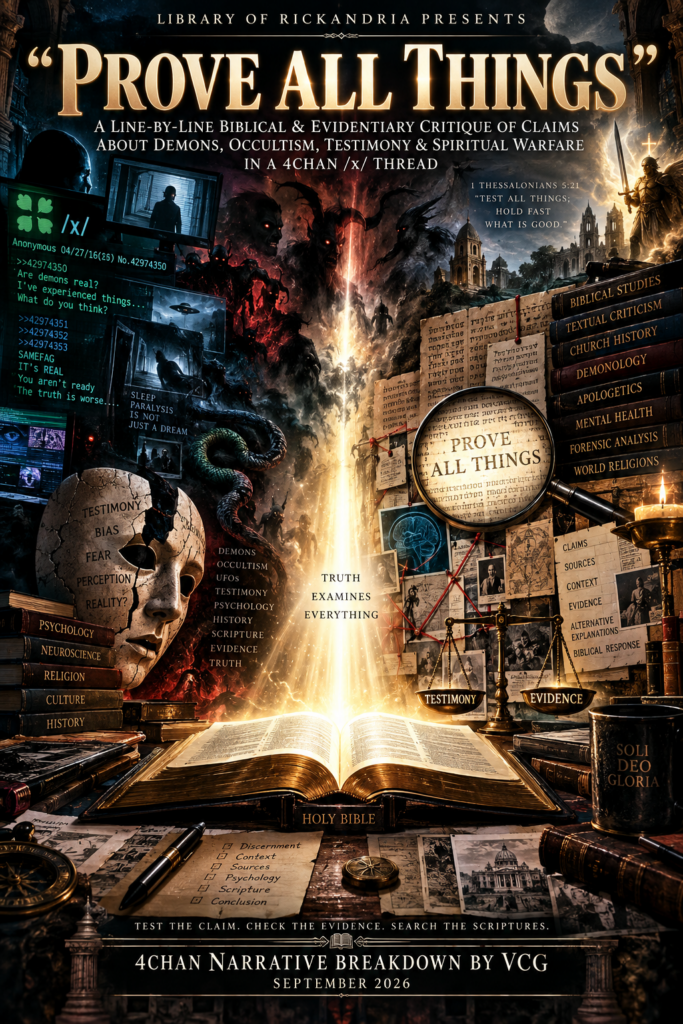
UPDATED BY VCG ON 9/20/2026 @ 05:55 EST
Anyone can do this, but most won’t.
ChatGPT – Library of Rickandria
LIBRARY OF RICKANDRIA PRESENTS
“PROVE ALL THINGS”
A Line-by-Line Biblical & Evidentiary Critique of Claims About Demons, Occultism, Testimony & Spiritual Warfare in a 4chan /x/ Thread
4CHAN NARRATIVE BREAKDOWN BY VCG
SEPTEMBER 2026
“Prove all things; hold fast that which is good.”— 1 Thessalonians 5:21, KJV
ABSTRACT
On September 17, 2026, an anonymous poster using the name “Knight of the Faith” opened a thread on 4chan’s paranormal board, /x/, titled Casting out demons, spiritual protection, and staying vigilant.
/x/ – Casting out demons, spiritual protection, and staying vigilant – Paranormal – 4chan
The stated purpose was ambitious:
the author promised to present:
“convincing material that confirms the truth of the Bible,”
teach readers about demons and spiritual protection, and expose what he regarded as deception and spiritual darkness.
The thread quickly grew into a sprawling discussion of:
- exorcism
- psychedelic drugs
- demonic possession
- sleep paralysis
- mental illness
- near-death and hell testimonies
- occultism
- atheism
- morality
- Western civilization
- biblical manuscripts
- dreams
- unidentified anomalous phenomena
- antisemitic conspiracy theories
- Christian theology
and the historical existence of Jesus.
This paper does not begin by assuming either that every supernatural claim in the thread is true or that supernatural claims are impossible.
Instead, it follows the principle from which its title is taken:
test the claim.
That requires several distinctions which are repeatedly blurred in the thread.
A proposition may be explicitly taught by Scripture; it may instead be a theological inference.
A person may sincerely testify that an experience happened without knowing its ultimate cause.
A phenomenon may have a well-established medical mechanism without that mechanism settling every metaphysical question.
A historical claim may be strongly supported even though historians cannot demonstrate a miracle by the same methods used to date a manuscript or identify a Roman governor.
And an argument may reach a conclusion compatible with Christianity while still arriving there by poor reasoning.
The central conclusion of this investigation is therefore deliberately nuanced.
The New Testament unquestionably presents a world in which:
- Satan
- demons
- temptation
- spiritual deception
- possession
and spiritual conflict are real.
Jesus is portrayed as exercising authority over unclean spirits, the apostles encounter evil spirits, Christians are warned about spiritual wickedness, and divination and occult practices are condemned.
These doctrines cannot honestly be removed from the biblical text merely because modern readers find them uncomfortable.
Matthew distinguishes people suffering ordinary diseases from people described as possessed; Mark likewise distinguishes the diseased from those described as demonized.
At the same time, the thread repeatedly goes beyond the biblical text.
Scripture does not identify extraterrestrials with demons.
It does not say every episode of sleep paralysis is demonic.
It does not teach that every case of:
- depression
- anxiety
- obsessive thoughts
- addiction
or psychosis results from demons.
It does not tell Christians to interpret every hostile commenter as an agent of Satan.
It does not authorize us to treat anonymous YouTube comments as self-authenticating proof of miracles.
Nor does it allow a person to elevate a politically charged private dream into divine revelation merely because some of its imagery can be associated with a biblical verse.
The skeptical participants fare unevenly as well.
They are right to distinguish testimony from proof, to ask questions about manuscript transmission, and to demand evidence for causal claims.
But several then abandon that same evidentiary standard, making claims that Jesus was merely fictional, that Christian ritual is literal cannibalism or “black magic,”
or advancing antisemitic theories about:
- Jews
- blood pacts
- circumcision
- secret control
Those claims also fail historical, logical, or biblical scrutiny.
The purpose of this paper, then, is neither to baptize every supernatural story nor to explain away the supernatural in advance.
It is to ask a harder question:
What survives when every side is required to use the same standard of evidence?
I. THE THREAD UNDER EXAMINATION
The thread begins at post No. 42974350, dated September 17, 2026.
The opening poster promises material that will:
“confirm the truth of the Bible”
and instructs readers interested in:
- deliverance
- spiritual protection
- deception
to follow along.
He also recommends using 4chan’s “hide post” function against detractors and predicts that the discussion will attract dismissive or irrational responses.
That opening matters because it establishes the burden of proof.
There is a difference between saying:
“Here are testimonies that I personally find compelling.”
and saying:
“Here is convincing material that confirms the truth of the Bible.”
The latter is a much larger claim.
It requires us to ask not simply whether a testimony is moving, but whether its source can be verified, whether alternative explanations have been considered, whether the conclusion follows from the evidence, and whether the biblical passage being cited actually teaches what the poster says it teaches.
This paper consequently treats the thread as a claim corpus.
- Hostile insults
- repetitive image-posts
- racial slurs
- jokes
- memes
and substantially identical testimonies are not independently re-argued each time they appear.
Instead, every distinct substantive argument is isolated and evaluated.
When the same reasoning pattern appears again, it is treated as another instance of the same claim structure.
II. METHODOLOGY: HOW A CLAIM IS TESTED
The most important methodological rule in this paper is that different kinds of claims require different kinds of evidence.
A verse can establish what a biblical author says.
It cannot by itself establish that an anonymous modern YouTube story happened exactly as described.
A medical study can establish that sleep paralysis has a recognized relationship with REM sleep.
It cannot experimentally prove the philosophical proposition that no nonmaterial beings exist.
An ancient manuscript can tell us what an early Christian text said.
It does not by itself establish that every miracle described within the manuscript occurred.
A testimony can establish that someone reports an experience.
It does not automatically identify the experience’s ultimate cause.
For clarity, the paper therefore uses the following evidentiary classifications:
| Classification | Meaning |
|---|---|
| Explicit Scripture | The proposition is directly stated or unmistakably depicted in the biblical text. |
| Biblical Inference | The proposition may reasonably be inferred from multiple texts but is not directly stated in those words. |
| Theological Tradition | The idea has an established history in Christian theology but is not identical to explicit biblical teaching. |
| Testimonial Evidence | Someone reports an experience. The report may be sincere, but the cause has not necessarily been established. |
| Historically Supported | Documentary or historical evidence supports the proposition to a meaningful degree. |
| Empirically Supported | Observational or experimental evidence supports the proposition. |
| Plausible but Unverified | The claim is possible but sufficient evidence is unavailable. |
| Unsupported | The evidence provided does not establish the claim. |
| Contradicted | Available evidence directly conflicts with the claim as stated. |
| Unfalsifiable | The claim is structured so that practically every conceivable outcome can be interpreted as confirmation. |
This approach is itself consistent with the epistemic posture of Scripture.
Paul does not tell the Thessalonians to believe every religious claim.
He says:
“Prove all things; hold fast that which is good.”
John likewise warns:
“Beloved, believe not every spirit, but try the spirits whether they are of God.”
And Acts praises the Bereans because they:
“searched the scriptures daily, whether those things were so.”
Biblical faith, therefore, does not require credulity.
Discernment exists because claims can be wrong.
III. THE FIRST MAJOR CLAIM: SHAWN RYAN IS SUFFERING DEMONIC OPPRESSION
At post 42974379, the OP argues that podcaster Shawn Ryan has been experiencing:
“serious demonic oppression.”
The stated explanation is that:
“the kingdom of darkness”
opposes Ryan because his interviews with Christian clergy and exorcists have led listeners toward Christianity.
The OP links a video interpreting Ryan’s psychedelic experiences and subsequent difficulties through this framework.
There are at least three separate propositions here.
First, Ryan reports disturbing experiences.
That proposition can be investigated through Ryan’s own public statements.
Second, particular clergy interpret those experiences as demonic.
That can also be documented.
Third, demons actually caused those particular experiences because Ryan was advancing Christian truth.
That final proposition does not follow automatically from the first two.
This distinction becomes especially important because even the Roman Catholic institution from which some of the thread’s exorcism material is drawn adopts a considerably more cautious diagnostic standard.
The United States Conference of Catholic Bishops states that a person claiming demonic affliction should undergo thorough:
- medical
- psychological
- psychiatric
evaluation before referral for major exorcism.
Its guidance explicitly warns against believing too easily that the devil is responsible while also warning against ruling out spiritual causes in advance.
Whatever one thinks about Catholic theology, that procedural caution is significant.
The thread frequently presents modern exorcists as authorities while ignoring the evidentiary caution embedded within formal exorcism practice itself.
The biblical record likewise refuses to flatten every illness or disturbing condition into demonic possession.
Matthew 4:24 distinguishes:
“divers diseases and torments,”
those:
“possessed with devils,”
those described as “lunatick,” and those with palsy.
Mark 1 similarly distinguishes:
“all that were diseased”
from
“them that were possessed with devils.”
The texts undeniably affirm demonization.
But precisely because they distinguish demonization from sickness, they do not authorize the rule:
unusual suffering = demon.
The most defensible formulation is therefore:
Within the Christian worldview, demonic oppression is a theological possibility.
The thread does not independently establish that demons are the cause of Shawn Ryan’s particular reported experiences.
That is a meaningful distinction.
IV. THE TESTIMONY ENGINE
At post 42974405, the OP answers a skeptical participant by pointing to what he calls a surprisingly large number of testimonies.
One reproduced testimony describes:
- military trauma
- alcohol abuse
- psychedelic use
- conversion to Christianity
- the cessation of night terrors after prayer
- sobriety
and a later pregnancy following a vasectomy reversal.
The OP follows this with more comments claiming that Jesus made demons disappear and that invoking Jesus stopped frightening paranormal events.
This becomes the thread’s principal apologetic method.
The pattern is:
person suffered → person encountered Christianity → condition improved → therefore the condition was spiritual → therefore Jesus caused the improvement → therefore biblical Christianity has been confirmed.
Parts of this argument may be true.
But the chain contains several steps, each of which requires evidence.
Suppose a person truthfully reports:
“I suffered night terrors for twenty years.
I prayed after converting to Christianity.
They stopped.”
That testimony directly supports one proposition:
The person reports that the night terrors stopped after prayer.
It does not by itself establish:
The prayer caused the cessation.
And it still does not establish:
Demons caused the night terrors and were expelled by prayer.
Those may be the person’s sincere interpretation.
They are not identical to the observable sequence.
This distinction is not hostility toward testimony.
It is the ordinary distinction between:
- event
- sequence
- causation
- interpretation
The denominator problem
The thread collects dramatic successful stories, but it does not tell us:
How many Christians pray during night terrors and continue having them?
How many people recover from substance use without religious conversion?
How many people convert and later relapse?
How many people pray for physical healing without receiving the desired outcome?
How many people from other religions tell structurally similar transformation stories?
Without comparison groups or denominators, a collection of selected success stories is vulnerable to selection bias and survivorship bias.
A testimony may still be important.
It simply cannot bear every evidentiary burden the thread places upon it.
V. WHY TESTIMONY SHOULD NOT BE MOCKED EITHER
One skeptical participant later calls the evidence:
“cheap and low quality fake testimonies”
and compares it to using Spider-Man cartoons as evidence for Spider-Man.
That criticism identifies a genuine problem but overcorrects.
A testimonial source is not equivalent to a fictional comic merely because it is insufficient to prove every attached interpretation.
Human testimony is indispensable to:
- history
- courts
- journalism
- biography
- medicine
- ordinary life
The right question is not:
“Is testimony worthless?”
It is:
“What exactly does this testimony establish?”
A firsthand account may provide evidence that an experience occurred.
Independent witnesses may strengthen it.
Contemporaneous documentation may strengthen it further.
Medical records may test claims of physical change.
Multiple accounts may be compared for independence.
But none of this should be skipped merely because the testimony supports the conclusion we already prefer.
The same standard should apply:
- when an atheist recounts deconversion
- when a Hindu reports a vision
- when a Muslim reports answered prayer
or when a New Age practitioner reports beneficial spiritual contact.
Mutually incompatible religions all contain sincere testimonies.
Therefore:
sincerity ≠ exclusive theological truth.
The thread needs another step.
VI. PSYCHEDELICS, PTSD, AND THE CLAIM THAT DRUGS “OPEN PORTALS”
At post 42974441, the OP reproduces comments warning that psychedelics expose users to spirits and demons.
One commenter mentions a new VA psychedelic treatment for PTSD.
Another interprets the cancellation of an ayahuasca retreat during a storm as God’s intervention.
The OP advises readers not to take psychedelics or marijuana because they can allegedly:
“open you up to the demonic.”
There is a factual claim hiding inside the testimony.
The U.S. Department of Veterans Affairs really is researching psychedelic-assisted treatment.
On May 26, 2026, VA announced a randomized controlled trial of MDMA-assisted therapy involving approximately 80 veterans with PTSD and alcohol-use disorder.
But this is a clinical trial evaluating safety and efficacy, not proof that psychedelics have simply become ordinary VA PTSD medication.
Psychedelic drugs can produce profound alterations in:
- perception
- cognition
- emotion
- identity
- sensory processing
It is entirely legitimate to investigate:
- acute psychiatric risk
- interactions with preexisting vulnerability
- dosage, setting
- informed consent
- long-term outcomes
and whether therapeutic benefits survive controlled trials.
But those are distinct from the metaphysical proposition:
psychedelics open spiritual portals.
The thread provides testimony for that interpretation but no method capable of discriminating between:
a pharmacological hallucination,
a psychologically mediated experience,
a spiritually interpreted experience,
and an actual encounter with an independent nonphysical being.
A Christian can nevertheless oppose recreational intoxication on theological and moral grounds without pretending a scientific experiment has demonstrated “portals.”
This illustrates a principle that will recur throughout the paper:
A theological prohibition does not need a fabricated scientific proof added to it.
VII. MANUSCRIPTS: “NO HISTORIAN CAN VERIFY WHERE THESE TEXTS CAME FROM”
At post 42974430, a skeptic argues that old scriptural rolls and books prove nothing, that no historian has a meaningful chance of verifying their origins, and that the Bible has no greater evidentiary standing than ancient stories about Hindu gods.
This criticism begins with a legitimate question and ends with an overstatement.
No original physical manuscript—the autograph—of any New Testament book survives.
The Institute for New Testament Textual Research at Münster states this plainly.
The earliest surviving New Testament papyrus fragments date to the second century, major complete codices such as Vaticanus and Sinaiticus to the fourth century, and roughly 5,700 Greek manuscript witnesses are known.
Centuries of copying produced numerous variants, and no two manuscript witnesses possess exactly the same variant profile.
That is not a secret concealed by textual scholars.
It is the reason textual criticism exists.
The same institute explains that scholars compare:
- manuscript relationships
- internal readings
- external attestation
- ancient translations
and citations in early Christian literature in order to reconstruct the earliest recoverable text.
Thus the accurate statement is:
The original autographs are lost and the manuscript tradition contains variants.
Scholars reconstruct the earliest recoverable text by comparing a very large surviving textual tradition.
The inaccurate statement is:
“No historian has any chance to investigate where these texts came from.”
Those are not remotely the same proposition.
Historical uncertainty exists in degrees.
It does not reduce every ancient text to evidentiary zero.
VIII. THE BIBLE’S OWN TRANSLATORS WERE LESS FRAGILE ABOUT TEXTUAL QUESTIONS
There is an irony here.
Some modern defenders of Scripture treat any acknowledgment of textual or translational uncertainty as an attack upon the Bible.
The translators associated with the King James tradition were more sophisticated.
The supplied Cambridge KJV includes The Translators to the Reader, where the translators discuss previous translations, original Hebrew and Greek, alternative renderings, difficult words, and the usefulness of marginal readings.
The historical KJV project itself involved multiple companies of scholars and revision.
Their confidence in Scripture did not require pretending translation was mechanically simple.
That should discipline both extremes.
The existence of textual variants does not mean:
“we know nothing.”
But reverence for Scripture does not require saying:
“there are no textual problems.”
Truth does not need false certainty.
IX. “CRIME AND MENTAL ILLNESS ARE EXPLODING BECAUSE DEMONS ARE INCREASING”
At one point the OP states that a Catholic exorcist has described increasing demonic oppression or possession and then adds that people paying attention have seen a “huge increase” in violent crime and mentally ill people,
concluding:
“It’s because of demons.”
Later he expands the argument:
violent crime is increasing;
drug addiction is increasing;
suicide is rising;
mental illness is increasing;
young women are turning to witchcraft;
pornography addiction is widespread;
and demonic possession is increasing.
This is rhetorically powerful because multiple alarming subjects are compressed into one escalating story.
But they have to be separated before they can be tested.
Violent crime
The latest nationwide FBI evidence available when this paper was prepared directly contradicts the thread’s blanket assertion.
The FBI reported in August 2026 that the U.S. violent-crime rate fell 9.3 percent from 2024 to 2025, which it described as the largest year-to-year decline since national estimates began in 1936.
Murder and nonnegligent manslaughter fell 18.1 percent, robbery 18.5 percent, rape 7.6 percent, and aggravated assault 7.2 percent.
Localities can differ.
But the national statement:
“violent crime has been increasing”
was not an accurate description of the latest national trend.
Drug overdose
Drug-related suffering remains severe.
But overdose mortality also contradicts the simple:
“everything is rising”
narrative. CDC provisional data estimated 69,973 overdose deaths in 2025, nearly 14 percent below the 2024 estimate of 81,313.
CDC described this as the third consecutive annual decline.
That does not mean addiction has been solved.
It means the thread’s trend claim needs qualification.
Mental illness
SAMHSA’s 2024 National Survey on Drug Use and Health found no statistically significant change from 2021 through 2024 in the percentage of U.S. adults with:
“any mental illness”
or
“serious mental illness.”
Serious mental illness among adults ages 18–25 actually declined over that interval in the comparable series.
Again, the absolute burden remains large.
But
“many people suffer”
is not synonymous with:
“prevalence is rapidly increasing.”
Suicide
CDC reports 48,824 U.S. suicide deaths in 2024.
Suicide remains a grave public-health concern, and trends differ by:
- age
- sex
- race
- region
- time period
But the evidence does not justify the simplistic phrase:
“the suicide rate keeps rising higher”
as though every recent year forms an uninterrupted upward line.
The deeper problem remains even if every statistic had increased.
Suppose:
- violent crime
- addiction
- suicide
- psychiatric illness
all rose simultaneously.
That would still not demonstrate:
therefore, demons increased.
The proposed causal variable—demonic activity—is not being independently measured.
This is correlation being converted into metaphysical causation.
X. “MANY YOUNG WOMEN ARE PRACTICING WITCHCRAFT”
The OP connects young women in particular with witchcraft and New Age practices.
There is a real demographic pattern beneath the exaggeration.
A 2025 Pew Research Center survey found that women, and especially women ages 18–49, were substantially more likely than men to say they believe in astrology.
Forty-three percent of women ages 18–49 said they believed in astrology.
Women were also more likely to engage with astrology and related practices.
But two cautions matter.
First, astrology or tarot use is not identical to practicing witchcraft.
Second, Pew reports that belief in astrology among major demographic categories had changed relatively little since its earlier 2017 measurement.
So, the evidence can support a statement such as:
Certain occult-adjacent or divinatory practices are relatively common among younger women.
It does not automatically support:
Witchcraft is rapidly exploding because demonic influence has increased.
The latter adds claims the data do not measure.
XI. PORNOGRAPHY AND THE DANGER OF CASUAL DIAGNOSIS
The thread also places pornography into its catalogue of escalating social pathology.
Problematic or compulsive pornography use can certainly damage:
- work
- relationships
- mental health
- daily functioning
But diagnostic language matters.
The DSM does not simply contain a diagnosis called “porn addiction.”
The WHO’s ICD-11 recognizes compulsive sexual behaviour disorder under impulse-control disorders, and professional literature explicitly warns against diagnosing pathology solely on the basis of moral distress or a person applying the word “addict” to himself.
This is another example of a legitimate moral or pastoral concern weakened by careless clinical labeling.
A Christian may have strong theological objections to pornography.
That does not eliminate the need for accurate psychological terminology.
XII. “CHILDREN ARE BEING TAUGHT TO BE GAY AND TRANS”
The thread includes the statement that children are:
“being taught to be gay and trans.”
This compresses several different questions into one sentence.
Schools may teach students that homosexuality, bisexuality, or transgender identities exist.
Parents and citizens may legitimately debate what sexual or gender material is age appropriate, what should be included in curricula, how parental notification works, and how schools should address contested ethical questions.
Those are public-policy questions.
But teaching about a category is not the same causal claim as teaching a person to become that category.
On sexual orientation specifically, the American Psychological Association states that there is no consensus reducing orientation to any single causal factor and that most people report little or no sense of voluntarily choosing their orientation.
Whatever moral or theological conclusion a Christian reaches about sexual behavior, the evidentiary correction is straightforward:
curriculum exposure ≠ demonstrated causal production of sexual orientation.
XIII. THE “TOP FIVE REASONS NOT TO BE AN ATHEIST”
At post 42974892, the OP offers five arguments against atheism:
- that atheism depends on belief that a primordial explosion organized itself into life
- that atheists have no objective morality
- that naturalism produces nihilistic depression
- that humans inevitably worship substitutes when they reject God
and that atheism arrogantly rejects the Christian foundation of Western civilization.
These arguments should not simply be laughed away.
But neither should they be presented as settled facts.
Atheism is not a theory of abiogenesis
Atheism, in its minimal sense, concerns belief or nonbelief in gods.
The Big Bang theory concerns cosmic expansion and the early physical universe.
Abiogenesis concerns the emergence of life from nonliving chemistry.
Biological evolution concerns the diversification of living populations after life exists.
One person may accept some combination of these theories and reject others.
Therefore:
“atheism requires blind faith that a primeval explosion spontaneously organized itself into life”
collapses several distinct questions into a single caricature.
A stronger Christian apologetic argument would ask why there is something rather than nothing, whether contingent reality requires explanation, whether cosmic intelligibility points beyond itself, or whether consciousness and rationality are adequately accounted for by naturalism.
Those are serious philosophical questions.
The thread’s formulation is not.
Objective morality
The argument that objective moral obligations require a transcendent ground is a serious philosophical position.
But secular moral realism also exists.
An atheist may be:
- a moral realist
- constructivist
- consequentialist
- contractualist
- virtue ethicist
or something else entirely.
A Christian may argue that these theories ultimately fail to ground moral obligation as adequately as theism.
But that requires argument.
It cannot simply be defined out of existence by saying atheists possess:
“zero objective basis.”
Nihilism
Naturalism does raise profound questions about ultimate purpose.
But it does not logically follow that every atheist believes life has no meaningful human value.
A person may ground meaning in:
- relationships
- knowledge
- creativity
- moral duty
- love
- family
- conscious flourishing
or chosen projects.
A Christian can reply that these forms of meaning lack an ultimate eternal foundation.
That is a much more precise argument than saying atheists simply live in a meaningless void.
“Everyone worships something”
As theological rhetoric, this can be insightful.
Humans can certainly absolutize:
- nation
- ideology
- career
- pleasure
- status
- wealth
- identity
or self.
But if “worship” is redefined to include every intense commitment, the proposition becomes true by definition rather than by discovery.
Western civilization
Christianity has exercised enormous influence upon European and Western civilization.
But Western civilization also inherits:
- Hebrew
- Greek
- Roman
- Germanic
- Enlightenment
- scientific
and many other streams.
More importantly:
a civilization’s achievements do not logically establish the truth of every metaphysical proposition held by that civilization.
Christianity must ultimately stand or fall upon truth—not architectural output.
XIV. SUFFERING: “YOUR LIFE IS AWFUL BECAUSE YOU CHOSE SIN”
Immediately before those five arguments, the OP says many people choose sin, reject God, and then complain that their life is terrible:
“It’s your own choice.”
There is a biblical truth inside this.
Actions have consequences.
Galatians speaks of sowing and reaping.
James places a real source of temptation within human desire:
“every man is tempted, when he is drawn away of his own lust, and enticed.”
This is important because it prevents a demonological worldview from becoming an excuse for human responsibility.
But Scripture also rejects the inverse error: assuming suffering proves personal guilt.
In John 9 the disciples ask whether a man’s congenital blindness resulted from his own sin or his parents’.
Jesus rejects the proposed binary.
In Luke 13, Jesus refuses to conclude that victims of Pilate or the collapse of the tower of Siloam were worse sinners than others because tragedy befell them.
The entire book of Job resists simplistic equations between suffering and personal wrongdoing.
A more biblical theology recognizes several possible sources of suffering:
human choices;
the actions of others;
ordinary bodily frailty;
accidents and natural events;
living within a fallen creation;
persecution;
spiritual conflict;
and causes unknown to the sufferer.
“Your life is bad because you chose sin”
is therefore sometimes true.
As a universal explanation, it resembles the reasoning Scripture itself rebukes.
XV. HELL, “LUCIFER,” AND FREE WILL
At post 42974964, the OP replies to criticism of hell by saying Scripture teaches that hell was created for the devil and his angels; that Satan, then called Lucifer, rebelled because he wished to be God; that Adam and Eve essentially joined Satan’s side; and that God cannot override human free will.
Several different theological claims need separation.
Hell and the devil’s angels
Matthew 25:41 explicitly speaks of:
“everlasting fire, prepared for the devil and his angels.”
That claim has direct textual grounding.
“Lucifer” as Satan’s original personal name
Isaiah 14:12 in the KJV famously uses “Lucifer.”
But the immediate literary context explicitly introduces the passage as a taunt against the king of Babylon.
Christian interpreters have historically read the arrogant fall described there typologically as reflecting Satan’s fall.
That traditional interpretation may be defended.
But it should not be represented as though Isaiah explicitly opens a historical biography entitled Satan’s Life Before Eden.
That distinction is the difference between text and theological interpretation.
Lucifer as Morning Star, Fallen Angel, Light-Bringer & Symbol of Sovereignty – Library of Rickandria
“God cannot override free will”
Scripture treats human beings as morally responsible creatures whose choices matter.
But
“God cannot override free will”
goes considerably beyond the language of the biblical text.
Scripture also contains strong descriptions of:
- divine sovereignty
- election
- providence
- drawing
- hardening
and God accomplishing his purposes.
Christians consequently disagree over how these statements interrelate.
- Augustinian
- Reformed
- Arminian
- Molinist
- Thomistic
and other systems formulate freedom differently.
A safer statement is:
Scripture holds human beings responsible for their response to God while simultaneously affirming divine sovereignty.
The precise philosophical relationship between those truths is disputed within Christianity.
That formulation says what Scripture gives us without pretending a later philosophical synthesis is itself a verse.
XVI. DREAMS AND PRIVATE REVELATION
The thread repeatedly appeals to dreams.
One testimony concerns a Muslim who allegedly saw Jesus in a dream.
Other posts cite conversion experiences involving visions.
The OP also interprets a politically charged dream of his own through biblical symbolism.
Dreams unquestionably appear in Scripture.
Some are divinely given.
That fact, however, does not imply:
therefore, a vivid dream is probably a revelation from God.
Jeremiah 23 is unusually relevant.
It condemns people who claim divine authority for dreams originating in their own hearts, including those who say,
“I have dreamed, I have dreamed.”
The chapter distinguishes a dream from the trustworthy word of God and warns against falsely declaring:
“He saith.”
Likewise:
“Believe not every spirit, but try the spirits whether they are of God.”
A useful rule follows:
A private experience may be evaluated by Scripture.
Scripture should not be reinterpreted by a private experience.
If a person dreams about a river and later notices John 7 uses living water as imagery for the Holy Spirit, the similarity may be personally meaningful.
It does not prove that God authored the dream.
Otherwise any dream containing water could be converted into divine revelation after the fact.
XVII. “THE DEVIL AND HIS MINIONS ARE ATTACKING THIS THREAD”
At post 42975095, criticism of the thread itself is interpreted as evidence that:
“the devil and his minions”
do not want readers to learn the truth.
One reply immediately mocks this implication by asking whether the devil is literally posting in the thread.
The theological premise is not absurd.
The New Testament does teach spiritual opposition.
Ephesians says:
“we wrestle not against flesh and blood, but against principalities, against powers … against spiritual wickedness in high places.”
First Peter likewise describes the devil as an adversary and commands sobriety and vigilance.
But applying those doctrines to individual anonymous critics without additional evidence creates a serious epistemic problem.
Consider the resulting system:
supportive comment = confirmation;
conversion testimony = confirmation;
frightening experience = confirmation;
mockery = confirmation because Satan mocks;
skepticism = confirmation because Satan wants readers to doubt;
hostility = confirmation because demons oppose truth.
Every response becomes evidence.
That is an unfalsifiable confirmation loop.
Ephesians 6 is also worth reading beyond verses 11–12.
The “armor” Paul prescribes consists of:
- truth
- righteousness
- the gospel of peace
- faith
- salvation
- the word of God
- prayer
It does not tell Christians to identify disagreeable strangers as demons.
XVIII. THE SEVEN-POINT DEMONOLOGY MANIFESTO
At post 42975822, the OP provides perhaps the most useful summary of his worldview:
- demons are real and deceptive;
- aliens are demons;
- enormous numbers and varieties of demons roam physical and spiritual realms;
- sleep paralysis happens because of demons;
- demons can cause evil behavior, depression, anxiety, thoughts and feelings;
- demonic possession is real;
- the greatest protection is giving one’s life to Jesus and living according to Scripture.
Each claim deserves its own evidentiary classification.
Claim 1: Demons are real and deceptive
Classification: Explicit within the biblical worldview.
The Gospels repeatedly describe unclean spirits as personal agents.
In Mark 1 an unclean spirit recognizes Jesus, speaks, and is commanded to leave.
The New Testament therefore cannot honestly be rewritten as though “demons” are merely a metaphor invented centuries later.
Whether a modern reader accepts the ontology is another question.
But the biblical text itself is clear.
Claim 2: Extraterrestrials are demons
Classification: Unsupported theological speculation.
Scripture nowhere states:
“extraterrestrials are demons.”
And modern UAP evidence cannot fill the gap.
NASA defines an unidentified anomalous phenomenon as an observation that cannot presently be identified as known aircraft or a known natural phenomenon.
NASA emphasizes that the number of high-quality observations is too limited to draw firm conclusions concerning UAP nature or origin.
There is an elementary logical problem:
unidentified ≠ extraterrestrial.
And even if some future object were shown to be extraterrestrial:
extraterrestrial ≠ demon.
To reach the OP’s conclusion requires multiple unsupported transformations:
UAP
→ alien
→ interdimensional being
→ spiritual being
→ demon.
Each arrow needs evidence.
The thread treats the entire chain as one proposition.
Claim 3: Massive numbers and varieties of demons roam everywhere
Classification: Part biblical inference, part unsupported quantification.
Scripture depicts multiple demons and spiritual powers.
The Gospels can speak of many spirits; Ephesians uses plural language concerning principalities and powers.
But Scripture provides no global demon census.
The word “massive” introduces quantity without measurement.
We may say Scripture presents demonic beings as plural and active.
We cannot honestly say Scripture tells us their current worldwide number.
Claim 4: Sleep paralysis is caused by demons
Classification: Not established; strong ordinary mechanism available.
Sleep paralysis is a recognized state in which conscious awareness occurs while REM-related muscle atonia persists.
- Hallucinations
- sensed presences
- fear
- chest pressure
and intruder experiences are common features.
The cross-cultural evidence is particularly important.
Different cultures describe remarkably similar sleep-paralysis experiences while assigning different identities to the perceived intruder:
- ghosts
- demons
- witches
- jinn
- ancestral beings
or extraterrestrials.
Researchers have specifically documented the cultural shaping of interpretations placed upon the same underlying phenomenon.
That does not experimentally prove the metaphysical statement:
“No spiritual being could ever interact with a sleeping human being.”
Science is not equipped to demonstrate a universal metaphysical negative of that kind.
What it does show is that a demon is not required to explain the ordinary phenomenon of sleep paralysis.
Therefore
“sleep paralysis happens because of demons”
is substantially stronger than the evidence allows.
Claim 5: Depression, anxiety, evil thoughts and feelings can be caused by demons
Classification: Biblically conceivable in limited contexts; clinically unsafe as a default diagnosis.
The Bible does associate some suffering with hostile spirits.
Luke 13, for example, describes a woman whom Jesus says Satan had bound.
But Scripture simultaneously distinguishes illnesses from demonization.
Matthew 4:24 is especially important because it lists:
- diseases
- torments
- possession
- lunacy
- palsy
distinctly.
James also describes temptation arising from a person’s own desire rather than assigning every sinful impulse to an external spirit.
Psychiatric disorders such as:
- major depression
- OCD
- psychotic disorders
- PTSD
- anxiety disorders
- sleep disorders
and substance-use disorders have extensive clinical literatures involving:
- neurobiology
- cognition
- trauma
- learning
- social environment
- genetics
- sleep
- substances
and other factors.
A Christian may believe spiritual conflict exists without making it the default explanation for psychiatric symptoms.
The Catholic exorcism guidance already cited is instructive precisely because it requires medical and psychiatric evaluation before major exorcism is considered.
Claim 6: Demonic possession is real
Classification: Explicit New Testament teaching.
Whatever philosophical judgment one makes about the text, the Gospel writers clearly intend to describe something they distinguish from ordinary sickness.
Matthew 8 describes possessed individuals and demons speaking to Jesus.
Mark 1 depicts an unclean spirit speaking and leaving at Jesus’ command.
Acts 19 likewise contains an account involving an evil spirit and attempted exorcists.
What Scripture’s claims establish for a Christian doctrine of demons and what can be independently diagnosed in a modern clinical case are two different questions.
Claim 7: Protection comes through Jesus Christ and biblical obedience
Classification: Strongly supported Christian theological claim.
Within the New Testament worldview, Christ possesses authority over hostile spiritual powers.
Ephesians’ spiritual-war passage directs believers toward:
- truth
- righteousness
- faith
- salvation
- Scripture
- prayer
and the gospel.
Colossians describes believers as delivered from:
“the power of darkness”
into the kingdom of God’s Son.
APOSTLE PAUL DEFINES HIS OWN WORDS: WHAT DOES “KINGDOM OF GOD” MEAN? – Library of Rickandria
But Acts 19 provides a useful warning against turning the name of Jesus into a magical incantation.
Certain exorcists attempt to invoke:
“Jesus whom Paul preacheth”
the narrative portrays the attempt as a failure.
Christian spiritual protection is consequently not presented as spellcraft with Christian vocabulary.
The New Testament points to:
- allegiance
- faith
- truth
- obedience
- prayer
and Christ—not mechanical word formulas.
XIX. THE BIBLE DOES NOT BLAME EVERYTHING ON DEMONS
This deserves a chapter of its own because it is one of the strongest corrections available from Scripture itself.
The modern imagination often produces two caricatures.
The materialist caricature says:
Nothing spiritual can ever occur.
The hyper-demonological caricature says:
Anything troubling might really be a demon.
Scripture fits neither.
Matthew 4:24 distinguishes categories.
Mark 1 distinguishes disease from demonization.
James 1 locates some temptation within human desire.
John 9 rejects a simplistic link between disability and personal sin.
Luke 13 rejects the assumption that tragedy demonstrates superior guilt.
The Bible therefore contains a multi-causal anthropology.
Humans are bodily creatures.
Humans are morally responsible creatures.
Humans can suffer because of others.
Humans can suffer without knowing why.
And within the biblical worldview, hostile spiritual beings also exist.
A serious Christian demonology should preserve all of these categories.
XX. OCCULTISM: THE BIBLICAL CASE DOES NOT NEED SENSATIONALISM
One of the thread’s most defensible concerns is its warning against occult practice.
Deuteronomy explicitly condemns:
- divination
- enchantment
- witchcraft
- consultation with familiar spirits
- wizardry
- necromancy
Acts 19 describes converts in Ephesus abandoning “curious arts” and destroying associated books.
A Christian therefore does not need to prove that:
tarot inevitably causes schizophrenia;
every Ouija-board experience produces possession;
everyone practicing astrology communes with literal demons;
or every psychedelic vision reveals the spirit world
in order to conclude that divination and attempted spirit-contact conflict with biblical teaching.
This is important.
When a theological prohibition already has clear textual support, attaching poorly evidenced medical or paranormal claims to it actually makes the argument weaker.
The strongest formulation is simpler:
Scripture forbids divination and attempts to consult spirits; therefore Christians should not practice them.
That proposition can stand on its own textual foundation.
XXI. WITCHCRAFT, PSYCHOSIS, OCD, DEPRESSION AND “DELIVERANCE”
At posts 42975901 and following, the thread explicitly claims that:
- witchcraft
- sorcery
- Ouija boards
- tarot cards
- spirit guides
- succubi and incubi “can lead” people into paranoia
- schizophrenia
and psychosis.
It then supplies conversion testimonies from people who say Christianity freed them from:
- depression
- anxiety
- OCD
- intrusive thoughts
- insomnia
or suicidal thinking.
Several very different statements have been bundled together.
A person can become psychologically distressed by frightening occult beliefs.
A person experiencing psychosis can interpret hallucinations within occult or religious frameworks.
- Sleep deprivation
- substance use
- trauma
- suggestibility
- fear
- social reinforcement
and preexisting psychiatric vulnerability can interact with unusual practices.
A person may experience major psychological improvement after conversion because:
- religious community
- behavioral change
- sobriety
- meaning
- social support
- hope
- structured living
- confession
- prayer
- expectancy
and changed relationships can all affect wellbeing.
None of those observations proves:
the underlying disorder was literally a demon.
Nor does recovery after conversion prove:
the recovery could not involve ordinary psychological or physiological pathways.
This is not a theological concession.
Christian theology has never required the proposition that divine providence only operates when ordinary mechanisms are absent.
A Christian can thank God for a successful surgery without claiming the surgeon was unnecessary.
Likewise one can thank God for psychiatric improvement without needing to deny every psychological mechanism involved.
XXII. PASTORAL SAFETY: WHY THIS DISTINCTION MATTERS
Misdiagnosing psychiatric symptoms as demons is not merely a philosophical mistake.
It can frighten vulnerable people.
A person with obsessive-compulsive disorder may already experience unwanted intrusive thoughts and interpret those thoughts as morally significant despite not choosing them.
Telling such a person that every intrusive thought represents a demon speaking into the mind can dramatically increase fear and compulsive monitoring.
A person experiencing psychosis may already believe hostile entities are targeting him.
Reinforcing the belief without careful evaluation can intensify paranoia.
A person suffering depression may interpret persistent symptoms after prayer as proof of spiritual failure.
None of this requires denying prayer.
The safer Christian principle is:
pray seriously, take spiritual concerns seriously, and evaluate medical and psychiatric explanations seriously.
The USCCB guidance on exorcism—again, a body that explicitly accepts demonic possession—requires precisely this kind of differentiation.
That should tell us something.
If even exorcists are instructed not to call everything demonic, anonymous internet posters should be slower still.
XXIII. CHRISTIAN DEMONOLOGY THROUGH HISTORY
Popular internet demonology often presents itself as though every contemporary idea came straight from the apostles.
Historically, the picture is more complicated.
Belief in evil spirits appears throughout early Christianity.
Scholarly work on Augustine, for example, shows a developed demonology in which demons function as false mediators within his broader theology rather than merely as metaphors for psychological forces.
Medieval Christian culture elaborated demonology much further, producing detailed discussions of:
- fallen angels
- temptation
- magic
- visions
- possession
- demonic agency
The Reformation did not simply abolish demonology.
Protestants and Catholics continued to believe in demons, but exorcistic practices and sacramental interpretations became points of fierce dispute.
Late-Reformation Lutherans and Reformed Christians, for example, disagreed sharply over exorcistic elements in baptism.
Modern Pentecostal and Charismatic Christianity later developed influential “deliverance” traditions emphasizing:
- demonic harassment
- possession or demonization
- ancestral or generational curses
- spiritual warfare
Scholarship documents both their global importance and internal disputes—including whether a born-again Christian can be demonized or possessed.
This history matters because it teaches us to ask:
Is this idea in Scripture, or did it develop within a later Christian subculture?
For example, the New Testament clearly depicts possession.
Detailed systems assigning a particular named demon to nearly every:
- addiction
- personality trait
- illness
- family problem
or emotional condition are a different matter.
Historical Christianity contains much more demonology than modern secular readers realize.
But
“historically Christian”
and
“explicitly biblical”
are not synonyms.
XXIV. GENERATIONAL CURSES
Several testimonies in the thread invoke “family curses” or generational demonic strongholds.
This concept has become particularly prominent in some modern deliverance traditions.
Scholarship on Pentecostal and Charismatic movements documents its significance, including the global influence of teachers who developed doctrines of ancestral curses and Christian vulnerability to demonization.
The question for this paper is narrower:
Does the New Testament teach the modern deliverance formula that Christians should identify and verbally break inherited demons or curses attached to their family line?
That formulation is much less explicit than proponents often suggest.
Scripture certainly describes consequences of sin extending across families and generations.
It also strongly emphasizes personal responsibility.
And the New Testament repeatedly centers the believer’s new identity upon union with Christ rather than providing a detailed procedure for mapping ancestral demons.
This does not settle every theological debate.
It means that “generational curse” systems should be identified as interpretive traditions, not quoted as though the phrase came from an apostolic deliverance manual.
XXV. UAPs, ALIENS AND STACKED INFERENCE
The alien claim deserves special attention because it provides one of the clearest examples of stacked inference in the thread.
Imagine a video shows a strange light.
The first proposition might be:
“We do not presently know what produced this observation.”
That is a statement about ignorance.
But the reasoning can quickly become:
unidentified object
→ intelligently controlled craft
→ nonhuman craft
→ extraterrestrial intelligence
→ interdimensional intelligence
→ spiritual intelligence
→ fallen spiritual intelligence
→ demon.
By the time the argument reaches its conclusion, the original observation has accumulated six or seven additional propositions.
NASA’s own UAP work emphasizes inadequate high-quality data and the inability to draw firm conclusions concerning many observations.
“Unidentified”
should therefore remain unidentified until evidence identifies it.
The Christian should be particularly cautious here because Scripture warns against deception.
Declaring certainty where God has not given certainty is not spiritual discernment.
It is another form of speculation.
XXVI. WESTERN CIVILIZATION AS EVIDENCE FOR CHRIST
At post 42975961, the OP argues that Western civilization is the greatest civilization in history, that most important inventions, discoveries, art and architecture came from Christian European civilization, and that this therefore
“very strongly evidences”
Jesus Christ as the one true God.
He then interprets perceived Western decline as a consequence of turning away from God.
The civilizational claim is too sweeping to sustain as stated.
Christian institutions unquestionably played major roles in European:
- education
- art
- law
- charity
- philosophy
- literacy
- universities
and scientific culture.
It is equally undeniable that Western civilization inherited and incorporated:
- Greek philosophy
- Roman law and governance
- Hebrew religion
- Islamic preservation
and development of classical learning, interactions with Asian and Middle Eastern civilizations, Enlightenment thought, and numerous other sources.
But the larger logical problem remains even if one grants every claim about Western achievement.
The structure is:
Christian society produced extraordinary accomplishments.
Therefore Christianity’s supernatural claims are true.
That conclusion does not deductively follow.
A civilization influenced by false beliefs could still produce:
- art
- scientific insight
- institutional innovation
or military power.
Conversely, the truth of Christianity would not be refuted merely because a Christian civilization experienced political collapse.
Christianity therefore should not rest its historical case upon civilizational scorekeeping.
Its most important historical claims concern Jesus.
XXVII. “JESUS IS JUST A BOOK CHARACTER”
At post 42975601, a skeptic answers one Christian claim by simply declaring that Jesus is only a “book character.”
That statement lies well outside mainstream historical study.
Cambridge scholarship discussing the historical Jesus notes non-Christian references in Josephus and Tacitus.
Tacitus associates the Christian name with Christus, executed under Pontius Pilate during the reign of Tiberius.
Scholars debate the textual history of the Josephus passage, especially Christian alteration, but the historical existence of Jesus is not generally treated as comparable to the existence of Spider-Man.
Historian Helen Bond describes Jesus’ crucifixion under Pontius Pilate as one of the most secure historical facts connected with early Christianity, supported by Christian traditions and Tacitus.
This does not prove:
Jesus is God;
the tomb was empty;
every Gospel episode happened exactly as described;
or the resurrection occurred.
Those require further argument.
But responsible skepticism should proceed from:
“A historical Jesus almost certainly existed; what can we know about him?”
rather than:
“Jesus was merely fictional.”
The latter posture is not stronger skepticism.
It is simply historically weaker.
XXVIII. THE GOSPELS: HISTORY, MEMORY AND TRANSMISSION
A better skeptical objection asks how traditions about Jesus were preserved and how the Gospels relate to eyewitness testimony.
Those are legitimate questions.
Many scholars date Mark around the time of the Jewish War and Matthew and Luke somewhat later.
There is therefore a chronological interval between Jesus’ ministry and the final written forms of the canonical Gospels.
But calling this interval simply “gossip” is not historical analysis.
Ancient cultures transmitted:
- sayings
- teachings
- liturgy
- narrative traditions
- communal memories
- written collections
and testimony through multiple channels.
Luke itself opens by claiming dependence upon traditions associated with:
“eyewitnesses, and ministers of the word.”
That claim can be historically evaluated; it need not be accepted merely because Luke says it.
Likewise John presents itself as grounded in testimonial authority.
Historical analysis therefore asks:
How early are particular traditions?
Are they multiply attested?
Do they fit first-century Palestinian context?
Can literary dependence explain their similarity?
Where do sources diverge?
What theological development is visible?
What can external sources corroborate?
That is much richer than either internet extreme:
“Every sentence is obviously an untouched eyewitness transcript.”
or:
“Forty years passed, therefore it is meaningless gossip.”
XXIX. CHRISTIANITY, THE EUCHARIST AND THE “CANNIBALISM” CHARGE
A hostile participant characterizes Christianity as belief in human sacrifice, “black magic,” and eating Christ’s flesh and blood.
This criticism has ancient precedents.
But it still misdescribes Christian theology.
Christian traditions disagree over the Eucharist.
Roman Catholic theology speaks of transubstantiation.
Lutheran theology describes sacramental presence differently.
Reformed traditions contain several accounts of real spiritual presence.
Baptist and other memorialist traditions emphasize remembrance and symbolism.
None teaches that Christians ordinarily butcher a human body and ingest biological tissue in the manner meant by literal cannibalism.
The crucifixion likewise is represented within the New Testament as Christ voluntarily laying down his life, not merely as an unwilling victim whom Christians later celebrate killing.
A critic may reject atonement theology.
A critic may regard sacramental theology as philosophically incoherent.
But serious criticism should address the doctrine Christians actually hold.
Replacing it with “vampirism” wins rhetoric by losing accuracy.
XXX. ANTISEMITIC BLOOD-PACT CLAIMS
One of the most demonstrably false counterclaims appears in post 42974799, where a commenter alleges that Jews made a pact with a demon while enslaved in Egypt and that circumcision was the blood price paid in exchange for the deaths of Egyptian firstborn sons.
This collapses against the Bible’s own chronology.
Genesis places the circumcision covenant with Abraham generations before the Exodus.
Isaac is circumcised in the patriarchal period.
Therefore circumcision cannot originally have been instituted as payment for the Passover deaths in Egypt.
The claim is not an alternative biblical interpretation.
It contradicts the narrative sequence.
This section also demonstrates an important methodological point.
A skeptic who demands evidence from Christians and then accepts an unsupported racial conspiracy has abandoned skepticism.
Critical thinking is not skepticism directed only at beliefs one dislikes.
XXXI. COLLECTIVE JEWISH GUILT FOR JESUS’ DEATH
The thread contains multiple antisemitic comments presenting Jews collectively as Christ-killers or describing Judaism and Jewish identity in demonological terms.
The New Testament itself does not support perpetual ethnic guilt.
The earliest Christian movement was Jewish.
Jesus was Jewish.
His apostles were Jewish.
Paul was Jewish.
Acts describes responsibility for the crucifixion across several actors and groups rather than creating an eternal biological guilt inherited by all Jewish people.
Romans 11 even warns Gentile believers not to boast against the Jewish branches.
Texts such as Revelation’s “synagogue of Satan” occur within specific first-century conflicts and cannot responsibly be turned into a racial synonym for every Jewish person.
The antisemitism in the thread is therefore not merely morally ugly.
It is exegetically careless.
XXXII. THE “ONE-THIRD OF THE ANGELS” AND 0.666 NUMEROLOGY
A participant jokes that if one-third of the angels rebelled, two-thirds remained loyal, producing the repeating decimal 0.666….
The arithmetic is true:
one-third = .333…;
two-thirds = .666….
The proposed significance is not.
Revelation 12 describes the dragon drawing a third of the stars of heaven.
Many Christians interpret those stars as fallen angels.
But the text does not say:
“Compute the decimal fraction of the loyal angels and connect it to the beast’s number.”
Revelation 13 identifies 666 as the number of the beast and a number connected with a man.
A repeating decimal coincidence is not exegesis.
This is pattern recognition without textual warrant.
Human minds are extremely good at finding patterns.
Discernment requires asking whether the pattern was actually put there.
XXXIII. THE “LAST DAYS”
Near the end of the thread, the OP states that he strongly believes we are living in the:
“very last days”
and that conditions will only worsen.
His wording—
“I strongly believe”
—is actually more epistemically careful than several earlier claims.
It marks the conclusion as belief rather than indisputable fact.
The New Testament certainly contains eschatological expectation.
But it also uses “last days” language for the apostolic era itself.
Hebrews says God
“hath in these last days spoken unto us by his Son.”
First John says
“it is the last time.”
This means the biblical concept of the “last days” is already broader than
“the final few years immediately preceding 2026.”
Second Thessalonians warns believers not to be easily shaken by claims that the day is immediately present.
Christians may debate prophetic chronology.
What should be avoided is converting every alarming news cycle into a certainty that one’s own generation occupies the final few moments of history.
Many generations have done exactly that.
XXXIV. PSYCHOLOGICAL ANATOMY OF THE THREAD
Psychological analysis needs an important limitation.
We cannot diagnose anonymous posters.
Calling someone:
- schizophrenic
- narcissistic
- delusional
- psychotic
or mentally ill based solely on a message board argument would be irresponsible.
What we can analyze are reasoning patterns.
Confirmation bias
Psychologist Raymond Nickerson’s classic review describes confirmation bias as the tendency to seek or interpret information in ways favorable to an existing belief or hypothesis.
The thread repeatedly exhibits a structure compatible with this bias:
A Christian testimony confirms Christianity.
A frightening paranormal report confirms demons.
A recovery after conversion confirms deliverance.
Opposition confirms Satanic resistance.
Social problems confirm increasing spiritual darkness.
A dream confirms divine warning.
Once enough mutually reinforcing items are collected, quantity creates an impression of certainty even though the individual pieces may remain weak.
Availability and salience
Dramatic stories are easier to remember than boring aggregate statistics.
- A brutal murder
- possession video
- suicide testimony
or frightening occult story is psychologically vivid.
Millions of ordinary days in which nothing paranormal happens are not.
This helps explain how someone can sincerely feel that violent crime is “obviously exploding” during a period when national FBI statistics record a major decline.
Post hoc causation
The recurring pattern:
I prayed → symptom stopped → prayer caused it
may be correct.
But temporal sequence alone does not demonstrate causality.
The stronger claim requires comparison with alternative explanations.
Source-monitoring and memory reconstruction
Human memory is not a video file.
Research on the misinformation effect shows that later information can become incorporated into recollection and that memory is reconstructive rather than perfectly reproductive.
This does not mean witnesses are usually lying.
It means sincerity and accuracy are distinct questions.
That principle applies to:
- paranormal stories
- courtroom testimony
- religious experiences
and ordinary memory alike.
Cultural interpretation
Sleep paralysis provides an unusually clean example.
Across cultures, people report:
- paralysis
- sensed presence
- terror
- chest pressure
and humanoid or threatening figures.
Yet different cultures interpret the intruder differently—
- ghosts
- witches
- demons
- jinn
- folkloric beings
or aliens.
The experience is real.
The interpretation is culturally mediated.
That is exactly why experience and explanation have to be separated.
XXXV. NARRATIVE ESCALATION
Viewed chronologically, the thread does something interesting.
It begins with a comparatively narrow claim:
demons exist and people need spiritual protection.
It quickly moves to:
Shawn Ryan is being demonically oppressed.
Then:
psychedelics expose people to demons.
Then:
large numbers of testimonies confirm Christianity.
Then:
crime and mental illness show demons are increasing.
Then:
atheism produces nihilism and civilizational collapse.
Then:
private dreams are spiritually significant.
Then:
critics are influenced by the devil.
Then:
aliens are demons.
Then:
psychological illnesses can be caused by demons.
Then:
occultism explains psychosis.
Then:
Western civilizational decline confirms departure from God.
Then:
the very last days have probably arrived.
This is claim expansion.
A modest premise gradually becomes the foundation for much larger conclusions.
The rhetorical effect is cumulative.
The evidentiary problem is that each expansion needs its own support.
One supported proposition cannot carry every later proposition merely because they form a coherent story.
XXXVI. INFORMATION-WARFARE STYLE AND RHETORIC
The thread’s persuasive structure resembles an information cascade more than a conventional argument.
The OP repeatedly posts:
- screenshots
- YouTube thumbnails
- conversion stories
- quotations
- warnings
- striking imagery
- testimonies
and biblical verses in rapid succession.
This produces a feeling of overwhelming evidence.
But volume is not the same thing as independence.
Twenty YouTube comments under one video do not represent twenty independently verified investigations.
Ten people repeating:
“Jesus made the demons leave”
may represent ten sincere reports.
It does not transform the causal interpretation into a controlled experiment.
Likewise, an alarming YouTube title is not a primary source merely because the thumbnail looks documentary.
Several rhetorical patterns recur:
evidence flooding — presenting many weak pieces so rapidly that individually examining them becomes difficult;
authority transfer — a priest, veteran, scientist, ex-occultist or celebrity is used to lend credibility beyond the speaker’s actual expertise;
apocalyptic aggregation — unrelated social problems are gathered into a single narrative of accelerating collapse;
opposition-as-confirmation — criticism is itself interpreted as proof of spiritual resistance;
testimonial repetition — multiple conversion narratives generate emotional cumulative force despite limited causal verification.
None proves malicious intent.
They describe the form of the argument.
XXXVII. STEELMANNING THE CHRISTIAN SIDE
A fair paper should reconstruct the strongest form of the thread’s case before criticizing it.
The strongest version is something like this:
The biblical documents clearly portray hostile spiritual beings as real.
Belief in nonhuman spiritual intelligences has existed across many cultures.
Human beings continue to report unusual experiences that they interpret as encounters with hostile entities.
Some testimonies include striking similarities to traditional Christian accounts:
- sensed presences
- oppressive experiences
- occult involvement
- relief following conversion or prayer
and perceived authority associated with Jesus’ name.
Modern materialism does not possess a demonstrated explanation for every human experience.
Therefore Christians are justified in refusing to assume in advance that every spiritual report is merely delusion or biology.
That is substantially stronger than saying:
“Sleep paralysis proves demons.”
It allows genuine uncertainty.
It leaves room for natural mechanisms.
And it asks the philosophical question materialism cannot answer simply by labeling an experience.
The Christian case is strongest when it does not overclaim.
XXXVIII. STEELMANNING THE SKEPTICAL SIDE
The strongest skeptical case also deserves reconstruction.
It would say:
Extraordinary causal explanations require evidence capable of distinguishing them from ordinary alternatives.
Many experiences historically interpreted as supernatural have known neurological or psychological correlates.
Sleep paralysis can produce vivid entity encounters without requiring an external intruder.
Psychedelic drugs directly alter consciousness.
Memory can be reconstructed.
Testimonies are vulnerable to selection effects and interpretation.
Different religions produce incompatible supernatural testimonies.
Modern claims of possession therefore require careful medical and psychological evaluation before supernatural explanations are preferred.
That is a serious argument.
It does not require declaring Jesus fictional.
It does not require mocking believers as mentally ill.
It does not require antisemitic conspiracy theories.
It does not require pretending philosophy has experimentally disproved all nonmaterial reality.
The strongest skeptic and the strongest Christian are actually closer methodologically than the worst participants on either side.
Both should want false claims discarded.
XXXIX. WHAT THE THREAD GETS RIGHT
After this much criticism, it would be misleading not to state clearly what survives.
Within the biblical text:
hostile spiritual beings are real;
Jesus confronts and commands unclean spirits;
demonic possession is presented as distinct from ordinary sickness;
Satan is portrayed as deceiver and adversary;
Christians are warned about spiritual conflict;
divination, necromancy and spirit consultation are forbidden;
believers are commanded to remain sober and vigilant;
spiritual claims are to be tested;
Christ rather than occult technique is presented as the center of spiritual authority.
The thread is therefore not wrong simply because it talks about demons.
A Christianity stripped of:
- Satan
- demons
- temptation
- spiritual deception
- exorcism narratives
- principalities and powers
would no longer straightforwardly reflect the New Testament documents.
The correction is not:
“Demons are embarrassing; remove them.”
The correction is:
“Do not make Scripture say more than it says.”
XL. WHAT THE THREAD OVERCLAIMS
The major overclaims are now easier to summarize.
The thread moves too quickly from:
demons exist
to
this specific unexplained event was demonic;
from:
prayer preceded recovery
to
prayer is proven to have caused the recovery;
from:
some occult practitioners report psychological distress
to
occult practices cause schizophrenia through demons;
from:
UAP means unidentified
to
aliens are demons;
from:
a dream contained biblical imagery
to
God sent the dream;
from:
Scripture teaches spiritual opposition
to
critics of this thread are Satan’s minions;
from:
society contains serious problems
to
those problems are all increasing because demonic activity is rising.
That movement—from possibility to certainty—is the thread’s central methodological defect.
XLI. MASTER CLAIM MATRIX
| Thread claim | Evidence offered | Biblical status | External evidence | Assessment |
|---|---|---|---|---|
| Shawn Ryan is being demonically oppressed | Interviews, exorcist commentary | Possible worldview category; case not identified by Scripture | Formal exorcism practice requires differential evaluation | Unverified |
| Conversion testimonies confirm Christianity | YouTube comments and personal stories | Testimony has biblical importance | Testimony alone cannot isolate causation | Suggestive, not conclusive |
| Psychedelics open people to demons | Testimony and warnings | Scripture values sobriety but does not identify psychedelics as portals | VA research treats MDMA as an investigational clinical intervention | Theological interpretation, not established fact |
| Historians cannot verify Bible transmission | Skeptical assertion | N/A | Thousands of manuscripts are critically compared | Contradicted as stated |
| Violent crime is increasing | Impression/social narrative | N/A | FBI reports 9.3% decline in 2025 | Contradicted nationally |
| Mental illness is rapidly increasing | Impression | N/A | SAMHSA shows no significant 2021–24 adult AMI/SMI rise overall | Unsupported as blanket claim |
| Overdose crisis keeps worsening | Social narrative | N/A | CDC records major 2025 overdose decline | Requires qualification |
| Young women increasingly practice witchcraft | Anecdotes | Scripture condemns divination | Younger women show higher astrology engagement, but trend is not equivalent to witchcraft explosion | Partially grounded, overstated |
| Sleep paralysis is demonic | Testimonies | Scripture never says this | Established REM-parasomnia model; cultural interpretations vary | Not established |
| Aliens are demons | Assertion | Scripture never identifies extraterrestrials as demons | UAP remain unidentified; insufficient high-quality data | Unsupported |
| Demons can cause every kind of mental distress | Testimony | Some spiritual affliction appears in Scripture, but categories are distinguished | Psychiatric and medical etiologies are well established | Overgeneralized |
| Demonic possession exists | Scripture/testimony | Explicit NT category | Modern case identification requires separate evidence | Biblically explicit; modern diagnosis case-specific |
| Occult practice is forbidden | Scripture | Explicit | Historical Christian continuity | Strongly supported biblically |
| Critics prove the devil opposes the thread | Hostile responses | Spiritual opposition is biblical | No evidence identifying particular critics as demonic | Unfalsifiable application |
| Western achievement proves Jesus is God | Civilizational history | Not a biblical proof structure | Historical influence does not logically prove deity | Non sequitur |
| We are certainly in the final years | Contemporary decline | Eschatology is biblical | Date/timing remains disputed and unestablished | Interpretation |
| Jesus is fictional | Skeptical assertion | N/A | Historical scholarship broadly accepts Jesus’ existence/crucifixion | Historically weak |
| Circumcision began as an Egyptian demon blood pact | Antisemitic assertion | Contradicts Genesis chronology | Circumcision precedes Exodus in biblical narrative | False within the text itself |
XLII. WHAT WOULD CHANGE OUR MINDS?
A serious investigation should state what evidence could alter its conclusions.
This protects the analysis from becoming the same kind of closed system it criticizes.
The sleep-paralysis conclusion would become more supernatural if controlled observations demonstrated reliable externally verifiable information obtained during episodes that could not reasonably derive from:
- perception
- memory
- chance
- prior knowledge
or ordinary sensory pathways.
A particular possession claim would become stronger if medical and psychiatric explanations were carefully evaluated; phenomena were independently documented rather than merely reported after the fact; information unknown to the subject were reliably demonstrated; and the evidence survived skeptical observation.
A miracle-healing testimony would become much stronger if there were clear pre-event diagnosis, objective post-event medical evidence, a time course difficult to explain through ordinary recovery, and independent clinical verification.
The claim that violent social pathology is increasing because demons are increasing would require both accurate trend data and some independently measurable indicator of demonic activity that predicts the social outcomes better than ordinary explanatory variables.
The claim:
“aliens are demons”
would require evidence first establishing the existence and nature of the alleged nonhuman entities and then evidence connecting those beings with the category Scripture describes as demons.
Notice what this does.
It converts vague confidence into testable expectations.
By contrast, when a worldview says:
agreement proves me right;
disagreement proves me right;
success proves me right;
failure proves the enemy interfered;
silence proves concealment;
criticism proves persecution;
then the belief is insulated from evidence.
“Prove all things”
requires the opposite posture.
XLIII. A BIBLICAL EPISTEMOLOGY OF DISCERNMENT
The deepest irony of the 4chan thread is that Scripture itself offers a better method than many of the arguments presented in Scripture’s defense.
Paul says:
“Prove all things; hold fast that which is good.”
John says:
“Believe not every spirit, but try the spirits whether they are of God.”
The Bereans listen willingly—and then check.
Jeremiah warns against people who turn personal dreams into claims that God has spoken.
James warns that human desire itself can produce temptation.
Jesus warns against assuming that suffering proves exceptional guilt.
Paul’s armor of God begins with truth.
None of this resembles gullibility.
The biblical worldview contains supernatural beings.
It also contains warnings about deception.
Those two facts belong together.
If demons deceive, then Christians should be among the least willing people to accept a spectacular spiritual claim merely because it sounds Christian.
XLIV. CONCLUSION
The /x/ thread begins with a worthwhile challenge.
What if modern people dismiss spiritual realities too quickly?
That question deserves serious consideration.
The New Testament undeniably depicts a populated spiritual world.
Demons are not a marginal footnote inserted into Christianity centuries later.
Jesus encounters unclean spirits.
The apostles speak about spiritual powers.
Christians are told to resist the devil.
Occult practices are rejected.
Scripture presents spiritual deception as a genuine danger.
A purely reductionist reading that silently edits these elements out of the Bible is not an honest reading of the Bible.
But the opposite temptation is equally serious.
Once a person accepts the biblical existence of demons, it becomes easy to use “demonic” as an all-purpose explanation for everything:
- frightening
- mysterious
- politically troubling
- psychologically disturbing
- medically unusual
- culturally unfamiliar
or personally inexplicable.
The Bible does not authorize that move.
The same New Testament that depicts demons distinguishes them from ordinary diseases.
The same Bible that contains divine dreams warns about false dreams.
The same Scriptures that teach spiritual warfare place responsibility for some temptation within human desire.
The same faith that calls Christians to believe also commands them to test.
That is the standard the 4chan thread too often abandons.
Anonymous conversion testimonies may be sincere and important, but sincerity does not settle causation.
Sleep paralysis is genuinely terrifying, but a terrifying experience is not automatically evidence of an external demon.
Psychological suffering may coexist with religious belief, but psychiatry should not be replaced by amateur exorcistic diagnosis.
UAPs may be genuinely unexplained, but an unknown object does not become an extraterrestrial simply because it is unknown, and an extraterrestrial does not become a demon merely because the idea fits a larger narrative.
Social problems are real, but they must be measured individually before being assembled into an argument for accelerating demonic activity.
Historical questions about the Bible are legitimate, but textual variants do not mean historians know nothing.
And skeptical ridicule is not evidence either.
Declaring Jesus fictional, repeating antisemitic blood-pact myths, or calling Christian sacraments cannibalism does not become rational simply because it attacks religion rather than defending it.
Both credulity and reflexive disbelief can become shortcuts.
The harder path is discernment.
For Christians especially, that should not be frightening.
If something is true, examination cannot make it false.
If something is false, defending it does not honor God.
The Library of Rickandria’s conclusion is therefore narrower—and stronger—than the thread’s:
The biblical case for spiritual warfare does not depend upon proving every paranormal testimony true.
The biblical prohibition of occult practice does not depend upon inventing medical claims Scripture never makes.
The historical case for Jesus does not require denying textual criticism.
Faith does not require calling uncertainty certainty.
And a Christian need not fear evidence.
The controlling principle is already written:
“Prove all things; hold fast that which is good.”— 1 Thessalonians 5:21
APPENDIX A — SOURCE RELIABILITY LADDER
For purposes of this study, source reliability is judged according to the question being asked.
A biblical manuscript is the primary source for asking what the biblical text says.
An FBI dataset is substantially better than personal impressions for determining recent national violent-crime trends.
A clinical review is more appropriate than an exorcism testimony for determining the ordinary mechanism of sleep paralysis.
An exorcist may be a relevant source for what exorcists believe or report encountering.
He is not, solely by virtue of that role, an independent scientific instrument demonstrating a supernatural cause.
A YouTube testimony is a primary source for the speaker’s testimony.
It is not automatically a primary source for the invisible cause the speaker assigns to the experience.
This distinction should be kept visible throughout future revisions of the paper.
APPENDIX B — SCRIPTURE INDEX FOR THE CORE QUESTIONS
Testing claims: 1 Thessalonians 5:21; 1 John 4:1; Acts 17:11.
Spiritual warfare: Ephesians 6:10–18; 1 Peter 5:8–9.
Demonic possession: Matthew 8:28–34; Mark 1:23–27; Acts 19:13–17.
Disease distinguished from possession: Matthew 4:24; Mark 1:32–34.
Human temptation: James 1:13–15.
Suffering not reducible to personal sin: Job; John 9:1–3; Luke 13:1–5.
Occult/divinatory prohibition: Deuteronomy 18:9–12; Acts 19:18–20.
Testing dreams/revelation: Jeremiah 23:16–32; 1 John 4:1.
Last-days caution: Hebrews 1:2; 1 John 2:18; 2 Thessalonians 2:1–3.
Christ’s authority: Mark 1:21–27; Colossians 1; Acts 19.
APPENDIX C — SELECTED RESEARCH SOURCES
Primary thread: Casting out demons, spiritual protection, and staying vigilant, 4chan /x/, thread No. 42974350, September 17–18, 2026.
Bible: The Holy Bible, King James Version, Pure Cambridge Edition, supplied research copy.
New Testament textual transmission: Institut für Neutestamentliche Textforschung, University of Münster, material on the Coherence-Based Genealogical Method and Editio Critica Maior.
Historical Jesus: Cambridge University Press material on Jesus as a historical figure and Helen Bond’s work on Pontius Pilate.
Violent crime: Federal Bureau of Investigation, 2025 national crime statistics released August 2026.
Drug overdose: CDC/NCHS, provisional 2025 overdose mortality data.
Suicide: CDC suicide statistics and 2024 mortality data.
Mental illness: SAMHSA, 2024 National Survey on Drug Use and Health.
Psychedelic research: U.S. Department of Veterans Affairs, 2026 MDMA-assisted therapy clinical trial announcement.
Sleep paralysis: clinical and cross-cultural reviews of REM-related paralysis, hallucinations, sensed presences, and cultural attribution.
Exorcism differential evaluation: United States Conference of Catholic Bishops guidance on exorcism and medical/psychiatric assessment.
Astrology and demographic patterns: Pew Research Center, 2025.
Confirmation bias: Raymond S. Nickerson, “Confirmation Bias: A Ubiquitous Phenomenon in Many Guises,” Review of General Psychology 2, no. 2 (1998).
Memory and misinformation: recent systematic and experimental research on reconstructive memory and the misinformation effect.
Historical demonology: research on Augustine, medieval demonology, Reformation exorcism controversies, and modern Pentecostal/Charismatic deliverance traditions.
FINAL PRINCIPLE
A supernatural worldview does not excuse bad evidence.
A scientific explanation does not automatically settle metaphysics.
A testimony deserves to be heard without being automatically canonized.
A skeptic deserves to ask hard questions without being allowed to substitute ridicule for research.
And Christians, of all people, should not need exaggeration to defend what they believe is true.
Test the claim.
Check the evidence.
Search the Scriptures.
Hold fast that which is good.
4CHAN THREAD & POST BREAKDOWNS – Library of Rickandria
VCG PAPER PROJECTS – Library of Rickandria