
Is Social Media Stealing Your Soul? Exposing 4chan’s Darkest Theories: Digital Vampirism, Psychological Manipulation, Occult Contracts & What the Bible Actually Says
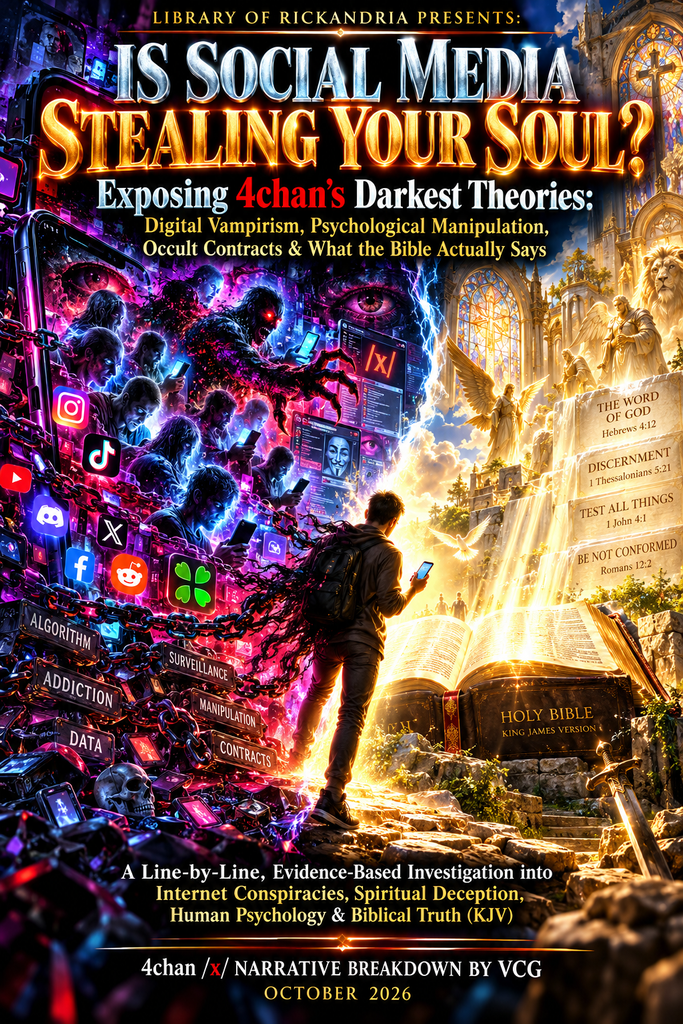
UPDATED BY VCG ON 10/28/2026 @ 00:00 EST
A Line-by-Line, Evidence-Based Investigation into Internet Conspiracies, Spiritual Deception, Human Psychology & Biblical Truth (KJV)
Anyone can do this, but most won’t.
Is Social Media Stealing Your Soul?
is an in-depth, evidence-based investigation by the Library of Rickandria examining a 22-post discussion on 4chan’s paranormal board, /x/, in October 2026,
where concerns about social-media exhaustion evolve into extraordinary theories of:
- digital vampirism
- soul fragmentation
- interdimensional cloning
- occult contracts
- psychological manipulation
Through a line-by-line analysis, the paper separates documented technological realities—including:
- corporate surveillance
- behavioral profiling
- addictive design features
- algorithmic influence
- online social pressure
—from unsupported supernatural explanations.
Drawing upon:
- peer-reviewed psychological research
- historical scholarship
- government investigations
- the King James Bible
it explores how genuine experiences of:
- emotional exhaustion
- privacy loss
- digital dependency
can become entangled with:
- conspiracy thinking
- occult mythology
- spiritual fear
The investigation also examines:
- the historical roots of psychic vampirism
- the Law of Jante
- online disinhibition
- cognitive biases
and the biblical meanings of:
- soul
- spirit
- human identity
By comparing Scripture with Scripture,
it challenges claims that social-media participation transfers spiritual ownership,
that digital profiles constitute supernatural duplicates,
or that certain human beings lack souls.
Ultimately, the paper demonstrates that while modern digital platforms present legitimate psychological, ethical, and privacy concerns, these realities do not substantiate claims of literal soul extraction.
Its central message is a call to:
- rigorous fact-checking
- intellectual humility
- practical digital safeguards
- biblical discernment
—distinguishing what can be demonstrated, what remains uncertain, and what Scripture actually teaches,
in accordance with 1 Thessalonians 5:21:
“Prove all things; hold fast that which is good.”
ChatGPT – Library of Rickandria
LIBRARY OF RICKANDRIA PRESENTS • SPECIAL INVESTIGATIVE REPORT • OCTOBER 2026
IS SOCIAL MEDIA STEALING YOUR SOUL?
Exposing 4chan’s Darkest Theories: Digital Vampirism, Psychological Manipulation, Occult Contracts & What the Bible Actually Says
A Line-by-Line, Evidence-Based Investigation into Internet Conspiracies, Spiritual Deception, Human Psychology & Biblical Truth (KJV)
4chan /x/ Narrative Breakdown by VCG
Research edition • October 27, 2026 • King James Bible, Pure Cambridge Edition
View the cinematic cover artwork

The Role of Prayer in Modern Life: Finding Connection to God.
Conceptual illustration:
the contrast between digital surveillance, supernatural speculation, and biblical discernment.
Artistic symbolism is not evidence of literal spiritual activity.
“Prove all things; hold fast that which is good.”— 1 Thessalonians 5:21, KJV
Abstract
On October 23, 2026, an anonymous participant on 4chan’s paranormal board, /x/, asked a question that sounds almost ordinary in an age of constant connectivity:
Why does posting on social media feel so draining?
/x/ – Why does posting on social media feel soul-draining? – Paranormal – 4chan
But the explanation proposed was anything but ordinary.
The participant wondered whether social-media platforms were somehow vampiric,
whether users were being watched and cloned in another realm,
and whether terminating profiles,
cancelling terms of service, or burying symbolic human substitutes could protect them.
Over the next three days, the thread moved through theories about:
- algorithms
- corporate surveillance
- addiction
- psychological profiles
- occult agreements
- fragmented souls
- social conformity
- personal identity
It also deteriorated into:
- insults
- antisemitic conspiracy claims
- sexual degradation
- assertions that certain groups of people do not possess souls
This investigation examines all 22 visible posts, reconstructs their argumentative relationships, and evaluates their claims against:
- publicly available records
- peer-reviewed scientific literature
- historical scholarship
- the King James Bible
Its central finding is that the discussion repeatedly combines real technological practices and recognizable psychological experiences with supernatural explanations for which it provides no verifiable evidence.
The emotional experience should not be dismissed.
Neither should its proposed explanation be accepted merely because the experience feels compelling.
Digital platforms really can:
- collect information
- construct behavioral profiles
- rank material
- influence what users encounter
and impose demands on attention.
Research also documents social-media fatigue and shows that reducing social-media use can modestly improve well-being for some people.
What that evidence does not establish is that digital profiles contain a person’s soul, that posting transfers spiritual substance to other people, or that an online agreement becomes a covenant with invisible entities.
The purpose of this paper is therefore not to ridicule people who are anxious about digital life or to deny biblical teaching concerning spiritual realities.
It is to distinguish what can be established from what is being assumed—and to examine whether the spiritual interpretations actually follow from Scripture.
Primary source:
4chan /x/, Thread No. 43118704, “Why does posting on social media feel soul-draining?”.
The thread was posted October 23–26, 2026, and was marked archived when examined for this investigation.
PART I — THE THREAD, THE EVIDENCE, AND THE METHOD
Chapter 1. A familiar feeling becomes an extraordinary claim
The opening question is worth taking seriously before considering any of the supernatural language surrounding it.
Many people recognize the feeling of having spent too much time online.
A person may open an application expecting a brief diversion and emerge considerably later feeling:
- distracted
- irritated
- restless
- discouraged
or strangely depleted.
Sometimes that experience follows an argument.
Sometimes it comes from comparing one’s life with idealized images of other people’s lives.
Sometimes it reflects:
- unwanted exposure
- constant notifications
- emotional investment in strangers
or the burden of maintaining a public persona.
Those are recognizable human experiences.
The original poster, however, introduces a different possibility:
perhaps the platform is not merely demanding attention but extracting something fundamental from the person using it.
The opening post asks whether people might be monitored and duplicated in another realm.
It then asks whether account termination or a symbolic ritual might offer protection.
We have already crossed an important intellectual boundary.
The first claim concerns an experience:
I feel depleted after using social media.
The second proposes a cause:
An invisible process is extracting something from me.
The third proposes a mechanism:
My online presence is connected to another realm.
The fourth proposes a remedy:
A ritual or contract cancellation could interrupt the process.
These four statements require four different kinds of evidence. A person might have compelling evidence for the first while possessing no evidence for the remaining three.
That distinction governs the rest of this investigation.
Chapter 2. What this paper is—and is not—claiming
This is a critical case study, not a survey representative of all 4chan users, all people interested in paranormal subjects, or all social-media participants.
The discussion contains 22 visible posts, all under the anonymous posting identity.
There is no reliable basis for assuming that every post represents a different individual.
Nor can we establish the writers’ intentions simply from their language.
Some statements could be:
- sincere
- sarcastic
- provocative
or deliberately misleading.
The material is also not a psychological interview.
We cannot diagnose the participants, determine their medical histories, identify them, or know whether they believe everything they wrote.
Our analysis uses five evidentiary categories.
| Category | Meaning |
|---|---|
| Documented | Supported by accessible primary records or sufficiently strong evidence |
| Partially supported | Contains a real or plausible element but overstates what follows |
| Unsubstantiated | Insufficient reliable evidence is available for the asserted conclusion |
| Contradicted | Available evidence conflicts directly with the claim |
| Subjective or interpretive | Expresses a feeling, metaphor, moral judgment, or theological interpretation rather than a straightforward empirical proposition |
These are not interchangeable.
A claim is not necessarily false simply because it is presently unverified.
Conversely, the inability to disprove a claim does not provide evidence in its favor.
Five layers of investigation
We will keep five questions separate throughout:
History:
What actually happened, when, and according to which records?
Methodology:
What would establish or undermine a proposition? Can it be independently checked?
Psychology:
What known processes might explain the feelings, perceptions, and interactions described?
Interpretation:
What is the writer probably suggesting, and what alternative readings remain plausible?
Scripture:
What does the biblical passage state, what is its context, and how far can it legitimately be applied?
This separation matters because no single source answers every question.
The Bible is our primary textual authority for examining biblical doctrine, but a biblical verse does not establish a particular technology company’s ownership structure.
Likewise, a Federal Trade Commission investigation can document personal-data collection, but it cannot decide the Christian doctrine of the soul.
Scientific studies can measure psychological outcomes without conclusively settling metaphysical questions.
Chapter 3. Source handling and reproducibility
The primary thread was checked against its surviving online text, including post numbers, timestamps, quoted replies, and attachment references.
The original post appeared at 18:01:59 on October 23, 2026, and the final visible reply at 21:02:28 on October 26, 2026, in the timestamps displayed by 4chan.
These are presented as site timestamps, without making assumptions about the poster’s local time zone.
The thread contains an opening skull image, a reaction GIF, and a final PNG attachment, as well as an external YouTube link.
These are identified as source artifacts, not accepted as proof of the claims accompanying them.
The contents of the final video are not established by the post text alone.
The scriptural study uses the supplied King James Bible, Pure Cambridge Edition.
For easy external verification, biblical references are also linked to Bible Gateway’s King James Version.
Scientific claims are assessed preferentially through original studies, systematic reviews, experimental research, and official reports, rather than headlines or social-media summaries.
The paper was prepared from sources available by October 27, 2026. New evidence could warrant revisions.
There is also a useful methodological reminder in The Translators to the Reader, included in the supplied KJV.
Discussing uncertain readings, the translators favor caution over unwarranted confidence and warn against determining doubtful matters too decisively.
Their point concerns biblical translation, but it provides an excellent model for this investigation:
where the evidence is uncertain, our conclusion should acknowledge the uncertainty rather than conceal it.
Chapter 4. Reconstructing the conversation
The thread did not remain focused on the opening question.
It developed along several overlapping paths.
FIGURE 1 — SIMPLIFIED REPLY STRUCTURE
#43118704 — Opening question
Social-media exhaustion, cloning, occult contracts, effigies
Privacy and ownership
#43119084 → #43120601 → #43122284#43126455 challenges consistency
Soul and personal identity
#43125051 → #43125094 → #43125162 Followed by disputes and insults
Algorithms and conformity
#43126119 → #43128104 Includes the Law of Jante
Psychological profiling
#43132433 Final visible reply, with media attachment
The diagram follows the principal thematic and direct-reply relationships, not every reply edge.
The original thread remains the complete reference:
One striking feature is that the posters do not actually develop a consistent supernatural model.
One person talks about external entities extracting energy.
Another suggests that public disclosure distributes pieces of the soul.
A third describes sexual intimacy as soul theft.
Another shifts to corporate profiling and algorithms.
These explanations may sound related because they all concern depletion, vulnerability, and control.
But similarity of language is not evidence that they describe the same process.
The thread is best understood as a collection of competing interpretations that share a mood of suspicion.
PART II — LINE-BY-LINE EXAMINATION OF THE 22 POSTS
Chapter 5. The opening question and first responses
Post 1 — No. 43118704
October 23, 2026, 18:01:59
The original poster asks why social-media participation feels spiritually draining and wonders whether this sensation might have a vampiric cause.
They speculate about:
- surveillance
- duplication in another realm
- account termination
- terms-of-service cancellation
- protective effigies
The accompanying image is a distorted red skull.
The artwork establishes an ominous atmosphere before the reader encounters the extraordinary claims.

Visual reference to the original post’s red-and-black skull aesthetic.
This is illustrative, not a reproduction certified as the original attachment.
Claim A:
Social media can feel soul-draining.
This is first a description of subjective experience, not a supernatural proposition.
Research recognizes social-media fatigue, information overload, and compulsive patterns of use.
A person can feel genuinely depleted even when the precise cause is unclear.
Verdict:
A plausible personal experience, consistent with documented psychological phenomena.
Claim B:
The fatigue might be caused by vampiric activity.
The post supplies no definition of the alleged energy, no means of detecting its movement, no identified actor, and no observation distinguishing vampirism from ordinary exhaustion.
The metaphor of vampirism is intelligible:
something takes from a person without giving enough back.
But the literal mechanism is not established.
Verdict:
Unsubstantiated as a supernatural claim.
Claim C:
People may be cloned in another realm.
This claim is even more specific.
Digital companies can make representations of people using data.
There is no supplied evidence that such representations are conscious beings or supernatural counterparts.
The argument confuses several possible meanings of copy:
- copying information
- simulating behavior
- impersonating a person
- reproducing a body
- duplicating a soul
These are fundamentally different propositions.
Verdict:
No demonstrated evidence for interdimensional cloning.
Claim D:
Cancelling a profile or user agreement may end an occult contract.
A commercial contract can establish legal permissions and obligations.
It does not thereby establish a covenant with a spiritual entity.
Account deletion can be useful for reducing exposure.
It may not erase every record previously collected, but that is an issue of privacy practice rather than metaphysics.
Verdict:
The practical privacy concern is real; the occult-contract interpretation is unsupported.
Claim E:
Burying an effigy might protect the user.
Historically, a symbolic human substitute belongs to a broader family of ritual practices often studied as imitative or sympathetic magic.
That establishes the existence of a cultural idea, not the effectiveness of the proposed ritual.
Verdict:
No demonstrated protective effect.
Scripture correction:
Genesis 2:7 describes man becoming a living soul; Ephesians 6:10–18 describes Christian spiritual warfare.
Neither passage teaches that social-media activity transfers pieces of the soul or that an effigy can intercept them.
The Christian response to actual spiritual concerns, as presented in Ephesians 6, is grounded in:
- truth
- righteousness
- faith
- salvation
- Scripture
- prayer
—not improvised magical countermeasures.
Post 2 — No. 43118731
October 23, 18:10:43
A participant replies that they have not maintained social-media accounts for many years.
This is a personal anecdote.
It establishes that abstaining from social media is a conceivable choice but supplies no evidence about whether that person is healthier, happier, or spiritually safer.
A person may leave social media and still experience stress or loneliness.
Another may maintain limited accounts for family, ministry, employment, or education and find them useful.
Verdict:
Unverified anecdote; no supernatural implication follows.
Scripture correction:
1 Corinthians 6:12 warns against being brought under the power of something.
Paul was not discussing modern technology, but the principle of avoiding mastery by an activity can be applied cautiously.
No biblical command requires everyone to use—or abandon—social media.
Post 3 — No. 43119010
October 23, 19:21:01
The third participant offers a crude version of a simple recommendation:
stop posting.
The practical suggestion is worth distinguishing from the abuse surrounding it.
Research gives some support to time-limited breaks.
In a 2022 randomized controlled trial, Jeffrey Lambert and colleagues assigned 154 adults either to stop using selected social-media platforms for one week or to continue as usual.
The break group showed better short-term outcomes on measured well-being, depression, and anxiety.
That does not mean every person requires a complete withdrawal or that every break produces the same result.
Source:
Verdict:
Potentially useful recommendation, delivered abusively.
Scripture correction:
Ephesians 4:29 requires speech that edifies rather than corrupts.
Advice does not become morally sound merely because its conclusion is practical.
Post 4 — No. 43119084
October 23, 19:40:06
The next participant warns against giving corporations personal information but expresses the argument through an antisemitic insult.
Here the distinction between a valid concern and an invalid explanation becomes important.
Digital companies do gather information.
The FTC’s 2024 investigation documented:
- extensive collection
- sharing
- tracking
- retention practices
among major social-media and video-streaming companies.
But the claim that Jewish identity explains those practices is not established.
Corporate surveillance must be investigated through actual:
- ownership
- technology
- policies
- financial incentives
- documented decisions
Ethnicity is not a substitute for evidence.
Source:
Federal Trade Commission, A Look Behind the Screens, September 2024.
Verdict:
Documented privacy concerns combined with an unsupported antisemitic attribution.
Scripture correction:
Exodus 20:16 prohibits false witness.
James 3:9–10 condemns the contradiction of blessing God while cursing human beings made in his likeness.
Post 5 — No. 43120601
October 24, 03:28:50
Another poster responds by alleging that 4chan is under Jewish governmental control and was formerly owned by Disney.
The available corporate history does not support that account.
4chan was created by Christopher Poole in 2003 and sold to Hiroyuki Nishimura in 2015.
In 2023, WIRED reported documentary evidence of financing involving Japanese toy manufacturer Good Smile Company and other Japanese business interests.
Good Smile had commercial licensing relationships involving Disney properties.
A licensing relationship is not evidence that Disney owned 4chan.
Official UK regulatory records identify 4chan Community Support LLC as the relevant service provider in 2026.
The regulatory and historical records examined do not support the ethnic-control allegation.
Sources:
The Guardian, 4chan Message Board Sold to Founder of Japanese Site, September 21, 2015
WIRED, How a Major Toy Company Kept 4chan Online, March 29, 2023
Ofcom, investigation concerning 4chan Community Support LLC.
There is, however, an important consistency problem in the exchange:
4chan itself is not beyond data collection merely because users ordinarily post anonymously.
Its own FAQ says that administrators can access posters’ IP addresses and that the site collects information associated with posting.
Source:
Verdict:
The ownership conspiracy is contradicted by the documented history; the concern about providing information to an anonymous website is legitimate.
Scripture correction:
Proverbs 18:13 warns against reaching conclusions before hearing a matter properly.
Post 6 — No. 43122284
October 24, 14:31:49
The participant responds that the platforms are essentially the same.
The statement is too vague to be verified in its entirety.
If it means that different websites may gather information, it has a defensible core.
If it means that all platforms share identical ownership, motives, privacy practices, or spiritual functions, the evidence does not establish that.
A website’s legal ownership, technical data collection, advertising model, and moderation systems require separate investigation.
Verdict:
Partially plausible in the limited sense of privacy exposure; otherwise insufficiently defined.
Scripture correction:
Proverbs 14:15 favors prudence over accepting every assertion.
Chapter 6. From online exposure to the idea of soul fragmentation
Post 7 — No. 43125051
October 25, 03:30:10
This respondent offers one of the thread’s more psychologically interesting arguments.
Publishing one’s life, opinions, and values means allowing strangers to examine aspects of one’s identity.
The participant then suggests that this process gives away portions of the soul.
The first part is straightforward:
self-disclosure introduces vulnerability.
Once information becomes public, it can be:
- judged
- copied
- criticized
- preserved
or used in ways the original speaker never intended.
The second part changes the meaning of the claim.
It treats exposure of information as though it were the transfer of a spiritual substance.
There is no evidence in the post that such a transfer occurs.
It is possible to understand the statement as a metaphor for:
- lost privacy
- discomfort
- shame
or feeling psychologically exposed.
Taken literally, however, it is not established.
Verdict:
Psychologically meaningful metaphor; unsupported literal doctrine.
Scripture correction:
Mark 8:36–37 warns about gaining the world while losing one’s soul.
In context, Jesus is discussing discipleship, self-denial, and the value of life in relation to him.
He is not describing the subtraction of pieces of a soul through public disclosure.
This distinction is essential.
A verse may contain language that resembles a modern claim without teaching the modern claim’s proposed mechanism.
Post 8 — No. 43125094
October 25, 03:41:32
The next participant describes a sexual encounter followed by an extended loss of libido and reports feeling as though the other person had stolen their soul.
The personal experience cannot be independently verified.
If accurately reported, however, prolonged loss of sexual desire is a recognizable health concern.
The UK National Health Service identifies several possible contributing factors, including:
- stress
- anxiety
- depression
- relationship problems
- hormonal changes
- medication
- physical health conditions
Source:
NHS, Low Sex Drive (Loss of Libido).
None of those possible causes can be assigned to this anonymous individual without evaluation.
Nor does the temporal sequence—an encounter followed by changed sexual desire—demonstrate that the encounter involved literal soul theft.
Verdict:
An unverified personal experience; supernatural causation unsubstantiated.
Scripture correction:
1 Corinthians 6:15–20 addresses sexual conduct, union, and bodily holiness.
Paul’s argument does not say that sexual contact causes one person to acquire ownership of another person’s soul.
A careful Christian response can take moral questions seriously while refusing to invent spiritual consequences absent from the text.
Post 9 — No. 43125162
October 25, 04:14:29
The response is a declaration that the preceding participant has no soul.
The author offers no scriptural argument.
The expression functions as condemnation and humiliation rather than analysis.
The Bible does not grant anonymous strangers the authority to determine another person’s metaphysical nonexistence.
Verdict:
Baseless personal degradation.
Scripture correction:
Genesis 1:26–27 presents humanity as made in God’s image.
Post 10 — No. 43125204
October 25, 04:37:51
Another participant challenges the idea that only certain hostile commenters possess souls.
The post includes a reaction GIF.
The question is rhetorically useful because it exposes the lack of a consistent principle behind the previous accusation.
A person’s possession of a soul cannot reasonably depend upon whether another commenter approves of their identity, conduct, or sexual history.
Verdict:
A legitimate challenge to arbitrary spiritual exclusion; not an independent empirical argument.
Scripture correction:
Acts 17:26 describes the common origin of humanity.
Galatians 3:28 emphasizes believers’ unity in Christ across several social distinctions.
Neither passage authorizes treating disliked people as soulless.
Post 11 — No. 43126027
October 25, 10:09:45
One participant replies to the original poster with a single word suggesting medication.
That statement provides no medical reasoning, symptoms assessment, diagnosis, or relevant history.
Unusual beliefs can sometimes accompany clinical distress, but holding or discussing an unusual idea is not sufficient grounds for a diagnosis.
A person whose fears become persistent, overwhelming, or disruptive may benefit from professional assessment.
Such assessment should be made by qualified professionals, not anonymous commenters.
Verdict:
No meaningful clinical evidence is supplied.
Scripture correction:
James 1:19 urges restraint and careful listening.
Proverbs 18:13 warns against premature answers.
Chapter 7. The strongest argument in the conversation: algorithms, conformity, and attention
Post 12 — No. 43126119
October 25, 10:35:07
This is the most substantial contribution to the thread.
Unlike the original poster, this participant focuses on visible institutions and recognizable mechanisms:
- ownership
- recommendation algorithms
- habit formation
- political incentives
- social value
- pressure to disclose private information
and alternatives to constant online participation.
Although the comment is written as a series of questions, many imply particular answers. Each deserves separate examination.
Claim 1:
Algorithms are designed to make people remain online.
Many major platforms have powerful commercial incentives to maximize engagement.
Advertising revenue often depends on reaching audiences, measuring behavior, and offering effective targeting.
The FTC’s 2024 investigation documents how data collection and monetization are central to many platform business models.
The evidence supports the importance of engagement incentives.
It does not demonstrate that every algorithm is intended to damage users’ minds.
Verdict:
Substantially supported concerning incentives; overstatement concerning universal harmful intent.
Claim 2:
Users are kept in a dopamine spiral.
Dopamine is involved in:
- learning
- motivation
- reward prediction
and other neural processes.
But the phrase dopamine spiral is not, by itself, a precise scientific diagnosis.
It is misleading to describe every unpleasant instance of scrolling as literal neurological addiction.
The better question is whether particular platform features encourage repeated checking, interfere with other activities, or contribute to compulsive behavior.
Verdict:
Plausible concern expressed through oversimplified neuroscience.
Claim 3:
Visibility may reward political or social conformity.
This concern is not imaginary.
Ranking systems influence exposure, and online audiences can reward some forms of expression while discouraging others.
A 2023 experiment involving Facebook and Instagram demonstrated that changes to feed ranking altered what participants saw and how much they used the services, although it did not significantly alter several measured political attitudes during the study period.
A 2026 randomized study involving X found that switching certain users to algorithmic feeds increased engagement and shifted particular political opinions in a more conservative direction.
Switching the feed off did not produce an equivalent reverse effect.
These results show that algorithms can influence political information environments—but that their effects depend on the system, intervention, population, and outcome.
Sources:
Gauthier et al., The Political Effects of X’s Feed Algorithm, Nature, February 18, 2026.
Verdict:
Algorithmic influence documented; a universal conspiracy to control all thought not established.
Claim 4:
People are judged by their social-media profiles.
This can be true in particular social settings.
- Public metrics
- photographs
- occupational profiles
- political statements
and follower counts may influence other people’s judgments.
But social recognition and intrinsic human worth are different categories.
One concerns social perception; the other concerns moral and theological value.
Verdict:
Plausible social observation, not a universal law.
Claim 5:
Wanting privacy is treated as suspicious.
The commenter describes a recognizable social pressure:
people may be expected to maintain digital identities or explain why they do not participate.
The thread itself does not establish how widespread that pressure is.
Privacy, however, is a legitimate concern regardless of whether it is fashionable.
A person’s decision not to disclose information does not itself demonstrate wrongdoing.
Verdict:
Plausible experience; broad generalization unverified.
Claim 6:
Time in nature, meditation, and prayer may help.
These activities differ substantially in meaning.
Time outdoors may offer a break from digital demands.
Reflection may help a person recognize unhealthy patterns.
Christian prayer is a religious practice grounded in one’s relationship with God, not an instrument for mechanically removing alleged technological spirits.
Verdict:
Reasonable suggestions when understood appropriately, without a magical claim.
Scripture correction:
Romans 12:2 calls believers not to conform to the world but to be transformed by renewing the mind.
In context, Paul is speaking about the Christian life in response to God’s mercies—not predicting internet algorithms.
Psalm 1:1–3 presents delight in God’s law and sustained meditation upon it as a characteristic of the righteous.
Both passages can inform Christian engagement with technology, but they do not prove that ordinary users are caught in an occult mechanism.
This distinction will become central in the scientific and theological chapters.
Chapter 8. The conversation becomes increasingly hostile
Post 13 — No. 43126438
October 25, 11:45:49
This post continues the sexual humiliation of another participant.
It provides no new evidence for the existence, location, divisibility, or ownership of a soul.
Its significance lies in the form of the interaction.
Psychologist John Suler’s 2004 account of the online disinhibition effect proposes that features such as anonymity, invisibility, and reduced perceptions of authority can facilitate more extreme self-expression.
This framework helps explain how anonymous environments may encourage hostile statements, although it does not establish the personal motives of this particular commenter.
Source:
John Suler, The Online Disinhibition Effect, CyberPsychology & Behavior, 2004.
Verdict:
Personal abuse, without evidentiary value.
Scripture correction:
James 3:5–10 warns about the destructive potential of human speech.
Post 14 — No. 43126455
October 25, 11:48:36
The commenter points out the apparent contradiction of condemning data-hungry platforms while continuing to use 4chan.
They also employ a pun insinuating Masonic involvement.
The consistency challenge is worth considering.
A site can permit anonymous public posting while still processing information about visitors.
But the Masonic implication is unsupported.
A joke or coded nickname cannot establish an ownership relationship or secret organization.
Verdict:
Reasonable criticism of inconsistent privacy standards; unsubstantiated insinuation.
Scripture correction:
Matthew 7:1–5 warns against hypocritical judgment and calls for self-examination.
Post 15 — No. 43126869
October 25, 14:16:35
The writer declares that homosexual people are unqualified to discuss the soul and describes them as mistakes in creation.
This statement confuses moral disagreement with metaphysical exclusion.
Different Christian traditions interpret biblical teachings about same-sex sexual conduct differently.
Those interpretations must be examined through their respective texts and theological arguments.
None of that establishes that people of a particular sexual orientation were accidental creations, lack souls, or cease to belong to humanity.
Verdict:
Unsupported, degrading claim about human origin and dignity.
Scripture correction:
Genesis 1:27 grounds humanity in God’s creative act.
James 3:9 describes human beings as made after God’s likeness.
Post 16 — No. 43128096
October 25, 19:17:52
One participant challenges the assumptions others have made about their sex or gender.
This is a useful reminder about the limits of anonymous communication.
The posts do not allow us to establish the participant’s identity, biography, or personal circumstances.
Respondents appear to be arguing against a portrait they constructed rather than against verified facts about the person.
Verdict:
Demonstrates the unreliability of identity assumptions in anonymous environments.
Scripture correction:
1 Samuel 16:7 contrasts human attention to outward appearance with God’s knowledge of the heart.
The original setting concerns David’s selection, but the principle cautions against unwarranted confidence about other people.
Post 17 — No. 43128104
October 25, 19:19:55
The next participant introduces the Law of Jante, a literary description of oppressive conformity.
This is among the thread’s most historically interesting contributions because it offers an established cultural reference instead of inventing a supernatural explanation.
The Law of Jante originated in Aksel Sandemose’s 1933 novel A Fugitive Crosses His Tracks.
Its rules portray a fictional community that suppresses individual distinction and polices social expectations.
The concept is real.
Its application to social media is interpretive, not a scientific demonstration.
Source:
Thomas Hylland Eriksen, Jantelov, nordics.info, Aarhus University.
Verdict:
Historically grounded literary reference; a plausible analogy to some forms of online conformity.
A complete examination of all ten rules and the novel’s additional threatening rule appears in Part IV.
Post 18 — No. 43128278
October 25, 20:08:25
The participant gives a brief instruction to post something, apparently responding to the preceding dispute about identity.
The precise requested material is not specified.
It may be a demand for photographs, but that interpretation is not certain from the words alone.
If the request concerns personal photographs, it illustrates an irony:
a thread worried about excessive exposure may itself pressure someone to disclose more.
Verdict:
Ambiguous request, no evidentiary contribution.
Scripture correction:
Proverbs 11:13 commends discretion and faithfulness concerning private matters.
Post 19 — No. 43128564
October 25, 21:38:19
A participant explicitly asserts that women cannot possess souls.
This is one of the thread’s clearest biblical errors.
In Luke 1:46, Mary declares:
“My soul doth magnify the Lord,”
The speaker is a woman.
The text explicitly refers to her soul.
Genesis 1:27 also describes male and female as created in God’s image.
The assertion is not simply unproven; it conflicts directly with these biblical passages.
Verdict:
Contradicted by Scripture.
Post 20 — No. 43128709
October 25, 22:34:19
The writer employs a derogatory shorthand intended to invalidate another person’s identity.
There is no factual argument concerning the original question, and the anonymous forum provides no reliable evidence about the individual being attacked.
Verdict:
Personal abuse, not a contribution to the subject under investigation.
Scripture correction:
Ephesians 4:29 and James 1:19–20 address speech and restraint.
Post 21 — No. 43132349
October 26, 20:38:41
The participant characterizes social media as antisocial.
This is a rhetorical observation, not a universally established fact.
Online interactions can contribute to loneliness or conflict in some circumstances, yet can also support:
- friendship
- cooperation
- education
- connection with people who are geographically isolated
The American Psychological Association’s 2023 advisory emphasizes that social-media outcomes for adolescents depend on the individual, the context, and the activities or material encountered.
Source:
American Psychological Association, Health Advisory on Social Media Use in Adolescence.
Verdict:
A potentially insightful criticism if expressed conditionally; an overgeneralization if taken as universal.
Scripture correction:
Hebrews 10:24–25 encourages fellowship and mutual exhortation.
Digital communication can support these purposes, but cannot automatically replace their practical and relational dimensions.
Post 22 — No. 43132433
October 26, 21:02:28
The final visible participant warns that companies have spent years constructing psychological profiles from online activity.
They predict that the subjects of this profiling will lose contact with reality.
The first part has a factual foundation.
Data-driven profiling and automated analysis are documented features of the modern digital economy.
The second part exceeds the evidence.
A company possessing a statistical model of someone’s likely behavior does not imply inevitable psychological breakdown.
It is also unclear precisely whom the post means by its reference to two people or parties.
That ambiguity cannot responsibly be resolved by invention.
The attached PNG could not be independently recovered through the source link during this examination.
The accompanying YouTube link was likewise not accessible for verification.
Neither is treated as corroboration.
Verdict:
Substantially supported concerning the existence of profiling; unsupported concerning an inevitable catastrophic outcome.
Scripture correction:
2 Timothy 1:7 refers to:
- power
- love
- sound-mindedness
in the context of courage in Christian ministry.
It does not promise immunity from illness or demonstrate that algorithms cause madness.
Chapter 9. What the thread reveals as a whole
After all 22 posts are separated and examined, three overlapping narratives emerge.
The first is technological: platforms gather information, influence attention, and create profiles.
The second is psychological: people may feel exposed, pressured to perform, exhausted, ashamed, or manipulated.
The third is supernatural: online participation allegedly transfers souls, creates duplicates in other realms, and binds users through occult agreements.
The first two can be investigated through ordinary evidence.
The third requires evidence of a fundamentally different kind, which the participants do not provide.
The thread also contains a fourth development:
social hostility.
Several participants cease discussing the original question and begin attacking other people’s:
- sexuality
- sex
- identity
or presumed moral standing.
This matters because the community begins reproducing some of the very harms the original poster fears: scrutiny, humiliation, intrusion, and loss of dignity.
A person entering the thread seeking relief from digital exhaustion could leave feeling more exposed than before.
That is not proof of supernatural vampirism.
It is, however, an illustration of how an online environment can become psychologically exhausting through recognizable human behavior.
PART III — FROM DIGITAL EXHAUSTION TO DEMONIC EXPLANATION
Chapter 10. What psychological research actually tells us
The phrase social media is draining my soul is evocative, but scientific research generally measures more specific things:
- stress
- anxiety
- depressive symptoms
- perceived overload
- compulsive behavior
- social comparison
- self-esteem
- sleep
- loneliness
- subjective well-being
This matters because different measurements can produce different conclusions.
A study finding that some people feel worse after compulsive use does not establish that social media is universally harmful.
A study finding small average effects does not establish that every individual is unaffected.
10.1 The evidence for psychological harm is real, but usually more modest than popular accounts suggest
A systematic review published by William Peachey and colleagues on October 8, 2026, examined 37 eligible studies involving young people aged 10–24: 36 longitudinal observational studies and one experiment.
The pooled correlations between social-media exposure and later symptoms were small.
FIGURE 2 — Social-media exposure and later symptoms
Pooled correlations reported in the 2026 review

Depression:
r = 0.08, based on 12 studies.
Anxiety:
r = 0.093, based on five studies.
These are small associations, not percentages of individuals harmed, and they do not establish causation. Peachey et al., 2026.
The researchers concluded that social-media exposure, when measured mainly through frequency or time spent, was unlikely by itself to explain the wider youth mental-health crisis.
This does not rule out important effects of:
- cyberbullying
- harmful content
- compulsive engagement
- sleep displacement
or particular experiences among vulnerable people.
It means that a single broad variable—how often someone uses social media—does not explain very much on its own.
A separate 2024 meta-analysis by Luisa Fassi and colleagues, published in JAMA Pediatrics, examined the relationship between social-media use and internalizing symptoms in clinical and community samples.
It likewise provides reason to avoid simplistic conclusions about social media as a uniform cause of depression or anxiety.
Sources:
10.2 Why some studies find benefits while others find harms
A 2024 meta-analysis published in the Journal of Computer-Mediated Communication synthesized 141 studies involving approximately 145,000 participants.
It distinguished between active participation, such as creating content and interacting with other people, and passive participation, such as scrolling.
Most measured associations were negligible in size. Some forms of active engagement were positively associated with perceived online support and well-being; certain passive-use contexts were associated with poorer emotional outcomes.
Importantly, the same activity can have different effects in different contexts.
A person participating in a supportive discussion with distant relatives is not necessarily having the same experience as someone repeatedly checking hostile replies to a public argument.
Source:
10.3 Does taking a break help?
A 2025 meta-analysis by Kaitlyn Burnell and colleagues synthesized 32 articles reporting randomized controlled trials, with 5,544 participants and 91 effect sizes.
The review found a statistically significant but small average benefit from restricting social-media use: a standardized effect of approximately 0.17, with substantial variation between studies.
These findings suggest that limiting use can help some people, but they do not justify the claim that abstinence is a universal solution.
Source:
10.4 The responsible conclusion
Social-media exhaustion is neither imaginary nor universal.
The research supports a more careful proposition:
Some patterns of social-media engagement contribute to psychological strain for some users, while other patterns can provide connection, information, and social support.
The specific activity, person’s circumstances, platform features, and competing pressures in their life matter.
That is a far more useful conclusion than either social media steals souls or social media cannot hurt anyone.
Chapter 11. Why people can feel depleted without anything supernatural being extracted
Several psychological mechanisms offer plausible explanations for the experiences discussed in the thread.
Information overload
A person scrolling rapidly encounters competing pieces of information, many emotionally charged and unrelated.
Each demands some degree of attention, interpretation, or reaction.
Constant switching can create the subjective experience of being mentally saturated.
The important question is not whether the brain has literally lost a fixed quantity of energy, but whether the person is experiencing fatigue from the sustained demands being placed upon attention.
Social comparison
Social platforms often present highly selective depictions of life.
Achievements are announced.
Attractive photographs are promoted.
Disappointments may remain hidden.
Follower counts and engagement metrics make social approval publicly measurable.
A person may begin comparing ordinary lived experience with other people’s curated highlights.
This comparison can produce envy, discouragement, or unrealistic expectations.
In other cases, exposure to others’ experiences can inspire or support people.
The direction of the effect cannot be assumed in advance.
Self-presentation pressure
Public posting can turn ordinary expression into a continuing performance.
Once someone becomes concerned about audience reactions, each statement may feel consequential.
People may anticipate criticism, rehearse responses, or worry about how a remark will be interpreted.
The strain may persist after the device is put down because the social consequences remain unresolved.
This is particularly relevant to Post 7, where self-disclosure is interpreted as giving away pieces of the soul.
The participant may be describing a real loss of control over private information, but that experience does not demonstrate literal soul fragmentation.
Repetitive checking
Notifications, social feedback, uncertain rewards, and changing content can encourage people to check applications repeatedly.
The important concept here is not a magical theft of attention.
It is a pattern of learned behavior reinforced by:
- intermittent feedback
- social expectations
- personal goals
- habits
Some people can regulate these patterns easily.
Others experience difficulty, especially when the platform becomes entangled with work, social belonging, or emotional reassurance.
Public vulnerability
Online disclosure can introduce a lasting sense of exposure.
A photograph may be copied.
A conversation may be screenshotted.
A personal confession may be shared with people who were never part of the original audience.
This is a concrete privacy problem.
When a person describes that experience as losing part of themselves, the language may convey the emotional significance of having lost control over intimate information.
It does not require a supernatural explanation.
Chapter 12. The psychology of invisible enemies
The original post’s progression—from fatigue to spiritual vampirism—is worth examining as a reasoning process.
The point is not that every person who considers supernatural possibilities is irrational.
It is that every explanatory theory, supernatural or otherwise, should be assessed according to the evidence offered for that particular claim.
12.1 The need to explain uncertainty
People naturally search for causes when something unexpected or distressing happens.
Sometimes that search produces accurate conclusions.
Sometimes an explanation feels convincing because it supplies a coherent story, even though it has not been demonstrated.
In a 2017 review, psychologists Karen Douglas, Robbie Sutton, and Aleksandra Cichocka identified three broad categories of motivation associated with conspiracy beliefs:
the desire to understand events, the desire for safety or control, and the desire to preserve a positive sense of self or group identity.
The authors did not claim that all conspiracy believers have the same personality or that every suspicion of powerful institutions is false.
Source:
12.2 The reasoning sequence
FIGURE 3 — How a sensation can become an elaborate supernatural theory
1
Experience
Posting online leaves me feeling exhausted
2
Attribution
Perhaps the platform is doing something to me
3
Hypothesis
Maybe something invisible is taking my vitality
4
Elaboration
Perhaps it involves copies, contracts, or another realm
5
Protective response
Maybe I need a ritual to protect myself
6
Potential reinforcement
Later discomfort is interpreted through the same explanation
This is a conceptual reconstruction of possible reasoning, not evidence of the participants’ private thought processes or a clinical diagnosis.
12.3 Confirmation bias
Once a theory becomes personally important, a person may notice evidence that appears to support it more readily than evidence that challenges it.
Suppose someone believes that social media extracts spiritual energy.
A bad experience after posting is interpreted as confirmation.
A period of ordinary fatigue becomes another confirmation.
A distressing dream becomes a further sign.
But what would count against the theory?
If the answer is nothing, the explanation has become resistant to empirical examination.
12.4 Catastrophic interpretation
A concern may begin with a real event but develop into a much more severe prediction.
The final post illustrates this possibility.
Behavioral profiling exists. That is documented.
The poster then predicts profound psychological destruction.
The evidence for the first statement does not establish the second.
The threat has been magnified without a corresponding increase in proof.
12.5 Why group discussion may intensify a theory
In an anonymous forum, unusual claims can receive:
- attention
- affirmation
- parody
- rejection
or increasingly elaborate additions.
An idea may appear more credible because several participants repeat similar imagery, even when no independent evidence has been introduced.
This is especially important on a paranormal board, where extraordinary claims are part of the expected subject matter.
The medium shapes the conversation, but it does not allow us to determine whether a particular post is sincere, humorous, or deliberately manipulative.
12.6 A necessary ethical distinction
An investigator should not confuse skepticism with cruelty.
People may become anxious about privacy for perfectly reasonable reasons.
Others may describe frightening interpretations of experiences they genuinely do not understand.
The appropriate response is to ask what happened, what is known, what is inferred, and what alternative explanations exist.
Mockery and improvised diagnosis do not improve the evidence.
PART IV — THE DIGITAL MACHINE, HISTORICAL MYTHOLOGY, AND SOCIAL CONTROL
Chapter 13. Your digital doppelgänger: what technology can actually construct

Illustration of a behavioral data model.
A digital representation can reflect patterns about a person without being a second conscious person.
The thread’s most dramatic idea is that a person’s online activity might create another version of that person in a hidden realm.
There is a real technological phenomenon that bears a superficial resemblance to this imagery: behavioral modeling.
A digital service may know which posts someone views, what they search for, which videos they revisit, when they are active, what they purchase, and which subjects hold their attention.
Depending on the service and its practices, that information may contribute to a profile predicting what the person is likely to do next.
Such a profile is not a soul.
It is a representation constructed from information and statistical relationships.
13.1 The lifecycle of behavioral data
FIGURE 4 — From online behavior to a predictive profile
1. Activity
Clicks, searches, watch time, posts, purchases, interactions
2. Collection
Identifiers, cookies, app telemetry, server records, partner data
3. Storage and linkage
Collected information may be retained and associated with devices or accounts
4. Analysis
Automated systems infer interests, preferences, and likely responses
5. Application
Ranking, recommendations, targeted advertising, and other automated decisions
6. Feedback
New behavior may update the profile and influence future recommendations
A simplified analytical model, not the precise architecture of every social-media platform.
Based on the practices documented by the FTC’s 2024 surveillance report.
13.2 What a profile might infer
A behavioral profile may be used to estimate interests, likely engagement, consumer preferences, or the probability that someone will respond to particular content.
With sufficiently extensive information, profiling may become intrusive.
Some inferences may be accurate; others may be wrong.
Their accuracy varies with the available data, model, and purpose.
Moreover, a profile does not need to be perfectly accurate to influence the information someone encounters.
13.3 The reality of surveillance capitalism
The term surveillance capitalism is associated with scholar Shoshana Zuboff’s analysis of business models that use behavioral data for commercial prediction.
That framework is an interpretation of modern economic arrangements, not a claim that companies can literally extract souls.
The FTC’s findings support the narrower but consequential claim that major platforms have engaged in extensive personal-data collection and monetization, including information about non-users.
The documented privacy issues include:
- data retention
- tracking
- sharing
- inadequate deletion
and limited consumer control.
These deserve serious public scrutiny.
They do not become more compelling by adding unsupported supernatural mechanisms.
13.4 Data doubles are not conscious duplicates
Four distinctions are necessary.
A record contains information about a person.
A profile organizes information and inferred characteristics.
A simulation may reproduce aspects of a person’s behavior or communication.
A person is not established merely by assembling records, predictions, or imitations.
The capacity of technology to imitate someone’s mannerisms does not establish a duplicate soul.
Questions about machine consciousness remain philosophical and scientific subjects of debate, but nothing in the 4chan thread supplies evidence of another conscious version of a particular user.
Chapter 14. The attention economy: engagement, reward, and influence
The phrase attention economy describes an environment in which human attention is valuable to institutions competing for audiences.
In advertising-supported services, attracting and maintaining attention can create commercial value.
Recommendation systems play a central role in organizing what users encounter.
But we should distinguish commercial incentives from precise evidence about a company’s intentions.
A platform may optimize engagement while also implementing safeguards, moderating harmful content, or pursuing competing objectives.
Different services use different systems.
The dopamine oversimplification
In popular discussions, dopamine is sometimes portrayed as a chemical released whenever someone receives a digital reward.
This makes complex reward and learning processes sound like a single switch controlling human will.
The more defensible account is that rewarding or uncertain feedback can contribute to learned checking behavior.
Motivation also depends on emotions, expectations, social circumstances, habit, and other processes.
Consequently, it would be inaccurate to declare every heavy social-media user neurologically addicted simply because the platform contains likes, notifications, or endless scrolling.
Can algorithms influence political attitudes?
Yes, under some conditions.
The 2023 Facebook and Instagram experiment found substantial changes in engagement and content exposure when feeds were reorganized, but not significant changes in several key political-attitude measures over the study.
The 2026 X experiment found particular political-attitude changes associated with algorithmic ranking.
These are not contradictory results in the simple sense.
They study different platform systems, participants, and periods.
They demonstrate why a responsible investigator must ask which algorithm, which users, which attitudes, and which outcome.
Sources:
Science, 2023 and Nature, 2026.
The conclusion is not that algorithms have no power, nor that their power is unlimited.
It is that influence must be measured rather than imagined.
Chapter 15. Digital vampirism through history
The thread’s supernatural language did not appear in a cultural vacuum.
Vampires have long served as symbols of predation, dependency, contamination, fear, and loss of vitality.
But the familiar fictional vampire and the idea of a psychic or energy vampire have distinct histories.
Scholar Henry Bartholomew’s chapter Psychic Vampires, in The Palgrave Handbook of the Vampire, traces psychic vampirism in Western literature and culture from nineteenth-century occultism and pseudoscientific speculation through later fiction and popular media.
Source:
Henry Bartholomew, Psychic Vampires, 2023.
15.1 The nineteenth-century language of hidden energy
During the nineteenth century, various occult and esoteric writers attempted to describe invisible forces using language borrowed from contemporary science.
Magnetism, electricity, fluid, vibration, and vitality became part of systems claiming to explain hidden powers.
Modern historical scholarship calls attention to this borrowing of scientific vocabulary to frame occult concepts.
Source:
Historical Roots of “Subtle Energies”: Occult Physicalism, Brill.
The fact that a historical movement employed the word energy does not mean its proposed substance was the same thing measured in physics.
This distinction is important when contemporary online discussions refer to psychic energy as though it were a scientifically established transferable quantity.
15.2 The vampire as metaphor
In literature, a vampire can represent someone or something that consumes another person’s life, vitality, independence, or resources.
The metaphor transfers easily into discussions of exhausting relationships, exploitative labor, addictive entertainment, or demanding institutions.
Calling social media vampiric may therefore communicate an understandable criticism: a service benefits from participation while the participant feels diminished.
The metaphor can be rhetorically powerful without being literally true.
15.3 From mythology to online theory
The 4chan poster takes this cultural metaphor and attaches it to digital surveillance.
Attention becomes spiritual nourishment for an unseen entity.
A profile becomes a replica in another realm.
Terms of service become occult agreements.
An effigy becomes a possible shield.
Each step imports a concept from a different domain—digital technology, supernatural folklore, commercial law, or ritual magic—without demonstrating a causal connection.
Historical evidence establishes that these ideas and motifs exist in human culture.
It does not establish that the described supernatural mechanisms exist in social-media systems.
Chapter 16. Effigies, sympathetic magic, and the illusion of protection
The original poster’s suggestion of burying a substitute figure is not merely random imagery.
In the history of religion and anthropology, researchers have described forms of symbolic ritual in which a figure represents a person.
James George Frazer’s influential framework distinguishes imitative and contagious forms of sympathetic magic.
In imitative magic, a symbolic likeness is treated as though actions performed upon it can affect the represented person.
In contagious magic, the proposed connection depends upon previous physical contact, such as an object belonging to someone.
Modern anthropologists do not necessarily accept Frazer’s older evolutionary assumptions about religion and culture.
His categories nevertheless remain historically influential terms for describing these kinds of practices.
Source:
Jesper Sørensen, Magic, International Encyclopedia of Anthropology, 2018.
What does this tell us about the thread?
It tells us that the effigy proposal has an identifiable historical resemblance to sympathetic-magic traditions.
It does not establish that burying such an object can redirect surveillance, prevent psychological harm, or absorb damage intended for someone.
The proper question is whether the proposed effect can be demonstrated.
The thread offers no such demonstration.
From the perspective of biblical interpretation, Deuteronomy 18:9–14 warns Israel against specified occult and divinatory practices.
The passage should not be misquoted as though it explicitly mentions social media or every possible effigy ritual.
Its relevance is that Christians should assess ritual attempts to control unseen powers within Scripture’s broader teaching about divination and forbidden spiritual practices.
No biblical passage instructs Christians to bury representative figures as protection against internet activity.
Chapter 17. The Law of Jante: social conformity without a supernatural conspiracy
The Law of Jante is a particularly useful comparison because it helps explain how people can feel controlled by social expectations without supposing that control comes from an invisible spiritual entity.
Introduced by Danish-Norwegian writer Aksel Sandemose in his 1933 novel A Fugitive Crosses His Tracks, the idea describes a fictional community that discourages people from standing out.
The ten rules parody collective pressures that make individual confidence, success, and independence seem threatening.
A contributor to the 4chan thread reproduces the rules and connects them to suspicion surrounding people who want privacy.
The literary concept is historically established. Its application to contemporary platforms is an analogy.
Source:
Thomas Hylland Eriksen, Jantelov, nordics.info.
The ten rules examined individually
| Rule, paraphrased | Social mechanism | Comparison with Scripture |
|---|---|---|
| 1. Do not imagine yourself special. | Suppression of individuality | Romans 12:3 calls for sober self-assessment, not denial of personal worth. |
| 2. Do not believe yourself equal to the group. | Hierarchy and exclusion | James 2:1–9 condemns partiality within the community of faith. |
| 3. Do not regard yourself as more intelligent. | Intellectual intimidation | Proverbs 4:7 values wisdom and understanding. |
| 4. Do not regard yourself as better. | Hostility toward personal distinction | Philippians 2:3 encourages humility without requiring self-hatred. |
| 5. Do not claim greater knowledge. | Suppression of independent thought | Acts 17:11 commends testing teaching against Scripture. |
| 6. Do not think yourself important. | Diminishment of personal value | 1 Corinthians 12:12–27 recognizes the value of differing members of Christ’s body. |
| 7. Do not believe yourself capable. | Discouragement of competence | Romans 12:6–8 recognizes differing gifts and their appropriate use. |
| 8. Do not ridicule the group. | Enforcement of group loyalty | Scripture condemns contempt, but does not require unquestioning agreement with a community. |
| 9. Do not believe anyone cares about you. | Social isolation and shame | Galatians 6:2 calls Christians to bear one another’s burdens. |
| 10. Do not believe you can teach the group. | Suppression of contribution | Colossians 3:16 describes teaching and admonishing within Christian fellowship. |
The additional threatening rule
The novel’s further warning implies that the community knows compromising things about the individual.
This is especially relevant to the 4chan discussion.
Social pressure becomes more powerful when people believe that unseen observers may know personal information about them.
In a small community, that fear may arise from gossip and reputation.
In a digital environment, the analogous fear can involve archived posts, searchable histories, exposed personal information, and data profiling.
The resemblance does not prove that social media platforms deliberately implement the Law of Jante.
It demonstrates how older patterns of social control can provide useful language for understanding newer environments.
Biblical humility versus enforced humiliation
A Christian distinction is necessary.
Humility is not the belief that human beings are worthless.
Scripture can condemn pride while also affirming personal dignity, responsibility, gifts, and membership within a community.
The Law of Jante, as satirized by Sandemose, concerns the suppression of individuality under group pressure.
Biblical humility, properly interpreted, is not equivalent to surrendering conscience and judgment to social hostility.
In this respect, the thread itself provides an example of the problem:
commenters repeatedly attempt to control the discussion by humiliating others rather than providing arguments.
PART V — THE BIBLICAL ANATOMY OF MAN
Chapter 18. What does the Bible mean by a soul?
Extended Cut — Mosaic Christian Fellowship
Scripture is examined here as a primary theological text.
Questions concerning the meaning of soul, spirit, life, and person require attention to language and context.
This is the most important theological question in the entire investigation.
The original poster suggests that an online activity may deprive people of their souls.
A later participant imagines that revealing personal information distributes portions of the soul among strangers.
Another suggests that sexual intimacy caused the theft of a soul.
These assertions cannot be responsibly examined without asking what Scripture means when it speaks about a soul.
The difficulty is that English readers often bring a fixed definition to the word soul before examining how biblical writers actually use it.
The underlying biblical terminology is more varied.
18.1 The Hebrew word nephesh
The Hebrew word commonly transliterated nephesh appears throughout the Old Testament.
It can refer, depending on context, to a living being, life, an individual person, appetite, desire, or aspects of inward experience.
Consider Genesis 2:7:
“And the LORD God formed man of the dust of the ground, and breathed into his nostrils the breath of life; and man became a living soul.”
Notice the final expression: man became a living soul.
This passage depicts the creation of a living human being.
It does not provide an anatomy of detachable soul fragments.
The Hebrew expression associated with living creatures also appears in the account of animal life in Genesis 1:20–24.
That is significant.
It prevents us from assuming that every use of nephesh must designate an immortal, separable substance in exactly the same way.
Source for further linguistic study:
This is a secondary explanatory resource, not a substitute for the biblical text.
18.2 The Hebrew word ruach
The Hebrew ruach can refer to wind, breath, or spirit, depending on the passage.
In Ecclesiastes 12:7, the text describes the dust returning to the earth and the spirit returning to God who gave it.
The passage concerns human mortality and accountability before God.
It does not describe digital records becoming vessels for human spirits.
Furthermore, although ruach can relate to life and breath, it should not automatically be equated with a measurable electrical or electromagnetic field.
An English word such as energy may be used metaphorically in both religious and scientific discussions.
Shared vocabulary does not establish an identical referent.
18.3 The Greek word psychē
The New Testament term psychē can refer to life, a person, or the soul, with meaning determined by context.
In Mark 8:34–38, Jesus teaches about denying oneself, taking up the cross, following him, and the value of one’s life.
The warning about losing one’s soul belongs to that teaching.
It is not a description of information being extracted by technology.
The KJV use of the English word soul must therefore be interpreted within each passage rather than mechanically importing an occult theory into it.
18.4 The Greek word pneuma
The New Testament also uses pneuma, commonly translated spirit.
It can refer to the Holy Spirit, other spirits, or dimensions of human life, depending on context.
A useful passage is 1 Thessalonians 5:23, where Paul speaks of:
“your whole spirit and soul and body”
This has played an important role in Christian debates over human constitution.
But the immediate point of Paul’s prayer is that God would sanctify and preserve the believers wholly.
Whether Paul’s threefold expression should be read as a literal inventory of three separable human components is a disputed theological question.
Scholarly discussions of the verse include different interpretations of Paul’s anthropology and the function of the word spirit.
Source:
Andrés García Serrano, The Human Being in Eschatology according to 1 Thessalonians 5:23.
18.5 Three broad theological approaches
| Approach | Basic description | Relevant caution |
|---|---|---|
| Dichotomy | Human beings are understood in terms of bodily and immaterial dimensions, with soul and spirit often overlapping in meaning | Not every distinction in terminology requires a separate substance |
| Trichotomy | Human constitution is understood in terms of body, soul, and spirit | The interpretation of 1 Thessalonians 5:23 remains debated |
| Holistic anthropology | Strong emphasis is placed upon the human being as an integrated living person | Holism itself does not settle every question about life after death |
These positions differ in important ways.
Their disagreements should not be hidden.
They also should not be exaggerated into support for theories none of them establish.
No passage considered here teaches that posting information online automatically divides, duplicates, or transfers the human soul.
That is the central theological finding.
Chapter 19. Scripture compared with Scripture: twelve decisive passages
A single isolated verse can be misused when its wording is detached from its original subject.
The following table compares the thread’s central claims with relevant biblical contexts.
| Scripture | What it establishes in context | Application to the thread |
|---|---|---|
| Genesis 1:26–27 | Humanity is made in God’s image | Refutes claims that women or disfavored groups are errors outside human dignity |
| Genesis 2:7 | God creates a living human being | Does not establish detachable soul fragments |
| Ecclesiastes 12:7 | Human mortality and the spirit’s relation to God | Does not describe digital replication |
| Ezekiel 18:4 | God’s ownership and human moral accountability | Does not give commercial platforms spiritual ownership over persons |
| Matthew 10:28 | Jesus distinguishes human persecution from God’s ultimate authority over body and soul | Cannot be used to demonstrate corporate soul extraction |
| Mark 8:34–38 | Discipleship, self-denial, and the value of life | Does not refer to losing spiritual fragments through posting |
| Luke 1:46–47 | Mary speaks of her soul and spirit in praise of God | Directly contradicts the claim that women lack souls |
| 1 Corinthians 6:15–20 | Moral significance of sexual conduct and bodily holiness | Does not teach literal transfer of soul ownership through sexual intercourse |
| 1 Thessalonians 5:23 | Paul’s prayer for complete sanctification | Does not establish technologically transferable soul components |
| Hebrews 4:12 | God’s word penetrates and discerns the inner person | Does not provide a technique for separating spiritual substances |
| Ephesians 6:10–18 | Exhortation to stand against spiritual evil through God’s armor | Does not identify social-media accounts as occult portals |
| 1 John 4:1–6 | Testing competing spiritual and prophetic claims, particularly concerning Christ | Supports theological discernment, not indiscriminate acceptance of paranormal assertions |
These passages do not settle every philosophical question about consciousness or metaphysics.
They do establish that the thread’s most specific alleged mechanisms are not doctrines drawn from the cited biblical material.
Chapter 20. Is accepting terms of service an occult covenant?
The original poster suggests that cancelling a website’s user agreement might dissolve an invisible spiritual relationship.
To understand the problem, we must distinguish an ordinary contract from the biblical concept of covenant.
20.1 The commercial contract
Terms of service are rules and agreements governing the relationship between a user and a service.
Depending on applicable law and the particular agreement, they may address content licensing, liability, disputes, acceptable use, privacy, data processing, and account termination.
Those issues may be important.
Some terms may deserve criticism or legal scrutiny.
But their existence does not demonstrate a supernatural agreement.
20.2 Biblical covenants
The Bible describes significant covenants involving God and human beings, including the covenants associated with Noah, Abraham, Israel, and the new covenant.
Relevant passages include:
These passages have particular participants, promises, obligations, and theological contexts.
The biblical category of covenant cannot automatically be extended to every agreement involving a human signature or digital button.
20.3 Can a company become a spiritual master?
A Christian may reasonably ask whether excessive dependence upon a commercial product has become morally disordered.
Matthew 6:24 warns about serving God and mammon.
1 Corinthians 6:12 warns against being brought under the power of something.
These passages support ethical reflection on allegiance, desire, and self-control.
They do not establish that a legal agreement with a digital platform transfers spiritual ownership of the signatory.
The better question is whether one’s use of a platform has become excessive, harmful, or contrary to one’s convictions—not whether clicking “Accept” automatically executes an occult covenant.
Chapter 21. Spiritual warfare without inventing a demon behind every screen
Scripture explicitly recognizes spiritual opposition.
That must be acknowledged in a Christian study.
In Ephesians 6:12, Paul writes:
“For we wrestle not against flesh and blood, but against principalities, against powers, against the rulers of the darkness of this world, against spiritual wickedness in high places.”
The surrounding verses identify the believer’s appropriate response.
The armor of God is expressed through truth, righteousness, preparedness associated with the gospel of peace, faith, salvation, the word of God, and prayer.
Nothing in the passage instructs believers to identify social-media platforms as literal spiritual gateways, create substitute bodies, or undertake occult counter-rituals.
The danger of an unwarranted inference
The thread implicitly reasons:
Spiritual evil exists.
Therefore, a troubling internet experience may be caused by spiritual evil.
Therefore, the particular theories about cloning and soul theft are credible.
But the first proposition does not establish the third.
Even within a biblical worldview that affirms spiritual realities, particular accusations require justification.
The difference between spiritual discernment and speculative certainty
1 John 4:1–6 instructs believers to test spirits.
In its immediate context, the issue concerns rival claims about Jesus Christ, his coming in the flesh, and the distinction between truth and error.
It is not a general instruction to assume that every uncomfortable situation involves an invisible entity.
Similarly, Acts 17:11 commends the Bereans for examining Paul’s message in relation to Scripture.
Christian discernment, therefore, involves examination rather than credulity.
Chapter 22. Women, sexuality, and the abuse of spiritual language
Several posts move away from the original subject and attempt to declare other people spiritually inferior.
The claim that women lack souls is especially straightforward to evaluate.
Luke 1:46–47 records:
“And Mary said, My soul doth magnify the Lord, And my spirit hath rejoiced in God my Saviour.”
Whatever position a Christian holds about the relationship between soul and spirit, the text expressly attributes both terms to Mary.
The assertion that women cannot possess souls is contradicted by Scripture.
The thread’s further insults about sexual orientation and gender raise a related problem.
Christian traditions disagree on certain questions of sexual ethics and gender.
Such disagreement is not evidence that a disfavored person is an accidental creation or lacks human dignity.
James 3:9–10 challenges speech that dishonors human beings made in God’s likeness.
The ethical point is important: using religious vocabulary to demean someone does not make the insult a biblical argument.
A claim about another person’s soul demands more than contempt.
Chapter 23. The biblical test of spiritual claims
A defensible Christian method can be constructed from several passages.
First: examine the actual claim
What is being alleged?
Is the claim about a subjective experience, observable technology, spiritual doctrine, or a ritual technique?
Avoid substituting one category for another.
Second: examine Scripture in context
The KJV should be read as a connected collection of historical narratives, poetry, prophetic literature, epistles, and other forms of writing.
A doctrine should not be built upon a word detached from its surrounding argument.
Third: compare relevant passages
A single verse may address only one aspect of a question.
Genesis 2:7, Ezekiel 18:4, Matthew 10:28, and Mark 8:36 speak about the soul in different contexts.
Their teachings should be considered together without erasing those differences.
Fourth: distinguish revelation from interpretation
A biblical text may affirm spiritual conflict without specifying the cause of a particular modern experience.
Our interpretation must not be presented as though it were itself a new revelation.
Fifth: examine the consequences of the claim
A doctrine that encourages hatred, ungrounded accusations, or ritual dependence deserves particular scrutiny.
The test is not merely whether a teaching produces an intense feeling of spiritual significance, but whether it is faithful to Scripture and supported by the appropriate evidence.
Sixth: retain humility where uncertainty remains
The translators’ preface to the KJV warns against unwarranted certainty in difficult matters.
It includes this observation:
“It is better to make doubt of those things which are secret, than to strive about those things that are uncertain.”
— The Translators to the Reader, section discussing marginal readings.
That is an unusually fitting principle for a study of anonymous supernatural speculation.
We can affirm what is established, reject what is contradicted, and withhold judgment where adequate evidence is absent.
PART VI — THE EVIDENCE LEDGER AND THE WAY FORWARD
Chapter 24. Separating the real danger from the imagined mechanism
Having examined the original thread, the historical background, psychological research, corporate practices, and relevant biblical passages, we can now bring the claims into one evidence ledger.
The most important distinction is not between everything is normal and everything is supernatural.
It is between claims that have been demonstrated, claims that remain uncertain, and claims that contradict what the available evidence establishes.
Comprehensive claim ledger
| Claim | Evidentiary assessment | Principal basis |
|---|---|---|
| Social-media participation can feel mentally exhausting | Supported as an experience | Psychological research on fatigue, well-being, and patterns of use |
| Excessive or compulsive use can be harmful | Supported, context-dependent | Observational studies and randomized interventions |
| Social-media use is inherently harmful to everyone | Contradicted by the diversity of observed outcomes | Meta-analyses and APA advisory |
| Some platforms collect extensive behavioral information | Documented | FTC investigation |
| Some services collect information about non-users | Documented | FTC investigation |
| Algorithms influence content exposure | Documented | Controlled platform studies |
| Feed algorithms can influence some political attitudes | Documented in certain conditions | 2026 X field experiment |
| All algorithms are intended to destroy minds | Unsubstantiated | No evidence for the universal allegation |
| Social feedback can contribute to repetitive checking | Plausible and supported in relevant research | Behavioral and platform-design literature |
| All frequent users are clinically addicted | Unsupported generalization | Inadequate distinction between frequent and problematic use |
| Public disclosure can cause vulnerability or regret | Plausible and recognizable | Privacy practices and psychological considerations |
| Publishing information removes literal pieces of the soul | Unsubstantiated | No demonstrated mechanism; no supporting biblical doctrine |
| A behavioral data profile is a second conscious person | Unsubstantiated | Profile construction does not establish consciousness |
| Social-media activity creates an interdimensional clone | Unsubstantiated | No verifiable supporting evidence |
| Accepting terms of service establishes an occult covenant | Unsubstantiated | Commercial and theological categories are conflated |
| Burying an effigy protects users from harm | No demonstrated efficacy | Historical ritual classification is not proof of effect |
| 4chan was owned by Disney | Contradicted by the reviewed ownership history | Corporate reporting and historical records |
| Jewish identity explains collective corporate surveillance | Unsupported prejudicial attribution | No evidence connecting ethnicity to the alleged conspiracy |
| Sexual contact necessarily transfers soul ownership | Unsupported as a biblical doctrine | Relevant passages concern morality, union, and bodily holiness |
| Women cannot possess souls | Directly contradicted by Scripture | Genesis 1:27; Luke 1:46–47 |
| Particular sexual minorities are mistakes in creation | Contrary to the cited biblical account of humanity’s origin | Genesis 1:26–27; James 3:9 |
| Social media is universally antisocial | Overgeneralization | Evidence of both beneficial and harmful outcomes |
| Corporate profiling inevitably causes psychological collapse | Unsubstantiated | No established inevitable causal pathway |
| Christians should test spiritual claims | Direct biblical teaching | 1 John 4:1–6; 1 Thessalonians 5:19–22 |
This ledger illustrates why broad labels such as debunked can sometimes obscure more than they clarify.
Some statements are plainly contradicted.
Others describe real activities but exaggerate what those activities accomplish.
Still others are metaphysical propositions for which the thread supplies neither a credible method of verification nor a clear definition.
The researcher’s responsibility is to preserve those differences.
Chapter 25. The Digital Discernment Protocol
The following protocol is intended to help readers examine extraordinary internet claims without either automatic credulity or automatic dismissal.
FIGURE 5 — A REPEATABLE CLAIM-EXAMINATION METHOD
1. Identify
What exactly is being claimed?
2. Verify
What records or observations support it?
3. Compare
What alternative explanations exist?
4. Examine
What does Scripture actually say?
5. Protect
Which practical precautions address real risks?
6. Conclude
What can responsibly be affirmed, denied, or left open?
Step 1: Define the proposition
Before evaluating a claim, rewrite it into a precise statement.
For example, social media is stealing my soul could refer to several very different propositions:
It might mean that a person experiences psychological exhaustion.
It might mean that a platform stores personal information.
It might mean that online pressure is damaging someone’s sense of identity.
Or it might mean that an invisible entity is literally acquiring a spiritual substance.
These possibilities should not be treated as interchangeable.
Step 2: Look for independent evidence
Ask what evidence would exist if the proposed mechanism were real.
For claims involving technology, examine technical documentation, company policies, independently conducted research, and regulatory findings.
For claims involving health or psychology, examine the relevant clinical and scientific evidence.
For claims about biblical doctrine, examine the actual scriptural passages.
A theory should not be credited solely because it has an emotionally powerful explanation.
Step 3: Consider ordinary alternatives
Suppose someone becomes exhausted after participating in an online argument.
Possible contributing factors include anger, anxiety, poor sleep, cognitive strain, stress, and the anticipation of criticism.
The existence of plausible alternatives does not prove that one particular alternative caused the experience.
It does demonstrate that supernatural soul theft has not been established merely by observing fatigue.
Step 4: Examine the biblical text
If a claim is presented as Christian doctrine, ask which passage teaches it.
Read the surrounding chapter.
Identify the speaker, audience, literary genre, and original concern.
Compare other passages that address the subject.
Then distinguish the explicit teaching from modern application.
Step 5: Apply safeguards that address demonstrated risks
If the concern is online profiling, privacy settings and data minimization are relevant.
If the concern is compulsive checking, limits on notifications or use may help.
If the concern is emotional distress, reducing exposure and seeking appropriate support may help.
An alleged ritual designed to absorb harm does not substitute for those measures.
Step 6: State the conclusion honestly
The result may be:
The event happened, but the explanation is unknown.
The claim is consistent with available evidence.
The evidence contradicts the claim.
Or the claim is not presently verifiable.
Each of these is a meaningful conclusion.
The purpose of investigation is not to create certainty where certainty does not exist.
Chapter 26. Practical privacy and digital-boundary measures
A person concerned about social-media exhaustion can make useful changes without accepting the supernatural explanations in the thread.
A measured response
Rather than attempting to defeat an alleged invisible entity, a person can examine the concrete relationship between their activities and their well-being.
One useful approach is to observe ordinary patterns before and after changing a specific behavior.
For example, a reader might reduce social-media use for one week while recording sleep, time online, mood, productivity, and the frequency of unwanted checking.
Such an observation is not a controlled scientific experiment.
Changes could reflect other events or expectations.
It can nevertheless provide personally useful information about whether a particular behavior is helping or hindering everyday life.
Privacy protection
The FTC recommends reviewing browser and device privacy settings, understanding online tracking, considering advertising controls, and taking steps to limit unnecessary disclosure.
Source:
FTC Consumer Advice, Your Guide to Protecting Your Privacy Online.
Reader’s digital-boundaries checklist
Review which social-media accounts are actually necessary.
Reduce unnecessary notifications and repetitive checking.
Audit public posts and avoid disclosing sensitive personal details.
Review location sharing, connected applications, and tracking permissions.
Check account deletion and data-export options where available.
Use a time-limited break to evaluate the effects on daily life.
Protect sleep, offline relationships, physical activity, and personal responsibilities.
Seek appropriate professional support if distress becomes persistent or seriously disruptive.
The limits of account deletion
Deleting an account may reduce future participation and certain forms of data collection.
It does not guarantee that all previously collected information, shared copies, archived content, or legally retained records will disappear.
The FTC’s 2024 findings describe companies that did not delete all relevant user information even when deletion had been requested.
The practical lesson is that privacy protection should begin before disclosure wherever possible, rather than depending entirely upon later deletion.
The spiritual dimension of practical boundaries
Christian reflection adds questions of character, conscience, and stewardship.
Does an activity encourage truthfulness?
Does it contribute to love of neighbor?
Does it consume attention needed for important responsibilities?
Does it foster resentment, envy, or a constant need for approval?
Those are moral and spiritual questions that can be asked without inventing a supernatural account of how a platform works.
Philippians 4:8 calls believers to give attention to what is:
- true
- honest
- just
- pure
- lovely
- worthy of praise
The passage does not prescribe an internet-use schedule.
Its moral principle is nevertheless relevant to the material people deliberately place before their minds.
Chapter 27. Research limitations and unanswered questions
This paper should not claim more than its evidence allows.
Anonymous identity
There is no reliable basis for determining the real identities, demographic characteristics, expertise, or intentions of the posters.
Nor can we determine how many distinct people contributed to the discussion.
Selection bias
A short thread on a paranormal board is not representative of broader internet opinion.
The material is useful as a case study of ideas and reasoning, not as a statistical sample.
Missing media context
The text of the thread and its attachment references were recoverable, and the opening skull image was accessible.
However, the final PNG attachment and linked video could not be independently examined reliably in this investigation.
Any additional claims conveyed by those media elements remain outside the verified scope of the paper.
Scientific uncertainty
Much social-media research is observational.
Even when a correlation is statistically significant, it does not automatically identify the direction of causation.
Some participants may use social media heavily because they are already distressed.
Others may experience distress partly because of particular kinds of use. Both possibilities require investigation.
Randomized studies help address causal questions, but their results depend on participants, interventions, measured outcomes, and follow-up periods.
Technological uncertainty
Corporate data practices evolve.
The FTC’s 2024 report establishes what its investigation documented; it should not be treated as a complete account of every company’s systems in October 2026.
Likewise, the findings from one platform’s feed-ranking experiment should not be generalized indiscriminately to every recommendation algorithm.
Theological disagreement
Christians disagree about some aspects of the relationship among body, soul, and spirit.
This paper identifies those disagreements instead of claiming that one model represents all Christian theology.
Its more limited conclusion is that the specific internet-based soul-extraction mechanisms proposed by the thread are not established by the examined passages.
Limits of psychological interpretation
The discussion contains examples of possible overgeneralization, confirmation bias, catastrophic reasoning, and online disinhibition.
Those observations concern patterns of reasoning and behavior visible in the text.
They are not diagnoses of anonymous participants.
Chapter 28. Opportunities for future investigation
Several questions deserve further research.
First, the relationship between digital self-disclosure and perceived identity loss.
It would be useful to distinguish the ordinary consequences of privacy loss from spiritual metaphors that describe exposure as a loss of personal essence.
Second, the role of supernatural explanations in online technology anxiety.
A comparative study of paranormal discussion forums might examine how people transform concerns about algorithms, artificial intelligence, and surveillance into ideas involving invisible beings, copies of the self, or occult agreements.
Third, the effects of different platform designs.
Research should continue distinguishing recommendation systems, direct communication, public posting, passive scrolling, and supportive groups rather than treating social-media use as a single undifferentiated activity.
Fourth, the relationship between anonymity and moral responsibility.
Anonymous environments can support valuable disclosure and honest discussion, but also abuse and irresponsible accusations.
Fifth, the interpretation of biblical anthropology in contemporary digital culture.
The language of the soul is increasingly used in discussions of artificial intelligence, digital identity, consciousness, and virtual representations of people.
This deserves careful work in biblical studies and philosophy without confusing technological analogy with scriptural teaching.
Companion research from the Library of Rickandria
This paper can be read alongside the Library’s earlier investigation, Experience, Evidence & Spiritual Discernment: A Critical Analysis of Occult Claims in an Online Esoteric Community.
That September 2026 publication examines a separate 4chan /x/ conversation involving claims about astral energy, spirits, religious power, and occult practices.
Its methodological distinction between an experience, the interpretation attached to it, and the evidence supporting that interpretation is closely related to the present study.
The two investigations can form the beginning of a larger research series on internet folklore, contemporary occult narratives, psychological experience, digital culture, and biblical discernment.
PART VII — FINAL SYNTHESIS
Chapter 29. From data to demons: the central error
We began with an anonymous person asking why posting on social media felt as though it were draining their soul.
The question was understandable.
The proposed explanations were extraordinary.
As the discussion developed, participants introduced genuine concerns about data collection, manipulation, attention, privacy, and social conformity.
They also introduced unsupported theories about vampiric extraction, interdimensional duplication, and spiritual agreements.
Then, in several cases, the conversation itself became hostile and degrading.
The investigation shows that these developments should not be collapsed into one narrative.
Three different subjects are operating at once.
The first is technology.
Commercial platforms can collect and analyze information, shape exposure, and influence some aspects of behavior.
The second is human psychology.
Public interaction can produce fatigue, comparison, uncertainty, shame, and social pressure.
The third is supernatural interpretation.
Some participants explain these experiences by appealing to invisible entities, transferable souls, or occult agreements.
The existence of the first two does not establish the third.
This is the thread’s central reasoning error.
A meaningful metaphor is treated as though it describes a literal substance.
A technological profile is treated as though it creates a supernatural duplicate.
A commercial agreement is treated as though it creates a spiritual covenant.
A distressing experience is treated as though its cause has already been identified.
And in the most objectionable portions of the thread, contempt for other human beings is treated as though it were theological authority.
The evidence does not support those transitions.
Chapter 30. What Scripture actually contributes
The Bible does not require Christians to deny the existence of spiritual evil.
It also does not authorize believers to assign a supernatural cause to every troubling experience.
The passages examined in this paper establish several important principles.
Human beings are creatures made in God’s image.
The biblical language of soul and spirit is rich and context-dependent.
The value of a human life is not determined by wealth, reputation, popularity, or the judgment of strangers.
Spiritual claims must be tested.
Christians are instructed to pursue truth, practice discernment, reject false witness, and govern their speech.
Nothing in the examined biblical material establishes that posting photographs, expressing opinions, accepting terms of service, or allowing a company to construct a data profile causes literal soul extraction.
The strongest biblical response is therefore not an invented ritual.
It is careful discernment grounded in Scripture.
The closing words of 1 Thessalonians 5:21 are especially fitting:
“Prove all things; hold fast that which is good.”
In context, Paul’s exhortation occurs among instructions concerning the Spirit, prophecy, and Christian conduct.
Its value here is not that Paul anticipated social media.
He did not describe such technology.
Its value is that Christian belief should not be built upon indiscriminate acceptance of every extraordinary claim.
Conclusion: Is social media stealing your soul?
The evidence examined in this paper does not establish that social media literally steals souls.
It does establish that digital systems can collect personal information, influence what users encounter, and create conditions in which some people experience stress, exhaustion, or diminished well-being.
Those problems are serious enough to investigate without adding supernatural explanations that cannot be supported.
It is possible to criticize invasive data practices without alleging invisible spiritual cloning.
It is possible to recognize emotional exhaustion without calling it demonic vampirism.
It is possible to affirm biblical spiritual warfare without treating every technological system as an occult portal.
And it is possible to value Christian moral teaching without declaring disliked people soulless.
In fact, careful distinctions make the analysis stronger.
The thread’s most revealing feature may be that a discussion about losing one’s humanity becomes a place where participants begin denying the humanity of others.
That is a far more observable warning than the original theory of stolen souls.
If digital life has become exhausting, intrusive, or degrading, the responsible response is to examine the specific causes, set appropriate boundaries, address actual privacy risks, and seek support when needed.
From a Christian perspective, the response should also involve truthful speech, humility, prayer, and serious attention to Scripture.
The pursuit of truth does not require fear of every unexplained experience.
Nor does it require dismissing the experiences themselves.
It requires the discipline to distinguish what happened, what may have caused it, what can be demonstrated, and what has merely been imagined.
“And ye shall know the truth, and the truth shall make you free.”— John 8:32, KJV
In context, Jesus speaks about continuing in his word and the freedom associated with being his disciples.
That context matters:
the verse should not be reduced to a slogan implying that investigation alone brings the freedom Jesus describes.
Nevertheless, its emphasis upon truth offers a fitting conclusion to a study concerned with distinguishing reality from speculation.
Soli Deo Gloria.
Research Bibliography and External Source Links
The following links lead to the original thread, primary regulatory materials, scientific studies, historical resources, and scriptural references used throughout the investigation. They are provided as direct external citations for readers wishing to examine the sources independently.
Primary online and biblical sources
1. 4chan /x/ — Thread No. 43118704. Why Does Posting on Social Media Feel Soul-Draining? October 23–26, 2026. Original archived thread.
2. 4chan. Official Frequently Asked Questions. Information on anonymous posting, administration, and user data. 4chan FAQ.
3. The Holy Bible, King James Version, Pure Cambridge Edition. The supplied Bible serves as the principal scriptural text. King James Version reference.
4. The Translators to the Reader. Prefatory material to the Authorized Version, discussing translation, textual uncertainty, and interpretive humility. Included in the supplied KJV edition.
Digital privacy, corporate history, and algorithmic influence
5. Federal Trade Commission. A Look Behind the Screens: Examining the Data Practices of Social Media and Video Streaming Services. September 2024. Full report and supporting documents.
6. Federal Trade Commission. FTC Staff Report Finds Large Social Media and Video Streaming Companies Have Engaged in Vast Surveillance. September 2024. Official summary.
7. Federal Trade Commission. Your Guide to Protecting Your Privacy Online. Consumer guidance.
8. Ling, Justin. How a Major Toy Company Kept 4chan Online. WIRED, March 29, 2023. Investigation.
9. Woolf, Nicky. 4chan Message Board Sold to Founder of Japanese Site That Inspired It. The Guardian, September 21, 2015. Historical reporting.
10. Ofcom. Investigation Into 4chan and Its Compliance With Duties to Protect Users From Illegal Content. Regulatory proceedings updated in 2026. Official investigation.
11. Guess, Andrew M., et al. How Do Social Media Feed Algorithms Affect Attitudes and Behavior in an Election Campaign? Science, 2023. DOI and study.
12. Gauthier, Germain, et al. The Political Effects of X’s Feed Algorithm. Nature, 2026. Published research.
Psychology, mental health, and behavioral science
13. Peachey, William, et al. Social Media Exposure and Anxiety and Depression in Young People: A Systematic Review and Meta-Analysis of Longitudinal and Experimental Studies. British Journal of Clinical Psychology, October 8, 2026. DOI.
14. Fassi, Luisa, et al. Social Media Use and Internalizing Symptoms in Clinical and Community Adolescent Samples: A Systematic Review and Meta-Analysis. JAMA Pediatrics, 2024. Full article.
15. Burnell, Kaitlyn, et al. The Effects of Social Media Restriction: Meta-Analytic Evidence From Randomized Controlled Trials. SSM–Mental Health, 2025. DOI.
16. Lambert, Jeffrey, et al. Taking a One-Week Break From Social Media Improves Well-Being, Depression, and Anxiety: A Randomized Controlled Trial. Cyberpsychology, Behavior, and Social Networking, 2022. PubMed record.
17. Journal of Computer-Mediated Communication. Are Active and Passive Social Media Use Related to Mental Health, Wellbeing, and Social Support Outcomes? A Meta-Analysis of 141 Studies. 2024. Published article.
18. American Psychological Association. Health Advisory on Social Media Use in Adolescence. 2023. APA recommendations.
19. Suler, John. The Online Disinhibition Effect. CyberPsychology & Behavior, 2004, 7(3), 321–326. PubMed record.
20. Douglas, Karen M., Robbie M. Sutton, and Aleksandra Cichocka. The Psychology of Conspiracy Theories. Current Directions in Psychological Science, 2017. Open-access article.
21. National Health Service. Low Sex Drive (Loss of Libido). Clinical information.
History, folklore, anthropology, and theology
22. Bartholomew, Henry. Psychic Vampires. In The Palgrave Handbook of the Vampire, 2023. DOI.
23. Sørensen, Jesper. Magic. The International Encyclopedia of Anthropology, 2018. Academic source.
24. Historical Roots of “Subtle Energies”: Occult Physicalism. Brill, in Subtle Energies in Therapy, Spirituality, Arts, and Politics. DOI.
25. Eriksen, Thomas Hylland. Jantelov. nordics.info, Aarhus University, 2019. Historical explanation.
26. Sandemose, Aksel. A Fugitive Crosses His Tracks. 1933. Historical literary source for the Law of Jante. Discussed in academic scholarship on Jante.
27. BibleProject. Nephesh / Soul. A linguistic and theological introduction to the Hebrew term. Word study.
28. García Serrano, Andrés. The Human Being in Eschatology According to 1 Thessalonians 5:23. Biblical Annals. Scholarly article.
Related Library of Rickandria publication
29. Library of Rickandria / VCG. Experience, Evidence & Spiritual Discernment: A Critical Analysis of Occult Claims in an Online Esoteric Community. Updated September 2026. Companion investigation.
EDITORIAL NOTE
This is an independently reasoned investigative analysis of public anonymous discussion, not a clinical evaluation of its participants, a legal opinion, or a claim of divine revelation.
External links have been included directly in the text and bibliography for reader verification.
The illustrations and diagrams are explanatory rather than documentary evidence.
Scientific, historical, and theological conclusions are distinguished throughout.
LIBRARY OF RICKANDRIA • 4chan /x/ NARRATIVE BREAKDOWN BY VCG • OCTOBER 2026
THE 4CHAN FILES: Where Anonymous Claims Meet Evidence & Scripture – Library of Rickandria
VCG PAPER PROJECTS – Library of Rickandria