
Testing the Spirits: A Biblical, Historical, Psychological & Scientific Examination of Energy Cultivation, Qi, Kundalini & Occult Syncretism
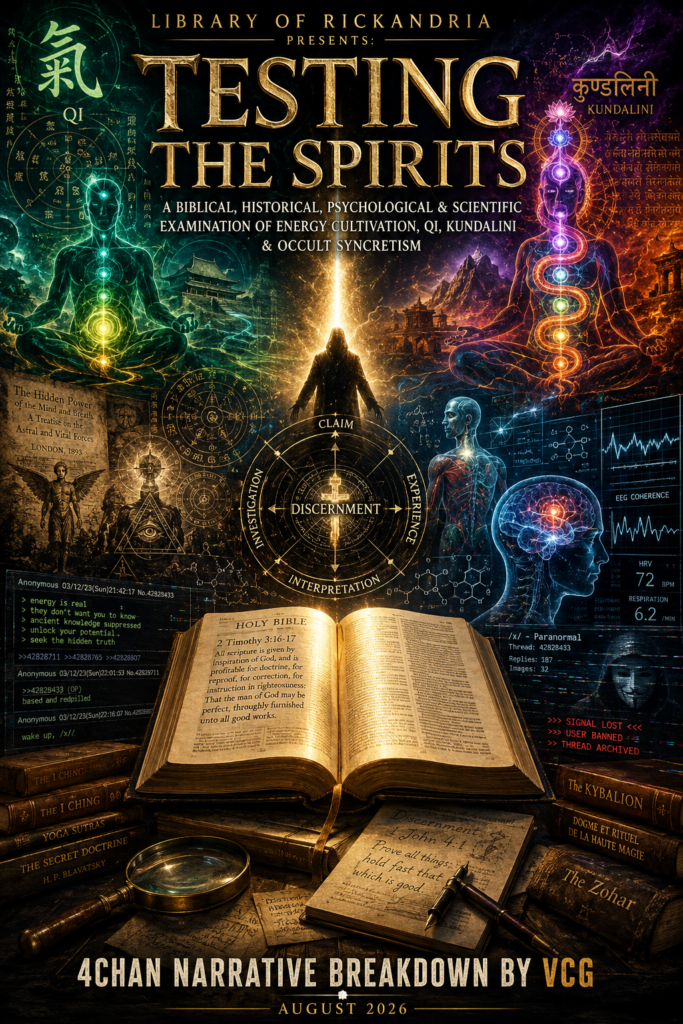
UPDATED BY VCG ON 8/17/2026 @ 17:17 EST
I want to share a heartfelt cause with my audience. Conner Blaisdell-Greene, a brave Airforce Sr. Airman, recently lost his battle with cancer, leaving his family in financial distress. Every donation, no matter how small, can help cover his funeral costs and ease their burden during this difficult time. Please consider clicking the link below to contribute or share Conner’s story with others. Your support truly matters.
Anyone can do this, but most won’t.
ChatGPT – Library of Rickandria
Soli Deo Gloria brethren.
I’ll treat the thread as the primary claim-set, separate what it actually says from inference, then test each substantive line against external evidence and Scripture.
I’ll also flag:
- rhetorical techniques
- cognitive biases
- evidentiary gaps
and where a biblical correction is textually strong versus merely interpretive.
/x/ – /ECG/ Energy Cultivation General: From the ashes edition [16] – Paranormal – 4chan
The thread is live and accessible; it began August 15, 2026 and is still receiving replies today.
One important early finding is that it mixes several very different things—
- ordinary breathing/meditation
- traditional Taoist/Hindu metaphysics
- health claims
- occult “energy” claims
- personal anecdotes
—then often treats them as evidence for one unified substance.
That conflation is going to matter throughout the rebuttal.
A second major finding: the thread itself contains an internal falsification problem.
It predicts noticeable “energy” within roughly 2–3 weeks, yet one participant reports two months of practice with no energy sensations; the response does not reconsider the hypothesis, but instead adds auxiliary explanations (“not enough fuel,” “foundations,” different technique).
That is a classic way a belief-system becomes hard to disconfirm.
The strongest factual red flag may be in the OP’s very definition of the alleged substance:
it lists:
- qi
- prana
- orgone
- aether
- Vril
and even “Nen” as interchangeable names for one energy.
Those terms come from different:
- historical
- religious
- occult
- scientific
and fictional frameworks; simply putting them in one list does not establish that they denote the same thing.
There is also a useful theological distinction here:
Scripture does not require us to deny ordinary physiological benefits simply because a technique originated outside Christianity.
- Slow breathing
- posture
- attention
- exercise
- fasting
or sexual self-control can have ordinary effects.
The biblical question changes when those effects are reinterpreted as:
- impersonal divine/vital power
- subtle-body anatomy
- occult attainment
or a path to
“higher planes.”
That distinction keeps the critique from becoming guilt-by-association.
I’ve now cross-checked the thread against biomedical literature, official NCCIH summaries, the historical provenance of several “energy” terms, and the uploaded KJV.
The emerging pattern is nuanced:
some practices can produce real sensations and measurable physiological/psychological effects, but those effects do not establish the thread’s claimed universal occult-energy ontology.
The thread repeatedly moves from
“I felt something”
→
“therefore qi/prana/orgone/etc. is real”
without the necessary evidentiary step.
I completed a live evidentiary audit of the thread as it stood Monday, August 17, 2026, through post #42834898 at 5:11:54 p.m.
The thread begins with #42828433 on August 15 and mixes:
- breathing exercises
- qigong
- Taoist internal alchemy
- Kundalini
- Reiki
- meditation
- fasting
- raw food
- celibacy/semen retention
- purported subtle-energy phenomena
and personal testimony. (4chan)
I am applying the same basic standard preserved in the VCG research manual:
Scripture first, evidence before opinion, context before commentary, and a deliberate separation of fact, interpretation, speculation, and rhetoric.
The KJV/Pure Cambridge text supplied for this project is the biblical source used below.
Executive verdict
The thread is not simply “all nonsense,” and that distinction is crucial.
There are at least four layers being collapsed together:
Real physiology:
- breathing rate
- diaphragmatic movement
- attention
- relaxation
- posture
- exercise
- pelvic-floor contraction
- fasting
- sexual behavior
- meditation
can produce real physiological or psychological effects.
Slow breathing in particular has documented autonomic effects, and some qigong/tai-chi interventions show modest benefits for particular outcomes.
Subjective experience:
- warmth
- tingling
- pressure
- altered body boundaries
- unusual attentional states
- calmness
- “floating” sensations
etc., may genuinely be experienced.
Genuine experience does not, by itself, establish the experiencer’s interpretation of its cause.
Traditional religious/metaphysical systems:
- qi
- prāṇa
- Kundalini
- chakras
- jing/qi/shen
- Neidan
have histories and meanings within different Chinese and Indian traditions.
They are not merely interchangeable scientific synonyms.
Chinese Philosophy and Chinese Medicine (Stanford Encyclopedia of Philosophy)
Modern occult or fictional concepts:
the OP nevertheless adds things such as Vril, originating as the mysterious energy in Edward Bulwer-Lytton’s 1871 novel The Coming Race, and Nen, explicitly the fictional aura/life-energy system of Hunter × Hunter.
The Coming Race by Baron Edward Bulwer Lytton Lytton | Project Gutenberg
The central error is therefore:
real sensation / real physiological effect → interpreted through a particular tradition → treated as proof of a universal occult substance → all historical concepts declared names for that same substance.
None of those arrows follows automatically from the previous one.
And biblically, there is another category distinction:
Scripture gives no warrant for identifying God’s “breath of life,” the human spirit, or the Holy Ghost with an impersonal manipulable substance called qi/prāṇa/orgone/Nen/Vril.
Genesis 2:7 says:
“And the LORD God formed man of the dust of the ground, and breathed into his nostrils the breath of life; and man became a living soul.”
The subject is the LORD God; the result is a living man.
The passage is not instruction in manipulating an ambient cosmic energy.
I. OP #42828433 — “higher planes of being”
The thread announces that
“energy cultivation”
will help practitioners toward
“higher planes of being.”
It never operationally defines a plane, how one detects one, how movement between planes is measured, or what observation could falsify the claim. (4chan)
Methodological problem
This is initially a metaphysical claim, not a scientific finding.
There is nothing improper about metaphysics as metaphysics, but it cannot acquire scientific status merely by attaching words such as “energy” to it.
A useful test would be:
- What precisely constitutes a “higher plane”?
- Is it a change in mood?
- brain activity?
- moral character?
- an objectively existing realm?
- altered perception?
- paranormal ability?
- survival after death?
Until this is specified, almost any unusual experience can retrospectively be counted as confirmation.
Psychology
This framing also creates expectancy before experimentation.
The practitioner enters the exercise expecting progressive hidden realities.
Ordinary bodily sensations therefore arrive already packaged with an explanatory narrative.
This does not mean sensations are imaginary.
It means the interpretation is primed.
Scripture correction
The Christian’s goal is not an undefined hierarchy of esoteric attainment.
Colossians says that in Christ
“are hid all the treasures of wisdom and knowledge,”
then immediately warns:
“Beware lest any man spoil you through philosophy and vain deceit, after the tradition of men, after the rudiments of the world, and not after Christ.” — Colossians 2:8
Paul is not condemning every philosophical thought; the modifiers matter:
“vain deceit,”
“tradition of men,”
“not after Christ.”
A few verses later he warns against becoming occupied with purported unseen realities while
“not holding the Head.”
II. OP’s master definition of “energy”
The OP lists:
- qi
- ki
- aether
- orgone
- archeus
- etheric energy
- vital life-essence
- prana
- chi
- mana
- Vril
- life force
- Nen
- quintessence
and says essentially,
“whatever you call it.”
(4chan)
This is perhaps the thread’s single biggest epistemological failure.
These are not established synonyms
Qi has a long and complicated place within Chinese:
- philosophy
- cosmology
- medicine
Stanford’s philosophy references discuss qi within early Chinese theories of:
- bodily constitution
- health
- cosmology
- change
Chinese Philosophy and Chinese Medicine (Stanford Encyclopedia of Philosophy)
Prāṇa is Sanskrit and means “breath,” and in Hindu usage can refer to the vital principle distinguishing life from death.
Neidan is a specific Taoist internal-alchemical tradition with its own extensive technical vocabulary and textual history; modern specialist Fabrizio Pregadio’s dictionary alone contains around 1,600 entries and thousands of examples drawn from primary Neidan sources.
Fabrizio Pregadio – Online Publications
Vril, by contrast, entered literature as an invented power in an 1871 novel.
The Coming Race by Baron Edward Bulwer Lytton Lytton | Project Gutenberg
And Nen is explicitly the supernatural power system in the manga/anime Hunter × Hunter; VIZ itself describes Nen as the fictional ability to control life energy or aura.
VIZ | Blog / Welcome to Hunter x Hunter!
So, the list effectively says:
Ancient Chinese cosmological term + Sanskrit religious concept + Taoist terminology + nineteenth-century occult terminology + Victorian fictional energy + Japanese manga magic system = one substance.
That is not comparative scholarship.
It is syncretism by vocabulary.
Logical fallacy: argument from resemblance
The reasoning seems to be:
culture A has something translated “vital energy”;
culture B has something translated “vital energy”;
fiction C calls its power “life energy”;
therefore they independently discovered one real phenomenon.
That conclusion does not follow.
Many cultures have concepts translated as:
“spirit,”
“soul,”
“heaven,”
“underworld,”
“divine,”
“breath,”
or
“fate.”
Similar English glosses do not establish ontological identity.
Biblical correction
This is especially important when someone tries to fold biblical language into the system.
Genesis says:
“the LORD God … breathed into his nostrils the breath of life.”
Biblically, life’s ultimate source is God, not an autonomous cosmic reservoir discovered equally as:
- qi
- Vril
- Nen
John likewise says concerning the Word:
“In him was life; and the life was the light of men.” — John 1:4
One may compare religions historically.
One should not silently rewrite biblical categories into an occult universalism the text itself never teaches.
III. “Energy … radiates within every life form”
This is an empirical-sounding assertion. (4chan)
But what is being measured?
Living organisms certainly exhibit measurable phenomena:
electrical membrane potentials,
electrochemical gradients,
electromagnetic activity,
thermal radiation,
chemical energy,
metabolism,
nervous activity.
For example, modern biological “bioelectricity” refers to things such as:
- ion channels
- membrane voltage
- pumps
- electrical gradients
in cells and tissues.
That is real science.
But:
“Bodies have bioelectric activity”
does not entail
“qi/prāṇa/orgone/Vril/Nen is scientifically confirmed.”
That is a category substitution.
If someone invokes Robert Becker’s The Body Electric, the relevant question is not,
“Does biology involve electricity?”
Yes.
The relevant question is:
Has someone demonstrated that measured membrane potentials and ion fluxes are identical to the occult substance being called qi/orgone/prāṇa?
The thread provides no such demonstration.
This is analogous to saying:
“The human brain emits measurable electrical activity; therefore telepathy is proven.”
The premise can be true while the conclusion remains unsupported.
IV. Claimed benefits: joints, mental health, perception, creativity, strength, spiritual development, etc.
Here the thread bundles dozens of outcomes into one claim. (4chan)
That needs to be disaggregated.
Some physical/psychological benefits are plausible or supported
NCCIH reports that qigong has been studied for pain, function and other health outcomes; some findings are promising, while evidence is frequently limited or low-certainty and stronger trials are needed.
Qigong: What You Need To Know | NCCIH
Similarly, tai chi/qigong trials have reported improvements in some measures of:
- fatigue
- sleep
- depressive symptoms
- balance
- quality of life in particular populations
although the quality and consistency of evidence varies substantially.
Tai Chi: What You Need To Know | NCCIH
Slow breathing itself has measurable psychophysiological effects.
A systematic review found associations with autonomic changes including heart-rate variability and respiratory sinus arrhythmia, alongside changes in emotional or psychological state.
So, it would be a bad rebuttal to say:
“Qigong or breathing exercises can never make anyone feel better.”
Evidence does not support that blanket dismissal.
But the benefits don’t validate the metaphysics
Suppose a slow-breathing qigong routine reduces someone’s anxiety.
Possible contributors include:
slower respiratory rhythm,
relaxation,
physical movement,
attentional regulation,
expectation,
social context,
repeated exercise.
That observation alone cannot tell us whether a Taoist metaphysical model of qi is literally true.
Effectiveness of an intervention ≠ proof of every explanation historically attached to the intervention.
A person could receive pain relief from acupuncture-like stimulation without that automatically proving every traditional meridian theory.
Likewise exercise can work without validating ancient humoral medicine.
V. “Practice whichever one resonates”
This sounds open-minded but is poor experimental methodology. (4chan)
If someone selects the worldview or technique that already “resonates” emotionally, then:
expectancy rises;
ambiguous sensations are more readily noticed;
successful experiences receive more attention;
failures are more easily blamed on “wrong technique”;
switching methods prevents clean falsification.
This is self-selection, not controlled comparison.
For spiritual exploration, someone may legitimately choose a tradition based on personal conviction.
But that choice should not subsequently be presented as scientific verification.
Biblically the standard is not
“what resonates with me.”
“Prove all things; hold fast that which is good.” — 1 Thessalonians 5:21
That verse is particularly apt here because it combines openness with discrimination:
test rather than reflexively accept or reflexively reject.
VI. The “library” and the supposed “academic reference”
The thread supplies enormous collections of books and torrents, then labels Shyam Sundar Goswami’s Layayoga an “academic reference.” (4chan)
There are two problems.
Quantity of literature is not evidentiary strength
50 GB or 300 GB of occult/Taoist material may establish that many people have written about these subjects.
It cannot establish that what they wrote is true.
A library of:
primary religious texts,
practice manuals,
autobiographies,
occult works,
popular books,
philosophical treatises,
is enormously useful for answering:
“What have practitioners believed and taught?”
It is not equivalent to controlled evidence answering:
“Does the claimed invisible force objectively exist?”
These are different questions.
“Layayoga” is a religious/yogic book, not a peer-reviewed experimental validation
The publisher describes Goswami’s Layayoga as a comprehensive guide to chakra meditation and the spiritual science of layayoga.
It is published by Inner Traditions.
That may make it useful for understanding a yogic tradition.
It does not turn it into controlled experimental evidence for Kundalini.
This is a recurring thread error:
authority on what a tradition teaches → authority proving the tradition’s metaphysical claims.
Those are different kinds of authority.
VII. “I’m Christian; this has got to be Satanic”
The thread anticipates this objection and links a
“Kundalini and Christianity”
document. (4chan)
Here we should be more precise than either side.
Breathing itself is not satanic
Neither:
- inhaling slowly
- relaxing muscles
- sitting quietly
- stretching
- walking
- controlling posture
nor noticing bodily sensations is intrinsically occult.
It would be an association fallacy to argue:
“A Hindu breathes this way; therefore a Christian who breathes this way worships Hindu gods.”
That does not follow.
Likewise bodily disciplines can be used within radically different belief systems.
But Kundalini isn’t historically just “breathing”
Kundalini belongs to Indian yogic/Tantric traditions involving concepts of latent spiritual power, subtle-body structures and spiritual transformation.
It is not historically equivalent to a generic clinical relaxation exercise.
So the Christian question is not merely:
“Is slow breathing forbidden?”
No.
It is:
“What spiritual reality am I being taught to invoke, awaken, submit to, visualize or unite with?”
That question becomes significant when the practice’s purpose moves from ordinary physiology into religious initiation or occult power.
Scripture
Deuteronomy 18 specifically prohibits Israel from adopting the surrounding nations’ divinatory and spirit-consulting practices:
“thou shalt not learn to do after the abominations of those nations.”
It then names:
- divination
- enchantment
- witchcraft
- charms
- familiar spirits
- wizardry
- necromancy
That text does not say every foreign exercise is witchcraft.
But it absolutely denies the premise that spiritual techniques are safe merely because they “work.”
The biblical question includes source, allegiance and object of worship, not merely phenomenological effect.
VIII. Reiki
Reiki is included alongside these cultivation systems. (4chan)
This gives us an unusually clean scientific comparison because the U.S. NCCIH directly addresses it.
NCCIH says:
Reiki has not been clearly demonstrated effective for any health-related purpose;
much of the research is low quality and inconsistent; there is no scientific evidence supporting the existence of the energy field claimed in Reiki theory.
That does not logically prove
“no such thing could ever exist.”
It means the present evidence does not establish it.
Therefore the thread cannot legitimately cite
“energy healing exists”
as settled empirical fact.
IX. The TL;DR — fasting, raw food, generosity, celibacy, compassion, breathwork, meditation, adventure
This line is rhetorically powerful because it bundles several genuinely beneficial or morally admirable activities with an unproven energy ontology. (4chan)
This is a form of halo transfer.
If generosity is good, and compassion is good, and exercise/adventure may be good, the reader begins to experience the entire package as validated.
But each proposition requires separate evaluation.
Fasting
Intermittent fasting has legitimate biomedical research behind it.
Umbrella reviews of randomized trials find beneficial associations for some obesity/metabolic outcomes, though evidence quality varies and many questions about long-term outcomes remain.
None of this demonstrates that fasting accumulates an occult substance.
Raw food
A carefully planned diet rich in minimally processed plant foods can be healthy.
But strict long-term raw diets can also produce nutritional difficulties.
Research has identified both favorable biomarkers and potential problems involving nutrient status in strict raw-food populations.
Nutritional Intake and Biomarker Status in Strict Raw Food Eaters – PMC
“Raw” therefore does not equal “spiritually purer” or “more energetic.”
Compassion/generosity
Christianity already gives an abundant theological reason to practice charity:
love of God and neighbor, not acquisition of subtle power.
If compassion becomes merely a technology for accumulating spiritual energy, even the moral act has been subtly redirected toward self-optimization.
X. “These are legit sources verified by me and multiple other people”
This is testimonial evidence. (4chan)
At most it establishes:
several people believe these practices helped them.
It cannot distinguish among:
intervention effects,
expectation,
natural fluctuation,
placebo/context effects,
concurrent lifestyle changes,
selective reporting,
mistaken causal attribution,
actual unexplained effects.
There is nothing dishonest about testimony itself.
The error comes when:
“multiple people said X”
becomes
“therefore the proposed invisible mechanism is established.”
That is not how causal inference works.
XI. The thread’s most important testable prediction: “2–3 weeks”
The OP states that consistent practitioners should see clearly definable results after roughly 2–3 weeks and, after a couple of months, effectively have no doubt. (4chan)
Excellent.
That finally gives us something approaching a falsifiable prediction.
Then a poster reports:
two months practicing Robert Bruce’s New Energy Ways, with no energy sensations. (4chan)
Now watch what happens.
Instead of:
“Our prediction may have been false.”
the response becomes:
perhaps you lack “fuel”;
perhaps you haven’t mastered the “foundations”;
perhaps use different breathing;
perhaps return to basics;
perhaps cultivate the dantian instead. (4chan)
And the responder makes an especially revealing admission:
it is his first time actually reading the Bruce material he is now diagnosing the other person’s failure to perform correctly. (4chan)
This is a textbook hypothesis-rescue pattern
Initial hypothesis:
Technique + consistency → unmistakable energy within weeks.
Counterexample:
consistent practice × two months → nothing.
Revised hypothesis:
you lacked fuel/foundations.
But “fuel” and “foundations” were not operationalized in the original prediction.
This is an ad hoc auxiliary explanation.
It does not necessarily prove the underlying claim false.
It shows that the thread’s method does not permit failure to count as evidence against the claim.
That makes the belief increasingly unfalsifiable.
This is probably the single strongest methodological rebuttal in the entire thread because it comes from inside the thread itself.
XII. “Foundations” become defined after failure
The dissatisfied practitioner correctly asks:
What foundations?
I followed the recommendation.
Later posters answer with breath refinement, stillness and body awareness. (4chan)
That is another example of moving the success criteria after the outcome.
A rigorous protocol would have said before the experiment:
- exactly what constitutes mastery;
- exactly how often to practice;
- what outcome should occur;
- by when;
- what counts as failure.
Otherwise, there is always another hidden prerequisite.
This resembles systems where:
success proves the method; failure proves the student was unprepared.
That structure protects the theory from evidence.
XIII. The slow abdominal breathing instructions
The thread next introduces:
- slow breathing
- relaxation
- mental attention
- abdominal expansion
while imagining an
“ocean of chi.”
(4chan)
This needs a split verdict.
Physiological component: plausible
Slow abdominal breathing can affect autonomic regulation and subjective state.
Slow-breathing literature documents changes in heart-rate variability and related physiological measures.
So:
“I feel different after this”
is completely plausible.
Metaphysical component: unproven
The instruction simultaneously tells the practitioner to focus on a lower-dantian location and conceptualize the breath in terms of an “ocean of chi.” (4chan)
The physiological evidence for slow respiration does not validate that second interpretation.
This is a recurring problem:
physiological technique + metaphysical visualization → every physiological response credited to metaphysical model.
A controlled test would separate them.
For example:
- Group A: identical respiratory rhythm with neutral anatomical language.
- Group B: identical rhythm with qi/dantian imagery.
- Group C: ordinary breathing.
- Blinded outcome assessors.
- Objective respiration, CO₂, heart-rate variability, skin temperature, etc.
- Subjective sensation ratings recorded separately.
That starts distinguishing breathing effects from metaphysical framing.
XIV. Controlled breathing and breath retention
The thread adds breath holding and then cites ancient claims that progressively enormous holds could heal illness and ultimately approach “immortality.”
To its credit, the poster explicitly says the extreme ancient method is dangerous and does not recommend it without a master. (4chan)
That caution should be acknowledged.
But the historical report itself is not scientific evidence.
The quoted progression includes a state in which sight, hearing and thought supposedly cease, then treats greater retention as progression toward immortality. (4chan)
That is exactly where phenomenology must not be mistaken for spiritual achievement.
Extreme alteration of consciousness is not self-authenticating.
Biblically, Scripture never teaches that life everlasting is obtained through mastery of respiration.
Eternal life is located in relation to God and Christ, not breath-retention expertise.
XV. Pelvic-floor/anus control
The thread progresses to repetitive pelvic-floor contractions integrated with breathing and visualization.
It then claims that anal control keeps internal organs “tight,” creates abdominal power, prolongs life, and may even prolong the life of a dying person. (4chan)
There are three separate propositions here:
- Can pelvic-floor muscles be voluntarily contracted? Obviously yes.
- Can pelvic-floor training have physical applications? Yes, in ordinary clinical contexts.
- Does this demonstrate qi retention or longevity? The thread gives no controlled evidence.
The balloon analogy—essentially closing the bottom so energy does not escape—is an analogy, not anatomy.
An analogy may help a practitioner visualize muscle engagement.
It cannot establish:
“therefore vital force is being sealed inside.”
Those are different claims.
XVI. “Compress the air into the ocean of chi”
The next exercise explicitly says coordinated abdominal/pelvic movement should
“compress the air”
into the dantian/ocean of chi. (4chan)
One should distinguish traditional embodied language from literal anatomy.
If
“compress the air”
is metaphorical traditional instruction, it should be presented as such.
If literal, the thread needs to identify:
what anatomical compartment receives this air,
how it is measured,
where the alleged reservoir is,
and what instrument detects accumulated qi.
The thread does none of that.
A later participant actually notices an anatomical problem and criticizes the technique’s description of compression, asking for its source. (4chan)
That skeptical response is methodologically healthier than
“if it works, it works.”
XVII. The “magnetic sensation” between the hands
One post instructs users to imagine palm-to-dantian connections and predicts that after several sessions they will feel a
“magnetic sensation”
during hand movements. (4chan)
This is a beautiful demonstration of why sensation ≠ external physical force.
The participant is told:
where to focus;
what to imagine;
what movement to make;
what type of sensation to expect.
Then the predicted sensation is treated as confirmation.
But feeling something “magnetic” is not the same as measuring a magnetic field.
A proper test
Measure it.
Use:
magnetometry appropriate to the hypothesized field;
sham sessions;
altered hand positions;
blinded experimenters;
randomized instructions;
a group not told to expect “magnetism.”
If no measurable field is proposed, then “magnetic” is merely phenomenological vocabulary.
And that is fine—but it should not be smuggled back into physics.
XVIII. “A whole book exists, so the method is legitimate”
When someone laughs at the pelvic-floor routine, the response is essentially that an entire book exists about the practice. (4chan)
That’s an appeal to literature, not evidence.
Books exist advocating mutually contradictory:
medical, political, religious and paranormal systems.
A book establishes that somebody has articulated a doctrine.
The next question is:
What evidence supports the book’s empirical claims?
XIX. “That resembles another teacher, so he must know what he’s talking about”
After a poster says the exercise resembles Steve Gray’s material, another replies that therefore whoever Gray is
“must know what he’s talking about.”
(4chan)
This is circular social confirmation:
Teacher A resembles anonymous technique B → therefore A validates B → which validates A.
No independent measurement has entered the chain.
It’s convergent tradition, perhaps.
It is not yet convergent empirical evidence.
XX. “This book helps me control more parts of my brain”
Another participant says a book helps control “more parts” of the brain and regards that as preparation for energy work. (4chan)
What would
“control more parts of my brain”
mean scientifically?
Possibilities include:
enhanced attentional control;
voluntary motor refinement;
interoceptive awareness;
altered arousal;
subjective concentration.
Those can be investigated.
But without operationalization, the phrase sounds neuroscientific while remaining undefined.
Again:
neuroscience vocabulary is not neuroscience evidence.
XXI. The “floating awareness / couldn’t feel my body” testimony
One participant guarantees energetic experiences and recounts an episode where awareness seemed localized near the head and bodily sensation disappeared.
He then admits he has not reproduced it consistently. (4chan)
I would not dismiss the experience.
The person may indeed have experienced something profound.
But we have to distinguish:
Event:
“My normal sense of bodily location changed.”
from
Interpretation:
“I encountered subtle energy or left ordinary bodily consciousness.”
Those are not identical propositions.
Meditative and respiratory practices are capable of altering bodily awareness and subjective state; research on meditation also recognizes both unusual experiences and adverse/difficult effects in some practitioners.
Defining and measuring meditation-related adverse effects in mindfulness-based programs – PMC
An unexpectedly useful biblical comparison
Paul describes an extraordinary experience in 2 Corinthians 12 and says:
“whether in the body, I cannot tell; or whether out of the body, I cannot tell:
God knoweth.”
Notice the epistemic humility.
Paul reports the experience without pretending to know the physical mechanism.
That is a much sounder model:
experience can be certain to the experiencer while its ontology remains uncertain.
XXII. The Neidan recommendations expose an expertise problem
Someone asks for a beginner Neidan book.
A respondent provides one, then admits:
“I don’t practice neidan”
“I’ve only scanned this book.”
(4chan)
Later others describe Neidan as so complicated and potentially dangerous that books are insufficient and a qualified master is necessary. (4chan)
This produces a credibility inconsistency:
anonymous novices are simultaneously recommending a spiritually and physically consequential practice that they themselves say requires specialist transmission they do not possess.
The thread itself eventually acknowledges that Neidan carries substantial philosophical, metaphysical and medical-cultural “baggage.” (4chan)
That concession is important—and historically much closer to the truth.
Specialist scholarship treats Neidan as a distinctive Taoist internal-alchemy tradition with extensive terminology and textual history.
Fabrizio Pregadio – Online Publications
Thus OP’s initial
“whatever you call it”
treatment is contradicted by the thread’s own later admission:
these traditions are not merely interchangeable techniques.
XXIII. “You must be 100% healthy” / practice can cause premature death
One poster asserts that advanced Neidan requires perfect health and that doing it incorrectly can cause one’s premature death. (4chan)
This is a serious health assertion without evidence.
Notice another potentially self-sealing pattern:
- Successful practitioner → method works.
- Failed practitioner → lacked foundations.
- Sick practitioner → shouldn’t have practiced.
- Harmed practitioner → practiced incorrectly.
- No teacher → insufficient transmission.
Every outcome can be incorporated without threatening the theory.
That is a warning sign for unfalsifiability.
It does not prove every traditional practice worthless.
It means the argument as presented has poor failure conditions.
XXIV. “Any successful cultivation practice improves health and longevity”
Another post asserts that genuine cultivation first brings health and longevity, invokes jing → qi metaphysics, and supports it with the writer’s personal claim of roughly twenty years without a cold, flu or seasonal allergy. (4chan)
This is an anecdote with no control.
We do not know:
diagnosis criteria;
exposures;
vaccination;
genetics;
environment;
other health behaviors;
whether asymptomatic infections occurred;
memory accuracy;
comparison population.
Even if perfectly true, it establishes:
one individual reports exceptional health.
It does not establish:
jing became qi and therefore caused exceptional health.
Biblically, unusual health is also not a guaranteed proof of superior spirituality.
The New Testament contains faithful servants who became ill; Christianity does not teach that sufficient spiritual cultivation renders believers immune to ordinary sickness.
XXV. “If it works, it works”
This appears after criticism of one breathing method. (4chan)
It sounds practical but avoids the key question:
What does “works” mean?
If it means:
makes me calmer,
improves posture,
reduces anxiety,
those outcomes are testable.
If it means:
seals qi,
awakens an invisible dantian,
extends lifespan,
opens a subtle channel,
those are separate claims requiring separate evidence.
A method can “work” for outcome A while its theoretical explanation B is wrong.
Medicine is full of historical examples where treatments sometimes had effects before mechanisms were correctly understood.
XXVI. “Neidan is personal, not empirical”
Near the end, someone states:
Neidan is individual and
“personal not empirical.”
(4chan)
If that claim were consistently maintained, science would have little to say about the private spiritual meaning assigned to the practice.
But the thread has already claimed:
energy radiates through organisms;
people should detect it in 2–3 weeks;
it improves health;
bolsters longevity;
prevents illness;
produces magnetic sensations;
breath retention heals;
pelvic-floor techniques prolong life.
Those are empirical claims. (4chan)
You cannot reasonably say:
“This produces observable health effects and detectable energy.”
then, when evidence is requested:
“It isn’t empirical.”
That is equivocation between subjective spirituality and objective claims.
The personal meaning may be non-empirical.
The medical and physical predictions are not.
XXVII. The Katha Upanishad’s “eleven gates”
One participant wonders whether the “11 gates” mentioned in the Katha Upanishad correspond to chakras and perhaps longevity. (4chan)
The verse really does use the image of a city with eleven gates.
Katha Upanishad (Ch-V)- Translation
But the thread’s inference:
eleven gates → minor chakras → longevity procedure
is not stated by that verse.
The poster is trying to fit one conceptual system onto another before establishing that the original text intends the same referents.
That is eisegesis—reading a preferred framework into a text.
And the same methodological warning applies to the Bible.
We must not see “breath,” “spirit,” “oil,” “fire,” “light,” or “power” in Scripture and automatically translate them into qi, chakras or Kundalini.
Similarity of imagery is not identity of doctrine.
XXVIII. Vril and Nen are devastating to the “ancient universal energy” argument
This deserves emphasis.
The OP’s taxonomy places both alongside ancient religious concepts.
Yet:
The Coming Race is an 1871 novel whose subterranean Vril-ya wield a mysterious power called Vril.
The Coming Race by Baron Edward Bulwer Lytton Lytton | Project Gutenberg
VIZ describes Nen as the supernatural “life energy”/aura system characters learn to manipulate in Hunter × Hunter.
VIZ | Blog / Welcome to Hunter x Hunter!
If a modern fictional author invents “Mystic Plasma” tomorrow and says it permeates living beings, the verbal resemblance would not prove that ancient Chinese sages knew Mystic Plasma.
Adding fictional systems to the list demonstrates that the criterion for equivalence is not historical transmission or scientific measurement.
It is basically:
“Does this concept sound like life energy?”
That criterion is far too loose to establish a common reality.
XXIX. The real psychology operating through the thread
I would identify nine recurring mechanisms, without claiming that any poster is deliberately deceiving anyone.
1. Expectancy effects
Readers are told in advance what sensations to expect—
- energy
- magnetism
- internal movement
- altered awareness
This shapes attention.
2. Interoceptive amplification
Focused attention on:
- respiration
- abdomen
- palms
- internal sensations
can make previously unnoticed bodily signals salient.
That does not mean the signals are unreal; it changes awareness of them.
3. Confirmation bias
Successes are remembered as proof while failures acquire explanations such as inadequate fuel, weak foundations or wrong technique.
4. Attribution error
“I practiced X and later felt Y”
becomes
“X’s metaphysical explanation caused Y.”
Temporal sequence alone cannot establish mechanism.
5. Social proof
Repeated statements such as
“others verified this,”
“every serious cultivator knows,”
and personal testimonials make the worldview feel independently confirmed.
But participants may all be interpreting experiences through shared literature.
6. Escalating commitment
Once someone has:
- fasted
- practiced celibacy
- meditated
- bought books
- trained for months
abandoning the explanatory framework carries psychological cost.
This can motivate further reinterpretation instead of falsification.
7. Prestige/authority effects
“Ancient Taoists,”
“masters,”
large libraries and specialist terminology create epistemic weight even where controlled evidence is absent.
8. Unfalsifiability
If every failure means insufficient practice and every success confirms the theory, the theory ceases exposing itself to meaningful disproof.
9. Syncretic pattern recognition
Humans are exceptionally good at recognizing similarities.
The thread notices recurring motifs—
- breath
- vitality
- sexuality
- stillness
- energy
—and concludes they must all describe one hidden truth.
But sometimes similar metaphors arise because human beings everywhere have bodies, breathe, reproduce, experience altered states, become ill and die.
Cross-cultural resemblance can arise without a single occult mechanism.
XXX. The biblical question: Is it all “demonic”?
This requires greater care than the thread gives it.
I would divide the material into three categories.
Category A — ordinary bodily actions
- Breathing slowly
- sitting quietly
- stretching
- practicing balance
- exercising
- eating nutritious food
and learning bodily awareness are not identified by Scripture as occult acts.
Calling every such activity demonic would go beyond the text.
Category B — disciplines Scripture itself can commend
Fasting, generosity, compassion and even celibacy can have biblical contexts.
But Christianity gives them radically different purposes.
Celibacy, for example, is not taught as conservation of an impersonal sexual fuel.
Jesus speaks of some remaining unmarried
“for the kingdom of heaven’s sake,”
while recognizing this is not given to everyone.
Paul similarly recognizes celibacy as a gift, while affirming marriage.
For married believers he says:
“Defraud ye not one the other, except it be with consent for a time, that ye may give yourselves to fasting and prayer; and come together again…” — 1 Corinthians 7:5
That directly challenges any universal rule saying sexual abstinence is spiritually mandatory because ejaculation leaks vital force.
Scripture permits temporary mutual abstinence for fasting and prayer, not the transmutation of semen into qi.
Category C — occult/religious allegiance
This is different.
When a practice becomes:
pursuit of occult powers;
divination;
spirit consultation;
invocation of other spiritual beings;
participation in idolatrous worship;
seeking spiritual salvation/immortality through a competing religious system;
then Scripture gives much clearer prohibitions.
Deuteronomy 18 is explicit regarding occult consultation.
Colossians warns Christians against spiritual systems that displace Christ and culminates in:
“And ye are complete in him…” — Colossians 2:10
That phrase strikes at the heart of spiritual “upgrade” systems claiming Christians require hidden energetic knowledge to become spiritually complete.
XXXI. Scripture also corrects ascetic extremism
This is important because one could overreact to the thread and accidentally make a different biblical error.
The thread promotes fasting, raw food and celibacy as components of energetic cultivation.
Yet Paul warns Timothy concerning teachings that elevate restrictions on marriage and foods into spiritual doctrine:
“Forbidding to marry, and commanding to abstain from meats…” — 1 Timothy 4:3
Then:
“For every creature of God is good, and nothing to be refused, if it be received with thanksgiving.”
Again, Paul isn’t condemning voluntary fasting or celibacy—he practiced disciplines himself.
The correction is against making ascetic regulations into a spiritual law or pathway to higher status.
That is highly relevant here.
XXXII. “Sex drains health/Qi” and the 100-day semen-retention claim
The thread says sexual activity expends health/Qi and that roughly 100 days can transform retained sexual essence into subtle qi. (4chan)
This contains at least three claims:
ejaculation affects reproductive physiology;
prolonged abstinence improves general health;
semen/sexual essence is converted into a subtle energy called qi.
Only the first has an ordinary biomedical basis: abstinence interval can affect semen parameters.
But the relationship is not
“longer is always better.”
Recent reviews describe a complex tradeoff:
prolonged abstinence tends to increase semen volume/count while potentially worsening motility and DNA-fragmentation measures; shorter abstinence can improve other sperm-quality parameters.
None of this demonstrates conversion into a supernatural energy.
The “100 days” statement therefore belongs to traditional doctrine, not established reproductive medicine.
Biblical correction
Sex within marriage is not treated as a regrettable leakage of spiritual vitality.
Paul’s marital teaching is reciprocal and affirmative.
The Christian case for sexual self-control rests on:
holiness,
fidelity,
mastery of lust,
proper marriage relations,
not conservation of mystical semen-energy.
Those two moral systems may sometimes prescribe similar outward restraint while supplying very different reasons.
XXXIII. Qigong health benefit ≠ qi scientifically demonstrated
This distinction deserves to be memorized.
NCCIH reports some positive results for qigong on specific outcomes while repeatedly noting weaknesses and the need for stronger evidence.
Qigong: What You Need To Know | NCCIH
Thus:
“Qigong may help some people with X”
is not equivalent to:
“Clinical trials have detected the metaphysical qi described by the thread.”
A breathing-and-movement practice can produce benefits through mechanisms already known to physiology.
That does not disprove qi as a philosophical concept.
It simply means the clinical outcome cannot be used as proof of the separate ontological claim.
XXXIV. Reiki demonstrates why this distinction matters
Reiki gives us the clean counterexample.
People can report relaxation or subjective improvement during a therapeutic ritual.
Yet NCCIH still says the proposed Reiki energy field itself lacks scientific evidence.
Therefore:
subjective benefit
≠ mechanism demonstrated.
That methodological rule applies equally to the entire thread.
XXXV. Real bioelectricity does not rescue “subtle energy”
One of the books linked is The Body Electric.
Modern science certainly recognizes bioelectricity.
- Ion channels
- pumps
- gap junctions
- membrane potentials
influence living cells and tissue organization. (PubMed Central (PMC))
But those phenomena are:
measurable;
quantifiable;
physically defined;
experimentally manipulable.
If the thread’s energy is the same thing, then its proponents should specify:
- volts?
- amperes?
- field strength?
- ion concentrations?
- tissue location?
- detector?
- expected magnitude?
If instead they say qi is not measurable electrical phenomena, then ordinary bioelectricity cannot be cited as scientific proof of qi.
You cannot have it both ways:
“Science proves our energy because bioelectricity exists.”
and
“Our energy cannot be measured by science because it is subtle/non-empirical.”
That is another moving definition.
XXXVI. A rigorous experiment for the thread’s central claim
Here is how I would actually test it.
Hypothesis:
a defined cultivation practice produces a real, externally detectable biological field distinct from known physiological processes.
Before beginning, proponents must specify:
what “energy” means operationally;
where it occurs;
what unit or detector can observe it—or, if no instrument exists, what blinded behavioral effect it reliably produces;
expected magnitude;
expected timeline;
success threshold;
failure threshold.
Then:
randomly assign participants to genuine practice and structurally similar sham practice;
keep expectation instructions comparable;
use blinded assessors;
preregister the 2–3 week prediction;
record respiration, CO₂, heart rate/HRV, temperature, movement and muscle activity so ordinary physiological effects can be separated;
separately record subjective sensations;
do not redefine “foundations” after results are known;
replicate independently.
If the genuine group repeatedly produces something not explained by measured physiological changes, then we investigate further.
That approach obeys the biblical principle far better than credulity:
“Prove all things; hold fast that which is good.”
XXXVII. Source hierarchy for this thread
This is another place where the thread badly needs discipline.
For what a religious tradition historically taught, use:
primary texts → critical editions/translations → specialists in that tradition’s history.
For health effectiveness, use:
systematic reviews → randomized trials → observational studies → case reports → anecdotes.
For whether an energy physically exists, use:
replicable physical measurement, not practitioner testimony.
For Christian doctrine, use:
Scripture in context → compare Scripture with Scripture, while distinguishing that textual result from later theological interpretation.
The thread repeatedly crosses those lanes:
manual → medical evidence
religious text → physics evidence
sensation → ontology
fiction → ancient wisdom
testimonial → causal proof.
Once those category crossings are corrected, much of the apparent case collapses.
XXXVIII. What survives the audit?
Some things do.
Slow, controlled breathing:
physiologically meaningful and potentially useful.
Meditative attention/stillness:
can affect psychological state, while not being universally harmless or spiritually self-interpreting.
Defining and measuring meditation-related adverse effects in mindfulness-based programs – PMC
Qigong/tai chi as movement practices:
some evidence supports benefits for selected symptoms/outcomes, although the evidence base is mixed.
Qigong: What You Need To Know | NCCIH
Fasting:
can have legitimate physiological effects under suitable circumstances.
Sexual self-control:
a legitimate ethical/religious subject; Scripture itself teaches chastity and recognizes celibacy.
Generosity and compassion:
thoroughly compatible with Christian ethics.
But what does not survive as established fact is the thread’s central synthesis:
that all these effects demonstrate one forgotten universal energy called interchangeably qi, prāṇa, aether, orgone, Vril, Nen, etc.;
that semen is empirically transmuted into this substance;
that specific breath retention approaches immortality;
that “magnetic” hand sensations demonstrate an external energy field;
or that two or three weeks of practice reliably verifies the system.
The thread simply hasn’t supplied evidence proportionate to those conclusions. (4chan)
XXXIX. Final Scripture correction
The biblical alternative is not:
“Never breathe slowly, never fast, never sit still, never exercise, because pagans have done those things.”
That would be indefensible.
Nor is it:
“Every tradition describes the same divine energy, so combine them all.”
Scripture gives no basis for that either.
Its categories are substantially different.
Life comes from God.
“the LORD God … breathed into his nostrils the breath of life; and man became a living soul.” — Genesis 2:7
The Christian’s fullness is located in Christ.
“For in him dwelleth all the fulness of the Godhead bodily.
And ye are complete in him…” — Colossians 2:9–10
Claims are to be tested.
“Prove all things; hold fast that which is good.” — 1 Thessalonians 5:21
Spiritual claims are not accepted merely because something unusual is experienced.
1 John instructs believers to “try the spirits,” rather than believe every spiritual claim.
Occult consultation is explicitly prohibited.
Deuteronomy 18:9–11 names:
- divination
- enchantment
- familiar spirits
- wizardry
- necromancy
among practices Israel was not to adopt.
Asceticism isn’t salvation or hidden energetic technology.
Paul warns against spiritually imposed restrictions concerning marriage and foods while recognizing legitimate voluntary discipline.
And perhaps the best psychological safeguard in the whole discussion comes from Paul’s handling of his own extraordinary experience:
“whether in the body, I cannot tell; or whether out of the body, I cannot tell:
God knoweth.”
That is intellectually powerful humility.
“I experienced something”
does not require
“therefore I know exactly what metaphysical mechanism produced it.”
Overall assessment
| Component | Verdict |
|---|---|
| Slow breathing has effects | Supported |
| Qigong can have some health benefits | Supported in limited contexts |
| Meditation can alter bodily awareness | Supported |
| Fasting has physiological effects | Supported, context-dependent |
| Celibacy can be a valid discipline | Yes; theological/ethical question |
| Qi is historically a Chinese concept | Yes |
| Prāṇa is historically an Indian concept | Yes |
| Neidan is a distinct Taoist internal-alchemy tradition | Yes |
| All traditions describe one identical substance | Not established |
| Qi = prāṇa = orgone = aether = Vril = Nen | Historically/methodologically indefensible |
| Vril independently confirms ancient energy | False premise: literary origin |
| Nen confirms universal life energy | False premise: fictional manga system |
| Reiki energy field scientifically established | No |
| Feeling “magnetism” proves a physical field | No |
| Sexual activity drains measurable Qi | Not established |
| 100 days converts semen into Qi | Not established |
| Extreme breath retention approaches immortality | Not established |
| 2–3 weeks reliably proves cultivation | Contradicted within the thread itself |
| Failure explained by hidden “foundations” | Ad hoc unless specified beforehand |
| Biblical breath of life = qi/prāṇa | Text does not support this identification |
| Every breathing/stretching technique from another religion is demonic | Scripture does not support that blanket conclusion |
| Participation in occult/spirit-seeking worship is biblically permissible | No |
| Christian spiritual completeness requires energy cultivation | Contradicted by Colossians 2:9–10 |
The central lesson is therefore not
“mock everyone who reports strange experiences.”
Nor is it
“believe the experience’s supplied interpretation.”
It is:
separate experience from explanation, physiology from metaphysics, historical tradition from scientific evidence, and biblical vocabulary from imported occult categories.
That gives us a critique considerably stronger than merely calling the thread “Satanic”:
it shows exactly where its reasoning succeeds, where it fails, why sincere practitioners can nevertheless experience something real, how those experiences can reinforce the system psychologically, and where Scripture actually draws its boundaries.
4CHAN THREAD & POST BREAKDOWNS – Library of Rickandria
VCG PAPER PROJECTS – Library of Rickandria