
UNMASKING SAMHAIN: CHAPTER ONE – WHAT DOES IT MEAN TO UNMASK SAMHAIN?
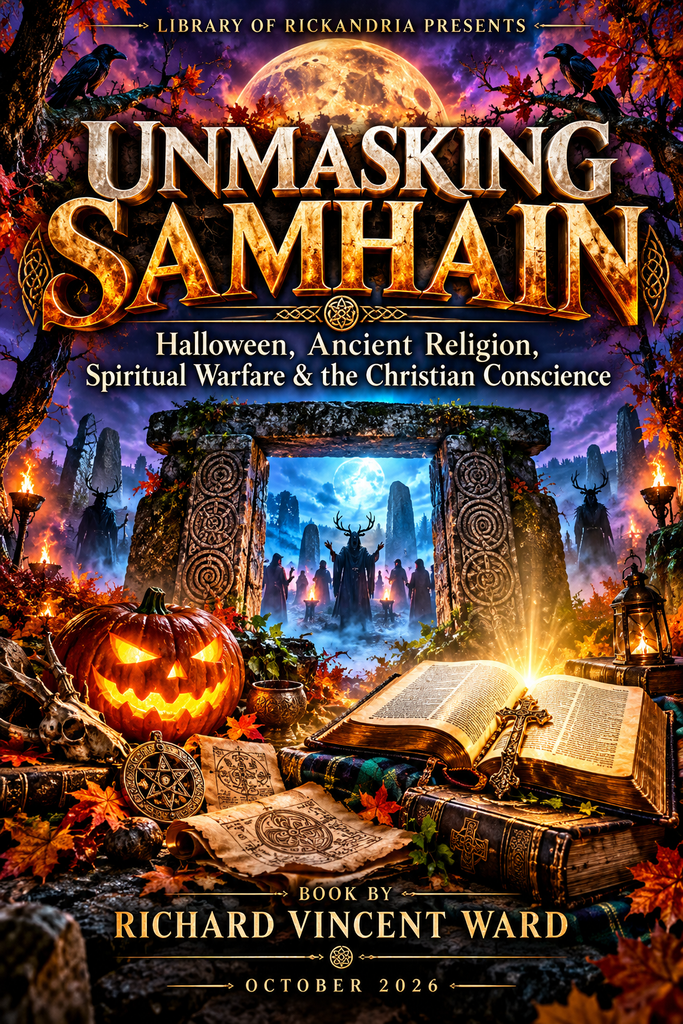
UPDATED BY VCG ON 10/23/2026 @ 15:15 EST
CHAPTER 1
WHAT DOES IT MEAN TO UNMASK SAMHAIN?
Examining the History, Testing the Claims, and Establishing the Biblical Standard
“Prove all things; hold fast that which is good.”— 1 Thessalonians 5:21, King James Bible
1. The Difference Between Exposing a Mystery and Creating One
Every investigation begins with a question.
But not every investigation begins with an open mind.
Sometimes the conclusion has already been accepted before the evidence is examined. The researcher then searches the historical record for details that appear to confirm it, interprets uncertainties in its favor, and dismisses contrary evidence as deception, ignorance, or compromise.
The resulting account may be elaborate, persuasive, and emotionally compelling.
It may also be profoundly misleading.
This danger becomes especially significant when investigating subjects that involve religion, the supernatural, children, ancient ritual, and spiritual warfare.
These subjects naturally provoke strong responses. For believers who understand Scripture as divine revelation, questions concerning idolatry and occult practice carry serious moral implications. For historians, claims concerning vanished civilizations and prehistoric ceremonies raise difficult questions about the surviving evidence. For psychologists, stories of invisible danger offer an opportunity to examine the relationship between belief, fear, interpretation, and human behavior.
A responsible investigation cannot ignore any of these dimensions.
But neither can it confuse them.
The existence of an ancient religious practice is a historical question.
The meaning of that practice to its participants is a question for historical and religious interpretation.
The psychological effects of a modern custom are empirical questions requiring appropriate research.
The moral evaluation of that custom within Christianity is a theological question requiring careful attention to Scripture.
And the claim that a particular activity produces an invisible supernatural consequence is a further assertion that cannot automatically be established by answering the others.
The difficulty is not that these questions are entirely unrelated.
It is that they require different kinds of evidence.
A Roman historian may describe a sacrifice.
A medieval Irish manuscript may preserve an encounter with an otherworldly being.
A modern psychologist may study responses to frightening imagery.
A biblical passage may prohibit consultation with the dead.
All four sources can contribute to a serious investigation.
But they do not automatically describe the same event, the same practice, or the same moral situation.
The first responsibility of this book is therefore to distinguish the questions before attempting to answer them.
To unmask Samhain is not simply to search for frightening historical associations. It is to uncover the origin, development, interpretation, and evidentiary status of the claims made about Samhain and Halloween.
This includes investigating the claims made by those who defend Halloween.
It also includes investigating the claims made by those who condemn it.
Neither position receives immunity from scrutiny.
2. What Exactly Are We Investigating?
Before examining ancient sources, we must clarify the terminology.
The words Samhain, Halloween, All Hallows’ Eve, All Saints’ Day, and All Souls’ Day are related in popular historical discussions.
They are not interchangeable.
Samhain
Samhain, also written Samain in early Irish sources, denotes the seasonal transition associated with the beginning of winter around November 1.
Its conventional English pronunciation approximates SOW-in, although pronunciations vary among Gaelic languages and dialects.
Samhain occupied an important place in early Irish tradition. It was one of the principal seasonal divisions of the year, and medieval Irish literature associates it with feasting, assemblies, extraordinary events, and encounters involving otherworldly beings.
Historian Ronald Hutton, in The Stations of the Sun: A History of the Ritual Year in Britain, identifies Samhain as a major festival marking the opening of winter in early medieval Ireland.
That historical conclusion is significant.
It establishes that Samhain was more than an invention of recent popular culture.
But it does not automatically establish the details of every religious ceremony attributed to prehistoric Druids.
The surviving medieval Irish texts and the evidence for pre-Roman religious practices must be examined separately.
Halloween
The English name Halloween developed from expressions referring to the evening preceding All Saints’ Day.
According to the Online Etymology Dictionary’s historical entry, the shortened form emerged in a Scottish linguistic context, while earlier expressions referring to All Hallows’ Eve are documented in medieval English.
This is a linguistic fact.
The word Halloween has a documented relationship to the Christian liturgical calendar.
That fact does not prove that every activity associated with modern Halloween originated within Christianity.
Neither does it prove that every such activity originated in pagan religion.
A festival’s name, ceremonial history, social customs, and contemporary meaning may have different historical trajectories.
All Saints’ Day and All Souls’ Day
All Saints’ Day commemorates saints within Christian liturgical traditions.
All Souls’ Day developed as a commemoration particularly associated in Western Christianity with prayer for the departed faithful.
Their historical development involved ecclesiastical decisions, regional practices, and changing theological emphases.
The relationship between these observances and earlier seasonal traditions is a legitimate historical subject.
But a resemblance in date does not, by itself, prove that one festival was deliberately established to replace another.
Evidence of such a decision requires appropriate historical documentation.
Modern Halloween
Contemporary Halloween includes a wide range of practices: dressing in costumes, distributing candy, decorating homes, attending parties, visiting haunted attractions, watching horror films, participating in religious observances, or attending church-sponsored alternatives.
These activities do not all possess the same purpose.
A commercial haunted attraction is not identical to a religious ceremony.
A child dressed as a fictional character is not performing the same action as an individual intentionally invoking a deity or spirit.
A church hosting an autumn meal is not necessarily conducting the same activity as a contemporary Pagan group celebrating Samhain.
This does not settle whether each activity is morally appropriate.
It establishes that each must be understood before it can be judged.
The word Halloween describes a calendar occasion encompassing many forms of conduct.
It does not, by itself, provide a complete theological description of every person who participates.
3. The First Major Historical Problem: Which Samhain?
The popular narrative frequently begins with a single ancient festival.
It then treats that festival as though its ceremonies were practiced uniformly across the Celtic-speaking world.
But the term Celtic encompasses different peoples, places, periods, languages, and historical circumstances.
The Gauls described by Roman authors were not culturally identical in every respect to medieval Irish communities.
The religious practices of Britain cannot automatically be reconstructed from traditions recorded in Ireland centuries later.
Nor can the practices of every Celtic-speaking population be inferred from one literary narrative.
Historical investigation requires attention to these distinctions.
Consider the Roman commander Julius Caesar.
In The Gallic War, Book VI, Chapter 13, Caesar described Druids as a prominent class involved in religious affairs, sacrifices, instruction, and certain legal or social functions.
This account provides valuable information about Roman representations of Gallic society during the first century before Christ.
But Caesar did not provide a complete record of religious activity throughout all Celtic-speaking regions.
His account also reflects the perspective of a Roman military and political figure writing about peoples involved in Rome’s expansion.
Now consider medieval Ireland.
In Irish literary tradition, Samhain appears in connection with seasonal gatherings and supernatural narratives.
The University College Cork Department of Early and Medieval Irish discusses examples in its article Secrets at Samhain.
Among them is the tale commonly known as Fíngen’s Night-Watch, in which a supernatural female figure conveys knowledge concerning events in Ireland at Samhain.
The same discussion refers to an entry in the Annals of Tigernach concerning a man seeking knowledge of the future at Newgrange during the festival.
These examples demonstrate that associations between Samhain, supernatural knowledge, and the Otherworld are genuinely present within medieval Irish tradition.
They should not be dismissed as modern inventions.
Yet an association appearing in medieval literature is not automatically proof of a universal prehistoric Druidic ceremony.
There are several possibilities to examine.
A medieval story may preserve an older cultural memory.
It may combine older material with later beliefs.
It may reflect literary symbolism rather than a typical religious practice.
Or it may preserve evidence of an actual custom whose earlier development cannot be fully recovered.
Historians must determine which interpretation is justified by the available sources.
It is not sufficient to choose whichever explanation best supports an argument already accepted.
The New Year and Feast of the Dead Question
A particularly important historical issue concerns the claim that Samhain was the universal ancient Celtic New Year and great annual feast of the dead.
This interpretation became widespread through influential earlier scholarship, including the work of Sir John Rhys and James George Frazer.
In 2024, Ronald Hutton published The Celtic New Year and Feast of the Dead in Folklore, volume 135, issue 1, pages 69–86.
After reviewing the historical development of these ideas, Hutton concluded that the evidence for an ancient New Year festival remains indirect and inconclusive.
He found the evidence for a prehistoric annual feast of the dead even less substantial.
His argument did not demonstrate that such practices were impossible.
Instead, it showed that claims long repeated as historical facts rested upon uncertain reconstructions.
This distinction changes how the history must be written.
We may state that Samhain was an important early Irish seasonal festival.
We may state that medieval Irish literature contains notable supernatural associations.
We may investigate whether some traditions reflect older religious practices.
But we must not transform an uncertain reconstruction into an eyewitness account of prehistoric ritual.
The proper historical conclusion is narrower than the familiar popular narrative.
And that narrower conclusion is more trustworthy.
4. Re-examining the Original Book’s Central Argument
The first edition of Unmasking Samhain presented Halloween as a continuing manifestation of ancient spiritual practices.
In its introduction, the holiday was described as:
“not innocent. It is not neutral. It is not redeemable.”
This statement expressed the manuscript’s central conclusion before its historical and biblical arguments had been systematically tested.
To evaluate the conclusion, we must separate its components.
The first proposition concerns innocence.
Can particular Halloween activities be morally wrong?
Certainly, some activities can be evaluated negatively under biblical teachings, particularly where they involve actual idolatrous worship, intentional divination, cruelty, or other prohibited conduct.
But proving that certain activities are wrong does not establish that every activity associated with the calendar date is wrong.
The second proposition concerns neutrality.
Can an object, symbol, performance, or cultural custom carry different meanings in different settings?
Historical evidence suggests that cultural meanings frequently change.
The same outward form may be employed for religious, political, artistic, educational, or recreational purposes.
This does not make the form morally irrelevant in every circumstance.
But it prevents us from assuming that one meaning permanently determines every subsequent use.
The third proposition concerns redemption.
Can a cultural practice be adapted to purposes different from those associated with an earlier religious tradition?
This is a theological and historical question.
Christians disagree about the permissible extent of cultural adaptation.
Some understand certain inherited customs as intrinsically incompatible with Christian worship.
Others distinguish the original religious function from the contemporary meaning and use.
Still others argue for a more limited participation governed by conscience and pastoral wisdom.
These positions must be examined in light of Scripture and documented historical circumstances.
The original conclusion therefore contains several separate arguments requiring investigation.
Its confidence is not evidence of their correctness.
Claim A: Samhain Was a Spiritually Active Gateway
The earlier manuscript treated Samhain as a literal spiritual gateway through which supernatural beings could cross into the human world.
Medieval Irish literature certainly contains stories of otherworldly encounters associated with Samhain.
That is a historical fact about the literature.
But the existence of such stories does not establish that a supernatural gateway objectively opens at a particular annual date.
We must distinguish three propositions.
First, people told stories associating Samhain with the Otherworld.
Second, certain people may have believed that supernatural activity was particularly significant during that season.
Third, a supernatural portal actually exists and remains active today.
The first can be established through surviving texts.
The second may be investigated through historical evidence concerning belief and religious practice.
The third is a metaphysical assertion requiring independent justification.
The original work often moved from the first proposition to the third without clearly establishing the intervening argument.
Editorial verdict: Historical associations with the Otherworld are supported; the literal and continuing supernatural-gateway claim remains an unestablished theological assertion.
Claim B: Ancient Druidic Sacrifices Were Samhain Sacrifices
The original manuscript referred to Julius Caesar as support for Druidic blood rituals.
Caesar did describe human sacrifice among the Gauls.
In The Gallic War, VI.16, he also described figures constructed from woven materials and filled with living victims before being burned.
This account deserves examination rather than denial.
But Caesar did not identify the rite as a Samhain ceremony.
He did not specify October 31 or November 1.
He did not describe Halloween.
The original argument therefore joined a genuine ancient report to a specific festival without demonstrating the connection.
That does not prove that sacrifices never occurred at Samhain.
It means the evidence cited does not establish that they did.
An additional issue concerns the reliability of Caesar’s testimony itself. He was writing in the context of Roman military campaigns. His account must be compared with other ancient testimony, archaeological findings, and the broader conventions of Roman ethnographic writing.
A source can be historically valuable without being beyond criticism.
Editorial verdict: Caesar’s report is authentic ancient testimony. Its application to a specific Samhain sacrificial ceremony is not established by the passage.
Claim C: Halloween Costumes Continue Ancient Rituals
The original edition described modern costumes as continuing the spiritual purpose of ancient disguises.
It subsequently asserted:
“The act itself becomes an open door.”
This is a strong supernatural claim.
It cannot be demonstrated merely by identifying similarities between ancient disguise traditions and modern costumes.
A mask may function as part of a ritual.
It may also function in theater, carnival, storytelling, protective equipment, or children’s imaginative play.
The activity must be evaluated according to its actual setting and purpose.
Historical borrowing may help explain the development of a costume tradition, but it does not establish that every later costume functions as the same ritual.
There is a further issue.
Scripture nowhere explicitly states that the ordinary act of wearing a costume creates a spiritual agreement or automatically grants demonic access.
That does not mean Christian parents must approve every costume.
They may have serious moral objections to particular imagery or associated activities.
But those objections must be argued from relevant biblical principles rather than presented as proof of an automatic supernatural mechanism.
Editorial verdict: A historical relationship between some Halloween disguise customs and earlier folk traditions is plausible and documentable in specific cases. A universal spiritual contract created by ordinary costuming is unsupported.
Claim D: Halloween Is a Direct Continuation of Ancient Pagan Worship
The original edition described modern Halloween imagery, sweets, and community activities as repackaged forms of ancient rites.
To establish such a conclusion, several things would have to be demonstrated.
There must be evidence for the proposed ancient practice.
There must be evidence connecting that practice to later customs.
There must be evidence explaining how the custom changed or survived.
And there must be grounds for treating the modern practice as a continuation of the earlier religious function rather than merely a practice influenced by it.
This is particularly important because modern Halloween developed through multiple historical influences.
These include Christian commemorations, Irish and Scottish traditions, regional folklore, immigration, seasonal festivities, twentieth-century community practices, and commercial entertainment.
An account that treats every element as a direct survival of one ancient ceremony oversimplifies that development.
The Library of Rickandria’s later investigation, Pagan Origins, Christian Adaptation & Internet Mythmaking, recognized the same methodological danger: a possible historical influence must not be confused with proven direct descent.
Editorial verdict: Historical influences are real, but the sweeping assertion of continuous and uniform religious meaning is not established.
Claim E: Similarity Proves Spiritual Identity
The earlier book frequently associated modern Halloween symbols with biblical descriptions of evil because both involved imagery of death, darkness, supernatural beings, or ritual activity.
This creates a logical problem.
Two things may resemble one another without having identical origins, purposes, or meanings.
A flame may appear in a sacrificial ceremony, a birthday celebration, an emergency signal, and a religious vigil.
Its physical resemblance does not make these activities equivalent.
Likewise, the depiction of a fictional ghost does not, by itself, establish an attempt to communicate with the dead.
The representation of a witch in a story does not automatically constitute the practice of sorcery.
And a skeletal decoration does not automatically become an act of religious devotion.
There may be situations in which such representations are inappropriate according to a person’s conscience, religious commitments, or the particular circumstances.
But resemblance alone is insufficient to prove identity of practice.
Editorial verdict: Symbolic similarity can justify investigation, but it cannot serve as sufficient proof of identical religious meaning.
5. The Biblical Standard: What Does Scripture Actually Condemn?
At this point, we must turn from historical inquiry to biblical interpretation.
The original edition correctly recognized that Scripture addresses occult practices and idolatrous worship.
Its central weakness was not necessarily the identification of those prohibitions.
It was the tendency to apply them to modern customs without first establishing that the modern actions corresponded to what the passages actually prohibit.
Leviticus 19:31 — Consulting Familiar Spirits
The 2025 book opened its original first chapter with Leviticus 19:31.
The KJV reads:
“Regard not them that have familiar spirits, neither seek after wizards, to be defiled by them:
I am the LORD your God.”
The instruction addresses turning toward individuals who practice forbidden forms of spiritual consultation.
Its subject is not the mere depiction of supernatural beings in art or fiction.
It concerns conduct involving recourse to prohibited religious specialists.
The distinction is observable within the verse itself.
The command is directed against seeking these practitioners.
A modern activity involving an actual medium or intentional spirit consultation would therefore raise a directly relevant biblical issue.
But a Halloween costume or decorative ghost cannot simply be declared equivalent without additional argument.
To do so would enlarge the command beyond what the cited words directly establish.
Deuteronomy 18:9–14 — Forbidden Religious Practices
Deuteronomy 18 supplies an even fuller account.
Verse 9 introduces the prohibition against imitating specified practices of the nations Israel would encounter.
Verses 10–11 identify activities including child sacrifice, divination, enchantment, consultation with familiar spirits, and necromancy.
Verse 12 condemns these practices.
Verse 14 contrasts the nations’ reliance upon diviners with what was permitted to Israel.
The historical setting is the covenantal instruction given to Israel concerning life in the land.
Christian interpreters must consider how these prohibitions relate to broader biblical teaching, including New Testament condemnations of idolatry and sorcery.
But the passage itself identifies actual conduct.
It does not teach that every object once associated with a non-Israelite culture automatically performs the same forbidden spiritual function in every later context.
This distinction does not weaken the command.
It protects the command from being misapplied.
Where actual divination or necromancy occurs, the biblical prohibition is directly relevant. Where such conduct is merely alleged because an object resembles something associated with ancient religion, the historical and theological argument remains incomplete.
1 Corinthians 10 — Participation, Association, and Conscience
One of the most important New Testament passages for this investigation is 1 Corinthians 10:14–33.
Paul first commands Christians to flee idolatry.
He then warns against participation in religious fellowship associated with sacrifices to idols.
In verse 21, he declares that believers cannot participate simultaneously in the Lord’s table and the table of devils.
This is a serious prohibition.
Yet Paul continues the discussion by addressing food obtained in ordinary circumstances.
In verse 25, he writes:
“Whatsoever is sold in the shambles, that eat, asking no question for conscience sake:”
He then discusses accepting hospitality from an unbeliever and what to do if the food’s association with sacrifice is specifically identified.
These distinctions are essential.
Paul did not teach that every physical association with an idol automatically made all later contact spiritually identical to worship.
He distinguished participation in idolatrous fellowship from other encounters with food, while also considering the consciences of others.
This passage does not directly answer every modern Halloween controversy.
But it provides a biblical framework that challenges simplistic reasoning based solely upon prior associations.
A Christian must consider what an activity actually involves, whether it constitutes religious participation, and whether the action is consistent with love, conscience, and the glory of God.
The discussion culminates in verse 31:
“Whether therefore ye eat, or drink, or whatsoever ye do, do all to the glory of God.”
This is a demanding standard.
It does not permit indifference to the moral character of one’s actions.
But neither does it authorize the invention of prohibitions unsupported by the passage.
Acts 17:11 — The Responsibility to Examine
In Acts 17, Luke describes the people of Berea receiving the apostolic message and examining Scripture to determine whether the teaching was consistent with it.
The verse commends both receptiveness and investigation.
For our purposes, the application is methodological.
We should examine biblical teaching carefully rather than relying upon the confidence of a religious speaker.
We should also examine claims about historical events rather than accepting them because they have been accompanied by Bible quotations.
A historical assertion does not become true merely because the writer places a genuine biblical warning beside it.
The accuracy of the quotation and the accuracy of the historical conclusion remain separate matters.
1 Thessalonians 5:21–22 — Testing and Abstaining
The original work repeatedly invoked the command to abstain from evil.
But Paul’s instruction occurs immediately after the command to examine what is presented.
The two principles belong together.
Testing does not eliminate moral judgment.
Moral judgment does not eliminate testing.
It would be inconsistent to demand that believers abstain from what is evil while refusing to examine whether a particular activity has actually been shown to fall within that category.
Likewise, it would be inconsistent to use the language of investigation as an excuse to disregard conduct clearly prohibited by Scripture.
The biblical responsibility is to discern faithfully and act accordingly.
Not to condemn first and investigate afterward.
6. A Necessary Distinction: Three Different Christian Conclusions
Christian disagreement about Halloween is often presented as though one side respects Scripture while the other disregards it.
That description is frequently too simplistic.
Some Christians abstain entirely because they regard the holiday’s associations and contemporary imagery as inconsistent with their commitments to holiness.
Others distinguish between particular practices, rejecting actual occult activities while permitting forms of ordinary recreation or hospitality.
Others see modern Halloween largely as a secular cultural celebration but may still exercise caution concerning frightening content, commercial excess, and personal conscience.
These positions are not automatically equal in every argument they make.
Each must be evaluated according to Scripture, historical evidence, and the actual conduct involved.
But neither should the disagreement be misrepresented.
A Christian who abstains may do so from sincere conscientious conviction.
A Christian who participates in a neighborhood activity does not thereby prove that he or she intends to engage in spirit worship.
To infer hidden religious allegiance from outward resemblance alone would require evidence not supplied by the mere presence of a costume, decoration, or calendar date.
Romans 14 also requires attention when considering disputes among believers, although the chapter cannot be used to excuse practices directly prohibited elsewhere.
Its relevance depends upon whether the disputed action is actually a matter of Christian liberty.
That is precisely what careful interpretation must determine.
The question is not simply whether one Christian dislikes an activity and another enjoys it.
It is whether the action has been properly identified and whether the biblical grounds for condemning or permitting it have been established.
7. The Psychology of the Hidden Narrative
There is a psychological dimension to the original manuscript that must also be examined.
The book presented many different symbols and customs as expressions of one underlying spiritual system.
Once that system was accepted, almost every additional detail could appear to confirm it.
The pumpkin, mask, flame, ghost, candy, and autumn gathering were interpreted through the same explanatory framework.
This is an example of how a comprehensive narrative can organize otherwise diverse observations.
Such narratives are not automatically false.
They can be useful when the connections are well established.
But they can also become self-reinforcing.
If every detail is interpreted as confirming the theory, and every objection is explained away as deception or ignorance, the theory becomes increasingly difficult to test.
Confirmation Bias
Confirmation bias involves favoring or interpreting information in ways that support existing beliefs.
In his 2024 article Stop Fooling Yourself! (Diagnosing and Treating Confirmation Bias), neuroscientist Richard T. Born reviewed the ways selective attention and distorted interpretation can influence reasoning.
The problem is not limited to unintelligent or poorly educated individuals.
It can affect experienced researchers.
A person convinced that Halloween has a single demonic origin may preferentially select accounts of sacrifice, spirits, and ritual disguise while overlooking documentation of social entertainment, Christian commemorations, and modern commercial development.
A person convinced that Halloween has no legitimate religious concerns may commit the opposite error by dismissing evidence of actual religious observance or intentional occult practice.
Both tendencies require correction.
Repetition and the Illusion of Independent Evidence
An especially important problem arises when multiple publications repeat the same allegation.
A reader may encounter a claim in a sermon, a book, a documentary, and an online article.
Four appearances can create the impression of four independent sources.
But all four may ultimately depend upon one original assertion.
This is a form of source dependence.
The number of repetitions does not necessarily increase the number of independent witnesses.
Psychological research also shows that repetition can influence perceived credibility.
A 2026 systematic review published in Nature Communications, Systematic Review and Meta-analysis of the Evidence for an Illusory Truth Effect and Its Determinants, synthesized findings from 182 studies involving 31,184 participants.
The researchers found an overall tendency for repeated statements to be judged more truthful, although the effect varied across studies and conditions.
This finding does not show that repeated claims are necessarily false.
It demonstrates why familiarity must not be mistaken for verification.
The researcher must return to the original source.
If a historical assertion concerning ancient Samhain first appears in a speculative nineteenth-century reconstruction, quoting a succession of modern writers who repeat it does not establish that a prehistoric eyewitness account exists.
If a religious allegation appears in one person’s testimony, its appearance in dozens of later books does not automatically convert it into independently corroborated fact.
The evidence must be traced backward.
Fear and the Burden of Proof
Fear can also affect how we evaluate a claim.
A warning involving children, unseen forces, and spiritual danger may seem too serious to question.
A reader may reason that, even if the evidence is uncertain, accepting the allegation is safer than risking the danger it describes.
But this reasoning has consequences.
If unverified allegations are treated as facts because their subject is frightening, almost any cultural practice can be condemned through hypothetical spiritual mechanisms.
The same method could be used to assign invisible dangers to ordinary foods, clothing, household objects, music, books, or public events.
Responsible caution requires a reasonable relationship between the proposed danger and the evidence supporting it.
This does not mean every concern must await perfect certainty.
Parents and individuals routinely make prudent decisions under uncertainty.
But there is a difference between personally avoiding an activity because of concern and publicly asserting that the activity necessarily produces a specific supernatural consequence.
The second claim carries a greater evidentiary burden.
That burden cannot be discharged through emotional intensity alone.
8. How We Will Judge the Evidence
The chapters ahead will use a consistent investigative standard.
Whenever the original manuscript advances a substantial factual or theological claim, we shall determine what kind of proposition it is.
For historical claims, we shall identify the earliest relevant source, its date, the location and period it describes, its reliability, and its relationship to later accounts.
For archaeological claims, we shall distinguish material evidence from interpretations placed upon it.
For linguistic claims, we shall investigate documented word histories without assuming that similar-sounding terms share an origin.
For psychological claims, we shall examine scientific research appropriate to the proposed effect.
For biblical claims, we shall quote the relevant KJV passage, consider its context, compare related texts, and identify the difference between explicit teaching and theological inference.
For allegations involving contemporary individuals or organizations, identifiable documentation and corroboration will be essential.
A claim may be classified as established, partially supported, disputed, unsupported, contradicted, or not presently determinable.
These conclusions will not be assigned according to whether a claim supports or challenges a preferred religious position.
They will reflect the strength of its evidence.
Why an Absence of Evidence Must Be Interpreted Carefully
There is an important difference between saying that a practice never occurred and saying that available sources do not establish that it occurred.
The ancient world has left an incomplete historical record.
Many customs were transmitted orally.
Some practices may have existed without leaving identifiable documentary or archaeological traces.
Therefore, a lack of evidence cannot always establish impossibility.
But the incompleteness of the record does not authorize confident invention.
When a proposed ceremony has no contemporary documentation, a researcher may consider whether it is plausible.
The researcher may not simply describe it as demonstrated fact.
The evidentiary burden remains with the person advancing the claim.
The correct conclusion may sometimes be that we do not know.
That answer is less dramatic than a complete narrative.
It is often more historically responsible.
9. The First Corrections to the 2025 Manuscript
Our opening investigation has already established several necessary revisions.
The original edition’s treatment of Samhain contained historically recognizable elements, including the festival’s seasonal significance and its association with supernatural themes in Irish tradition.
Its reference to Caesar also rested upon a genuine ancient source.
These elements deserve preservation.
But the original argument went further than those sources independently established.
It treated reconstructed prehistoric rites as sufficiently certain, assigned continuing spiritual mechanisms to modern cultural practices, and interpreted the use of costumes and decorations through a framework that was not explicitly established by the cited biblical passages.
These elements require correction.
The revised account should therefore read as follows:
Corrected Historical and Biblical Statement
Samhain was an important seasonal festival in early Irish tradition, associated with the transition into winter and represented in medieval literature through assemblies, feasting, and supernatural narratives. Some surviving texts associate the season with encounters involving the Otherworld and the pursuit of extraordinary knowledge.
Ancient Roman authors, including Julius Caesar, described aspects of Celtic religious practice, including reports of human sacrifice among the Gauls. These accounts must be examined critically and cannot automatically be assigned to particular Samhain ceremonies without additional evidence.
The historical development of modern Halloween reflects several traditions and periods, including medieval Christian commemorations, European folklore, migration, changing community customs, and modern commercialization.
Consequently, individual contemporary practices cannot be assumed to preserve the original religious meaning of every earlier custom with which they may share a resemblance.
From a biblical perspective, Christians have clear grounds for rejecting actual idolatry, divination, necromancy, and intentional participation in forbidden spiritual practices.
However, applying those prohibitions to particular Halloween activities requires examining what the activity actually involves.
Historical origins, present intentions, symbolic meanings, conscience, and biblical teaching all deserve consideration.
Where the practice is explicitly forbidden by Scripture, Christians should take that prohibition seriously.
Where the connection is interpretive or disputed, the conclusion should be identified accordingly.
And where historical allegations lack adequate evidence, they should not be presented as established facts.
This is the revised foundation upon which the rest of the book will proceed.
10. Why This Investigation Matters
The subject before us reaches beyond one festival.
It concerns the reliability of religious teaching.
It concerns how historical narratives are constructed.
It concerns the psychological power of fear.
It concerns the way parents instruct children.
And it concerns the responsibilities of anyone who claims to explain Scripture.
An inaccurate warning can produce unnecessary anxiety.
An inaccurate reassurance can conceal genuine danger.
A fabricated historical connection can damage the credibility of an otherwise legitimate biblical argument.
And an interpretation presented as direct revelation can burden consciences beyond what the text itself requires.
These consequences are not trivial.
They are reasons to conduct the investigation carefully.
A Christian author should not be satisfied merely because readers become alarmed.
A historian should not be satisfied merely because readers find a reconstruction compelling.
A psychologist should not be satisfied merely because a theory provides an elegant explanation.
Each must ask whether the conclusion is justified.
For the present work, that responsibility is especially personal.
The Library of Rickandria published an earlier argument.
The revised edition must now examine that argument according to the same standards applied to opposing views.
If an earlier statement was supported, it should be defended.
If it was exaggerated, it should be qualified.
If it was mistaken, it should be corrected.
If it was speculative, it should be identified as speculation.
That is how an investigation becomes more trustworthy.
Not through the absence of error, but through a consistent willingness to recognize and correct it.
11. Conclusion — The First Mask Removed
We began with a question.
What does it mean to unmask Samhain?
At first glance, the answer might seem to involve uncovering an ancient religious system hidden beneath a modern cultural celebration.
That is one possibility to investigate.
But the evidence already reveals a more complex task.
We must uncover the differences between prehistoric reconstruction and medieval testimony.
Between ancient religious practice and modern cultural adaptation.
Between historical association and direct continuity.
Between symbolic representation and actual religious participation.
Between psychological fear and demonstrated danger.
Between an explicit biblical prohibition and an interpretation that extends beyond it.
And between what an author believes and what an author can establish.
The first mask to be removed, therefore, is the illusion that a complete historical and spiritual explanation can be constructed without addressing these distinctions.
There is much yet to examine.
The Celtic world must be reconstructed.
The Druids must be investigated.
Caesar’s testimony must be weighed.
The medieval Irish manuscripts must be studied.
The development of Allhallowtide must be traced.
The history of costumes, lanterns, fires, and trick-or-treating must be documented.
Modern religious observances must be described accurately.
Claims of occult activity must be distinguished from claims about ordinary cultural participation.
Psychological assertions must be tested against appropriate research.
And the biblical passages must be examined in context.
Only then can the central questions of this book receive responsible answers.
It may turn out that some traditional warnings rest upon genuine evidence.
Others may rest upon historical misunderstandings.
Still others may represent sincerely held theological interpretations that cannot be established as historical facts.
The investigation must remain capable of recognizing all three outcomes.
We must neither conceal wrongdoing nor invent it.
Neither dismiss Scripture nor misapply it.
Neither ignore danger nor manufacture fear.
The pursuit of truth calls for something more demanding than choosing between alarm and indifference.
It calls for discernment.
And discernment requires examination.
The words of Proverbs 18:17 provide a fitting final reminder:
“He that is first in his own cause seemeth just; but his neighbour cometh and searcheth him.”
Our earlier conclusions must now submit to that search.
The history is waiting.
The documents are before us.
And the work has only begun.
Let every claim be tested.
Let every source be examined.
Let Scripture speak within its proper context.
And let no conclusion claim greater certainty than the evidence allows.
Soli Deo Gloria.
CHAPTER 1 — RESEARCH NOTES & SOURCE REGISTER
Historical Foundations
1. Original Library of Rickandria publication
Unmasking Samhain: Exposing the Satanic Roots of Halloween. October 29, 2025. Primary document under revision.
Unmasking Samhain: Exposing the Satanic Roots of Halloween – Library of Rickandria
2. Ronald Hutton, 2024
“The Celtic New Year and Feast of the Dead.” Folklore 135, no. 1, pp. 69–86. Peer-reviewed historical reassessment of the evidence for Samhain as a prehistoric Celtic New Year and annual feast of the dead.
Full article: The Celtic New Year and Feast of the Dead
3. Ronald Hutton, 1996
“The Stations of the Sun: A History of the Ritual Year in Britain,” Chapter 35, “Samhain.” Oxford University Press. Examination of early Irish seasonal traditions and the wider ritual calendar.
Samhain | The Stations of the Sun: A History of the Ritual Year in Britain | Oxford Academic
4. University College Cork, 2021
“Secrets at Samhain.” Department of Early and Medieval Irish. Discussion of medieval Irish traditions involving the Otherworld, supernatural knowledge, and Samhain.
Secrets at Samhain | University College Cork
5. Julius Caesar
Commentarii de Bello Gallico, Book VI, Chapters 13 and 16. Latin primary text and classical commentary provided by Dickinson College.
Chapter 6.13 | Dickinson College Commentaries
Chapter 6.16 | Dickinson College Commentaries
6. Online Etymology Dictionary
“Halloween.” Historical development of the name from All Hallows’ Eve.
Halloween – Etymology, Origin & Meaning of the Name
Psychology & Research Methodology
7. Richard T. Born, 2024
“Stop Fooling Yourself! (Diagnosing and Treating Confirmation Bias).” eNeuro, 11(10). A discussion of confirmation bias and research practices designed to reduce its influence.
Stop Fooling Yourself! (Diagnosing and Treating Confirmation Bias) – PMC
8. Jessica Udry and Sarah J. Barber, 2024
“The Illusory Truth Effect: A Review of How Repetition Increases Belief in Misinformation.” Current Opinion in Psychology, 56, 101736.
9. Steeven Ye and colleagues, 2026
“Systematic Review and Meta-analysis of the Evidence for an Illusory Truth Effect and Its Determinants.” Nature Communications. A large-scale synthesis of research investigating the relationship between repeated information and perceived truth.
10. American Psychological Association, 2024
“What Psychological Factors Make People Susceptible to Believe and Act on Misinformation?”
What psychological factors make people susceptible to believe and act on misinformation?
Library of Rickandria Companion Research
11. Library of Rickandria, August 2026
Pagan Origins, Christian Adaptation & Internet Mythmaking: A Historical, Biblical & Psychological Analysis of a 4chan Debate on Christian Holidays.
This companion investigation is relevant to the problems of historical continuity, source reliability, and overly simplistic pagan-origin arguments. It is prior analysis rather than independent primary evidence.
Scripture Register — KJV Pure Cambridge Edition
The following passages form the primary biblical framework for Chapter 1:
- Leviticus 19:31 — Seeking familiar spirits and wizards.
- Deuteronomy 18:9–14 — Forbidden religious practices.
- Acts 17:10–12 — The examination of Scripture at Berea.
- Romans 14:1–23 — Disputed practices, judgment, and conscience.
- 1 Corinthians 8:1–13 — Idols, knowledge, and concern for another’s conscience.
- 1 Corinthians 10:14–33 — Idolatrous participation, food, and the glory of God.
- 1 Thessalonians 5:19–22 — Testing, discernment, and abstaining from evil.
- Proverbs 18:13, 17 — The responsibility to hear and examine a matter.
Editorial conclusion: Chapter 1 establishes the terms and standards of the investigation. The substantive original-chapter claims identified here will receive fuller historical, psychological, and biblical examination in their assigned chapters, with a complete claim-level audit retained for Appendix A.
End of Chapter 1 — What Does It Mean to Unmask Samhain?
Richard Vincent Ward
Library of Rickandria
October 2026
SOLI DEO GLORIA
THE 4CHAN FILES: Where Anonymous Claims Meet Evidence & Scripture – Library of Rickandria
VCG PAPER PROJECTS – Library of Rickandria