
When Words Become “Magic”: A Linguistic, Psychological, Historical & Biblical Analysis of the Claim That Curse Words Are Literal Curses
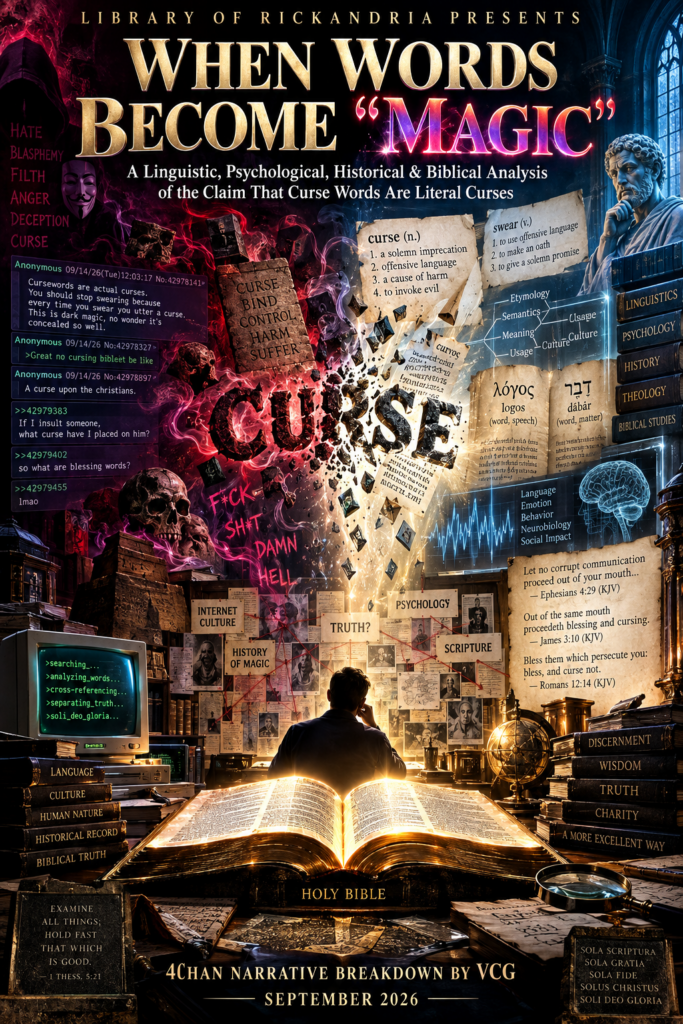
UPDATED BY VCG ON 9/19/2026 @ 00:00 EST
Anyone can do this, but most won’t.
ChatGPT – Library of Rickandria
Abstract
On September 18, 2026, an anonymous thread appeared on 4chan’s /x/—the site’s paranormal board—arguing that ordinary “curse words” are not merely called curses but are literally curses, and that swearing therefore amounts to a concealed form of dark magic.
/x/ – Cursewords are actual curses. You should stop swea – Paranormal – 4chan
The argument is striking because it combines several things that are individually true:
- words can affect people
- profanity can produce unusual psychological and physiological responses
- human societies have historically practiced verbal and written cursing
and the Bible treats human speech as morally serious.

VCG – WATCH YOUR MOUTH by VCG | Suno
From those premises, however, the thread moves to a much stronger proposition:
that uttering modern profanity automatically performs an occult act.
This paper examines that proposition without dismissing the real issues underneath it.
We first establish a methodology and distinguish:
- profanity
- obscenity
- oath-taking
- cursing
- imprecation
- blasphemy
- incantation
and occult practice.
We then examine:
- English semantics and etymology
- the psychology of taboo language
- speech-act theory
- experimental findings on swearing
- magical thinking and thought-action fusion
- archaeological evidence for historical curse practices
and the unusual epistemic conditions of anonymous imageboards.
The second half turns to Scripture, using the supplied Authorized King James Version, Pure Cambridge Edition as the principal biblical text.
Particular attention is given to:
- Numbers 22–24
- Deuteronomy 18:9–14
- Proverbs 18:21 and 26:2
- Matthew 5:33–37 and 12:33–37
- Romans 12:14
- Ephesians 4:29–5:4
- Colossians 3:8
- James 3
- James 5:12
The conclusion is narrower than either extreme.
Ordinary profanity is not demonstrated by:
- linguistic history
- psychology
- archaeology
or the biblical text to be an automatically operative form of dark magic.
At the same time, reducing speech to:
“just sounds”
is also inadequate.
Words can carry:
- moral
- relational
- psychological
- legal
- rhetorical
and sometimes religious significance.
Scripture provides serious reasons to govern the tongue without requiring a doctrine of unconscious verbal sorcery.
I. The Thread and the Question We Are Actually Asking
The thread began on /x/ at 11:38 a.m. on September 18, 2026.
In the snapshot examined for this paper, twelve posts were visible:
the original post and eleven replies.
Because 4chan threads are live and ephemeral, this paper treats that captured state of the thread as its corpus rather than assuming the page will remain unchanged indefinitely.
The original poster advances three connected propositions.
First, the English expression curse word is treated as revealing the actual nature of the thing:
a curse word is presumed to be literally a curse.
Second, the ordinary act of swearing is treated as the performance of that curse.
Third, that supposed mechanism is identified as occult or “dark magic,” with the fact that most people do not recognize it being interpreted as evidence that it has been concealed in plain sight.
It is important to state the claim precisely because several weaker claims are easy to defend:
Words can hurt people.

HURT PEOPLE, HURT PEOPLE by VCG | Suno
Profanity can intensify emotion.
Cursing someone can be morally wrong.
People have historically tried to curse others through ritual speech.
The Bible condemns various forms of corrupt speech.
None of those propositions is equivalent to:
Every utterance of a modern curse word automatically performs literal dark magic.
That final proposition is the one requiring investigation.
II. Method: Five Questions, Five Kinds of Evidence
A recurring problem in discussions of the occult is that several kinds of evidence get merged together.
- A historical fact becomes evidence for supernatural efficacy
- a psychological effect becomes evidence for a spiritual mechanism
- a Bible verse about one category of speech is transferred to another
or an etymology is treated as though it reveals a hidden metaphysical property.
This paper therefore uses five separate lanes of inquiry.
| Lane | Question being asked | What it can establish | What it cannot establish by itself |
|---|---|---|---|
| Linguistics | What do curse, curse word, and swear mean? | Usage, semantic distinctions, historical development | Whether supernatural forces exist or operate |
| History | How did historical people practice cursing or magic? | Beliefs, rituals, artifacts, social practices | Whether those rituals actually produced supernatural effects |
| Psychology | What effects can taboo language have on people? | Measurable cognitive, emotional, physiological, social effects | A supernatural explanation merely because an effect exists |
| Logic / methodology | Does the conclusion follow from the evidence? | Validity, alternative explanations, falsifiability | Theological truth by itself |
| Scripture | What categories and claims does the biblical text actually make? | What the cited text says and how passages relate | Claims the text does not make merely because they sound compatible with it |
This distinction is not an attempt to prevent the fields from informing one another.
It is an attempt to stop one field from being made to say what only another could establish.
Source hierarchy
The biblical portion begins with the supplied KJV text itself.
Historical questions prioritize artifacts, university collections, and specialist scholarship.
Psychological questions prioritize peer-reviewed experimental studies and reviews.
Linguistic questions use:
- established dictionaries
- semantic evidence
- historical etymology
The thread itself is primary evidence only for what its anonymous participants wrote; it is not evidence that their claims are true.
This hierarchy matters particularly with paranormal assertions.
The larger the causal claim, the more evidence is required to move from:
“people believed this,”
to:
“people reported this,”
to:
“this effect occurred,”
and finally to:
“this supernatural mechanism caused it.”
III. Before Debating the Claim: What Kind of Speech Are We Talking About?
Much of the confusion disappears when several different activities are no longer packed into the same English words.
| Category | Working description | Example of the underlying act | Same as automatic occult magic? |
|---|---|---|---|
| Profanity | Taboo or irreverent language | Offensive exclamation | No evidence establishes this |
| Vulgarity | Socially coarse language | Crude bodily expression | No |
| Obscenity | Sexually or otherwise grossly offensive speech | Explicit expression | No |
| Insult / reviling | Speech attacking a person | Degrading another person | No, though morally/socially consequential |
| Blasphemy | Irreverent or hostile speech concerning God or sacred things | Speaking against what is holy | Biblically serious, but not synonymous with every vulgar word |
| Oath / swearing | Solemnly invoking or pledging truth | “I swear…” | A distinct linguistic and biblical category |
| Imprecation / curse | Calling for evil, judgment, or harm to befall a target | “May judgment fall upon…” | Closer to the traditional meaning of curse |
| Blessing | Speaking or praying good concerning another | “God bless you” | Not simply a reverse magic spell |
| Incantation | Formulaic speech used within ritual practice | Ritual verbal formula | Can belong to magical practice |
| Enchantment / occult practice | Deliberate supernatural practice | Divination, charms, necromancy, etc. | Explicitly treated as occult in biblical texts such as Deuteronomy 18 |
The Oxford project on Roman curse tablets makes the historical distinction concrete.
Surviving curse tablets were intentionally prepared objects:
people inscribed messages, directed them toward gods or spirits, sought influence over other people, and deposited the tablets in locations associated with supernatural agents.
A person deliberately petitioning a supernatural being to harm a named enemy is therefore categorically different from somebody dropping a vulgar expletive after hitting his thumb with a hammer.
Whether either behavior is morally wise is another question.
But they are not automatically the same behavior.
IV. The Strongest Case for the Thread Before We Critique It
A fair analysis should not begin by making the argument look foolish.
There is a stronger version of the original intuition than the thread itself develops.
It could be stated this way:
Human words are not neutral noises.
Certain words acquire powerful associations through culture and childhood learning.
Taboo words can change:
- physiological arousal
- emotional intensity
- social relationships
- pain responses
- attention
Historically, words were central to:
- curses
- spells
- oaths
- blessings
- ritual actions
Scripture also portrays the tongue as extraordinarily consequential and contains examples of:
- blessing
- cursing
- vows
- prophetic speech
- occult practices
Perhaps modern speakers are therefore participating in something older and more spiritually consequential than they realize.
That is a serious question.
Research actually supports part of it.
A major interdisciplinary review published in Lingua concluded that swearing can produce distinctive:
- physiological
- cognitive
- emotional
- pain-related
- interpersonal
- rhetorical effects
The same review emphasizes, however, that those effects are not simply intrinsic properties sitting inside the phonetic form of taboo words.
Learning, cultural taboo, emotional association, and context matter.
This is exactly where careful inquiry becomes important.
The evidence supports:
Swear words can become unusually powerful human signals.
It does not automatically support:
The unusual power is occult energy released whenever the word is spoken.
The second proposition requires an additional argument.
V. The Linguistic Problem: One Word, Several Meanings
The OP’s reasoning depends heavily on the English label curse word.
Yet dictionaries do not define that expression as:
“a word which automatically performs supernatural cursing.”
Cambridge defines curse word as a rude or offensive word and treats swear word as its synonym.
More importantly, curse itself is polysemous.
Cambridge separately records a profanity-related sense—speaking rude or offensive words—and a wish-for-evil sense in which someone desires evil to befall another, potentially by appeal to magical power.
Likewise, swear can mean using offensive language, but it can also mean making a serious promise or taking an oath.
English therefore already gives us the problem:
same word ≠ same activity.
This is not unusual.
A person can run a race, run a company, run a program, or have a run in a stocking.
Nobody concludes that corporate management must secretly involve moving one’s legs rapidly because both actions use the verb run.
Meaning depends on usage and context.
VI. The Etymology Trap
The historical connection between:
- swearing
- sacred oaths
- profanity
and cursing is genuinely interesting.
The English verb swear originally concerned oath-taking and solemn declaration.
The profanity sense developed later, apparently in connection with the profane or blasphemous invocation of sacred names.
The history of curse is likewise complex.
Old English forms concerned wishing evil upon someone or consigning a person to an evil fate, while an intransitive profanity sense appears in Middle English.
So there is historical entanglement.
But that fact cuts against the simplistic argument rather than proving it.
The words accumulated and differentiated senses through time.
The mistake of assuming that a former meaning permanently controls every later meaning is commonly called the etymological fallacy.
Scholarly treatments of the problem emphasize that etymology informs the history of a word but does not freeze that word’s later semantic development.
That distinction is worth stating carefully.
Etymology matters when we ask:
Where did this word come from?
Usage matters when we ask:
What does a speaker mean by it here?
Metaphysics requires still more when we ask:
What causal power does uttering it have?
An etymology cannot answer that third question simply by itself.
VII. Words Really Do Things
Here the thread touches something important.
The corrective to magical thinking should not be the equally crude statement that words are:
“just noises.”
Language philosophers have long examined speech acts:
things human beings genuinely do by speaking.
Under suitable circumstances, words can constitute:
- promises
- commands
- warnings
- declarations
- agreements
- apologies
- accusations
- vows
But those acts operate in linguistic, social, and institutional contexts.
The successful performance of a promise, for example, depends on more than merely producing certain sounds.
Consider the difference:
“I promise to repay you.”
“I sentence you to ten years.”
“I now pronounce you married.”
All are words, but the latter two require appropriate authority and circumstances if the utterance is to perform the institutional act people normally associate with it.
That observation gives us a useful middle position:
Words can perform real actions without being magic.
They can also cause effects.
An insult may provoke anger.
A threat may create fear.
A false accusation may destroy a reputation.
A lie may alter another person’s decision.
A command may mobilize an army.
A contract may create legal obligations.
A sermon may persuade.
A blessing may comfort.
A slur may humiliate.
None of those effects is trivial.
None requires us to infer invisible occult energy from the fact that language changed what happened next.
VIII. The Psychology of Swearing: Why Taboo Words Feel Different
Modern research confirms that swearing is psychologically unusual.
Stapleton, Beers Fägersten, Stephens, and Loveday’s 2022 interdisciplinary review found evidence of distinctive:
- emotional
- physiological
- cognitive
- pain-related
- interpersonal
and rhetorical effects associated with swearing.
The authors discuss learned taboo and aversive conditioning as plausible contributors to this unusual potency.
One of the most reproducible examples is pain.
A 2024 review of experimental work concluded that swearing has repeatedly produced hypoalgesic effects—participants can sometimes tolerate acute experimentally induced pain longer while swearing.
The review also emphasizes that the mechanism is still uncertain.
Possible contributors include:
- arousal
- emotion
- humor
- distraction
- aggression
- disinhibition
- psychological flow
- self-confidence
Most evidence comes from controlled laboratory studies, particularly cold-pressor tasks, so extrapolation to broader clinical situations requires caution.
That is fascinating.
It is also exactly the kind of finding that could be misinterpreted in an occult framework.
A person might reason:
- Saying this word changes my body.
- Therefore the word contains a special force.
- Therefore the force is supernatural.
But only the first statement has been experimentally demonstrated.
The second and third require independent evidence.
The fact that a taboo word raises arousal is no more proof of sorcery than the fact that hearing one’s name shouted in danger increases arousal.
Human beings learn what signals mean.
Meaning affects bodies.
IX. Why “Magic Words” Can Feel Like Magic
This brings us to conditioning.
A child may learn very early that certain words cause immediate reactions.
Adults gasp.
Punishment follows.
Peers laugh.
Teachers intervene.
The speaker suddenly becomes the center of attention.
Those words therefore become emotionally marked.
By adulthood, a taboo expression may feel qualitatively different from a neutral synonym even if both refer to the same thing.
The response can be partly automatic because emotional learning itself can become automatic.
The 2022 review specifically identifies aversive classical conditioning as one proposed explanation for the exceptional emotional force of swearing.
This offers a natural explanation for an experience that someone could otherwise interpret mystically:
“I said the forbidden word and immediately felt something.”
Yes.
Something may genuinely have happened.
But the existence of a genuine reaction does not settle its causal interpretation.
That distinction—experience versus explanation—is essential throughout paranormal research.
X. Magical Thinking, Thought-Action Fusion, and Symbolic Causation
Psychology also provides concepts for understanding why words and thoughts can feel causally connected to external events.
A 2026 systematic review defines magical thinking broadly as beliefs that thoughts or actions influence events in unrealistic ways.
Importantly, the review notes that magical thinking occurs in different forms across the general population as well as in clinical contexts.
The existence of such a cognitive tendency therefore must not be used to diagnose an anonymous person from a single internet post.
A related concept is thought-action fusion.
Research literature distinguishes, among other things, the feeling that thinking something increases the probability that it will happen, or that merely having a thought has a moral significance comparable to performing an action.
The relevance to this thread is structural, not diagnostic.
The reasoning pattern looks like:
symbol → represented thing → causal identity
The word is called a curse.
Therefore the word is a curse.
Therefore uttering the symbol performs the supernatural effect represented by one meaning of the symbol.
Humans often reason this way with:
- names
- images
- relics
- contaminated objects
- lucky numbers
- unlucky words
- ritual formulas
But similarity, association, and symbolism are not sufficient evidence of causation.
XI. “Hidden in Plain Sight” and the Self-Sealing Claim
The OP goes further by suggesting that the truth is concealed even though the ordinary English terminology supposedly reveals it.
This kind of formulation has a methodological problem.
Suppose evidence confirms the theory.
That can be counted as confirmation.
But suppose evidence contradicts it.
The contradiction can be interpreted as part of the concealment.
Suppose experts distinguish curse words from magical curses.
That can be interpreted as evidence that society has forgotten or suppressed the original truth.
Suppose nobody can demonstrate the magical mechanism.
That absence can itself be interpreted as proof of how well the mechanism is hidden.
At that point the theory becomes difficult to falsify because almost any outcome can be absorbed into it.
A useful research question is therefore:
What observation would cause us to conclude that the theory is mistaken?
If the answer is “nothing,” then we are no longer testing the claim in the ordinary sense.
This does not prove the claim false.
It means the claim has been insulated from correction.
XII. Historical Curses Were Real Practices—But “Real Practice” Is Not the Same as “Proven Supernatural Mechanism”
Ancient curse practices are well documented.
This deserves emphasis because an overzealous rebuttal can make the opposite mistake and pretend that historical people did not actually engage in ritual cursing.
They did.
Oxford’s Roman Britain project describes small lead sheets inscribed by people who sought the aid of gods or spirits to influence others against their will.
The rituals could involve writing, special scripts or symbols, invocation of supernatural powers, and deposition in temples, pools, graves, or other charged locations.
Greg Woolf’s study of Mediterranean curse tablets likewise emphasizes that these were material technologies employed for a variety of purposes over more than a thousand years.
Some sought to bind future actions; others sought punishment or justice.
Gods, demons, or other supernatural beings could be addressed, and targets were often specific human individuals or opponents.
The category itself is not simple.
Fritz Graf notes that ancient Greek distinctions between curses and binding spells can be obscured by the modern umbrella term curse tablet.
That historical nuance matters greatly.
Ancient cursing was not simply:
bad word spoken → magical force emitted.
It frequently involved:
- intention
- target
- ritual procedure
- supernatural appeal
- formula
- object
- place
or some combination of these.
And we must preserve one more distinction:
Archaeology can establish that people performed these rituals.
It does not, by itself, establish that the:
- gods
- spirits
- spells
or supernatural mechanisms invoked by the participants objectively accomplished the requested outcome.
Historical evidence tells us what human beings did and believed.
It does not automatically adjudicate the metaphysics of the practice.
XIII. Seven Questions the Literal-Curse Theory Must Answer
Before turning to Scripture, the thread’s hypothesis can be tested for internal coherence.
| Question | Why it matters |
|---|---|
| 1. Does intention matter? | If a person unknowingly says a taboo word, has magic occurred? |
| 2. Must there be a target? | A traditional curse normally concerns someone or something. What is being cursed during an accidental expletive? |
| 3. Must anyone understand the word? | If an English taboo word is spoken to people who know no English, does the alleged occult effect remain identical? |
| 4. What happens in quotation? | Does a historian reading a curse word aloud activate it? What about an actor, linguist, or Bible teacher discussing vulgar language? |
| 5. Does translation preserve the power? | If different cultures use entirely different taboo vocabularies, where does the proposed magical property reside? |
| 6. What observable effect should occur? | “Dark magic” needs some specified consequence if it is to function as a causal explanation. |
| 7. What evidence could disprove the theory? | A claim that survives every possible contrary result has become self-sealing rather than testable. |
These questions are not rhetorical tricks.
A strong theory should become clearer when tested.
XIV. The Biblical Question Must Start With Biblical Categories
The supplied KJV provides a much richer vocabulary of speech than the thread’s single equation.
Scripture speaks of oaths.
It speaks of blessing.
It speaks of cursing.
It speaks of lying.
It speaks of false witness.
It speaks of blasphemy.
It speaks of corrupt communication.
It speaks of filthy communication.
It speaks of foolish talking.
It speaks of evil speaking.
It speaks of:
- enchantment
- divination
- familiar spirits
- witchcraft
- wizardry
- charms
- necromancy
If Scripture distinguishes those things, interpreters should be cautious about collapsing them back together.
XV. “Swear Not at All”: Matthew 5 Is About Oaths
Matthew 5:33–37 is sometimes cited as though Jesus were discussing modern profanity:
“But I say unto you, Swear not at all…”
Yet the surrounding words explain the category.
Jesus begins:
“Thou shalt not forswear thyself, but shalt perform unto the Lord thine oaths.”
He then discusses swearing by:
- heaven
- earth
- Jerusalem
and one’s own head before concluding:
“But let your communication be, Yea, yea; Nay, nay…”
The subject is oath-taking and the integrity of one’s word.
James makes the point even more explicitly:
“swear not, neither by heaven, neither by the earth, neither by any other oath…” — James 5:12
This does not mean Scripture approves vulgarity.
It means vulgarity should be addressed from passages that actually address corrupt or filthy speech rather than by changing the category of Matthew 5.
This is one of the most important corrections in the entire discussion.
XVI. Scripture Has Direct Texts About Corrupt Speech
There is no need to invent an occult theory to take profanity seriously.
Ephesians 4 states:
“Let no corrupt communication proceed out of your mouth, but that which is good to the use of edifying…” — Ephesians 4:29
The surrounding passage connects speech with:
- truth
- anger
- bitterness
- wrath
- clamour
- evil speaking
- kindness
- tenderness
- forgiveness
Then Ephesians 5 continues:
“Neither filthiness, nor foolish talking, nor jesting, which are not convenient:
but rather giving of thanks.”
Colossians similarly commands believers to put away:
“anger, wrath, malice, blasphemy, filthy communication out of your mouth.” — Colossians 3:8
Notice how morally serious these passages are.
Also notice what they do not say.
They do not explain the sin by saying culturally taboo syllables automatically perform sorcery.
Their emphasis is ethical and relational: what kind of person is speaking, what proceeds from that person, and what it does among other people.
XVII. James 3: The Strong Biblical Doctrine of the Tongue
If someone wants a biblical passage teaching that words have enormous power, James 3 is far stronger than the 4chan theory.
James compares the tongue to the small bit controlling a horse, the small helm steering a ship, and a little fire capable of igniting something much larger.
He calls the tongue unruly and dangerous.
Then he reaches the central contradiction:
“Therewith bless we God, even the Father; and therewith curse we men, which are made after the similitude of God.”
And:
“Out of the same mouth proceedeth blessing and cursing.
My brethren, these things ought not so to be.” — James 3:9–10
This is a severe doctrine of speech.
But look closely at James’s mechanism.
He is concerned with the tongue as a vehicle of:
- boasting
- destruction
- blessing
- cursing
- hypocrisy
- envy
- strife
- wisdom
His illustration is moral and relational.
The tongue can set a human world ablaze because speech:
- spreads evil
- corrupts relationships
- expresses the heart
- incites conflict
- harms people
James does not give us a lexicon of inherently magical syllables.
In fact, his contrast between blessing God and cursing people makes far better sense if cursing concerns what the speaker directs toward persons rather than membership in a modern list of English obscenities.
XVIII. What Does It Mean to Curse Someone?
Romans 12 provides one of the cleanest New Testament contrasts:
“Bless them which persecute you: bless, and curse not.” — Romans 12:14
The context continues by forbidding personal vengeance and commanding believers to respond to enemies with good rather than evil.
Here curse makes sense as hostile speech or imprecation directed toward another person.
That is morally different from accidentally exclaiming a vulgar interjection.
It is also closer to what we encounter when one poster in the thread deliberately directs a curse toward Christians.
Even there, however, an important distinction remains.
We can identify the utterance linguistically as a curse or imprecation.
That fact alone does not tell us whether supernatural harm was actually produced.
The Bible tells the believer how to respond to hostility—by blessing rather than retaliatory cursing.
XIX. Deuteronomy 18: What the Bible Actually Calls Occult Practice
If every ordinary swear word is an act of dark magic, we should ask what Scripture itself calls occult practice.
Deuteronomy 18:9–14 names a series of activities Israel is forbidden to imitate:
- divination
- observing times
- enchantment
- witchcraft
- charming
- consulting familiar spirits
- wizardry
- necromancy
The point here is not that the list necessarily exhausts every imaginable occult practice.
The point is methodological.
When Scripture wishes to address occult behavior, it has vocabulary for doing so.
The thread supplies an additional proposition:
ordinary profanity automatically belongs to that occult category.
The cited text does not supply that proposition.
That distinction should be preserved.
XX. Balaam: The Most Important Biblical Case Study
Numbers 22–24 deserves special attention because it actually contains someone being hired to curse a people.
Balak sends for Balaam because he believes Balaam can bless and curse effectively.
His messengers even arrive with:
“the rewards of divination.”
Balak asks Balaam to curse Israel so that Moab may prevail.
Whatever one concludes about Balaam’s larger character and practices, the narrative repeatedly insists on a fact that directly challenges autonomous word-magic.
God tells Balaam:
“thou shalt not curse the people: for they are blessed.”
Later Balaam says:
“Behold, I have received commandment to bless:
and he hath blessed; and I cannot reverse it.”
And the passage states:
“Surely there is no enchantment against Jacob, neither is there any divination against Israel…”
Balaam finally tells Balak that he cannot go beyond the commandment of the LORD to speak according to his own mind.
This is not a picture of human words functioning as sovereign magical projectiles.
The theological center of the narrative is precisely the opposite:
Balak wants the curse, Balaam is hired in connection with divination, rituals are performed, yet the desired verbal outcome cannot override what God has determined.
One should not force Numbers 22–24 into a modern scientific theory of language.
But as biblical theology it provides very poor support for the fear that an ordinary human can unknowingly release autonomous supernatural doom merely by saying an English obscenity.
The narrative emphasizes divine sovereignty.
XXI. “Death and Life Are in the Power of the Tongue”
Proverbs 18:21 is perhaps the verse most likely to be brought forward against this paper:
“Death and life are in the power of the tongue:
and they that love it shall eat the fruit thereof.”
The words are strong.
But strong language should not be weakened—and it should not be made to say more than its context supports.
The same chapter speaks of:
- fools whose mouths bring destruction
- words that wound
- contention
- offended brothers
- answering matters before hearing them
and being filled with the “fruit” of one’s mouth immediately before the statement about death and life.
The natural reading is that speech can produce consequences of extraordinary seriousness.
Lies can condemn.
Truth can save from disaster.
False testimony can destroy lives.
Counsel can preserve them.
Slander can rupture relationships.
Commands can lead people toward life or death.
Teaching can direct generations.
Nothing in the immediate passage requires the additional doctrine that human speech metaphysically manifests reality through an inherent vibrational or magical law.
That interpretation may be proposed.
But it must be identified as an interpretation, not quietly substituted for the proverb itself.
XXII. “The Curse Causeless Shall Not Come”
Proverbs 26:2 adds another interesting text:
“As the bird by wandering, as the swallow by flying, so the curse causeless shall not come.”
Again, caution is needed.
This is proverbial literature, not a laboratory protocol describing the mechanics of supernatural causation.
Still, it hardly encourages indiscriminate terror toward every hostile utterance.
The image instead denies that a causeless curse simply lands as though human speech mechanically controls destiny.
That is significant when compared with the thread’s automatic model.
XXIII. Matthew 12 and “Every Idle Word”
Jesus warns:
“That every idle word that men shall speak, they shall give account thereof in the day of judgment.” — Matthew 12:36
This should not be softened.
Jesus treats speech as morally accountable.
But the surrounding argument is crucial.
The Pharisees have attributed Jesus’ work to Beelzebub.
Jesus discusses blasphemy, good and corrupt trees, and the relationship between the heart and the mouth:
“for out of the abundance of the heart the mouth speaketh.”
The passage concerns speech as revealing moral character and as something for which persons answer before God.
It does not discuss sound frequencies, verbal manifestation, unconscious spellcraft, or occult energy.
Its doctrine of speech is serious enough without adding those concepts.
XXIV. Biblical Blessing Is Not Merely “White Magic”
One reply asks, quite perceptively, what the corresponding “blessing words” would be if curse words literally carry magical force.
The question exposes a weakness in the theory.
The Bible certainly portrays people blessing others.
But biblical blessing cannot be reduced to locating a special vocabulary that automatically forces favorable outcomes.
Sometimes blessing is praise directed toward God.
Sometimes it is prayer for another.
Sometimes it is a covenantal pronouncement.
Sometimes it is ordinary speech of good toward another person.
Sometimes God himself is said to bless.
The identity of the:
- speaker
- recipient
- covenantal situation
- intention
- divine will
and broader context matter.
James 3 contrasts blessing God and cursing men; Romans 12 commands believers to bless persecutors instead of curse them.
Neither passage depicts a binary magical dictionary in which one set of vocabulary emits benevolent force and another emits malevolent force.
XXV. Imprecatory Psalms: A Necessary Complication
Any biblical treatment of cursing should acknowledge the imprecatory material rather than pretend it does not exist.
Psalm 109, for example, contains severe appeals for judgment against adversaries.
But the literary form is instructive.
The psalmist addresses God and asks God to judge.
The judgment is not presented as an independent magical force mechanically manufactured by syllables.
Readers disagree about how Christians should apply the imprecatory psalms, and that theological question deserves more space than this paper can give it.
The relevant point here is narrower:
An imprecatory prayer is still not the same category as an involuntary vulgar exclamation.
Intent, object, address, and theological framework differ.
XXVI. The Thread’s Online Environment
A 4chan post should also be read as a 4chan post.
Research on 4chan’s /b/ board—not /x/, and therefore not directly generalizable in every respect—has documented unusually high anonymity and ephemerality.
In a large study, more than 90 percent of posts were fully anonymous, with identity signals being adopted and discarded readily.
That matters for interpretation.
On a conventional forum, a named participant may have a stable history, known commitments, and reputational incentives.
On an anonymous imageboard, one sentence may be:
- sincere
- sarcastic
- experimental
- role-played
- antagonistic
- copied
- memetic
or deliberately absurd.
We therefore should not write:
“The poster believes X because he has psychological trait Y.”
We can responsibly write:
“This post asserts X.”
And:
“The reasoning used in X resembles pattern Y.”
That is why this paper discusses magical thinking as a cognitive pattern without diagnosing the OP.
The same caution applies when a later poster ominously suggests the OP does not know whom he is speaking to.
We cannot establish whether that sentence reflects:
- supernatural self-identification
- bravado
- trolling
- humor
- role-playing
or something else.
The ambiguity itself is the evidence.
XXVII. Line-by-Line Forensic Reading of the Thread
Post No. 42978141 — The foundational claim
The OP argues that because taboo words are called curse words, they are literal curses; that swearing therefore performs such a curse; and that this is concealed dark magic.
Three reasoning steps occur.
Linguistically, the argument equivocates between different senses of curse.
Modern dictionaries separately recognize profanity and wishing evil upon someone.
Historically, curse magic existed, but documented curse practices frequently involved:
- deliberate targeting
- supernatural appeals
- ritual actions
- specialized objects
Methodologically, the:
“concealed in plain sight”
component risks making the proposition self-sealing.
Biblically, Scripture condemns corrupt speech and occult practice, but it does not equate the two categories merely because modern English can call profanity “cursing.”
The OP therefore begins with a legitimate moral intuition—that speech matters—but draws a supernatural conclusion the supplied evidence does not establish.
Post No. 42978147 — The profane insult
The first response simply directs profanity at the OP.
It proves nothing about occult causation.
Yet it illustrates something the research does support:
taboo language can intensify:
- aggression
- emotion
- emphasis
- interpersonal conflict
- rhetorical force
The biblical correction does not need a magical mechanism:
“Let no corrupt communication proceed out of your mouth…”
The sentence may be sinful or harmful without functioning as a spell.
Post No. 42978327 — The sarcastic Bible response
This poster mocks the apparent conclusion that Scripture simply says:
“no cursing.”
As an argument it contributes little.
But it inadvertently highlights the need for biblical taxonomy.
The Bible does forbid certain kinds of cursing and speech.
It also distinguishes those from:
- oaths
- blasphemy
- lies
- filthy communication
- occult practices
“Biblical restrictions on speech exist”
is true.
“Therefore every English profanity is witchcraft”
does not follow.
Post No. 42978333 — “Infusing” words with magic
The OP reiterates that every act of cursing supposedly infuses language with dark magic.
The key problem is the word infuse.
What has entered the speech?
How is it detected?
What does it subsequently do?
What differentiates infused speech from uninfused speech?
Without answers, infusion names the proposed mechanism without explaining it.
Historical magic gives us examples of people deliberately attempting supernatural action; psychology gives us measurable emotional and physiological effects of profanity.
Neither evidence base independently identifies an occult substance or force entering ordinary swear words.
Post No. 42978796 — The tree and its roots
The poster offers a metaphor implying that a thing cannot rise beyond its roots—apparently suggesting that the original roots of words determine their true nature.
As metaphor, it is memorable.
As linguistics, it does not work.
Words regularly develop additional and changed meanings.
As literal botany, the statement is not correct either.
Iowa State University Extension notes that most tree roots occupy shallow soil, often the upper 6–18 inches, while spreading laterally far beyond the crown.
Mature trees can exceed one hundred feet in height without possessing equivalently deep roots.
The metaphor therefore cannot carry the burden of proof.
Origins matter.
Origins do not imprison later meaning.
Post No. 42978810 — Negative emotion
This poster suggests that people may curse to express negative emotion and wonders whether there are better ways to handle those emotions.
This is the most empirically grounded observation in the discussion.
Swearing often functions as emotional expression, though it can also serve:
- humor
- solidarity
- emphasis
- pain response
- aggression
and other functions.
The biblical parallel is interesting:
“Be ye angry, and sin not…” — Ephesians 4:26
Scripture does not require pretending that anger does not exist.
It addresses how anger is governed and what flows out of it—
- wrath
- clamour
- evil speaking
- bitterness
or alternatively kindness and forgiveness.
This reply therefore points toward a much more practical question than the occult theory:
What habits of speech do our emotional states train us to become?
Post No. 42978897 — An actual imprecation
A poster directs an explicit curse toward Christians.
Linguistically, this is considerably closer to a traditional curse than ordinary profanity because there is a target and an expressed hostile wish.
Biblically, Romans 12 answers precisely this kind of hostility:
“Bless them which persecute you: bless, and curse not.”
What the post does not establish is that the speaker successfully caused supernatural harm.
A hostile imprecation and an effective supernatural operation are still two different claims.
Post No. 42979372 — Implied menace
The poster implies that the OP may not know whom he is addressing.
There is too little information to infer more.
We cannot responsibly decide whether the poster is:
- joking
- role-playing
- threatening
- pretending to supernatural status
or doing something else.
A rigorous paper stops where the evidence stops.
Post No. 42979383 — The mechanism challenge
Another poster gives an intentionally offensive insult and asks what specific curse would thereby have been placed on the target.
Despite the offensive wording, this is one of the thread’s strongest methodological challenges.
If every profane insult literally performs a curse, the theory needs to specify the result.
Does the target become ill?
Unlucky?
Spiritually oppressed?
Condemned?
Does anything happen if he never hears it?
What if the speaker does not know the meaning?
The question exposes the absence of a specified mechanism.
Biblically, an insult may still fall under:
- corrupt
- malicious
- filthy
speech without requiring an occult effect.
Post No. 42979402 — Where are the blessing words?
The poster asks what the matching “blessing words” are.
This is conceptually important.
If words possess stable magical polarity merely by lexical classification, then the theory should identify the opposite class and explain how those words work.
Scripture instead portrays blessing as an act situated within relationships—to God, to other human beings, and sometimes within covenantal or prophetic settings.
The text does not present a secret positive-energy vocabulary corresponding to modern lists of profanity.
Post No. 42979455 — Pure derail
The next response is juvenile bathroom humor.
There is no substantive proposition to analyze.
That is itself methodologically useful.
A line-by-line analysis should not invent hidden meaning simply because a line exists.
Sometimes noise is noise.
Post No. 42979706 — The old-computer tangent
The final visible reply comments on the computer pictured in the OP and asks whether it is a particular Pentium-era configuration and whether it uses an AT or ATX platform.
The image may evoke a particular era, but the front-facing visual alone does not establish exact internal hardware.
More importantly, the post is unrelated to the supernatural claim.
The thread ends, in the examined snapshot, not with evidence for the theory but with a hardware tangent.
XXVIII. Claim–Evidence Ledger
| Claim | Best available evidence | Finding |
|---|---|---|
| Modern curse words are called “curse words” | Dictionary usage confirms the expression | Supported |
| Therefore each is literally a supernatural curse | The conclusion does not follow from the label | Unsupported |
| Swear can mean profanity | Modern dictionary usage | Supported |
| Swear can also mean oath-taking | Dictionaries, etymology, Matthew 5 and James 5 context | Supported |
| Swearing can affect emotion and physiology | Experimental and review literature | Supported |
| Swearing can affect acute pain tolerance | Repeated laboratory findings and 2024 review | Supported with limitations |
| These effects prove occult energy | No cited study identifies such a mechanism | Unsupported |
| Historical cultures practiced ritual cursing | Archaeological and textual evidence | Strongly supported |
| Historical practice proves supernatural efficacy | Practice/belief and efficacy are distinct questions | Not established by historical evidence |
| Ancient curse practices were identical to blurting profanity | Evidence shows more complex ritual and intentional practices | Unsupported |
| Scripture treats speech seriously | James 3, Matthew 12, Ephesians 4–5, Colossians 3, Proverbs | Strongly supported |
| Matthew 5’s “swear not” primarily concerns profanity | Context explicitly concerns oaths | Unsupported |
| Scripture forbids occult practices | Deuteronomy 18 and related texts | Supported |
| Scripture explicitly says every vulgar word is automatic witchcraft | No examined passage makes this identification | Unsupported |
| Humans can direct curses toward other humans | Biblically and historically documented | Supported |
| Such words autonomously override divine sovereignty | Balaam narrative points strongly in the opposite theological direction | Not supported |
| “Death and life are in the power of the tongue” means words have serious consequences | Supported by Proverbs 18 context | Supported |
| Proverbs 18:21 teaches a universal verbal-manifestation mechanism | Not stated by the passage itself | Interpretive addition |
| “Hidden in plain sight” proves concealment | The formulation can absorb both evidence and counterevidence | Methodologically weak |
XXIX. What This Paper Is Not Saying
Rejecting the thread’s automatic-dark-magic theory does not require saying that profanity is good.
It does not require saying curses do not exist as speech acts.
It does not require denying historical occult practices.
It does not require saying the Bible treats speech casually.
It does not require denying the biblical supernatural worldview.
It does not require saying that words cannot profoundly alter human lives.
And it does not require believing that every form of cursing in Scripture is reducible to modern psychology.
The conclusion is narrower:
The specific proposition that ordinary modern curse words automatically become literal acts of dark magic whenever spoken has not been established by the evidence examined here.
That narrower conclusion leaves room for a very serious doctrine of speech.
XXX. A Better Model: Seven Kinds of Power in Words
Instead of saying either:
“words are magic”
or
“words are meaningless noises,”
we can describe their power more carefully.
Semantic power: words communicate meaning.
Psychological power:
words can trigger learned emotional, cognitive, and physiological responses.
Social power:
words can build trust, cause humiliation, create solidarity, provoke conflict, or destroy relationships.
Performative power:
in the right circumstances, speech can constitute:
- promises
- vows
- declarations
- commands
and other acts.
Legal and institutional power:
- testimony
- contracts
- verdicts
- oaths
and official declarations can alter a person’s rights or obligations because societies establish conventions around them.
Moral power:
Scripture treats speech as an arena of:
- truth
- falsehood
- love
- hatred
- blessing
- cursing
- edification
- accountability
Religious significance:
Scripture contains:
- prayer
- prophecy
- blessing
- cursing
- vows
and explicit condemnations of occult practices; but these need to be understood according to their own textual categories rather than collapsed into a theory of magical vocabulary.
This model explains why speech can be profoundly consequential without assigning an occult mechanism to every effect.
XXXI. Why the Thread’s Theory Feels Persuasive
The theory succeeds rhetorically because it joins several true observations in a way that makes the final leap feel smaller than it really is.
We know words are powerful.
We know certain words feel especially powerful.
We know the word curse has supernatural associations.
We know historical curses existed.
We know Scripture speaks of blessings and curses.
We know Scripture warns about the tongue.
We know occult practices exist within the biblical worldview.
Put those facts close enough together and the conclusion can begin to feel self-evident:
curse word = curse = magic.
But the equality signs are precisely what must be proved.
The linguistic evidence separates the senses.
The historical evidence separates casual profanity from ritual practices.
The psychological evidence supplies ordinary mechanisms for many measurable effects.
And the biblical text distinguishes:
- corrupt speech
- oaths
- cursing people
and occult practice rather than making them synonyms.
The argument feels powerful because it collapses distinctions.
The investigation becomes clearer when we restore them.
XXXII. Practical and Pastoral Application
There is a curious result to this investigation.
Removing the unsupported occult claim does not make the biblical warning about speech weaker.
It may make it stronger.
If someone believes profanity is wrong only because particular syllables contain occult energy, moral attention can become fixated on the vocabulary itself.
Then a person may proudly avoid four-letter words while:
- lying
- slandering
- humiliating
- flattering deceptively
- raging at family members
- gossiping
- bearing false witness
or speaking with cruelty.
Biblical ethics goes deeper.
James asks what kind of fountain the tongue reveals.
Jesus connects speech with the abundance of the heart.
Paul asks whether speech builds up and ministers grace.
Colossians tells readers to put away:
- malice
- blasphemy
- filthy communication
- lying
and later says:
“Let your speech be alway with grace, seasoned with salt…”
Romans tells the persecuted believer to bless instead of curse.
These texts require more than avoiding a banned-word list.
They require examining what speech is for.
Is it true?
Is it malicious?
Does it degrade someone made in the image of God?
Does it deliberately call evil upon another?
Does it needlessly inflame anger?
Does it corrupt?
Does it edify?
Does it bear false witness?
Does it glorify wickedness?
Does it express bitterness or charity?
Those questions remain even when no conventional swear word appears in the sentence.
A person can speak wickedly in perfectly polite vocabulary.
And a word can be culturally vulgar without thereby becoming a magical incantation.
The biblical concern is both deeper and more demanding.
XXXIII. Final Finding
The original 4chan thread begins with a linguistic coincidence—or, more precisely, a historical overlap of meanings—and turns it into an ontology.
Because English speakers call certain forms of profanity curse words, the OP concludes that the words are literal curses.
Because they are literal curses, the OP concludes that speaking them performs magic.
Because most people do not recognize this magic, the OP concludes that the mechanism has been successfully concealed.
Each transition needs evidence.
The evidence examined in this paper does not supply it.
Modern English distinguishes:
- swearing
- oath-taking
- offensive language
and wishing evil upon someone.
The history of these words shows semantic development rather than a permanently fixed occult definition.
Experimental psychology demonstrates that profanity can produce unusual:
- emotional
- physiological
- cognitive
- social
and pain-related effects, but the leading literature explicitly investigates learned and contextual mechanisms rather than identifying supernatural force intrinsic to the words.
Historical scholarship demonstrates deliberate curse practices involving:
- targets
- rituals
- supernatural appeals
- material artifacts
That evidence establishes the historical practice of cursing; it does not turn every modern expletive into the same ritual or demonstrate supernatural efficacy.
And Scripture gives us a richer and more disciplined taxonomy.
Matthew 5 and James 5 address oaths.
James 3 and Romans 12 address blessing and cursing persons.
Ephesians and Colossians address:
- corrupt
- filthy
- malicious
- destructive
speech.
Deuteronomy 18 addresses identifiable occult practices.
Numbers 22–24 portrays an attempted curse whose outcome is subordinated to the will and word of God rather than to autonomous verbal power.
Proverbs portrays words as capable of consequences involving life and death without requiring a doctrine of verbal manifestation.
Matthew 12 makes speakers accountable for their words and relates speech to the condition of the heart.
Taken together, these passages support neither careless speech nor superstitious fear of language.
They support disciplined speech.
The best correction to the thread is therefore not:
“Words do nothing.”
That would be demonstrably false.
Nor is it:
“Every forbidden word is dark magic.”
That has not been demonstrated.
The stronger conclusion is:
Words matter profoundly because human beings use them to communicate:
- truth and falsehood
- love and hatred
- blessing and cursing
- promises and lies
- wisdom and folly
Scripture therefore calls the tongue to moral accountability.
But the evidence does not justify converting ordinary profanity into an automatic occult technology merely because English calls such expressions “curse words.”
James gives the final biblical emphasis more accurately than the thread does:
“Out of the same mouth proceedeth blessing and cursing.
My brethren, these things ought not so to be.” — James 3:10
The problem is serious enough without adding what the text does not say.
Selected Sources and Bibliography
Primary source — thread. 4chan, /x/ - Paranormal, Thread No. 42978141, September 18, 2026. Snapshot examined September 18, 2026.
Primary biblical text. The Holy Bible, Authorized King James Version, Pure Cambridge Edition, supplied research copy.
Stapleton, Karyn, Kristy Beers Fägersten, Richard Stephens, and Catherine Loveday. “The Power of Swearing: What We Know and What We Don’t.” Lingua 277 (2022): 103406. DOI: 10.1016/j.lingua.2022.103406.
Hay, Carlie M., et al. “F@#$ Pain! A Mini-Review of the Hypoalgesic Effects of Swearing.” Frontiers in Psychology 15 (2024): 1416041. DOI: 10.3389/fpsyg.2024.1416041.
Eddy, Clare M. “The Many Manifestations of Magical Thinking: A Systematic Review.” Frontiers in Psychiatry 17 (2026): 1759906. DOI: 10.3389/fpsyt.2026.1759906.
Berle, David, and Vladan Starcevic. “Thought-Action Fusion: Review of the Literature and Future Directions.” Clinical Psychology Review 25, no. 3 (2005): 263–284. DOI: 10.1016/j.cpr.2004.12.001.
Woolf, Greg. “Curse Tablets: The History of a Technology.” Greece & Rome 69, no. 1 (2022): 120–134. DOI: 10.1017/S0017383521000267.
Graf, Fritz. “Greek Cursing, and Ours.” Greece & Rome 69, no. 1 (2022): 104–119.
University of Oxford, Faculty of Classics. “Curse Tablets of Roman Britain.” Digital Humanities at Oxford.
Stanford Encyclopedia of Philosophy. “Pragmatics,” section on Austin, Searle, and speech acts.
Cambridge Dictionary. Entries for “curse,” “curse word,” “swear,” and “swear word.”
Online Etymology Dictionary. Entries for “curse,” “swear,” “swearing,” and “swear-word.” Used for lexical history rather than as evidence of supernatural claims.
Kolb, Leigh. “Etymological Fallacy.” In Bad Arguments. Wiley, 2018. DOI: 10.1002/9781119165811.ch58.
Bernstein, Michael S., Andrés Monroy-Hernández, Drew Harry, Paul André, Katrina Panovich, and Greg Vargas. “4chan and /b/: An Analysis of Anonymity and Ephemerality in a Large Online Community.” Proceedings of the International AAAI Conference on Web and Social Media 5, no. 1. Original conference publication 2011. DOI: 10.1609/icwsm.v5i1.14134. Used cautiously as research on /b/, not as a direct empirical study of /x/.
Iowa State University Extension. “Tree Anatomy 101.” Used only to evaluate the literal botanical claim concerning tree height and root depth.
Research Note
This paper distinguishes four levels of conclusion throughout:
Text:
what a cited source actually says.
Historical evidence:
what can be established about human practices and beliefs.
Empirical evidence:
what controlled observation or experimental research has measured.
Interpretation:
conclusions drawn by comparing those materials.
This distinction is especially important when investigating supernatural claims.
Evidence that people believed in curses is not automatically evidence that curses worked.
Evidence that words produce measurable effects is not automatically evidence that those effects are supernatural.
And evidence that Scripture condemns one category of speech should not be transferred to another category without textual warrant.
The goal is neither reflexive skepticism nor reflexive credulity.
It is to examine all things carefully enough that an attractive theory is not mistaken for a demonstrated one.
4CHAN THREAD & POST BREAKDOWNS – Library of Rickandria
VCG PAPER PROJECTS – Library of Rickandria