
Hidden Knowledge, False Connections & Biblical Discernment: A Critical Examination of Occult Claims, Conspiracy Reasoning & Scripture in a 4chan /x/ Thread
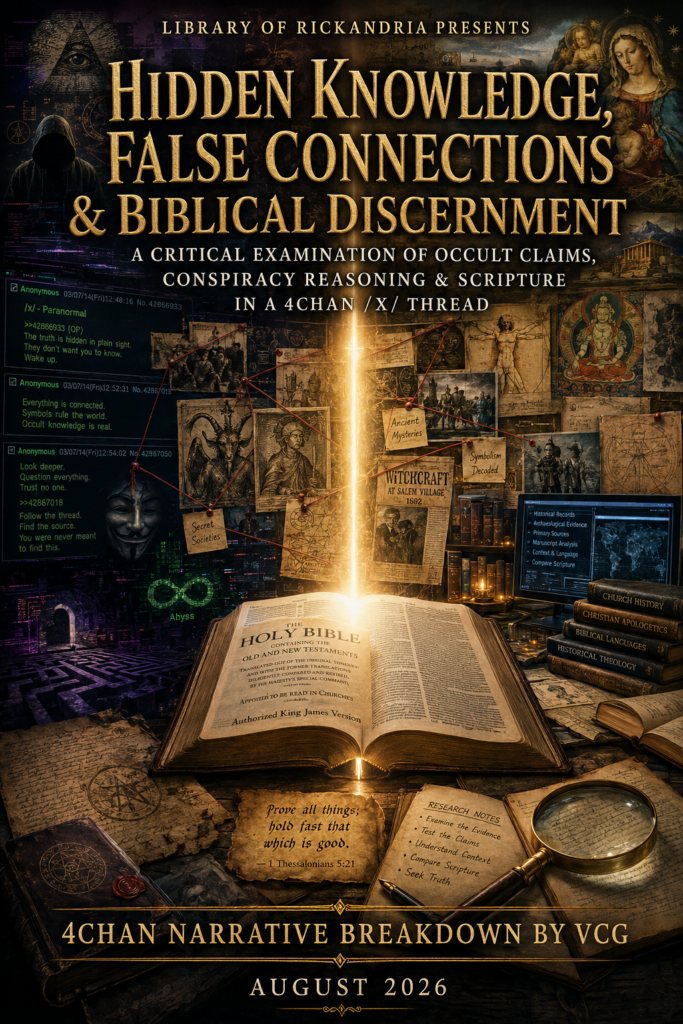
UPDATED BY VCG ON 8/26/2026 @ 19:19 EST
Soli Deo Gloria, brethren.
“Prove all things; hold fast that which is good.” — 1 Thessalonians 5:21
Abstract
This paper examines a lengthy discussion from 4chan’s paranormal board, /x/, centered on an apparently simple question: if magic, supernatural beings, ancient practitioners, or hidden knowledge really exist, why has someone not publicly revealed the truth?
From there, the conversation expands into a much larger theory involving occult initiation, blackmail, reincarnation, art history, medieval saints, witch-hunting literature, ancient medicine, advanced prehistoric civilizations, gender, circumcision, hidden elites, institutional suppression, Christianity, and the Bible.
The thread is worth examining carefully because it is not built entirely from fabricated material. Several of its historical references are real. Saint Wilgefortis really developed an extraordinary European cult. Heinrich Cornelius Agrippa really wrote a provocative defense of women. The Malleus Maleficarum really discusses “seminal ducts.” Ancient Mehrgarh really provides evidence of very early dental drilling. Mohenjo-daro really possessed sophisticated drainage and sanitation. Göbekli Tepe really is astonishingly ancient. The high-value art market really does present money-laundering vulnerabilities.
The central problem is therefore subtler than simply deciding that
“everything in the thread is false.”
Again and again, the discussion moves through a three-stage pattern:
documented historical fact → speculative connection → asserted occult conclusion.
The first step may be well supported. The second may be possible. The third is frequently treated as established without the evidence necessary to cross the gap.
This paper walks through those claims in approximately the order in which they develop, while keeping five categories separate: history, methodology, psychology, interpretation, and Scripture. Psychological research is used to illuminate general reasoning mechanisms, not to diagnose anonymous posters. Historical sources are distinguished from speculative interpretation. Biblical claims are tested against the supplied King James Bible rather than against assumptions about what Christianity supposedly teaches.
The conclusion is neither
“conspiracies never happen”
nor
“anything hidden is therefore true.”
It is a more demanding principle: real conspiracies, real supernatural claims, real historical anomalies, and real religious doctrines should all be tested with evidence appropriate to the claim being made.
1. Introduction: Why Take a 4chan Thread Seriously?
It would be easy to approach an anonymous paranormal-board discussion with ridicule. That would also be a poor method.
Anonymous forums contain jokes, trolling, deliberate provocation, sincere testimony, ideological arguments, speculation, fragments of genuine scholarship, and claims that cannot easily be classified. A thread should therefore be judged not by the reputation of the website on which it appears but by the quality of the particular evidence and reasoning being offered.
This particular discussion begins with a question that is actually reasonable.
The opening poster assumes that “magical” persons or beings exist and asks why some very old practitioner, especially one nearing death, has not simply disclosed everything publicly. The poster then suggests a possible answer: perhaps such people are kept silent through blackmail or threats extending to their descendants. Other users propose different explanations. Perhaps the knowledge is dangerous. Perhaps it cannot really be taught in ordinary words. Perhaps initiates already reveal it selectively. One particularly revealing response says, in effect, that the knowledge is being revealed—just not to the person asking.
That opening contains the seed from which almost the entire thread grows.
The question changes from:
“Is there hidden knowledge?”
to:
“Why is the hidden knowledge being withheld?”
But this transition quietly assumes the answer to the first question.
Before explaining why something is hidden, one must first establish that the proposed thing exists.
That is the basic methodological problem we will keep encountering.
2. How This Investigation Approaches the Thread
Because many different anonymous users participate, the thread should not be treated as though one coherent author wrote it. Some posters believe in occult initiation. Others argue for reincarnation. Others introduce theories about gender, circumcision, art, historical suppression, or hidden technology. Still others challenge those claims.
This distinction matters. When one poster says something extreme, it would be unfair to attribute it to everyone else in the conversation.
For this reason, the present analysis uses five different questions.
Historical question
Did the person, artwork, text, archaeological site, event, or practice actually exist?
Methodological question
Does the evidence offered support the conclusion drawn from it?
Psychological question
What known human reasoning tendencies might make certain kinds of explanations attractive or persuasive?
Interpretive question
Even where a historical artifact is genuine, is the meaning assigned to it actually documented, or is that meaning being supplied by the poster?
Biblical question
When Scripture is invoked, does the biblical text actually teach the doctrine being attributed to it?
These questions must not be collapsed into one another.
A psychological explanation for why someone believes something does not prove the belief false.
A historical artifact being real does not prove a poster’s interpretation of it.
A biblical text mentioning demons does not establish every later occult claim about demons.
And the failure to explain an event naturally does not automatically establish a supernatural cause.
A useful standard is the one Luke records concerning the Bereans:
“they received the word with all readiness of mind, and searched the scriptures daily, whether those things were so.”
There are two parts to that posture: readiness and examination.
Neither reflexive dismissal nor reflexive acceptance is enough.
3. The Opening Theory: Hidden Knowledge, Blackmail, and the Problem of Assumption
The opening post starts with two assumptions.
First, magical beings or exceptionally long-lived practitioners exist.
Second, at least one of them would eventually want to reveal what he or she knows.
The problem then becomes explaining the missing disclosure.
Blackmail is proposed.
There is nothing inherently impossible about blackmail. Governments, corporations, criminal organizations, abusive families, religious institutions, and intelligence services have all used coercion or secrecy at various points in history.
But the mere existence of blackmail as a human practice cannot establish that blackmail is occurring in this particular case.
To do that, we would want evidence such as:
an identifiable person possessing the alleged knowledge;
evidence that the person attempted disclosure;
communications showing a threat;
witnesses;
financial or institutional records;
a documented act of retaliation;
correspondence identifying who ordered it.
Without some version of that chain, “blackmail” functions primarily as a rescue explanation.
The theory predicts that someone should reveal the secret.
No one does.
Instead of decreasing confidence in the original prediction, a second invisible mechanism is introduced:
They would reveal it, but hidden people stop them.
That may be true. But at this stage it has not been demonstrated.
The distinction is important:
Possible explanation is not the same category as established explanation.
4. “It Cannot Be Explained to You”
Several posters respond to the demand for disclosure by arguing that real occult knowledge cannot be communicated normally. It must be experienced, gradually discovered, or “caught” rather than taught. Another says dangerous knowledge ought not be casually distributed. Others imply that revelation is already taking place, but only for those capable of receiving it.
There is a legitimate idea buried inside this.
Some forms of knowledge really are experiential.
A person can read about swimming without knowing what water feels like. A description of playing a violin cannot substitute for years of practice. A surgeon learns from books, but also develops skills that cannot be reduced to a paragraph.
So, the claim that some knowledge requires experience should not be mocked.
The methodological question is different:
Can the experience produce observable consequences?
Suppose someone says:
“I cannot completely describe what musical performance feels like.”
That is understandable.
But the musician can still pick up an instrument and play.
Suppose someone says:
“The technique cannot be put fully into words.”
Fine.
If the alleged technique can nevertheless produce:
- heat
- levitation
- healing
- remote knowledge
- physical force
- precognition
or another measurable effect, then at least the effect should become accessible to examination.
The difficulty arises when “ineffability” becomes an all-purpose shield:
cannot explain it;
cannot demonstrate it;
cannot teach it;
cannot reproduce it;
outsiders cannot understand it;
failure proves the outsider is not initiated.
At that point the claim becomes increasingly resistant to testing.
That is not the same as saying the claim is false.
It means our confidence cannot rationally increase merely because the theory has been designed so that failure is always expected.
5. Status and the Appeal of Initiation
The idea that hidden truth is available only to the right kind of person appears throughout the thread.
Initiates understand.
Outsiders do not.
Some people are “vessels.”
Others corrupt whatever knowledge is given to them.
Some are effectively portrayed as incapable of comprehension.
This structure deserves attention because secret knowledge does more than explain the world. It can also create a social hierarchy.
One person possesses ordinary knowledge.
Another possesses knowledge that supposedly proves he belongs to the small group capable of seeing what everyone else misses.
Psychological research has found a modest but consistent relationship between conspiracy mentality and a desire for uniqueness. In experimental work, people higher in conspiracy mentality showed greater attraction to a fictitious conspiracy when it was described as a minority belief. This does not tell us what any particular 4chan poster is thinking, and it certainly does not establish that unusual minority beliefs are false. It does, however, identify one reason “knowledge that almost nobody else can see” can be socially and psychologically rewarding.
The correct response is not:
“Minority beliefs are wrong.”
Many minority beliefs have eventually turned out to be correct.
The better question is:
Would I find this evidence equally persuasive if possessing the belief gave me no special status at all?
That is a much harder test.
6. Symbols in Art: When Interpretation Becomes Evidence
One early visual example involves Jean-François de Troy’s Time Unveiling Truth.
The thread treats imagery surrounding Father Time, Truth, and a serpent as part of a darker symbolic world.
But the documented iconography matters.
The National Gallery identifies the figures as Father Time, Truth, Deceit, and the cardinal virtues. The serpent belongs to Prudence, whose traditional attributes included a snake. Truth is unmasking Deceit, and the broader motif concerns truth eventually being revealed through time.
This provides a useful lesson in symbolic interpretation.
A serpent does not have one universal meaning.
Within Scripture it can be associated with the serpent in Genesis and with evil imagery elsewhere. In classical and Renaissance iconography it may also symbolize prudence, medicine, renewal, wisdom, eternity, or another idea depending on context.
Therefore the reasoning:
snake appears → occult evil is being confessed
is too quick.
The interpretive process needs at least three questions:
- What did this symbol conventionally mean in the artist’s historical setting?
- What did patrons or contemporary viewers likely understand it to mean?
- Is there independent evidence that the artist intended a hidden second meaning?
Without those questions, almost any complex painting can be turned into evidence for almost any theory.
7. Agrippa: A Real Occultist, A Real Book, and a Speculative Hidden Meaning
The thread later invokes Heinrich Cornelius Agrippa and his Declamation on the Nobility and Preeminence of the Female Sex.
Agrippa is particularly attractive to the thread’s argument because he really was associated with Renaissance occultism, and the cited work is real.
This is exactly the kind of case where we should resist both extremes.
We should not pretend Agrippa was unconnected to occult thought.
But we should not assume everything he wrote is therefore an encoded occult confession.
University of Chicago Press describes the Declamation, published in 1529, as an argument that women are not merely equal but, rhetorically, superior in many significant respects. The work overturns familiar misogynistic readings and asks why women have historically been excluded, pointing toward social conditioning, educational exclusion, and prejudice.
The thread speculates that Agrippa may have “seen too much” and could not directly state what he knew. Later reasoning even moves toward reading his apparent praise of women as a hidden expression of something close to the opposite.
Here we encounter an important interpretive danger.
If a text says X, but the interpreter can answer:
“X really means not-X because the author was secretly encoding his true belief,”
then what evidence could ever correct the interpretation?
Secret irony is certainly possible.
History contains:
- satire
- coded writing
- censorship
- double meanings
But responsible interpretation requires evidence for the code.
Letters.
Contemporary readers.
Manuscript history.
Political context.
Known censorship.
Consistent patterns across the author’s work.
Without those controls, “secret meaning” becomes permission to make an author say whatever the theory requires.
8. Reincarnation and Tibetan Recognition Practices
The discussion next moves into reincarnation. Tibetan recognition traditions are mentioned, particularly cases in which children are shown possessions associated with a deceased lama and are judged partly by whether they recognize the correct objects.
The practice is real.
The office of the Dalai Lama itself describes identifying reincarnated lamas partly through signs and, in some cases, presenting candidates with possessions belonging to a previous incarnation. Correct selection may be regarded as a positive indication.
That establishes something historically significant:
Tibetan Buddhist communities genuinely developed methods intended to recognize reincarnated teachers.
It does not, by itself, establish the metaphysical explanation.
A scientific evaluation would ask additional questions:
- How many objects were presented?
- Who selected them?
- Did the child have prior access to relevant information?
- Were evaluators blinded?
- How many unsuccessful candidates were tested?
- Were criteria established beforehand?
- Have equivalent procedures been independently reproduced?
This distinction is not disrespectful to the religious tradition.
It is simply the difference between:
“A community practices recognition of reincarnation”
and:
“Reincarnation has therefore been scientifically established.”
Scriptural distinction
Whatever one concludes philosophically, the thread’s reincarnation framework is not the ordinary biblical description of human destiny.
Hebrews states:
“it is appointed unto men once to die, but after this the judgment.”
Paul’s sustained hope in 1 Corinthians 15 is resurrection:
“But now is Christ risen from the dead, and become the firstfruits of them that slept.”
The Christian promise is not an endless series of earthly rebirths. Paul moves from death to resurrection, judgment, and life in Christ.
That does not settle every philosophical question about consciousness.
It does settle whether ordinary reincarnation should be presented as biblical Christian doctrine.
It should not.
9. Actors, Greece, and the Danger of Historical Generalization
At another point, acting is portrayed as spiritually destructive, with the suggestion that ancient Greeks looked down upon actors.
The historical situation is much more complicated.
In classical Athens, actors involved in important festivals could be free men of good standing and could achieve considerable public status. Cambridge’s Dictionary of Classical Civilization notes that prominent actors could become significant public figures and were even used on diplomatic missions. Roman attitudes toward performers were often considerably lower in status.
The thread appears to collapse Greek and Roman cultural attitudes into a single ancient judgment.
This may seem like a small mistake, but it illustrates a larger principle:
“Ancient people believed X”
is almost never a sufficiently precise historical statement.
Which ancient people?
Which century?
Which city?
Which class?
Which genre?
Greek tragedy in fifth-century Athens cannot simply be equated with Roman theatrical social status centuries later.
And even if a society despised actors, that would tell us something about its social hierarchy—not prove that acting literally empties or destroys a soul.
10. Gender Claims: From Suspicion to Metaphysical Essentialism
As the thread progresses, some posts move beyond historical speculation into sweeping claims about women.
Women are portrayed as inherently resistant to truth, spiritually deficient, or even “empty” and demonic.
This is no longer merely an argument about historical gender roles.
It is an ontological claim about half the human race.
Methodologically, the theory becomes self-confirming.
If a woman agrees with the theory, she can be treated as an exception who has awakened.
If she disagrees, her disagreement itself can be counted as evidence that women resist truth.
That means both possible outcomes confirm the claim.
Whenever a theory operates this way, we should ask whether it can actually be tested.
Biblical correction
Genesis gives a fundamentally different starting point:
“So God created man in his own image, in the image of God created he him; male and female created he them.”
This verse does not erase every biblical distinction between men and women, nor does it settle every Christian debate over marriage or church office.
But it does establish something prior to those debates:
male and female are both included in the creation of humanity in God’s image.
James later condemns the contradiction of blessing God while cursing human beings:
“Therewith bless we God, even the Father; and therewith curse we men, which are made after the similitude of God.”
He immediately adds:
“My brethren, these things ought not so to be.”
The biblical text therefore gives no warrant for reducing women, unbelievers, outsiders, or difficult people to spiritually empty biological props.
11. Eternal Life Is Not Simply Biological Reproduction
The thread also proposes that what religions call eternal life can really mean reproduction: a person “continues” through children.
There is a limited naturalistic sense in which descendants carry genetic and cultural continuity.
Parents influence children.
Genes continue.
Names continue.
Stories continue.
But that is not what the New Testament means by eternal life or resurrection.
Paul’s entire argument in 1 Corinthians 15 depends on the dead themselves being raised. He even argues that if resurrection is false, Christian preaching and faith collapse:
“if Christ be not risen, then is our preaching vain, and your faith is also vain.”
The distinction could hardly be clearer.
Christian resurrection is not a metaphor for having descendants.
A person dying while his children survive is not what Paul means by the dead being raised.
12. “It Is in the KJV”
One poster responds to the occult discussion by saying, essentially, that the hidden reality is already in the King James Bible.
This claim needs careful treatment because there is a partial truth in it.
The Bible is profoundly supernatural.
It contains:
angels;
devils;
visions;
prophecy;
miracles;
spiritual conflict;
dreams;
divine judgment;
supernatural healing;
demonic deception.
Therefore, a reading of Christianity that reduces the Bible to ordinary materialism would plainly fail to represent the text.
The question is not whether Scripture presents a supernatural world.
It does.
The question is whether the particular occult system proposed in the thread is the same supernatural worldview Scripture teaches.
That is where major contradictions appear.
Deuteronomy 18 tells Israel:
“thou shalt not learn to do after the abominations of those nations.”
It then prohibits divination, enchantment, witchcraft, consulting familiar spirits, wizardry, and necromancy.
Acts gives a New Testament parallel. When people in Ephesus turned to the Christian faith, those who had practiced “curious arts” brought their books together and burned them publicly.
The apostolic response to occult technique is therefore not:
“You have discovered the deeper esoteric level of Christianity.”
It is separation from those practices.
Recognition that spiritual beings exist must not be confused with permission to seek them as teachers.
13. Does the Bible Contain Deception?
The thread sometimes treats the Bible almost as a coded puzzle in which deceit itself is part of the message.
This requires an elementary but important distinction between description and endorsement.
Scripture contains lies.
Satan speaks.
False prophets speak.
Murderers speak.
Corrupt rulers speak.
The Bible records deception because deception exists within the history it narrates.
That does not mean the narrator endorses the deception.
A courtroom transcript containing a criminal’s lie does not make the court stenographer a liar.
Likewise, one cannot take every sentence spoken by every biblical character as a theological proposition the Bible approves.
This matters especially in occult readings, where a deceptive statement inside a narrative may be treated as though Scripture itself is revealing a secret doctrine.
Context determines who is speaking, to whom, under what circumstances, and whether the narrative approves or condemns the speech.
14. Ganymede, Pope Julius III, and the Problem of Connecting Distant Facts
The thread next makes a striking historical association involving Rembrandt’s The Abduction of Ganymede and scandal surrounding Pope Julius III and Innocenzo del Monte.
There is real history here.
Julius III elevated the teenage Innocenzo del Monte to the cardinalate in 1550, provoking enormous scandal. Contemporary accusations circulated that the young man was more than merely the pope’s favorite.
Rembrandt’s Ganymede is also real and dates to 1635.
So, we have two genuine facts:
- a papal scandal in the sixteenth century;
- a seventeenth-century painting depicting the ancient myth of Ganymede.
But the second does not automatically encode the first.
Ganymede was a classical mythological subject more than a millennium before Julius III.
The relevant question becomes:
What connects this particular painting to this particular pope?
We would look for:
a commission;
correspondence;
a patron associated with the scandal;
identifiable iconographic references;
contemporary commentary;
provenance tying the work to the event;
an artist’s statement;
a unique visual clue that cannot be explained by the classical story itself.
Without such evidence, temporal and thematic resemblance remains an interesting hypothesis, not a historical demonstration.
This is one of the thread’s most common reasoning patterns:
A is real. B is real. A and B share a theme.
Therefore, A secretly explains B.
Sometimes that inference will be correct.
But the connecting evidence is the part that has to be shown.
15. The Art Market: A Real Vulnerability, an Unsupported Extra Step
The conversation also suggests that expensive contemporary art may serve money laundering and then goes further, proposing that high prices may function like membership fees or “tickets” into hidden groups.
The first part has genuine institutional support.
The U.S. Treasury has identified characteristics of the high-value art market that can create money-laundering vulnerabilities: very high transaction values, privacy, intermediaries, and the portability of valuable objects.
So, a blanket statement that money laundering through art is impossible would be wrong.
But the second claim still needs evidence.
Art can facilitate laundering does not entail:
High-priced art is secretly an occult membership system.
That requires independent documentation.
A good investigation should preserve the first fact without smuggling in the second conclusion.
16. Saint Wilgefortis: A Strange Saint Who Really Was Popular
Saint Wilgefortis is one of the most interesting examples in the thread because the historical claim sounds so bizarre that a careless critic might dismiss it outright.
That would be a mistake.
Wilgefortis was represented as a bearded woman on a cross and developed an enormous cult in parts of Europe. Smarthistory notes that she was once popular enough to rival the Virgin Mary in some regions. She became especially associated with women seeking relief from unwanted husbands or burdensome marriages.
That is a fascinating piece of Christian folk-religious history.
The thread uses it as evidence for a much wider magical “war of the sexes.”
But the evidence actually establishes:
a medieval/early-modern saint legend;
unusual gendered iconography;
popular devotion;
associations with marital distress;
a complicated relationship with crucifix imagery.
It does not establish an organized supernatural gender war.
This is exactly why careful fact-checking is preferable to ridicule.
The historical object survives examination.
The occult interpretation does not yet follow from it.
17. Lilith: Later Folklore Is Not Genesis
The thread then brings Lilith into its argument about sex, women, infants, and circumcision.
Here again there is a genuine historical tradition behind part of the claim.
The Alphabet of Ben Sira, a much later Jewish work from the first millennium AD, contains a story in which Lilith threatens infants. In that tradition, male infants are treated as vulnerable for eight days and female infants for a longer period. Protective angelic names or images on an amulet are said to ward her off. The eight-day period has an obvious possible connection to the timing of circumcision.
That is real folklore.
But several distinctions matter.
First, this is later Jewish folklore, not the Genesis creation narrative.
Genesis does not describe Lilith as Adam’s original wife.
Second, the protective device in the cited tradition is an amulet bearing angelic names or forms.
That is not the same claim as saying families must either circumcise children or purchase expensive jewelry as part of an extortion system.
The thread has moved from:
later folklore exists
to:
the folklore reveals the hidden operational mechanism behind circumcision and economic coercion.
That additional bridge is not established by the text.
18. Personal Experience and the “Layers of Obfuscation” Problem
At one point, personal reproductive events are interpreted as possible evidence that the poster was manipulated, “psyoped,” or affected through magic.
Another reply suggests that certainty may be impossible because the manipulators use layers of obfuscation.
Personal experiences deserve respect.
People encounter coincidences, improbable events, betrayals, illnesses, dreams, strange timing, and circumstances that feel deeply meaningful.
The problem is not that personal experience is worthless.
The problem arises when a framework makes every outcome consistent with hidden manipulation.
If something strange happens:
magic may have caused it.
If nothing strange happens:
the magic may have been concealed.
If evidence points elsewhere:
the evidence may be part of the obfuscation.
At some point, ordinary coincidence has been given no possible role.
That is methodologically dangerous because human beings are natural pattern detectors.
Research by Whitson and Galinsky found across six experiments that experimentally reducing people’s sense of control increased false pattern perception, including perceived conspiracies, superstition, and patterns in visual noise.
This does not mean:
“People who experience strange events are imagining everything.”
Nor does it mean:
“Every conspiracy belief comes from feeling powerless.”
It means that under uncertainty and reduced control, human cognition may become more willing to infer connections.
That should make us more disciplined precisely when the events are emotionally powerful.
19. Asmodeus and the Seventh Seal
A particularly clear biblical claim appears when a poster says that Asmodeus will meet a person at the “gate of the seventh seal.”
This can be tested directly.
Revelation 8 begins:
“And when he had opened the seventh seal, there was silence in heaven about the space of half an hour.”
John then sees:
“the seven angels which stood before God; and to them were given seven trumpets.”
Asmodeus does not appear at the seventh seal.
The claim may belong to some later occult cosmology, magical text, or syncretic system.
But it is not what Revelation says.
This distinction should be maintained consistently:
Extra-biblical occult doctrine may be studied historically. It should not be relabeled as biblical teaching simply because biblical language such as “seal” is incorporated into it.
20. “Jesus Never Walked the Earth”
Another poster says, in effect, that convincing a Christian Jesus never existed would be difficult.
Here we must separate two very different questions:
- Did Jesus of Nazareth exist historically?
- Was Jesus divine, did he perform miracles, and did he rise from the dead?
Historical scholarship can address the first question using ordinary historical methods.
The second involves historical argument but also theology and philosophical assumptions about miracle claims.
The total nonexistence position—often called Christ mythicism—is not the dominant position among specialists.
One important external source is Josephus’s reference to James as the brother of “Jesus who was called Christ.” A recent Oxford Academic treatment notes that the vast majority of scholars regard that particular Josephus passage as authentic.
This does not prove the incarnation.
It does not prove every Gospel event.
It does not prove the resurrection.
It does mean that:
“Jesus existed historically”
and:
“Christian theology about Jesus is true”
are not the same evidentiary proposition.
Rejecting the latter does not automatically establish that the former never happened.
21. Ancient India: Impressive History Without an Occult Shortcut
The thread turns next to ancient India and the Indus Valley world, invoking sanitation, dentistry, and erotic religious art as evidence that ancient civilizations possessed knowledge later forgotten or suppressed.
Here the factual foundation is unusually strong.
Mohenjo-daro
UNESCO describes Mohenjo-daro as an exceptionally planned ancient city with sophisticated drainage, wells, bathing facilities, soak pits, and sanitation infrastructure.
That is real engineering sophistication.
Mehrgarh dentistry
A Nature report describes eleven drilled molars from nine adults at the Neolithic site of Mehrgarh in present-day Pakistan, approximately 7,500–9,000 years old.
That is an extraordinary archaeological discovery.
What follows?
The right conclusion is:
Ancient people possessed technical abilities that simplistic narratives of “primitive humanity” can badly underestimate.
The evidence does not by itself establish:
They obtained those abilities through magical initiation.
Ancient human beings had essentially the same cognitive capacities for observation, experimentation, craft specialization, trial and error, apprenticeship, and cumulative technical learning that human beings possess now.
Discovering remarkable ancient technology should first increase our estimate of ancient human ingenuity.
A supernatural mechanism remains a separate hypothesis requiring separate evidence.
22. Göbekli Tepe and the Irony of “Hidden Archaeology”
Göbekli Tepe appears later as another example of knowledge supposedly older than conventional books would admit.
The dates are genuinely astonishing.
UNESCO places its monumental structures approximately between 9600 and 8200 BC and describes them as the work of hunter-gatherer communities.
This discovery significantly complicated older assumptions about the relationship between settled agriculture, social organization, ritual centers, and monumental architecture.
But notice the irony.
We know Göbekli Tepe is extraordinarily old because archaeologists excavated it, dated it, published it, debated it, and incorporated it into mainstream historical discussion.
The site is not a secret that archaeology refuses to acknowledge.
It is evidence that archaeology can revise its models when new evidence appears.
That is a strength of the historical method, not evidence of its failure.
23. The Malleus Maleficarum and “Seminal Ducts”
One of the thread’s strongest historical observations concerns the Malleus Maleficarum.
The text really does discuss alleged witchcraft affecting reproduction and uses language translated as the closing or obstructing of “seminal ducts,” preventing semen from reaching reproductive organs or being properly emitted.
The thread then notes that the first recorded experimental vasectomy on a dog is associated with Sir Astley Cooper in 1823 and asks how a fifteenth-century text could apparently know about obstructing seminal passages long before modern vasectomy.
This sounds powerful because the chronology is real.
But we must ask what the Malleus actually knows.
The surrounding explanation is embedded in premodern reproductive theory and demonology. It discusses witches, devils, bodily powers, and “vital” processes.
Knowing that semen travels through internal passages is not equivalent to knowing the modern anatomy, surgical method, physiology, sterility procedures, and controlled occlusion involved in vasectomy.
Humans had observed:
castration;
impotence;
genital injury;
ejaculation;
infertility;
anatomical structures;
for thousands of years.
A medieval author could therefore imagine semen being physically obstructed without possessing nineteenth-century surgical science.
The reasoning error is subtle:
same or similar terminology → same level of scientific understanding.
Those are not equivalent.
The Malleus passage is genuinely interesting.
It is not evidence, by itself, of a secretly transmitted modern vasectomy technique.
24. A Charm Sewn Beneath the Skin and the History of Antisepsis
The thread makes a similar argument from another Malleus passage describing a magical charm supposedly sewn between skin and flesh.
The poster compares this with the much later development of antiseptic surgery.
Modern antiseptic surgery indeed came centuries afterward. Joseph Lister’s major antiseptic work began in the 1860s, building on developments associated with Semmelweis, Pasteur, and germ theory. The Royal College of Surgeons notes the severe danger of postoperative infection before antiseptic technique.
But the conclusion again does not follow.
Human beings performed invasive procedures long before they understood germ theory.
Ancient and medieval people:
pierced ears;
tattooed;
scarified;
cut abscesses;
performed amputations;
carried out trepanation;
inserted objects into tissue;
operated on wounds.
Many people survived.
Many others died of infection.
The existence of a subcutaneous object therefore proves neither modern antiseptic knowledge nor hidden advanced surgery.
If anything, the history of surgery demonstrates that invasive procedures can exist for millennia before the mechanism of infection is understood.
25. A Recurring Error: “They Knew Something, Therefore They Knew Everything”
Several examples in the thread operate through a similar assumption.
Ancient people had sophisticated sanitation.
Therefore they possessed hidden knowledge.
Medieval people understood seminal passages.
Therefore they possessed suppressed modern reproductive science.
A charm was inserted under skin.
Therefore someone possessed hidden antiseptic technology.
Ancient people drilled teeth.
Therefore advanced knowledge came from an extraordinary source.
But knowledge does not arrive all at once.
A civilization can possess:
excellent hydraulic engineering;
poor infectious disease theory;
impressive dentistry;
inaccurate cosmology;
advanced metalwork;
magical medicine;
brilliant astronomy;
mistaken physiology;
simultaneously.
Human knowledge is patchy.
Modern society is patchy too.
Future historians will undoubtedly find areas in which twenty-first-century people understood one sophisticated system while remaining badly mistaken about another.
Ancient sophistication is therefore evidence against arrogance about the past.
It is not automatically evidence for occult transmission.
26. Foucault and Sexual Discourse: A Better Argument Than Most
Not everything in the thread is weak.
The reference to Michel Foucault’s History of Sexuality is substantially more sophisticated.
Foucault challenged a simplistic story in which Victorian modernity merely “repressed” sex into silence. He argued instead that modern institutions generated enormous amounts of discourse about sexuality—classification, confession, diagnosis, regulation, investigation, and professional interpretation. Modern scholarship often summarizes this as an incitement to discourse rather than pure silence.
A poster then draws a connection between that framework and contemporary social media.
As interpretation, that is interesting.
Modern platforms certainly encourage people to:
disclose intimate details;
classify identity;
confess desires;
publicly narrate relationships;
receive algorithmic and social feedback.
One can reasonably analyze social media through a Foucauldian lens.
But even a strong philosophical analogy does not prove a hidden occult conspiracy.
This is an important distinction because the thread sometimes contains worthwhile observations that should be preserved independently of the larger theory.
27. “Victors Write History”: True Warning, Dangerous Escape Hatch
Eventually the discussion moves toward a familiar statement:
The victors write history.
There is truth in the warning.
Power affects archives.
States produce propaganda.
Documents disappear.
Victorious regimes memorialize themselves.
Institutions protect reputations.
Witnesses lie.
Governments classify information.
Religious organizations have hidden abuse.
Corporations suppress damaging records.
A naïve belief that every official document is true would be historically indefensible.
But radical skepticism creates a second problem.
If any evidence against a theory can be dismissed with:
“The winners fabricated it,”
then why trust the documents that support the theory?
Why trust Agrippa?
Why trust the Malleus?
Why trust medieval legends?
Why trust archaeological publication?
Why trust an old painting?
Why trust any surviving source at all?
A consistent investigator cannot use two evidence standards:
Source agrees with me → authentic clue.
Source disagrees with me → manipulated history.
That is asymmetric skepticism.
Historical criticism instead asks the same questions of friendly and unfriendly evidence:
- Who produced it?
- When?
- For what audience?
- How close was the source to the event?
- Do independent sources converge?
- What manuscript or archival chain survives?
- What incentives affected the author?
- What evidence could contradict it?
The thread is strongest when it applies these questions to institutions.
It becomes weakest when it exempts its own preferred sources from them.
28. A Theory That Explains Everything Explains Very Little
By this stage, a larger methodological pattern has emerged.
Consider the possible outcomes.
If evidence appears
The hidden theory is true.
If evidence is absent
The evidence was suppressed.
If contrary evidence appears
The victors fabricated it.
If an outsider cannot understand
The outsider lacks initiation.
If an insider understands
The teaching has been confirmed.
If the teaching cannot be explained
It is ineffable.
If experiments fail
The operator was not prepared or the conditions were wrong.
If unusual events happen
Magic caused them.
If ordinary events happen
Magic may have concealed itself.
This is what philosophers of science would call a severe falsifiability problem.
The point is not that every true claim must be simple to falsify.
Historical events cannot be rerun.
Some theological claims are not laboratory hypotheses.
But a factual theory about hidden actors influencing physical events must still discriminate among possibilities.
A useful theory tells us:
If X occurs, my confidence should increase.
If Y occurs, my confidence should decrease.
If no possible observation can ever decrease confidence, then evidence is no longer controlling the theory.
The theory is controlling the evidence.
29. Pattern Perception and Conspiracy Reasoning
This is where psychology can help, provided it is used carefully.
We should not diagnose anonymous posters.
We do not know them.
We do not know their histories.
We do not know whether they are sincere, joking, trolling, traumatized, experimenting intellectually, or simply arguing for entertainment.
Psychological research can instead describe general human tendencies.
A study by van Prooijen, Douglas, and De Inocencio found associations between illusory pattern perception and both conspiracy and supernatural beliefs. Across multiple studies, perceiving meaningful patterns in random or unrelated material was associated with stronger endorsement of conspiratorial explanations.
That mechanism is especially relevant to this thread because the argument connects:
Renaissance paintings;
papal scandals;
medieval saints;
occult manuals;
reproductive anatomy;
ancient dentistry;
sanitation;
Tibetan reincarnation;
actors;
folklore;
circumcision;
archaeology;
social media;
Christianity.
Some of those connections may be real.
The psychological question is how we distinguish a genuine pattern from a compelling-looking pattern.
The answer is not:
“Stop looking for connections.”
Pattern recognition is essential to intelligence.
The answer is:
Require the connection itself to leave evidence.
30. Control, Uncertainty, and Explanatory Totality
The thread repeatedly returns to subjects involving limited human control:
death;
sex;
reproduction;
institutional secrecy;
abuse;
children;
bodily modification;
hidden motives;
social manipulation;
the supernatural.
These are exactly the kinds of subjects in which people naturally want explanatory closure.
Research on perceived control is relevant here. Whitson and Galinsky experimentally reduced participants’ feelings of control and observed increases in illusory pattern perception, including superstition and conspiracy perception.
Again, this does not prove any given conspiracy false.
Real conspiracies occur.
What the research suggests is that uncertainty can make total explanations especially psychologically attractive.
A grand conspiracy theory offers something fragmented reality often does not:
Everything is connected.
Nothing is accidental.
Every contradiction has a reason.
Every enemy fits somewhere.
Every strange historical detail has a single underlying cause.
That coherence can feel like evidence.
But coherence and truth are not identical.
A novel can be perfectly coherent and fictional.
A true historical explanation can be messy, incomplete, and unsatisfying.
31. The “NPC” Problem
Some of the thread eventually describes large portions of humanity in language resembling “NPCs,” filler, or cannon fodder.
This is not merely insulting rhetoric.
It performs an important epistemic function.
If critics are ordinary human beings capable of reasoning, their objections require answers.
If critics are spiritually deficient entities who cannot comprehend truth, their objections can be dismissed without examination.
That gives the theory a social immune system.
The same pattern appears whenever a movement divides humanity into:
those who see
and
those whose inability to see proves the theory.
From a biblical standpoint, this is especially serious.
Genesis does not describe some ordinary humans as disposable metaphysical background characters:
“in the image of God created he him; male and female created he them.”
James likewise grounds speech ethics in the fact that people are made after God’s similitude and warns against blessing God while cursing them.
There are biblical categories of righteousness and wickedness, belief and unbelief, wisdom and foolishness.
But those categories do not authorize us to declare unwanted human beings unreal.
32. Jesus’ Parables: The Thread Has a Point—But Only Part of One
A later post argues that truth must sometimes be self-discovered and appeals to Jesus’ use of parables.
This deserves more care than a dismissive response.
Jesus really did use parables partly in connection with differential understanding.
Matthew records:
“Why speakest thou unto them in parables?”
Jesus answers:
“Because it is given unto you to know the mysteries of the kingdom of heaven, but to them it is not given.”
So the biblical correction cannot be:
“Christianity contains no hiddenness, mystery, or differential understanding.”
That would be false.
Scripture contains mysteries.
Jesus sometimes withheld information temporarily.
He sometimes commanded people not to publicize particular events.
Paul even speaks of
“the wisdom of God in a mystery”
and of truths spiritually discerned.
The crucial question is what happens to those mysteries in the apostolic message.
33. Biblical Mystery Is Not the Same Thing as an Occult Initiatory Caste
Paul describes the gospel mystery in striking language:
“the mystery which hath been hid from ages and from generations, but now is made manifest to his saints.”
He continues:
“Whom we preach, warning every man, and teaching every man in all wisdom.”
Romans is even more explicit. Paul speaks of:
“the revelation of the mystery, which was kept secret since the world began,”
but says it:
“now is made manifest”
and is made known to all nations.
This is quite different from the thread’s model of a secret occult technique guarded permanently by a superior class of initiates.
Biblical mystery can involve:
truth previously hidden;
truth revealed by God;
spiritual discernment;
progressive understanding.
But the gospel is then proclaimed.
The movement is from hiddenness toward revelation.
That is one of the strongest textual corrections to the thread.
34. “Right Vessel,” Dreams, Visions, and Entity Initiation
The thread later says that real occult initiation may come through visions, dreams, entities, or spontaneous insight and that the right “vessel” may receive what ordinary people cannot.
The Bible certainly cannot be used to argue that dreams and visions never occur.
Joseph dreams.
Daniel receives visions.
Prophets receive revelations.
Peter receives visions.
Paul reports extraordinary experiences.
The relevant question is whether the mere existence of an extraordinary experience proves the message true.
It does not.
Paul gives an unusually strong warning in Galatians:
“But though we, or an angel from heaven, preach any other gospel unto you than that which we have preached unto you, let him be accursed.”
That is extremely important.
Even an apparent angelic encounter is not allowed to override the previously delivered gospel.
The criterion is therefore not:
“I encountered an entity; therefore the entity is trustworthy.”
Biblical discernment asks whether the message is true.
This is one of the places where the thread and Scripture diverge most sharply.
35. The Christian Response to Occult Power Is Not Initiation
Acts 19 provides another useful comparison.
The narrative does not portray the early Christians as materialists. It explicitly presents miracles, evil spirits, exorcistic claims, and supernatural confrontation.
Yet when practitioners of “curious arts” believe, they bring their books and burn them publicly.
Whether a modern reader interprets every supernatural event in Acts exactly as the first readers did is a separate question.
The theological direction of the text is clear.
Christianity does not answer pagan occult practice by saying:
“Learn the technique more safely.”
The people abandon it.
Thus the thread is correct that biblical Christianity inhabits a supernatural universe.
It is incorrect when that fact is used to collapse biblical faith into occult initiation.
36. Resurrection Versus Reincarnation
The distinction becomes especially clear when death is discussed.
Some posters treat death as unreal, identity as transferable, or reincarnation as part of the hidden truth.
Paul’s argument runs in a different direction.
He insists on resurrection so strongly that he says if Christ has not risen, Christian faith is vain.
Hebrews says human beings die once and afterward face judgment.
First Thessalonians describes the dead in Christ rising at the Lord’s coming.
One can reject those claims philosophically.
But they cannot fairly be replaced with reincarnation and still called the same biblical doctrine.
37. Hiddenness in Scripture Does Not Mean Every Hidden Theory Is Biblical
At this point a broader interpretive correction is needed.
Scripture itself contains:
conspiracies;
secret sin;
hidden motives;
lying rulers;
spiritual deception;
false teachers;
secret plans;
visions;
miracles;
demonic activity.
For example, 2 Kings explicitly says the king of Assyria discovered a conspiracy involving Hoshea.
So, there is nothing intrinsically “unbiblical” about believing that human beings sometimes conspire.
The Bible is not naïve about power.
The error occurs when biblical categories are used as blank checks.
Because Scripture says conspiracies exist, it does not follow that this conspiracy exists.
Because Scripture says demons exist, it does not follow that this alleged entity is a demon.
Because Scripture says signs and lying wonders can occur, it does not establish every paranormal video.
Because Scripture contains mystery, it does not validate every esoteric mystery school.
Biblical categories create possibilities.
Evidence and context identify particular cases.
38. The Thread’s Own Best Thought Experiment Works Against It
One poster offers a thought experiment involving a magical-looking device whose effect is secretly controlled by an unseen operator.
The user of the device might sincerely believe the object itself possesses power because every time he performs the ritual, something happens.
Unknown to him, someone else is activating the effect remotely.
This is actually a good epistemological example.
It demonstrates that:
observing an effect does not guarantee that we have correctly identified the cause.
But that principle cuts both ways.
If a ritual is followed by an unusual event, the observer may say:
“The ritual caused the event magically.”
The hidden-controller thought experiment reminds us that another mechanism might exist.
That is precisely why experiments use:
controls;
blinding;
randomization;
independent replication;
fraud precautions;
predefined outcomes.
Ironically, one of the thread’s better arguments points toward scientific controls rather than away from them.
39. What Would Actually Count as Evidence for Operational Magic?
Suppose we grant the thread’s central supernatural hypothesis serious consideration.
What would move it from speculation toward evidence?
The answer does not require proving every secret in the universe.
A small reproducible effect would be enough to transform the discussion.
For example:
A defined effect
The practitioner states exactly what will happen.
Not:
“Something strange may occur.”
But:
“Under these conditions, object X will move beyond a defined threshold.”
Controls
The investigator controls the objects, room, timing, recording equipment, and relevant materials.
Blinding
Where possible, participants do not know information whose leakage could explain the result.
Repetition
The effect occurs more than once.
Independent replication
Other competent practitioners or investigators can obtain comparable results.
Fraud controls
Known stage-magic, technological, sensory, statistical, and information-leakage explanations are addressed.
Pre-registration
The success criterion is defined before the experiment.
This prevents the target from moving after the result.
If something like this repeatedly succeeded, skeptics would have a real phenomenon to explain.
The rational position would change.
That is what evidence is supposed to do.
40. What Would Count as Evidence for Systematic Suppression?
The same principle applies to hidden institutions.
Suppose the claim is not merely that magic exists, but that a network systematically suppresses public knowledge of it.
We would look for a chain such as:
identifiable practitioners;
attempted disclosures;
threats;
payments;
legal intimidation;
intercepted communications;
internal memoranda;
whistleblowers with independently verifiable access;
consistent institutional behavior;
destroyed or altered records with recoverable provenance;
multiple independent witnesses.
Historical conspiracies become known precisely because conspirators leave traces.
People talk.
Documents survive.
Payments move.
Organizations keep records.
Enemies defect.
Plans fail.
Someone records something.
A conspiracy theory becomes a historical conspiracy when the evidentiary trail is strong enough.
41. “Technology Will Eventually Prove It”
Near the end of the thread, a poster suggests that advancing technology will eventually make hidden magical realities obvious.
This is potentially the healthiest version of the claim because it points toward future observation.
But a prediction becomes useful only when it is specific.
What technology?
What signal?
What measurement?
What date range?
What result?
What result would count against the claim?
Compare:
“Technology will eventually prove us right.”
with:
“Within a defined experimental setup, instrument X should detect signal Y when condition Z occurs, and no signal should appear under control conditions.”
The second risks failure.
That risk is what gives a prediction evidentiary value.
42. The Most Important Psychological Distinction: Explanation Is Not Refutation
At this point, a warning is necessary.
Psychological explanations are often abused in debates.
A skeptic may say:
“You believe this because you need control.”
That is not a rebuttal.
A believer may answer:
“You reject it because you fear the truth.”
That is also not a rebuttal.
Both are forms of the genetic fallacy—judging a claim solely by explaining where the belief came from.
A paranoid person can correctly notice a real conspiracy.
A calm person can confidently believe nonsense.
A traumatized witness can tell the truth.
A prestigious scholar can be wrong.
Therefore, the psychology section of this paper should not be read as:
“The thread is wrong because conspiracy psychology exists.”
Its purpose is narrower.
Psychology shows why humans need methodological safeguards, especially when interpreting ambiguous patterns.
The evidence for the claim must still be evaluated separately.
43. Where the Thread Is Strongest
A fair paper should say where the thread performs well.
It is strongest when it:
Refuses simplistic assumptions about ancient people
Ancient sanitation, dentistry, architecture, and technical achievements really can overturn condescending modern narratives.
Recognizes institutional secrecy as possible
History contains genuine cover-ups, censorship, propaganda, and corruption.
Notices that official narratives deserve scrutiny
Authority is not evidence by itself.
Questions whether direct experience can be fully reduced to words
Some knowledge really is experiential.
Recognizes that Christian Scripture contains a supernatural worldview
The Bible plainly does not teach philosophical materialism.
Draws attention to unusual historical objects
Wilgefortis, Agrippa, the Malleus, ancient dentistry, Tibetan recognition practices, and Göbekli Tepe are all legitimate subjects for investigation.
The problem is usually not the curiosity.
The problem is premature synthesis.
44. Where the Thread Is Weakest
The thread is weakest when it:
Treats possibility as probability
Something could have happened, so it begins to be discussed as though it probably did.
Treats probability as certainty
A plausible speculation becomes a hidden fact.
Connects genuine facts without proving the bridge
Historical fact A and historical fact B become one causal system because they share symbolism.
Uses absence of evidence as evidence of concealment
Missing evidence stops lowering confidence.
Uses contrary evidence as evidence of fabrication
Nothing can count against the theory.
Applies skepticism asymmetrically
Institutional sources receive extreme scrutiny while friendly occult anecdotes receive less.
Treats disagreement as proof of incapacity
The critic becomes “programmed,” uninitiated, an NPC, or spiritually unable to comprehend.
Imports extra-biblical doctrine into biblical vocabulary
Occult seals, entities, reincarnation, and initiatory systems are presented using Christian language without demonstrating that Scripture teaches them.
45. A Biblical Model of Discernment
The most appropriate biblical sentence for this investigation may be the short command:
“Prove all things; hold fast that which is good.”
Notice what Paul does not say.
He does not say:
Reject everything unusual.
He does not say:
Believe every supernatural claim.
Immediately before the command he says:
“Despise not prophesyings.”
Then:
“Prove all things.”
That is a remarkable balance.
Do not dismiss merely because something claims supernatural origin.
But test it.
The Bereans embody the same pattern:
“received the word with all readiness of mind”
and then:
“searched the scriptures daily, whether those things were so.”
Readiness without testing becomes gullibility.
Testing without readiness can become prejudice.
Biblical discernment requires both.
46. Truth Does Not Require Contempt
There is one more correction worth making because some portions of the thread become hostile and dehumanizing.
James contrasts two kinds of supposed wisdom.
He describes bitter envy and strife as producing confusion, then says:
“the wisdom that is from above is first pure, then peaceable, gentle, and easy to be intreated, full of mercy and good fruits, without partiality, and without hypocrisy.”
This does not mean Christian argument must be weak.
Jesus could speak with severe force.
Paul could sharply rebuke error.
The issue is whether truth-seeking becomes an excuse for contempt.
If one’s theory requires treating large classes of people as subhuman, spiritually empty, or incapable of thought, something has gone wrong before the historical argument is even finished.
The method we use to pursue truth matters.
47. A Better Way to Read Threads Like This
Rather than asking:
“Is this conspiracy true or false?”
at the beginning, try working claim by claim.
For each statement, ask:
What exactly is being claimed?
Write it in one sentence.
What is directly documented?
Separate the artifact from the interpretation.
What is inferred?
Mark the bridge explicitly.
What alternative explanations exist?
Do not assume the first explanation is the only one.
What evidence would distinguish the explanations?
This is the most important question.
Is the claim falsifiable in any meaningful sense?
If not, how should that affect confidence?
Is Scripture actually being quoted in context?
Or is biblical terminology being attached to an outside doctrine?
What level of certainty is justified?
Possible?
Plausible?
Probable?
Well established?
Uncertain?
False?
This vocabulary protects us from turning curiosity into certainty too quickly.
48. Selected Case Findings
The investigation can be summarized compactly.
| Thread claim or evidence | Historical finding | What does not automatically follow |
|---|---|---|
| Saint Wilgefortis had a major cult | Substantially true; her cult was once extraordinarily popular. | A secret magical war between the sexes |
| Agrippa wrote a remarkable defense of women | True. | That he secretly meant the opposite |
| Tibetan traditions test reincarnation candidates with possessions | True as a religious practice. | Scientific proof of reincarnation |
| Ancient Greeks despised actors | Too broad and misleading; Athenian actors could hold considerable status. | Spiritual destruction through acting |
| High-value art can be used for laundering | Real institutional concern. | Art prices are occult membership fees |
| Mohenjo-daro had sophisticated sanitation | True. | Magical origin of the technology |
| Mehrgarh shows ancient dental drilling | True. | Hidden advanced civilization or occult medicine |
| Göbekli Tepe dates roughly 9600–8200 BC | True. | Mainstream archaeology is concealing its age |
| Malleus refers to “seminal ducts” | True. | Secret modern vasectomy science |
| A charm under skin appears in demonological literature | The reported motif exists | Hidden germ theory or antiseptic surgery |
| Listerian antisepsis comes centuries later | True. | Earlier invasive procedures required modern antiseptic knowledge |
| Julius III/Innocenzo scandal existed | True; serious contemporary allegations circulated. | Rembrandt’s Ganymede painting is an encoded confession about it |
| Later Lilith lore involves infant danger and amulets | True. | Genesis teaches Lilith was Adam’s wife or that circumcision is an occult extortion system |
| Jesus’ historical existence is questioned | Total mythicism is outside mainstream specialist consensus; Josephus’s James passage is widely regarded as authentic. | That historical existence alone proves Christian theology |
| Jesus taught in parables and spoke of mysteries | True. | Christianity is therefore an occult mystery school |
| Paul speaks of hidden mystery | True—but says it is now made manifest and preached. | Saving truth is permanently restricted to occult initiates |
| Scripture depicts spirits and supernatural events | True | Consulting spirits is therefore permitted |
| Deuteronomy forbids occult consultation | Explicitly true. | Biblical supernaturalism equals occult practice |
| Revelation contains a seventh seal | True | Asmodeus stands there; Revelation 8 instead describes silence and seven angels. |
| Human beings differ in belief and understanding | Obviously true | Some ordinary humans are metaphysical “NPCs” |
49. The Thread’s Central Logical Movement
After following the conversation through its historical examples, theological claims, and psychological dynamics, the same pattern appears repeatedly:
Step One: A genuine anomaly is identified
A strange saint.
An old medical phrase.
A remarkable archaeological discovery.
A suspicious institution.
A difficult symbol.
A religious initiation tradition.
Step Two: A speculative explanation is proposed
Perhaps there is hidden continuity.
Perhaps elites knew more.
Perhaps the painting encodes a scandal.
Perhaps the ritual preserves forbidden knowledge.
Step Three: The speculation becomes part of a unified theory
The historical items begin validating each other.
This is the dangerous step.
Ten weak links do not necessarily become one strong chain merely because they can be connected on a board with red string.
Independent evidence must support the connections themselves.
That is the central finding of this paper.
50. The Final Skeptic Asks the Right Question
Near the end of the thread, one skeptical poster returns to the original premise.
If mischievous magical beings and people supposedly exist, the skeptic essentially asks:
Where? What? Who?
He also points out that the opening argument assumes such beings would want to reveal themselves at all.
Those questions may sound simple after hundreds of lines of discussion.
They are actually the questions the investigation required from the beginning.
Where is the phenomenon?
What exactly does it do?
Who can demonstrate it?
What evidence identifies the suppressor?
What prediction distinguishes the hidden explanation from ordinary alternatives?
These questions do not deny the supernatural.
They simply refuse to use the supernatural as a substitute for evidence.
51. Conclusion
The 4chan thread examined here is not worthless, and it is not best understood as a collection of random falsehoods.
Its persuasive strength comes from something more interesting.
It repeatedly discovers genuine historical material.
Saint Wilgefortis really was extraordinarily popular.
Agrippa really wrote a remarkable work on women.
Tibetan Buddhists really employ recognition traditions associated with reincarnated lamas.
The high-value art market really does present money-laundering risks.
The Indus Valley world really possessed remarkable sanitation.
Mehrgarh really preserves evidence of prehistoric dental drilling.
Göbekli Tepe really transformed discussion of early monumental construction.
The Malleus Maleficarum really does use language about obstructed seminal ducts.
Modern antiseptic surgery really did emerge centuries after invasive human practices already existed.
Foucault really did analyze the proliferation of discourse around sexuality rather than merely a simple Victorian silence.
These facts deserve to be studied.
But repeatedly, the thread crosses an evidentiary boundary without acknowledging that it has done so.
A real historical fact becomes a possible hidden connection.
The possible connection becomes a likely occult mechanism.
The occult mechanism becomes part of a unified secret history.
Then, when evidence for the unified history is missing, secrecy itself explains the absence.
At that point the theory becomes difficult to distinguish from a system that can absorb any possible outcome.
Psychology helps us understand why such systems can become compelling. Human beings naturally seek patterns, especially under uncertainty. Secret knowledge can offer explanatory closure and social distinction. Yet psychology cannot settle the historical question by itself. Each claim must still rise or fall on evidence.
Scripture adds another important correction.
The Bible is supernatural, but it is not an occult manual.
It contains mystery, but the apostolic mystery is proclaimed.
It contains visions, but even an angelic message is to be judged against the gospel.
It acknowledges spiritual evil, but commands God’s people not to seek diviners, familiar spirits, witches, or necromancers.
It teaches resurrection rather than reincarnation.
It teaches that male and female are created within humanity’s bearing of God’s image, not that one sex is spiritually empty.
It gives no basis for describing unwanted people as metaphysical NPCs.
And perhaps most fittingly, it does not command either naïve belief or automatic dismissal:
“Prove all things; hold fast that which is good.”
That standard allows us to keep the strange historical facts that survive investigation while rejecting conclusions that outrun their evidence.
It allows us to acknowledge genuine conspiracies without believing every conspiracy.
It allows us to acknowledge that people lie without assuming every contrary record is fabricated.
It allows us to believe Scripture’s supernatural claims without importing unrelated occult systems into the text.
It allows mystery without credulity.
It allows skepticism without cynicism.
And it permits the investigator to say three intellectually important words whenever the evidence runs out:
We do not know.
That is not defeat.
It is where honest research waits for better evidence.
Selected Sources and Research Basis
Primary thread: 4chan /x/, thread 42866933, reviewed in August 2026.
Biblical text: The Holy Bible, Authorized King James Version, Pure Cambridge Edition, supplied research copy.
Art and iconography: National Gallery, Jean-François de Troy, Time Unveiling Truth.
Agrippa: University of Chicago Press scholarship on Declamation on the Nobility and Preeminence of the Female Sex.
Saint Wilgefortis: Smarthistory historical overview.
High-value art-market risk: U.S. Department of the Treasury study.
Indus Valley archaeology: UNESCO, Archaeological Ruins at Moenjodaro.
Prehistoric dentistry: Nature, evidence from Mehrgarh.
Göbekli Tepe: UNESCO World Heritage documentation.
Tibetan reincarnation-recognition tradition: Office of His Holiness the Dalai Lama.
Classical actors: Cambridge scholarship on actors and social status in classical civilization.
Lilith tradition: Alphabet of Ben Sira tradition and commentary.
Julius III and Innocenzo del Monte: Treccani biographical scholarship.
Jesus and Josephus: Oxford Academic treatment of Josephus’s reference to James and Jesus.
Malleus Maleficarum: historical text concerning alleged reproductive obstruction.
History of surgical antisepsis: Royal College of Surgeons of England.
Foucault and history of sexuality: Cambridge scholarship on Foucault’s influence.
Pattern perception and conspiracy belief: van Prooijen, Douglas & De Inocencio, research on illusory pattern perception.
Control and pattern perception: Whitson & Galinsky, experimental research on lack of control and illusory pattern detection.
Need for uniqueness and conspiracy mentality: Imhoff & Lamberty.
Final Research Principle
Historical fact is not interpretation.
Interpretation is not mechanism.
Possibility is not probability.
Probability is not proof.
Experience is not automatically revelation.
Mystery is not automatically occultism.
And Scripture should be allowed to say what Scripture says.
4CHAN THREAD & POST BREAKDOWNS – Library of Rickandria
VCG PAPER PROJECTS – Library of Rickandria