
Taboo, Power & the Occult Imagination: A Fact-Checked Psychological & Biblical Analysis of the 4chan “Transgression” Thesis
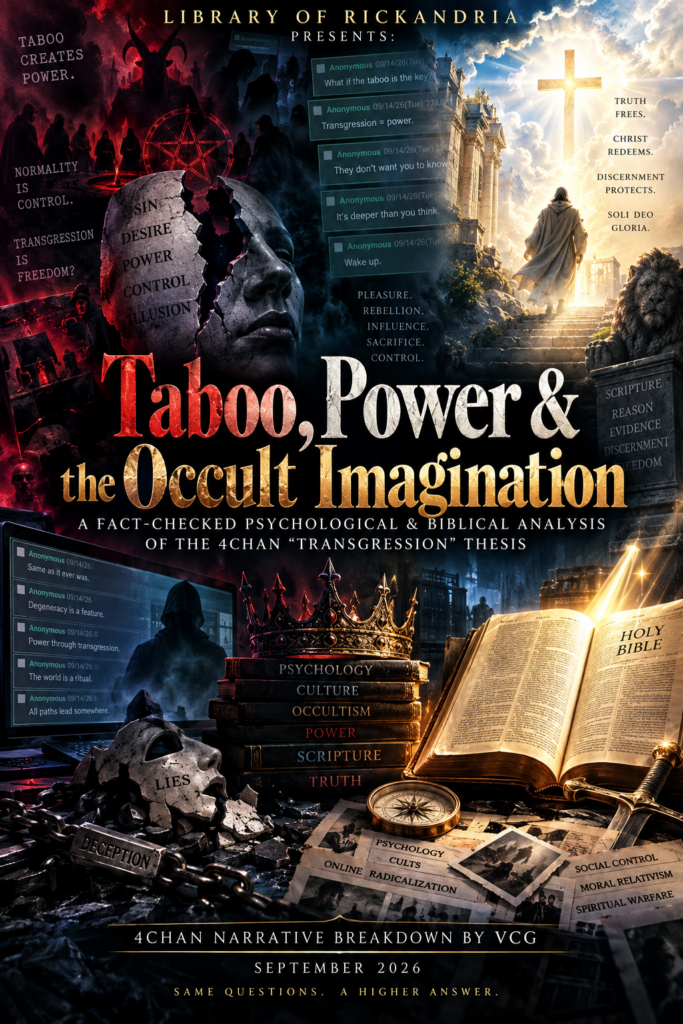
UPDATED BY VCG ON 9/15/2026 @ 19:19 EST
Anyone can do this, but most won’t.
ChatGPT – Library of Rickandria
Abstract
This paper examines a September 15, 2026 thread on 4chan’s /x/ (Paranormal) board that proposes a layered theory of extreme transgression.
/x/ – I hate the field limit – Paranormal – 4chan
The thread begins with claims about:
- reward circuitry
- power
- secrecy
- repetition
and group reinforcement, then extends those claims into a metaphysical model in which taboo-breaking allegedly produces a measurable or usable “charge” within a shared field of consciousness.
A reply further connects the model to unnamed
“elite cults.”
Rather than dismissing the thread wholesale, this paper separates its claims into categories:
primary-source description
established psychological or neuroscientific findings
plausible but unverified inference
metaphysical speculation
historical analogy
and biblical interpretation.
The resulting picture is mixed. Several social-psychological mechanisms invoked by the thread—
- moral disengagement
- normalization
- group reinforcement
- costly commitment
- power-related disinhibition
- reduced deterrence
—have genuine empirical support.
The thread’s simplified neuroscience, however, often overstates what dopamine, arousal, dissociation, and conditioning can establish.
Most importantly, the proposed:
“shared field,”
“energetic yield,”
and
“higher-amplitude”
ontology are not demonstrated by the evidence offered.
The biblical section likewise distinguishes explicit teaching from inference:
Scripture affirms:
- human culpability
- spiritual evil
- idolatry
- occult prohibition
- truthful testimony
- testing claims
but does not teach a doctrine of psychic energy extraction through transgression.
The central methodological conclusion is that a sound analysis should neither reduce every spiritual claim to materialism nor baptize speculation as knowledge.
Research Question
How much of the 4chan “transgression” thesis can be supported by:
- psychology
- neuroscience
- organizational research
- historical evidence
- Scripture
—and where does the argument cross from evidence into interpretation or speculation?
Source Status Key
| Label | Meaning | Use in this paper | Typical evidence |
| FACT | Directly supported by a primary or high-quality source. | Stated affirmatively, with citation. | Primary records, peer-reviewed synthesis, Scripture text. |
| INFERENCE | Reasonable conclusion that goes beyond the direct observation. | Clearly marked as inference. | Multiple converging facts, mechanism research. |
| SPECULATION | Possible, but not established by the evidence presented. | Not treated as fact. | Untested metaphysical or causal proposal. |
| SCRIPTURE | What the biblical text explicitly says in context. | Separated from later theological interpretation. | KJV Pure Cambridge Edition supplied for this project. |
Executive Summary: Findings at a Glance
The thread is strongest when it describes social and organizational mechanisms:
repeated wrongdoing can become normalized; group norms can reshape conduct; secrecy can bind and burden; costly participation can signal commitment; and power can shift attention toward reward and disinhibited action.
The thread is weaker when it compresses neuroscience into slogans.
Dopamine is not a simple pleasure chemical, adrenaline is not a reward marker, and dissociation is not a synonym for psychopathy, moral disengagement, or cruelty.
Cannibalism is too rare and clinically heterogeneous to support the thread’s proposed universal reinforcement sequence.
The forensic literature describes multiple etiologies rather than one established “taboo-crossing” mechanism.
Sexual conditioning exists, but the literature does not justify treating:
- consensual BDSM
- coercive sexual sadism
- sexual violence
and ritualized abuse as one neurobehavioral category.
The move from psychological intensity to an objective:
“shared field of consciousness,”
then to
“energetic yield,”
is not supported by the evidence offered.
Scientific field theories of consciousness are real research programs, but they concern testable relationships between brain activity, information, and electromagnetic dynamics—not a demonstrated transpersonal reservoir charged by taboo acts.
The reply about “elite cults” adds a new empirical claim without new evidence.
A mechanism can be plausible without proving that a specific organization exists or uses that mechanism.
History supplies both warnings:
real conspiracies and coercive organizations do occur, but moral panics and false allegations also occur.
The correct lesson is not automatic belief or disbelief; it is disciplined corroboration.
Scripture affirms human responsibility for:
- sin
- the reality of spiritual wickedness
- demonic association with idolatry
- prohibitions on occult practice
It also commands:
- truthful testimony
- testing
- sobriety
- careful hearing
Scripture does not teach the thread’s field-energy model.
Table of Contents
1. The Thread as a Primary Source
2. Methodology: How Claims Are Tested
3. Steelmanning the Transgression Thesis
4. Neuroscience Audit: Dopamine, Adrenaline, Reward, and Learning
5. Cannibalism and the Problem of Heterogeneous Cases
6. Sexual Conditioning, Domination, and Category Errors
7. Power, Impunity, and Dissociation
8. Group Reinforcement, Secrecy, Initiation, and Normalization
9. From Psychology to Metaphysics: The “Shared Field” Claim
10. Phenomenology vs. Ontology
11. Alternative Explanations and Falsifiability
12. Memory, Suggestibility, Recovered Memory, and the Satanic Panic
13. Documented Conspiracies vs. Conspiracy Thinking
14. Case Studies: NXIVM and Watergate
15. Rhetorical and Visual Analysis of the Thread
16. The Autism Reply: What It Does and Does Not Establish
17. Biblical Analysis: Human Evil, Spiritual Warfare, and Discernment
18. The Danger of Fascination With Evil and Hidden Knowledge
19. Claim-Evidence Matrix
20. Source Reliability Hierarchy
21. Limitations
22. What We Can Say With Confidence
Conclusion
Appendix A. Line-by-Line Audit
Appendix B. Glossary
References
1. The Thread as a Primary Source
The object of analysis is 4chan /x/ thread No. 42966226, posted on September 15, 2026 under the subject
“I hate the field limit.”
The original poster proposes that some acts are so far beyond ordinary social limits that performing them creates an unusual concentration of:
- fear
- secrecy
- dominance
- attention
- violation
The argument then develops in three layers:
reward circuitry; repetition and group reinforcement; and access to what the poster calls
“repressed layers of the field.”
In the second post, the theory becomes explicitly metaphysical:
deliberate taboo violation is described as a way to rupture the ordinary self and enter a higher-intensity region of a shared consciousness field.
The poster concludes that the alleged yield is partly chemical, partly social, and partly ontological.
A respondent then says that the model captures what many users supposedly know “intuitively” about “elite cults.”
Another commenter pushes back from supernatural causation, arguing that oppression and corruption are mostly human acts.
A final reply frames inability to relate to the theory in terms of autism and “normies.”
Those distinctions matter because the thread is not one claim; it is a ladder of claims, and each rung needs its own evidence.
As a primary source, the thread proves only what anonymous posters wrote and how the argument was framed.
It does not independently prove any:
- external event
- organization
- cult
- crime
or metaphysical mechanism.
That basic rule—distinguishing the existence of a narrative from the truth of the narrative—is the first safeguard in this paper.
2. Methodology: How Claims Are Tested
The method used here is intentionally conservative.
The goal is not to protect an institution, debunk the supernatural by assumption, or validate an occult model because it feels spiritually resonant.
The goal is to match the strength of the conclusion to the strength and type of evidence.
Atomize the argument.
Each sentence is broken into its component claims.
A paragraph can contain a true psychological observation, a plausible inference, and an unsupported metaphysical conclusion at the same time.
Match evidence to claim.
A neuroscience paper can support a claim about reward learning; it cannot by itself establish demons, occult technologies, or a secret society.
Separate mechanism from occurrence.
Showing that secrecy can strengthen commitment does not prove that a particular alleged group used secrecy in a particular crime.
Distinguish phenomenology from ontology.
A person may genuinely experience:
- terror
- ecstasy
- dissociation
- presence
or transcendence.
The experience is evidence of the experience; the cause remains a separate question.
Prefer converging evidence.
- Court records
- contemporaneous documents
- physical evidence
- independent witnesses
- communications
- financial records
are stronger together than any one source alone.
State falsifiers.
A theory that interprets both confirmation and non-confirmation as proof becomes difficult to test.
Good explanatory models should specify what would count against them.
Keep Scripture and science in their lanes.
Scripture is used to establish what the biblical text teaches.
Psychology is used to establish psychological findings.
Neither is silently substituted for the other.
3. Steelmanning the Transgression Thesis
Before criticizing the thread, it is worth reconstructing the strongest version of its argument.
A charitable formulation would be this: some people, especially in environments where power reduces accountability, may learn to associate highly transgressive acts with:
- arousal
- agency
- secrecy
- status
- belonging
Repetition within a closed group may normalize conduct that outsiders regard as abhorrent.
Shared risk and irreversible participation can make exit costly, while secrecy can intensify attention and identity.
Over time, participants may interpret the resulting altered states—
- arousal
- dissociation
- narrowed attention
- emotional numbing
or domination—as contact with a deeper reality.
In a religious or occult worldview, they may then describe the experience in metaphysical language.
That steelman is substantially more defensible than the thread’s strongest claims because it leaves the metaphysical interpretation as an interpretation rather than pretending it has already been scientifically measured.
The rest of the paper tests which parts of this reconstruction survive.
4. Neuroscience Audit: Dopamine, Adrenaline, Reward, and Learning
4.1 Dopamine is not a synonym for pleasure
The thread says that transgression under secrecy and power:
“dumps dopamine”
and teaches the brain that the intensity is rewarding.
The problem is not that dopamine is irrelevant; the problem is that the sentence is too simple.
Reward research distinguishes hedonic impact (“liking”), incentive salience (“wanting”), and learning.
Berridge and Robinson’s work is particularly important here:
mesolimbic dopamine is strongly involved in incentive salience and motivated pursuit, while hedonic pleasure depends on partially distinct systems.
A person can intensely “want” something without proportionally “liking” it (Berridge & Robinson, 2016; Robinson & Berridge, 2025).
This matters because the thread’s causal story uses dopamine as a rhetorical bridge:
taboo act → dopamine → reward → compulsion.
The actual neuroscience is more complex.
Dopamine-related signals participate in:
- motivation
- prediction
- learning
- salience
and responses to biologically important events, including aversive ones.
Dopamine involvement therefore does not tell us whether an act is pleasurable, morally meaningful, addictive, traumatic, or spiritually significant.
4.2 Adrenaline is an arousal signal, not a reward certificate
The same problem applies to adrenaline.
Epinephrine and related sympathetic responses rise during:
- threat
- exertion
- fear
- stress
and other high-arousal states.
The presence of adrenaline shows arousal; it does not establish that the person values the experience or that the act is becoming rewarding.
Thrill-seeking and sensation-seeking can make intense arousal appetitive for some people, but that is a psychological pattern, not a universal law of taboo.
4.3 Conditioning is real, but content matters
Human reward learning and conditioning are real.
Sexual responses can be conditioned, aggressive behavior can sometimes acquire reinforcing properties, and repeated cues can gain motivational salience.
But the existence of conditioning does not mean that any sufficiently forbidden act becomes addictive merely because it is forbidden.
A causal model needs to identify the person’s prior motives, the reinforcing consequences, the context, and alternative explanations.
The thread skips those steps.
5. Cannibalism and the Problem of Heterogeneous Cases
Cannibalism is used in the thread as historical evidence for an escalation loop:
cross the prohibition, survive it, experience the intensity, and develop a drive to repeat it.
That is a striking story, but the modern clinical literature is too sparse and heterogeneous to sustain it as a general mechanism.
Raymond and colleagues’ review of five forensic psychiatric cases emphasizes how rare human cannibalism is and how difficult unbiased inference becomes when the sample is so small.
The cases clustered into very different psychopathological patterns, including severe schizophrenia and mixed personality pathology with psychopathic, sadistic, and paraphilic features (Raymond et al., 2019).
This is exactly the kind of literature in which selection effects are enormous:
the cases available for clinical study are not a random sample of all historical or cultural forms of cannibalism.
The broader category also mixes survival cannibalism, culturally embedded:
- funerary practice
- warfare
- criminal sadism
- psychosis
- paraphilic homicide
Those contexts differ in:
- motive
- meaning
- agency
- repetition
- mental state
To infer one universal ‘taboo-crossing reward loop’ from them is a category error.
A proper causal demonstration would require evidence that a specific drive emerged after the first act rather than predated it.
6. Sexual Conditioning, Domination, and Category Errors
The thread next compares its model to extreme sexual domination and ritualized violation.
Here terminology matters.
- Consensual BDSM
- coercive sexual sadism
- sexual assault
- torture
- homicide
are not one clinical or moral category.
The literature on sexual sadism disorder itself notes significant definitional and operationalization problems, especially when clinicians attempt to distinguish sadistic interest from coercive paraphilic patterns (Liu et al., 2022).
A 2014 review concluded that sexual arousal can be conditioned in both animals and humans and discussed dopamine-related learning mechanisms (Brom et al., 2014).
That supports a limited proposition:
sexual responses and cues can be learned. It does not establish a universal escalation law from ordinary sexuality to increasingly transgressive acts, and it certainly does not establish occult causation.
For this reason, the paper will use the term ‘coercive sexual violence’ when coercion is the relevant variable, rather than allowing the thread’s imagery to merge consensual and criminal behavior into one continuum.
7. Power, Impunity, and Dissociation
7.1 Power can change attention, affect, and inhibition
This is one of the thread’s better-supported intuitions.
- Sabey
- Shanklin
- Colquitt
- Baer’s
2025 meta-analysis synthesized 1,712 effect sizes from 813 independent samples across 432 manuscripts, representing 269,534 participants.
It found substantial support for approach-inhibition theory:
power was positively associated with attention to:
- rewards
- automatic cognition
- positive affect
- disinhibited behavior
with larger approach than inhibition associations (Sabey et al., 2025).
That finding is important, but it is not a blank check.
“Power can facilitate approach and disinhibition”
is not equivalent to:
“power causes ritual atrocity.”
The latter requires specific evidence about specific actors and settings.
7.2 Reduced accountability can weaken external brakes
Deterrence research likewise gives the thread a plausible mechanism without validating its conspiracy claim.
The U.S. National Institute of Justice summarizes a long-standing finding:
the certainty of being caught generally matters more to deterrence than simply increasing punishment severity.
If a person expects low detection and low sanction, an important external restraint is reduced (National Institute of Justice, n.d.).
Institutional protection, corrupted oversight, or wealth can therefore matter—but only when those protections are independently established.
7.3 Dissociation is not a catch-all explanation
The phrase:
“practiced dissociation”
is one of the thread’s least defined psychological terms.
Dissociation can refer to:
- depersonalization
- derealization
- amnesia
- fragmentation of experience
or trauma-related alterations in consciousness.
- Moral disengagement
- psychopathy
- emotional compartmentalization
- strategic concealment
are different constructs.
A 2019 systematic review found growing but limited evidence connecting dissociation to ongoing interpersonal violence and explicitly concluded that the evidence was too limited for broad generalization (Tschoeke, Steinert, & Bichescu-Burian, 2019).
It would therefore be irresponsible to infer that dissociative people are especially likely to commit extreme violence.
The thread uses the term as if it names a known offender profile; the literature does not justify that confidence.
8. Group Reinforcement, Secrecy, Initiation, and Normalization
8.1 Normalization of corruption
The organizational literature strongly supports the idea that wrongdoing can become ordinary inside a group.
Ashforth and Anand’s influential model describes three mutually reinforcing processes:
- institutionalization
- rationalization
- socialization
An initial corrupt act can become embedded in procedures; members can develop ideologies that justify it; newcomers can learn to regard the conduct as permissible or desirable (Ashforth & Anand, 2003).
This is close to the thread’s second layer and does not require an occult mechanism.
8.2 Moral disengagement
Moral disengagement theory provides an additional bridge.
Moore summarizes mechanisms by which people disconnect internal moral standards from conduct—through:
- euphemistic labeling
- diffusion of responsibility
- displacement of responsibility
- advantageous comparison
- minimizing consequences
- devaluing victims
(Moore, 2015).
This framework explains how people can participate in conduct they would otherwise condemn while preserving a self-concept of being justified or normal.
8.3 Costly commitment and initiation
The thread’s suggestion that extreme shared acts can function as bonding or status signals also has partial support.
Classic cognitive-dissonance research found that severe initiation can increase subsequent valuation of a group, and later studies of extreme rituals have found prosocial and solidarity effects among participants and observers (Gerard & Mathewson, 1966; Xygalatas et al., 2013).
The correct inference is not that violent cult initiation is ubiquitous.
It is that costly, painful, embarrassing, or irreversible participation can—in some settings—strengthen commitment and identity.
8.4 Secrecy can bind and burden
Secrecy also deserves a more careful treatment than the thread gives it.
Slepian and colleagues show that secrets can produce:
- preoccupation
- isolation
- goal conflict
- fatigue
- reduced well-being
confiding can improve coping even when the secret itself remains concealed from others (Slepian, Halevy, & Galinsky, 2019; Slepian & Moulton-Tetlock, 2019).
Keeping another person’s secret can increase intimacy while also increasing burden (Slepian & Greenaway, 2018).
This means secrecy may indeed intensify attention and relationships.
But the literature does not establish a general rule that secrecy makes severe wrongdoing more pleasurable.
The thread turns a complex social variable into a one-directional amplifier.
9. From Psychology to Metaphysics: The “Shared Field” Claim
The third layer is where the thread changes explanatory domains.
The first two layers at least refer to recognizable psychological mechanisms.
The third introduces a ‘shared field of consciousness,’ ‘higher amplitude,’ ‘energetic yield,’ and access to ‘repressed layers’ of reality.
These terms sound scientific because ‘field,’ ‘amplitude,’ and ‘energy’ have technical meanings in physics and neuroscience.
In the thread, however, they are not operationally defined.
Consciousness science is genuinely unsettled.
Major theories include global neuronal workspace approaches, integrated information theory, higher-order theories, recurrent processing, predictive processing, and others (Seth & Bayne, 2022).
A 2025 adversarial collaboration directly tested predictions from integrated information theory and global neuronal workspace theory using fMRI, MEG, and intracranial EEG in 256 participants, illustrating what serious theory comparison looks like: predictions and pass/fail criteria were specified before the data were interpreted (Cogitate Consortium et al., 2025).
There are also real electromagnetic-field theories of consciousness.
Recent publications discuss whether brain-generated electromagnetic fields could play a causal or integrative role in conscious experience and explicitly call for experiments capable of discriminating field effects from ordinary neural-network effects (Hunt et al., 2024; Strupp, 2024).
That research should not be caricatured.
But it also does not establish the thread’s claim.
A brain-related EM field theory is not evidence that taboo violation generates a transpersonal psychic charge shared across minds.
To move from metaphor to science, the thread would need to specify what the field is, what quantity changes, how it is measured, what unit is used, how expectation and arousal are controlled, and what observation would count against the theory.
Without those steps, “field” and “energy” function as interpretive language rather than measured variables.
10. Phenomenology vs. Ontology
This distinction is the conceptual hinge of the entire paper.
Phenomenology asks what an experience feels like.
Ontology asks what exists and what caused the experience.
A person may honestly report that a ritual made reality feel porous, that a violent act produced a sense of sovereignty, that an altered state felt inhabited by another presence, or that time seemed to stop.
Those reports may be sincere and psychologically important.
But sincerity does not settle ontology.
Similar subjective states can arise in:
- trauma
- panic
- psychosis
- meditation
- intoxication
- sleep paralysis
- sensory deprivation
- religious worship
- neurological disturbance
- intense group ritual
The interpretation ‘I contacted a deeper field’ is one possible interpretation; it is not contained inside the experience itself.
A biblical worldview likewise does not eliminate the distinction.
Scripture affirms spiritual beings and spiritual deception, but it also contains warnings about:
- false prophets
- lying spirits
- human deceit
and the need to test claims.
A Christian need not adopt materialism in order to refuse an evidential shortcut.
11. Alternative Explanations and Falsifiability
For each extraordinary claim, the strongest competing explanations should be considered before an additional ontology is introduced.
Plausible alternatives include:
autonomic arousal; reward learning; sensation seeking; trauma responses; dissociation; psychopathy; moral disengagement; group conformity; costly signaling; coercion; identity fusion; sexual conditioning; ideological indoctrination; drug effects; sleep deprivation; expectancy; ritual suggestion; and deliberate performance or fraud.
This does not mean the metaphysical explanation is impossible.
It means the metaphysical explanation earns evidentiary weight only if it explains something the alternatives cannot explain and if it generates distinctive, testable predictions.
11.1 What evidence would change the analysis?
A clear operational definition of the alleged shared field and its measurable variables.
A prediction that differs from ordinary psychological and physiological models.
Ethically permissible experiments in which arousal, expectation, group pressure, and suggestion are controlled.
Pre-registered outcomes and failure criteria.
Independent replication by researchers who do not share the originating worldview.
Evidence that the alleged field effect predicts outcomes beyond known neural, social, and behavioral measures.
A theory that treats positive evidence as confirmation, missing evidence as proof of concealment, disbelief as proof of conditioning, and failed replication as proof that outsiders lack initiation is not falsifiable in a useful scientific sense.
12. Memory, Suggestibility, Recovered Memory, and the Satanic Panic
Any paper dealing with alleged secret ritual abuse has to confront the history of memory research and the satanic-panic era.
The responsible position is uncomfortable because two truths have to be held together:
genuine abuse can be concealed and underreported, and human memory can also be distorted by:
- suggestion
- expectation
- reconstruction
- social reinforcement
The American Psychological Association’s guidance on childhood-abuse memories explicitly warns against both extremes.
It notes that forgotten experiences can later be remembered and that suggested memories can also be experienced as true; without corroboration, current knowledge often cannot determine with certainty whether a specific recovered memory is accurate or false (APA, 1995).
Experimental work confirms that false autobiographical memories can sometimes be induced, though estimates depend strongly on definitions and procedures.
Brewin and Andrews’ systematic review distinguished belief, recollective experience, and full memory, cautioning against simplistic claims about implantation rates (Brewin & Andrews, 2017).
A 2023 meta-analysis likewise found robust effects of suggestion procedures and higher effects for guided imagery and pressure than for nondirective instructions (Arce et al., 2023).
The satanic ritual abuse panic of the 1980s and 1990s illustrates why corroboration matters.
Historical scholarship documents cases in which sensational allegations expanded through suggestive interviewing, media dynamics, and institutional feedback, contributing to miscarriages of justice (deYoung, 2016).
At the same time, the existence of a moral panic does not prove that every allegation of ritualized abuse is false.
The correct forensic response is differential diagnosis and case-by-case evidence, not a universal verdict.
Kenneth Lanning’s 1992 investigator’s guide—written from the FBI Behavioral Science Unit perspective—was designed precisely to separate:
- criminal acts
- ritualized symbolism
- satanic claims
- unsupported extrapolation
Its enduring methodological lesson is that investigators must prove the underlying crimes with ordinary evidence rather than allowing extraordinary labels to substitute for the evidence.
13. Documented Conspiracies vs. Conspiracy Thinking
The phrase ‘conspiracy theory’ can be used lazily.
Real conspiracies occur.
The question is not whether powerful people ever coordinate wrongdoing; history proves that they do.
The question is what real conspiracy evidence looks like.
Documented conspiracies tend to leave multiple independent trails:
- communications
- records
- money flows
- witness testimony
- physical evidence
- legal findings
- internal documents
- identifiable participants
- timelines
By contrast, weak conspiracy reasoning often works backward from a grand conclusion, treating ambiguity as evidence, absence as concealment, symbolism as confession, and association as participation.
This distinction is essential because skepticism toward one weak allegation must not become naïveté about institutional wrongdoing, while awareness of real corruption must not become permission to accuse unnamed classes of people without evidence.
14. Case Studies: NXIVM and Watergate
14.1 NXIVM: what a documented coercive secret structure looks like
NXIVM is useful because it contains several mechanisms the 4chan thread associates with secret elite groups—
- hierarchy
- secrecy
- costly commitment
- coercive leverage
- status
- ritualized practices
—but here the relevant facts were established through named:
- defendants
- witnesses
- digital records
- trial evidence
- conviction
- sentencing
In 2019 a federal jury convicted Keith Raniere on:
- racketeering
- sex-trafficking
- attempted sex-trafficking
- forced-labor
and related counts.
The Department of Justice described DOS, a secret society within NXIVM, as a master-slave hierarchy that collected compromising ‘collateral’ and used it as leverage; members were also branded in ceremonies.
Raniere was sentenced in 2020 to 120 years in prison (U.S. Department of Justice, 2019, 2020).
The point is not that NXIVM proves the 4chan field theory.
It proves something more modest and more useful:
- coercive
- secretive
- status-laden
systems can exist, and when they do, serious evidence can be gathered without invoking psychic energy.
14.2 Watergate: what evidentiary convergence looks like
Watergate provides a second model.
The underlying conspiracy was not established because the theory sounded plausible; it was established through:
- arrests
- testimony
- documents
- court proceedings
- grand-jury material
and—crucially—White House recordings.
The National Archives preserves the:
- tapes
- exhibits
- grand-jury materials
- forensic examinations
The June 23, 1972 ‘smoking gun’ tape became direct evidence of obstruction related to the investigation (National Archives, 2007; 2026).
Real conspiracies therefore teach a double lesson:
do not assume that power makes conspiracy impossible, and do not use the reality of one conspiracy to lower the evidentiary bar for another.
15. Rhetorical and Visual Analysis of the Thread
The thread is persuasive not only because of what it says but because of how it moves.
It begins with familiar observations—
- power
- arousal
- secrecy
- transgression
—and gradually changes vocabulary. Intensity becomes ‘charge’; charge becomes a property of a ‘field’; the field gains ‘amplitude’; and the resulting experience becomes a ‘technology’ with an ‘energetic yield.’
The reader is not given a distinct evidentiary step for each transformation.
This is a form of explanatory compression:
many phenomena are made to feel like one system.
It is psychologically satisfying because one mechanism appears to explain:
- sex
- power
- violence
- cults
- corruption
- dissociation
- metaphysics
at once. But explanatory elegance is not evidence.
The images reinforce the same movement.
Hooded or ritual-coded imagery supplies visual specificity where the text remains nonspecific about:
- actors
- institutions
- dates
- evidence
The viewer can begin to picture a coherent hidden organization before the thread has actually demonstrated one.
Visual rhetoric can make a hypothesis feel concrete.
16. The Autism Reply: What It Does and Does Not Establish
The final substantial reply says the theory is hard to relate to, jokes about being ‘too autistic,’ and speculates that ordinary people may be biologically malformed.
This is best read as internet self-description and subcultural humor, not evidence.
Autism is a neurodevelopmental condition involving differences in social communication, sensory processing, behavior, and restricted or repetitive interests; it is not a category for moral purity, immunity to group influence, or superior access to logical truth.
The reply contributes information about one poster’s self-conception and the board’s discourse style, but virtually no evidentiary weight to the transgression thesis itself.
17. Biblical Analysis: Human Evil, Spiritual Warfare, and Discernment
17.1 Scripture places substantial responsibility inside the human person
The thread’s later reply—that much oppression is human rather than simply angelic or demonic—contains a biblical truth if stated carefully.
James 1:14–15 says that a person is tempted when drawn away by his own lust; lust conceives and brings forth sin, and sin brings forth death.
Jesus likewise teaches that:
- evil thoughts
- murders
- adulteries
- fornications
- thefts
- false witness
- blasphemies
proceed ‘out of the heart’ (Matthew 15:18–20)
Scripture therefore does not permit human beings to erase culpability by attributing their acts to an external spirit.
17.2 Scripture also affirms spiritual evil
The corrective cannot be turned into the opposite absolute.
Ephesians 6:11–12 explicitly speaks of the wiles of the devil, principalities, powers, rulers of darkness, and spiritual wickedness.
First Corinthians 10:19–20 distinguishes the material idol from the spiritual fellowship involved in pagan sacrifice and says that Gentile sacrifices are offered to devils rather than to God.
In other words, the biblical framework can contain both human agency and spiritual evil without collapsing one into the other.
17.3 What Scripture does not say
None of those passages teaches that atrocity creates a measurable psychic charge, that consciousness has an occult amplitude increased by taboo violation, or that perpetrators harvest energy from a shared dream.
Those ideas may exist in modern occult, esoteric, or speculative systems, but they should not be presented as though they are biblical doctrines.
17.4 Occult practice is forbidden, not reverse-engineered
Deuteronomy 18:9–11 forbids divination, enchantment, witchcraft, consultation with familiar spirits, wizardry, and necromancy.
Isaiah 8:19–20 contrasts consultation with spirits and wizards with seeking God and returning ‘to the law and to the testimony.’
The biblical response to prohibited hidden knowledge is not to reproduce the practice experimentally until its mechanism is mastered.
17.5 Testing claims is a biblical virtue
The Bible’s supernatural worldview does not require credulity.
First John 4:1 says, ‘believe not every spirit, but try the spirits whether they are of God.’
First Thessalonians 5:21 says, ‘Prove all things; hold fast that which is good.’
Acts 17:11 commends the Bereans for searching the Scriptures daily to test what they were hearing.
These passages differ in immediate context, but together they establish a posture of examination rather than automatic acceptance.
17.6 Truthful testimony and due hearing
Proverbs 18:13 warns against answering a matter before hearing it; verse 17 warns that the first case can seem just until another comes and searches it.
This is especially relevant to sensational accusations.
Exodus 20:16 forbids false witness, while the Mosaic legal tradition repeatedly requires corroborating testimony.
A Christian concern about secret evil therefore cannot justify careless accusation.
17.7 Scripture itself contains elite conspiracy—without romanticizing it
First Kings 21 is a striking biblical example of a powerful ruler’s household using:
- institutional leverage
- forged authority
- local elites
- false witnesses
to kill Naboth and seize his vineyard.
The text is useful precisely because it neither denies elite conspiracy nor turns the conspirators into possessors of glamorous hidden wisdom.
They are simply:
- wicked
- deceptive
- accountable
people.
Jezebel’s plan succeeds for a time; the prophetic judgment then names the crime.
17.8 Secret things remain accountable
Ecclesiastes 12:14 closes with the claim that God will bring every work into judgment, including every secret thing, whether good or evil.
For a biblical reader, that reduces the temptation to treat secret wickedness as evidence of metaphysical superiority.
Concealment may delay human accountability; it does not imply transcendence.
18. The Danger of Fascination With Evil and Hidden Knowledge
A paper on occult narratives should examine not only whether a claim is true but what sustained attention to it does to the reader.
Ephesians 5:11–12 tells believers to have no fellowship with the unfruitful works of darkness but rather reprove them, adding that some secret deeds are shameful even to speak of.
The passage is not a prohibition on responsible investigation; Paul himself names and exposes evil.
But it does place a boundary around participation and fascination.
The ‘hidden knowledge’ temptation also has a recognizable psychology.
To believe that one sees what ‘normies’ cannot see can provide identity, status, certainty, and belonging.
This can make a theory emotionally costly to revise because abandoning the theory may feel like losing membership in the group of people who ‘know.’
The corrective is not anti-intellectualism.
It is humility:
hiddenness is not evidence of truth, and obscurity is not the same thing as depth.
19. Claim-Evidence Matrix
| Thread Claim | Assessment | Why | Domain |
| Extreme taboo produces intense arousal. | Partly supported. | Extreme acts can produce intense arousal, stress, salience, or excitement; the direction and meaning vary by person and context. | Psychology/physiology. |
| Transgression ‘dumps dopamine’ and teaches reward. | Overstated. | Dopamine participates in wanting, learning, and salience; it is not a simple pleasure meter. | Neuroscience. |
| Crossing taboo itself drives repeated cannibalism. | Not established. | Clinical cannibalism literature is sparse and heterogeneous; causal direction is not demonstrated. | Forensic psychiatry. |
| Power and low consequence reduce brakes. | Plausible and partly supported. | Power is associated with approach/disinhibition; certainty of detection matters for deterrence. | Meta-analysis; criminology. |
| Repeated group wrongdoing can normalize itself. | Well supported. | Normalization, rationalization, socialization, conformity, and moral disengagement are established mechanisms. | Organizational/social psychology. |
| Secrecy can intensify group dynamics. | Supported in a qualified sense. | Secrets can produce intimacy, burden, preoccupation, and isolation; no general ‘reward amplifier’ law is established. | Social psychology. |
| Costly shared acts can increase commitment. | Supported in some contexts. | Severe initiation and extreme rituals can strengthen valuation, prosociality, or solidarity. | Experimental/field research. |
| Taboo violation accesses repressed layers of a shared field. | Speculative. | No operational definition or discriminating empirical evidence is supplied. | Metaphysics. |
| The field yields objective psychic energy. | Unsupported. | No measurement, unit, instrument, or replicated effect is provided. | Metaphysics/physics claim. |
| This explains what ‘elite cults’ do. | Unsupported as stated. | No named group, independent evidence, or case-specific corroboration accompanies the claim. | Conspiracy claim. |
| Human evil matters alongside spiritual evil. | Biblically supported. | James 1, Matthew 15, Ephesians 6, and 1 Corinthians 10 preserve both human responsibility and spiritual categories. | Scripture. |
20. Source Reliability Hierarchy
Source quality is not a moral ranking of people.
It is a practical guide to what different sources can establish.
A forum post may be valuable evidence of subculture and rhetoric while being weak evidence of an external criminal event.
Tier 1 — Primary legal/scientific records:
- Court judgments
- trial exhibits
- authenticated recordings
- official archives
- preregistered data
- Scripture text for biblical claims
Tier 2 — Peer-reviewed syntheses:
- Meta-analyses
- systematic reviews
- major scholarly reviews
Tier 3 — Peer-reviewed individual studies:
Useful for mechanisms, but limited by:
- sample
- design
- replication
- generalizability
Tier 4 — Reputable institutional summaries:
Government or professional-body guidance, especially when it transparently cites underlying research.
Tier 5 — Investigative journalism and books:
Potentially valuable, but source chains and primary records should be checked where claims are consequential.
Tier 6 — First-person testimony:
Potentially important, sometimes decisive when corroborated, but vulnerable to:
- memory error
- deception
- misunderstanding
- social influence
Tier 7 — Anonymous posts, memes, and symbolic interpretation:
Useful for studying narratives and communities; weak for proving external events without independent evidence.
21. Limitations
The 4chan thread is anonymous.
The poster’s identity, sources, and intended seriousness cannot be independently established from the thread itself.
Some research areas discussed here—especially consciousness theory, dissociation and violence, sexual sadism, and ritual-abuse memory—remain contested or methodologically difficult.
The absence of evidence for the thread’s field theory is not a philosophical proof that every nonmaterial theory of consciousness is false.
The paper’s conclusion is narrower:
the thread does not establish its own mechanism.
Biblical interpretation is distinguished from the biblical text, but Christians differ on demonology, spiritual warfare, and how particular passages apply to modern phenomena.
Case studies such as NXIVM and Watergate demonstrate what strong evidence can look like; they do not prove that every secretive organization follows the same pattern.
This paper does not attempt to investigate unnamed modern individuals or institutions merely because a commenter used the phrase ‘elite cults.’
22. What We Can Say With Confidence
Human beings can normalize serious wrongdoing within groups.
Power can alter:
- attention
- affect
- approach behavior
- inhibition
although effects are context-dependent.
Low perceived risk of detection can reduce an important deterrent.
Moral disengagement can help people participate in conduct they would otherwise condemn.
Secrecy can change cognition and relationships and can create both intimacy and burden.
Costly initiation and extreme ritual can strengthen commitment or solidarity in some settings.
Dopamine should not be reduced to ‘pleasure,’ and adrenaline should not be treated as proof of reward.
Cannibalism does not currently provide a strong scientific basis for a universal taboo-escalation mechanism.
A subjective experience of altered reality does not by itself establish the metaphysical explanation attached to it.
Consciousness-field theories exist in scientific literature, but they do not demonstrate the thread’s transpersonal taboo-energy model.
Real conspiracies and coercive secret groups exist, but case-specific claims require case-specific evidence.
Memory can be both genuinely recovered and distorted; corroboration remains essential in forensic claims.
Scripture affirms:
- human sin
- spiritual evil
- occult prohibition
- discernment
- truthful testimony
- divine judgment of secret acts
Scripture does not teach that transgression is a technology for harvesting psychic energy.
Conclusion
The 4chan thread is compelling because it braids together several things that are genuinely real. Power can disinhibit.
Groups can normalize corruption.
Secrecy can bind people.
Costly participation can deepen commitment.
- Violence
- sexuality
- fear
- dominance
can interact with learning and arousal.
People can interpret altered states through religious or occult frameworks.
None of those observations should be dismissed merely because they appeared on /x/.
But the thread’s central weakness is methodological.
It repeatedly moves from a supported mechanism to a larger ontological conclusion without supplying the additional evidence that conclusion requires.
Dopamine becomes a reward substance; arousal becomes charge; charge becomes a property of a shared field; the field becomes an energetic technology; and a reply then maps that technology onto unnamed elite cults.
Each transition needs its own evidence.
The thread supplies rhetoric and analogy instead.
A careful Christian analysis should resist two equal and opposite temptations.
The first is to assume that spiritual claims are impossible because only material explanations are allowed.
The second is to assume that a spiritually suggestive narrative is true because Scripture affirms a spiritual world.
The Bible itself does not ask readers to be gullible.
It asks them to test, to hear a matter before answering, to refuse false witness, to reject forbidden occult practice, and to remain truthful while exposing darkness.
The strongest conclusion, therefore, is modest but consequential:
much of what the thread wants to explain can already be discussed in terms of:
- power
- reinforcement
- moral disengagement
- secrecy
- coercion
- group identity
- human sin
Where the evidence ends, a serious researcher should say so.
Where Scripture speaks, quote it accurately.
Where interpretation begins, label it.
And where a claim accuses real people, demand evidence strong enough to carry the moral weight of the accusation.
Appendix A. Line-by-Line Audit of the Thread
1. Post 42966226: extreme acts generate unusual intensity. — Reasonable as a phenomenological/psychophysiological observation, but ‘biological limits’ is undefined.
2. That intensity registers as a high-yield charge in a shared field. — Unsupported metaphysical claim; no operational definition or measurement.
3. A smaller subset of powerful, protected, dissociative personalities finds the charge reinforcing. — Contains plausible variables (power, impunity, reinforcement) but combines them into an unvalidated offender profile.
4. Layer 1: taboo plus secrecy and power ‘dumps dopamine’ and adrenaline. — Neuroscience shorthand; arousal and incentive learning are real, but dopamine ≠ pleasure and adrenaline ≠ reward.
5. Cannibalism shows a repeat-after-taboo pattern. — Overgeneralized from rare and heterogeneous cases.
6. Extreme sexual domination shows the same loop. — Too broad; must distinguish consensual BDSM, coercion, sadism, assault, and paraphilic disorder.
7. Layer 2: repeated shared acts become bonding and rank signals. — Plausible and partly supported by social identity, initiation, costly signaling, and organizational normalization literature.
8. Secrecy becomes part of the charge. — Secrecy changes cognition and relationships; ‘charge’ remains metaphorical.
9. Money and institutional protection remove brakes. — Plausible in deterrence and organizational terms; requires case-specific proof when applied to real institutions.
10. Layer 3: taboos protect a boundary to repressed layers of consciousness. — Speculation. The psychological meaning of taboo does not prove an ontological boundary.
11. Violation ruptures the self and opens a channel into denser material. — Could describe altered states phenomenologically; does not establish a literal channel.
12. The act becomes a technology and drug. — ‘Drug’ can be metaphorical; ‘technology’ implies reproducibility and prediction, which are not shown.
13. The yield is chemical, social, and ontological. — Chemical/social components are plausible in qualified form; ontological component is unestablished.
14. Reply: this explains what elite cults do. — New empirical accusation without new evidence.
15. Reply: oppression is mostly human, not angels/demons. — Useful moral corrective; biblically incomplete if stated as an absolute.
16. Reply: inability to relate may be autism/biological difference. — Anecdotal and memetic; does not support the thesis.
Appendix B. Glossary
Arousal: A state of physiological and psychological activation; not synonymous with pleasure.
Conditioning: Learning in which cues or behaviors acquire associations with outcomes.
Dissociation: A family of disruptions in the integration of consciousness, memory, identity, perception, or experience; not a synonym for psychopathy.
Incentive salience: The motivational ‘wanting’ attributed to cues or rewards; strongly associated with mesolimbic dopamine systems.
Moral disengagement: Cognitive mechanisms that allow people to violate moral standards without equivalent self-condemnation.
Normalization of corruption: The process by which corrupt behavior becomes routinized, rationalized, and socially transmitted within an organization.
Phenomenology: Description of what an experience feels like to the person having it.
Ontology: Claims about what exists and what kind of reality an experience belongs to.
Occult: A broad historical/religious label for hidden, esoteric, magical, divinatory, or spirit-related practices; the term should not be used as a precise clinical category.
Ritual: A structured, repeated, symbolically meaningful action. Ritual is not inherently abusive or occult.
Shared field of consciousness: The thread’s proposed transpersonal substrate. No operational definition is supplied in the thread.
Taboo: A strong social, moral, or religious prohibition. Taboos vary across cultures and are not automatically evidence of a metaphysical boundary.
References
4chan. (2026, September 15). /x/ thread No. 42966226, “I hate the field limit.” https://boards.4chan.org/x/thread/42966226
American Psychological Association. (1995). Questions and answers about memories of childhood abuse. https://www.apa.org/topics/trauma/memories.html
Arce, R., Selaya, A., Sanmarco, J., & Fariña, F. (2023). Implanting rich autobiographical false memories: Meta-analysis for forensic practice and judicial judgment making. International Journal of Clinical and Health Psychology, 23(4), 100386. https://doi.org/10.1016/j.ijchp.2023.100386
Ashforth, B. E., & Anand, V. (2003). The normalization of corruption in organizations. Research in Organizational Behavior, 25, 1–52. https://doi.org/10.1016/S0191-3085(03)25001-2
Berridge, K. C., & Robinson, T. E. (2016). Liking, wanting, and the incentive-sensitization theory of addiction. American Psychologist, 71(8), 670–679. https://doi.org/10.1037/amp0000059
Brewin, C. R., & Andrews, B. (2017). Creating memories for false autobiographical events in childhood: A systematic review. Applied Cognitive Psychology, 31(1), 2–23. https://doi.org/10.1002/acp.3220
Brom, M., Both, S., Laan, E., Everaerd, W., & Spinhoven, P. (2014). The role of conditioning, learning and dopamine in sexual behavior: A narrative review of animal and human studies. Neuroscience & Biobehavioral Reviews, 38, 38–59. https://doi.org/10.1016/j.neubiorev.2013.10.014
Cogitate Consortium et al. (2025). Adversarial testing of global neuronal workspace and integrated information theories of consciousness. Nature, 642, 133–142. https://doi.org/10.1038/s41586-025-08888-1
deYoung, M. (2016). Demons, devils, and ritual abuse: Interdisciplinary perspectives. In Wrongful Allegations of Sexual and Child Abuse. Oxford University Press.
Gerard, H. B., & Mathewson, G. C. (1966). The effects of severity of initiation on liking for a group: A replication. Journal of Experimental Social Psychology, 2(3), 278–287. https://doi.org/10.1016/0022-1031(66)90084-9
Holy Bible, King James Version, Pure Cambridge Edition. Cambridge University Press text supplied for this project.
Hunt, T., Jones, M., McFadden, J., Delorme, A., Hales, C. G., Ericson, M., & Schooler, J. (2024). Editorial: Electromagnetic field theories of consciousness: opportunities and obstacles. Frontiers in Human Neuroscience, 17, 1342634. https://doi.org/10.3389/fnhum.2023.1342634
Lanning, K. V. (1992). Investigator’s Guide to Allegations of “Ritual” Child Abuse. FBI Behavioral Science Unit / National Center for the Analysis of Violent Crime.
Liu, A., Zhang, E., Leroux, E. J., & Benassi, P. (2022). Sexual Sadism Disorder and Coercive Paraphilic Disorder: A scoping review. Journal of Sexual Medicine, 19(3), 496–506. https://doi.org/10.1016/j.jsxm.2022.01.002
Moore, C. (2015). Moral disengagement. Current Opinion in Psychology, 6, 199–204. https://doi.org/10.1016/j.copsyc.2015.07.018
National Archives and Records Administration. (2007). Listening to Nixon. Prologue Magazine.
National Archives and Records Administration. (2026). Nixon Grand Jury Records / Watergate Special Prosecution Force records.
National Institute of Justice. (n.d.). Five Things About Deterrence. U.S. Department of Justice.
Raymond, S., et al. (2019). The psychopathological profile of cannibalism: A review of five cases. Journal of Forensic Sciences. https://doi.org/10.1111/1556-4029.14099
Reicher, S. D., Spears, R., & Postmes, T. (1995). A social identity model of deindividuation phenomena. European Review of Social Psychology, 6(1), 161–198. https://doi.org/10.1080/14792779443000049
Robinson, T. E., & Berridge, K. C. (2025). The incentive-sensitization theory of addiction 30 years on. Annual Review of Psychology, 76, 29–58. https://doi.org/10.1146/annurev-psych-011624-024031
Sabey, T. B., Shanklin, B. C., Colquitt, J. A., & Baer, M. D. (2025). The approach-inhibition theory of power: A meta-analytic test and synthesis. Psychological Bulletin, 151(10), 1245–1279. https://doi.org/10.1037/bul0000500
Seth, A. K., & Bayne, T. (2022). Theories of consciousness. Nature Reviews Neuroscience, 23, 439–452. https://doi.org/10.1038/s41583-022-00587-4
Slepian, M. L., & Greenaway, K. H. (2018). The benefits and burdens of keeping others’ secrets. Journal of Experimental Social Psychology.
Slepian, M. L., Halevy, N., & Galinsky, A. D. (2019). The solitude of secrecy: Thinking about secrets evokes goal conflict and feelings of fatigue. Personality and Social Psychology Bulletin.
Slepian, M. L., & Moulton-Tetlock, E. (2019). Confiding secrets and well-being. Social Psychological and Personality Science, 10(4).
Strupp, W. (2024). A new variant of the electromagnetic field theory of consciousness: approaches to empirical confirmation. Frontiers in Neurology, 15, 1420676. https://doi.org/10.3389/fneur.2024.1420676
Tschoeke, S., Steinert, T., & Bichescu-Burian, D. (2019). Causal connection between dissociation and ongoing interpersonal violence: A systematic review. Neuroscience & Biobehavioral Reviews, 107, 424–437. https://doi.org/10.1016/j.neubiorev.2019.09.030
U.S. Department of Justice, Eastern District of New York. (2019, June 19). Jury finds NXIVM leader Keith Raniere guilty of all counts.
U.S. Department of Justice, Eastern District of New York. (2020, October 27). NXIVM leader Keith Raniere sentenced to 120 years in prison for racketeering and sex trafficking offenses.
Xygalatas, D., Mitkidis, P., Fischer, R., Reddish, P., Skewes, J., Geertz, A. W., Roepstorff, A., & Bulbulia, J. (2013). Extreme rituals promote prosociality. Psychological Science, 24(8), 1602–1605. https://doi.org/10.1177/0956797612472910
Scripture Index Used in the Analysis
Deuteronomy 18:9–11 — prohibition of divination, witchcraft, familiar spirits, wizardry, and necromancy.
1 Kings 21:1–20 — Naboth, Jezebel, false witnesses, abuse of authority, and judgment.
Proverbs 18:13, 17 — hearing before answering; testing the first case presented.
Ecclesiastes 12:13–14 — judgment of every work and every secret thing.
Isaiah 8:19–20 — rejecting consultation with familiar spirits and returning to the law and testimony.
Matthew 15:18–20 — evil proceeding from the human heart.
Acts 17:11 — the Bereans searching the Scriptures to test teaching.
1 Corinthians 10:19–21 — idolatrous sacrifice and fellowship with devils.
Ephesians 5:8–13 — light, truth, and exposing works of darkness.
Ephesians 6:10–18 — spiritual warfare and the armor of God.
1 Thessalonians 5:21–22 — proving all things and holding fast what is good.
James 1:13–16 — human desire, temptation, sin, and death.
1 John 4:1–6 — testing spirits and false prophets.
4CHAN THREAD & POST BREAKDOWNS – Library of Rickandria
VCG PAPER PROJECTS – Library of Rickandria