
THE LOOSH TRAP: Are Demons Feeding on Your Fear? Exposing the Claims Behind 4chan’s “Unlooshable” Conspiracy — A Line-by-Line Investigation Through Scripture, Science, History & Psychology
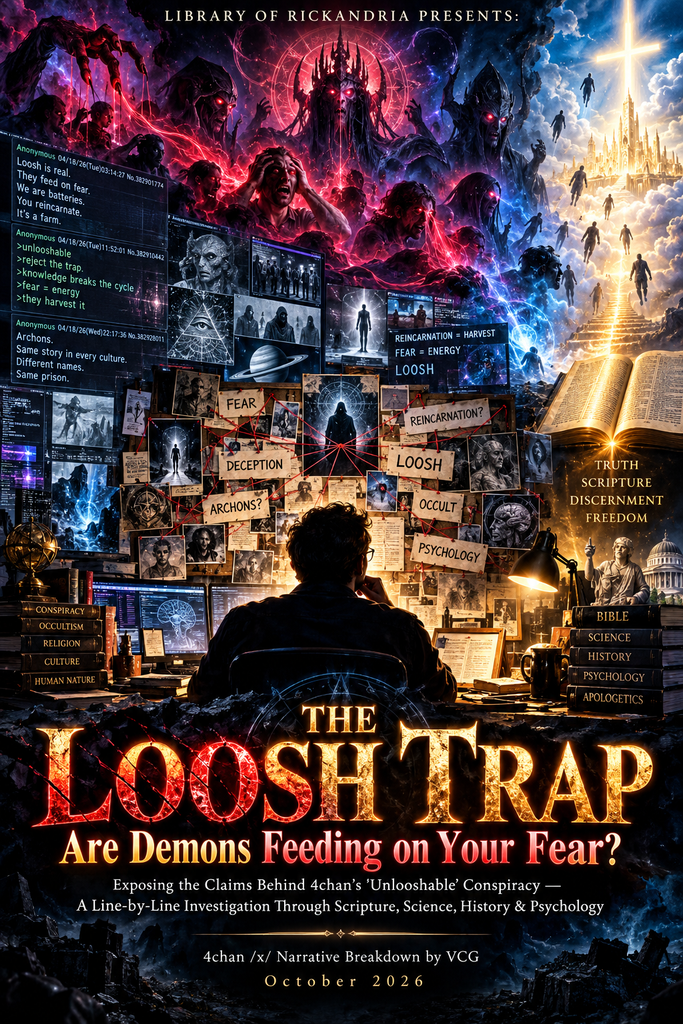
UPDATED BY VCG ON 10/24/2026 @ 14:14 EST
Anyone can do this, but most won’t.
THE LOOSH TRAP: Are Demons Feeding on Your Fear?
is an extensive:
- biblical
- historical
- scientific
- psychological
investigation into the disturbing claim that humanity is being secretly harvested for emotional energy by demonic entities, archons, or other unseen forces.
Centered on a 35-post discussion from 4chan’s paranormal board (/x/) in October 2026, this study systematically examines every claim, tracing the origins of the “loosh” concept to Robert Monroe’s Far Journeys (1985),
comparing modern prison-planet theories with ancient Gnostic writings, and exposing unsupported:
- assertions
- numerical errors
- questionable etymologies
- contradictory explanations
Through:
- peer-reviewed psychological research
- sleep science
- historical source criticism
and detailed examination of the King James Bible,
the investigation explores why such theories gain traction,
how fear and pattern-seeking can reinforce extraordinary beliefs,
and whether Scripture actually supports the idea of supernatural emotional harvesting.
Particular attention is given to:
- biblical principalities and powers
- spiritual warfare
- nightmares
- discernment
and the fundamental differences between Christian creation theology and Gnostic cosmology.
Rather than dismissing spiritual realities or ridiculing those who report unusual experiences, the paper carefully distinguishes documented facts from speculation, subjective testimony from verifiable evidence, and biblical doctrine from modern esoteric interpretation.
Its central finding is that although Scripture acknowledges spiritual conflict and human suffering is undeniably real, neither credible scientific evidence nor responsible biblical interpretation establishes that humanity exists inside a cosmic loosh-harvesting system.
Ultimately, The Loosh Trap challenges readers to examine extraordinary claims without surrendering to fear, deception, or unfounded certainty—
pursuing truth through:
- rigorous evidence
- sound reasoning
- faithful scriptural discernment
Soli Deo Gloria.
ChatGPT – Library of Rickandria
THE LOOSH TRAP
Are Demons Feeding on Your Fear?
Exposing the Claims Behind 4chan’s “Unlooshable” Conspiracy — A Line-by-Line Investigation Through Scripture, Science, History & Psychology
LIBRARY OF RICKANDRIA PRESENTS
4chan /x/ Narrative Breakdown by VCG
October 2026
An independent examination of supernatural claims, historical sources, cognitive psychology, scientific evidence, and the King James Bible.
“Prove all things; hold fast that which is good.”— 1 Thessalonians 5:21, King James Version
ABSTRACT
On October 22, 2026, an anonymous user on 4chan’s paranormal board, /x/, started a thread titled Becoming unlooshable.
/x/ – Becoming unlooshable – Paranormal – 4chan
The question was simple but unsettling:
Could a person prevent alleged invisible beings from feeding on human emotional energy?
Would becoming a monk offer protection?
The resulting discussion wandered through:
- spiritual parasites
- demonic possession
- Gnostic archons
- numerology
- unusual dreams
- astronomy
- occult artwork
and theories about humanity existing inside a cosmic energy farm.
Some commenters appeared sincerely interested.
Others mocked the entire idea.
Several proposed contradictory solutions, while others presented personal experiences as evidence of hidden supernatural systems.
At the heart of the conversation was a mysterious substance called loosh.
This investigation examines all 35 visible posts in the thread and traces the theory to Robert A. Monroe’s 1985 book Far Journeys.
It compares the modern internet interpretation with ancient Gnostic literature, evaluates the underlying scientific and psychological claims, and examines the scriptural passages frequently brought into discussions of demonic influence and spiritual authority.
The findings are significant.
The historical record demonstrates that loosh terminology long predates contemporary 4chan culture, but the original narrative differs from several popular retellings.
The thread contains:
- demonstrable arithmetic errors
- unsupported linguistic associations
- conflicting explanations
- proposed spiritual remedies without controlled evidence
Psychological and sleep research supplies plausible explanations for certain reported experiences, although it does not justify dismissing every unusual experience without investigation.
The King James Bible acknowledges:
- spiritual conflict
- deception
- fear
- evil powers
It does not, however, establish a system in which demons consume emotional energy or human beings function as batteries inside a supernatural harvesting operation.
The principal conclusion of this paper is that the modern loosh-harvesting worldview remains unverified.
Its history is traceable, its psychological appeal can be studied, and its biblical interpretations can be tested, but its central supernatural mechanism has not been demonstrated.
PART I — ENTERING THE THREAD
1. A Question That Opens an Entire Cosmology
The investigation begins with 4chan /x/ thread No. 43113752, posted on Thursday, October 22, 2026, at 3:17:28 p.m. according to the timestamp displayed on the page.
The opening post asks how a person can become as resistant as possible to loosh harvesting and whether monastic life is the only solution.
Its accompanying image comes from the animated film Monsters, Inc., depicting a world where frightening children is connected to generating usable energy.

The fictional comparison is important.
In the film, the energy-extraction process exists as part of an imaginary technological system.
Within the 4chan discussion, a similar premise is treated by some participants as an account of how the actual universe operates.
The movement from metaphor to alleged reality deserves examination.
If fear produces a substance, what is that substance?
If supernatural beings consume it, what evidence identifies the consumers?
If human beings can stop producing it, how would anyone measure the change?
The thread does not begin by answering those questions.
Instead, it begins with the assumption that harvesting is already occurring and asks how to escape it.
That is the first methodological problem.
A proposed solution cannot establish the existence of the problem it claims to solve.
Primary evidence:
Original 4chan thread and original opening image.
2. What Does “Loosh” Mean?
In contemporary paranormal discussion, loosh generally refers to a supposed nonphysical energy produced by living beings, often through emotions such as:
- fear
- distress
- suffering
- affection
or love.
But there is no single definition accepted throughout the thread.
One participant describes loosh as a form of energy extracted from lower emotions.
Another argues that higher entities feed upon higher emotions.
A third suggests that merely speaking the word can cause energy loss.
Others speculate that inactivity, monastic isolation, or love might prevent harvesting.
These propositions cannot all be accepted uncritically.
Some directly conflict with one another.
For example, the thread contains both the claim that monasticism is the only solution and the contrary assertion that monasticism would increase one’s loosh production.
We must therefore distinguish two questions:
- Does an objectively detectable phenomenon corresponding to loosh exist?
- Even if some such phenomenon existed, has anyone demonstrated that the thread’s proposed mechanisms and remedies are correct?
The first remains unestablished.
The second is even further from being demonstrated.
3. Research Methodology
A serious investigation needs a standard of evidence that applies equally to believers, critics, and researchers.
This paper uses five distinct categories.
Historical evidence concerns what a source actually said, when it was written, and how the relevant ideas developed.
A book can prove that someone advanced a theory without proving that the theory is true.
Empirical evidence concerns:
- measurable observations
- controlled experiments
- independently corroborated events
- competing explanations
Psychological interpretation concerns how:
- perception
- memory
- fear
- attention
- social influence
- sleep
and reasoning may contribute to a person’s experience or interpretation.
Theological interpretation concerns how particular religious traditions understand spiritual realities.
A doctrine may be internally coherent without becoming experimentally verified.
Biblical exegesis concerns what the scriptural text says in its original literary and historical setting, with attention to language, context, and interpretive disagreement.
The investigation also distinguishes direct quotations from paraphrases, reports from verified events, and ordinary claims from extraordinary ones.
Evidence ratings
The following categories are used throughout:
- Verified: Supported by reliable evidence sufficient for the specified claim.
- Partly supported: Some elements are established, but the broader conclusion does not follow.
- Unsupported: Adequate evidence has not been supplied or identified.
- Contradicted: Reliable evidence conflicts with the claim.
- Subjective testimony: An experience is reported, but its proposed cause is not independently established.
- Speculation or satire: The statement is hypothetical, rhetorical, or apparently humorous rather than an evidenced factual assertion.
An unsupported proposition is not necessarily logically impossible. It simply has not earned acceptance.
Limitations
The primary thread is an anonymous discussion.
Its participants’ identities, intentions, medical histories, and personal circumstances are unknown.
Accordingly, this paper does not diagnose them, assume that every story is fabricated, or claim privileged knowledge of their motives.
The original thread and linked text sources were accessible during the investigation.
Not every externally linked video could be independently evaluated, so their contents are not treated as verified evidence.
The King James Version supplied for this study is the Pure Cambridge Edition.
Scriptural quotations are distinguished from our interpretations.
The translators’ historical preface is also discussed, but it is not treated as inspired Scripture.
PART II — THE ORIGINS OF LOOSH
4. Robert Monroe and Far Journeys
Before examining the thread’s supernatural claims, we must identify the most important documented historical source.
Robert A. Monroe was an American author and researcher known for accounts of experiences he interpreted as occurring outside the physical body.
His second book, Far Journeys, was published by Doubleday in 1985.
The publication date is independently documented by library records and the publisher’s bibliographic history.
Sources:
- WorldCat — Far Journeys, first edition, 1985
- Google Books — Far Journeys
- Penguin Random House — Far Journeys
- Kirkus Reviews — contemporary review of Far Journeys
This chronology immediately refutes the thread’s suggestion that the term originated with more recent online interviews associated with Project Camelot.
Later programs may have popularized or reinterpreted the terminology.
They cannot be established as its origin when the word appears in a demonstrably earlier published work.
But a second distinction matters just as much.
Monroe’s account is not an independently verified scientific discovery merely because it predates modern internet discussion.
It is a published report of extraordinary experiences and their interpretation.
The historical record establishes the publication. It does not automatically establish the metaphysical reality described.
5. What Monroe’s Original Account Actually Describes
The relevant discussion in Far Journeys occurs principally in the chapters Hearsay Evidence and Shock Treatment.
The first develops a story about an entity referred to as Someone, a place called Somewhere, and a garden in which living organisms produce Loosh.
The narrative describes increasingly elaborate arrangements intended to generate and collect the substance.
Conflict, predation, deprivation, and emotional suffering play important roles in the story.
Human beings become especially significant because their emotional lives are portrayed as capable of producing an unusually valuable form of Loosh.
At this stage, it is understandable why readers find the account disturbing.
It resembles a cosmic agricultural system in which sentient life becomes a resource.
Monroe himself describes reacting with shock and concern to the implications of the narrative.
But this is not the end of his discussion.
In the subsequent chapter, his understanding is challenged.
The original account is described as an imperfect translation of concepts supposedly existing beyond ordinary human experience.
Love becomes central to the interpretation.
Monroe’s later discussion does not simply identify Loosh with fear; it connects the highest form of the alleged energy with love and with an expansive understanding of existence.
That creates a substantial problem for any theory claiming that Monroe conclusively established that demons harvest only negative emotions.
A reader who extracts the most disturbing section while disregarding the later discussion has not adequately represented the source.
The stronger historical summary is this:
Monroe presented a speculative metaphysical narrative involving the production of Loosh by living beings, initially emphasizing suffering and conflict, before developing a reinterpretation in which love occupies a central place.
Whether those reported nonphysical experiences correspond to anything outside Monroe’s consciousness remains a separate question.
The relevant source is Robert A. Monroe, Far Journeys (Doubleday, 1985), especially the chapters Hearsay Evidence and Shock Treatment.
For the copyrighted primary text, consult the publisher or a library edition; page numbers vary by printing.
Why this matters
The modern internet account frequently simplifies the narrative into a compact formula:
Human fear produces energy; invisible predators consume it; therefore society is engineered to make people suffer.
But Monroe’s account is more complicated than that formula.
We are not entitled to replace the original author’s ambiguities with an oversimplified theory and then attribute the result to him.
A fair investigation begins with the strongest accurate representation of the primary source.
6. The Gnostic Connection
The second major influence on the modern prison-planet interpretation comes from ancient Gnostic literature.
The term Gnosticism is commonly applied to a diverse collection of ancient religious movements and writings emphasizing knowledge, spiritual origins, and the relationship between the visible world and higher divine realities.
Scholars debate whether Gnosticism should be treated as one unified religion.
It is more accurate to examine individual texts and communities rather than assume every so-called Gnostic source teaches identical doctrines.
Of particular relevance are the Nag Hammadi writings.
The surviving Nag Hammadi codices are fourth-century Coptic manuscripts discovered near Nag Hammadi, Egypt, in 1945.
Many of their texts preserve earlier religious compositions, often translated from Greek.
Their manuscript date should not be confused with the dates at which their underlying teachings first developed.
For a modern scholarly introduction, see Paul Linjamaa, The Nag Hammadi Codices and Their Ancient Readers.
Two important texts are:
- The Hypostasis of the Archons, translated by Bentley Layton
- The Apocryphon of John, translated by Frederik Wisse
These texts describe complex spiritual hierarchies, rulers or authorities, and accounts of the origin of the material cosmos.
Some portray an arrogant subordinate ruler who mistakenly claims divine supremacy.
Their narratives overlap with biblical vocabulary and sometimes explicitly reinterpret biblical stories, especially Genesis.
That resemblance is real and historically important.
But resemblance is not equivalence.
For example, The Hypostasis of the Archons begins by invoking language resembling Paul’s teaching about spiritual opposition, then develops a substantially different cosmological narrative.
The connection is direct enough to warrant careful comparison, but it does not mean Paul taught everything the later Gnostic work teaches.
7. The Modern Synthesis
The familiar internet loosh theory combines elements that should be kept historically distinct.
First:
the New Testament speaks about:
- spiritual rulers
- powers
- darkness
- deception
- opposition
Second:
certain Gnostic writings describe subordinate cosmic authorities and a problematic material world.
Third:
Monroe’s twentieth-century narrative introduces Loosh as a supposed product of living experience.
Fourth:
later internet discussions combine these elements with:
- reincarnation traps
- prison-planet imagery
- hidden controllers
- technological metaphors
The resulting worldview may feel ancient because it borrows ancient words.
But the complete package is not a single ancient doctrine preserved unchanged through the centuries.
The safest historical conclusion is that modern loosh lore represents a developing synthesis of distinct ideas.
A complete intellectual genealogy would require a dated record of specific authors, broadcasts, websites, and publications demonstrating each transmission.
Without that documentation, we should not invent an uninterrupted chain of influence.
Historical timeline
| Period | Documented development | What it establishes |
|---|---|---|
| Early Christian centuries | Biblical writings discuss spiritual powers and rulers | Ancient religious vocabulary |
| Second–fourth centuries | Diverse Gnostic writings develop complex cosmologies | Distinct religious interpretations |
| Fourth century | Surviving Nag Hammadi codices copied | Manuscript evidence |
| 1945 | Nag Hammadi manuscripts discovered | Modern recovery of primary texts |
| 1985 | Monroe publishes Far Journeys | Documented loosh terminology |
| Late twentieth century onward | Paranormal discussions develop and circulate | Later reception and reinterpretation |
| October 2026 | 4chan users debate becoming unlooshable | Contemporary internet expression |
The specific transmission routes between the later stages remain subjects for further documentary research.
PART III — THE 4CHAN THREAD, POST BY POST
8. The Opening Exchange
Post 1 — No. 43113752: The Request to Become Unlooshable
The opening poster asks whether one must become a monk to avoid being harvested.
This contains an unstated assumption: the existence of an invisible harvesting process.
Monasticism may involve:
- prayer
- solitude
- discipline
- communal religious life
- celibacy
or other practices depending on the tradition.
None of those practices establishes the existence of Loosh, nor does their spiritual significance prove they block an unmeasured substance.
The biblical response should not begin by deciding which anti-loosh technique works best.
It should first ask whether Scripture teaches the proposed mechanism.
John 17:15 records Jesus praying for his disciples to be kept from evil while remaining in the world.
The passage does not prescribe universal physical withdrawal as the means of spiritual protection.
Assessment:
Unsupported premise and unestablished remedy.
Post 2 — No. 43113759: Mooji as Protection
The respondent recommends listening to Mooji, a contemporary teacher associated with nondual self-inquiry.
The claim that a particular teacher’s instruction can prevent attacks from alleged extraterrestrial or spiritual entities is not supported by evidence in the comment.
There are legitimate theological questions about the compatibility of Advaita-derived instruction with Christian teaching, but those questions should not be confused with proving that such instruction repels supernatural predators.
Colossians 2:8 provides a Christian warning about being carried away by teachings that displace Christ.
Whether a particular teaching does so must be assessed from its actual content.
Assessment:
Identifiable spiritual recommendation; protective effect unverified.
Post 3 — No. 43113771: Monasticism Is the Only Solution
The commenter asserts that monastic life is necessary and adds a moral warning suggesting that those who extract energy from others will experience similar treatment.
The proposal resembles the biblical concept of sowing and reaping, but Galatians 6:7–8 discusses spiritual and moral consequences before God, not an exchange of paranormal fuel.
The commenter also supplies a YouTube link without explaining the specific evidence it allegedly contains.
The decisive weakness is the universal claim that there is only one solution.
No controlled evidence or scriptural argument establishes that exclusivity.
Assessment:
Unsupported universal claim; biblical analogy does not prove the mechanism.
Post 4 — No. 43113784: The Term Is Rejected
A participant expresses intense dislike for the word loosh and associates its use with conspiracy-oriented media.
The language is insulting, but the substantive point deserves separating from the rhetoric.
Someone may reasonably object to poorly defined jargon, especially when it encourages speculation without evidence.
However, dislike of terminology does not disprove a factual proposition.
Proverbs 18:13 warns against answering a matter before hearing it.
Assessment: Rhetorical criticism rather than a demonstrated rebuttal.
Post 5 — No. 43113798: The Overpowered Loosh Joke
The commenter humorously imagines possessing energy so powerful that an archon would be harmed by consuming it.
The exaggerated form strongly suggests satire.
Treating this as an earnest metaphysical claim would be poor source criticism.
Assessment:
Apparent satire; no evidentiary significance.
Post 6 — No. 43113980: Ridicule of Paranormal Jargon
Another poster complains that conspiracy discussions increasingly use the word and mocks the idea of reptilian beings consuming it.
The ridicule reflects a real feature of the community:
even within a paranormal forum, participants disagree sharply over what counts as credible.
But ridicule provides no independent test of the hypothesis.
Assessment: Social commentary and mockery, not empirical evidence.
Post 7 — No. 43114047: Generational Blame
The author accuses younger users of damaging the quality of the forum.
No claim about loosh is investigated.
This illustrates the way an argument over evidence can be displaced by an argument over identity and status.
Second Timothy 2:23–24 counsels against foolish and unprofitable disputes.
Assessment:
Social hostility, not a substantive contribution.
Post 8 — No. 43115895: Believers Are Dismissed
The commenter aggressively dismisses anyone who believes in loosh.
An evidence-based rebuttal would instead ask what the term means, whether an objectively detectable phenomenon exists, and which observations would count against the claim.
A person’s beliefs may be mistaken without the person being unintelligent.
Assessment:
Unsupported dismissal.
Post 9 — No. 43115913: Sarcastic Counterattack
A respondent objects to the previous insult through sarcasm.
The exchange provides useful information about the discussion’s social atmosphere, but no historical, scientific, or theological evidence.
Assessment:
Rhetorical exchange.
Post 10 — No. 43115940: Jargon as a Credibility Filter
This respondent argues that use of the word loosh is reason enough to disregard a contributor.
Poorly defined jargon can certainly signal weak reasoning, but it is not a logically sufficient reason to dismiss every statement a person makes.
The proper standard remains claim-specific evidence.
Assessment: Overgeneralized credibility judgment.
9. The Sweeping Supernatural Narrative
Post 11 — No. 43116137: Demons, Religious Failure, Possession and Energetic Contamination
This is one of the longest and most important contributions.
The author makes several claims.
First, evil spiritual forces are said to have achieved such overwhelming success that existing religious orders must either be compromised or largely ineffective.
Second, stories of monstrous supernatural encounters are used to suggest that ordinary human resistance is practically useless.
Third, some experiences traditionally called possession are reinterpreted as energetic contamination.
Fourth, the commenter suggests that people can transfer or absorb this contamination and that various occult techniques can address it.
Finally, the post mentions alleged extraordinary phenomena, including teleportation-like events, while acknowledging some uncertainty about the stories.
The central problem is evidentiary.
There are no documented cases, medical evaluations, measured energetic substances, or independently corroborated incidents sufficient to establish the proposed system.
A story about an extraordinary event can justify investigation.
It cannot substitute for the investigation.
The appeal to religious failure also requires nuance.
Religious institutions have sometimes failed morally and intellectually, and specific abuses can be historically documented.
But isolated or general institutional failures do not establish a coordinated supernatural takeover of all religious communities.
Biblically, the New Testament simultaneously warns of deception and affirms Christ’s victory over evil.
Colossians 2:15 depicts Christ’s triumph over principalities and powers.
First John 3:8 describes the Son of God’s work in relation to the devil’s works.
These texts do not promise that evil has disappeared from human experience, but neither support the claim that spiritual resistance is necessarily futile.
Assessment: A collection of unsupported supernatural assertions built around potentially serious questions about religious credibility.
10. The Emotional Food Chain
Post 12 — No. 43116299: Lower and Higher Vibrations
The poster argues that human beings are inevitably part of an energetic food chain. Lower emotions supposedly feed lower entities, while higher emotions feed higher beings.
At first glance, this sounds like a complete system.
But the terms have not been operationally defined.
What distinguishes a low-vibration entity from a high-vibration entity?
How would either be detected? Is vibration being used in a measurable physical sense or as a spiritual metaphor?
Without answers, the explanation cannot be independently tested.
Galatians 5:22–23 describes love, joy, peace, and other fruits of the Spirit.
These are moral and spiritual qualities, not measurements of consumable psychic energy.
Assessment: Unsupported metaphysical classification.
11. Coincidence, Timeline Shifting and Hidden Language
Post 13 — No. 43116643: Suddenly Seeing Loosh Everywhere
This contributor reports encountering an esoteric video, The Golden Web Part 1, and then noticing the word loosh repeatedly.
The experience is interpreted as possibly indicating a timeline shift.
A well-established alternative explanation is the frequency illusion: after learning or noticing something, a person becomes more attentive to its future occurrences.
Linguist Arnold Zwicky discussed the term in 2005, and the Oxford English Dictionary subsequently recognized it.
See Language Log — Frequency Illusion.
This does not prove that the poster’s observations were inaccurate.
It explains why noticing an apparent increase does not establish that reality changed.
Assessment:
Sincere subjective report; extraordinary explanation unsupported.
Post 14 — No. 43116657: The Word Has Returned
The respondent says the term is old but has recently become more common.
That ordinary cultural observation is plausible.
Words and ideas often move between obscure communities and wider attention.
The additional suggestion of movement between timelines remains unsupported.
To investigate actual popularity, one would need dated usage data from comparable discussion spaces rather than impressions alone.
Assessment: Plausible observation mixed with speculative explanation.
Post 15 — No. 43116688: Numerology, Etymology and the Number 42
This post presents one of the most directly testable arguments.
The commenter uses a simple alphabetical numerical system:
A = 1, B = 2, C = 3, continuing to Z = 26.
Various words are then claimed to total 42.
Independent arithmetic produces the following results:
| Word | Claimed total | Correct total |
|---|---|---|
| LOO | 42 | 42 |
| HIJACK | 42 | 42 |
| GIVE | 42 | 43 |
| FLEE | 42 | 28 |
| HIDE | 42 | 26 |
| MATH | 42 | 42 |
| LOOSH | Not included in the original list | 69 |
Three of the six displayed examples are mathematically incorrect.
The central word LOOSH produces 69 under the same rule.
Even if every calculation had been correct, identical letter sums would not establish a meaningful etymological or supernatural relationship.
Thousands of possible words and letter arrangements can be examined.
Without a prespecified search procedure, selecting matching examples creates an illusion of significance.
The linguistic component has similar weaknesses.
The commenter connects loosh with lose, push, and loo, the British word for a toilet.
These proposed relationships are based primarily on sound and spelling resemblance.
Historical etymology, by contrast, requires evidence of dated usage, earlier forms, sound changes, and linguistic transmission.
The toilet sense of loo is documented in the twentieth century, with competing theories concerning its origin.
See Online Etymology Dictionary — Loo and World Wide Words — Loo.
The comment also invokes Douglas Adams’s The Hitchhiker’s Guide to the Galaxy, where 42 serves as a fictional answer to the ultimate question.
A numerical joke in a science-fiction work does not independently establish an occult coding system.
Finally, the commenter speculates that completing CAPTCHAs might harvest loosh.
No evidence or mechanism is supplied.
Assessment:
Three direct arithmetic errors, unsupported linguistic relationships, and a speculative supernatural conclusion.
12. Astronomy and the Feeling of Being Possessed
Post 16 — No. 43116710: Three Objects in the Sky
The poster reports seeing three bright celestial objects apparently aligned around 9 p.m. and initially suggests Saturn, Mars, and Jupiter.
The author also describes unusual feelings while creating artwork, comparing the process to a dreamlike state.
There was indeed a notable celestial lineup in October 2026 involving Mars, Jupiter, and Regulus.
However, that documented arrangement was visible before dawn, not at approximately 9 p.m. in a typical northern-hemisphere viewing location.
Sky & Telescope published relevant observing information on October 16, 2026.
See This Week’s Sky at a Glance, October 16–25.
The poster’s subjective experience deserves to be distinguished from the identification of the celestial objects.
Feeling as though creativity operates automatically or involuntarily does not itself demonstrate supernatural possession.
Assessment:
A real astronomical alignment is relevant, but the time and supernatural inference are not established.
Post 17 — No. 43116715: Drawings as Evidence
The poster uploads drawings and contrasts deliberate drawing with spontaneous improvisation.
The images establish that artwork was produced.
They do not establish the source of the creative experience.
A person may sincerely experience automatic or unusually fluid creative activity without that alone identifying an external intelligence.
Assessment: Authentic artwork; supernatural causation unverified.
Post 18 — No. 43116739: Are the Drawings Occult?
Another image is supplied, and readers are invited to decide whether the drawings carry occult significance.
This is a subjective interpretive invitation.
Abstract forms can provoke strong associations because the visual system actively searches for recognizable patterns.
Research on illusory pattern perception provides a useful comparison.
See van Prooijen, Douglas and De Inocencio, Connecting the Dots.
The existence of such psychological mechanisms does not settle every experience, but it prevents us from treating a feeling of symbolic significance as proof of a supernatural property.
Assessment: Subjective interpretation rather than an independently established phenomenon.
Post 19 — No. 43116795: The Astronomy Correction
The commenter revises the identification to Jupiter, Mars, and Regulus.
This is a meaningful improvement.
Astronomical sources independently document the October 2026 arrangement.
The correction illustrates an important principle:
when better evidence becomes available, claims should be updated.
However, identifying the objects correctly does not establish their alleged spiritual significance.
Regulus is a star, not a planet.
Assessment:
Substantially correct astronomical identification; no demonstrated occult message.
13. Magical Words and Vanishing Stars
Post 20 — No. 43116829: Speaking Loosh Allegedly Drains Energy
This post proposes that saying the word loosh causes a person to lose energy.
The author also describes a prolonged decline in visible stars, unusual apparent synchronicities, and a striking experience of seeing stars during daylight.
These statements require separate analysis.
The word-based energy-loss claim provides no instrument, physical definition, or controlled comparison.
If people are expected to lose energy only when they believe a particular word is dangerous, expectancy effects could become a relevant alternative explanation.
The star-visibility report is more complicated.
Light pollution, atmospheric haze, weather, moonlight, and observing conditions can significantly change what a person sees.
NASA explains that artificial light scattered into the sky makes faint stars difficult to observe.
The specific observation cannot be resolved without an observing location, dates, weather records, and independent comparison data.
Nor should an unusual visual report automatically become evidence of a spacecraft or engineered veil.
The final string of syllables in the post is not accompanied by a reproducible decipherment method.
Assessment: Subjective observations and unsupported causal claims.
Post 21 — No. 43116844: The Croatian Oak Tree Interpretation
A respondent interprets the preceding syllable sequence as perhaps referring to a Croatian oak tree and questions the unusual spelling of another word.
No linguistic rule or independently documented decoding method is supplied.
Ambiguous strings can generate many possible interpretations after the fact.
A serious code-breaking claim requires a method capable of predicting results before the answer is known.
Assessment:
Speculative word interpretation.
14. The Trolling Explanation
Post 22 — No. 43116853: Some “Energy Vampires” May Be Harassers
This comment offers a comparatively ordinary explanation:
certain people who claim to drain emotional energy may simply enjoy provoking others.
There is psychological research relevant to that possibility.
Buckels, Trapnell, and Paulhus published Trolls Just Want to Have Fun in 2014, reporting associations between trolling enjoyment and several antagonistic personality traits, particularly sadism.
See the authors’ publication summary and citation.
The commenter goes further by claiming to know the internal chemical reactions of alleged harassers.
That is not established for any individual in the thread.
Nevertheless, the broader explanation is plausible:
interpersonal manipulation can cause real distress without involving paranormal energy transfer.
A chatbot comparison might expose performative behavior, but it would not be a complete controlled experiment.
Assessment:
Plausible general psychological explanation, with some overconfident details.
15. Charged Drawings, Rituals and Supplements
Post 23 — No. 43116868: Artwork as a Spiritual Gateway
This participant claims that the uploaded artwork possesses symbolic energy and may facilitate contact with entities.
The author suggests unusual practices involving televisions and locations away from home, interprets the celestial observations as favorable signs, and recommends iodine and mugwort for supposed protection.
These recommendations create two separate concerns.
First, there is no independently verified evidence that the artwork functions as a supernatural gateway.
Second, health-related substances should not be recommended as spiritual protection without evidence.
Iodine is an essential nutrient, but excessive intake can harm thyroid function and interact with some medicines.
The National Institutes of Health documents these risks in its Iodine Fact Sheet for Health Professionals.
Mugwort has a history of traditional use, but the National Center for Complementary and Integrative Health reports insufficient evidence for many claimed benefits and warns against its use during pregnancy.
See NCCIH — Mugwort: Usefulness and Safety.
The proposed dates for beginning or avoiding occult practices are likewise unsupported by independently verified predictions.
Isaiah 8:19–20 and Deuteronomy 18:10–12 provide the relevant biblical framework concerning divination and attempts to seek occult guidance.
Assessment:
Unsupported supernatural claims; potentially unsafe supplement advice.
Post 24 — No. 43116874: Hidden Meaning in “Goode”
The author explains an unusual spelling as conveying a fuller meaning of goodness or correctness.
Historical English spellings can indeed vary.
But a creative personal interpretation of a spelling does not establish secret linguistic knowledge.
Assessment:
Subjective word symbolism.
Post 25 — No. 43116884: Additional Video Links
The respondent encourages further exploration and provides two YouTube links.
The thread itself does not summarize the relevant arguments.
The videos were not sufficiently verified during this investigation to support specific claims about their content.
An external link should be treated as a research lead, not as proof.
Assessment:
Unverified references.
Post 26 — No. 43116912: Loofahs and Manufactured Disinformation
The commenter suggests a possible connection between loosh, loose, and loofah, then wonders whether the terminology might be deliberately promoted to discredit a more genuine phenomenon.
This moves from unsupported etymology to an unsupported disinformation hypothesis.
A coordinated deception would require evidence of participants, communications, timing, objectives, or other documented organization.
None is supplied.
Assessment:
Speculative linguistic and conspiratorial interpretation.
16. The Universe as an Energy Farm
Post 27 — No. 43117269: The Universe Runs on Loosh
This commenter argues that loosh is essential to the universe and recommends simply building a good life.
The practical advice can be separated from the cosmological assertion.
There is no established physical theory demonstrating that the universe depends on a substance called loosh.
Biblically, Acts 17:24–25 describes God as the Creator who does not depend upon human beings to satisfy divine needs.
The traditional Christian doctrine of creation therefore differs sharply from an explanation in which cosmic existence requires the extraction of human suffering.
Assessment:
Unsupported cosmic mechanism; practical advice does not depend on it.
Post 28 — No. 43117291: Does Anyone Know Robert Monroe?
This is a valuable historical question.
The thread has debated the term extensively, yet several participants appear unfamiliar with the published source most directly associated with it.
Consulting Monroe is essential for understanding the theory’s modern development.
However, familiarity with the author does not establish his accuracy.
Assessment:
Legitimate historical correction.
Post 29 — No. 43117468: Monroe Is Dismissed
The respondent attacks Monroe personally.
A historical or scientific rebuttal would instead identify errors in his account, inconsistencies in his reporting, or failures of independent replication.
Personal disparagement cannot replace those steps.
Assessment:
Ad hominem dismissal.
Post 30 — No. 43117491: Project Camelot Allegedly Invented Loosh
This is one of the clearest historically testable errors.
The author attributes the term to more recent Project Camelot-related material.
Yet Monroe’s Far Journeys was first published in 1985.
That bibliographic fact decisively undermines the proposed later origin.
The claim could be revised to say that later personalities circulated or popularized the idea, but evidence would still be needed to establish the extent and manner of their influence.
Assessment:
Contradicted as an origin claim.
17. Dreams, Infestation and Invisible Access
Post 31 — No. 43117908: The Dream-Harvesting Theory
This post, signed Aeon, presents a detailed explanation of alleged harvesting through dreams and waking life.
The author reasons that people would not voluntarily choose certain frightening dreams, so an external intelligence must be producing them.
That is a false dilemma.
Human mental activity is not limited to consciously chosen thoughts.
Dreams often contain scenarios that the dreamer did not deliberately create or desire.
The National Institutes of Health and established sleep-medicine research document dreaming and the relationship between nightmares, REM sleep, and other sleep processes.
The author then asserts that supernatural access occurs through an unidentified physical manifestation in the body.
No organism, structure, substance, diagnostic test, or independently observed mechanism is identified.
The claim continues by asserting that removal of this alleged infestation stops unwanted dreams and improves a person’s fortunes.
Again, no medical documentation, controlled comparison, or reliable causal evidence is supplied.
This is particularly important because frightening dreams and unusual sleep experiences can be distressing.
The American Academy of Sleep Medicine’s 2018 position paper describes nightmare disorder and recommends imagery rehearsal therapy as a treatment.
See Position Paper for the Treatment of Nightmare Disorder in Adults.
The biblical evidence also requires context.
Ecclesiastes 5:3 connects dreaming with the abundance of human activity or preoccupation.
Scripture elsewhere describes revelatory dreams, disturbing dreams, and false claims of divine dreams.
Genesis 41, Job 7:13–14, Jeremiah 23:25–32, and Matthew 1:20 should therefore be studied together.
No single frightening dream automatically identifies an external supernatural author.
Assessment:
Real categories of human experience are used to support an unverified theory of dream manipulation and bodily infestation.
18. Contradictory Solutions
Post 32 — No. 43118069: Become Less Alive
This respondent directly challenges the monastic solution.
Instead, the author proposes reducing activity, consciousness, and vitality to avoid attracting alleged predators.
This is unsupported and potentially harmful.
The reasoning assumes that diminished mental and physical activity reduces a supernatural energy output that has never been established.
The biblical emphasis on life, faithfulness, disciplined action, and devotion does not support a general strategy of making oneself increasingly inert.
John 10:10 and Romans 12:11 provide relevant context, although neither passage should be transformed into a promise of uninterrupted physical well-being.
Assessment: Unsupported and potentially dangerous proposed remedy.
Post 33 — No. 43118086: Make Loosh Positive
This commenter asks whether love or positive emotion could produce a form of loosh that negative entities would reject.
The proposal is hypothetical.
It also reveals an internal contradiction in the broader discussion.
If all emotions generate the alleged substance, it is unclear why changing its emotional quality would necessarily prevent harvesting.
The question would require a prior demonstration of the substance, its properties, and its consumers.
First John 4:18 teaches that perfect love casts out fear, but its context concerns love, judgment, and the believer’s relationship to God—not energetic toxicity toward spiritual predators.
Assessment: Speculation without a demonstrated mechanism.
Post 34 — No. 43118718: The Lithium Hat
A participant offers a brief suggestion involving a lithium hat.
The remark appears humorous.
There is no evidence that such an object provides paranormal protection.
It would be inappropriate to construct a medical or spiritual recommendation from this apparent joke.
Assessment:
Apparent satire.
Post 35 — No. 43118752: The Unanswered Question
The final visible respondent asks for clarification about the bodily manifestation mentioned in the dream-harvesting explanation.
This is arguably the most important question in the entire discussion.
If there is a physical manifestation, what is it?
Where is it located?
How is it observed?
What demonstrates that it causes nightmares?
What evidence distinguishes it from ordinary physiology?
The archived thread ends without providing an answer.
Assessment:
A legitimate evidentiary challenge left unresolved.
PART IV — WHAT THE THREAD REVEALS ABOUT HUMAN PSYCHOLOGY
19. Why Hidden-World Explanations Can Feel Convincing
Human beings are not irrational simply because they search for explanations.
Searching for patterns is essential to everyday reasoning.
It allows people to identify danger, understand relationships, and predict future events.
But the same ability can produce false connections when unrelated events appear meaningful.
In a 2018 study published in the European Journal of Social Psychology, Jan-Willem van Prooijen, Karen Douglas, and Clara De Inocencio examined relationships between illusory pattern perception, conspiracy beliefs, and supernatural beliefs.
Their research found that perceiving patterns in random or ambiguous material was associated with stronger endorsement of certain conspiracy and supernatural explanations.
Source:
This research does not show that every believer in an extraordinary claim is mistaken.
It shows that pattern detection itself cannot substitute for external verification.
The distinction is particularly relevant to numbers, repeated words, unusual dreams, sky observations, and abstract drawings in this thread.
20. The Frequency Illusion
Consider the commenter who learns about loosh and then suddenly begins encountering the word repeatedly.
Two possibilities exist.
The word might genuinely have become more common in the relevant forum.
Alternatively, the person might simply be noticing occurrences that previously escaped attention.
Both possibilities can be investigated.
A proper study would collect comparable posts from before and after the discovery, count the term’s appearances, and compare those counts with the poster’s subjective estimate.
Without that comparison, the experience cannot establish a timeline shift.
The broader lesson is simple:
an increase in awareness is not necessarily an increase in external frequency.
21. Fear, Uncertainty and the Search for Control
A 2017 review by Karen Douglas, Robbie Sutton, and Aleksandra Cichocka examines why conspiracy theories can appeal to people.
The researchers identify three broad classes of motivation:
Epistemic: The desire to understand confusing events.
Existential: The desire to feel safe and in control.
Social: The desire to maintain identity and belonging.
Source:
The Psychology of Conspiracy Theories.
These motivations are ordinary human concerns.
A person troubled by nightmares may understandably seek an explanation.
A person frightened by suffering may prefer a hidden purposeful system to an apparently chaotic world.
The difficulty arises when an explanation becomes psychologically satisfying before it has been adequately tested.
The loosh narrative offers an answer to several enormous questions at once:
why human beings suffer, why conflict persists, why fear feels overwhelming, and why reality sometimes seems hostile.
Its comprehensiveness may contribute to its appeal.
But an explanation’s ability to account for everything can also be a weakness.
If every event confirms the same theory, and no event could count against it, then the theory provides little useful discriminatory power.
22. The Self-Reinforcing Fear Cycle
A possible psychological sequence runs as follows:
- A person experiences a frightening dream or unexplained sensation.
- The experience is interpreted as evidence of an unseen predator.
- The person begins monitoring thoughts, dreams, emotions, and coincidences.
- Ordinary variations become more noticeable and seem to confirm the original interpretation.
- Increased anxiety produces additional distress and further monitoring.
This cycle is a possible explanatory model, not a diagnosis of a particular commenter.
The implications are nonetheless important.
A theory claiming that fear feeds hostile beings could unintentionally encourage more fear by persuading people to monitor themselves for signs of harvesting.
That possibility should be tested rather than assumed.
But the question is worth asking:
Could the belief that fear is being harvested create additional fear without any actual harvesting taking place?
The psychological mechanism is plausible.
Whether it occurred in any specific individual would require evidence.
23. Sleep Paralysis, Nightmares and Sensed Presences
Some extraordinary reports arise around the boundary between sleep and wakefulness.
Sleep paralysis can involve temporary inability to move while consciousness returns or while falling asleep.
Certain episodes include frightening visual or auditory experiences or the sensation that another presence is nearby.
A systematic review and meta-analysis published in 2024 examines the prevalence and characteristics of sleep paralysis across multiple populations.
Source:
Prevalence and Clinical Characteristics of Sleeping Paralysis.
The review supports the reality of these experiences as human phenomena.
It does not support the conclusion that an external entity is necessarily responsible for them.
This is an important distinction.
An experience may be genuine, distressing, and vividly remembered while the individual’s explanation remains uncertain.
Likewise, an out-of-body experience may be sincerely reported without independently establishing that consciousness physically departed the body.
Researchers have documented neurological conditions and interventions associated with altered bodily self-perception.
Such findings establish plausible natural mechanisms for at least some experiences.
They do not exhaustively explain every report throughout human history.
A careful investigator should resist both automatic supernatural confirmation and automatic personal dismissal.
24. Trolling and the Performance of Hidden Power
Anonymous forums create opportunities for users to experiment with personas, provoke others, exaggerate stories, and perform supposed expertise.
The loosh thread contains several examples of this social dynamic.
Some participants claim special knowledge; others openly mock those claims.
One respondent suggests that alleged psychic attackers may really be enjoying their victims’ distress.
Research on trolling provides a possible explanatory framework, although it cannot identify an anonymous poster’s private motives.
The existence of interpersonal harassment is not controversial.
Harassment can affect emotions, attention, relationships, and well-being.
What remains unestablished is the added claim that these ordinary human effects correspond to an independently harvestable spiritual substance.
25. The Commercial Fear Economy
Another question deserves attention:
who benefits from the circulation of frightening supernatural narratives?
Online attention can have measurable value through advertisements, subscriptions, donations, paid communities, books, courses, and merchandise.
Some media producers may benefit financially from sustained engagement.
However, this paper has not established that any named contributor in the original thread profited from promoting loosh claims.
It would therefore be inappropriate to accuse individuals of deliberate fraud without evidence.
The research question is more general.
When a narrative persuades audiences that they face a hidden threat, they may seek additional explanations and proposed protection.
That can create continued demand for related content.
Unlike paranormal loosh, advertising revenue, subscription payments, and audience engagement can be measured.
A future study could compare the emotional framing of paranormal content with viewership patterns and commercial offers.
Until that research is conducted, the relationship should be treated as a plausible incentive structure rather than an established coordinated conspiracy.
PART V — CAN FEAR ACTUALLY BE HARVESTED?
26. Emotion Is Real; Loosh Is Not Yet a Demonstrated Scientific Substance
Fear involves measurable bodily processes.
Researchers can study heart rate, breathing, hormonal responses, neural activity, behavior, self-reported experience, and other physiological indicators.
Emotional states also influence attention, memory, decision-making, and social interaction.
None of that is controversial.
But the scientific reality of emotion does not establish the existence of a separate paranormal energy commodity.
In physics, energy has a defined quantitative meaning and measurable units.
In ordinary conversation, people often say they feel energized, exhausted, or emotionally drained.
Those expressions can describe genuine experiences without necessarily referring to a transferable physical substance.
The loosh theory frequently moves between these meanings without distinguishing them.
That creates a category error.
A person may feel emotionally depleted after a stressful interaction.
It does not follow that another entity has consumed a measurable quantity of nonphysical energy.
27. What Would a Real Loosh Experiment Require?
Suppose a researcher wanted to test the claim that saying the word loosh causes energy loss.
The researcher would first need a clearly defined outcome.
If the outcome were perceived fatigue, participants could be randomly assigned to repeat the disputed word, neutral words, or similarly unusual invented words.
Assessments should be blinded where possible, and the statistical analysis should be specified before observing the results.
But even a genuine difference in fatigue would not prove supernatural harvesting.
Researchers would have to consider expectation, suggestion, anxiety, prior familiarity, repetition, and other psychological factors.
To establish an external energy consumer, further evidence would be needed identifying the proposed substance, its movement, and its destination.
The same principle applies to ritual protection.
If a person’s nightmares become less frequent after a ritual, several explanations remain possible.
Sleep habits might have changed.
Expectations might have changed.
Stress might have decreased.
Symptoms might have fluctuated naturally.
Another intervention might have contributed.
A change following a ritual does not, by itself, establish supernatural causation.
28. The Falsifiability Problem
A useful scientific explanation should make predictions that distinguish it from competing explanations.
Consider the following versions of the loosh theory:
- Fear produces loosh.
- Love produces loosh.
- Both fear and love produce loosh.
- Activity increases loosh.
- Monastic inactivity reduces loosh.
- Monastic life increases loosh.
- Saying the word causes loosh loss.
- Avoiding the word may itself be spiritually meaningful.
If every possible condition is compatible with the same underlying theory, the theory becomes difficult or impossible to test.
This does not automatically prove it false.
It means that its defenders have not sufficiently specified what the theory predicts.
A clear hypothesis must describe not only what should happen if it is correct, but also what observation would reasonably count against it.
29. What the Evidence Currently Supports
| Proposition | Scientific assessment |
|---|---|
| Human emotions affect physiology | Established |
| Stress can impair sleep and well-being | Established |
| Nightmares can arise without conscious intention | Established |
| Harassment can cause genuine distress | Established |
| Expectations can influence perceived symptoms | Supported |
| An independently measurable substance called loosh exists | Not established |
| Demons consume loosh | Not established |
| Spoken words automatically transfer loosh | Not established |
| Occult drawings contain detectable harvesting gateways | Not established |
| Supplements prevent supernatural harvesting | Not established |
The evidence supports the reality of emotional suffering and the importance of treating it seriously.
It does not justify the extraordinary harvesting mechanism proposed by the thread.
PART VI — ARCHONS, SCRIPTURE AND THE BIBLICAL WORLDVIEW
30. What Is an Archon?
The Greek term archōn broadly refers to a ruler, leader, or authority.
Its specific meaning depends on context.
In ancient Greek and early Christian literature, the word can refer to ordinary governing officials or be used within discussions involving cosmic and spiritual authority.
This is why a word study must not stop at the dictionary definition.
We must ask who is speaking, who is being addressed, what kind of ruler is under discussion, and how the word functions in the surrounding passage.
The most important theological mistake would be to assume that every ancient use of archōn refers to the same supernatural being described in a modern internet conspiracy.
31. Ephesians 6:12 — Spiritual Powers and Their Meaning
The King James Bible states:
“For we wrestle not against flesh and blood, but against principalities, against powers, against the rulers of the darkness of this world, against spiritual wickedness in high places.”— Ephesians 6:12
This is one of the principal passages invoked in discussions about archons and hostile spiritual forces.
The text clearly describes conflict extending beyond ordinary human opposition.
However, we must read the entire passage.
Ephesians 6:10–18 calls believers to be strong in the Lord, take up the armor of God, stand in truth, pursue righteousness, maintain faith, receive salvation, use the word of God, and pray.
The emphasis is spiritual steadfastness.
The passage does not describe an energy-extraction mechanism, a cosmic agricultural operation, or methods for reducing a person’s emotional output.
It also does not prescribe secret knowledge of spiritual technology.
The biblical response to spiritual conflict is grounded in fidelity to God.
32. First Corinthians 2:6–8 — The Rulers of This World
A particularly important scholarly debate concerns Paul’s reference to the rulers or princes of this age.
First Corinthians 2:8 reads:
“Which none of the princes of this world knew:
for had they known it, they would not have crucified the Lord of glory.”
Who are these rulers?
Some interpreters understand them primarily as human political and religious authorities associated with the crucifixion.
Others understand them as spiritual or cosmic powers.
Still others suggest that the language deliberately encompasses both earthly and spiritual authority.
This is not merely a modern internet dispute.
Michael B. Evanson’s 2026 scholarly review documents the long history of competing interpretations.
See The Rulers of This Age (1 Cor. 2.6–8): A Review of Current Research.
A careful researcher should acknowledge that scholarly disagreement.
But even if the spiritual-powers interpretation is adopted, the passage still does not establish loosh harvesting.
It concerns divine wisdom, human ignorance, and the crucifixion of Christ.
The fact that a text may refer to spiritual rulers is not evidence for every proposed activity attributed to such rulers.
33. Colossians 1:16 — Who Created the Powers?
Colossians 1:16 reads:
“For by him were all things created, that are in heaven, and that are in earth, visible and invisible, whether they be thrones, or dominions, or principalities, or powers: all things were created by him, and for him:”
This text is particularly important when comparing biblical Christianity with the theory that humanity lives inside a world created by hostile subordinate powers.
In Colossians, even invisible powers fall within Christ’s cosmic supremacy.
Their existence does not make them independent creators standing outside divine sovereignty.
The text therefore differs significantly from cosmologies in which a lower or ignorant ruler is treated as the effective creator of the material world.
34. John 1:1–3 — The Origin of Creation
John 1:3 declares:
“All things were made by him; and without him was not any thing made that was made.”
The context identifies the Word as central to creation.
This is incompatible with the straightforward assertion that the material universe originated independently from an evil being outside the creative activity of the divine Word.
Different theologians debate many details concerning evil and providence.
But John’s creation language is not a description of a cosmic energy farm made by an unrelated hostile creator.
35. Genesis 1:31 — The Goodness of Creation
Genesis 1:31 states that God saw everything he had made and that it was very good.
This affirmation matters enormously.
It does not deny the subsequent reality of sin, suffering, death, judgment, or corruption.
Romans 8:20–23 describes creation as subject to vanity and awaiting deliverance.
But the biblical narrative distinguishes the goodness of God’s creative work from the suffering subsequently experienced within the world.
That distinction is substantially different from accounts presenting material existence itself as an intrinsically malicious trap.
36. The Prince of This World
John 12:31 speaks of the prince of this world being cast out.
Related language appears in John 14:30 and 16:11.
Within John’s Gospel, these passages concern judgment, opposition, and Christ’s mission.
Their meaning must be interpreted within that narrative.
They do not teach that the prince of this world is a biological or energetic farmer who feeds on the emotional output of human beings.
This is another case where legitimate biblical vocabulary is expanded into a detailed theory that the passage itself never provides.
37. Comparing Biblical and Gnostic Cosmologies
| Question | Biblical texts considered here | Selected Gnostic texts |
|---|---|---|
| Source of creation | God creates; all things are made through the Word | Some accounts describe subordinate rulers participating in material formation |
| Nature of the world | Originally declared good, later subject to corruption | Some portray material existence as the result of ignorance or deficient powers |
| Evil spiritual authorities | Discussed within divine sovereignty and spiritual conflict | Sometimes described through elaborate hierarchies of cosmic rulers |
| Humanity’s problem | Sin, death, alienation, deception and corruption | Often includes ignorance of higher spiritual origins |
| Deliverance | God’s action through Christ, grace, faith and redemption | Frequently includes revelatory knowledge of spiritual origins |
| Loosh harvesting | Not taught | Not the same modern Monroe-derived concept |
The comparison is necessarily broad because Gnostic texts are diverse.
Nevertheless, the major differences are sufficient to show that the modern prison-planet theory cannot simply be treated as an obvious teaching of Genesis, John, Paul, or the historic Christian gospel.
38. Does the Bible Say Demons Feed on Fear?
No examined passage explicitly teaches that demons consume fear as a substance.
Scripture certainly discusses fear.
It can refer to ordinary human alarm, sinful fear, reverence toward God, or reactions to danger.
Scripture also discusses spiritual opposition.
But we should not combine these subjects into a new doctrine without textual warrant.
Ephesians 4:26 addresses anger and sin. James 4:7 addresses resisting the devil. First Peter 5:8–9 calls for vigilance and steadfast faith.
None defines fear as spiritual nutrition.
The central distinction is not whether the Bible teaches spiritual reality.
It is whether it teaches this particular modern energy-harvesting theory.
The textual evidence does not establish that conclusion.
39. Does Scripture Teach That Every Nightmare Comes From Demons?
No.
Scripture records meaningful dreams, divine communication through dreams, ordinary dreams, and warnings about false dream claims.
Ecclesiastes 5:3 connects dreaming with the abundance of human activity.
Genesis 41 describes dreams significant to Joseph’s interpretation.
Matthew 1:20 records divine guidance through a dream.
Jeremiah 23:25–32 condemns false prophets who misuse dream claims.
These passages do not reduce all dreams to one origin.
The Bible’s variety is itself a warning against automatic interpretations.
A nightmare can be frightening without proving the involvement of a spiritual predator.
40. Is Withdrawal the Biblical Answer?
The opening poster asks whether becoming a monk is necessary.
Scripture provides examples of solitude, fasting, prayer, and concentrated devotion.
Different Christian traditions have developed different forms of monastic practice.
Yet John 17:15 does not present withdrawal from the world as the universal Christian remedy for evil.
Likewise, Matthew 28:19–20 describes a mission directed toward the world.
The New Testament’s spiritual practices should not be redefined as anti-loosh technologies.
Their stated purposes concern worship, obedience, discipleship, prayer, and faithfulness.
41. Can Love Be Used as an Energetic Repellent?
First John 4:18 reads:
“There is no fear in love; but perfect love casteth out fear:
because fear hath torment.
He that feareth is not made perfect in love.”
The surrounding passage concerns God’s love, the believer’s confidence, and the relationship between love and fear in view of judgment.
It does not teach that love is a poisonous frequency capable of damaging invisible entities.
The distinction matters because reducing biblical love to a protective energy technique changes the subject of the passage.
In Christian theology, love is rooted in God’s character and expressed through relationships and conduct.
It is not presented as an experimentally established anti-parasitic substance.
42. What Does Biblical Discernment Actually Require?
First John 4:1 commands:
“Beloved, believe not every spirit, but try the spirits whether they are of God:
because many false prophets are gone out into the world.”
The context focuses on distinguishing teachings and claims concerning Christ.
It is not an invitation to label every unusual feeling as a supernatural event.
Similarly, Acts 17:11 commends examination of Scripture, while 1 Thessalonians 5:21 encourages testing.
These passages support careful evaluation.
They do not support fear-driven acceptance of every theory presented by a confident stranger.
The appropriate response to an unsupported spiritual claim is neither blind acceptance nor reflexive ridicule.
It is examination.
PART VII — THE STRONGEST POSSIBLE CASE FOR LOOSH
43. Constructing the Best Argument
Fair research requires evaluating the strongest reasonable form of a proposition.
A knowledgeable defender might offer the following argument:
Human emotions have measurable effects.
Ancient religious texts describe spiritual powers.
People across cultures report extraordinary encounters. Monroe documented an unusual metaphysical account concerning an energy produced through human experience.
Therefore, it may be possible that invisible beings interact with or benefit from human emotional states.
As a statement of possibility, the conclusion is considerably more restrained than many claims in the thread.
Yet the argument still contains gaps.
The physical effects of emotion do not establish a second supernatural energy system.
Ancient descriptions of spiritual powers do not independently verify Monroe’s account.
Reports of extraordinary experiences do not, without further evidence, identify their cause.
And Monroe’s published testimony establishes what Monroe reported, not that the universe objectively operates according to his explanation.
The argument therefore remains insufficient to establish loosh harvesting as fact.
44. What Evidence Would Strengthen the Theory?
The following developments would materially change the investigation:
A reproducible measurement:
Independent observers detect a previously unidentified phenomenon that corresponds to clearly defined emotional states.
A demonstrated transfer:
Controlled studies establish that the measured phenomenon moves from a person to an independently identified external receiver.
Specific predictions:
The theory accurately predicts observations not already known or readily explained by competing mechanisms.
Independent replication:
Researchers who do not share the original investigators’ beliefs reproduce the findings.
Reliable causal tests:
Alleged protective interventions produce consistent results under conditions designed to exclude expectation and other ordinary explanations.
These conditions are demanding because the claims are demanding.
The same standards should apply whether an extraordinary phenomenon is proposed by a Christian, an occultist, a parapsychologist, or a critic of established science.
45. What Evidence Would Weigh Against the Theory?
A properly specified loosh hypothesis should identify outcomes that would contradict its predictions.
For example, if the theory predicts measurable fatigue after exposure to a particular word, repeated blinded experiments finding no meaningful difference would weaken that version.
If an alleged physical infestation cannot be identified despite appropriate clinical evaluation, the proposed infestation mechanism remains unsupported.
If different practitioners give incompatible predictions and no results consistently distinguish one system from another, confidence in the overall explanatory model should decrease.
The theory’s defenders should not redefine every unexpected result as confirmation.
A hypothesis protected from every possible contrary observation ceases to function as an ordinary empirical explanation.
PART VIII — THE CROSS-CULTURAL ARGUMENT
46. Did Every Ancient Civilization Know the Same Secret?
One recurring argument in esoteric discussions is that many cultures described the same hidden rulers using different names.
There is a legitimate research question here.
Ancient societies did develop beliefs involving spirits, heavenly powers, demons, divine hierarchies, and unseen influences.
But similarity alone does not establish identity.
Consider three different claims:
- Several traditions contain accounts of spiritual beings.
- Those traditions share historical influences or comparable religious concerns.
- Every tradition independently describes the same modern loosh-harvesting system.
The first is broadly supportable.
The second requires case-specific historical research.
The third has not been demonstrated.
An honest cross-cultural comparison needs dated texts, faithful translations, knowledge of the relevant religious settings, and attention to differences as well as similarities.
One must also avoid selecting only passages that resemble the desired conclusion.
A historian cannot reasonably treat all spirits, demons, archons, gods, ancestors, or cosmic rulers as interchangeable simply because they are nonhuman or invisible.
47. Ancient Language Does Not Automatically Confirm Modern Doctrine
A major feature of internet esotericism is the transformation of ancient vocabulary into modern technological metaphors.
A cosmic ruler becomes an administrator of a simulation.
A soul becomes an energy battery.
A religious image becomes evidence of a control system.
A dream becomes a programmed scenario.
These comparisons may be imaginative or philosophically suggestive.
But a metaphor is not a historical identification.
To prove that an ancient author intended a modern technological concept, one needs evidence from the ancient text and its historical context.
Without it, modern interpretation risks being projected backward onto material that originally meant something different.
PART IX — THE EVIDENCE LEDGER
48. Principal Claims and Findings
| Claim | Primary basis | Finding | Reason |
|---|---|---|---|
| Monroe discussed loosh before current internet culture | Far Journeys, 1985 | Verified | Dated publication |
| Project Camelot invented loosh terminology | Post 43117491 | Contradicted | Monroe’s earlier book |
| Human fear produces harvestable supernatural energy | Multiple posts | Unsupported | No validated measurement |
| Lower entities consume lower emotions | Post 43116299 | Unsupported | Undefined entities and mechanism |
| Higher entities consume higher emotions | Post 43116299 | Unsupported | No independent evidence |
| Monasticism is the only protection | Post 43113771 | Unsupported | No empirical or biblical necessity |
| Monasticism increases harvesting | Post 43118069 | Unsupported | Conflicts with earlier proposal |
| Reduced consciousness prevents harvesting | Post 43118069 | Unsupported | No demonstrated effect |
| Love poisons alleged predators | Post 43118086 | Speculative | No identified consumer or test |
| Speaking “loosh” drains energy | Post 43116829 | Unsupported | No controlled demonstration |
| A1Z26 word totals all equal 42 | Post 43116688 | Contradicted | Three arithmetic errors |
| Repeatedly noticing loosh proves timeline shifting | Post 43116643 | Unsupported | Plausible attentional explanation |
| October 2026 included a Mars–Jupiter–Regulus lineup | Posts 43116710/43116795 | Verified with qualification | Documented before dawn |
| The 9 p.m. sighting was necessarily that lineup | Post 43116710 | Not established | Time and observing details differ |
| Abstract drawings contain supernatural gateways | Post 43116868 | Unsupported | No reproducible evidence |
| Iodine and mugwort provide paranormal protection | Post 43116868 | Unsupported | No established protective benefit |
| Trolls can enjoy provoking distress | Post 43116853 | Plausible and research-supported generally | Trolling literature |
| Dreams can occur without conscious choice | Post 43117908 raises issue | Verified | Sleep science |
| All frightening dreams are externally engineered | Post 43117908 | Unsupported | False dilemma and absent evidence |
| A bodily infestation permits archon access | Post 43117908 | Unsupported | Mechanism unidentified |
| Scripture describes spiritual conflict | Ephesians 6 | Textually established | Explicit passage |
| Scripture teaches loosh metabolism | Modern synthesis | Not established | No such mechanism described |
These judgments should be interpreted in their proper categories.
An interpretation unsupported by Scripture is not automatically scientifically disproven.
A historically documented doctrine is not automatically an empirically demonstrated fact.
And a subjective experience may be sincerely reported without confirming the explanation attached to it.
PART X — A CHRISTIAN DISCERNMENT FRAMEWORK
49. How to Evaluate the Next Extraordinary Claim
Readers are likely to encounter future theories that use different terminology but similar reasoning.
A practical method of discernment should be portable.
First, identify the precise claim.
Avoid vague language that shifts between physical and metaphorical meanings.
Second, identify its source.
Is the claim based on a primary document, a firsthand report, a later retelling, or an anonymous interpretation?
Third, examine the evidence.
What has actually been observed? What has merely been inferred?
Fourth, identify alternative explanations.
Could the observation arise from known psychological, social, physiological, or environmental processes?
Fifth, examine whether the claim can be tested.
What result would count against it?
Sixth, evaluate Scripture in context.
Does the passage actually teach the alleged doctrine, or does the interpretation depend on importing outside assumptions?
Seventh, remain open to correction.
The purpose of investigation should be discovering what is true, not protecting a predetermined conclusion.
50. Biblical Discernment Without Fear-Based Speculation
There is a temptation to approach every frightening claim with another frightening claim.
That is rarely useful.
The New Testament provides a different pattern.
Believers are called toward truth, prayer, faithfulness, love, discernment, and resistance to evil.
Ephesians 6:10–18 describes spiritual readiness using the imagery of God’s armour.
James 4:7 instructs believers to submit to God and resist the devil.
First John 4:1 directs Christians to test spiritual claims.
None of these passages requires Christians to calculate loosh output, monitor emotional frequencies, or search their bodies for imagined access devices.
The biblical framework is demanding, but it is not a system of compulsive paranormal self-surveillance.
51. A Note on Unusual Experiences and Personal Distress
Some readers may recognize experiences described in the thread.
A person may have recurring nightmares, disturbing sensations while falling asleep, or experiences that seem difficult to explain.
Such experiences should not be mocked.
But neither should a distressed person be told, without evidence, that unseen entities are harvesting their mind or body.
If sleep disturbances or frightening experiences become persistent or interfere with everyday functioning, seeking assessment from qualified health professionals is reasonable.
That does not require abandoning prayer, Scripture, or religious commitments.
It simply recognizes that human beings have physical, psychological, social, and spiritual concerns that should not automatically be collapsed into one speculative explanation.
PART XI — FINAL EVALUATION
52. What the Thread Actually Proves
The 4chan discussion demonstrates that loosh has become a flexible interpretive concept within certain paranormal internet communities.
It can be used to explain nightmares, fear, conflict, fatigue, harassment, spirituality, celestial observations, and even wordplay.
That flexibility gives the theory broad narrative reach.
But broad explanatory reach is not the same thing as evidentiary strength.
The thread does not provide a scientifically validated definition of loosh.
It does not identify a reproducible detector.
It does not establish that supernatural beings consume the proposed substance.
It does not demonstrate that monasticism, emotional withdrawal, ritual practices, altered consciousness, or particular supplements prevent harvesting.
Several participants contradict one another about the very processes they claim to understand.
And some of the more concrete supporting arguments, especially the numerical ones, fail simple verification.
The historical investigation also reveals a common problem in contemporary conspiracy discourse: later interpretations can become detached from their original sources.
Monroe’s published account is more nuanced than the familiar claim that demons simply eat human fear.
Ancient Gnostic texts employ language about rulers and material existence, but that language cannot automatically be equated with the modern loosh theory.
The New Testament describes spiritual conflict, yet does not supply the alleged harvesting mechanism.
53. The Most Defensible Conclusion
The strongest conclusion is neither that all spiritual claims are impossible nor that the supernatural harvesting theory has been established.
The evidence supports a more precise judgment.
Loosh is historically identifiable as a term in Monroe’s twentieth-century metaphysical literature.
The surrounding prison-planet interpretation incorporates elements from several different traditions.
The central harvesting mechanism has not been demonstrated scientifically.
The psychological experiences used to support it can, in a number of cases, be approached through established research on attention, pattern perception, sleep, fear, and social interaction.
And the biblical passages commonly associated with archons and spiritual powers do not establish a loosh-based cosmology.
That conclusion does not claim universal knowledge of everything that may exist.
It recognizes the limits of the evidence presently available.
54. The Deeper Danger of an Untested Explanation
Perhaps the most important consequence of the theory is not its account of the universe, but its possible effect on the people who believe it.
A person who becomes convinced that every frightening emotion feeds unseen predators may begin to fear fear itself.
Ordinary nightmares may become evidence of attack.
Coincidences may become signals.
Emotional exhaustion may become proof of extraction.
A strange word may acquire imagined power.
And every uncertainty may generate another speculative explanation.
This is not an inevitable outcome for every believer.
It is a plausible psychological risk that deserves thoughtful attention.
A worldview that explains every distressing experience through invisible hostile manipulation can become difficult to challenge precisely because distress itself is treated as confirmation.
That is why sound methodology matters.
The investigator must be able to distinguish an experience from its interpretation, an ancient word from a modern doctrine, a biblical statement from an added theory, and evidence from speculation.
55. Final Biblical Reflection
The King James translators themselves offered an instructive expression of scholarly modesty in The Translators to the Reader.
When discussing genuinely uncertain textual matters, they commended further inquiry rather than premature certainty.
Their position can be summarized as preferring careful doubt over contentious certainty where evidence does not settle the matter.
That preface is a historical statement about translation, not a biblical command. Nevertheless, the scholarly principle is worth remembering.
It is possible to take Scripture seriously while refusing to invent doctrines it does not teach.
It is possible to investigate extraordinary reports without treating every witness as dishonest.
It is possible to challenge a conspiracy theory without insulting the people who find it persuasive.
And it is possible to recognize genuine uncertainty without surrendering the demand for evidence.
The final scriptural word belongs in its proper context.
John 8:31–36 speaks of abiding in Christ’s word and freedom from bondage to sin.
Within that passage, Christ declares:
“And ye shall know the truth, and the truth shall make you free.”— John 8:32, KJV
The promise should not be detached from its context and converted into a claim about escaping a supernatural energy farm.
But it does place truth at the center of the Christian understanding of freedom.
That is an appropriate governing principle for this investigation.
Final verdict: The October 2026 Becoming unlooshable discussion provides a revealing example of how historical occult concepts, modern metaphysical narratives, psychological experiences, numerical coincidences, and biblical vocabulary can be combined into an elaborate but unverified explanatory system.
The correct response is not panic, ridicule, or dogmatism.
It is patient examination.
Soli Deo Gloria.
APPENDIX A — PRIMARY THREAD INDEX
The original thread is available at:
/x/ – Becoming unlooshable – Paranormal – 4chan
The following links identify the individual posts, in chronological order.
| No. | Post ID | Principal topic |
|---|---|---|
| 1 | 43113752 | Becoming unlooshable |
| 2 | 43113759 | Mooji |
| 3 | 43113771 | Monasticism |
| 4 | 43113784 | Rejection of terminology |
| 5 | 43113798 | Archon joke |
| 6 | 43113980 | Paranormal jargon |
| 7 | 43114047 | Generational insults |
| 8 | 43115895 | Anti-loosh ridicule |
| 9 | 43115913 | Sarcasm |
| 10 | 43115940 | Credibility attack |
| 11 | 43116137 | Demons and contamination |
| 12 | 43116299 | Emotional food chain |
| 13 | 43116643 | Frequency illusion |
| 14 | 43116657 | Timeline speculation |
| 15 | 43116688 | Numerology |
| 16 | 43116710 | Astronomy and drawing |
| 17 | 43116715 | First artwork upload |
| 18 | 43116739 | Occult artwork |
| 19 | 43116795 | Regulus identification |
| 20 | 43116829 | Word taboo and stars |
| 21 | 43116844 | Linguistic interpretation |
| 22 | 43116853 | Trolling hypothesis |
| 23 | 43116868 | Rituals and supplements |
| 24 | 43116874 | Unusual spelling |
| 25 | 43116884 | Video links |
| 26 | 43116912 | Loofah and disinformation |
| 27 | 43117269 | Universe as loosh system |
| 28 | 43117291 | Robert Monroe |
| 29 | 43117468 | Monroe insult |
| 30 | 43117491 | Project Camelot origin claim |
| 31 | 43117908 | Dream harvesting |
| 32 | 43118069 | Reducing vitality |
| 33 | 43118086 | Love as protection |
| 34 | 43118718 | Lithium hat |
| 35 | 43118752 | Unanswered physical mechanism |
Some posts contain abusive or derogatory language.
This paper paraphrases those passages where exact repetition is unnecessary to the argument.
APPENDIX B — FIGURE SOURCES
Figure 1 — The Loosh Trap cinematic cover
Original artwork prepared for the Library of Rickandria investigation. This is a fictional visual montage, not a reproduction of the original 4chan thread.
Figure 2 — Robert Monroe, Far Journeys
Publisher’s book listing and cover:
Far Journeys by Robert A. Monroe: 9780385231824 | PenguinRandomHouse.com: Books
Figure 3 — Nag Hammadi manuscripts
Illustrative source:
What Makes the Nag Hammadi Library So Significant? | TheCollector
Scholarly historical context:
Introduction – The Nag Hammadi Codices and their Ancient Readers
Figure 4 — Original 4chan opening image
1792696648865928.jpg (1900×1009)
The opening image is a still from Monsters, Inc. and is presented for identification and critical commentary.
Figure 5 — October 2026 astronomy
This Week’s Sky at a Glance, October 16 – 25 – Sky & Telescope
Illustrations and image credits should be retained when reproducing or adapting the paper.
Publication rights should be checked for third-party photographs and film stills.
APPENDIX C — SELECTED BIBLIOGRAPHY
Primary historical and religious sources
The Holy Bible. King James Version, Pure Cambridge Edition. Supplied study copy. Relevant passages include Genesis 1; John 1, 8, 12 and 17; Romans 8; 1 Corinthians 2; Colossians 1–2; Ephesians 4 and 6; James 4; and 1 John 4.
Monroe, Robert A. Far Journeys. Doubleday, 1985.
Publisher:
Far Journeys by Robert A. Monroe: 9780385231824 | PenguinRandomHouse.com: Books
WorldCat:
The Hypostasis of the Archons. English translation by Bentley Layton.
The Apocryphon of John. English translation by Frederik Wisse.
Linjamaa, Paul. The Nag Hammadi Codices and Their Ancient Readers. Cambridge University Press.
Biblical scholarship
Evanson, Michael B. “The Rulers of This Age (1 Cor. 2.6–8): A Review of Current Research.” Currents in Biblical Research 24, no. 3 (2026): 259–276.
The Rulers of This Age (1 Cor. 2.6–8): A Review of Current Research – Michael B. Evanson, 2026
Psychology and cognition
Douglas, Karen M., Robbie M. Sutton, and Aleksandra Cichocka. “The Psychology of Conspiracy Theories.” Current Directions in Psychological Science 26, no. 6 (2017): 538–542.
The Psychology of Conspiracy Theories – PMC
Van Prooijen, Jan-Willem, Karen M. Douglas, and Clara De Inocencio. “Connecting the Dots: Illusory Pattern Perception Predicts Belief in Conspiracies and the Supernatural.” European Journal of Social Psychology 48, no. 3 (2018): 320–335.
Buckels, Erin E., Paul D. Trapnell, and Delroy L. Paulhus. “Trolls Just Want to Have Fun.” Personality and Individual Differences 67 (2014): 97–102.
Trolls just want to have fun – ScienceDirect
Zimmer, Ben. “Frequency Illusion in the OED.” Language Log, March 19, 2019.
Language Log » “Frequency illusion” in the OED
Sleep science and health
Morgenthaler, Timothy I., and colleagues. “Position Paper for the Treatment of Nightmare Disorder in Adults.” Journal of Clinical Sleep Medicine 14, no. 6 (2018): 1041–1055.
Prevalence and Clinical Characteristics of Sleeping Paralysis: A Systematic Review and Meta-Analysis.
National Institutes of Health, Office of Dietary Supplements. “Iodine: Fact Sheet for Health Professionals.”
Iodine – Health Professional Fact Sheet
National Center for Complementary and Integrative Health. “Mugwort: Usefulness and Safety.”
Mugwort: Usefulness and Safety | NCCIH
Astronomy and language
MacRobert, Alan. “This Week’s Sky at a Glance, October 16–25.” Sky & Telescope, October 16, 2026.
This Week’s Sky at a Glance, October 16 – 25 – Sky & Telescope
The Planetary Society. “What’s Up in the Night Sky: October 2026.”
What’s up in the night sky: October 2026 | The Planetary Society
NASA. “Skywatching FAQ.”
Skywatching FAQ – NASA Science
Online Etymology Dictionary. “Loo.”
Loo – Etymology, Origin & Meaning
World Wide Words. “Loo.”
Loo: The British Toilet Word’s Mysterious Origins
APPENDIX D — RESEARCH NOTES AND UNRESOLVED QUESTIONS
Several questions remain open for future research.
The precise path by which Monroe’s loosh terminology entered successive paranormal communities has not been comprehensively reconstructed here.
A fuller historical study would require dated archives, publications, interviews, and evidence of transmission.
The external YouTube videos appearing in the thread have not all been independently reviewed.
Their content should not be inferred from the claims of the users who posted them.
The personal experiences reported by anonymous contributors cannot be independently verified from the thread alone.
The artworks are visual artifacts, not proof of occult properties.
The precise circumstances of the reported sky sightings are incompletely documented.
Although the real predawn lineup is confirmed, that does not identify every object reported by the commenter.
The central loosh hypothesis remains undefined in sufficiently precise empirical terms to permit a decisive scientific test of all its variants.
These limitations are not incidental.
They are part of the findings.
A serious investigation should explain what it cannot establish as clearly as what it can.
LIBRARY OF RICKANDRIA
The Loosh Trap: Are Demons Feeding on Your Fear?
A Line-by-Line Investigation Through Scripture, Science, History & Psychology
4chan /x/ Narrative Breakdown by VCG
October 2026
SOLI DEO GLORIA
THE 4CHAN FILES: Where Anonymous Claims Meet Evidence & Scripture – Library of Rickandria
VCG PAPER PROJECTS – Library of Rickandria