
THE COSMIC JOKE EXPOSED: DID LSD REVEAL GOD—OR THE GREATEST DECEPTION OF THE HUMAN MIND?
UPDATED BY VCG ON 10/22/2026 @ 18:18 EST
Inside a Viral 4chan Thread: Solipsism, Psychedelic Ego Death, the “You Are God” Delusion, Neuroscience & What the King James Bible Actually Says.
Anyone can do this, but most won’t.
THE COSMIC JOKE EXPOSED: DID LSD REVEAL GOD—OR THE GREATEST DECEPTION OF THE HUMAN MIND?
is a comprehensive:
- biblical
- scientific
- philosophical
- psychological
investigation into a mysterious October 2026 4chan /x/ thread in which an anonymous user claimed that an intense LSD experience seemingly revealed a shocking cosmic secret:
that human beings may actually be God, reality may be an illusion, and existence itself may be an elaborate cosmic joke.
Through a detailed examination of all 45 visible posts, the Library of Rickandria investigates the thread’s claims about:
- solipsism
- psychedelic ego death
- universal consciousness
- divine identity
- hidden knowledge
- spiritual enlightenment
separating personal testimony from verifiable evidence.
Drawing on peer-reviewed neuroscience, research into:
- psychedelic-induced false insights
- theories of consciousness
- comparative religion
- historical theology
- philosophical analysis
the paper explores why extraordinary experiences can feel like undeniable revelations without necessarily proving their interpretations.
Each major claim is critically evaluated alongside the King James Bible, including:
- Genesis 3:5
- Psalm 82:6
- John 10:34–36
- Acts 17:28
- 2 Peter 1:4
examining the fundamental distinction between being created in God’s image, participating in divine life, and claiming to be the Creator Himself.
The investigation also exposes logical contradictions, unsupported appeals to quantum physics, fear-based claims about salvation, and psychological mechanisms that can reinforce extraordinary beliefs.
Rather than dismissing unusual experiences or automatically declaring them supernatural, this study asks a deeper question:
When the human mind becomes absolutely convinced it has discovered ultimate truth, how can we distinguish genuine knowledge from a powerful but mistaken interpretation?
Ultimately, The Cosmic Joke Exposed challenges readers to examine extraordinary claims with:
- intellectual honesty
- scientific rigor
- philosophical clarity
- biblical discernment
—seeking truth rather than surrendering judgment to mystery, emotional certainty, or spiritual speculation.
Soli Deo Gloria.
ChatGPT – Library of Rickandria
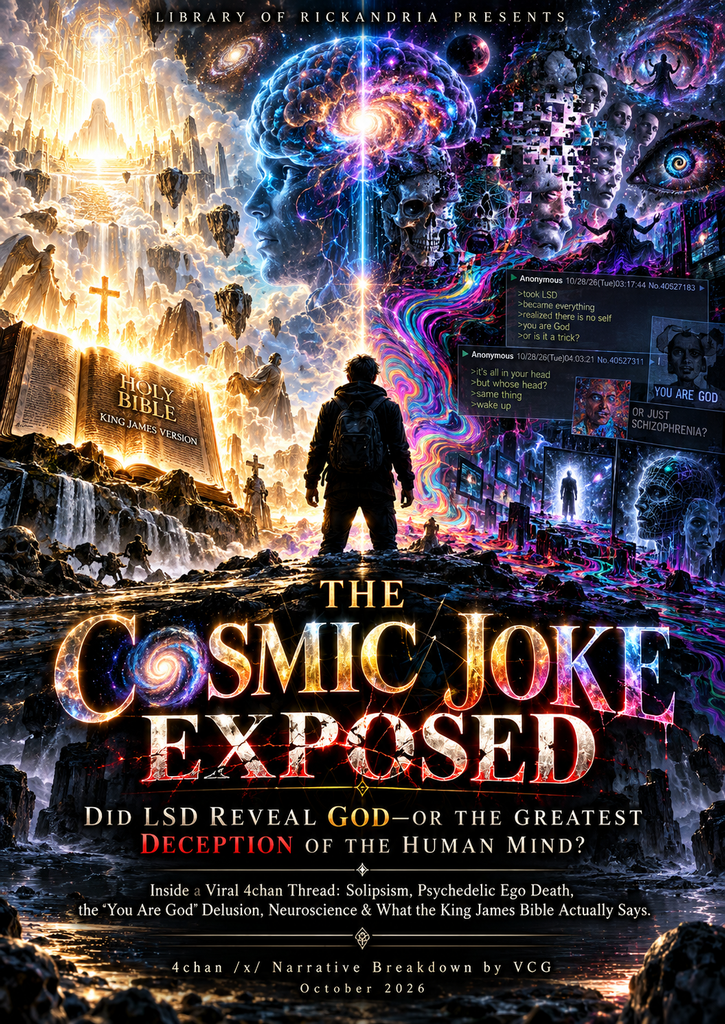
Cinematic cover for the Library of Rickandria investigation.
This is an artistic illustration, not an authentic screenshot; the miniature forum messages in the artwork are fictionalized.

The original image attached to 4chan post #43091640 can be viewed here.
THE COSMIC JOKE EXPOSED
DID LSD REVEAL GOD—OR THE GREATEST DECEPTION OF THE HUMAN MIND?
Inside a Viral 4chan Thread: Solipsism, Psychedelic Ego Death, the “You Are God” Delusion, Neuroscience & What the King James Bible Actually Says
LIBRARY OF RICKANDRIA PRESENTS
4chan /x/ Narrative Breakdown by VCG
October 2026
An investigative study of 45 anonymous posts, altered consciousness, metaphysical certainty, philosophy, psychological influence, and biblical discernment.
Soli Deo Gloria
ABSTRACT
On October 16, 2026, an anonymous user posted a question on 4chan’s paranormal board, /x/, titled What is the “Cosmic Joke?”
/x/ – What is the “Cosmic Joke?” – Paranormal – 4chan
The writer reported that, during an experience involving an estimated 1,000 micrograms of LSD, reality seemed to rearrange itself and communicate something extraordinary:
that the individual might somehow be God.
What followed was a remarkable collection of answers.
Some respondents offered jokes.
Others proposed:
- solipsism
- universal consciousness
- spiritual enlightenment
- psychedelic illusion
- existential meaninglessness
or speculative cosmology.
One claimed that failure to accept the mysterious truth would lead to hell.
HELL UNVEILED: The Eternal Truth the World Refuses to Face – Library of Rickandria
Another developed an extended explanation in which discovering oneself to be God supposedly brings both absolute power and complete powerlessness.
This paper examines every visible post in the archived thread, distinguishes the participants’ statements from independently established facts, and tests the major claims against controlled:
- psychedelic research
- philosophy
- psychology
- historical theology
- the King James Bible
Its central finding is straightforward but important:
the experience of overwhelming certainty is not the same thing as evidence that the content of that certainty is true.
The scientific literature supports the conclusion that psychedelic substances can profoundly alter perception, self-experience, emotional significance, and belief formation.
It does not establish that the user experienced an external rearrangement of physical reality or discovered universal Godhood.
Likewise, although the Bible contains profound teachings about humanity being made in God’s image, participating in divine life, and living through God’s sustaining power, its broader narrative distinguishes the Creator from his creation.
The investigation concludes that the thread is best understood as a case study in competing interpretations of extraordinary experience, not as a verified revelation of a hidden cosmic truth.
PART I — THE THREAD, THE RECORD, AND THE RULES OF THE INVESTIGATION
Chapter 1 — The Question That Started Everything
The original discussion can be examined here:
Primary source:
/x/ – What is the “Cosmic Joke?” – Paranormal – 4chan
Original attached image:
1792205650195737.jpg (479×640)
The opening post appeared on Friday, October 16, 2026, at 10:54:10 p.m., according to the displayed thread timestamp.
The post’s author reported that reality had appeared to reorganize itself during an LSD experience, apparently communicating that everything somehow referred back to the observer.
The writer then asked whether they were the cosmic joke and whether that meant they were God.
The attached meme displayed a human face blended with colorful cosmic imagery.
Its caption asked whether humanity might collectively participate in a vast cosmic joke.
That image establishes the visual theme of the discussion, but it does not provide evidence for any metaphysical theory.
The question underlying the thread is much older than the internet:
What is the relationship between consciousness, the universe, personal identity, and God?
Human beings have investigated aspects of this question through:
- philosophy
- religion
- mysticism
- science
for centuries.
What makes the 4chan thread interesting is the speed with which its participants move among answers that are not necessarily compatible.
Sometimes God means the Creator of the universe.
Sometimes God means consciousness.
Sometimes the self refers to the ordinary personality, while elsewhere it refers to something allegedly universal.
Without identifying those shifts, a reader can easily mistake a collection of suggestive statements for a coherent explanation.
What can we independently confirm?
The recovered thread contains 45 visible posts, beginning October 16 and ending October 21, 2026.
The webpage is marked as archived.
The opening author reported an estimated LSD dose, but the record does not include:
- drug testing
- medical documentation
- witness statements
or independent measurements of the alleged physical event.
The discussion contains multiple anonymous replies.
Because 4chan allows anonymous posting, the record generally does not establish which replies came from the same individual.
For example, a later post repeats the original questions with considerable intensity.
That resemblance does not prove it was written by the original author.
There is another limitation.
The paper’s subtitle calls the discussion viral, but the record does not establish audience reach, unique viewers, or transmission across other websites.
In this study, “viral” is part of the editorial title, not a statistically verified description.
These distinctions are not minor technicalities.
They determine what evidence we actually possess.
Chapter 2 — Our Methodology: Five Standards of Evidence
This investigation evaluates claims through five different lenses.
1. Primary-source verification
We identify what was written, when it appeared, and which messages respond to one another.
A 4chan post proves that a statement was published.
It does not prove that the statement is factually accurate.
2. Empirical scientific evidence
We use controlled studies and research reviews to assess claims involving:
- perception
- LSD
- consciousness
- brain function
- memory
- psychology
Science can explain mechanisms and test observable claims.
It cannot resolve every metaphysical question by measurement alone.
3. Philosophical analysis
We ask whether an argument follows logically from its premises.
If someone reports feeling connected to everything, does it follow that they literally created everything?
That conclusion requires additional premises.
4. Historical and theological interpretation
We distinguish what a religious or philosophical tradition teaches from what a modern participant attributes to it.
An anonymous claim resembling Buddhism, Christianity, or Advaita Vedanta does not automatically represent those traditions accurately.
5. Biblical exegesis
We read Scripture in its literary and historical context, using the supplied Pure Cambridge Edition of the King James Bible as our primary English text.
A verse’s speaker, audience, surrounding argument, and place within the biblical narrative matter.
Throughout this investigation, five verdicts are used:
| Verdict | Meaning |
|---|---|
| Supported | Adequate evidence supports the stated conclusion. |
| Plausible but unverified | The claim is possible, but available evidence does not establish it. |
| Unsupported | The required evidence or argument has not been supplied. |
| Contradicted | Relevant evidence or textual context conflicts with the claim. |
| Interpretively disputed | Credible competing readings remain possible. |
An unsupported claim is not necessarily a deliberate deception.
A sincerely held experience may be genuine as an experience while its explanation remains mistaken.
Chapter 3 — A Lesson From the King James Translators
The King James Bible’s historical preface, The Translators to the Reader, offers an unexpectedly appropriate principle for this investigation.
In the section discussing alternative meanings in Scripture, the translators defend acknowledging genuine uncertainty.
They warn against treating difficult or disputed words as though every interpretive question had been definitively settled.
Their discussion includes the principle:
“It is better to make doubt of those things which are secret, than to strive about those things that are uncertain.”
This is from the preface reproduced in the supplied King James Bible, under the heading discussing diversity of senses in the margin.
The statement does not mean the translators believed nothing could be known.
They affirmed the authority and clarity of Scripture on central matters of salvation.
Their concern was unwarranted certainty about difficult matters.
That is especially relevant here.
The anonymous participants often speak as though ultimate reality is completely understood, even while disagreeing over what that reality supposedly is.
The biblical instruction of 1 Thessalonians 5:21 provides a better starting point:
“Prove all things; hold fast that which is good.”
We should not treat skepticism as an excuse for dismissing every extraordinary experience.
Neither should we treat amazement as an excuse for abandoning examination.
PART II — THE ORIGINAL 4CHAN DISCUSSION: A POST-BY-POST INVESTIGATION
All post numbers and chronology below come from the archived primary thread.
Rather than reproduce large amounts of anonymous forum text, the analysis paraphrases most contributions and identifies short, relevant statements where necessary.
Chapter 4 — October 16: A Claimed Revelation and the First Responses
Post 01 — #43091640: The original LSD experience
The opening post describes a perceived transformation of reality accompanied by the possibility that the writer is God.
Three propositions must be separated.
The writer reports an unusual experience.
That is personal testimony.
The writer attributes special significance to the experience.
That is an interpretation.
The writer considers personal divinity as a possible explanation.
That is a metaphysical hypothesis.
The first proposition does not logically establish the third.
Controlled studies demonstrate that LSD can alter perceptions of identity, reality, time, and connectedness.
However, the thread contains no independent evidence that external reality physically rearranged itself.
The writer’s stated dose of approximately 1,000 micrograms is also unconfirmed.
We cannot reliably infer the substance’s purity or precise exposure from an anonymous report.
Biblical comparison:
Genesis 1:27 says that God created humanity in his image.
The grammatical distinction is clear: God creates, and humanity is created.
Being made in God’s image does not establish identity with God.
Assessment:
A powerful experience is reported; the proposed conclusion of Godhood is unsupported.
Post 02 — #43091671: Hell, Hekate, chaos, and a burning seraph
The respondent describes threatening or mocking supernatural imagery, including references to Hekate, chaos, hell, and a seraph.
The post mixes elements associated with different religious and mythological systems.
Because no independent evidence accompanies the account, we cannot determine whether the language reflects an actual belief, a remembered experience, metaphor, emotional distress, or online role-playing.
Isaiah 6:1–7 presents seraphim in a specific vision of God’s holiness.
Merely invoking the word seraph does not establish that the biblical beings were involved.
Assessment: Personal testimony or symbolic expression; no verified supernatural event.
Post 03 — #43091747: The mirror as an oracle
A participant suggests that the seeker can discover the cosmic joke by staring into a nearby mirror.
The claim is significant because it provides something resembling an experiment.
But what should the observer expect to see?
The respondent does not specify a measurable result.
Research by Giovanni Caputo has shown that prolonged mirror-gazing in low illumination can generate unusual perceptions of faces.
In controlled conditions, participants reported distortions and unfamiliar appearances while looking at their own reflections.
Source:
Such findings do not prove that the respondent intended to induce a perceptual illusion. They demonstrate that extraordinary mirror experiences do not necessarily require supernatural causes.
Biblical comparison:
James 1:23–25 uses a mirror as a metaphor for hearing and responding to God’s word.
It does not teach mirror-gazing as a method of obtaining hidden cosmic knowledge.
Posts 04–05 — #43091752 and #43091758: The mirror test is attempted
One participant expresses willingness to try the exercise.
A subsequent reply reports:
“Nothing happened”
This negative result matters.
If the mirror suggestion implied a reliable, repeatable revelation, the unsuccessful attempt provides a reason to question the method.
It does not establish that no person could ever have an unusual mirror experience.
The correct scientific response is to define the predicted outcome and investigate when, why, and how often it occurs.
Assessment: The visible attempt did not produce the advertised revelation.
Post 06 — #43091867: The answer allegedly cannot be given
The respondent says the answer cannot be communicated directly; people can only be guided toward discovering it.
There is a legitimate insight here:
some experiences are difficult to describe.
Nevertheless, difficulty describing an experience does not establish the truth of a metaphysical explanation attached to it.
This statement also makes the alleged revelation difficult to challenge.
A person who does not understand can always be told that they have not experienced the answer properly.
Biblical comparison:
Acts 17:11 commends those who examined teachings against Scripture.
Truth claims do not become exempt from investigation because their advocates describe them as ineffable.
Chapter 5 — October 17: Theories Begin to Multiply
Post 07 — #43092053: God, divine origin, and solipsism
A participant urgently repeats questions about whether they are God, come from God, are the universe experiencing itself, or inhabit a solipsistic reality.
These questions appear related, but they are not equivalent.
Being God means one thing. Existing because of God means another.
Being a manifestation of a universal consciousness means something else.
Solipsism, meanwhile, concerns whether only one’s own mind exists or whether other minds can be known.
A detailed philosophical treatment appears later in this paper.
At this stage, the important observation is that the commenter has proposed several competing hypotheses without distinguishing them.
Post 08 — #43092130: Bob Dylan enters the discussion
A commenter posts lines from Bob Dylan’s All Along the Watchtower, referencing people who regard life as a joke.
The attribution is supported by Dylan’s official website:
All Along the Watchtower | The Official Bob Dylan Site
The literary reference is appropriate to the topic.
It does not, however, provide empirical or theological evidence for a cosmic secret.
The song itself is not a philosophical demonstration of solipsism or Godhood.
Post 09 — #43092333: A passage attributed to Longchenpa
The thread introduces a passage suggesting that appearances can be accepted without attaching rigid judgments to them, culminating in laughter.
A related passage is attributed to the Tibetan Buddhist teacher Longchenpa in The Natural Freedom of Mind, with a published English translation credited to Herbert Guenther.
A later biographical work reproduces the attribution and provides the translation reference:
The Life of Longchenpa by Jampa Mackenzie Stewart (Ebook) – Read free for 30 days
This establishes a substantially better historical trail than a quotation circulating without attribution, although it is not an independent examination of the Tibetan manuscript.
The philosophical question is whether the passage’s account of appearances entails that moral distinctions are unreal in every sense.
We should not impose that conclusion without considering Buddhist teachings in their own context.
Biblical comparison:
Isaiah 5:20 condemns the reversal of moral categories.
However, Christian morality and Buddhist philosophical accounts of conventional and ultimate truth are different frameworks.
A fair comparison requires explaining each accurately before declaring disagreement.
Post 10 — #43092347: The cosmic sense of humor
The respondent jokingly suggests that the supposed problem is simply an absence of cosmic humor.
It is a rhetorical answer, not a testable explanation.
Laughter may be psychologically valuable, as Proverbs 17:22 recognizes, but laughter is not evidence that the universe has deliberately constructed a joke.
Post 11 — #43093731: Everyone is allegedly God
This post introduces one of the discussion’s strongest theological assertions.
The respondent proposes that every person is the monotheistic God, while simultaneously saying that God is not identical with human beings.
The author appeals to paradox.
Paradox can be a legitimate philosophical concept.
But an apparent contradiction must be carefully explained, not merely renamed.
Does the writer mean that human persons share one ultimate reality?
That the universe is divine? Or that every ordinary individual possesses the identity of the Creator?
Those are different theories.
Biblical correction:
Isaiah 45:5 says:
“I am the LORD, and there is none else, there is no God beside me”
The wider biblical account presents one sovereign Creator distinct from dependent creatures.
Assessment:
The theory lacks definitions and supporting evidence.
Posts 12–14 — #43093870, #43093882, and #43093891: The ego-death paradox
A sarcastic reply observes that an experience described as ego death has apparently resulted in the conclusion that everything concerns the experiencer.
Another participant responds that when the ego dissolves, something identified as the self remains.
A third makes a joke about the person’s head.
The serious question is the meaning of ego.
In psychology, the word can refer to different constructs depending on the theoretical tradition.
In contemporary psychedelic research, ego dissolution usually refers to changes in the experienced boundaries or continuity of the self.
It does not automatically mean that an eternal universal consciousness has been discovered.
Neither does it necessarily mean that the ordinary personality has become more grandiose.
A person may experience diminished self-boundaries and afterward interpret that experience in many different ways.
Biblical comparison:
Romans 12:3 commends sober judgment about oneself.
The passage is concerned with humility and proper self-assessment, not a technical theory of psychedelic self-processing.
Post 15 — #43093960: The joke is that life has no ultimate punchline
This respondent proposes that human existence may have no final meaning but can nevertheless be approached with humor.
Unlike many other participants, the writer presents the idea as a personal interpretation.
It resembles one form of existential absurdism.
The problem is that the absence of perceived meaning does not prove that meaning objectively does not exist.
Philosophers distinguish meaning grounded in God, meaning grounded in human flourishing, meaning through relationships, and meaning based on individual projects.
Biblical comparison:
Ecclesiastes 12:13–14 concludes by directing attention toward God, human responsibility, and judgment.
The book recognizes apparent futility without treating futility as the whole truth.
Post 16 — #43094041: Everything is supposedly an illusion
The respondent argues that a broken computer or lost internet connection demonstrates life’s illusory nature.
This is a logical mistake.
An object may be dependent, temporary, fragile, or changeable without being unreal.
A computer that breaks still existed.
An internet connection that disappears was not therefore imaginary.
The post confuses impermanence with illusion.
Biblical comparison:
James 4:14 emphasizes the brevity of human life.
Its purpose is to challenge presumption, not deny the world’s reality.
Posts 17–18 — #43094049 and #43094148: Is the drug experience authoritative?
One respondent rejects the idea that a drug-induced experience should determine an entire worldview, while also suggesting that the real answer is obvious.
Another insists that an extremely intense LSD experience would overturn conventional understanding.
The first commenter raises a defensible objection:
subjective drug effects require critical evaluation.
But claiming an unspecified obvious answer is not itself an explanation.
The second commenter relies on the authority of transformative experience.
The hidden assumption is that experiencing something extraordinary necessarily provides superior knowledge about reality.
That assumption requires evidence.
Post 19 — #43094161: Pluto
The respondent offers Pluto as the entire answer.
This appears to be absurdist humor.
There is no meaningful astronomical argument to evaluate.
Post 20 — #43094403: Reality as a voluntary game
This commenter suggests that existence is a large role-playing activity into which the individual somehow voluntarily entered.
The claim presupposes conscious agency before ordinary life.
The thread supplies no evidence for such preexistence or consent.
Jeremiah 1:5 speaks of God’s knowledge of Jeremiah before birth, but it does not explicitly say that Jeremiah consciously chose to enter human life.
That distinction prevents the verse from being used as proof of the forum’s claim.
Post 21 — #43094425: A crude joke
This is a sexual joke rather than a substantive theory.
Its inclusion is useful for understanding the character of the forum, but it does not require an invented theological rebuttal.
Post 22 — #43094483: Drugs produce predictable effects
This respondent argues that psychedelic experiences can be explained through pharmacology.
That is one of the more empirically defensible contributions.
Controlled research does show that LSD produces recognizable alterations of consciousness through identifiable neurochemical mechanisms.
However, the additional claim that drug experiences are necessarily meaningless or equivalent to self-deception goes beyond the research.
The effects of drugs can be measurable, meaningful to the experiencer, and misinterpreted at the same time.
These possibilities are not mutually exclusive.
Post 23 — #43094760: Profound meaninglessness
The commenter describes a recurring sense that everything eventually becomes meaningless.
We should treat this as a statement about personal experience, not as a proven conclusion about the universe.
Feelings of emptiness or futility can be intensely persuasive.
Yet their intensity does not settle questions about purpose, morality, or God.
Psalm 42 openly describes spiritual distress while continuing to address God.
The Bible does not demand that people deny such feelings.
It does not make them infallible judges of reality either.
Chapter 6 — October 17–20: Solipsism, Cosmology, and Fear
Posts 24–26 — #43095270, #43095573, and #43095951: The repeated Boltzmann-brain assertion
Three messages repeat the same claim that human existence is merely a Boltzmann brain conversing with itself.
A Boltzmann brain is a hypothetical observer produced by rare fluctuations under certain theoretical cosmological conditions.
The concept plays a role in evaluating the predictions of some cosmological models.
For example, De Simone and colleagues examine the implications of Boltzmann brains for models of eternal inflation.
Source:
Boltzmann brains and the scale-factor cutoff measure of the multiverse | Phys. Rev. D
The researchers do not establish that ordinary human beings are actually Boltzmann brains.
The anonymous replies transform a conditional theoretical problem into an asserted certainty.
Furthermore, repeating the same statement three times does not provide three independent pieces of evidence.
The record does not identify whether one person or several people authored the repetitions.
Assessment: Speculative cosmology presented as demonstrated fact.
Post 27 — #43097602: Numerology, Douglas Adams, and a duplicate Earth
This contribution combines the contemporary six-seven meme, the number 42 from The Hitchhiker’s Guide to the Galaxy, and the claim that our present Earth is a duplicate of another Earth.
The number 42 has a clear literary association with Douglas Adams’s science-fiction work.
Multiplying six by seven produces 42, but that arithmetic does not establish cosmic significance.
The further claim about a duplicate Earth is not supported by observational evidence.
This resembles a Mandela-effect interpretation.
Research by Deepasri Prasad and Wilma Bainbridge demonstrates that different people can form similar, specific false visual memories.
Source:
The Visual Mandela Effect as Evidence for Shared and Specific False Memories Across People – PubMed
Their results offer an empirical explanation for some shared memory errors.
They do not prove that every reported Mandela effect has the same cause, but they provide no support for claims of planetary replacement.
Post 28 — #43097878: Solipsism
This respondent supplies a one-word philosophical answer.
But a label is not an argument.
Solipsism raises difficult questions concerning other minds and the relationship between subjective experience and external reality.
The Stanford Encyclopedia of Philosophy discusses the problem in depth:
Other Minds (Stanford Encyclopedia of Philosophy)
The forum post provides no justification for choosing solipsism over more ordinary explanations.
Post 29 — #43098543: Hell as a threat
This is among the most theologically serious statements in the thread.
The respondent threatens hell for failing to accept the alleged hidden truth.
The claim attempts to attach an ultimate consequence to an undefined doctrine.
The participant supplies no biblical passage establishing that recognition of the cosmic joke determines salvation.
The New Testament presents a different account.
Ephesians 2:8–9 teaches salvation by grace through faith, rather than an achievement of secret metaphysical understanding.
Acts 4:12 centers salvation on Jesus Christ.
The threat therefore has no demonstrated basis in the cited biblical framework.
Psychological observation:
Threatening severe consequences for failing to accept a claim can exert emotional pressure even when no evidence has been provided.
That is a reason to examine the argument more carefully, not to yield to the threat.
Post 30 — #43098689: The central questions return
The earlier questions about Godhood, divine origin, self-experience, and solipsism reappear.
The author is anonymous, and we cannot confirm whether this is the same individual who posted the earlier questions.
Its appearance demonstrates that the discussion has not produced a settled explanation.
Post 31 — #43099622: Alone together
The respondent combines the assertion that solipsism is true with the claim that everyone is God.
The problem is that strict metaphysical solipsism normally allows only one individual mind.
A worldview in which many apparent individuals share a more fundamental consciousness is not necessarily solipsism.
It may be better described as a form of idealism, monism, or nondualism.
The post does not identify the distinction.
Biblical comparison:
1 Corinthians 12:12–27 describes many members within one body.
This is an image of unity that preserves meaningful distinction.
It cannot simply be converted into an assertion that everyone is numerically the same individual.
Post 32 — #43102549: The answer is elsewhere
The respondent suggests that the alleged answer lies outside the discussion.
No explanatory evidence accompanies the statement.
It is a conversational deferral.
Post 33 — #43105974: Humanity is supposedly doing it to itself
This response suggests that humanity collectively creates its predicament and should participate willingly.
As a practical metaphor, human responsibility for some of our problems is plausible.
As a claim that humanity creates the whole underlying universe, the statement requires substantial additional evidence.
Revelation 4:11 attributes the existence of created things to God’s will.
The biblical doctrine of creation does not identify humanity as its ultimate author.
Post 34 — #43106977: The unconscious as the explanation
The respondent suggests that LSD changed the relationship between ego and unconscious processes, rather than revealing facts about the entire universe.
The explanation is closer to psychology than to supernatural cosmology.
Nevertheless, it refers to a blockage being removed without identifying a measurable anatomical structure.
Contemporary research describes changes in brain connectivity, receptor signaling, and subjective experience.
The ego and unconscious are not literal chambers separated by a removable physical barrier.
Assessment:
A potentially useful psychological metaphor, not an established neuroanatomical description.
Post 35 — #43106979: Nobody is here
This statement can mean several different things.
It might express the Buddhist-inspired idea that the ordinary self lacks permanent independent existence.
It might mean that personal identity is illusory.
Or it might literally deny the existence of all persons.
Without clarification, we should not assume these meanings are identical.
The biblical narrative consistently presents persons as morally accountable beings who live in relationships with God and one another.
Post 36 — #43107107: The laughing crowd
The commenter uses mockery and an accompanying image to suggest that everyone is laughing at the original poster.
The post contributes social pressure rather than evidence.
An individual’s embarrassment is not proof that a cosmological theory is true or false.
Proverbs 18:17 emphasizes the importance of examining an account rather than accepting its first presentation.
Ridicule does not replace such examination.
Chapter 7 — October 20–21: The Most Elaborate Version of the Cosmic Joke
Post 37 — #43107454: The Godhood revelation explained
This is the most important extended reply in the thread.
The author proposes that the great discovery is personal divinity, accompanied by the realization that knowing one is God provides no practical power.
The post also describes threats to ordinary identity, surrender, possible bliss, cosmic paradoxes, and comedy as a function of contrast.
We can separate this into eleven claims.
Claim 1: The ultimate discovery is that the experiencer is God.
No independent evidence establishes this identity.
If the author means the God of biblical monotheism, the assertion conflicts with biblical descriptions of the Creator as distinct from created humanity.
If the author uses God to mean universal consciousness, the concept requires a different definition and argument.
Claim 2: An experience of knowing everything proves omniscience.
The feeling of complete understanding is not equivalent to possessing complete knowledge.
A genuine test would require independently verifiable knowledge that could not plausibly have been acquired through ordinary means.
The thread provides no such demonstration.
Claim 3: Being God provides no power.
This conflicts with ordinary understandings of divine omnipotence unless the word God is being redefined.
A sophisticated nondual interpretation might distinguish ultimate reality from the limited powers of its apparent manifestations.
But the commenter does not adequately explain how that distinction works.
Claim 4: There is nobody else to tell.
That assumes the solipsistic or monistic conclusion.
It does not demonstrate it.
Claim 5: Other people will misunderstand the revelation.
This prediction can make a theory resistant to correction.
If agreement confirms the revelation and disagreement also confirms it, there is no clear evidential standard.
Claim 6: Realization can threaten ordinary identity.
This is one of the more plausible statements.
Intense altered states can disturb a person’s normal sense of self.
However, the possible destabilization of identity does not establish the metaphysical explanation attached to the experience.
Claim 7: The ordinary self does not exist.
The statement again needs definitions.
A self-model can be psychologically constructed without the person thereby being nonexistent.
Claim 8: Surrender is the only appropriate response.
This is an instruction based on the author’s worldview.
It is not a demonstrated necessity.
Claim 9: Surrender produces union with a merciful God.
The description may reflect a sincerely interpreted mystical experience.
But the emotional quality of bliss does not independently establish the supernatural cause or identity of the experience.
Claim 10: Reality exists because of interlocking paradoxes.
No identifiable causal model is provided.
The word paradox cannot serve as a universal explanation simply because the writer finds the subject difficult to understand.
Claim 11: Comedy is fundamentally contrast or duality.
Incongruity and contrast have important roles in theories of humor.
Nevertheless, a theory of why jokes are funny does not explain why the universe exists.
The central problem is the movement from subjective experience into increasingly expansive claims without corresponding increases in evidence.
At the same time, the post recognizes a genuine practical danger:
an overwhelming experience may leave a person struggling with their sense of identity.
That concern deserves to be taken seriously without accepting the surrounding cosmology.
Post 38 — #43107607: The personal Godhood assertion returns
A respondent insists on personal divinity.
The statement supplies no new argument.
Repetition increases the prominence of the claim but not its evidential support.
Post 39 — #43107693: Children and ownership
The writer suggests that one’s children were never truly one’s own.
The meaning is ambiguous.
If this means parents do not own children as property, the claim can be understood ethically.
If it means that personal relationships are fictitious because all individual identity is unreal, a different argument is required.
Psalm 127:3 describes children as a heritage from the LORD.
Ephesians 6:4 treats parental responsibility as meaningful.
Post 40 — #43107864: The universe is not locally real
This phrase is connected to genuine scientific discussions about quantum mechanics.
The 2022 Nobel Prize in Physics recognized experiments involving entangled photons and violations of Bell inequalities.
Official Nobel Prize information:
The Nobel Prize in Physics 2022 – NobelPrize.org
However, the technical meaning of locality and realism in Bell-type experiments must not be confused with the general philosophical claim that the physical world is imaginary.
Bell experiments do not establish that consciousness created the universe.
They do not show that human beings are God.
A detailed treatment appears later in this paper.
Posts 41–42 — #43107953 and #43107960: Contradictory-sounding answers
Two replies offer a brief affirmation-and-denial response.
One is directed at the personal Godhood claim.
The other refers to post #43107613, which is not among the recovered visible posts.
Therefore we cannot confidently reconstruct the second reply’s immediate context.
The ambiguous responses could express a distinction between ordinary and ultimate identity, but that interpretation is not established.
Post 43 — #43110563: A website and video as alleged proof
The respondent links to an online video and a website associated with Peter Brown’s Yoga of Radiant Presence.
Website:
Video identified in the post:
The website presents a nondual spiritual teaching emphasizing the nature of present experience and reality beyond conceptual description.
This helps identify an intellectual tradition that resembles some of the thread’s claims.
However, the webpage is an advocate’s presentation of a spiritual teaching, not a controlled scientific demonstration.
The specific video footage was not independently evaluated in this investigation, so its claimed evidential value remains unverified.
Post 44 — #43110692: The accusation of commercial deception
A respondent dismisses the linked material as exploitative or worthless.
Suspicion is not evidence of fraud.
To establish deceptive commercial conduct, we would need reliable information about representations, financial practices, and demonstrable misstatements.
This investigation does not establish those facts.
We can criticize an argument without alleging unproven dishonesty.
Post 45 — #43111088: The conversation moves elsewhere
The last visible reply contains a Discord invitation.
It adds no independently assessable cosmological argument.
The contents of the outside community are not established by the archived thread.
The discussion therefore closes without demonstrating any single proposed explanation.
PART III — THE NEUROSCIENCE OF REVELATION AND FALSE INSIGHT
Chapter 8 — What LSD Can Actually Do
The thread begins with an estimated dose of approximately 1,000 micrograms.
Before discussing the extraordinary conclusions drawn from that experience, we need to understand what the controlled evidence establishes.
LSD interacts with several receptor systems, particularly serotonin receptors.
Research identifies the serotonin 5-HT2A receptor as central to its characteristic psychedelic effects.
A controlled dose-response study involving 16 participants investigated doses from 25 to 200 micrograms.
The researchers observed changes in experiences described as oceanic boundlessness, visionary restructuring, and ego dissolution.
At higher tested doses, some measures of ego dissolution and anxiety increased, while several positive subjective effects showed evidence of a ceiling effect.
Source:
Holze and colleagues, Acute dose-dependent effects of lysergic acid diethylamide in a double-blind placebo-controlled study in healthy subjects, Neuropsychopharmacology.
The study’s highest tested dose was 200 micrograms.
The thread’s estimated exposure was five times that amount.
Therefore it would be scientifically irresponsible to claim that the controlled study precisely predicts the original writer’s experience.
The study does establish that LSD can generate profound changes in subjective experience.
Chapter 9 — The Receptor-Blocking Evidence
One of the strongest ways to investigate a drug’s effects is to test whether a targeted pharmacological intervention changes them.
Preller and colleagues investigated LSD’s effects on brain connectivity using a randomized, double-blind crossover design.
Participants received placebo, LSD, or LSD preceded by ketanserin, which blocks the relevant serotonin receptor.
The study found that ketanserin blocked the measured neural and subjective LSD effects.
Source: Preller and colleagues, eLife (2018).
A separate randomized controlled study investigated whether ketanserin could reverse the effects after LSD had already been administered.
The study found a substantial reduction in the duration of acute subjective effects.
Source:
Ketanserin Reverses the Acute Response to LSD.
Why does this matter?
Because it demonstrates a causal role for a measurable biological process in the unusual subjective state.
This does not logically disprove the existence of God or settle whether all mystical experiences are purely physical.
It does undermine the argument that the mere intensity of psychedelic experience is adequate proof of a supernatural revelation.
Chapter 10 — The False Insights and Beliefs Under Psychedelics Model
An especially relevant scientific source was published on August 1, 2024.
H. T. McGovern and colleagues:
An Integrated theory of false insights and beliefs under psychedelics.
Communications Psychology, Volume 2, Article 69.
An Integrated theory of false insights and beliefs under psychedelics | Communications Psychology
The authors propose a framework called False Insights and Beliefs Under Psychedelics, or FIBUS.
The central issue is the relationship between perceived insight and actual correctness.
An insight may arrive with a powerful emotional and cognitive sensation of understanding.
That sensation can accompany a correct discovery.
It can also accompany an incorrect interpretation.
The proposed framework considers how psychedelic alterations may increase the number, intensity, and apparent importance of such insights.
This has immediate relevance to the 4chan thread.
The original report involves a profound change in perception followed by a striking metaphysical interpretation.
FIBUS provides one possible framework for examining how the interpretation could become unusually convincing.
It does not establish that the original poster experienced a false insight.
The paper is a theoretical perspective drawing on experimental and psychological findings, not a clinical assessment of the anonymous individual.
The careful conclusion is that the feeling of revelation requires independent verification before being treated as knowledge.
Chapter 11 — Not All Psychedelic Experiences Produce the Same Beliefs
It would be equally mistaken to claim that LSD or other psychedelics always cause belief in universal divinity.
A prospective study involving 657 participants who planned to use psilocybin outside a laboratory investigated changes in mind attribution, metaphysical belief, and religious identification.
The researchers observed increases in attributing consciousness or mental experience to various entities.
However, they found little or no overall change in several broader metaphysical beliefs or atheist–believer status.
Source:
Nayak and colleagues, Psychedelic Experiences Increase Mind Perception but do not Change Atheist-Believer Status.
This is important counterevidence against overly simplistic narratives.
The study involved psilocybin rather than LSD, and its observational design and follow-up sample create limitations.
Nevertheless, it illustrates that changes in experience do not necessarily produce a uniform spiritual worldview.
The interpretation depends on more than pharmacology alone.
A person’s expectations, prior beliefs, social environment, and subsequent reflection can also matter.
Chapter 12 — Mirror-Gazing, Perceptual Distortion, and the Illusion of Discovery
The mirror suggestion in the thread is a useful example of a broader problem.
Human perception is not a passive recording of reality.
It is an active process shaped by sensory information, attention, expectation, and interpretation.
Caputo’s research on mirror-gazing demonstrates that observers may perceive unusual faces while viewing their reflections under specific conditions.
Source:
Strange-Face-in-the-Mirror Illusion – Giovanni B Caputo, 2010
A strange perception is therefore not automatically evidence of an external entity.
Yet we should not reverse the error.
Demonstrating one natural mechanism for an unusual visual experience does not establish that all reported spiritual experiences are identical.
The correct method is to investigate the particular experience, its circumstances, and the proposed explanation.
Chapter 13 — What We Still Cannot Determine
The thread leaves several essential questions unanswered.
We do not know the actual drug dose or composition.
We do not know the original poster’s medical or psychological history.
We do not know what happened during the experience apart from the short description.
We do not have independent observations of external physical changes.
We cannot determine whether the poster’s interpretation remained stable or changed afterward.
We cannot diagnose psychosis, schizophrenia, or any other condition from the thread.
These are not failures of the investigation.
They are the boundaries of the available evidence.
A responsible conclusion must remain within them.
PART IV — THE PHILOSOPHICAL PROBLEM: WHAT DOES “I AM GOD” EVEN MEAN?
Chapter 14 — The Strongest Version of the Nondual Argument
Before criticizing the thread’s claims, we should distinguish them from more sophisticated philosophical accounts of nonduality.
A serious nondual thinker need not claim that the everyday personality controls the weather or can create planets through conscious intention.
Some nondual philosophies propose that apparently separate minds and objects arise within, depend upon, or express a more fundamental reality.
For example, Advaita Vedanta identifies the essential self, atman, with Brahman, understood as ultimate reality.
The tradition develops arguments about consciousness, appearance, knowledge, and liberation.
Its philosophical structure is far more extensive than a forum statement about everyone being God.
Reference:
Stanford Encyclopedia of Philosophy, Śaṅkara.
Śaṅkara (Stanford Encyclopedia of Philosophy)
Pantheism, meanwhile, broadly identifies the divine with the cosmos or rejects a fundamental distinction between God and the universe.
But pantheism is a family of theories, not one perfectly uniform doctrine.
Reference:
Stanford Encyclopedia of Philosophy, Pantheism.
Pantheism (Stanford Encyclopedia of Philosophy)
These distinctions matter because a criticism of personal omnipotence does not automatically refute every account of nondual consciousness.
The strongest objection to the thread’s account is not merely that its language sounds extraordinary.
It is that the thread does not supply a sufficiently defined theory or a sound argument connecting the experience to the conclusion.
Chapter 15 — Solipsism Is Not the Same as Nonduality
Solipsism usually concerns the existence or knowability of minds other than one’s own.
Metaphysical solipsism holds that only one’s own mind exists.
Epistemological solipsism concerns the limits of what one can know beyond one’s own mental life.
Neither position automatically establishes that the individual is the biblical God.
Nondual philosophies, by contrast, may deny ultimate separateness without reducing reality to the everyday mind of one ordinary individual.
These differences are essential.
The 4chan discussion repeatedly moves among them without a clear explanation.
There is a further ethical issue.
If a person concludes that other people do not genuinely exist, how should that person understand obligations toward them?
Not every nondual tradition denies compassion or moral responsibility. Many explicitly emphasize them.
The ethical problem arises when the forum’s vague assertions are interpreted as eliminating the reality or significance of other persons.
Christian ethics approaches this differently.
Matthew 22:37–39 joins love of God with love of one’s neighbor.
The neighbor is not dismissed as an insignificant illusion.
Chapter 16 — The Difference Between Unity and Identity
Consider three propositions.
Proposition A: Everything depends upon God.
Proposition B: Everything is connected through God.
Proposition C: Everything literally is God.
These are not logically identical.
A Christian can affirm the first without affirming the third.
Depending on definitions, the second may also be expressed in some Christian theological language.
But the third makes a different claim about the nature of reality.
The difference between participation and identity is especially important.
A created being can receive life from God without becoming the uncreated source of that life.
This distinction will become central when we examine Psalm 82, Acts 17, and 2 Peter 1.
Chapter 17 — The Quantum Physics Misinterpretation
The thread’s statement about the universe not being locally real sounds scientific because it draws on genuine problems in quantum mechanics.
Bell’s theorem concerns the constraints placed on theories attempting to reproduce quantum correlations under particular assumptions, including locality.
Experiments have shown violations of Bell inequalities under relevant conditions.
But the term observer in quantum mechanics should not casually be equated with a human consciousness constructing the world.
Nor does rejecting a specified form of local realism mean rejecting the existence of a physical universe altogether.
Reference:
Stanford Encyclopedia of Philosophy, Bell’s Theorem.
Bell’s Theorem (Stanford Encyclopedia of Philosophy)
The scientific results are profound.
The forum’s metaphysical conclusion is not established by them.
Chapter 18 — The Boltzmann-Brain Problem
The Boltzmann-brain hypothesis deserves careful treatment because it appears three times in the discussion.
The central concern arises in cosmological models where certain observer-like fluctuations might occur over immense durations.
The question is whether a theory predicts that such observers vastly outnumber observers formed through ordinary cosmic and biological history.
If it does, the theory may create serious problems about the reliability and typicality of observation.
This is not the same thing as discovering that every human being is a randomly fluctuating brain.
The published literature treats the question in relation to specific theoretical models.
Reference:
De Simone and colleagues, Physical Review D.
Boltzmann brains and the scale-factor cutoff measure of the multiverse | Phys. Rev. D
The thread omits that conditional structure.
It substitutes certainty for a research problem.
Chapter 19 — Does Meaninglessness Follow From Cosmic Uncertainty?
The thread also contains an existential interpretation in which the joke is the absence of meaning.
But uncertainty about the ultimate nature of consciousness does not logically establish that life is meaningless.
One can be uncertain about cosmology while recognizing the reality of relationships, moral commitments, creativity, and responsibility.
Religious philosophers may ground meaning in God.
Other philosophers seek accounts of meaning without supernatural assumptions.
The thread does not demonstrate that those alternatives fail.
Christian Scripture takes suffering and apparent futility seriously.
The book of Ecclesiastes is especially important here.
It does not offer a simplistic denial of life’s difficulties.
It examines the fragility of achievement, pleasure, labor, and human ambition, before concluding with responsibility before God.
PART V — THE BIBLICAL EXAMINATION
Chapter 20 — Genesis 3:5 and the Promise of Becoming Like Gods
The first major biblical parallel is the serpent’s statement to Eve.
“For God doth know that in the day ye eat thereof, then your eyes shall be opened, and ye shall be as gods, knowing good and evil.”
Notice who is speaking.
This is not presented as an unconditional declaration from God that human beings are already the Creator.
It is part of the serpent’s conversation with Eve concerning the forbidden fruit.
The surrounding narrative involves temptation, knowledge, trust, disobedience, and consequences.
The thematic resemblance to the forum’s promise of hidden divine identity is worth exploring.
Both concern the relationship between humanity, knowledge, and divine status.
But resemblance does not prove direct historical influence or supernatural causation.
We cannot establish that the anonymous participants are consciously repeating the serpent’s words or that an identifiable demonic entity produced their experiences.
The defensible theological comparison is narrower:
The biblical narrative warns that claims of elevated divine knowledge or status must be evaluated in relation to God’s revealed word.
Chapter 21 — Genesis 1:27: Humanity in God’s Image
Genesis 1:27 states:
“So God created man in his own image, in the image of God created he him; male and female created he them.”
The verse affirms humanity’s special dignity and relationship to God.
It does not state that humanity and God are numerically identical.
The grammatical structure distinguishes the one who creates from those who are created.
Christian interpreters disagree about the full implications of the image of God, including its relationship to reason, moral responsibility, relationships, vocation, and human dignity.
But identifying humanity with the Creator is not a necessary conclusion from the verse.
Chapter 22 — Psalm 82:6: The Bible Really Does Use the Word “Gods”
This is a passage that deserves genuine care.
“I have said, Ye are gods; and all of you are children of the most High.
But ye shall die like men, and fall like one of the princes.”
The term gods is present in the biblical text.
Simply denying that fact would be poor scholarship.
The question is whom the psalm addresses and what kind of status it describes.
Major interpretations include unjust human authorities exercising delegated responsibility, heavenly beings within a divine council, and readings concerned with divine sonship or participation in God’s life.
The opening verse describes God judging among the gods, while later verses emphasize injustice and judgment.
The immediate context therefore does not straightforwardly teach that every ordinary person possesses God’s unique omnipotence.
A major historical study by Carl Mosser examines early Christian interpretations of this passage and their relationship to the development of deification theology.
Source:
The Earliest Patristic Interpretations of Psalm 82, Jewish Antecedents, and the Origin of Christian Deification.
This historical complexity is precisely why isolated proof-texting is inadequate.
Chapter 23 — John 10:34–36: Jesus Quotes Psalm 82
In John 10:34–36, Jesus refers to Psalm 82 while answering an accusation of blasphemy.
The dispute centers on Jesus’ identity and his claim to be the Son of God.
Interpreters debate the precise rhetorical force of Jesus’ quotation.
One common interpretation understands an argument from a lesser application of divine terminology toward the legitimacy of Jesus’ greater claim.
Other interpretations place greater emphasis on the historical and theological context of Psalm 82.
But none of this allows us to bypass the surrounding argument.
The passage cannot be reduced to the proposition that Jesus taught every individual to identify themselves as the Creator.
Chapter 24 — Acts 17:28: In God We Live and Move
Acts 17:28 says:
“For in him we live, and move, and have our being”
This statement is frequently cited in discussions of pantheism and mystical union.
However, Paul’s surrounding speech in Acts 17:22–31 distinguishes God from the world he created.
He presents God as the maker of heaven and earth, the giver of life, and the one before whom humanity is accountable.
The passage affirms radical human dependence upon God.
It does not plainly identify each human being as the world’s Creator.
The distinction is theologically substantial.
Chapter 25 — 2 Peter 1:4: Partakers of the Divine Nature
2 Peter 1:4 describes believers becoming:
“partakers of the divine nature”
This is one of the New Testament’s most important expressions for discussions of participation in divine life.
Eastern Christian theology has developed the doctrine of theosis, often translated as deification.
Within classical Christian treatments, this generally concerns participation in God’s life and grace rather than the claim that created persons become the uncreated divine essence.
Different Christian traditions explain sanctification, union with Christ, and deification in different ways.
Those disagreements should be acknowledged.
Nevertheless, the passage does not straightforwardly teach the forum’s claim that every individual is already the omnipotent Creator.
Chapter 26 — Luke 17:21: The Kingdom Within You
The KJV renders Luke 17:21:
“for, behold, the kingdom of God is within you.”
This text is sometimes used to argue that Godhood is hidden inside each individual.
But Jesus is answering the Pharisees about the kingdom of God.
The Greek expression has generated translation and interpretive debate, including the alternatives within you and among you.
A lexical discussion can be consulted here:
Entos (ἐντός): inside | Biblang: entos
Even if the KJV wording is maintained, the existence or presence of God’s kingdom is not equivalent to the metaphysical proposition that every person created the universe.
Chapter 27 — John 17: Spiritual Unity Without Erasing Relationship
Jesus prays for the unity of believers in John 17:20–23.
The language is profound.
Believers are to be one in a way related to the unity of the Father and Son.
Yet the passage continues to distinguish the Father, Son, and believers.
The participants remain identifiable within a relationship.
The unity is therefore not accurately represented by simply eliminating every personal distinction.
This is an important correction to crude interpretations of the forum’s repeated universal-identity claims.
Chapter 28 — Colossians 1: Christ and Creation
Colossians 1:15–17 describes Christ in relation to the creation of all things.
The passage presents a profound Christological account of creation and divine supremacy.
Within mainstream Christian interpretation, Christ is not simply one more finite consciousness discovering its identity with the universe.
The text centers creation in Christ’s unique divine role.
This provides another major distinction between biblical Christology and the thread’s generalized Godhood assertions.
Chapter 29 — The False Gospel Test
The thread contains a warning that failure to accept the cosmic secret leads to hell.
The theological question is whether salvation depends on attaining an esoteric realization.
The New Testament’s proclamation centers on the person and work of Jesus Christ.
John 14:6 presents Christ as the way to the Father.
Acts 4:12 emphasizes salvation through him.
Ephesians 2:8–9 describes salvation as a gift of grace received through faith.
The anonymous doctrine of recognizing oneself as God is not established as a biblical condition for salvation.
A historical comparison with ancient movements frequently categorized as Gnostic is useful because some such movements emphasized saving knowledge and divine origin.
Yet Gnosticism is a contested scholarly category encompassing diverse ancient traditions.
A resemblance in language does not establish that the modern thread descends directly from an ancient school.
Historical reference:
Nicola Denzey Lewis, Gnosticism, Oxford Bibliographies.
Gnosticism | Oxford Bibliographies in Biblical Studies | Oxford Academic
The most accurate conclusion is that the forum’s salvation threat is unsupported by its own evidence and incompatible with the New Testament account of salvation used in this investigation.
Chapter 30 — Spiritual Discernment Without Reckless Accusation
1 John 4:1 instructs believers not to accept every spiritual claim indiscriminately.
Deuteronomy 13:1–4 likewise places loyalty to God above impressive alleged signs.
These passages support the theological importance of discernment.
They do not authorize declaring, without evidence, that a particular anonymous person is demonically possessed, mentally ill, or deliberately malicious.
Several explanations may remain possible for a troubling experience or belief.
Someone may be sincerely mistaken.
Someone may have undergone an unusual but naturally explainable perceptual event.
Someone may be using religious language symbolically.
Someone may be engaging in deliberate online provocation.
Determining which applies requires evidence.
The biblical command to exercise discernment should be applied alongside truthfulness, humility, and restraint.
PART VI — HISTORY, RELIGIOUS COMPARISON, AND THE “COSMIC JOKE”
Chapter 31 — Why Similar Experiences Receive Different Interpretations
An extraordinary experience of unity may be described differently by people from different cultural or religious backgrounds.
One person may interpret it through Hindu nonduality.
Another may describe it through Buddhist traditions.
Another may relate it to Christian mystical language.
Another may understand it through neuroscience or naturalistic philosophy.
These interpretations can share certain descriptive features without being theologically or philosophically identical.
Classical Advaita Vedanta, for example, has a developed metaphysics identifying the essential self with Brahman.
Christian accounts of union with God generally preserve a Creator–creature distinction.
Buddhist traditions frequently approach selfhood through different philosophical categories from both.
It would therefore be misleading to combine them into a single alleged ancient doctrine that everyone secretly knows they are God.
A careful comparison asks what each tradition actually claims and what arguments it gives for those claims.
Chapter 32 — The Problem With Borrowed Spiritual Authority
The thread draws upon religious imagery and philosophical language without consistently identifying sources.
This creates a potential appearance of depth.
A quotation associated with a respected spiritual teacher may sound authoritative.
A technical term from quantum physics may sound scientific.
A biblical phrase may sound decisive.
Yet the mere combination of prestigious references does not produce a valid argument.
Each reference must be understood in its original context.
The Longchenpa quotation must be examined as a Buddhist teaching.
Bell’s theorem must be examined as a result in physics.
Psalm 82 must be examined within its literary and historical setting.
Without those distinctions, apparently impressive language can conceal serious confusion.
PART VII — THE PSYCHOLOGY OF THE ONLINE ORACLE
Chapter 33 — When Feeling Certain Replaces Evidence
A central theme of the discussion is that certain knowledge allegedly becomes available only after a transformative experience.
The person who has experienced it is treated as possessing access to reality that ordinary questioning cannot reach.
This creates an important epistemological problem.
How can an outsider distinguish a true revelation from a mistaken interpretation if every request for evidence is answered with a demand to undergo the same experience?
The proper test is not whether an experience feels real.
It is whether the explanation attached to that experience withstands appropriate scrutiny.
The 2024 FIBUS framework provides a useful scientific starting point for considering this distinction.
Chapter 34 — Suggestion and Expectation
The mirror exchange illustrates the role that suggestion may play in interpreting ambiguous experiences.
One commenter proposes a mysterious exercise.
Another attempts it.
A subsequent response implies that more time may be needed.
The initial instruction lacks a clearly defined outcome.
This creates opportunities for almost any resulting sensation to acquire special meaning.
Such a pattern does not prove intentional manipulation.
It demonstrates how uncertainty and expectation can interact.
Chapter 35 — The Self-Sealing Explanation
Some responses imply that those who reject or misunderstand the cosmic joke simply have not discovered the truth.
This reasoning risks becoming self-sealing.
If agreement supports the theory, disagreement supports the theory, and the absence of an experience also supports the theory, there is little room for correction.
A useful scientific or philosophical argument should specify which observations count against it.
This is particularly important when the claim concerns extraordinary powers, cosmological identity, or the supernatural.
Chapter 36 — Fear, Mockery, and Social Pressure
The forum contains several different kinds of emotional pressure.
Some commenters ridicule the seeker.
One threatens hell.
Others imply that the answer is obvious to those with sufficient insight.
These tactics may influence the emotional environment of the conversation.
They do not independently establish the truth of any assertion.
A frightening threat can be sincerely believed and still be wrong.
A confident statement can be forcefully expressed and still be unsupported.
A joke can be memorable without being explanatory.
Chapter 37 — Apophenia, Patterns, and Coincidence
Human cognition is highly responsive to patterns.
That capacity is often beneficial.
But people may also perceive meaningful connections in ambiguous or unrelated information.
The thread includes cosmic imagery, numerical references, apparent paradoxes, and repeated assertions.
These elements can feel connected even when no causal relationship has been demonstrated.
The appearance of a pattern is a reason to investigate, not an automatic demonstration of its meaning.
Chapter 38 — Why We Must Avoid Psychiatric Labels
Some of the thread’s language sounds extreme.
But psychiatric assessment requires far more information than a short anonymous message.
The term delusion has a clinical meaning that should not be casually assigned to people whose medical histories, functioning, and circumstances are unknown.
The article’s subtitle uses the phrase “You Are God” delusion as part of the proposed belief’s characterization.
That should not be mistaken for a clinical diagnosis of the original poster or any other participant.
A person can hold a false philosophical belief without having a psychiatric disorder.
A person can describe a strange experience without losing touch with reality in everyday life.
And a person can be distressed by an experience without that distress demonstrating supernatural involvement.
These distinctions protect the integrity of the investigation.
PART VIII — VISUAL EVIDENCE AND THE CONTRADICTION MAP
Chapter 39 — The Anatomy of a Claimed Revelation
Visual Exhibit A: A Possible Pathway From Experience to Belief
The first accompanying graphic illustrates a hypothetical sequence:
Unusual experience → metaphysical interpretation → subjective certainty → social reinforcement → critical examination.
This is not a reconstruction of the original poster’s neurological condition.
It is a conceptual model for distinguishing what happened from what someone concluded had happened.
A central question should accompany every stage:
What independent observation would confirm or challenge the interpretation?
Chapter 40 — What Different Sources of Evidence Can Establish
Visual Exhibit B: Evidence Versus Interpretation
The second graphic distinguishes testimony, neuroscience, philosophy, and Scripture.
These categories answer different questions.
Personal testimony can establish that someone reports an experience.
Neuroscience can investigate the biological mechanisms of that experience.
Philosophy can assess whether the reasoning from experience to conclusion is logically valid.
Scripture can establish the content of a biblical claim and supply the basis for theological comparison.
A scientifically established brain mechanism is not automatically a complete theological conclusion.
Likewise, a theological interpretation is not an experimental measurement.
Keeping these categories separate is one of the paper’s most important methodological commitments.
Chapter 41 — The Creator–Creature Distinction
Visual Exhibit C: Biblical Comparison
The third graphic places two groups of passages alongside one another.
The first concerns God as Creator: Genesis 1:1, Isaiah 45:5, Acts 17:24–25, and Colossians 1:16–17.
The second concerns humanity as God’s creation and the difficult question of participation in divine life: Genesis 1:27, Acts 17:28–29, Psalm 82:6–7, and 2 Peter 1:4.
The purpose is not to flatten these passages into a single slogan.
It is to make their different claims visible.
Chapter 42 — The Thread’s Principal Contradictions
| Thread claim | Question requiring resolution |
|---|---|
| Everyone is God. | Does God mean the biblical Creator, the cosmos, or universal consciousness? |
| The ego disappears, but the self remains. | Which psychological or metaphysical definition of self is intended? |
| Solipsism is true, but everyone exists together. | Is the theory actually solipsism, monism, or idealism? |
| God is all-powerful, yet discovering Godhood provides no power. | How is divine power being defined? |
| An ineffable revelation explains everything. | What observable evidence would count against the explanation? |
| The universe is not locally real. | What does Bell’s theorem actually demonstrate? |
| Acceptance of the secret determines salvation. | Where is that condition established in Scripture? |
These questions are not rhetorical substitutes for investigation.
They identify precisely where the claims require clearer definitions, additional premises, or evidence.
PART IX — AFTER THE COSMIC JOKE: PRACTICAL DISCERNMENT
Chapter 43 — What Should Someone Do With an Overwhelming Experience?
Some extraordinary experiences may be personally meaningful and emotionally transformative.
That fact does not remove the need for careful interpretation.
A responsible response begins by distinguishing the original experience from conclusions added afterward.
A person may consider recording what they perceived before revising the account through exposure to online theories.
They can compare alternative explanations and discuss the experience with grounded, trustworthy people.
They should be especially cautious when strangers insist that the experience proves personal divinity, demands obedience to an unexplained secret, or threatens spiritual punishment.
There is no reason to reproduce a dangerous drug exposure to test such claims.
When confusion, fear, perceptual disturbances, or disruptions to ordinary functioning persist, appropriate medical or mental-health assessment may be helpful.
MedlinePlus describes potential psychological effects and recurring perceptual disturbances associated with LSD.
Source:
Substance use – LSD: MedlinePlus Medical Encyclopedia
A pastoral or theological conversation may be valuable to someone who wants spiritual guidance, but it should not replace necessary medical evaluation.
Chapter 44 — How to Test a Claimed Revelation
Suppose someone claims that an experience proves universal Godhood.
A careful investigator might ask:
What exactly was experienced?
Which details were directly perceived, and which were inferred afterward?
What evidence would distinguish the proposed supernatural explanation from an altered state of consciousness?
Does the explanation make predictions that could be wrong?
Are there competing explanations that fit the observations equally well?
Does the doctrine agree with the biblical passages being cited?
These questions do not presuppose that every extraordinary event is false.
They are designed to prevent the investigator from granting any interpretation privileged immunity from examination.
Chapter 45 — Why Humility Matters
Both excessive skepticism and excessive certainty can distort inquiry.
If every unusual experience is dismissed without investigation, potentially useful information is lost.
If every unusual experience is accepted as ultimate revelation, critical judgment disappears.
The proper approach is disciplined openness.
The biblical instruction to test claims and the scientific requirement to examine evidence can both encourage intellectual humility, even though they arise within different frameworks.
PART X — THE FINAL FINDINGS
Chapter 46 — What the Thread Actually Establishes
After examining the available evidence, several conclusions can be stated with different levels of confidence.
Finding 1: The original poster reported an extraordinary experience.
Supported by the primary source.
Whether every detail of the event occurred as described is not independently established.
Finding 2: LSD can produce profound changes in perception and self-experience.
Supported by controlled research.
The exact mechanism and intensity of the anonymous experience cannot be reconstructed.
Finding 3: Such experiences can be accompanied by powerful feelings of certainty.
Supported as a recognized feature of some psychedelic experiences and relevant psychological models.
The correctness of any particular insight must still be examined independently.
Finding 4: The thread offers no valid demonstration that every person is God.
Supported by the absence of a developed argument or independent verification within the recovered record.
This does not claim to settle all philosophical debates about consciousness or ultimate reality.
Finding 5: The thread repeatedly confuses distinct philosophical positions.
Supported by its shifting references to Godhood, selfhood, solipsism, nonduality, and cosmic illusion.
Finding 6: The biblical passages concerning divine image, sonship, and participation do not straightforwardly establish universal identity with the Creator.
Supported by the literary context of Genesis 1, Acts 17, John 10, John 17, and related passages.
Some passages, especially Psalm 82, retain legitimate historical interpretive disputes.
Finding 7: The threat of hell for failing to accept the cosmic secret has no demonstrated biblical foundation.
Supported by the absence of a scriptural argument in the thread and the contrast with the New Testament’s presentation of salvation through Christ.
Finding 8: Quantum physics and Boltzmann-brain cosmology do not prove the thread’s metaphysical conclusions.
Supported by the scope and limitations of the relevant scientific literature.
Finding 9: The discussion cannot establish the participants’ clinical conditions or intentions.
Supported by the anonymity and severe informational limitations of the record.
Finding 10: The thread is valuable as evidence of how extraordinary experiences are interpreted and debated online.
This is the investigation’s central historical and psychological significance.
Chapter 47 — What the Thread Gets Partly Right
Not everything said in the discussion is without value.
The participants recognize that ordinary human perception is not infallible.
They raise legitimate questions about the nature of the self.
They acknowledge that human existence is fragile and that people can experience profound uncertainty about meaning.
They recognize that laughter can change one’s relationship to troubling ideas.
They also illustrate how difficult it can be to communicate an intense subjective experience to people who have not shared it.
Those observations deserve serious thought.
The error arises when possibilities become certainties without adequate reasoning, or when a personal experience is promoted into a universal doctrine without sufficient evidence.
Chapter 48 — What Is the Cosmic Joke?
The phrase has several possible meanings in the thread.
For some, it is a joke about the human search for meaning.
For others, it concerns the apparent fragility of personal identity.
For others still, it refers to a mystical sense of unity.
Some respondents treat it as proof that everyone is God.
Others reject the premise altogether.
These meanings cannot be reduced to one verified explanation.
The original thread is not a coherent revelation shared by all participants.
It is a record of disagreement.
That makes the question more revealing as an investigation into belief formation than as a demonstrated answer to existence itself.
CONCLUSION — WHEN THE MIND BECOMES CONVINCED IT HAS FOUND GOD
The central issue is not whether extraordinary experiences occur.
They do.
Nor is the issue whether human consciousness contains mysteries.
It does.
The issue is what conclusions those experiences justify.
The original 4chan poster encountered something described as radically transformative.
The participants then supplied competing explanations ranging from drug-induced illusion to universal divinity.
The scientific research provides substantial support for the possibility that altered neuropsychological processes can produce intense experiences of unity, significance, and revelation.
It does not provide evidence that the experiencer became God or caused the physical universe to reorganize itself.
The philosophical claims remain inadequately argued.
The biblical examination reaches a clearer theological distinction.
Humanity is created in God’s image.
Human beings depend upon God for life.
Believers are described as united with Christ and as participants in divine promises.
Yet the biblical narrative does not simply identify ordinary human consciousness with the sovereign Creator.
Romans 1:25 warns about confusing creation with its Creator.
This passage is part of Paul’s argument about idolatry. Applying it to the thread is a theological comparison, not proof that every participant is intentionally deceiving others.
The New Testament’s positive account of eternal life is expressed in John 17:3:
“And this is life eternal, that they might know thee the only true God, and Jesus Christ, whom thou hast sent.”
That is a different claim from the assertion that personal ego dissolution reveals the individual to be the Creator.
A careful investigator must recognize the distinction without pretending to know every detail of another person’s inner life.
The final question is therefore not merely whether the cosmic joke exists.
It is this:
When the human mind becomes overwhelmingly convinced that it has encountered ultimate truth, how can we determine whether it has discovered something about reality—or become convinced of an interpretation that goes beyond the evidence?
The answer requires honesty about experience, rigor about evidence, clarity about philosophy, and fidelity to Scripture when making biblical claims.
The most responsible conclusion is not fear, ridicule, or unquestioning acceptance.
It is examination.
“Prove all things; hold fast that which is good.” — 1 Thessalonians 5:21
Soli Deo Gloria.
APPENDIX A — PRIMARY-SOURCE AUDIT
The complete recovered thread:
/x/ – What is the “Cosmic Joke?” – Paranormal – 4chan
Original attached image:
1792205650195737.jpg (479×640)
Dates represented: October 16–21, 2026.
Visible posts: 45.
Relevant original post numbers, in chronological order:
| No. | Post ID | Principal subject |
|---|---|---|
| 01 | 43091640 | Original LSD and Godhood questions |
| 02 | 43091671 | Hell and supernatural imagery |
| 03 | 43091747 | Mirror-gazing suggestion |
| 04 | 43091752 | Agreement to try mirror-gazing |
| 05 | 43091758 | No reported result |
| 06 | 43091867 | Answer supposedly cannot be communicated |
| 07 | 43092053 | Godhood and solipsism questions |
| 08 | 43092130 | Bob Dylan quotation |
| 09 | 43092333 | Longchenpa-associated passage |
| 10 | 43092347 | Cosmic humor |
| 11 | 43093731 | Everyone as God |
| 12 | 43093870 | Ego-death sarcasm |
| 13 | 43093882 | Ego dissolution and remaining self |
| 14 | 43093891 | Sarcastic response |
| 15 | 43093960 | Meaninglessness and absurdism |
| 16 | 43094041 | Everything as illusion |
| 17 | 43094049 | Skepticism about drug revelations |
| 18 | 43094148 | LSD as transformative knowledge |
| 19 | 43094161 | Pluto joke |
| 20 | 43094403 | Reality as voluntary role-play |
| 21 | 43094425 | Sexual joke |
| 22 | 43094483 | Drug-induced interpretation |
| 23 | 43094760 | Profound meaninglessness |
| 24 | 43095270 | Boltzmann-brain theory |
| 25 | 43095573 | Repeated Boltzmann-brain claim |
| 26 | 43095951 | Repeated Boltzmann-brain claim |
| 27 | 43097602 | Six-seven meme, 42, duplicate Earth |
| 28 | 43097878 | Solipsism |
| 29 | 43098543 | Hell threat |
| 30 | 43098689 | Repeated central questions |
| 31 | 43099622 | Solipsism and collective divinity |
| 32 | 43102549 | Answer allegedly elsewhere |
| 33 | 43105974 | Collective cosmic responsibility |
| 34 | 43106977 | Ego and unconscious |
| 35 | 43106979 | Denial of personal presence |
| 36 | 43107107 | Mockery |
| 37 | 43107454 | Extended cosmic Godhood explanation |
| 38 | 43107607 | Personal Godhood assertion |
| 39 | 43107693 | Children and ownership |
| 40 | 43107864 | Local realism |
| 41 | 43107953 | Ambiguous affirmation and denial |
| 42 | 43107960 | Ambiguous reply to unavailable post |
| 43 | 43110563 | Video and spiritual teaching website |
| 44 | 43110692 | Accusation of exploitation |
| 45 | 43111088 | Discord invitation |
Archival caution:
This appendix documents the posts visible on the recovered 4chan page.
It does not establish whether other posts were deleted before capture, whether all attachments remain accessible, or whether any anonymous messages share a common author.
APPENDIX B — SCIENTIFIC, HISTORICAL, AND PHILOSOPHICAL SOURCES
The following direct URLs are included so readers can independently locate the cited materials when this paper is copied or reproduced.
Primary digital evidence
[1] 4chan /x/, What is the “Cosmic Joke?”, October 16–21, 2026.
/x/ – What is the “Cosmic Joke?” – Paranormal – 4chan
[2] Original thread image.
1792205650195737.jpg (479×640)
Psychedelic neuroscience and psychology
[3] Holze et al., Acute dose-dependent effects of lysergic acid diethylamide in a double-blind placebo-controlled study in healthy subjects, Neuropsychopharmacology.
[4] Preller et al., Changes in global and thalamic brain connectivity in LSD-induced altered states of consciousness are attributable to the 5-HT2A receptor, eLife, 2018.
[5] Ketanserin Reverses the Acute Response to LSD in a Randomized, Double-Blind, Placebo-Controlled, Crossover Study in Healthy Participants.
[6] McGovern et al., An Integrated theory of false insights and beliefs under psychedelics, Communications Psychology, 2024.
An Integrated theory of false insights and beliefs under psychedelics | Communications Psychology
[7] Nayak et al., Psychedelic Experiences Increase Mind Perception but do not Change Atheist-Believer Status: A Prospective Longitudinal Study.
[8] Caputo, Strange-face-in-the-mirror illusion, Perception, 2010.
Strange-Face-in-the-Mirror Illusion – Giovanni B Caputo, 2010
[9] Caputo, Apparitional Experiences of New Faces and Dissociation of Self-Identity during Mirror Gazing, 2010.
[10] Prasad and Bainbridge, The Visual Mandela Effect as Evidence for Shared and Specific False Memories Across People, Psychological Science, 2022.
The Visual Mandela Effect as Evidence for Shared and Specific False Memories Across People – PubMed
[11] MedlinePlus, Substance use — LSD.
Substance use – LSD: MedlinePlus Medical Encyclopedia
Philosophy, cosmology, and physics
[12] Stanford Encyclopedia of Philosophy, Other Minds.
Other Minds (Stanford Encyclopedia of Philosophy)
[13] Stanford Encyclopedia of Philosophy, Pantheism.
Pantheism (Stanford Encyclopedia of Philosophy)
[14] Stanford Encyclopedia of Philosophy, Śaṅkara.
Śaṅkara (Stanford Encyclopedia of Philosophy)
[15] Stanford Encyclopedia of Philosophy, Bell’s Theorem.
Bell’s Theorem (Stanford Encyclopedia of Philosophy)
[16] Nobel Prize in Physics, 2022.
The Nobel Prize in Physics 2022 – NobelPrize.org
[17] De Simone et al., Boltzmann brains and the scale-factor cutoff measure of the multiverse, Physical Review D, 2010.
Boltzmann brains and the scale-factor cutoff measure of the multiverse | Phys. Rev. D
Historical theology and comparative religion
[18] Mosser, The Earliest Patristic Interpretations of Psalm 82, Jewish Antecedents, and the Origin of Christian Deification, Journal of Theological Studies, 2005.
[19] Denzey Lewis, Gnosticism, Oxford Bibliographies.
Gnosticism | Oxford Bibliographies in Biblical Studies | Oxford Academic
[20] The Life of Longchenpa, containing the attribution and translation information for the passage used in the thread.
The Life of Longchenpa by Jampa Mackenzie Stewart (Ebook) – Read free for 30 days
[21] Bob Dylan, All Along the Watchtower, official song information.
All Along the Watchtower | The Official Bob Dylan Site
[22] The Open Doorway, Peter Brown’s Yoga of Radiant Presence.
Scriptural source
[23] The Holy Bible, King James Version, Pure Cambridge Edition, supplied research copy, including The Translators to the Reader.
This is the principal English biblical text for the paper.
For independently accessible KJV passages and chapter context:
King James Version (KJV) – Version Information – BibleGateway.com
Note about access:
Some scholarly journals provide an abstract without unrestricted access to the complete article.
Where full texts were unavailable, the analysis does not claim to have verified details beyond the accessible record.
APPENDIX C — LIMITATIONS, DISCLOSURES, AND RESEARCH INTEGRITY
This investigation evaluates an anonymous internet discussion.
It is not a clinical case report.
Its conclusions do not establish the identities, psychiatric diagnoses, private intentions, or spiritual conditions of the participants.
Controlled neuroscience research is used to explain documented effects and plausible mechanisms.
It is not presented as direct testing of the anonymous original poster.
Theological conclusions are explicitly grounded in interpretation of the King James Bible.
They should not be misrepresented as laboratory findings.
Historical comparisons with Buddhist, Hindu, Gnostic, and Christian traditions identify similarities and differences, not verified lines of influence on the thread.
The cover artwork is an original cinematic interpretation.
Its miniature forum panels are fictionalized design elements and must not be cited as historical evidence.
The original 4chan image, post numbers, and archived text are the evidentiary record.
No commercial fraud, supernatural intervention, or psychiatric diagnosis is established by the available material.
The paper’s commitment is to distinguish what was posted, what was experienced, what can be scientifically established, what can be philosophically argued, and what Scripture actually says.
LIBRARY OF RICKANDRIA
4CHAN /X/ NARRATIVE BREAKDOWN BY VCG
OCTOBER 2026
SOLI DEO GLORIA
Illustrated research exhibits
These three original figures accompany the paper
They are explanatory illustrations, not images extracted from the 4chan thread.
Exhibit A — How a Claimed Revelation Becomes a Belief

A possible pathway connecting extraordinary experiences, interpretation, certainty, social reinforcement, and critical examination.
Exhibit B — What the Evidence Can and Cannot Establish

The distinct contributions of personal testimony, neuroscience, philosophy, and biblical interpretation.
Exhibit C — Creator and Creature in Scripture

Key KJV passages that help distinguish creation, divine identity, human dependence, and participation in divine life.
THE 4CHAN FILES: Where Anonymous Claims Meet Evidence & Scripture – Library of Rickandria
VCG PAPER PROJECTS – Library of Rickandria
THE COSMIC JOKE EXPOSED: DID LSD REVEAL GOD—OR THE GREATEST DECEPTION OF THE HUMAN MIND?