Unidentified Is Not Extraterrestrial: A Fact-Checked, Psychological & Biblical Analysis of Dr. Phil’s UFO Cover-Up Claims
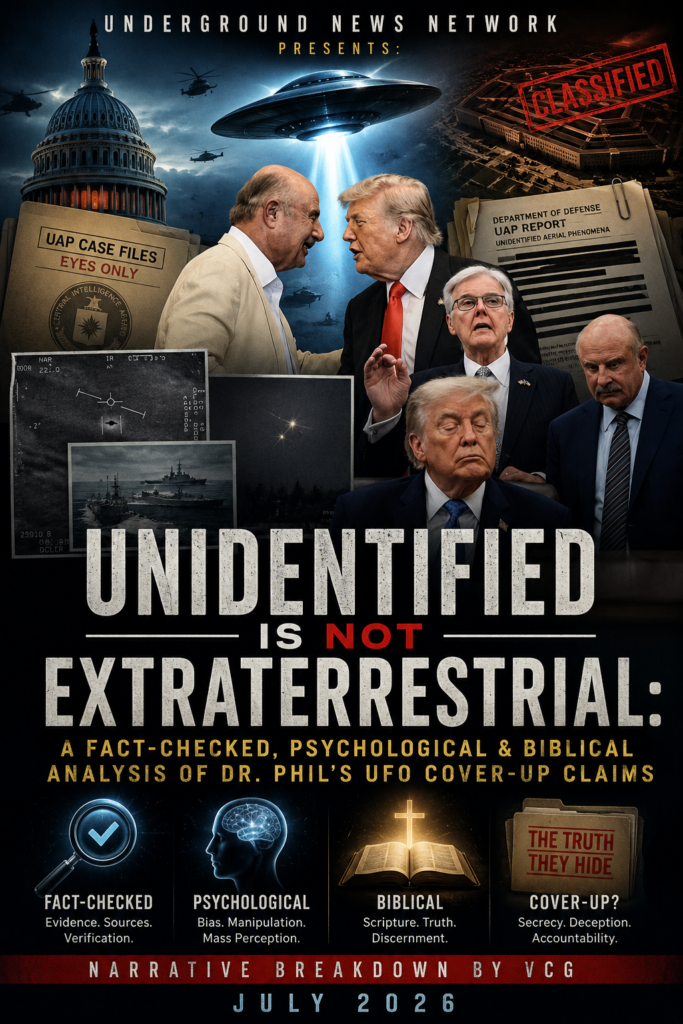
BY VCG ON 7/27/2026
Soli Deo Gloria.
Dr. Phil claims Trump recruited him to review UFO files and found government cover-up
The article reports a real, recent claim by Dr. Phil McGraw, but it repeatedly blurs four very different propositions:
- Dr. Phil says officials gave him access to UAP-related material.
- Some UAP reports remain unexplained.
- Government agencies sometimes withhold information.
- Therefore, the government possesses concealed proof of nonhuman beings or technology.
Only the first proposition is directly supported by the reported interview.
The fourth does not logically follow from the first three.
The article under review is reproduced in the uploaded text.
Scripture quotations below are from the uploaded King James Bible.
1. Methodology
I evaluated each sentence by asking:
Source question:
Is this firsthand testimony, independently confirmed reporting, an official record, or merely another publication repeating the same claim?
Definition question:
Does “UFO” mean only unidentified, or is the article quietly making it mean extraterrestrial?
Evidence question:
What material was actually examined? Was it classified, declassified, raw sensor data, summaries, witness statements, or previously public records?
Inference question:
Does the conclusion follow from the evidence, or is an evidentiary gap being filled by suspicion?
Psychological question:
What emotional or cognitive mechanisms does the wording activate—fear, authority, secrecy, pattern detection, distrust, or cosmic anxiety?
Biblical question:
Does Scripture directly address the factual claim, establish a governing principle, permit multiple interpretations, or remain silent?
This distinction matters because Scripture commands neither naïve credulity nor reflexive skepticism:
“He that answereth a matter before he heareth it, it is folly and shame unto him.”—Proverbs 18:13
“The simple believeth every word:
but the prudent man looketh well to his going.”—Proverbs 14:15
“Prove all things; hold fast that which is good.”—1 Thessalonians 5:21
2. Source-chain problem
The uploaded article is attributed to Jerry Lawton and apparently republishes or summarizes material appearing elsewhere.
Within the article, one quotation is introduced with “reports the Daily Star.”
That means the reader is not always receiving a direct transcript of the original interview.
The chain is approximately:
Dr. Phil interview → NewsNation presentation → secondary reporting → Daily Express/MSN republication.
Each layer may shorten context, strengthen wording, or combine distinct remarks.
A contemporaneous report from The Independent, syndicated through Yahoo, described these statements explicitly as Dr. Phil’s claims and noted that the White House had been contacted for comment.
It did not report independent White House confirmation of the alleged assignment or the nature of his access. (Yahoo News)
Therefore, the proper evidentiary label is:
Confirmed: Dr. Phil publicly made the claim.
Not independently established by the article:
Precisely who authorized him, what clearance or access he received, what documents he saw, whether they were classified at the time, and whether those documents establish a cover-up or extraterrestrial origin.
3. Headline analysis
“Dr. Phil claims Trump recruited him to review UFO files and found government cover-up”
What is supportable
The verb “claims” is responsible journalism because it attributes the assertion to Dr. Phil rather than declaring it proven.
What is misleading
The phrase “Trump recruited him” is stronger than the body’s wording, which alternates between “the Trump administration,” “the White House,” and government officials.
Those are not automatically identical to a personal recruitment by Donald Trump.
Likewise, “found government cover-up” sounds like an evidential discovery.
But the article offers no document, excerpt, classification marking, named official, chain of custody, or demonstrated contradiction proving concealment.
A more accurate headline would be:
Dr. Phil says White House officials let him review UAP-related material and says he suspects information is being withheld.
That formulation preserves his allegation without converting his interpretation into a discovery.
Logical issue
The headline uses an epistemic upgrade:
“I saw material.”
becomes
“I found a cover-up.”
which readers may hear as
“The material proved aliens and proved concealment.”
Those are three separate claims requiring three separate bodies of evidence.
Scriptural correction
“The first in his own cause seemeth just; but his neighbour cometh and searcheth him.”—Proverbs 18:17
Dr. Phil’s account may deserve investigation.
It is not self-authenticating merely because he speaks confidently.
4. Sentence-by-sentence examination
Line 1
“TV personality Dr. Phil said the Trump administration enlisted him to examine classified UFO files before their public release and claims that he discovered evidence of a ‘cover up.’”
Factual assessment
Partially substantiated as testimony, not independently verified.
The reporting establishes that Dr. Phil said he was given access.
It does not publicly establish:
the documents’ classification level;
whether Dr. Phil possessed a security clearance;
which agency owned the records;
whether he saw originals or curated summaries;
whether all material was subsequently released;
what exact item demonstrated concealment.
The White House’s official Religious Liberty Commission announcement confirms that Dr. Phil was appointed to that commission.
It does not, by itself, confirm a UAP advisory role or access to classified UAP intelligence. (The White House)
Terminological correction
“UFO files” does not mean “alien files.”
A UAP is, operationally, an observation not yet identified from the available information.
NASA defines the category around observations that cannot initially be identified as known aircraft or natural phenomena.
Unidentified is a status of analysis, not an identification of origin. (NASA Science)
Evidentiary correction
To establish a cover-up, investigators would need evidence such as:
demonstrable possession of relevant information;
an obligation or representation to disclose it;
intentional concealment or deception;
corroborating records or testimony;
exclusion of ordinary security, privacy, jurisdictional, or classification explanations.
The article presents none of that.
Biblical principle
Government secrecy can be lawful, prudent, corrupt, or abusive depending on purpose and conduct.
Scripture does not teach that every secret is wicked:
“A prudent man concealeth knowledge:
but the heart of fools proclaimeth foolishness.”—Proverbs 12:23
But concealment used to protect wrongdoing is condemned:
“For every one that doeth evil hateth the light, neither cometh to the light, lest his deeds should be reproved.”—John 3:20
The biblical response is not
“secrecy proves conspiracy,”
but
“judge the concealment by truthful evidence and righteous standards.”
Line 2
“The 75-year-old talk show host explained the White House sought his expertise to assess how people might respond to discovering that humans are ‘somewhere different in the food chain’ within the universe.”
Factual assessment
The statement accurately represents his reported explanation, but the reason for his selection remains his account of the White House’s motive, unless corroborated by the White House or documentary evidence.
Psychological framing
“Somewhere different in the food chain”
is emotionally loaded.
It invokes:
predation;
loss of human control;
existential vulnerability;
demotion from a privileged status;
a powerful unknown intelligence.
This is not neutral language such as
“possible nonhuman life.”
It frames the unknown as hierarchy and threat.
Threat framing raises attention and memorability, but it can also encourage premature causal interpretations.
Research on conspiracy belief finds that uncertainty, intuitive reasoning, and the search for meaningful patterns can increase receptivity to explanations involving hidden intentional actors. (American Psychological Association)
Scientific correction
Even the discovery of extraterrestrial microbial life would not place humanity in a “food chain.”
Nor would detection of an intelligent civilization automatically establish predation, hostility, superiority in every respect, or contact with Earth.
The phrase compresses numerous speculative steps:
- Some observations are unexplained.
- They are artificial objects.
- They are nonhuman.
- They are extraterrestrial or otherwise extraordinary.
- Their operators are more powerful than humans.
- Their relationship to humanity is analogous to predator and prey.
No such chain is demonstrated in the article.
Scriptural correction
Human dignity in Scripture is grounded in God’s creation and purpose, not in the proposition that humans are the most technologically capable embodied creatures conceivable.
“So God created man in his own image, in the image of God created he him; male and female created he them.”—Genesis 1:27
“Thou madest him a little lower than the angels; thou crownedst him with glory and honour.”—Hebrews 2:7
The Bible already presents creatures more powerful than man—angels—without diminishing the image of God in humanity.
Therefore, even hypothetical nonhuman intelligence would not logically overturn biblical anthropology.
At the same time, Scripture does not explicitly teach that extraterrestrial biological civilizations exist.
Christians should not insert them into the text, nor claim that Scripture disproves them when Scripture does not directly address the question.
Line 3
“After examining the materials, the clinical psychologist said he became convinced they expose a government ‘cover-up’ regarding the reality behind UFO encounters.”
Core problem
This substitutes conviction for demonstration.
A person may sincerely become convinced and still be mistaken.
Sincerity establishes psychological confidence, not factual correctness.
Missing methodology
The article does not tell us:
the number of files;
whether the sample was representative;
the selection criteria;
whether exculpatory or mundane cases were included;
whether Dr. Phil had technical advisers;
whether he consulted aerospace engineers, intelligence analysts, physicists, sensor specialists, meteorologists, or image-forensics experts;
whether alternative explanations were tested;
whether the evidence was independently replicated.
Dr. Phil’s psychological expertise may be relevant to public response, interviewing, or behavioral interpretation.
It does not automatically confer expertise in:
- radar systems
- infrared artifacts
- aerospace performance
- orbital mechanics
- intelligence classification
or extraterrestrial-life detection.
That is not an insult.
It is the ordinary principle of staying within disciplinary competence.
Official evidentiary baseline
NASA states that there are currently no data supporting the conclusion that UAP are alien technologies and that limited data prevent firm conclusions in many cases. (NASA Science)
AARO’s historical review reported finding no verified evidence that any UAP observation represented extraterrestrial activity or technology.
It also stated that many unresolved cases remain unresolved because the necessary data are insufficient, while many resolved cases have ordinary explanations. (AARO)
These government conclusions could conceivably be wrong, incomplete, or later revised.
But rebutting them requires better evidence—not merely the assertion that their incompleteness proves concealment.
Key distinction
Unresolved means:
Available evidence is insufficient for a confident identification.
It does not mean:
The object has been shown to violate known physics or originate from nonhuman intelligence.
AARO’s public imagery catalogue itself contains a mixture of balloons, birds, ordinary aircraft, sensor limitations, unremarkable physical objects, and unresolved cases lacking sufficient data. (AARO)
Scriptural correction
“Doth our law judge any man, before it hear him, and know what he doeth?”—John 7:51
The principle applies both ways.
We should not dismiss all UAP witnesses unheard, but neither should we convict unnamed officials of a cover-up without examining the relevant evidence.
Line 4
“He claimed government officials had treated President Donald Trump like a ‘temp employee’ and withheld their complete knowledge from him.”
Factual assessment
This is allegation, analogy, and inferred motive—not demonstrated fact in the article.
It is plausible in a general structural sense that permanent bureaucracies sometimes possess compartmented information not automatically conveyed in full to every political officeholder.
Presidents do not personally receive every classified fact held throughout government.
But that ordinary institutional reality would not itself prove unlawful or conspiratorial withholding.
Possible explanations include:
compartmentalization;
need-to-know restrictions;
source-and-method protection;
incomplete interagency communication;
legal limits;
bureaucratic error;
institutional resistance;
deliberate deception.
The article jumps toward the last possibility without showing why alternatives were excluded.
Rhetorical function
“Temp employee” is a vivid populist metaphor.
It creates two parties:
the elected president as the public’s legitimate representative;
a hidden permanent bureaucracy as an unaccountable ruling class.
That may reflect genuine democratic concerns, but it also primes the reader to interpret every information gap as evidence of hostile concealment.
Biblical correction
Scripture recognizes both the legitimacy and fallibility of rulers and officials:
“For there is no power but of God:
the powers that be are ordained of God.”—Romans 13:1
Yet rulers are not omniscient, infallible, or above scrutiny:
“It is an abomination to kings to commit wickedness:
for the throne is established by righteousness.”—Proverbs 16:12
And Christians must not make a political leader the final measure of truth:
“Put not your trust in princes, nor in the son of man, in whom there is no help.”—Psalm 146:3
Therefore:
Officials should not deceive lawful authorities.
Presidents should not be treated as omniscient or incapable of error.
Christians should judge claims by evidence, not partisan allegiance.
Lines 5–7
“That infuriates me.”
“How dare they do that?”
“I don’t think that’s right and I think we deserve better.”
Assessment
These sentences express moral indignation but add no evidence.
Emotion may be appropriate after wrongdoing is established.
Here, anger functions rhetorically as an implied proof:
the speaker’s indignation signals that something outrageous must have occurred.
This is an appeal to moral emotion, not necessarily a logical fallacy in itself, but it becomes misleading when it replaces substantiation.
Psychological mechanism
Moralized language increases engagement and social sharing because it converts a technical uncertainty into a conflict between victims and wrongdoers.
Once the issue is framed as betrayal, contrary evidence may be interpreted as further proof of the betrayal.
Conspiracy theories can become resistant to correction because denials, missing evidence, and institutional disagreement are incorporated into the theory itself.
Psychological reviews find that conspiracy explanations often promise certainty or agency while sometimes worsening anxiety and distrust rather than resolving them. (PubMed Central (PMC))
Biblical correction
Scripture does not condemn all anger:
“Be ye angry, and sin not:
let not the sun go down upon your wrath.”—Ephesians 4:26
But anger must remain governed by truth and righteousness:
“For the wrath of man worketh not the righteousness of God.”—James 1:20
A righteous evidentiary order would be:
hear → verify → judge → respond.
Not:
suspect → become angry → treat anger as confirmation.
Line 8
“He expressed worry about the ethical and psychological consequences of disclosing UFO information to the public, which could trigger everything from spiritual crises to doomsday scams.”
What is reasonable
This is one of the article’s more defensible observations.
Any announcement perceived as overturning humanity’s understanding of life, intelligence, or cosmic history could affect:
religious interpretation;
existential anxiety;
group identity;
financial markets;
apocalyptic movements;
cult recruitment;
fraud;
distrust of institutions.
Doomsday scams and religious exploitation are plausible concerns during periods of uncertainty.
What remains speculative
The article provides no empirical assessment showing that a specific disclosure would cause these outcomes, how many people would be affected, or whether effects would be temporary or severe.
There is also a danger of the deficit model: assuming authorities are stable and knowledgeable while ordinary people are too fragile to receive raw facts. Such paternalism can itself deepen distrust.
Risk-communication research generally supports honesty about what is known and unknown, transparent explanation of decision-making, and correction when conclusions change. Transparency can demonstrate respect for the public’s ability to understand uncertainty. (National Academies Press)
Biblical correction
Christians need not have a spiritual crisis merely because new facts about creation are discovered:
“The heavens declare the glory of God; and the firmament sheweth his handywork.”—Psalm 19:1
“For by him were all things created, that are in heaven, and that are in earth, visible and invisible…”—Colossians 1:16
Any genuinely created being would remain a creature, not God.
It would not overturn:
God as Creator;
man’s sin;
Christ’s incarnation;
Christ’s resurrection;
salvation by grace;
the final judgment.
However, Scripture gives us no basis to invent an alien theology, assign hypothetical beings a place in redemptive history, or interpret every aerial anomaly as angelic or demonic.
Lines 9–10
“I think it needs to be provided with context and I think that the American public is prepared to handle that.”
“I think we as a government need to be prepared to help those that have a difficult time with it.”
Assessment
These are prudent general principles:
disclose accurately;
provide context;
distinguish certainty from uncertainty;
anticipate distress;
guard against exploitation.
But “context” must not become curated persuasion designed to steer the public toward an unproved conclusion.
Good context would include:
what was observed;
instrument limitations;
confidence levels;
alternative explanations;
what remains unknown;
why material was classified;
what has and has not been independently verified;
whether “nonhuman” is evidence-based or hypothetical.
Communication correction
Authorities should not say,
“Trust us; we know more,”
while withholding the basis for extraordinary claims.
Nor should media outlets sensationalize uncertainty to produce attention.
Scientific communication is more credible when uncertainty is accurately acknowledged rather than concealed or exaggerated. (National Academies Press)
Scriptural correction
“Wherefore putting away lying, speak every man truth with his neighbour…”—Ephesians 4:25
“Providing for honest things, not only in the sight of the Lord, but also in the sight of men.”—2 Corinthians 8:21
Truthful communication requires both actual honesty and procedures that permit reasonable public confidence.
Line 11
“Dr Phil, a presidential ally and member of the administration’s religious liberty committee, suggested he was selected due to his ‘independence.’”
Factual assessment
His membership on the Religious Liberty Commission is confirmed by the White House. (The White House)
“Presidential ally” is a journalistic characterization.
It appears broadly reasonable given his public association with the administration, but it is not a neutral credential.
Internal tension
The article simultaneously presents him as:
an ally of the president;
an administration commission member;
selected by the White House;
nevertheless “independent.”
Those conditions do not make independence impossible.
But independence should be demonstrated by methods, disclosures, willingness to contradict patrons, and absence of control—not merely asserted.
Conflict-of-interest analysis
A rigorous article should disclose:
who selected him;
whether he was paid;
whether he signed nondisclosure agreements;
who chose the documents;
whether he could discuss all he saw;
whether officials reviewed his public statements;
whether he had access to skeptical experts;
whether the role was political, scientific, pastoral, or communications-oriented.
Without this, “independence” remains a self-description.
Biblical correction
“For not he that commendeth himself is approved, but whom the Lord commendeth.”—2 Corinthians 10:18
Applied as a general principle:
self-attestation is weaker than tested character and corroborated conduct.
Line 12
“During Trump’s administration, the U.S. government has disclosed four batches of UFO material.”
Factual assessment
This may be accurate concerning a specific 2026 disclosure initiative, but the article does not identify:
the four release dates;
the issuing office;
the legal authority;
the record collections;
official titles or links.
Because the government has released UAP-related material through multiple agencies and mechanisms over many years, “four batches” needs qualification.
It should not be read as
“the government has only ever released four UAP collections.”
Journalistic weakness
A verifiable report would enumerate them:
date;
agency;
page count;
classification status;
major contents;
what was new;
what had previously been public.
Without those details, the number adds an appearance of specificity without giving readers the means to verify it.
Line 13
“The documents, obtained from organizations including the Pentagon, NASA and the CIA, chronicle incidents spanning several decades.”
Terminological issue
Government organizations do not all perform the same role:
The Pentagon and AARO investigate national-security and defense reports.
NASA’s UAP study focused principally on scientific methods, available data, and improved future collection—not on proving extraterrestrial visitation.
The CIA possesses historical records, many of which may reflect intelligence collection, foreign technology concerns, public reports, or prior investigations.
Pooling all these under “UFO files” can create a false impression of one unified alien dossier.
NASA explicitly stated that its independent study report was not an assessment of past individual incidents; it focused on how better data could advance scientific understanding. (NASA)
Category error
A file about a UFO report is not proof that the reported object was extraordinary.
Archives contain:
claims;
witness accounts;
preliminary assessments;
mistaken reports;
unresolved observations;
internal speculation;
competing hypotheses.
The existence of a government record proves that the government recorded or discussed something.
It does not automatically prove the underlying interpretation.
Line 14
“They encompassed puzzling observations ranging from the Apollo astronauts’ experiences on the Moon to a 2025 incident in which a military sensor detected ‘an area of contrast resembling a six-pointed star’ over the Yellow Sea near China.”
“Apollo astronauts’ experiences”
This phrase is too vague to evaluate.
It gives no mission, astronaut, date, quotation, image, transcript, or official conclusion.
Vagueness is rhetorically useful because “Apollo astronauts” carries enormous prestige.
The reader may infer that moonwalkers witnessed alien craft when the underlying record might concern lights, debris, reflections, unidentified objects, communications, or later retellings.
“Area of contrast”
This wording is crucial. An “area of contrast” is a sensor description, not necessarily a sharply defined physical six-pointed object.
Sensor imagery can be affected by:
focus;
glare;
blooming;
diffraction;
compression;
aperture shape;
display processing;
atmospheric effects;
motion;
viewing geometry.
A shape in processed imagery is not automatically the shape of the object that produced the signal.
Evidentiary correction
The proper wording would be:
A sensor recorded an image pattern described as resembling a six-pointed star; the article does not establish the object’s physical shape or origin.
This is consistent with AARO’s case descriptions, which repeatedly separate the existence of a contrast signature from conclusions about the source’s physical nature or performance. (AARO)
Psychological mechanism: pareidolia
Humans naturally recognize familiar forms in ambiguous input.
This capacity is usually helpful, but under low-information conditions it produces false positives.
A star-like appearance may be meaningful, or it may be generated by optics and processing.
The correct response is measurement, not ridicule and not mythology.
Scriptural correction
Nothing in Scripture teaches that geometric aerial images are signs from God, angels, demons, or extraterrestrials.
Jesus warned against indiscriminate sign-seeking:
“An evil and adulterous generation seeketh after a sign…”—Matthew 12:39
That verse should not be misused to forbid scientific investigation.
It warns against spiritually demanding sensational signs rather than receiving God’s revealed truth.
Line 15
“The most recent disclosure showed defense officials are investigating allegations that U.S. Navy vessels were approached by 100 UFOs.”
Key word: “allegations”
An investigation of an allegation establishes neither the number, identity, nor extraordinary nature of the objects.
Questions the article should answer include:
Was “100” an exact count, estimate, or cumulative total?
Over one incident or many?
Detected visually, by radar, infrared, or multiple sensors?
Were drones, balloons, aircraft, birds, spoofing, or sensor artifacts excluded?
Did “approached” mean converged, passed within a specified distance, or merely appeared in the area?
Were the reports contemporaneous?
Did investigators corroborate them?
Headline inflation within the sentence
“100 UFOs approached Navy vessels”
sounds like a confirmed mass encounter.
The evidentially accurate proposition may be only:
Officials are examining reports alleging that numerous unidentified observations occurred near naval vessels.
That is still worthy of investigation because unidentified objects around military assets may represent surveillance, drones, adversarial systems, air-safety hazards, or sensor problems. Extraterrestrial origin is not required for the matter to be serious.
Scriptural principle
“The thoughts of the diligent tend only to plenteousness; but of every one that is hasty only to want.”—Proverbs 21:5
Careful investigation is not unbelief.
Hasty identification is not faith.
Line 16
“UFO investigators have argued the X-File disclosures thus far have fallen short of complete transparency.”
Factual and rhetorical assessment
Some UFO investigators undoubtedly argue this.
But “UFO investigators” is a broad label, not a defined expert consensus.
The article gives no survey, organizational statement, methodology, or range of views.
It uses an unspecified group to strengthen the impression that inadequacy is widely established.
“X-File disclosures” also imports fictional imagery from The X-Files, encouraging readers to frame government records through a popular mythology of secret extraterrestrial conspiracies.
Transparency correction
It is reasonable to demand:
release indexes;
declassification rationales;
redaction codes;
agency provenance;
record completeness statements;
technical metadata where security permits.
But “not fully transparent” does not entail “concealing aliens.”
Governments may withhold information for legitimate and illegitimate reasons.
The particular reason must be established.
Lines 17–18
Donald Schmitt said,
“It’s nothing new.”
“It’s the same game that they have played all these years.
Once again, we’re getting the carrot dangled in front of us.”
Source assessment
Schmitt is presented through his affiliation with a UFO museum and Roswell research.
That establishes involvement and experience within the UFO-investigation community, but not neutrality or correctness.
The article includes no balancing expert from:
AARO;
NASA;
radar engineering;
aerospace science;
intelligence classification;
image analysis;
skeptical UAP research.
Rhetorical analysis
“Same game” presupposes a continuing intentional strategy.
“Carrot dangled” implies deliberate manipulation in which authorities release just enough to maintain hope while withholding the truth.
This is a compelling narrative because every outcome can be assimilated:
Release documents → they are dangling a carrot.
Withhold documents → they are hiding the truth.
Resolve cases conventionally → they are debunking dishonestly.
Leave cases unresolved → extraordinary craft remain possible.
Deny evidence → the denial is part of the cover-up.
A theory structured this way risks becoming unfalsifiable.
Correct standard
A meaningful cover-up hypothesis must specify what evidence could count against it.
For example:
What records are predicted to exist?
Which officials would know?
What dates and programs are involved?
What documentary traces should remain?
What result would cause the investigator to withdraw the claim?
Without potential falsification, the position becomes insulated belief rather than disciplined investigation.
Scriptural correction
“But refuse profane and old wives’ fables, and exercise thyself rather unto godliness.”—1 Timothy 4:7
This does not mean every unconventional claim is a fable.
It means Christians must resist narratives sustained by repetition, mystery, and fascination rather than sound evidence.
5. Psychological architecture of the article
The article is effective because it combines several psychologically powerful elements.
Authority transfer
Dr. Phil’s status as a well-known psychologist is transferred to a technical intelligence and aerospace subject.
Readers may unconsciously treat celebrity familiarity as subject-matter credibility.
Correction:
Ask whether the expertise matches the claim.
Secrecy premium
Information described as “classified” or “secret” is often perceived as more valuable and authentic simply because access is restricted.
Correction:
Classification may concern collection methods, defense capabilities, foreign intelligence, privacy, or bureaucratic rules—not necessarily extraordinary content.
Ambiguity escalation
“Unidentified” becomes “mysterious,” then “nonhuman,” then “higher in the food chain.”
Correction:
Preserve each uncertainty boundary.
Do not allow a descriptive gap to become a positive identification.
Existential threat
The food-chain metaphor activates fear before evidence is evaluated.
Correction:
Separate possibility from probability and probability from proof.
Betrayal narrative
The “temp employee” line frames the story as democratic authority versus an unaccountable hidden state.
Correction:
Investigate concrete withholding rather than assuming every compartment is malicious.
Inoculation against disconfirmation
Claims of pervasive cover-up make contrary evidence appear compromised in advance.
Correction:
Require the claim to identify trusted evidence, disconfirming conditions, and independent validation.
Pattern completion
- Apollo stories
- star-shaped sensor imagery
- Navy reports
- NASA
- CIA
- Roswell
and classified files are placed together.
Their proximity encourages readers to infer one connected phenomenon.
But a collection of anomalies does not automatically have one cause.
Psychological research shows that illusory pattern perception can contribute to conspiracy and supernatural beliefs, especially when people encounter ambiguous or unrelated events. (PubMed Central (PMC))
Confirmation bias
A reader who already distrusts government will notice concealment language.
A reader who already believes in extraterrestrial visitation will notice unexplained cases.
A political loyalist will notice officials allegedly disrespecting Trump.
Information aligned with a person’s worldview is less likely to be questioned or verified. (American Psychological Association)
6. What the article gets right
A fair rebuttal should acknowledge legitimate points.
The article is right that:
Governments have sometimes concealed wrongdoing.
Bureaucracies can be opaque and compartmented.
UAP reports deserve competent investigation.
Some cases remain unresolved.
Military encounters may raise genuine security and safety concerns.
Public disclosure should be accurate and contextualized.
Religious fraud, panic, and opportunism could accompany sensational announcements.
The public deserves lawful transparency.
Official denial is not automatically infallible.
But none of these propositions proves extraterrestrial visitation or this particular alleged cover-up.
7. What the article does not establish
The article does not establish that:
Dr. Phil saw proof of extraterrestrial craft;
nonhuman beings have visited Earth;
the “food chain” metaphor reflects any actual intelligence assessment;
Trump personally recruited him;
the White House has confirmed his claimed role;
the files he reviewed were all classified;
officials intentionally deceived the president;
unresolved sensor observations share a single cause;
the six-pointed appearance represented an object’s true shape;
100 extraordinary craft approached Navy ships;
a coordinated multidecade cover-up has been demonstrated.
NASA’s current public position is that there are no data showing UAP are alien technologies.
AARO likewise says it has found no verified evidence of extraterrestrial technology, while continuing to investigate reports. (NASA Science)
That official position should itself remain open to correction if new, testable evidence emerges.
Scientific humility runs in both directions.
8. Biblical doctrine and possible extraterrestrial life
What Scripture clearly teaches
Scripture teaches:
God created all things.
Humanity uniquely bears God’s image.
Humanity is fallen in Adam.
Jesus Christ truly became man.
Christ died and rose bodily.
Salvation is through Christ.
Angels and devils are real created spiritual beings.
Deception, lying wonders, false prophets, and fear-driven error exist.
Christians must test claims.
What Scripture does not clearly teach
Scripture does not clearly state:
that biological life exists on other planets;
that no such biological life can exist;
that UFOs are aliens;
that UFOs are demons;
that every strange light is a spiritual manifestation;
that Ezekiel’s wheels were spacecraft;
that “sons of God” were extraterrestrials;
that modern UAP disclosure fulfills a particular prophecy.
Any categorical teaching on these points goes beyond the text.
Angels are not extraterrestrials in the modern biological sense
Biblical angels are spiritual ministering beings:
“Are they not all ministering spirits, sent forth to minister for them who shall be heirs of salvation?”—Hebrews 1:14
Calling angels “aliens” may create confusion by importing modern science-fiction assumptions into biblical categories.
Demonic deception is possible, but not a default explanation
Scripture warns:
“For such are false apostles, deceitful workers, transforming themselves into the apostles of Christ.
And no marvel; for Satan himself is transformed into an angel of light.”—2 Corinthians 11:13–14
“Beloved, believe not every spirit, but try the spirits whether they are of God…”—1 John 4:1
But these texts do not authorize us to classify every unexplained aerial report as demonic.
Before calling something spiritual, we should first determine whether it is a balloon, aircraft, planet, bird, drone, optical artifact, fraud, misperception, or unresolved physical event.
Human dignity would remain intact
Suppose, purely hypothetically, that microbial or intelligent nonhuman biological life were discovered.
It would still be created:
“All things were made by him; and without him was not any thing made that was made.”—John 1:3
Such a discovery would raise theological questions, but it would not make Christ false or dethrone God.
Christ must remain central
The danger is not the mere possibility of other creatures.
The danger is allowing speculative creatures—alien, angelic, demonic, or otherwise—to displace the revealed Lord Jesus Christ:
“And he is before all things, and by him all things consist.”—Colossians 1:17
9. A biblically disciplined response to UAP claims
A Christian investigation should follow these rules:
Do not mock honest witnesses.
People may accurately report an experience while misidentifying its cause.
Do not call uncertainty proof.
An unanswered question is not a positive demonstration.
Do not bear false witness against officials.
A cover-up accusation requires evidence.
Do not make government an oracle.
Official statements may be limited, mistaken, or deceptive.
Do not make celebrities prophets.
Fame, confidence, and access do not confer infallibility.
Do not spiritualize prematurely.
Natural, technological, psychological, and fraudulent explanations must be investigated.
Do not fear creation.
Whatever exists is under the sovereignty of God.
“What time I am afraid, I will trust in thee.”—Psalm 56:3
Do not build doctrine from headlines.
“To the law and to the testimony:
if they speak not according to this word, it is because there is no light in them.”—Isaiah 8:20
That verse primarily directs Israel to God’s revealed instruction rather than occult counsel.
Its governing principle remains relevant: extraordinary spiritual claims must be judged by revelation, not allowed to reinterpret revelation.
10. Final verdict
Overall reliability: Mixed and substantially under-evidenced
The article appears to report Dr. Phil’s words with some attribution, and several surrounding details are genuine:
he serves on the Religious Liberty Commission, government agencies investigate UAP reports, and some incidents remain unresolved. (The White House)
Its central weakness is not necessarily fabricated quotation.
Its weakness is evidentiary compression:
testimony is presented near the level of verification;
unresolved becomes suggestive of nonhuman origin;
restricted information becomes evidence of cover-up;
emotional conviction substitutes for documented proof;
disparate incidents are placed together to imply a unified phenomenon;
psychological speculation is mixed with intelligence claims;
no serious skeptical or technical counteranalysis is included.
The most defensible conclusion is:
Dr. Phil says he was granted unusual access to UAP-related material and came away believing that government personnel possess and withhold more information than they have disclosed.
His public remarks may justify further questions and demands for documentary verification, but the article supplies no independently testable evidence proving extraterrestrial visitation, a coordinated cover-up, or deliberate deception of the president.
The biblically sound posture is neither “believe everything” nor “nothing unusual can happen.”
It is sober examination:
“Prove all things; hold fast that which is good.”—1 Thessalonians 5:21
“For God hath not given us the spirit of fear; but of power, and of love, and of a sound mind.”—2 Timothy 1:7
VCG SONG: Watch & Be Sober – Library of Rickandria
Leave a Comment