
Anonymous Diagnosis: A Fact-Checked, Psychological, Methodological & Biblical Rebuttal of “Donald Is Deteriorating Before Our Very Eyes”
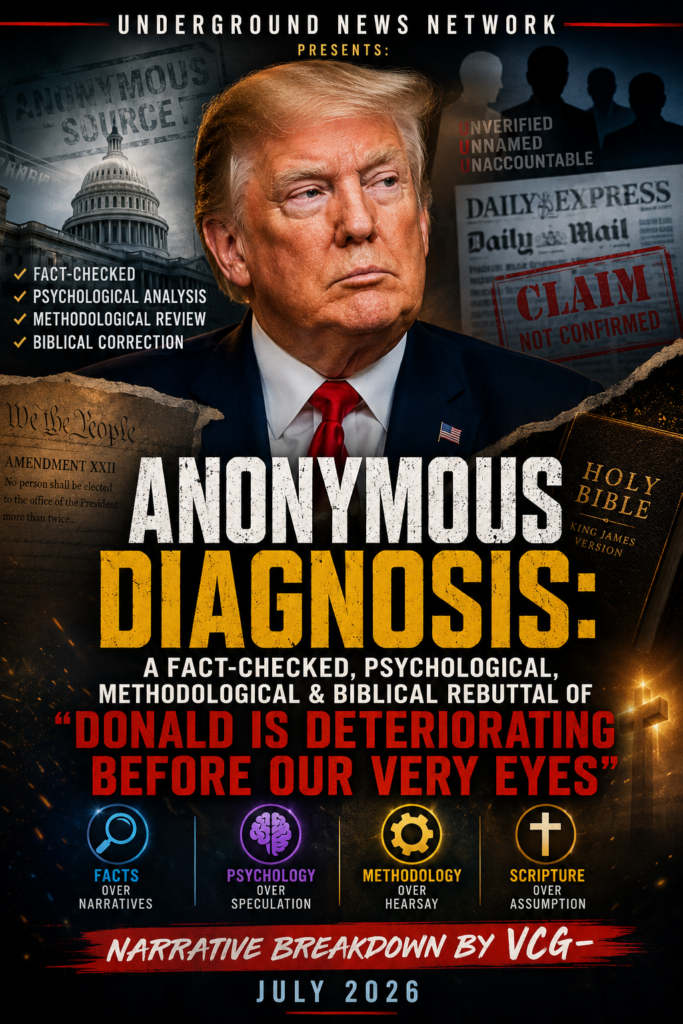
BY VCG ON 7/27/2026
Soli Deo Gloria, brethren.
The central problem with this article is not that every sentence is false.
Several peripheral facts are true.
The problem is that it presents an anonymous, medically unsupported allegation as though it were an established diagnosis, then surrounds that allegation with emotionally charged political commentary and a few verifiable facts that lend the whole package an appearance of credibility.
A responsible rebuttal must not swing into the opposite error.
The evidence supplied does not prove that President Trump is deteriorating, but neither does it prove that he is perfectly healthy.
The honest conclusion is narrower:
The article does not provide sufficient evidence to establish physical or mental decline. Its central claim remains an unverified anonymous allegation.
The uploaded article is cited here in full.
Donald is deteriorating before our very eyes, close Trump confidant says
1. Methodology used in this review
I evaluated each sentence under five categories:
- Verifiable fact — independently confirmable through primary or reliable sources.
- Attributed allegation — someone is reported to have said it, but its truth is unproved.
- Inference — a conclusion drawn from conduct or circumstances.
- Opinion or prediction — evaluative language that cannot be fact-checked as a simple fact.
- Misleading framing — technically qualified wording arranged so that readers receive a stronger impression than the evidence supports.
For health claims, the relevant evidentiary hierarchy is approximately:
direct medical records or examination;
findings from identified treating clinicians;
documented symptoms observed consistently by multiple named witnesses;
complete, contextualized video or transcripts;
anonymous second-hand testimony;
partisan or journalistic interpretation of selected behavior.
This article rests near the bottom of that hierarchy.
2. The sourcing chain is the first major warning
The article is attributed to Lauge Risom Koch at Dagens, but repeatedly says that its information comes “according to The Daily Express,” which itself reportedly summarizes Andrew Neil’s writing in the Daily Mail, which relies upon an unnamed Washington source.
The chain is therefore:
Anonymous individual → Andrew Neil → Daily Mail → Daily Express → Dagens → reader
That is at least four layers between the reader and the alleged witness.
Each layer creates possibilities for:
omitted context;
paraphrase drift;
exaggeration;
headline compression;
selective quotation;
uncertainty being gradually converted into apparent fact.
The headline,
“Donald is deteriorating before our very eyes, close Trump confidant says,”
is especially problematic.
The article does not identify the source, establish that the source truly is a “close confidant,” provide the source’s exact relationship to Trump, or allow the reader to assess possible motive, access, expertise, or reliability.
The headline therefore asks the reader to trust an unknown person solely because a journalist characterizes that person as close to Trump.
Biblical standard
The Bible does not forbid anonymous testimony in every circumstance, but it repeatedly warns against accepting accusations without adequate establishment:
“One witness shall not rise up against a man for any iniquity, or for any sin…” —Deuteronomy 19:15
“He that answereth a matter before he heareth it, it is folly and shame unto him.” —Proverbs 18:13
“The simple believeth every word:
but the prudent man looketh well to his going.” —Proverbs 14:15
“The first in his own cause seemeth just; but his neighbour cometh and searcheth him.”— Proverbs 18:17
These passages do not mean that every news report requires courtroom-level proof.
They do mean that Christians should distinguish an accusation from an established fact.
3. Line-by-line analysis
Headline
“Donald is deteriorating before our very eyes, close Trump confidant says”
What is established
An unnamed person was reportedly quoted by Andrew Neil using that language.
What is not established
that the source is genuinely a close confidant;
that the source has medical expertise;
that the source personally observed clinically meaningful deterioration;
that the quotation was complete and contextualized;
that the source is unbiased;
that “deteriorating” refers to a medically defined condition;
that the source’s conclusion is correct.
Why the headline misleads
The title omits the most important qualifier:
anonymous.
A more accurate headline would be:
“Andrew Neil reports anonymous Trump associate alleging health decline.”
That wording would still report the claim, but would not disguise its evidentiary weakness.
Psychological mechanism
The headline uses an authority-by-proximity effect.
Readers are encouraged to believe the claim because the speaker allegedly knows Trump personally.
But proximity is not medical qualification, and familiarity can also produce bias, resentment, factional conflict, or selective perception.
The phrase
“before our very eyes”
also creates an illusion that the evidence is publicly obvious, although the article itself provides almost no observable medical evidence.
Opening sentence
“Political broadcaster Andrew Neil has claimed President Donald Trump’s physical and mental health are declining…”
This sentence correctly attributes the claim to Neil rather than stating it entirely as fact.
However, the grammatical emphasis still places
“physical and mental health are declining”
at the center of the sentence.
Many readers retain the accusation more strongly than the qualifier “has claimed.”
Correction
The article should specify:
Neil reported that an unnamed source believes Trump is declining; no medical evidence is presented in the article to verify that assessment.
That is the epistemically responsible formulation.
“…arguing that the ongoing conflict with Iran has placed increasing strain on the president during his second term.”
This contains two different propositions:
- the conflict with Iran creates presidential strain;
- that strain is causing or revealing health decline.
The first is plausible.
Wartime decision-making is inherently demanding.
The second is an inference requiring evidence.
Stress can cause fatigue, irritability, disturbed sleep, reduced concentration, and other temporary changes.
But ordinary stress reactions are not synonymous with dementia, mental instability, incapacity, or progressive decline.
Psychological correction
A journalist cannot move from:
“The president is under extraordinary pressure”
to:
“Therefore his mental health is deteriorating”
without demonstrating:
baseline functioning;
persistent change over time;
symptoms across several settings;
impairment in duties;
alternative explanations;
medical assessment.
Stress may affect behavior, but it does not identify a particular pathology.
“According to The Daily Express, Neil cited conversations with people close to Trump…”
This says “conversations” and “people” in the plural.
Later, however, the article’s central quotation is attributed to “a Washington source” and “a close confidant.”
That discrepancy matters.
Did Neil speak to several people who independently expressed the same concern, or one person whose views were generalized into “people close to Trump”?
The article does not tell us.
Fact-check verdict
Insufficiently supported.
Without the underlying Neil article and identification of how many sources corroborated the claim, the plural phrasing may overstate the evidentiary base.
“…who allegedly expressed concern about the president’s condition and the pressure surrounding the war.”
The word “allegedly” protects the writer legally and rhetorically, but it also confirms that the article cannot independently substantiate the assertion.
This should alert the reader that the article is reporting a report of an allegation—not presenting verified medical findings.
4.
“Health concerns”
“Writing in the Daily Mail, Neil said he had been told by a Washington source that Trump appeared to be struggling both physically and mentally.”
The operative phrase is
“had been told.”
Neil is not claiming here to have conducted an examination.
He is transmitting another person’s judgment.
The term “appeared to be struggling” is also undefined.
It could refer to:
fatigue;
frustration;
physical discomfort;
emotional stress;
a temporary illness;
ordinary aging;
disagreement with decisions;
or genuine medical impairment.
The article does not differentiate among these possibilities.
Proper conclusion
This is hearsay evidence of concern, not proof of a diagnosis.
“There is growing concern for his physical health and mental stability.”
The phrase “growing concern” is vague and rhetorically powerful.
Questions the article leaves unanswered:
Growing among whom?
How many people?
Over what period?
Based on what observations?
Are these people clinicians?
Are they political rivals, staff members, friends, or former associates?
Do they independently report the same symptoms?
“Concern exists” is not the same proposition as “decline exists.”
People can sincerely fear something and still be mistaken.
“‘Donald is deteriorating before our very eyes,’ I was told…”
This is the article’s most dramatic line but one of its least evidentially useful.
“Deteriorating” is not operationally defined.
Scientific and medical claims require measurable indicators.
For example:
worsening memory scores;
impaired executive function;
neurological findings;
inability to perform routine duties;
documented changes in gait, speech, motor function, orientation, or judgment;
longitudinal clinical comparison.
None is supplied.
Methodological problem: conclusion without data
The source gives the reader a verdict, not the observations from which the verdict was reached.
A useful account would say something like:
“Over six months I observed X, Y, and Z on multiple occasions, representing a change from his prior baseline.”
Instead, the source offers only a generalized label.
“…by a close confidant who sees him regularly.”
This strengthens the source’s presumed access but does not establish:
clinical competence;
objectivity;
truthfulness;
duration and setting of contact;
ability to distinguish
- stress
- age
- temperament
- medication effects
- exhaustion
- disease
A person can observe meaningful changes without being a doctor.
But to evaluate the report, readers need the observations themselves, not merely the observer’s conclusion.
“His physical and mental health is in decline.”
This is phrased as a direct medical conclusion.
Yet the article provides no:
examination;
records;
diagnosis;
test results;
named clinician;
symptom history;
differential diagnosis;
corroboration.
Medical ethics
The American Medical Association instructs physicians to refrain from making clinical diagnoses about public figures they have not personally examined.
The American Psychiatric Association’s Goldwater Rule similarly bars its members from offering professional opinions on a public figure without examination and proper authorization. (Code of Medical Ethics)
Andrew Neil is a broadcaster, not presented here as Trump’s examining physician.
The anonymous source is not identified as one either.
Strictly speaking, the article does not name a diagnosis.
But
“mental health is in decline”
is still clinical-sounding language unsupported by a disclosed clinical process.
“Those around him don’t know what to do about it.”
This is another sweeping plural assertion.
Who are “those around him”?
Cabinet officials?
family?
physicians?
aides?
political advisers?
one dissatisfied acquaintance?
No evidence is provided that the source is authorized to speak for all or even most people around the president.
Rhetorical device: inaccessible consensus
The sentence manufactures the impression of a broad inner-circle consensus while allowing no named member of that circle to confirm or deny it.
This is a common persuasion technique:
“Everyone close to the situation knows…”
The reader is made to feel that insiders possess a truth hidden from the public.
But the supposed consensus cannot be audited.
“It can only get worse.”
This is not merely an observation.
It is a prognosis.
No responsible prognosis can be made from the information supplied.
Even where a person has a confirmed medical condition, outcomes may:
improve;
stabilize;
fluctuate;
respond to treatment;
result from reversible causes;
or have been misinterpreted initially.
The word “only” claims certainty that the article does not possess.
Verdict
Unsupported prediction.
“He’s 80 — and it’s showing.”
Trump turned 80 on June 14, 2026, so the age statement is accurate as of July 27, 2026.
The White House issued a Flag Day proclamation for June 14, 2026, and public biographical records identify June 14, 1946, as his birth date. (The White House)
But “and it’s showing” is interpretation.
Age is a risk factor, not a diagnosis
Older age is associated statistically with increased risk of many illnesses.
It does not prove that a particular individual has one.
Reasoning from:
“He is 80”
to:
“His mental stability is declining”
is an example of base-rate misuse and potentially age-based stereotyping.
A proper assessment would compare the individual against:
his own prior baseline;
objective functional demands;
clinical findings;
relevant age-adjusted norms.
Biblical consideration
Scripture recognizes the bodily effects of age:
“The days of our years are threescore years and ten; and if by reason of strength they be fourscore years…” — Psalm 90:10
But Scripture also forbids unjust judgment based on appearance:
“Judge not according to the appearance, but judge righteous judgment.” — John 7:24
Age should encourage realism and humility, not license unsupported accusation.
5. The Oval Office language about Iran
“Trump had recently launched into a lengthy criticism of Iran’s leadership…”
This is potentially verifiable through video or an official transcript, but the article does not provide either.
The terms “launched into” and “lengthy” are editorial descriptions.
They are not neutral.
A fact-focused rendering would state:
During an Oval Office meeting, Trump criticized Iran’s leadership and used the terms…
The specific setting and full transcript are necessary to determine tone and context.
“…describing its leaders as ‘scumbags’ and ‘lunatics.’”
Assuming the quotation is accurate, this supports only the conclusion that Trump used harsh, insulting language.
It does not by itself establish cognitive deterioration.
People may use intemperate language because of:
anger;
calculated political rhetoric;
longstanding speech habits;
provocation;
moral outrage;
poor self-control;
strategic signaling;
or impairment.
The same behavior can have multiple explanations.
One cannot choose a medical explanation merely because it fits a preferred narrative.
Nevertheless, a biblical correction is warranted
A rebuttal of the article should not excuse sinful or degrading speech by Trump.
Scripture says:
“Let no corrupt communication proceed out of your mouth, but that which is good to the use of edifying…” — Ephesians 4:29
“To speak evil of no man, to be no brawlers, but gentle, shewing all meekness unto all men.” — Titus 3:2
“A soft answer turneth away wrath: but grievous words stir up anger.” — Proverbs 15:1
Therefore:
The article cannot legitimately diagnose Trump from insulting language.
Trump’s insulting language can still be morally criticized on biblical grounds.
Those are not contradictory conclusions.
6. “Iran and legacy”
“Neil argued that the conflict with Iran could ultimately define Trump’s presidency…”
The phrase “could ultimately define” is a prediction and interpretive judgment.
It may prove correct, but it is not presently a fact in the same sense as the date of a speech or constitutional text.
Major wars often shape presidential legacies, but historical legacy is determined over time and depends upon:
military outcome;
political objectives;
casualties;
regional effects;
economic consequences;
public opinion;
later historical evidence;
long-term strategic consequences.
Verdict
Plausible opinion, not established fact.
“…suggesting the president had become increasingly frustrated by Tehran’s resilience.”
Again, this attributes an internal mental state.
What evidence demonstrates increasing frustration?
private statements?
changes in policy?
public language?
accounts from identified advisers?
a direct admission?
The article does not say.
Psychological error: mind-reading
This is a form of intent attribution or “mind-reading”:
inferring a person’s internal emotional state from selected external behavior without sufficient corroboration.
Such inferences can sometimes be reasonable, but they must be labeled as inference rather than fact.
“It is not a legacy any president should wish to emulate.”
This is an opinion.
It cannot be “fact-checked” as true or false because it expresses a normative judgment about presidential legacy.
A reader may agree strongly while still recognizing that it is commentary, not reporting.
“But, through a mixture of stupidity and bravado, Trump looks like doing exactly that.”
This is openly pejorative rhetoric.
“Stupidity”
This is an insult, not an analytical category.
It supplies no:
strategic evaluation;
decision tree;
intelligence assessment;
alternatives considered;
probability estimate;
cost-benefit analysis.
“Bravado”
This may describe behavior, but it requires examples and a definition.
The sentence replaces argument with characterization.
Ad hominem structure
Rather than demonstrating:
Policy X is unsound because evidence A, B, and C show it is unlikely to achieve objective Y,
the sentence says, in effect:
Trump is acting from stupidity and bravado.
That attacks presumed intelligence and motive rather than fully analyzing the policy.
Biblical correction
The Bible permits strong moral rebuke.
Prophets, apostles, and Christ himself sometimes used severe language.
But biblical rebuke is tied to truth, evidence, and moral substance—not mere partisan contempt.
“Speaking the truth in love…” — Ephesians 4:15
“Wherefore putting away lying, speak every man truth with his neighbour…” — Ephesians 4:25
“The wrath of man worketh not the righteousness of God.” — James 1:20
A Christian should not defend Trump by returning insult for insult.
Nor should he accept insulting commentary merely because he opposes Trump.
“We will all be the poorer for it.”
This may mean economically, geopolitically, morally, or socially.
The article does not specify.
As written, it is a prediction and rhetorical conclusion, not a measurable finding.
A serious analysis would define:
which costs;
expected magnitude;
causal mechanism;
compared with which alternative;
degree of uncertainty.
7. The fourth-term joke
“Trump has shown no indication that he believes his health is limiting him.”
This is a weak inference.
A person’s public confidence does not prove medical fitness.
Conversely, an unverified allegation of decline does not prove incapacity.
The sentence is best understood as:
Trump has not publicly portrayed himself as incapacitated.
That narrower claim is supportable.
“At a recent White House Correspondents’ Dinner, he joked about seeking another term in office.”
This appears substantially accurate. Multiple reports describe Trump at the July 24, 2026 dinner joking that he intended to run for a “fourth term,” while displaying a “Trump 2028” hat. (The Independent)
The article correctly signals the comedic context by saying he “joked.”
That context matters.
Quoting the statement without identifying it as humor would be misleading.
“I’m pleased to announce…my intention to run for a fourth term…”
The reported quotation is corroborated by multiple video-based news accounts. (The Independent)
However, this quotation does not meaningfully prove or disprove mental decline.
It is consistent with several interpretations:
an obvious joke;
trolling the press;
continuing his claim that he won the 2020 election;
testing political reaction;
seriously cultivating third-term rhetoric beneath comic delivery.
The article cannot validly choose one interpretation as a medical marker without additional evidence.
Numerical context
Trump calls it a “fourth term” because he has long claimed to have won three presidential elections—2016, 2020, and 2024—even though the official constitutional record recognizes Joe Biden as the winner of 2020.
In conventional legal terms, a 2028 victory would be Trump’s third elected presidential term, not his fourth.
The joke therefore relies on his disputed election narrative.
8. Constitutional claim
“The U.S. Constitution limits presidents to two elected terms…”
This is correct.
The Twenty-Second Amendment says:
“No person shall be elected to the office of the President more than twice…”
That is the controlling constitutional text. (Constitution.gov)
“…making another bid legally impossible under the current constitutional framework.”
This is broadly correct but slightly imprecise.
The amendment expressly prohibits being elected more than twice.
It does not literally say,
“No person may announce, campaign, file paperwork, or receive votes.”
Therefore, the most precise formulation is:
Trump is constitutionally ineligible to be elected president again under the present Twenty-Second Amendment.
Whether election officials could or should prevent an ineligible candidate from appearing on ballots involves additional legal and procedural questions.
But the core conclusion—that he cannot constitutionally be elected to another term under the current framework—is sound.
Could the Constitution be changed?
In theory, yes.
The Twenty-Second Amendment could be repealed or altered through the Article V amendment process.
That would require extraordinary national agreement and is not something a president can accomplish unilaterally.
Thus,
“legally impossible under the current constitutional framework”
is fair if understood to mean constitutionally barred absent amendment.
9. The article never demonstrates presidential incapacity
Even if some health decline were eventually documented, “decline” is not identical to constitutional inability.
The Twenty-Fifth Amendment concerns whether a president is unable to discharge the powers and duties of the office.
Section 4 places the initial institutional responsibility on the vice president and a majority of the principal executive officers, subject to congressional procedures if disputed. (Constitution.gov)
The article provides no evidence that:
the vice president has made such a determination;
a Cabinet majority believes Trump unable to serve;
Trump cannot perform official duties;
a medical team has found incapacity;
constitutional procedures have been initiated.
Therefore the article does not establish either:
- a medical diagnosis, or
- constitutional inability.
10. Psychological and propaganda techniques in the article
Anonymous authority
The unknown source is assigned status—“close confidant”—without accountability.
Layered attribution
Repeated phrases such as “according to The Daily Express” and “Neil said he had been told” allow each publisher to transmit a severe allegation while distancing itself from responsibility for proving it.
Diagnostic insinuation
The article uses medical-sounding terms—“mental stability,” “deteriorating,” “in decline”—without naming a diagnosis or presenting clinical evidence.
This creates the impression of medical authority without assuming the burden of medical proof.
Emotional priming
Words such as:
deteriorating;
instability;
scumbags;
lunatics;
stupidity;
bravado;
poorer;
place the reader into an emotional frame before the claims are critically evaluated.
Halo of verified details
The article includes facts that can be checked:
Trump is 80;
he used harsh rhetoric about Iran;
he joked about another term;
the Constitution bars election to more than two terms.
Those verified details can make the unverified health allegation feel more credible by association.
But evidence for one claim does not automatically transfer to another.
Confirmation bias
Readers who already believe Trump is mentally impaired will likely interpret every quoted behavior as confirmation.
Readers who strongly support Trump may reject even legitimate concerns automatically.
The disciplined response is to ask:
What evidence would I require if the same claim were made about a politician I favored—or opposed?
Availability heuristic
Dramatic clips, verbal mistakes, angry remarks, or unusual jokes are memorable.
Memorable behavior can seem more common and more diagnostically significant than it actually is.
A valid assessment requires the full rate and pattern of conduct, not merely the most shareable examples.
Fundamental attribution error
The article encourages readers to attribute behavior to stable internal defects—decline, stupidity, instability—rather than considering situational explanations such as
- stress
- fatigue
- anger
- strategic performance
or ordinary personality.
Illusory consensus
“Those around him”
suggests broad agreement without identifying anyone.
Prognostic certainty
“It can only get worse”
converts uncertainty into inevitability.
11. What a genuinely rigorous article would need
To responsibly substantiate the central thesis, a serious investigation should provide several of the following:
multiple independently corroborating sources;
clear descriptions of each source’s access;
named sources where possible;
specific observed changes over time;
dates and contexts;
full video or transcript comparisons;
identified medical expertise;
opportunity for White House and physician response;
relevant medical records or examination findings;
consideration of benign and reversible explanations;
distinction between ordinary aging and disease;
distinction between unpopular decisions and incapacity;
correction of misleading headline language;
explicit uncertainty ratings.
For example:
| Claim | Required evidence |
|---|---|
| Physical deterioration | examination, records, observable functional changes |
| Cognitive decline | longitudinal cognitive and functional evidence |
| Mental instability | defined symptoms, qualified assessment, impairment |
| Inability to serve | evidence tied to presidential duties and constitutional standards |
| Stress from Iran caused decline | chronology plus credible causal analysis |
| Inner circle consensus | several independent, appropriately placed sources |
The article supplies almost none of this.
12. Scripture: how Christians should evaluate the article
Do not circulate an unverified report as fact
“Thou shalt not raise a false report…” — Exodus 23:1
This does not require proving the publisher intentionally lied.
A “false report” can also be propagated when people repeat something without adequate grounds.
A Christian may say:
“An anonymous source alleges…”
He should not casually convert that into:
“Trump is mentally deteriorating.”
Require establishment before accusation
“In the mouth of two or three witnesses shall every word be established.” — 2 Corinthians 13:1
This principle appears in legal, ecclesiastical, and moral contexts.
It teaches caution where serious accusations can injure reputation or destabilize judgment.
Hear the whole matter
“He that is first in his own cause seemeth just; but his neighbour cometh and searcheth him.” — Proverbs 18:17
The article provides the accusation but little meaningful counterevidence, response, or medical context.
Do not show partisan partiality
“Ye shall do no unrighteousness in judgment:
thou shalt not respect the person of the poor, nor honour the person of the mighty…” — Leviticus 19:15
Trump’s office does not make him immune from scrutiny.
Neither does his unpopularity lower the standard of proof.
The same evidentiary standard should apply to:
Trump;
Biden;
Obama;
any monarch;
any pastor;
any ordinary person.
Do not trust princes uncritically
Rejecting this article’s weak reasoning does not require treating Trump as spiritually trustworthy or politically infallible.
“Put not your trust in princes, nor in the son of man, in whom there is no help.” — Psalm 146:3
“It is better to trust in the LORD than to put confidence in princes.” — Psalm 118:9
Christian discernment must avoid both political slander and political idolatry.
Pray for rulers while judging conduct truthfully
“I exhort therefore, that, first of all, supplications, prayers, intercessions, and giving of thanks, be made…for kings, and for all that are in authority…” — 1 Timothy 2:1–2
Prayer for a ruler does not mean endorsing all his conduct.
Biblical figures prayed for, obeyed, confronted, and sometimes resisted rulers depending upon the circumstances.
Authority does not erase accountability
“Wherefore by their fruits ye shall know them.” — Matthew 7:20
Public conduct, policies, speech, justice, truthfulness, and consequences may all be evaluated.
But evaluating fruit is different from inventing a hidden medical diagnosis.
Restrain contemptuous speech
“Let all bitterness, and wrath, and anger, and clamour, and evil speaking, be put away from you…” — Ephesians 4:31
This applies equally to:
journalists speaking about Trump;
Trump speaking about enemies;
Christians speaking about journalists;
supporters and critics speaking about one another.
All Scripture quotations above are from the uploaded King James Bible.
13. What can fairly be criticized about Trump from this article?
A truthful rebuttal should not pretend that every criticism is illegitimate.
On the information presented, one may reasonably criticize:
his use of insulting terminology;
inflammatory public rhetoric;
joking about constitutionally prohibited additional terms;
any policies toward Iran judged unwise after examining actual evidence;
the potential destabilizing effect of ambiguous third-term messaging.
But none of those automatically proves:
dementia;
psychiatric disease;
mental instability;
physical collapse;
constitutional inability.
The article repeatedly blurs those categories.
14. What cannot fairly be claimed?
The article does not justify stating as fact that:
Trump is medically deteriorating;
Trump is mentally unstable;
his condition “can only get worse”;
everyone around him recognizes serious decline;
the Iran war caused a health decline;
his rhetoric is proof of cognitive impairment;
he is unable to discharge the presidency.
Each of those claims requires substantially more evidence.
15. Overall fact-check table
| Article proposition | Assessment |
|---|---|
| Andrew Neil reported concern about Trump | Supported as attribution |
| A close confidant said Trump is deteriorating | Reported but unverified; source anonymous |
| Several people close to Trump share the concern | Unclear; article does not establish plurality |
| Trump’s physical health is declining | Not established |
| Trump’s mental health is declining | Not established |
| Those around him do not know what to do | Unsupported generalization |
| It can only worsen | Unsupported prognosis |
| Trump is 80 | True |
| Trump used insulting language about Iranian leaders | Apparently reportable, but context should be checked |
| Iran may define his presidency | Opinion/prediction |
| His conduct results from stupidity and bravado | Pejorative interpretation |
| Trump joked about a fourth term | Verified in context as a joke |
| The Constitution limits election to two terms | True |
| Trump can constitutionally be elected again under current law | No |
| The article proves presidential incapacity | No |
Final judgment
The article is best classified as commentary-driven aggregation built around an anonymous allegation.
Its most important weaknesses are:
an elongated and opaque source chain;
anonymous sourcing;
no medical evidence;
no defined symptoms;
no identified clinician;
no meaningful corroboration;
age-based inference;
mind-reading about motives and frustration;
emotionally loaded language;
conflation of harsh rhetoric with mental pathology;
prediction presented with unjustified certainty.
Its accurate supporting details—Trump’s age, his fourth-term joke, and the Twenty-Second Amendment—do not validate its central medical claim.
The biblically responsible position is neither:
“The article says it, therefore Trump is deteriorating,”
nor:
“I support Trump, therefore no health concern could possibly be true.”
It is:
Receive the allegation cautiously. Demand adequate evidence.
Refuse slander and partisan contempt. Judge publicly verifiable words and deeds righteously.
Pray for those in authority.
Place ultimate trust in God, not in rulers or journalists.