
Fiction, Fear & Political Prophecy: A Biblical & Psychological Critique of “Trump’s Death Imagined”
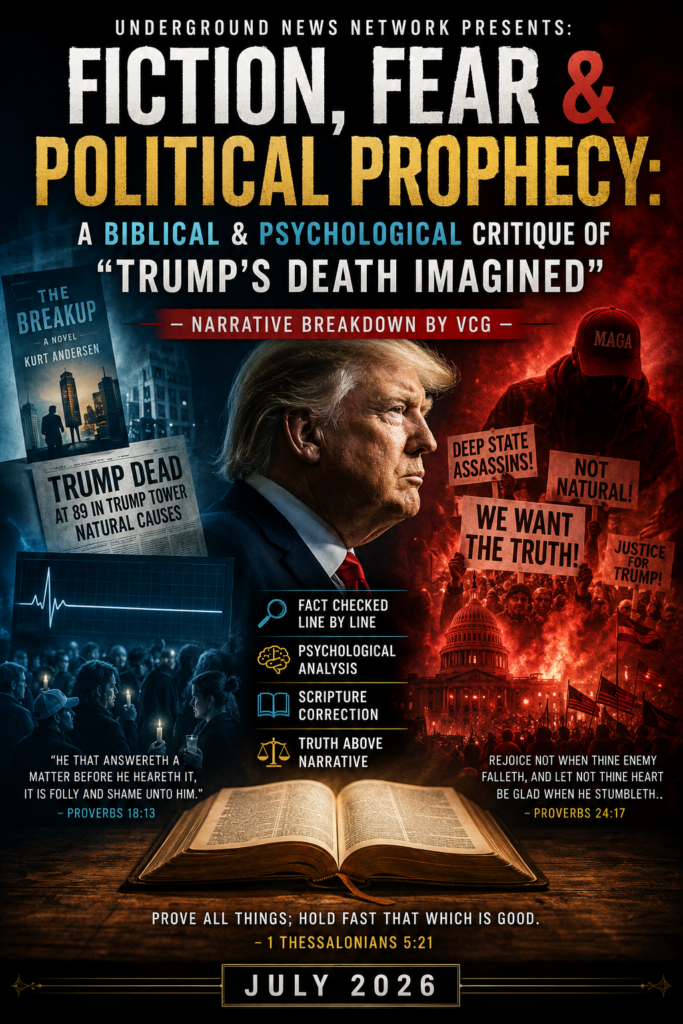
BY VCG ON 7/27/2026
Soli Deo Gloria.
The article is best understood not as straight reporting about an actual threat, but as publicity for a forthcoming dystopian novel, framed through highly partisan commentary.
Its central scenario is possible in the broad sense that political conspiracy narratives can contribute to unrest, but the article repeatedly moves from fiction → plausibility → implied prediction without supplying evidence sufficient for that progression.
The uploaded article is cited here:
Trump’s death imagined in dark new novel by noted author after ‘horror show’ term
Scripture quotations below are from the uploaded King James Bible.
1. Methodology
I evaluated each statement under five headings:
- What kind of claim is it? Fact, quotation, fictional premise, prediction, opinion, or psychological generalization.
- Can it be verified? Through the author, publisher, interview, election records, or historical evidence.
- Does the evidence justify the wording?
- What rhetorical or psychological technique is operating?
- What biblical principle corrects either the writer or the political reader?
A necessary distinction throughout:
A novel may legitimately imagine events.
An author may legitimately believe his imagined events are plausible.
A journalist may accurately report what the author said.
None of those facts establishes that the imagined event is likely to happen.
2. Overall verdict
What is substantially factual
The following basic elements are supported:
Kurt Andersen is an established author and co-founder of Spy magazine.
His novel is titled The Breakup.
It is scheduled for publication by Random House on August 18, 2026.
The story includes a fictional sequence involving Donald Trump’s death, conspiracy allegations, political violence, and eventual domestic conflict.
Andersen did describe the current political situation as a “horror show” and said he darkened the novel while writing it. (The Daily Beast)
What is not established
The article does not establish that:
Trump supporters as a class would riot after his natural death.
They would reject medical evidence automatically.
A nationwide terrorist uprising would follow.
Andersen’s scenario has become objectively “predictive.”
“True believers” require no evidence.
Current events make the fictional chain of events probable rather than merely imaginable.
Those are speculative judgments, not verified findings.
3. Headline analysis
“Trump’s death imagined in dark new novel by noted author after ‘horror show’ term”
Factual core
The novel apparently does imagine Trump’s death, and Andersen did use language describing the term as a “horror show.” (The Daily Beast)
Manipulative features
The headline combines four emotionally charged elements:
“Trump’s death”
“dark”
“noted author”
“horror show”
This is affective framing.
Before the reader receives evidence, the reader is given an emotional interpretation.
“Noted author” is also a mild authority cue.
Andersen’s literary reputation may establish that he is an accomplished novelist; it does not make him a reliable political forecaster.
Biblical correction
Scripture does not forbid severe criticism of rulers.
Prophets sometimes rebuked kings directly.
But judgment must be truthful and just:
“He that answereth a matter before he heareth it, it is folly and shame unto him.”—Proverbs 18:13
“He that is first in his own cause seemeth just; but his neighbour cometh and searcheth him.”—Proverbs 18:17
The biblical response is neither automatic defense of Trump nor automatic acceptance of Andersen’s characterization.
The claim must be searched.
4. Opening sentence
“Unable to cope with President Donald Trump’s death by natural causes, his followers will instead take to the streets and riot, believing his passing was the result of a ‘deep state’ plot.”
Claim type
This is a description of the novel’s fictional premise, but its grammar initially sounds like a direct prediction:
“his followers will.”
Only in the following paragraph does the article clarify that this is fiction.
Accuracy
As a summary of the fictional scenario, it is broadly accurate.
As a claim about real Trump supporters, it is unproven.
Problems in wording
1. Outgroup homogeneity
“His followers” treats millions of politically diverse people as though they possess one mind and one response.
Political coalitions contain:
ordinary voters,
reluctant voters,
enthusiastic supporters,
policy-oriented conservatives,
populists,
religious voters,
protest voters,
conspiratorial subgroups,
disengaged voters,
and potentially violent extremists.
It is unsound to transfer the psychology of an extremist minority to the entire electorate.
2. Mind-reading
“Unable to cope” assigns an internal psychological condition to a mass population without interviewing or measuring them.
3. Certainty inflation
“Will” is stronger than:
“might,”
“could,”
“the novel imagines,”
or
“Andersen fears.”
The sentence compresses speculative fiction into predictive language.
Psychological evidence
Research does show that conspiracy belief can be associated with perceived threat, distrust, strong group identification, uncertainty, collective grievance, and—in some circumstances—greater acceptance of political violence.
But these are probabilistic relationships.
They do not justify diagnosing every member of a political movement. (PubMed Central (PMC))
Even where conspiracy mentality correlates with support for violence, correlation is not destiny.
Moral restraints, self-control, perceived efficacy, social relationships, institutional trust, leadership signals, and situational conditions affect whether belief becomes action. (Cambridge University Press)
Biblical correction
Christians must not stereotype a multitude unjustly:
“Doth our law judge any man, before it hear him, and know what he doeth?”—John 7:51
At the same time, Christians must reject violent loyalty to any political leader:
“For the wrath of man worketh not the righteousness of God.”—James 1:20
“Dearly beloved, avenge not yourselves…”—Romans 12:19
5. “That is the premise…”
“That is the premise of a new novel by popular author Kurt Andersen, co-founder of Spy magazine, which will likely set off the president’s die-hard supporters…”
What is factual
Andersen co-founded Spy.
The book exists and is scheduled for publication. (The Daily Beast)
What is speculative
“Will likely set off”
is a prediction about audience reaction.
No polling, reader survey, advance response analysis, or representative evidence is offered.
Rhetorical function
This sentence manufactures a second anticipated conflict:
- The novel imagines MAGA violence.
- The article predicts MAGA outrage about the novel.
That framing can become self-sealing:
If supporters object, their objection is presented as confirmation.
If they do not object, the prediction is forgotten.
If they object to being stereotyped, that objection may itself be described as emotional instability.
This resembles a Kafka trap:
denial is treated as evidence of the accusation.
Better wording
A responsible report would say:
The premise may draw criticism from Trump supporters who regard it as an inflammatory stereotype.
That states a reasonable possibility without pretending to know the future.
Scripture
“A false balance is abomination to the LORD:
but a just weight is his delight.”—Proverbs 11:1
A “just weight” in journalism means representing the strength of evidence accurately.
6. The missing subject
“reads like a dark prediction of where the country could head.”
The uploaded text appears to contain a grammatical omission before “reads.”
It may be a copying or publication error.
More important substantive point
“Could head” is technically modest.
Many outcomes “could” occur.
But “reads like a dark prediction” encourages the reader to treat fiction as prognostication.
This is a shift from:
- possibility to
- plausibility to
- prediction.
Those categories are not identical.
A nuclear exchange, constitutional collapse, peaceful reconciliation, regional secession, or renewed civic unity might all be imagined.
Narrative vividness does not provide a probability estimate.
Psychological mechanism: narrative transportation
A vivid story can feel truer than an abstract statistical argument because the reader mentally simulates it.
Concrete scenes—Trump Tower, the escalator, a birthday crowd, sudden death—make the future easier to picture.
Ease of imagination is then mistakenly treated as evidence of likelihood.
This overlaps with the availability heuristic:
events that are memorable or easy to imagine can be judged more probable than the evidence warrants.
Scripture
Nathan’s parable to David in 2 Samuel 12 shows that narrative can reveal moral truth.
But a parable’s moral force does not make every narrative detail a historical prediction.
We must distinguish illustration from demonstration.
7. The 2035 scenario
“The novel ‘The Breakup’ imagines a 2035 scenario where Trump, celebrating his 89th birthday at Trump Tower, suffers a massive stroke while descending his golden escalator.”
Fact-check
This accurately reflects Andersen’s reported description of the scene. (The Daily Beast)
The age is arithmetically consistent with Trump’s 1946 birth year: he would turn 89 in June 2035.
What cannot be fact-checked
The stroke and death are fictional.
They should never be described as medical prognosis.
The term “massive brain stroke” appears to come from Andersen’s interview description.
It is not a clinical assessment. (The Daily Beast)
Symbolism
The golden escalator deliberately recalls Trump’s June 2015 campaign announcement.
The setting gives the fictional death an almost theatrical symmetry:
the political identity begins and symbolically ends at the same place.
This is literary construction, not epidemiological modeling.
Ethical observation
Imagining the death of a living political figure is not necessarily an endorsement of his death.
Literature has long depicted the fictional deaths of rulers.
Nevertheless, publicity centered on a living person’s death can encourage morbid spectacle, contempt, or dehumanization.
Scripture
Christians should not rejoice at an enemy’s downfall:
“Rejoice not when thine enemy falleth, and let not thine heart be glad when he stumbleth.”—Proverbs 24:17
That applies regardless of whether the person is Trump, Biden, another ruler, or an ideological opponent.
8.
“But the president’s fictional death is just the beginning”
This is a suspense device, not a factual claim.
Technique
It uses the conventional escalation formula:
death,
denial,
conspiracy,
rage,
riot,
terrorism,
uprising,
national breakup.
Each stage raises emotional stakes.
The article does not pause to estimate the probability of each transition.
In probabilistic reasoning, a chain of events becomes less likely when every link is required.
Even when each step is individually plausible, the total scenario may remain unlikely.
For example, the novel appears to require:
Trump remains the central figure through 2035.
A major public commemoration occurs at Trump Tower.
He dies visibly during it.
influential actors allege assassination,
enough supporters believe them,
substantial violence begins,
violence persists,
organization develops,
institutions fail to contain it,
a broader uprising follows.
The article evaluates no link separately.
Scripture
“The simple believeth every word:
but the prudent man looketh well to his going.”—Proverbs 14:15
This verse rebukes both blind belief in alleged “deep state” plots and blind belief in journalistic predictions about future MAGA terrorism.
9.
“MAGA followers… immediately reject the official cause”
“MAGA followers… immediately reject the official cause of death.”
Internal status
Within the novel, this can be true because the novelist determines what his characters do.
External evidentiary status
It cannot be generalized to real voters without representative evidence.
Strongest argument supporting Andersen
There is historical reason not to dismiss the possibility entirely.
Following the 2020 election, false or unsupported election narratives contributed to an environment in which the Capitol was breached on January 6, 2021.
More than 1,100 people had been charged by October 2023, including hundreds accused of assaulting or impeding law enforcement. (Department of Justice)
That history demonstrates:
conspiracy narratives can mobilize some people;
partisan identity can override institutional trust;
a minority can produce serious violence.
What January 6 does not prove
It does not prove:
every Trump voter accepts conspiracies;
every disputed event will cause violence;
a future death would produce a larger uprising;
the entire political right is terroristic;
comparable psychological mechanisms exist only on the right.
The article takes a real precedent and stretches it into a deterministic mass portrait.
Scripture
Christians must require evidence:
“One witness shall not rise up against a man for any iniquity…”—Deuteronomy 19:15
The underlying principle is that grave accusations require adequate testimony.
A Christian should not declare “assassination” merely because a natural death is emotionally difficult to accept.
Nor should a journalist declare future collective guilt on the basis of political affiliation.
10.
“Conspiracy theory requiring no evidence”
“Instead, they blame assassination by the ‘deep state’ — a conspiracy theory requiring no evidence to gain traction among his true believers.”
This is among the article’s least defensible sentences.
Reasonable core
Some conspiracy claims do spread without adequate evidence.
Research supports the conclusion that uncertainty, threat, distrust, identity protection, and prior conspiratorial disposition can make certain narratives attractive. (PubMed Central (PMC))
Overstatement
“Requiring no evidence”
is rhetorical absolutism.
Even weakly founded conspiracy narratives commonly employ things presented as evidence:
suspicious timing,
anonymous testimony,
misunderstood documents,
selectively edited footage,
real institutional misconduct,
statistical anomalies,
alleged inconsistencies,
or claims from trusted elites.
The problem is usually not a literal absence of anything called evidence.
The problem is that the evidence may be:
irrelevant,
misinterpreted,
fabricated,
unfalsifiable,
cherry-picked,
contradicted by stronger evidence,
or insufficient for the conclusion.
That distinction matters because effective correction requires examining the alleged evidence, not merely insulting the believer.
“True believers”
This phrase functions as a delegitimizing label.
It suggests cultic credulity and closes inquiry into differences among supporters.
Ironically,
“true believers require no evidence”
is itself asserted without evidence about the imagined population.
Better analytical statement
In Andersen’s novel, some supporters accept assassination allegations before credible evidence is produced, reflecting the documented tendency of identity-protective conspiracy narratives to spread during uncertainty.
That would preserve the concern while avoiding a blanket insult.
Scripture
“Prove all things; hold fast that which is good.”—1 Thessalonians 5:21
“Prove all things” applies to anti-government allegations, official reports, partisan media, and accusations against political groups.
11.
“The mourning quickly transforms into rage”
This is psychologically possible, but not inevitable.
Psychological pathways
Collective mourning can become anger when people believe:
the death was intentional,
their group was attacked,
authorities are concealing the truth,
normal justice is unavailable,
retaliation is morally necessary,
and violence will be socially rewarded.
Strong identification can cause an attack on a leader to feel like an attack on the self or group.
Collective narcissism—an exaggerated belief that one’s group deserves recognition but is insufficiently appreciated—has been associated with sensitivity to insult, conspiracy thinking, and retaliatory hostility. (Cambridge University Press)
Necessary warning
These constructs are research variables, not remote psychiatric diagnoses.
It would be unethical to say,
“Trump supporters are collectively narcissistic,”
without direct representative measurement and careful comparison groups.
Alternative outcomes omitted by the article
Mourning could also lead to:
peaceful memorials,
succession planning,
religious services,
electoral reorganization,
internal party disputes,
withdrawal from politics,
or reduced intensity after the central personality is gone.
The article foregrounds the most dramatic outcome because drama promotes attention and sells dystopian fiction.
Scripture
“He that is slow to wrath is of great understanding:
but he that is hasty of spirit exalteth folly.”—Proverbs 14:29
12. Promotional interruption
“Want more breaking political news?
Click for the latest headlines at Raw Story.”
This is not part of the argument.
It is an engagement device.
Why it matters
The insertion reveals the commercial environment in which the article operates:
emotionally charged subject,
fear-inducing scenario,
famous political figure,
anticipated outrage,
prompt to continue clicking.
This does not prove the report is false.
It does mean the outlet has an incentive to maximize attention.
Media methodology lesson
Do not assume:
commercial incentive means falsehood;
ideological alignment means falsehood;
emotional language means falsehood.
Instead ask whether those incentives help explain:
headline selection,
omitted context,
overstatement,
and emphasis on conflict.
13. Andersen’s quotation about violence
“It’s the first spectacular piece of violence, spontaneous violence that then results a year later in an uprising, in a, in a true right-wing uprising, terrorist uprising.”
Accuracy
The Raw Story article appears to represent Andersen’s description faithfully.
The repetition and broken syntax are consistent with spoken interview language. (The Daily Beast)
What the quotation proves
It proves what Andersen says happens in his novel.
It does not prove his political forecast.
Ambiguity
“Spontaneous violence” followed a year later by a “terrorist uprising” raises unanswered questions:
How does spontaneous action become organized?
Who supplies leadership?
How broad is participation?
What ideology unites them?
What role do government failures play?
What counter-mobilization occurs?
Why do law-enforcement institutions fail?
Is “uprising” the narrator’s term, a government label, or an objective description?
Without reading the entire novel, those cannot be fairly answered.
Loaded label
“Terrorist” can be an accurate term when violence is used against civilians or institutions to intimidate a population or coerce political action.
But in commentary, it can also be used broadly to morally classify an opposing movement before specifics are given.
A careful analysis asks about conduct, targets, intent, and organization—not merely ideology.
Scripture
Scripture condemns politically motivated murder and disorder without making partisan exceptions:
“Thou shalt not kill.”—Exodus 20:13
“For God is not the author of confusion, but of peace…”—1 Corinthians 14:33
The immediate context of 1 Corinthians 14 concerns orderly worship, so it should not be treated as a direct political proof text.
Its stated truth about God’s order is relevant by principle, but the contextual distinction should be acknowledged.
14.
“What makes… unsettling is how plausible it now seems”
The words “it now seems” are crucial.
This is a subjective judgment.
Missing methodology
No forecasting method is reported:
no comparison with historical leader deaths,
no probability model,
no expert survey,
no trend data,
no threat assessment,
no polling of Trump supporters,
no analysis of institutional resilience.
Therefore “plausible” here means approximately:
The scenario feels more believable to Andersen in light of recent events.
That is legitimate as authorial commentary.
It should not be mistaken for a scientific conclusion.
Plausibility versus probability
A scenario may be internally coherent and still improbable.
For example, it is plausible that:
a famous leader’s sudden death would generate rumors;
some people would allege foul play;
a tiny number might commit violence.
It is a much larger claim that the process would cause a nationwide right-wing terrorist uprising and national disintegration.
The article blurs those levels.
Psychological mechanism: affect heuristic
When a person experiences current events as frightening or morally shocking, future catastrophe can feel more probable.
Emotional intensity becomes a substitute for formal risk assessment.
This does not mean Andersen is insincere.
It means sincerity and forecasting accuracy are separate matters.
15.
“When he began… exaggeration. Now… prediction”
“When he began writing the novel, the premise felt like an exaggeration.
Now it reads like a prediction.”
This is a classic retrospective validation claim.
Problem
A work can seem prophetic because readers selectively match its broad themes with later events.
This is especially easy with dystopian fiction, which deliberately uses recognizable social tensions.
To establish predictive success, one would need to identify in advance:
the specific prediction,
its timeframe,
its probability,
the conditions under which it would fail,
and alternative outcomes.
Otherwise “prediction” means
“fiction that resembles my interpretation of current trends.”
Confirmation bias risk
Once an author believes reality is moving toward his story, he may:
notice confirming developments,
discount stabilizing developments,
interpret ambiguous events darkly,
and revise the story to preserve the apparent parallel.
That possibility does not refute his concerns.
It shows why independent methods are needed.
Biblical correction
“The heart is deceitful above all things, and desperately wicked:
who can know it?”—Jeremiah 17:9
This verse should first be applied to ourselves, not weaponized against political opponents.
Writers, Trump supporters, journalists, pastors, and critics are all capable of self-confirming interpretations.
16.
“I was basically done when he took off”
“I was basically done when he took off… Almost done when he took office.”
Factual timing
Trump won the 2024 election and returned to office on January 20, 2025.
Official FEC results document his electoral victory, while the current White House identifies him as the sitting president. (FEC.gov)
Ambiguity in Raw Story’s paraphrase
The article introduces the quotation with “Trump’s 2024 victory,” but “when he took off” may be a transcription issue, verbal stumble, or reference not fully preserved in the short article.
The next phrase, “when he took office,” is clear.
Relevance
The quotation shows that real events influenced revision of a fictional manuscript.
That is normal artistic practice.
It does not independently validate the political interpretation embedded in those revisions.
17.
“Trump’s second term forced Andersen…”
“Trump’s second term forced Andersen to substantially darken his manuscript.”
Rhetorical problem
“Forced” removes the author’s agency.
Trump’s second term did not literally compel Andersen to revise anything.
Andersen chose to interpret events and revise his manuscript accordingly.
Better:
Events during Trump’s second term led Andersen to darken the manuscript.
Why the difference matters
“Was forced” rhetorically portrays the author as a passive recorder of an objectively dark reality rather than an active interpreter with political commitments.
All writers select, interpret, and frame.
Scripture
“The words of a talebearer are as wounds, and they go down into the innermost parts of the belly.”—Proverbs 18:8
This does not mean Andersen is a “talebearer.”
It warns that dramatic words penetrate deeply; therefore writers bear responsibility for precision.
18.
“More horrible and nightmarish”
“It required me to go through and darken the backstory… more horrible and nightmarish than I had had them in the earlier draft.”
This is verifiable as Andersen’s report of his creative process. (The Daily Beast)
It is not a fact-checkable description of the administration
“Horrible” and “nightmarish” are moral and emotional evaluations.
To evaluate them responsibly, the interviewer would need to ask:
Which policies?
Which executive actions?
Which constitutional violations?
Which economic or foreign-policy effects?
Compared with what baseline?
What evidence?
What counterevidence?
The Raw Story article supplies none.
Framing substitution
Instead of presenting evidence for why the term is a “horror show,” the article uses Andersen’s emotional reaction as evidence that the term is horrible.
That is circular:
- Andersen darkened the book because events were nightmarish.
- We know events were nightmarish because Andersen darkened the book.
Fair correction
The absence of evidence in this article does not establish that all criticism of Trump is false.
It establishes only that this article does not make the case.
A sound rebuttal must avoid the reverse fallacy:
Raw Story uses emotional language; therefore Trump’s conduct must be righteous.
That conclusion would also be invalid.
19.
“The horror show of this term”
“The horror show of this term, the nightmare beyond what I expected…”
This is testimony, not analysis
It tells us about Andersen’s evaluation.
It does not identify the objects being evaluated.
Psychological effect
Such language promotes:
disgust,
fear,
moral urgency,
and catastrophic expectation.
Fear can narrow attention toward threat-consistent information.
Disgust can increase moral distancing.
Once an opposing group is perceived as an existential danger, extreme countermeasures can begin to appear reasonable.
This is precisely why both left-wing and right-wing apocalyptic rhetoric should be scrutinized.
Biblical balance
The Bible permits calling evil, evil:
“Woe unto them that call evil good, and good evil…”—Isaiah 5:20
But the verse does not license unsupported accusations.
Before identifying a “horror show,” one must identify concrete acts and judge them by a consistent moral standard.
20.
“Much less far-fetched”
“It has become much less far-fetched than it seemed when I began.”
This is the strongest defensible version of Andersen’s argument because it is openly subjective:
“than it seemed.”
What can reasonably be conceded
After January 6 and the continuing circulation of political conspiracy narratives, it is not irrational to imagine that a sudden, symbolically charged death of a polarizing leader could generate rumors and isolated violence.
Official investigations confirm that the January 6 Capitol breach involved real violence and serious law-enforcement failures. (Department of Justice)
What should be rejected
It remains unjustified to present a broad terrorist uprising as the natural or representative response of “his followers.”
The responsible conclusion is:
The scenario has identifiable historical and psychological precedents, but the article provides no basis for estimating its probability or generalizing it to Trump’s supporters as a whole.
21. Psychological profile of the article itself
The article employs several recognizable mechanisms.
Catastrophizing
It selects a worst-case chain and treats its increasing vividness as increasing likelihood.
Outgroup homogeneity
Millions of people are compressed into “followers,” “die-hard supporters,” and “true believers.”
Essentialism
The political group is implicitly treated as possessing a stable conspiratorial essence.
Emotional reasoning
Because current events feel nightmarish to Andersen, the imagined future feels predictive.
Availability
January 6 makes another right-wing riot easier to imagine.
That increases subjective probability, but not necessarily objective probability.
Confirmation bias
Recent developments are interpreted as confirmation of a manuscript already organized around national breakdown.
Authority signaling
“Popular author” and “co-founder of Spy” lend prestige, although literary accomplishment does not confer forecasting expertise.
Engagement optimization
Death, riot, terrorism, “deep state,” MAGA, and “horror show” are combined in a short item with a prompt to click for more political news.
Moral polarization
One side is positioned as perceptive and alarmed; the other as irrational and potentially violent.
22. Psychology the rebuttal must not ignore
A credible rebuttal cannot say,
“Nothing like this could happen.”
Research and history indicate that political violence can become more likely when several factors combine:
intense group identity,
humiliation or status loss,
perceived existential threat,
conspiratorial explanations,
delegitimization of institutions,
moral justification of violence,
charismatic leadership,
social reinforcement,
and a triggering event.
Research also links conspiracy belief with:
- threat
- uncertainty
- distrust
- collective identity processes
and—in some contexts—support for extremist action. (PubMed Central (PMC))
But these findings require four qualifications:
- Associations are not universal diagnoses.
- Most conspiracy believers do not become violent.
- Political extremism is not confined to one ideological direction.
- Context and social restraints strongly affect behavior.
Therefore the article’s concern has a rational basis, while its mass characterization and predictive confidence do not.
23. Biblical correction for Trump supporters
The article’s unfairness must not become an excuse to overlook genuine temptations within personality-centered politics.
Do not idolize a ruler
“Put not your trust in princes, nor in the son of man, in whom there is no help.”—Psalm 146:3
No president is the saviour of the nation or church.
Do not believe allegations without proof
“The simple believeth every word…”—Proverbs 14:15
Distrust of government does not make every allegation true.
Do not avenge a leader
“Avenge not yourselves…”—Romans 12:19
Even actual assassination would not authorize private vengeance or indiscriminate violence.
Submit to lawful order
Romans 13:1–7 teaches the legitimacy of civil authority.
It does not teach blind obedience to every command, as Acts 5:29 demonstrates; but it does reject anarchic violence as the ordinary Christian response.
Pray for rulers rather than worship them
“I exhort therefore, that, first of all, supplications, prayers, intercessions, and giving of thanks, be made… for kings, and for all that are in authority…”—1 Timothy 2:1–2
Prayer is owed even to rulers one criticizes.
24. Biblical correction for Trump’s opponents
Do not rejoice over death
“Rejoice not when thine enemy falleth…”—Proverbs 24:17
Do not bear false witness
“Thou shalt not bear false witness against thy neighbour.”—Exodus 20:16
This includes exaggerating what an entire political population believes or will do.
Do not return contempt for contempt
“Recompense to no man evil for evil.”—Romans 12:17
Speak evil of no man
“To speak evil of no man, to be no brawlers, but gentle…”—Titus 3:2
“Speak evil” cannot mean never identifying wrongdoing, because Scripture itself rebukes wrongdoing.
It means Christians must avoid malicious, slanderous, quarrelsome speech.
Apply judgment impartially
“My brethren, have not the faith of our Lord Jesus Christ, the Lord of glory, with respect of persons.”—James 2:1
A president’s popularity or offensiveness does not alter the standard of truth.
25. A corrected Christian evaluation
A biblically responsible response might read:
Kurt Andersen’s novel is free to imagine a future in which Trump’s death becomes the catalyst for conspiracy claims and political violence. History and psychological research show that such mechanisms are possible, particularly when group identity, distrust, perceived threat, and conspiratorial narratives converge. January 6 provides a genuine warning that some political actors may commit violence under such conditions.
Nevertheless, the Raw Story article does not demonstrate that Trump supporters generally would respond this way, nor that a nationwide terrorist uprising is probable. It uses emotionally charged language, treats a politically diverse population as homogeneous, and repeatedly blurs fiction, subjective plausibility, and prediction.
Christians should reject both political idolatry and partisan dehumanization. They should neither accept assassination claims without evidence nor delight in the imagined death of a political adversary. Every allegation and every ruler must be judged truthfully, impartially, and under the authority of God’s word.
Final assessment
| Category | Judgment |
|---|---|
| Reporting that Andersen wrote the novel | Supported |
| Reporting the fictional death scene | Supported |
| Reporting Andersen’s quoted opinions | Generally supported |
| Calling the scenario “plausible” | Subjective, not demonstrated |
| Treating the book as prediction | Unsupported escalation |
| Saying Trump supporters will riot | Unproven generalization |
| Saying “true believers” require no evidence | Polemic, not measured fact |
| Warning that conspiracies can contribute to violence | Supported in general |
| Predicting a national right-wing terrorist uprising | No adequate evidence supplied |
| Biblical posture | Reject idolatry, violence, false accusation, delight in death, and partisan double standards |
The article contains a legitimate warning buried inside an inflammatory frame:
political mythology and conspiracy claims can become dangerous.
But the warning is weakened by stereotyping, emotional certainty, and the conversion of a novelist’s chosen scenario into a quasi-forecast.
Fiction, Fear & Political Prophecy: A Biblical & Psychological Critique of “Trump’s Death Imagined”