
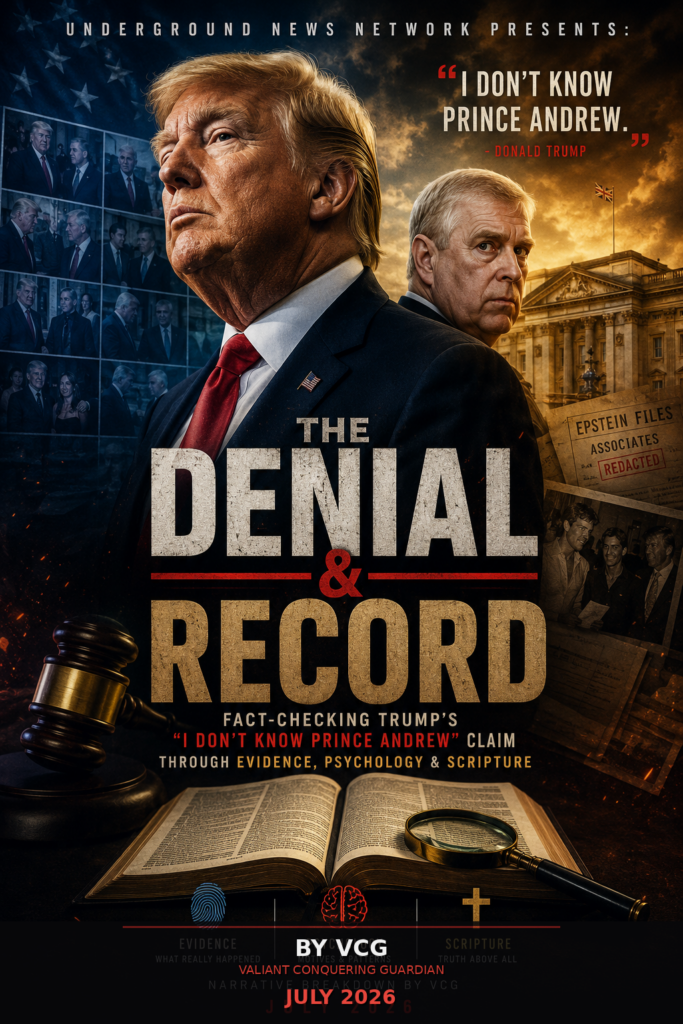
The Denial & the Record: Fact-Checking Trump’s “I Don’t Know Prince Andrew” Claim Through Evidence, Psychology & Scripture
BY VCG ON 7/28/2026
Overall verdict
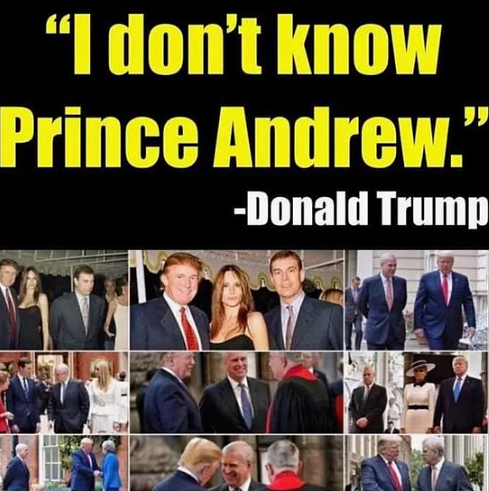
The meme’s central quotation is authentic, but the image collage is being used to make a broader argument than the evidence alone can prove.
On December 3, 2019, during the NATO summit in London, Donald Trump said:
“I don’t know Prince Andrew, but it’s a tough story, it’s a very tough story.
I don’t know him, no.”
Reuters recorded the remark contemporaneously, and a transcript of the working breakfast also contains the statement. (Reuters)
The rebuttal implied by the collage is substantially justified:
Trump and Andrew had met repeatedly, appeared together at social and official events, toured Westminster Abbey together, and participated in a breakfast meeting only about six months before Trump’s denial.
AP therefore judged the denial inconsistent with the public record. (AP News)
The careful conclusion is:
Trump really said he did not know Andrew, and the documented record strongly contradicts the ordinary meaning of that statement.
But the collage does not, by itself, prove:
a close friendship;
knowledge of Andrew’s alleged misconduct;
involvement in Epstein’s crimes;
or that every individual photograph has been accurately dated and captioned.
What the meme visibly contains
The meme consists of two different kinds of material:
- A large quotation attributed to Donald Trump.
- A grid of small photographs said to show Trump and Prince Andrew together.
Because the images are compressed and lack captions, dates and photographer credits, I cannot authenticate every individual tile from this composite alone.
Nor should any person be identified solely through facial appearance.
The relevant identities and encounters are instead confirmed through independent archival reporting and official event records.
Several publicly authenticated photographs do show Trump and Andrew together.
One Getty image places them at Westminster Abbey on June 3, 2019, and Westminster Abbey’s own account confirms Trump’s visit that day. (Getty Images)
That independent evidence is stronger than the meme itself.
Line-by-line examination
1.
“I don’t know…”
These are Trump’s actual words, not an invented meme quotation.
The statement was made after a reporter asked him about Andrew’s withdrawal from public duties amid scrutiny of Andrew’s association with Jeffrey Epstein.
Trump responded that he did not know Andrew and called it a:
“very tough story.”
(Reuters)
The crucial question is what “know” means.
It can mean several things:
“I have never met him.”
“I am not personally acquainted with him.”
“I do not know him closely.”
“I cannot speak to his private conduct.”
“I do not know the facts of the controversy.”
Trump did not say
“I barely know him”
or
“I do not know the facts.”
He gave the broader denial:
“I don’t know Prince Andrew… I don’t know him.”
In ordinary speech, that sounds like denial of personal acquaintance.
What the evidence establishes
The public record shows more than one incidental encounter:
Andrew accompanied Trump at Westminster Abbey in June 2019.
Andrew hosted or participated in a breakfast event involving Trump during the same state visit.
Photographs document encounters extending back many years.
AP reported that the two had been photographed together on occasions spanning roughly two decades. (AP News)
This makes the unqualified denial difficult to reconcile with the documented record.
What the evidence does not establish
Repeated meetings do not automatically prove:
intimacy;
confidential discussions;
friendship;
participation in wrongdoing;
or detailed knowledge of another person’s private life.
The sound rebuttal is:
“Trump’s claim not to know Andrew conflicts with evidence of repeated social and official encounters.”
The unsound exaggeration would be:
“These pictures prove Trump knew everything Andrew was accused of doing.”
2.
“Prince Andrew”
The quotation arose at a particular moment of public controversy.
Andrew had stepped back from royal duties following intense criticism over his friendship with Jeffrey Epstein and his November 2019 BBC interview.
Reuters’ report specifically identified that controversy as the context of Trump’s answer. (Reuters)
That context matters because the denial was not made during casual reminiscence.
It came when Andrew’s name had become politically and reputationally dangerous.
This creates a reasonable question:
Was Trump denying meaningful acquaintance in order to distance himself from a controversial associate?
That is a plausible interpretation, but motive cannot be read directly from a photograph or a single sentence.
It should be labeled as inference, not fact.
3.
“—Donald Trump”
The attribution is accurate.
Unlike many viral memes, this one does not fabricate the central quotation.
Reuters, AP and the event transcript independently preserve it. (Reuters)
Nevertheless, the meme omits the rest of the statement:
“But it’s a tough story, it’s a very tough story.”
That omission does not reverse the meaning of:
“I don’t know him,”
but it does remove the immediate context that Trump was responding to a particular controversy.
A complete presentation should quote the whole relevant answer.
Photograph-by-photograph limitations
The collage presents multiple images as cumulative proof.
That technique can be legitimate, but each photograph should ideally have:
a date;
a location;
a photographer;
an original archive;
an uncropped frame;
and a description of the event.
Without those, viewers cannot distinguish:
a private social gathering from a diplomatic ceremony;
a planned meeting from an incidental receiving line;
one occasion photographed repeatedly from several angles from many different occasions;
or a close relationship from public duties requiring two figures to stand together.
At least some encounters are firmly authenticated.
For example, Getty’s caption places Trump, Melania Trump and Andrew at the Grave of the Unknown Warrior in Westminster Abbey on June 3, 2019. (Getty Images)
The Washington Post also reported that Andrew welcomed Trump and then-Prime Minister Theresa May ahead of a breakfast meeting on June 4, 2019. (The Washington Post)
So, the broad rebuttal does not depend on every low-resolution tile being independently authenticated.
A few securely documented encounters are enough to disprove the strongest possible reading—
“I have never met or interacted with him.”
Evidentiary assessment
| Claim | Assessment |
|---|---|
| Trump said, “I don’t know Prince Andrew” | True |
| The quote was made in December 2019 | True |
| Trump and Andrew had previously met | True |
| They appeared together during the June 2019 state visit | True |
| Andrew participated in a breakfast involving Trump | Supported |
| Photographs exist over multiple years | Supported |
| Every tile in this meme is independently authenticated | Not established from the meme |
| The photos prove a close friendship | Not necessarily |
| The photos prove knowledge of Andrew’s alleged misconduct | No |
| The photos prove participation in Epstein-related crimes | No |
| Trump’s unqualified denial is consistent with the public record | No, not under the ordinary meaning of “know” |
The strongest responsible rebuttal
A factually disciplined rebuttal would read:
On December 3, 2019, Donald Trump said he did not know Prince Andrew.
Public records contradict an ordinary reading of that denial:
the two had appeared together at social and official events, Andrew accompanied Trump at Westminster Abbey, and Andrew participated in a breakfast meeting during Trump’s June 2019 state visit.
Those encounters establish acquaintance, but they do not by themselves prove closeness, knowledge of misconduct or criminal involvement.
That wording corrects the denial without claiming more than the evidence supports.
Methodology for evaluating this meme
Step 1: Verify the quotation separately
Do not assume that genuine-looking photographs authenticate the text.
The quote should be checked against:
video;
transcript;
wire-service reporting;
or an official record.
Here, Reuters and the event transcript verify it. (Reuters)
Step 2: Define the disputed word
The entire argument depends on “know.”
Ask:
Does the evidence show they met, were acquainted, were friends or shared private knowledge?
These are different propositions.
The photographs and meetings establish at least repeated acquaintance.
They do not automatically establish close friendship.
Step 3: Authenticate photographs individually
Reverse-search each tile and locate the earliest reliable source.
Prefer:
Reuters;
AP;
Getty;
official royal records;
White House archives;
venue records;
and contemporaneous newspaper captions.
Step 4: Reconstruct a timeline
Known anchor points include:
earlier social encounters documented in photographs;
Westminster Abbey on June 3, 2019;
a breakfast-related event on June 4, 2019;
Trump’s denial on December 3, 2019. (Getty Images)
The six-month gap between an official encounter and the denial is especially relevant.
Step 5: Keep association separate from culpability
The logical structure must remain:
repeated meetings → acquaintance
not:
repeated meetings → knowledge of crimes → participation in crimes.
Each additional claim requires additional evidence.
Psychology and rhetoric
1. Visual contradiction
The meme places the denial directly above photographs of the men together.
The viewer experiences an immediate contradiction:
“He says he does not know him, yet here they are together.”
This is effective because pictures often feel more direct than verbal qualifications.
In this case, the contradiction is meaningful, but a photograph proves physical co-presence—not necessarily closeness.
2. Cumulative-image effect
One photo could be dismissed as accidental.
A grid of many photos creates the impression of an extensive relationship.
That may be partly justified, but collage construction can inflate apparent frequency when:
several pictures come from one event;
images are different crops of the same encounter;
ceremonial meetings are presented as private socializing;
or dates are omitted.
The correct unit is not simply
“number of pictures.”
It is number, type and context of independent encounters.
3. Binary framing
The meme implicitly offers two choices:
- They never knew each other.
- They were close associates.
Reality can occupy the middle:
They clearly met repeatedly and were acquainted, but the depth of the relationship requires more evidence.
Binary framing increases shareability because nuance is less emotionally satisfying.
4. Reputation transfer
Because Andrew’s association with Epstein was notorious by December 2019, any photograph of someone beside Andrew carries moral contamination.
That can lead to:
Andrew was implicated in scandal; Trump met Andrew; therefore Trump shares Andrew’s culpability.
This is guilt by association unless independent evidence establishes knowledge or participation.
The denial should be criticized for its conflict with the record, not converted into proof of unrelated crimes.
5. Motivated reasoning
Partisans may apply opposite standards:
A critic may say:
“One photograph proves a close relationship.”
A defender may say:
“No number of meetings means they knew each other.”
Both positions distort ordinary evidentiary reasoning.
A consistent standard asks what we would conclude if the political identities were reversed.
6. Euphemistic distancing
Public figures often use phrases such as:
“I don’t know him.”
“I barely knew him.”
“He was just a volunteer.”
“We met briefly.”
“I know nothing about it.”
Such language can serve to reduce perceived association when a person becomes controversial.
AP placed Trump’s Andrew statement within a broader pattern of distancing himself from people who had become politically inconvenient. (AP News)
That pattern is relevant context, but it still does not allow us to read Trump’s private intent with certainty.
Scripture correction
1. Do not bear false witness
“Thou shalt not bear false witness against thy neighbour.”—Exodus 20:16
This command applies in both directions.
It would be false or misleading to deny documented acquaintance when repeated meetings are publicly established.
It would also be false to say the photographs prove participation in Andrew’s alleged misconduct when they do not.
Truth requires correcting both understatement and exaggeration.
2. Do not raise a false report
“Thou shalt not raise a false report:
put not thine hand with the wicked to be an unrighteous witness.”—Exodus 23:1
A meme can communicate a false report without inventing every component.
Here:
the quote is genuine;
several encounters are genuine;
but an added insinuation of shared criminal guilt would exceed the evidence.
We should preserve what is true while refusing unsupported implications.
3. Hear the whole matter
“He that answereth a matter before he heareth it, it is folly and shame unto him.”
—Proverbs 18:13
Before judging, hear:
the full quotation;
its date and setting;
the dates of the photographs;
what kind of events they depict;
and what the images do and do not prove.
The meme gives a useful contradiction but not a complete evidentiary file.
4. Search the first account
“He that is first in his own cause seemeth just; but his neighbour cometh and searcheth him.”—Proverbs 18:17
Trump’s denial may initially sound decisive.
The archival record “searcheth” that denial and reveals repeated contact.
Yet the same verse also teaches us to search the meme itself rather than accepting its implied conclusions uncritically.
5. Judge without respecting status
“Thou shalt not respect the person of the poor, nor honour the person of the mighty:
but in righteousness shalt thou judge thy neighbour.”—Leviticus 19:15
Trump’s office and Andrew’s royal status should neither shield them from factual scrutiny nor justify accusations beyond the evidence.
Righteous judgment is impartial:
no special protection for the powerful;
no special permission to slander them.
6. Test all claims
“Prove all things; hold fast that which is good.”—1 Thessalonians 5:21
After testing, we may hold fast to these conclusions:
Trump made the denial.
Trump and Andrew had met repeatedly.
The denial was materially misleading under its ordinary meaning.
The photographs do not establish criminal complicity.
Final conclusion
The meme’s core rebuttal is substantially correct:
Donald Trump publicly said he did not know Prince Andrew despite documented social and official encounters, including events only months earlier.
The strongest evidence is not the low-resolution collage itself but authenticated photographs, official event records, contemporaneous reporting and the transcript of Trump’s own words. (Reuters)
The disciplined conclusion is:
The denial conflicts with the documented record of acquaintance.
The record justifies calling the statement misleading, but it does not by itself prove intimate friendship, knowledge of misconduct or participation in any crime.
VCG INVESTIGATION: TRUMP – Library of Rickandria