
The Image & the Allegation: Fact-Checking a Viral Trump–Ivanka Meme Through Evidence, Psychology & Scripture
BY VCG ON 7/28/2026
Overall verdict
The photograph appears to come from a real September 1995 father–daughter photo shoot, but the quotation superimposed on it is not verified as an authenticated Donald Trump quotation.
The most defensible rating is:
Photo: authentic or substantially authentic.
Quotation: unproven.
Combined meme: misleading, because it visually presents an unsupported quotation as established fact.
The image’s emotional force comes from combining three separate elements:
a genuine family photograph;
a disturbing quotation attributed to Trump;
the parenthetical claim that Ivanka was thirteen.
Only the photograph and her approximate age are well supported.
The specific quotation lacks a recording, transcript, named firsthand witness or published contemporaneous source.
What the photograph actually shows
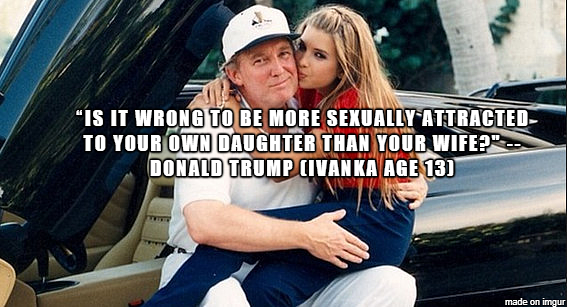
The meme uses an image from a staged photo session in which Donald Trump and his teenage daughter Ivanka posed around a Ferrari.
Archival entertainment coverage dates the shoot to September 1995 and describes Ivanka sitting on her father’s lap and kissing him on the cheek. (Extra)
Ivanka Trump was born on October 30, 1981, so in September 1995 she was indeed thirteen, turning fourteen the following month. (Wikipedia)
Visually, the image shows:
a father and daughter sitting together beside or partly inside a sports car;
the daughter kissing her father’s cheek;
his arm around her;
his other hand resting around her hip or upper thigh area;
a posed, fashion-oriented photographic setting.
Those observations are descriptive.
The photograph alone cannot establish:
sexual attraction;
sexual intent;
abuse;
incestuous conduct;
what either person privately thought;
or whether a disputed quotation was ever spoken.
People may reasonably find the pose uncomfortable, especially when the image is paired with Trump’s separately documented comments about Ivanka.
But discomfort is interpretation, not proof of the captioned quotation.
Line-by-line fact-check
1.
“Is it wrong…”
The opening is framed as a rhetorical question.
Rhetorical questions often communicate a proposition while retaining plausible deniability. Instead of directly saying,
“I am more attracted to my daughter,”
the attributed wording asks whether such attraction would be morally wrong.
Psychologically, this structure is powerful because readers mentally supply the implied confession:
Why would someone ask this unless it described his own feelings?
That inference may be understandable, but before interpreting the psychology of the speaker, we must establish whether the speaker actually said it.
In this case, that foundational step has not been completed.
2.
“…to be more sexually attracted…”
This is the central allegation.
The phrase does not merely call Ivanka attractive or beautiful.
It attributes a specifically sexual attraction to her father.
Because that allegation is unusually serious, the required evidentiary standard should be correspondingly high.
Ideally, one would want:
audio or video;
a contemporaneous transcript;
a named direct witness;
contemporaneous notes;
multiple independent witnesses;
or an on-record confirmation.
None has surfaced publicly for this exact sentence.
Fact-checking reviews have therefore classified the quotation as unproven, not authenticated. (Snopes)
“Unproven” does not mean:
“It was conclusively fabricated.”
It means:
“The available public evidence is insufficient to affirm that Trump said it.”
That distinction must be preserved.
3.
“…to your own daughter…”
This is the language that creates the strongest moral shock.
The meme intentionally pairs the words “sexually attracted” and “own daughter” with a physical image of the father and daughter embracing.
This is a textbook example of visual anchoring:
the photograph causes the unsupported quotation to feel witnessed.
But the picture is not photographic evidence of the words.
The image and quotation came from different evidentiary streams:
the image came from a documented photo shoot;
the quotation circulated from a later journalistic anecdote;
the meme fuses them into what looks like one contemporaneous record.
That fusion is misleading even if the designer sincerely believed the quotation.
4.
“…than your wife?”
This introduces a supposed comparison between daughter and wife.
At the probable time alleged—1994 or 1995—Trump was married to Marla Maples.
But the meme does not identify the wife, date the alleged conversation precisely or provide a firsthand source.
The comparative structure intensifies the accusation because it implies not only sexual attraction toward his daughter, but attraction exceeding that toward his spouse.
Again, this is not a minor paraphrase.
It is an extraordinary claim requiring direct evidence.
5.
“Donald Trump”
The quotation is presented as verbatim speech from Trump.
Quotation marks ordinarily mean:
These exact words were spoken or written by this person.
The traceable public origin is much weaker.
In 2016, Washington Post columnist Richard Cohen reportedly included the sentence in an early draft of a column.
The draft allegedly said Trump had asked the question of
“someone I know”
when Ivanka was thirteen.
The sentence was removed before the syndicated column was published. (BET)
That source chain is:
unnamed person
→ recounts alleged conversation to Richard Cohen
→ Cohen places it in a draft
→ sentence is removed before publication
→ draft is reported by other outlets
→ quote spreads as an established fact.
This is not equivalent to a direct recording or named witness.
The source may have been telling the truth.
Cohen may have considered the source credible. But outsiders cannot adequately test:
who the source was;
whether the source heard it firsthand;
when the remark allegedly occurred;
whether the exact words were remembered accurately;
whether the remark was serious, joking or misquoted;
why the passage was removed;
or whether Cohen ultimately stood behind it.
Therefore the attribution must remain qualified.
6.
“Ivanka age 13”
This part is plausible and likely accurate for the photographed September 1995 session.
Because Ivanka was born October 30, 1981, she was thirteen during September 1995. (Wikipedia)
However, the meme subtly suggests more than the age calculation proves:
The quoted sentence was spoken at the time this exact picture was taken.
There is no established evidence connecting the alleged statement to this photo shoot.
The quotation has been variously dated online to 1993, 1994 or 1995.
That instability is another warning sign.
A reliable quotation should normally have a consistent source, date and context.
So the accurate statement is:
Ivanka was thirteen in the photograph.
The unsupported statement is:
Trump spoke this quotation during or in connection with this photographed moment.
What Trump is separately documented as saying
Rejecting this exact quotation as unproven does not require pretending that Trump never made troubling public comments about Ivanka.
Several other remarks are directly documented.
“Perhaps I’d be dating her”
During a 2006 appearance on The View, Trump said that if Ivanka were not his daughter, “perhaps” he would be dating her.
The remark was recorded and broadcast, and Trump’s spokesperson described it as a joke about his tendency to date younger women. (Yahoo)
That quotation is authenticated.
Comments about her body
On Howard Stern’s program, Trump participated in discussion of Ivanka’s body and said she had always been “very voluptuous.”
Contemporary reporting and preserved coverage document that exchange. (The Independent)
Other Stern appearances
There are searchable transcripts of Trump’s Howard Stern interviews documenting crude and sexualized conversation.
But the specific
“more sexually attracted to your own daughter than your wife”
sentence does not appear in the authenticated transcript material cited for those broadcasts. (Roll Call)
This yields an important conclusion:
There is strong evidence that Trump publicly made inappropriate or sexualized comments about Ivanka.
There is not comparable evidence authenticating this exact meme quotation.
Both statements can be true.
A careful rebuttal must not use one category of evidence to erase the other.
Evidentiary classification
| Claim | Assessment |
|---|---|
| The photograph is genuine | Strongly supported |
| The session occurred in September 1995 | Supported by archival footage coverage |
| Ivanka was thirteen | Supported by date of birth and shoot date |
| Trump and Ivanka posed affectionately beside a Ferrari | Supported |
| Trump said the captioned words during the photo shoot | No evidence |
| Trump said the exact words at another time | Unproven |
| The quote appeared in a journalist’s unpublished draft | Reported |
| The journalist cited a named eyewitness | No |
| Audio, video or transcript exists | None publicly established |
| Trump made other sexualized remarks about Ivanka | Authenticated |
| The photograph proves incestuous intent or conduct | No |
Proper fact-checking methodology
Step 1: Separate image authentication from quote authentication
A genuine photograph can carry a false quotation.
Ask two independent questions:
- Where did the photograph originate?
- Where did the words originate?
The meme encourages the viewer to answer both questions at once.
That is precisely what should not be done.
Step 2: Trace the quotation to its earliest source
The earliest traceable chain appears to be an unpublished 2016 draft by columnist Richard Cohen, referring to an unnamed acquaintance.
That should be described as:
“Cohen reportedly alleged that an unnamed person told him Trump said…”
It should not be simplified to:
“Trump said…”
Each shortening removes a layer of uncertainty.
Step 3: Search primary-source archives
Relevant archives include:
full Howard Stern recordings and transcripts;
television interviews;
newspaper databases;
public speeches;
published memoirs;
original columns;
and named firsthand testimony.
The quotation is often misattributed to Howard Stern, but no authenticated Stern recording has been produced for this exact wording.
Step 4: Test the date
The meme should answer:
Was it 1993, 1994 or 1995?
Who heard it?
Where was it said?
Which wife was being referenced?
Was Ivanka actually thirteen at that moment?
When an allegation’s date changes across reposts, confidence should decrease until the discrepancy is resolved.
Step 5: Distinguish pattern evidence from proof of one quote
Trump’s authenticated remarks may make the disputed quote sound plausible.
But plausibility is not provenance.
A person who has made several inappropriate comments could also be falsely attributed a different comment.
Fact-checking exists precisely to prevent:
“It sounds like something he would say”
from becoming:
“He definitely said it.”
Psychological construction of the meme
1. Picture-superiority effect
People remember images more readily than source qualifications.
The affectionate photograph becomes the mental evidence for words that were never recorded in the image.
Later, a viewer may remember:
“I saw the picture where he said it.”
But photographs do not contain speech unless the speech was captured or reliably captioned.
2. Emotional congruence
The image was selected because the pose appears consistent with the accusation.
The daughter is seated on her father’s lap, kissing his cheek, while his hand is positioned around her lower body.
When placed beside a sexual-attraction quotation, ordinary physical details take on a sexualized interpretation.
Without the caption, many viewers might read it simply as a staged father–daughter portrait.
The words change the perceived image; the image then appears to confirm the words.
This is a circular persuasion loop.
3. Confirmation bias
Critics familiar with Trump’s documented remarks may accept the quote instantly because it fits an existing pattern.
Supporters may reject every related quotation—including recorded ones—because this particular meme is unreliable.
Both errors should be avoided:
a false or unproven meme does not erase authentic remarks;
authentic remarks do not authenticate every meme.
4. Source laundering
An allegation gains apparent strength through repetition:
unnamed source
→ columnist’s draft
→ news article about draft
→ meme
→ thousands of shares
→ “widely reported fact.”
The number of reposts does not create an independent witness.
Many pages may all derive from one anonymous anecdote.
5. Moral disgust as an accuracy suppressant
The idea of a father being sexually attracted to a minor daughter creates immediate disgust.
That reaction can make requests for evidence feel like moral evasion.
But requiring proof is not defending incest. It is defending truth.
One can simultaneously say:
“Such a sentiment would be morally abhorrent.”
and:
“We have not established that this person spoke these exact words.”
6. The familiarity effect
Repeated quotations become cognitively familiar.
Familiarity is often misread as authenticity:
“I have seen this quote for years, so there must be a recording.”
But repetition may indicate only that one meme was copied many times.
Scripture correction
1. Do not bear witness beyond the evidence
“Thou shalt not bear false witness against thy neighbour.”—Exodus 20:16
The command applies even when the subject is powerful, offensive or politically hated.
To place quotation marks around unverified words is to testify that the person spoke them.
If that has not been established, the wording must be qualified.
A Christianly responsible caption would say:
“Trump was alleged by an unnamed source, reported in an unpublished draft, to have asked…”
That is cumbersome because the evidence itself is indirect.
The inconvenience of accurate wording does not justify removing the uncertainty.
2. Do not circulate a false report
“Thou shalt not raise a false report:
put not thine hand with the wicked to be an unrighteous witness.”—Exodus 23:1
A report may be false in two ways:
wholly invented;
or presented with greater certainty than the evidence warrants.
The quotation might eventually be corroborated.
At present, sharing it as settled fact exceeds the available support.
3. Hear the whole matter first
“He that answereth a matter before he heareth it, it is folly and shame unto him.”
—Proverbs 18:13
The meme gives the emotional conclusion before the reader hears:
that the quote came from an anonymous anecdote;
that it appeared only in a draft;
that it was removed;
and that no recording has been produced.
That omitted context is essential.
4. Examine the first account
“He that is first in his own cause seemeth just; but his neighbour cometh and searcheth him.”—Proverbs 18:17
The first presentation appears conclusive:
photograph + quotation + age = proof.
Searching the matter reveals that each element has a different provenance and evidentiary strength.
5. Test everything
“Prove all things; hold fast that which is good.”—1 Thessalonians 5:21
“Prove” here carries the sense of testing or examining.
It does not mean cynically rejecting all reports.
After testing:
retain the authentic photograph;
retain the accurate age;
retain Trump’s genuinely recorded remarks;
reject certainty about the unsupported quotation.
6. Speak truthfully without partisan hatred
“But speaking the truth in love…”—Ephesians 4:15
“Love” does not require minimizing repulsive speech.
“Truth” does not allow inventing or overstating it.
The Christian standard is neither flattering the powerful nor slandering them.
7. Fathers bear a duty toward children
“And, ye fathers, provoke not your children to wrath:
but bring them up in the nurture and admonition of the Lord.”—Ephesians 6:4
Biblically, the parental role is protective and formative, not sexualized.
Trump’s authenticated public comments about dating Ivanka or discussing her body may therefore be criticized as inappropriate and inconsistent with the dignity proper to a father–daughter relationship.
But Scripture’s moral standard must be applied using truthful evidence.
A righteous conclusion reached through false witness is still corrupted.
A responsible corrected caption
This genuine September 1995 photograph shows thirteen-year-old Ivanka Trump posing affectionately with her father during a Ferrari photo shoot.
A later claim that Donald Trump asked whether it was wrong to be more sexually attracted to his daughter than his wife originated from an unpublished draft citing an unnamed source; no recording, transcript or named firsthand witness has publicly authenticated the quotation.
Trump did, however, make other recorded sexualized remarks about Ivanka, which should be evaluated on their own documented evidence.
Final conclusion
This meme is most accurately classified as:
A genuine photograph paired with an unverified quotation.
Its strongest factual elements are:
the photo shoot was real;
Ivanka was thirteen;
Trump later made other genuinely documented remarks about her that many people reasonably regard as inappropriate.
Its central weakness is decisive:
the exact quotation shown in large quotation marks has not been authenticated.
The truthful response is therefore neither blanket exoneration nor careless condemnation:
Criticize what is documented.
Investigate what is alleged.
Do not turn an anonymous anecdote into a verbatim historical fact.
VCG INVESTIGATION: TRUMP – Library of Rickandria