
WHO IS GOD?
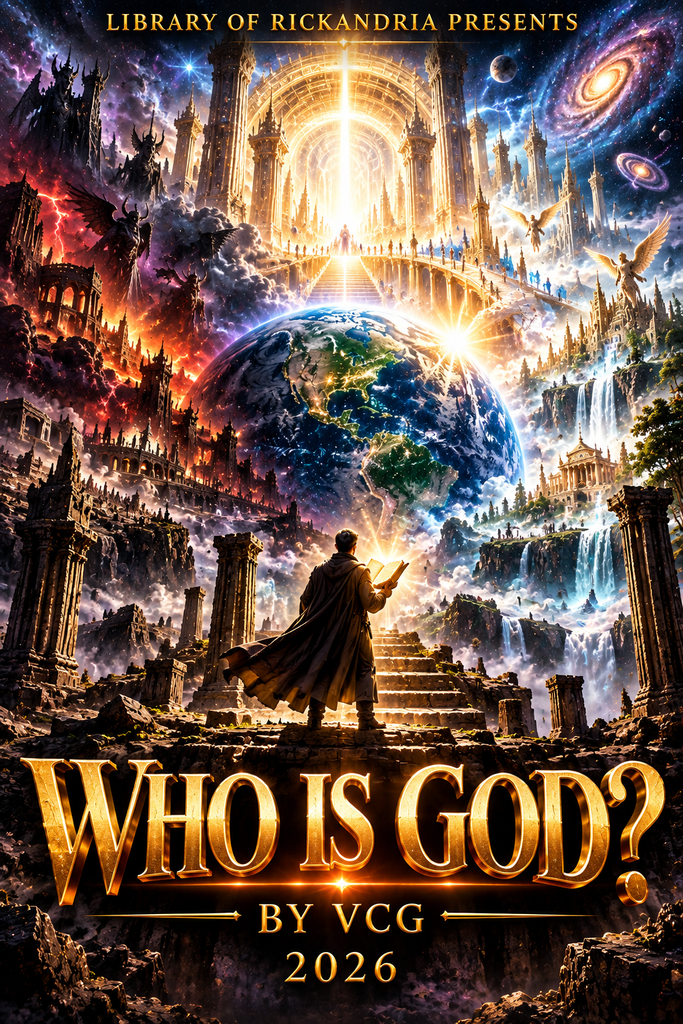
UPDATED BY VCG ON 10/25/2026 @ 14:14 EST
WHO IS GOD?
LIBRARY OF RICKANDRIA PRESENTS
The Nature of God, Creation, Suffering, Divine Justice & the Search for Truth
18 Investigations • By VCG • 2026
“Prove all things; hold fast that which is good.” — 1 Thessalonians 5:21, KJV
Introduction
The question
“Who is God?”
is not merely an argument about whether a powerful being exists.
It also asks what the word God means, whether creation reveals anything about its Creator, what Scripture attributes to God, why evil and suffering occur, how judgment relates to mercy, and whether human beings can mistake their own experiences for divine revelation.
The Library of Rickandria’s Who Is God? collection brings together 18 investigations by VCG, primarily examining conversations on 4chan’s paranormal board, /x/.
These conversations are the subjects of investigation, not authorities on theology.
A forum post records what someone claimed; it does not establish the claim’s truth.
This research hub organizes the studies by their central questions, introduces relevant King James Bible passages, and makes room for serious objections.
Its purpose is to help readers distinguish the biblical text, historical and scientific evidence, theological interpretation, and unverified speculation—especially when someone speaks with certainty about another person’s suffering or claims to know the mind of God.
The God Described in Scripture
Before asking whether a viral claim accurately describes God, establish which conception of God is being discussed.
The following is a summary of the biblical portrayal; it should not be mistaken for independent empirical proof or an exhaustive account of every Christian interpretation.
The Creator, not another creature.
Genesis 1:1 opens with God creating the heavens and the earth; Acts 17:24–25 speaks of the God who gives life and breath.
In the biblical presentation, God is not merely the strongest being inside the universe.
Eternal and self-existent.
Psalm 90:2 describes God as being:
“from everlasting to everlasting.”
In Exodus 3:14, God declares,
“I AM THAT I AM.”
These passages have shaped centuries of reflection on divine identity.
One God, and the Christian confession about Christ.
Deuteronomy 6:4 affirms the oneness of the LORD.
John 1:1 and 1:14 speak of the Word who was God and was made flesh.
Historic Trinitarian Christianity reads these and other passages together; how they should be understood is a matter of substantial theological discussion.
Holy, just and merciful.
Exodus 34:6–7 joins mercy and forgiveness with accountability.
The books of Job and the Psalms also preserve honest questions about apparent injustice, rather than forbidding lament.
Not sustained by human attention.
Acts 17:25 says God is not served:
“as though he needed any thing.”
Whatever one’s ultimate conclusions about worship, the biblical description is not of a deity kept alive by consuming human fear or praise.
Christian doctrine further understands God’s identity through the life, death and resurrection of Jesus Christ (John 1:14; 1 Corinthians 15).
- Judaism
- Islam
- Buddhism
and other traditions should not be collapsed into a single doctrine simply because familiar words appear across them.
A Research Collection, Not an Oracle
These papers study:
- anonymous claims
- difficult biblical passages
- theological disputes
- philosophical arguments
and sometimes reports of troubling personal experiences.
A documented thread shows what was posted; a historical text shows what an author taught; medical research supports conclusions within its methods and limitations; Scripture provides evidence of biblical teaching; and none of these categories can silently stand in for all the others.
Each investigation should be read alongside its linked primary materials and scriptural references.
The descriptions below summarize the linked articles; they do not amount to fresh independent verification of every cited detail.
EXPLORE THE 18 INVESTIGATIONS
01. God, Creation & Worship
What is meant by “God”?
Is the Creator separate from creation?
Does worship nourish God?
How do different traditions use the same words?
1. Did God Sabotage Human DNA?
Biology, aging and the Demiurge
A forum discussion interprets human biological limitations as deliberate genetic sabotage by an allegedly hostile creator.
The investigation checks claims about:
- bones
- aging
- genetics
- Gnostic cosmology
and concludes that bodily vulnerability does not establish intentional sabotage.
Read the Investigation — Did God Sabotage Human DNA?
2. God, Worship & the “Parasite” Claim
Does God depend on human worship?
This analysis takes seriously questions about worship, judgment and divine authority, then examines the allegation that gods feed on belief, fear or suffering.
It contrasts the parasite theory with Acts 17:24–25 and Psalm 50, which portray the biblical God as the giver rather than a dependent consumer.
Read the Investigation — God, Worship & the “Parasite” Claim
3. Did Buddha Reject God—or Did 4chan Get It Wrong?
Buddhism, the “I AM” and competing definitions
The study distinguishes early Buddhist teaching about liberation and creator claims from Christian doctrine about God and Jesus Christ.
It cautions against assuming the historical Buddha personally rejected the biblical God and against treating every use of “God,” “self” or “enlightenment” as equivalent.
Read the Investigation — Did Buddha Reject God?
02. Suffering, Justice & Divine Hiddenness
Why do people suffer?
Does tragedy mean God hates someone, has abandoned the world, or has sentenced humanity to punishment?
4. Did God Die… or Did We Get Sent to Hell?
The abandoned-heaven and spiritual-prison theory
Beginning with a speculative picture of an empty heaven, this investigation studies the claim that Earth is punishment for forgotten pre-earthly crimes.
It finds no evidence for that prison narrative and shows why pain cannot be taken as proof of concealed guilt.
Read the Investigation — Did God Die… or Did We Get Sent to Hell?
5. GOD ON TRIAL: The 4chan Thread That Put Heaven in the Hot Seat
Can a sufferer ask God for a fair trial?
A discussion about seeking a hearing before God grows into debate over:
- Job
- Satan
- the Demiurge
- judgment
- reincarnation
The study asks what actually justifies calling someone’s illness or misfortune a divine sentence; the companion full text examines 46 posts.
Read the Investigation — GOD ON TRIAL
6. “I Hate God. I Know He Exists.”
Anger at God and the problem of evil
A twelve-post exchange accuses God of permitting or enjoying human misery.
The investigation distinguishes a sincere moral objection from speculative explanations about predestination, divine cruelty and counterfeit creators, without treating every person’s suffering as a simple spiritual lesson.
Read the Investigation — “I Hate God. I Know He Exists.”
7. Does God Hate Me—or Is 4chan Lying?
Happiness, curses and the appearance of divine favor
This study challenges the claims that happiness is always a choice, persistent disappointment proves a curse, or worldly success proves God’s approval.
It brings together Job, biblical lament, social comparison and psychological research, with particular care for people already in distress.
Read the Investigation — Does God Hate Me?
8. Does God Hate the Broken?
Prosperity, despair and victim-blaming
The starting point is a meme depicting God as favoring the prosperous and rejecting the afflicted.
The paper examines:
- inequality
- religious guilt
- prison-planet speculation
- Gnostic explanations
while rejecting the inference that hardship reveals someone’s guilt or rejection by God.
Read the Investigation — Does God Hate the Broken?
9. “DOES YHWH HATE ME?”
Job, Isaiah 45:7 and undeserved suffering
An investigation of 32 posts weighs accusations against YHWH, disputed interpretations of Isaiah 45:7, and arguments about Satan and the Book of Job.
It emphasizes that Job’s friends are rebuked for confidently explaining suffering they did not understand.
Read the Investigation — “DOES YHWH HATE ME?”
03. Judgment, Moral Questions & Human Freedom
Is God just?
How should difficult biblical narratives be read?
How are divine sovereignty and human responsibility related?
10. Did God Command Genocide?
Numbers 31, 1 Samuel 15 and the moral difficulty of biblical violence
The study confronts passages involving the killing of children and taking of captives rather than concealing their brutality.
It distinguishes what the biblical narratives say, which actions are attributed to divine command, competing moral interpretations, and claims that misquote or oversimplify the texts.
Read the Investigation — Did God Command Genocide?
11. God’s Will vs. Man’s Free Will
Calvinism, Arminianism and Pharaoh’s heart
An eight-post controversy becomes a guided examination of:
- Romans 9–11
- election
- grace
- Pharaoh’s hardened heart
- moral accountability
The article resists the false choice that either God is sovereign or human decisions matter.
Read the Investigation — God’s Will vs. Man’s Free Will
12. 4chan /x/ Put God on Trial—But Did Anyone Read the Bible?
Heaven, hell and what a just judgment means
Beginning with whether God admits people to heaven according to personal preference, this study tests arguments about:
- divine punishment
- freedom
- biblical consistency
and the reliability of competing religious assertions.
It asks whether participants are critiquing the biblical account or an imagined substitute.
Read the Investigation — 4chan /x/ Put God on Trial
04. Spiritual Claims, Consciousness & Human Godhood
Can intense experience, new religious language or confidence in a revelation establish that someone speaks for God—or is God?
13. GOD, DRUGS & GANGSTALKING
Fear, medications and allegations of persecution
A discussion about substances, God’s approval and alleged organized harassment becomes a study in the difference between distress and the explanations attached to it.
The paper rejects unsupported surveillance and demonic claims while warning against risky medical advice and casual diagnoses.
Read the Investigation — GOD, DRUGS & GANGSTALKING
14. THE COSMIC JOKE EXPOSED: DID LSD REVEAL GOD?
Psychedelic certainty, solipsism and spiritual interpretation
After an intense reported LSD experience, a poster asks whether the universe disclosed that they are God.
This investigation explores:
- altered self-experience
- consciousness
- philosophical solipsism
and KJV passages sometimes invoked to claim universal godhood.
Read the Investigation — THE COSMIC JOKE EXPOSED
15. When Internet Prophets Play God
Anonymous certainty versus spiritual authority
A poster asserts spiritual certainty and uses language resembling divine authority.
The study examines:
- prophecy
- salvation
- inflammatory historical claims
- the misuse of Scripture
arguing that a confident speaker has not thereby acquired God’s authority.
Read the Investigation — When Internet Prophets Play God
16. God’s Body Cam?
Psalm 139, human dignity and a harmful analogy
This article examines the claim that human consciousness functions as a recording device for God.
It explains why divine knowledge in Psalm 139 does not reduce a person to a camera, and it rejects the thread’s dangerous romanticization of suicide.
Read the Investigation — God’s Body Cam?
17. THE 5D DECEPTION
Manifestation, cosmology and supposed power over reality
A forum theory combines flat-Earth ideas, gravity, higher dimensions and manifestation into a program for personal godhood.
The investigation distinguishes changes in perception from evidence of changes to physical reality and examines misapplied biblical language about creation.
Read the Investigation — THE 5D DECEPTION
18. “ARE WE ALL GOD?”
One consciousness, Jesus and the Creator–creature distinction
A 38-post exchange proposes that all persons are one divine consciousness and reinterprets Jesus accordingly.
The paper tests these claims against:
- the New Testament
- philosophy
- neuroscience
distinguishing union with God, bearing God’s image and literally being God.
Read the Investigation — “ARE WE ALL GOD?”
An Order for Careful Reading
Begin with God’s character.
Read God, Worship & the “Parasite” Claim and Did Buddha Reject God? for definitions, dependence, worship and important differences between traditions.
Face the hardest objections.
Read “DOES YHWH HATE ME?”, GOD ON TRIAL, and Did God Command Genocide? to consider suffering, divine justice and morally difficult biblical texts.
Examine freedom and judgment.
Read God’s Will vs. Man’s Free Will and 4chan /x/ Put God on Trial for:
- sovereignty
- judgment
- responsibility
- grace
Test modern claims of godhood. Finish with THE COSMIC JOKE EXPOSED and “ARE WE ALL GOD?”, which examine spiritual experience and the distinction between creation and Creator.
How to Test a Claim About God
A useful investigation keeps different kinds of evidence in their proper places:
- Scripture: What does the passage actually say, who is speaking, and what is its literary and historical context?
- History: Can a claim about a text, event, tradition, person or quotation be checked against documentary evidence?
- Science and psychology: Does a theory make a testable claim? Do available studies support it, and what do they not show?
- Philosophy: Are the premises clear, are the terms consistent, and does the conclusion follow?
- Interpretation: Where does a reasonable inference begin, and where do different Christian or non-Christian perspectives disagree?
Be especially cautious when a stranger claims to know why a specific person is suffering, diagnoses another person from a forum message, or presents fear and spiritual intimidation as evidence.
Compassion, careful reasoning and appropriate practical support should not be discarded for a dramatic theory.
Frequently Asked Questions
Who is God according to the King James Bible?
In Scripture, God is presented as the uncreated Creator, eternal, sovereign, holy, just and merciful (Genesis 1:1; Psalm 90:2; Exodus 34:6–7).
The New Testament places Jesus Christ at the center of its account of God’s self-disclosure (John 1:1–14; Hebrews 1:1–3).
These are descriptions of biblical teaching, not independently measured scientific propositions.
Does God need people to worship him?
Acts 17:24–25 denies that the Creator depends upon human service for what he lacks.
Biblical worship is better understood in terms of honoring, trusting and responding to God than supplying him with a substance necessary for survival.
Philosophers and theologians debate why worship is fitting.
Does suffering mean God hates someone?
Neither Job nor John 9 supports a rule that a person’s suffering reveals a particular secret sin or divine rejection.
The Bible includes both judgment narratives and accounts of righteous sufferers.
No stranger can infer God’s private verdict about a person from hardship alone.
Did God create evil?
Isaiah 45:7 says, in the KJV,
“I make peace, and create evil.”
The immediate contrast with peace makes the passage central to debates over calamity, judgment and moral evil.
Responsible interpretation examines its Hebrew wording, context and related passages rather than deriving an entire doctrine from one English word.
Does the Bible teach that people are gods?
Genesis 1:27 says humans are created in God’s image, which does not simply identify the creature with the Creator.
Psalm 82:6 and John 10:34–36 must be interpreted in context; different traditions debate themes such as participation in divine life, but that is not the same claim as every individual literally being the one Creator.
Does divine sovereignty cancel human responsibility?
The Bible speaks both of God’s purposes and of commands, choices and accountability.
Calvinist, Arminian and other Christian traditions explain their relationship differently.
The collection’s study of Romans 9–11 and Pharaoh’s hardened heart explores this disagreement.
Can dreams, psychedelics or strong convictions prove a revelation came from God?
An experience may be intense and sincerely reported without establishing the supernatural explanation attached to it.
First John 4:1 calls for testing spiritual claims.
Historical, psychological and scientific evidence may help assess some parts of a report; Scripture must still be read in context.
Related Research Collections
THE 4CHAN FILES — Where Anonymous Claims Meet Evidence & Scripture
The wider archive of online-claim investigations.
Final Perspective
Some questions addressed here are theological:
what does Scripture reveal about:
- God
- Christ
- judgment
- mercy
- prayer
and human dignity?
Others are historical or empirical:
was a quotation authentic, did an event occur, or does a proposed mechanism have evidence?
Still others are philosophical:
how can divine goodness be reconciled with suffering, and how should human responsibility be understood?
No single anonymous discussion settles these questions.
Nor does an easy answer become true because it feels reassuring.
This collection exists to make the strongest available evidence visible, preserve the hard questions, and distinguish Scripture from confident human invention.
“The secret things belong unto the LORD our God:
but those things which are revealed belong unto us and to our children for ever…” — Deuteronomy 29:29, KJV
Soli Deo Gloria — To God alone be the glory.
LIBRARY OF RICKANDRIA
Research & Investigations by VCG
© 2026 — SOLI DEO GLORIA
THE 4CHAN FILES: Where Anonymous Claims Meet Evidence & Scripture – Library of Rickandria
VCG PAPER PROJECTS – Library of Rickandria