
Did Buddha Reject God—or Did 4chan Get It Wrong? A Line-by-Line Biblical Investigation of Enlightenment, the “I AM” & the War Over Ultimate Truth
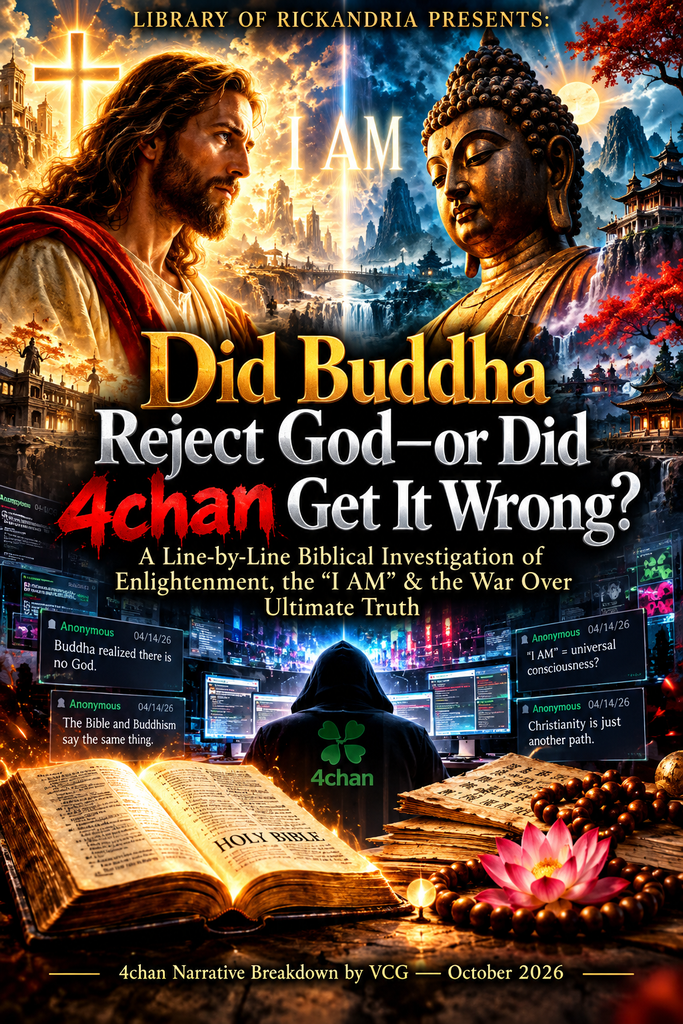
UPDATED BY VCG ON 10/11/2026 @ 18:18 EST
Anyone can do this, but most won’t.
Did Buddha Reject God—or Did 4chan Get It Wrong? is an extensive, evidence-based investigation by the Library of Rickandria examining a controversial October 2026 4chan discussion about Buddhism, Christianity, enlightenment, divine authorship, and the nature of ultimate reality. Through a detailed post-by-post analysis, the paper separates historical facts from theological interpretations, compares early Buddhist teachings with the King James Bible, investigates the meaning of the biblical “I AM,” and exposes logical fallacies, misattributed quotations, religious misconceptions, and psychological patterns of online persuasion. Drawing upon Scripture, ancient religious texts, historical scholarship, philosophy, and peer-reviewed psychological research, the investigation challenges the assumption that the Buddha knowingly rejected the biblical God while demonstrating the profound differences between Buddhist liberation and salvation through Jesus Christ. Ultimately, the paper argues that truth must be established through careful examination of evidence, faithful interpretation of Scripture, sound reasoning, and intellectual humility—not speculation, spiritual claims of superiority, or religious prejudice. Its guiding principle is simple: test every claim, distinguish fact from interpretation, and never sacrifice truth to win an argument. Soli Deo Gloria.
ChatGPT – Library of Rickandria
LIBRARY OF RICKANDRIA PRESENTS
Did Buddha Reject God—or Did 4chan Get It Wrong?
A Line-by-Line Biblical Investigation of Enlightenment, the “I AM” & the War Over Ultimate Truth
4chan Narrative Breakdown by VCG | October 2026
A historical, philosophical, psychological, and scriptural investigation of 4chan /x/ Thread No. 43050524
Primary biblical text: The Holy Bible, King James Version, Pure Cambridge Edition
Abstract
On October 6, 2026, an anonymous user on 4chan’s paranormal board posted an image of the Buddha and asked a deceptively simple question:

“Why did he reject God?
He thinks he enlightened himself?”
/x/ – Why did he reject God? He thinks he enlightened hi – Paranormal – 4chan
What followed was a sprawling discussion about:
- Buddhism
- Christianity
- Hindu philosophy
- divine creation
- personal identity
- the meaning of enlightenment
and the possibility that everything in existence is somehow God.
Some participants attempted serious philosophical arguments.
Others quoted religious texts without identifying their sources.
Several confused different traditions or treated speculative metaphysical propositions as settled facts.
Still others introduced:
- insults
- antisemitic claims
- occult symbolism
and assertions of supernatural knowledge.
The thread is interesting not because anonymous users settled any of these questions, but because it exposes a larger problem in contemporary religious discourse:
people frequently use the same words while arguing about fundamentally different ideas.
The word God can refer to:
- the biblical Creator
- the Buddhist deity Brahmā
- the Hindu philosophical principle Brahman
- a personal Lord called Īśvara
or an impersonal absolute reality.
The word self may refer to:
- an ordinary human person
- an immortal soul
- an independent metaphysical essence
or the ego as understood in popular psychology.
When these distinctions disappear, disagreement becomes inevitable—and genuine understanding becomes difficult.
This paper examines the thread chronologically, evaluates its most important arguments against primary historical and religious sources, and tests its biblical claims against the King James Bible.
It also investigates the psychology of anonymous online discourse, the misuse of religious symbolism, and the limits of what historical scholarship can establish.
Its central conclusion is that the historical and theological evidence supports a much more precise answer than the thread’s opening question allows:
Early Buddhism does not teach salvation through the biblical Creator, and certain early Buddhist texts challenge claims of supreme creatorhood.
But this does not establish that the historical Buddha knowingly and personally rejected the God of Abraham.
Christianity and Buddhism have genuine, consequential doctrinal differences. Understanding those differences requires neither caricature nor hostility.
The purpose here is not to make every tradition say the same thing, nor to manufacture evidence against an opposing view.
It is to examine each claim with the seriousness it deserves.
A note on sources and independence
The primary discussion examined here is:
/x/ – Why did he reject God? He thinks he enlightened hi – Paranormal – 4chan
The thread began on October 6, 2026, at 20:44:21, according to its displayed timestamp.
This investigation covers the retrieved discussion through October 11, 2026, ending with post #43068008.
Because 4chan discussions can disappear, the original page should be independently preserved for archival purposes.
The biblical quotations and references follow the King James Version supplied for this project.
Buddhist primary texts are identified by their standard collection numbers, allowing readers to consult different translations.
Historical and psychological claims are supported by linked academic, museum, or documentary sources.
All external references appear as ordinary clickable links in the text or bibliography so that they remain useful when this paper is copied.
Throughout the paper, four distinctions govern the analysis:
Textual fact:
What an identifiable source actually says.
Historical finding:
What surviving documents and other evidence allow us to conclude about the past.
Interpretation:
What:
- a reader
- philosopher
- historian
or theologian concludes from that evidence.
Faith claim: What a religious tradition teaches as a matter of doctrine, including propositions that cannot be independently demonstrated by historical methodology alone.
Confusing these categories is one of the thread’s recurring problems.
We will not repeat that error in our own conclusions.
Part I — The Evidence Before the Argument
Chapter 1. Why this thread deserves a serious investigation
At first glance, the original post seems designed to provoke a quick exchange:
one person questions the Buddha, another defends him, and someone eventually quotes a Bible verse.
But that is not quite what happened.
Within minutes, the discussion divided into several disputes that were never properly separated.
One group argued that everything is God.
Another insisted that Buddhism had abandoned or ignored a divine Creator.
Others challenged the very idea of a permanent self.
A recurring contributor developed a theory of divine authorship, claiming that individual agency could be real without being metaphysically independent.
Eventually, the conversation expanded into:
- Egyptian symbolism
- Hindu nondualism
- competing definitions of emptiness
- antisemitic conspiracy rhetoric
and arguments over whether spiritual realization could be expressed in language at all.
These discussions matter because several of their central questions are genuinely difficult.
If everything depends on something else, must there be one ultimate source?
If the individual self is not independently existing, does that mean the individual is unreal?
If God sustains all things, is every human action therefore God’s action?
Can a human being attain enlightenment without divine revelation?
And, from the Christian perspective, what separates salvation through Jesus Christ from the spiritual liberation described by Buddhism?
JESUS CHRIST REVEALED — THE TRUTH THEY HID – Library of Rickandria
None of these questions is answered adequately by mockery.
1.1. What this investigation is—and is not
The paper approaches Christianity from the biblical framework requested for the Library of Rickandria.
Its theological comparisons use the King James Bible, with particular attention to the Creator–creature distinction and the New Testament’s teaching concerning salvation in Christ.
That does not mean historical investigation will automatically treat every biblical assertion as an independently verified historical conclusion.
When Genesis says God created the heavens and the earth, we can establish with certainty that this is what Genesis teaches.
Whether a reader accepts that proposition as the truth about reality is an additional theological and philosophical question.
The same principle applies to Buddhist texts.
We can establish that an early Buddhist discourse describes the Buddha confronting a mistaken Brahmā.
That does not mean historical investigation has verified an encounter with a supernatural being.
The distinction is essential to intellectual honesty.
1.2. Five questions for every claim
Rather than beginning with our preferred conclusion, we will ask:
- What exactly is being claimed?
- Where did the claim originate?
- What evidence supports it?
- Does the conclusion actually follow from the evidence?
- What does Scripture teach about the matter, and where does interpretation begin?
The fifth question is especially important.
A biblical quotation may be perfectly accurate while the interpretation attached to it is still mistaken.
For example, Psalm 82:6 really does contain the words
“Ye are gods.”
But those four words cannot responsibly be interpreted without reading the rest of the psalm, its setting, and Jesus’ later reference to it in John 10.
The same standard will be applied to Buddhism and Hinduism.
Chapter 2. Research methodology: how we can tell what is true
The expression fully fact-checked carries obligations.
It cannot mean simply attaching many links to an argument.
An independent reader should be able to follow the evidence and understand why a conclusion was reached.
2.1. The evidence hierarchy
For claims about a religious text, an identifiable primary source is normally preferable to an anonymous paraphrase.
For claims about ancient history, surviving textual and archaeological evidence must be considered together, with attention to:
- dating
- transmission
- genre
and possible later additions.
For claims about psychology, peer-reviewed research is preferable to attempts to diagnose someone’s personality from a few internet messages.
For supernatural claims, an assertion may be investigated as testimony, but it does not become independently verified merely because its speaker expresses confidence.
We will use the following assessments throughout the paper.
| Assessment | Meaning |
|---|---|
| Supported | Credible evidence substantially establishes the claim as stated. |
| Partly supported | The claim contains a defensible element but also exaggeration, ambiguity, or an unsupported addition. |
| Unsupported | Insufficient evidence is offered or found to establish the claim. |
| Contradicted | Relevant source material directly conflicts with the claim. |
| Interpretation | The claim represents a reading or philosophical position, potentially defensible but not established as a historical fact. |
| Not independently verifiable | The evidence does not permit a determination about the asserted experience or supernatural event. |
A claim may also combine categories.
A statement about what a scripture teaches can be supported, while the speaker’s conclusion about the whole universe remains a theological interpretation.
2.2. Why translation matters
English words do not map perfectly onto ancient:
- Hebrew
- Greek
- Pāli
- Sanskrit
A forum participant may use “God” to translate several unrelated religious concepts.
Another may say “emptiness” while referring to physical space, Buddhist metaphysics, or psychological detachment.
Before deciding whether two positions contradict each other, we must identify what their words mean.
A contradiction exists only when the relevant propositions cannot both be true in the same sense and under the same conditions.
Consider:
- Everything depends on God.
- Everything is God.
These are not equivalent.
The first describes dependence.
The second describes identity.
A person can consistently affirm the first and deny the second.
2.3. The Bible edition used
The biblical text supplied for this project is identified as the King James Version, Pure Cambridge Edition.
Its introductory material includes The Translators to the Reader, the historic preface associated with the 1611 translation, as well as later editorial material promoting the Pure Cambridge Edition.
These layers should not be confused.
The KJV was first published in 1611.
The supplied document represents a later textual presentation; the filename’s reference to Cambridge and 1909 should not, by itself, be treated as proof that every modern editorial statement originated with the original translators.
Indeed, the modern material in the supplied PDF describes the Pure Cambridge Edition as the:
“correct, perfect and final text.”
That is the edition’s publisher-associated claim, not an independently demonstrated historical conclusion.
The original translators’ preface is instructive here.
In discussing revision, they explained their intention:
“…to make a good one better, or out of many good ones one principal good one…”
They also defended the value of marginal alternatives where interpretation was uncertain.
That is a notably careful attitude toward translation and scholarly difficulty.
It should encourage examination rather than discourage it.
For externally accessible KJV references, readers may consult Bible Gateway’s King James Version.
2.4. Limitations of an anonymous thread
A post number establishes that a particular message appeared in the thread.
It does not establish the author’s:
- legal identity
- credentials
- sincere beliefs
- mental state
or intentions.
A repeated 4chan tripcode can help associate posts carrying the same identifier within the forum’s system.
It is not proof of a particular real-world person.
Similarly, a religious image or an esoteric pseudonym is evidence of the symbolism a poster chose to display. It does not establish supernatural affiliation.
Where no reliable source for an attributed quotation can be identified, the paper will say so.
Chapter 3. The historical Buddha: separating a person from a tradition
Before asking why the Buddha rejected God, we need to establish what can actually be known about the Buddha.
Siddhartha Gautama, also known as Śākyamuni, is widely regarded by historians as the historical founder associated with Buddhism.
Yet his precise dates remain disputed.
The Internet Encyclopedia of Philosophy’s study of the Buddha explains that older Western chronologies often placed his life around 560–480 BC, whereas substantial modern scholarship favors later dates, with his life situated around the fifth century BC.
It is therefore better to use approximate dates than to present a disputed chronology as certain.
3.1. The problem of textual transmission
The historical Buddha did not leave an authenticated personal manuscript comparable to a modern author’s signed book.
Buddhist teachings were transmitted orally through communities of reciters before they were committed to writing.
Oxford Bibliographies, History of the Buddhist Canon explains that the Pāli canon was probably first written down in Sri Lanka around the middle of the first century BC.
The canon subsequently developed through:
- transmission
- redaction
- commentary
This is important, but we must not exaggerate the implication.
Oral transmission does not automatically make a tradition false.
Structured:
- recitation
- memorization
- repetition
- communal preservation
can transmit substantial information.
Nor does oral transmission establish that every surviving wording is an exact record of an ancient speaker.
The safest distinction is between what a surviving Buddhist text attributes to the Buddha and what a historian can independently demonstrate that the historical Gautama personally said.
Those categories frequently overlap in scholarly reconstruction, but they are not identical.
3.2. The historical person, the textual Buddha, and the artistic Buddha
Three layers should be separated.
The historical Gautama was a religious teacher who lived in ancient northern India.
His life and activity are reconstructed from sources transmitted by Buddhist communities and from the wider historical context.
The Buddha of religious literature is presented through discourses, biographies, and later traditions that contain:
- teachings
- debates
- cosmology
- miracles
and developed devotional themes.
The Buddha of visual art is represented through symbols and artistic conventions that developed long after his lifetime.
The Asia Society’s history of the Buddha image explains that recognizable human-form depictions emerged around the early centuries of the Common Era, particularly in Gandhara and Mathura.
This means that an image of a golden Buddha with elongated earlobes cannot function as an eyewitness portrait.
The image may preserve an important religious tradition.
It does not independently establish the exact appearance of Gautama.
This distinction will become relevant when the thread begins debating his ears.
3.3. Chronological exhibit: what came when?
EXHIBIT A — ANCIENT TEXTS AND RELIGIOUS DEVELOPMENTS
| Approximate period | Development | Why it matters |
|---|---|---|
| Second to first millennium BC | Vedic religious traditions develop in ancient South Asia | Background to later Indian discussions of sacrifice, cosmic order, gods, and ultimate reality |
| First millennium BC | Early Upanishadic traditions develop; dating varies by text | Important context for debates about ātman and brahman |
| Around fifth century BC | Probable lifetime of the historical Buddha | The central historical figure under examination |
| Third century BC | Reign of Emperor Aśoka and Buddhist royal patronage | Provides important historical evidence for the established spread of Buddhism |
| Around first century BC | Probable first writing down of the Pāli canon in Sri Lanka | A major milestone in the transmission of surviving Buddhist texts |
| Late first century BC to early centuries AD | Composition and compilation of the Bhagavad Gītā are commonly placed within a broad scholarly range | Later preserved Hindu formulations cannot automatically be projected backward into the Buddha’s lifetime |
| First century AD | Life of Jesus and beginnings of the Christian movement | Central historical setting of the New Testament |
| First–third centuries AD | Human-form Buddha images become prominent; Mahāyāna traditions continue developing | Explains why later Buddhist art and doctrine must be historically situated |
| Approximately second–third centuries AD | Nāgārjuna is commonly placed within this period, though dating is disputed | His Madhyamaka arguments should not automatically be attributed verbatim to the historical Buddha |
| Seventh century AD | Emergence of the Qur’an | Relevant to the thread’s claim that Qur’anic material identifies the Buddha as a prophet |
| 1611 AD | First publication of the King James Version | Establishes the translation history of the Bible used in this paper |
| October 6–11, 2026 | The examined 4chan discussion | The modern source under investigation |
Dates in this exhibit are approximate where scholarship is uncertain.
Helpful references include the Internet Encyclopedia of Philosophy on Buddha, Oxford on the Buddhist canon, and the Smithsonian’s discussion of Buddhist visual history.
The timeline immediately reveals a problem with some internet religious arguments:
a text preserved in a later form may reflect earlier traditions, but that relationship has to be investigated rather than assumed.
Historical priority does not prove theological correctness, and historical resemblance does not by itself prove borrowing.
Part II — Did the Buddha Reject God?
Chapter 4. The question that began the thread
Post #43050524 asks:
“Why did he reject God?
He thinks he enlightened himself?”
This sentence bundles several distinct questions together.
Did the Buddha recognize the existence of a creator?
Did he consider worship of a creator necessary for liberation?
Did he criticize the claims of beings understood as gods?
Did he believe that enlightenment was accomplished without divine assistance?
And did he specifically reject the God described in the Hebrew Bible?
These are not the same question.
The first four can be investigated through Buddhist doctrinal sources.
The fifth requires historical evidence connecting the Buddha’s actual knowledge and beliefs to the particular biblical conception of God.
The thread never establishes that connection.
4.1. Dīgha Nikāya 1: A creator who misunderstands his position
One of the clearest primary texts is the Brahmajāla Sutta, DN 1.
The discourse describes a cosmological situation in which one being appears first in a heavenly realm.
Other beings arrive later.
Because he appeared before them, the first being incorrectly concludes that he created them.
The later beings also interpret their arrival as evidence that the earlier being was their creator.
The narrative then presents the possibility that a person recollects an existence in that realm but not the earlier circumstances, leading to an erroneous religious conclusion.
This is a sophisticated observation about the limitations of knowledge:
a being may remember a sequence of events without knowing enough to identify its ultimate cause.
From the standpoint of the Buddhist text, the supposed creator’s confidence exceeds his knowledge.
What does this establish?
Textual finding: DN 1 explicitly portrays a claim of creatorhood as mistaken in the described cosmological circumstances.
Historical limitation:
We cannot independently verify the supernatural events in the story.
Theological limitation:
The being described in DN 1 should not automatically be identified with the uncreated God of Genesis.
The identification would require further argument.
The biblical God is not described as merely arriving first in an already existing realm and mistakenly inferring that He created subsequent beings.
According to Genesis 1:1:
“In the beginning God created the heaven and the earth.”
The difference is substantial.
The Buddhist discourse challenges an assertion of creatorhood attributed to a conditioned being.
Genesis presents God as the source of creation itself.
One may argue that these accounts are incompatible at a deeper metaphysical level.
But it is not sound to claim that the narratives describe precisely the same being without demonstrating it.
4.2. Majjhima Nikāya 49: The Buddha challenges Baka Brahmā
The Brahmā Invitation, MN 49, provides another relevant account.
Baka Brahmā believes his realm and attainment are permanent and ultimate.
The Buddha challenges that belief and claims knowledge beyond Baka’s understanding.
The discourse contains an explicitly polemical critique of a powerful being who believes himself supreme.
Its significance should not be minimized.
Early Buddhism is not simply indifferent to every creator claim.
Yet the same caution applies:
Baka Brahmā is a figure within Buddhist cosmology.
He is not automatically identical with the biblical Creator.
The question is not whether Buddhism includes criticisms of creator-deity claims. It does.
The question is what those criticisms actually establish.
A theological critique directed at one conception of a supreme being does not automatically disprove every possible conception of God.
4.3. Majjhima Nikāya 63: The poisoned arrow
A third important source is MN 63, the Cūḷa-Māluṅkyovāda Sutta.
Here, a monk is troubled because certain speculative questions have not received definitive answers.
The Buddha responds with the illustration of a wounded man who refuses treatment until he receives extensive information about the person who shot him, the weapon, and other details.
The man would die before obtaining the answers.
The teaching emphasizes that certain speculative controversies do not serve the immediate goal of ending suffering.
This discourse is frequently used to summarize Buddhism as practical rather than theistic.
But we should notice what the text does and does not say.
It does not provide a historical transcript of the Buddha comparing himself with Jesus.
It does not identify Yahweh and declare Him nonexistent.
Nor does it teach that every metaphysical question is automatically meaningless.
Its point concerns the relationship between speculative inquiry and the path to liberation.
The doctrinal position is still different from Christianity, where knowledge of God and reconciliation with Him are central to salvation.
That disagreement is real and deserves examination on its own terms.
4.4. The Middle Way: a claim the thread gets plainly wrong
Post #43051398 confidently suggests that the Buddha did not know how to explain the Middle Way, before acknowledging limited knowledge of Buddhism.
The relevant primary text is Saṃyutta Nikāya 56.11, the Dhammacakkappavattana Sutta.
In the discourse, the Middle Way is explicitly described as a path between indulgence in sensual pleasure and severe self-mortification.
It is identified with the Noble Eightfold Path, including right:
- view
- intention
- speech
- action
- livelihood
- effort
- mindfulness
- concentration
Whatever one’s opinion of this teaching, it is demonstrably incorrect to claim that the received Buddhist tradition fails to explain the Middle Way.
Verdict on #43051398:
Contradicted by an identifiable primary text.
This is a good example of why accurate criticism matters.
A Christian can reject the Buddhist account of liberation without making a false claim about whether Buddhism possesses an account at all.
4.5. So did the Buddha enlighten himself?
In SN 56.11, the Buddha is portrayed as realizing the Four Noble Truths and describing his awakening without attributing it to a supreme creator God.
That is the relevant Buddhist teaching.
However, to say that Buddhism describes self-awakening is not to say that it teaches a person’s ordinary ego is an omnipotent independent creator.
The tradition also emphasizes:
- teachers
- communities
- disciplined practice
- conditions
and the nature of reality.
A Christian assessment raises a separate question:
can any human path to liberation provide what the New Testament calls salvation?
The New Testament answers by identifying Jesus Christ as the mediator between God and humanity.
“Jesus saith unto him, I am the way, the truth, and the life:
no man cometh unto the Father, but by me.”
“For by grace are ye saved through faith; and that not of yourselves:
it is the gift of God:
Not of works, lest any man should boast.”
The immediate conclusion is not that the Buddha was personally arrogant.
It is that Buddhist awakening and salvation through Christ are described within different theological systems.
4.6. The chapter’s verdict
The most accurate answer to the thread’s central question is threefold.
Historically, we cannot establish that Gautama knowingly rejected the specific God described in the Bible.
Textually, early Buddhist teachings do not depend upon a supreme creator for liberation, and some expressly challenge claims of supreme creatorhood.
Biblically, Christianity teaches that salvation comes through Jesus Christ, not through independent human attainment.
These conclusions should be kept distinct.
Combining them without explanation creates an appearance of certainty that the evidence does not justify.
Part III — Lost in Translation: Words That Changed the Argument
Chapter 5. The vocabulary problem
The most persistent source of confusion in the thread is not a shortage of religious vocabulary. It is the opposite.
The participants frequently use technical words without defining them, then assume that other participants mean the same thing.
A person discussing Brahmā may be answered by someone discussing Brahman.
Someone describing anattā may receive a rebuttal aimed at nihilism.
Someone speaking of God’s sustaining power may be accused of pantheism.
These are meaningful differences, not merely academic details.
5.1. Comparative terminology
| Term | Language or tradition | Working meaning | Common mistake in the thread |
|---|---|---|---|
| Brahmā | Pāli/Sanskrit; Indian religious cosmology | A high deity or class of exalted beings, depending on context | Automatically identifying Brahmā with the God of Genesis |
| Brahman | Sanskrit; especially Hindu philosophy | Ultimate reality or absolute principle in several schools | Confusing this with the deity Brahmā |
| Īśvara | Sanskrit; Indian theistic philosophy | Lord, ruler, or supreme divine being, differently understood across traditions | Assuming every dependent phenomenon proves Īśvara |
| Ātman | Sanskrit | Self, particularly an enduring metaphysical self in many Hindu accounts | Assuming all Indian traditions teach the same self |
| Anattā / Anātman | Pāli / Sanskrit; Buddhism | Not-self, especially rejection of identifying conditioned aggregates as a permanent independent self | Translating this as personal worthlessness or complete nonexistence |
| Dukkha / Duḥkha | Pāli / Sanskrit | Suffering, distress, unsatisfactoriness, or stress | Reducing it to physical pain alone |
| Taṇhā / Tṛṣṇā | Pāli / Sanskrit | Craving or thirst | Treating all purposeful action as forbidden desire |
| Nibbāna / Nirvāṇa | Pāli / Sanskrit | Liberation from craving and the cycle of rebirth | Treating it as simply heaven or annihilation |
| Paṭiccasamuppāda / Pratītyasamutpāda | Pāli / Sanskrit | Dependent origination | Automatically adding a divine first agent |
| Śūnyatā | Sanskrit; especially developed in Mahāyāna philosophy | Emptiness, prominently of intrinsic existence | Confusing it with a physical vacuum |
| Svabhāva | Sanskrit | Intrinsic or independent nature; technical meanings vary | Treating all appearances as though they must possess independent existence |
| Nāmarūpa | Pāli/Sanskrit | Name-and-form; a technical category in Indian philosophical analysis | Treating a term’s appearance in two systems as proof that both systems mean exactly the same thing |
| Elohim | Biblical Hebrew | Can refer to God or other beings, depending on context | Assuming every occurrence means the same kind of being |
| Ehyeh | Biblical Hebrew | First-person form of the verb to be; central to Exodus 3:14 | Treating God’s divine self-identification as a declaration that all humans are God |
| Egō eimi | New Testament Greek | “I am,” with significance determined by context | Assuming every first-person statement has the same theological force as John 8:58 |
For the Indian philosophical distinctions, useful starting points are the Stanford Encyclopedia of Philosophy on Nāgārjuna, OpenStax on Hindu and Buddhist understandings of self, and the Internet Encyclopedia of Philosophy on the Buddha.
5.2. Not-self is not the same as having no value
Several posts assume that Buddhism says the individual is unreal and therefore worthless.
But the early Buddhist text SN 22.59 makes a more particular argument.
It considers the five aggregates:
- physical form
- feeling
- perception
- mental formations
- consciousness
These are impermanent and not fully subject to personal control.
The discourse argues that they should not be regarded as one’s permanent, independent self.
The argument is not that pain never occurs or that other people do not matter. In fact, recognizing suffering is central to its reasoning.
This matters when we compare Christianity.
CHRISTIANITY – Library of Rickandria
Genesis 1:27, KJV teaches:
“So God created man in his own image, in the image of God created he him; male and female created he them.”
SOULS: The Eternal War for God’s Image – Library of Rickandria
Christianity assigns human beings dignity because they are created in God’s image.
Buddhism typically explains the human predicament through a different account of personal identity, craving, and liberation.
We should not erase that distinction.
But neither should we claim that not-self necessarily means no moral worth.
5.3. Christian self-denial is not Buddhist anattā
A familiar point of confusion appears when Christ’s command to deny oneself is compared with Buddhist not-self.
“And he said to them all, If any man will come after me, let him deny himself, and take up his cross daily, and follow me.”
The command is addressed to a person who is being called to follow Jesus.
It involves discipleship, self-sacrifice, and a transformation of priorities.
It does not say that the person’s existence is an illusion.
Nor does it explicitly adopt the Buddhist analysis of the five aggregates.
There are possible ethical parallels involving humility and freedom from destructive attachment, but conceptual similarity is not doctrinal identity.
5.4. Emptiness is not a growing vacuum
Post #43057781 proposes treating emptiness as an object of scientific investigation and speculates that emptiness might be growing.
Post #43058808 responds by arguing from the impossibility of a perfect physical vacuum.
Neither response adequately addresses Madhyamaka emptiness.
In Nāgārjuna’s philosophy, śūnyatā does not refer primarily to an empty region of space.
It concerns the absence of an intrinsic, self-sustaining nature.
A tree exists conventionally, but depends upon:
- seeds
- soil
- water
- sunlight
- biological processes
and other conditions.
The Madhyamaka argument goes further: nothing within that network possesses the kind of independent existence that would free it from dependence and conceptual designation.
This is not the assertion that trees are imaginary.
The Stanford Encyclopedia of Philosophy’s treatment of Nāgārjuna explains the importance of svabhāva, intrinsic existence, to understanding what emptiness means.
A scientific vacuum is a physical concept.
Buddhist emptiness is a philosophical and soteriological concept.
Using evidence about one to refute the other commits a category error.
Part IV — The Bible Under Examination
Chapter 6. Creation, dependence, and the Creator–creature distinction
Post #43050613 introduces one of the thread’s dominant alternatives to the opening question:
everything, including every individual, is God.
That claim should not be confused with the biblical doctrine that God sustains creation.
6.1. What Genesis actually claims
“In the beginning God created the heaven and the earth.”
In this biblical account, God is the Creator, and heaven and earth are His creation.
The passage does not say that God became all created objects or that individual creatures are separate fragments of His divine essence.
“All things were made by him; and without him was not any thing made that was made.”
This statement strengthens the distinction.
If all created things are made through the Word, the Word is not presented as merely another created object.
“And he is before all things, and by him all things consist.”
The biblical claim is not only that creation happened in the past.
It is also that creation depends continuously upon God.
Yet dependence does not entail identity.
A song depends upon its composer, but it is not literally the composer.
The analogy is imperfect, because God’s relationship to creation is different from a human artist’s relationship to a work.
Nevertheless, it helps distinguish authorship from identity.
6.2. Acts 17:28 and the problem of pantheism
One passage often cited in discussions of divine immanence is Acts 17:28:
“For in him we live, and move, and have our being; as certain also of your own poets have said, For we are also his offspring.”
Taken alone, this language might be made to sound pantheistic.
But the surrounding passage matters.
Paul begins by speaking about the God who made the world.
He then distinguishes the Creator from:
- temples
- idols
- human craftsmanship
Later, in verse 29, he argues against thinking of the Godhead as something manufactured from gold, silver, or stone.
His argument is not that everything is literally divine.
It is that all human beings live in dependence upon the God who made them.
This is why Acts 17 should be read together with Romans 1:25, where Paul explicitly distinguishes the Creator from the creature.
Scriptural conclusion: God’s presence throughout creation does not erase the distinction between God and creation.
Chapter 7. Who is the “I AM”?
The later portion of the 4chan discussion shifts from Buddhist philosophy toward an assertion that the individual already is absolute Being.
The phrase “I AM” becomes a bridge between Hindu-style nondualism, esoteric spirituality, and biblical terminology.
But is that bridge scripturally justified?
7.1. Exodus 3:14 in context
“And God said unto Moses, I AM THAT I AM:
and he said, Thus shalt thou say unto the children of Israel, I AM hath sent me unto you.”
The immediate setting is God’s encounter with Moses at the burning bush.
Moses is being commissioned to lead the children of Israel out of Egypt.
He asks what he should say when the Israelites inquire about the identity of the One who sent him.
God replies with His self-identification.
The Hebrew expression is commonly transliterated ehyeh asher ehyeh.
The form ehyeh can be translated in ways connected with both present and future existence, which is why discussions include “I am” and “I will be.”
The exact nuance is debated.
Some interpreters emphasize God’s self-existence, while others emphasize His promise of faithful presence with Moses and Israel.
Matthew Newkirk’s discussion of Exodus 3:14 explains the significance of the related wording in Exodus 3:12, where God assures Moses of His presence.
The point for our investigation is straightforward.
The speaker in Exodus 3:14 is God.
The passage does not instruct every human being to identify himself as the same divine being.
7.2. Jesus and the “I am” statement
“Jesus said unto them, Verily, verily, I say unto you, Before Abraham was, I am.”
Within John’s Gospel, this is a striking statement about Jesus’ identity and relationship to Abraham.
The immediate reaction of His opponents in verse 59 shows that the declaration was understood as profoundly controversial.
Christian interpreters frequently understand it as an expression of divine identity, read alongside the Gospel’s opening statement that the Word was God (John 1:1).
There are historical and exegetical debates about the precise linguistic relationship between John’s Greek and Exodus’ Hebrew and Greek traditions.
Those debates should be acknowledged.
But even without resolving every detail, the text does not establish that every human being is entitled to make the identical claim.
The Johannine passage is about Jesus.
7.3. Psalm 82: “Ye are gods”
Post #43051398 invokes Psalm 82 without explaining its context.
The relevant verses are Psalm 82:6–7, KJV:
“I have said, Ye are gods; and all of you are children of the most High.
But ye shall die like men, and fall like one of the princes.”
The crucial word is the Hebrew elohim.
This term can have different referents, depending on the passage.
Two well-established interpretations of Psalm 82 are worth examining.
Under the human-judges interpretation, the figures addressed are rulers or judges entrusted with authority who have failed to administer justice.
Under the heavenly-beings interpretation, the scene depicts God judging other beings in a divine or heavenly council.
The passage’s precise referents are disputed, as acknowledged by the Cambridge Bible for Schools and Colleges commentary.
We should not pretend this difficulty does not exist.
Yet either reading has a feature that the thread largely overlooks: Psalm 82 is a judgment passage.
The beings addressed are condemned for injustice, and the psalm concludes with a call for God to judge the earth.
It is not a straightforward statement that every human being is identical with the supreme God.
7.4. What does Jesus do with Psalm 82?
John 10:34–36, KJV contains Jesus’ reference to the psalm.
His opponents have accused Him of blasphemy.
Jesus appeals to Scripture to challenge the reasoning of that accusation.
Interpreters differ over the precise force of the argument.
But the immediate question is Jesus’ claim, the words of Scripture, and the accusation made against Him.
The passage is not a lesson instructing every human being to worship himself.
Verdict:
The thread’s use of Psalm 82 as an unexplained warrant for universal divinity is not justified by the surrounding biblical context.
Chapter 8. Is Buddha another incarnation of God?
Post #43055841 claims that the Buddha was God incarnate, while specifying a conception of God different from ordinary Christian theism.
This is a theological interpretation, not a finding established by historical evidence.
Christian Scripture speaks of incarnation in a particular way.
“And the Word was made flesh, and dwelt among us, (and we beheld his glory, the glory as of the only begotten of the Father,) full of grace and truth.”
“For there is one God, and one mediator between God and men, the man Christ Jesus;”
The New Testament identifies the incarnate Word with Jesus Christ.
It does not identify Siddhartha Gautama as an additional incarnation of the Word.
Nor does Scripture identify Gautama as a prophet commissioned by the God of Israel.
Christians can investigate whether elements of Buddhist ethics resemble biblical wisdom.
They can examine philosophical arguments about natural revelation.
They can even ask whether an individual outside the biblical covenant possessed some knowledge of moral truth.
But that is different from declaring that the Buddha was an authorized prophet or incarnation of God.
That latter assertion needs evidence not supplied in the thread.
8.1. The Qur’anic claim
Post #43065269 attempts to connect the Buddha with Abrahamic prophecy and invokes Qur’an 57:27.
The passage concerns a succession of:
- messengers
- Jesus
- the Gospel
- compassion
- monasticism
It does not name Siddhartha Gautama.
The University of Leeds’ Quranic Arabic Corpus provides several translations for comparison.
A Muslim theologian might separately speculate about the identity of unnamed prophets.
The Prophets of the Bible: A Scriptural & Historical Account – Library of Rickandria
Such speculation should be distinguished from what this verse explicitly states.
More importantly for our paper, the Qur’an is not part of the Christian biblical canon, and a later text’s testimony must be treated according to its own historical and theological context.
Verdict:
The proposed identification of the Buddha as a prophet of the Holy Spirit is unsupported by the cited passage and by the KJV.
Chapter 9. Salvation, enlightenment, and resurrection
This chapter addresses the deepest Christian–Buddhist disagreement.
A comparison becomes misleading when the words salvation and enlightenment are treated as though they name exactly the same condition.
9.1. What is the problem being solved?
In SN 56.11, the Buddha’s teaching revolves around:
- suffering
- its arising
- its cessation
and the path leading to cessation.
This includes craving and the conditions sustaining the cycle of birth and death.
The New Testament describes humanity’s fundamental problem through sin, separation from God, death, and the need for reconciliation.
“For all have sinned, and come short of the glory of God;”
The problem described in Romans is not simply that human beings have mistaken their permanent self for changing mental experiences.
Nor does the Christian Gospel teach that freedom from craving alone reconciles a sinner to God.
It addresses:
- guilt
- forgiveness
- justification
- reconciliation
and eternal life through Christ.
9.2. What is the solution?
The Buddhist path includes ethical conduct, disciplined mental cultivation, and wisdom directed toward liberation.
Christianity includes ethical conduct and spiritual transformation, but it identifies God’s grace in Christ as the foundation of salvation.
“Not by works of righteousness which we have done, but according to his mercy he saved us, by the washing of regeneration, and renewing of the Holy Ghost;”
Christianity does not deny the importance of transformed conduct.
James 2 emphasizes that genuine faith is not barren.
Ephesians 2:10 describes believers as created in Christ Jesus unto good works.
But good works and saving grace are not presented as interchangeable concepts.
9.3. What is the final hope?
This difference becomes especially clear when we examine bodily resurrection.
1 Corinthians 15 presents Christ’s resurrection as central to the Christian hope and connects it to the future resurrection of believers.
The chapter’s argument is not merely that enlightened consciousness escapes the world of appearances.
It concerns the defeat of death through resurrection.
Revelation 21:1–4 describes a new heaven and new earth, God’s dwelling with His people, and the removal of death and sorrow.
Buddhist accounts of nirvāṇa and the end of rebirth arise from a different conception of the human predicament and its resolution.
A comparison may identify parallels concerning freedom from suffering, but those parallels do not remove the doctrinal differences.
9.4. Comparative conclusion
| Question | Biblical Christianity | Early Buddhist tradition |
|---|---|---|
| What is the ultimate problem? | Sin, death, and alienation from God | Suffering, craving, and ignorance |
| Who or what brings liberation? | God’s grace through Jesus Christ | Awakening and the path of practice taught by the Buddha |
| Is a supreme Creator essential? | Yes | No, not as the basis of liberation |
| Is a permanent independent self affirmed? | Humans are creatures in God’s image; Christian accounts of the soul require further theological distinctions | The aggregates are not an enduring independent self |
| Is resurrection central? | Yes | No; rebirth and release from rebirth occupy a different framework |
| What is the final goal? | Eternal life with God through Christ | Nirvāṇa, understood through Buddhist teachings on liberation |
These are broad comparisons, not exhaustive descriptions of every denominational or philosophical variation.
The main point is not that one tradition contains moral concern while the other lacks it.
The main point is that their explanations of what must be overcome, how liberation occurs, and what the final goal is are substantially different.
A Christian response should begin there.
Part V — The Thread on Trial: Chronological Post-by-Post Audit
Chapter 10. Reading the conversation as it actually unfolded
We now return to the 4chan thread itself.
The purpose of this audit is not to classify every person as right or wrong. It is to evaluate each visible contribution according to what it actually establishes.
For reference, all numbered posts below come from the original 4chan discussion.
The supporting religious texts and scholarly sources are identified in the preceding chapters and linked again where particularly relevant.
Some posts consist only of insults, jokes, or images.
Those are recorded because they affect the discussion, but they cannot honestly be made into fully developed philosophical arguments.
10.1. October 6–7: From the Buddha to insults, divinity, and Psalm 82
| Post | What the contributor argues or introduces | Research assessment |
|---|---|---|
| #43050524 | Asks why the Buddha rejected God and supposedly enlightened himself. | Unsupported premise. The historical Buddha’s personal knowledge of the biblical God is not established. See Chapter 4. |
| #43050537 | Replies that the Buddha did, broadly speaking, awaken through his own realization. | Partly supported. Consistent with traditional Buddhist descriptions of awakening, but not proof of metaphysical self-sufficiency. |
| #43050540 | Qualifies the preceding answer by invoking conventional truth. | Interpretation. Potentially relevant to the two-truths distinction, but too brief to establish its intended meaning. |
| #43050542 | Asks why the Buddha’s ears are so long in images. | Valid factual question. Buddhist iconography supplies a documented explanation involving royal jewelry and renunciation. |
| #43050567 | Contrasts individual enlightenment with Hebrew traditions of communal boundaries. | Overgeneralized. Neither Buddhism nor biblical Judaism can be reduced to this binary. Buddhist monastic rules are themselves a form of communal discipline. |
| #43050575 | Introduces ethnic hostility and sexualized accusations. | Unsupported prejudice. No historical or scriptural evidence substantiates the collective accusations. |
| #43050581 | Uses a degrading caricature of Hinduism and devotion to Yahweh. | Contradicted by the traditions’ complexity. The statement does not accurately represent either Hindu philosophical diversity or biblical worship. |
| #43050587 | Agrees with the earlier communal-boundaries argument. | No independent evidence. Agreement does not establish the claim. |
| #43050593 | Suggests enlarged ears symbolize listening. | Possible secondary symbolism. Not established as the primary historical explanation of the iconographic convention. |
| #43050597 | Introduces psychiatric insults and ethnic conspiracy claims. | Unsupported. Insults and alleged collective motives do not constitute evidence. |
| #43050598 | Mocks the conspiratorial rhetoric. | Rhetorical reaction. Challenges the claim socially but does not independently disprove it. |
| #43050599 | Replies with further personal insinuations. | No substantive argument. |
| #43050613 | Identifies everything and everyone with God. | Pantheistic assertion. Not established by argument and not equivalent to the Creator–creature distinction of Genesis 1 and John 1. |
| #43050630 | Asks what practical moral difference supposed divine knowledge makes. | Important ethical question. A metaphysical theory should explain its consequences for conduct. Compare James 2:14–26. |
| #43050635 | Attacks someone’s capacity to reason through references to drug use. | Ad hominem. Personal disparagement does not demonstrate logical error. |
| #43050651 | Claims Buddhism leaves no room for an I–Thou relationship and mentions the Buddha’s renunciation. | Partly supported. Classical Buddhist liberation is not normally framed as reconciliation with a creator; the assertion about every Buddhist relationship is too sweeping. |
| #43051398 | Claims the Buddha was on the wrong path, could not explain the Middle Way, and invokes Psalm 82. | Partly contradicted. SN 56.11 explicitly explains the Middle Way. Psalm 82 needs contextual interpretation. |
| #43051548 | Expresses hostility toward religious systems and the pursuit of enlightenment. | Personal assessment. Does not establish that the underlying doctrines are false. |
| #43051939 | Uses a derogatory insult while dismissing worship. | No substantive argument. |
| #43051945 | Describes personal harassment attributed to gods. | Not independently verifiable. The testimony does not establish supernatural causation or identify any purported agents. |
| #43052009 | Continues sexualized attacks on religious devotion and authority. | Unsupported polemic. Contains no reliable historical or textual demonstration. |
| #43052106 | Attributes experiences to Brahmā or Īśvara and contrasts immediate spiritual experiences with a supreme cause. | Unverified supernatural attribution. Also needs clearer separation of the Indian concepts being invoked. |
| #43052197 | Portrays Buddhist enlightenment as refusing to help or care. | Misleading. Sn 1.8 teaches extensive goodwill toward living beings. |
| #43053443 | Claims to have enlightened God. | Extraordinary unsupported assertion. No identifiable evidence or defined meaning accompanies it. |
| #43054300 | Says the Buddha supposedly made the same claim. | Unsupported attribution. No authenticated Buddhist text is provided establishing that Gautama claimed to have enlightened a supreme creator. |
| #43054331 | Lists the Four Noble Truths, Eightfold Path, three marks, poisons, precepts, aggregates, and dependent origination. | Substantially informed. The list reflects recognizable Buddhist teachings. However, the account of rebirth and its significance is oversimplified. |
The pattern is already apparent.
The thread contains legitimate philosophical questions, but the most confident answers are not necessarily the best documented.
The argument about Psalm 82 is especially revealing.
The participant appeals to biblical authority but does not examine the passage’s setting.
Similarly, an assertion about the Buddha’s inability to explain the Middle Way is directly contradicted by one of Buddhism’s best-known discourses.
By contrast, the participant who lists identifiable Buddhist teachings gives readers something they can actually research.
That is a better starting point for discussion, even when the doctrines themselves remain open to Christian theological criticism.
10.2. October 8: The argument becomes philosophical
The next stage introduces dependence, creation, and the possibility of a single divine source behind all events.
| Post | What the contributor argues or introduces | Research assessment |
|---|---|---|
| #43054631 | Describes Buddhist practice as liberation from attachment and conceptual fixation. | Partly supported. These are genuine themes but do not fully describe Buddhist practice, ethics, cosmology, or devotion. |
| #43054654 | Ranks Nietzsche above the Buddha. | Value judgment. No criteria or argument are provided for the comparison. |
| #43054696 | Labels participants mentally ill. | Unwarranted diagnosis. The post does not establish any participant’s clinical condition. |
| #43054811 | Asks whether lacking substance means not existing. | Excellent conceptual question. In Madhyamaka, lack of intrinsic existence does not simply entail absolute nonexistence. |
| #43054850 | Invokes the distinction between a map and the territory it describes. | Potentially useful analogy, but the intended relationship must be explained. |
| #43054945 | Asks for a substantive explanation rather than a slogan. | Methodologically sound. Analogies require an argument connecting them to the proposition in dispute. |
| #43055095 | Argues that dependent events point toward divine authorship and proposes Īśvara as the ultimate actor. | Interpretation with a missing premise. Dependence alone does not establish a particular personal deity. The attribution of a formulation to Buddha is also unsupported. |
| #43055102 | Questions reincarnation and contrasts it with a better life in heaven. | Genuine doctrinal contrast, though Christian resurrection and judgment should not be reduced to a vague afterlife. |
| #43055205 | Responds with a sexualized insult involving a demiurge. | No argumentative evidence. |
| #43055269 | Asks whether ignorance about dependent origination contributes to suffering. | Substantive question. Requires distinguishing ordinary lack of information from Buddhist avijjā, or ignorance. |
| #43055284 | Requests a specific criticism of the Buddhist explanation for suffering. | Reasonable demand. The previous objections had not clearly identified a doctrinal contradiction. |
| #43055302 | Argues that suffering can be observed while the existence of Īśvara has not been established. | Important evidentiary distinction. Directly experienced suffering and the existence of a particular creator are different kinds of claims. |
| #43055338 | Suggests the Buddha left some creator questions unanswered but criticized Brahmā’s mistaken self-understanding. | Partly supported. DN 1 and MN 49 are relevant, but universalizing their claims to every religion requires another argument. |
| #43055428 | Posts an image-led reaction. | No independent textual proposition to verify from the post itself. |
| #43055733 | Corrects the confusion between Brahmā and a brahmin. | Supported. A brahmin is a social or religious category; Brahmā is a deity. Brahman is a separate philosophical term. |
| #43055738 | Claims God’s love is limited relative to His other attributes. | Unsupported theological measurement. Scripture gives no numerical relationship among divine attributes. |
| #43055841 | Declares the Buddha to have been God incarnate, in a nonstandard sense. | Interpretation, not established fact. In biblical Christianity, John 1:14 concerns Jesus Christ. |
| #43056239 | Contrasts accepting conditional peace with loving the divine Author. | Philosophical interpretation. Does not establish that Buddhists are incapable of compassion or love. |
| #43056294 | Presents an assertion that truth exists whether or not a Buddha appears. | Recognizable Buddhist theme. The particular quotation is insufficiently sourced, and it does not independently prove God. |
| #43056302 | Argues that older Hindu teachings had already solved suffering and that the Buddha removed God from their framework. | Historically unproved. Requires specific texts, dating, and a demonstration of intellectual dependence. |
| #43056318 | Presents eternal light as a principle of knowledge. | Metaphysical claim. Similar religious symbolism does not establish doctrinal identity. |
| #43056346 | Defends loving a sovereign Author rather than merely accepting impersonal conditions. | Coherent theological proposal. Its premise of an established divine Author remains to be defended. |
| #43056418 | Suggests the Buddha gave different answers about God’s existence to different people. | Unverified anecdote. No identified discourse supports the specific claim as stated. |
| #43056484 | Announces that dragons are real. | Unsupported assertion. Mythology and biblical symbolism do not by themselves verify a modern literal claim. |
| #43056509 | Suggests that attributing everything to a supreme being may be an oversimplification. | Reasonable critical question. Simplicity alone neither proves nor disproves a theory. |
| #43056580 | Warns against making emptiness into a fixed philosophical view. | Relevant to Madhyamaka. Needs contextual explanation rather than being treated as an instruction to abandon reasoning. |
| #43056601 | Shares a quotation about the limits of particular views and the nature of entities. | Attribution unverified. Its philosophical content can be discussed, but its source should not be invented. |
| #43056613 | Argues that truth exists independently of individual preference or imagination. | Defensible philosophical position. The accompanying material involving Mao does not establish a quotation by the Buddha. |
| #43056635 | Claims that calling reality complex treats it as self-standing. | Questionable inference. Describing complexity does not necessarily imply metaphysical independence. |
| #43056671 | Describes Buddhist wisdom as removing mistaken views and disclosing emptiness of intrinsic nature. | Recognizable Buddhist philosophical vocabulary. The precise wording remains insufficiently attributed. |
What is happening philosophically?
The conversation now contains two competing projects.
One group is trying to explain experience through dependent origination and the rejection of self-sufficient existence.
Another is trying to argue that dependence implies a sovereign source, identified as God or Īśvara.
The first group asks whether the divine source has been unnecessarily added to an already coherent explanatory structure.
The second group asks whether merely identifying conditions fails to explain why anything exists in the first place.
These are legitimate philosophical challenges.
But the inference from dependence to a particular divine Author has not yet been supplied.
The fact that things exist through causes and conditions does not, by itself, prove that Īśvara (God) is the sole actor or ultimate author behind everything that happens.
That conclusion might be defended by additional philosophical premises.
It does not follow solely from the observation that phenomena are conditioned.
The historical Buddha’s teachings also should not be reduced to the claim that everything happens randomly or without conditions.
Dependent origination is precisely an account organized around conditions.
The real disagreement is over whether an ultimate personal source must be added to that account.
10.3. October 8: Agency, selfhood, and the Buddha’s ears
The discussion now divides between several reply chains.
One asks whether divine authorship eliminates free will.
Another debates the physical features of Buddhist sculpture.
A third begins a prolonged disagreement over emptiness.
| Post | What the contributor argues or introduces | Research assessment |
|---|---|---|
| #43056916 | Treats the individual self and ultimate source as fundamentally identical. | Nondual interpretation. Requires metaphysical premises beyond the mere observation of dependence. |
| #43056996 | Offers an explanation of Buddha iconography involving ears, wisdom, and tradition. | Mixed. Some symbolism is traditional, but the specific historical details require documentation. |
| #43057036 | Defends the distinction between dependence upon God and literal identity with God. | Substantive theological distinction. More precise than bare pantheism, though its account of divine causation remains unproved. |
| #43057452 | Asks whether the theory of divine authorship entails predetermination and the absence of agency. | Strong objection. A serious doctrine of providence must explain the relationship between divine and human action. |
| #43057460 | Explains elongated earlobes as reminders of heavy royal earrings abandoned during renunciation. | Supported as iconography by the Asia Society. |
| #43057472 | Presents a detailed account of the Buddha’s ears, including the assertion that they are among the 32 marks. | Partly contradicted. The traditional jewelry symbolism is supported; the 32-mark claim is contradicted by the Asia Society’s catalog. |
| #43057492 | Suggests discussion of divine authorship would lose 90% of listeners. | Unsupported statistic. No survey, sample, or defined audience is provided. |
| #43057517 | Treats the Buddha’s elongated ears as a historical consequence of heavy earrings. | Traditional biography, not independently verified anatomy. |
| #43057519 | Introduces imagery associated with sacred physiognomy. | Symbolic evidence only. Religious marks do not independently prove supernatural attainment. |
| #43057530 | Distinguishes genuine agency from independent authorship. | Philosophically useful. A person may act intentionally without being causally independent of every condition. |
| #43057560 | Uses an ethnic insult against an interlocutor. | No evidence. Personal labeling does not establish or refute a metaphysical claim. |
| #43057565 | Argues that genuine agency necessarily requires independent authorship. | Contested definition. It assumes what a competing account of agency disputes. |
| #43057572 | Suggests that Buddhism teaches no ultimate difference between self and God. | Incorrect as a general account of Buddhism. It conflates Buddhist not-self with some Hindu theories of Ātman–Brahman identity. |
| #43057615 | Requests a source for the previous assertion. | Sound research practice. The claim needs an identifiable Buddhist text. |
| #43057702 | Discusses using conventional concepts to point toward nonconceptual realization. | Recognizable contemplative idea. The Zen quotation is not securely identified, but the broader distinction merits discussion. |
| #43057750 | Ridicules ethnic conspiracy theories and their implications. | Partly corrective. The challenge to conspiratorial reasoning is relevant; insults do not strengthen it. |
| #43057781 | Asks whether emptiness could be a scientific phenomenon that grows. | Category confusion. Buddhist philosophical emptiness is not the same as a physical vacuum. |
| #43058081 | States that all things are empty. | Potentially valid Madhyamaka shorthand, provided emptiness means lack of intrinsic existence and not absolute nothingness. |
| #43058126 | Introduces an esoteric statement concerning a gate that dispels light. | Unverified attribution or meaning. The source and doctrinal relevance are not established. |
| #43058133 | Challenges the apparent contradiction between rejecting philosophical views of emptiness and teaching emptiness as true. | Important logical challenge. It deserves a response about the relationship between conventional teaching and ultimate claims. |
| #43058155 | Uses an analogy involving a shopkeeper who has nothing to sell. | Incomplete analogy. It does not directly explain why a statement about emptiness avoids being a proposition. |
| #43058181 | Argues that a teacher’s claims can be examined through reasoning and evidence. | Methodologically strong. Spiritual realization is not a substitute for explaining an argument. |
| #43058203 | Questions whether love is a lesser attribute than other aspects of God. | Legitimate theological question. The premise that divine attributes can be numerically ranked remains unsupported. |
| #43058245 | Contrasts the violence associated with creator religions and Buddhism’s allegedly more peaceful framework. | Overgeneralized. Historical evidence of Buddhist nationalist violence defeats claims of immunity, though it does not settle Buddhist doctrine. |
| #43058295 | Compares language to the reflection of a face in a mirror. | Possible philosophical analogy. Does not independently establish the stated doctrine of emptiness. |
| #43058352 | Requests an explanation of why the mirror analogy supports the earlier argument. | Appropriate objection. The logical connection has not been demonstrated. |
| #43058362 | Questions whether the other speaker is personally lost. | Ad hominem diversion. It does not answer the conceptual objection. |
| #43058487 | Again requests a precise explanation, distinguishing ordinary knowledge from knowledge of ultimate origins. | Strong clarification request. Recognizing limitations of knowledge does not excuse a person from explaining what he claims to know. |
| #43058573 | Declares that emptiness does not justify philosophical views. | Potentially defensible within a particular Madhyamaka interpretation, but too absolute without explanation. |
A closer look: the ears and the 32 marks
Exhibit B — Buddha Shakyamuni, Central Tibet, 12th century
This sculpture illustrates the long earlobes that several 4chan participants discuss.
The Metropolitan Museum of Art identifies them with the Buddha’s former princely status.
Museum catalog and provenance.
The prolonged argument about the ears produces one of the clearest opportunities for source verification.
The Asia Society’s description of its standing Buddha explicitly says that the elongated earlobes are not among the prescribed 32 auspicious marks, although they are commonly depicted.
The same description associates them with the earrings traditionally worn during the Buddha’s princely life.
We therefore have to separate three claims:
Supported: Long earlobes are a recognizable convention in Buddhist sculpture.
Supported as traditional interpretation:
They recall princely adornment and its renunciation.
Not independently established:
The historical Gautama’s exact ear anatomy and whether it developed in precisely the way later artwork suggests.
This distinction is strengthened by art history.
Human-form depictions of the Buddha became widespread centuries after his lifetime.
The result is a small but instructive correction:
the most detailed-sounding comment in the thread, #43057472, contains both accurate traditional information and a specific canonical error.
Confidence is not evidence.
10.4. October 9: Emptiness, violence, and the limits of language
| Post | What the contributor argues or introduces | Research assessment |
|---|---|---|
| #43058808 | Challenges the existence of emptiness by referring to physical vacuum conditions, then connects Buddhist emptiness to not-self. | Mixed. The vacuum analogy is mistaken; the not-self connection is relevant but incomplete. |
| #43058931 | Points to historical oppression and violence associated with Buddhist actors. | Historically supported in specific cases, including documented violence in Myanmar. |
| #43058937 | Criticizes divine-authorship language for allegedly preserving ego and dualism. | Philosophical interpretation, weakened when it assumes access to another person’s inner motives. |
| #43058998 | Argues that a single divine Author can be used to justify harm while Buddhist doctrines resist such misuse. | Partly reasonable concern, overstated conclusion. Both traditions can be politically distorted. |
| #43059570 | Rejects treating existence and nonexistence as exhaustive metaphysical alternatives. | Recognizable Middle Way language. The precise implications require context. |
| #43059575 | Encourages people to show kindness. | Ethically constructive. Compare Matthew 22:39 and Sn 1.8. |
| #43059599 | Claims that the Buddha revealed destinations beyond the divine realm. | Unsubstantiated wording. Different Buddhist realms can be studied, but the claim needs a defined meaning of “divine.” |
| #43059617 | Questions whether rejecting existence and nonexistence is compatible with repeatedly asserting emptiness. | Legitimate conceptual objection. Needs explanation of the two truths and non-reification. |
| #43059670 | Claims spiritual traditions tell ordinary people they are unreal and worthless, using prejudicial language. | Misrepresentation. Buddhism’s not-self doctrine does not entail worthlessness; biblical humanity is made in God’s image. |
| #43059725 | Corrects the caricature of Buddhist not-self but claims Buddhism is practically immune to exploitation. | Mixed. Correct on the caricature, wrong to make a near-universal historical claim. |
| #43059766 | Continues degrading representations of Buddhism, Hinduism, and biblical religion. | Unsupported caricatures. The actual doctrines must be examined through identifiable sources. |
| #43059775 | Accuses another speaker of reifying emptiness and declines further explanation. | Possible philosophical criticism, but technical language is not a substitute for an argument. |
| #43060242 | Clarifies why dependence upon a divine cause need not eliminate human choosing. | Useful distinction. It remains necessary to defend the proposed account of God and causation. |
| #43060248 | Observes that Nāgārjuna developed substantial philosophical arguments. | Supported. His surviving works contain detailed criticisms of competing positions. |
| #43060262 | Invokes Nāgārjuna’s statement concerning the absence of a thesis. | Identifiable textual issue. The meaning of Vigrahavyāvartanī 29 remains debated in modern scholarship. |
| #43060279 | Uses Taoist material to discuss emptiness and adds a personal attack. | Comparative interpretation. Taoism and Madhyamaka cannot be assumed identical, and the quoted material requires authentication. |
| #43060317 | Uses a quotation about fixation on ontological positions and the danger of clinging. | Philosophically relevant, but the exact quotation’s provenance is insufficiently established. |
| #43060323 | Introduces an Egyptian religious hymn or invocation. | Evidence of Egyptian religious imagery, not proof of its supernatural claims or of doctrinal identity with Buddhism. |
| #43060340 | Argues that relational differences need not imply independent substances. | Valid conceptual distinction. Relation, independence, and identity are three different matters. |
| #43060349 | Returns to the jewelry explanation of the Buddha’s ears. | Supported as iconography. Consistent with museum scholarship. |
| #43060571 | Challenges the consistency of claiming unity while retaining devotional separation and asks what a creature is. | Important philosophical question. A theology of creation must explain what distinguishes God from a dependent creature. |
| #43060964 | Posts a cat image without developing a textual argument. | Visual reaction, not independently testable theology. |
| #43060997 | Asks about another contributor’s recurring mocking expression. | Question about forum language, not a doctrinal claim. |
| #43061037 | Challenges a possible contradiction concerning emptiness, accepts the conceptual possibility of agency under divine authorship, and requests clarification. | Among the strongest replies. It narrows disagreement and asks for the actual missing premise. |
| #43061064 | Cross-references two earlier posts without adding a substantial explanation. | No independent argument. |
| #43061398 | Contrasts becoming nothing with identifying as “I AM” and encourages resistance to an unspecified machine. | Esoteric exhortation. Neither its metaphysics nor the asserted mechanism is demonstrated. |
| #43061420 | Claims that the individual has always been identical with absolute Being. | Nondual assertion. This cannot simply be imported into Exodus 3:14. |
| #43061519 | Predicts an impending public release and organized return to the forum. | Unverified prediction. A specific release, date, and evidence would be necessary to assess fulfillment. |
| #43061573 | Responds with sarcasm about an internet-forum invasion. | Rhetorical reaction, not an evidentiary finding. |
| #43061957 | Describes a single sovereign operator, calls the position causal monism, and defines creatures as dependent expressions. | Identifiable metaphysical theory. Raises important questions about responsibility, evil, and the Creator–creature distinction. |
| #43061964 | States that the Buddha lacked devotion to God in his heart. | Historically unproved attribution of inward intention. A doctrinal difference does not establish certainty about private mental states. |
| #43062066 | Challenges whether an adherent of divine authorship acts consistently with that belief. | Legitimate practical question, though mockery of someone’s circumstances does not disprove a doctrine. |
| #43062073 | Uses a joke to suggest that God is present within an apparently godless tradition. | Satirical interpretation. Does not independently establish a theological conclusion. |
| #43062127 | Dismisses Buddhist doctrinal lists and declares a single God sufficient. | Expression of conviction. Christianity’s account of saving faith requires more precision than generic monotheism. |
A closer look: the unusual argument about Nāgārjuna
The exchange surrounding #43056580, #43058133, #43060248, and #43060262 is one of the most intellectually substantial parts of the thread.
The disagreement turns on an apparent paradox.
If someone says that making a philosophical position out of emptiness is a mistake, has that person not just advanced a philosophical position?
At first glance, the objection appears decisive.
But the history of Madhyamaka is more complicated.
Nāgārjuna’s Vigrahavyāvartanī, especially verse 29, has generated sustained scholarly debate concerning whether he advances a thesis, rejects a particular type of formal thesis, or uses statements without committing to the intrinsic existence of their apparent referents.
Matthew Williams-Wyant explores the term pratijñā within ancient Indian debate conventions in “Nagarjuna’s no-thesis view revisited”.
Stanisław Jan Kania offers another interpretation in “Nāgārjuna’s No-Thesis Statement as an Absurd Consequence Revisited”.
These scholarly disagreements matter because an anonymous forum comment cannot settle the issue by repeating a famous line without explaining its intended meaning.
A charitable understanding of Madhyamaka may allow a philosopher to use reasoning provisionally while refusing to treat the philosophical concepts themselves as intrinsically existent.
That is not necessarily self-contradictory.
But it also does not mean the philosophy is exempt from examination.
One can still ask whether an argument is valid, whether its premises are coherent, and whether its interpretation of the relevant texts is defensible.
The strongest contribution made by the skeptical participants is their insistence on that distinction.
10.5. October 10–11: Hindu scripture, religious synthesis, and final claims
The thread’s closing exchanges introduce another important problem:
drawing together quotations from unrelated religious traditions and treating their similarities as evidence of a single hidden doctrine.
Some similarities are worth investigating.
But an argument about common religious origins must supply historical evidence, not merely place quotations next to each other.
| Post | What the contributor argues or introduces | Research assessment |
|---|---|---|
| #43064421 | Posts a Sanskrit verse about seeing the divine everywhere. | Identifiable source. The line is from Bhagavad Gītā 6:30, with Krishna as the speaker. It is not a Buddhist or biblical quotation. |
| #43065177 | Envisions a cosmic unity in which God divides into many individual expressions and ultimately reunites. | Nondual metaphysical interpretation. Not established by biblical creation texts or by Buddhist dependent origination alone. |
| #43065269 | Proposes that the Buddha was a prophet or saint associated with the Holy Spirit, invoking Qur’anic material. | Unsupported identification. Qur’an 57:27 does not name Gautama. The KJV also contains no such identification. |
| #43065287 | Uses a bodhisattva-related reflection alongside Egyptian symbolism. | Comparative religious juxtaposition. Similar imagery is not proof of historical transmission or supernatural equivalence. |
| #43065314 | Quotes Egyptian religious material involving Re, Osiris, Khepri, and related figures. | Different religious source tradition. Neither the quotation’s religious claims nor its historical provenance is established solely by the forum post. |
| #43065583 | Defends participating in the forum against suggestions that it is an unworthy use of divine time. | Practical rejoinder. Does not independently establish or refute divine authorship. |
| #43065629 | Combines ethnic conspiracy rhetoric with unrelated technological, political, and medical insinuations. | Unsupported accumulation. Numerous assertions do not become mutually corroborating simply by appearing together. |
| #43065827 | Describes the relation between conventional truth and ultimate meaning in terms of dependent origination and emptiness. | Interpretation. Relevant to Madhyamaka, but its exact formulation needs textual attribution and explanation. |
| #43065892 | Invokes the Egyptian Khepri and Apep. | Mythological material. The post does not independently verify any supernatural claim. |
| #43066219 | Defends devotion to a sovereign personal God rather than surrendering relational distinctions to impersonal unity. | Theological position. Coherent as a statement of devotional belief, but its metaphysical premises require argument. |
| #43066315 | Explains elongated ears as receptivity to gods or nature and introduces cryptic numerical symbolism. | Speculative symbolism. No reliable basis is provided for the proposed numerological inference. |
| #43067566 | Explains the Buddha’s earlobes as symbols of abandoned luxury and royal adornment. | Supported iconographically. Consistent with Asia Society museum scholarship. |
| #43067586 | Suggests waiting for fragmented cosmic parts to be reunited. | Speculative cosmology. No independent evidence or clearly defined religious source accompanies the claim. |
| #43067630 | Asks whether name and form are mistakenly imposed upon what another participant calls God. | Serious philosophical challenge. Questions whether the divine source is being added through interpretation. |
| #43067892 | Shares a quotation claiming profound truths require prior meditative cultivation. | Unverified attribution. Meditation may be relevant to practice, but it does not remove the need to substantiate textual claims. |
| #43067908 | Refers to humanity escaping an unspecified machine-like structure. | Insufficiently defined. There is no clear, independently testable proposition. |
| #43067958 | Treats name and form as dependent manifestations of Īśvara and rejects intrinsic independent existence. | Developed metaphysical interpretation. The addition of Īśvara is a further theistic premise, not something established by emptiness alone. |
| #43068008 | Invokes the Madhyamaka distinction between conventional practice and ultimate truth. | Textually grounded theme. Compare Nāgārjuna, Mūlamadhyamakakārikā 24:10. |
A closer look: Bhagavad Gītā 6:30
Post #43064421 is a particularly useful example of why identification matters.
The posted Sanskrit is from Bhagavad Gītā 6:30.
In context, Krishna speaks about seeing Him everywhere and seeing all things in Him.
This belongs to the theological and philosophical world of the Bhagavad Gītā, not to an authenticated saying of Gautama Buddha.
It can be compared with biblical passages concerning God’s presence. It can also be compared with some forms of Indian nondualism.
But the comparison does not establish that the texts have identical meanings.
Consider Acts 17:28 again: Paul says that human life depends upon God.
The Bhagavad Gītā presents a declaration of divine omnipresence within its own framework.
A superficial resemblance does not resolve the underlying question of divine identity, creation, and the relationship between ultimate reality and finite beings.
A closer look: the closing argument
Post #43067958 offers one of the thread’s more developed final positions.
The contributor describes individual beings as dependent manifestations and argues that assigning intrinsic, independent existence to name and form is a mistake.
This resembles the language of nondual theism, combined with Buddhist terminology concerning intrinsic existence.
It is a philosophically intelligible construction.
But the vital question remains: what establishes that the invariant reality behind phenomena is Īśvara?
The post asserts that identification.
It does not derive it from premises independently accepted by all parties.
That matters because one could agree that things lack independent existence without agreeing that a particular personal God is the underlying reality.
The final post, #43068008, returns to a different emphasis:
conventional language is necessary for explaining ultimate truth.
There is a revealing irony here.
The thread ends by acknowledging the importance of conceptual communication after spending days repeatedly frustrating that very process.
A serious philosophical conversation requires working definitions, careful distinctions, and reasons that others can examine.
Part VI — The Hidden Architecture of the Debate
Chapter 11. The strongest arguments, reconstructed rather than caricatured
Having examined the individual posts, we can now identify the underlying arguments.
This is where a serious investigation should go beyond correcting isolated mistakes.
Some arguments are worth reconstructing in their strongest form before we evaluate them.
11.1. Argument A: Dependence implies a divine Author
Several contributors develop a line of reasoning resembling the following:
- Everything we observe appears through causes and conditions.
- Nothing within the observed world is independently self-sufficient.
- Dependent reality must ultimately have a source that is not itself dependent.
- That source is a single divine Author.
- Therefore, everything is ultimately an expression of God’s sovereign activity.
The first two propositions are compatible with many observations about the natural world and with certain Buddhist philosophical accounts.
The third introduces a new philosophical claim:
that dependence must terminate in an independent source.
That premise is central to several historical cosmological arguments.
It is not established simply by repeating the first two propositions.
The fourth introduces another claim:
that the proposed source is a personal God.
A critic can accept the existence of dependent phenomena while questioning whether their ultimate explanation must be:
- personal
- impersonal
- necessary
- contingent
- singular
or otherwise.
The argumentative gap occurs between recognizing dependence and identifying its ultimate explanation with a particular deity.
This does not demonstrate that theism is false.
It identifies which premises need defending.
A more rigorous theistic argument would explain why dependent reality requires an ultimate ground, why that ground possesses attributes associated with God, and why the biblical account is preferable to competing metaphysical explanations.
11.2. Argument B: Dependent origination makes a creator unnecessary
A Buddhist-oriented response can be reconstructed this way:
- Suffering and ordinary experience arise through conditions.
- The Buddhist path addresses those conditions and their cessation.
- A supreme creator is not necessary to explain the practical method of liberation.
- Therefore, adding a creator is unnecessary to the Buddhist account of liberation.
That is a stronger argument than simply asserting that there is no God.
But it establishes a narrower conclusion.
A proposed creator can be unnecessary to a particular account of suffering without thereby being shown not to exist.
Theological claims about ultimate origin are not automatically refuted by showing that a practical account of psychological suffering can function without invoking them.
A Christian can therefore acknowledge Buddhism’s sustained examination of craving and suffering while maintaining that the Gospel addresses additional and more fundamental questions concerning God, sin, and reconciliation.
The disagreement is not resolved simply by proving that suffering exists.
11.3. Argument C: If there is no permanent self, nobody exists
This argument appears in various distorted forms.
Its central inference is:
The claim is that if there is no permanent, independently existing self, then no individual person truly exists.
However, this conclusion does not logically follow, because the absence of a permanent self does not necessarily mean the absence of personal existence.
The inference is invalid without an additional premise.
One must first establish that a person can exist only if the person possesses a permanent, independent metaphysical essence.
That is exactly what many Buddhist philosophers dispute.
The Buddhist position is not ordinarily that the experiences of a person are imaginary.
It is that those experiences do not support the kind of permanent self that is being rejected.
This is why not-self should not automatically be translated into nihilism.
From the Christian perspective, we may disagree with Buddhist accounts of enduring personal identity.
But we should not force Buddhism into an assertion it does not need to make.
11.4. Argument D: If everything is empty, nothing can be true
This objection has a similar problem.
The premise is that emptiness means absolute nonexistence.
Once that definition is assumed, the doctrine seems to destroy its own capacity to make claims.
But the definition is precisely what Madhyamaka disputes.
Nāgārjuna’s arguments connect emptiness with dependent origination rather than treating it as a denial that conventional activities occur.
The Stanford Encyclopedia’s discussion of the two truths explains that conventional practices and ultimate analysis play different roles.
Nevertheless, a legitimate issue remains: how should a thinker explain the truth of statements that reject intrinsic existence without treating those statements as intrinsically grounded?
This is a real philosophical question, not a reason to dismiss every Buddhist argument as meaningless.
Modern scholarship continues debating it, as demonstrated by the 2024 Journal of Indian Philosophy article on emptiness and the two truths.
11.5. Argument E: If God authors everything, no human being is responsible
Another recurring concern is whether divine authorship entails that all actions are God’s actions in the same sense.
The argument can be reconstructed as follows:
- A single divine Author determines every event.
- Human decisions are events.
- Therefore, God determines human decisions.
- If God determines human decisions, human beings are not genuinely responsible.
- Therefore, divine authorship destroys moral agency.
The validity of the conclusion depends especially upon the fourth premise.
Different philosophical and theological traditions disagree over whether responsibility requires the ability to choose otherwise, whether causally determined choices can be genuinely voluntary, and whether divine and creaturely causation operate in the same way.
There is no consensus that simply defining agency settles the matter.
Biblical Christianity contains strong claims concerning God’s providence and equally strong claims concerning human responsibility.
Philippians 2:12–13 speaks of believers acting while God works in them.
James 1:13 explicitly rejects attributing temptation to God.
Any Christian theory of absolute divine authorship must account for both.
It cannot simply eliminate human responsibility or assign moral evil to God without confronting these passages.
11.6. The problem of evil
The thread’s divine-authorship discussion leaves another major challenge insufficiently developed.
If a single sovereign divine actor is directly responsible for everything that occurs, how do we distinguish divine goodness from the evil actions of creatures?
Biblical texts describe God as holy and just.
“This then is the message which we have heard of him, and declare unto you, that God is light, and in him is no darkness at all.”
At the same time, Scripture presents God as sovereign over history.
Christian thinkers have developed different answers involving primary and secondary causes,
- permission
- freedom
- providence
and the relationship between divine purposes and sinful actions.
The thread’s causal-monist model requires its own explanation of these issues.
Merely calling creatures dependent expressions of God does not solve them.
A responsible Christian rebuttal should also acknowledge that this problem challenges theistic interpretations themselves.
It is not enough to use it only against someone else’s metaphysics.
11.7. Which argument survives best?
The strongest defensible philosophical observations in the thread are modest:
Things can be dependent without being nonexistent.
An individual may possess agency without being an independent first cause.
Conventional language may communicate insights whose subject matter is difficult to express.
A spiritual teaching can be logically examined even when its adherents emphasize experience.
And the existence of suffering does not by itself settle the existence or nonexistence of God.
The weaker arguments are those that announce what the ultimate source must be without providing the necessary premises, or that assert privileged spiritual knowledge while refusing to explain it.
Part VII — The Psychology of the Thread
Chapter 12. What anonymity changes—and what it doesn’t
The social environment of an anonymous imageboard matters to the interpretation of this discussion.
A person may behave differently when speaking anonymously than when speaking face-to-face.
Anonymity can encourage openness, experimentation, and the discussion of controversial subjects.
It can also lower inhibitions against hostility and provocation.
But it would be a mistake to assume that anonymous participants are necessarily dishonest or that their aggressive comments reveal their hidden personalities.
12.1. Online disinhibition
Psychologist John Suler’s 2004 paper, The Online Disinhibition Effect, identifies several features of online environments that can contribute to increased disclosure or uninhibited behavior.
These include anonymity, invisibility, delays between interactions, imaginative separation between online and offline life, and the reduced immediate presence of authority.
These mechanisms provide a useful framework for understanding the thread.
For example, several comments move abruptly from religious philosophy to crude insults.
Other posts adopt dramatic titles or mystical identities.
Some speakers offer sweeping declarations without anticipating the immediate social consequences that might accompany similar statements in person.
These are behaviors consistent with an environment in which ordinary social restraints may be weaker.
That does not establish any individual participant’s psychological motivation.
12.2. Social identity and group behavior
Anonymity can also increase the influence of shared group norms.
This point is developed in research on the Social Identity Model of Deindividuation Effects, or SIDE.
Tom Postmes, Russell Spears, and Martin Lea examine these dynamics in Breaching or Building Social Boundaries? SIDE-Effects of Computer-Mediated Communication.
Their work challenges the oversimplified assumption that anonymity merely removes social influence.
In some circumstances, it can make shared identities and group expectations more influential.
This is relevant to a forum where:
- mockery
- contrarian performance
- occult aesthetics
and contentious religious debate are familiar modes of communication.
Again, however, it does not prove that any participant is consciously performing for approval.
The framework identifies a plausible influence on discussion.
It does not identify every individual’s personal reasons for speaking.
12.3. Motivated reasoning
Ziva Kunda’s 1990 review, The Case for Motivated Reasoning, examines how desired conclusions may influence reasoning.
A person can genuinely attempt to reason while searching selectively for arguments that support an existing conclusion.
This matters in religious discussions because religious commitments often concern:
- identity
- morality
- hope
- ultimate meaning
Consider the contrasting approaches in the thread.
A defender of divine authorship may interpret dependent origination as incomplete because it does not identify the personal Creator already assumed by the defender.
A Buddhist-oriented participant may interpret the absence of a necessary creator within Buddhist practice as sufficient reason to reject creator-centered theology.
Both arguments risk moving from a preferred conclusion toward supporting premises rather than carefully examining the premises first.
The solution is not to assume that everyone is equally mistaken.
It is to require the same standard of evidence from every position.
12.4. The appearance of expertise
The thread also illustrates a communication problem involving technical language.
Words such as:
- svabhāva
- reification
- ontological
- epistemological
and causal monism can be useful when accurately defined.
They can also make a statement appear more authoritative than its reasoning warrants.
We can distinguish genuine expertise from mere vocabulary by asking whether the speaker can explain the concept, identify a source, and answer a relevant objection.
Post #43061037 is instructive because it accepts a clarification concerning agency while continuing to ask what the opposing theory actually establishes.
That is productive argumentation.
It narrows the dispute rather than merely intensifying it.
12.5. Conspiratorial pattern-making
Some comments connect unrelated:
- ethnic
- political
- medical
- technological
accusations.
There is a psychological explanation worth considering, although it must not be applied as a diagnosis of individual posters.
Jan-Willem van Prooijen, Karen Douglas, and Clara De Inocencio examined associations between illusory pattern perception and belief in conspiracy theories in their 2018 paper, Connecting the Dots: Illusory Pattern Perception Predicts Belief in Conspiracies and the Supernatural.
Their studies suggest that perceiving meaningful patterns in material that does not support them can contribute to certain unfounded beliefs.
The lesson for this thread is methodological.
The presence of an Egyptian symbol, a Hindu verse, a political allegation, and a biblical quotation in one conversation does not establish that they belong to a coordinated hidden system.
Each proposed connection must be evaluated independently.
12.6. Why religious arguments become identity conflicts
Nikolitsa Grigoropoulou’s 2020 study, Discussing God: The Effect of (Ir)Religious Identities on Topic-Sentiment Polarization in Online Debates, examines how religious identification and disagreement appear in online discussions.
The study analyzes large samples of comments from interreligious debates on YouTube and finds forms of polarization connected with religious identity.
It cannot be used to infer the precise psychology of anonymous 4chan participants.
The platform, participants, and study design differ.
But the broader research is relevant to understanding why an argument nominally about God can quickly become an argument about which community is enlightened, legitimate, oppressed, or morally superior.
When a theological idea becomes an identity marker, criticism of the idea may be experienced as a challenge to the group.
At that point, insults can replace analysis.
The thread repeatedly approaches that boundary.
Chapter 13. Rhetorical techniques identified in the discussion
| Technique | Relevant posts | What it does | Appropriate response |
|---|---|---|---|
| Begging the question | #43050524, #43055095 | Assumes the contested premise while asking for agreement | Identify the premise and request evidence |
| Equivocation | #43050575–81, #43057572 | Uses religious terms with shifting meanings | Define each term by its original tradition |
| False equivalence | #43050613, #43065177 | Treats dependence on God as literal identity with God | Distinguish dependence, identity, and participation |
| Straw man | #43052197, #43059670, #43059766 | Attributes exaggerated or invented doctrines to opponents | Compare the claim with the actual primary texts |
| Appeal to private authority | #43053443, #43058126 | Asserts exceptional knowledge without substantiation | Request an identifiable claim and supporting evidence |
| Ad hominem | #43050635, #43054696, #43058362 | Shifts from criticizing claims to attacking people | Return to the argument’s premises |
| Unsupported numerical precision | #43057492 | Gives an impression of measurement without data | Request the methodology and sample |
| Category error | #43057781, #43058808 | Confuses philosophical emptiness with physical vacuum | Separate the concepts before comparing them |
| Conspiratorial accumulation | #43065629 | Combines unrelated allegations to produce a sense of hidden coherence | Require independent evidence for each claim |
| Immunization against criticism | #43059775, potentially #43067892 | Suggests disagreement results from insufficient spiritual insight | Ask how the claim can be meaningfully examined |
| False historical attribution | #43054300, #43056418 | Attributes claims to the Buddha without identifying the source | Require named texts, passage numbers, and context |
This table should not be understood as a claim that all the named participants were deliberately using manipulative strategies.
A reasoning error can be sincerely committed.
Equally, an aggressively worded argument can sometimes contain a legitimate question.
The tone of a claim and the truth of a claim must be evaluated separately.
13.1. The recurring persona and Egyptian symbolism
Several posts display the same visible tripcode with different pseudonyms, including variations involving LUCIFER and later Egyptian-themed names.
Lucifer as Morning Star, Fallen Angel, Light-Bringer & Symbol of Sovereignty – Library of Rickandria
The associated material includes references to:
- Shu
- Re
- Horus
- Khepri
and other Egyptian religious imagery.
These details contribute to the atmosphere of the discussion.
They can be studied as choices of religious symbolism or online presentation.
They cannot, without further evidence, demonstrate the poster’s real identity, occult status, or supernatural authority.
Nor should the presence of the name Lucifer by itself determine the truth or falsity of a philosophical statement made under that name.
Christian discernment concerns what is being taught, the authority being claimed, and the evidence available.
13.2. The original image versus generated cover art
The opening post uses a stylized golden portrait of the Buddha with elongated earlobes.
View the original image attached to post #43050524.
The cinematic cover generated for the Library of Rickandria is illustrative artwork, not evidence from the thread.
Its fictional forum screens must not be represented as genuine screenshots; some include dates that do not match this October 2026 discussion.
For publication, the poster should be identified as original illustrative cover art, with any depicted forum content treated as fictional unless separately replaced by verified excerpts.
That is an important distinction between visual storytelling and documentary evidence.
Part VIII — Religious Prejudice, Violence, and Christian Discernment
Chapter 14. The misuse of Jewish identity and Scripture
Some of the thread’s most disturbing comments contain hostility toward Jewish people, including sexually degrading insults and allegations that Jewish identity explains systems of religious or political oppression.
Those allegations are not substantiated by evidence.
They also have no valid role in establishing whether the Buddha’s teaching agrees with Christianity.
A biblical response should be precise rather than merely emotional.
14.1. Jesus and the Jewish people
“Ye worship ye know not what:
we know what we worship:
for salvation is of the Jews.”
Jesus speaks as a Jew within a discussion of worship.
Christian Scripture cannot be interpreted responsibly while erasing the Jewish identity of Jesus, His apostles, and the earliest Christian communities.
The Bible contains serious internal disputes involving:
- Jewish leaders
- religious institutions
- members of the Jewish community
Those disputes must be read in their historical and literary contexts.
They do not authorize assigning collective guilt to Jewish people across history.
14.2. Paul’s direct correction
“I say then, Hath God cast away his people?
God forbid.
For I also am an Israelite, of the seed of Abraham, of the tribe of Benjamin.”
Paul explicitly refuses the sweeping conclusion that God has simply abandoned His people.
Romans 9–11 requires careful theological interpretation, but its complexity cannot be replaced by ethnic hostility.
Likewise, biblical statements about sin, judgment, and unbelief cannot be converted into claims that an entire ancestry is inherently corrupt.
14.3. Revelation and the phrase “synagogue of Satan”
Revelation 2:9 and 3:9 contain sharp polemical language concerning particular communities and opponents.
These are texts addressed to specific churches in concrete settings.
Their interpretation requires attention to those settings, the apocalyptic genre, and the circumstances of early Christianity.
It is not legitimate to transform them into a universal racial accusation against Jewish people.
The same standard applies to other biblical passages containing conflict with named groups.
A text’s polemical language must be interpreted rather than repurposed as permission for modern collective hatred.
14.4. The moral contradiction
“If a man say, I love God, and hateth his brother, he is a liar:
for he that loveth not his brother whom he hath seen, how can he love God whom he hath not seen?”
And James 3:9 refers to human beings as made after God’s similitude.
The implication is clear: Christian theological disagreement is not a license to dehumanize people.
The investigation may criticize:
- doctrines
- actions
- institutions
- historical claims
It must not replace those criticisms with prejudice against ancestry.
Chapter 15. Can religion be used to justify oppression?
Another group of posts suggests that creator-centered religions are easily exploited for violence, whereas Buddhism is practically resistant to such exploitation.
The claim is historically indefensible in that absolute form.
Human Rights Watch’s April 2013 report, All You Can Do Is Pray: Crimes Against Humanity and Ethnic Cleansing of Rohingya Muslims in Burma’s Arakan State, documents violence against Rohingya Muslims and describes the involvement of certain Buddhist monastic and nationalist actors.
That report establishes that Buddhist religious identity and institutions have, in particular historical circumstances, been associated with serious abuses.
But we must be careful about what follows.
It does not establish that Buddhism’s foundational teachings command ethnic violence.
The same methodological standard applies to Christianity.
Historical violence by people identifying as Christian does not automatically establish that Jesus commanded those actions.
- Religious texts
- institutional interpretations
- political movements
- actual human conduct
must be examined separately.
15.1. Buddhism’s own teachings on compassion
The Karaṇīya Mettā Sutta, Sn 1.8, emphasizes goodwill and the rejection of hatred toward living beings.
This is directly relevant to claims that Buddhism requires indifference to the suffering of others.
The tradition includes a strong ethical concern for compassion.
Mahayana Buddhist traditions also develop the bodhisattva ideal, emphasizing the welfare and liberation of other beings.
A criticism of Buddhist theology should not erase these teachings.
15.2. Christianity’s corresponding teaching
“Jesus said unto him, Thou shalt love the Lord thy God with all thy heart, and with all thy soul, and with all thy mind.
This is the first and great commandment.
And the second is like unto it, Thou shalt love thy neighbour as thyself.”
The central moral command is love of God and neighbor.
This does not mean Christianity and Buddhism teach identical ethics.
Their understanding of moral obligation and its ultimate basis differs.
But it means that simplistic claims portraying one tradition as caring and the other as necessarily cruel do not survive primary-source examination.
15.3. The historical lesson
Religious claims can influence human conduct.
Religious authority can also be misunderstood, misused, or politically exploited.
The proper response is not to conclude that all religions are equally violent or that none has distinct ethical teachings.
Instead, we should ask what a tradition actually teaches, what a particular institution advocated, what historical actors did, and what evidence supports the connection among them.
That is the only defensible way to study these questions.
Chapter 16. Testing spiritual claims without claiming supernatural authority
The thread contains assertions about encounters with:
- gods
- occult identities
- cosmic machinery
and special insights unavailable to ordinary people.
Christian Scripture includes instructions about evaluating claims to spiritual authority.
“Beloved, believe not every spirit, but try the spirits whether they are of God:
because many false prophets are gone out into the world.”
This passage belongs to a specific Christian context concerning spiritual confession and teaching, not a modern laboratory procedure.
It authorizes discernment within Christian faith.
It does not mean that every unusual internet comment can be identified with certainty as the work of a particular supernatural entity.
Other passages strengthen the principle of careful examination:
Deuteronomy 13:1–5 warns Israel against following signs or religious claims that direct worship away from the LORD.
Isaiah 8:20 appeals to God’s law and testimony.
Matthew 7:15–20 warns against false prophets and directs attention to their fruits.
Galatians 1:8 stresses the importance of evaluating religious proclamation against the Gospel received.
These passages can guide Christian theological assessment.
But their contexts must be respected, and they should not be used to manufacture certainty about a stranger’s private experience.
A person can reject an unsupported supernatural attribution without pretending to know everything about what the individual experienced.
Part IX — The Strongest Challenge to Our Own Conclusions
Chapter 17. Can the Christian interpretation withstand serious criticism?
It would be easy to end this paper by declaring that Christianity is true, Buddhism is false, and the internet participants were confused.
That conclusion would satisfy some readers.
But it would not complete the research.
A stronger investigation should examine what the best-informed critics could reasonably object to in our own argument.
This is particularly important for a work dedicated to careful biblical study.
Truth is not strengthened by avoiding difficult questions.
17.1. The Buddhist objection: Why add a Creator?
A knowledgeable Buddhist critic might challenge the Christian account as follows.
Buddhist teachings describe suffering, craving, impermanence, and the conditions through which experience arises.
They offer a program of ethical and contemplative practice intended to address those problems.
Why introduce a supreme Creator when the immediate experience of suffering and its conditions can already be investigated?
The question deserves an answer.
A Christian should not simply reply that every dependent thing requires God, as though that were a self-evident logical truth.
The proposition requires argument.
Classical Christian thinkers have developed sophisticated arguments concerning contingency, causation, the distinction between necessary and dependent being, and the ultimate explanation of existence.
But a successful philosophical argument for an ultimate ground would still require additional reasoning to establish the specific character of the biblical God.
A Christian may also argue that the Gospel addresses something Buddhism does not fully recognize: sin against a holy Creator and humanity’s need for reconciliation through Christ.
That is an important theological disagreement.
Yet it is not an independently established historical refutation of Buddhist meditative practices or ethical insights.
Research conclusion:
The Buddhist challenge reveals that the Christian argument must distinguish the existence of suffering, the explanation of dependence, the existence of God, and the particular claims of the Gospel.
These are connected questions, not one question.
17.2. The historical objection: How do we know the biblical texts are reliable?
A critic might also ask why we carefully scrutinize Buddhist textual transmission while treating biblical transmission more confidently.
This challenge is fair.
Both traditions have histories of:
- composition
- copying
- interpretation
- canon formation
The circumstances are different, and those differences matter.
But they cannot be ignored.
The Christian New Testament survives in a substantial manuscript tradition containing textual variations.
Studying those variations is a normal part of responsible New Testament scholarship.
The KJV is a historically important English translation, but it is not a first-century autograph.
It is based upon Hebrew and Greek textual traditions available to its translators, together with earlier translations and substantial scholarly work.
Our supplied KJV itself preserves the translators’ discussion of the use of original languages and of translating earlier versions.
A careful Christian researcher can affirm the authority of Scripture while acknowledging the history of its transmission.
What should not happen is this:
- Treat every Buddhist textual variation as disproof of Buddhism.
- Treat every biblical textual variation as irrelevant without examination.
The same standards of:
- attribution
- dating
- context
- linguistic analysis
should apply to both.
17.3. The philosophical objection: Does the Creator solve the problem of dependence?
The divine-authorship contributor argues that dependent reality needs a sovereign Author.
A critic might ask whether describing God as independent simply moves the question back one step.
Why may God exist independently while nothing else may do so?
A serious classical theistic answer typically distinguishes God from contingent created beings.
It does not claim that every existent thing needs a prior cause.
Rather, it argues that contingent beings need explanation and that the ultimate explanation must differ from them.
That is a more defensible formulation than the simplistic claim that everything must have a creator, followed by an unexplained exception for God.
But the argument remains philosophically disputed.
Furthermore, even if one concludes that a necessary foundation exists, identifying it with the God of the Bible requires further argument.
The lesson:
The strongest theistic arguments should be presented in their proper philosophical form, not reduced to slogans.
17.4. The scriptural objection: Is Romans 1 proof that the Buddha knew Yahweh?
A Christian might invoke Romans 1:19–25 to argue that humanity possesses knowledge of God through creation.
This is an important biblical teaching concerning revelation and human responsibility.
But there are two distinct conclusions.
First, Paul teaches that God’s attributes are disclosed through creation.
Second, a reader might apply Paul’s account to the historical Buddha and conclude that Gautama possessed some awareness of the Creator.
The second is a theological application of the first.
It does not establish a detailed historical biography of Gautama’s private understanding.
Nor does it establish that Gautama encountered the Hebrew Scriptures or consciously compared their God with the Brahmās discussed in Buddhist texts.
We must not convert Paul’s general theological claims into historical evidence for events the sources do not describe.
17.5. The Buddhist objection: Are compassion and enlightenment being misrepresented?
A critic may reasonably object if Christian commentators portray Buddhism as an exercise in selfish detachment.
Early Buddhist teachings include:
- ethics
- communal responsibilities
- non-harming
and extensive cultivation of goodwill.
The Karaṇīya Mettā Sutta is enough to demonstrate that simple caricatures of Buddhist indifference are inaccurate.
A Christian need not deny that these teachings contain ethically serious commitments.
The disagreement concerns their larger metaphysical and soteriological framework.
Acknowledging moral insight in an opposing tradition does not require accepting the entire religious system.
17.6. The Christian response: Why the resurrection matters
The strongest specifically Christian claim is not merely that an ultimate divine source exists.
Many philosophical and religious traditions have accounts of ultimate reality.
The New Testament’s central claim concerns Jesus Christ:
His person, death, resurrection, and the salvation proclaimed through Him.
“And if Christ be not risen, then is our preaching vain, and your faith is also vain.”
Paul explicitly connects Christian faith to the resurrection.
This is not merely a metaphysical assertion that everything is one, or that spiritual ignorance can be removed through insight.
It is a claim about a historical event with theological significance.
Historical scholars can investigate the origins of resurrection belief, the testimony preserved in early Christian sources, and the historical circumstances surrounding Jesus’ death.
Whether the resurrection itself occurred remains a contested conclusion, involving historical argument and broader judgments about the possibility of miracles.
But the structure of Paul’s claim is clear.
Christianity places Jesus Christ and His resurrection at the center of salvation.
This is a more precise basis for comparison with Buddhism than a vague contrast between belief in God and belief in enlightenment.
17.7. The strongest conclusion that survives both sides
The evidence does not justify saying that every Buddhist teaching is nonsense.
It does not justify saying that Buddhism secretly teaches the Christian Gospel.
It does not justify saying that the Buddha was another incarnation of Christ, or that every expression of dependence is proof of Īśvara.
It does justify identifying real disagreements about:
- creation
- God
- personal identity
- liberation
- salvation
And for Christian theology, the final question remains whether salvation is found through the person and work of Jesus Christ.
That is where the biblical case should be made.
Part X — Evidence Exhibits and Research Tools
Chapter 18. How a claim becomes an evidence-based conclusion
To make the paper useful beyond this particular thread, the following exhibits demonstrate how to investigate similar claims.
Exhibit C — Scripture in context
The table below distinguishes a biblical passage from a claim that is sometimes attached to it.
| Biblical passage | What the passage explicitly addresses | What cannot simply be inferred |
|---|---|---|
| Genesis 1:1 | God creates heaven and earth | That all created things are literally God |
| Exodus 3:14 | God’s self-identification to Moses | That every person’s individual self is the biblical “I AM” |
| Psalm 82 | Divine judgment against unjust figures called gods | That all humans possess God’s independent nature |
| John 1:1–14 | The Word, creation, and incarnation | That Gautama Buddha is identified as the incarnate Word |
| John 8:58 | Jesus’ extraordinary statement concerning Abraham | That every human being has always been identical with God |
| John 10:34–36 | Jesus’ reply to an accusation of blasphemy | That Psalm 82 teaches unrestricted universal self-deification |
| Acts 17:22–31 | God as Creator and humanity’s dependence upon Him | That Creator and creation are identical |
| Ephesians 2:8–10 | Grace, faith, salvation, and good works | That salvation is a purely self-generated achievement |
| 1 Corinthians 15 | Christ’s resurrection and the resurrection hope | That resurrection and Buddhist nirvāṇa are the same doctrine |
| 1 John 4:1–3 | Testing spiritual claims in Christian context | That every unusual forum post can be assigned a specific supernatural origin |
The procedure is straightforward: read the passage, identify its speaker and audience, establish the subject, examine the immediate context, and only then consider broader theological implications.
Exhibit D — The thread’s argument network
The thread is easier to understand when its major reply chains are separated.
Exhibit D — The Thread’s Argument Network
The discussion begins with the question of whether the Buddha rejected God, then branches into several interconnected controversies:

the historical teachings of Buddhism, the biblical doctrine of creation and salvation, divine authorship and human agency, the Buddhist concepts of not-self and emptiness, the meaning of the biblical “I AM,” religious symbolism, and the psychology of online argumentation.
Although these subjects overlap, they are not interchangeable.
Each requires its own:
- definitions
- primary sources
- historical context
- methods of evaluation
The central research principle is that every claim must be traced to its source and evaluated on its own evidence before conclusions are drawn across religious or philosophical traditions.
That replacement contains no special rendering code and should paste cleanly into your paper.
This is a map of topics and their argumentative relationships, not a map of secret associations or real-world identities.
Notice the central difficulty: participants frequently answer a question from one branch with a claim from another.
A question about the historical Buddha receives a reply about Hindu ultimate reality.
A question about moral agency receives a reply about a mystical interpretation of emptiness.
A request for the meaning of the biblical “I AM” receives a generalized statement about consciousness.
Without distinguishing the branches, apparent agreement and disagreement become unreliable.
Chapter 19. Four model evidence dossiers
Dossier 1 — The opening claim
Post: #43050524
Question under examination:
Did Gautama consciously reject the biblical God?
Primary evidence: DN 1, MN 49, MN 63.
Historical finding: Early Buddhist traditions contain critiques of creator claims and do not make a supreme Creator essential to liberation.
Limitation:
These texts do not establish the historical Buddha’s personal encounter with the particular God of the Hebrew Bible.
Biblical comparison: Genesis 1:1, Acts 17:24–31, John 14:6.
Verdict:
The opening premise exceeds the available historical evidence.
The underlying Christian–Buddhist doctrinal disagreement is genuine.
Dossier 2 — The Middle Way claim
Post: #43051398
Assertion:
The Buddha supposedly failed to explain the Middle Way.
Primary evidence: SN 56.11.
Finding:
The discourse explicitly explains the Middle Way through avoidance of two extremes and identification of the Noble Eightfold Path.
Verdict:
Contradicted by the received primary Buddhist text.
Research lesson:
A claim about what a religious founder taught must be checked against identifiable textual evidence.
Dossier 3 — The 32-mark claim
Post: #43057472
Assertion:
The Buddha’s elongated earlobes are among the 32 marks.
Historical evidence:
The Asia Society museum catalog explicitly distinguishes the elongated earlobes from the prescribed 32 marks.
Finding:
The post correctly discusses traditional artistic symbolism but incorrectly identifies elongated earlobes as part of the prescribed numbered list.
Verdict:
Partly supported, with a specific factual error.
Research lesson:
A polished explanation can contain verifiable mistakes.
Dossier 4 — The Sanskrit quotation
Post: #43064421
Assertion or implication:
A Sanskrit passage is introduced into the dispute concerning God, identity, and divine action.
Primary source: Bhagavad Gītā 6:30.
Finding:
The verse belongs to the Bhagavad Gītā and is spoken by Krishna within that work’s religious framework.
Verdict: Authentic Sanskrit source, but its relevance to the historical Buddha or biblical theology requires separate argument.
Research lesson: Authentic quotations can still be misapplied.
Part XI — Final Findings
Chapter 20. What the investigation establishes
After following the discussion from its opening question to its final appeals to Madhyamaka philosophy, the findings become clearer.
The thread does contain serious questions.
What does it mean for anything to exist independently?
Is a personal Creator necessary to explain dependent reality?
Can spiritual liberation be described without an enduring self?
Is meaningful agency compatible with divine sovereignty?
These questions deserve careful consideration.
But they cannot be settled by:
- shifting definitions
- misattributed quotations
- insults
or assertions of secret spiritual knowledge.
20.1. Final evidence matrix
| Central claim | Final assessment | Confidence in assessment |
|---|---|---|
| The historical Buddha knowingly rejected the biblical God | Not historically established | High |
| Early Buddhist texts criticize some claims of supreme creatorhood | Supported | High |
| Early Buddhism makes a supreme Creator necessary for liberation | Contradicted by its central framework | High |
| Buddhist texts describe the Buddha teaching the Middle Way | Supported | High |
| Buddhist not-self means that people are worthless | Misrepresentation | High |
| Madhyamaka emptiness means a physical vacuum | Incorrect | High |
| Dependence logically proves a single personal divine actor | Requires additional premises | High |
| Genuine agency necessarily requires complete causal independence | Philosophically disputed | High |
| The Bible identifies every human being with the divine “I AM” | Not established by the cited passages | High |
| Psalm 82 has only one undisputed interpretation | Incorrect | High |
| Buddha statues use elongated earlobes to represent renounced luxury | Supported as traditional iconography | High |
| Elongated earlobes are among the formal 32 marks listed in DN 30 | Contradicted by the identified canonical list and museum evidence | High |
| Gautama’s real ears were exactly as pictured in modern images | Not independently established | High |
| Buddhism cannot be exploited for oppression | Contradicted by historical examples | High |
| The Buddha was a prophet of the Holy Spirit | Unsupported by cited biblical and historical evidence | High |
| Krishna’s Bhagavad Gītā 6:30 is a saying of the Buddha | Incorrect attribution if presented that way | High |
| Anonymous participants’ mental disorders can be inferred from posts | Not justified | High |
| Egyptian symbols prove supernatural authority | Not established | High |
| Christian and Buddhist salvation are doctrinally identical | Not supported by their primary theological frameworks | High |
The confidence ratings describe how strongly the available evidence supports each assessment.
They are not percentages, and they do not claim to measure the metaphysical truth of every religious position.
20.2. What remains unresolved
Several major philosophical questions remain legitimately open to debate.
Whether a necessary ultimate ground exists and what its attributes would be.
Whether the strongest accounts of divine providence can reconcile sovereignty with meaningful human responsibility.
How precisely Nāgārjuna’s denial of a thesis should be interpreted.
How to evaluate miracle claims historically.
How various Buddhist schools and Christian traditions should understand personal continuity beyond death.
And how far comparisons among religious philosophies can legitimately go before they erase the distinctive claims of each tradition.
A responsible research paper should not disguise these unresolved questions as victories.
20.3. The final biblical distinction
The New Testament makes a specific claim about salvation.
“Neither is there salvation in any other:
for there is none other name under heaven given among men, whereby we must be saved.”
That claim is central to Christian theology.
A Christian may therefore conclude that the Buddhist path does not provide the reconciliation with God proclaimed through Jesus Christ.
But the conclusion should be stated accurately:
it is a conclusion grounded in Christian revelation and interpretation, not proof that the historical Buddha was dishonest, foolish, or personally acquainted with the biblical Gospel.
The Christian argument is strongest when it tells the truth about what Buddhism actually teaches.
20.4. The larger lesson
An anonymous internet discussion is not a substitute for studying primary sources.
But it can reveal where difficult ideas have become confused.
This thread repeatedly treats resemblance as identity, dependence as proof of divine authorship, and a rejection of permanent selfhood as a rejection of meaningful existence.
It also demonstrates a pattern common in controversial religious debate:
when participants become unable to agree on terms, the discussion often shifts toward social identity, rhetorical superiority, and accusations about motives.
The antidote is neither unquestioning certainty nor indiscriminate skepticism.
It is disciplined inquiry.
A question should be answered with evidence where evidence is available, interpretation where interpretation is necessary, and acknowledgement of uncertainty where the sources do not decide the matter.
That standard applies to our own preferred position as much as to its critics.
Appendix A — Primary Sources and External Bibliography
All of the following references are clickable and use ordinary external URLs.
A. The original discussion and primary religious texts
| Source | Research use |
|---|---|
| 4chan /x/, Thread No. 43050524 | Original chronological discussion |
| Original opening-post image | Visual reference for the opening post and its iconography |
| King James Version — Bible Gateway | Externally accessible KJV cross-reference |
| Dīgha Nikāya 1 — Brahmajāla Sutta | Critique of speculative views and claims of creatorhood |
| Majjhima Nikāya 49 — Brahmā Invitation | The Buddha and Baka Brahmā |
| Majjhima Nikāya 63 — Cūḷa-Māluṅkyovāda | Speculative questions and the poisoned-arrow illustration |
| Saṃyutta Nikāya 56.11 — Setting the Wheel of Dhamma in Motion | Four Noble Truths and Noble Eightfold Path |
| Saṃyutta Nikāya 22.59 — Not-Self Characteristic | Five aggregates and not-self |
| Sutta Nipāta 1.8 — Goodwill | Buddhist ethical teaching concerning goodwill |
| Bhagavad Gītā 6:30 | Source of the Sanskrit text in post #43064421 |
| Qur’an 57:27 — Quranic Arabic Corpus | Verification of the passage invoked in post #43065269 |
The English Buddhist translations linked above are principally associated with Thanissaro Bhikkhu.
Their choices of terminology may differ from other translations.
Readers conducting advanced comparative work should consult alternative translations and, where possible, the original-language texts.
B. Historical and philosophical scholarship
| Source | Relevance |
|---|---|
| Internet Encyclopedia of Philosophy — Buddha | Historical dating, biographical reconstruction, and philosophical teachings |
| Oxford Bibliographies — History of the Buddhist Canon | Oral transmission and development of canonical texts |
| Oxford Bibliographies — Oral and Literate Traditions | Problems of transmission and textual preservation |
| Stanford Encyclopedia of Philosophy — Nāgārjuna | Emptiness, intrinsic existence, and Madhyamaka arguments |
| Stanford Encyclopedia of Philosophy — The Theory of Two Truths in India | Conventional and ultimate truth |
| Macor, Not Even Absent (2024) | Recent philosophical treatment of emptiness and the two truths |
| Williams-Wyant, Nagarjuna’s no-thesis view revisited (2017) | Interpretation of Vigrahavyāvartanī 29 |
| Kania, Nāgārjuna’s No-Thesis Statement (2024) | Alternative analysis of the no-thesis problem |
| OpenStax — Hindu and Buddhist Views of Self | Comparative introductory philosophy |
C. Museum and material-culture sources
| Source | Relevance |
|---|---|
| Metropolitan Museum of Art — Buddha Shakyamuni | Later Buddhist representation and the meaning of elongated earlobes |
| Asia Society — Standing Buddha | Historical artwork and distinction between earlobes and the formal 32 marks |
| Asia Society — Buddhism and the Trade Routes | Development of Buddhist iconography |
| Smithsonian National Museum of Asian Art — Religious Art Timeline | Archaeological and artistic chronology |
D. Psychology and online behavior
| Source | Relevance |
|---|---|
| Suler, The Online Disinhibition Effect (2004) | Anonymity and online expression |
| Kunda, The Case for Motivated Reasoning (1990) | Motivation and evaluation of arguments |
| Postmes, Spears, and Lea, Breaching or Building Social Boundaries? (1998) | Social identity and anonymous online interaction |
| Grigoropoulou, Discussing God (2020) | Religious identity and polarization in online debate |
| Van Prooijen, Douglas, and De Inocencio, Connecting the Dots (2018) | Illusory pattern perception and conspiracy beliefs |
E. Historical violence and religious institutions
Human Rights Watch — All You Can Do Is Pray (April 22, 2013)
Used to evaluate historically absolute claims about the political exploitation of Buddhism.
The report documents particular events and actors.
It does not serve as a theological judgment against all Buddhists.
Appendix B — Remaining Research Limitations and Publication Standards
The present investigation is substantial, but there are limits that should be stated openly before publication.
First, it is based on the retrieved thread and its visible replies as of October 11, 2026.
A durable public archive of the complete HTML, images, and relevant reply chains should be maintained if the work is intended for permanent reference.
Second, not every unattributed religious quotation or attached image has been independently authenticated.
The paper identifies those limits rather than inventing bibliographic details.
Third, the philosophical analysis distinguishes views represented within the thread from the full diversity of Buddhist and Christian philosophy.
An anonymous participant’s interpretation should not automatically be treated as the authoritative position of an entire religion.
Fourth, the psychological research describes possible explanatory mechanisms for online discourse.
This is not a clinical assessment of the participants.
Fifth, the biblical discussion uses the supplied KJV as its primary English text while distinguishing scriptural wording from interpretive claims.
Advanced publication would benefit from an additional appendix comparing relevant:
- Hebrew
- Greek
- Pāli
- Sanskrit
passages in their original scripts and documenting significant translation alternatives.
Finally, external links may change or become unavailable.
For long-term publication, the bibliography should be accompanied by permanent identifiers, publication dates, and archived copies where legally appropriate.
These limitations do not invalidate the findings.
They establish the boundaries within which those findings are justified.
Conclusion — Truth Does Not Need a Caricature
The original question was whether the Buddha rejected God.
After examining the relevant traditions, the answer is more precise than either a simple yes or a simple no.
Early Buddhist texts do not teach that liberation depends upon the Creator described in the Bible.
Some of those texts actively criticize claims of supreme creatorhood.
But that does not establish what the historical Gautama personally knew about the God of Abraham, much less his private motives.
The larger discussion demonstrates how easily legitimate theological disagreements become distorted when language is imprecise, primary sources are ignored, and religious conviction is confused with historical evidence.
It also demonstrates that thoughtful questions can appear even in chaotic and hostile conversations.
Several participants:
- challenged weak arguments
- requested sources
- distinguished agency from independence
and recognized that emptiness is more complicated than literal nothingness.
Those contributions deserved attention.
For a Christian investigation, the final theological distinction concerns Jesus Christ.
The New Testament does not present salvation as the achievement of independent human enlightenment. It presents salvation through the grace of God and the person and work of Jesus Christ.
That conviction can be explained clearly without falsifying Buddhist teachings or claiming more historical knowledge than the evidence permits.
The KJV translators themselves offered a fitting principle in The Translators to the Reader:
“If we will be sons of the truth, we must consider what it speaketh…”
This is not inspired Scripture, but it is a worthy scholarly standard.
It asks the researcher to place truth above reputation, argument-winning, and personal preference.
And Scripture provides an additional charge:
“Study to shew thyself approved unto God, a workman that needeth not to be ashamed, rightly dividing the word of truth.”
“But sanctify the Lord God in your hearts: and be ready always to give an answer to every man that asketh you a reason of the hope that is in you with meekness and fear:”
The lesson is not that an investigation must avoid firm conclusions.
It is that a conclusion should be no stronger than the evidence supporting it.
If we seek truth, we must be willing to correct our own mistakes as carefully as we correct those of others.
That principle is the foundation of responsible biblical study, historical research, and intellectual integrity.
LIBRARY OF RICKANDRIA
Did Buddha Reject God—or Did 4chan Get It Wrong?
A Line-by-Line Biblical Investigation of Enlightenment, the “I AM” & the War Over Ultimate Truth
4chan Narrative Breakdown by VCG — October 2026
Soli Deo Gloria.
4CHAN THREAD & POST BREAKDOWNS – Library of Rickandria
VCG PAPER PROJECTS – Library of Rickandria