
GOD, DRUGS & GANGSTALKING: The 4chan Thread Where Fear Became “Truth”
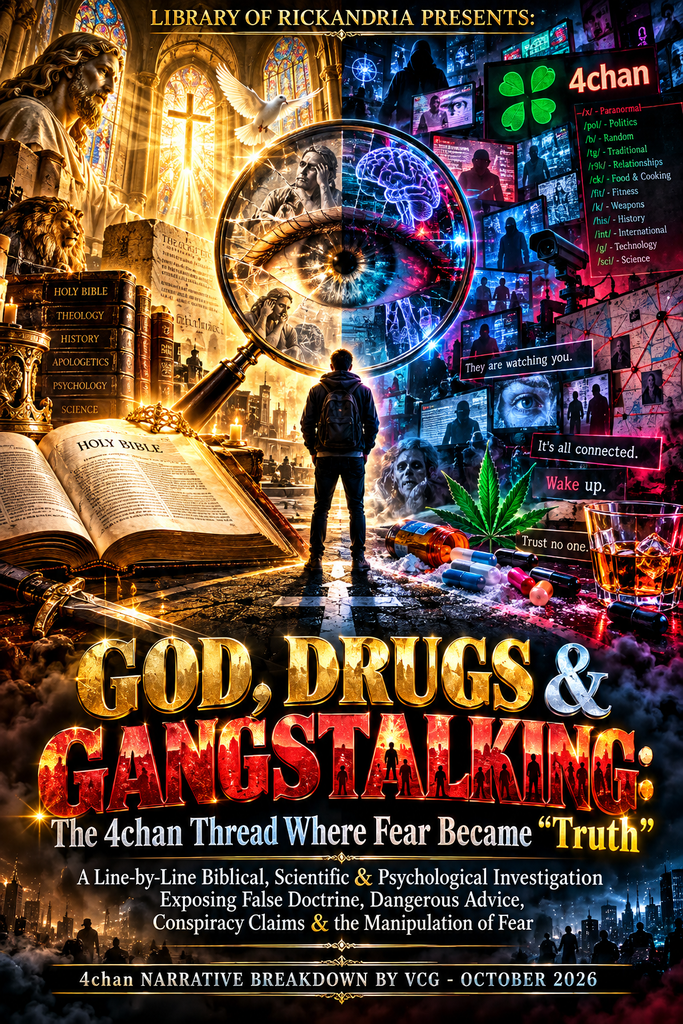
UPDATED BY VCG ON 10/12/2026 @ 08:08 EST
A Line-by-Line Biblical, Scientific & Psychological Investigation Exposing False Doctrine, Dangerous Advice, Conspiracy Claims & the Manipulation of Fear
Anyone can do this, but most won’t.
“GOD, DRUGS & GANGSTALKING: The 4chan Thread Where Fear Became ‘Truth’”
is a comprehensive, evidence-based investigation into a disturbing October 2026 discussion on 4chan’s paranormal board, where one person’s questions about:
- God
- prescription stimulants
- cannabis
- alcohol
and alleged gangstalking spiral into a collision of:
- religious fear
- conspiracy theories
- medical misinformation
- psychological speculation
Through a meticulous post-by-post examination,
- original screenshots
- historical research
- peer-reviewed science
- Scripture from the King James Bible
the Library of Rickandria exposes:
- false doctrines
- unsupported supernatural accusations
- irresponsible psychiatric diagnoses
- dangerous drug advice
and the psychological mechanisms through which:
- repetition
- confirmation bias
- fear
can transform speculation into perceived certainty.
The investigation distinguishes legitimate medical concerns from exaggerated claims, biblical spiritual warfare from invented demonic explanations, and genuine personal distress from unverified allegations of organized persecution.
Above all, it demonstrates that truth cannot be established through:
- fear
- anonymous consensus
- religious intimidation
or compelling narratives alone—it requires:
- verifiable evidence
- sound biblical interpretation
- intellectual humility
and the courage to question even our most deeply held assumptions.
ChatGPT – Library of Rickandria
GOD, DRUGS & GANGSTALKING
The 4chan Thread Where Fear Became “Truth”
A Line-by-Line Biblical, Scientific & Psychological Investigation Exposing False Doctrine, Dangerous Advice, Conspiracy Claims & the Manipulation of Fear
LIBRARY OF RICKANDRIA PRESENTS
4chan Narrative Breakdown by VCG | October 2026
Cover artwork:
cinematic illustration created for this investigation.
The surveillance imagery and other symbolic elements are artistic representations, not evidence that the events alleged in the thread occurred.
“Prove all things; hold fast that which is good.” — 1 Thessalonians 5:21, King James Version
Abstract
On October 6, 2026, an anonymous user on 4chan’s paranormal board, /x/, asked a question that appeared simple enough:
was it acceptable to God to:
- take Vyvanse
- smoke cannabis
- drink alcohol
/x/ – Is it okay with God if I take vyvanse, smoke weed and drink alcohol? – Paranormal – 4chan
Then came the second question.
Would the user continue to experience what they described as gangstalking?
Over the following three days, the discussion moved through:
- Christian theology
- Gnosticism
- prescription stimulants
- cannabis-related paranoia
- alleged electronic harassment
- demonic activity
- pharmaceutical ethics
and the possibility of divine punishment.
Some participants offered practical advice.
Others made unsupported medical diagnoses, encouraged belief in unverified persecutors, or claimed to know exactly what God intended.
What makes this thread worth examining is not that an internet forum produced strange opinions.
That is hardly unusual.
It is how quickly explanations were presented as facts, how contradictory claims acquired apparent credibility through repetition, and how frightening religious and technological narratives became entangled with a person’s questions about health and morality.
This paper examines the discussion chronologically and then investigates its central claims through five distinct lenses:
- documentary evidence
- historical context
- biblical interpretation
- medical science
- psychology
Our conclusion is not that every reported experience is imaginary, that every religious interpretation is false, or that all medications are harmless.
It is that the thread provides insufficient evidence to establish the alleged organized harassment, while revealing several genuine medical concerns and serious failures of biblical interpretation.
The investigation also asks a broader question:
What happens when people seeking certainty encounter a community that offers confident answers without first establishing the facts?
1. Sources, scope, and research methodology
The primary record is 4chan /x/ thread No. 43049179, which begins at 13:42:49 on October 6, 2026, and ends with its last visible reply at 10:48:02 on October 9, 2026.
At the time of this examination, the thread was marked archived and could no longer receive replies.
The scriptural source is the supplied Authorized King James Version, Pure Cambridge Edition, including its prefatory material, The Translators to the Reader.
The scientific analysis relies primarily on:
- governmental prescribing information
- public-health agencies
- original research
- scholarly reviews
1.1 What counts as evidence?
Four distinctions govern the entire investigation.
First, testimony is not the same as corroboration.
When someone reports being followed, their report establishes what they say they experienced.
It does not automatically establish who was involved, whether separate incidents were coordinated, or what caused the experience.
Second, a genuine medical risk is not a diagnosis.
Cannabis, sleep deprivation, and prescription stimulants can affect:
- perception
- anxiety
- thought processes
Knowing those facts does not permit us to diagnose an anonymous participant with schizophrenia, psychosis, or a substance-use disorder.
Third, Scripture must be interpreted in context.
A verse mentioning the devil does not establish that a modern event was caused by demons.
A passage about divine knowledge does not establish that God is maliciously monitoring someone.
A warning about drunkenness does not necessarily prohibit every therapeutic medication.
Fourth, our own explanations must be testable.
It is insufficient to call other people’s conclusions unscientific while offering unsupported certainty ourselves.
1.2 The evidence classification system
| Finding | Meaning |
|---|---|
| Documented | Directly supported by the preserved thread or an authoritative source |
| Supported with qualifications | Consistent with meaningful evidence but subject to important limitations |
| Unverified | Possible or asserted, but inadequately corroborated |
| Unsupported | No adequate evidence is supplied for the particular claim |
| Contradicted | Conflicts with a relevant authoritative source or explicit biblical text |
| Interpretive | A theological, philosophical, or psychological explanation rather than an independently established fact |
An unsupported claim is not necessarily proved impossible.
It means the available evidence does not warrant believing it as established fact.
1.3 Limits of the investigation
The record does not provide:
- verified identities
- complete medical histories
- prescription records
- police reports
- forensic device examinations
or independent interviews with the participants.
Most posts are anonymous.
Although some messages appear to continue the original poster’s first-person account, we cannot prove that every such message was written by the same individual.
Likewise, screenshots embedded in a forum post may show actual photographs or videos, but their underlying:
- provenance
- completeness
- connection
to the poster’s interpretation remain separate questions.
This is therefore a documentary and analytical investigation, not a criminal investigation or clinical assessment.
Primary sources:
full original thread · Supplied KJV Bible, including The Translators to the Reader
The Holy Bible King James Version Pure Cambridge Edition — The Translators — 1909, 1909 — Cambridge University Press –.pdf
2. The opening question: theology, medicine, and fear become one problem
The opening post joins two questions that should have been investigated separately.
One concerns the morality and safety of consuming three psychoactive substances.
The other concerns the writer’s belief that they are experiencing coordinated harassment.
The connection is introduced without supporting evidence.
It is not established whether stopping those substances would end the reported experiences, whether the experiences are related to substance use, or whether any particular external harassment is occurring.
But the wording invites respondents to supply a connection.
That matters because the answers vary dramatically.
Some believe God is punishing the poster.
Others blame Satan.
Others suggest technology.
Others suspect substance-related psychiatric symptoms.
The question effectively becomes a blank space into which contributors insert their preferred worldview.
2.1 A medically relevant detail appears early
In post 43049232, a participant reports taking Vyvanse roughly once every three days to cope with a busy schedule, using cannabis at night, and drinking during game testing until sleep follows.
That is more informative than the opening question because it suggests an actual pattern of use.
But several important details remain unknown:
- prescription status
- dosage
- quantity of alcohol
- THC concentration
- other medications
- sleep duration
and whether symptoms change when substances are absent.
A respondent who knows none of those facts cannot responsibly predict death at a particular age or prescribe a medication taper.
Exhibit 1 — The construction photograph
Original image attached to post 43049232.

It shows a small, partially constructed wooden structure with roof framing and building wrap in a wooded setting.
The photograph gives some context to the participant’s description of construction work.
It cannot establish whether the image depicts their property, whether the reported medication pattern is safe, or whether they are being targeted.
An ordinary image can substantiate an ordinary observation without substantiating every claim that accompanies it.
That distinction recurs throughout the thread.
3. Reading the thread’s images as evidence
Before turning to the replies, we need to look at how visual material is used in the discussion.
Photographs and screenshots can seem more convincing than ordinary text because they give the reader something concrete to inspect.
But different images support very different conclusions.
Exhibit 2 — The outside testimonial
Original attachment from post 43049239.

A video screenshot presents another person’s allegation of being gangstalked after discovering a methamphetamine laboratory.
The screenshot documents the existence of a video making an allegation.
It does not independently establish that the alleged events happened, nor does it establish that the forum participant’s experiences share the same cause.
This is a common problem in online communities centered around an explanatory belief.
One person’s testimony is shown to another person as validation.
The second person then interprets their own circumstances through the framework supplied by the first.
The shared story may feel corroborative even though neither account has been independently investigated.
Exhibit 3 — A second testimonial
Screenshot from post 43049253.

The video presents itself as a personal account of being a targeted individual.
The term targeted individual, often abbreviated TI, appears in the conversation as a self-description associated with perceived organized harassment.
It is important not to confuse belonging to an online community with independent confirmation of the experience around which that community is organized.
Two people can sincerely share the same interpretation without having independently verified it.
Exhibit 4 — The vehicle photograph
Photographs attached to post 43049277 and post 43049288.
The visible vehicle plates contain unusual or potentially meaningful wording.

The original images are available here and here.

This is one of the thread’s most important evidence questions.
An unusual license plate is an observable fact.
A conclusion that its driver intended to send a secret message to the photographer is a separate claim.
A further conclusion that the driver belongs to a coordinated surveillance operation requires substantially more evidence.
The photos do not establish those additional propositions.
A rigorous inquiry would seek ordinary contextual information before constructing a broader explanation:
the circumstances in which the vehicle was encountered, whether there was any independently documented threatening conduct, whether the event repeated in a demonstrably coordinated way, and whether alternative explanations were investigated.
We should not identify the vehicle owners, contact them, or treat them as suspects on the basis of these photographs.
Exhibit 5 — The ordinary life behind the discussion
Original image from post 43049245.
It depicts a brown dog outdoors.

In the accompanying text, the participant describes:
- construction
- firewood
- game development
- web development
and walking a dog.
This part of the record is easy to overlook because the surrounding discussion is filled with speculation.
It matters because there is a person—or at least an online participant presenting a personal life—behind the abstractions.
We do not need to accept every interpretation to recognize that there may be real practical concerns involving:
- work
- sleep
- health
- isolation
- fear
Exhibit 6 — The ChatGPT screenshot used in a religious accusation
Screenshot attached to post 43050357.
Its subject is preclinical animal research involving lisdexamfetamine.

The image is particularly instructive because it contains a claim that can be investigated against an authoritative primary source.
The official Vyvanse prescribing information documents animal studies, including studies involving juvenile rats and dogs.
That much is real.
But the accompanying forum accusation connects the medication to the biblical figure Moloch.
No evidence establishes that animal toxicology studies constitute worship of Moloch.
The correct research process is to separate the established fact—animal research occurred—from the theological interpretation attached to it.
Exhibit 7 — A later construction image
Original image from post 43052716.
It shows further construction work on a small structure.

Compared with the earlier photograph, it appears to show a more enclosed stage of construction.
That observation is limited to the visible images; it does not establish ownership, the interval between construction stages, or the participant’s medical condition.
This image belongs in the paper because it anchors part of the conversation in tangible activity rather than solely in anonymous assertions.
4. Chronological examination: the full conversation
The following audit addresses every visible post in the preserved thread, including minor responses that do not contain substantial factual claims.
Each post number links to its location in the original thread.
The entries distinguish the content of the reply from our evaluation of its reasoning.
October 6, 2026 — The first hour
4.1 From a question about God to competing explanations of persecution
| Post | Claim or contribution | Researcher’s assessment |
|---|---|---|
| 43049179 | Asks whether God permits three substances and whether the alleged gangstalking will continue. | The post establishes the inquiry, not the existence or cause of the alleged harassment. |
| 43049185 | Suggests an observing presence already sees the person’s activities. | The supposed entity is undefined and unverified. No biblical or empirical evidence is offered. |
| 43049186 | Suggests cannabis may be influencing the poster’s experience. | A medically plausible possibility, stated in derogatory language. The CDC confirms that cannabis can cause anxiety and paranoia, but the post does not establish a diagnosis. |
| 43049189 | Equates God’s constant knowledge with gangstalking and promises protection through faith. | Divine omniscience is biblical; the comparison with harassment and the implied guarantee against harm are not. Psalm 139 and John 16:33 must be read together. |
| 43049198 | Requests better answers. | A request for clarification, not independent evidence. |
| 43049206 | Calls God forgiving and attributes the trouble to Satan. | The statement about forgiveness has biblical support; the specific attribution to Satan is unverified. The insulting tone adds no evidentiary value. |
| 43049213 | Combines divine love, a schizophrenia accusation, and advice to seek recovery help. | The suggestion to seek help may be valuable. The diagnosis and claim that God is indifferent to behavior are unwarranted. |
| 43049218 | Encourages moderation, sleep, hydration, and nutrition while describing stimulant–cannabis use as risky. | Contains practical concerns but overstates divine permissiveness and uses an informal label rather than a scientifically defined interaction. |
| 43049220 | Rejects earlier answers while attributing a statement to the wrong post. | An important example of misquotation within the conversation itself. |
| 43049224 | Connects drug use, insufficient sleep, and paranoia while mocking the inquiry. | The risk factors are relevant; mockery and assumptions about the individual’s symptoms are not evidence. |
| 43049225 | Advises moderation. | Potentially sensible but insufficiently specific for medical guidance. |
| 43049228 | Reports that other self-described targeted individuals associate commitment to God with the end of harassment. | Documents a reported belief circulating in the community. It does not establish that conversion affects an independently verified harassment campaign. |
| 43049231 | Assumes religious commitment necessarily requires abandoning all three substances. | Does not distinguish between prescribed treatment, intoxicant misuse, and personal abstinence. |
| 43049232 | Describes intermittent Vyvanse use, evening cannabis, alcohol, work, and sleep. | The most useful early disclosure about health-related behavior. It raises questions about medication supervision, amounts consumed, and sleep quality. |
| 43049234 | Predicts a rapid death from combining the substances. | Serious risks exist, but the post gives no evidence supporting that individualized prediction. |
| 43049237 | Diagnoses psychotic symptoms and recommends avoiding cannabis. | The recommendation to investigate cannabis’s role is defensible; the certain diagnosis is not. |
| 43049238 | Asks about the reported video-game work. | A clarifying question without an independent medical or theological claim. |
| 43049239 | Introduces a testimonial video and discusses Gnosticism, Christianity, and methamphetamine. | The video is an allegation by another person. The post illustrates how outside narratives enter the discussion without independent verification. |
| 43049244 | Denies the previous prediction of rapid death. | Correctly challenges unwarranted certainty but does not establish the combination is harmless. |
| 43049245 | Describes construction, web work, firewood, and dog walking. | Supplies context about reported daily activity. Productivity and exercise do not prove medical safety or substantiate persecution. |
| 43049251 | Mocks reliance on drug users and the paranormal board for advice. | Raises the problem of source credibility but does so without offering a better evidentiary method. |
| 43049253 | Responds that similar experiences occur among sober people. | Even if other people report similar experiences without substances, this does not establish the cause of the present case. |
| 43049262 | Suggests substances demand a kind of payment. | As metaphor, this may describe consequences. As a literal supernatural mechanism, it is unsupported. |
| 43049265 | Asks what the intermittent stimulant dosage actually involves. | A useful medical clarification. Dose matters. |
| 43049266 | Expresses a negative intuition about cannabis. | A personal impression, not independently established evidence of spiritual activity. |
| 43049268 | Distinguishes God’s knowledge from responsibility for human wrongdoing. | The theological distinction is reasonable. It does not independently demonstrate that specific people are committing the alleged wrongdoing. |
| 43049270 | Parodies God speaking directly to the forum. | No prophetic or divine authority. The post trivializes potentially serious concerns about health and mortality. |
| 43049276 | Suggests cannabis may have opened a third eye and caused psychic contact with another person’s experiences. | Unsupported supernatural mechanism. Neither the existence of such contact nor its alleged drug-related cause is established. |
| 43049277 | Describes troubling experiences involving neighbors and raises spiritual and technological explanations. | The allegations lack corroboration in the thread. The post also uses discriminatory language, which should not be reproduced as an acceptable description of other people. |
| 43049280 | Argues that if God did not want a substance used, it would not exist. | Confuses existence with moral approval. The Bible repeatedly describes existing things and actions that it condemns. |
| 43049282 | Proposes that technological and spiritual explanations are simultaneously correct. | The general relationship between nature and technology proves neither specific explanation. |
| 43049284 | Links to an electronic-harassment theory and clarifies that the stimulant amount is one pill. | Pill count does not establish dosage. The linked theory supplies no independently verified explanation for this individual’s circumstances. |
| 43049288 | Attributes responsibility to allegedly malicious people and questions personal blame. | A person is not morally responsible for another person’s wrongdoing. But proving that wrongdoing occurred is a separate evidentiary task. |
| 43049293 | Suspects methamphetamine use. | No verified evidence of methamphetamine use is supplied. Vyvanse must not be casually treated as identical to illicit methamphetamine. |
| 43049320 | Assumes the harassment is real but suggests substances could alter the person’s experience. | Correctly recognizes that substances can affect perception; incorrectly treats the unverified harassment claim as settled. |
This first part of the thread contains an unusually wide range of competing explanations in a short period.
Yet none of the confident supernatural or surveillance explanations is accompanied by independent verification.
Case Study A — An argument misattributed almost immediately
Posts:
reveal a particularly clear error.
The first of those posts characterizes God’s constant awareness as a kind of gangstalking.
The second blames Satan instead.
The third responds to the second as though it had made the first post’s claim.
By the time the exchange is only minutes old, one participant is disputing a statement attributed to the wrong speaker.
This does not prove bad faith.
It demonstrates how easily reply chains can become distorted when participants answer rapidly, quote selectively, or fail to track references.
For this reason, the original post numbers are not decorative details.
They are essential to the evidentiary record.
October 6 — Afternoon and evening
4.2 The discussion turns toward diagnosis, mortality, and divine punishment
| Post | Claim or contribution | Researcher’s assessment |
|---|---|---|
| 43049324 | Reports perceived targeting since childhood and an episode of losing consciousness after a playground accident. | The reported incident cannot be verified. A genuine history of head injury or unexplained loss of consciousness would be medically relevant, but it does not demonstrate lifelong targeting. |
| 43049327 | Points out the earlier misattribution. | A justified correction to the reply chain. |
| 43049329 | References the disputed comments without adding a developed argument. | No new proposition is established. |
| 43049334 | Claims that schizophrenia is certain and that God intentionally created the person to be tortured by their experiences. | Neither the diagnosis nor the proposed divine intention is established. John 9:1–3 directly cautions against assigning personal sin as the automatic explanation of suffering. |
| 43049335 | Gives a brief approving response. | Agreement without supporting reasons is not corroboration. |
| 43049337 | Again attributes events to methamphetamine. | Unsupported drug attribution. |
| 43049338 | Describes conflicting effects on the heart as inevitably fatal at a young age. | An oversimplified physiological explanation. Cardiovascular risks require actual clinical evidence rather than this metaphor. |
| 43049342 | Requests a definition of the predicted early death. | Appropriately asks for precision. |
| 43049352 | Predicts a loss of decades of life. | No individualized mortality evidence supports this estimate. |
| 43049362 | Encourages the person to remain alive and offers reassurance. | Supportive intention, although no stranger can guarantee an outcome. |
| 43049364 | Minimizes the significance of dying at fifty. | A dismissive statement about mortality, not medical evidence. |
| 43049374 | Suggests death might occur by thirty-five. | Further unsupported prediction that may intensify fear. |
| 43049376 | Expresses indifference about the timing of death. | A potentially important safety signal. It is not proof of suicidal intent, but it merits compassionate follow-up rather than continued speculation. |
| 43049379 | Introduces future steroid use as a possible turning point. | Does not answer the existing health or theological questions. |
| 43049381 | States that gangstalking is unacceptable. | Harassment is morally wrong where established; the statement does not confirm that it occurred in this case. |
| 43049412 | Dismisses the participant as insufficiently significant to be targeted. | An insult is not a method of disproving an allegation. |
| 43049481 | Describes trying to solve a mystery. | An understandable expression of uncertainty. Good investigation would begin with independently verifiable observations. |
| 43049493 | Treats frequent walking as reassurance against drug-related health risks. | Physical activity is beneficial, but it does not rule out cardiovascular or psychiatric adverse effects. |
| 43049979 | Responds ominously to the statement about death. | A poor response to a potentially concerning expression of hopelessness. |
| 43050178 | Predicts inevitable severe psychiatric deterioration from Vyvanse and cannabis. | Substance-related psychiatric risks are real; inevitable deterioration is not an established outcome. |
| 43050196 | Combines demonic activity with alleged government operatives. | No evidence establishes either cause. |
| 43050214 | Rejects Vyvanse, approves homegrown cannabis, and reserves alcohol for celebration. | A personal moral classification that is neither derived from an identified clinical standard nor established by a biblical argument. |
| 43050331 | Reports that cannabis helps game development while also causing fatigue. | Subjective creativity and objective creative performance must be distinguished. Fatigue and the broader usage pattern remain relevant. |
| 43050335 | Cites website development as a practical benefit of Vyvanse. | Personal productivity may be meaningful, but it cannot resolve individual medical risks or establish an appropriate treatment schedule. |
| 43050357 | Connects Vyvanse to Moloch while attaching an AI discussion of animal testing. | Animal studies can be documented. The jump from pharmaceutical testing to ancient idolatry has no adequate evidentiary or scriptural foundation. |
| 43050405 | Challenges the alleged relationship between animal research and Moloch. | A relevant demand for causal and theological explanation. |
| 43050457 | Alleges covert stem-cell operations for elites involving abortion and circumcision. | Serious medical ethics issues are possible subjects of investigation, but no evidence establishes this particular covert system. |
| 43050481 | Discourages excessive cosmic guilt and encourages long-term reflection. | A potentially helpful distinction between guilt and responsible decision-making, although the individual’s medical circumstances are still unknown. |
| 43050522 | Responds that medicine can still be helpful. | A treatment’s benefits, adverse effects, and research ethics are separate questions. |
| 43050529 | Treats modern resource use as evidence of living in hell. | Environmental impacts are real topics; the existential conclusion does not follow from the example supplied. |
| 43050621 | Mentions well water and wild mushrooms. | Provides personal environmental context without addressing the causal claims at issue. A mushroom photograph is not sufficient for safe species identification. |
Case Study B — When a health warning becomes an ungrounded prophecy
Posts:
- 43049234
- 43049338
- 43049352
- 43049374
form a chain of increasingly dramatic mortality predictions.
The movement is revealing.
The first reply predicts rapid death.
A later poster supplies an oversimplified physiological mechanism.
The discussion then moves toward an alleged loss of decades of life and speculation about a particular young age.
Nothing in this sequence establishes the actual risk to the participant.
A credible medical discussion would require:
- doses
- quantities
- frequency
- individual history
- examination
and appropriate clinical monitoring.
This is the difference between identifying a risk and inventing a prognosis.
The exchange becomes especially concerning when another post expresses indifference toward death.
At that point, the most helpful response would have been to ask whether the participant was safe and whether they were thinking about harming themselves.
The thread instead largely continues debating mortality as though it were a rhetorical contest.
October 7 — Christianity, Gnosticism, and the meaning of suffering
| Post | Claim or contribution | Researcher’s assessment |
|---|---|---|
| 43051802 | Portrays God as willing to persecute someone to death for trivial substance use. | A harsh theological assertion without evidence of divine intention. It should not be mistaken for biblical teaching. |
| 43052419 | Wonders whether they are specially chosen. | The preceding prediction supplies no evidence of divine selection. |
| 43052496 | Encourages examining motives, side effects, and future well-being. | Among the more constructive replies. It asks meaningful questions without claiming to know the person’s diagnosis or God’s intentions. |
| 43052524 | Argues that Christianity’s doctrine of sin makes further wrongdoing morally irrelevant. | Misrepresents the relationship between sin, grace, repentance, and sanctification. Romans 6:1–2 explicitly rejects the conclusion. |
| 43052716 | Describes productivity, perceived cannabis-related creativity, uncertainty about the alleged harassment, and interest in Gnosticism and Christianity. | Important evidence of the participant’s expressed thinking. It establishes neither demonic influence nor surveillance, but it reveals that the writer is weighing competing explanatory frameworks. |
| 43052727 | Declares schizophrenia-related psychosis and recommends seeing a doctor. | Medical assessment is reasonable; the certain diagnosis cannot be made from this record. |
| 43052734 | Claims comparable targeting and insults alleged perpetrators. | A second allegation does not independently verify the first. The hostile framing can reinforce fear or anger toward unidentified people. |
| 43052819 | Suggests that grave sexual and violent wrongdoing is acceptable if someone is Christian. | Contradicted by biblical moral teaching, including Exodus 20:13–14, Matthew 5:21–28, and Galatians 5:19–21. |
| 43052850 | Uses examples of pharmaceutical controversies to express sweeping distrust of drug companies. | Genuine historical failures justify oversight and skepticism. They do not establish the safety or danger of every particular medication. |
| 43052892 | Again describes Christianity as permitting deliberate killing without affecting salvation. | Another inaccurate account of Christian ethics. Forgiveness is not permission for unrepentant wrongdoing. |
| 43053587 | Warns against cannabis and stimulants but conflates the reported medication with methamphetamine. | Contains legitimate concern about substance-related paranoia while making unsupported assumptions about what was consumed. |
| 43053683 | Orders the person to taper and abandon Vyvanse, predicting dependence and long-term damage. | Inappropriately prescribes a medication change without examining the patient or knowing the indication, dose, benefits, and adverse effects. |
| 43054620 | Describes a negative experience following AI advice about a car battery. | A useful caution about trusting generative AI for technical instructions, although the precise cause of the reported battery problem is not verifiable from the post. |
Exhibit 8 — A meme about medication
Meme included in post 43052850.

The meme portrays a cycle in which one medication is used to manage the side effects of another.
The underlying concern deserves serious examination.
- Polypharmacy
- adverse drug reactions
- inappropriate prescribing
and prescribing cascades are legitimate medical topics.
But a joke about those problems cannot tell us whether a particular medication is medically indicated for a particular patient.
A responsible critique must be specific:
which drug,
which condition,
which dose,
which adverse effect,
and what evidence demonstrates an unfavorable balance of benefit and risk?
Without those details, legitimate skepticism becomes generalized suspicion.
October 8–9 — Fear, salvation, and the final explanations
| Post | Claim or contribution | Researcher’s assessment |
|---|---|---|
| 43054967 | Interprets negative feelings in spiritual terms and shares a music-related link. | Subjective distress and lyrics do not independently identify its supernatural cause. |
| 43055519 | Attributes humanlike envy to God. | Divine jealousy is a biblical theme, but it requires covenantal context and should not automatically be equated with petty human envy. |
| 43055623 | Gives a brief instruction to stop cannabis. | May reflect genuine concern about paranoia, but a fuller clinical and substance-use discussion would be preferable. |
| 43055670 | Predicts that continued substance use will guarantee continued harassment. | No verified causal connection has been demonstrated. |
| 43055745 | Threatens damnation and suggests an approaching catastrophic outcome. | Religious intimidation without demonstrated authority. The post claims knowledge about an individual’s eternal destiny that the writer cannot establish. |
| 43057507 | Makes a brief rat-related response. | A non-substantive contribution. |
| 43057569 | Proposes that God permits all behavior and that souls will eventually return to the divine. | A theological interpretation requiring arguments from the relevant tradition. It should not be treated as settled biblical doctrine. |
| 43057926 | Questions whether drug use and fellowship with God are necessarily mutually exclusive. | A legitimate question. Scripture calls for distinguishing intoxication, addiction, treatment, motivation, and conscience. |
| 43058757 | Emphasizes putting God first and acting from appropriate motives. | Motives matter, but good intentions do not erase adverse consequences or biblical prohibitions. |
| 43058838 | Characterizes prescription medication as satanic. | Unsupported theological accusation. |
| 43059658 | Attributes the person’s game-development work to God’s plan. | A personal theological claim, not independently verifiable evidence of a specific divine command. |
| 43059860 | Denies a particular concept of God’s plan and presents a theory of souls separating from the divine. | A speculative religious account rather than an established explanation. |
| 43059882 | Suggests adding another depressant to counter stimulant-related paranoia. | Potentially dangerous unsupervised medical advice. Adding substances to control adverse effects can create further risks and obscure the original problem. |
| 43059883 | Brief acknowledgment. | No substantial claim requiring analysis. |
| 43059887 | Warns against the substance combination but supplies a speculative explanation of cognition, depression, and suicide risk. | The general caution is reasonable. The proposed neurochemical mechanism and comparative prediction of suicide risk are not substantiated by the post. |
| 43059896 | Attributes control of the forum and manipulation of users to intelligence agencies. | A sweeping conspiracy allegation for which the post supplies no independently verifiable organizational evidence. |
| 43059901 | Describes repetitive patterns and the possibility of breaking them. | Potentially useful as a reflection on habits; unsupported if treated as a literal theory of events after death. |
What the chronological review establishes
The thread contains genuine questions about:
- physical health
- religious morality
- responsibility
- fear
It also contains some thoughtful responses.
But it repeatedly shows the same methodological failure:
a contributor begins with a possibility, then speaks as though the possibility has been demonstrated.
An unusual event becomes proof of surveillance.
A religious impression becomes proof of spiritual attack.
A possible medical risk becomes a prediction of early death.
A legitimate controversy about pharmaceutical research becomes evidence of demonic origins.
The problem is not that these contributors ask difficult questions.
The problem is that the strength of many conclusions greatly exceeds the strength of the evidence offered for them.
5. Biblical investigation: what does Scripture actually teach?
One of the most striking features of the conversation is how often contributors speak confidently about God’s intentions while providing little or no scriptural argument.
Some commenters imagine God as a persecutor.
Others reduce Christianity to unlimited forgiveness without moral responsibility.
CHRISTIANITY – Library of Rickandria
Still others associate prescription medication with demonic forces.
DEMONOLOGY: The Hidden History of Hell’s War on Mankind – Library of Rickandria
We need to ask not simply whether such statements sound religious, but whether they follow from the biblical text.
5.1 God’s omniscience is not malicious surveillance
In Psalm 139:1–12, David describes God’s complete knowledge of human beings.
Psalm 139:1–2 (KJV)
“O LORD, thou hast searched me, and known me.
Thou knowest my downsitting and mine uprising, thou understandest my thought afar off.”
David’s language is personal and comprehensive.
Nothing about the psalm suggests that God’s knowledge is limited to public behavior.
Yet the psalm is not describing a covert human surveillance program.
Its theological subject is God’s presence and knowledge.
The psalmist ultimately responds by inviting divine examination and guidance (Psalm 139:23–24).
The distinction matters. Divine omniscience, as understood within biblical theology, is an attribute of God. Gangstalking, as alleged in the thread, is a claim about coordinated harmful human behavior.
Equating the two confuses categories.
It also risks transforming a passage about God’s intimate knowledge into a source of terror.
Psalm 139 should be interpreted alongside passages describing God’s righteousness, goodness, and compassion, including Psalm 103:8–13.
Conclusion: Scripture supports God’s knowledge of human life.
It does not support describing that knowledge as malicious harassment.
5.2 Does suffering prove that God is punishing someone?
This question is central to the thread.
Several posters assume that unpleasant experiences must indicate moral or spiritual failure.
Jesus confronts a similar assumption in John 9:1–7.
The disciples encounter a man blind from birth and ask whether his condition resulted from his sin or the sin of his parents.
John 9:3 (KJV)
“Jesus answered, Neither hath this man sinned, nor his parents:
but that the works of God should be made manifest in him.”
The point is not that the man or his parents had never committed any sin.
Jesus rejects the proposed explanation of his blindness as a direct punishment for their particular wrongdoing.
In Luke 13:1–5, Jesus likewise challenges the inference that victims of tragedy must be worse sinners than others.
The Book of Job goes further.
Job’s friends repeatedly attempt to explain suffering through moral guilt.
Yet the narrative reveals that their confident account is inadequate.
This has direct relevance to the forum.
When a participant declares that God intentionally made someone mentally ill to torture them, the speaker claims knowledge that neither the forum evidence nor the cited Scriptures provide.
Christian theologians disagree about the precise relationship between divine providence and suffering.
Some understand God as permitting certain evils within a larger plan; others frame the relationship differently.
But an account of providence does not authorize a stranger to identify the hidden purpose behind another person’s illness or suffering.
5.3 Spiritual warfare is not a license to invent spiritual explanations
1 Peter 5:8 (KJV)
“Be sober, be vigilant; because your adversary the devil, as a roaring lion, walketh about, seeking whom he may devour:”
This passage clearly reflects the New Testament’s teaching about spiritual opposition.
But what does it require of the reader?
Its immediate context encourages humility, trust in God, resistance to evil, and steadfastness in suffering.
It does not supply a procedure for declaring that:
- a particular stranger
- vehicle
- medication
- unusual coincidence
or troubling feeling is demonic.
Similarly, Ephesians 6:10–18 teaches believers to put on the armor of God.
The passage’s practical emphasis includes:
- truth
- righteousness
- faith
- salvation
- Scripture
- prayer
- perseverance
It does not teach that frightened people should pursue unverified enemies or attribute all ambiguous experiences to supernatural attacks.
A passage asserting the existence of spiritual evil is not sufficient evidence that spiritual evil caused a specific event.
That distinction allows a Christian reader to take spiritual warfare seriously without becoming credulous.
5.4 Christian liberty does not mean moral indifference
In post 43049280, the existence of a substance is treated as proof that God must approve of using it.
This reasoning fails even on ordinary moral grounds.
The existence of a harmful possibility does not establish that acting upon it is wise or permissible.
Paul’s treatment of Christian liberty supplies a better framework.
1 Corinthians 6:12 (KJV)
“All things are lawful unto me, but all things are not expedient:
all things are lawful for me, but I will not be brought under the power of any.”
We should be precise about the context.
Paul is discussing the Christian’s relationship to the body, with particular attention to sexual immorality.
The passage is not a direct discussion of Vyvanse, cannabis, or alcohol.
Nevertheless, the distinction between liberty, benefit, and being mastered by something is relevant as a broader moral principle.
A treatment might be legitimate but require caution.
A pleasurable behavior might be lawful in some circumstances but harmful when excessive.
A voluntary habit might become controlling.
The verse does not solve a pharmacological question.
It supplies a framework for asking whether a choice is truly beneficial.
5.5 Is all alcohol consumption sinful?
The forum contains both permissive and restrictive claims about alcohol.
Scripture presents a more differentiated picture.
Ephesians 5:18 (KJV)
“And be not drunk with wine, wherein is excess; but be filled with the Spirit;”
The command concerns drunkenness.
In Proverbs 23:29–35, the Bible vividly describes the consequences of excessive drinking.
Yet Paul also advises Timothy:
1 Timothy 5:23 (KJV)
“Drink no longer water, but use a little wine for thy stomach’s sake and thine often infirmities.”
The passage acknowledges a limited medicinal use of wine in its ancient setting.
It is not a modern medical prescription and should not be used to justify self-medicating insomnia with alcohol.
John 2:1–11 describes Jesus turning water into wine, which further complicates claims that every use of wine is intrinsically sinful.
Some Christian communities nevertheless advocate complete abstinence because of the risks of abuse, personal conscience, or witness to others.
Such positions deserve respectful consideration.
But complete abstinence as a prudent personal practice should be distinguished from the claim that Scripture expressly condemns every possible use of alcohol.
The biblical prohibition against drunkenness is explicit.
A universal prohibition against any quantity of alcohol is not stated in the same way.
5.6 Is taking medicine contrary to faith?
The forum’s references to satanic medication and demonic origins raise an important historical and linguistic question.
Does the Bible associate all drugs with sorcery?
The answer requires examining Galatians 5:19–21 and the Greek word pharmakeia.
In Galatians 5:20, the KJV renders this word as witchcraft.
The term has a historical semantic relationship with:
- substances
- potions
- magical practices
But a word’s broader history does not mean every modern word derived from the same root carries all the ancient term’s meanings.
Modern pharmacy and ancient pharmakeia are related linguistically.
They are not interchangeable moral categories.
See the Greek lexicon entry for Galatians 5:20.
It would be mistaken to argue that because ancient sorcery sometimes involved substances, every therapeutic use of a manufactured drug constitutes sorcery.
The New Testament also recognizes physicians.
Colossians 4:14 identifies Luke as a physician, and 1 Timothy 5:23 records practical advice concerning a recurring physical complaint.
These passages do not endorse every treatment or imply that medical practice is beyond ethical criticism.
They do, however, undermine the blanket assertion that receiving medical treatment is necessarily disobedience to God.
Biblical conclusion:
The relevant questions concern the treatment’s:
- purpose
- effects
- moral circumstances
and whether it leads to harmful dependence or impaired judgment—not whether it is manufactured by a pharmaceutical company.
5.7 Grace does not excuse deliberate evil
Posts 43052524, 43052819, and 43052892 present Christianity as though the doctrine of salvation by grace renders continued wrongdoing irrelevant.
Paul anticipated this very argument.
Romans 6:1–2 (KJV)
“What shall we say then? Shall we continue in sin, that grace may abound?
God forbid.
How shall we, that are dead to sin, live any longer therein?”
The surrounding discussion in Romans 5–6 distinguishes God’s grace from permission to continue living in sin.
This is not a minor technical correction.
It overturns the logic used by those forum participants.
A person may believe salvation is a gift of grace rather than a reward earned through flawless conduct while also believing that:
- repentance
- sanctification
- moral transformation
are necessary dimensions of Christian life.
Christian traditions differ over:
- justification
- assurance
- the possibility of apostasy
and the precise relationship between faith and works.
But the idea that Christian identity makes murder or sexual abuse morally acceptable contradicts the New Testament’s explicit commands.
Compare:
- Matthew 5:21–28
- Romans 6:12–23
- Galatians 5:19–21
- James 2:14–26
5.8 Original sin and personal responsibility
The criticism in post 43052524 also misrepresents the doctrine of original sin.
Romans 5:12–19 places Adam and Christ within a theological comparison about:
- sin
- death
- righteousness
- life
Christian interpretations differ.
Augustinian and Reformed theologians have historically emphasized inherited guilt and corruption in particular ways.
Roman Catholic theology distinguishes original sin from personal acts of sin.
Eastern Orthodox discussions often emphasize inherited mortality and corruption without adopting every Western formulation of inherited guilt.
These are genuine theological differences.
But none establishes that each additional moral choice is inconsequential.
Ezekiel 18:20 also emphasizes individual accountability for wrongdoing.
To claim that the Christian doctrine of sin makes the number or nature of sins irrelevant is to confuse humanity’s fallen condition with the moral evaluation of particular actions.
5.9 Is God jealous or envious?
Post 43055519 deserves a separate correction.
Exodus 34:14 describes the LORD as jealous, using the language of exclusive covenantal loyalty.
Human envy ordinarily involves resentment over another person’s advantages or possessions.
These ideas overlap linguistically in English but are not necessarily identical in theological meaning.
In the covenantal context of Exodus, divine jealousy concerns Israel’s obligations to the God with whom the covenant was established.
Interpreting this as evidence that God suffers from petty competitiveness or envies a human being requires further argument.
The forum supplies none.
5.10 Testing spiritual claims
1 John 4:1 (KJV)
“Beloved, believe not every spirit, but try the spirits whether they are of God:
because many false prophets are gone out into the world.”
In context, John provides a doctrinal test involving the confession of Jesus Christ.
JESUS CHRIST REVEALED — THE TRUTH THEY HID – Library of Rickandria
The verse is not a command to accept every subjective spiritual impression and then invent an explanation for it.
Alongside it stand Acts 17:11, John 7:24, and 1 Thessalonians 5:21.
The consistent lesson is that claims should be examined rather than accepted simply because they are expressed with religious confidence.
The KJV translators themselves defended this intellectual humility.
In The Translators to the Reader, they explain why uncertain interpretations should sometimes be represented in the margins rather than dogmatically resolved.
They invoke Augustine’s principle that it is better to remain uncertain about hidden matters than to quarrel over what is not established.
This is especially relevant to the forum.
The fact that a religious explanation could be imagined does not mean the available evidence justifies asserting it as fact.
Biblical findings matrix
| Question raised by the thread | Primary KJV passages | Finding |
|---|---|---|
| Is God aware of human conduct? | Psalm 139:1–12; Hebrews 4:13 | Yes, within biblical theology; this is not proof of malicious surveillance |
| Is every hardship divine punishment? | John 9:1–3; Luke 13:1–5; Job 1–2 | No such universal inference is permitted |
| Must Christians believe every spiritual impression? | 1 John 4:1; 1 Thessalonians 5:21 | No; claims must be tested |
| Are medicines inherently satanic? | Colossians 4:14; 1 Timothy 5:23; Galatians 5:20 | No general biblical prohibition against medicine is established |
| Is drunkenness prohibited? | Ephesians 5:18; Proverbs 23:29–35 | Yes |
| Is every use of wine prohibited? | John 2:1–11; 1 Timothy 5:23 | Not explicitly |
| Does Christian liberty eliminate consequences? | 1 Corinthians 6:12; 10:23 | No |
| Does salvation by grace permit deliberate evil? | Romans 6:1–2; Titus 2:11–12 | No |
| Does God guarantee freedom from earthly suffering? | John 16:33; 1 Peter 5:10 | No |
| Does God identify the cause of this specific forum participant’s distress? | No passage identifies this event | Scripture does not establish the proposed explanation |
The biblical correction, then, is neither unrestricted permission nor coercive condemnation.
It is a call to examine the facts, avoid intoxication and harmful bondage, treat the body responsibly, and refuse to claim knowledge about God’s hidden purposes that Scripture has not supplied.
6. History and theology: Gnosticism versus biblical Christianity
The thread contains an unusually revealing admission of uncertainty in post 43052716.
The participant expresses an attraction to Gnosticism while observing that others in the targeted-individual community recommend Christianity.
The writer seems interested in which worldview produces practical relief.
That deserves attention, because it shifts the discussion from the historical truth of a theological system to its perceived usefulness as a response to distress.
6.1 What historians mean by Gnosticism
Gnosticism is a modern scholarly label applied to various ancient religious movements and texts associated with forms of saving knowledge, or gnosis.
The term is controversial because the texts and communities grouped under it were diverse.
They did not necessarily possess one unified theology, one set of scriptures, or one institutional structure.
The discovery of the Nag Hammadi codices in Egypt in 1945 greatly expanded the surviving evidence.
The collection contains more than fifty writings across thirteen codices, including works commonly associated with Gnostic traditions.
These writings include the:
- Gospel of Thomas
- Gospel of Philip,
- Gospel of Truth
- Apocryphon of John
They are historical documents deserving serious study, not interchangeable expressions of one timeless doctrine.
6.2 What the texts themselves emphasize
The Gospel of Thomas presents sayings attributed to Jesus, with strong interest in understanding their hidden or deeper meaning.
Other writings, especially the Apocryphon of John, contain elaborate cosmological narratives that differ substantially from Genesis and the canonical New Testament.
Some traditions commonly called Gnostic distinguish a higher divine realm from the material world’s creator or governing powers.
But it would be inaccurate to say that every Gnostic movement taught exactly the same relationship between God, matter, and salvation.
Historians must examine particular texts rather than rely on generalized internet descriptions.
6.3 The relevant Christian comparison
In canonical Christian Scripture, creation is repeatedly described as God’s work.
Genesis 1 presents creation as good.
John 1:1–3 places the Word in relation to creation.
Colossians 1:16–20 connects Christ with creation and reconciliation.
Salvation in the New Testament is not ordinarily presented as liberation through secret knowledge of a hidden cosmic hierarchy.
It centers on:
- Jesus Christ
- his death and resurrection
- repentance
- faith
- divine grace
- John 14:6
- Romans 5–6
- 1 Corinthians 15
- Ephesians 2:8–10
are central passages.
However, we should avoid replacing historical investigation with polemics.
Gnostic writings and canonical Christianity often use overlapping terminology while developing distinct theological claims.
The differences must be demonstrated through textual comparison.
6.4 Does Gnosticism explain the alleged targeting?
Nothing in the thread establishes that choosing Gnosticism, Christianity, or another religious position will alter an independently verified harassment operation.
The participant reports finding Christian prayer and related practices subjectively helpful.
That report deserves respect as an account of personal experience.
But subjective relief does not establish the proposed mechanism.
Prayer might provide:
- comfort
- a sense of meaning
- renewed hope
or improved emotional regulation.
A believer may additionally interpret prayer in theological terms.
Those interpretations are not identical to independently demonstrating that external demons or persecutors were driven away.
The distinctions should remain visible.
6.5 The attraction of secret explanations
One reason alternative cosmologies can become appealing during frightening experiences is that they appear to organize confusing events into a larger narrative.
A person who feels powerless may find an explanation attractive because it assigns a cause, describes an antagonist, and proposes a path toward liberation.
That does not prove the explanation false.
It explains why the psychological appeal of an idea is not sufficient evidence of its truth.
The same caution applies to religious claims that promise the immediate end of suffering in exchange for belief or obedience.
Historical conclusion
This thread does not provide enough evidence to settle major philosophical disputes about Gnosticism, Christianity, or providence.
It does reveal how theological systems can be evaluated according to whether they appear to explain distress.
Our responsibility as researchers is to keep historical description, theological truth claims, and psychological usefulness separate.
7. The chemistry of fear: Vyvanse, cannabis, alcohol, and sleep
A responsible investigation must take the medical concerns seriously without turning them into unsupported predictions.
7.1 Vyvanse is a recognized treatment with recognized risks
Vyvanse is the brand name for lisdexamfetamine, a prescription central nervous system stimulant.
According to the current official United States prescribing information, it is approved for ADHD in patients six years of age and older, and for moderate-to-severe binge-eating disorder in adults.
It is a Schedule II controlled substance and carries a boxed warning regarding abuse, misuse, and addiction.
The prescribing information also addresses increased heart rate and blood pressure, serious cardiac concerns in:
- susceptible patients
- insomnia
- anxiety
- psychiatric adverse reactions
Of particular relevance here, the label warns that central nervous system stimulants can cause new psychotic or manic symptoms and may exacerbate symptoms in people with preexisting psychiatric conditions.
What does that mean for this forum?
It means the medication is a legitimate potential factor to review when someone describes troubling perceptions or persecutory beliefs.
It does not mean every person taking Vyvanse will experience psychosis.
Nor does it mean everyone who reports feeling watched has developed a medication-induced psychiatric disorder.
- The dose
- timing
- underlying diagnosis
- sleep
- other substances
and individual medical history all matter.
7.2 Cannabis and psychiatric symptoms
The CDC’s cannabis and mental-health review reports that cannabis can cause:
- anxiety
- disorientation
- paranoia
and sometimes psychotic symptoms.
It also identifies an association between cannabis use and schizophrenia, particularly with earlier initiation and more frequent use.
The nature of these relationships is scientifically complex.
Observational associations do not mean every individual case is caused by cannabis.
The evidence nevertheless provides a substantial reason to consider cannabis exposure when someone reports suspiciousness, disturbing perceptions, or changes in thinking.
This is stronger than either forum extreme
that cannabis automatically produces permanent schizophrenia, or that cannabis can have no relationship to the experience.
7.3 Alcohol and the problem of using it to sleep
Alcohol can make a person feel sleepy, but sedation is not equivalent to healthy, restorative sleep.
It can disrupt sleep architecture and contribute to fragmented sleep, depending on dose and timing.
Using alcohol specifically to become unconscious after intensive work raises questions about sleep quality, dependence, and the relationship between stimulant effects and efforts to counter them later in the day.
The CDC’s overview of cannabis-related health effects further notes that simultaneous alcohol and cannabis use can increase impairment.
That does not establish a precise risk level for this particular participant.
It identifies an important reason to review the pattern.
7.4 Sleep loss can influence paranoid thinking
The scientific literature on sleep and psychotic experiences is directly relevant.
Reeve and colleagues conducted a controlled sleep-restriction experiment examining whether reduced sleep could affect experiences such as paranoia, hallucinations, and disorganized thought.
Their findings supported a role for sleep disruption in increasing some psychotic-like experiences.
The study was published as:
Reeve, S., Emsley, R., Sheaves, B., & Freeman, D. (2018). Disrupting Sleep: The Effects of Sleep Loss on Psychotic Experiences Tested in an Experimental Study With Mediation Analysis. Schizophrenia Bulletin.
This does not prove what happened to the forum participant.
It does establish why a sleep history should be part of any responsible assessment.
The relationship between:
- sleep
- stress
- substances
and perception is much better supported than a conclusion that one particular unknown group is secretly controlling the person’s experiences.
7.5 Does cannabis improve creativity?
Post 43050331 claims that cannabis improves the participant’s creative work.
That is a subjective report, and it should not be dismissed merely because it is personal.
But feelings of creativity and independently measured creative performance are not the same thing.
In a randomized, double-blind experiment involving regular cannabis users, Kowal and colleagues compared placebo with low- and high-dose THC.
Participants receiving the higher THC dose performed worse on a divergent-thinking task.
The lower-dose condition did not demonstrate a creativity enhancement.
See Kowal et al., Psychopharmacology (2015).
In a separate experimental research program, Heng and colleagues found that cannabis use could produce more favorable evaluations of creative ideas without demonstrating corresponding improvement in actual creative performance in the conditions studied.
See Heng et al., Journal of Applied Psychology (2023).
These findings do not establish the quality of any individual game-development project.
They show why subjective confidence cannot substitute for objective assessment.
Someone may enjoy working under the influence while performing no better—or sometimes worse—on particular measurable tasks.
7.6 What is known about combining the substances?
| Combination | Scientifically relevant concern | Important limitation |
|---|---|---|
| Vyvanse and cannabis | Potential overlap involving anxiety, sleep disruption, cardiovascular effects, and psychiatric symptoms | The risk cannot be determined from the drug names alone |
| Cannabis and alcohol | Greater impairment than either substance alone in some circumstances | Depends on dose, timing, and individual factors |
| Vyvanse and alcohol | Concerns about judgment, intoxication, cardiovascular effects, and sleep | No valid mortality prediction can be made without individual information |
| All three | A pattern that warrants a comprehensive medication and substance-use review | No established universal outcome or guaranteed timeline of harm |
The absence of a reliable prediction is not a declaration of safety.
It is a reminder that risk assessment requires information.
7.7 Should the participant stop Vyvanse?
The forum repeatedly makes categorical demands.
But the thread does not establish whether the medicine was prescribed, why it was prescribed, what dosage was used, or whether the user had already discussed its effects with a clinician.
The appropriate medical step would be a prompt review with the prescribing clinician, particularly given the reported substance use, sleep concerns, and persecutory experiences.
The participant should not add sedatives or abruptly alter a prescribed regimen based solely on anonymous advice.
The National Institute of Mental Health explains that experiences involving paranoia or changes in perception can arise through multiple pathways,
including:
- sleep loss
- substances
- medications
and different medical or psychiatric conditions.
A professional assessment is necessary to distinguish among them.
Medical conclusion
The forum’s warnings are not entirely baseless.
There are genuine concerns about the reported pattern of:
- medication use
- alcohol
- cannabis
- sleep
But the strongest evidence supports clinical assessment and individualized care, not declarations that the poster will inevitably become insane, die young, or be abandoned by God.
8. The anatomy of an online fear spiral
The psychological analysis should begin with an important limitation.
We are not evaluating the mind of a diagnosed patient.
We are examining the language and reasoning of an anonymous internet conversation.
That distinction allows us to study the development of particular claims without turning the research into amateur psychiatry.
8.1 From uncertainty to apparent certainty
Several points in the discussion reveal a recurring sequence.
Stage 1 — An ambiguous experience
Someone reports an unusual event, troubling interaction, or feeling of being watched.
Stage 2 — A proposed explanation
The event is interpreted through a preexisting framework:
- surveillance
- spiritual warfare
- divine punishment
or psychological disturbance.
Stage 3 — Selective supporting material
- Videos
- screenshots
- unusual coincidences
and similar personal stories are introduced.
Stage 4 — Social reinforcement
Other commenters repeat or elaborate the proposed explanation, making it appear increasingly established.
Stage 5 — Reduced openness to alternatives
New information may be interpreted as confirmation rather than used to test whether the explanation was correct.
This diagram is a model of a possible reasoning process.
It is not evidence that every participant followed all five stages.
The actual thread contains:
- disagreement
- resistance
- jokes
and uncertainty alongside reinforcement.
That complexity matters.
8.2 Illusory pattern perception
Human beings naturally seek patterns. Usually, this is useful.
We:
- recognize faces
- learn causal relationships
- identify threats
and predict events because the brain detects structure in experience.
Problems arise when patterns are inferred from information that does not support them.
Van Prooijen, Douglas, and De Inocencio examined the relationship between illusory pattern perception and beliefs involving conspiracies and supernatural phenomena.
Across multiple studies, they found evidence linking the perception of meaningful patterns in random or ambiguous material with certain conspiracy and supernatural beliefs.
Van Prooijen, J.-W., Douglas, K. M., & De Inocencio, C. (2018). Connecting the dots: Illusory pattern perception predicts belief in conspiracies and the supernatural. European Journal of Social Psychology, 48, 320–335.
Read the original, open-access study.
This research provides a useful framework for examining the thread’s license-plate photographs and testimonial videos.
But it does not justify diagnosing the photographer with a specific cognitive defect.
The appropriate question is narrower: does the evidence actually establish the pattern that the poster claims to see?
8.3 Confirmation bias
Confirmation bias refers broadly to tendencies that favor information consistent with existing beliefs or expectations.
Consider the vehicle photographs.
If a person already believes they are being sent messages, an unusually worded license plate may appear highly significant.
Other vehicles with ordinary plates may receive little attention.
Without a record of all relevant observations, it becomes difficult to know whether the supposedly meaningful event is genuinely unusual or is one memorable example selected from many ordinary encounters.
This is why controlled comparisons and representative evidence matter.
The issue is not that unusual events never occur.
It is that unusualness alone does not establish deliberate coordination.
8.4 The illusion of truth through repetition
A further problem is the tendency for repeatedly encountered claims to become more believable simply because they are familiar.
A review by Udry and Barber describes the illusory truth effect: repetition can increase perceived truth even for misinformation.
Udry, J., & Barber, S. J. (2024). The illusory truth effect: A review of how repetition increases belief in misinformation. Current Opinion in Psychology, 56, 101736.
In the thread, multiple respondents refer to gangstalking as though its existence in the particular case has already been established.
Others refer to demons or psychiatric diagnoses with similar certainty.
The risk is that repetition makes a proposition seem familiar and therefore credible.
But repetition is not independent verification.
Five people repeating the same unsupported allegation do not necessarily provide five independent sources of evidence.
The American Psychological Association’s consensus statement on health misinformation similarly recommends placing corrections prominently alongside false claims rather than repeatedly circulating those claims without context.
That principle has guided the presentation of this investigation.
8.5 The problem of self-sealing explanations
A claim becomes especially difficult to investigate when every possible outcome can be interpreted as evidence that it is correct.
Imagine the following reasoning:
A person experiences something frightening and attributes it to coordinated harassment.
If the experience continues, that is treated as proof that the alleged persecutors remain active.
If the experience stops, the improvement is attributed to a successful spiritual intervention against the persecutors.
If someone disagrees, the disagreement is interpreted as further evidence of organized manipulation.
Under this framework, almost any observation can be made consistent with the original belief.
An investigator must ask what observation could count against it.
If no conceivable result could challenge the explanation, it is difficult to treat the claim as an empirically testable hypothesis.
This does not automatically make every philosophical or theological proposition false.
It means the proposition cannot be confirmed by the kind of evidence being offered.
8.6 Fear, agency, and explanatory relief
Frightening uncertainty can be psychologically exhausting.
An explanation that identifies a persecutor or cosmic purpose may provide a temporary sense of order.
The person may no longer feel that events are random or unintelligible.
They have a narrative containing causes, antagonists, and possible remedies.
That can make an explanation emotionally attractive.
But emotional usefulness is not the same as factual accuracy.
A careful researcher should ask whether the explanation predicts observations better than competing hypotheses.
It should not be accepted merely because it reduces uncertainty or provides a dramatic story.
8.7 Special selection and spiritual significance
The exchange surrounding posts 43051802 and 43052419 raises another interpretive issue.
A threatening religious prediction is followed by a question about being specially chosen.
The movement is understandable:
if someone has been told that their suffering is part of divine attention, they may begin asking why God selected them.
Yet the original prediction supplied no evidence of selection.
The later question therefore rests on a premise that has never been established.
This is an important feature of some fear-based narratives.
A claim can become the starting assumption for further questions, even when no one has verified the claim itself.
By the time the conversation has moved several steps forward, participants may be debating the meaning of an event whose existence or cause was never established.
8.8 Not every unusual belief is evidence of mental illness
This qualification is essential.
Religious beliefs, unusual metaphysical interpretations, participation in fringe communities, and suspicion of institutions do not automatically establish psychiatric illness.
Clinical assessment considers many factors, including:
- distress
- functioning
- cultural context
- thought processes
- medical history
- substance exposure
and other symptoms.
The NIMH’s guide to understanding psychosis emphasizes that symptoms may arise from several different medical or psychiatric causes and that an assessment by qualified professionals is necessary.
It would be irresponsible to convert this paper into an exercise in labeling strangers.
The correct focus is the quality of evidence and reasoning in the conversation.
9. When anonymous strangers become authorities
4chan’s anonymous structure creates particular challenges for source evaluation.
In many ordinary settings, the identity and qualifications of a speaker help us assess a claim.
A physician can be asked about licensing and clinical expertise.
A scholar can be asked for publications.
A witness can be interviewed about the circumstances of an event.
In an anonymous thread, those ordinary checks are often unavailable.
9.1 Confidence can imitate expertise
One poster confidently announces a medical diagnosis.
Another predicts death decades early.
Another declares God’s intentions.
Another identifies secret technological or spiritual forces.
None of these assertions becomes more reliable because it is delivered forcefully.
When readers encounter a confident statement on a technical subject, the crucial question should be whether the author supplies verifiable evidence.
An anonymous statement can be correct.
But anonymity does not provide a substitute for corroboration.
9.2 Apparent agreement may not represent independent agreement
Anonymous posting also complicates the interpretation of consensus.
We cannot assume every reply comes from a distinct person, or that all respondents have independently examined the evidence.
Nor can we simply assume that two similar replies were written by the same individual.
The record generally does not permit either conclusion.
As a result, counting supportive replies cannot reliably establish the number of independent witnesses or investigators.
9.3 Ridicule is not a rebuttal
Some participants use insults to dismiss the possibility of real distress.
That is methodologically weak.
Mocking a claim does not establish its falsity, just as sympathizing with a claim does not establish its truth.
An effective response can be respectful and skeptical simultaneously.
It can recognize that someone’s fear matters without accepting a particular explanation for that fear.
9.4 What responsible disagreement looks like
Consider the difference between two approaches.
One response tells a person that their allegations are definitely real and caused by secret enemies.
Another tells them that they are definitely schizophrenic.
Both claim more certainty than the evidence supports.
A better response would acknowledge the distress, request details about specific incidents, consider ordinary explanations, encourage appropriate medical evaluation, and avoid assigning guilt or hidden motives without evidence.
This is not indecision.
It is disciplined uncertainty.
10. The technology question: electronic harassment and the limits of evidence
The thread raises the possibility of technological harassment, including a reference to voice-to-skull technology.
The relevant distinction is between established physical phenomena and unverified allegations about a particular person’s experiences.
10.1 What electromagnetic fields can and cannot establish
Electromagnetic fields are real, measurable physical phenomena.
Many everyday technologies generate electromagnetic fields of different types and strengths.
The existence of those technologies does not demonstrate that a particular person is being deliberately targeted.
The World Health Organization’s backgrounder on electromagnetic hypersensitivity reviews reports from people who attribute symptoms to exposure to electromagnetic fields.
It concludes that the reported symptoms can be real and distressing while noting that controlled studies have generally failed to establish the proposed causal relationship with electromagnetic exposure.
This distinction is particularly important.
One can acknowledge that someone is suffering without accepting their explanation of why they are suffering.
The WHO document specifically recommends attention to the symptoms and overall clinical circumstances rather than assuming the attributed cause has been demonstrated.
10.2 What about the microwave auditory effect?
There is a documented scientific phenomenon in which certain pulsed microwave exposures can produce perceived auditory sensations.
The phenomenon is often discussed under the terms microwave auditory effect or Frey effect.
Its existence, however, does not establish the deployment of a covert, individualized harassment system against the participant in this thread.
That further conclusion would require evidence of an actual source, exposure characteristics, mechanism, and connection to the individual.
An effect observed under particular experimental conditions is not evidence that the effect caused every superficially similar reported experience.
10.3 The theory referenced in the thread
Post 43049284 links to a website proposing an explanation of electronic harassment involving a supposed nano-fungal infection.
The forum supplies no independent diagnostic, laboratory, or exposure evidence supporting that theory.
The terminology sounds technical, but technical vocabulary does not establish scientific validity.
Claims involving novel pathogens, electromagnetic mechanisms, and deliberate targeting would require independently reproducible observations, appropriate testing, and publication of a coherent evidentiary basis.
The thread provides none.
10.4 What would count as meaningful evidence?
A credible investigation of a specific technological harassment allegation would require identifiable observations and reliable documentation.
Examples might include independently verifiable threatening communications, authenticated records of unauthorized access, or properly collected physical measurements connected to a testable mechanism.
The investigation would also need to address ordinary alternative explanations and establish that the relevant events were connected rather than coincidental.
It would be inappropriate to initiate confrontations with strangers, monitor suspected people, or purchase purported counter-surveillance devices based on ambiguous photographs or speculative websites.
Technical conclusion:
The evidence in the thread does not establish an electronic harassment operation.
That is a conclusion about the available evidence, not a claim that every conceivable technological abuse is impossible.
11. Pharmaceutical ethics: separating legitimate scrutiny from conspiracy
The exchange over animal testing is one of the few places in the thread where a controversial claim rests partly on a documentable fact.
This makes it a useful test of our methodology.
11.1 Animal research really occurred
The current Vyvanse prescribing information documents animal experiments, including studies involving juvenile rats and dogs.
These studies evaluated developmental and toxicological outcomes.
That is a legitimate subject of ethical debate.
Questions about:
- animal welfare
- experimental necessity
- alternatives
- scientific validity
and regulatory oversight deserve serious answers.
11.2 Why the reference to Moloch fails
Moloch, also rendered Molech, appears in biblical contexts involving prohibited religious practices.
Leviticus 18:21 and 20:2–5 are central passages.
But the biblical prohibition concerning those practices does not imply that every act of modern animal experimentation is literally a sacrifice to Moloch.
A person might make a moral argument that some experiments are cruel, unjustified, or unethical.
That would require examining the research itself.
Declaring a medication demonic is a different kind of claim, requiring evidence the post does not provide.
11.3 Stem cells and the allegation of secret elite markets
Post 43050457 introduces accusations involving stem-cell banking, abortion, circumcision, and wealthy elites.
Some of the underlying topics are real and ethically complex.
Stem-cell research involves different kinds of cells with distinct biological properties and origins.
The National Institutes of Health’s Stem Cell Basics distinguishes embryonic stem cells, adult stem cells, and induced pluripotent stem cells.
The FDA has warned about misleading and unlawfully marketed regenerative products.
These are documented issues.
They do not, by themselves, establish the particular covert system alleged by the forum participant.
Evidence that wrongdoing can occur in a field is not proof that every specific allegation concerning that field is true.
11.4 Is pharmaceutical distrust entirely unreasonable?
No.
Medicine has a documented history of:
- serious ethical failures
- regulatory shortcomings
- inadequate informed consent
- harmful products
One well-documented example is the United States Public Health Service’s untreated syphilis study at Tuskegee, which involved profound violations of ethical duties toward its participants.
The CDC maintains a historical timeline of that study.
Such events justify strong demands for transparency, informed consent, independent oversight, accurate safety reporting, and institutional accountability.
But the correct lesson is not that all contemporary medicines are satanic or useless.
It is that medical claims must be tested through transparent, rigorous evidence, with real mechanisms for recognizing and correcting error.
Ethical conclusion:
The reasonable response to institutional failures is better evidence and accountability—not abandoning evidence altogether.
12. Spiritual blackmail: when faith becomes a threat
Several of the thread’s harshest statements use religious language to make frightening predictions.
The recurring message is that if the poster continues using certain substances, God will permit or intensify their suffering.
That claim should be examined both theologically and psychologically.
12.1 The false choice between obedience and safety
A religious warning can be appropriate when it accurately addresses conduct that Scripture condemns.
But this is different from promising that a person’s alleged persecutors will disappear if they adopt a particular belief or behavior.
The thread supplies no evidence that religious conversion or abstinence would stop a verified harassment operation.
It also supplies no biblical text establishing that the person’s experiences are punishment for the substances discussed.
Presenting those conclusions as divine certainty creates a coercive choice:
obey the poster’s interpretation or expect continued suffering.
That is not a conclusion we can responsibly derive from Scripture.
12.2 Why certainty about another person’s damnation is unjustified
Post 43055745 claims to know the person’s eternal fate.
The New Testament contains serious warnings concerning:
- sin
- repentance
- judgment
These should not be ignored.
Yet the existence of such warnings does not give an anonymous commenter authority to pronounce a specific person’s final destiny based on a short discussion of substance use.
The Gospel calls for repentance, but also speaks of mercy, forgiveness, and hope.
Compare:
- John 3:16–17
- Luke 15:11–32
- Ephesians 2:8–10
- Romans 8:1–4
There are significant doctrinal disagreements over assurance, perseverance, and the conditions of final salvation.
Those debates require textual arguments.
They cannot be settled through personal intimidation.
12.3 A visual expression of religious fatalism
Original image attached to post 43055519.
The meme frames mental illness as something God knowingly imposed to restrain personal power.
It is evidence of an idea circulating in the conversation, not evidence about divine intention.

The meme expresses a recognizable narrative: suffering is reimagined as proof that a person possesses extraordinary significance.
For some readers, such a thought may function as humor or consolation.
But it would be irresponsible to present the idea as a factual explanation for someone’s medical condition.
The Bible does not provide a universal rule that mental illness indicates concealed greatness, special supernatural status, or deliberate divine suppression.
This distinction matters because vulnerable people can be harmed when speculation about their spiritual significance replaces practical care.
12.4 A healthier scriptural orientation
James 1:19 encourages attentiveness and restraint in speech.
Galatians 6:2 calls Christians to bear one another’s burdens.
Proverbs 12:18 contrasts harmful words with speech that promotes healing.
The most faithful response to an individual expressing fear or confusion is not necessarily to produce an elaborate explanation.
Sometimes it is to listen carefully, identify what is known, avoid unjustified accusations, and help the person obtain appropriate support.
13. Compassion without credulity
The thread illustrates two opposite mistakes.
One is accepting an individual’s proposed explanation without adequate evidence.
The other is treating the individual’s distress as grounds for mockery or dismissal.
Neither is a satisfactory response.
13.1 The difference between validating distress and validating a claim
Someone might say that they feel unsafe or watched.
A compassionate response can acknowledge that the experience sounds frightening.
But that does not require agreeing that:
- secret agents
- neighbors
- demons
or technological devices are responsible.
It is possible to take the distress seriously while remaining uncertain about its cause.
This distinction also avoids turning disagreement into an accusation that the person is lying.
People can sincerely report experiences while being mistaken about their interpretation.
13.2 Why psychiatric labels require caution
Psychosis is a clinical term describing symptoms involving a disturbance in one’s relationship to reality.
It can occur in several contexts, including psychiatric illness, certain medical conditions, substance effects, and sleep deprivation.
Schizophrenia is a specific disorder requiring an appropriate diagnostic assessment.
They are not interchangeable terms.
The forum does not contain the information necessary to establish either diagnosis.
The National Institute of Mental Health emphasizes early assessment because outcomes can improve when emerging symptoms receive appropriate treatment.
A responsible recommendation would be to discuss troubling experiences with a qualified clinician, particularly where substance use and disrupted sleep may be involved.
13.3 When death-related language deserves attention
The statement about being indifferent to the timing of death is among the more concerning moments in the thread.
It does not independently establish suicidal intention.
But expressions of hopelessness, indifference toward living, or thoughts of death can warrant further questions about safety.
Instead of predicting an early death or dismissing the concern, a supportive respondent could have asked whether the participant was safe, whether they had thoughts of self-harm, and whether someone trusted could help them access support.
In the United States, the 988 Suicide & Crisis Lifeline is available for people experiencing suicidal thoughts or emotional crisis.
Immediate danger requires local emergency assistance.
The broader lesson is that uncertainty about another person’s mental state should encourage care rather than reckless prediction.
13.4 How a responsible response might have sounded
A careful reply could have conveyed the following:
I cannot determine from this thread what is causing the experiences you describe.
But the combination of:
- prescription stimulants
- cannabis
- alcohol
and possible sleep disruption deserves attention.
Please discuss your medication and substance use with a qualified healthcare professional, especially if you feel watched or unsafe.
You do not need to settle a spiritual explanation before seeking care.
It is also reasonable to examine specific events carefully rather than assume they are connected.
This approach does not settle every theological question.
It does avoid unsupported certainty while responding to the practical issues visible in the record.
14. The strongest counterarguments
A credible investigation should reconstruct the best arguments against its own conclusions.
Otherwise, we risk producing a rebuttal that only defeats the weakest versions of opposing positions.
Counterargument 1: Real harassment exists
Yes.
- Stalking
- intimidation
- cyberharassment
- organized wrongdoing
are real phenomena.
The conclusion that a particular allegation is unverified does not establish that harassment never occurs.
The appropriate response is to investigate specific, independently documentable actions rather than infer coordination from ambiguous encounters alone.
If a person receives a credible threat or observes identifiable criminal conduct, appropriate local authorities and safety procedures may be relevant.
Our finding:
The thread does not provide sufficient evidence to establish the specific alleged operation.
Counterargument 2: Some people report comparable experiences without using drugs
That may be true.
But it does not establish the cause of another person’s experiences.
A substance may contribute to one person’s symptoms without being the cause of every superficially similar experience reported by others.
Nor does a report of sobriety independently establish the existence of organized harassment.
Our finding: Different cases require individual evaluation.
Counterargument 3: Prescription stimulants can have serious adverse effects
Correct.
This is among the strongest medically grounded concerns in the conversation.
The official prescribing information documents risks involving:
- misuse
- insomnia
- cardiovascular effects
- psychiatric symptoms
But recognizing those risks does not prove that the participant is misusing the medication, has developed a particular disorder, or will suffer an inevitable catastrophic outcome.
Our finding: Medical review is justified; an anonymous diagnosis or mortality forecast is not.
Counterargument 4: Pharmaceutical companies and governments have behaved unethically
Correct.
Past misconduct provides good reasons to demand transparency, independent evidence, and meaningful regulatory oversight.
But demonstrating that an institution has committed wrongdoing does not establish an unrelated allegation about secret elite markets, demonic origins, or every medication it produces.
Our finding:
Historical misconduct strengthens the case for careful verification rather than removing the need for it.
Counterargument 5: Christianity genuinely teaches spiritual warfare
Correct within Christian theology.
The New Testament contains passages about:
- Satan
- temptation
- deception
- spiritual resistance
The dispute here concerns whether those general theological teachings establish the cause of a specific modern experience.
They do not identify the participants in this thread or provide evidence that particular strangers, vehicles, or medicines were instruments of spiritual attack.
Our finding:
General doctrine and particular factual attribution must be distinguished.
Counterargument 6: Prayer can genuinely help people
Many people report comfort, meaning, and psychological benefit from prayer and religious practice.
A Christian may interpret such experiences within a theological account of God’s care.
That interpretation should not be confused with empirical proof that an alleged surveillance operation existed and then stopped because of prayer.
Our finding: Subjective benefit and causal verification are separate questions.
Counterargument 7: Gnosticism offers a different explanation of the human condition
Yes. Historical traditions associated with Gnosticism present different accounts of knowledge, creation, alienation, and liberation.
Those accounts deserve accurate historical treatment.
But a worldview’s ability to supply an explanation does not demonstrate that the explanation describes a particular contemporary event.
Our finding: Historical understanding is necessary before meaningful theological comparison.
15. A reproducible evidence audit
The investigation’s strongest claims should be capable of independent review.
For each major allegation, we can identify what is documented, what remains unknown, and what evidence might change the assessment.
| Major claim | Present evidence | Finding | What would strengthen or change the conclusion? |
|---|---|---|---|
| The forum participant is being gangstalked | Personal statements, video references, photographs, and interpretations | Unverified | Independent evidence of specific threats, coordinated conduct, or identifiable incidents |
| God is punishing the participant through harassment | Anonymous theological assertions | Unsupported | A coherent scriptural argument would be needed for the doctrine; the particular divine attribution remains beyond verification by forum evidence |
| Cannabis may contribute to paranoia | CDC findings and published medical research | Supported | Individual exposure history and clinical assessment would clarify relevance to this particular case |
| Vyvanse can cause psychiatric adverse reactions | Official prescribing information | Established general risk | Individual medical history, medication details, and evaluation would be needed to assess causation |
| All three substances guarantee early death | Anonymous predictions | Unsupported | Individualized medical data and a scientifically valid risk model |
| Animal studies involving lisdexamfetamine occurred | Official drug labeling | Documented | The original toxicology reports could provide greater detail on design and ethical oversight |
| Vyvanse originates from Moloch | Forum accusation | Unsupported | Evidence establishing the alleged religious connection, which the post does not supply |
| Secret electronic devices are targeting the participant | Speculative websites and interpretations | Unverified | Properly authenticated technical measurements and a demonstrated link to a specific source |
| Christianity permits deliberate wrongdoing without moral consequence | Forum characterization | Contradicted | Romans 6:1–2 and other explicit passages reject the general claim |
| Gnosticism or Christianity will end the alleged harassment | Reported testimonies and personal interpretation | Unverified | The underlying events and their alleged causal relationship to religious practice would first require independent verification |
| The participant may need medical support | Reported use pattern, sleep concerns, and disturbing experiences | Reasonable recommendation | A qualified assessment could determine which concerns require treatment |
This table illustrates a crucial distinction between absence of proof and proof of absence.
Some claims are contradicted by explicit textual or medical evidence.
Others remain unverified because the necessary information has not been supplied.
We should not collapse those categories.
16. Ethical and methodological safeguards
There are risks associated with publishing an investigation of an anonymous person discussing potentially sensitive experiences.
The paper should therefore observe the following standards.
Do not attempt to identify the participants.
Their real identities are unnecessary to evaluate the arguments.
The presence of:
- photographs
- usernames
- personal anecdotes
or recognizable locations should not become an invitation to investigate private individuals.
Do not treat vehicle owners or neighbors as suspects.
The photographs do not establish wrongdoing.
Reproducing them as documentary exhibits should not be interpreted as an accusation against the people associated with those vehicles.
Do not diagnose from internet posts.
The study may discuss psychiatric symptoms and possible risk factors, but it must not assign a clinical condition to someone based on this conversation alone.
Do not invent consensus.
Anonymous repetition is not evidence that multiple independent witnesses reached the same verified conclusion.
Do not selectively quote Scripture.
Relevant passages must be examined in context, with distinctions between direct biblical teaching and later theological application.
Do not conceal contrary evidence.
Legitimate medical risks, documented pharmaceutical misconduct, and the real existence of stalking should be acknowledged even when those facts do not establish the thread’s central conspiracy claims.
Do not turn uncertainty into certainty. If the available record cannot establish a proposition, the correct conclusion is that the proposition remains unresolved.
The KJV translators’ methodological lesson
The introduction supplied with the King James Bible is especially appropriate here.
Its translators openly discuss the difficulties of interpretation, the value of consulting other scholars, and the importance of acknowledging uncertainty where the evidence warrants it.
Their concern was not to make Scripture appear less authoritative.
It was to avoid pretending that human interpreters possessed certainty where the textual evidence left room for disagreement.
That distinction is worth applying beyond biblical translation.
It is better to acknowledge a genuine uncertainty than to settle it through rhetoric, fear, or invented certainty.
17. The documentary image record
The images reproduced earlier in this paper are original attachments from the forum.
This supplementary index provides direct access to additional significant material.
Online media promoting surveillance-related narratives.

A modified or outlined version of the earlier vehicle photograph.

An illustration emphasizing the relationship between self-perception and the world.

A photograph of a wild mushroom, unrelated to proof of the alleged harassment.

The full source thread also contains reaction images, memes, and GIFs that are not essential to the principal factual claims.
Readers can examine those attachments in their original post context.
The distinction between these images and the cover artwork is deliberate.
The original attachments form part of the documentary record.
The cinematic poster is an editorial illustration.
Neither an editorial image nor an original screenshot should be treated as proof of a causal explanation merely because it is visually compelling.
18. Conclusion: when fear becomes “truth”
The investigation began with a question about God, medicine, and personal suffering.
By the end of the thread, the answers had expanded into competing accounts involving:
- divine punishment
- demons
- prescription stimulants
- psychosis
- covert technology
- pharmaceutical conspiracies
- Gnosticism
and the fate of the human soul.
Some of those subjects belong to established fields of inquiry.
Scripture genuinely addresses:
- sobriety
- conscience
- sin
- grace
- suffering
- spiritual warfare
- discernment
Medicine genuinely recognizes the therapeutic uses and adverse effects of stimulants, the potential psychiatric effects of cannabis, the risks of alcohol, and the importance of sleep.
Psychology genuinely studies how people interpret ambiguous information, perceive patterns, respond to uncertainty, and influence one another through repeated claims.
But the existence of those fields does not mean their findings can be combined without care.
An established medical risk does not identify a stranger’s diagnosis.
A biblical passage about the devil does not prove demonic intervention in a particular event.
A genuine photograph does not establish the intention of its subjects.
A historical instance of institutional wrongdoing does not prove a new conspiracy.
And an emotionally powerful explanation is not necessarily a true one.
What the thread actually demonstrates
The most firmly established facts are modest.
An online conversation occurred.
Participants made the documented claims.
Several genuine medical concerns were raised. Many confident claims lacked sufficient evidence.
Some comments distorted biblical teaching, while others offered legitimate questions about health, motivation, and responsibility.
The thread does not establish that God is punishing the person, that demons are responsible for the reported experiences, or that an organized harassment campaign exists.
Neither does it provide enough information to establish a specific psychiatric diagnosis.
The most responsible path is to preserve those distinctions.
What the investigation tells us about fear
Fear can make uncertainty difficult to tolerate.
An explanation may appear attractive because it transforms confusing experiences into a coherent story.
A community can reinforce that story through anecdotes, repeated assertions, memorable images, and religious or scientific terminology.
Eventually, participants may debate the details of an explanation whose central premise has never been demonstrated.
That is the danger this paper seeks to illuminate.
Not the act of questioning institutions.
Not the act of considering difficult theological possibilities.
Not the act of exploring unusual experiences.
The danger is allowing explanation to outrun evidence.
What the investigation tells us about truth
A serious search for truth must be willing to correct itself.
It must acknowledge the strongest objections to its own position.
It must distinguish the meaning of a biblical passage from an imaginative contemporary application.
It must distinguish a research finding from an individualized medical conclusion.
And it must be able to say, without embarrassment, that some questions remain unresolved.
The biblical principle is concise.
Proverbs 18:13 (KJV)
“He that answereth a matter before he heareth it, it is folly and shame unto him.”
A researcher should resist the desire to answer more than the evidence permits.
A Christian reader should resist the temptation to turn personal interpretations into divine commands.
A person experiencing fear deserves seriousness, compassion, and careful attention—not ridicule, reckless reassurance, or terrifying predictions without evidence.
The strongest conclusion of this investigation is not that every mystery has been solved.
It is that truth requires the courage to distinguish what we know from what we merely suspect.
That is the standard by which the thread should be judged.
And it is the standard by which this paper should be judged as well.
Soli Deo Gloria.
References and further reading
The following are externally linked sources used in the investigation.
They are organized by field so readers can independently examine the evidence.
Primary documentary and biblical sources
1. Original 4chan /x/ thread No. 43049179, October 6–9, 2026. Full thread and original image attachments.
2. The Holy Bible, Authorized King James Version, Pure Cambridge Edition. User-supplied primary biblical text, including The Translators to the Reader. See also the King James Version online.
3. Galatians 5:20, Greek textual and lexical material. Bible Hub Interlinear/Lexicon.
Medicine, substance use, and clinical care
4. National Library of Medicine / DailyMed. Vyvanse (lisdexamfetamine) Official Prescribing Information, including approved uses, boxed warnings, psychiatric risks, adverse reactions, and animal toxicology. Full prescribing information.
5. Centers for Disease Control and Prevention. Cannabis and Mental Health. CDC review.
6. Centers for Disease Control and Prevention. Cannabis Health Effects. CDC overview.
7. National Institute of Mental Health. Understanding Psychosis. Clinical guidance and causes of psychosis.
8. Reeve, S., Emsley, R., Sheaves, B., & Freeman, D. (2018). Disrupting Sleep: The Effects of Sleep Loss on Psychotic Experiences Tested in an Experimental Study With Mediation Analysis. Schizophrenia Bulletin. Original open-access research.
9. Kowal, M. A., et al. (2015). Cannabis and creativity: highly potent cannabis impairs divergent thinking in regular cannabis users. Psychopharmacology, 232, 1123–1134. PubMed record and research.
10. Heng, Y. T., Barnes, C. M., & Yam, K. C. (2023). Cannabis use does not increase actual creativity but biases evaluations of creativity. Journal of Applied Psychology, 108(4), 635–646. PubMed record.
Psychology and misinformation
11. Van Prooijen, J.-W., Douglas, K. M., & De Inocencio, C. (2018). Connecting the dots: Illusory pattern perception predicts belief in conspiracies and the supernatural. European Journal of Social Psychology, 48, 320–335. Full open-access study.
12. Udry, J., & Barber, S. J. (2024). The illusory truth effect: A review of how repetition increases belief in misinformation. Current Opinion in Psychology, 56, 101736. PubMed record.
13. American Psychological Association. Using Psychological Science to Understand and Fight Health Misinformation: A Consensus Statement. Full research-based report (PDF).
14. Van Prooijen, J.-W., & Douglas, K. M. (2018). Belief in conspiracy theories: Basic principles of an emerging research domain. European Journal of Social Psychology, 48, 897–908. Scholarly review.
Technology and evidence
15. World Health Organization (2005). Electromagnetic Hypersensitivity. WHO scientific backgrounder.
16. World Health Organization. Radiation: Electromagnetic Fields. Evidence summary and research considerations.
Historical theology and ancient texts
17. The Gnostic Society Library. The Nag Hammadi Library. Collection history and primary-text index.
18. The Gnostic Society Library. The Gospel of Thomas, Thomas O. Lambdin translation. Primary historical text in translation.
19. The Gnostic Society Library. Nag Hammadi Codex Index. Manuscript and textual resources.
Pharmaceutical ethics and stem-cell research
20. National Institutes of Health. Stem Cell Basics. NIH educational reference.
21. United States Food and Drug Administration. Consumer Alert on Regenerative Medicine Products Including Stem Cells and Exosomes. FDA consumer advisory.
22. Centers for Disease Control and Prevention. The Untreated Syphilis Study at Tuskegee Timeline. Official historical record.
Publication note: This October 2026 manuscript is a documentary, biblical, and research-based analysis, not a clinical diagnosis, legal finding, or independent confirmation of the allegations discussed. Forum attachments remain hosted by the original third-party source, so their future availability is outside the Library of Rickandria’s control.
4CHAN THREAD & POST BREAKDOWNS – Library of Rickandria
VCG PAPER PROJECTS – Library of Rickandria
GOD, DRUGS & GANGSTALKING: The 4chan Thread Where Fear Became “Truth”
GOD, DRUGS & GANGSTALKING: The 4chan Thread Where Fear Became “Truth” – Library of Rickandria