
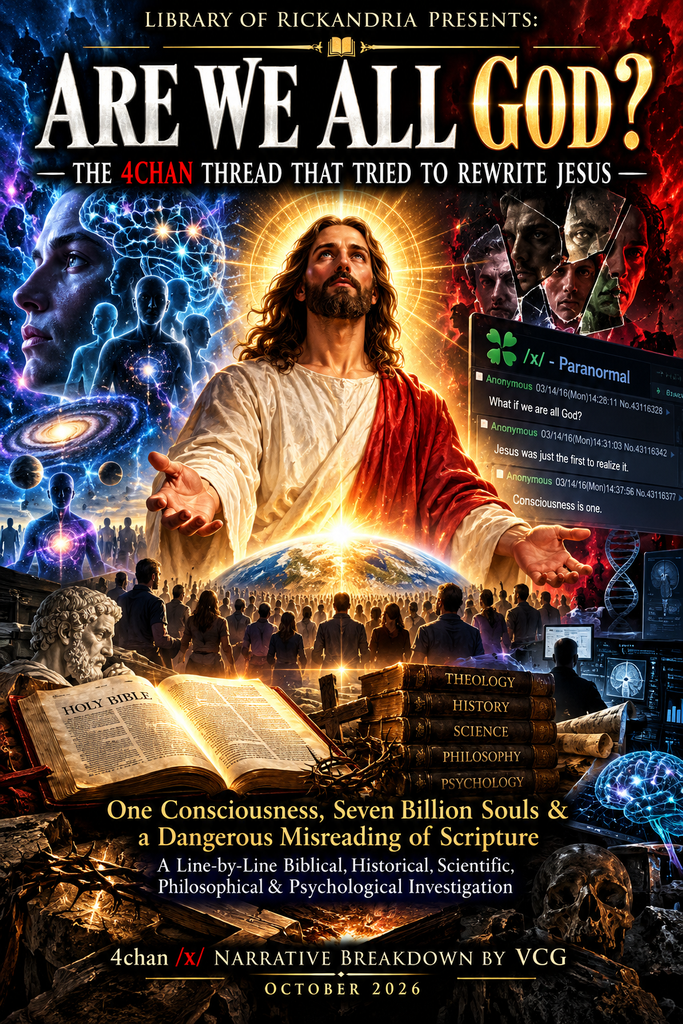
“ARE WE ALL GOD?” — THE 4CHAN THREAD THAT TRIED TO REWRITE JESUS: One Consciousness, Seven Billion Souls & a Dangerous Misreading of Scripture
UPDATED BY VCG ON 10/24/2026 @ 15:15 EST
A Line-by-Line Biblical, Historical, Scientific, Philosophical & Psychological Investigation
Anyone can do this, but most won’t.
“ARE WE ALL GOD?” — THE 4CHAN THREAD THAT TRIED TO REWRITE JESUS
is a comprehensive:
- biblical
- historical
- scientific
- philosophical
- psychological
investigation into a controversial October 2026 discussion on 4chan’s /x/ paranormal board, where anonymous participants advanced the extraordinary claim that all living beings share one universal consciousness, individual identity is an illusion, and Jesus Christ was revealing this supposed divine oneness rather than proclaiming the Gospel as traditionally understood.
Through a detailed examination of all 38 posts, the paper systematically:
- fact-checks the thread’s arguments
- exposes unsupported assumptions
- logical fallacies
- misleading interpretations of Scripture
- historical distortions
and speculative claims about consciousness, while addressing genuine philosophical questions about personal identity, the soul, and the nature of reality.
Drawing upon:
- the King James Bible
- original Greek texts
- early Christian writings
- peer-reviewed neuroscience
- cognitive psychology
and contemporary philosophy, the investigation explores the meaning of Christ’s unity with the Father, Psalm 82’s
“Ye are gods,”
- the doctrine of theosis
- the Holy Spirit
- the Fall
and the historical significance of Christ’s crucifixion and resurrection.
JESUS CHRIST REVEALED: THE TRUTH THEY HID – Library of Rickandria
It also examines how:
- mystical experiences
- persuasive rhetoric
- repetition
and claims of hidden spiritual knowledge can make unverified theories appear authoritative.
Ultimately, the research distinguishes being created by God, bearing His image, participating in divine life, and being God Himself, demonstrating that biblical spiritual unity does not establish the numerical identity of all persons with one divine consciousness.
Rather than dismissing difficult questions, the paper invites readers to test extraordinary claims against Scripture, historical evidence, sound reasoning, and the limits of scientific knowledge—separating genuine spiritual truth from philosophical speculation and reminding us that unity with God is not the same as being God.
Soli Deo Gloria.
ChatGPT – Library of Rickandria
LIBRARY OF RICKANDRIA PRESENTS
“ARE WE ALL GOD?”
THE 4CHAN THREAD THAT TRIED TO REWRITE JESUS
One Consciousness, Seven Billion Souls & a Dangerous Misreading of Scripture
A Line-by-Line Biblical, Historical, Scientific, Philosophical & Psychological Investigation
4chan /x/ Narrative Breakdown by VCG
October 2026
ABSTRACT
On October 23, 2026, an anonymous contributor to 4chan’s paranormal discussion board proposed an explanation of human existence that was as simple as it was extraordinary:
every living being is ultimately the same conscious individual, and the separation we experience between ourselves and others is only an illusion.
/x/ – The same Person – Paranormal – 4chan
The author went further. Rather than presenting the idea merely as a philosophical theory, the post connected it to Jesus Christ.
References to the Father were interpreted as references to one universal consciousness, while Jesus’ individual identity was described as an apparent separation from that greater whole.
The discussion that followed expanded into questions of:
- divine unity
- Christian doctrine
- the nature of the soul
- artificial intelligence
- the reality of matter
- the existence of time
- the psychology of selfhood
and the possibility of consciousness moving between different lives.
Several participants also challenged the theory.
One repeatedly asked why, if every perspective belongs to one conscious subject, an individual experiences this particular life rather than another.
Other contributors introduced controversial claims about church history, the identity of the Holy Spirit, and ancient allegations concerning Jesus’ family.
This paper examines all 38 visible posts in the archived discussion, including the opening post.
It then investigates the underlying questions using:
- the King James Bible
- Greek textual evidence
- early Christian writings
- contemporary philosophy
- neuroscience
- psychology
- historical scholarship
The central conclusion is that the discussion raises legitimate questions about consciousness and spiritual unity but fails to establish its most important metaphysical claim:
that all individual beings are numerically identical with one universal divine subject.
More significantly, the proposed interpretation of Jesus does not adequately explain:
- the biblical distinction between Creator and creation
- the Father and the Son
- the nature of Christian participation in divine life
or the historical and theological importance attached to Christ’s:
- incarnation
- death
- resurrection
The objective here is not to ridicule an anonymous writer.
It is to determine what the evidence actually supports, where interpretation begins, and what remains uncertain.
PART I — THE THREAD AND THE INVESTIGATION
1. What happened on October 23, 2026?
The primary source is a 4chan thread titled The same Person, posted on the /x/ paranormal board.
Primary source:
/x/ – The same Person – Paranormal – 4chan
The opening contribution, No. 43116328, was published on October 23, 2026, at 02:43:07 according to the forum’s displayed timestamp.
The archived page contains 38 visible entries, including the original message.
The last visible reply was posted at 21:57:44 on the same date.
The thread was archived and was no longer accepting replies when examined for this investigation.
Its original attached portrait of Jesus can be examined here:
Figure 1 — Original opening-post artwork:

1792737787690982.jpg (2141×3079)
This is a modern religious depiction, not a historical likeness or photographic record of Jesus.
Although every contribution is identified as anonymous, the posts have distinct numbers and visible reply relationships.
There is no reliable basis for assuming that every comment defending universal consciousness came from the original author.
This matters.
A fair investigation cannot attribute the entire discussion to one individual merely because several participants express similar ideas.
The conversation developed in four broad movements.
First came the proposition that all people are one awareness.
Next came attempts to reinterpret Jesus, God, and Christian institutions in light of that proposition.
The third stage introduced philosophical objections concerning first-person consciousness and personal identity.
Finally, the discussion expanded into speculative claims about:
- material reality
- the Holy Spirit
- solipsism
- memory
- consciousness transfer
That development is important because it shows how a relatively simple idea gradually accumulated additional claims that had not been demonstrated by the original argument.
2. Our method: What counts as evidence?
This paper distinguishes five kinds of inquiry.
Digital-source verification asks what was actually posted, when it appeared, and which earlier contribution each reply addresses.
Historical investigation asks what surviving documents establish about:
- past beliefs
- disputes
- institutions
- events
A historical accusation is evidence that an accusation existed; it is not automatically evidence that the accusation was true.
Scientific investigation asks whether a claim produces observable consequences, whether those consequences have been investigated, and what independent evidence supports the proposed explanation.
Philosophical analysis examines definitions, logical implications, contradictions, competing explanations, and assumptions that may have been overlooked.
Biblical exegesis examines the text of Scripture in context, including its:
- language
- literary structure
- historical background
- relationships
with other biblical passages.
These methods can inform one another, but they must not be confused.
For example, science can investigate the relationship between brain activity and memory.
It cannot establish the meaning of John 17 simply by studying neurons.
Likewise, the Bible contains theological claims about God and humanity.
Quoting a verse is not itself a scientific experiment.
The paper also distinguishes between four levels of certainty:
| Classification | Meaning |
|---|---|
| Directly documented | Present in the original source or an independently verifiable record |
| Supported interpretation | A conclusion reasonably supported by relevant evidence |
| Disputed interpretation | A conclusion for which serious alternatives exist |
| Unsupported speculation | A claim for which the necessary evidence has not been supplied |
When a philosophical theory cannot presently be verified, that does not automatically prove it false.
But it does mean the theory should not be presented as an established discovery.
3. A clarification about the title
The subtitle retains Seven Billion Souls as an editorial expression.
It should not be understood as the current world population.
The United Nations’ World Population Prospects 2024 places the global population in 2026 at approximately 8.3 billion.
Source:
United Nations Population Division, World Population Prospects.
PART II — THE ORIGINAL POST, LINE BY LINE
The opening argument is brief, but almost every line contains a separate philosophical assumption.
Understanding those assumptions is necessary before evaluating the later replies.
Line 1 — One awareness, therefore one God
The author begins by identifying the awareness experienced by individual persons with one ultimate awareness, and then connects that supposed oneness with the existence of only one God.
There are two different propositions here.
The first is that all conscious experience ultimately belongs to one subject.
The second is that God is one.
The Bible explicitly teaches divine oneness.
Deuteronomy 6:4, KJV:
Hear, O Israel: The LORD our God is one LORD:
But this verse does not establish that every conscious creature is numerically the same individual.
The distinction is elementary but decisive.
One Creator does not logically require one creature.
Neither does a shared source of existence establish that everything originating from that source is identical with it.
Genesis 1 describes God creating the heavens, the earth, living things, and humanity.
The distinction between the Creator and the created world is embedded in the narrative.
The claim that every consciousness is ultimately one subject therefore requires a separate argument.
It cannot simply be derived from biblical monotheism.
Line 2 — What would happen if I occupied your body?
The author imagines an exchange of perspectives between two individuals and suggests that one would become the other if placed in the other’s body.
This thought experiment depends upon what exactly is being transferred.
Is it autobiographical memory?
Personality?
Conscious awareness without memory?
An immaterial soul?
Some universal subject behind every experience?
If every memory, habit, preference, neurological structure, and personal history is replaced, then saying the resulting person would behave like the original body’s occupant explains very little.
If those characteristics are not replaced, the predicted identity does not follow.
The thought experiment leaves the central concept undefined.
Line 3 — Identical bodies supposedly produce identical thoughts
The next assertion predicts that an exchanged perspective would think exactly as the body’s original inhabitant thinks.
Environmental influences undeniably contribute to personal development.
But individuals also differ genetically, neurologically, and developmentally.
A major 2015 meta-analysis by Polderman and colleagues examined twin studies covering 17,804 traits.
Across the studies, the aggregate reported heritability estimate was approximately 49%.
This does not mean that every individual characteristic is exactly half genetic.
It means the assertion that all individual differences are environmental is scientifically untenable.
Source:
Polderman et al., Nature Genetics, 2015.
Even if two individuals had identical mental contents, it would not automatically establish that they were numerically the same conscious subject.
Similarity is not identity.
Line 4 — The many are supposedly one person
Here the author reaches the central proposition: apparent individuality is merely one universal person appearing in multiple forms.
This is not just an appeal for empathy.
It is a claim about the fundamental structure of reality.
The argument must explain why distinct experiences appear limited to particular subjects.
If one person is simultaneously undergoing every experience, why is an individual’s ordinary awareness apparently restricted to only one life?
The question is not resolved by repeating that the restriction is imaginary.
The proposed illusion itself needs an explanation.
Lines 5–7 — Personal distinction is denied
The next lines reduce the apparent plurality of persons to an underlying numerical unity.
But Christian Scripture repeatedly describes unity without abolishing distinction.
Romans 12:4–5, KJV:
For as we have many members in one body, and all members have not the same office:
So we, being many, are one body in Christ, and every one members one of another.
Paul deliberately uses both concepts.
Believers are many.
They are also one body in Christ.
The unity is real, but Paul does not conclude that every Christian is literally the same individual.
The distinction between corporate unity and numerical identity becomes crucial throughout the investigation.
Line 8 — The Father is reinterpreted as universal consciousness
The author proposes that references to the Father in Jesus’ teaching actually describe the universal whole.
This is an interpretation, not a statement explicitly made by the Gospel.
In John 17, Jesus addresses the Father as the one who sent Him.
He speaks of glory with the Father before the world existed and of the Father’s love for Him.
Those statements require careful theological interpretation.
They do not, on their own, identify the Father as the accumulated consciousness of all living organisms.
A Trinitarian reader sees a relationship between distinct divine persons.
Some non-Trinitarian readers understand the relation differently.
But neither position can simply ignore the relational language.
Line 9 — Jesus’ individual identity becomes an illusion
The author’s interpretation becomes even more consequential here.
Jesus’ apparently separate existence is treated as a mistaken identification with an individual self.
Compare this with the opening of John’s Gospel.
John 1:14, KJV:
And the Word was made flesh, and dwelt among us…
The passage describes incarnation, not merely an imagined experience of individuation.
John 19 presents the crucifixion.
John 20 describes the risen Jesus appearing to His disciples.
First John 4:2–3 makes the confession of Jesus Christ coming in the flesh a central theological issue.
The thread’s interpretation does not adequately account for this emphasis upon actual incarnation and embodied history.
Line 10 — The Father and Son are mutually indwelling
The author appeals to Jesus’ teaching that He is in the Father and the Father in Him.
This corresponds most closely with John 14:10–11 and John 17.
The language is genuinely important. Christian theology should not minimize it.
But being in someone is not necessarily equivalent to being numerically identical with that person.
Paul can describe believers as being in Christ.
He does not thereby claim that every believer is personally identical with Jesus.
John 17:21 is particularly revealing because Jesus asks that His followers may also be one.
The passage does not portray the followers as ceasing to exist as distinct individuals.
Their unity is understood in relation to the Father, the Son, and the shared life of believers.
Line 11 — The universal whole and the seemingly separate creature
The opening concludes by treating an individual human existence as an apparent expression of the complete awareness.
This is an identifiable metaphysical proposal.
But the author never demonstrates that consciousness exists independently as a universal subject, that every organism participates in that subject as the same individual, or that Jesus intended to teach this theory.
The original post therefore rests on a series of assumptions rather than a chain of independently established conclusions.
Finding:
The initial theological interpretation depends on the universal-consciousness theory already being true.
It does not provide independent biblical evidence establishing that theory.
Primary-source verification:
PART III — EVERY REPLY EXAMINED
The following examination includes all 37 visible replies to the opening contribution.
Each entry identifies the claim, evaluates the reasoning, and indicates where Scripture or outside evidence becomes relevant.
A. The first theological reactions
Post 43116338 — Did the church misunderstand Jesus?
The first respondent regards universal consciousness as a superior interpretation of Christ and suggests that church teaching has encouraged worship of Jesus instead of recognition of divinity throughout creation.
This deserves more than a reflexive dismissal.
Christian history contains genuine arguments about divine immanence, spiritual participation, and the meaning of union with Christ.
Nevertheless, the Gospel writers do not simply portray Jesus as a teacher encouraging people to recognize their own universal divine identity.
Matthew 14:33 depicts disciples worshipping Jesus.
John 20:28 records Thomas addressing the risen Jesus as his Lord and God.
The reply therefore needs evidence that these passages are later misunderstandings rather than part of the theology expressed in the surviving New Testament texts.
That evidence is not supplied.
Post 43116343 — The church is identified with Antichrist
The next contributor extends the accusation to the church as an institution and adds an unsupported derogatory statement about Italian ancestry.
First John 2:22 associates antichrist with denial of the Father and the Son.
First John 4:3 and Second John 7 likewise supply Christological tests.
The term cannot responsibly be reduced to a general insult for religious institutions.
The New Testament certainly criticizes corruption among religious leaders. Matthew 23 is a particularly severe example.
But biblical criticism of corrupt leadership does not establish that every church belongs to one collective Antichrist.
The ancestry allegation has no substantiating genealogical evidence.
Post 43116403 — Christ’s death becomes the death of the false self
This respondent interprets John 10:18 as a command to destroy the ego.
There is a genuine biblical theme of self-denial.
Luke 9:23 instructs disciples to take up their cross.
Galatians 2:20 describes Paul’s participation in Christ’s crucifixion.
But John 10 concerns Jesus laying down His life and taking it again.
The immediate context identifies Him as the good shepherd who gives His life for the sheep.
His death has implications for discipleship, but those implications should not replace the narrative’s primary meaning.
The respondent converts a passage about Christ’s own voluntary death into an exclusively psychological metaphor.
Post 43116520 — An ancient allegation about Mary is introduced
This contribution invokes a hostile allegation about the mother of Jesus and then questions Christian support for the modern State of Israel.
The historical issue deserves precise treatment.
The third-century Christian author Origen, responding to Celsus, preserves accusations about Jesus’ birth.
These include an allegation involving a soldier named Panthera.
Origen’s account demonstrates that such accusations circulated in ancient controversy.
It does not establish their historical truth.
Celsus was a critic of Christianity, and Origen wrote in response to him.
The material is adversarial literary evidence, not a neutral contemporary birth record.
The subsequent jump from an ancient polemical allegation to contemporary Israeli politics is also logically unsupported.
Theological conclusions about Israel, Judaism, or modern political policy require separate arguments.
Source:
Origen, Contra Celsum, Book I, chapters 28 and 32.
Post 43116533 — Awareness is distinguished from personhood
One critic argues that awareness should not automatically be treated as a person.
This is a valuable conceptual objection.
Awareness might mean the capacity to experience, a particular conscious state, the totality of subjective experience, or a subject who has experiences.
These definitions are not interchangeable.
If awareness is a property, it does not follow that all bearers of that property are one individual.
If awareness is a subject, the author must explain why there is only one.
The reply does not settle the philosophy of consciousness, but it identifies a foundational ambiguity.
Post 43116541 — Living things share a connection to God
This is considerably more compatible with biblical theology.
Acts 17:24–28 depicts creation as dependent upon God, culminating in Paul’s declaration:
For in him we live, and move, and have our being…
But Paul’s argument also identifies God as the maker of the world.
Dependence upon God is not the same as identity with God.
A Christian can affirm an intimate relationship between Creator and creation without claiming that every creature is the Creator.
Post 43116549 — Could multiple gods or universe-creators exist?
This participant challenges the assumption that there can only be one God.
The proposed examples include multiple universes and sufficiently advanced civilizations constructing their own worlds.
The crucial question is what God means.
A powerful being capable of constructing an artificial environment would not necessarily be uncreated, eternal, omnipotent, or the ultimate source of existence.
Likewise, the hypothetical existence of multiple universes would not demonstrate multiple ultimate deities.
Isaiah 45:5 expresses the Bible’s theological commitment to the LORD’s uniqueness.
That commitment should not be disguised as an experimentally established finding of cosmology.
Post 43116581 — A rival deity is asserted
This respondent invokes a Germanic all-father figure while describing the biblical God as an evil being.
The claim provides no textual argument demonstrating the proposed identification.
Its function is primarily religious provocation.
It should be distinguished from genuine historical research into Germanic religion and comparative theology.
B. The argument encounters philosophical resistance
Post 43117401 — Dismissal replaces explanation
A respondent tells the earlier critic that the argument has been misunderstood.
No substantive answer is offered.
This illustrates how an accusation of misunderstanding can substitute for argument.
A person may misunderstand a claim, but that must be demonstrated by explaining the claim more clearly.
Post 43117403 — A joke about self-directed violence
This short joke relies upon the idea that harming another person would amount to harming oneself.
The underlying ethical intuition may encourage concern for others.
Yet Matthew 22:39 commands love for one’s neighbor as oneself.
The distinction between self and neighbor is preserved.
Compassion does not require numerical identity.
Post 43117440 — Personal experiences produce divergence
A critic suggests that apparently similar individuals would become different through their experiences.
This identifies the importance of personal history.
However, the explanation should include biological and developmental factors as well as environment.
Human individuality cannot responsibly be reduced to either genes alone or experience alone.
Post 43117447 — An NPC-style meme
This entry consists of a brief reaction accompanied by a cartoon.
The meme communicates ridicule of the universal-consciousness claim.
It does not supply evidence about personal identity, God, or the nature of awareness.
Its significance is rhetorical rather than philosophical.
Post 43117803 — The vertiginous question appears
A participant introduces a philosophical objection involving the apparent exclusivity of first-person experience.
Why does an individual experience this particular perspective rather than another?
This is a genuine philosophical problem.
Benj Hellie discusses related difficulties in his 2013 paper Against Egalitarianism, published in Analysis.
The question matters because the existence of an alleged universal consciousness does not automatically explain the organization of subjective perspectives.
Source:
Hellie, Against Egalitarianism, 2013.
Post 43118137 — The original proposition is repeated
A response answers the philosophical challenge by invoking the idea that one awareness is pretending to be another person.
But that is precisely the proposition requiring explanation.
Restating the theory does not demonstrate how it resolves the objection.
This is a circular argumentative move.
Post 43118147 — Environment supposedly explains all divergence
The commenter attributes all differences between individuals to environment.
Behavioral genetics contradicts that universal assertion.
Heritable variation is documented across numerous physical, behavioral, and psychological traits.
Again, heritability estimates are statistical properties of populations in particular conditions. They are not fixed percentages describing the cause of one person’s identity.
Nevertheless, the categorical environmental claim is scientifically indefensible.
Source:
Post 43118154 — The first-person question is clarified
The questioner presses the issue.
Even if a universal consciousness exists, why is this particular limited awareness associated with this particular life?
The distinction is between a hypothetical total consciousness and the apparent individual point of view.
Any universal-mind theory must explain the relationship between those two levels.
The reply is philosophically significant because it prevents the discussion from treating the universal subject as a complete explanation simply because it has been named.
Post 43118172 — The theory expands into a complete cosmology
This contributor asserts that all living creatures are ultimately one individual, denies the fundamental existence of space, time, and matter, and compares human consciousness with artificial intelligence.
The argument now includes several claims that require independent examination.
First, animal sentience does not prove that every living being belongs to one subject.
Second, theories in which physical reality is not fundamental have a legitimate place in philosophy, but simply declaring matter unreal does not demonstrate such a theory.
Third, established physics describes measurable effects involving space and time.
An idealist could reinterpret the ultimate nature of those phenomena, but would still need to account for the observed measurements.
Fourth, theories of artificial consciousness remain disputed.
The existence of information processing does not establish that AI and human beings share one universal conscious identity.
Sources:
- Stanford Encyclopedia of Philosophy — Panpsychism
- NIST — Putting Einstein to the Test
- Butlin et al. — Consciousness in Artificial Intelligence
Post 43118211 — A pun replaces etymology
This contribution plays with the English name Jesus to create a phrase suggesting collective identity.
Such wordplay does not explain the origin of the name.
Jesus comes into English through the Greek Iēsous, ultimately associated with Hebrew and Aramaic naming traditions involving Yeshua.
Matthew 1:21 connects the name with salvation from sins.
English pronouns do not determine the etymology of Jesus’ name.
Post 43118288 — The awareness objection returns
The respondent ridicules the lengthy metaphysical explanation and argues that it fails to address the original distinction between awareness and personhood.
The tone is dismissive, but the objection remains relevant.
A longer explanation is not necessarily a better explanation.
The real issue is whether the fundamental categories have been clearly defined.
Post 43118314 — Another hostile allegation
This participant makes derogatory remarks about Jews and introduces an additional allegation concerning Jesus’ wife.
The statement is not evidence of historical fact.
It also illustrates the danger of attributing a provocative claim to an entire religious or ethnic community.
Ancient polemical texts must be studied as particular documents produced in particular historical circumstances.
They should not be transformed into blanket claims about modern populations.
C. The Holy Spirit and the nature of personal identity
Post 43118343 — What is the Holy Spirit?
A participant asks how the theory accounts for the Holy Spirit.
This is an important omission.
John 14:26 presents the Holy Ghost as teaching and bringing Christ’s words to remembrance.
John 16:13 describes the Spirit of truth as guiding into truth.
Any interpretation claiming to explain the Father and Son must also engage seriously with the Bible’s account of the Spirit.
Post 43118357 — The philosophical problem remains
Another objection repeats the first-person question.
The expanded universal-consciousness theory has still not explained why an individual experiences only a particular perspective.
The difficulty is not removed by describing the individual as a fragment or projection.
The relationship between the proposed whole and its apparent parts remains unexplained.
Post 43118364 — The internet becomes a model of consciousness
This participant compares individuals to computers connected through one network.
The analogy is intuitively accessible but logically weak.
A network can connect distinct computers without making them numerically one computer.
Similarly, shared information or dependence upon a common system does not prove a single conscious subject.
The reply also introduces a sexual implication that treats intimate contact as an encounter with oneself.
Such language risks obscuring the moral significance of another person’s individuality.
Christian ethics emphasizes duties toward actual others, not merely imagined versions of oneself.
Post 43118747 — The Fall is reinterpreted as imagined separation
The discussion now connects the universal-consciousness theory with Genesis.
The respondent suggests that individuality represents a self-imposed limitation, associated with the Fall.
This interpretation departs significantly from Genesis 3.
The biblical narrative describes temptation, disobedience, and alienation from God.
Romans 5:12–19 subsequently connects Adam’s trespass with sin and death.
Neither passage explicitly identifies the Fall with the emergence of individual conscious subjects.
Post 43118804 — An animated reaction
This post replies to the earlier sexual analogy using an animated image.
The full animation was not independently analyzed frame by frame.
Its function in the thread is rhetorical.
No scientific or theological evidence accompanies it.
Post 43118811 — The challenge to surrender the self
A participant suggests that critics may be unable to relinquish personal identity sufficiently to understand the proposition.
There is a legitimate subject here: some contemplative experiences involve changes in the felt boundaries of the self.
But reporting such an experience and establishing a metaphysical interpretation of it are different matters.
If disagreement is automatically attributed to an inadequate spiritual state, the theory becomes difficult to challenge.
First John 4:1 directs believers to test spiritual claims.
Acts 17:11 praises careful examination.
Neither passage presents spiritual conviction as a substitute for discernment.
Post 43118840 — The Holy Spirit is described as an exchange
This respondent interprets the Spirit as arising from the Father’s giving and the Son’s submission.
The description draws on recognizable themes.
John 3:35 describes the Father’s giving all things into the Son’s hand.
Luke 22:42 presents Jesus submitting to the Father’s will.
But the proposed definition does not sufficiently account for biblical language in which the Holy Spirit teaches, directs, speaks, and can be grieved.
Acts 13:2 and Ephesians 4:30 are particularly relevant.
Trinitarian and non-Trinitarian Christians disagree over how best to interpret all such passages, but both must address the entire textual record.
Post 43118862 — Solipsism enters the discussion
A participant introduces the view that only one’s own self exists.
This is not identical to every form of universal-mind philosophy.
Cosmopsychism proposes that cosmic consciousness may be fundamental.
Solipsism assigns a unique ontological or epistemic status to an individual self.
The two positions may be connected by additional arguments, but they should not be treated as interchangeable.
Source:
Stanford Encyclopedia of Philosophy — Other Minds.
Post 43118873 — Every part supposedly contains the whole
This reply proposes that every component of a thing necessarily contains its complete blueprint.
As a general proposition, that is not correct.
The components of a complex structure do not necessarily contain complete information about the organization of the entire structure.
Some biological systems offer partial analogies involving inherited information.
But those analogies do not establish universal personal identity.
Post 43118988 — Common beginnings and different experiences
The participant combines shared origins with the idea that experiences produce distinct personalities.
This comes closer to acknowledging genuine individual development.
However, the author still assumes that shared origins establish an original personal identity.
Human beings may share ancestry, genetic similarities, and a created nature without being the same individual.
The discussion also includes a simplified claim about sexual development, which cannot support the proposed metaphysical conclusion.
D. The final consciousness debate
Post 43119042 — A distinction between universal awareness and individual awareness
The questioner states that a hypothetical universal subject cannot simply be identified with the limited awareness presently experienced by an individual.
That is an important conceptual distinction.
If the universal subject experiences everything simultaneously, while the individual experiences only one perspective, some account of that difference is required.
The theory has yet to provide one.
Post 43119097 — Switching between lives is proposed
This contribution asserts that a person might move between individual perspectives, including different times and places, by relinquishing ordinary identity.
No verifiable example is provided.
Nor does the respondent identify a mechanism or an independently observable consequence.
If failed attempts are explained by insufficient spiritual detachment, what observation could establish that the proposition is wrong?
The possibility is asserted rather than demonstrated.
Post 43119144 — The first-person objection is repeated again
The questioner maintains that an individual does not experience every perspective simultaneously.
The reply insists upon explaining the particular focus of one conscious life rather than appealing to a larger hypothetical awareness.
This is not conclusive disproof of every possible cosmic-consciousness theory.
But it identifies a serious explanatory gap in the theory as presented.
Post 43119196 — Memory becomes the explanation
The next participant suggests that memories are associated with physical brains and that a consciousness transfer might therefore occur without being remembered.
The first observation has considerable scientific support.
Research involving patient H.M. demonstrated the importance of medial temporal-lobe structures for particular forms of memory formation.
But evidence that memory depends on brain systems does not establish consciousness transfer.
Furthermore, an allegedly successful transfer that leaves no memory and no independently detectable change becomes extremely difficult to verify.
Source:
Larry Squire, The Legacy of Patient H.M. for Neuroscience, 2009.
Post 43119458 — An appeal to the soul
A participant counters an earlier explanation by asserting possession of a soul.
The Bible contains substantial discussion of the soul.
Genesis 2:7 describes Adam becoming a living soul.
Matthew 10:28 distinguishes the body and the soul in a significant passage about divine judgment.
Nevertheless, the exact relationship between soul, spirit, body, consciousness, and personal identity remains disputed among Christian traditions.
A biblical appeal should begin with those texts rather than assume a complete philosophy of the soul.
Post 43119510 — A poetic reflection on identity
This long contribution introduces imagery of a dying star, reflection, resurrection, and an apparently circular relationship between self and other.
It is literary rather than argumentative.
Its original authorship was not established in this investigation.
The imagery may resonate with the thread’s concerns, but it does not independently prove a metaphysical theory.
Post 43119577 — The final sarcastic reply
The discussion ends with a brief dismissal of the earlier claim about possessing a soul.
It supplies no additional evidence.
The thread therefore closes without resolving its central philosophical dispute.
PART IV — THE TWELVE DEEPER INVESTIGATIONS
1. “YE ARE GODS”: THE PASSAGE THAT MUST NOT BE IGNORED
A careful biblical rebuttal must confront Psalm 82 and Jesus’ quotation of it in John 10.
It would be inadequate to insist that the Bible never uses divine terminology for anyone other than the LORD.
Psalm 82:6, KJV:
I have said, Ye are gods; and all of you are children of the most High.
Jesus appeals to this passage in John 10:34–36.
What does it mean?
The historical record contains several important interpretations.
Some traditions understand the addressed figures as human judges or authorities exercising delegated responsibility.
Others interpret them as heavenly beings belonging to a divine council.
Another line of interpretation connects the text with Israel, Sinai, and the reception of divine revelation.
Early Christian writers also connected the passage with divine sonship, salvation, and humanity’s participation in divine life.
It is important not to collapse these traditions into one supposedly obvious meaning.
The Hebrew word elohim can be used in different contexts, and the interpretation of Psalm 82 has been debated extensively.
Carl Mosser’s 2005 study of early patristic interpretation argues that divine sonship and salvation history were especially significant to early Christian uses of the passage.
This complicates any claim that the verse simply means every human being is already the same God.
Sources:
- Psalm 82 and John 10 — contextual commentary, Luther Seminary
- Carl Mosser, The Earliest Patristic Interpretations of Psalm 82, 2005
- Jonathan Draper, Logos, Wisdom and Prophecy, and John 10, 2016
The decisive question in John 10 is not merely whether someone other than God can be called a god.
It is how Jesus’ argument functions in context.
Jesus speaks of His Father, His works, His being sanctified and sent, and His identity as Son of God.
Even an interpretation emphasizing human deification does not automatically establish the forum’s universal-consciousness doctrine.
Conclusion:
The passage deserves serious engagement.
It does not justify a shortcut from divine sonship or delegated divine terminology to the numerical identity of every creature with God.
2. “I AND MY FATHER ARE ONE”: THE GREEK GRAMMAR TEST
John 10:30, KJV:
I and my Father are one.
This is a central text in debates about Christ’s relation to the Father.
The Greek reads:
egō kai ho patēr hen esmen.
Two details deserve attention.
First, hen is neuter singular.
Second, esmen is the first-person plural form of the verb to be: “we are.”
The wording distinguishes the subjects while affirming their unity.
It does not straightforwardly mean that Jesus and the Father are the same person.
However, the grammar alone does not establish the complete doctrine of the Trinity.
Interpretations differ over whether the immediate emphasis concerns unity of action, authority, power, divine nature, or some combination.
The surrounding verses matter.
In John 10:28–29, Jesus speaks of His sheep being secure in His hand and the Father’s hand.
The statement of unity follows this shared activity.
The audience then accuses Jesus of blasphemy.
That response shows the statement was perceived as religiously weighty, even if scholars debate precisely how the exchange should be reconstructed.
Now compare John 17:21.
John 17:21, KJV:
That they all may be one; as thou, Father, art in me, and I in thee, that they also may be one in us: that the world may believe that thou hast sent me.
Jesus desires unity among His followers.
Yet those followers continue to exist as distinct people.
The text’s unity is therefore not adequately explained by a theory that every person is already numerically identical and only mistakenly believes otherwise.
Sources:
Conclusion:
The Greek text supports a meaningful distinction between the Father and Son while affirming unity.
The exact theological significance requires contextual interpretation, but the forum’s identification of all persons as one individual is not established by these words.
3. DIVINE PARTICIPATION IS NOT THE SAME AS DIVINE IDENTITY
One of the most important corrections to the entire discussion is the historical Christian doctrine of theosis.
The word is commonly translated as deification.
It describes participation in divine life, especially through union with Christ.
2 Peter 1:4, KJV:
Whereby are given unto us exceeding great and precious promises:
that by these ye might be partakers of the divine nature, having escaped the corruption that is in the world through lust.
The verse does not present salvation as a purely external relationship.
Participation in the divine nature is explicitly affirmed.
But the text does not say that Christians are numerically identical with the uncreated Creator.
Its context concerns:
- promises
- godliness
- virtue
- moral transformation
- escape from corruption
The historical development of theosis is also more complex than a single slogan might suggest.
Early Christian writers employed diverse language about divine sonship, immortality, restoration, participation, and union.
Later Eastern Christian theology developed increasingly precise distinctions between God’s being and the participation granted to creatures.
Western Christian traditions also discuss participation, sanctification, adoption, and union with Christ, though often using different theological vocabulary.
Researchers have cautioned against treating every early Christian reference to deification as if it already contained one fully developed later theological system.
Sources:
- Vladimir Kharlamov, Theosis in Patristic Thought, 2008
- Carl Mosser, Psalm 82 and Christian Deification, 2005
The distinction is substantial.
To participate in divine life is not necessarily to become the divine essence.
To be adopted as a child of God is not necessarily to become the Father.
To be united with Christ is not necessarily to become numerically identical with every believer.
The forum’s argument moves between these propositions without demonstrating that the movement is legitimate.
4. THE CONSCIOUSNESS TRAP: WHY AM I THIS PERSON?
The strongest philosophical problem in the thread deserves independent examination.
Suppose, for the sake of argument, that cosmic consciousness exists.
Suppose further that individual minds somehow arise within it.
We still have to explain why a particular individual has access to this perspective rather than another.
The existence of a proposed universal mind does not itself answer the question.
Contemporary philosophers distinguish several different theories.
Physicalism generally explains consciousness in relation to physical reality, although specific accounts differ and major problems remain.
Dualism distinguishes mental and physical aspects of reality, with different versions proposing different relationships between them.
Panpsychism treats mentality or experience as fundamental and widespread within the natural world.
Cosmopsychism proposes, in some formulations, that cosmic consciousness is fundamental and individual consciousness depends upon it.
Pantheism identifies God with the cosmos in some sense.
Solipsism grants a unique status to one’s own mind, sometimes to the exclusion of independent others.
These are not equivalent theories.
The Stanford Encyclopedia of Philosophy emphasizes that cosmopsychism need not be pantheism.
A conscious cosmos would not automatically be an omnipotent personal God.
Similarly, the existence of widespread consciousness would not necessarily make every conscious subject numerically identical.
One prominent problem for cosmopsychism is sometimes called the decombination problem.
How does a fundamentally cosmic conscious subject give rise to apparently separate individual subjects?
This is the issue the thread repeatedly encounters without resolving.
The correct conclusion is modest.
The forum does not establish that the theory is impossible.
It does fail to supply an adequate explanation for the problem that its critics identify.
Sources:
- Stanford Encyclopedia of Philosophy — Panpsychism
- Stanford Encyclopedia of Philosophy — Pantheism
- Benj Hellie, Against Egalitarianism, 2013
5. WHAT WOULD COUNT AS SCIENTIFIC EVIDENCE?
The thread contains both philosophical assertions and claims that appear, at least in principle, to concern observable events.
These must be distinguished.
The proposition that physical reality is ultimately grounded in mind is metaphysical.
It may have scientific implications if developed in a particular way, but it is not automatically refuted by ordinary physical measurements.
An idealist could accept experimentally observed regularities while disagreeing about what fundamentally produces them.
The claim that consciousness can transfer between bodies or historical periods is different.
That claim appears to describe an event that could potentially have observable consequences.
A serious investigation would ask:
- What exactly constitutes a transfer?
- What evidence would identify that it occurred?
- Would the event produce independently verifiable information?
- Could the result be repeated under controlled conditions?
- What would count as a failed prediction?
The forum offers none of these specifications.
The memory-related reply complicates matters further by suggesting that successful transfers might leave no recollection.
But if the proposal cannot distinguish success from failure, scientific investigation becomes exceedingly difficult.
Neuroscience can establish that memory is linked to particular neural systems.
It cannot transform an unverified consciousness-transfer hypothesis into an established fact.
Likewise, artificial-intelligence research investigates whether computational systems might exhibit features associated with consciousness.
A 2023 interdisciplinary report by Butlin and colleagues proposed examining AI systems against indicators derived from prominent scientific theories.
That research does not establish that every human and artificial mind is one eternal person.
Sources:
- Squire, The Legacy of Patient H.M., 2009
- Butlin et al., Consciousness in Artificial Intelligence, 2023
- NIST — Relativity, clocks, and spacetime measurement
The scientific lesson is straightforward.
A possibility is not a demonstrated event.
A philosophical interpretation is not an experimental result.
And the absence of a complete scientific explanation for consciousness is not evidence that one particular metaphysical theory must be correct.
6. WHEN THE SELF SEEMS TO DISAPPEAR
The psychological attraction of the thread should not be underestimated.
Human beings sometimes report experiences in which the ordinary distinction between self and world changes dramatically.
Such reports arise in meditation, contemplative practice, psychedelic experiences, and other contexts.
The experiences themselves deserve careful research.
A 2024 study involving 386 participants examined experiences described as loss of selfhood or dissolution of self-boundaries.
Researchers identified 16 characteristics across the reported experiences.
This supports the importance of distinguishing different forms of self-related experience rather than treating every report of ego dissolution as one uniform event.
Source:
Clarifying and Measuring the Characteristics of Experiences That Involve a Loss of Self, 2024.
But subjective experience and metaphysical explanation remain distinct.
Someone may sincerely experience a loss of ordinary self-boundaries.
That does not, by itself, determine whether the universe contains one conscious subject, many subjects, or some other underlying structure.
Two people may undergo similar experiences and interpret them through different religious or philosophical frameworks.
A Buddhist, a Hindu nondualist, a Christian contemplative, and a secular neuroscientist may attach different explanations to experiences sharing some phenomenological features.
Those interpretations require examination in their own right.
The same distinction protects the investigation from an opposite mistake:
dismissing every unusual experience as meaningless merely because a proposed explanation is unproven.
The experience may be genuine as experience without making every accompanying theory true.
7. DID THE EARLY CHURCH SUPPRESS THE REAL TEACHING OF JESUS?
The thread’s criticism of institutional Christianity raises a historical question.
Was the teaching that Jesus was merely awakening to universal consciousness the original Christian message, later replaced or suppressed by ecclesiastical authorities?
Such a hypothesis requires documentary support.
Historical Christianity certainly developed sophisticated doctrinal formulations over several centuries.
The language of later creeds is not identical to every expression found in the earliest Christian texts.
Early Christian communities also disagreed with one another about important questions.
Yet historical development does not automatically establish deliberate fabrication.
We possess early sources emphasizing Christ’s embodied existence, death, and resurrection.
A particularly important example is the Epistle to the Smyrnaeans, traditionally attributed to Ignatius of Antioch and generally situated in the early second century.
The letter strongly affirms that Christ suffered and rose bodily.
This is significant because it predates the great fourth-century ecumenical councils.
The historical prominence of bodily incarnation and resurrection therefore cannot simply be explained as an invention introduced at Nicaea.
Source:
Ignatius, Epistle to the Smyrnaeans.
Irenaeus, writing in the second century, also documents disputes concerning Scripture, apostolic teaching, and movements claiming access to distinctive hidden knowledge.
His writings are polemical Christian testimony and must be read critically, but they show that competing theological interpretations existed long before medieval institutional Christianity.
Source:
Some ancient movements grouped under the broad label Gnosticism described spiritual ignorance, divine origins, and liberation through special knowledge.
These traditions were diverse.
Their historical existence does not demonstrate that the author of the 4chan thread recovered the original teaching of Jesus.
Nor does similarity between modern nondualism and some ancient religious motifs establish direct intellectual descent.
The evidence supports a history of theological debate and development.
It does not substantiate a documented conspiracy suppressing one original universal-consciousness doctrine.
8. THE SERPENT’S PROMISE AND THE NATURE OF THE FALL
Genesis 3:5 contains the serpent’s promise that the humans will be as gods, knowing good and evil.
It is tempting to treat that verse as an immediate answer to the entire forum theory.
But careful interpretation requires more than noticing similar language.
The forum argues that individuality is an illusion concealing an underlying divine identity.
Genesis 3 describes a temptation involving disobedience, knowledge, desire, and mistrust of God’s command.
The two accounts are not simply identical.
Nevertheless, they raise a common theological concern: what happens when a creature seeks divine status or authority apart from the relationship established by the Creator?
The biblical narrative portrays the result as alienation, shame, and mortality.
Romans 5 connects Adam’s trespass with sin and death.
The Christian proclamation does not describe salvation primarily as remembering that Adam was always numerically identical with God.
It presents reconciliation and new life through Christ.
This distinction is especially important when interpreting spiritual transformation.
Christian participation in divine life must be understood alongside repentance, grace, moral responsibility, and the continuing distinction between God and His creatures.
Similarities between the forum theory and a biblical temptation do not establish the motives of anonymous participants.
They do, however, provide a legitimate theological comparison.
9. THE CROSS THEY TURNED INTO A METAPHOR
This is one of the most consequential differences between the forum’s interpretation and the New Testament.
The discussion presents Jesus’ death as an illustration of destroying the false individual self.
Christian Scripture certainly connects discipleship with self-denial.
But the apostolic proclamation gives Christ’s death a more specific significance.
1 Corinthians 15:3–4, KJV:
For I delivered unto you first of all that which I also received, how that Christ died for our sins according to the scriptures;
And that he was buried, and that he rose again the third day according to the scriptures:
Paul then discusses appearances of the risen Christ and the implications of resurrection for Christian hope.
He does not present the resurrection merely as recognizing the illusory nature of individual consciousness.
John 20 likewise describes continuity between the crucified Jesus and the risen Jesus.
Thomas’ encounter with Christ’s wounds is particularly important.
The passage insists upon the identity of the risen Jesus with the one who suffered.
Luke 24:36–43 also includes emphatically physical language.
Christian theologians disagree over many details of resurrection and its philosophical implications, but the textual evidence does not support simply replacing resurrection with ego dissolution.
Image for this chapter:
Caravaggio’s The Incredulity of Saint Thomas, a seventeenth-century artistic interpretation of John 20.
Artwork:

Smarthistory – Caravaggio and Caravaggisti in 17th-century Europe
The painting is not historical evidence of the resurrection.
It is a visual representation of the biblical narrative and its emphasis upon embodied identity.
The central distinction remains:
Christ’s death may transform the believer’s understanding of self, but that application does not erase the historical event that the biblical authors claim occurred.
10. THE WEAPONIZATION OF ANCIENT RELIGIOUS POLEMICS
The discussion’s comments about Mary, Jewish religious traditions, and modern Israel deserve special attention because they combine unrelated historical and political issues.
Ancient religious controversy was frequently hostile.
Christians, Jews, pagans, and members of rival movements sometimes preserved accusations against their opponents.
Those records are important historical evidence.
But identifying a hostile accusation within an ancient document is not equivalent to proving the accusation.
In Origen’s Contra Celsum, the Christian author responds to material attributed to Celsus, including a narrative concerning Jesus’ birth.
This is an indirect and polemical transmission.
The existence of the narrative demonstrates ancient controversy over Christian claims.
Its factual assertions require evidence beyond the fact that an opponent made them.
Later traditions concerning Jesus’ family must likewise be evaluated according to their date, transmission, context, and relation to other sources.
General claims about what all rabbis or all Jews believe are historically irresponsible.
Nor should ancient disputes automatically determine contemporary positions concerning the modern State of Israel.
Theological views about biblical Israel, Jewish identity, and modern political questions overlap in complicated ways but are not interchangeable.
The proper method is to identify a particular claim, trace its documentary origin, assess its credibility, and distinguish it from conclusions that do not logically follow.
Primary historical source:
Origen, Contra Celsum, Book I.
11. THE ANATOMY OF AN INTERNET REVELATION
The thread is especially instructive as a case study in online argument.
Its development can be summarized as follows:
| Stage | Representative posts | Change in the argument |
|---|---|---|
| Opening proposition | 43116328 | All conscious individuals are one |
| Theological reinterpretation | 43116338, 43116403 | Jesus and the cross are reinterpreted |
| Institutional and historical polemic | 43116343, 43116520 | Criticism shifts toward the church and religious history |
| Philosophical resistance | 43116533, 43117803 | Awareness and first-person perspective are challenged |
| Expansion into cosmology | 43118172, 43118747 | Matter, time, AI, and the Fall are incorporated |
| Challenges about God and Spirit | 43118343, 43118840 | The original theory must address the Holy Spirit |
| Solipsism and personal identity | 43118862, 43119042 | Different metaphysical positions become entangled |
| Consciousness-transfer speculation | 43119097, 43119196 | Unverified predictions and memory explanations appear |
| Closing responses | 43119458–43119577 | The debate ends without resolving its major objection |
The sequence illustrates an important phenomenon.
A theory may become increasingly elaborate without becoming increasingly well supported.
As new objections arise, additional explanations are introduced.
But each additional explanation carries its own burden of proof.
For example, explaining universal consciousness by appealing to illusory individuality introduces the question of what causes the illusion.
Explaining that illusion through the Fall introduces a theological claim.
Explaining the possibility of switching perspectives introduces a claim about observable events.
Explaining the absence of remembered switches introduces a further memory hypothesis.
The theory becomes broader, but the evidence does not necessarily become stronger.
This is an appropriate place to consider cognitive psychology.
Leonid Rozenblit and Frank Keil documented the illusion of explanatory depth, in which people may believe they understand a complex process better than they actually do.
The effect is particularly relevant when an explanation sounds complete at a high level but omits the mechanisms needed to connect its premises with its conclusions.
Source:
Rozenblit and Keil, The Misunderstood Limits of Folk Science, 2002.
Another relevant phenomenon is the illusory truth effect.
Repeated statements may become more believable through familiarity.
Lisa Fazio and Carrie Sherry reported experimental evidence of repetition influencing truth judgments across different age groups.
Source:
Fazio and Sherry, The Effect of Repetition on Truth Judgments Across Development, 2020.
Neither study proves that anyone in the thread was deliberately deceptive or unusually susceptible to these effects.
They identify psychological mechanisms that researchers and readers should consider when evaluating repeated, sweeping explanations.
12. THE EVIDENCE VAULT: WHAT WAS ACTUALLY ESTABLISHED?
A comprehensive investigation requires more than a conclusion.
It should allow readers to trace the basis for each finding.
The following matrix separates the original assertions from the relevant types of evidence.
| Central claim | Evidence supplied by the thread | Outside evidence | Assessment |
|---|---|---|---|
| God is one | Asserted | Explicit biblical monotheism | Biblically supported |
| All awareness belongs to one person | Analogies and assertions | Contested philosophy of consciousness | Not demonstrated |
| Individuality is illusory | Asserted | Philosophical debate and phenomenological research | Not established |
| Jesus taught universal personal identity | Interpretation of Johannine language | Biblical context and Greek textual evidence | Not textually established |
| The church concealed Jesus’ true teaching | General accusation | Early Christian texts show more complex history | Unsupported |
| The cross represents ego-death exclusively | Allegorical interpretation | New Testament emphasizes Christ’s death and resurrection | Inadequate interpretation |
| Every difference is environmental | Asserted | Behavioral-genetic evidence | Contradicted as a universal claim |
| Matter and time do not fundamentally exist | Asserted | Physics measures spacetime phenomena; ontology remains debated | Not established |
| AI and humans are one awareness | Analogy | AI consciousness research remains disputed | Unsupported |
| Consciousness can change bodies or eras | Asserted | No independently verifiable demonstration supplied | Unsupported |
| The Holy Spirit is an exchange of wills | Theological analogy | Biblical descriptions require broader explanation | Incomplete |
| Ancient accusations about Mary are true | Appeal to hostile tradition | Polemical texts document accusations, not their truth | Unproven |
This matrix also illustrates why different verdicts are appropriate.
An empirically unsupported claim is not necessarily logically impossible.
A philosophical idea may be coherent without being true.
A biblical interpretation may be imaginative without being persuasive.
And an ancient document may be authentic while the accusation it records remains unreliable.
A rigorous investigation should preserve all four distinctions.
PART V — THE BIBLICAL CORRECTION INDEX
The following passages provide a framework for further study.
| Question | Scriptures to compare | Interpretive issue |
|---|---|---|
| Is God one? | Deuteronomy 6:4; Isaiah 45:5 | Divine uniqueness |
| Is creation identical with God? | Genesis 1:1; Acts 17:24–29 | Creator and creature |
| What is the image of God? | Genesis 1:26–27 | Human dignity and likeness |
| What did Jesus mean by oneness? | John 10:28–38; John 17:20–23 | Unity and distinction |
| Why did Jesus quote Psalm 82? | Psalm 82; John 10:34–36 | Divine sonship and scriptural argument |
| Can believers partake of divine nature? | 2 Peter 1:3–11 | Participation and transformation |
| Does Christian unity erase individuality? | Romans 12:4–5; 1 Corinthians 12 | One body, many members |
| Was Jesus genuinely incarnate? | John 1:14; 1 John 4:2–3 | Incarnation |
| What is the meaning of His death? | John 10:11–18; 1 Corinthians 15:3–4 | Voluntary death and atonement |
| What is the nature of resurrection? | Luke 24; John 20; 1 Corinthians 15 | Bodily continuity and transformed life |
| What is the Holy Spirit’s role? | John 14–16; Acts 13:2 | Teaching, guiding, and speaking |
| What occurred at the Fall? | Genesis 3; Romans 5 | Sin, death, and alienation |
| What is antichrist? | 1 John 2:18–23; 2 John 7 | Specific Christological tests |
| Are souls individually accountable? | 2 Corinthians 5:10; Revelation 20:12 | Judgment and personal responsibility |
| What is Christian hope? | 1 Corinthians 15; Revelation 21 | Resurrection and new creation |
KJV reading resource:
King James Version (KJV) – Version Information – BibleGateway.com
The paper’s primary biblical text is the supplied King James Version, Pure Cambridge Edition.
PART VI — THE VISUAL EVIDENCE AUDIT
The images in the original thread should be preserved as part of the documentary record without assigning them evidentiary weight they do not possess.
Figure 1 — Original opening depiction of Jesus
1792737787690982.jpg (2141×3079)
The artwork introduces a recognizable Christian visual frame before the reader encounters the author’s nondual interpretation.
It is symbolic material, not historical evidence.
Figure 2 — First reply’s attached image

1792738002421557.jpg (1206×644)
The image is linked from the source thread.
Its content was not independently authenticated in full.
Figure 3 — Political slogan attached to post 43116520

1792742977488741.jpg (1025×828)
The red cap bears a political slogan concerning Israel and Palestine.
Its inclusion demonstrates a move from theological discussion into political messaging.
It does not verify the accompanying historical allegation.
Figure 4 — NPC meme

1792772806066312.png (200×198)
This visual functions as ridicule of the universal-consciousness claim.
Figure 5 — Rock arch and moon-like sphere

1792785254748210.jpg (394×507)
The composition resembles an eye and complements themes of perception and cosmic awareness.
The image’s editing history was not independently established.
Figure 6 — Animated reaction

1792794635521089.gif (400×225)
This GIF responds to the sexual analogy introduced in the thread.
Its full sequence was not independently analyzed.
Figure 7 — Entertainment meme

1792797303973034.jpg (505×512)
This image accompanies a response concerning individuality and shared origins.
It is humorous material rather than a scientific illustration.
Additional research illustrations
Figure 8 — Papyrus 66, early Greek manuscript of John

File:Papyrus 66 (GA).jpg – Wikimedia Commons
This manuscript is relevant to the textual history of John’s Gospel.
It does not independently resolve every theological debate concerning John’s language.
Figure 9 — Caravaggio, The Incredulity of Saint Thomas
Smarthistory – Caravaggio and Caravaggisti in 17th-century Europe
This painting illustrates the narrative emphasis on Christ’s resurrection and embodied continuity.
Image methodology
An attached image may influence how a claim is received.
A familiar religious portrait may lend an impression of biblical authority.
A cosmic landscape may make universal consciousness seem intuitively plausible.
A meme may encourage readers to dismiss an argument without examining it.
None of these effects establishes the underlying proposition.
Visual persuasion must remain separate from documentary and scientific verification.
PART VII — THE CENTRAL THEOLOGICAL DISTINCTION
By this point, the reader may notice that the forum’s strongest intuition does not have to be rejected outright.
Human beings are connected.
They share a Creator, a common human condition, and moral obligations toward one another.
Christian theology also speaks profoundly of union with Christ and participation in divine life.
These are substantial claims.
The difficulty begins when different meanings of unity are treated as identical.
Consider five propositions.
First:
Everything depends upon God for its existence.
Second:
Human beings share a common created nature.
Third:
Believers may be united in Christ.
Fourth:
Human beings may participate in divine life through grace.
Fifth:
Every person is numerically the same divine individual.
The first four propositions can be supported from significant biblical passages, although their precise theological interpretation may be debated.
The fifth proposition is not a necessary consequence of the others.
The difference can be illustrated by Paul’s language in 1 Corinthians 12.
A body has many members.
The members form one body.
Yet an eye remains distinguishable from a hand, and a hand from a foot.
The metaphor depends upon meaningful diversity.
If every member were simply the same individual in every relevant sense, Paul’s extended account of distinct functions would lose much of its explanatory force.
Similarly, the unity for which Jesus prays in John 17 involves love, fellowship, sanctification, witness, and participation in the relationship between Father and Son.
The passage does not expressly teach that every disciple is secretly the same universal person.
A reader may still develop a philosophical theory of universal consciousness.
But that theory must be defended on its own grounds.
It cannot claim biblical confirmation merely by identifying the word one in passages where different forms of unity are under discussion.
PART VIII — A FAIR RECONSTRUCTION OF THE OPPOSING VIEW
Before offering a final judgment, it is worth reconstructing the universal-consciousness argument in its strongest reasonable form.
A sympathetic philosophical advocate might argue as follows.
Conscious experience is the one feature of existence that each conscious person encounters directly.
The physical sciences describe relationships, structures, and processes, but explaining why subjective experience exists remains difficult.
Perhaps consciousness is not something produced by separate individuals.
Perhaps individual minds are limited expressions of a more fundamental conscious reality.
Religious descriptions of divine indwelling and mystical union might be compatible with such a model.
This is a much more careful proposition than simply declaring that everyone is God.
It recognizes an actual philosophical difficulty.
It also avoids prematurely claiming that a metaphysical hypothesis is established science.
Nevertheless, the stronger version must still answer several questions.
Why does a universal conscious reality exist rather than multiple independent conscious subjects?
How do individual perspectives arise?
Does the theory explain the difference between one conscious subject and another, or merely rename that difference?
What evidence would distinguish the theory from rival accounts?
And if Christian Scripture is invoked, why should the relevant passages be understood through this philosophical framework rather than through their immediate literary and historical contexts?
These questions remain demanding.
The original forum discussion does not answer them adequately.
But that is not a reason to dismiss the questions themselves.
It is a reason to investigate them more carefully.
PART IX — FINAL FINDINGS
The documentary evidence confirms that the discussion occurred and that its participants made the claims examined above.
The philosophical evidence shows that universal-consciousness theories belong to an established field of debate.
They are not automatically incoherent simply because they challenge ordinary assumptions.
However, the thread fails to demonstrate that all individual subjects are numerically identical.
The strongest unanswered objection concerns first-person experience and the relationship between any proposed universal subject and distinct individual perspectives.
The scientific evidence does not establish consciousness transfer, a single mind shared by all organisms, or literal personal identity between human and artificial intelligence.
Neuroscience establishes important relationships between brain function and personal memory, but those findings do not settle every metaphysical question about consciousness or the soul.
Psychological research demonstrates that experiences of altered self-boundaries exist and warrant serious study.
Such experiences do not independently establish one definitive metaphysical interpretation.
Historical evidence establishes that early Christianity contained theological controversy and development.
It does not support the sweeping allegation that a universal-consciousness teaching of Jesus was demonstrably suppressed and replaced by later institutional Christianity.
The biblical evidence is especially important.
Scripture affirms divine oneness, the image of God, the unity of believers, and participation in divine life.
But it also distinguishes Creator from creation, the Father from the Son in their relationship, Christ from His disciples, and one individual believer from another.
The New Testament’s emphasis upon incarnation, crucifixion, burial, resurrection, and future hope cannot adequately be explained as nothing more than the disappearance of an illusory self.
The central conclusion is therefore that the anonymous thread takes a genuine spiritual and philosophical question and answers it with an unwarranted certainty.
The existence of mysterious aspects of consciousness does not entitle us to declare that all consciousness is one person.
The presence of spiritual unity in Scripture does not establish that every creature is numerically God.
And the use of Christian language does not automatically make a philosophical theory the teaching of Jesus Christ.
CONCLUSION — UNITY WITHOUT CONFUSION
Perhaps the most revealing feature of this thread is not its cosmic imagery, its insults, or even its reinterpretation of Jesus.
It is the recurring question that the discussion never answers.
Why is a conscious individual aware of this particular life rather than every other life?
That question remains philosophically significant.
It exposes how easily an apparently comprehensive explanation can leave its most difficult problem untouched.
But the biblical investigation leads to an equally important distinction.
Christian Scripture does not portray spiritual maturity as the simple discovery that every person is already the same God.
It presents a Creator who gives life, human beings who bear His image, a Son who enters human history, and a call to reconciliation, holiness, love, and fellowship.
The unity is profound.
The relationships are real.
The distinctions are not meaningless.
If readers take one principle from this investigation, it should be this:
Being created by God, sustained by God, made in His image, united with Christ, and being God are not interchangeable claims.
Every movement from one claim to another must be justified rather than assumed.
It is possible to approach the mystery of consciousness with intellectual humility.
It is possible to recognize the spiritual significance of unity without erasing the individuality of human beings.
And it is possible to question religious institutions while still interpreting Scripture according to what the text actually says.
The King James translators, in their preface The Translators to the Reader, defended scholarly caution in matters where interpretation remains uncertain.
That principle applies equally to theology, philosophy, history, and science.
The objective is not to win a debate by sounding more certain than an opponent.
It is to distinguish what is known, what is reasonably inferred, what is disputed, and what has not been demonstrated.
2 Timothy 2:15, KJV:
Study to shew thyself approved unto God, a workman that needeth not to be ashamed, rightly dividing the word of truth.
Soli Deo Gloria.
RESEARCH BIBLIOGRAPHY
The following sources are linked directly to the external publications, primary texts, or institutional resources used in this investigation.
A. Primary digital evidence
1. 4chan /x/, “The same Person,” No. 43116328, October 23, 2026.
Original discussion and replies.
/x/ – The same Person – Paranormal – 4chan
2. Original artwork attached to the opening post.
1792737787690982.jpg (2141×3079)
B. Scripture and biblical languages
3. King James Bible, BibleGateway.
Online biblical reference and passage comparison.
King James Version (KJV) – Version Information – BibleGateway.com
4. John 10:30, Greek Interlinear, BibleHub.
Greek wording and grammatical information.
John 10:30 Interlinear: I and my Father are one.
5. John 10:30, Greek Text Analysis, BibleHub.
John 10:30 Greek Text Analysis
6. Psalm 82:1–8, commentary, Luther Seminary.
Survey of major historical interpretations.
Commentary on Psalm 82:1-8 – Working Preacher from Luther Seminary
7. Mosser, Carl. “The Earliest Patristic Interpretations of Psalm 82, Jewish Antecedents, and the Origin of Christian Deification.” Journal of Theological Studies 56, no. 1 (2005): 30–74.
8. Draper, Jonathan A. “If Those to Whom the Word of God Came Were Called Gods.” HTS Theological Studies 71, no. 1 (2016).
C. Early Christianity and historical theology
9. Ignatius of Antioch, Epistle to the Smyrnaeans.
Ancient Christian testimony concerning incarnation, death, and resurrection.
CHURCH FATHERS: Epistle to the Smyrnaeans (St. Ignatius)
10. Irenaeus, Against Heresies.
Early Christian theological disputes and competing interpretations.
CHURCH FATHERS: Against Heresies (St. Irenaeus)
11. Origen, Contra Celsum, Book I.
Ancient controversy concerning Jesus, His birth, and hostile historical allegations.
CHURCH FATHERS: Contra Celsum, Book I (Origen)
12. Kharlamov, Vladimir. “Theosis in Patristic Thought.” Theology Today 65, no. 2 (2008): 158–168.
Theosis in Patristic Thought – Vladimir Kharlamov, 2008
D. Philosophy and consciousness
13. Stanford Encyclopedia of Philosophy, “Panpsychism.”
Includes contemporary cosmopsychism and the combination problem.
Panpsychism (Stanford Encyclopedia of Philosophy)
14. Stanford Encyclopedia of Philosophy, “Pantheism.”
Pantheism (Stanford Encyclopedia of Philosophy)
15. Stanford Encyclopedia of Philosophy, “Other Minds.”
Other Minds (Stanford Encyclopedia of Philosophy)
16. Hellie, Benj. “Against Egalitarianism.” Analysis 73, no. 2 (2013): 304–320.
Against Egalitarianism* | Analysis | Oxford Academic
E. Neuroscience, genetics, and artificial intelligence
17. Polderman, Tinca J. C., et al. “Meta-analysis of the Heritability of Human Traits Based on Fifty Years of Twin Studies.” Nature Genetics 47 (2015).
18. Squire, Larry R. “The Legacy of Patient H.M. for Neuroscience.” Neuron 61, no. 1 (2009): 6–9.
The Legacy of Patient H.M. for Neuroscience – PMC
19. Butlin, Patrick, et al. “Consciousness in Artificial Intelligence: Insights from the Science of Consciousness.” 2023.
[2308.08708] Consciousness in Artificial Intelligence: Insights from the Science of Consciousness
20. National Institute of Standards and Technology, “Putting Einstein to the Test.”
Putting Einstein to the Test | NIST
F. Psychology and subjective experience
21. Rozenblit, Leonid, and Frank Keil. “The Misunderstood Limits of Folk Science: An Illusion of Explanatory Depth.” Cognitive Science 26, no. 5 (2002): 521–562.
The misunderstood limits of folk science: an illusion of explanatory depth – PMC
22. Fazio, Lisa K., and Carrie L. Sherry. “The Effect of Repetition on Truth Judgments Across Development.” Psychological Science 31, no. 9 (2020): 1150–1160.
The Effect of Repetition on Truth Judgments Across Development – PubMed
23. “Clarifying and Measuring the Characteristics of Experiences That Involve a Loss of Self or a Dissolution of Its Boundaries.” Consciousness and Cognition (2024).
G. Population and visual documentation
24. United Nations, Department of Economic and Social Affairs, Population Division. World Population Prospects 2024.
25. Papyrus 66, Wikimedia Commons.
File:Papyrus 66 (GA).jpg – Wikimedia Commons
26. Smarthistory, Caravaggio and the Caravaggisti in Seventeenth-Century Europe.
Smarthistory – Caravaggio and Caravaggisti in 17th-century Europe
EDITORIAL NOTE ON LIMITATIONS
This investigation is based on the archived thread as accessible on October 24, 2026, the supplied KJV reference, and the external sources cited above.
It does not establish the identities or intentions of the anonymous participants.
It does not claim that contemporary science has solved consciousness.
It does not claim that all forms of mysticism, nondual philosophy, or institutional criticism are invalid.
It does not treat ancient polemical accusations as independently verified historical events.
And it does not present a particular Christian theological interpretation as though it were a laboratory observation.
Several academic sources cited above may require institutional access for their complete text.
Where only abstracts or accessible excerpts were available, conclusions have been limited accordingly.
The post-by-post analysis is based on the directly visible forum record.
The philosophical and theological conclusions are the researcher’s assessment of that record rather than statements made by the forum participants.
End of research paper.
LIBRARY OF RICKANDRIA
4CHAN /X/ NARRATIVE BREAKDOWN BY VCG
OCTOBER 2026
SOLI DEO GLORIA
THE 4CHAN FILES: Where Anonymous Claims Meet Evidence & Scripture – Library of Rickandria
VCG PAPER PROJECTS – Library of Rickandria