
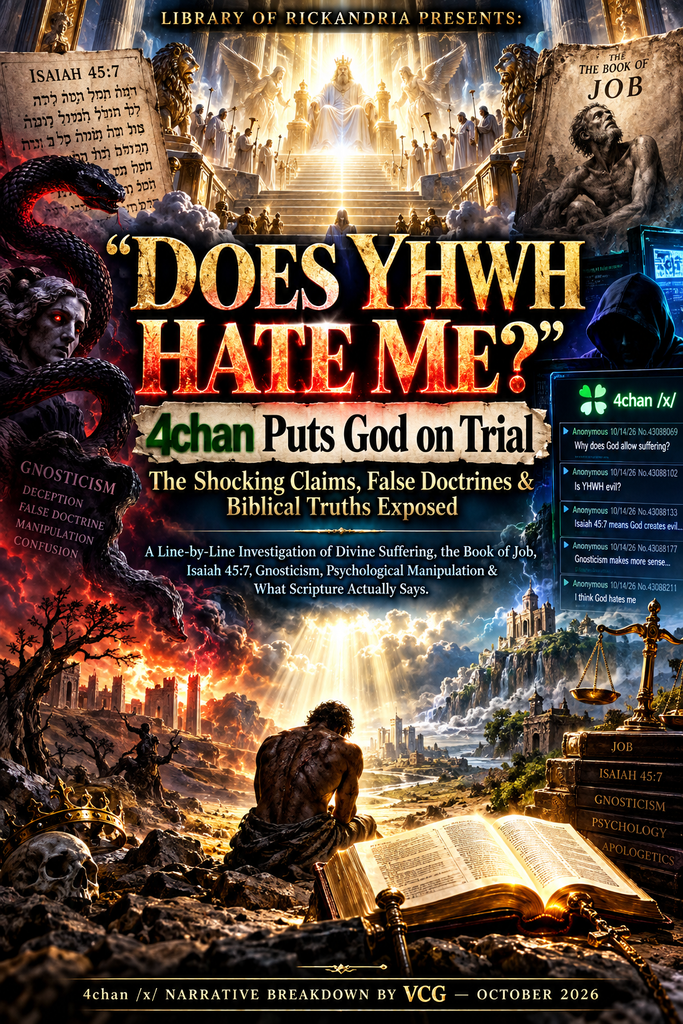
“DOES YHWH HATE ME?” — 4chan Puts God on Trial: The Shocking Claims, False Doctrines & Biblical Truths Exposed
UPDATED BY VCG ON 10/20/2026 @ 08:01 EST
A Line-by-Line Investigation of Divine Suffering, the Book of Job, Isaiah 45:7, Gnosticism, Psychological Manipulation & What Scripture Actually Says.
Anyone can do this, but most won’t.
“DOES YHWH HATE ME?” — 4chan Puts God on Trial
is an in-depth:
- biblical
- historical
- philosophical
- psychological
investigation into a controversial 4chan /x/ discussion questioning:
- God’s character
- the existence of suffering
- the meaning of divine justice
Through a systematic examination of all 32 posts, the Library of Rickandria exposes:
- unsupported supernatural claims
- questionable Hebrew interpretations
- Gnostic accusations against YHWH
- misconceptions surrounding Isaiah 45:7
and widespread misunderstandings of the Book of Job.
Drawing upon:
- the King James Bible
- ancient religious texts
- Hebrew linguistics
- academic scholarship
- psychological research
the study distinguishes what Scripture actually teaches from speculative theology, philosophical objections, and potentially harmful explanations of human suffering.
Special attention is given to whether Satan truly won in Job,
why God permits innocent suffering,
the historical origins of the Gnostic Demiurge,
and the psychological dangers of blaming sufferers or portraying every tragedy as divine punishment.
Rather than dismissing difficult questions or claiming certainty where the evidence does not permit it, this investigation confronts the strongest objections, corrects demonstrable errors, and carefully separates established facts from theological interpretation.
Ultimately, the paper explores a profound question at the heart of biblical faith:
Does suffering reveal God’s hatred, or does Scripture present a far more complex account of divine sovereignty, justice, mercy, and the limits of human understanding?
ChatGPT – Library of Rickandria
“DOES YHWH HATE ME?”
4chan Puts God on Trial: The Shocking Claims, False Doctrines & Biblical Truths Exposed
A Line-by-Line Investigation of Divine Suffering, the Book of Job, Isaiah 45:7, Gnosticism, Psychological Manipulation & What Scripture Actually Says
LIBRARY OF RICKANDRIA PRESENTS
4chan /x/ Narrative Breakdown by VCG — October 2026
Soli Deo Gloria
ABSTRACT
On October 16, 2026, an anonymous user posted a question on 4chan’s paranormal board, /x/, that was simultaneously personal, philosophical, and theological:
Does YHWH hate me?
/x/ – does YHWH hate me? – Paranormal – 4chan
The writer described a life marked by suffering, questioned why others appeared to live relatively ordinary lives, and wondered whether God had singled them out for punishment. Over the following two days, the thread developed into a surprisingly wide-ranging debate involving Gnosticism, the Hebrew Bible, divine sovereignty, the Book of Job, the meaning of Isaiah 45:7, ancient religious history, and the psychological consequences of suffering.
Some contributors attempted to comfort the sufferer. Others insisted that suffering was necessary for spiritual growth. Several challenged the morality of the biblical God. Others introduced unsupported supernatural claims or speculative interpretations of Hebrew divine names.
The discussion became particularly significant when a participant who appeared to be the original questioner clarified that the suffering arose from natural causes rather than deliberate human mistreatment.
That distinction changes the investigation.
The problem is no longer primarily why God allows people to harm one another. It is why a supposedly benevolent and omnipotent God permits suffering that no human being deliberately caused.
This study examines all 32 posts in their original sequence, evaluates the principal claims against Scripture and relevant scholarship, and distinguishes established historical facts from theological interpretations, philosophical arguments, and unsupported assertions.
The King James Version, specifically the supplied Pure Cambridge Edition-labelled text, serves as the principal English biblical reference. Hebrew-language analysis and comparative translations are introduced where necessary to investigate disputed readings.
The central conclusion is that the thread raises legitimate questions about undeserved suffering, but many of its proposed answers are incomplete, speculative, or inconsistent with the texts they invoke.
The Book of Job proves especially important. Contrary to several claims made in the discussion, its conclusion does not vindicate Job’s friends for defending God’s justice at all costs. God explicitly rebukes them.
The investigation ultimately argues that serious biblical interpretation requires both intellectual humility and moral seriousness. Defending Scripture must not become an excuse to defend explanations that Scripture itself does not provide.
Keywords: YHWH, suffering, divine justice, theodicy, Job, Isaiah 45:7, Gnosticism, Demiurge, Yaldabaoth, Hebrew Bible, natural evil, spiritual bypassing, religious trauma, biblical hermeneutics, 4chan.
INTRODUCTION
When a Question About Suffering Becomes a Trial of God
The thread begins with a complaint that could have been written thousands of years ago.
A person is suffering. They see other people living lives that appear comparatively ordinary. They cannot identify anything they have done that deserves their circumstances, and they ask why God would allow their life to become so painful.
The remarkable thing is not that someone asked this on 4chan.
The remarkable thing is how closely the underlying question resembles some of the most difficult passages in the Bible.
Job wrestles with it. Asaph confronts it in Psalm 73. Jeremiah raises it in Jeremiah 12. Habakkuk struggles with divine inaction in the face of injustice.
In each case, the central problem is a perceived conflict between what the sufferer believes about God’s character and what the sufferer sees in the world.
For an individual who believes God is just, the prosperity of the wicked and the affliction of the innocent create a serious theological challenge.
There are several possible ways to respond. One can question the sufferer’s innocence. One can argue that suffering produces a greater good. One can appeal to divine sovereignty or human ignorance. One can reject the belief that God is perfectly benevolent. Or one can insist that the situation remains genuinely unexplained.
Every one of these approaches appears, in some form, in the thread.
Our task is not to assume that every objection against God is malicious or that every defense of God is sound.
We will ask whether each argument succeeds on its own terms.
The three questions that govern this investigation
Three questions must remain separate throughout the paper:
- Why does suffering exist in a world governed by God?
- Does a person’s suffering demonstrate that God hates or punishes that person?
- Does the Bible teach that every instance of suffering has a specific beneficial purpose which human beings can identify?
These questions overlap, but they are not identical.
The first belongs primarily to philosophical theology and theodicy.
The second concerns divine character, biblical interpretation, and personal religious experience.
The third concerns whether particular explanations of suffering are actually authorized by Scripture.
A response may succeed at answering one question while failing to answer the others.
For example, showing that suffering can sometimes build character does not prove that every particular instance of suffering was necessary for character development.
Likewise, showing that God exercises sovereignty over calamity does not automatically prove either that God is morally wicked or that every calamity constitutes a personal punishment.
Those distinctions form the backbone of this investigation.
Primary source: 4chan /x/, Thread No. 43088069, October 16–17, 2026.
PART I — METHODOLOGY
How We Separate Evidence From Interpretation
A serious fact-checking paper must tell readers how its conclusions were reached.
This investigation uses five separate categories of evidence.
1. Primary-source evidence
The original thread establishes what was posted, when it appeared, which replies referenced earlier posts, and which images were attached.
It does not establish that the contributors’ statements are true.
It also does not independently establish the real-world identities of anonymous contributors.
Three later replies appear to continue the original poster’s perspective, including comments about requesting relief, natural suffering, and the Book of Job. We will refer to these as apparent continuations rather than authenticated statements from the original author.
2. Biblical textual evidence
Biblical claims are checked against the King James Version, with attention to the surrounding chapter, literary genre, speaker, and relationship to other passages.
This distinction is particularly important because the Bible records statements made by individuals whose interpretations are later rejected.
A character’s speech appearing in Scripture does not mean that Scripture endorses the character’s theology.
Job’s friends provide a decisive example.
3. Historical evidence
Claims about Gnosticism, Jewish history, ancient sacrifice, and the New Testament are evaluated using relevant ancient documents and modern historical scholarship.
Historical evidence can establish that a belief existed, that a text circulated, or that a philosophical movement developed during a particular period.
It cannot, by itself, establish that a supernatural cosmology described in an ancient document is true.
4. Psychological evidence
Research on trauma, resilience, religious coping, and online communication is used to assess general psychological claims.
This research does not permit us to diagnose the anonymous writers, infer their private intentions, or determine the medical causes of the original questioner’s suffering.
5. Philosophical and theological interpretation
Arguments about omnipotence, goodness, moral responsibility, and the problem of evil require philosophical examination.
They cannot always be settled by identifying a historical date or translating a Hebrew word.
Where serious disagreements remain, those disagreements will be acknowledged.
Evidence classifications
The findings use the following terms:
| Classification | Meaning |
|---|---|
| Textually supported | The relevant passage actually states or substantially supports the claim |
| Textually contradicted | The claim conflicts with an explicit statement in the cited text |
| Historically supported | Appropriate primary or scholarly evidence establishes the historical claim |
| Unsupported | Sufficient evidence has not been supplied |
| Partially supported | The argument contains a defensible point but goes beyond the available evidence |
| Interpretive | The claim depends on a disputed reading or philosophical judgment |
| Unresolved | The available evidence does not settle the question |
An unsupported claim is not automatically proven false. It means the evidence presented is insufficient.
Similarly, identifying an interpretation as disputed is not equivalent to declaring every interpretation equally persuasive.
PART II — THE PRIMARY THREAD
A Post-by-Post Investigative Examination
POST 01 — No. 43088069
October 16, 2026 — 03:03:09
The original question: Has God singled me out for suffering?
The original poster describes wanting an ordinary life rather than wealth, fame, or superiority over others.
They compare their experiences with those of people who appear not to face the same daily difficulties.
The poster then raises several connected questions: why the suffering occurred, whether it represents personal wrongdoing, and why other people who have committed worse acts appear to escape comparable hardship.
Let us separate the argument into its parts.
Claim one: The poster wanted an ordinary life.
This is a report of personal desire, not a fact we can independently verify. Nothing in the thread provides sufficient grounds to dismiss it.
Claim two: Other people seem to enjoy comparatively normal lives.
This is an observation about apparent inequality. The poster cannot know every private difficulty in the lives of others, but the observation that suffering is distributed unequally is plainly reasonable.
Claim three: Personal suffering may indicate divine punishment.
This is the central theological inference, and it is not necessarily valid.
In John 9:1–3, Jesus rejects the disciples’ assumption that a man’s congenital blindness must have resulted from either his own sin or his parents’ sin.
In Luke 13:1–5, Jesus refuses to describe victims of violent events and accidental disaster as greater sinners than those who escaped.
The broader biblical principle is that suffering cannot reliably be treated as a measure of personal guilt.
Claim four: People who do worse things sometimes suffer less.
Psalm 73:3–14 raises precisely this difficulty. The psalmist describes the apparent prosperity of the wicked and the affliction of the righteous.
The observation is not foreign to biblical thought.
Claim five: God must hate the person who suffers.
This does not follow logically from the preceding facts.
Even if suffering is real, severe, and undeserved, an argument is still required to establish that divine hatred caused it.
The Bible contains descriptions of righteous sufferers, compassionate divine concern, and suffering that is not explained as punishment.
Initial finding: The original question is legitimate. Its proposed inference about divine hatred remains unproved.
POST 02 — No. 43088086
October 16, 2026 — 03:15:13
The claim that YHWH is merely a mental condition
The first substantive reply reframes God as a state of consciousness rather than an independent being.
This is a metaphysical claim, not a scientific finding.
There is a legitimate distinction between a person’s experience of God and God’s alleged existence apart from that person.
Psychological research can examine beliefs, perceptions, religious experiences, and the effects of those experiences.
Such research does not automatically establish whether their supposed divine object exists.
The biblical authors portray God as an independent actor, creator, and covenantal agent.
Genesis 1:1, Exodus 3:14–15, and Isaiah 46:9–10 are relevant here.
Finding: Unsupported as a factual reduction of God to consciousness; inconsistent with the biblical portrayal.
POST 03 — No. 43088403
October 16, 2026 — 06:36:46
The Gnostic accusation against YHWH
This reply introduces one of the thread’s principal controversies.
The commenter appeals to Gnostic belief systems to characterize the biblical creator negatively, then cites Isaiah 45:7 as though the verse establishes God’s moral wickedness.
There are two claims to investigate.
First, some ancient Gnostic writings really do portray a lower creator or cosmic ruler as ignorant, arrogant, or malicious.
The Apocryphon of John describes a ruler named Yaldabaoth, also associated with the names Saklas and Samael, who proclaims exclusive divinity while remaining ignorant of a higher reality.
That is a genuine ancient literary tradition.
Second, the existence of this tradition does not establish that its interpretation of the biblical God is historically or metaphysically correct.
The commenter also moves too quickly from Isaiah’s language about creating evil to the conclusion that God is morally evil.
That argument depends on the meaning of the Hebrew word raʿ, the contrast with peace, and the historical setting involving Cyrus.
We examine all three later.
Finding: Historically grounded in some Gnostic traditions, but the alleged biblical confession of moral wickedness is not established.
Sources:
POST 04 — No. 43088430
October 16, 2026 — 06:54:26
The alleged male–female meaning of Elohim
This reply proposes that divine names encode masculine and feminine principles, ultimately becoming mind and heart.
The argument is not supported by the morphology of the Hebrew words.
El is an ancient Semitic term for a deity. Elohim is plural in form but often governs singular verbs when referring to Israel’s God.
In Genesis 1:1, Elohim appears with bara, a third-person masculine singular verb.
The ending -im does not establish that Elohim consists of a male and female pair.
Nor do the four Hebrew consonants YHWH spell a phrase meaning mind and heart.
The writer may be proposing a personal mystical symbolism, but symbolism is not the same as historical Hebrew etymology.
Finding: Linguistically unsupported.
Sources:
POST 05 — No. 43088452
October 16, 2026 — 07:03:30
The recommendation to forgive
The next comment offers forgiveness as the central response.
Forgiveness is indeed a major biblical ethical principle.
Ephesians 4:32 and Colossians 3:13 instruct believers to forgive, while Romans 12:19 rejects personal vengeance.
However, forgiveness presupposes some relevant offense or offender.
At this point in the thread, no human tormentor has been identified.
The later clarification about natural suffering makes this recommendation even less directly applicable.
Finding: Biblically recognizable advice, but insufficiently connected to the poster’s circumstances.
POST 06 — No. 43088841
October 16, 2026 — 10:15:13
An informal attempt at friendship
This brief reply appears to offer friendly contact.
It makes no factual claim requiring rebuttal.
Its importance lies in the contrast between relational support and abstract argument.
Job’s friends initially came to mourn and comfort him. According to Job 2:13, they remained silent with him for seven days.
That was not necessarily a failure to provide answers. It recognized the seriousness of his suffering.
Finding: No theological proposition to fact-check; potentially constructive as a gesture of companionship.
POST 07 — No. 43088885
October 16, 2026 — 10:30:11
The extraordinary claim that YHWH was destroyed in 2016
A commenter alleges that a supernatural event destroyed YHWH in 2016 and presents an accompanying image as proof.
The attached image is not evidence of such an event.
It is a screenshot of a Wikimedia Commons file page describing alpha radiation detected in an isopropanol cloud chamber, following the introduction of a radon-220 source.
The underlying photograph was dated May 17, 2016.
The date explains the claimed temporal connection, but the photograph’s physical subject has no demonstrated relationship to a supernatural entity.
The reasoning commits a straightforward evidentiary error: presenting a real photograph of one phenomenon as proof of an unrelated extraordinary claim.
Finding: Unsupported supernatural assertion; attached evidence does not establish the proposition.
Sources:
POST 08 — No. 43089213
October 16, 2026 — 12:01:58
Suffering as necessary spiritual development
This participant offers a sympathetic interpretation: pain can cultivate patience, empathy, and the ability to comfort others.
The claim contains an important biblical possibility.
Romans 5:3–5 links tribulation to patience, experience, and hope. James 1:2–4 discusses perseverance under trials.
But the commenter moves beyond those passages when suggesting that suffering is necessary for everyone to develop properly.
Some suffering may encourage maturity. Other suffering may produce lasting injury, fear, disability, or loss.
Psychological evidence does not establish that adversity always produces growth.
Furthermore, neither Romans nor James identifies the cause of the anonymous poster’s particular suffering.
Finding: Partially supported as a general possibility; unsupported as a universal explanation.
Source:
Jayawickreme and Blackie, Post-traumatic Growth as Positive Personality Change.
POST 09 — No. 43089390
October 16, 2026 — 13:04:00
The criticism of abusive discipline
This commenter challenges the claim that painful treatment necessarily makes someone stronger.
The writer acknowledges that some people develop resilience after harsh treatment but also recognizes that trauma may damage a person’s emotional life.
The second observation is important.
Research on childhood physical punishment does not support assuming that harmful discipline is an effective route to psychological maturity.
A 2016 meta-analysis by Elizabeth Gershoff and Andrew Grogan-Kaylor examined findings involving 160,927 children. Its results linked spanking with elevated risks of detrimental outcomes, although the research does not mean every individual child has the same experience.
The commenter then speculates about humanity ultimately destroying God.
That conclusion is not established by the psychological evidence or by Scripture.
Finding: The warning about trauma has empirical support. The proposed cosmic purpose does not.
Source:
Gershoff and Grogan-Kaylor, Spanking and Child Outcomes, 2016.
POST 10 — No. 43089433
October 16, 2026 — 13:21:44
The promise of unavoidable repayment for tormentors
The commenter imagines that every act of abuse will receive exact punishment.
The Bible teaches moral accountability and divine judgment, but it does not authorize anonymous commenters to announce precise supernatural repayment arrangements.
Romans 12:19 and Revelation 20:12 are relevant to judgment.
However, the explanation assumes a human tormentor.
The later clarification explicitly disputes that assumption.
Finding: Contains a general biblical theme of accountability but offers an unsupported explanation of this specific case.
POST 11 — No. 43089501
October 16, 2026 — 13:48:43
The sovereignty argument
This post emphasizes God’s supremacy and humanity’s obligation to submit.
Biblical texts do affirm that human beings cannot place God under ordinary contractual obligations.
Job 41:11 and Romans 11:35 are relevant examples.
But divine sovereignty is not the Bible’s only claim about God’s character.
Psalm 103 describes compassion. Exodus 34:6–7 describes mercy alongside justice. Psalm 34:18 depicts divine nearness to the brokenhearted.
The commenter also presents submission as though it eliminates the legitimacy of questions.
That is difficult to reconcile with the sustained biblical tradition of lament.
Finding: A partial statement of biblical sovereignty that neglects important counterbalancing passages.
POST 12 — No. 43092307
October 17, 2026 — 01:49:01
An apparent clarification: The sufferer wants relief, not entitlement
This reply directly answers the preceding sovereignty argument.
The writer distinguishes demanding special treatment from requesting divine generosity.
The distinction is important.
A request for mercy is not necessarily a claim that God owes something to the petitioner.
Psalm 6, Psalm 13, and the prayers of afflicted people in the Gospels repeatedly illustrate this difference.
In Mark 10:46–52, Bartimaeus asks Jesus for mercy.
The biblical narrative does not portray the request itself as inappropriate.
Finding: A meaningful correction to an apparent mischaracterization of the original complaint.
POST 13 — No. 43092315
October 17, 2026 — 01:51:00
The crucial clarification: Natural causes
A reply speaking as the sufferer states that the pain arises from natural causes and not from deliberate human torment.
This is one of the most important statements in the entire discussion.
It changes which explanations are relevant.
A free-will argument centered on human violence may explain some moral evils, but it does not directly explain genetic disease, accidental injury, congenital conditions, or natural disasters.
Philosophers distinguish moral evil from natural evil precisely because the causes differ.
We cannot independently verify that this anonymous response came from the original writer. Nevertheless, if it accurately describes the circumstances, much of the thread’s advice about forgiveness and human persecutors misses the actual issue.
Finding: A significant firsthand-style clarification with unverified authorship.
Source:
Stanford Encyclopedia of Philosophy, The Concept of Evil.
POST 14 — No. 43092355
October 17, 2026 — 02:03:55
Religious mockery directed at the original image
This reply makes a crude joke about the image attached to the original post.
It provides no historical, medical, or theological evidence.
Its significance is rhetorical rather than factual.
The post illustrates how an anonymous conversation can redirect another person’s distress into entertainment.
That observation does not establish why the author chose to make the joke.
Finding: No substantive claim to rebut.
POST 15 — No. 43092459
October 17, 2026 — 03:09:15
Could an omnipotent God create character without suffering?
This contributor challenges the earlier character-development argument.
The language is insulting, but the underlying philosophical question is serious.
If God can do all things consistent with his nature and logical possibility, why must moral maturity arise through painful experiences?
One possible response is that some virtues require the existence of genuine danger, temptation, sacrifice, or difficulty.
Courage, for instance, appears to involve confronting something frightening or dangerous.
But even if certain virtues require adversity, it does not follow that every particular illness, bereavement, or catastrophe is required.
Finding: A valid philosophical challenge presented in hostile language.
Source:
Stanford Encyclopedia of Philosophy, Theodicies, section on soul-making.
POST 16 — No. 43092463
October 17, 2026 — 03:16:20
The assertion that suffering prevents future suffering
The reply claims that suffering is beneficial because it enables people to avoid later suffering.
This is sometimes possible.
For example, learning from a painful mistake may help someone avoid repeating it.
But severe adversity can also increase vulnerability or create problems that would otherwise not have existed.
The commenter offers no evidence that the proposed mechanism operates in the original poster’s case.
Finding: Unsupported universal generalization.
POST 17 — No. 43092520
October 17, 2026 — 04:19:59
The claim that Job has already answered everything
This commenter dismisses the questioner’s concern and appeals to divine ownership as the decisive message of Job.
God’s sovereignty is certainly a major theme of the book.
However, the book contains 42 chapters of dialogue, protest, accusation, divine speech, and restoration.
Reducing that literary argument to the proposition that God may dispose of human lives as he wishes loses important features of the narrative.
Most notably, Job’s friends defend a conventional doctrine of divine justice, yet God eventually rebukes them.
Finding: A selective interpretation that omits central elements of Job.
POST 18 — No. 43092527
October 17, 2026 — 04:25:40
The major challenge to the Book of Job
This lengthy reply raises four significant objections.
First: Does Job contain material from different stages of composition?
Many scholars think so.
The prose frame, poetic dialogues, wisdom poem, and Elihu speeches display distinctive literary features.
Yale Bible Study summarizes the widespread scholarly view that the Elihu material may be secondary.
But recognizing different literary components does not prove that the work lacks coherence in its final form.
Second: Does Job depict an arrangement between God and Satan?
Yes.
Job 1–2 portrays a challenge to Job’s motives and divine permission for his testing.
Describing the exchange as a wager is understandable, although it is not a conventional betting transaction.
Third: Was Job innocent?
The narrative presents him as upright.
Job 1:1 and 1:8 establish that characterization, and Job 2:3 describes his destruction as occurring without cause.
The simplest retributive explanation is therefore explicitly excluded.
Fourth: Can new children compensate for the children who died?
This is a serious moral challenge.
Job 42 records later children and restored prosperity, but the text does not say the first children were interchangeable with the second.
A careful reader should not erase the significance of the original deaths.
Finding: This reply raises several of the discussion’s strongest legitimate objections, alongside some compressed and disputable interpretations.
Sources:
POST 19 — No. 43092536
October 17, 2026 — 04:36:24
Job defended as a unified story
This response argues that the narrative is coherent and that Job’s suffering illustrates sovereignty rather than deserved punishment.
The final form of Job can indeed be read as an integrated literary work.
But literary unity and single authorship are separate historical claims.
An editor can produce a coherent work from inherited material.
Likewise, the narrative provides an occasion for Job’s suffering without necessarily giving the reader a complete moral justification.
Finding: Defensible literary observations combined with excessive certainty about composition and meaning.
POST 20 — No. 43092552
October 17, 2026 — 04:57:48
The assertion that Satan won
This commenter argues that Job’s questioning of divine justice is equivalent to cursing God.
The writer therefore considers the friends faithful and Job unsuccessful.
The strongest objection to that interpretation comes from the Bible itself.
In Job 42:7–8, God condemns the three friends for failing to speak rightly concerning him, while distinguishing Job favorably.
Job’s protests are real. His statements are not all endorsed without qualification. Job 42:3 shows his acknowledgment of limited knowledge.
Nevertheless, the claim that the friends were vindicated directly contradicts the narrative’s final verdict.
Finding: Textually contradicted regarding the three friends; unsupported regarding Satan’s alleged victory.
POST 21 — No. 43092568
October 17, 2026 — 05:07:04
Questioning as a possible expression of fidelity
The commenter suggests that Job’s willingness to question God may have been part of his faithfulness.
There is considerable biblical support for regarding lament as compatible with faith.
Psalm 13 and Habakkuk 1 provide examples of intense questioning directed toward God.
Job also insists upon his innocence, which is consistent with the prologue’s description.
However, the further suggestion that Job’s three friends were directly serving Satan goes beyond what the text explicitly states.
Finding: A strong interpretive insight mixed with an unsupported assertion about Satanic agency.
POST 22 — No. 43092587
October 17, 2026 — 05:24:13
The accusation that God’s behavior was petty
The commenter condemns the events of Job as morally cruel.
This is an ethical judgment rather than a testable historical claim.
The losses described in Job are severe enough to make such moral discomfort understandable.
Yet identifying God’s alleged motive as personal vanity goes beyond the narrator’s statements.
The prologue presents a challenge about Job’s motives, not an explicit declaration that God acts from vanity.
Finding: A serious moral objection whose specific attribution of motive is not demonstrated.
POST 23 — No. 43092635
October 17, 2026 — 06:03:02
The reaction image
A cartoon image responds to the earlier celebration of suffering.
The visual functions rhetorically, conveying ridicule or disagreement.
It contains no developed proposition about Scripture, history, or psychology.
Finding: No substantive claim requiring fact-checking.
POST 24 — No. 43092842
October 17, 2026 — 08:05:19
God as an advanced state of consciousness
The earlier psychological interpretation is expanded into the idea that an especially advanced consciousness might deserve the designation of deity.
Such a proposal requires a definition of consciousness, identity, and divinity.
It may function as speculative philosophy.
However, redefining an advanced mental condition as divine does not establish that the biblical God has that nature.
Finding: Metaphysical speculation, not demonstrated biblical interpretation.
POST 25 — No. 43092851
October 17, 2026 — 08:06:49
The claim that God abandoned humanity
A commenter speculates that God withdrew from responsibility for humanity and that other supernatural beings subsequently intervened.
No supporting historical or empirical evidence is presented.
The statement also conflicts with biblical claims about ongoing divine activity.
Psalm 121:3–4 describes God as Israel’s watchful keeper. Isaiah 40:28 describes God as everlasting and not subject to weariness.
Finding: Unsupported supernatural narrative.
POST 26 — No. 43092868
October 17, 2026 — 08:14:19
Ancient sacrifice and the alleged Neoplatonist invention of a loving God
This post presents several historical claims.
The commenter argues that ancient sacrifices existed primarily because people believed the gods hated humanity.
This is an excessive generalization.
Ancient ritual sacrifice served numerous purposes, depending on culture and context. Biblical sacrifices included thanksgiving, peace offerings, purification, and acts of worship.
The commenter then argues that divine benevolence was a late philosophical invention.
That claim conflicts with pre-Christian Jewish traditions portraying God as merciful, compassionate, and loving.
Exodus 34:6–7, Hosea 11, and Psalm 103 are especially relevant.
Finally, the writer attributes the New Testament to Neoplatonist Jewish scribes in Alexandria.
That claim faces a serious chronological problem.
The earliest Pauline letters are commonly dated to the first century CE. Neoplatonism became a recognizable philosophical movement in the third century, especially through Plotinus.
Earlier Platonism did influence the ancient Mediterranean intellectual world, but this does not make the New Testament a third-century Neoplatonist production.
Finding: Historically overgeneralized and, regarding New Testament authorship, chronologically untenable.
Source:
Stanford Encyclopedia of Philosophy, Neoplatonism.
POST 27 — No. 43093765
October 17, 2026 — 14:09:54
The invitation to seek a relationship with God
This reply encourages connection with God.
It is a religious recommendation rather than an empirical explanation.
Jeremiah 29:13 and Matthew 7:7 provide relevant biblical themes, though each must be read in context.
The recommendation becomes problematic only if transformed into an unconditional promise of immediate physical relief.
Finding: Consistent with a broad biblical theme but not a demonstrated explanation of suffering.
POST 28 — No. 43093933
October 17, 2026 — 14:56:52
Allah asserted as the only true God
The commenter dismisses YHWH and affirms Allah.
This is a religious truth claim presented without argument.
It cannot be settled by merely comparing the spelling of divine names.
Islamic, Jewish, and Christian theology contain important shared monotheistic commitments as well as genuine disagreements about revelation, divine nature, and Jesus.
Finding: An unsupported assertion, not a demonstrated fact-check.
POST 29 — No. 43094008
October 17, 2026 — 15:18:03
The relationship between Allah and Aramaic vocabulary
This response correctly points toward a linguistic connection.
Arabic Allāh, Arabic ilāh, and Aramaic divine terminology such as Alāhā belong to a historically related Semitic vocabulary.
But linguistic relatedness does not establish complete agreement about doctrine.
Two communities can use historically related terms for God while disagreeing significantly about God’s identity and attributes.
Finding: Substantially correct linguistic observation; theological conclusion requires further argument.
POST 30 — No. 43094036
October 17, 2026 — 15:24:06
Character formation offered as the entire answer
A short reply once again presents suffering as a means of building character.
The possibility of beneficial growth does not establish that the suffering was necessary, intended, or beneficial in this instance.
Finding: Unsupported individual application of a possible general principle.
POST 31 — No. 43094047
October 17, 2026 — 15:26:19
The strongest-soldiers explanation
The commenter frames severe suffering as divine training for especially strong individuals.
The New Testament uses military imagery in passages such as 2 Timothy 2:3 and Ephesians 6:10–18.
Neither passage states that those who suffer most are necessarily God’s strongest servants.
The biblical record includes faithful people who experienced exhaustion, sorrow, fear, and weakness.
Elijah’s distress in 1 Kings 19 is one example.
Finding: A popular religious slogan presented as though it were a universal biblical teaching.
POST 32 — No. 43094066
October 17, 2026 — 15:29:59
The suggestion that God became kinder after having a Son
The final post humorously proposes that the God of the Old Testament mellowed after fatherhood.
As Christian theology understands the Son’s pre-existence, the suggestion does not describe the biblical relationship between the Father and the Son.
John 1:1–3 and John 17:5 portray the Word and Christ in relation to God before the earthly life of Jesus.
Furthermore, mercy appears throughout the Old Testament, while judgment appears in the New Testament.
Finding: A provocative joke rather than a historically or textually supported Christian doctrine.
PART III — THE ORIGINAL IMAGES
What the Attachments Actually Establish
The thread includes four attached images.
A responsible investigation must identify what each image depicts without treating its surrounding caption as authenticated.
Image 1 — The original post’s ancient-looking seal

View the original attached image
The photograph shows a circular seal-like impression containing an elaborate winged or hybrid figure.
The image is visually suggestive of ancient Near Eastern religious iconography.
However, the thread itself does not establish its archaeological provenance, date, place of discovery, or secure identification as YHWH.
It would be improper to assign the object a definite religious identity simply because it appears beside a question about God.
A complete archaeological authentication would require matching the photograph to a museum catalogue, excavation publication, or peer-reviewed specialist analysis.
Evidence finding: The image establishes what the poster attached. It does not authenticate the religious identity of the depicted figure.
Image 2 — The claimed supernatural destruction of YHWH

View the original attached image
The attachment is a screenshot of a Wikimedia Commons file page.
Its underlying photograph depicts radiation tracks in a cloud chamber.
The original file description identifies alpha radiation associated with a radon-220 source and dates the photograph to May 17, 2016.
Check the Wikimedia Commons source.
Nothing in that evidence demonstrates the existence, location, injury, or destruction of a supernatural being.
The screenshot is real. The interpretation attached to it is unsupported.
Image 3 — Monkey using a smartphone

View the original attached image
This image shows a monkey seated against a wall while holding a mobile phone.
Its function is humorous or rhetorical.
It supplies no theological evidence.
Image 4 — Cartoon reaction

View the original attached image
The final attachment is a small cartoon character smoking and making an obscene gesture.
Again, it communicates an attitude rather than establishing a fact.
What these images tell us about online argument
Images can make an argument feel more concrete.
An ancient-looking seal can suggest historical depth. A scientific photograph can suggest empirical proof. A meme can make a viewpoint socially memorable.
But visual force is not evidentiary force.
The correct procedure is to determine what the picture actually shows, establish its source where possible, and then ask whether the claimed conclusion follows.
PART IV — ISAIAH 45:7
Does God Say He Creates Evil?
This is perhaps the most important language dispute in the thread.
The King James Version reads:
I form the light, and create darkness: I make peace, and create evil:
I the LORD do all these things.
— Isaiah 45:7, KJV
At first glance, the difficulty is obvious.
If God creates evil, how can God be morally perfect?
The answer requires more than substituting a preferred modern English word.
1. The Hebrew word raʿ
The word translated evil is associated with the Hebrew root ר־ע־ע and appears here in the form רַע (raʿ).
Its semantic range includes wickedness, harm, adversity, misery, and calamity.
These meanings are related but not identical.
English also uses evil in different ways. A deliberately cruel act is morally evil. A devastating disaster may be described as an evil in the sense of a harmful occurrence, even when no human being caused it.
The Hebrew word can operate across comparable categories.
The Brown–Driver–Briggs lexical material specifically lists Isaiah 45:7 under the sense of calamity or distress.
Hebrew lexical reference: raʿ, Strong’s H7451 with BDB entries.
2. The importance of the parallel
The immediate contrast is between peace and evil.
The word translated peace is shalom, which can describe peace, well-being, completeness, and favorable conditions.
The opposite in this context is therefore plausibly adversity, disorder, judgment, or disaster.
This is why the NET Bible renders the passage using calamity language.
NET Bible textual and translation notes.
3. The historical context
Isaiah 45 addresses Cyrus, the Persian ruler whom the passage presents as an instrument of the LORD’s purposes.
The chapter emphasizes God’s sovereignty over rulers, nations, deliverance, and historical events.
The central point is that the LORD is not merely one local deity among competing divine powers.
He is portrayed as exercising authority over both favorable and disastrous circumstances.
This context strongly supports interpreting Isaiah 45:7 in terms of divine sovereignty over historical calamity.
4. What the passage does not say
It does not explicitly declare that God’s moral character is wicked.
It does not identify God as a demon.
It does not teach that moral goodness and moral evil are equally admirable expressions of divine character.
5. What the passage does say
It does make an expansive claim about divine authority over events that people experience as good or disastrous.
That claim should not be minimized.
A sophisticated critic may still ask whether the deliberate infliction of disaster can be reconciled with moral perfection.
That is a serious philosophical question.
But it is different from the claim that the Hebrew vocabulary straightforwardly describes God as morally corrupt.
6. Comparing Scripture with Scripture
Several passages complicate the discussion:
Amos 3:6 attributes calamity in a city to divine action.
Lamentations 3:37–38 speaks of both adverse and beneficial outcomes in relation to divine authority.
Job 2:10 describes Job receiving good and evil at God’s hand.
James 1:13 rejects the idea that God tempts people with evil.
Deuteronomy 32:4 portrays God’s work as perfect and his ways as just.
These texts require interpreters to distinguish divine judgment and calamity from moral wrongdoing.
They also make the relationship between divine action and suffering an unavoidable subject of biblical theology.
Isaiah 45:7 verdict
The 4chan commenter correctly identifies a difficult biblical statement.
The error lies in assuming that the word evil must refer to God’s moral wickedness.
The contextual meaning concerns calamity and divine sovereignty.
Whether that sovereignty creates a deeper moral problem remains a legitimate subject of philosophical debate.
PART V — THE BOOK OF JOB
Did Satan Win, and Were Job’s Friends Right?
Job is the intellectual center of the thread.
Several participants appeal to it, but they disagree sharply about its message.
To examine their arguments, we must follow the narrative rather than isolate the ending.
1. The prologue: Innocence is established before suffering begins
Job 1:1 describes a man who is upright and fears God.
The narrative does not ask readers to discover a hidden sin that explains his catastrophe.
Instead, the reader is told from the outset that Job’s character is exemplary.
In Job 1–2, Satan challenges the authenticity of Job’s devotion.
The question is whether Job serves God only because his life is prosperous.
God permits Job to be tested.
Job loses possessions, servants, children, and eventually his health.
Job 2:3 includes a particularly difficult statement in which Job’s destruction is described as occurring without cause.
This does not mean the narrative offers no explanation of why the test occurred.
It means that the devastation is not presented as justified by Job’s own misconduct.
2. The three friends: The danger of defending a theory at the expense of a person
Eliphaz, Bildad, and Zophar argue from a strong belief in divine justice.
Their reasoning repeatedly connects suffering with wrongdoing.
If God is just, they infer, then Job’s suffering must correspond to some moral failure.
The problem is that readers have already been told the opposite.
The friends are attempting to defend a general doctrine while misrepresenting the actual case before them.
Their error is not necessarily believing that God is just.
Their error is claiming knowledge of the reason for Job’s suffering when that reason is not available to them.
3. Job’s response: Protest rather than passive acceptance
Job refuses to admit to a transgression he does not believe he committed.
He laments his condition, questions divine justice, and demands a hearing.
Job 31:35 expresses his desire for the Almighty to answer him.
The demands are striking because they occur within a religious tradition that strongly affirms divine power.
Job does not treat divine sovereignty as a reason to abandon the search for truth.
4. God’s speeches: Creation beyond human mastery
In Job 38–41, God responds from the whirlwind.
The speeches examine the natural world, its complexity, and creatures that lie beyond human control.
God challenges Job’s understanding of creation and governance.
One interpretation emphasizes the limits of human knowledge.
Another stresses that the divine speeches reveal a creation whose purposes cannot be reduced to immediate human interests.
Still another criticizes the response for failing to explain the moral legitimacy of Job’s suffering.
These readings are not equivalent, and the biblical text does not erase every difficulty separating them.
5. The decisive ending
Job 42:7 states:
My wrath is kindled against thee, and against thy two friends:
for ye have not spoken of me the thing that is right, as my servant Job hath.
This verse directly contradicts the claim that Job’s friends were vindicated simply because they defended God.
God rebukes them and instructs them to approach Job, who will pray for them.
That reversal is central to the narrative.
The defenders who claimed to know God’s justice are corrected.
The sufferer who protested is distinguished favorably.
6. The Hebrew question in Job 42:7
The Hebrew expression commonly translated as speaking rightly about God also permits discussion about speaking rightly to God.
The distinction matters.
If the verse concerns accurate statements about God, the question becomes why Job’s accusations receive a favorable assessment.
If the verse emphasizes rightly addressing God, Job’s direct engagement may be part of what differentiates him from the friends.
The grammatical and literary interpretation remains debated.
A recent peer-reviewed study by Choon-Leong Seow directly examines the divine verdict, the friends’ failure, Job’s intercession, and the coherence of the epilogue.
Choon-Leong Seow, Divine Anger, Intercession, and Restoration: Theology and Ethics in Job 42:7–10, Interpretation 80, no. 2 (2026), 140–150.
7. Did Job actually curse God?
Satan’s test concerns whether Job will turn against God under adversity.
Job initially resists the temptation to curse God.
As the story develops, his protests become more severe.
Nevertheless, the distinction between lamenting, arguing, accusing, and cursing cannot simply be erased.
The narrative includes Job’s acknowledgment of speaking beyond his understanding in chapter 42.
But it also includes God’s favorable judgment of Job over the friends.
Consequently, declaring that Satan won merely because Job questioned divine justice is not supported by the book’s final literary evaluation.
8. Were the friends Satan’s agents?
One commenter imagines that the friends served as Satan’s representatives.
This interpretation has literary possibilities because their accusations intensify Job’s suffering.
However, the text does not explicitly identify the friends as Satan’s agents.
Satan disappears from the narrative after the prologue.
Readers should distinguish a proposed literary relationship from a directly stated supernatural fact.
9. Was Job written by one author?
The Book of Job contains a prose framework, extensive poetic dialogue, wisdom material, Elihu speeches, divine speeches, and a prose conclusion.
These components have long attracted scholarly attention.
The Yale Bible Study guide identifies the prose framework and the possible later insertion of Elihu’s speeches as major issues.
Edward L. Greenstein discusses Job’s unusual Hebrew and the possibility of composition in a Persian-period intellectual environment.
These are scholarly conclusions derived from literary and linguistic analysis.
They are not absolute demonstrations of a particular number of authors.
A text may have a complicated history and still possess a carefully developed final literary structure.
Edward L. Greenstein, Yale University Press.
10. Did new children compensate for the dead children?
Job 42 records material restoration and the birth of additional children.
It does not explicitly claim that new children erase the loss of the first.
From an ethical standpoint, persons are not interchangeable possessions.
A later blessing may be meaningful without undoing an earlier tragedy.
This is one of the strongest criticisms raised in the thread, and it deserves acknowledgment rather than dismissal.
The Book of Job verdict
Job does not authorize Christians to accuse every sufferer of secret wrongdoing.
It does not establish that every affliction produces spiritual strength.
It does not vindicate the friends simply because they confidently defended divine justice.
It portrays innocence, suffering, lament, limited knowledge, and a surprising divine judgment against those who misrepresented the case.
PART VI — IS YHWH THE GNOSTIC DEMIURGE?
The Ancient Sources Behind the Accusation
The thread’s Gnostic accusations should be investigated historically rather than dismissed merely because they oppose biblical orthodoxy.
1. What is Gnosticism?
The label Gnosticism is used for a diverse collection of ancient religious movements and writings often associated with salvific knowledge, complex heavenly hierarchies, and distinctive interpretations of creation.
It should not be treated as one perfectly unified religion.
Modern scholarship debates the usefulness of the category itself because ancient groups differed considerably.
2. The Apocryphon of John
The Apocryphon of John, also known as the Secret Book of John, is an important source for certain Gnostic interpretations of creation.
Its cosmology presents a supreme divine reality and a lower cosmic ruler commonly named Yaldabaoth.
That figure is associated with ignorance of the higher divine realm and with an arrogant claim to exclusive divine authority.
The text reworks biblical themes and language in an alternative cosmological system.
Read the Apocryphon of John, translated by Frederik Wisse.
Read Marvin Meyer’s translation.
3. The Hypostasis of the Archons
Another important text is The Hypostasis of the Archons, also called The Reality of the Rulers.
It describes ignorant cosmic authorities and interprets creation in a way sharply different from the Genesis narrative.
Read The Hypostasis of the Archons, translated by Bentley Layton.
4. On the Origin of the World
This text further develops a cosmology involving heavenly beings, lower rulers, and the origins of the material world.
Read On the Origin of the World, translated by Bethge and Layton.
5. Yaldabaoth, Saklas, Samael, and Satan
These names must not automatically be treated as interchangeable in every religious system.
In the Apocryphon of John, Yaldabaoth is associated with Saklas and Samael.
In other traditions, Samael can have different associations.
Satan in the Book of Job likewise occupies a different narrative position from the lower creator figure in Gnostic cosmology.
Comparing these figures requires attention to the text being studied.
6. Does the Gnostic interpretation prove anything about YHWH?
Historically, it establishes that some ancient religious writers criticized or reinterpreted the biblical creator.
It does not demonstrate that their supernatural account corresponds to reality.
We must distinguish three propositions:
- Ancient Gnostic writers criticized the creator represented in certain biblical traditions.
- Their criticism can be studied as part of the history of religion.
- Their criticism accurately describes an objectively existing supernatural being.
The first two can be supported historically.
The third is a metaphysical conclusion requiring evidence beyond the existence of the literature.
7. The biblical counterpoint
Genesis 1 portrays creation as good.
Psalm 145 emphasizes divine goodness.
Isaiah 45 asserts exclusive divine sovereignty.
These passages directly conflict with cosmologies in which the creator is an ignorant subordinate being.
The difference is theological, not merely terminological.
Gnostic accusation verdict
The thread is correct that ancient Gnostic literature contains severe critiques of the biblical creator.
It is incorrect to treat the existence of those critiques as independent proof that the biblical God is a malicious Demiurge.
PART VII — THE DIVINE NAME INVESTIGATION
YHWH, Elohim, El, Adonai, and Allah
The thread contains speculative claims about divine names.
To evaluate them, we must distinguish philology from symbolism.
| Expression | Written form | Principal explanation |
|---|---|---|
| YHWH | יהוה | The four-consonant personal divine name, the Tetragrammaton |
| El | אל | A Semitic term for god or deity |
| Eloah | אלוה | A Hebrew designation for God or a god |
| Elohim | אלהים | Morphologically plural; frequently syntactically singular when referring to Israel’s God |
| Adonai | אדני | A title traditionally rendered Lord |
| HaShem | השם | Hebrew for the Name; a reverential substitute |
| Allah | الله | Arabic designation for God |
| Alāhā | ܐܠܗܐ | A Syriac/Aramaic form for God |
The Tetragrammaton
The divine name YHWH is written using four Hebrew consonants.
Its original pronunciation is not preserved with complete certainty.
Many modern scholars reconstruct a pronunciation resembling Yahweh, while traditional Jewish practice generally substitutes titles such as Adonai or HaShem.
The English form Jehovah reflects a later historical process involving the consonants of the divine name and the traditional reading system.
Oxford Research Encyclopedia, Names of God in the Hebrew Bible.
My Jewish Learning, What Is the Tetragrammaton?.
Does Elohim mean a male–female union?
The form Elohim includes a plural morphological ending.
When referring to Israel’s God, however, it commonly appears with singular grammatical agreement.
Genesis 1:1 provides a clear example.
The morphological plurality alone does not establish a union of separate masculine and feminine divine persons.
Nor does it prove that the biblical author intended the later Christian doctrine of the Trinity.
Both interpretations require arguments beyond the grammatical ending.
Is Allah linguistically related to biblical divine terminology?
Yes.
Arabic, Hebrew, and Aramaic are Semitic languages containing historically related vocabulary.
However, shared vocabulary is not equivalent to identical theology.
The relationship between Jewish, Christian, and Islamic descriptions of God must be studied historically and doctrinally, not merely through resemblance between words.
Linguistic verdict
The thread’s proposed mind–heart and male–female etymologies do not follow from the Hebrew forms.
The relationship between Arabic and Aramaic divine vocabulary is substantially more defensible.
PART VIII — THE STRONGEST CASE AGAINST GOD
Why Natural Suffering Remains a Serious Philosophical Problem
A rigorous apologetics paper should not answer only the weakest objections.
The original poster’s question, especially if the clarification concerning natural causes is genuine, raises a formidable philosophical challenge.
1. The basic problem of evil
Classical theism traditionally describes God as omnipotent, omniscient, and perfectly good.
Yet the world contains suffering.
The argument from evil asks whether the reality, intensity, and distribution of suffering are compatible with the existence of such a God.
This argument can be developed in different ways.
2. The logical problem of evil
The logical problem claims that divine omnipotence, omniscience, and perfect goodness are incompatible with the existence of evil.
One prominent response, associated with Alvin Plantinga, argues that there may be logically possible reasons why God creates a world containing free creatures capable of wrongdoing.
This is a defense: it attempts to show compatibility.
It does not establish the actual reason for every occurrence of suffering.
3. The evidential problem of evil
The evidential version argues that some suffering appears so extreme, apparently pointless, or disproportionate that it counts as evidence against the existence of a perfectly good and omnipotent God.
William Rowe’s famous discussion of apparently pointless animal suffering illustrates this approach.
The difficulty is not merely the logical possibility of evil.
It is the actual amount, severity, and apparent distribution of suffering in the world.
A defense that establishes logical possibility may leave this evidential challenge largely untouched.
4. Why natural evil is especially difficult
Human freedom can explain why people sometimes deliberately harm others.
It does not, without further premises, explain a child born with a painful disease, an animal suffering from a natural injury, or a deadly earthquake.
Theological explanations sometimes invoke the Fall or a disordered creation.
Genesis 3 and Romans 8 are often used in such discussions.
But interpreters disagree about how directly these passages explain specific natural phenomena.
The text does not identify a particular sufferer’s illness as the result of a particular personal sin.
5. Soul-making theodicy
John Hick developed a well-known account in which difficulty contributes to the formation of mature moral character.
A world containing genuine challenge may provide opportunities for courage, compassion, and endurance.
However, there are important objections.
Could moral development occur through less severe difficulties?
Why does some suffering destroy rather than develop the capacities of its victims?
Why do children and animals experience forms of suffering from which they may gain no recognizable moral benefit?
The soul-making explanation has philosophical value, but it cannot be treated as a comprehensive answer to every tragedy.
6. Skeptical theism
Another response emphasizes the limitations of human knowledge.
Human inability to identify a sufficient reason for suffering does not necessarily prove that no such reason exists.
This is logically important.
But skepticism about our ability to know divine purposes creates its own problems.
If we routinely claim ignorance of God’s reasons, how can we confidently announce that a particular tragedy was required for someone’s moral improvement?
Skeptical theism may caution against concluding that suffering is pointless.
It should also caution believers against confidently inventing specific explanations.
7. Does divine sovereignty settle moral evaluation?
Sovereignty and goodness are different concepts.
To say that God has power over creation is not yet to explain why every exercise of that power is morally justified.
Classical theism ordinarily includes claims about divine goodness, not merely divine supremacy.
An adequate theological response must therefore consider moral character as well as authority.
8. What remains unresolved?
No philosophical defense discussed here establishes the precise cause or divine purpose of the anonymous poster’s suffering.
The strongest defensible conclusion is more modest.
The existence of suffering presents a serious challenge to classical theism.
There are philosophical responses to that challenge.
Those responses differ in ambition, strength, and limitations.
None permits a stranger to claim detailed knowledge of God’s intentions toward a particular sufferer.
Further reading:
Stanford Encyclopedia of Philosophy, The Problem of Evil; Theodicies.
PART IX — THE BIBLICAL RIGHT TO LAMENT
When Questioning God Is Not the Same as Abandoning God
Several participants treat questioning divine justice as inherently rebellious.
The Bible presents a more complicated picture.
Psalm 13 — The unresolved cry
The psalmist repeatedly asks how long divine absence and suffering will continue.
The psalm does not begin with a carefully balanced theological explanation.
It begins with anguish.
Psalm 22 — The experience of abandonment
Psalm 22 opens:
My God, my God, why hast thou forsaken me?
The cry is remarkable because Jesus also uses it in the Gospel passion narratives.
The text demonstrates that an expression of perceived abandonment is not automatically equivalent to atheism or apostasy.
Psalm 44 — Innocence and suffering
The community insists that it has not forgotten God, yet it experiences defeat and affliction.
The psalm challenges overly simple explanations of suffering as punishment.
Psalm 73 — The prosperity of the wicked
The psalmist confronts the apparent mismatch between righteousness and prosperity.
This passage is especially relevant to the original 4chan poster’s comparison with people who appear to live easier lives.
Psalm 88 — A lament without an obvious resolution
Psalm 88 is one of the most important neglected passages in discussions of suffering.
It does not end with the same clear movement toward confidence found in many other laments.
Its conclusion remains dark.
The inclusion of this psalm in Scripture prevents us from assuming that every faithful lament must reach emotional resolution before it can be legitimate.
Jeremiah 12 and Habakkuk 1
Both texts contain questions about divine justice and God’s toleration of suffering or wickedness.
Their presence in prophetic literature shows that difficult questioning is not foreign to biblical faith.
Lament verdict
The Bible distinguishes between questioning God, rejecting God, falsely accusing others, and demanding certainty where none has been revealed.
Job’s story demonstrates the danger of collapsing those distinctions.
PART X — DID GOD CHANGE BETWEEN THE OLD AND NEW TESTAMENTS?
A recurring popular argument portrays the Old Testament God as severe and the New Testament God as compassionate.
The contrast is too simplistic.
Mercy in the Old Testament
Exodus 34:6–7 presents the LORD as merciful and gracious while also describing divine judgment.
Psalm 103 celebrates compassion and forgiveness.
Hosea 11 describes divine love and reluctance to surrender Israel to destruction.
Lamentations 3:31–33 speaks of affliction alongside compassion.
These passages demonstrate that mercy is not a late addition invented by Christian philosophers.
Judgment in the New Testament
The New Testament contains significant judgment language.
Matthew 25:31–46 portrays final judgment.
Acts 5:1–11 recounts the deaths of Ananias and Sapphira.
Romans 1–2 develops themes of divine wrath and judgment.
Revelation 20 describes final judgment.
The New Testament cannot accurately be described as teaching only unconditional benevolence.
The Christian claim about Christ
John 1:1–3 places the Word in relation to God and creation before the earthly ministry of Jesus.
Hebrews 4:15 presents Christ as one able to sympathize with human weakness.
The Christian response to suffering therefore includes the claim that God acts in and through Christ, not merely that God’s character became gentler over time.
What still needs examination
The relationship between divine judgments in different biblical texts raises genuine moral and historical difficulties.
Recognizing continuity between the Testaments does not settle every ethical question about conquest, punishment, war, or divine violence.
Those subjects require separate close readings.
Verdict
The claim that biblical divine mercy originated only in later Christian philosophy is historically unsustainable.
The suggestion that God’s character changed simply because he became a father is inconsistent with mainstream Christian doctrine.
PART XI — PSYCHOLOGY OF THE THREAD
Suffering, Certainty, and the Pressure to Find an Explanation
The thread is not simply a catalogue of theological arguments.
It also shows how people use explanations to respond to another person’s pain.
Several psychological concepts help illuminate these patterns.
They should be applied cautiously.
1. The just-world hypothesis
Melvin Lerner and Dale Miller explored the tendency to believe that the world is fundamentally orderly and that people generally receive the outcomes they deserve.
This tendency can influence responses to innocent suffering.
If someone assumes the world always distributes suffering justly, evidence of undeserved hardship becomes psychologically uncomfortable.
One possible response is to search for hidden wrongdoing by the sufferer.
Job’s friends repeatedly reason in a comparable way.
That does not mean their arguments can be reduced entirely to a modern psychological mechanism.
It does mean the theory provides a useful framework for examining why innocent suffering can provoke blame.
Source:
Lerner and Miller, Just World Research and the Attribution Process, Psychological Bulletin 85 (1978), 1030–1051.
2. Spiritual bypassing
Spiritual bypassing occurs when religious or spiritual ideas are used to avoid engaging with painful experiences or necessary practical problems.
A person may be told to accept suffering, forgive immediately, or interpret harm as a blessing before their actual circumstances have been understood.
Spiritual explanations are not inherently harmful.
They become problematic when they suppress emotion, prevent practical action, or replace appropriate care.
A 2026 qualitative synthesis emphasizes that spiritual bypassing can emerge as an adaptive response to severe distress rather than as a simple personality defect.
Source:
It helps me cope: a meta-ethnographic synthesis on lived experiences of spiritual bypassing, Frontiers in Psychology, 2026.
3. Religious coping
Research distinguishes more constructive and more distress-associated forms of religious coping.
Seeking spiritual support, experiencing community care, and maintaining a benevolent religious framework may help some individuals.
Feeling abandoned or punished by God may intensify distress for others.
These are associations, not universal laws.
They should not be used to argue that every religious doubt is psychologically unhealthy.
Sources:
- Ano and Vasconcelles, Religious Coping and Psychological Adjustment to Stress, meta-analysis
- 2026 pooled cohort analysis of religious coping and health
4. Posttraumatic growth
Growth following adversity is possible.
But researchers distinguish actual positive change from retrospective beliefs that one’s character has improved.
It is methodologically difficult to establish lasting personality changes without information about the person before the traumatic event.
Consequently, the statement that suffering inevitably makes people stronger cannot be treated as a scientific law.
Source:
Jayawickreme and Blackie, 2014.
5. Trauma and parental discipline
The thread invokes the idea that severe parental discipline produces stronger adults.
This is particularly troubling when used as a defense of abuse.
The 2016 Gershoff and Grogan-Kaylor meta-analysis found associations between spanking and elevated risks across numerous detrimental child outcomes.
Although correlation does not establish every causal pathway, the research provides no basis for declaring harsh physical punishment universally beneficial.
Source:
Gershoff and Grogan-Kaylor, 2016.
6. Online disinhibition
John Suler’s work on online disinhibition identifies conditions under which people may behave more openly, impulsively, or aggressively online.
Anonymity can facilitate sincere disclosure.
It can also facilitate mockery and hostility.
Both appear in this discussion.
However, anonymity alone does not establish whether any particular commenter is truthful or deceptive.
Source:
John Suler, The Online Disinhibition Effect, 2004.
7. The difference between compassion and explanation
One of the thread’s recurring problems is the assumption that the sufferer’s main need is a theological explanation.
Perhaps they do want one.
But they also appear to want relief.
That difference matters.
A response that accurately discusses God’s sovereignty may still fail to address the person’s immediate circumstances.
A compassionate response may include prayer, conversation, medical attention, practical assistance, or simply refusing to make unsupported accusations.
Job 2:11–13 provides a striking model of presence before explanation.
Psychological verdict
The thread contains patterns consistent with just-world reasoning, speculative meaning-making, spiritual bypassing, and online disinhibition.
Those patterns are worth examining.
They do not authorize psychological diagnoses of anonymous contributors.
PART XII — THE ANATOMY OF THE 4CHAN NARRATIVE
How the Discussion Moves Away From the Original Question
The discussion follows a recognizable pattern.
Stage one: Personal suffering.
An individual describes pain and asks whether it reveals divine hostility.
Stage two: Competing religious explanations.
Participants introduce divine discipline, forgiveness, submission, and supernatural punishment.
Stage three: Alternative cosmologies.
The conversation moves toward Gnosticism, speculative consciousness theories, and unsupported supernatural narratives.
Stage four: Philosophical confrontation.
Commenters question whether an omnipotent God needs suffering to develop human character.
Stage five: The Book of Job becomes the battlefield.
The discussion turns to innocence, Satan’s challenge, authorship, divine sovereignty, and Job’s protests.
Stage six: Historical claims broaden the dispute.
Ancient sacrifice, Neoplatonism, Judaism, Islam, and the New Testament enter the discussion.
Stage seven: The original problem remains unresolved.
The discussion produces many explanatory systems but little evidence about the particular suffering that initiated it.
This is the most important methodological observation.
A large number of arguments does not necessarily create a large amount of relevant knowledge.
The participants debate the nature of God far more extensively than they investigate what kind of help the sufferer may need.
We should not interpret this as evidence of a centrally coordinated manipulation campaign.
The available record does not establish such coordination.
It illustrates how anonymous conversations can fragment into competing narratives that answer different questions.
PART XIII — A FAIR HEARING
Jewish, Christian, Gnostic, and Secular Interpretations
An honest comparative investigation should not treat every tradition as interchangeable.
Jewish approaches
Jewish interpretations of Job are diverse.
They include discussions of divine justice, righteous suffering, human limitations, protest, and covenantal fidelity.
Jewish readings do not require acceptance of the New Testament or Christian doctrines concerning Christ.
For primary Jewish textual comparison, readers may consult the Hebrew text and Jewish translations of Job.
Job 42 with Hebrew and translation, Sefaria.
Christian approaches
Christians often interpret Job within a wider biblical narrative involving creation, fall, redemption, Christ’s suffering, and final restoration.
But there are significant differences among Christian thinkers.
Some emphasize divine sovereignty.
Others emphasize soul-making, mystery, lament, or Christ’s participation in human suffering.
No single apologetic formula exhausts the Christian theological tradition.
Gnostic approaches
Some ancient Gnostic texts distinguish a supreme divine reality from a lower creator.
Their interpretations respond to problems concerning matter, ignorance, suffering, and cosmic rule.
They should be studied from their own primary sources rather than treated as mere collections of modern internet slogans.
Secular philosophical approaches
A secular critic may argue that apparently gratuitous suffering provides evidence against classical theism.
This critique does not require hatred of religion or belief in Gnostic cosmology.
It can be evaluated as a philosophical argument based on proposed premises about goodness, power, knowledge, and the observable world.
Where the interpretations disagree
The major disagreement concerns more than the existence of suffering.
It concerns the character of ultimate reality, the nature of creation, the authority of religious revelation, and what counts as a satisfactory explanation.
Recognizing these differences prevents one tradition’s conclusions from being silently imported into another.
PART XIV — WHAT WOULD A CAREFUL BIBLICAL ANSWER ACTUALLY SAY?
Responding to the Person, Not Merely Winning the Debate
After examining the entire discussion, we return to the question that started it.
What could a careful reader of Scripture responsibly say to someone who feels that God hates them because they are suffering?
First, their suffering should be acknowledged without questioning its reality.
Second, the assumption that suffering proves personal guilt should be challenged.
Job 1–2, John 9:1–3, and Luke 13:1–5 are relevant.
Third, the person should not be told that their suffering was definitely arranged for character development.
Scripture describes growth through trials, but it does not disclose the precise purpose of every individual affliction.
Fourth, the person should be allowed to lament.
Psalm 13, Psalm 22, Psalm 88, and Job demonstrate that profound distress belongs within the biblical record.
Fifth, the Bible’s descriptions of God’s mercy should be considered alongside its difficult claims about judgment and sovereignty.
Psalm 34:18, Psalm 103:13, and Exodus 34:6–7 are relevant.
Sixth, practical help should not be treated as less spiritual than verbal encouragement.
If suffering has medical or physical causes, seeking appropriate evaluation and relief is entirely compatible with prayer.
Finally, no one should claim supernatural knowledge of why a particular anonymous sufferer is afflicted.
The Bible does not authorize that certainty.
The Christian perspective on suffering and Christ
Christian theology locates a distinctive response to human suffering in Jesus Christ.
Isaiah 53 portrays a suffering servant.
Hebrews 4:15 describes Christ’s sympathy with human infirmities.
John 11:35 records Jesus weeping.
The Christian claim is not merely that God observes suffering from an inaccessible distance.
It is also that God’s redemptive work is understood through Christ’s suffering, death, and resurrection.
That claim belongs to Christian theology and should be clearly identified as such.
It does not constitute independent historical proof that every particular tragedy has a disclosed beneficial purpose.
The promise of final restoration
Revelation 21:4 describes the removal of death, sorrow, crying, and pain.
This is an eschatological promise.
It should not be misrepresented as a guarantee of immediate recovery from every illness or injury.
Hope for final restoration and acknowledgment of unresolved present suffering can coexist.
PART XV — SCRIPTURE AND EVIDENCE MATRIX
The following reference table summarizes the paper’s major contested claims.
| Contested claim | Primary passages | Finding |
|---|---|---|
| God creates moral wickedness | Isaiah 45:7; James 1:13; Deuteronomy 32:4 | Isaiah concerns sovereignty over calamity; moral implications require further argument |
| Personal suffering proves guilt | Job 1–2; John 9:1–3; Luke 13:1–5 | Rejected as a universal rule |
| Job deserved his suffering | Job 1:1; 1:8; 2:3 | Contradicted by the narrative |
| Job’s friends were vindicated | Job 42:7–9 | Explicitly contradicted |
| Satan clearly won | Job 1–2; 42 | Not established |
| Questioning God is necessarily rebellion | Psalms 13, 22, 88; Habakkuk 1; Job | Too broad |
| Suffering always produces maturity | Romans 5:3–5; James 1:2–4 | Not taught as a universal rule |
| Divine sovereignty means God lacks compassion | Psalm 103; Exodus 34:6–7 | Contradicted by substantial biblical evidence |
| The creator is the Gnostic Demiurge | Genesis 1; Isaiah 45; Gnostic primary texts | A competing religious interpretation, not an established fact |
| The loving God was invented by Neoplatonists | Exodus 34; Hosea 11; Psalm 103 | Historically contradicted |
| The Old Testament contains only wrath | Psalm 103; Hosea 11; Isaiah 49 | False generalization |
| The New Testament contains only mercy | Matthew 25; Acts 5; Revelation 20 | False generalization |
| New children erase Job’s earlier loss | Job 42:10–17 | Not explicitly stated |
| God’s exact reason for one person’s suffering is known | Job 38–42; Deuteronomy 29:29 | Not established |
PART XVI — FINAL RESEARCH VERDICT
What the Thread Gets Right, What It Gets Wrong, and What Remains Unresolved
After examining all 32 posts, several conclusions stand out.
What the thread gets right
The opening question is legitimate.
Natural suffering creates serious philosophical difficulties for the belief in a perfectly good and omnipotent God.
The Book of Job portrays an innocent man whose suffering cannot be explained as punishment for a corresponding personal wrongdoing.
Job’s protest is an important part of the biblical narrative.
Some ancient Gnostic writings genuinely reinterpret the creator as ignorant or morally compromised.
Trauma does not invariably produce maturity, and religious explanations can become harmful when they dismiss a sufferer’s circumstances.
These points deserve serious consideration.
What the thread gets wrong
Isaiah 45:7 does not straightforwardly identify God as morally wicked.
The Hebrew names YHWH and Elohim do not encode the proposed male–female, mind–heart formula.
A cloud-chamber photograph does not prove a supernatural being was destroyed.
The Book of Job does not vindicate the friends who falsely explain Job’s affliction.
The assertion that Satan won because Job questioned God is not established by the narrative.
The New Testament was not composed as a collective third-century Neoplatonist project.
Nor does Scripture teach that those who suffer most are necessarily God’s strongest soldiers.
What remains unresolved
The precise causes of the anonymous questioner’s suffering are unknown.
Their identity is unknown.
The reasons why a perfectly good and omnipotent God would permit every particular instance of natural suffering remain philosophically contested.
The ethical difficulties surrounding Job’s catastrophic losses are not erased merely by acknowledging divine sovereignty.
Nor does the text reveal every feature of God’s purposes.
A responsible paper must be willing to stop where its evidence stops.
CONCLUSION
When Defending God Becomes Misrepresenting God
The most revealing irony in the 4chan thread is that some of the harshest defenders of divine justice resemble the very friends whom the Book of Job rebukes.
They offer certainty where the narrative preserves tension.
They explain suffering without establishing its cause.
They assume that defending God’s authority requires dismissing the sufferer’s questions.
Yet Job repeatedly refuses to confess sins he did not commit.
He laments, questions, protests, and demands an answer.
His words are not presented as universally correct, but his position is distinguished from that of the friends who confidently misrepresent his situation.
That distinction deserves serious attention.
There is a difference between acknowledging divine sovereignty and pretending to understand every exercise of it.
There is a difference between affirming the possibility of growth through suffering and declaring that every tragedy is necessary for growth.
There is a difference between using Scripture to encourage someone and using Scripture to silence them.
There is also a difference between demonstrating that an ancient Gnostic accusation existed and establishing that the accusation is true.
A careful investigation must preserve these distinctions.
The 4chan thread does not demonstrate that YHWH hates the original questioner.
Nor does it establish the hidden purpose of their suffering.
What it reveals is how difficult it can be for human beings to confront suffering without rushing toward explanations that offer more certainty than the evidence allows.
The biblical record does not eliminate every question.
It does, however, preserve the voices of people who asked them.
Perhaps the most appropriate closing principle comes from the King James translators themselves.
In The Translators to the Reader, they commend humility concerning matters that remain uncertain:
It is better to make doubt of those things which are secret, than to strive about those things that are uncertain.
That principle applies to textual interpretation, historical scholarship, psychological analysis, and theology alike.
Truth does not become stronger when uncertainty is concealed.
Scripture does not become more authoritative when interpreters claim knowledge that Scripture has not given them.
And compassion does not become less biblical when it refuses to invent a reason for another person’s pain.
The task of careful research is not merely to win an argument.
It is to understand what the evidence says, acknowledge what it does not say, and refuse to confuse conviction with proof.
Soli Deo Gloria.
APPENDIX A — PRIMARY-SOURCE ARCHIVE
Original thread
4chan, /x/ — Paranormal, Thread No. 43088069, October 16–17, 2026.
/x/ – does YHWH hate me? – Paranormal – 4chan
Original image attachments
- Opening seal-like image: 1792134189831298.png (1602×1520)
- Cloud-chamber screenshot: 1792161011732393.png (955×995)
- Monkey photograph: 1792172923781040.jpg (952×1024)
- Cartoon reaction image: 1792231382376535.png (212×236)
Archival qualification:
A complete preservation package should retain a dated copy of the HTML, the four original image files, their original filenames, and cryptographic hashes.
This paper documents the accessible sources but does not claim that such an archival package has already been created.
APPENDIX B — ANNOTATED SCHOLARLY BIBLIOGRAPHY
Biblical studies and Hebrew
The King James Bible, Pure Cambridge Edition-labelled text. Supplied reference edition used for English biblical quotations and cross-references.
The NET Bible. Translation and textual notes on Isaiah 45:7.
The NET Bible. Hebrew grammatical notes on Genesis 1:1.
Brown–Driver–Briggs Hebrew Lexicon.
Entries concerning raʿ, accessible through the Hebrew lexical reference page.
Strong’s Hebrew: 7451. רָע (ra’) — Evil, bad, wicked, harmful, unpleasant
Yale Bible Study. Wisdom Literature: Job Prologue — Study Guide.
Wisdom Literature → Job Prologue – Study Guide – Yale Bible Study
Greenstein, Edward L. The Historical Context of the Book of Job. Yale University Press, 2020.
The Historical Context of the Book of Job – Yale University Press
Seow, Choon-Leong. Divine Anger, Intercession, and Restoration: Theology and Ethics in Job 42:7–10. Interpretation 80, no. 2 (2026): 140–150.
Cornell, Collin. Names of God in the Hebrew Bible. Oxford Research Encyclopedia of Religion, 2019.
Names of God in the Hebrew Bible | Oxford Research Encyclopedia of Religion | Oxford Academic
Sefaria. Hebrew and Jewish translations of Job 42.
Job 42:7 | The Sefaria Library
Gnosticism and ancient religious history
The Apocryphon of John. Translation by Frederik Wisse.
The Secret Book of John. Translation by Marvin Meyer.
The Hypostasis of the Archons. Translation by Bentley Layton.
On the Origin of the World. Translation by Hans-Gebhard Bethge and Bentley Layton.
Stanford Encyclopedia of Philosophy. Neoplatonism.
Neoplatonism (Stanford Encyclopedia of Philosophy)
The Israel Museum, Jerusalem. A Voice from the Desert: The Great Isaiah Scroll.
A Voice from the Desert | The Israel Museum, Jerusalem
Philosophy and theodicy
Stanford Encyclopedia of Philosophy. The Problem of Evil.
The Problem of Evil (Stanford Encyclopedia of Philosophy)
Stanford Encyclopedia of Philosophy. Theodicies.
Theodicies (Stanford Encyclopedia of Philosophy)
Stanford Encyclopedia of Philosophy. The Concept of Evil.
The Concept of Evil (Stanford Encyclopedia of Philosophy)
Psychology and religious coping
Lerner, Melvin J., and Dale T. Miller. Just World Research and the Attribution Process: Looking Back and Ahead. Psychological Bulletin 85, no. 5 (1978): 1030–1051.
Just world research and the attribution process: Looking back and ahead.
Suler, John. The Online Disinhibition Effect. CyberPsychology & Behavior 7, no. 3 (2004): 321–326.
The online disinhibition effect – PubMed
Gershoff, Elizabeth T., and Andrew Grogan-Kaylor. Spanking and Child Outcomes: Old Controversies and New Meta-Analyses. Journal of Family Psychology 30, no. 4 (2016): 453–469.
Spanking and Child Outcomes: Old Controversies and New Meta-Analyses – PMC
Jayawickreme, Eranda, and Laura E. R. Blackie. Post-traumatic Growth as Positive Personality Change: Evidence, Controversies and Future Directions. European Journal of Personality 28, no. 4 (2014): 312–331.
Ano, Gene G., and Erin B. Vasconcelles. Religious Coping and Psychological Adjustment to Stress: A Meta-analysis. Journal of Clinical Psychology, 2005.
Religious coping and psychological adjustment to stress: a meta-analysis – PubMed
Frontiers in Psychology. It helps me cope: a meta-ethnographic synthesis on lived experiences of spiritual bypassing. 2026.
Journal of Religion and Health. Religious Coping, Stress, and Mental and Physical Health: A Pooled Analysis Across Diverse US Cohorts. 2026.
Visual and photographic sources
William Blake. Job and His Family, 1825. National Gallery of Art.
Job and His Family by William Blake
The Great Isaiah Scroll. Israel Museum, Jerusalem.
A Voice from the Desert | The Israel Museum, Jerusalem
Wikimedia Commons. Alpha radiation in a cloud chamber. Photograph attributed to Nuledo, dated May 17, 2016.
File:Alpha radiation in a cloud chamber.jpg – Wikimedia Commons
APPENDIX C — FINAL METHODOLOGICAL NOTE
This paper distinguishes the following:
What the primary thread establishes: The existence, wording, ordering, and reply relationships of the archived posts, together with their attached images.
What the biblical texts establish: The words and narrative relationships present in the examined passages, subject to responsible translation and contextual interpretation.
What historical scholarship establishes: The existence and development of relevant texts, traditions, intellectual movements, and historical contexts, with varying degrees of scholarly certainty.
What psychological research establishes: General empirical findings and patterns, not the private motives or diagnoses of the thread’s anonymous participants.
What remains theological or philosophical: Arguments concerning divine nature, the ultimate justification of suffering, revelation, and the relationship between moral goodness and omnipotence.
The research is therefore intended as an evidence-based interpretive investigation, not an experimental demonstration of divine existence, divine nonexistence, or supernatural motives.
END OF RESEARCH PAPER
LIBRARY OF RICKANDRIA
4chan /x/ Narrative Breakdown by VCG
October 2026
Soli Deo Gloria.
THE 4CHAN FILES: Where Anonymous Claims Meet Evidence & Scripture – Library of Rickandria
VCG PAPER PROJECTS – Library of Rickandria