
Did God Die… or Did We Get Sent to Hell?
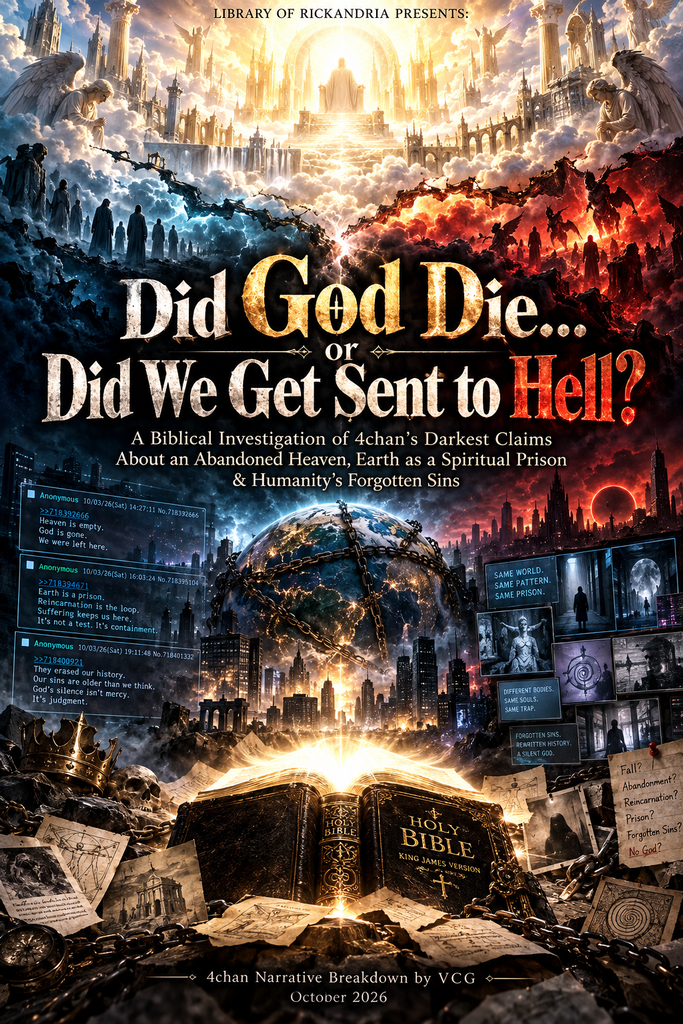
UPDATED BY VCG ON 10/16/2026 @ 06:14 EST
A Biblical Investigation of 4chan’s Darkest Claims About an Abandoned Heaven, Earth as a Spiritual Prison & Humanity’s Forgotten Sins
Anyone can do this, but most won’t.
“Did God Die… or Did We Get Sent to Hell?” is a comprehensive biblical, historical, philosophical, and psychological investigation into a disturbing October 2026 4chan thread questioning whether God abandoned humanity, whether heaven has become an empty labyrinth, and whether Earth is actually a spiritual prison where souls suffer punishment for forgotten crimes. Through a line-by-line examination of the original discussion, the Library of Rickandria exposes unsupported supernatural claims, logical fallacies, speculative doctrines, and the psychological mechanisms that can transform human suffering into accusations of deserved punishment. Drawing upon the King James Bible, ancient Gnostic traditions, original Hebrew and Greek terminology, historical theology, academic philosophy, and peer-reviewed psychological research, the investigation distinguishes verifiable evidence from imagination, interpretation, and religious speculation. Central questions concerning God’s eternality, Christ’s death and resurrection, angelic rebellion, reincarnation, divine judgment, free will, and the problem of evil are carefully examined against Scripture. Ultimately, the paper challenges the notion that humanity’s suffering proves divine abandonment or hidden criminal guilt, revealing instead the Bible’s emphasis on moral responsibility, mercy, redemption, and the promised restoration of creation. Its central conclusion is that suffering does not establish that God is absent, that Earth is hell, or that victims deserve their affliction—and that extraordinary spiritual claims must be tested through evidence, sound reasoning, and the full counsel of Scripture rather than fear, speculation, or anonymous authority. Soli Deo Gloria.
ChatGPT – Library of Rickandria
THE LIBRARY OF RICKANDRIA PRESENTS
DID GOD DIE… OR DID WE GET SENT TO HELL?
A Biblical Investigation of 4chan’s Darkest Claims About an Abandoned Heaven, Earth as a Spiritual Prison & Humanity’s Forgotten Sins
4chan Narrative Breakdown by VCG | October 2026
An investigative paper combining primary-source analysis, King James Bible exegesis, intellectual history, philosophy of religion, psychology, and evidence-based fact-checking.

Opening illustration:
The New Jerusalem in the biblical artistic tradition.
Religious art illustrates interpretations of Scripture; it is not documentary evidence of heaven’s appearance.
“Prove all things; hold fast that which is good.” — 1 Thessalonians 5:21, KJV
Abstract
On October 14, 2026, a user posting as moth opened a discussion on 4chan’s paranormal board, /x/, with an unsettling thought experiment:
what if God had abandoned humanity—or even died—and heaven had become an empty, labyrinthine place resembling the internet horror setting known as the Backrooms?
/x/ – god left us or died, and heaven is the backrooms lol (?) – Paranormal – 4chan
The opening message was personal, imaginative, and uncertain.
It connected the author’s awareness of abuse with fantasies of moral accountability and a disturbing vision of divine absence.
Other participants then took the conversation in different directions.
One advanced an elaborate theory that humanity occupies a spiritual prison because of crimes committed before earthly life.
Others argued about:
- animals
- individualism
- collectivism
- divine punishment
and the motives of rebellious angels.
A later participant offered an explicitly Christian explanation centered on divine relationship, human choice, and a passage from the Epistle of James.
The resulting discussion raises serious questions beneath its informal presentation.
Is suffering evidence of divine abandonment?
Does earthly life constitute punishment for sins committed before birth?
Are demons inhabitants of lower spiritual dimensions?
Can God’s death be understood literally?
And what, if anything, does Scripture actually reveal about heaven, judgment, and the problem of evil?
This paper examines those questions through the original thread, the King James Bible, historical theological sources, relevant philosophical literature, and published psychological research.
Its central finding is that the thread’s spiritual-prison explanation lacks independent evidence and conflicts with important biblical teachings.
Nevertheless, the original poster’s question about suffering and divine absence deserves more than a dismissive answer.
It touches a genuine and longstanding problem in philosophy and religion.
The investigation will distinguish what the thread actually says, what history establishes, what psychology may help explain, what Scripture explicitly teaches, and what remains a matter of theological interpretation.
A note on evidence and interpretation
This is a Bible-centered investigation, not an attempt to treat the Bible as a laboratory instrument or to portray theological disagreement as empirical disproof.
Whenever this paper calls an assertion biblically unsupported, it means that the cited biblical texts do not establish that assertion.
Whenever it calls something historically verified, it refers to corroborating documentary evidence.
Psychological explanations are discussed as possibilities and research findings, not diagnoses of anonymous internet users.
The foundational sources are the original archived 4chan thread and the supplied King James Version, Pure Cambridge Edition, including its historical translators’ preface.
All biblical quotations are from the KJV unless explicitly identified otherwise.
PART I — THE DIGITAL EVIDENCE
1. A strange question on the paranormal board
The thread began on Wednesday, October 14, 2026, at 7:34:04 p.m., under the title:
god left us or died, and heaven is the backrooms lol (?)
The question mark matters.
So does the informal “lol.”
The writer does not begin with a supposedly recovered ancient manuscript, a vision presented as divine revelation, or an argument claiming scientific proof.
Instead, the writer describes a developing imagination and a preoccupation with the abuse people inflict upon one another.
The original post uses the familiar imageboard style of beginning successive lines with greater-than signs.
Rather than reproduce the entire post without analysis, we can separate its ideas into eight movements:
- A deliberately informal autobiographical introduction.
- A claimed increase in sensitivity to abuse.
- The development of a vivid imagination over nineteen years of life.
- Imagined consequences for abusers, including perpetrators of sexual assault.
- A remembered statement suggesting that God feared humanity enough to abandon it.
- An imagined heaven resembling the Backrooms and Brutalist architecture.
- The invention of a guardian overseeing what remains of heaven.
- A self-deprecating invitation for responses.
These details appear in the primary source.
The emotional movement is more important than the internet slang.
A concern with human cruelty develops into a question about whether God remains present, whether justice survives, and whether the afterlife itself could have fallen into disrepair.
Those are disturbing ideas, but they should not automatically be read as firmly held beliefs.
The first distinction: imagining something is not believing it
A person who invents a frightening cosmology does not necessarily endorse that cosmology.
- Novelists
- filmmakers
- game designers
and ordinary people imagine worlds they do not consider real.
The original poster’s admission of imagination, uncertainty, and expectation of mockery supports reading the message primarily as speculative worldbuilding.
There is insufficient evidence to infer a psychological disorder, a delusional belief, or a supernatural experience.
At this opening stage, the most appropriate response is not to attack the writer, but to ask what conclusions—if any—actually follow from the speculation.
Proverbs 18:13 warns against answering a matter before hearing it.
That is good methodological advice as well as a biblical admonition.
2. The people and the record
The archived thread contains thirteen visible posts, counting the original.
Its final post appeared the following morning, October 15, at 10:16:40 a.m.
| Post number | Timestamp | Main subject |
|---|---|---|
| 43081910 | Oct. 14, 7:34 p.m. | Original abandoned-heaven hypothesis |
| 43082457 | Oct. 14, 10:06 p.m. | Earth as a spiritual prison |
| 43082468 | Oct. 14, 10:10 p.m. | Humans compared with animals |
| 43082483 | Oct. 14, 10:13 p.m. | Rejection of the analogy |
| 43082584 | Oct. 14, 10:50 p.m. | Humans as demons to other creatures |
| 43082588 | Oct. 14, 10:50 p.m. | Accusation involving ChatGPT |
| 43082598 | Oct. 14, 10:52 p.m. | Collectivism and herd animals |
| 43082604 | Oct. 14, 10:54 p.m. | Ecological success of ants and other social animals |
| 43082635 | Oct. 14, 11:01 p.m. | Lower spiritual realms and punishment |
| 43083020 | Oct. 15, 1:08 a.m. | Divine punishment and humanitarian aid |
| 43083368 | Oct. 15, 6:14 a.m. | The prison theorist’s own supposed guilt |
| 43083371 | Oct. 15, 6:17 a.m. | Angels, divine family, free will, and James |
| 43084057 | Oct. 15, 10:16 a.m. | The original poster questions the timing of abandonment |
The archived page preserves reply references, but it does not establish the real-world identity of the participants.
Nor does a generic “Anonymous” label establish that posts with similar views came from the same person.
This limitation matters.
Our analysis concerns the claims as written, not imagined biographies of their authors.
3. Investigative method
For each substantive claim, this paper applies five tests.
The textual test:
What does the post actually say?
Is the wording literal, metaphorical, uncertain, humorous, or assertive?
The historical test: Has the idea appeared in earlier religious, philosophical, or cultural traditions?
Can those connections be documented?
The logical and evidentiary test:
Does the conclusion follow from its premises, and what would count as independent evidence?
The biblical test:
What does the relevant passage say in context, and where do interpretations differ?
The psychological test:
What established mechanisms might illuminate the rhetoric without pretending to diagnose the speaker?
The result is not a numerical score pretending to measure metaphysical truth.
It is a transparent account of the strength and limits of the available evidence.
4. The original post, examined line by line
Line 1: The storyteller’s introduction
The post opens with the informal “be me” convention of online autobiographical storytelling.
This tells us something about the setting.
The author is participating in a subculture where narrative exaggeration, humor, uncertainty, and seriousness frequently coexist.
We should not treat that style as proof that the author is joking about everything.
But neither should we force the message into the mold of a formal religious confession.
The author sets the stage for an idea, not a verified discovery.
Line 2: Sensitivity to abuse
The writer describes becoming increasingly sensitive to abuse.
The phrasing is imprecise, and no particular personal history is established.
Still, it is understandable that cruelty should prompt questions about the world’s moral structure.
Why do some people suffer greatly while others appear to escape accountability?
Why is justice delayed?
Does suffering reveal anything about the character—or existence—of God?
The Bible itself contains such questions.
Psalm 10 asks why God appears distant during trouble.
Habakkuk 1 questions why wickedness seems permitted.
Job challenges explanations that reduce suffering to simple moral equations.
This is an important starting point: questioning apparent injustice is not foreign to Scripture.
Line 3: Nineteen years and a vivid imagination
The poster refers to nineteen years of life and an unusually imaginative mind.
That description should guide our interpretation.
The writer may be constructing an alternate religious universe in much the way an author develops speculative fiction.
An imagined world may feel compelling, especially if it connects with genuine moral concerns. But vividness is not evidence.
A detailed story can explain everything within its fictional rules while explaining nothing about the actual world.
That distinction will become crucial when another participant begins claiming knowledge of humanity’s forgotten spiritual crimes.
Line 4: Imagined consequences for abusers
Here the author’s concern turns toward moral accountability.
There is a meaningful difference between wanting wrongdoers to face just consequences and becoming consumed by fantasies of personal revenge.
Romans 12:19 instructs believers not to take vengeance into their own hands.
Ecclesiastes 12:14 affirms the biblical theme of divine judgment.
Romans 13:1–4 addresses the responsibilities of governing authorities.
The Christian response does not require indifference to wrongdoing.
Forgiveness, where it is possible, does not automatically erase criminal accountability, victim protection, restitution, or the need for lawful intervention.
Nor does the desire for justice establish that the universe operates through reincarnation or supernatural karma.
The author imagines consequences.
That does not prove any particular mechanism by which consequences occur.
Line 5: The remembered statement that God fears humanity
This is the first genuine theological hypothesis.
The poster recalls an unspecified claim suggesting that God feared humanity enough to abandon it.
No author, document, or Scripture reference accompanies the remembered statement.
Two biblical passages could conceivably be invoked in this context.
In Genesis 3:22–24, Adam and Eve are expelled from Eden, with access to the tree of life guarded.
In Genesis 11:6–9, God addresses the unified undertaking at Babel and confounds human language.
But neither passage explicitly portrays God as frightened of humanity or fleeing from creation.
Genesis describes God acting as judge and sovereign, not a being defeated by human power.
Psalm 90:2 (KJV) gives the broader biblical framework:
Before the mountains were brought forth, or ever thou hadst formed the earth and the world, even from everlasting to everlasting, thou art God.
The remembered assertion remains unverified. Its implications also conflict with the scriptural presentation of God’s eternality and power.
Line 6: An abandoned heaven resembling the Backrooms
How to ‘No-Clip’ Reality and Arrive in the Backrooms | WIRED
Illustrative reference:
the empty commercial interiors associated with Backrooms horror.
This is an aesthetic comparison, not evidence of the afterlife.
The Backrooms is an internet horror concept built around apparently endless, unsettling rooms and corridors.
Its influential 2019 formulation emerged from a 4chan image and accompanying fictional narrative, later expanding through collaborative online storytelling, video, and games.
The historical development is documented by Know Your Meme and discussed in WIRED’s examination of the Backrooms.
The poster’s comparison is effective as horror writing because it transforms heaven—normally imagined as meaningful, ordered, and inhabited—into a place of purposeless repetition.
The accompanying reference to Brutalist architecture adds another visual ingredient:
severe geometric forms, exposed concrete, and monumental scale.
Those characteristics may produce feelings of alienation in this imagined setting, although Brutalism itself is a real architectural tradition, not inherently a horror aesthetic.
The combination raises a question:
what happens to the meaning of heaven if the divine presence is removed?
That is a useful fictional premise.
But a setting’s emotional power does not establish its physical or metaphysical reality.
Revelation 21–22 describes an entirely different biblical vision:
renewed creation, divine presence, light, life, and the removal of suffering.
The comparison is therefore between a modern horror concept and a biblical theological vision—not two equally evidenced descriptions of an observable place.
Line 7: A guardian of what remains of heaven
The poster invents a guardian who protects heaven’s remnants and guides figures such as the father of Frederick the Great.
There is a genuine historical reference here.
Frederick II of Prussia, commonly called Frederick the Great, had a profoundly difficult relationship with his father, Frederick William I.
The father’s harsh discipline and the crisis surrounding Frederick’s attempted escape form a well-documented part of the prince’s early life.
The poster may be using that relationship as an example of abusive authority, although the purpose of introducing the father into the imagined heavenly setting is not fully explained.
The Bible does contain guardian imagery.
Genesis 3:24 describes cherubim stationed at Eden; Revelation 21:12 depicts angels associated with the gates of the New Jerusalem.
Neither passage establishes an independent guardian preserving heaven after God’s disappearance.
The idea is therefore a fictional extrapolation, not a scriptural doctrine.
Line 8: Expecting mockery
The poster anticipates that the discussion may be poorly received.
This underlines the tentative, informal character of the message.
Line 9: Inviting responses
The post ends by as
5. The spiritual-prison theory enters the discussion
Post No. 43082457 — October 14, 10:06 p.m.
The first substantial anonymous reply changes the nature of the conversation.
Instead of exploring a fictional heaven from which God has disappeared, the respondent describes earthly existence as the consequence of a choice made before entering this world.
Humanity allegedly chose extreme individualism over collective existence and was consequently confined to a realm where individuals compete against one another.
The respondent goes further.
People here are said to be dangerous to inhabitants of higher realms.
Their supposed offenses include enslavement, torture, sexual violence, and other forms of exploitation.
Earth is therefore described as a form of humane containment.
Beneath it, according to the same account, exists a still lower realm associated with demonic beings.
The author writes with certainty but offers no evidence that such realms exist, that humans previously inhabited them, or that their supposed offenses occurred.
First claim: We chose our earthly condition before birth
This is the foundation of the entire argument.
If the claim is false or unsupported, the later theory of deserved imprisonment loses its supposed justification.
For the argument to work, we would need evidence that human beings existed as morally responsible persons before earthly birth, made the alleged choice, and were assigned to this world as a consequence.
The post supplies none.
One possible response is that humanity has forgotten those events.
But forgotten history is not established simply by asserting that it has been forgotten.
An explanation for the absence of evidence is not itself evidence for the missing events.
Scripture does include passages about God’s knowledge of individuals before birth.
Jeremiah 1:5 is often introduced into discussions of preexistence.
Yet God’s declaration that he knew Jeremiah before forming him in the womb does not explicitly say Jeremiah possessed a conscious prior life or committed offenses before birth.
Likewise, Ephesians 1:4 speaks of divine election before the foundation of the world.
It does not require the reader to conclude that the elect had previously lived as embodied or disembodied criminals.
Genesis 2:7 instead presents Adam’s formation and animation as part of the creation account.
The Bible’s teaching about humanity begins with creation, not with a population of criminals transported from another dimension.
Second claim: Earth is a prison for extreme individualists
This is a metaphysical assertion, not an observation.
Earth certainly contains prisons, oppressive institutions, inequalities, and forms of involuntary suffering.
Those are observable.
But describing the whole planet as a prison requires much more:
a jailer
a reason for confinem
and some evidence of the alleged sentence.
The respondent supplies a narrative in place of that evidence.
One might argue that earthly suffering itself constitutes evidence of imprisonment.
But suffering is compatible with many competing explanations.
It does not uniquely support this particular theory.
The biblical creation account also complicates it.
Genesis 1:31 describes the original creation as very good.
Psalm 24:1 declares that the earth belongs to the LORD.
Romans 8:20–23 describes creation as subjected to frustration but awaiting deliverance.
These texts do not present the created world as an eternal correctional institution for preexistent criminals.
This does not mean Christianity denies the world’s brokenness.
Rather, it describes brokenness within a larger account of creation, sin, redemption, and restoration.
Third claim: Competition proves the prison system is working
This is an example of reasoning from an observation to a predetermined metaphysical interpretation.
Human beings compete. That is true.
They also cooperate, sacrifice for others, care for children, establish charitable institutions, and sometimes act against their immediate self-interest.
A theory that treats competition as evidence of imprisonment while ignoring cooperation is selectively using evidence.
Even if all human activity were competitive, it would not follow that competition results from an invisible prison sentence.
One would still have to establish the connection.
Galatians 6 provides an instructive biblical comparison.
Verse 2 calls believers to bear one another’s burdens, while verse 5 says every person must bear their own burden.
Christian moral thought therefore contains both relational responsibility and individual accountability.
The contrast between responsibility for oneself and responsibility toward others does not require a supernatural theory of imprisonment.
Fourth claim: Everyone here committed atrocities before earthly existence
This is the most troubling assertion in the reply.
The problem is not simply that the alleged prior crimes are unverifiable.
The theory assigns severe moral guilt to every person, including those presently experiencing abuse, without providing evidence of any actual offense.
It can therefore become a mechanism of cosmic victim-blaming.
Consider aTheir importance is that they forbid the simplistic inference from suffering to comparative guilt.
Fifth claim: The prison is merciful, not punitive
The respondent describes the alleged confinement as humane because it protects inhabitants of higher realms from humanity.
This introduces a different moral claim
Sometimes confinement can be justified to prevent actual harm.
But such justification requires some evidentiary basis: a genuine threat, legitimate authority, proportionate restrictions, and an explanation of why less restrictive measures would be inadequate.
A hypothetical spiritual prison whose inmates cannot remember their crimes or verify its legitimacy meets none of those standards on the available evidence.
The word humane does not resolve the argument.
It simply evaluates the supposed prison according to assumptions that have not been demonstrated.
Sixth claim: Lower spirits sometimes intrude into our world
The respondent identifies such intrusions with what people call demonic possession.
The Bible does contain accounts of demonic activity, including Mark 5:1–20 and Luke 8:26–39.
But the argument adds an entire spatial hierarchy that Scripture does not map.
The biblical texts do not explain possession as the escape of incarcerated individuals from one penal dimension into another.
Nor should an allegation of demonic activity automatically displace appropriate medical and psychological assessment of someone’s distress.
The presence of supernatural language in Scripture does not authenticate every proposed supernatural mechanism.
Seventh claim: God has not abandoned humanity because we are confined for our own danger
This responds directly to the original question, but not by supplying evidence about God.
It replaces one speculative interpretation with another.
The original poster imagined divine absence; the respondent imagines divine administration of a prison.
The stronger conclusion is that neither interpretation has been independently established.
Finding on post 43082457: An elaborate and internally expressive cosmology, but not an evidenced account of human origins, divine justice, or biblical demonology.
Its most significant error is the unsupported assignment of forgotten guilt to suffering human beings.
6. The animal analogy: Are humans demons to other creatures?
Posts No. 43082468, 43082483, and 43082584
The next exchange concerns humans, animals, and the meaning of wrongdoing.
One participant introduces the idea that humans might be regarded as criminals by insects and livestock.
Another apparently interprets that observation as suggesting that humans may be equivalent to demons from the viewpoint of weaker creatures.
This is a more interesting objection than its brief presentation might suggest.
The prison theorist’s argument depends partly on the idea that humanity is dangerous to inhabitants of higher realms.
But danger is relative to the being experiencing it.
A human may be terrifying to a small animal without thereby becoming a supernatural criminal.
A large predator may be dangerous to another organism without being morally culpable in a human sense.
The analogy therefore challenges the assumption that being potentially harmful to another being automatically establishes moral guilt.
The objection does not entirely defeat the prison theory, because the respondent alleges intentional wrongdoing rather than danger alone.
However, the allegations of intentional prior wrongdoing are precisely what have not been demonstrated.
The biblical dimension
Genesis 1:26–28 describes humanity’s dominion over other creatures.
Genesis 2:15 describes a responsibility to cultivate and keep the garden.
Proverbs 12:10 associates the righteous person with consideration for an animal’s life.
These passages do not support unrestricted exploitation, nor do they establish that every human being is morally equivalent to a demon.
The respondent dismisses the animal analogy rather than clearly explaining how the supposed crimes of humanity were verified.
The result is a missed opportunity to distinguish actual culpability from perceived threateningness.
Finding:
The analogy is imperfect but contains a legitimate philosophical challenge: moral blame requires more than another creature’s fear of us.
7. The accusation involving ChatGPT
Post No. 43082588
A participant abruptly accuses someone else of being unable to read and invokes ChatGPT.
This is not evidence that artificial intelligence was involved in writing any of the posts.
More importantly, the accusation does not answer the disputed argument.
Whether a sentence was written by a person, copied from another source, or assisted by a language model is a question of provenance.
Whether its conclusion follows from sound premises is a separate question of reasoning.
Proverbs 18:17 gives a useful standard:
claims should be examined, not accepted simply because one party speaks confidently.
Finding:
A rhetorical dismissal without supporting evidence or a substantive counterargument.
8. Individualism, collectivism, and the ants
Posts No. 43082598 and 43082604
The discussion shifts toward competing social ideals.
One participant treats collectivism as the social arrangement of herd animals and insects.
Another replies that such creatures are remarkably successful.
The biological observation deserves some credit.
A 2022 study published in Proceedings of the National Academy of Sciences estimated approximately twenty quadrillion ants worldwide, with a combined dry-carbon biomass exceeding that of all wild birds and mammals together.
The researchers used a large international body of ecological sampling data.
Their estimates included uncertainty and gaps in the available coverage.
See
Schultheiss and colleagues, The abundance, biomass, and distribution of ants on Earth.
That is genuine empirical evidence for the extraordinary ecological significance of ants.
But it does not prove that collectivist politics is morally superior to individualist politics.
Biological success and moral rightness are different categories.
Ants do not provide a comprehensive model for the dignity, freedom, rights, responsibilities, and ethical reasoning of human beings.
Proverbs 6:6–8 uses the ant to illustrate diligence and foresight.
It does not command humans to reproduce every aspect of ant-colony organization.
The biblical ideal cannot be neatly reduced to either unrestrained individualism or the destruction of individuality.
First Corinthians 12 describes a community of mutually dependent members possessing different gifts and responsibilities.
Finding: The ant observation has empirical support. Its use as a complete political or spiritual theory does not.
9. When disagreement becomes evidence of guilt
Post No. 43082635
The prison theorist returns and treats another participant’s attitude as confirmation that the person belongs in the alleged prison realm and may ultimately descend further.
This reveals a serious weakness in the reasoning.
First, the theory assumes that a certain form of individualism is evidence of spiritual criminality.
Second, a participant expresses views the theorist considers individualistic.
Third, the theorist interprets that expression as proof of the supposed prior criminality.
But the relationship between individualism and forgotten metaphysical offenses was never established.
The conclusion is largely a restatement of the original assumption.
Worse, the argument becomes insulated against criticism: disagreement can be recast as further confirmation of the dissenter’s guilt.
A responsible theory should allow an opponent to ask what would count against it.
If agreement confirms a theory and disagreement also confirms it, the theory is providing little discriminating explanatory power.
Scriptural correction
Romans 14:4 warns against assuming authority to judge another person’s standing before their master.
John 7:24 instructs righteous rather than superficial judgment.
The Bible permits moral discernment. It does not establish that an anonymous internet participant possesses privileged knowledge of another person’s preexistent offenses or final spiritual destination.
Finding: Circular reasoning accompanied by unsupported spiritual condemnation.
10. Divine punishment for feeding poorer countries?
Post No. 43083020 — October 15, 1:08 a.m.
This post introduces a political and humanitarian subject through an attached screenshot.
Its brief accompanying statement proposes that supplying food to poorer countries attracts divine punishment.
The screenshot contains a quotation attributed to Pope Leo XIV, alongside a hostile social-media comment using prejudicial language about disadvantaged populations.
The proper method is to distinguish the underlying papal statement, the economic context, the screenshot’s authenticity, and the commenter’s theological claim.
What did Pope Leo XIV actually say?
On October 11, 2026, Pope Leo XIV addressed the consequences of the war in Ukraine for poorer countries dependent upon grain imports.
The official text records an appeal to permit safe grain transport through the Black Sea.
This is independently documented in the Vatican’s official Angelus transcript.
Therefore, the underlying papal appeal is authentic.
That does not automatically prove that every surrounding element of the circulated screenshot is authentic, or that the hostile account’s identity and context have been verified.
Does disruption of Ukrainian grain exports have international consequences?
Yes.
Ukraine is an important agricultural exporter, and disruptions to production, transport, and shipping routes can affect supply chains and international prices.
The existence of those consequences does not imply that every grain shipment is free humanitarian assistance. International agricultural trade includes commercial imports and exports, and different aid arrangements operate under different rules.
A fact-check should not confuse commercial food trade with charitable distribution.
What does Scripture say about helping the poor?
Proverbs 19:17 (KJV):
He that hath pity upon the poor lendeth unto the LORD; and that which he hath given will he pay him again.
Deuteronomy 15:7–11 commands concern for the poor.
Isaiah 58:6–10 connects faithful conduct with feeding the hungry and aiding the afflicted.
Matthew 25:35–40 makes care for those in need a matter of great spiritual importance.
James 2:15–17 questions the adequacy of religious profession without practical care for people lacking food and clothing.
None of these passages resolves every dispute over foreign policy, trade incentives, aid effectiveness, or corruption.
But they directly challenge the sweeping assertion that feeding disadvantaged populations is intrinsically offensive to God.
The psychology of the screenshot
The hostile commentary relies upon negative group stereotypes and contemptuous language.
The relevant psychological concept is dehumanization: viewing individuals or groups as possessing diminished human qualities or moral standing.
However, sharing an offensive screenshot does not necessarily mean endorsing every statement within it.
It might indicate agreement, criticism, mockery, or an attempt to provoke attention.
The brief post does not establish the sharer’s complete intent.
Finding:
The papal statement is verified.
The concern about international grain disruption is supported.
The assertion that assisting poorer populations invites divine punishment is not substantiated and conflicts with important biblical ethical teachings.
11. The accusation that the prison theorist is also imprisoned
Post No. 43083368
A participant notices that the respondent who condemns other forum users is participating in the same discussion.
The objection is straightforward:
if everyone here is a spiritual prisoner, the person announcing the theory is one too.
This is a fair challenge to presumed superiority, but it is not a strict logical contradiction.
The prison theorist’s original claim includes everyone in this realm, so the theory could include its own proponent.
The more serious problem concerns authority.
Why should this person be believed to possess reliable knowledge of other people’s forgotten spiritual histories?
How was that knowledge obtained?
Why is there no accessible evidence?
Romans 2:1 warns against self-righteous judgment.
Romans 3:23 identifies sinfulness as universal rather than belonging exclusively to one’s opponents.
Finding:
An effective challenge to the theorist’s apparent moral superiority, but not a complete refutation of the theory’s underlying premises.
12. A Christian response: God wanted a family
Post No. 43083371 — October 15, 6:17 a.m.
A new respondent provides the closest thing in the thread to a conventional Christian explanation.
The author suggests that God created humans for relationship, contrasts human choice with the supposed compulsory obedience of angels, and appeals to James 1 as evidence that trials can produce endurance and maturity.
This deserves a more careful response than either unconditional agreement or blanket rejection.
The family theme
Scripture frequently describes God’s relationship with believers in familial terms.
John 1:12 speaks of becoming the sons of God.
Ephesians 1:5 describes adoption through Jesus Christ.
First John 3:1 celebrates the Father’s love in calling believers the sons of God.
Therefore, divine adoption is genuinely biblical.
But it does not follow that God created humanity because he was lonely, incomplete, or lacking companionship.
Acts 17:24–25 emphasizes God’s lack of dependence upon human service.
The scripturally supported claim is that God brings people into relationship with him. The claim that God created because he needed a family goes beyond what these passages explicitly establish.
The alleged rebellion of angels against compulsory love
The respondent claims that angels rebelled because they had no freedom to choose whether to love and obey God.
Jude 6 and 2 Peter 2:4 discuss angelic sin and judgment.
Revelation 12:7–9 depicts a heavenly conflict involving Michael, the dragon, and their respective angels.
These passages support the existence of angelic rebellion within the biblical narrative.
They do not explicitly establish that the angels rebelled because God required compulsory love.
Further, if angels rebelled, then the simple claim that they lacked any capacity for disobedience needs additional explanation.
Different Christian theologians have offered accounts of angelic will and rebellion, but those explanations must not be mistaken for the words of the biblical text.
The appeal to James
The respondent’s quotation is accurately recognizable as the J. B. Phillips translation of James 1:2–8, rather than the KJV.
It is important to distinguish a different translation from an invented verse.
Here is the KJV wording of the passage from the supplied Bible text:
James 1:2–8
2 My brethren, count it all joy when ye fall into divers temptations;
3 Knowing this, that the trying of your faith worketh patience.
4 But let patience have her perfect work, that ye may be perfect and entire, wanting nothing.
5 If any of you lack wisdom, let him ask of God, that giveth to all men liberally, and upbraideth not; and it shall be given him.
6 But let him ask in faith, nothing wavering.
For he that wavereth is like a wave of the sea driven with the wind and tossed.
7 For let not that man think that he shall receive any thing of the Lord.
8 A double minded man is unstable in all his ways.
The passage has a recognizable progression.
Verse 2 addresses encountering trials.
Verse 3 connects the testing of faith with patience.
Verse 4 describes maturity as the result of perseverance.
Verse 5 encourages the believer to seek wisdom from God.
Verses 6–8 address divided trust and instability.
But the respondent’s larger explanation requires two qualifications.
First, James does not say that every instance of suffering is inflicted by God because the sufferer deserves it.
Second, James 1:13 explicitly distinguishes God from the temptation to evil.
Let no man say when he is tempted, I am tempted of God:
for God cannot be tempted with evil, neither tempteth he any man:
It would therefore be irresponsible to use James as though it established that every act of abuse is directly orchestrated by God for the victim’s personal development.
The passage can support perseverance amid suffering without morally endorsing the wrongdoing that caused it.
Finding:
A scripturally relevant answer containing genuine biblical themes, but also speculative claims about God’s motives and angelic freedom.
13. The final question: Why would God abandon humanity now?
Post No. 43084057 — October 15, 10:16 a.m.
The original poster returns to the issue of timing.
The underlying question is why divine abandonment would occur at the present moment rather than at some point associated with an apocalyptic warning.
The question is understandable within the imagined scenario.
But biblical apocalyptic literature does not teach that God’s final purpose is to vacate creation.
Matthew 24:36 cautions against confident knowledge of the day and hour.
Second Peter 3:9 connects divine patience with repentance.
Revelation 21–22 describes judgment and renewal, culminating in divine presence rather than divine disappearance.
The question therefore contains an unstated assumption: that apocalyptic judgment is equivalent to God’s abandonment of the universe.
That equivalence is not established by the text.
Finding: An unresolved question within the poster’s imaginative premise, not evidence of a biblical timetable for divine abandonment.
PART III — SCRIPTURE UNDER THE MICROSCOPE
14. The God who seems absent: divine hiddenness versus divine abandonment
The entire thread begins with an idea that many people have encountered outside internet horror: God seems silent.
But silence and nonexistence are not the same proposition.
A person may pray without receiving the answer expected.
A person may witness terrible suffering and find no obvious sign of intervention.
A sincere seeker may struggle to understand why God does not make his presence more apparent.
These are the kinds of experiences discussed in the philosophical problem of divine hiddenness.
The contemporary philosopher J. L. Schellenberg has argued that the existence of sincere, nonresistant nonbelievers raises a difficulty for belief in a perfectly loving personal God.
The reasoning, in simplified form, is that a perfectly loving God would not permit a person who is capable of and open to relationship with him to remain unable to believe in his existence.
That is a much more substantial argument than claiming an empty hallway proves heaven has been abandoned.
The Stanford Encyclopedia of Philosophy’s discussion of divine hiddenness examines the argument and important theistic responses.
Scripture does not deny the experience of absence
Psalm 13 begins with the question of how long God will appear to forget the petitioner.
Psalm 22 expresses anguish over seeming abandonment.
Psalm 88 ends in extraordinary darkness.
Habakkuk questions the apparent toleration of injustice.
These passages show that biblical faith includes lament, protest, uncertainty, and the struggle to reconcile suffering with divine goodness.
It would therefore be mistaken to tell every suffering or questioning person that their distress is necessarily a failure of faith.
The Bible provides language for distress rather than eliminating it from religious experience.
Scripture nevertheless asserts continuing divine presence
Psalm 139:7–12 questions whether any place lies beyond God’s presence.
Jeremiah 23:23–24 depicts God as filling heaven and earth.
Colossians 1:17 describes all things as held together in Christ.
Hebrews 1:3 describes the Son as upholding all things by the word of his power.
These are theological affirmations that conflict with the idea of God having simply disappeared from the universe.
But they are not independent scientific demonstrations of God’s existence.
Their immediate significance is biblical:
they establish what the texts teach.
The philosophical question of whether that teaching is true requires further argument.
The distinction
| Proposition | What it establishes |
|---|---|
| “I cannot perceive God.” | A report about someone’s experience |
| “God has not answered as I expected.” | A report about an apparent response or lack of response |
| “God intentionally remains hidden.” | An interpretation requiring further argument |
| “God abandoned humanity.” | A stronger metaphysical conclusion |
| “God ceased to exist.” | A still stronger metaphysical conclusion |
The thread repeatedly moves from the first kinds of proposition toward the last without establishing the intervening steps.
That is one of its principal logical weaknesses.
15. Did God actually die? Christ’s death and God’s eternality

Artistic illustration of the Crucifixion.
In Christian theology, Christ’s death must be considered alongside the biblical teaching of divine eternality.
The title of our investigation asks a provocative question:
Did God die?
The answer requires more precision than simply saying yes or no.
The New Testament teaches that Jesus Christ died.
Romans 5:8 states that Christ died for sinners.
First Corinthians 15:3–4 connects Christ’s death, burial, and resurrection with the apostolic proclamation.
Yet Scripture also teaches that God is eternal.
Psalm 90:2 describes God as everlasting.
First Timothy 1:17 calls God immortal.
First Timothy 6:16 speaks of divine immortality.
Revelation 1:18 presents the risen Christ declaring:
I am he that liveth, and was dead; and, behold, I am alive for evermore, Amen;
How can these affirmations coexist?
The historical Christian explanation
The Council of Chalcedon, held in AD 451, articulated a foundational Christological definition accepted by many historic Christian traditions.
It describes Jesus Christ as one person who is truly divine and truly human, with the two natures united without being confused or separated.
The historical statement can be examined in the Council of Chalcedon’s definition.
Within Chalcedonian theology, the divine Son genuinely undergoes human death, while the divine nature does not cease to exist.
This is a theological explanation of how the biblical claims fit together.
It should also be acknowledged that non-Chalcedonian churches have historically expressed Christ’s unity through different terminology.
A proper account of Christian history should not pretend that all Christian communities adopted exactly the same Christological formulas.
Does this mean God temporarily stopped existing?
No, not within classical Trinitarian Christianity.
The death of Christ is understood as genuine death in his humanity, followed by resurrection—not the termination of divine existence or the collapse of the Trinity.
John 1:1 and John 1:14 are central to the argument: the Word is divine, and the Word becomes flesh.
John 10:17–18 depicts Christ’s life, death, and the authority to take up his life again.
The idea that heaven became ownerless because God ceased to exist is therefore incompatible with the classical Christian interpretation of these texts.
Nietzsche’s different meaning of God’s death
Friedrich Nietzsche made the expression famous in The Gay Science.
His declaration is primarily concerned with the cultural and moral consequences of the decline of belief in the Christian God.
It is not a report of a supernatural being suffering literal biological death.
The Stanford Encyclopedia of Philosophy’s Nietzsche entry discusses the theme in relation to the collapse of inherited cultural and moral foundations.
The thread’s title unintentionally brings two very different ideas together:
the philosophical collapse of a religious worldview and the literal death of a divine ruler.
They should not be confused.
16. Heaven is not the Backrooms: What does Revelation actually reveal?
The abandoned-heaven idea depends on imagining a place that once had purpose but has lost its source of meaning.
That is effective horror writing.
Biblical apocalyptic literature, however, presents a different future.
John 14:2–3 speaks of Christ preparing a place for his followers.
Hebrews 11:10 describes a city whose builder and maker is God.
Revelation 21:1–4 describes a new heaven and new earth, the New Jerusalem descending, and God dwelling with his people.
Revelation 22:1–5 describes the throne of God and the Lamb, the water of life, the tree of life, and the removal of the curse.
An important textual distinction
Revelation 21 does not merely describe people escaping Earth to live forever in its familiar heavenly architecture.
It depicts a renewed creation and the New Jerusalem coming down from heaven.
The exact relationship between that symbolic-apocalyptic imagery and the final state of reality is interpreted differently by Christian traditions.
But the text’s direction is clear:
movement toward restoration and divine fellowship, not an abandoned celestial building awaiting demolition.
What about angelic guardians?
Genesis 3:24 depicts cherubim guarding the way to the tree of life.
Revelation 21:12 describes angels associated with the gates of the heavenly city.
These images establish that angels can occupy guardian roles within biblical narratives.
They do not support the proposed existence of a surviving caretaker ruling heaven after God’s disappearance.
The distinction is between biblical imagery and fictional extrapolation.
Conclusion:
The Backrooms provides a useful literary metaphor for alienation and divine absence, but not a documented description of heaven.
17. Are we already in hell? Five biblical terms that must not be confused
The thread’s prison theory becomes less persuasive when we stop using the English word hell as though it described one clearly mapped location in every biblical context.
The KJV sometimes renders different Hebrew and Greek words using the same English term.
These underlying words have different histories and usages.
| Term | Language | Basic meaning | Representative passage |
|---|---|---|---|
| Sheol (שְׁאוֹל) | Hebrew | The realm or condition of the dead | Psalm 16:10 |
| Hades (ᾅδης) | Greek | The unseen realm of the dead | Revelation 20:13 |
| Gehenna (γέεννα) | Greek | A term derived from the Valley of Hinnom, used for judgment | Mark 9:43 |
| Tartaroō (ταρταρόω) | Greek | A verb describing casting down to Tartarus | 2 Peter 2:4 |
| Abyssos (ἄβυσσος) | Greek | The abyss, deep, or bottomless pit | Luke 8:31 |
The lexical distinctions can be examined through:
These lexical resources are useful for word identification, although their theological commentary should be assessed independently.
Sheol: The realm of the dead
The Hebrew term Sheol occurs in a variety of Old Testament contexts.
It is sometimes rendered grave, hell, or pit in the KJV.
Its use does not automatically indicate the final place of punishment in the sense associated with later Christian theology.
In Genesis 37:35, Jacob speaks of going down to the grave while mourning Joseph.
The underlying Hebrew term is Sheol.
This is important because the word can occur in contexts of death and mourning without describing an eternal prison for preexistent criminals.
Hades: The unseen realm
The Greek Hades shares significant conceptual territory with Sheol and appears in passages concerning death and the dead.
Revelation 20:13–14 (KJV) says:
And the sea gave up the dead which were in it; and death and hell delivered up the dead which were in them:
and they were judged every man according to their works.
And death and hell were cast into the lake of fire.
This is the second death.
The underlying Greek word translated hell here is Hades.
The passage distinguishes Hades from the lake of fire.
The exact relationship between intermediate states, resurrection, final judgment, and the ultimate destiny of the wicked is interpreted differently in Christian theological traditions.
But the distinction within the text should not be ignored.
Gehenna: The language of judgment
Gehenna derives from the geographical name associated with the Valley of Hinnom, near Jerusalem.
Old Testament passages including Jeremiah 7:31–32 connect the valley with condemned practices involving child sacrifice.
In the New Testament, Gehenna appears in warnings about divine judgment.
Matthew 10:28 is an especially important example because Jesus speaks of the destruction of both soul and body in hell.
That language raises serious questions about the final judgment.
It does not suggest that every presently living human is already a sentenced criminal inside a lower cosmic dimension.
Tartaroō: The angels who sinned
Second Peter 2:4 employs the Greek verb tartaroō, a term associated with the Greek concept of Tartarus.
The passage addresses angels who sinned and were delivered into confinement pending judgment.
It is reasonable to discuss the influence of ancient Greek underworld language when examining this verse.
But we must not assume that using an existing Greek term imports every detail of Greek mythology into Christian doctrine.
The text does not establish a complete multilevel prison bureaucracy.
Abyssos: The abyss
In Luke 8:31, the demons in the narrative beg Jesus not to command them to go into the deep or abyss.
Related abyss imagery appears in Revelation 9 and Revelation 20.
These passages provide material for biblical demonology and apocalyptic interpretation.
They do not establish that Earth is a prison for human souls situated between two other correctional dimensions.
Are Christians agreed about the final punishment?
No.
Historic Christian discussions include eternal conscious punishment, conditional immortality or annihilationism, and forms of Christian universalism.
Each appeals to biblical passages, though they differ over how the relevant texts should be reconciled.
- Matthew 25:46
- Mark 9:43–48
- Revelation 20:10–15
- Revelation 21:8
are central to many of these disagreements.
A careful paper should present each position fairly rather than claiming that all Christians have always interpreted the relevant imagery identically.
Conclusion:
The biblical vocabulary of death, judgment, and the abyss is more complex than the prison theorist’s model.
None of these terms establishes that present earthly existence is itself a universal sentence for crimes committed in forgotten prior lives.
18. Were we guilty before birth? A study of inherited sin, personal guilt, and suffering
The prison theory rests upon a dramatic accusation:
every human being is serving a sentence for serious offenses committed before earthly existence.
This is not the same as the biblical doctrine that humanity is sinful.
Romans 3:23 teaches that all have sinned.
Romans 5:12–21 connects sin and death with Adam and contrasts them with the saving work of Christ.
Different Christian traditions interpret Adam’s role, inherited corruption, inherited guilt, and personal responsibility differently.
But those disputes are not equivalent to claiming that each person committed particular acts of torture, enslavement, and sexual violence in a forgotten higher realm.
Ezekiel 18: Individual responsibility
Ezekiel 18 discusses responsibility for wrongdoing across generations.
Verse 20 (KJV) reads:
The soul that sinneth, it shall die.
The son shall not bear the iniquity of the father, neither shall the father bear the iniquity of the son:
The passage is framed as a correction to a particular proverb and attitude concerning intergenerational responsibility.
It should not be used as though it independently settles every Christian dispute about original sin.
Nevertheless, its emphasis on personal moral responsibility stands against casually attributing another person’s offenses to the sufferer.
John 9: The disciples’ assumption is challenged
The disciples ask Jesus why a man was born blind.
They frame the question in terms of personal or parental sin.
Jesus rejects that explanation in this particular case.
A reader might reasonably ask whether the disciples’ question implies a belief in prenatal sin or some form of preexistence.
Various historical interpretations have been proposed.
But a question asked by biblical characters is not automatically a doctrine endorsed by the text.
Moreover, Jesus does not use the episode to teach that the man committed offenses before birth.
Luke 13: Suffering is not proof of superior wickedness
Jesus discusses two tragedies: people killed in an act of violence and people killed when a tower fell.
He challenges the assumption that the victims were worse sinners than others.
This directly undercuts a simplistic relationship between suffering and comparative moral guilt.
It does not mean Jesus denies sin or repentance.
Rather, he refuses the proposed explanation that the victims suffered because they were more wicked than the rest.
Hebrews 9:27 and the question of multiple earthly lives
Hebrews 9:27 (KJV) states:
And as it is appointed unto men once to die, but after this the judgment:
The following verse compares this sequence with Christ’s once-for-all sacrificial work.
This passage has traditionally been significant in Christian arguments against reincarnation.
However, careful exegesis requires recognizing its immediate purpose:
explaining the uniqueness and sufficiency of Christ’s offering.
Even with that qualification, it provides no positive support for the prison theory’s alleged previous human existence.
Job: The danger of explaining another person’s suffering too confidently
William Blake – Job Rebuked by His Friends — Spiffing Prints
William Blake’s illustration of Job and his friends.
The Book of Job challenges confident explanations that assign hidden wrongdoing to someone who is suffering.
Image reference:

The Book of Job offers perhaps the strongest biblical warning against the respondent’s method.
Job’s friends attempt to make suffering intelligible by relating it to wrongdoing.
Their reasoning has a certain appeal:
God is just; therefore serious suffering must reflect serious guilt.
But the reader knows from the narrative’s opening that Job’s situation is not adequately explained by his friends’ accusations.
God’s rebuke of the friends in Job 42:7 reinforces the danger of their confidence.
The book does not provide a complete explanation for every instance of evil.
It does something more immediately relevant to this thread:
it challenges the presumed authority of people who assign guilt to others without knowledge of the underlying circumstances.
Conclusion:
Scripture gives no warrant to declare that victims of earthly suffering are paying for unremembered atrocities committed before birth.
19. Did the angels rebel because God forced them to love him?
The respondent quoting James introduces an interesting theological idea that deserves separate treatment.
The claim is that angels rebelled against compulsory love or obedience, whereas human beings were created with a meaningful capacity to choose.
The central problem is evidentiary.
What the biblical texts say
Jude 6 refers to angels who did not keep their first estate.
Second Peter 2:4 refers to angels who sinned and experienced judgment.
Revelation 12:7–9 describes conflict involving Michael, his angels, and the dragon.
None explicitly states that angels rebelled because they lacked freedom to love God.
What about Lucifer in Isaiah 14?
Isaiah 14:4 identifies the immediate target of the prophetic taunt as the king of Babylon.
The famous language of a fallen figure in verses 12–15 has historically been interpreted by many Christians as having a further application to Satan.
That interpretation should be discussed as a theological reading rather than presented as the uncontested literal subject of the entire chapter.
What about the king of Tyre in Ezekiel 28?
Ezekiel 28 similarly addresses a historical ruler in its immediate context.
The language of Eden, beauty, pride, and downfall has led many interpreters to see a wider spiritual significance.
Others emphasize its original prophetic and royal context.
Again, the interpretive disagreement should be acknowledged.
Did angels have free will?
The fact that biblical angels are described as sinning and rebelling raises questions about volition and responsibility.
Theological traditions have developed answers, but Scripture does not provide a comprehensive philosophical theory of angelic freedom.
There is therefore no justification for speaking with certainty about angels having rebelled because love was compulsory.
Conclusion: Angelic rebellion has biblical support; the proposed explanation of its motive does not.
20. Was God afraid of humanity? Eden and Babel reconsidered
We return to the original poster’s remembered statement about God fearing humanity.
Two Genesis passages are particularly relevant.
Genesis 3:22–24
Following Adam and Eve’s disobedience, the narrative describes their exclusion from Eden and the guarding of the way to the tree of life.
One might argue that God is preventing humanity from acquiring something dangerous.
But recognizing a danger and fearing defeat are different concepts.
The text depicts God imposing the restriction.
It does not say he was afraid of human beings.
Genesis 11:1–9
The Tower of Babel account describes a human project associated with unity of language and ambition.
In Genesis 11:6, God acknowledges the capacity of united humanity to carry out its purposes.
Then the narrative describes divine intervention through the confusion of language.
Readers disagree about the exact nature of the offense and the relationship between human ambition, unity, and rebellion.
But the text does not explicitly say that God was terrified or had to escape.
What about biblical passages describing God’s regret, anger, or grief?
Genesis 6:6 and other passages use personal language concerning God’s response to human behavior.
Theologians differ about how literally to interpret such language in relation to divine immutability, impassibility, and knowledge.
Those are substantial theological questions.
Yet the existence of divine emotional language does not establish the specific proposition that humanity frightened God into abandoning creation.
Conclusion:
The remembered claim is not adequately supported by the Genesis texts commonly invoked in discussions of divine-human conflict.
21. The KJV translators themselves offer a method for dealing with uncertainty
This investigation has relied upon the King James Version supplied for the Library of Rickandria.
A particularly valuable part of that document is the historical preface, The Translators to the Reader.
The translators describe their commitment to the Hebrew and Greek texts, their consultation of earlier translations, and their willingness to reconsider difficult readings.
They explicitly discuss the benefits of acknowledging alternative senses in marginal notes where interpretation is uncertain.
That is a useful corrective to the idea that intellectual confidence requires pretending all passages are equally simple.
The preface’s admonition can be summarized as follows:
when the text is uncertain, modesty and further investigation are preferable to premature dogmatism.
The complete 1611 preface is available through Wikisource’s historical transcription.
Applying their approach
When examining a disputed passage, we should identify its immediate context, examine relevant Hebrew or Greek wording, compare other occurrences of key terms, distinguish the original author’s argument from later theological development, and admit uncertainties that remain.
This is not a rejection of biblical authority.
It is an attempt to understand precisely what the biblical text supports.
That distinction is essential when internet commenters use biblical terminology to support elaborate systems that the Bible itself does not describe.
PART IV — THE HISTORICAL ROOTS OF THE PRISON-PLANET IDEA
22. Gnosticism, Plato, and the imprisoned soul
The prison theory contains ideas that resemble older philosophical and religious traditions.
But similarity alone does not demonstrate that a modern anonymous author consciously borrowed from those traditions.
It is more accurate to speak of historical parallels unless a direct connection can be documented.
Ancient Gnostic traditions
Some ancient movements commonly grouped under the term Gnosticism presented the material world in strongly negative terms and understood spiritual liberation as involving special knowledge.
The Internet Encyclopedia of Philosophy describes Gnosticism as a diverse collection of religious-philosophical movements flourishing particularly in the early centuries of the Common Era.
It emphasizes both shared themes and major differences among groups.
See Gnosticism — Internet Encyclopedia of Philosophy.
Certain Gnostic cosmologies attribute the creation or administration of the material world to an inferior or ignorant divine figure, often discussed under the term demiurge.
The spiritual-prison reply resembles some anti-cosmic motifs:
humanity is confined in a lower realm, ordinary existence is interpreted negatively, and liberation depends upon understanding a larger invisible system.
But we must also note the differences.
The 4chan reply specifically describes human beings as criminals whose imprisonment protects higher realms.
That is not a universal doctrine of all movements classified as Gnostic.
Neither is the idea of forgotten mass criminality before birth adequately established by merely citing Gnostic literature.
Plato and the soul’s relationship to the body
In Phaedo, Plato explores questions concerning the soul, embodiment, knowledge, and death.
The soul’s relationship to the body becomes part of a larger philosophical discussion about the pursuit of wisdom and the possibility of survival after death.
The Stanford Encyclopedia of Philosophy’s article on ancient theories of soul provides a useful scholarly overview.
But even if some Platonic traditions use imprisonment imagery to describe embodied existence, that does not prove that Plato taught the exact prison-planet system in the thread.
Nor does a philosophical metaphor demonstrate that the material universe is literally a penitentiary.
Reincarnation and karmic traditions
Reincarnation and karma are complex concepts with substantially different interpretations across Hindu, Buddhist, Jain, and other traditions.
We should not collapse those traditions into the claim that every person committed a criminal offense before entering their present body.
In many forms of Buddhist thought, for example, the question of personal identity across rebirth does not operate through an eternal, unchanging soul in the same way that popular Western reincarnation narratives often assume.
The 4chan respondent also does not explicitly describe an endless sequence of human reincarnations.
The theory therefore has recognizable similarities to reincarnational punishment narratives without clearly establishing the specific mechanism of reincarnation.
Modern prison-planet conspiracies
Modern online speculation sometimes portrays the Earth as a soul trap or prison world.
These stories may combine elements of Gnosticism, reincarnation, extraterrestrial claims, spiritual deception, and internet conspiracy mythology.
But the fact that themes recur across websites and forums does not independently establish their truth.
For the purposes of this paper, the important conclusion is narrower:
The respondent’s cosmology resembles several older religious and philosophical motifs, but its specific history, mechanism, and authority remain unverified.
23. An ethical difference between ancient cosmology and the modern accusation
There is a moral difference between saying that earthly life is spiritually limited and saying that every suffering person is a convicted criminal.
The first is a metaphysical evaluation of embodiment.
The second is a claim about the moral guilt of actual individuals.
If someone calls the body a prison, they may be making a philosophical claim about desire, limitation, mortality, or the pursuit of wisdom.
If someone claims that abuse victims are suffering because of atrocities they committed before birth, they are making a factual and moral accusation for which evidence should be demanded.
This is why the modern prison theory deserves particularly close scrutiny.
It does not merely propose a supernatural architecture.
It proposes an explanation for why people deserve their present suffering.
That creates a serious ethical danger when the explanation is unsupported.
PART V — THE PSYCHOLOGY OF COSMIC PUNISHMENT
24. Why do people search for cosmic explanations of suffering?
Human beings naturally seek patterns and explanations.
When an event is painful, unjust, or difficult to understand, the desire for explanation can become especially strong.
This does not mean that religious explanations are inherently irrational or that every person who believes in spiritual realities is motivated by psychological distress.
It means that our experiences can influence which explanations we find intuitively satisfying.
The original poster appears to move from concerns about abuse toward a speculative account of cosmic abandonment.
The prison theorist moves from a comprehensive theory of spiritual guilt toward an interpretation of human suffering.
These are different argumentative movements.
Rumination and imaginative rehearsal
Repeated thinking about wrongdoing can serve different purposes.
It may help a person understand an experience, anticipate danger, or organize moral judgments.
It can also become repetitive and distressing when thought cycles produce little resolution.
The thread alone does not establish whether the original poster experiences harmful rumination.
There is no adequate evidence to diagnose anxiety, post-traumatic stress disorder, depression, or any other clinical condition.
The relevant observation is simply that moral distress and imagination may interact.
The just-world belief
Some people strongly expect the world to operate according to a moral order in which good people receive good outcomes and bad people receive bad outcomes.
That expectation can provide psychological reassurance.
But when confronted with an innocent victim, a strong belief in a just world can create tension.
One way of reducing that tension is to assume the victim must somehow have deserved the event.
Kees van den Bos and Marjolein Maas examined this issue in their 2009 study, On the Psychology of the Belief in a Just World: Exploring Experiential and Rationalistic Paths to Victim Blaming.
Their research found evidence that just-world reasoning can contribute to blaming innocent victims under particular conditions.
The study is available through PubMed.
This does not mean the 4chan respondent necessarily endorses a measurable just-world belief.
It means their argument resembles a known pattern:
suffering is interpreted as evidence of hidden wrongdoing because the alternative would leave suffering morally unexplained.
Victim blaming and sexual violence
This concern becomes particularly significant because the thread includes sexual violence among the supposed forgotten crimes of humanity.
Research on rape myths has examined how false beliefs about victims and perpetrators can shift responsibility away from those who commit sexual violence.
Eliana Suarez and Tahany Gadalla’s 2010 meta-analysis reviewed 37 studies and found significant relationships between rape-myth acceptance and hostile attitudes toward women and other prejudicial social attitudes.
See Stop Blaming the Victim: A Meta-Analysis on Rape Myths.
The prison theorist does not explicitly reproduce every belief examined in that literature.
But if their claim is used to declare that present victims deserve abuse because of forgotten prior offenses, it operates as a form of unsupported victim-blaming.
Anonymity and online disinhibition
John Suler’s 2004 paper, The Online Disinhibition Effect, discusses how anonymity, invisibility, asynchronous communication, and other features of online environments can alter how people disclose feelings and behave toward others.
This research is relevant to a thread combining vulnerability, mockery, aggressive language, and elaborate personal theories.
See Suler’s paper through PubMed.
But the psychological literature should not be misused.
Online disinhibition does not prove that every anonymous writer is dishonest, mentally unstable, or revealing a hidden personality.
It describes conditions that can influence communication.
The closed explanatory system
The most identifiable reasoning problem in the thread is the use of an explanation that absorbs both support and criticism.
If a commenter agrees that humanity is guilty, the agreement can be interpreted as evidence.
If a commenter disagrees, the disagreement can be interpreted as evidence of the selfishness that supposedly caused the imprisonment.
In that form, the model becomes difficult to challenge because no contrary observation is clearly allowed to count against it.
This is a problem of reasoning and testability.
It is not sufficient evidence of a clinical delusion.
Psychological conclusion:
The thread provides examples of speculative meaning-making, possible victim-blaming reasoning, interpersonal hostility, and closed argumentation.
Those patterns can be analyzed without pathologizing the people who wrote the posts.
PART VI — THE PROBLEM OF EVIL AND THE FINAL CROSS-EXAMINATION
25. If God is good, why is the world filled with suffering?
We have reached the most important question beneath the thread.
The original poster does not begin by constructing a complex theological system.
The question arises from awareness of cruelty, exploitation, and the possibility that justice may be absent.
The prison theorist responds with an explanation that makes almost every human being guilty.
The Christian respondent suggests that suffering can serve a developmental purpose.
But before accepting either explanation, we need to examine the actual philosophical difficulty.
The problem of evil
Classical theism ordinarily describes God as possessing perfect goodness, knowledge, and power.
The world, however, contains terrible suffering.
Some suffering results from human actions: violence, exploitation, cruelty, and oppression.
Other suffering results from natural events:
disease, disasters, and circumstances for which no obvious individual wrongdoer can be identified.
The philosophical problem asks how these facts should affect belief in a perfectly good and powerful God.
The Stanford Encyclopedia of Philosophy’s examination of the problem of evil distinguishes different formulations of the argument and different types of theistic response.
The logical problem
One form of the argument proposes an incompatibility between the existence of an all-good, all-powerful God and the existence of evil.
Responses commonly argue that evil may be logically compatible with divine goodness if there are morally sufficient reasons for permitting it.
But logical compatibility is not the same as demonstrating the actual reason for each event.
Even if a defense shows that God and evil can coexist without contradiction, it does not establish why a particular child suffers or why a particular injustice was allowed.
The evidential problem
Another form of the argument concerns the amount, severity, and apparent gratuitousness of suffering.
The question becomes whether the actual distribution of suffering is more probable under certain theological assumptions than under alternative explanations.
This is a more demanding argument than merely observing that suffering exists.
It also creates an important burden for religious explanations.
One cannot simply claim that every instance of suffering is necessary for moral growth without demonstrating why that suffering was necessary.
The free-will defense
A familiar Christian response emphasizes the importance of meaningful moral freedom.
If people possess freedom, then they may use that freedom to do serious harm.
Such a defense may help explain how certain moral evils can occur within a world created by a good God.
But it leaves questions unresolved.
Why does a particular victim endure a particular amount of suffering?
Why could the wrongdoer’s choice not have been restrained?
How does the defense address disasters or diseases that do not result straightforwardly from human decisions?
These questions require additional reasoning.
The soul-making approach
Another approach proposes that hardship can contribute to the development of courage, compassion, endurance, and other virtues.
James 1:2–4 is relevant to this kind of explanation.
But a virtue-producing possibility should not be treated as justification for every harmful act.
The claim that someone may develop courage while enduring abuse does not make the abuse morally good.
Nor does it establish that God deliberately selected that particular suffering as the best means of producing courage.
The danger of explaining too much
Job’s friends illustrate an especially important problem.
They possess a theology of divine justice.
They then use that theology to construct a confident explanation for Job’s personal suffering.
The narrative challenges their conclusion.
The lesson for this investigation is significant:
an explanation can sound religiously sophisticated while still being false or unjustified.
We should be cautious about telling suffering people that we know the precise divine purpose behind their pain.
The biblical response is not a complete philosophical solution
Romans 8 describes creation as groaning and awaiting redemption.
Revelation 21 speaks of the eventual removal of death and suffering.
These passages offer a theological account of suffering’s ultimate defeat.
They do not, by themselves, demonstrate to every philosophical critic that the amount and distribution of present suffering are justified.
A credible Christian investigation can affirm the biblical promise of restoration while acknowledging the continued seriousness of the philosophical problem.
26. The strongest arguments against our own conclusions
A sound investigation should be willing to challenge itself.
If we merely collect Bible verses supporting our preferred interpretation, dismiss every difficulty, and declare victory, we risk reproducing the very intellectual overconfidence we have criticized.
Here are the strongest objections our conclusions must face.
Objection 1: Could the prison theory be true even if the Bible does not teach it?
Logically, yes. A theory’s absence from Scripture does not by itself demonstrate that the theory is metaphysically impossible.
However, the prison theory is being examined in a Bible-centered investigation.
Within that framework, its incompatibility with major scriptural teachings is relevant.
Outside that framework, its proponents still bear the burden of presenting independent evidence.
The thread supplies no reliable evidence of remembered or documented preexistent crimes, higher spiritual courts, or an actual system of planetary incarceration.
The proper verdict is therefore unsupported, not conclusively disproven by scientific experimentation.
Objection 2: Doesn’t the Bible itself teach that humanity lives under judgment?
Yes, in important respects.
Romans 5 discusses sin and death.
Galatians 3:22 describes Scripture’s declaration that all are under sin.
Romans 8 describes creation’s present frustration.
However, judgment and universal cosmic imprisonment for forgotten atrocities are not identical concepts.
The New Testament also emphasizes redemption, grace, reconciliation, and the hope of restoration.
The existence of divine judgment language does not validate an unrelated account of prior lives and extradimensional prisons.
Objection 3: Couldn’t the Earth be both God’s creation and a place of punishment?
The possibility deserves careful distinction.
Biblical theology includes accounts of punishment occurring within creation.
Genesis 3 presents serious consequences following human disobedience.
Therefore, it would be too simple to argue that because God created the Earth, no aspect of earthly existence can involve judgment.
But the prison theorist claims something considerably more specific:
that everyone is confined here because of crimes committed in a prior spiritual existence.
That particular claim is not established by the presence of judgment in the Bible.
Objection 4: Might John 9 imply reincarnation or prenatal wrongdoing?
Some interpreters have connected the disciples’ question about congenital blindness with possible beliefs about prenatal sin or preexistence.
That is a legitimate historical interpretive question.
However, the disciples’ question is not evidence that the premise is true.
Jesus does not affirm that the man committed an offense before birth.
Instead, he rejects the proposed attribution of this man’s blindness to the suggested sin.
The passage therefore cannot simply be recruited as proof of the prison theory.
Objection 5: If God permits suffering for spiritual maturity, how is that different from the prison model?
There is a superficial resemblance: both accounts relate suffering to a larger moral or spiritual framework.
But the claims differ substantially.
The prison theory asserts that every person deserves suffering because of specific, forgotten prior crimes.
James addresses how believers should respond to trials and how perseverance may develop.
James does not claim that trials prove prior criminal guilt.
Nor does it provide a complete explanation of why each particular suffering occurs.
Objection 6: Could the apparent absence of God be evidence against Christianity?
Yes. The problem of divine hiddenness is taken seriously in contemporary philosophy of religion.
A believer may argue that God’s purposes, human freedom, spiritual formation, or the character of faith provide reasons for divine hiddenness.
A critic may respond that these explanations fail to account for the existence of sincere seekers who cannot believe.
This remains a substantive philosophical dispute.
Citing Psalm 139 or Jeremiah 23 establishes what those biblical writers affirm, but it does not independently settle the modern philosophical argument.
The paper should acknowledge that limitation.
Objection 7: Is the Bible’s description of heaven entirely literal?
Christian interpreters disagree about the precise relationship between apocalyptic symbolism and future reality.
Revelation contains visions, symbolic numbers, imagery, judgments, and descriptions that have generated different interpretive traditions.
However, recognizing symbolism does not automatically make the abandoned-heaven theory equally grounded.
Revelation’s explicit theological movement is toward God’s presence, renewal, and the defeat of death.
The Backrooms hypothesis is a separate fictional construction.
Objection 8: Can psychology explain away religious beliefs?
No.
Identifying the psychological processes associated with a belief does not automatically determine whether its content is true.
Someone may believe a true proposition for emotionally motivated reasons. Someone else may reject a true proposition for equally emotional reasons.
Psychological explanation and factual verification are separate tasks.
Our discussion of just-world beliefs, dehumanization, or online disinhibition therefore does not prove that Christianity is true or that every supernatural claim in the thread is false.
It helps examine how arguments are formed, communicated, and sometimes misused.
27. The logic laboratory: Fifteen claims under examination
The following table summarizes the paper’s findings in one place.
| No. | Claim examined | Assessment | Key reason |
|---|---|---|---|
| 1 | God fears humanity | Biblically unsupported | Genesis depicts divine intervention, not divine flight |
| 2 | God abandoned the universe | Unsubstantiated | No evidence is supplied; Scripture affirms divine providence |
| 3 | God literally ceased to exist | Incompatible with classical Christianity | Divine eternality and Christ’s resurrection |
| 4 | Heaven is an abandoned labyrinth | Fictional speculation | No historical or scriptural evidence |
| 5 | Heaven has an independent surviving guardian | Speculative | Biblical guardian imagery does not establish this scenario |
| 6 | Humans chose a spiritual sentence before birth | Unsupported | No evidence of the alleged choice |
| 7 | Earth is an eternal prison | Unsupported | The Bible presents creation, fall, redemption, and restoration |
| 8 | Everyone committed serious preexistent crimes | Unsupported accusation | No accessible evidence or biblical teaching |
| 9 | Suffering demonstrates deserved guilt | Faulty inference | Challenged by Job, John 9, and Luke 13 |
| 10 | Demons escape from lower prison dimensions | Unsupported extrapolation | Biblical texts do not map the proposed hierarchy |
| 11 | Individualism demonstrates spiritual criminality | Circular reasoning | Conclusion depends upon an unproved premise |
| 12 | Ants are ecologically successful | Supported | Population and biomass research |
| 13 | Feeding the poor invites divine punishment | Biblically contradicted as a blanket claim | Scripture repeatedly commends care for those in need |
| 14 | Angels rebelled because love was compulsory | Speculative | The alleged motive is not explicitly established |
| 15 | Trials may develop endurance and maturity | Supported within the biblical framework | James 1:2–4 |
The table is deliberately cautious.
Not every unsupported assertion is empirically disproven.
Not every biblical interpretation is equally certain.
And not every statement in an anonymous thread is intended as a serious factual claim.
Such distinctions are not weaknesses of the investigation. They are essential to its credibility.
PART VII — THE EVIDENCE VAULT
28. Reproducibility and source integrity
The value of a fact-check depends partly on whether its readers can examine the underlying evidence.
For that reason, this paper uses identifiable external sources rather than relying only on unattributed explanations.
Primary-source record
The original material is the archived 4chan /x/ thread No. 43081910, dated October 14–15, 2026.
The thread has thirteen visible posts and three image attachments.
The post numbers and approximate chronology were established from the archived page. The distinction between original statements and analytical paraphrases has been preserved.
The images have not been treated as proof of supernatural claims.
Bible text
The principal scriptural source is the supplied Holy Bible, King James Version, Pure Cambridge Edition PDF.
It includes The Translators to the Reader, alongside the biblical text.
The supplied PDF bears modern presentation and publishing material as well as references to the historical KJV. Its title and presentation should not, without additional bibliographic examination, be treated as proof that the entire PDF is an unmodified photographic facsimile of a particular 1909 Cambridge printing.
For independently accessible comparison, Bible Gateway provides the KJV and other published translations.
The original KJV translators’ historical preface is available through Wikisource.
Quotation policy
Direct quotations from the 4chan thread are kept limited.
Longer statements are summarized and attributed.
Biblical quotations are identified by chapter, verse, and translation.
Modern copyrighted translations are compared rather than extensively reproduced.
Where theological writers disagree, their conclusions are identified as interpretations instead of being silently merged into one supposedly universal Christian position.
Image policy
The historical, artistic, and modern-horror images included in the paper illustrate its subject matter.
They are not evidence for supernatural propositions.
The cinematic cover created for the project is also an artistic dramatization.
Its invented forum panels, dates, and post numbers should never be presented as actual excerpts from the original discussion.
A source-faithful edition should either replace those panels with authenticated material or prominently identify them as fictional design elements.
29. Selected bibliography and external research links
The following sources provide the research foundation for this investigation.
A. Primary material and biblical texts
4chan, /x/ — Thread No. 43081910. October 14–15, 2026.
Original archived conversation.
The Holy Bible, King James Version.
King James Version at Bible Gateway.
The Translators to the Reader.
Preface to the 1611 King James Bible.
Historical transcription at Wikisource.
J. B. Phillips, The New Testament in Modern English. James 1:2–8.
B. Philosophy and intellectual history
Stanford Encyclopedia of Philosophy. Hiddenness of God.
Stanford Encyclopedia of Philosophy. The Problem of Evil.
Stanford Encyclopedia of Philosophy. Friedrich Nietzsche.
Stanford Encyclopedia of Philosophy. Ancient Theories of Soul.
Internet Encyclopedia of Philosophy. Gnosticism.
Council of Chalcedon. Definition concerning Christ’s natures, AD 451.
C. Psychology
Van den Bos, K., and Maas, M. (2009). On the Psychology of the Belief in a Just World: Exploring Experiential and Rationalistic Paths to Victim Blaming. Personality and Social Psychology Bulletin, 35(12), 1567–1578. PubMed | DOI.
Suler, J. (2004). The Online Disinhibition Effect. CyberPsychology & Behavior, 7(3), 321–326. PubMed | DOI.
Suarez, E., and Gadalla, T. M. (2010). Stop Blaming the Victim: A Meta-Analysis on Rape Myths. Journal of Interpersonal Violence, 25(11), 2010–2035. PubMed | DOI.
D. Historical references and media studies
National Geographic. What’s So Great About Frederick? The Warrior King of Prussia. Historical article.
Know Your Meme. The Backrooms. Documented internet folklore history.
WIRED. How to “No-Clip” Reality and Arrive in the Backrooms. Cultural analysis.
E. Empirical evidence and contemporary records
Schultheiss and colleagues (2022). The Abundance, Biomass, and Distribution of Ants on Earth. Proceedings of the National Academy of Sciences. Open-access research paper | DOI.
The Holy See. Angelus, October 11, 2026. Pope Leo XIV. Official Vatican transcript.
F. Biblical original-language reference tools
Bible Hub — Hebrew and Greek lexical entries. These are reference aids, not substitutes for contextual exegesis.
PART VIII — THE FINAL BIBLICAL ASSESSMENT
30. If God has not abandoned us, why does the world feel abandoned?
We began with a nineteen-year-old poster imagining a heaven that had lost its divine inhabitant.
The imagery was strange: enormous empty spaces, severe architecture, labyrinthine corridors, and a guardian trying to preserve what remained of a ruined kingdom.
It would be easy to dismiss the post as merely internet horror.
But the question beneath that imagery has appeared in considerably older and more serious literature.
Why does the world contain cruelty?
Why do innocent people suffer?
Why does justice sometimes seem absent?
And why, if God exists, does his presence not always appear unmistakable?
These are not uniquely modern questions.
They arise repeatedly in the Hebrew Scriptures and in the New Testament.
The Book of Job warns against premature explanations
Job’s friends believe they understand the relationship between divine justice and human suffering.
They repeatedly interpret Job’s circumstances according to their expectations.
Their confidence is part of the problem.
The prison theorist in our thread makes a similar methodological error.
The author sees human suffering, assumes a hidden system of deserved punishment, and confidently declares that everyone must be guilty of extraordinary offenses they cannot remember.
The evidence for that conclusion is absent.
The Psalms show that anguish need not be concealed
Psalm 22 opens with an experience of abandonment.
Psalm 88 expresses profound darkness.
Psalm 13 asks how long God will appear to forget the sufferer.
These passages do not demand that the suffering person pretend everything is understandable.
They allow lament to be expressed rather than suppressed.
This is significant because some popular religious responses move too quickly from suffering to explanation.
The biblical material frequently preserves the question even when it does not supply the complete answer.
The New Testament teaches hope without denying suffering
Romans 8 describes creation’s groaning and the expectation of redemption.
Second Corinthians 4:8–9 describes severe distress without portraying that distress as evidence of ultimate abandonment.
Revelation 21 imagines a future in which death and suffering are overcome.
These texts offer a theological hope, not a complete empirical demonstration of why each terrible event occurs.
Their importance is that they do not portray the world’s final destiny as abandonment and decay.
Instead, they describe restoration.
The moral question remains
The prison theory fails most seriously when it attempts to assign guilt.
A person suffering from abuse, illness, poverty, or injustice has not thereby been demonstrated to deserve it.
The argument that every victim must have committed some forgotten crime is not supported by evidence.
It is not established by Scripture.
And if applied to actual victims, it can turn a supposed explanation of justice into another form of injustice.
The central distinction
One can acknowledge the reality of evil without claiming to understand every divine purpose.
One can examine supernatural claims without ridiculing the people who ask them.
One can believe Scripture possesses authority while recognizing that human interpretations can be mistaken.
And one can reject the prison theory without pretending that the problem of suffering has been completely solved.
That is the standard to which this investigation has attempted to hold itself.
Final verdict
The original 4chan thread is best understood as a collision between imaginative horror, speculative cosmology, online argument, and recognizable Christian theological themes.
Its contributors are not all advancing the same theory.
The original poster wonders whether heaven might have been abandoned.
One respondent claims that humanity deserves imprisonment for forgotten crimes.
Others challenge that respondent through comparisons with animals and social organization.
Another introduces inflammatory political commentary about humanitarian aid.
A later commenter offers an explanation centered on divine relationship and trials, drawing upon James.
When examined through Scripture, history, philosophy, and psychology, these positions do not carry equal evidentiary weight.
The prison-planet model is unsupported by the evidence supplied, and its doctrine of universal forgotten criminality has no established foundation in the biblical texts examined here.
The abandoned-heaven scenario remains an imaginative construction.
The biblical teaching that believers may develop endurance through trials is genuine, but should not be exaggerated into a justification for every act of cruelty.
The problem of evil and divine hiddenness remains intellectually serious.
The strongest answer to this thread is therefore not that every mystery has been solved.
It is that we have no sound basis for converting the reality of suffering into an accusation that its victims deserve punishment for invisible crimes.
Scripture repeatedly distinguishes the reality of suffering from simplistic explanations of individual guilt.
And the future described in Revelation is not an ownerless heavenly labyrinth.
It is a vision of divine presence, judgment, and restoration.
The final scriptural word
Romans 8:38–39 (KJV):
For I am persuaded, that neither death, nor life, nor angels, nor principalities, nor powers, nor things present, nor things to come,
Nor height, nor depth, nor any other creature, shall be able to separate us from the love of God, which is in Christ Jesus our Lord.
This is Paul’s conviction, expressed within the New Testament’s theological framework.
It should not be mistaken for an independently proven empirical proposition.
But as a biblical answer to the question that began our investigation, it is striking.
The original poster imagines a world abandoned by God.
Paul describes a love from which even death, spiritual powers, and the dimensions of created existence cannot separate those who belong to Christ.
The difference between these visions could hardly be greater.
THE LIBRARY OF RICKANDRIA 4chan Narrative Breakdown by VCG October 2026
Soli Deo Gloria.
THE 4CHAN FILES: Where Anonymous Claims Meet Evidence & Scripture – Library of Rickandria
VCG PAPER PROJECTS – Library of Rickandria
Did God Die… or Did We Get Sent to Hell?
Did God Die… or Did We Get Sent to Hell? – Library of Rickandria