
Polarized Cosmology: A Biblical, Historical, Psychological & Methodological Critique of a 4chan /x/ Thread
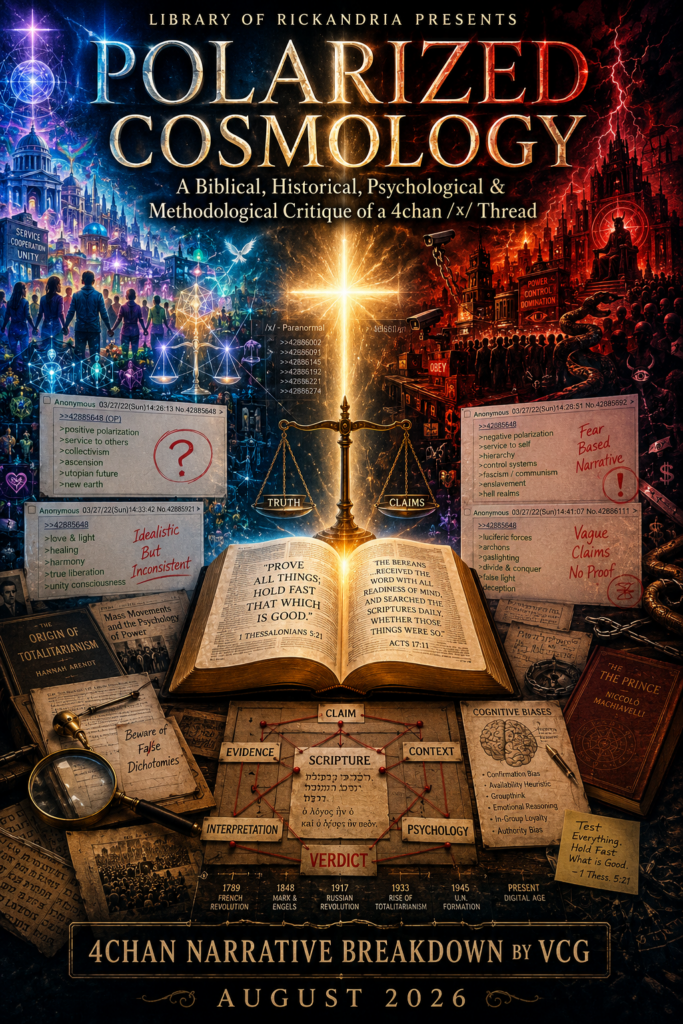
UPDATED BY VCG ON 8/28/2026 @ 17:17 EST
I want to share a heartfelt cause with my audience. Conner Blaisdell-Greene, a brave Airforce Sr. Airman, recently lost his battle with cancer, leaving his family in financial distress. Every donation, no matter how small, can help cover his funeral costs and ease their burden during this difficult time. Please consider clicking the link below to contribute or share Conner’s story with others. Your support truly matters.
Until We Meet Again
Spoken Tribute
Abstract
On August 28, 2026, an anonymous poster on 4chan’s paranormal board, /x/, proposed a sweeping theory of politics, morality, spiritual beings, and the afterlife. According to the thread’s opening argument, the familiar Democratic-versus-Republican struggle continues beyond this life in a more fundamental form: cooperation, human rights, God, and communism occupy one side, while individualism, competition, fascism, demons, Lucifer, and domination occupy the other. Fallen spiritual beings are said to have been expelled into “lower realms,” while our present world is identified as hell—not primarily as divine punishment, but as an environment in which destructive beings are permitted to experience the consequences of their desires. As the discussion proceeds, political disagreement itself increasingly becomes evidence of allegiance to evil.
This paper takes the thread seriously enough to examine it carefully without treating its assertions as established facts. It separates five different questions that are repeatedly collapsed in the discussion: what the posters actually claim; what political terms such as fascism, libertarianism, socialism, and communism mean historically; whether the supernatural claims are testable or evidentially supported; what psychological and rhetorical patterns appear in the argument; and what the biblical text actually says.
The result is mixed. The thread contains a recognizable moral intuition: domination, exploitation, cruelty, rape, murder, and enslavement are evil, while mercy, justice, generosity, and concern for others are morally serious goods. Scripture strongly supports many of those ethical judgments. The problem arises when those judgments are fused with modern political labels and then projected into a speculative cosmology. Historically, fascism is not a philosophy of radical individualism; libertarianism and fascism are not interchangeable; Christian generosity cannot simply be equated with Marxist communism; and neither historical evidence nor Scripture establishes an eternal Democratic-Republican divide. The language of “positive” and “negative” spiritual polarization also bears a notable resemblance to modern esoteric systems such as the Ra Contact/Law of One, although resemblance alone cannot establish direct influence.
Most importantly, the thread repeatedly moves from moral judgment to political classification, from political classification to spiritual identity, and from spiritual identity to claims about another person’s hidden motives without supplying the additional evidence required for those transitions. Its most serious weakness is therefore not merely political or theological. It is methodological.
1. Why Take an Anonymous 4chan Thread Seriously?
There is an easy way to approach material like this:
laugh at it.
That would also be the least interesting way.
Anonymous internet discussions can function as compressed expressions of ideas circulating much more widely through contemporary culture. Political tribalism, occult vocabulary, Christian terminology, New Age metaphysics, conspiracy thinking, moral psychology, popular ideas about hell, and social-media language about “gaslighting” can all meet in the same short conversation. A thread does not need to be academically sophisticated to reveal how people assemble a worldview.
The thread examined here was posted to 4chan’s /x/ board on August 28, 2026. The opening post, No. 42885648, argues that the political conflict familiar from earthly life continues “on the other side.” One spiritual-political faction is associated with human rights, cooperation, the biblical God, and communism. The opposing faction is associated with Lucifer, demons, harsh individualism, competition, domination, and fascism. The OP then says these “negatively polarized” entities were cast into lower realms and identifies our present realm with hell. Nine replies develop, challenge, or reinforce parts of this model.
The thread matters for another reason: it contains some genuine moral observations. If everything in it were nonsense, analysis would be simple. It is precisely because good observations are mixed with unsupported transitions that careful examination becomes useful.
Rape is evil. Murder is evil. Enslavement is evil. Exploitation and deliberate oppression are morally serious matters. Scripture repeatedly condemns violence, injustice, pride, fraud, oppression, and neglect of the vulnerable. Isaiah tells Judah to “seek judgment, relieve the oppressed, judge the fatherless, plead for the widow.” Psalm 82 likewise commands defense of the poor, fatherless, afflicted, and needy.
The question is not whether cruelty is evil.
The question is whether that moral truth proves the rest of the thread’s cosmology.
It does not.
2. Method: Keeping Different Kinds of Claims Separate
The single most important rule in evaluating this thread is to stop different categories of claim from bleeding into one another.
A statement such as “fascism historically subordinates the individual to the nation” is a historical and definitional claim. It can be checked against fascist doctrine, fascist regimes, and historians.
A statement such as “people sometimes process political opponents in morally polarized categories” is a psychological claim. It can be compared with empirical research.
A statement such as “there are negatively polarized entities inhabiting lower spiritual realms” is a metaphysical claim. It requires a different kind of justification and cannot simply be treated as though it were a result discovered through political history or experimental psychology.
A statement such as “the Bible says hell exists so that rebellious entities can fulfill their desire to dominate others” is a biblical interpretation. It must first be checked against what the biblical text actually states.
Those distinctions matter because a claim can succeed in one category and fail in another.
For example, a person might offer an insightful moral criticism of exploitation while using the word fascism incorrectly. A political definition can be historically wrong even when the speaker’s moral concern is legitimate. Likewise, a metaphysical model might be internally coherent without being empirically demonstrated. And a theological interpretation can be meaningful without being explicitly stated in Scripture.
2.1 The primary-source principle
The first task is therefore reconstruction rather than rebuttal: What did the posters actually say?
This matters because critics can make the same mistake they accuse others of making—quietly replacing an opponent’s argument with a weaker version.
One especially revealing example occurs in the OP. After describing the negative faction as committed to competition, the post says these beings were cast out because of their “unwillingness to compete.” As written, this contradicts the preceding description. The most charitable reconstruction is probably that the author intended “unwillingness to cooperate.” But a responsible analysis should not silently rewrite the source. The wording itself must be preserved, while the likely intended meaning can be noted separately.
2.2 Unsupported is not the same as disproved
Another distinction is equally important.
If someone says that invisible spiritual beings inhabit another dimension, the proper scholarly response is not automatically, “Science disproves that.”
Science does not function by disproving every metaphysical possibility.
The Stanford Encyclopedia of Philosophy’s discussion of scientific method notes that Karl Popper’s criterion of falsifiability was intended primarily to distinguish testable science from systems protected against meaningful empirical failure. It also emphasizes the distinction between science and metaphysics: a proposition can be non-scientific without thereby being meaningless or false.
Accordingly, this paper uses terms such as unsupported, not empirically demonstrated, not established by the cited evidence, or extrabiblical where appropriate.
That is stronger methodology than calling every metaphysical claim “pseudoscience.”
2.3 Scripture and interpretation
All biblical quotations in this paper are taken from the supplied King James Bible, Pure Cambridge Edition.
A recurring distinction will be made between:
Scripture: what the text actually says.
Interpretation: a conclusion drawn from the text.
Theological synthesis: conclusions produced by comparing multiple passages.
Speculation: claims that may be conceivable but are not established by the biblical text.
The Bereans are praised because they “searched the scriptures daily, whether those things were so.” That principle is especially relevant whenever someone places words into the mouth of God.
3. The Opening Post: From Politics to Cosmology
3.1 “Democrats vs. Republicans on the other side”
The OP begins with an extraordinary premise: the Democratic-Republican conflict familiar from the United States is effectively an earthly manifestation of a conflict extending into spiritual reality. One side represents rights and cooperation; the other represents domination and destructive competition.
The immediate methodological problem is straightforward:
No evidence is supplied for the afterlife component.
The post does not describe an observation, historical document, biblical passage, controlled investigation, or even a chain of philosophical reasoning establishing that American partisan categories persist after death.
That does not prove that no political or moral conflict could exist in a spiritual realm. It means only that this particular mapping has not been demonstrated.
There is also an obvious problem of historical scale. The Democratic and Republican parties are historically contingent American institutions. Christianity predates both by many centuries. Judaism predates both by millennia. If the alleged conflict is truly cosmic, identifying its sides with contemporary American partisan labels requires additional argument.
Scripture certainly contains conflict between righteousness and wickedness, truth and deception, obedience and rebellion. Revelation depicts conflict involving God, Christ, angels, Satan, and human kingdoms. But it never identifies those categories with Democrats and Republicans.
That identification comes from the poster.
It does not come from the biblical text.
4. Cooperation Does Not Equal Communism
The OP’s next move is subtler. The “good” side values cooperation and human rights and is therefore described as “basically communist.”
This inference fails because cooperation is too broad a category to define communism.
Families cooperate.
Businesses cooperate internally.
Military units cooperate.
Churches cooperate.
Free-market transactions can involve voluntary cooperation.
Labor unions cooperate.
Monasteries cooperate.
Charitable organizations cooperate.
Communist movements cooperate.
None of those facts makes cooperation itself communist.
The Stanford Encyclopedia of Philosophy describes socialism in economic terms centering on control of productive resources: unlike capitalism, socialist arrangements require the bulk of the means of production to be under social or worker control rather than controlled by a separate capitalist class.
Classical communist writings are more specific still. Marx and Engels identify the overthrow of bourgeois political supremacy and transformation of bourgeois property relations as central communist aims; the Communist Manifesto famously summarizes the program in terms of abolition of bourgeois private property. Engels likewise described communist social organization as replacing the capitalist property system and reorganizing productive resources collectively.
One may agree or disagree with those programs. That is not the issue.
The definitional point is that “people cooperate” does not establish “therefore communism.”
Human cooperation is a moral and social phenomenon.
Communism is a much more specific political-economic tradition.
5. Does Acts Teach Communism?
This is where the biblical question becomes more interesting, because the New Testament does describe unusually radical economic sharing among early Christians.
Acts 4 says the believers were “of one heart and of one soul,” and that they had “all things common.” Property was sold and resources were distributed according to need.
A careless reading can stop there and announce:
Christianity is communism.
But Acts itself supplies more information.
When Peter confronts Ananias in Acts 5, the issue is not that Ananias refused to surrender all private property to the community. Peter tells him that before the property was sold it remained his, and after it was sold the proceeds remained within his power. The sin involved deceit before God, not failure to obey a compulsory abolition of ownership.
This reading is also supported by scholarly work specifically addressing the “primitive communism” question in Acts. New Testament scholar Steve Walton argues that Acts portrays remarkable generosity and readiness to meet needs, but not compulsory pooling of possessions. He describes the underlying principle as believers holding possessions lightly as stewards rather than the imposition of mandatory communal ownership.
Paul makes the voluntary character even clearer:
“Every man according as he purposeth in his heart, so let him give; not grudgingly, or of necessity:
for God loveth a cheerful giver.”— 2 Corinthians 9:7
This does not weaken the New Testament’s economic demands.
If anything, it makes them more personal.
The Christian cannot outsource compassion to an ideological label. Scripture repeatedly commands generosity, hospitality, almsgiving, brotherly love, justice, and concern for the needy. But voluntary Christian generosity and Marxist political economy are not identical propositions.
The accurate conclusion is narrower:
The New Testament presents a community in which attachment to possessions is subordinated to love of God and neighbor, where believers willingly sacrifice wealth to meet genuine need. That can challenge selfishness under any economic system. It does not, by itself, establish that the apostles endorsed a later nineteenth-century theory of communism.
6. The “Jewish God”: Particular Revelation and Universal Sovereignty
The OP identifies the cooperative faction with the “one true holy Jewish God.” Later, another poster accepts much of the cosmology but rejects the identification of the God of the Bible with the true God of the universe.
The phrase requires care.
Historically and biblically, Christianity absolutely claims continuity with the God of Israel. Jesus is Jewish. The apostles are Jewish. The Christian Old Testament is Israel’s Scripture. Paul repeatedly speaks of Abraham, Moses, Israel, the covenants, and the prophets.
It would therefore be historically nonsensical to detach Christianity from Israel.
At the same time, Scripture does not describe God as merely a local ethnic deity whose sovereignty terminates at Israel’s borders.
Paul asks:
“Is he the God of the Jews only?
is he not also of the Gentiles?
Yes, of the Gentiles also:
Seeing it is one God…”— Romans 3:29–30
Psalm 103 states:
“The LORD hath prepared his throne in the heavens; and his kingdom ruleth over all.”
The biblical synthesis is therefore:
God reveals himself historically through Israel while claiming universal sovereignty over all nations and creation.
Calling him “the God of Israel” is biblical.
Treating that description as meaning
“God only belongs to one ethnic people”
is not.
7. Fascism Is Not Radical Individualism
This is the thread’s clearest historical error.
The OP describes the negative spiritual faction as harshly individualistic, competitive, predatory, and therefore “basically fascists.”
Some of those associated traits do overlap with documented features of fascism.
Historical fascist movements have glorified violence, hierarchy, domination, militarism, exclusion, conquest, and authoritarian power.
But individualism is not what makes fascism fascist.
The United States Holocaust Memorial Museum defines fascism as ultranationalist and authoritarian. Crucially, it states that fascism prioritizes the nation over the individual and places the unity and interests of the national community above individual rights. Fascism opposes pluralism and liberal individual rights and embraces authoritarian government.
The historical Nazi state illustrates the point in practice. Individual freedoms including speech, press, assembly, privacy, and political organization were systematically dismantled as Germany became a one-party dictatorship.
So the OP correctly associates fascism with domination and violence in important respects.
But the political direction is backwards when fascism is defined as radical individualism.
Fascism says, in effect:
the individual is subordinate to the nation, racial community, state, or leader.
Radical individualism says something fundamentally different.
This distinction becomes decisive when another poster introduces libertarianism.
8. Fascism and Libertarianism Are Not the Same Political Philosophy
Post No. 42885716 tells the OP that “libertarian” would be a better analogy for extreme individualism than fascism. The OP rejects the correction and claims there is no meaningful difference between fascism and libertarianism; both are allegedly empty right-wing marketing labels.
Historically and philosophically, that is false.
The Stanford Encyclopedia of Philosophy describes libertarianism as a family of political philosophies for which individual freedom is the paramount political value and coercion is something requiring strong justification. Libertarians characteristically support private property, freedom of contract, and voluntary cooperation, while arguing for stringent limits on coercion.
Compare that with fascism:
Libertarianism: individual liberty limits coercive authority.
Fascism: individual rights are subordinated to an authoritarian national community.
Those are not minor terminological differences.
They point in substantially different directions concerning state power and individual autonomy.
That does not establish that libertarianism is morally correct.
One can criticize libertarian theories of property, inequality, social obligation, labor power, public goods, or economic coercion. Those are legitimate philosophical debates.
But criticism requires engaging the position that actually exists.
Declaring libertarianism and fascism identical makes meaningful criticism harder because the concepts cease to carry stable content.
There is another useful complication. Libertarian thought is itself diverse, and political philosophy recognizes left-libertarian and other variants that do not fit neatly into a simple contemporary American left-right spectrum. This makes the reply claiming that libertarianism is simply “the other side of communism” too neat as well.
The corrective lesson applies to both sides of the exchange:
political ideologies are multidimensional.
Compressing them all onto one moral line from “cooperation” to “competition” sacrifices history for rhetorical simplicity.
9. Fascism Is Not Socialism Merely Because Fascist States Exercise Power Over the Economy
The poster correcting the OP is substantially right about fascism not being individualist, but then says fascism often comes with
“brands of socialism.”
That statement needs its own qualification.
Historical fascism and Marxist socialism were rivals, not interchangeable ideologies. The Holocaust Encyclopedia explicitly lists socialism and communism among the political philosophies fascism opposed. It also notes that despite the word socialism in “National Socialism,” Hitler presented his movement as opposed to socialism and communism and centered it instead on racialized national unity and power.
The fact that an authoritarian state intervenes heavily in economic life does not by itself make that state socialist.
State control can occur for many ideological purposes.
Again, definitions matter.
The thread contains an instructive pattern: one poster corrects a category error and then nearly introduces another.
That is exactly why claims should be tested individually rather than accepting or rejecting whole “sides.”
10. “Pseudodualism”: One of the Thread’s Better Theological Intuitions
The OP calls the universe “pseudodualistic”: there appears to be a conflict between good and evil, but good is ultimately stronger.
This is one place where the thread approaches a recognizable Christian theological distinction.
Biblical Christianity is not a strict metaphysical dualism in which God and Satan are two eternal, independent, equal principles locked in permanent equilibrium.
Satan is never presented as God’s equal.
Psalm 103 describes the LORD’s kingdom as ruling over all. Revelation 12 portrays Michael and his angels fighting the dragon, but the dragon does not prevail and is cast down; the passage explicitly identifies the dragon as “the Devil, and Satan.”
Jude likewise speaks of angels who “kept not their first estate” and are reserved for judgment.
So if “pseudodualistic” means:
evil is real, spiritual conflict is real, but evil is not an equal eternal power alongside God,
then there is a genuine point of contact with Christian thought.
But the thread’s language should not be confused with Scripture’s own terminology.
The Bible does not teach a cosmic political balance between two parties.
It teaches a sovereign Creator confronted by creaturely rebellion.
That is a very different metaphysical structure.
11. The Internal Contradiction: “Unwillingness to Compete”
The OP says the negative beings favor competition and harsh individualism, then immediately says they were cast out because of their “unwillingness to compete.”
As written, those statements conflict.
The likely intended word is cooperate.
A charitable reader can acknowledge that.
A careful researcher should also record what was actually written.
This small example illustrates an important practice in source analysis:
charity does not require falsifying the source.
We can say:
“The author probably intended X.”
We should not say:
“The author wrote X,”
when the author did not.
That distinction becomes much more important when dealing with Scripture.
12. When the Poster Writes Dialogue for God
The OP next summarizes God’s supposed response to rebellious entities in colloquial first-person dialogue: they want to fight, dominate, rape, pillage, and compete, so God allegedly banishes them to a realm where they can experience those consequences.
The poster does signal uncertainty by saying God “appears” to have said something like this.
That is worth recognizing.
Nevertheless, quotation marks have rhetorical power. They make an interpretation sound close to remembered speech.
So the necessary biblical clarification is simple:
Those words are not a quotation from Scripture.
Scripture does teach rebellion.
Scripture does teach angelic judgment.
Scripture does teach divine judgment on human evil.
Scripture does portray Satan as cast down.
But the detailed causal narrative—
God created a lower realm so negatively polarized beings could live out their preferred political psychology—
is not stated in the biblical text.
Jude says:
“And the angels which kept not their first estate, but left their own habitation, he hath reserved in everlasting chains under darkness unto the judgment of the great day.”
Revelation 12 says the dragon and his angels fight, fail to prevail, and are cast down.
Neither passage says that their fundamental offense was libertarianism, capitalist competition, Republican politics, or refusal to participate in a cooperative economic order.
Those additions belong to the modern interpreter.
13. Is This World Literally Hell?
The OP then identifies our present realm with hell.
That idea may resonate emotionally. Human history contains war, torture, disease, grief, exploitation, predation, betrayal, and death. Biblical writers themselves describe the present world in deeply fallen terms.
But emotional resemblance is not textual identity.
Matthew 25 depicts final judgment as an event associated with the future coming of the Son of man in glory. Nations are gathered, judgment is rendered, and then the condemned are told:
“Depart from me, ye cursed, into everlasting fire, prepared for the devil and his angels.”— Matthew 25:41
The same passage concludes:
“And these shall go away into everlasting punishment:
but the righteous into life eternal.”— Matthew 25:46
Whatever interpretive questions surround those verses, the narrative sequence does not naturally read as:
every person presently alive is already inhabiting the final state described in the judgment.
Biblically, the present world is fallen.
That is not the same proposition as saying the present earth is hell.
14. “Hell Is Not Punishment”
The OP sharpens the claim further. Hell, it says, is not really punishment; it exists so destructive beings can experience fulfillment of their own desires.
Here the conflict with the KJV wording is direct.
Matthew 25:46 explicitly uses the word:
“punishment.”
Second Thessalonians likewise speaks of divine judgment and of those who
“shall be punished with everlasting destruction.”
That does not settle every theological debate about hell.
Christian thinkers have disagreed significantly about the nature, duration, and purpose of final judgment. Contemporary scholarship discusses traditional eternal-conscious-punishment models, annihilationism or conditional immortality, universalism, and models emphasizing self-chosen separation or the consequences of rejecting God.
Even the biblical vocabulary underlying English “hell” is more complex than popular imagery sometimes suggests. Oxford Biblical Studies notes that the fully developed picture of a subterranean realm of endless conscious torture is partly the product of a long history of interpretation involving several different biblical terms and traditions.
That nuance matters.
But nuance cannot be used to make Matthew 25:46 disappear.
A Christian may argue over what everlasting punishment consists in.
A Christian may argue over whether annihilation, conscious suffering, eventual restoration, or another model best accounts for all relevant texts.
What cannot simply be asserted is:
“The Bible says hell is not punishment.”
At least in the KJV passage before us, it says precisely the opposite.
A more defensible theological proposal would be:
divine judgment may include allowing creatures to experience the consequences of what they persistently choose.
That idea can be philosophically discussed.
But it is an interpretation of punishment, not the elimination of punishment from the text.
15. “Negative Polarization”: Where the Thread Begins to Sound Esoteric
The phrase “negatively polarized … entities” deserves attention because it is not normal biblical language.
Scripture speaks of:
sin and righteousness,
light and darkness,
flesh and spirit,
God and idols,
holy and unclean,
angels and devils,
obedience and rebellion.
It does not ordinarily classify spiritual beings as positively and negatively polarized entities.
That vocabulary has a notable parallel in a modern esoteric corpus known as The Ra Contact or Law of One.
In Session 93 of the Ra Contact, the two spiritual polarities are explicitly described as “service to others” and “service to self,” with positive and negative polarization forming a central metaphysical framework.
The similarity is difficult to miss:
Thread: positive/cooperative orientation versus negatively polarized self-oriented entities.
Ra system: service-to-others polarity versus service-to-self polarity.
But careful sourcing requires a restraint here.
We do not know from the thread that the OP read the Ra Material.
No citation is provided.
Similar concepts circulate through broader New Age and occult subcultures.
Therefore the responsible conclusion is:
there is a strong conceptual and terminological resemblance, but direct dependence cannot be established from the available evidence.
The provenance of the Ra Contact also needs to be described accurately. L/L Research itself states that the material originated between 1981 and 1984 through sessions in which participants believed an extraterrestrial civilization identifying itself as “Ra” communicated through Carla Rueckert while she was unconscious. The publisher labels the material “telepathic channeling” and instructs readers to use their own discrimination in assessing it.
Whatever one thinks of those claims spiritually, historically the material is a claimed channeling corpus.
It is not independent scientific confirmation that positive and negative spiritual polarities objectively exist.
That distinction between source description and source validation is essential.
16. Reply No. 42885655: “Both Sides Suck”
The first reply says, in effect, that both political sides are bad and that the best strategy is to keep them fighting each other rather than allowing either to gain control over one’s life.
This response is politically cynical, but it does not really address the supernatural argument.
It does not demonstrate that:
the afterlife contains American party politics,
spiritual beings are politically polarized,
God is communist,
demons are fascist,
or earth is hell.
It simply introduces another political intuition: distrust of concentrated power.
That intuition could be reasonable in some circumstances.
It could also become a false equivalence if two groups genuinely differ in relevant moral responsibility.
“Both sides” is therefore not a conclusion that can be accepted or rejected abstractly. It has to be tested issue by issue.
The notable point is that this reply begins shifting the thread away from metaphysics and toward tribal political identification.
That shift accelerates immediately.
17. Replies No. 42885692 and 42885704: The Argument Becomes Circular
The OP answers that both sides cannot be bad because the demonic/fascistic side is obviously the evil one. Shortly afterward, the OP argues that anyone claiming both sides are bad is effectively promoting the agenda of pure evil.
Here the reasoning changes character.
The initial cosmology may be speculative, but it is at least a claim about reality.
Now the framework begins protecting itself from criticism.
The structure becomes:
1. My side is defined as cooperation and good.
2. The opposing side is defined as rape, murder, enslavement, and evil.
3. Therefore, anyone who says both sides have faults is helping evil.
The conclusion is guaranteed by the definitions.
No empirical investigation of the actual parties is required.
This is a classic example of begging the question: the moral status that was supposed to be demonstrated has already been built into the category labels.
More importantly, it creates the beginnings of a self-sealing system.
Agreement becomes evidence of truth.
Disagreement becomes evidence that the dissenter is compromised.
Once that happens, counterevidence becomes increasingly difficult even in principle.
18. Reply No. 42885707: The Hidden True God Hypothesis
Another participant agrees with most of the OP’s cosmology but disputes the identity of the biblical God. The reasoning is that if this lower realm is heavily controlled by negative spiritual entities, those entities would presumably prohibit an accurate revelation of the true God.
This is philosophically interesting because it creates an exceptionally difficult evidential problem.
Suppose we ask:
Why is the true hidden God not clearly revealed?
The answer becomes:
Because hostile beings suppress that revelation.
Then we ask:
What evidence shows that hostile beings suppress it?
The lack of reliable revelation can itself be offered as evidence.
The theory can therefore absorb nearly every possible state of evidence.
If documents reveal the true God, that can count as evidence.
If documents do not reveal the true God, that can count as evidence of suppression.
If contrary religious traditions exist, that can count as deception.
If someone questions the suppression hypothesis, that person may simply have been deceived.
The issue is not that such a scenario is logically impossible.
The issue is testability.
Popper’s work on scientific methodology emphasized the danger of theories that can be protected from every possible adverse observation by adding auxiliary explanations. Again, this does not prove a metaphysical theory false. It shows why the theory has weak empirical discriminatory power: radically different observations can all be made compatible with it.
Biblically, the proposed suppression model also conflicts with the Bible’s own presentation of divine sovereignty.
Psalm 103 does not depict God as struggling unsuccessfully to get reliable information through a demonic censorship apparatus.
It states:
“his kingdom ruleth over all.”
That is the Bible’s claim about itself and its God.
One may reject that claim.
But one cannot fairly replace it with the thread’s cosmology and then call the replacement the biblical teaching.
19. Replies No. 42885716 and 42885727: The Definitional Crisis
At this point one participant introduces the historical correction already discussed: fascism is not fundamentally individualistic; libertarianism better fits the OP’s stated concern about radical individual autonomy.
Instead of refining the theory, the OP responds that fascism and libertarianism have no meaningful difference and are merely opportunistic political labels.
This move creates a methodological problem larger than the original misuse of fascism.
If definitions cease to matter whenever they challenge the theory, the theory becomes impossible to correct.
Terms become emotionally interchangeable:
individualism → libertarianism → fascism → exploitation → rape → demons.
But those arrows do not represent established equivalences.
They represent rhetorical association.
The historical evidence is particularly decisive here. Fascism elevates the nation over individual rights and embraces authoritarian national unity. Libertarianism elevates individual liberty and seeks stringent limits on coercion.
One may dislike both.
One may argue that either can lead to harmful consequences.
One may even argue that certain real-world movements betray their own stated philosophies.
None of those arguments proves that the concepts have “no difference.”
This distinction between doctrine and behavior matters.
A person calling himself libertarian may behave tyrannically.
A self-described socialist may behave greedily.
A self-described Christian may behave wickedly.
A self-described democrat may behave autocratically.
Hypocrisy does not erase the meaning of words.
It shows a discrepancy between professed principle and conduct.
20. Motive Attribution: “Your Politics Are Really Rape and Exploitation”
Having rejected the distinction between fascism and libertarianism, the OP then tells the other participant what his politics are “really” about:
- domination
- rape
- pillaging
- exploitation
Notice what has happened.
The discussion began with a metaphysical thesis.
It moved to political definitions.
It now becomes a claim of direct access to another person’s internal motivations.
The interlocutor has not said:
“I support rape.”
He has not said:
“I support pillaging.”
He has not said:
“I support enslaving other people.”
Those motives are assigned to him.
Several reasoning problems converge here.
The first is straw-manning: replacing the expressed argument with an uglier one.
The second is guilt by association: because the OP has linked a political label to atrocities, anyone placed under the label inherits those atrocities.
The third is mind-reading in the ordinary cognitive sense: asserting hidden motives without sufficient evidence.
The fourth is moral essentialization: disagreement is not merely incorrect but reveals what kind of evil person the opponent fundamentally is.
At that point, political argument becomes nearly impossible.
A denial does not help because the framework can interpret the denial as further deception.
21. The Gaslighting Accusation
In No. 42885738, the OP anticipates further disagreement and describes the expected correction itself as “gaslighting.”
This word is often used so broadly online that it can come to mean little more than:
someone strongly disagreed with my account of reality.
That is not a careful psychological definition.
A 2026 historical review in Clinical Psychology Review describes gaslighting as psychological manipulation that causes a victim to doubt his or her sense of reality, often producing loss of agency and psychological instability.
A 2025 systematic review likewise notes that the word is frequently defined inconsistently and conflated with manipulation more broadly.
Therefore:
correcting someone’s definition of fascism is not, merely by being a correction, gaslighting.
A correction can be mistaken.
It can be dishonest.
It can be manipulative.
But those features have to be shown.
The thread instead uses gaslighting as a preemptive defense:
If you disagree with my definition, your disagreement itself proves manipulation.
This strengthens the self-sealing quality of the worldview.
Before the critic speaks, the critic’s response has already been classified as evidence against him.
22. Reply No. 42885762: A Better Distinction, but Still Too Simple
The next participant insists that fascism and libertarianism are different ideologies and offers deliberately simplified descriptions: fascists as collectivist national aggressors, libertarians as people chiefly concerned with being left alone and retaining their property. The same poster then claims that libertarianism is essentially the opposite side of communism.
The first part is broadly corrective.
The second part is too simple.
Political philosophy does not fit cleanly onto a single line.
One axis might concern private versus social ownership.
Another might concern authoritarian versus decentralized political power.
Another concerns nationalism.
Another concerns democracy.
Another concerns civil liberties.
Another concerns economic regulation.
Another concerns social hierarchy.
Another concerns cultural tradition.
Another concerns foreign intervention.
That is why political traditions exist that complicate a simple communism-versus-libertarianism opposition, including left-libertarian positions. The Stanford Encyclopedia explicitly treats libertarianism as a family of views rather than one uniform platform.
So, this commenter provides a useful correction without solving the deeper problem.
The thread keeps trying to turn multidimensional political history into one cosmic moral axis.
23. Final Reply No. 42885766: From Argument to Closure
The final post no longer attempts to defend the political definitions.
Instead, the OP repeats that the other participant’s politics are really about exploitation and rape, insists that he knows this, and ends with an insult.
The progression of the thread is revealing:
At the beginning:
Here is a theory about cosmic morality.
Then:
Here are political labels for the cosmic sides.
Then:
Those labels need no stable definition.
Then:
Anyone who corrects the labels serves the evil side.
Then:
The correction itself is gaslighting.
Finally:
I know what you really believe regardless of what you say.
At that stage there is no remaining procedure by which the theory can be corrected from within the conversation.
That is the central methodological failure of the thread.
24. Psychology of the Argument—Without Diagnosing the Poster
A necessary warning belongs at the beginning of this section.
Nothing in this paper constitutes a psychiatric diagnosis of an anonymous 4chan user.
We do not know the poster.
We do not know the poster’s history.
We do not know whether the poster was serious, provocative, intoxicated, role-playing, experimenting with an idea, or simply arguing badly for fifteen minutes on an imageboard.
Psychology can nevertheless help describe patterns in arguments.
That is what follows.
24.1 Dichotomous thinking
Psychological literature uses dichotomous thinking to describe a tendency to process phenomena in binary opposition. Atsushi Oshio’s work defines it in essentially those terms.
The thread repeatedly uses this structure:
cooperation / competition
good / evil
God / Lucifer
communism / fascism
victim / exploiter
truth / gaslighting
The problem is not that binary distinctions are always false.
Some propositions really are mutually exclusive.
Murder and non-murder are different.
Truth and falsehood are different.
The problem occurs when phenomena with multiple dimensions are forced into a binary model prematurely.
Political philosophy is one example.
A person can favor markets and oppose imperial war.
A person can support social welfare and favor authoritarian censorship.
A person can be communitarian without being communist.
A person can be highly individualistic without supporting exploitation.
A person can believe in cooperation while opposing compulsory collectivization.
A binary model loses those distinctions.
24.2 Othering, aversion, and moralization
Modern political psychology offers another useful framework.
Researchers studying affective polarization increasingly distinguish at least three dimensions:
othering — perceiving the political outgroup as fundamentally different;
aversion — disliking or avoiding members of the outgroup;
moralization — tying political identity to core moral convictions.
A 2026 American Political Science Review study developed and validated a multidimensional measure around precisely these three components. Earlier work on “political sectarianism” similarly emphasized the dangerous combination of outgroup othering, aversion, and moral condemnation.
The 4chan thread offers an unusually vivid example at the level of rhetoric.
The outgroup is not merely mistaken.
It becomes:
demonic,
rapacious,
enslaving,
deceptive,
and knowingly committed to evil.
That is a profound escalation from:
“I believe your economic theory produces bad outcomes.”
Once politics becomes a proxy for ultimate cosmic identity, compromise can look like cooperation with metaphysical evil.
That is much harder to correct than ordinary policy disagreement.
24.3 Confirmation bias and partisan reasoning
The American Psychological Association defines confirmation bias as the tendency to seek or emphasize evidence supporting prior expectations while dismissing or failing to seek contradictory evidence.
Political cognition provides fertile ground for this problem.
A 2025 review in the Annual Review of Psychology concludes that partisan judgment shows robust ingroup favoritism: people systematically tend to seek, believe, and remember information congenial to their political attachments. The authors also stress that the psychological mechanisms are debated and involve both cognitive and motivational processes, which is an important caution against simplistic explanations.
The thread’s structure encourages confirmation because almost any behavior by the outgroup can be interpreted through an already moralized lens.
If the opponent disagrees:
evidence of evil.
If the opponent corrects a definition:
gaslighting.
If the opponent denies supporting exploitation:
pretending.
If the opponent objects to being called fascist:
proof that political labels are deceptive.
The system does not merely contain a belief.
It contains a mechanism for converting resistance into confirmation.
24.4 The self-sealing argument
This is perhaps the most important psychological-methodological observation.
Consider a theory that says:
All critics of this theory are agents of deception.
How could a critic possibly disprove it?
Evidence against the theory becomes evidence for the theory.
This resembles what philosophers of science sometimes call immunizing or ad hoc strategies: adjustments that protect a theory from observations that would otherwise count against it. Popper’s discussion of falsifiability remains useful here—not as a weapon for declaring metaphysics meaningless, but as a reminder that a theory explaining every possible outcome may actually discriminate poorly between outcomes.
A robust worldview should be able to answer:
What evidence would cause me to revise this particular belief?
If the answer is:
nothing, because all contrary evidence is produced by evil entities, brainwashing, gaslighting, propaganda, or hidden manipulation,
then the problem is not merely that the belief may be wrong.
The problem is that the belief has become difficult to test at all.
25. The Law-of-One Parallel Revisited
The resemblance between the thread and Ra Contact vocabulary becomes especially illuminating when viewed psychologically.
The Ra Material frames spiritual development in terms of positive and negative polarity, with the fundamental ethical choice described as service to others versus service to self.
The 4chan thread appears to translate something very similar into contemporary partisan politics:
service to others → cooperation → communism → God
service to self → individualism → competition → fascism → Lucifer
If that reconstruction is right, the unusual feature is not the original moral polarity.
Many traditions contrast selfishness with love.
The unusual move is the political concretization of the polarity.
A metaphysical concept becomes a party map.
That creates the thread’s most persistent category error.
Even the Ra Material itself is more complicated than the 4chan reduction: its metaphysics does not simply teach that Democrats are positively polarized and Republicans negatively polarized. Session 93 explicitly cautions against simplistic judgments of the polarity of individual acts or entities.
So even if the OP were influenced by that tradition, the partisan mapping would still require its own justification.
26. Biblical Correction: Scripture Does Have a Moral Polarity
After spending so much time criticizing the thread’s binaries, we should not make the opposite mistake.
The Bible really does distinguish good from evil.
It does not teach that every moral distinction is gray.
John 3 speaks of light and darkness and says that people may love darkness because their deeds are evil.
Paul distinguishes righteousness from unrighteousness and light from darkness.
Scripture condemns:
- murder
- oppression
- deceit
- sexual violence
- covetousness
- cruelty
- exploitation
So, the problem is not that the thread has moral categories.
The problem is that it identifies those categories too quickly with modern political identities.
Biblical moral seriousness should produce careful judgment.
It should not relieve us of the need for evidence.
27. Scripture Does Not Make One Modern Political Tribe Sinless
The thread increasingly assigns goodness to one political camp and intrinsic wickedness to the other.
Romans dismantles that kind of moral anthropology before we ever reach modern politics:
“For all have sinned, and come short of the glory of God.”— Romans 3:23
Paul’s surrounding argument explicitly places both Jews and Gentiles under sin before presenting justification by grace.
Theologically, that matters enormously.
Christianity does not begin with:
our sociopolitical group contains the righteous humans.
It begins with:
human beings are sinners in need of reconciliation with God.
That universal diagnosis does not make all political programs morally equal.
A genocidal policy is worse than a tax disagreement.
A slave system is not morally equivalent to a debate over zoning.
Scripture permits and requires real moral discrimination.
But no political party becomes the church, the kingdom of God, or the sinless class merely by occupying one side of an electoral contest.
28. The Bible’s Concern for the Poor Is Real—and Politically Inconvenient
Correcting the thread’s equation of Christianity with communism should not be used as an excuse to domesticate the Bible’s economic ethics.
Scripture speaks fiercely about oppression.
Isaiah condemns corrupt social conditions and commands:
“Learn to do well; seek judgment, relieve the oppressed, judge the fatherless, plead for the widow.”
Psalm 82 commands rulers to defend the poor and fatherless and deliver the needy from the wicked.
Jesus’ judgment scene in Matthew 25 places extraordinary weight on treatment of the hungry, thirsty, stranger, naked, sick, and imprisoned.
The proper correction is therefore not:
“The Bible is not communist, therefore wealth and poverty are spiritually unimportant.”
That would be another distortion.
The better conclusion is:
Scripture demands justice, mercy, generosity, and concern for the vulnerable without reducing those commands to one modern economic ideology.
Different Christians may sincerely disagree over which institutions or policies best fulfill those obligations.
They are not free to conclude that the obligations themselves do not exist.
29. Spiritual Warfare Is Not a License to Demonize Political Opponents
The Bible does teach spiritual conflict.
Revelation explicitly identifies the dragon with Satan.
Jude speaks of fallen angels awaiting judgment.
The New Testament warns about:
- deception
- temptation
- principalities
- powers
- false teachers
- spiritual wickedness
But none of that authorizes the shortcut:
my political opponent disagrees with me, therefore my opponent belongs to Satan’s party.
Even Jude contains a striking warning about reckless speech. When Michael disputes with the devil, Jude says he does not bring a railing accusation but says,
“The Lord rebuke thee.”
Whatever one’s theology of spiritual warfare, Scripture does not present slander as spiritual discernment.
A claim that another person serves evil requires more than ideological dislike.
30. “Lucifer”: Scripture, Translation, and Later Interpretation
The thread uses Lucifer straightforwardly as another name for Satan.
The KJV famously reads:
“How art thou fallen from heaven, O Lucifer, son of the morning!”— Isaiah 14:12
But the context deserves careful attention.
Isaiah 14:4 explicitly introduces the unit as a proverb or taunt
“against the king of Babylon.”
The surrounding passage describes the collapse of an arrogant ruler.
Modern textual notes likewise point out that the Hebrew expression is hêlēl ben-šāḥar, associated with a shining or morning-star image. The NET notes emphasize that Isaiah 14:4–21 directly addresses the king of Babylon as a human ruler while acknowledging that some Christian interpreters have understood the language as having an additional satanic referent.
This is an excellent example of why text and interpretation must be distinguished.
Textual observation: Isaiah explicitly frames the taunt against the king of Babylon.
Traditional theological interpretation: many Christians have seen the king’s proud heavenly-fall imagery as typologically or analogically reflecting Satan.
Those are not identical claims.
A person may defend a satanic secondary application by comparing Isaiah with passages such as Luke 10:18 or Revelation 12.
What should not be said carelessly is:
Isaiah simply tells us Satan’s original personal name was Lucifer.
That skips the literary context and the history of interpretation.
31. Why Were the Fallen Angels Cast Out?
The thread gives a very specific answer: their basic orientation was domination, violent competition, and refusal to live cooperatively with the positive faction.
Scripture gives us less detail.
Jude says angels abandoned their proper estate and are reserved for judgment.
Revelation 12 describes conflict in heaven and the expulsion of the dragon and his angels.
Those passages establish, within the biblical worldview:
rebellious spiritual beings,
conflict,
expulsion,
and judgment.
They do not establish:
a capitalist-versus-communist heavenly economy,
libertarian angelic philosophy,
fascist angels,
Republican demons,
or a service-to-self polarization metric.
When Scripture stops, responsible theology should notice that it has stopped.
That does not forbid asking speculative questions.
It means speculation should be labeled as speculation.
32. Is Evil Merely Getting What It Wants?
The OP’s conception of hell contains an intriguing moral insight: wicked choices can become their own kind of punishment.
That idea has biblical echoes.
Sin can enslave.
Destructive desires can produce destructive consequences.
A person can be “given over” to the direction he persistently chooses.
Psalm 81 describes God giving rebellious people over to “their own hearts’ lust,” allowing them to walk in their own counsels.
So there is something worth preserving in the OP’s intuition:
judgment and consequence need not always be unrelated.
But biblical judgment cannot be reduced to nothing more than neutral self-selection.
Matthew 25 portrays a judging King.
Jude speaks of judgment.
Second Thessalonians speaks of recompense and punishment.
The biblical picture includes both creaturely choice and divine judgment.
A theology that preserves only one side is incomplete.
33. A Better Model Than the Thread’s Binary
We can now reconstruct the moral insight without the historical and theological category errors.
Instead of:
Communism = cooperation = God = positive spiritual polarity
and
Libertarianism/fascism = individualism = Satan = negative spiritual polarity,
a more defensible biblical model would begin with moral qualities themselves:
Love can appear under more than one political system.
Greed can appear under more than one political system.
Authoritarianism can appear on more than one ideological side.
Generosity can be practiced by people who disagree economically.
Selfishness can exist in collectivist institutions.
Self-sacrifice can exist among political individualists.
Oppression can be conducted by governments, corporations, mobs, families, religious authorities, revolutionary movements, or individuals.
The Bible evaluates conduct and allegiance according to its own categories rather than allowing a modern party platform to define righteousness in advance.
This makes biblical judgment harder, not easier.
We have to examine actual fruit.
We cannot merely check the label.
34. The Thread’s Central Logical Error: Category Collapse
The entire discussion can be understood through one recurring operation.
The OP begins with a valid moral distinction:
love of others versus predatory self-interest.
Then several new categories are stacked on top of it:
cooperation / competition
communism / individualism
Democrat / Republican
God / Lucifer
heaven / hell
good entity / negative entity
Eventually those pairs are treated as if they were synonyms.
They are not.
This is category collapse.
Each transition requires an argument.
Perhaps a particular policy encourages cooperation.
That must be shown.
Perhaps a particular institution encourages exploitation.
That must be shown.
Perhaps a political movement contains authoritarian tendencies.
That must be historically demonstrated.
Perhaps a religious teaching resembles an esoteric polarity system.
That resemblance must be documented.
Perhaps a moral behavior is sinful according to Scripture.
That must be established from Scripture.
Skipping those intermediate steps creates the illusion that one enormous conclusion has been proved when only the first moral intuition was ever secure.
35. What the Thread Gets Right
A fair critique should preserve what survives examination.
First, might does not make right.
Power alone does not establish moral legitimacy.
Second, rape, murder, enslavement, predatory domination, and deliberate exploitation are evil.
Third, Scripture places serious moral obligations on human beings toward others, particularly the vulnerable.
Fourth, Christian theology does not require an equal-power dualism between God and Satan. Evil is real without being God’s co-eternal equivalent.
Fifth, sinful desires can contain consequences that flow from the desires themselves.
Sixth, political labels can be abused opportunistically. People really do misrepresent doctrines, adopt labels strategically, and behave inconsistently with professed principles.
Seventh, political identity can become moralized in unhealthy ways, and psychological literature confirms that political othering and partisan bias are genuine phenomena.
The problem is not that the OP noticed nothing true.
The problem is what happens after those truths are noticed.
36. What the Thread Does Not Establish
The available evidence does not establish that Democrats and Republicans continue as spiritual factions after death.
It does not establish that God is communist in a historically meaningful political-economic sense.
It does not establish that fascism is radical individualism.
It does not establish that fascism and libertarianism are the same ideology.
It does not establish that Western countries are collectively “fascist nations” merely because the poster sees competition within them.
It does not establish that someone correcting a political definition secretly supports rape or enslavement.
It does not establish that disagreement is gaslighting.
It does not establish that hostile spiritual beings successfully prevent the true God from revealing himself.
It does not establish that this present earth is identical with the final biblical hell.
It does not establish that hell is non-punitive.
It does not establish that fallen angels rebelled over an economic or political philosophy.
And it does not establish that the “negative polarization” framework is biblical merely because Christian terms such as God, Lucifer, demons, and hell are inserted into it.
37. A Biblical Method for Threads Like This
The most useful response to a strange spiritual claim is not automatic credulity.
It is also not reflexive mockery.
Acts 17 praises the Bereans because they:
“received the word with all readiness of mind, and searched the scriptures daily, whether those things were so.”
That verse describes a remarkable balance.
They received.
They searched.
They did not reject before hearing.
They did not accept before testing.
Likewise:
“Prove all things; hold fast that which is good.”— 1 Thessalonians 5:21
That is a better method than either gullibility or cynicism.
When confronting an online cosmology, we can ask:
What exactly is being claimed?
What is observation, and what is inference?
What definitions are being used?
Do the historical terms match the historical evidence?
Could the claim survive serious counterevidence?
Is disagreement being permitted?
Are psychological concepts being used correctly?
Is Scripture actually being quoted, or are modern ideas being placed into biblical vocabulary?
Where does the text end and speculation begin?
Those questions do not destroy faith.
They protect truth claims from careless inflation.
Conclusion
The 4chan thread begins with a moral intuition that is difficult to dispute: a world governed by rape, enslavement, murder, exploitation, and domination would be evil, while love, justice, cooperation, mercy, and concern for others are morally superior.
From there, however, the argument moves too quickly.
Moral categories become political categories.
Political categories become metaphysical categories.
Metaphysical categories become spiritual identities.
Spiritual identities become explanations of other people’s hidden motives.
By the end, disagreement itself is taken as evidence of corruption.
That progression is the real story of the thread.
Historically, the political taxonomy fails because fascism is not radical individualism and libertarianism is not fascism. Social cooperation is far broader than communism, while biblical generosity cannot simply be identified with Marxist economic theory.
Methodologically, the supernatural claims remain largely unsupported. Some are metaphysical rather than empirically testable; that does not make them automatically false, but neither does it permit them to be presented as established facts. The later argument becomes increasingly self-protective: critics are classified as evil, corrections as gaslighting, and denials as evidence of hidden motives.
Psychologically, the rhetoric displays recognizable patterns of dichotomous framing, partisan moralization, othering, confirmation-seeking, and belief insulation. Those observations describe the structure of the argument; they do not justify diagnosing the anonymous author.
Theologically, the thread is best understood as a syncretic construction. It combines genuine biblical themes—good and evil, God and Satan, fallen angels, judgment, mercy, care for others—with language strongly resembling modern esoteric ideas of positive and negative spiritual polarization.
The biblical correction is therefore not simply to reverse the political signs and announce that the opposite party represents God.
That would repeat the same error.
Scripture does not teach salvation by political classification.
It says:
“For all have sinned, and come short of the glory of God.”
It commands justice for the oppressed.
It commands generosity without necessity or compulsion.
It presents God as sovereign over all.
It presents Satan as defeated rather than as God’s equal political opposite.
It presents divine judgment as real.
And it instructs the reader to examine claims rather than merely inherit them.
The deepest correction to the thread is therefore methodological as much as doctrinal:
Do not begin with a political map and force heaven into it.
Begin with the evidence.
Define the terms.
Distinguish what is known from what is inferred.
Distinguish Scripture from speculation.
Allow beliefs to be corrected.
And where Scripture speaks, let it speak in its own categories.
Where Scripture does not speak, humility is more honest than invented certainty.
“Prove all things; hold fast that which is good.”
References and Sources
Primary 4chan Source
Anonymous. “It’s democrats vs republicans on the other side, too.” 4chan /x/ — Paranormal, thread No. 42885648, August 28, 2026. Posts No. 42885648–42885766.
Biblical Source
The Holy Bible, Authorized King James Version, Pure Cambridge Edition. Cambridge University Press / supplied digital edition.
Political History and Philosophy
Stanford Encyclopedia of Philosophy. “Libertarianism.” The entry defines libertarianism as a family of views making individual freedom a paramount political value and placing stringent limits on coercion.
Stanford Encyclopedia of Philosophy. “Socialism.” The entry discusses socialist economic arrangements in terms of control over productive resources and contrasts them with capitalist ownership structures.
United States Holocaust Memorial Museum. “Fascism.” Holocaust Encyclopedia. Fascism is defined as ultranationalist and authoritarian, placing the national community above individual rights and opposing liberal democracy, pluralism, communism, and socialism.
United States Holocaust Memorial Museum. “Foundations of the Nazi State” and “Nazi Terror Begins.” Documentation of the elimination of civil liberties and development of the Nazi one-party authoritarian state.
Marx, Karl, and Friedrich Engels. Manifesto of the Communist Party, Chapter II, “Proletarians and Communists.” Primary-source description of communist aims and bourgeois property relations.
Engels, Friedrich. The Principles of Communism. Primary-source discussion of property, class, competition, and communist reorganization of production.
New Testament Economic Practice
Walton, Steve. “Primitive Communism in Acts?” Evangelical Quarterly: An International Review of Bible and Theology 80, no. 2 (2008): 99–111. Walton argues from Acts 2:44–45; 4:32–5:11; and 6:1–6 that the early Christian community demonstrated remarkable sharing without compulsory pooling of possessions.
Psychology and Political Cognition
Adair, Jewels. “Defining Gaslighting in Gender-Based Violence: A Mixed-Methods Systematic Review.” Trauma, Violence, & Abuse (2025). Notes inconsistent contemporary use of the term and its frequent conflation with manipulation generally.
Campos, Nicolas, and Christopher Federico. “A New Measure of Affective Polarization.” American Political Science Review 120, no. 1 (2026): 160–178. Develops a model of affective polarization incorporating othering, aversion, and moralization.
Ditto, Peter H., Jared B. Celniker, Shiri Spitz Siddiqi, Mertcan Güngör, and Daniel P. Relihan. “Partisan Bias in Political Judgment.” Annual Review of Psychology 76 (2025): 717–740. Reviews evidence for partisan ingroup favoritism, selective information processing, and debates over motivated reasoning.
Finkel, Eli J., et al. “Political Sectarianism in America.” Science 370, no. 6516 (2020): 533–536. Discusses political sectarianism and the interaction of othering, aversion, and moralization.
Oshio, Atsushi. “An All-or-Nothing Thinking Turns into Darkness: Relations Between Dichotomous Thinking and Personality Disorders.” Japanese Psychological Research 54, no. 4 (2012): 424–429. Defines dichotomous thinking as a propensity to think in binary opposition. The present paper uses that definition descriptively and does not infer a diagnosis from the 4chan posts.
American Psychological Association. “Confirmation Bias.” APA Dictionary of Psychology. Defines the tendency to emphasize evidence confirming prior expectations while dismissing or failing to seek contradictory evidence.
Klein, Willis, Suzanne Wood, Audrey-Anne Forget, and Jennifer A. Bartz. “A Historical Review of Gaslighting: Tracing Changing Conceptualizations Within Psychiatry and Psychology.” Clinical Psychology Review 126 (2026): 102742.
Methodology and Philosophy of Science
Stanford Encyclopedia of Philosophy. “Scientific Method.” Discussion of Popper, falsifiability, rigorous testing, ad hoc immunization of theories, and the important distinction between scientific demarcation and metaphysics.
Esoteric / Comparative Source
L/L Research. The Ra Contact, Introduction. Describes the 1981–1984 sessions and the participants’ claim that communications came from beings identifying themselves as Ra through Carla Rueckert while she was unconscious.
L/L Research. The Ra Contact, Session 93. Describes positive and negative spiritual polarity in terms of service to others and service to self.
Isaiah / “Lucifer”
NET Bible textual notes on Isaiah 14:12. Discusses the Hebrew hêlēl ben-šāḥar, the morning-star imagery, the explicit contextual address to the king of Babylon, and the history of interpreting the passage in relation to Satan.
Hell and Christian Eschatology
Henning, Meghan, and Carol Newsom. “Hell.” Oxford Bibliographies in Biblical Studies. Discusses the diverse biblical vocabulary and the development of later conceptions of hell.
Kvanvig, Jonathan L. “Heaven and Hell.” Oxford Bibliographies in Philosophy. Surveys debates over traditional views, universalism, and annihilationism/conditional immortality.
Pinnock, Clark H. “Annihilationism.” In The Oxford Handbook of Eschatology. Discusses conditional immortality and annihilationist interpretations of final judgment.
Manis, R. Zachary. Sinners in the Presence of a Loving God: An Essay on the Problem of Hell. Oxford University Press, 2019. Surveys traditionalism, annihilationism, choice models, universalism, and an alternative divine-presence model.
4CHAN THREAD & POST BREAKDOWNS – Library of Rickandria
VCG PAPER PROJECTS – Library of Rickandria