
Apocalypse, Polemic & Proof: A Line-by-Line Critical Analysis of a 4chan Thread on Judaism, Christianity, Islam & Biblical Prophecy
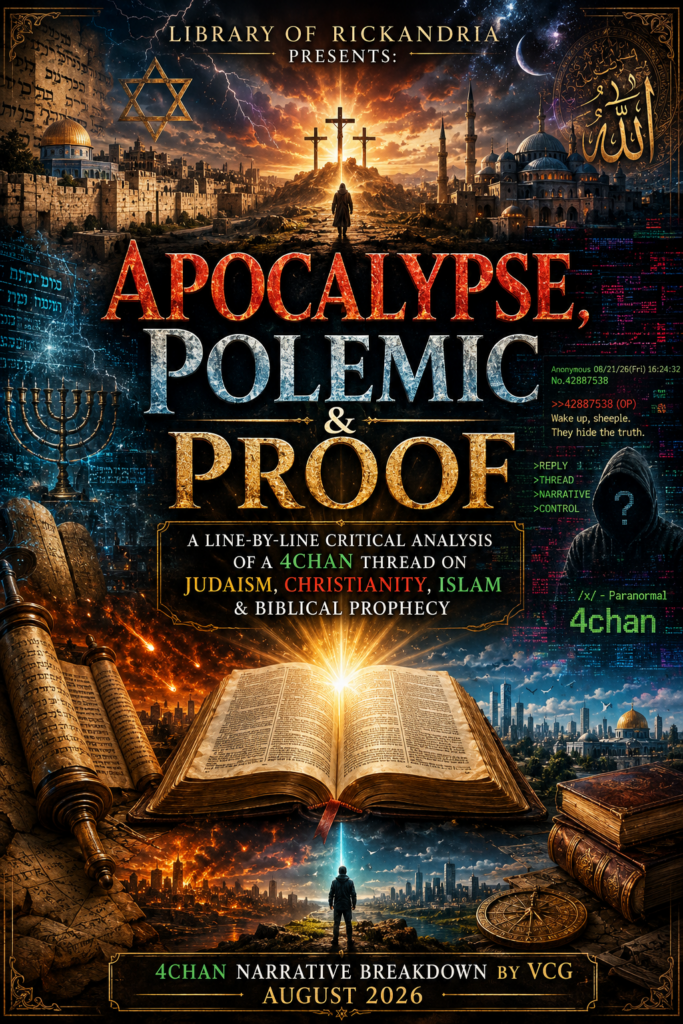
UPDATED BY VCG ON 8/29/2026 @ 19:19 EST
I want to share a heartfelt cause with my audience. Conner Blaisdell-Greene, a brave Airforce Sr. Airman, recently lost his battle with cancer, leaving his family in financial distress. Every donation, no matter how small, can help cover his funeral costs and ease their burden during this difficult time. Please consider clicking the link below to contribute or share Conner’s story with others. Your support truly matters.
Until We Meet Again
Spoken Tribute
Abstract
On August 29, 2026, an anonymous discussion on 4chan’s /x/ board began as a general invitation to discuss Judaism, Christianity, Islam, and the “Abrahamic religions.” It quickly expanded into claims about fulfilled end-times prophecy, the Third Temple, the Islamic Dajjal, geomagnetic pole reversal, Kabbalah, circumcision, the divinity of Jesus, Buddhism, biblical warfare, sacrifice, hell, religious psychology, and finally the claim that “Abrahamism” itself is a dangerous and wicked ideology. Other participants responded with skepticism, satire, ethnic hostility, and competing religious claims.
This paper examines the thread as a case study in online religious argument. Its purpose is not to defend every statement made by Christians, Jews, or Muslims, nor to dismiss every criticism made against them. Instead, it applies a consistent standard: identify the claim actually being made; distinguish fact from interpretation and speculation; compare historical assertions with historical evidence; compare scientific assertions with science; examine logical and psychological mechanisms without diagnosing anonymous participants; and, where Christian or biblical claims are involved, compare them directly with the King James Bible.
The result is mixed. Several criticisms in the thread raise legitimate and difficult questions, particularly concerning 1 Samuel 15, eternal punishment, childhood suffering, circumcision, and violent religious traditions. Some religious claims in the thread are also poorly supported, especially attempts to identify generic wars, earthquakes, or scientific phenomena as unambiguous fulfilments of prophecy. At the same time, many of the thread’s strongest anti-religious conclusions depend upon equivocation, overgeneralization, arguments from silence, retrospective prophecy matching, psychiatric labeling of disagreement, collective guilt, and the substitution of emotionally charged terminology for careful argument.
The governing principle of this investigation is therefore neither credulity nor reflexive skepticism, but examination:
“Prove all things; hold fast that which is good.”— 1 Thessalonians 5:21
1. Introduction: What Kind of Thread Is This?
The thread begins innocently enough. Its original poster invites discussion about Judaism, Christianity, and Islam, describing them under the familiar heading of “Abrahamic religions.” Within minutes, however, the conversation begins moving in several directions at once: prophecy, comparative religion, Jewish mysticism, Islamic eschatology, Christian doctrine, science, moral philosophy, memes, mockery, conspiracy claims, and eventually overt ethnic contempt.
That mixture matters.
A meme is not the same thing as a historical argument. A theological interpretation is not the same thing as an empirical observation. A scientific hypothesis is not the same thing as a prophecy. A morally disturbing biblical passage is not answered merely by calling it “symbolic,” and an anonymous poster cannot be diagnosed with schizophrenia because his beliefs seem irrational to another anonymous poster.
The thread therefore offers an unusually clear example of what happens when categories collapse.
The VCG research methodology used for this paper explicitly calls for separating the original statement from what it communicates, then considering historical, biblical, linguistic, scientific, psychological, logical, and methodological questions while also identifying missing context and alternative interpretations. Its stated standards include “Scripture-first, evidence-based analysis,” “context before commentary,” “evidence before opinion,” honest statements of uncertainty, and fair representation of opposing positions.
That framework is especially useful here because both defenders and critics of religion make mistakes.
A Christian analysis loses credibility if it pretends that 1 Samuel 15 does not mention infants.
A skeptic loses credibility if he calls a geomagnetic reversal proof that the earth will start rotating backward.
A critic of Islam loses credibility if he invents a violent hadith that does not exist.
A defender of Islam loses credibility if he denies a disturbing hadith that plainly does exist.
A critic of Christianity loses credibility if he says the New Testament never depicts Jesus making extraordinary divine-status claims.
A Christian loses credibility if he treats every earthquake as though Matthew 24 says earthquakes automatically prove that the final generation has arrived.
The question throughout this paper is therefore not, “Which side do we like?” It is, “What does the evidence actually support?”
2. Sources, Limitations, and Method
The primary source is the 4chan /x/ thread identified as No. 42887538, examined on August 29, 2026. Because imageboards are fluid and ephemeral, individual post numbers are used as anchors. The material examined extended through No. 42890290, posted at 6:56:46 PM EDT.
Biblical quotations are taken from the uploaded Authorized King James Version, Pure Cambridge Edition. The Bible itself must be distinguished from interpretations subsequently placed upon it. For example, “1 Samuel 15:3 says X” is a textual observation. “Ancient Near Eastern military rhetoric explains X” is an interpretation. “Therefore Christians today are commanded to do X” is another proposition requiring its own argument. Those three claims cannot simply be blended together.
Historical questions are evaluated using primary texts where possible and academic secondary literature where necessary. Islamic claims are checked against Islamic textual sources rather than Christian summaries of Islam. Jewish mystical or rabbinic claims are checked against Jewish texts and scholarship rather than internet paraphrases. Scientific claims are compared with scientific agencies such as NASA and the U.S. Geological Survey.
Psychological analysis has an important limitation: nothing in this paper attempts to diagnose an anonymous poster. Psychology can help us recognize cognitive or rhetorical patterns—confirmation bias, online disinhibition, outgroup homogenization, motivated interpretation, or the medicalization of disagreement—but a clinical diagnosis requires information no imageboard thread can provide.
For convenience, assessments in this paper use several ordinary categories: supported, partly supported, unsupported, false, interpretive, and category error. “Unsupported” does not necessarily mean impossible. It means the evidence presented does not establish the claim.
3. “Abrahamic Religions”: A Useful Label That Can Also Mislead
The OP’s classification of Judaism, Christianity, and Islam as “Abrahamic religions” is conventional. Modern religious studies routinely uses the term for traditions that construct important theological and historical identities in relation to Abraham. At the same time, historians have noted that “Abrahamic religions” is itself a comparatively modern classificatory concept and that it can conceal profound differences between the three traditions.
That distinction becomes important later in the thread.
There is no single religion called Abrahamism with one uniform teaching about inherited sin, circumcision, salvation, sacrifice, eschatology, law, or hell.
Judaism, Christianity, and Islam overlap historically and conceptually, but they also disagree about foundational matters:
Christians confess Jesus as Christ and Son of God in a sense rejected by Judaism and Islam.
Rabbinic Judaism does not accept the New Testament as Scripture.
Islam accepts Jesus as Messiah and prophet while rejecting the Christian doctrine of his deity.
Christianity does not impose physical circumcision on Gentiles as a requirement of salvation.
Islam does not simply reproduce the Augustinian Christian doctrine of inherited original guilt.
Consequently, whenever the thread says “Abrahamism teaches X,” the first methodological question must be: which tradition, which period, which text, and which school?
4. Post No. 42887600: Judaism, Christianity, Islam, and the Three Yogas
One participant proposes an imaginative comparison: Judaism as a mixture of karma and jñāna yoga, Christianity as “pure bhakti,” and Islam as a mixture of bhakti and karma.
There is nothing inherently unreasonable about using cross-religious analogies. Bhakti is commonly associated with devotion or loving worship, karma-yoga with action, and jñāna with knowledge or discernment. Scholarship on the Bhagavad Gita itself recognizes these familiar categories while also warning against oversimplifying them into rigidly separate systems.
The problem is that the 4chan classification sounds much more exact than it is.
Christianity, for example, plainly contains devotion, knowledge, and action.
James writes:
“Even so faith, if it hath not works, is dead, being alone.”— James 2:17
That verse does not settle every Protestant-Catholic debate over justification, but it is enough to show that Christianity cannot accurately be described as devotion with little meaningful place for action.
Likewise Judaism contains prayer, study, law, ethics, mystical devotion, and intellectual tradition. Islam contains worship, doctrine, jurisprudence, works, mystical devotion, and scholarship.
The comparison therefore works best as a personal analogy rather than a historical taxonomy.
There is no evidence in the post that Judaism actually developed as “karma plus jñāna,” Christianity as “bhakti,” or Islam as “bhakti plus karma.” The Hindu categories can illuminate similarities, but resemblance is not genealogy.
5. Post No. 42887599: “All Three End-Times Prophecies Are Being Fulfilled”
The first major factual claim in the thread is also one of its largest: Judaism, Christianity, and Islam are supposedly all experiencing the fulfilment of their end-times prophecies now. The post then connects contemporary conflict, the Temple Mount, Christ/Isa and the Antichrist/Dajjal, natural disasters, geomagnetic reversal, and a final battle.
Several of those topics have real textual foundations.
The conclusion that the present moment has therefore been demonstrated to be the terminal prophetic period does not.
5.1 Wars and Earthquakes
The strongest biblical correction comes from the very chapter most often invoked to support end-times alarm.
Jesus says:
“And ye shall hear of wars and rumours of wars:
see that ye be not troubled:
for all these things must come to pass, but the end is not yet.”— Matthew 24:6
He continues with nations and kingdoms rising against one another, famines, pestilences, and earthquakes, and then describes these as:
“the beginning of sorrows.”
That wording is significant. Whatever one’s eschatological system, Jesus does not say,
“When you hear of wars, the existence of war by itself proves that the end has arrived.”
The skeptical poster who later objects that wars and earthquakes have existed throughout history therefore raises a legitimate base-rate problem.
A prediction has little discriminating power if its proposed fulfilment occurs in almost every century.
The U.S. Geological Survey additionally cautions against assuming that a larger modern earthquake catalogue means the earth is experiencing an unprecedented increase in earthquakes. More instruments and improved detection mean more earthquakes are recorded than in the past, while fluctuations from year to year are normal.
This does not disprove biblical prophecy.
It disproves a weaker claim: that the existence of many recorded earthquakes in a modern database automatically demonstrates Matthew 24 has uniquely identified our year.
Christian eschatology itself demands more care than that.
Acts records Jesus telling the apostles:
“It is not for you to know the times or the seasons, which the Father hath put in his own power.”— Acts 1:7
And Matthew later says:
“But of that day and hour knoweth no man…”— Matthew 24:36
That is not an argument for indifference. It is an argument against premature certainty.
6. The Third Temple and the Dome of the Rock
The thread then predicts that “the Jews” will arrange for the Dome of the Rock to be destroyed so that a Third Temple can be built.
There is a real subject underneath the conspiracy framing.
Contemporary scholarship documents the increasing importance of Temple Mount activism within parts of Religious Zionism. Movements exist that advocate Jewish prayer on the mount, greater Jewish sovereignty over the site, and, in some circles, the eventual restoration of a Temple. Organizations such as the Temple Institute openly study and prepare for aspects of Temple worship.
There have also been radical individuals and fringe movements connected with plots or aspirations involving the destruction of existing Muslim structures. Scholarship on modern Temple activism does not require us to pretend such currents have never existed.
But this is exactly where precision is essential.
From:
some Jewish religious activists desire a Third Temple,
one cannot validly infer:
“the Jews” collectively are arranging the destruction of the Dome of the Rock.
That leap converts a specific political-religious movement into the secret intention of an entire ethnoreligious population.
Recent scholarship actually describes a more complicated situation: Temple Mount activism has become more normalized in sectors of Religious Zionism, but much contemporary activism emphasizes access, prayer, and sovereignty rather than an immediate operational program to demolish Islamic shrines and construct a Temple tomorrow.
The thread therefore begins with a fact and expands it into a collective conspiracy claim.
That pattern will repeat.
7. Antichrist, Dajjal, Jesus, and Damascus
The same post says Christianity and Islam both expect an Antichrist figure and that Christ/Isa will return around Damascus and kill him.
Here, the poster is considerably closer to real source material.
In the New Testament, however, one complication should immediately be noted: “antichrist” is not simply Revelation’s technical name for one final beast.
First John says:
“as ye have heard that antichrist shall come, even now are there many antichrists…”
and identifies antichrist doctrinally with denial concerning Christ, the Father, and the Son.
Later Christian eschatological systems frequently correlate “antichrist” with Paul’s “man of sin” and Revelation’s beast. That synthesis may be defensible, but it is a synthesis. It should not be mistaken for Revelation itself saying, “This beast is named Antichrist.”
In Sunni Islamic tradition, by contrast, al-Dajjal is explicitly an end-times deceiver. An authentic report in Sahih Muslim says Jesus son of Mary descends near the white minaret east of Damascus, pursues Dajjal, and kills him at the gate of Ludd.
The 4chan post therefore has a real comparative-religion observation behind it:
Christian and Islamic eschatologies both contain a climactic deceiver/opponent associated with Jesus.
But the systems are not identical, and the Islamic source does not say Jesus kills Dajjal in Damascus itself. His descent is described near Damascus; Dajjal’s death is at Ludd.
This is a good example of a claim that is substantially grounded but compressed too aggressively.
8. The Sun Rising in the West and the Geomagnetic Pole Reversal
The post next proposes that a magnetic pole reversal could fulfil the Islamic sign of the sun rising in the west.
This is one of the thread’s clearest scientific mistakes.
The Islamic textual premise is real. An authentic hadith tradition states that the Hour will not occur until the sun rises from the west.
Geomagnetic reversals are also real. NASA describes them as reversals in the polarity of Earth’s magnetic field, in which magnetic north and south exchange orientation. Earth has experienced many such reversals in geological history.
But the apparent daily rising of the sun in the east is caused by Earth’s rotation, not by which direction a magnetic compass points. NASA educational material explains the east-to-west apparent motion of the sun from Earth’s eastward rotation.
A magnetic-field reversal does not reverse planetary rotation.
Therefore:
Islamic tradition: the sun rises from the west.
Geophysics: Earth’s magnetic field can reverse polarity.
Internet inference: therefore, magnetic reversal will cause western sunrise.
The third statement does not follow from the first two.
This is a classic example of a modern scientific retrofit: a real scientific phenomenon is attached to an older religious prediction because the vocabulary feels suggestively similar.
Similarity is not mechanism.
9. Seals, Trumpets, and Nuclear Fallout
Post No. 42887800 moves from wars and earthquakes into Revelation, suggesting that its seals and trumpets are “almost certainly” metaphorical and may describe something like radioactive fallout.
Revelation unquestionably uses apocalyptic imagery.
In Revelation 6, John sees symbolic horsemen connected with conquest, warfare, scarcity, death, earthquake, and cosmic disturbance.
It is therefore reasonable to say Revelation is highly symbolic.
What does not follow is that a particular modern physical interpretation is “almost certain.”
Nothing in the text identifies uranium, plutonium, fission, nuclear weapons, ionizing radiation, or radioactive fallout.
A futurist interpreter may ask whether nuclear warfare could physically resemble some imagery in Revelation. That is a legitimate speculative question.
But speculation becomes weak methodology when the reasoning is:
- Revelation contains catastrophic imagery.
- Nuclear war is catastrophic.
- Therefore, Revelation predicted nuclear war.
The same imagery could be correlated after the fact with volcanic eruptions, meteoritic impacts, conventional warfare, famine, celestial symbolism, divine supernatural judgment, or combinations of these.
The text does not provide enough distinguishing information to select nuclear fallout uniquely.
The proper label is therefore possible interpretation, not established fulfilment.
10. A Skeptic Asks for Something Less Ambiguous
Post No. 42888016 responds by saying, in effect, that the poster wants to see unmistakable events—Gog and Magog, Christ visibly returning, angels, and overt miracles—before accepting vague contemporary signs as proof.
That instinct is methodologically stronger than it may first appear.
The New Testament’s depiction of Christ’s return is not limited to statistical increases in bad news.
Matthew says:
“they shall see the Son of man coming in the clouds of heaven with power and great glory.”— Matthew 24:30
Acts says:
“this same Jesus… shall so come in like manner as ye have seen him go into heaven.”
— Acts 1:11
Whatever disputes Christians have over millennium, tribulation, Israel, preterism, futurism, or the chronology of Revelation, the final coming of Christ is presented as something far more substantial than
“earthquake numbers look scary this decade.”
That should make Christians cautious about using ambiguous phenomena as apologetic proof.
11. Failed Dates and “Two More Weeks”
Later in the thread, another poster mocks repeated prophetic countdowns: always
“two more weeks,”
followed by another delay when nothing happens.
The mockery is crude, but the methodological principle is sound.
When someone gives a specific, testable date for an event and the event does not happen, the failure is evidence against that prediction and against the predictive method that produced it.
A Christian does not need to defend failed date-setters.
Indeed, Scripture itself places limits on such confidence:
“Watch therefore: for ye know not what hour your Lord doth come.”— Matthew 24:42
The appropriate Christian response to failed prophecy influencers is not to change the date quietly and protect the brand. It is to acknowledge the failure.
“Prove all things” applies to prophecy claims made by Christians too.
12. Post No. 42887966: Judaism, Kabbalah, Rabbinic Authority, and Gravity
A later participant argues that Judaism is not really Abrahamic, that Kabbalah is basically Neoplatonism with the names changed, that rabbis say the law is “on earth rather than in heaven,” that Jews possess special souls, and that if religious law truly operates on earth then changing that law ought somehow to alter physics or gravity.
The post is useful because some of its premises have genuine sources while its conclusion is logically incoherent.
12.1 “Judaism Isn’t Abrahamic”
By ordinary modern usage, this is false.
Judaism is one of the paradigmatic religions designated by the term “Abrahamic.” Scholars may critique the modern category, but criticizing a classification is not the same thing as saying Judaism is excluded from that classification.
12.2 “Kabbalah Is Just Neoplatonism”
This begins with something real.
Modern scholarship does identify major Neoplatonic elements in medieval Jewish mystical thought, particularly themes of emanation, hierarchical reality, negative theology, and metaphysical procession. Recent Oxford scholarship explicitly discusses kabbalistic adaptations of Neoplatonic emanative systems.
But “influence” and “identity” are not the same proposition.
Kabbalah also develops through Jewish biblical interpretation, Hebrew symbolism, rabbinic traditions, earlier Jewish mystical currents, and medieval Jewish religious problems.
It is therefore fair to say:
Kabbalah interacted deeply with Neoplatonic thought.
It is reductionist to say:
Kabbalah is nothing but Neoplatonism with Jewish words substituted.
That would be like saying Christian theology is:
“just Greek philosophy with Bible names”
because Christian thinkers used Greek philosophical categories.
Influence is historically important precisely because traditions transform borrowed concepts rather than merely photocopying them.
13. “It Is Not in Heaven”
The rabbinic statement behind the thread’s
“law is on earth”
claim is real.
In the famous Oven of Akhnai narrative in the Babylonian Talmud, Rabbi Joshua cites Deuteronomy’s phrase “It is not in heaven” during a legal dispute. The point is that, once Torah has been given, halakhic disputes are adjudicated through authorized interpretive/legal procedures rather than continually decided by supernatural interventions or heavenly voices.
That is a claim about religious jurisprudence.
The thread then quietly changes the meaning of the English word law.
“Law” can mean:
a normative command;
a civil statute;
religious jurisprudence;
a descriptive regularity in physics.
Halakhah and Newtonian gravitation are not the same type of thing merely because English uses the word law for both.
Changing a legal ruling does not alter the gravitational constant any more than repealing a traffic law changes the speed of light.
The gravity argument is therefore not a disproof of rabbinic theology.
It is an equivocation.
14. “Special Jewish Souls”
The thread’s allegation about special souls also has a real textual background, but once again universalizes it.
The Hasidic work Tanya, drawing on Kabbalistic categories, distinguishes the souls of Jews and non-Jews in strongly ontological language. Chabad’s own publication of Tanya preserves this material rather than hiding it.
Critics are therefore entitled to examine such passages.
What they are not entitled to do is silently transform:
a particular Kabbalistic/Hasidic anthropology
into:
what every Jew and every rabbi everywhere believes.
Judaism is historically and theologically diverse.
The correct procedure is to name the work, school, period, and claim.
That actually makes criticism stronger, not weaker, because the criticism can then be tested against a real text rather than an ethnic generalization.
15. Circumcision: Covenant, Christianity, and Ethics
The thread repeatedly returns to circumcision, eventually describing it as:
- mutilation
- torture
- schizophrenia
- psychosis
- masochism
We should begin with what the Bible actually says.
Genesis 17 describes circumcision as a covenantal sign given to Abraham’s household. Abraham, Ishmael, and the males of the household are circumcised; Ishmael is specifically said to be thirteen years old at the time.
For biblical Judaism, then, circumcision is not presented as random bodily injury. It is covenantal.
That theological statement does not resolve the modern medical-ethical question.
Non-therapeutic circumcision of a child unable to give informed consent raises legitimate questions about parental authority, bodily autonomy, religious freedom, medical risk, and irreversible alteration.
The World Health Organization has recommended voluntary medical male circumcision in particular high-HIV-prevalence settings because randomized trials found substantial reduction in heterosexual HIV acquisition risk. That policy should not be misrepresented as a blanket medical endorsement of every religious infant circumcision. WHO ethical guidance separately discusses consent, assent, and special protections for minors.
So, the serious question is:
Under what conditions, if any, should parents be permitted to authorize an irreversible non-emergency procedure for religious reasons before a child can personally consent?
That is a real bioethical question.
Calling the procedure “schizophrenia” does nothing to answer it.
Christian correction
The thread also repeatedly speaks as though circumcision were an undifferentiated obligation of “Abrahamism.”
The New Testament specifically rejects that conclusion for Gentile Christians.
Acts 15 records a major dispute because some were teaching:
“Except ye be circumcised after the manner of Moses, ye cannot be saved.”
The apostles and elders reject imposing that requirement upon Gentile converts and emphasize salvation through the grace of the Lord Jesus Christ.
Thus an argument that says,
“Christianity requires Gentile believers to undergo Abrahamic circumcision for salvation,”
is biblically incorrect.
16. Post No. 42888156: “Jesus Never Claimed to Be God”
This is one of the most important historical claims in the thread, and it requires separating two questions that internet arguments often confuse.
Question One:
Do the surviving canonical Christian texts portray Jesus in divine or extraordinary divine-status terms?
Question Two:
Can the historian establish that every particular saying—especially in John—is a verbatim transcript of Jesus’ historical speech?
The answer to the first question is clear.
The answer to the second is historically debated.
16.1 What the New Testament Text Actually Says
John’s Gospel is explicit.
Jesus says:
“Before Abraham was, I am.”— John 8:58
The narrative immediately describes an attempt to stone him.
In John 10:
“I and my Father are one.”
His opponents reply that they are accusing him of blasphemy because, as they understand it, he is a man making himself God. Jesus continues by speaking of the Father being in him and he in the Father.
The Johannine prologue declares that the Word existed in the beginning, is involved in creation, and then says:
“And the Word was made flesh, and dwelt among us…”— John 1:14
Therefore, the textual statement:
“The canonical New Testament never presents Jesus as making divine-status claims”
is false.
16.2 The Historical-Critical Question
The skeptic is on firmer ground when observing that the Gospels were written after Jesus’ ministry.
Mainstream scholarly dating commonly places Mark around the period of the Jewish War or approximately 65–75 CE, with Matthew and Luke later and the final form of John later still.
That creates a legitimate historical question about oral transmission, literary development, theological framing, and the relationship between remembered sayings and the evangelists’ presentation.
But the thread goes further and implies that Jesus’ divine status was simply invented much later.
That is much harder to sustain.
Paul’s undisputed letters are earlier than the canonical Gospels. First Corinthians is commonly dated around 53–55 CE.
Scholars continue to debate precisely how early “high Christology” developed and how passages such as Philippians 2 should be reconstructed, but elevated devotion to Jesus is demonstrably present very early in the surviving Christian record. Recent scholarship continues to treat this as an important debate precisely because the evidence cannot be reduced to “John invented deity around the year 100.”
A careful conclusion is therefore:
Textually: the canonical New Testament unmistakably contains extremely high claims about Jesus.
Historically: scholars debate which sayings reproduce Jesus’ exact words and how Christological language developed.
What the evidence does not justify: the simplistic claim that Jesus was merely a human teacher until late Christians suddenly invented divine status generations or centuries later.
17. “That Fits Islam’s Jesus Better”
The poster then notes that a non-divine Jesus would fit Islam’s view of Isa more closely.
That observation is broadly correct.
Islam reveres Jesus as Messiah and prophet but rejects the Christian identification of Jesus as divine.
What does not follow is that the Islamic portrait is historically proven simply because one historical reconstruction of Jesus happens to resemble later Islamic theology.
Historical method cannot work backward from:
“This reconstruction resembles my preferred later religion”
to:
“Therefore, my preferred later religion has been historically demonstrated.”
The historical Jesus must be reconstructed from the earliest relevant evidence, not selected by theological resemblance.
18. “The Catholic Church Is the Whore of Babylon”
This is not a new internet theory.
Certain Protestant historicist traditions historically identified Revelation’s Babylon or the woman of Revelation 17 with papal Rome or the Roman Catholic system.
That interpretation therefore has a real theological history.
But the Book of Revelation itself never contains the words “Roman Catholic Church.”
Revelation’s Babylon is associated with a great city, kingship, wealth, persecution, and seven mountains. Modern scholarship very commonly reads the symbolism against the backdrop of imperial Rome. Cambridge scholarship explicitly treats Revelation 17–19 as a prophetic vision of Rome’s destruction, and Richard Bauckham likewise emphasizes Rome and its imperial-economic power behind Babylon imagery.
A fair distinction is therefore:
Biblical text: Babylon the Great, seven mountains, great city, kings and merchants.
First-century historical interpretation: imperial Rome is strongly indicated.
Later Protestant interpretation: papal or Roman Catholic Rome can be treated as a continuing or later manifestation of Babylon.
The last position is theological interpretation, not an explicit identification written into Revelation.
That does not make it automatically false.
It means it should be labeled honestly.
19. Jesus, Buddhism, the Wise Men, and the “Lost Years”
The same post suggests Jesus was almost Buddhist, speculates that the wise men came from the East in a way implying Eastern religious contact, and imagines Jesus travelling east during the unrecorded years of his youth.
There are several problems.
19.1 The Bible Never Says There Were Three Wise Men
Matthew says:
“there came wise men from the east to Jerusalem…”
and later describes gifts of gold, frankincense, and myrrh.
The traditional number three is inferred from three classes of gifts.
Matthew never says there were exactly three visitors.
This is a small detail, but it illustrates why
“what everyone remembers”
and
“what the text actually says”
need to be separated.
19.2 Wise Men Visiting Jesus Do Not Prove Jesus Later Studied Under Eastern Teachers
This is a non sequitur.
Even if the visitors came from far east of Judea, their journey toward Jesus as a child provides no evidence that Jesus later travelled to their homeland.
19.3 The Buddha Predates Jesus
The thread’s suggestion that Jesus was “pre-Buddha” is chronologically false.
The historical Buddha is placed centuries before Jesus. Traditional chronology puts his life approximately in the sixth-to-fifth centuries BCE, while modern scholarly revisions may shift the dates somewhat later; either way, Buddhism predates first-century Christianity by several centuries.
19.4 What Does the New Testament Say About Jesus’ Youth?
Luke places Jesus at age twelve in Jerusalem and then says:
“And he went down with them, and came to Nazareth, and was subject unto them…”
followed by:
“And Jesus increased in wisdom and stature, and in favour with God and man.”
That does not provide a detailed year-by-year biography from twelve to approximately thirty.
But a gap in surviving biography does not become positive evidence for:
- India
- Tibet
- Persia
- Egypt
- Britain
or any other proposed destination.
This is an argument from silence.
19.5 The Modern “Jesus in India” Story
One major source behind later popular “lost years” claims is Nicolas Notovitch’s nineteenth-century story concerning an alleged Tibetan manuscript about “Issa,” supposedly describing Jesus studying in India.
Academic treatments describe the Notovitch material as a famous modern forgery or hoax rather than an ancient independent witness to Jesus’ biography.
Long-distance travel in antiquity was possible.
Possible is not the same word as evidenced.
At present, the thread supplies no credible early historical source establishing Jesus as a Buddhist student in India.
20. Islam, Jews, and the Tree-and-Stone Hadith
Post No. 42888406 turns to a disturbing Islamic eschatological tradition involving Muslims fighting Jews and trees or stones revealing someone hiding behind them.
This source is real.
Sahih Muslim contains an eschatological report in which Muslims fight Jews and stones or trees call attention to a Jew hiding behind them, with an exception involving the gharqad tree.
A careful fact-check must say that plainly.
It would damage credibility to dismiss the quotation as an anti-Muslim fabrication.
At the same time, the 4chan description expands the wording into the extermination of “every Jew.”
The hadith depicts severe and morally disturbing eschatological violence. But the exact report should not be made to say more than it says.
The appropriate approach is therefore neither denial nor exaggeration.
The text deserves direct moral and theological scrutiny.
Claims that every Muslim personally endorses such violence, or that the hadith by itself proves a contemporary operational plan by the entire Muslim world, would require additional evidence.
The thread also mentions forces from the region of Iran joining a final coalition, but the post supplies no exact source. Several Islamic and biblical apocalyptic traditions involving eastern armies, Persia, Khorasan, Gog, or final conflict are easily blended together online. Without the precise claimed text, the safest conclusion is that this portion is not securely verified from the wording supplied.
That is preferable to pretending certainty.
21. The Pancake Miracle and Childhood Cancer
Post No. 42888075 uses a parody “miracle” and then pivots to a far more serious point: children suffering and dying from cancer.
The pancake joke requires little response.
Childhood cancer does.
This is a version of the philosophical problem of evil, especially the evidential problem of natural suffering.
The Stanford Encyclopedia of Philosophy explicitly uses examples such as children dying from cancer and severe animal suffering when discussing the challenge evil presents to theism.
A superficial Christian answer would say:
“Free will.”
That is insufficient.
Human free choices can explain many instances of moral evil—murder, abuse, betrayal, oppression.
A child developing leukemia is not straightforwardly explained by that child or another person freely choosing evil.
Christian theology has proposed many broader accounts involving fallen creation, natural law, soul-making, providence, human epistemic limitations, and eschatological restoration. Those arguments deserve examination on their merits.
What should not be done is to pretend the problem disappears because a slogan has been repeated.
Scripture itself does not treat suffering cheaply.
Job spends much of an entire book wrestling with undeserved suffering.
The Psalms contain lament.
Jesus weeps.
The New Testament describes creation as groaning.
The Christian promise that suffering and death will ultimately be overcome is a theological answer of one kind. It is not identical to a complete explanation for why a particular child suffers now.
The skeptic’s question is therefore legitimate even if one rejects his larger conclusions.
22. Post No. 42889277: The Thread’s Main Anti-“Abrahamic” Indictment
The central polemical post argues that Abrahamic religion is fundamentally evil. It moves through Eden, inherited sin, circumcision, Amalek, animal sacrifice, Eucharist, crucifixion, hell, the cross, demons, mistreatment of children and animals, and mental illness.
Because this is the strongest section of the critique, it deserves something better than a defensive dismissal.
Several accusations touch authentic texts.
Others rewrite those texts.
23. Eden: Did God “Send the Serpent”?
The critic argues that God placed the forbidden tree in Eden and then sent the serpent to deceive Adam and Eve.
The first part is in Genesis.
The second part is not.
Genesis 3 introduces the serpent and records it contradicting God:
“Ye shall not surely die…”
The woman later says she was beguiled. God subsequently judges the serpent.
Nowhere in Genesis 3 does the narrator say:
“God sent the serpent to deceive the woman.”
That premise has been inserted.
Within the broader Christian canon, James makes the theological distinction even sharper:
“Let no man say when he is tempted, I am tempted of God:
for God cannot be tempted with evil, neither tempteth he any man.”— James 1:13
This corrects the direct accusation that Scripture portrays God as morally enticing humans toward evil.
It does not eliminate the deeper philosophical question:
If God is sovereign and knew the serpent would deceive, why permit the serpent access to Eden at all?
That is a legitimate theological problem concerning providence, freedom, permission, and evil.
But it is a different problem from claiming that Genesis explicitly says God dispatched the serpent as his deception agent.
Precision matters.
24. Original Sin: One Doctrine or Three?
The thread then presents inherited punishment from Adam as though Judaism, Christianity, and Islam all teach the same doctrine.
They do not.
24.1 Christianity
Romans 5 explicitly connects Adam, sin, and death:
“by one man sin entered into the world, and death by sin; and so death passed upon all men…”
Paul continues by contrasting Adam’s disobedience with Christ’s obedience.
Christian theology therefore has genuine textual grounds for doctrines of the Fall and original sin.
But even within Christianity, theologians disagree about precisely what is inherited:
guilt;
corruption;
mortality;
a disordered nature;
federal covenant status;
combinations of these.
Contemporary philosophical theology continues to discuss versions of original sin that distinguish inherited corruption from inherited personal guilt.
24.2 Rabbinic Judaism
Classical rabbinic Judaism does not simply reproduce Augustine’s doctrine of hereditary original guilt. Historical scholarship has long recognized the difference, even though Jewish literature can contain other ideas about Adam, Eve, death, inclination, and inherited consequences.
24.3 Islam
The Qur’an states:
“no bearer of burdens will bear the burden of another.”
That principle is difficult to reconcile with the claim that Islam teaches every human being is born personally guilty of Adam’s transgression.
Islam has its own account of Adam, sin, repentance, human weakness, and judgment, but it does not simply import Augustinian original guilt.
The thread therefore takes a particularly Christian doctrinal problem and universalizes it across “Abrahamism.”
That is historically inaccurate.
25. Amalek and 1 Samuel 15: The Passage Christians Should Not Evade
The critic’s reference to Amalek reaches one of the hardest texts in the Bible.
1 Samuel 15:3 says:
“Now go and smite Amalek, and utterly destroy all that they have, and spare them not; but slay both man and woman, infant and suckling, ox and sheep, camel and ass.”
No honest analysis should hide the words
“infant and suckling.”
The passage really is there.
Academic literature on biblical warfare recognizes the severity of the Amalek material and its relationship to total-destruction warfare traditions. Modern use of the legal term genocide can be historically anachronistic when imposed on ancient texts, but the moral comparison arises because the text depicts the destruction of an entire named enemy population, including noncombatants.
Christian interpretations vary.
Some read the command as literal divine judgment against a historical enemy.
Some argue that ancient military accounts used conventional totalizing rhetoric that should not always be read as demographic reporting.
Some combine literary, theological, and historical approaches.
The important point is that interpretation cannot simply erase the wording.
What Does Not Follow
From the existence of 1 Samuel 15, however, it does not automatically follow that:
Christians today have a standing command to annihilate an ethnic population.
The New Testament gives Christians no Amalek-style territorial commission.
Jesus says:
“Love your enemies, do good to them which hate you.”— Luke 6:27
Paul says:
“Recompense to no man evil for evil…”
and:
“Be not overcome of evil, but overcome evil with good.”
That does not solve every moral question raised by the Old Testament.
It does establish that treating 1 Samuel 15 as an ongoing Christian authorization for ethnic extermination is exegetically wrong.
A Christian response should therefore do two things simultaneously:
concede the genuine moral severity of the text, and
reject the claim that the New Testament commissions Christians to reenact it.
Anything less is selective honesty.
26. “Bloody Sacrifice”
The thread characterizes the biblical religious system as obsessed with bloody sacrifice.
The rhetorical word obsessed is interpretive.
The existence of sacrificial blood is factual.
The Hebrew Bible includes animal sacrifices, and the New Testament builds theological arguments around sacrificial imagery.
Hebrews, however, explicitly says:
“For it is not possible that the blood of bulls and of goats should take away sins.”— Hebrews 10:4
It then presents Christ’s offering as decisive and non-repeatable:
“the offering of the body of Jesus Christ once for all.”
Hebrews 9 likewise contrasts repeated animal sacrifices with Christ offering himself once.
So
“blood and sacrifice are major biblical categories”
is true.
“Christianity teaches God eternally demands the repeated slaughter of animals because he enjoys blood”
is not what Hebrews teaches.
The real philosophical question is deeper:
Why does reconciliation with God take sacrificial form at all?
That deserves theological analysis rather than caricature.
27. Eucharist: “Cannibalism”?
The thread calls Christian Eucharistic practice cannibalistic.
The provocative label depends upon a real textual foundation.
Paul records Jesus’ words over bread and cup:
“this is my body…”
and:
“This cup is the new testament in my blood…”
Matthew records closely related language at the Last Supper.
Christians disagree strongly over how Christ is present in Communion.
Roman Catholicism teaches transubstantiation and real substantial presence while also maintaining that the outward properties of bread and wine remain.
Other Christian traditions explain the meal differently.
The important point for fact-checking is that historic sacramental Christianity does not teach that a priest visibly slices ordinary biological muscle from Jesus’ corpse and serves it as flesh.
Calling the Eucharist “cannibalism” therefore imports a crude physical mechanism into the doctrine and then condemns that mechanism.
A critic can reject transubstantiation or sacramental realism without misdescribing it.
The stronger criticism would ask:
Is the theological distinction between sacramental presence and ordinary eating philosophically coherent?
That actually addresses the doctrine Christians claim to believe.
28. Crucifixion, Human Sacrifice, and Atonement
The thread describes Christianity as salvation through human sacrifice and torture.
This charge needs careful language.
Crucifixion was unquestionably an instrument of Roman torture and execution.
Christianity unquestionably places Jesus’ death at the center of salvation.
Those are facts.
But the theological question includes Christ’s agency.
In John 10, Jesus says of his life:
“No man taketh it from me, but I lay it down of myself.”
Hebrews speaks of Christ offering himself.
The Christian claim is therefore not simply:
God finds an unwilling innocent victim and tortures him because pain is pleasurable.
Rather, Christian theology presents Christ as voluntarily entering suffering and death for reconciliation, redemption, victory over sin and death, or related purposes depending on the atonement model.
Christians themselves disagree over how best to explain the atonement—penal substitution, satisfaction, Christus Victor, ransom, moral influence, participation, recapitulation, and combinations of these.
A critic is entitled to ask whether any of those accounts is morally coherent.
But the question must be asked about the doctrine actually held.
29. Hell and Eternal Punishment
The thread’s accusation that Christianity contains a doctrine of eternal fiery punishment cannot simply be dismissed.
There are severe New Testament passages.
Matthew 25 speaks of:
“everlasting fire”
and later:
“everlasting punishment.”
Luke 16 depicts the rich man in torment and flame.
Historically, eternal conscious punishment became a major traditional Christian position.
At the same time, Christian theology has also contained alternative approaches including conditional immortality/annihilationism and forms of universal reconciliation. Contemporary philosophy of religion continues to distinguish these models.
Thus:
“Christianity has no doctrine of eternal punishment”
would be false.
But so is the meme-level explanation that God burns people forever because his feelings are hurt when they
“do not love him back.”
John 3 frames condemnation differently:
“God so loved the world…”
followed by a discussion of belief, light, evil deeds, and condemnation.
One can still ask whether eternal punishment is proportionate.
That is a serious philosophical problem.
The point is only that the critic should argue against the biblical/theological rationale rather than replacing it with divine romantic insecurity.
30. “Worshipping a Torture Device”
The cross was a Roman execution device.
Christianity turned that device into its central visual symbol because the crucifixion and resurrection are central to Christian proclamation.
The critic calls this
“worshipping a torture device.”
That confuses the historical function of a symbol with the meaning assigned to it.
A symbol can represent the defeat, transformation, or remembrance of what it once inflicted.
Christians do not ordinarily look at a cross and say:
Roman torture is morally good.
They look at it as a sign of Christ’s:
- suffering
- self-giving
- redemption
- resurrection
or victory.
A critic can reject those theological meanings.
But that rejection should not depend on pretending Christians are praising Roman execution as execution.
31. “Bad Behaviour Is Blamed on Demons”
The Bible teaches the existence of evil spirits.
It does not therefore teach that every moral failure, mental disorder, illness, or bad decision is demon possession.
James locates temptation partly within the person:
“every man is tempted, when he is drawn away of his own lust, and enticed.”
The New Testament can also distinguish sickness and disease from demonic affliction rather than using the words as automatic synonyms.
A Christian who tells every:
- depressed
- psychotic
- epileptic
- addicted
or traumatized person that his condition is simply a demon is making a claim that requires evidence.
The thread is therefore correct to be suspicious of indiscriminate demonization.
It is incorrect to say Christianity necessarily explains all bad behaviour this way.
32. Religion, Children, and Abuse
The polemic claims religion permits mistreatment of children and should therefore itself be categorized as child abuse.
Religious institutions and families have unquestionably committed and concealed real abuse.
Those cases deserve investigation rather than institutional defensiveness.
But the universal inference:
abuse has occurred in religious settings, therefore religious instruction is abuse,
does not follow.
Jesus receives little children and says:
“Suffer little children, and forbid them not, to come unto me…”
James describes “pure religion” in terms that include care for vulnerable people:
“To visit the fatherless and widows in their affliction…”
Those verses do not prove that every Christian home is safe.
They do prove that mistreating children cannot simply be equated with the moral instruction of the New Testament.
The proper standard should be applied consistently:
physical abuse, sexual abuse, coercive isolation, neglect, denial of necessary care, exploitation, and similar harms should be evaluated as harms whether they occur in a religious or secular setting.
33. “Religious Schizophrenia”
The most scientifically irresponsible section of the thread repeatedly labels religious belief “schizophrenia,” “psychosis,” and related psychiatric pathology.
Schizophrenia is not a synonym for:
“a worldview I think is irrational.”
Clinical assessment of delusions specifically requires sensitivity to cultural and religious context. A belief shared within a cultural or religious community is not automatically classified as a psychotic delusion merely because an outsider rejects its truth.
Research on religion and psychosis is also considerably more complicated than the thread implies.
A recent systematic review found both beneficial and harmful associations depending upon how religion is experienced. Positive religious coping can assist meaning-making, well-being, treatment engagement, and social support, while negative religious coping—such as terrifying interpretations, spiritual guilt, or perceived divine punishment—can intensify distress in some individuals.
Broader reviews similarly find religion can function as a protective factor, risk factor, or neutral factor depending on context.
Therefore:
“religion can interact with psychopathology”
is defensible.
“religion is schizophrenia”
is not.
There is another ethical problem. Using schizophrenia as an insult stigmatizes people who actually live with schizophrenia-spectrum disorders.
If a religious claim is false, demonstrate why it is false.
A psychiatric label is not a substitute for an argument.
34. The Psychology of the Thread Itself
This is where psychological analysis can be useful—provided we do not pretend to know the mental health of individual posters.
34.1 Online Disinhibition
John Suler’s influential work on the online disinhibition effect identifies features such as anonymity, invisibility, reduced authority, and altered social consequences that can make people speak online in ways they might not speak face-to-face.
Research on trolling likewise finds relationships between anonymity and antisocial online behavior.
A board like 4chan creates many of these conditions.
That does not mean every anonymous argument is worthless.
It helps explain the dramatic alternation between serious theology, racial insults, confessions, irony, memes, and extreme rhetorical claims.
34.2 Confirmation Bias
Confirmation bias refers broadly to seeking, interpreting, or remembering evidence in ways that disproportionately support existing beliefs. The phenomenon is well documented.
Both sides of this thread display opportunities for it.
The prophecy believer sees war and earthquake and maps them immediately onto the Bible.
The anti-religious critic sees Amalek and then maps the worst possible interpretation onto every modern Christian.
The first can become:
“Everything happening proves prophecy.”
The second can become:
“Everything religious proves pathology.”
Both frameworks risk becoming self-confirming.
34.3 Hostile Compression
A repeated rhetorical structure in the thread can be described as hostile compression:
A complex tradition is reduced to its most troubling available element, and then that element becomes the essence of the entire tradition.
Thus:
1 Samuel 15 → Christianity is genocide.
A violent hadith → every Muslim wants Jewish extermination.
A Kabbalistic soul doctrine → all Judaism is racial metaphysics.
Religious psychosis exists → religious faith is schizophrenia.
The initial evidence may be real.
The universal conclusion is not contained within it.
34.4 Loaded Relabeling
The thread also repeatedly substitutes emotionally maximized labels:
Eucharist becomes cannibalism.
Circumcision becomes torture.
Atonement becomes sadism.
Religious belief becomes psychosis.
Divine judgment becomes God being angry that people do not “love him back.”
Loaded labels are not always illegitimate. Sometimes a shocking label accurately reveals what polite language hides.
But when the label contains the conclusion, the argument becomes circular.
The question should be:
Does this practice meet the relevant definition, and why?
not:
What is the ugliest word I can attach to it?
35. God and the “Seven Deadly Sins”
Post No. 42889287 claims God commits all seven deadly sins and adds a supposedly hidden eighth sin, cruelty.
Historically, the familiar seven deadly sins are not a seven-item list quoted directly from the Bible.
Their formulation developed through early Christian ascetic classification. Evagrius Ponticus described eight troubling thoughts; later traditions rearranged and consolidated the list, with Gregory the Great playing an important role in the familiar seven. The earlier eight were not a suppressed list in which “cruelty” was secretly removed.
Thus the “secret eighth sin they do not want you to know” framing is historically false.
The individual accusations also depend largely upon equivocation.
Envy
Biblical descriptions of divine jealousy concern covenant allegiance. Whether divine jealousy is morally defensible is a proper theological question.
But envy ordinarily means resentment of another person’s good or desire to possess what belongs to another.
The two concepts cannot simply be declared identical.
Greed
The thread does not demonstrate God coveting property belonging to another being.
Wrath
Scripture unquestionably attributes wrath to God.
The question is whether all wrath is sinful or whether righteous judgment can exist.
The label “deadly sin” assumes that question rather than answering it.
Lust
The poster redefines lust as wanting influence or power.
That is not what the traditional vice of lust means.
Sloth
The argument is that God sometimes does not intervene when the poster thinks he should.
That is a version of the problem of evil.
It is not the definition of laziness.
Gluttony
Animal sacrifice does not demonstrate God overeating out of bodily appetite.
This is another category change.
Pride
This is the strongest philosophical issue in the list.
If God demands worship and declares his own glory, is that perfect recognition of the highest good, or does it resemble narcissistic self-exaltation?
That question cannot be dismissed with a dictionary.
But simply labeling divine self-exaltation “pride” also does not settle it.
The broader problem is consistent throughout the list: words normally describing defects in finite human beings are assigned to God without first establishing that the relevant divine action has the defining defect.
36. God as an “Egregore”
The thread also describes God as an egregore—a collective thought-form generated by human consciousness.
That is an esoteric metaphysical interpretation.
It is not a fact established by using the word.
If one wishes to argue that Yahweh, God, Allah, or any deity exists only as a socially generated thought-form, evidence must be supplied for that ontology.
Calling God an egregore merely places the biblical concept inside a different metaphysical system.
It does not prove that system.
37. Judaism, Christianity, Islam—and Satanism?
The polemic groups Satanism alongside the three Abrahamic religions.
Historically, that is confused.
Modern Satanism arose within a cultural world profoundly shaped by Christian ideas about Satan, and modern Satanic movements often deliberately invert or repurpose Christian symbols.
But contemporary Satanism is diverse, and academic scholarship notes that many modern Satanists are nontheistic and use Satan symbolically rather than worshipping the literal biblical Devil.
That makes Satanism historically dependent on Abrahamic symbolism in important ways.
It does not make it a fourth Abrahamic religion in the same conventional sense as Judaism, Christianity, or Islam.
38. The Thread’s “Seven Commandments of Morality”
Post No. 42889291 proposes a replacement moral system centered on compassion, freedom, beauty, wisdom, life, innocence, environmental protection, logic, and common sense.
Several of these values are admirable.
The interesting question is whether they form a sufficient moral theory.
They do not yet.
38.1 “Never Cause or Allow Suffering”
Taken literally, this rule is impossible.
A surgeon causes pain to remove a tumor.
A parent causes distress by stopping a child from running into traffic.
A judge may impose confinement to prevent greater harm.
Refusing to give an addicted person money can increase immediate suffering while reducing longer-term destruction.
And “never allow suffering” potentially makes each individual morally responsible for every preventable suffering he fails to stop.
The rule needs concepts such as proportionality, intention, necessity, competing goods, and foreseeable consequences.
38.2 Freedom
“Respect freedom so long as others respect freedom”
sounds attractive.
But difficult ethical disputes occur precisely because freedoms collide:
religious freedom and child welfare;
speech and harassment;
privacy and public safety;
property and need;
individual autonomy and communal risk.
A rule saying “respect freedom” does not tell us which freedom prevails when two legitimate claims conflict.
38.3 Beauty
Beauty can be genuinely valuable.
But what happens when preserving beauty conflicts with affordable housing, agriculture, accessibility, or environmental restoration?
A moral theory needs a hierarchy.
38.4 Wisdom
Promoting wisdom is admirable.
But the system first needs to define what wisdom consists of and how competing wisdom traditions are adjudicated.
38.5 Protect Life
Again, admirable.
But does this mean absolute pacifism?
Self-defense?
Abortion?
Euthanasia?
Animals?
Capital punishment?
War?
Microorganisms?
The principle opens questions rather than settling them.
38.6 Protect Innocence
“Innocence” requires definition.
Does it mean childhood, lack of legal guilt, ignorance, moral purity, or absence of harmful intention?
38.7 Protect the Environment
Environmental stewardship is a serious moral good.
It also requires tradeoffs with energy, food production, transportation, poverty, housing, and human development.
The Core Problem
The seven commandments contain valuable ends but no adequate conflict-resolution mechanism.
“Use common sense”
cannot solve that problem because moral disagreement often arises over what common sense requires.
Interestingly, several values overlap strongly with biblical ethics.
Jesus summarizes the law through love of God and neighbor.
Paul tells believers to bless persecutors, provide for needs, seek peace, and overcome evil with good.
James emphasizes care for the vulnerable.
So the debate is not simply:
religion = cruelty, secular morality = compassion.
The real questions concern moral grounding, competing duties, authority, human nature, and how principles are applied.
39. “God Loves You and Burns You if You Don’t Love Him Back”
Post No. 42889300 compresses Christian salvation into a mocking formula: God claims to love people, but burns them if they refuse to love him and “do what Jews say.”
The first part caricatures final judgment, as discussed earlier.
The second part is also historically and biblically wrong.
Christianity began among Jews.
Jesus and the apostles were Jewish.
But the New Testament contains a major first-century controversy over whether Gentile converts had to adopt Jewish covenant markers.
Acts 15 emphatically rejects making Mosaic circumcision a condition of Gentile salvation.
Paul likewise writes:
“What then? are we better than they?
No, in no wise:
for we have before proved both Jews and Gentiles, that they are all under sin…”
and then argues for justification through faith in Christ without ethnic boasting.
So describing Christian salvation as “doing what Jews say” is not theological analysis.
It is an ethnic insinuation replacing the actual Christian doctrine under dispute.
40. The Ethnic Caricature Post
Post No. 42889319 reduces Christianity, Judaism, and Islam to insulting ethnic stereotypes.
There is no argument here to refute.
It is an example of outgroup homogenization: a complex population is compressed into an insulting type, after which contempt substitutes for analysis.
Christianity’s Jewish historical origins are relevant facts.
The ethnicity of Jesus is relevant to history.
Neither fact proves that Christians “worship Jews” as an ethnic group.
Likewise, reducing a religion to a racial caricature tells us nothing about whether its theology is true or false.
A paper concerned with truth should not answer ethnic contempt with counter-contempt.
41. Posts That Do Not Constitute Arguments
Several posts in the thread are jokes, memes, insults, or personal questions rather than propositions requiring a historical rebuttal.
One poster says he burned a Qur’an while drunk and asks what will happen.
One posts Joseph Smith imagery and calls that tradition the best Abrahamic religion.
Another makes a waterski joke.
Several complain about the state of /x/.
One simply responds “BASED.”
These posts are socially revealing, but adding more paragraphs of theological counterargument would give them intellectual weight they do not possess.
Methodologically, sometimes the correct response to a meme is:
No evidentiary claim has been made.
That is part of line-by-line analysis too.
42. What the Critics in the Thread Get Right
A fair paper should say plainly where the hostile side raises valid issues.
42.1 1 Samuel 15 Is a Difficult Text
The command includes “infant and suckling.” A Christian rebuttal that hides that fact is weaker than the criticism it is trying to answer.
42.2 Childhood Cancer Is a Serious Problem for Theism
Free will by itself does not explain natural evil.
A serious Christian philosophy must engage that question rather than dismissing it.
42.3 Severe Christian Judgment Traditions Really Exist
Eternal conscious punishment is not an atheist invention.
Christians themselves disagree about its correct interpretation, but the severe texts are there.
42.4 Sacrifice and Blood Are Genuine Biblical Categories
Calling all of it meaningless “bloodlust” is reductionist, but the Bible really does build major theological structures around sacrifice.
42.5 The Gospels Were Written After Jesus’ Ministry
Historical criticism is entitled to ask how memory, tradition, authorship, literary dependence, and theology affect our access to Jesus.
42.6 Some Kabbalistic Texts Make Strong Jewish/Gentile Soul Distinctions
This should be studied rather than denied.
42.7 The Anti-Jewish Eschatological Hadith Exists
It is real and deserves moral examination.
42.8 Failed Date-Setting Deserves Criticism
Repeated failed predictions are evidence against the predictor’s interpretive method.
None of these concessions requires accepting the thread’s total conclusion that all “Abrahamism” is fundamentally wicked.
In fact, acknowledging difficult evidence is what makes the later distinctions credible.
43. What the Religious or Prophecy-Positive Side Gets Wrong
Fairness works in the opposite direction too.
43.1 Generic Crisis Is Not Self-Authenticating Prophecy
Jesus himself says wars occur while “the end is not yet.”
43.2 Magnetic Reversal Does Not Make the Sun Rise West
The scientific mechanism is wrong.
43.3 Revelation Should Not Be Casually Reverse-Engineered Into Nuclear Technology
Possible resemblance is not demonstrated prediction.
43.4 Temple Activism Does Not Prove a Collective Jewish Conspiracy
Specific organizations and radicals should be named specifically.
43.5 Prophecy Should Not Be Protected From Falsification by Continually Moving Dates
Acts 1:7 and Matthew 24:36 should make Christians particularly resistant to prophetic sensationalism.
The Christian standard cannot be:
demand rigorous evidence from critics, but accept vague correlations from believers.
Truth requires one measuring stick.
44. Where the Anti-Religious Polemic Fails Most Clearly
Several claims fare badly under even basic scrutiny.
A geomagnetic reversal causing a western sunrise is scientifically false.
Genesis does not say God sent the serpent to deceive Eve.
The Buddha did not live after Jesus.
Matthew does not say there were three wise men.
No credible early historical evidence establishes Jesus as a Buddhist student in India.
The New Testament does depict Jesus in extraordinarily high and divine terms.
Religion is not a clinical synonym for schizophrenia.
A rabbinic statement about halakhic authority has nothing to do with changing gravity.
A specific Kabbalistic doctrine cannot automatically be assigned to every Jew.
Modern Satanism is not simply a fourth Abrahamic religion.
The traditional pre-seven list of Christian vices did contain eight items, but “cruelty” was not a secretly suppressed eighth deadly sin.
And identifying the existence of a fringe Temple movement does not establish that “the Jews” collectively are arranging the destruction of the Dome of the Rock.
The recurring problem is not skepticism.
Skepticism can be healthy.
The problem is premature totalization: a fact is found, its worst possible interpretation is selected, and the result is universalized.
45. A Biblical Standard for the Argument Itself
One of the more striking features of the thread is that Scripture contains warnings relevant not merely to the doctrines being debated, but to the manner of debate.
James writes:
“the tongue is a fire, a world of iniquity…”
and then warns about using the same tongue to bless God while cursing human beings.
He also says:
“let every man be swift to hear, slow to speak, slow to wrath:
For the wrath of man worketh not the righteousness of God.”
Paul writes:
“putting away lying, speak every man truth with his neighbour…”
and later:
“Let all bitterness, and wrath, and anger, and clamour, and evil speaking, be put away from you…”
Peter instructs Christians to be ready to answer questions concerning their hope:
“with meekness and fear.”
These commands cut in more than one direction.
They prohibit Christians from answering anti-Christian falsehood with anti-Jewish hatred.
They prohibit Christians from answering anti-Islamic inaccuracies with lies about Muslims.
They prohibit Christians from pretending morally difficult biblical texts are easy.
And they prohibit an apologetic method in which the desired conclusion determines what evidence is allowed to count.
The Christian claim is supposed to be served by truth.
It cannot therefore be defended by falsehood.
46. Conclusion: Apocalypse, Polemic, and Proof
The 4chan thread began with comparative religion and ended with the declaration that “Abrahamism” is dangerous and wicked. Between those points, it passed through genuine theology, real historical sources, scientific mistakes, moral problems, prophetic speculation, racial caricature, psychiatric insults, jokes, and a surprisingly serious attempt to construct an alternative morality.
Its greatest strength is accidental: it places difficult questions in the open.
What does 1 Samuel 15 mean?
How should eternal judgment be understood?
Why does a good God permit children to suffer?
What is inherited from Adam?
What did the earliest Christians believe about Jesus?
How should violent eschatological traditions be morally evaluated?
What authority should religious parents have over children’s bodies?
How should prophecy claims be tested?
Those are serious questions.
They should not be feared.
Its greatest weakness is methodological.
Again and again, the thread substitutes association for demonstration.
A magnetic pole reversal resembles a west/east reversal linguistically, so it becomes prophetic fulfilment.
Kabbalah has Neoplatonic influence, so it becomes nothing but Neoplatonism.
A Talmudic legal maxim uses the word “law,” so it gets turned into a claim about gravity.
The Gospels were written decades after Jesus, so Jesus’ deity becomes an invention by definition.
Some years of Jesus’ life are unrecorded, so India enters the biography.
A violent biblical command exists, so every form of Christianity becomes genocidal.
A severe hadith exists, so every Muslim becomes a genocidal actor.
Religious delusions exist, so religion becomes schizophrenia.
A religious institution has abused children, so religious upbringing becomes child abuse by definition.
None of these conclusions follows merely from the premise preceding it.
Yet Christians should resist the temptation simply to reverse the same method.
The existence of war is not proof that the final generation has arrived.
A news headline is not automatically a fulfilment of Revelation.
An uncomfortable biblical passage cannot be neutralized by calling everything symbolic.
The historical Jesus cannot be reconstructed by starting with the doctrine we already want him to teach.
And the truth of Christianity would not be protected by denying genuine problems in Christian history or Scripture.
The King James translators themselves described careful revision, consultation, comparison, and willingness to reconsider wording rather than presenting intellectual inflexibility as a virtue. They wrote that matters of great consequence should be handled with maturity and acknowledged places where certainty should give way to modesty.
That attitude is appropriate here.
There is a difference between doubt and dishonesty.
There is a difference between faith and credulity.
There is a difference between criticism and contempt.
There is a difference between evidence and interpretation.
And there is a difference between saying Scripture teaches something and saying our preferred interpretation of Scripture must therefore be infallible.
The final biblical principle for this investigation is consequently not an instruction to fear questions.
It is an instruction to test claims:
“Despise not prophesyings.
Prove all things; hold fast that which is good.”— 1 Thessalonians 5:20–21
The same standard must be applied to the prophet, the skeptic, the apologist, the historian, the anonymous poster—and to ourselves.
That is where polemic gives way to proof.
Appendix: Post-by-Post Audit
No. 42887538 — Opening post. A conventional invitation to discuss Judaism, Christianity, and Islam as Abrahamic religions. The classification is standard modern usage, although academically imperfect.
No. 42887599 — End-times convergence. Contains authentic Christian and Islamic eschatological motifs but overstates present fulfilment, turns Temple activism into a collective Jewish plot, and makes a scientifically false connection between geomagnetic reversal and western sunrise.
No. 42887600 — Three yogas comparison. Useful as analogy; unsupported as historical classification.
No. 42887640 — Request for specific prophecies. Methodologically constructive because it asks the claimant to move from general assertion to evidence.
No. 42887647 — Circumcision question. Genesis 17 identifies circumcision as covenantal; later Christian Scripture does not impose it upon Gentiles as a requirement for salvation.
No. 42887649 — Burning a Qur’an. Personal/religious question rather than a factual thesis. It contributes little to the thread’s evidentiary argument.
No. 42887800 — Wars, earthquakes, Revelation, nuclear fallout. Correct that Revelation employs powerful apocalyptic imagery; unsupported in identifying modern nuclear fallout as the likely referent. Matthew 24 itself says wars do not by themselves mean the end has arrived.
No. 42887966 — Kabbalah, law, souls, gravity. Neoplatonic influence and exclusivist soul texts have real sources; the universalization to all Judaism and the transition from halakhic “law” to physical law are invalid.
No. 42888010 — Wars always existed; sin does not. The historical base-rate objection to generic prophecy signs is meaningful. “Sin does not exist” is a philosophical assertion, not an empirical finding. Biblically, sin is plainly a category and is defined in 1 John as transgression of the law.
No. 42888016 — Wants unmistakable signs. Methodologically reasonable. The New Testament portrays Christ’s climactic return as overt rather than as a barely detectable statistical pattern.
No. 42888075 — Pancake miracle/child cancer. The miracle portion is satire; the childhood-cancer challenge is a serious form of the problem of evil.
No. 42888156 — Jesus not God; Catholic Babylon; Jesus Buddhist. The canonical New Testament contradicts the first claim textually; historical-critical questions remain more nuanced. Babylon as Catholicism is a later interpretation rather than Revelation’s explicit wording. The Jesus-in-India theory lacks credible early evidence, and Buddhism predates Jesus.
No. 42888406 — Muslims and Jews. The stone-and-tree hadith is authentic; the post’s universal extermination wording overstates it. The additional Iran/coalition claim is insufficiently sourced in the post.
No. 42888421 — Joseph Smith meme. Preference/humor rather than fact-checkable argument.
Nos. 42888655–42889059 — Joke and meme material. Socially relevant but evidentially negligible.
No. 42889277 — Major anti-Abrahamic indictment. Contains some real difficult material, especially Amalek, sacrifice, judgment, and the problem of suffering, but repeatedly turns particular texts into universal descriptions of all three religions.
No. 42889287 — Religion as mental illness; seven deadly sins. The psychiatric generalization is unsupported by clinical research. The historical “secret eighth sin” claim is false. Several accusations depend upon redefinitions of the traditional vice terms.
No. 42889291 — Seven moral commandments. Contains worthwhile values but lacks definitions, priority rules, and conflict-resolution procedures necessary for a functioning ethical theory.
No. 42889300 — God loves/burns people; “do what Jews say.” Severe judgment really appears in Christian Scripture, but the stated motivation is a caricature, while the ethnic description of Christian salvation conflicts with Acts 15 and Pauline theology.
No. 42889311 — “BASED.” Agreement without evidence.
No. 42889319 — Ethnic caricature. Polemical denigration, not argument.
No. 42889333 — Circumcision as schizophrenia/psychosis. Psychiatric terminology used rhetorically rather than clinically.
Nos. 42889336, 42889380, 42889408 — Board disputes and insults. No substantial theological thesis.
No. 42889358 — Failed “two more weeks” predictions. A valid methodological criticism when directed at specific failed predictions; Scripture itself discourages confident date-setting.
No. 42890290 — “Abrahamism is dangerous and wicked.” A sweeping conclusion too broad to follow from the mixture of evidence presented. Specific doctrines and practices can be morally evaluated; three global religious traditions cannot responsibly be reduced to one undifferentiated moral actor.
Selected Sources and Further Reading
Primary Sources
4chan /x/, Thread No. 42887538, accessed August 29, 2026. Primary source for the anonymous posts examined in this paper.
The Holy Bible, Authorized King James Version, Pure Cambridge Edition. Primary biblical text used throughout this analysis.
VCG Research Manual & Master Project Handoff. Methodological framework emphasizing Scripture-first analysis, evidence before opinion, separation of fact/interpretation/speculation/rhetoric, context, uncertainty, and fair representation.
Biblical History and Early Christianity
Academic studies on the dating of Mark and the Synoptic Gospels.
Reference material on the dating and development of John.
Oxford reference material on the dating of 1 Corinthians and early Pauline evidence.
Recent scholarship on early/high Christology.
Cambridge scholarship identifying Revelation’s Babylon primarily with imperial Rome in its historical context.
Academic discussion of Amalek, biblical warfare, and the moral problem of annihilation language.
Judaism and Jewish Mysticism
Oxford scholarship on Neoplatonism and Kabbalah.
Babylonian Talmud, Bava Metzia 59b, concerning “It is not in heaven” and halakhic authority.
Chabad publication of Tanya concerning its Kabbalistic anthropology of souls.
Recent scholarship on Temple Mount activism and the changing place of Temple discourse in Religious Zionism.
Islamic Sources
Sahih Muslim tradition concerning Jesus’ descent near Damascus and the death of Dajjal at Ludd.
Authentic hadith material concerning the sun rising from the west.
Sahih Muslim tradition concerning fighting Jews and the stone/tree motif.
Qur’anic teaching that no bearer bears another person’s burden.
Science
NASA material on geomagnetic polarity reversals.
NASA material explaining the relation between Earth’s rotation and apparent sunrise direction.
U.S. Geological Survey explanation of global earthquake detection, fluctuations, and apparent increases in recorded earthquakes.
Psychology
John Suler, research on the online disinhibition effect.
Research concerning anonymity and online trolling.
Raymond Nickerson’s review of confirmation bias.
Systematic review of religion/spirituality and psychosis, including both positive and negative forms of religious coping.
Clinical discussion distinguishing culturally shared religious belief from psychopathological delusion.
Philosophy and Religious Studies
Stanford Encyclopedia of Philosophy, The Problem of Evil, including natural suffering and childhood disease.
Philosophical discussion of divine providence, moral evil, and natural evil.
Scholarship on differing Christian accounts of hell, annihilation, and universal reconciliation.
Academic studies of modern Satanism and its often nontheistic or symbolic character.
Historical material on the development of the seven deadly sins from earlier eightfold classifications.
Metropolitan Museum of Art material on the historical Buddha, establishing that Buddhism predates Jesus by centuries.
Academic discussion of Nicolas Notovitch and the later “Jesus in India”/“Issa” tradition.
Final Assessment
The thread should not be dismissed merely because it is anonymous, vulgar, or hosted on 4chan.
Some of its questions deserve serious answers.
Neither should its confidence be mistaken for evidence.
The most defensible conclusion is narrower and stronger:
The thread contains genuine source material, genuine moral problems, genuine religious differences, substantial misinformation, speculative prophecy matching, scientific errors, historical compression, and psychologically charged rhetoric. Its strongest criticisms deserve engagement; its broadest conclusions are not supported by the evidence presented.
For the Christian researcher, the appropriate response is therefore neither panic nor contempt.
It is examination.
“These were more noble… in that they received the word with all readiness of mind, and searched the scriptures daily, whether those things were so.”— Acts 17:11
Soli Deo Gloria.
4CHAN THREAD & POST BREAKDOWNS – Library of Rickandria
VCG PAPER PROJECTS – Library of Rickandria