
Ancestral Memory, Pterosaurs & Demonic Imagery: A Scientific, Psychological, Historical & Biblical Critique
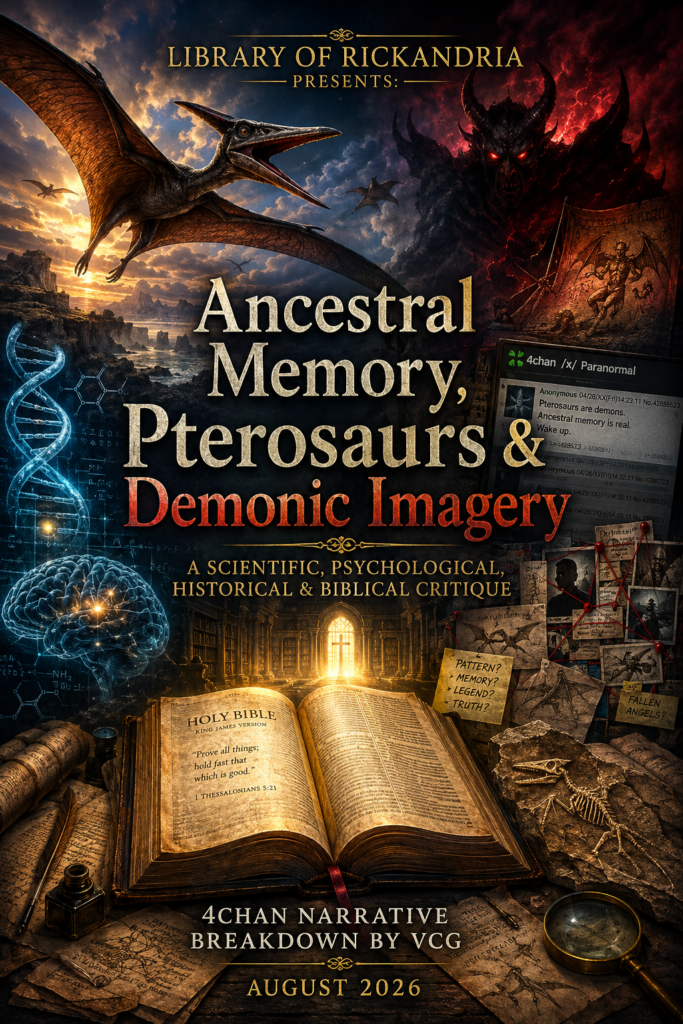
UPDATED BY VCG ON 8/29/2026 @ 22:22 EST
I want to share a heartfelt cause with my audience. Conner Blaisdell-Greene, a brave Airforce Sr. Airman, recently lost his battle with cancer, leaving his family in financial distress. Every donation, no matter how small, can help cover his funeral costs and ease their burden during this difficult time. Please consider clicking the link below to contribute or share Conner’s story with others. Your support truly matters.
Until We Meet Again
Spoken Tribute
Abstract
On August 28, 2026, an anonymous poster on 4chan’s /x/ paranormal board proposed an unusual explanation for demonic imagery: demons are not real supernatural beings but inherited ancestral memories of pterosaurs that once preyed upon ancient mammals. The poster pointed particularly to the wings and apparent “horns” of some pterosaurs and their resemblance to later artistic representations of demons. Subsequent replies challenged the theory on paleontological, biological, and intuitive grounds, while other posters introduced claims concerning pterosaur feathers, Hinduism and Buddhism, ancestral memory, and the apparent capacity of plants to possess memory despite lacking brains.
The thread is worth examining not because it has established a new scientific hypothesis, but because it illustrates how true observations can be assembled into a conclusion that exceeds the evidence supporting them. Pterosaurs existed. Mammals lived alongside them. Some pterosaurs probably consumed small vertebrates. Organisms can inherit evolved predispositions. Certain epigenetic states can sometimes cross generations. Plants possess forms of biochemical and environmental “memory.” Human beings are highly responsive to predator-like forms, and human cultures repeatedly construct monsters from animal characteristics.
Every one of those propositions can be discussed seriously.
The difficulty comes when several distinct meanings of memory, inheritance, similarity, and demon are treated as though they were interchangeable. There is presently no demonstrated mechanism by which a specific visual experience acquired by a Mesozoic mammal could be transmitted as recognizable episodic imagery through tens of millions of years of descendants and eventually become human representations of demons. Historical research, meanwhile, provides identifiable cultural pathways for the familiar horned, hoofed, and bat-winged devil imagery of Western art. Finally, the biblical texts do not describe demons primarily through that later artistic anatomy at all. They describe devils and unclean spirits as intentional spiritual agents who know, speak, recognize, fear, request, deceive, enter, depart, and oppose.
This paper therefore does not argue that “science proves demons.” Science is not equipped to establish every metaphysical proposition merely by failing to provide a natural explanation. Nor does this paper argue that every medieval representation of a devil is biblically accurate. Rather, it asks a narrower question:
Does the ancestral-pterosaur-memory hypothesis adequately explain demonic imagery and thereby disprove the biblical category of demons?
The evidence examined here indicates that it does not.
1. Why Examine a 4chan Thread Seriously?
It would be easy to laugh at the thread.
That would also be intellectually unproductive.
The original proposition combines paleontology, evolutionary psychology, hereditary biology, mythology, religious iconography, and demonology in only a few sentences. That makes it unusually useful as a case study in interdisciplinary reasoning.
The governing principle of this investigation is therefore not ridicule but examination:
“Prove all things; hold fast that which is good.” — 1 Thessalonians 5:21
The surrounding passage also urges sobriety, patience, and discernment rather than reflexive reaction.
A claim should not be accepted merely because it is unconventional. Neither should it be rejected merely because it sounds strange.
The proper question is:
What evidence would have to exist for this explanation to be true, and does that evidence actually exist?
That requires separating several different fields of inquiry.
2. Methodology
Throughout this paper, five categories will be kept distinct.
Historical evidence
What can surviving texts, artworks, fossils, manuscripts, and documentary records tell us about how particular ideas developed?
Scientific evidence
What biological, paleontological, neurological, genetic, or psychological mechanisms have actually been observed or reasonably inferred?
Logical analysis
Even if individual premises are true, does the proposed conclusion necessarily follow from them?
Psychological interpretation
What ordinary cognitive mechanisms might help explain why a hypothesis feels compelling?
Psychological analysis here is not diagnosis. Anonymous posters cannot responsibly be diagnosed from a handful of sentences.
Biblical interpretation
What does the biblical text itself say?
That must be distinguished from:
later Christian art,
medieval folklore,
theological synthesis,
popular imagination,
and modern apologetic speculation.
This distinction will become especially important because the stereotypical red or black horned demon with hooves and bat wings is not a straightforward biblical description.
3. The Original Claim
The thread began on August 28, 2026 with the proposition:
“Demons are not real.
Demons are Ancestral Memories of Pterodactyls hunting Ancient Mammals.”
The poster then appealed to similarities between pterosaur wings and cranial projections and later demon imagery.
There are actually several separate propositions concealed inside those sentences:
- Ancient mammals encountered pterosaurs.
- Some pterosaurs preyed upon mammals.
- Those encounters produced memories.
- Those memories somehow entered mammalian heredity.
- The information persisted through enormous evolutionary timescales.
- Humans inherited recognizable visual content from those encounters.
- Humans interpreted those inherited impressions as demons.
- The resemblance between pterosaurs and demon imagery confirms the theory.
- Therefore demons themselves do not exist.
These propositions should not be treated as a single claim.
Each bridge must be demonstrated independently.
If the chain contains one unsupported bridge, the final conclusion becomes weaker. If several central bridges are unsupported, the explanation collapses even if some peripheral observations are correct.
4. Were Pterosaurs Real, Winged Predators?
Yes—but precision matters.
Pterosaurs were flying reptiles whose known fossil record extends from approximately 210 million years ago until the end-Cretaceous extinction approximately 66 million years ago. They were not dinosaurs, although they lived during the same broad geological era. Their ecology was diverse rather than uniform. Proposed diets across different pterosaur groups include insects, fish, vertebrate prey, hard-shelled animals, plants, filter-feeding, carrion, and generalist diets.
The popular word pterodactyl is also imprecise when referring to the entire group. Pterodactylus is one genus within the much larger Pterosauria. The first scientifically described pterosaur fossil was published by Cosimo Alessandro Collini in 1784; Georges Cuvier later recognized its flying reptilian nature and used the “ptero-dactyle,” or wing-finger, terminology from which the familiar popular name developed.
Pterosaur flight anatomy also matters.
Their wings were not simply giant bird wings. An extraordinarily elongated finger supported a membrane of skin extending through much of the wing. The Natural History Museum describes pterosaur wings as skin membranes supported by the elongated wing digit and internal fibres.
So, the OP is correct about a basic fact:
Pterosaurs were winged animals.
But that fact alone tells us nothing about the origin of demon imagery.
5. Did Pterosaurs and Mammals Coexist?
Yes.
Mammals and close mammalian relatives were present through much of the Mesozoic. Smithsonian material places early mammals deep within the age of dinosaurs and notes that mammals occupied a wider variety of ecological niches than the old stereotype of tiny nocturnal insect-eaters suggested.
That means the OP does not fail at the most basic chronological level.
There really were periods in which pterosaurs and mammals occupied the same world.
But coexistence is not predation, and predation is not hereditary memory.
Those are three separate propositions.
6. Did Pterosaurs Hunt Small Vertebrates?
For at least some groups, this is plausible and sometimes strongly supported.
Pterosaur feeding ecology varied enormously. A major review emphasizes that their diets remain incompletely constrained but documents hypotheses ranging from insectivory and piscivory to carnivory, herbivory, filter feeding, and generalism.
Azhdarchids are especially interesting.
Mark Witton and Darren Naish argued from anatomy, trackways, habitat associations, limb proportions, and comparisons with modern terrestrial birds that azhdarchids were competent terrestrial foragers. Their proposed model is closer to large storks or ground hornbills than aerial monsters snatching everything from the sky. Such animals could have taken relatively small vertebrates, large invertebrates, carrion, and possibly plant material.
Later research continues to treat terrestrial predation or opportunistic feeding as plausible for at least some azhdarchids.
Therefore, this statement would be reasonable:
Some pterosaurs probably consumed small terrestrial vertebrates.
But this statement would go well beyond the available evidence:
Pterosaurs routinely terrorized the particular mammalian ancestors relevant to later humans so intensely that pterosaur-specific imagery became biologically encoded and persisted into Homo sapiens.
The fossil record does not establish that.
The transition from the first statement to the second is where speculation begins.
7. The Central Problem: What Is an “Ancestral Memory”?
The thread repeatedly uses memory without defining it.
That is the most important conceptual problem in the entire discussion.
At least four very different phenomena can be called “memory” in ordinary conversation.
7.1 Episodic memory
This is the most intuitive meaning.
An organism experiences an event and later recollects something about that particular event.
For example:
I remember seeing an animal attack me.
That requires information about an individual experience to be encoded within the organism.
Nothing presently established in genetics shows that the visual or episodic content of an ancestor’s personal experience is copied from that ancestor’s nervous system into germ cells and then delivered as recognizable imagery to remote descendants.
That is the mechanism the OP actually requires.
And it is precisely the mechanism for which evidence is missing.
8. Evolved Predisposition Is Not Inherited Recollection
Evolution can produce something superficially similar to “ancestral fear” without transmitting anybody’s memories.
Suppose a population repeatedly encounters a predator.
Individuals who more rapidly notice particular shapes, movements, sounds, or behavioral cues might survive and reproduce at higher rates. Across many generations, descendants could therefore inherit neural or perceptual tendencies making certain stimuli unusually salient.
No ancestral memory needs to be copied.
The descendants do not “remember” what happened to their ancestors.
They inherit biological systems shaped by differential survival and reproduction.
That distinction matters enormously.
Consider the long debate over human reactions to snakes.
Some experiments suggest humans, including infants, display special attentional responses to snake-like stimuli. But attention is not the same thing as innate fear. One infant study found physiological responses more consistent with increased attention than with simple inborn aversion.
The broader preparedness literature is also less conclusive than simplified popular accounts suggest. A systematic review of 32 fear-conditioning experiments found the expected stronger resistance to extinction for snake or spider cues in only 10 experiments; most did not support that particular prediction of preparedness theory.
A critical review of snake-detection hypotheses likewise cautions that rapid threat-detection claims from laboratory research do not always map neatly onto behavior in natural environments.
The cautious conclusion is therefore:
Evolution can plausibly bias perception and behavior toward certain recurring threats.
But:
An evolved threat-detection bias is not a stored visual memory of an ancestor’s experience.
This is the first major category error in the thread.
9. Epigenetic Inheritance Does Not Solve the Problem
The modern science of epigenetics is sometimes invoked to rescue ancestral-memory theories.
There is something real here.
Not all inherited biological information is simply a change in the underlying DNA sequence. Research has documented mechanisms involving DNA methylation, histone states, RNAs, proteins, metabolites, and other molecular factors that can affect offspring.
But the important question is not:
Can anything besides DNA sequence influence descendants?
The answer to that is yes.
The relevant question is:
Can the detailed content of an ancestor’s visual experience be encoded in the germline and transmitted as recognizable imagery across tens of millions of years?
That is a completely different proposition.
Mammalian epigenetic inheritance faces substantial reprogramming between generations. Reviews repeatedly stress that transgenerational inheritance is more limited and difficult to demonstrate in mammals than in organisms such as plants or some invertebrates.
Even researchers sympathetic to transgenerational epigenetic effects emphasize experimental difficulty, confounding variables, and the rarity of strong causal demonstrations connecting germ cells to inherited phenotypes across generations.
A 2023 Nature Reviews Genetics discussion described true mammalian transgenerational epigenetic inheritance as comparatively elusive and controversial, in part because chromatin states undergo substantial resetting during gametogenesis and embryonic development.
Most importantly, the phenomena under discussion are things such as:
changes in gene regulation,
metabolic phenotypes,
developmental states,
stress responses,
molecular marks,
regulatory RNA effects.
They are not inherited autobiographical movies.
No known epigenetic mechanism translates:
“My ancestor saw a crested flying reptile approaching from above”
into a detailed symbolic visual representation transmitted for tens of millions of years.
Invoking the word epigenetics therefore does not solve the OP’s problem.
It merely replaces an undefined mechanism with a scientific term.
10. The Time Problem Is Enormous
One reply correctly noted that pterosaurs disappeared roughly 66 million years ago.
That criticism is directionally correct, but it can be improved.
Long time periods alone do not refute inherited adaptations.
A biological adaptation can persist for enormous spans of evolutionary time if selection, developmental constraint, or continued utility preserves it.
So the best objection is not merely:
“Sixty-six million years is too long.”
The better question is:
What exactly was transmitted during those 66 million years, through what mechanism, under what selection pressure, and how can we detect it?
For the OP’s specific hypothesis, we would need evidence that:
a pterosaur-related perceptual signature became biologically encoded;
it remained sufficiently stable through mammalian evolution;
it survived countless changes in ecology;
it eventually appeared in human cognition;
it generated culturally recognizable demon imagery;
and alternative cultural explanations fit the evidence less well.
None of that has been demonstrated.
The chronological gap is therefore not an automatic disproof.
It is an enormous evidential burden.
11. “Pterosaurs Have Horns”
This is where visual similarity begins doing more work than the evidence allows.
Many pterosaurs possessed extraordinary cranial crests.
Those crests varied enormously in form, size, composition, and likely function. Research describes extensive variation within Pterosauria, and hypotheses have included display, species recognition, and sexual selection.
Calling these structures “horns” is understandable in ordinary speech when a crest looks horn-like.
But scientifically, it subtly changes the argument.
A cranial crest becomes a horn.
A horn becomes a demonic horn.
A demonic horn becomes evidence of cultural memory.
Each transformation adds interpretation.
The actual observation is simply:
Some pterosaurs had conspicuous structures projecting from their heads.
That is true.
The next question is whether this similarity is historically diagnostic.
It is not enough that two things resemble one another.
12. Resemblance Does Not Establish Descent
Suppose we observe:
a pterosaur with a large head crest,
a medieval demon with horns,
and both possessing wings.
That is interesting.
It does not yet demonstrate a causal relationship.
Human imagery constantly recombines familiar animal characteristics.
Winged human figures existed in many ancient traditions.
Horned supernatural figures existed in many cultures.
Serpentine monsters existed.
Bird-human hybrids existed.
Lion-human hybrids existed.
Goat-human hybrids existed.
A visual analogy becomes evidence for historical descent only when we can show a plausible pathway connecting the images.
This is a methodological principle worth emphasizing:
Similarity generates a hypothesis. It does not confirm the hypothesis.
The pterosaur theory begins with resemblance and moves rapidly toward causation without supplying the missing historical mechanism.
Fortunately, the history of demon iconography is not a blank page.
13. Where Did the Horned Devil Actually Come From?
The familiar Western devil is a composite image with a long cultural history.
Alexander Kulik’s study in Numen examines the development of the anthropomorphic devil with horns and hooves and traces relevant motifs through a complicated interaction involving Greco-Roman Pan and satyr imagery, Jewish seirim traditions, rabbinic material, and early Christian literature.
That does not mean every horn in every image has one single source.
Historical iconography rarely develops that neatly.
It means we possess documentary and literary evidence showing that horned and hoofed demonic imagery can be traced through human cultural traditions without appealing to genetically inherited memories of extinct reptiles.
This dramatically changes the burden of proof.
We have:
documented cultural transmission
on one side,
and:
hypothesized biological transmission without a demonstrated mechanism
on the other.
The cultural pathway is presently far better supported.
14. What About Demonic Wings?
The same problem appears here.
A 2023 historical study by Marco Riccucci examined the development of bat wings as an attribute of the devil in art. The study reports that bat-winged devil imagery became widespread in medieval Europe beginning around the thirteenth century and identifies an early European example in the Cappella Palatina in Palermo, dated approximately 1135–1143. The contrast between feathered angelic wings and darker bat-like demonic wings became part of the visual vocabulary.
That is centuries before European science began reconstructing pterosaurs.
The first scientifically described pterosaur specimen appeared in 1784.
So, the historical sequence is important:
medieval bat-winged devil imagery → centuries pass → scientific discovery and reconstruction of pterosaurs
not:
scientific reconstruction of pterosaurs → invention of winged devils.
Of course, a defender of ancestral memory could respond that people did not need fossils because the images were genetically inherited.
But notice what has happened.
Once documentary cultural history explains an image, the ancestral-memory theory retreats into an invisible mechanism for which independent evidence has still not been provided.
That makes it increasingly difficult to test.
15. The Feather Debate in the Thread
One responder asks why the depicted pterosaur has no feathers and mocks the scientists who reconstructed it. Another replies that pterosaurs “always had feathers” and therefore the OP image is nonsense.
Both reactions need qualification.
Pterosaurs are widely understood to have possessed filamentous integumentary structures traditionally called pycnofibres.
Whether some or all of these structures should be considered feathers or homologues of dinosaur/bird feathers has generated genuine scientific debate.
A 2019 paper reported multiple types of pterosaur pycnofibres, including branching structures interpreted as feather-like, and argued that the evolutionary origin of feathers could extend much deeper into archosaur ancestry.
Unwin and Martill challenged that interpretation in 2020, arguing that some supposed branching structures might reflect degraded or overlapping fibres associated with the wing membrane rather than true protofeathers.
The original research team replied that the structures were morphologically and chemically distinct from the wing-support fibres and maintained that feathers remained the most parsimonious explanation.
A later 2022 Nature paper reported additional evidence from preserved pterosaur soft tissues and again supported the presence of feather-like structures while explicitly acknowledging that pterosaur-feather homology had been debated.
The careful conclusion is therefore:
Pterosaurs possessed filamentous body coverings. Evidence that at least some of these structures are feather homologues is significant, but the terminology and evolutionary interpretation have been debated.
The thread’s categorical statement that pterosaurs “always had feathers” goes beyond what the evidence safely establishes for every species.
At the same time, reconstructions depicting every pterosaur as uniformly naked and leathery may also fail to reflect what soft-tissue evidence now suggests.
Neither exaggeration helps.
And importantly, this debate changes almost nothing about the ancestral-memory hypothesis.
Whether the imagined predator was furry, filamented, feather-like, or mostly naked does not provide the missing hereditary mechanism.
16. “Fragment Theory” in Hinduism and Buddhism
Another poster labels the proposal “fragment theory” and attributes something resembling it to Hinduism and Buddhism.
This terminology could not be verified as a standard Hindu-Buddhist doctrine describing inherited memories of remote biological ancestors.
There are certainly concepts in Indian traditions involving:
rebirth,
karmic continuity,
latent impressions,
mental dispositions,
saṃskāras,
vāsanās,
and causal continuity across lives.
But those traditions should not be collapsed into one doctrine.
Classical Indian philosophy contains substantial disagreement concerning personal identity, consciousness, rebirth, and what—if anything—persists through those processes. Stanford’s overview of classical Indian philosophy notes the importance of saṃskāra as mental disposition in theories of cognition and memory.
Indian Buddhist philosophy introduces an additional complication: Buddhism generally rejects an enduring metaphysical self through its doctrine of anātman or not-self. Certain Buddhist theories describe causal “seeds” or memory traces within a stream of mental events, but this is very different from the OP’s biological claim that pterosaur encounters became hereditary mammalian imagery.
Most non-materialist classical Indian traditions accepted some form of rebirth, but their explanations of what constitutes continuity differ greatly.
So, the phrase
“Hinduism and Buddhism teach this”
is too broad to be useful.
If a specific school or text is intended, it should be named.
Until then, the statement functions more as an association than as evidence.
17. Plants and the Word “Memory”
The thread then takes an interesting turn.
A poster suggests that even plants possess memories despite lacking brains. Another later repeats the challenge: if ancestral memory is impossible, how can plants remember?
This is exactly where definitions become indispensable.
Plants really can exhibit what biologists call memory.
A 2023 review in AoB PLANTS defines environmental memory broadly as a situation in which previously integrated environmental information influences later developmental stages or even subsequent generations. Proposed mechanisms can include changes in metabolism, gene regulation, physiology, and epigenetic state.
Plant stress-memory research also discusses:
DNA methylation,
histone modification,
chromatin states,
regulatory RNAs,
altered transcription,
somatic memory,
intergenerational effects,
and transgenerational effects.
Therefore:
“Plants have no brains, but plants can exhibit biological memory”
is defensible when memory is clearly defined.
What does not follow is:
“Therefore animals can inherit detailed pictorial memories experienced by ancient ancestors.”
These are different types of information retention.
18. The Equivocation on “Memory”
The word memory is doing several jobs at once.
Consider:
Neural episodic memory
An organism recalls a particular experience.
Immunological memory
The immune system responds differently after prior exposure.
Cellular memory
A cell maintains a regulatory state.
Plant stress memory
Previous environmental conditions alter later physiological or molecular responses.
Evolutionary adaptation
A population contains inherited traits shaped by ancestral selection pressures.
These can all be described metaphorically or technically as “memory.”
But they are not equivalent mechanisms.
This creates an equivocation.
The argument effectively says:
- Plants can possess a form of memory without brains.
- Therefore memory does not require brains.
- Therefore ancestral mammalian experiences can become hereditary memories.
- Therefore pterosaur encounters can survive into humans as demon imagery.
The first proposition can be true while the final three fail completely.
A plant retaining a chromatin state after heat stress is not analogous to a person possessing a visual recollection of something experienced by an ancestor 70 million years earlier.
Using the same word for both phenomena does not make them biologically identical.
19. Do Plants “Learn”?
An especially interesting study reported habituation-like responses in Mimosa pudica, the sensitive plant. Repeated harmless dropping produced progressively weaker leaf-folding responses, and the researchers interpreted this as evidence for an elementary form of learning without a nervous system.
But science did not stop at the exciting interpretation.
A published critique subsequently argued that the reported behavior could largely be explained by motor fatigue and that the evidence did not adequately establish dishabituation or stimulus specificity. The critic concluded that habituation in Mimosa remained uncertain.
That is a useful example of healthy scientific methodology.
The question is not settled by saying:
“Scientists discovered plants have memories.”
Instead, we ask:
- What was measured?
- How was “learning” operationally defined?
- Were alternative explanations excluded?
- Was the effect replicated?
- What mechanism is proposed?
That same discipline should be applied to the pterosaur hypothesis.
20. Reply: “Ancestral Memories Are Not Real”
Another participant simply responds that ancestral memories do not exist.
That answer is closer to the scientific consensus if by ancestral memory we mean inherited episodic recollections.
But it is still too broad.
What can be inherited includes:
DNA sequence,
developmental predispositions,
evolved perceptual biases,
and in limited circumstances non-sequence molecular information.
So, it would be inaccurate to imply that ancestral experience can never influence descendants biologically.
The scientifically stronger correction is:
There is evidence for inherited predispositions and some intergenerational or transgenerational molecular effects; there is no established evidence that descendants inherit the detailed episodic or visual contents of remote ancestors’ experiences.
That formulation avoids denying genuine biology while rejecting the unsupported leap.
21. The Psychological Appeal of the Theory
Why does the pterosaur-demon theory feel more persuasive than its evidence warrants?
Not because anyone entertaining it must be irrational.
The underlying cognitive processes are normal.
They become problematic only when pattern recognition outruns verification.
22. Pattern Recognition
Human beings survive by finding patterns.
We recognize faces, tracks, predators, social alliances, repeating sounds, causes, and regularities.
The problem is that a system optimized to detect meaningful patterns can sometimes detect meaning where the causal connection is weak or absent.
Whitson and Galinsky experimentally found that reduced perceptions of control could increase what they termed illusory pattern perception—the identification of meaningful relationships among unrelated stimuli.
Later research found associations between conspiracy or paranormal beliefs and tendencies to perceive patterns in randomness, while also emphasizing that these relationships are probabilistic rather than grounds for diagnosing individual believers.
The pterosaur theory begins with a genuine pattern:
winged creature + head projection + threatening appearance
resembles:
winged demon + horns + threatening appearance.
That resemblance deserves a question.
It does not deserve a conclusion until a causal pathway is established.
23. Confirmation Bias
Once a hypothesis has been proposed, evidence is rarely processed in a completely neutral way.
Raymond Nickerson’s classic review defines confirmation bias broadly as seeking or interpreting evidence in ways that favor an existing belief, expectation, or hypothesis.
Once someone starts with:
“demons are ancestral pterosaur memories,”
the supporting features become extremely noticeable:
wings,
pointed heads,
crests,
predation,
darkness,
fear,
monstrous appearance.
Contradictory features fade into the background:
pterosaur diversity,
the absence of demonstrated hereditary image transmission,
the humanoid anatomy of many demons,
hooves,
tails,
cultural variation,
documented medieval iconographic transmission,
the much later scientific reconstruction of pterosaurs,
and the biblical absence of a standard pterosaur-like demon anatomy.
This does not mean the OP deliberately ignored contrary evidence.
Confirmation bias ordinarily operates without conscious deception.
24. Motivated Reasoning Works in Every Direction
Psychologist Ziva Kunda’s influential review of motivated reasoning argued that desired conclusions can influence how people search for, construct, and evaluate supporting arguments, although people remain constrained by what they can make appear reasonable to themselves.
That matters because motivated reasoning is not exclusively a “skeptic problem,” “religious problem,” “atheist problem,” or “conspiracy problem.”
A paranormal enthusiast can reason toward a desired hidden connection.
A skeptic can dismiss an unusual claim before actually examining it.
A Christian can defend imagery Scripture never teaches.
An atheist can mistake the methodological limits of natural science for a proof of metaphysical naturalism.
The proper safeguard is not to imagine ourselves immune.
It is to make the reasoning transparent.
25. The Dismissive Replies Are Not Good Rebuttals
One responder tells the OP that the claim is not even expressed in a real language. Another responds to the 66-million-year problem with a personal insult.
Neither adds evidence.
The OP is actually understandable.
Its problem is that several key terms remain undefined.
A much better response would have been:
What do you mean by ancestral memory? An inherited behavioral predisposition? Epigenetic transmission? A Jungian archetype? Reincarnational memory? Or literal inherited episodic recollection?
That question forces the hypothesis into a testable form.
Insult does the opposite.
It substitutes social dominance for analysis.
There is an appropriate biblical correction here as well.
James warns that blessing and cursing should not proceed from the same mouth and says that wisdom should be demonstrated with “meekness of wisdom.”
Jude similarly contrasts Michael’s refusal to bring a “railing accusation” with those who speak evil concerning matters they do not understand.
A claim can be false without its proponent becoming a legitimate target for contempt.
26. The Thread’s Strongest Possible Version
The original theory becomes much more interesting if we reconstruct it charitably.
Instead of:
Humans literally remember pterosaurs through inherited ancestral memories,
we could ask:
Could evolutionary history influence the kinds of animal features that human beings rapidly notice, fear, exaggerate, or combine when constructing monsters?
That is a legitimate research question.
Evolutionary pressures can shape attention.
Large eyes, staring faces, teeth, claws, rapid approach, serpentine movement, aerial attack, looming shadows, and other threat-associated cues can all potentially influence perception.
A culture could then take such broad psychological dispositions and build monsters from locally available animals and symbols.
Under this weaker hypothesis, ancient predator-prey relationships do not become inherited photographs.
They help shape general-purpose threat systems.
That is scientifically much more plausible.
But it also fails to prove the OP’s conclusion.
At most, it could help explain why certain frightening animal characteristics repeatedly appear in myth.
It would not establish:
pterosaur → demon
and still less:
therefore demons are unreal.
27. The Historical Explanation Is Stronger
The historical evidence gives us something the biological theory does not:
traceable intermediate stages.
Horned and hoofed demonic imagery can be situated within interactions among Greco-Roman satyr/Pan motifs, Jewish demonic imagery, and Christian adaptation.
Bat-winged demonic imagery appears within medieval art and develops as a visual counterpart to feather-winged angels.
These developments occurred before modern paleontology reconstructed pterosaurs.
That does not establish that every demonic image everywhere has the same historical origin.
But it demonstrates something important:
we do not need inherited pterosaur memories to explain the major features being cited as evidence for inherited pterosaur memories.
The simpler historical explanation already possesses documentation.
28. A Logical Problem Independent of the Science
Even if the ancestral-memory theory succeeded completely, its final conclusion would still not follow.
Imagine, purely for argument, that researchers proved tomorrow that medieval demon imagery was partly influenced by inherited predator biases.
Would that prove demons do not exist?
No.
It would explain the origin of an image.
That is different from establishing the nonexistence of the thing represented.
Consider angels.
Humans commonly paint angels as beautiful humans with large feathered bird wings.
Suppose we could reconstruct exactly how bird imagery became attached to angels.
That would tell us something about religious art.
It would not logically prove or disprove the existence of angels.
Likewise:
An explanation of why humans portray demons in a particular form is not automatically an explanation of whether demons exist.
The OP therefore commits a form of genetic reasoning: it tries to settle the truth of a claim by proposing an origin for the imagery associated with the claim.
Even if the origin story were correct, the metaphysical conclusion would require a separate argument.
29. What Can Science Actually Say About Demons?
This question requires care.
Modern science operates through publicly testable observation, measurement, causal inference, prediction, replication, and natural mechanisms.
The National Academies explicitly distinguishes the methodological rules of science from metaphysical declarations about the total impossibility of supernatural causation. Its teaching materials state that because science investigates through natural explanations, it should not advocate a religious explanation—but neither does that methodological practice prove that supernatural influence is impossible.
This means:
Science can investigate empirical claims associated with alleged demonic activity.
It can study:
hallucinations,
sleep paralysis,
neurological disorders,
psychiatric symptoms,
fraud,
suggestion,
expectation,
memory,
group behavior,
altered states,
physiological responses,
and environmental causes.
But the proposition:
“No non-material personal being of the biblical category called a devil can possibly exist”
is not established merely because science preferentially seeks natural explanations.
Methodological naturalism and metaphysical naturalism are not identical.
That distinction protects both science and theology from overclaiming.
30. Scripture Must Be Allowed to Define Its Own Category
Now we reach the central biblical correction.
One of the most important mistakes in the thread is assuming that “demon” means:
horned humanoid + bat wings + claws + tail.
That is not how the biblical text primarily defines the category.
Scripture’s concern is not anatomical description.
It concerns agency.
31. Mark 1: Knowledge, Speech, Recognition, Obedience
In Mark 1, Jesus encounters a man described as having an “unclean spirit.”
The spirit speaks:
“I know thee who thou art, the Holy One of God.”
Jesus commands it to be silent and come out of the man.
The narrative then says the unclean spirit comes out.
Later in the chapter, Mark distinguishes those who were sick from those
“possessed with devils”
and reports that Jesus did not permit the devils to speak
“because they knew him.”
Whatever conclusion a modern reader ultimately reaches about the ontology of the event, the literary presentation itself is clear.
The spirit is depicted as possessing:
recognition,
knowledge,
speech,
responsiveness,
and agency distinct from the afflicted person.
That is very different from an inherited image of an extinct predator.
32. The Gerasene/Gadarene Account: Agency Becomes Even Clearer
Luke’s parallel account describes a man who had been afflicted by devils for a long period.
Jesus commands the unclean spirit to leave.
When asked its name, the response is:
“Legion: because many devils were entered into him.”
The devils then request that Jesus not command them into the deep and ask permission to enter a nearby herd of swine.
The narrative subsequently says:
“Then went the devils out of the man, and entered into the swine.”
Within the narrative world of the Gospel, several propositions are unmistakable:
the devils are distinguished from the human being;
more than one is present;
they recognize Jesus’ authority;
they communicate;
they make requests;
they can leave one host;
and they can enter another.
To reinterpret this simply as inherited imagery requires introducing a conceptual framework absent from the passage itself.
One may reject the Gospel’s ontology.
But one should not misrepresent what the Gospel claims.
33. Matthew 12: Intentionality
Jesus speaks of an unclean spirit leaving a man and moving through dry places seeking rest.
The spirit then says:
“I will return into my house from whence I came out.”
It returns and brings
“seven other spirits more wicked than himself.”
Again the point here is textual before it is doctrinal.
The spirit is portrayed as:
acting,
seeking,
evaluating,
deciding,
returning,
and associating with other spirits.
This does not resemble the conceptual category of inherited visual memory.
34. James 2:19 — Belief and Fear
James states:
“the devils also believe, and tremble.”
James’s theological argument depends on devils possessing knowledge sufficient to recognize theological truth while remaining morally opposed to God.
The statement is meaningless if devils simply means hereditary predator imagery.
The entities are treated as cognizing agents.
35. Ephesians 6: Spiritual Opposition
Paul instructs believers:
“For we wrestle not against flesh and blood, but against principalities, against powers, against the rulers of the darkness of this world, against spiritual wickedness in high places.”
Whatever detailed hierarchy one constructs from those words—and we should be cautious about constructing more than the text gives—the basic category is explicit:
the conflict described is spiritual rather than merely flesh-and-blood opposition.
Paul does not describe hereditary memories of prehistoric animals.
36. Satan, the Devil, and His Angels
Matthew 25:41 refers to:
“the devil and his angels.”
Jude 6 refers to angels that
“kept not their first estate”
and
“left their own habitation,”
whom God reserves unto judgment.
Revelation 12 depicts a conflict involving Michael and his angels against the dragon and
“his angels.”
The text explicitly identifies the dragon as:
“that old serpent, called the Devil, and Satan.”
These passages contribute to the widespread Christian theological identification of demons with rebellious or fallen angelic beings.
But care is required.
Scripture gives us:
angels who sinned,
angels associated with the devil,
devils/unclean spirits,
Satan,
principalities and powers.
Many Christian interpreters synthesize these into a coherent demonology.
That synthesis may be reasonable.
But we should distinguish:
what a verse explicitly states
from:
what theology constructs by comparing several verses.
No single verse simply reads:
“All demons are the fallen angels of Jude 6.”
That conclusion is interpretive synthesis, not a direct quotation.
Truth benefits from making the distinction.
37. Revelation’s Dragon Does Not Give Us Satan’s Biology
There is another corrective for believers.
Revelation 12 describes Satan symbolically as a great red dragon with multiple heads, horns, and crowns. The text itself identifies the dragon with Satan.
But Revelation is apocalyptic literature saturated with symbolic imagery.
If every visual component were interpreted as biological anatomy, consistency would require Satan to possess:
seven literal heads,
ten literal horns,
and seven literal crowns.
The imagery communicates meaning.
It is not necessarily a zoological field guide.
Therefore Christians should not use Revelation’s dragon as evidence that demons literally resemble prehistoric reptiles.
That would repeat the OP’s mistake from the opposite theological direction.
38. What the Bible Does Not Say About Demon Appearance
The Bible does not establish that an ordinary demon looks like:
a red humanoid,
a goat,
a satyr,
a bat,
a pterosaur,
a horned man,
or a creature with a pitchfork.
Those images belong largely to later visual and literary traditions.
This matters because the OP’s central comparison depends upon treating the later Western artistic devil as though it were the Bible’s physical description of demonic beings.
It is not.
Scripture primarily describes what these beings do and what they are morally, not their ordinary visual anatomy.
The pterosaur comparison is therefore aimed largely at post-biblical iconography rather than at the biblical doctrine itself.
39. A More Careful Biblical Conclusion
On the biblical evidence examined here, several conclusions can be stated with different levels of confidence.
Explicit in the text
The New Testament portrays devils and unclean spirits as real personal agents.
They:
know,
speak,
identify,
fear,
request,
obey commands,
enter,
depart,
deceive,
and oppose.
Explicit in the text
The devil has angels associated with him.
Explicit in the text
Some angels sinned or abandoned their proper estate.
Theological synthesis
Many Christians conclude that the demons/unclean spirits are fallen angelic beings belonging to Satan’s rebellion.
That conclusion involves comparing passages rather than quoting a single exhaustive definition.
Not established by Scripture
The standard horned, hoofed, bat-winged devil is the literal physical anatomy of demons.
Not established by Scripture
Pterosaurs were demons.
Not established by Scripture
Pterosaurs generated demon imagery through ancestral memory.
Contrary to the ordinary presentation of numerous New Testament passages
Demons are nothing more than inherited predator imagery inside human minds.
40. The Thread Reconstructed Line by Line
The entire discussion can now be evaluated more precisely.
Post No. 42886523 — Demons are ancestral memories of pterosaurs
What is right:
Pterosaurs existed. Mammals coexisted with them. Some pterosaurs probably consumed vertebrate prey. Some had dramatic cranial crests. Humans possess biologically shaped perceptual systems.
What is unsupported:
The transmission of recognizable pterosaur imagery as inherited episodic memory.
Logical problem:
Even if demon imagery had a natural evolutionary origin, that would not establish that demons themselves cannot exist.
Historical problem:
Horned, hoofed, and bat-winged demon imagery has identifiable cultural histories.
Biblical correction:
Scripture does not define demons by medieval monster anatomy. It presents them as intentional spiritual agents.
Verdict:
Interesting resemblance; unsupported causal theory; invalid final inference.
41. Post No. 42886549 — The OP Is Essentially Meaningless
The responder dismisses the argument instead of defining its terms.
The OP is not meaningless.
It is underdefined.
The correct methodological response is to ask what ancestral memory means.
Once that term is clarified, most of the debate becomes much easier.
Verdict:
Rhetorically dismissive, analytically unhelpful.
42. Post No. 42886630 — Pterosaurs Died 66 Million Years Ago
The chronology is broadly correct.
But ancient origin alone does not make an evolved trait impossible.
The stronger objection is the complete absence of evidence for transmission of specific pterosaur imagery through that timescale.
The accompanying personal abuse adds nothing.
Verdict:
Correct chronology; incomplete scientific rebuttal; unnecessary insult.
43. Post No. 42886673 — Why Doesn’t the Pterosaur Have Feathers?
The challenge reflects genuine developments in pterosaur soft-tissue research.
Pterosaurs had filamentous coverings, and evidence exists for feather-like branching in some specimens.
But the matter is more complicated than the poster implies.
Pterosaur wings remained membrane-based, and the evolutionary homology between pycnofibres and true feathers has been debated.
Verdict:
Based on a legitimate paleontological issue, expressed far too categorically.
44. Post No. 42886683 — Reaction Without Argument
The response expresses surprise but adds no evidence.
Surprise should prompt investigation.
It cannot substitute for investigation.
Verdict:
No evidential contribution.
45. Post No. 42886707 — Pterosaurs Always Had Feathers; OP Image Is Nonsense
There is strong evidence for pterosaur integumentary coverings.
But
“always had feathers”
makes a universal claim exceeding the evidence available for every pterosaur taxon and every part of the body.
The image may be outdated or overly naked without being anatomically meaningless.
It still depicts identifiable pterosaur characteristics such as membranous wings and cranial ornamentation.
Verdict:
Substantive corrective buried beneath overstatement.
46. Post No. 42886709 — Hindu/Buddhist “Fragment Theory”
No standard doctrine by that exact description could be verified as the claimed explanation for inherited prehistoric imagery.
Indian religions contain sophisticated and varied theories of rebirth, mental dispositions, karmic continuity, and memory, but Hindu and Buddhist philosophies differ profoundly on personal identity and the nature of selfhood.
Verdict:
Insufficiently defined and religiously overgeneralized.
47. Post No. 42888141 — Plants Remember Through “Raw Instinct”
Plants can exhibit biological memory.
But “raw instinct” is not a mechanism explaining it.
Plant memory commonly refers to lasting molecular or physiological consequences of prior environmental conditions.
Instinct, molecular memory, nervous-system memory, and hereditary information should not be collapsed.
Verdict:
Contains a true observation but conflates separate biological categories.
48. Post No. 42889119 — “Wow”
No argument is made.
Verdict:
Reaction, not evidence.
49. Post No. 42889783 — Ancestral Memories Are Not Real
If this means literal inherited episodic recollection, the response is substantially correct.
If it means descendants cannot inherit any biologically meaningful consequence of ancestral conditions, it is too broad.
Epigenetic and developmental inheritance demonstrate more nuance.
Verdict:
Basically correct under one definition of memory; oversimplified without that definition.
50. Post No. 42890215 — Plants Lack Brains but Still Remember
Correct under certain biological definitions of memory.
Irrelevant to the specific hereditary mechanism required by the pterosaur theory.
A plant’s altered stress response cannot be used as evidence that humans contain inherited visual representations of extinct flying reptiles.
Verdict:
True premise; non sequitur conclusion.
51. What Evidence Would Actually Support the Pterosaur Hypothesis?
One of the best ways to evaluate an extraordinary theory is to ask what discoveries would make it stronger.
A serious pterosaur-memory model would need something like the following:
- Evidence identifying a specific pterosaur morphology that repeatedly exerted predator pressure upon relevant mammalian lineages.
- Evidence that mammalian threat-recognition systems developed a pterosaur-specific response rather than a general response to aerial predators.
- A hereditary mechanism capable of preserving recognizable stimulus structure rather than merely a broad behavioral predisposition.
- Evidence that the mechanism persists over enormous evolutionary timescales.
- Demonstration that humans display the predicted pterosaur response without cultural exposure.
- Cross-cultural imagery showing pterosaur-specific characteristics that cannot plausibly derive from ordinary living animals or cultural transmission.
- Evidence that such imagery predates or operates independently of known historical pathways involving snakes, goats, bats, birds, satyrs, dragons, and other symbolic sources.
- Predictions distinguishing the theory from competing explanations.
At present, the theory does not possess that evidence.
This does not mean every conceivable evolutionary contribution to monster imagery is impossible.
It means the specific causal claim remains unsubstantiated.
52. A Better Scientific Hypothesis
A scientifically respectable descendant of the original idea might look like this:
Human monster imagery may partly exploit evolved attentional and fear systems shaped by recurrent predatory threats, while culture determines the particular creatures and symbols through which those systems are represented.
That hypothesis does not require inherited photographs.
It allows biology and culture to interact.
It also makes sense of why monsters repeatedly display traits such as:
large teeth,
staring eyes,
claws,
predatory faces,
serpentine bodies,
looming size,
darkness,
abnormal movement,
aerial approach,
and combinations of dangerous animals.
That is a promising interdisciplinary question.
But it is much weaker and more defensible than claiming humans specifically remember pterosaurs.
53. A Better Historical Hypothesis
The familiar Western devil is best understood as a developing cultural composite rather than the unchanged memory of one prehistoric species.
Different periods supplied different visual vocabulary.
Greco-Roman animal-human figures contributed certain features.
Jewish and Christian texts supplied moral and spiritual categories.
Medieval artists developed contrasts between angelic and demonic forms.
Bats provided an effective visual opposite to feathered celestial wings.
Local folklore supplied further monstrous traits.
Artists copied artists.
Symbols accumulated.
The resulting image can look ancient because its components are ancient.
That does not require them to be genetically encoded.
54. A Better Psychological Interpretation
The pterosaur theory itself demonstrates something psychologically interesting.
A person notices a resemblance.
The resemblance generates a story.
The story unites multiple mysteries:
dinosaurs and pterosaurs,
ancient fear,
genetics,
dreams,
demons,
mythology,
evolution,
and religion.
The result feels explanatory because many separate observations suddenly appear connected.
But explanatory satisfaction and explanatory truth are not the same thing.
A good hypothesis should not merely connect facts.
It should survive attempts to disconnect them.
That means actively seeking contrary evidence.
55. The Best Biblical Response Is Not “Science Is Wrong”
A Christian response does not need to deny:
evolution,
fossils,
pterosaur predation,
inherited predispositions,
epigenetics,
plant memory,
cognitive bias,
or the cultural development of demon imagery.
None of those things contradicts the biblical proposition being discussed.
Indeed, historical research helps remove an unnecessary burden from Scripture.
Christians do not need to defend every horn, hoof, tail, pitchfork, red body, or bat wing ever painted onto a devil.
Those things are cultural imagery.
The biblical claim is considerably more focused.
The texts present intelligent spiritual opposition.
The OP therefore attacks something Scripture does not require Christians to believe—the medieval anatomy of demons—and then uses that attack to dismiss something Scripture actually does affirm—the existence and agency of evil spirits.
Those are different questions.
56. Where Science, History, and Scripture Should Not Be Confused
This investigation becomes clearer once each discipline stays within its proper evidential lane.
Paleontology can tell us:
what pterosaurs were like, when they lived, how they flew, and what some probably ate.
Genetics and epigenetics can tell us:
what kinds of biological information can pass between generations and under what constraints.
Neuroscience and psychology can tell us:
how memory works in organisms with nervous systems, how attention and fear conditioning operate, and how humans detect patterns.
Plant biology can tell us:
how non-neural organisms maintain molecular and physiological states influenced by previous conditions.
Art history can tell us:
when particular demon features appear and what cultural traditions influenced them.
Philosophy can ask:
whether an explanation of a belief’s origin determines whether its object exists.
Scripture can tell us:
what the biblical writers themselves claim about demons, Satan, spiritual beings, deception, and spiritual conflict.
Problems arise when evidence from one category is silently used as proof in another.
57. Final Evidentiary Scorecard
| Claim | Assessment |
|---|---|
| Pterosaurs existed | Established |
| Pterosaurs and mammals coexisted | Established |
| Some pterosaurs ate small vertebrates | Supported for at least some taxa |
| Pterosaurs all followed one predatory ecology | False/unsupported |
| Pterosaur wings were membrane wings | Established |
| Many pterosaurs had cranial crests | Established |
| Those crests should simply be called demonic horns | Interpretive |
| Pterosaurs possessed filamentous coverings | Strongly supported |
| Every pterosaur definitely possessed identical true feathers | Too categorical |
| Organisms can inherit evolved behavioral predispositions | Established in principle |
| Epigenetic information can sometimes cross generations | Established, with important limitations |
| Humans inherit detailed episodic images from remote ancestors | Not established |
| Plants possess forms of biological memory | Established under defined meanings of memory |
| Plant memory demonstrates inherited visual recollection | No |
| Humans can be biased toward biologically important threat cues | Plausible and empirically studied |
| Pterosaur-specific threat circuitry explains demons | No evidence presently demonstrates it |
| Horned demon imagery has identifiable historical precursors | Yes |
| Bat-winged demon imagery existed centuries before scientific pterosaur reconstruction | Yes |
| The Bible teaches ordinary demons physically resemble medieval horned bat-men | No |
| The Bible presents demons/unclean spirits as intentional spiritual agents | Yes |
| Explaining demon imagery naturally proves demons nonexistent | Logically invalid |
58. Conclusion
The 4chan thread begins with an imaginative observation:
some pterosaurs look surprisingly demonic.
That observation is allowed to be interesting.
Some pterosaurs really did possess enormous membranous wings, dramatic skulls, strange cranial crests, and predatory adaptations. Ancient mammals really did live within ecosystems containing pterosaurs. Human perceptual systems really have been shaped by evolutionary history. Biological inheritance is more complex than simple DNA sequence alone. Plants really can exhibit forms of molecular and environmental memory.
But good research becomes most necessary precisely when several true facts begin forming an exciting story.
The scientific problem is that none of these facts establishes inherited episodic memory of pterosaurs.
Evolutionary predisposition is not ancestral recollection.
Epigenetic inheritance is not hereditary video storage.
Plant stress memory is not visual memory.
Similarity is not causation.
And explaining an artistic image does not establish the nonexistence of the entity that image claims to represent.
The historical record presents a much better-supported account of demonic iconography. Horns and hooves can be situated within a long interaction between classical satyr/Pan imagery, Jewish demonic traditions, and Christian interpretation. Bat-winged demons appear within medieval art centuries before modern paleontology reconstructed pterosaurs.
The psychological question remains fascinating. Human beings do detect patterns, sometimes accurately and sometimes illusorily. We are susceptible to confirmation bias and motivated reasoning. Evolution may influence which threats capture our attention. These mechanisms could contribute to monster construction in general without transmitting literal prehistoric memories.
The biblical correction is equally important.
Scripture does not ask us to believe that demons resemble the creatures painted on medieval cathedral walls.
It gives almost no ordinary anatomical description of demons at all.
Instead, the biblical writers describe devils and unclean spirits through agency:
they know.
They speak.
They recognize.
They request.
They believe.
They tremble.
They deceive.
They enter.
They leave.
They obey commands.
They oppose.
Mark’s unclean spirit knows who Jesus is. The devils associated with Legion converse and request permission to enter the swine. Matthew depicts an unclean spirit deciding to return and bringing others with it. James says the devils believe and tremble. Paul describes opposition involving principalities, powers, rulers of darkness, and spiritual wickedness.
One may choose to reject the biblical account.
But the pterosaur-memory hypothesis does not refute it.
At most it proposes an unsupported explanation for certain later images associated with demons.
Those are not the same thing.
The most defensible final assessment is therefore neither:
“The theory is ridiculous, so ignore it,”
nor:
“Pterosaurs looked demonic, therefore humans genetically remember them.”
It is:
The thread identifies a visually intriguing resemblance and touches several genuine scientific topics, but repeatedly confuses distinct meanings of memory, heredity, instinct, representation, and causation. Historical evidence provides substantially better-supported explanations for horned and winged demon iconography, while the biblical texts themselves describe demons primarily as personal spiritual agents rather than as horned flying animals. The ancestral-pterosaur-memory theory is therefore an interesting speculative narrative, not an evidenced explanation of demon imagery and not a demonstration that demons do not exist.
The appropriate posture remains the one given in Scripture:
“Prove all things; hold fast that which is good.” — 1 Thessalonians 5:21
The point of proving all things is not to make every strange claim respectable.
It is to make our own conclusions answerable to truth.
Selected Sources and Further Reading
Primary Thread
4chan /x/ — Paranormal. “Demons are not real. Demons are Ancestral Memories…” Thread No. 42886523, August 28–29, 2026.
Paleontology
Bestwick, J., Unwin, D. M., Butler, R. J., Henderson, D. M., & Purnell, M. A. “Pterosaur dietary hypotheses: a review of ideas and approaches.” Biological Reviews 93 (2018).
Witton, M. P., & Naish, D. “A Reappraisal of Azhdarchid Pterosaur Functional Morphology and Paleoecology.” PLoS ONE 3 (2008).
Hone, D. W. E., Naish, D., & Cuthill, I. C. “Does mutual sexual selection explain the evolution of head crests in pterosaurs and dinosaurs?” Lethaia 45 (2012): 139–156.
Natural History Museum. “Pterosaurs: The truth about these ‘flying dinosaurs’.”
Pterosaur Integument
Yang, Z., et al. “Pterosaur integumentary structures with complex feather-like branching.” Nature Ecology & Evolution 3 (2019): 24–30.
Unwin, D. M., & Martill, D. M. “No protofeathers on pterosaurs.” Nature Ecology & Evolution 4 (2020): 1590–1591.
Yang, Z., et al. “Reply to: No protofeathers on pterosaurs.” Nature Ecology & Evolution 4 (2020): 1592–1593.
Cincotta, A., et al. “Pterosaur melanosomes support signalling functions for early feathers.” Nature (2022).
Epigenetic Inheritance
Fitz-James, M. H., & Cavalli, G. “Molecular mechanisms of transgenerational epigenetic inheritance.” Nature Reviews Genetics 23 (2022): 325–341.
Perez, M. F., & Lehner, B. “Intergenerational and transgenerational epigenetic inheritance in animals.” Nature Cell Biology 21 (2019): 143–151.
Skvortsova, K., Iovino, N., & Bogdanović, O. “Functions and mechanisms of epigenetic inheritance in animals.” Nature Reviews Molecular Cell Biology 19 (2018): 774–790.
Bohacek, J., & Mansuy, I. M. “A guide to designing germline-dependent epigenetic inheritance experiments in mammals.” Nature Methods 14 (2017): 243–249.
Plant Memory
Lampei, C., et al. “Plant environmental memory: implications, mechanisms and opportunities for plant scientists and beyond.” AoB PLANTS 15 (2023).
Ramakrishnan, M., et al. “Epigenetic stress memory: A new approach to study cold and heat stress responses in plants.” Frontiers in Plant Science 13 (2022).
Gagliano, M., Renton, M., Depczynski, M., & Mancuso, S. “Experience teaches plants to learn faster and forget slower in environments where it matters.” Oecologia 175 (2014): 63–72.
Holmes, E., & Gruenberg, G. “Insufficient evidence for habituation in Mimosa pudica.” Oecologia (2018).
Psychology
Nickerson, R. S. “Confirmation Bias: A Ubiquitous Phenomenon in Many Guises.” Review of General Psychology 2 (1998): 175–220.
Kunda, Z. “The case for motivated reasoning.” Psychological Bulletin 108 (1990): 480–498.
Whitson, J. A., & Galinsky, A. D. “Lacking control increases illusory pattern perception.” Science 322 (2008): 115–117.
van Prooijen, J.-W., Douglas, K. M., & De Inocencio, C. “Connecting the dots: Illusory pattern perception predicts belief in conspiracies and the supernatural.” European Journal of Social Psychology 48 (2018): 320–335.
Müller, P., & Hartmann, M. “Linking paranormal and conspiracy beliefs to illusory pattern perception through signal detection theory.” Scientific Reports 13 (2023).
Fear and Evolutionary Preparedness
Åhs, F., et al. “Biological preparedness and resistance to extinction of skin conductance responses conditioned to fear relevant animal pictures: A systematic review.” Neuroscience & Biobehavioral Reviews (2018).
Thrasher, C., & LoBue, V. “Do infants find snakes aversive? Infants’ physiological responses to ‘fear-relevant’ stimuli.” Journal of Experimental Child Psychology 142 (2016): 382–390.
History of Demonic Iconography
Kulik, A. “How the Devil Got His Hooves and Horns: The Origin of the Motif and the Implied Demonology of 3 Baruch.” Numen 60 (2013): 195–229.
Riccucci, M. “Bat wings in the devil: origin and spreading of this peculiar attribute in art.” Lynx, new series 54 (2023): 137–146.
Indian Philosophy
Stanford Encyclopedia of Philosophy. “Mind in Indian Buddhist Philosophy.”
Stanford Encyclopedia of Philosophy. “Personhood in Classical Indian Philosophy.”
Stanford Encyclopedia of Philosophy. “Epistemology in Classical Indian Philosophy.”
Scientific Method
National Academy of Sciences. Teaching About Evolution and the Nature of Science. National Academies Press.
National Academy of Sciences and Institute of Medicine. Science, Evolution, and Creationism. National Academies Press, 2008.
Scripture
The Holy Bible, King James Version, Pure Cambridge Edition. Primary passages examined: Mark 1; Luke 8; Matthew 12; Matthew 25; Ephesians 6; James 2–3; Jude; Revelation 12; 1 Thessalonians 5.
4CHAN THREAD & POST BREAKDOWNS – Library of Rickandria
VCG PAPER PROJECTS – Library of Rickandria