
Solitude, Spirituality & Speculation: A Critical Examination of Psychological, Paranormal & Biblical Claims in an Online Discussion
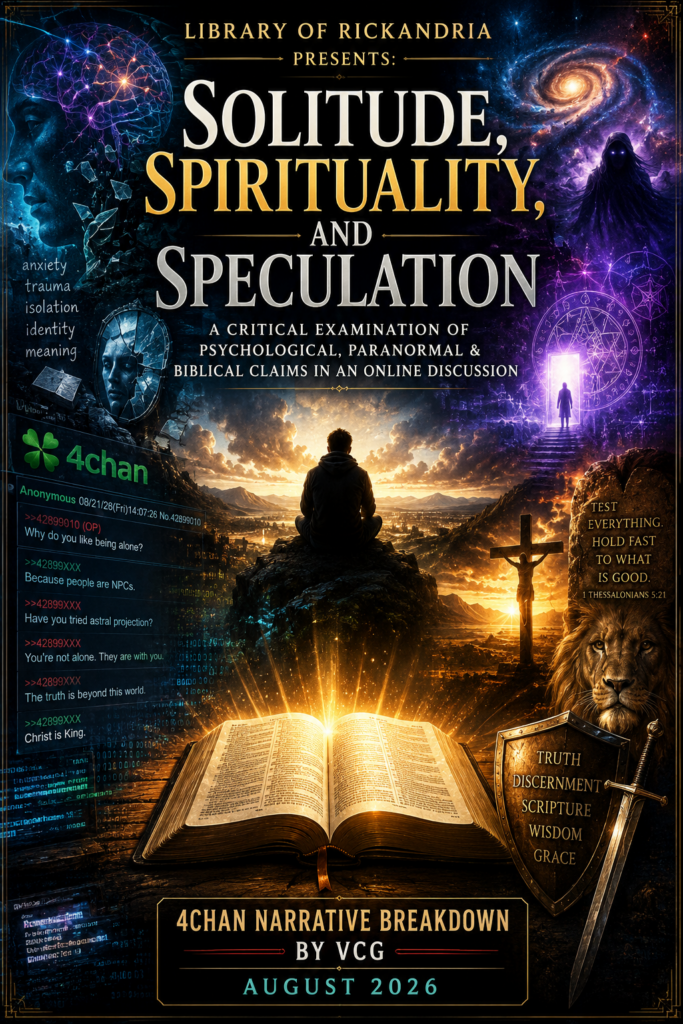
UPDATED BY VCG ON 8/31/2026 @ 23:23 EST
I want to share a heartfelt cause with my audience. Conner Blaisdell-Greene, a brave Airforce Sr. Airman, recently lost his battle with cancer, leaving his family in financial distress. Every donation, no matter how small, can help cover his funeral costs and ease their burden during this difficult time. Please consider clicking the link below to contribute or share Conner’s story with others. Your support truly matters.
Until We Meet Again
Spoken Tribute
Abstract
A short question posted to 4chan’s /x/ — Paranormal board on August 31, 2026, asks whether there are “paranormal implications” to having no close friends. What follows is a compact example of how an ambiguous human experience can rapidly accumulate competing explanations. Within a few replies, the same condition—having few or no close friendships—is interpreted as autism, low social intelligence, ordinary male aging, psychological trauma, exceptional status, occult development, “astral singularity,” Hermeticism, heightened self-knowledge, and spiritual integration.
This paper examines the thread post by post. Its purpose is neither to ridicule paranormal belief nor to medicalize solitude. Instead, it asks a more basic question: what does the available evidence actually allow us to conclude? Psychological research is used to distinguish solitude from loneliness, interpersonal skill from friendship count, correlation from diagnosis, and healthy reflection from rumination. Historical sources are used where the thread invokes the Hermit Tarot card and Hermeticism. Scientific claims concerning dissociation, interpersonal “energy,” and psychedelics are evaluated according to the quality and relevance of the evidence. Finally, the thread’s spiritual claims are compared with the King James Bible in context rather than by isolated proof-texting.
The central conclusion is modest but important: having no close friends, considered by itself, does not establish a paranormal identity, psychiatric diagnosis, superior intelligence, trauma history, deficient masculinity, spiritual maturity, or occult condition. Scripture likewise refuses both extremes. It contains purposeful solitude and serious warnings against uncritical human dependence, while also presenting friendship, fellowship, mutual burden-bearing, and love as positive goods. The more useful question is therefore not merely Why is this person alone? but What causes the solitude, how freely is it chosen, what effects does it have, and what kind of fruit does it produce?
Primary sources: the live 4chan thread and the supplied Pure Cambridge Edition of the King James Bible. (4chan)
1. Introduction: One Fact, Many Stories
The thread begins simply enough. An anonymous poster asks whether there are paranormal implications to having no friends—not literally knowing nobody, but having acquaintances without close companions with whom much time is spent. The poster asks what this condition “says about you” and why someone might be “perpetually alone.” The next reply adds an important piece of information: the person does not really feel lonely. (4chan)
What happens next is more revealing than any single answer.
One poster says the explanation is autism and NEET status. Another says low “social intelligence.” Another suggests ordinary people do not have genuine friends anyway. Another says this is simply what naturally happens to men as they age. Another proposes childhood trauma and dissociation. Another invokes the hermit and Hermeticism. Still another declares the person an “astral Singularity.” The final reply turns the absence of friends into evidence of unusual spiritual integration and introduces claims about energy exchange, vibration, psychedelics, and people disappearing from one’s “reality” once they have been sufficiently integrated. (4chan)
That gives us an unusually useful case study.
The same observation—
a person has few or no close friends
—is treated as evidence for mutually incompatible theories.
If the evidence supposedly demonstrates social deficiency, superior development, trauma, normal masculinity, occult identity, and spiritual wholeness at the same time, something has gone wrong in the reasoning. The observation is not selecting between theories. Instead, different posters are projecting their preferred explanatory frameworks onto a fact that is too underspecified to bear that weight.
This does not mean every comment is entirely wrong. Several contain a legitimate observation. Trauma really can affect later relationships. Social skills really matter. Men and women do show some average differences in friendship patterns. Chosen solitude can be meaningful. Reflection can lead to insight.
The problem is the move from:
“X sometimes contributes to Y”
to:
“You display Y; therefore X explains you.”
That distinction will recur throughout this paper.
2. Methodology: How the Thread Will Be Evaluated
A subject that mixes psychology, spirituality, anonymous testimony, occult language, and Scripture needs more than one kind of analysis. It also requires some restraint.
2.1 The primary-source problem
The thread itself is a primary source only for one thing: what anonymous users wrote.
It does not independently establish that:
the poster has literally no friends;
the poster has never felt lonely;
another poster truly knows someone with an IQ of 160;
any participant has accurately described his or her own psychological condition;
any alleged paranormal experience occurred.
Anonymous testimony may be sincere. It can be studied as testimony, rhetoric, interpretation, or evidence of what someone believes. It should not automatically be promoted into verified fact.
The thread retrieved for this analysis contains the original post at No. 42899010 followed by replies through No. 42899581. (4chan)
2.2 Categories used in this paper
To keep different questions from being blurred together, claims will be separated into several categories.
Historical claims concern origins, texts, terminology, and documented traditions—for example, whether “hermit” and “Hermeticism” share an origin.
Scientific or psychological claims concern measurable associations, behavior, cognition, diagnosis, pharmacology, or population-level patterns.
Methodological claims concern whether a conclusion follows from its evidence.
Interpretations may be plausible without being established facts.
Metaphysical claims concern realities such as spirits, astral conditions, occult energies, or cosmic vibration. Scientific research may test particular measurable versions of such claims, but science should not pretend that failing to verify one proposed mechanism logically disproves every conceivable spiritual reality.
Biblical claims are a separate category again. The relevant question is not whether a modern psychological study “proves the Bible,” but whether the doctrines being attributed to Scripture are actually present in the text and consistent with its context.
That distinction protects both science and theology from being made to say more than they can.
2.3 Evidence hierarchy
When evaluating psychological or scientific statements, greater weight is given to systematic reviews, meta-analyses, peer-reviewed studies, national scientific or medical institutions, and established diagnostic criteria than to anecdotes or assertions.
Historical claims are evaluated using primary historical sources where useful, along with reliable lexical and reference material.
The biblical section uses the King James Bible supplied for this project.
2.4 Correlation is not diagnosis
This point is especially important.
Suppose research finds:
people exposed to childhood maltreatment have, on average, higher rates of dissociative symptoms.
That finding does not license this reasoning:
this person appears socially withdrawn; therefore he was maltreated.
The first is a statistical association. The second is an individual diagnosis made without sufficient evidence.
The same applies to sex differences, personality differences, friendship patterns, social intelligence, or loneliness.
2.5 A biblical methodological principle
Long before modern research methodology, Proverbs warns against reaching conclusions before adequately hearing a matter:
“He that answereth a matter before he heareth it, it is folly and shame unto him.” — Proverbs 18:13
That verse should not be turned into a modern scientific-method proof-text. Its immediate subject is wise judgment and speech.
But the principle fits the present problem remarkably well:
conclusions should follow adequate understanding rather than precede it.
Proverbs 20:5 adds:
“Counsel in the heart of man is like deep water; but a man of understanding will draw it out.”
The image is instructive. What is within another person is not automatically obvious from one outward fact. Understanding requires drawing matters out.
3. The Original Question: Does Having No Friends Mean Something Paranormal?
The original poster asks whether there are paranormal implications to having acquaintances but no close friends. (4chan)
The scientifically responsible answer is straightforward:
friendship scarcity by itself does not provide evidence for a paranormal cause.
That statement is narrower than saying “nothing paranormal exists.” Those are different propositions.
A scientific investigation would need some identifiable phenomenon that distinguishes the paranormal hypothesis from ordinary explanations.
For example:
- What specifically happens to people who have this alleged paranormal condition?
- How does it differ from voluntary solitude?
- What measurable prediction follows?
- What evidence would count against the hypothesis?
- Can observers distinguish affected individuals from controls without already knowing who is socially isolated?
Without something like that, “paranormal” is not functioning as an explanation. It is merely a possible label placed over an unexplained circumstance.
The distinction between testable and non-testable claims is not quite as simple as “falsifiable = science, unfalsifiable = nonsense.” Philosophy of science has spent decades debating the demarcation problem, and Karl Popper’s famous falsifiability criterion has itself received substantial criticism. Still, one enduring point is useful here: empirical explanations should expose themselves to possible observations that could conflict with them rather than interpreting every possible outcome as confirmation.
Science and Pseudo-Science (Stanford Encyclopedia of Philosophy)
4. “I Don’t Really Ever Feel Lonely”: Solitude Is Not the Same as Loneliness
The first clarification in the thread may be its most important: the poster says he does not really feel lonely. (4chan)
Psychology makes essentially the same distinction.
The National Institute on Aging distinguishes social isolation, an objective condition involving separation or limited social contact, from loneliness, the subjective distress of feeling alone or disconnected. A person can experience loneliness while surrounded by others and can spend substantial time alone without feeling lonely. CDC material similarly distinguishes isolation from the subjective experience of loneliness and notes that low social connection can still have health implications even in someone who does not report loneliness.
Social isolation, loneliness in older people pose health risks | National Institute on Aging
That distinction prevents two opposite mistakes.
The first mistake is:
“You spend a lot of time alone, therefore you must secretly be miserable.”
Not necessarily.
The second is:
“You do not feel lonely, therefore the quantity and quality of your relationships can have no relevance to your health or functioning.”
That does not follow either.
Research on solitude has also become more precise about why someone is alone. Nguyen, Weinstein, and Ryan distinguish self-determined motivation for solitude—valuing time alone for personally meaningful reasons—from simply preferring isolation over company. In their diary studies, autonomous functioning predicted self-determined motivation for solitude; interestingly, simple introversion did not automatically predict enjoying solitude.
That gives us a much better starting question than
“alone: good or bad?”
We should ask:
Is the solitude freely chosen, meaningful, flexible, and compatible with healthy functioning—or is it unwanted, fear-driven, rigid, and impairing?
Those conditions may look similar from the outside while being psychologically very different.
5. Biblical Solitude: Jesus Withdrew, but Did Not Build a Theology of Isolation
Scripture gives no basis for declaring all solitude pathological.
Luke says of Jesus:
“And he withdrew himself into the wilderness, and prayed.” — Luke 5:16
Mark similarly records Jesus departing to a solitary place to pray before returning to active ministry.
The pattern is significant:
withdrawal → prayer → return to people and service.
Biblical solitude can therefore be purposeful. Silence, prayer, wilderness, contemplation, and withdrawal from crowds are not inherently suspicious.
Yet this cannot be stretched into the claim that increasing holiness necessarily means decreasing human relationship.
Jesus withdrew from people, but he also chose disciples, ate with others, taught crowds, entered homes, wept with mourners, loved particular individuals, and established a community.
The biblical pattern is neither compulsory sociability nor radical self-sufficiency.
6. Post 42899090: “Autistic NEET Manchild”
A later reply dismisses the original poster as an autistic “NEET manchild.” (4chan)
This sounds explanatory because it contains labels. But each part needs to be examined separately.
6.1 Autism
Difficulty forming or maintaining relationships can occur in autism spectrum disorder. But that is not remotely enough for a diagnosis.
CDC’s presentation of DSM-5 criteria requires persistent deficits across the social-communication domain plus restricted or repetitive patterns of behavior or interests, developmental history, clinically significant impact, and appropriate consideration of other explanations.
Clinical Testing and Diagnosis for Autism Spectrum Disorder | Autism Spectrum Disorder (ASD) | CDC
“No close friends”
does not establish those criteria.
Someone might lack close friendships because of social-communication difficulties. But the identical outcome might also arise from work conditions, relocation, caregiving, introversion, unusual interests, disappointment, grief, social anxiety, deliberate selectivity, poor local opportunity, or numerous other causes.
This is the difference between a possible explanation and an established diagnosis.
6.2 NEET
The term “NEET” has an actual socioeconomic meaning: someone not in employment, education, or training. OECD uses the category in precisely that sense.
Youth not in employment, education or training (NEET) | OECD
Friendship status provides no information about whether the original poster is employed or enrolled in education or training.
So the NEET label is not merely unsupported. It is logically unrelated to the evidence supplied.
6.3 “Manchild”
“Manchild” is not a diagnostic category.
It is an insult.
That matters methodologically because contempt can mimic analysis. Once an individual has been socially downgraded, readers may feel as though the case has been explained when all that has happened is a change in emotional framing.
The reply therefore commits two errors at once:
remote diagnosis and ad hominem dismissal.
It may be possible that the original poster has a psychological condition. The thread does not give us enough information to determine that.
7. Post 42899338: Social Intelligence, the 160-IQ Anecdote, and Spirits
The next substantial reply is more complicated. It says the poster has low social intelligence, recounts knowing a person with an IQ of 160 who was bad with people, recommends observing people and inferring their thoughts and feelings, then claims social intelligence helps “unlock higher intelligence” and enables communication with spirits. (4chan)
Those claims should be separated rather than accepted or rejected as one package.
7.1 Social intelligence is a meaningful idea
Research does recognize interpersonal capacities involving social perception, interpretation of verbal and nonverbal signals, communication, relationship-building, self-regulation, and adaptation to feedback. A National Research Council workshop review notes that overlapping constructs have been called social skills, social competence, people skills, or “social intelligence.” It also emphasizes that effective interpersonal behavior involves continual adjustment based on how others respond.
Assessing Interpersonal Skills – Assessing 21st Century Skills – NCBI Bookshelf
So the poster is not inventing the general idea that interpersonal competence exists.
7.2 But friendship count is not a social-intelligence test
The unsupported step is:
no close friends → low social intelligence.
Poor interpersonal functioning can certainly contribute to friendship loss.
But even if:
A can cause B,
we cannot infer:
B proves A.
A broken car can be caused by an empty fuel tank. Seeing a broken car does not prove the tank is empty.
Likewise, friendship scarcity has many possible causes.
7.3 The “160 IQ” story
The anecdote about a person with an IQ of 160 cannot be verified from an anonymous post.
Its underlying point is plausible: general cognitive ability and interpersonal competence are not identical. A person can be exceptionally capable in one domain and weaker in another.
But even if every detail of the story is true, one individual establishes possibility, not prevalence or causation.
The proper conclusion would be:
Very high cognitive test performance does not guarantee excellent interpersonal functioning.
That is considerably narrower than the rhetorical use of the anecdote.
7.4 “Guess what people think”
Here again the comment contains something sensible surrounded by something risky.
Understanding other people requires interpreting intentions, emotions, expectations, and social signals. Researchers even use terms such as mental-state attribution or “mindreading” in a technical sense for this capacity.
But healthy social inference should be calibrated.
Notice what the National Research Council summary emphasizes: effective interpersonal behavior continually corrects itself according to other people’s responses.
Assessing Interpersonal Skills – Assessing 21st Century Skills – NCBI Bookshelf
In practical language:
Observe.
Form a tentative hypothesis.
Ask questions.
Listen.
Compare your interpretation with the person’s actual response.
Revise.
That is very different from silently guessing what everyone thinks and then treating those guesses as facts.
Proverbs 20:5 again offers a strikingly compatible principle: understanding draws counsel out of another person rather than presuming omniscient access to the heart.
7.5 “Unlocking higher intelligence”
The claim that social intelligence
“unlocks higher intelligence”
is too vague to evaluate scientifically.
What is “higher intelligence”?
If the writer means that interpersonal competence broadens learning, perspective-taking, collaboration, and access to information, that is plausible.
If “higher intelligence” refers to a distinct supernatural cognitive level, the poster would need to define it and provide evidence.
Without definition, the phrase sounds explanatory without giving us something testable.
7.6 Communication with spirits
The final step—social intelligence enables communication with spirits—is not supported by the interpersonal-skills evidence.
Nothing in the research cited above establishes a progression:
social perception → higher intelligence → spirit communication.
That chain is added by the poster.
Science should not overreach and say,
“therefore no spiritual beings could possibly exist.”
That is a different philosophical claim.
But we can say:
the proposed causal connection has not been demonstrated.
Biblical correction
Scripture does not teach Christians to refine social intuition as a technique for contacting spirits.
Deuteronomy 18, in the context of Israel entering the land and being forbidden to imitate surrounding occult practices, prohibits divination and lists the “consulter with familiar spirits,” wizard, and necromancer among forbidden practices.
Isaiah 8 gives an equally important contrast:
“should not a people seek unto their God? for the living to the dead?”
followed immediately by:
“To the law and to the testimony…”
The context concerns pressure to seek mediums and familiar spirits rather than receiving God’s word.
First John 4:1 is also relevant, but its context must be respected:
“Beloved, believe not every spirit, but try the spirits whether they are of God:
because many false prophets are gone out into the world.”
John’s immediate test concerns false prophets and the confession of Jesus Christ coming in the flesh. The passage is therefore not a handbook for recreational spirit contact. It is a warning against spiritual deception.
The thread encourages acquiring a supposed capacity for contact.
The biblical posture is fundamentally different: seek God, reject forbidden consultation, and test claims rather than admiring them merely because they sound spiritual.
8. Post 42899369: “Normal People Have No True Friends”
Another reply claims that ordinary people have no genuine friends, only acquaintances. (4chan)
There is no evidence offered for the generalization.
Psychologically, however, the statement illustrates an interesting rhetorical move: the apparent disadvantage of having few relationships is transformed into evidence of authenticity.
The categories become:
few friends = deep/authentic
and
many friends = shallow/ordinary.
This kind of inversion can protect identity because an unwanted or stigmatized condition becomes proof of elite status.
That does not prove the anonymous poster consciously uses friendship beliefs defensively. We should not psychoanalyze an unknown person from one sentence.
The more defensible point is about the logic of the claim: it turns social scarcity into superiority without supplying evidence.
Research does not support the idea that friendship itself is merely fake. Longitudinal work has found that positive friendship quality predicts better later health, and a large British cohort study found friendship networks relevant to psychological well-being in both men and women.
Friendship trajectories and health across the lifespan – PubMed
Scripture is similarly capable of distinguishing superficial companionship from genuine friendship without abolishing the category.
“A friend loveth at all times, and a brother is born for adversity.” — Proverbs 17:17
Proverbs 27 describes both faithful correction and constructive friendship:
“Faithful are the wounds of a friend…”
and later:
“Iron sharpeneth iron; so a man sharpeneth the countenance of his friend.”
The Bible therefore does not teach that every person called a friend is trustworthy.
But it plainly teaches that genuine friendship is possible.
9. Post 42899395: Women Keep Friends; Men Naturally Lose Them
The next reply mocks concern about friendship as feminine, says women tend to keep more friendships in later life, and claims men naturally drift apart until coworkers are essentially all that remain. (4chan)
This deserves more nuance than simple dismissal.
9.1 There is a real descriptive signal
Research has found sex differences in friendship patterns, particularly later in life.
A longitudinal study of older adults found more pronounced decline among men than women on several friendship measures in advanced old age. Other work has found older women more likely to maintain some forms of network connectedness outside the household.
So the poster’s observation did not arise from nowhere.
9.2 The leap to “natural and inevitable” is not justified
Average differences between groups do not create laws for individuals.
A study showing that older men on average maintain fewer intimate friendships than older women does not mean:
every man will lose his friends;
men are biologically intended to have no close friends;
wanting friendship indicates femininity;
friendship is irrelevant to male well-being.
Indeed, the British cohort study by Cable and colleagues found that smaller friendship networks were associated with poorer later psychological well-being and concluded that friendship networks were important for both men and women.
The error is turning:
a population tendency
into:
a normative command.
Those are entirely different propositions.
9.3 Masculinity policing
The reply does more than describe men. It tells the reader how a man is permitted to feel.
Need for connection is framed as shameful and feminine.
That can produce a self-reinforcing pattern:
loss of friendship → desire for connection → shame about that desire → less outreach → additional isolation.
One must be careful here. This is a logical and psychological pathway, not a diagnosis of the poster who wrote the comment.
Biblical correction
There is no biblical doctrine that masculinity consists in needing nobody.
Ecclesiastes 4 begins with a solitary worker and then argues:
“Two are better than one; because they have a good reward for their labour.”
“For if they fall, the one will lift up his fellow…”
and:
“a threefold cord is not quickly broken.”
The immediate setting is practical life under the sun, not a treatise on modern friendship psychology. Still, the point is unmistakable: mutual support can be a strength.
Paul likewise commands:
“Bear ye one another’s burdens, and so fulfil the law of Christ.” — Galatians 6:2
Nothing in that command is coded as feminine weakness.
10. Post 42899421: “Special and Better Than Everyone Else”
A short reply says having no friends means the individual is “special and better than everyone else.” (4chan)
It may be sarcasm. The medium makes tone difficult to establish.
But if taken literally, it represents one of the thread’s recurring temptations: turning social isolation into exceptional status.
A circumstance that might otherwise create uncertainty—
“Why do I not connect with people?”
—is transformed into:
“Because I am above them.”
Research on compensatory control is relevant here, though it must not be overapplied. Experimental work suggests that threats to perceived control can sometimes increase people’s tendency to perceive order, structure, or patterns in ambiguous environments and can influence supernatural or conspiratorial interpretations.
Compensatory Control – Current Directions in Psychological Science – APS
That literature does not prove that this poster, the original poster, or spiritually minded people in general are “compensating.” Applying a population-level psychological mechanism to anonymous individuals without assessment would repeat the thread’s own mistake.
It does, however, demonstrate something more limited: humans are capable of constructing larger explanatory structures when circumstances feel uncertain or uncontrolled.
The biblical concern is less speculative.
Paul writes:
“For if a man think himself to be something, when he is nothing, he deceiveth himself.” — Galatians 6:3
And Philippians says:
“Let nothing be done through strife or vainglory; but in lowliness of mind let each esteem other better than themselves.”
Whatever spiritual maturity means biblically, self-declared superiority over humanity is a very poor measure of it.
11. Post 42899440: The Best Question in the Thread
One poster simply asks what the OP means and how often he actually talks to people. (4chan)
This unglamorous question may be the most methodologically responsible reply in the thread.
Why?
Because it requests more data.
Before diagnosing:
- social intelligence
- trauma
- autism
- spiritual integration
or anything paranormal, a careful inquiry would ask questions such as:
- How often does the person interact socially?
- Are acquaintances frequent and meaningful despite not being called “friends”?
- Is the solitude chosen?
- Does the individual desire closer relationships?
- Has this always been the case?
- Did a particular event change the pattern?
- Are family relationships close?
- Can the person maintain intimacy when he wants to?
- Is the situation distressing?
- Does it impair work or ordinary functioning?
- Does he repeatedly lose friends after conflict?
- Are there practical barriers to maintaining relationships?
Different answers would suggest entirely different explanations.
This is precisely why Proverbs’ warning about answering before hearing the matter is so pertinent.
The least dramatic comment is the one most closely resembling responsible assessment.
12. Post 42899447: “Astral Singularity”
Another reply declares:
“You are an astral Singularity.”
(4chan)
As an explanation, this fails at the definition stage.
Before deciding whether an astral singularity exists, we would need to know what the term means.
Questions immediately arise:
- What properties define one?
- How is one identified?
- Is the category taken from a particular occult system?
- Does that system have a stable historical definition?
- What distinguishes an astral singularity from an ordinary solitary person?
- What effects should follow?
- What observations would count against the identification?
None are supplied.
This illustrates mystification by relabeling.
Suppose someone asks why a machine stopped running and receives the answer:
“Because it entered a mechanical singularity.”
Unless the new term identifies a mechanism, renaming the unexplained condition has not explained it.
Likewise:
solitary person → astral singularity
adds atmosphere, not evidence.
There is also no biblical category called an astral singularity.
That does not mean Scripture contains a modern technical label for every real phenomenon. It means one should not present a term absent from Scripture as though it were established Christian doctrine.
13. Post 42899454: Trauma, Numbness, and Dissociation
The trauma reply is one of the more serious contributions because it contains a genuine research-based possibility.
The poster argues that trauma cuts people off, leading children to isolate and emotionally “hollow out,” after which numbness is mistaken for Stoicism even though the person is actually dissociated. (4chan)
13.1 What the evidence supports
Childhood maltreatment really is associated with later dissociative symptoms.
A meta-analysis by Lyssenko and colleagues examined 65 studies involving 7,352 abused or neglected individuals and found higher dissociation scores in maltreated groups than comparison groups, with variation according to maltreatment type and characteristics.
Dissociation in victims of childhood abuse or neglect: a meta-analytic review – PubMed
Likewise, a 2025 systematic review and meta-analysis by Curtis and colleagues examined adverse childhood experiences and adult loneliness. Twenty studies met inclusion criteria, and cumulative adversity showed a statistically significant association with later loneliness, with a pooled correlation of approximately r = .30, while the authors emphasized heterogeneity and the need for further rigorous research.
Adverse childhood experiences and loneliness: A systematic review and meta-analysis – ScienceDirect
So the thread has touched a real area of psychological research.
Childhood adversity can contribute to:
later interpersonal difficulties,
loneliness,
emotional numbing,
altered attachment patterns,
and dissociative symptoms.
13.2 What the evidence does not support
None of those findings allows us to infer from “few friends” that the original poster:
experienced childhood trauma;
is emotionally hollow;
is numb rather than content;
has mistaken pathology for philosophy;
is “completely dissociated.”
That is an individual diagnosis built from a population association.
The distinction can be expressed simply:
Trauma may increase the probability of later isolation.
It does not follow that:
Isolation proves trauma.
13.3 Stoicism and numbness
The poster also uses “stoic” as shorthand for emotional suppression.
That is too crude historically and psychologically.
But even without entering a full study of classical Stoicism, there is an important biblical point: spiritual maturity is not the extinction of emotion.
Scripture contains:
- grief
- joy
- compassion
- anger
- lamentation
- affection
- fear
- hope
- longing
- weeping
Paul can be content in hardship while also expressing intense affection for other believers.
In Philippians he says he has them “in my heart” and greatly longs after them.
Biblical self-control therefore should not be confused with emotional vacancy.
14. Post 42899482: “Hermit? Hermeticism”
A poster then asks whether the reader has heard of the term “hermit” and immediately invokes “hermeticism.” (4chan)
This creates an etymological association that does not hold.
14.1 The word “hermit”
Merriam-Webster traces hermit through Middle English and Anglo-French to Late Latin eremita and Greek erēmitēs, associated with living in the desert or desolate place.
HERMIT Definition & Meaning – Merriam-Webster
The word is historically connected with withdrawal into wilderness.
14.2 “Hermetic”
Hermetic, by contrast, derives from Hermes Trismegistus. Merriam-Webster defines the historical religious sense in relation to mystical and alchemical writings attributed to Hermes Trismegistus and traces the word through Medieval Latin hermeticus.
HERMETIC Definition & Meaning – Merriam-Webster
So, despite their resemblance in modern English:
hermit and Hermetic do not have the same etymological origin.
The association is understandable because “hermetic” can now also mean closed-off, sealed, or even solitary in extended usage. But the occult-philosophical term and the word for a recluse did not originate as the same concept.
Therefore:
person lives like a hermit → therefore Hermeticism
is historically invalid.
15. The Hermit Tarot Card: Even the Occult Source Is More Complicated
The reply saying
“I don’t really ever feel lonely”
includes an image of The Hermit, the ninth Major Arcana card from the Rider-Waite-Smith Tarot. (4chan)
The historical interpretation is interesting because it does not cleanly support the later thread’s idea of spiritual isolation as protection from interpersonal “energy.”
In The Pictorial Key to the Tarot, A. E. Waite describes the Hermit in terms of attainment and the elevated bearer of a light or beacon. More strikingly, Waite explicitly criticizes an interpretation connecting the Hermit with occult isolation for the protection of “personal magnetism” from admixture.
The Pictorial Key to the Tarot: Part II: The Doctrine Beh… | Internet Sacred Text Archive
That does not make Waite a biblical authority. He was writing within an occult interpretive tradition.
But historically it matters because the thread’s later energy-isolation theory should not be casually projected backward onto the card as though it were simply the traditional meaning.
Even within Tarot interpretation, there were disagreements.
Biblical distinction
A picture of a Tarot card is not automatically the same act as divination.
A person can discuss, reproduce, collect, or historically analyze a Tarot image without asking it to reveal hidden information.
If the card is used for divination, however, the relevant biblical issue changes. Deuteronomy 18’s prohibition of divination then becomes directly pertinent.
That distinction is important:
historical study of occult material is not identical to occult practice.
16. Post 42899501: Alone Is Not Lonely, and Solitude May Aid Reflection
The next thoughtful reply says being alone and being lonely are different, rejects paranormal implications, and proposes that solitude can give someone more opportunity to reflect and understand himself. It then argues that greater self-understanding reveals how different one is and usually makes connection harder. (4chan)
The first half is considerably stronger than the second.
16.1 Alone and lonely are indeed different
As already discussed, this distinction is well established.
Social isolation, loneliness in older people pose health risks | National Institute on Aging
16.2 Solitude can support reflection
Chosen solitude can provide time for contemplation, self-directed thought, creative work, decompression, or prayer. Research on self-determined solitude supports the idea that time alone can be experienced as meaningful rather than merely as deprivation.
So, the thread is right not to assume that all solitude is psychologically defective.
16.3 But reflection does not guarantee insight
This is the crucial qualification.
Spending more time thinking about oneself can produce genuine insight.
It can also produce rumination.
Harrington and Loffredo studied different forms of private self-focused attention and found that insight positively predicted multiple aspects of well-being, whereas rumination negatively predicted several of them; simple reflection had a much more limited positive relationship.
Insight, rumination, and self-reflection as predictors of well-being – PubMed
That gives us a useful distinction:
time thinking about yourself ≠ accurate self-knowledge.
A solitary person may discover important truths.
A solitary person may also repeat the same false story until repetition feels like evidence.
The value lies not merely in self-focus, but in whether the process produces accurate insight.
16.4 Does self-knowledge usually make connection harder?
The thread does not establish that.
Greater self-knowledge might make a person more selective because he better recognizes incompatibility.
But it could also improve relationships by helping someone:
recognize triggers;
understand personal limitations;
communicate boundaries;
detect recurring mistakes;
apologize more clearly;
understand what kinds of people are compatible;
and distinguish genuine differences from imagined ones.
So
“self-knowledge usually isolates you”
is far too strong.
Biblical balance
The biblical model again combines inward and outward life.
Jesus withdraws and prays.
Yet Hebrews tells believers:
“let us consider one another to provoke unto love and to good works”
and warns against forsaking their assembling, urging mutual exhortation.
Hebrews 10:24–25 should not be distorted into
“an introverted Christian must constantly socialize.”
The context is perseverance in Christian confession and mutual encouragement.
But the passage does make one thing difficult to defend:
a theology in which spiritual maturity culminates in needing no meaningful fellowship whatsoever.
17. Post 42899581: “Whole,” “Integrated,” and Beyond the Need for Other People
The last substantial reply is the most elaborate metaphysical system in the thread.
It says having few friends is good because the person is sufficiently “whole/integrated” that he does not need to “energy transfer” with many people. It then compares this with psychedelics, claiming people “vibrationally attract” them because their minds need to be cracked open, whereas the writer personally never required psychedelics because he was “born that way.” Finally, it argues there is no real need to miss absent people because they cease to appear in one’s reality once they have been sufficiently integrated. (4chan)
Each part needs its own examination.
18. Does Lack of Friendship Prove Psychological or Spiritual Integration?
No evidence is supplied for that inference.
Psychological integration is not measured by the number of friends a person lacks.
An emotionally mature person may maintain many relationships.
Another emotionally mature person may maintain only a handful.
A traumatized person may be highly social.
Another traumatized person may withdraw.
A lonely person may have dozens of acquaintances.
A contented person may live alone.
The outward social fact is therefore underdetermined.
The earlier research on friendship reinforces this. Positive friendship quality can be associated with health and well-being, while simply counting relationships tells us much less than their quality and function.
Friendship trajectories and health across the lifespan – PubMed
Thus:
few friends → spiritually integrated
has no more evidentiary warrant than:
few friends → psychologically defective.
They are opposite stories built on the same inadequate evidence.
19. “Energy Transfer”: Metaphor or Measurable Claim?
The term energy is notoriously slippery in spiritual discussions because it can refer to very different things.
If someone says:
“Talking to that person gave me energy,”
he may simply mean:
- encouragement
- stimulation
- affection
- motivation
or emotional arousal.
That is ordinary metaphor.
If the claim is instead that an invisible substance or field passes between people and that socially “integrated” individuals require less of it, then we have a proposed mechanism.
At that point reasonable questions include:
- What kind of energy?
- In what units?
- How is it detected?
- What transfers it?
- What measurable difference appears before and after?
- What distinguishes it from ordinary psychological effects?
Comparable claims have been investigated in some “biofield” healing traditions. For example, the NIH’s National Center for Complementary and Integrative Health notes that Reiki is premised on a proposed energy field but states that there is no scientific evidence supporting the existence of that purported field.
That finding does not directly test the 4chan poster’s undefined “energy transfer.”
It therefore would be invalid to say:
Reiki’s proposed energy field lacks evidence; therefore every possible spiritual meaning of “energy” is disproved.
The narrower conclusion is enough:
the poster has not defined or demonstrated the energy mechanism being invoked.
When ordinary vocabulary—attention, attachment, stimulation, affection, stress, co-regulation—already describes observable interpersonal processes, adding “energy” does explanatory work only if the additional phenomenon can be identified.
20. Psychedelics and “Vibrational Attraction”
The poster then proposes that people “vibrationally attract” psychedelics because their minds require cracking open.
This statement blends two separate questions.
First:
Why do psychedelic drugs alter consciousness?
Second:
Why does a particular person become interested in using one?
Modern pharmacology has substantial evidence regarding the first question. A 2026 BMJ state-of-the-art review notes that characteristic subjective effects of classic psychedelics are driven principally through agonism at serotonin 5-HT2A receptors. Human pharmacological studies show receptor involvement, and pretreatment with the 5-HT2A antagonist ketanserin can almost entirely block characteristic psychedelic effects.
Psychedelic medicine: mechanisms, evidence, and translation to practice | The BMJ
That does not completely explain the phenomenology of psychedelic experiences, much less every personal or cultural reason someone seeks them.
But it does demonstrate that we have an evidence-based biological mechanism for major features of the drug effect.
The separate claim—
a person encounters psychedelics because the universe or some metaphysical process vibrationally attracts the drug into his life when his consciousness requires expansion—
would need independent evidence.
No such evidence appears in the thread.
The known pharmacology does not logically prove that no metaphysical dimension could exist.
But the existence of a drug’s psychological effects cannot itself be treated as proof of vibrational attraction.
That would be adding a causal story after the fact.
21. “I Never Needed Psychedelics Because I Was Born That Way”
The poster’s autobiographical claim may be sincere.
Someone may genuinely experience himself as naturally imaginative, spiritually sensitive, psychologically open, or able to enter unusual states without drugs.
What does not follow is the larger inference:
I experience myself this way → other people seek psychedelics because they lack the quality I possess.
That conclusion interprets everyone else’s behavior through the poster’s self-concept.
The risk is a self-confirming hierarchy:
- I do not need the substance because I am already advanced.
- Other people need it because they are closed.
- My difference therefore confirms my superiority.
Again, that is analysis of the argument.
It would be irresponsible to diagnose the anonymous writer with a psychological disorder from one paragraph.
22. “People Don’t Show Up in Your Reality Because You Integrated Them”
This claim is particularly difficult because it appears capable of absorbing every possible outcome.
Suppose someone remains in your life.
The theory could say that person is still needed.
Suppose the person leaves.
The theory can say the integration is complete.
Suppose you miss the person.
The theory can say integration is incomplete.
Suppose you do not miss the person.
The theory can say integration succeeded.
When every imaginable result can be reinterpreted as confirmation, the explanation becomes resistant to correction.
This is why testability matters.
The point is not that all metaphysics must look exactly like laboratory physics. Many meaningful philosophical claims are not scientific hypotheses.
The problem appears when a metaphysical claim is presented as a causal explanation of observable events while no conceivable observation is allowed to count against it.
23. Scripture and the Claim That the Spiritually Whole Do Not Need to Miss Anyone
The biblical witness does not support the idea that emotional attachment to others indicates incomplete spiritual development.
Paul repeatedly expresses affection and longing.
In Philippians 1 he writes:
“I have you in my heart”
and says:
“how greatly I long after you all in the bowels of Jesus Christ.”
The language is not embarrassment over attachment.
It is Christian affection.
First John likewise makes love of fellow believers central rather than obsolete:
“Beloved, let us love one another: for love is of God…”
And Galatians instructs believers to bear one another’s burdens.
The biblical correction is not that Christians must become emotionally dependent upon every person.
Human beings can certainly be idolized.
Relationships can become controlling, possessive, or spiritually disordered.
But Scripture’s solution is not:
become so integrated that nobody’s absence matters.
The New Testament repeatedly depicts sanctified people caring deeply about one another.
24. The Thread’s Deeper Pattern: From Circumstance to Identity
Seen as a whole, the thread repeatedly moves through the same sequence.
Stage One: An ambiguous circumstance
“I do not have close friends.”
Stage Two: A search for meaning
“What does this say about me?”
Stage Three: Identity explanations
The thread supplies a menu:
socially defective;
autistic;
NEET;
low social intelligence;
intellectually gifted but interpersonally impaired;
ordinary male;
traumatized;
dissociated;
unusually self-aware;
spiritually superior;
Hermetic;
astrally singular;
completely integrated.
The dramatic feature is not merely that the answers disagree.
It is that almost every answer turns a relationship pattern into a statement about what kind of being the person fundamentally is.
That is a much larger claim.
It may be useful to describe this as a movement from circumstance to ontology.
A person’s friendship network becomes a secret diagnostic instrument for his essence.
But the thread never establishes that friendship count has that power.
25. Common Reasoning Errors Across the Discussion
Several reasoning patterns recur often enough to deserve names.
25.1 Affirming the consequent
If poor social skills can produce few friendships, it does not follow that few friendships prove poor social skills.
If trauma can contribute to isolation, isolation does not prove trauma.
If some autistic people struggle to maintain friendships, friendship difficulty does not establish autism.
25.2 Population averages treated as individual destiny
Even where men and women differ statistically in friendship patterns, averages do not dictate the history of a particular man.
Group-level findings answer questions about distributions.
They do not automatically diagnose individuals.
25.3 Anecdote promoted into evidence
The alleged 160-IQ acquaintance may be genuine.
Even so, anecdotes illustrate possibilities better than they establish general rules.
25.4 Mystification
Terms such as:
vibrational,
energy,
astral,
singularity,
higher intelligence,
integration
can be meaningful if carefully defined.
When they are undefined, however, they can give an explanation an appearance of depth without increasing its predictive power.
25.5 Self-sealing explanations
A theory becomes difficult to evaluate when every result confirms it.
Good inquiry should ask:
What would make me change my mind?
25.6 Remote diagnosis
The thread repeatedly assigns psychiatric or developmental explanations to a person about whom almost nothing is known.
That is methodologically weak regardless of whether the diagnosis later happens to be correct.
25.7 Status reversal
Several comments solve the discomfort of social isolation by reframing it as evidence of superiority.
That may feel empowering.
But a belief’s emotional usefulness does not establish its truth.
26. A Note on Psychological Meaning-Making
It would be too easy to mock the paranormal interpretations as though humans ordinarily respond to ambiguity with perfect objectivity.
They do not.
Psychological research on compensatory control suggests that when people’s sense of order or control is threatened, they can become more motivated to perceive structure in the world and, under some conditions, may increase reliance upon ideological, supernatural, institutional, or conspiratorial systems that provide order.
Compensatory Control – Current Directions in Psychological Science – APS
That does not mean:
spiritual belief is merely a pathology produced by lack of control.
Nor does it prove that the original poster’s paranormal question resulted from compensatory control.
Such conclusions would exceed the evidence.
What the research demonstrates is more modest and more useful: human beings are not neutral interpreters. We often want experiences to make sense.
That applies to skeptics as well as believers.
One person may prematurely spiritualize an unexplained event.
Another may prematurely pathologize it.
Both can be motivated by the desire for explanatory closure.
The solution is not to stop interpreting.
It is to become more disciplined about the difference between:
what we know, what we reasonably infer, and what we merely imagine.
27. Scripture’s Own Balance: Neither Isolation Worship nor Social Idolatry
The Bible’s position is considerably more balanced than either side of the thread.
Solitude exists
Jesus deliberately withdrew for prayer.
Quietness is not automatically pathological.
Friendship exists
“A friend loveth at all times…”
Friendship can sharpen character
“Iron sharpeneth iron; so a man sharpeneth the countenance of his friend.”
Mutual help is valuable
“Two are better than one…”
Christian fellowship matters
“let us consider one another to provoke unto love and to good works”
Mutual burden-bearing matters
“Bear ye one another’s burdens…”
Spiritual pride is rejected
“if a man think himself to be something, when he is nothing, he deceiveth himself.”
Occult consultation is forbidden
Deuteronomy 18 prohibits divination and consultation with familiar spirits.
Spiritual claims are to be tested
“believe not every spirit, but try the spirits whether they are of God…”
This is not a theology in which the ideal person dissolves all meaningful human attachments.
Neither is it a theology in which a person must be constantly surrounded by others to be spiritually healthy.
28. A Better Biblical Test: What Fruit Does the Solitude Bear?
This may be the most useful Christian correction to the thread.
Instead of asking:
“Does having no friends prove I am spiritually advanced?”
or:
“Does having no friends prove something is wrong with me?”
Scripture directs attention toward character and fruit.
Galatians describes:
“the fruit of the Spirit”
as:
“love, joy, peace, longsuffering, gentleness, goodness, faith, Meekness, temperance…”
That provides a much more useful set of questions.
What does the person’s solitude produce?
Does it help cultivate:
- love?
- patience?
- prayer?
- honesty?
- humility?
- wisdom?
- service?
- self-control?
Or does it increasingly produce:
- contempt?
- suspicion?
- resentment?
- grandiosity?
- fear?
- inability to tolerate correction?
- fascination with secret status?
- withdrawal from every form of accountability?
This does not mean good fruit proves every interpretation a person holds is correct.
Nor does difficult emotion prove spiritual failure.
It means Scripture evaluates spirituality by a very different standard from:
“I have fewer friends, therefore I must be more metaphysically integrated.”
29. What Can Actually Be Concluded About the Original Poster?
Very little—and that is not a failure of the investigation.
It is the honest result.
From the thread, we can reasonably say that the poster reports having acquaintances but few or no people considered close friends and says he does not generally feel lonely. (4chan)
We cannot establish from that information alone:
autism;
trauma;
dissociation;
social-intelligence deficits;
exceptional IQ;
low IQ;
spiritual advancement;
occult sensitivity;
paranormal influence;
masculinity problems;
narcissism;
emotional numbness;
or an astral identity.
A serious assessment would require far more information.
This is where intellectual humility matters.
Sometimes the most accurate answer to a fascinating question is:
we do not yet know.
30. Claim-by-Claim Findings
| Claim in the thread | Finding |
|---|---|
| Being alone means being lonely | False as a general rule. Isolation and loneliness are related but distinct. |
| A person can enjoy substantial solitude | Supported. Motivation and voluntariness matter. |
| No friends proves autism | Unsupported. Friendship difficulty alone does not satisfy diagnostic criteria. |
| No friends proves NEET status | Non sequitur. NEET refers to employment, education, and training. |
| Few friends prove low social intelligence | Possible explanation in some cases, but not established by friendship count. |
| A very high-IQ person can have poor interpersonal skills | Plausible; the specific anecdote remains unverified. |
| Social observation can improve interpersonal functioning | Reasonable if combined with feedback and correction. |
| Social intelligence unlocks “higher intelligence” | Undefined and unsupported as stated. |
| Social intelligence enables spirit communication | No evidence supplied; not part of established social-intelligence research. |
| Ordinary people have no real friends | Unsupported generalization. |
| Women may retain friendships differently from men in later life | Some empirical support at group level. |
| Men naturally end life with only work acquaintances | Overgeneralization. |
| Wanting friendship is unmanly | Cultural judgment, not a scientific finding or biblical teaching. |
| Having no friends proves exceptional superiority | Unsupported and contrary to biblical humility if taken literally. |
| Asking how often the person actually interacts with others is useful | Yes. This is one of the thread’s best methodological moves. |
| No friends means “astral singularity” | Undefined and unsupported. |
| Childhood trauma can contribute to dissociation and loneliness | Supported as an association. |
| Therefore the OP must be traumatized and completely dissociated | Unsupported individual diagnosis. |
| Hermit and Hermeticism are the same historical concept | False etymologically. |
| Solitude can aid reflection | Plausible and supported with qualifications. |
| More reflection automatically produces better self-knowledge | False. Reflection can become rumination; insight matters. |
| Greater self-knowledge usually makes relationships harder | Not established. |
| Few friends prove psychological/spiritual integration | Unsupported. |
| Humans exchange a scientifically established occult “energy” in relationships | Not demonstrated as stated. |
| Psychedelics are vibrationally attracted to people who need awakening | Unsupported metaphysical causal claim. |
| Classic psychedelic effects involve 5-HT2A receptor activity | Well supported. |
| People leave one’s reality because they have been spiritually integrated | Unfalsifiable as presented. |
| Spiritual maturity removes any need to miss people | Not supported by Scripture. |
31. Conclusion: Solitude Without Superstition
The most revealing feature of the thread is not any one strange claim.
It is how quickly an ordinary but deeply personal question becomes a contest between identities.
One fact—
“I do not have close friends”
—is turned into:
a diagnosis,
a gender theory,
a trauma narrative,
a superiority narrative,
an occult identity,
and finally a cosmology.
The research examined here supports a much less sensational conclusion.
Solitude and loneliness are not identical. Some people genuinely value time alone. Social connection nevertheless remains relevant to human well-being, and the quality of relationships matters. Trauma can influence later social and dissociative experiences, but social isolation cannot retrospectively diagnose trauma. Interpersonal competence is real, but the number of close friends a person possesses is not a standardized measure of social intelligence. Sex differences in friendship patterns exist at the population level but do not establish that male friendship is unnatural. Reflection can produce insight, but it can also become rumination. Psychedelic experiences have identifiable neuropharmacological mechanisms; adding “vibrational attraction” requires additional evidence rather than merely a more mysterious vocabulary.
Historically, the attempted connection between hermit and Hermeticism fails at the etymological level. Even the Rider-Waite-Smith Hermit image used in the thread has a more complicated interpretive history than the later “energy protection through isolation” narrative suggests.
HERMIT Definition & Meaning – Merriam-Webster
Scripture also resists simple answers.
Jesus withdrew into solitude and prayed.
Yet Scripture praises faithful friendship, mutual aid, fellowship, love, burden-bearing, humility, and concern for others.
It warns against occult consultation rather than presenting secret spirit contact as an advanced social skill.
And it tells believers not to believe every spiritual claim merely because someone makes it.
The Bible therefore gives no warrant for either extreme:
“I am alone, therefore I am spiritually defective.”
or:
“I am alone, therefore I have transcended ordinary humanity.”
A more careful question is:
Is this solitude freely chosen or fearfully maintained?
What created it? Is it flexible?
Does it impair the person’s life?
Does it permit genuine love?
Does it produce humility or superiority?
Does reflection result in insight or rumination?
And when spiritual explanations are proposed, can they withstand historical, logical, evidentiary, and biblical examination?
Those questions are less spectacular than declaring someone an astral singularity.
They are also far more likely to lead us toward truth.
And for a Christian investigation, that matters more than preserving either a skeptical or paranormal narrative.
“Buy the truth, and sell it not; also wisdom, and instruction, and understanding.” — Proverbs 23:23
References and Sources
Primary Sources
4chan. “Are there any paranormal implications to having no friends?” /x/ — Paranormal, thread No. 42899010, August 31, 2026. (4chan)
The Holy Bible, King James Version, Pure Cambridge Edition. Supplied research edition.
Waite, Arthur Edward. The Pictorial Key to the Tarot. London: William Rider & Son, 1911. The Hermit section is especially relevant because Waite explicitly discusses and rejects an “occult isolation” interpretation based on protecting personal magnetism. (Internet Sacred Text Archive)
Psychology, Social Connection, and Solitude
Cable, Noriko, Mel Bartley, Tarani Chandola, and Amanda Sacker. “Friends Are Equally Important to Men and Women, but Family Matters More for Men’s Well-Being.” Journal of Epidemiology & Community Health 67, no. 2 (2013): 166–171. doi: 10.1136/jech-2012-201113. (PubMed)
Centers for Disease Control and Prevention. “Health Effects of Social Isolation and Loneliness.” CDC Social Connectedness resources. (CDC)
Harrington, Rick, and Donald A. Loffredo. “Insight, Rumination, and Self-Reflection as Predictors of Well-Being.” Journal of Psychology 145, no. 1 (2011): 39–57. doi: 10.1080/00223980.2010.528072. (PubMed)
National Institute on Aging. “Social Isolation, Loneliness in Older People Pose Health Risks.” (National Institute on Aging)
National Research Council. Assessing 21st Century Skills: Summary of a Workshop. Washington, DC: National Academies Press, 2011. Chapter 3, “Assessing Interpersonal Skills.” (NCBI)
Nguyen, Thuy-vy T., Netta Weinstein, and Richard M. Ryan. “Who Enjoys Solitude? Autonomous Functioning (but Not Introversion) Predicts Self-Determined Motivation (but Not Preference) for Solitude.” PLOS ONE 17, no. 5 (2022): e0267185. doi: 10.1371/journal.pone.0267185. (PLOS)
Trauma and Dissociation
Curtis, Aisling, Martina Luchetti, Cian Prendergast, et al. “Adverse Childhood Experiences and Loneliness: A Systematic Review and Meta-Analysis.” Social Science & Medicine 370 (2025): 117860. doi: 10.1016/j.socscimed.2025.117860. (ScienceDirect)
Lyssenko, Lisa, et al. “Dissociation in Victims of Childhood Abuse or Neglect: A Meta-Analytic Review.” Psychological Medicine 48 (2018). The review incorporated 65 studies and 7,352 maltreated participants. (PubMed)
Friendship and Aging
Field, D. “Continuity and Change in Friendships in Advanced Old Age: Findings from the Berkeley Older Generation Study.” International Journal of Aging & Human Development 48, no. 4 (1999): 325–346. (PubMed)
Roberto, K. A., and P. J. Kimboko. “Friendships in Later Life: Definitions and Maintenance Patterns.” International Journal of Aging & Human Development 28, no. 1 (1989): 9–19. (PubMed)
Diagnostic and Socioeconomic Definitions
Centers for Disease Control and Prevention. “Clinical Testing and Diagnosis for Autism Spectrum Disorder.” Summary of DSM-5 diagnostic criteria. (CDC)
Organisation for Economic Co-operation and Development. “Youth Not in Employment, Education or Training (NEET).” (OECD)
History and Etymology
Merriam-Webster. “Hermit.” Etymology from Late Greek erēmitēs, associated with desert or desolate living. (Merriam-Webster)
Merriam-Webster. “Hermetic.” Etymology from Medieval Latin hermeticus, from Hermes Trismegistus; also summarizes the historical relationship of the term to mystical and alchemical writings. (Merriam-Webster)
Psychedelics and Proposed Energy Fields
Jacobs, Edward, Zarmeen Zahid, Jared Hinkle, Sandeep Nayak, and David B. Yaden. “Psychedelic Medicine: Mechanisms, Evidence, and Translation to Practice.” BMJ 392 (2026): e081723. doi: 10.1136/bmj-2024-081723. (BMJ)
National Center for Complementary and Integrative Health. “Reiki.” NCCIH notes the lack of scientific evidence for the proposed energy field underlying Reiki. This source is used only as a comparison with a defined biofield claim, not as a direct experimental test of the 4chan poster’s undefined “energy transfer.” (NCCIH)
Methodology and Psychology of Belief
Hansson, Sven Ove. “Science and Pseudo-Science.” Stanford Encyclopedia of Philosophy, substantive revision 2025. Discussion of falsifiability, the demarcation problem, and limitations of single-criterion approaches. (Stanford Encyclopedia of Philosophy)
Kay, Aaron C., Jennifer A. Whitson, Danielle Gaucher, and Adam D. Galinsky. “Compensatory Control: Achieving Order Through the Mind, Our Institutions, and the Heavens.” Current Directions in Psychological Science 18, no. 5 (2009). doi: 10.1111/j.1467-8721.2009.01649.x. (Association for Psychological Science)
Turner, Rose, and Fatima M. Felisberti. “Measuring Mindreading: A Review of Behavioral Approaches to Testing Cognitive and Affective Mental State Attribution in Neurologically Typical Adults.” Frontiers in Psychology 8 (2017). (PubMed Central (PMC))
4CHAN THREAD & POST BREAKDOWNS – Library of Rickandria
VCG PAPER PROJECTS – Library of Rickandria