
Testing Rudolf Steiner: Logic, Anthroposophy, & Scripture
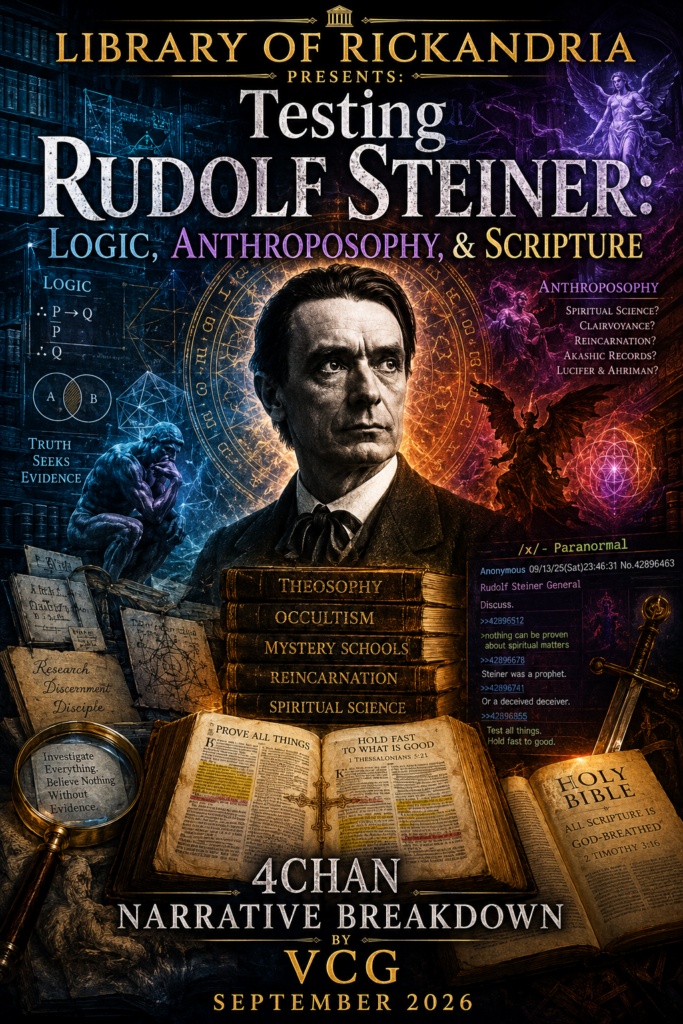
UPDATED BY VCG ON 9/2/2026 @ 00:00 EST
I want to share a heartfelt cause with my audience. Conner Blaisdell-Greene, a brave Airforce Sr. Airman, recently lost his battle with cancer, leaving his family in financial distress. Every donation, no matter how small, can help cover his funeral costs and ease their burden during this difficult time. Please consider clicking the link below to contribute or share Conner’s story with others. Your support truly matters.
Until We Meet Again
Spoken Tribute
Abstract
A short discussion on 4chan’s /x/ board began with a blunt accusation: Rudolf Steiner was supposedly an “obvious psyop,” hostile to logic, and responsible for an educational system followed by gullible parents. From there the thread widened quickly. Posters argued about whether schools teach logic, whether institutional knowledge is inherently corrupt, whether near-death experiences confirm a cosmic ratio of good and evil, whether Steiner’s Lucifer–Ahriman cosmology resembles Manichaeism, whether reincarnation is part of his teaching, whether traditional logic has been deliberately replaced by an inferior modern version, whether science is mostly circular reasoning, and even whether Steiner’s facial appearance should count in his favor.
This paper examines those claims one by one.
The result is not a defense of Rudolf Steiner. In fact, the strongest criticism of Steiner emerges only after several criticisms in the thread are corrected. Steiner did not simply teach that logic was evil. He explicitly praised formal logic, saying that it orders thought and teaches the connection of concepts leading to correct conclusions. Yet Steiner also claimed that trained individuals could develop “soul and spiritual organs of perception” through which otherwise inaccessible spiritual worlds could be perceived. In his later discussions of reincarnation he went further, stating that when investigating previous earthly lives, intellectual reasoning reaches its limit and “vision alone is the criterion.”
That is the real epistemological issue.
The biblical issue is even sharper. Steiner explicitly interpreted the man born blind in John 9 as suffering consequences originating in a previous incarnation. The text itself records Jesus answering the disciples’ question about whether the man or his parents had sinned: “Neither hath this man sinned, nor his parents.” Steiner’s karmic interpretation is therefore not simply an additional spiritual insight that Scripture happens not to mention. It imports reincarnation into a passage whose stated answer points in another direction.
The purpose of this paper is therefore neither to ridicule Steiner nor to accept him because he was intelligent, mystical, unconventional, or anti-establishment. It is to do something more demanding: identify what he actually said, distinguish fact from interpretation, assess the reasoning used by both his critics and defenders, examine relevant historical and scientific evidence, and finally compare his theological claims with Scripture.
The governing biblical principle is simple:
“Prove all things; hold fast that which is good.”— 1 Thessalonians 5:21, KJV
1. Why Examine a 4chan Thread Seriously?
At first glance, a small anonymous internet thread may seem like a strange object for an extended research paper. But threads like this are useful precisely because they compress many modern habits of reasoning into a few pages.
A historically real person is introduced through a meme. A legitimate philosophical question becomes attached to insults. Genuine pieces of historical information appear alongside unsupported conspiracy claims. A scientific topic—near-death experience research—is used to support metaphysics far beyond what the studies actually establish. Religious traditions separated by centuries are compressed into a simple good-versus-evil diagram. Neuroscience becomes a slogan about hemispheres. Old textbooks become evidence for a theory of educational decline. Personal appearance becomes evidence of character. And throughout the discussion, nearly everyone believes that they are the one defending logic.
That makes the thread worth studying.
The VCG research standard is particularly useful here because it calls for Scripture-first, evidence-based analysis while separating fact, interpretation, speculation, and rhetoric. It also calls for historical, biblical, scientific, psychological, logical, and methodological analysis rather than allowing one category to impersonate another.
The distinction matters. A historical statement can be true without its theological interpretation being true. A psychological mechanism can help explain why an argument feels persuasive without proving the argument false. A scientific study can establish that an experience occurs without establishing the metaphysical explanation attached to the experience. A doctrine can be internally coherent without being biblical. And a person can make a false argument for a true conclusion.
Throughout this paper, those categories will remain separate.
2. A Brief Historical Orientation: Who Was Rudolf Steiner?
Rudolf Steiner lived from 1861 to 1925 and became the founder and principal teacher of anthroposophy. His career cannot accurately be reduced to “occult crank,” nor can anthroposophy be reduced to Waldorf education. Steiner wrote philosophical works, lectured extensively, participated in the Theosophical movement before separating from it, developed his own system of “spiritual science,” and influenced education, agriculture, architecture, the arts, medicine, and other cultural projects. An academic overview in The Cambridge Handbook of Western Mysticism and Esotericism describes anthroposophy as concerned with spiritual knowledge that Steiner believed could, in principle, be attained by others, while noting his claims to research evolution, higher beings, the afterlife, and rebirth through supersensible means.
Waldorf education is genuinely connected to that worldview. Steiner founded the first Waldorf school in Germany in 1919. Historical scholarship describes Steiner’s life and writings as foundational to Waldorf schooling and anthroposophy as the spiritual-development framework from which the educational system emerged.
That means the original poster is not inventing the Steiner–Waldorf connection.
But acknowledging a historical connection is very different from calling every Waldorf parent a fool or assuming that every classroom practice is therefore invalid. A teaching method has to be evaluated as a teaching method. A claim about child development has to be evaluated as a claim about child development. An occult doctrine has to be evaluated as an occult doctrine.
This distinction will recur throughout the paper: association is context, not automatic refutation.
3. The Central Question: Was Rudolf Steiner “Anti-Logic”?
The opening post, No. 42896463, depicts Steiner as an obvious covert influence operation and summarizes his attitude toward reason as “logic is evil.” It then contrasts him with William Walker Atkinson, who wrote a book on logic.
This is the best place to begin because it supplies a testable claim.
What Steiner Actually Said About Logic
In a 1908 lecture devoted specifically to formal logic, Steiner does not condemn logic. He says logic concerns the form of thinking, “brings order to thoughts,” and teaches how concepts must be connected in order to produce correct conclusions. He also complains that logic is no longer sufficiently respected and says greater attention to formal logic is necessary.
That makes the simple claim
“Steiner taught that logic is evil”
false.
A fair critic should concede that immediately.
But that concession does not settle the larger question.
Steiner distinguishes logical thought from the acquisition of the content about which thought reasons. This distinction by itself is perfectly ordinary. Logic can tell us whether a conclusion follows from premises; logic alone cannot tell us whether the premises correspond to reality.
For example:
All creatures from planet X are immortal.
Ralph is a creature from planet X.
Therefore Ralph is immortal.
The inference can be valid while the premises remain completely unproven.
The question, then, is not whether Steiner understood formal validity. The question is how Steiner believed people obtain reliable premises about spiritual worlds, reincarnation, karma, Lucifer, Ahriman, and pre-earthly existence.
Here the issue becomes much more serious.
In Theosophy, Steiner says human beings can develop “soul and spiritual organs of perception” analogous to physical organs of perception. Just as an eye makes visible things available to sight, he argues, developed spiritual organs make soul and spiritual worlds perceptible. Those without such organs experience those worlds as unavailable to them.
Later, in 1924, while discussing investigations of previous incarnations, Steiner becomes even clearer about the methodological limit he places on ordinary reasoning:
“all intellectual reasoning comes to a standstill.
Vision alone is the criterion here.”
That sentence is far more important than the thread’s slogan.
The accurate criticism is therefore not:
Steiner hated logic.
It is:
Steiner valued logic within its assigned domain but claimed that certain major metaphysical truths are accessed by supersensible vision rather than established through ordinary intellectual reasoning.
That is both fairer and more challenging.
4. A Methodological Problem: What Would Count as Being Wrong?
Suppose Steiner says that a trained spiritual investigator perceives a relationship between a living person and one of that person’s previous incarnations.
A normal historical claim could be checked against documents, dates, archaeological evidence, letters, independent witnesses, material records, and competing explanations.
But a supposed previous incarnation is different.
If another person does not perceive the connection, the anthroposophical framework can respond that the observer has not developed the necessary spiritual faculties.
This does not logically prove the claim false.
It does, however, create what we might call a self-sealing risk.
A method becomes difficult to externally correct when unsuccessful confirmation can always be attributed to the inadequacy of the observer. Steiner attempts to answer this by insisting that spiritual perception can be trained and that others could in principle develop it. The difficulty remains: the decisive evidence is not publicly available in the same manner as an ordinary observable event.
This is why one must distinguish private or initiatory verification from publicly reproducible verification.
Steiner’s analogy with physical sight is rhetorically powerful:
A blind person cannot disprove color merely by failing to see it.
True.
But the analogy cannot establish the existence of the proposed spiritual faculty, because that is precisely what is disputed.
One cannot prove a new faculty of perception simply by comparing it with an already established faculty of perception.
The analogy helps us understand what Steiner means. It does not establish that his claimed perceptions correspond to external spiritual realities.
5. Post 42898406: “Institutional Knowledge Is Obviously Corrupted”
The first major defense of Steiner argues that critics misunderstand traditions that tell people to
“stop thinking.”
The poster then goes much further: the logic taught by the education system and experts is said to be
“obviously corrupted,”
and institutionalization itself is described as corrupting insight.
There is a legitimate observation buried here.
Institutions can become corrupt. Academic disciplines can develop fashionable assumptions. Experts can develop groupthink. Bureaucracies can protect themselves. Schools can teach badly. Religious institutions can preserve error. Scientific institutions can be influenced by incentives.
None of this should be controversial.
The logical failure comes when can be corrupted becomes is obviously corrupted.
No evidence is supplied for the universal step.
Worse, the proposed solution—returning to an
“uncorrupted state”
—raises another question:
by what method do we determine which state is uncorrupted?
If institutional standards are rejected because they are institutional, peer criticism is rejected because peers are compromised, expert knowledge is rejected because experts are compromised, and established methods are rejected because methods have become institutionalized, then the claim becomes increasingly difficult to test.
This is another self-sealing structure.
The biblical alternative is neither blind institutional obedience nor romantic anti-institutionalism.
Acts 17 describes the Bereans as receiving teaching readily while still “search[ing] the scriptures daily, whether those things were so.”
That posture is neither gullibility nor reflexive suspicion.
It is examination.
6. Posts 42898511, 42898547, and 42898584: What Counts as “Learning Logic”?
The next exchange is almost comical because the posters disagree strongly while using the word logic differently.
One claims that people learn “zero logic” in school. Another responds that students encounter induction and deduction in biology, chemistry, physics, and mathematics, and learn elementary reasoning and fallacies in language or introductory college courses. A third says a logic book was unexpectedly mathematical and difficult when the reader had expected something closer to ordinary philosophical reasoning.
All three comments reveal a definitional problem.
“Logic” can refer to traditional syllogistic, modern symbolic logic, informal argument analysis, inductive reasoning, deductive validity, probability, causal inference, fallacy identification, or simply disciplined critical thinking.
A person can therefore have considerable experience reasoning without ever having taken a course titled Logic. Conversely, a person can memorize logical notation without becoming especially good at evaluating evidence in everyday life.
The poster surprised by the mathematical appearance of a modern logic textbook has encountered a genuine feature of the discipline. Modern formal logic uses symbolic notation because it analyzes structures of inference with precision. That does not mean philosophy has disappeared from logic; it means the reader has encountered one branch of logic rather than the whole field.
The useful correction is not
“everyone learns logic”
or
“nobody learns logic.”
It is that logical education varies, and the term itself needs definition before the argument can proceed.
7. Post 42898622: “Ahriman” as a Joke with a Real Background
One poster jokingly calls the original critic “Ahriman.”
As an argument this contributes nothing.
Historically, however, it points to a genuine Steiner doctrine.
Ahriman is a major figure in Steiner’s cosmology, typically associated with hardening, materialism, intellectual rigidity, and excessive fixation on the external or mechanistic. Lucifer represents another danger: inflation, premature spirituality, mystical excess, or a pulling away from grounded earthly existence.
Steiner repeatedly describes human development as occurring between these forces. In a 1915 lecture he compares the Christ-centered path to the equilibrium point of a pendulum between Luciferic and Ahrimanic tendencies.
The joke therefore uses authentic anthroposophical vocabulary.
The question is what Steiner does with it.
8. Post 42899287: NDEs, “Two-Thirds Good,” Manichaeism, and Cosmic Arithmetic
This is the densest post in the entire thread.
The poster alleges that near-death experiences confirm a “matrix” that is two-thirds good and one-third evil, that Zoroastrianism and Manichaeism suggest a similar structure, and that Steiner perversely inverted the arrangement by placing two evil powers—Ahriman and Lucifer/Satan—around one good Christ figure.
Almost every part requires separation.
Near-Death Experiences Do Not Establish a Cosmic Ratio
Near-death experiences are a legitimate research subject. People report structured and often deeply consequential experiences during or around life-threatening conditions. The responsible scientific question is what those experiences are, under what conditions they occur, how they relate to physiology and consciousness, and what conclusions can legitimately be drawn from them.
A 2025 systematic and bibliometric review examined 775 NDE-related publications from 1977 through April 2025 and concluded that there remains no consensus regarding their origin or nature. The theoretical landscape remains fragmented.
AWARE II, a multicenter cardiac-arrest study, examined 567 in-hospital cardiac arrests. Fifty-three patients survived; 28 completed interviews; 11 of those 28 reported memories or perceptions suggestive of consciousness, including six categorized as transcendent recalled experiences of death. No participant identified the visual target used in the experimental setup, while one identified the auditory stimulus. The study is scientifically interesting precisely because it investigates consciousness around cardiac arrest—but it does not measure the moral population of another universe.
A separate systematic analysis of 123 NDE narratives found distressing experiences in 14 percent of that sample, not one-third. Even that figure should not be transformed into a cosmic census: it describes the contents of reported experiences in a particular sample.
This illustrates a major methodological distinction:
Phenomenology is not automatically ontology.
A person may genuinely experience something.
That establishes that an experience occurred.
It does not, by itself, establish what external reality produced it.
And even if one concluded that an NDE provides access to an objective spiritual realm, the frequency of reported pleasant and distressing experiences still would not demonstrate that reality itself contains a mathematically corresponding ratio of good and evil beings.
The thread moves from report → interpretation → cosmic mathematics without supplying the missing steps.
Zoroastrianism and Manichaeism Are Not a Three-Character Scoreboard
The religious-history claim is also oversimplified.
In a Zurvanite version of Zoroastrian cosmology, Ohrmazd and Ahriman are represented as twin offspring of a pre-existing Zurvan. But Zoroastrian dualism developed in different forms over time, and Zurvanism itself was one historically particular theological development rather than a convenient three-member equation.
Manichaeism further complicates the picture. It is fundamentally structured around opposition between Light and Darkness, but Iranian Manichaean texts sometimes reuse Iranian divine names in altered roles. Encyclopaedia Iranica warns against treating correspondences between Manichaean and Zoroastrian names as though the figures have identical theological functions. In Manichaean usage, for example, Ohrmazd could identify the Primordial Man, and Manichaean sources explicitly opposed the Zurvanite idea that Ohrmazd and Ahriman were simply divine brothers.
So
“Zurvan + Ohrmazd = two good beings; Ahriman = one bad being”
is not an adequate account of either tradition.
What Steiner Actually Taught
The poster does, however, identify something real in Steiner.
Steiner explicitly places Christ in relation to Lucifer and Ahriman. In one formulation he says Christ should be placed
“in the centre between Ahriman and Lucifer,”
with humanity continually seeking balance between Luciferic and Ahrimanic impulses.
Elsewhere he explains that the genuine polarity is Lucifer–Ahriman while the Christ impulse works in equilibrium between them.
So the thread is right about the threefold structure but wrong to turn it into arithmetic.
Steiner is not describing three fighters of equal ontological rank with Christ being outnumbered two to one.
His system is stranger and more sophisticated than that.
And from a biblical standpoint, that sophistication creates the real theological problem.
9. The Biblical Problem with Christ as “Equilibrium”
The biblical Christ is not introduced as the midpoint produced by two opposing spiritual principles.
John begins:
“In the beginning was the Word, and the Word was with God, and the Word was God.”
Then:
“All things were made by him; and without him was not any thing made that was made.”
— John 1:1, 3
This places the Word before the created order.
Colossians likewise places Christ over created spiritual powers and later calls Him
“the head of all principality and power.”
Paul says believers are:
“complete in him”
and describes Christ as triumphing over principalities and powers.
This differs fundamentally from a cosmology in which Christian life is defined through balance between Luciferic and Ahrimanic forces.
To be precise, Steiner is not saying that Christ is merely equal to those powers. But he does make the Christ impulse the means by which humanity negotiates a spiritually necessary polarity between them.
The New Testament’s emphasis is different.
Christ is not the negotiated center between rival cosmic necessities.
He is Lord over created powers.
That is a theological difference, not merely different symbolism.
10. “Biodynamic Farming Is Cool”
The same post casually adds that biodynamic farming is “cool.”
This is actually a good opportunity to demonstrate why careful analysis should resist guilt by association.
Biodynamic agriculture emerged from Steiner’s teachings and includes concepts rooted in his anthroposophical worldview. Yet agricultural outcomes can be studied independently of the metaphysical explanation Steiner attached to them.
A 2022 review identified 147 peer-reviewed studies in indexed journals concerning biodynamic agriculture. The review reported favorable findings regarding soil quality and biodiversity while also noting gaps in areas such as socioeconomic sustainability and product quality. Questions regarding what effects are specifically attributable to distinctively biodynamic preparations remain more difficult.
Therefore:
If a particular biodynamic practice improves soil, that is evidence for the agricultural effect.
It is not automatically evidence for Steiner’s spiritual cosmology.
Likewise, if a particular Steiner-inspired educational method works well, it may be educationally useful without validating reincarnation.
A method can produce an effect for reasons different from those proposed by its inventor.
11. Post 42899324: “They Were All Psyops—even Yogi Ramacharaka”
The thread then expands the conspiracy label. William Walker Atkinson, previously praised by the opening poster as a writer on logic, is now included among alleged “psyops,” with special reference to
“Yogi Ramacharaka.”
There is a true historical connection here.
William Walker Atkinson was a New Thought author who published under several pseudonyms, including Yogi Ramacharaka. Academic work on the history of modern yoga and American metaphysical religion confirms the identification and describes Atkinson’s Ramacharaka writings as a synthesis involving New Thought, Theosophical, and occult themes.
Atkinson also really did publish The Art of Logical Thinking; or, The Laws of Reasoning in 1909. Its contents include concepts, propositions, induction, hypotheses, deduction, syllogisms, analogy, and fallacies.
Here is the important methodological point:
Atkinson’s occult interests do not prove his logic book wrong.
That would be a genetic fallacy.
A sound syllogism remains sound when written by an occultist. A bad syllogism remains bad when written by a theologian.
But “psyop” is another matter.
In actual military usage, psychological operations refer to organized influence activity directed toward target audiences in pursuit of operational objectives. U.S. Army descriptions emphasize planned efforts to influence behavior, perceptions, motives, and reasoning in selected audiences.
Calling a historical spiritual movement a “psyop” therefore requires evidence of intentional organization, target selection, objectives, actors, and an influence strategy.
The thread provides none.
“Psyop” is functioning rhetorically as a synonym for influential idea I distrust.
That is not enough.
12. Post 42899332: “The Western Man Can’t Get Away with Buddha’s Path”
Another poster recalls Steiner as teaching that Western people cannot simply follow the Buddha’s path.
This claim should be handled more cautiously than some others.
Steiner did make extensive East–West spiritual distinctions and portrayed cultural development in terms of different spiritual tendencies. He sometimes connected Eastern spirituality with Luciferic tendencies and modern Western civilization with Ahrimanic tendencies, while assigning a mediating role to a Christian or Central-European impulse.
However, the exact sentence presented by the anonymous poster was not sourced in the thread, and I have not treated it as a verified quotation.
That is an important research habit.
A claim can fit an author’s worldview and still require a citation.
From a biblical standpoint, however, the Christian issue does not depend on whether Steiner thought Buddhist practice psychologically suited to Westerners.
The New Testament’s claim is universal rather than civilizational:
“I am the way, the truth, and the life:
no man cometh unto the Father, but by me.”— John 14:6, KJV
Within biblical Christianity, the question is not which spiritual technique best matches one’s racial, national, or civilizational temperament.
The issue is Christ.
13. Posts 42899364 and 42899367: “Soft Gnosticism” and Reincarnation
One poster describes Steiner as teaching a softer form of Gnosticism in which souls move freely and eventually ascend to a pleroma. Another adds that excessive attachment may cause a person to reincarnate.
The first description is too loose historically.
Anthroposophy certainly belongs within the wider history of Western esotericism. It contains initiatory knowledge, layered spiritual worlds, hierarchies of beings, reincarnation, karma, cosmic evolution, and an esoteric interpretation of Christianity. Those features create family resemblances with movements commonly called Gnostic.
But resemblance is not identity.
“Gnosticism” refers to a collection of historically specific ancient movements and texts, and “pleroma” belongs particularly to some ancient Gnostic vocabularies. Anthroposophy developed in a modern European setting shaped by German philosophy, Theosophy, Christianity, esotericism, Goethean thought, and Steiner’s own system.
Calling it “Gnostic” may function as a theological analogy, but it should not be mistaken for exact historical classification. Academic treatments place Steiner within modern Western mysticism and esotericism rather than simply identifying anthroposophy with an ancient Gnostic school.
The reincarnation claim, however, is not merely approximate.
It is central.
Steiner explicitly called reincarnation a “fundamental law” of spiritual life and taught that human beings pass through a series of repeated earthly lives. He paired reincarnation with karma, in which experiences and actions in one life participate in shaping destiny across lives.
So it is misleading to reduce Steiner’s teaching to:
“you reincarnate if you are too attached.”
Repeated earthly lives are structural within the system.
And here we reach one of the most important biblical tests in the entire investigation.
14. John 9: Steiner’s Karmic Reading versus the Text
John 9 begins with Jesus encountering a man blind from birth.
The disciples ask:
“Master, who did sin, this man, or his parents, that he was born blind?”
Jesus answers:
“Neither hath this man sinned, nor his parents:
but that the works of God should be made manifest in him.”— John 9:2–3, KJV
Steiner directly comments on this passage.
His interpretation is that the ordinary present personality had not caused the blindness, but that the deeper individuality had created the cause in a previous incarnation. Steiner says the man became blind because a former life supplied the karmic cause and explicitly states that Christ is pointing to karma.
In another lecture he explains that the man need not have sinned in his current life because guilt from a former life could have produced the present condition.
This is more than a disagreement over a peripheral verse.
It demonstrates Steiner’s hermeneutical method.
The text asks whether the blindness arose because the man sinned or his parents sinned.
Jesus answers: Neither.
Steiner’s interpretive framework effectively answers:
the man did cause it, but in an earlier incarnation.
The karmic system has therefore supplied information not contained in the passage and used that information to reinterpret the apparent force of Christ’s answer.
One could defend Steiner only by arguing that Jesus was denying sin by the man’s present personality while leaving open sin by a trans-incarnational individuality.
But that distinction comes from Steiner’s system, not from John’s text.
There is no mention in John 9 of an earlier earthly life.
This is a textbook example of the difference between exegesis and eisegesis.
Exegesis asks what meaning arises from the text.
Eisegesis introduces a prior system into the text and then reads the passage through that system.
Whatever one thinks about reincarnation independently, Steiner’s use of John 9 does not establish it.
15. Reincarnation versus the New Testament Pattern
The wider New Testament presents a different pattern of human destiny.
Hebrews says:
“And as it is appointed unto men once to die, but after this the judgment:”
— Hebrews 9:27, KJV
The immediate context compares human death with Christ’s once-for-all sacrifice. The verse does not offer a philosophical treatise on every possible question about the intermediate state, but its stated sequence is still important:
life → death → judgment
—not repeated earthly embodiment.
Jesus likewise describes the future in resurrection terms:
“the hour is coming, in the which all that are in the graves shall hear his voice,
And shall come forth…”— John 5:28–29, KJV
Paul similarly speaks of
“the dead in Christ”
rising at the Lord’s return.
The New Testament hope is resurrection, not progressive reincarnation through successive earthly personalities.
That does not mean every mystery of death and consciousness has been answered by these verses.
It means Steiner’s reincarnational anthropology cannot simply be presented as another vocabulary for ordinary New Testament resurrection doctrine.
They are different models.
16. Post 42899391: “Beautiful, Kind Eyes”
Another response posts a portrait and remarks on Steiner’s “beautiful, kind eyes.”
This is subjective and harmless as an aesthetic reaction.
It becomes relevant only if appearance begins carrying evidentiary weight.
Humans form rapid personality judgments from faces. But a meta-analysis of facial trustworthiness judgments found only modest correspondence between perceived and actual trustworthiness, with the authors concluding that the level of accuracy was unlikely to have much practical utility.
In other words, a face can make someone feel trustworthy.
That feeling is not a reliable method for evaluating metaphysics.
The same principle applies in reverse. An unpleasant-looking person is not thereby wrong.
Biblical and logical judgment both require something stronger than appearance.
17. Post 42901133: “Real Logic” versus Modern Logic
The thread then returns to logic.
A poster recommends Atkinson and Isaac Watts, but argues that there are effectively two kinds of logic. Traditional logic belonging to the classical liberal arts is described as the “real logic” that liberates people. Modern logic is described as a deliberate hollowing-out that gives people enough reasoning ability to become engineers without receiving a genuinely liberal education. The claim is extended to “all modern logic and all modern logic books.”
The recommendation of older logic texts is perfectly reasonable.
Atkinson’s text is accessible and covers many classical topics. Isaac Watts’s Logic, or the Right Use of Reason also belongs to the older tradition of practical logical education.
The historical conclusion drawn from this, however, is far too large.
Traditional Aristotelian syllogistic is enormously important in intellectual history. But modern formal logic did not arise simply because someone wanted to cripple human reasoning.
Modern logic developed partly because traditional syllogistic does not represent every valid form of inference.
The Stanford Encyclopedia of Philosophy notes that Aristotle’s syllogistic handles a restricted class of arguments. Modern formal developments revealed serious limitations in using traditional syllogistic as an exhaustive framework for mathematics, science, or everyday reasoning. Modern scholarship can simultaneously recognize those limitations and appreciate Aristotle as a foundational logician.
The poster has therefore created a false dichotomy:
traditional logic = real and liberating
versus
modern logic = artificial and servile
A better education would teach both the classical tradition and the modern expansions.
Students benefit from understanding terms, propositions, syllogisms, informal fallacies, rhetoric, deduction, induction, probability, symbolic representation, causal reasoning, and scientific inference.
There is no need to destroy one tradition in order to appreciate the other.
18. Post 42901140: Left Brain, Right Brain, and “Too Much Logic”
The original poster returns and says further reading makes Steiner look like another advocate of “balancing the left and right hemispheres of the brain.” The poster dismisses the idea and adds that one cannot really study too much logic.
The neuroscience skepticism has a valid basis—if the target is the familiar popular myth that some people are globally “left-brained” logical types while others are globally “right-brained” creative types.
A large resting-state fMRI analysis of 1,011 individuals found genuine regional brain lateralization but did not support a whole-brain personality phenotype in which individuals divide into globally left-brained and right-brained categories.
But the thread does not establish that this modern pop-neuroscience slogan is actually what Steiner taught.
Steiner certainly used balancing imagery, especially regarding Lucifer and Ahriman, and he developed many physiological and spiritual claims that would not fit modern neuroscience. But criticizing him accurately requires quoting his theory rather than substituting a contemporary meme.
The second statement—
“you cannot study too much logic”
—also requires qualification.
Studying logic is useful.
But logic cannot guarantee truth when its premises are false, evidence is missing, terms are ambiguous, or the relevant facts are unknown.
Validity concerns relationships between propositions.
Truth requires more.
Ironically, Steiner himself recognized this distinction when discussing formal logic.
Where Steiner becomes vulnerable is not in recognizing the distinction. It is in the epistemic authority he grants to supersensible “vision” as a source of the missing content.
19. Post 42901142: Insult as Argument
The next reply simply tells another poster that he knows nothing about logic, using an insult.
There is nothing to fact-check here.
It is an ad hominem in the ordinary sense that attention shifts from the argument to the person.
If someone’s reasoning is invalid, show the invalid inference.
If a premise is false, provide evidence.
If terminology is confused, define it.
An insult cannot perform any of those jobs.
The irony of discussing logic through personal abuse should not be missed.
20. Post 42902819: Steiner and Theosophy’s “False Prophet”
Another poster argues that hostility toward Steiner arises because he rejected the Theosophical movement’s proposed spiritual figure. The wording is crude, but the likely historical reference is Jiddu Krishnamurti.
There is a genuine historical event behind this.
Leading Theosophists promoted Krishnamurti in connection with expectations surrounding a coming World Teacher. Steiner rejected the claim and eventually separated organizationally from the Theosophical Society. Steiner later described the idea that an Indian boy was the reincarnation or vehicle of Christ as baseless and unacceptable.
Krishnamurti himself later broke with the role imposed upon him and dissolved the Order of the Star in 1929.
This is a point where Steiner deserves historical credit for rejecting a claim he considered false.
But rejecting one false or unsupported spiritual claim does not validate every spiritual claim one makes afterward.
A person who correctly rejects claimant A does not thereby prove claimant B.
That would be another non sequitur.
21. Post 42902850: “Basically a David Icke-Type Character”
One poster dismisses Steiner as essentially a David-Icke-type figure.
This is analogy rather than historical analysis.
There are obvious surface similarities between elaborate hidden-world cosmologies: unseen agencies, unconventional explanations of history, claims rejected by mainstream science, and systems that can become internally expansive.
But historical classification requires more than resemblance.
Steiner belonged to a particular late nineteenth- and early twentieth-century world of German philosophy, Theosophy, esotericism, Christianity, Goethean thought, and European spiritual movements.
Calling two figures “basically the same” may communicate skepticism quickly, but it does not tell us whether either figure’s individual claims are true.
22. Post 42903083: The Sexual Analogy
The next poster offers a vulgar sexual analogy for balancing the two hemispheres.
No substantive neuroscientific or theological claim is added.
The post is useful only as an illustration of how imageboard humor can derail conceptual analysis. It makes the thread more memorable while making the underlying question less precise.
That matters psychologically because memorable language and evidence are not the same thing.
A vivid analogy can survive in memory after its factual basis has been forgotten.
23. Post 42904153: “Most Science, Especially Biology, Is Circular Reasoning”
The thread then makes one of its largest claims:
“Most of science, especially biology, is circular reasoning.”
The same poster argues that secondary education should include a course on faulty reasoning, then concludes that “the system” instead wants obedient drones.
These statements must be separated.
The proposal to teach students more about bad reasoning is entirely defensible.
The claim that most science is circular is not supported.
“Most” is a quantitative word. To establish it, one would need a defined corpus of scientific arguments, a definition of circularity, a sampling method, a coding method, and results demonstrating that more than half fit that definition.
None is supplied.
Science is not reducible to one universal recipe, but contemporary philosophy of science still identifies systematic observation, experimentation, inductive and deductive reasoning, model construction, and the formation and testing of hypotheses among characteristic scientific practices. The most recent substantive revision of the Stanford Encyclopedia’s treatment emphasizes both these recurrent practices and methodological pluralism.
Can scientific researchers reason circularly?
Of course.
Can fields develop bad assumptions?
Yes.
Can incentives distort research?
Yes.
Can a theory survive too long because communities become attached to it?
Yes.
But criticism of specific failures is stronger than declaring “most science” corrupt without evidence.
The final statement—
“the system wants obedient drones”
—introduces intentional agency.
Who is “the system”?
What actors share this goal?
What documents establish the goal?
How is the strategy coordinated?
Without such evidence, a complex educational outcome is being converted into an intentional conspiracy.
This is not impossible in principle.
It is simply unproven in the post.
24. Post 42904562: SSRIs, the Brain, and Steiner’s “Spiritual Organs”
The final substantive post says that SSRI users hate Steiner, dismisses reference to the brain, and attaches an image quoting Steiner on spiritual organs of perception.
The SSRI statement has no evidence behind it.
No sample is identified. No survey is cited. No comparison group exists. It functions as poisoning the well: critics are associated with a stigmatized category rather than answered.
The important part of the post is the image.
The Steiner quotation is authentic in substance.
In Theosophy, Steiner writes that people can develop soul and spiritual organs of perception, just as bodily senses provide access to bodily phenomena. For those lacking the higher organs, he says, soul and spiritual worlds remain inaccessible.
So the correct response is not to call the meme fake.
The quotation is real.
The question is whether Steiner has demonstrated that the purported faculty reliably detects an external world rather than producing internally generated experiences, interpretations, expectations, imaginative constructions, altered states, or some mixture of these.
That question remains where the evidential burden belongs.
25. The Psychology of the Thread
Psychological analysis requires special caution.
Nothing in a 4chan thread permits responsible diagnosis of an anonymous poster.
We cannot infer psychiatric conditions, medication use, intelligence, personality disorder, trauma history, or personal motives from a few comments.
We can, however, compare the communication style with established psychological phenomena.
Online Disinhibition
Psychologist John Suler’s classic work on the
“online disinhibition effect”
describes how anonymity, invisibility, asynchronicity, minimized authority, and related factors can cause people to communicate more intensely online than they might face-to-face.
The aggression, sexual insults, status challenges, and casual contempt in the thread are consistent with that environment.
“Consistent with”
is the correct phrase.
We cannot prove why any individual poster chose a particular insult.
Conspiratorial Framing
The thread repeatedly uses “psyop,” “corrupted,” and “the system” to explain disagreement or institutional structure.
Research on conspiracy belief has identified epistemic motives—the desire to understand events—alongside existential motives involving safety and control and social motives involving self or group identity.
Again, this does not mean we can read those motives directly into any anonymous poster.
It does explain why conspiracy narratives can be psychologically attractive: they compress messy systems into coherent agency.
Instead of:
education is historically contingent, uneven, bureaucratic, culturally shaped, incentive-sensitive, and often imperfect,
the explanation becomes:
someone designed it this way to make you obedient.
The latter is simpler and more dramatic.
It therefore requires evidence proportional to its specificity.
Repetition and Familiarity
The word “psyop” appears repeatedly without accumulating evidence.
This matters because repetition can increase the perceived truth of information. Research on the illusory truth effect finds that repeated claims can feel more credible, including misinformation and conspiracy claims, even when they are implausible or conflict with prior knowledge.
This does not mean repetition caused the posters to believe the claim.
It means readers should consciously distinguish:
I have heard this repeatedly
from
this has been demonstrated repeatedly.
Those are not the same.
Hidden-Knowledge Status
The thread also repeatedly creates an implicit division between those who understand what is really happening and people trapped inside institutional thought.
That rhetorical position is powerful because it turns disagreement into confirmation.
If you agree, you have awakened.
If you disagree, your disagreement demonstrates how thoroughly the system has shaped you.
This is epistemically dangerous because the theory can protect itself from criticism.
Anthroposophical claims can develop a similar structure in a different direction:
If you perceive the spiritual world, the claim is confirmed.
If you do not, your spiritual organs may not yet be developed.
The skeptic and mystic can therefore fall into structurally similar traps while believing themselves to be opposites.
Facial Trust
The “kind eyes” post illustrates another human tendency: rapid inference from appearance.
Research suggests that facial trustworthiness judgments show only modest accuracy and are not practically reliable measures of actual moral character.
This is worth remembering because charisma, attractiveness, intensity, serenity, and visual symbolism can all shape receptivity to ideas.
None tells us whether karma is true.
26. The Logic of the Thread
Although “logic” is the nominal subject, the thread repeatedly substitutes rhetorical moves for logical demonstration.
The opening post uses a straw man when it reduces Steiner to
“logic is evil.”
The institutional-corruption response makes a hasty generalization, moving from the possibility or reality of some corruption to the assertion that institutionalized knowledge is obviously corrupt.
The
“zero logic in school”
and
“everyone learns logic”
responses use incompatible universal generalizations with no evidence for universality.
The NDE argument commits a non sequitur by moving from reported experience to a quantified metaphysical structure.
The simplified Zoroastrian/Manichaean analogy involves conceptual compression, treating historically distinct theological roles as interchangeable tokens.
The
“real logic versus modern logic”
argument creates a false dichotomy.
“Most biology is circular”
is an unsupported sweeping generalization.
“The system wants drones”
makes an intentionality attribution without establishing the coordinating actor.
The SSRI remark is poisoning the well.
“Kind eyes”
risks an appeal to appearance.
Repeated “psyop” accusations shift the burden of proof by treating suspicion as though the accused theory must disprove an unspecified covert operation.
None of this means every conclusion reached by those posters is false.
It means the conclusions cannot be justified by those particular arguments.
That distinction is foundational to logic.
27. What the Thread Actually Gets Right
Once the exaggeration is stripped away, the thread contains several genuine observations.
Steiner really did develop an esoteric system involving Lucifer and Ahriman.
He really did teach reincarnation and karma as fundamental spiritual laws.
He really did claim that trained spiritual perception can disclose worlds inaccessible to ordinary physical perception.
He really did place the Christ impulse in a balancing or equilibrium relationship to Luciferic and Ahrimanic forces.
Waldorf education really is historically rooted in Steiner and anthroposophy.
He really did break with Theosophical claims surrounding Krishnamurti.
Atkinson really did write a logic book and also write occult/New Thought material under names including Yogi Ramacharaka.
Biodynamic agriculture really does descend from Steiner and has produced enough empirical research to deserve evaluation independently of anthroposophical cosmology.
The problem is not that the thread contains no facts.
The problem is that facts repeatedly become launch pads for claims much larger than the evidence.
28. What the Thread Gets Wrong
Steiner was not simply anti-logic. His own lecture on formal logic directly contradicts that caricature.
Near-death research has not confirmed a universe that is two-thirds good and one-third evil. Contemporary reviews explicitly report ongoing disagreement over the origin and interpretation of NDEs.
Zoroastrianism and Manichaeism cannot responsibly be reduced to a three-character arithmetic model.
Steiner’s Lucifer–Ahriman–Christ structure cannot be refuted by saying Christ is “outnumbered”; that misunderstands Steiner’s own model.
Traditional logic and modern formal logic are not “true logic” and “fake logic.” Modern systems expanded the range of arguments that could be formally represented.
The popular global left-brain/right-brain personality dichotomy is not supported by the large neuroimaging study discussed above, but the thread still has to establish that its version of that meme accurately represents Steiner.
“Most science is circular”
is not established.
Neither is
“the system wants drones.”
Neither is
“SSRI users hate Steiner.”
Neither is
“they were all psyops.”
The thread’s biggest failure is therefore methodological: it frequently substitutes a strong feeling of pattern-recognition for demonstration.
29. The Stronger Critique of Steiner
Once the weak arguments are discarded, a much stronger case remains.
Steiner was intelligent enough to understand logic.
He did not teach his students to abandon all reasoning.
He explicitly valued disciplined thought.
Therefore the criticism of him should not depend on portraying him as stupid or irrational.
The deeper issue is his epistemology.
Steiner claims access to information ordinary public methods cannot independently establish. He then uses that claimed spiritual access to describe reincarnations, karmic relationships, spiritual beings, pre-earthly existence, cosmic history, and the spiritual meaning of biblical events.
When he discusses previous incarnations, he openly says that intellectual reasoning gives way to spiritual vision as the criterion.
That should make the critical reader ask:
How is a false spiritual vision distinguished from a true one?
How are contradictory seers adjudicated?
What would falsify a claimed previous incarnation?
What safeguards prevent symbolic interpretation from becoming literal metaphysics?
How can an outsider distinguish cultivated imagination from external perception?
How does the investigator prevent prior doctrinal expectations from shaping what is “seen”?
Those questions do not prove anthroposophy false.
They identify the evidential obligations created by the system.
30. Scripture and the Problem of Spiritual Experience
A biblical critique of Steiner should not make the mistake of treating all invisible reality as impossible.
The Bible itself contains:
- angels
- spirits
- visions
- dreams
- prophecy
- heaven
- Satan
- resurrection
- divine revelation
- realities
that cannot be reduced to ordinary material perception.
Therefore a Christian cannot simply argue:
Invisible = imaginary.
The biblical question is different:
What is the source of the spiritual claim, and how is it tested?
Scripture repeatedly refuses to treat supernatural experience as self-authenticating.
Deuteronomy 18 prohibits Israel from pursuing divination, enchantment, consultation with familiar spirits, wizardry, and necromancy.
That does not mean every anthroposophical exercise maps neatly onto one item in that list. We should not manufacture a one-to-one equivalence where the text does not.
The broader biblical principle is nevertheless clear:
Access to hidden information is not automatically holy merely because it appears spiritual.
The New Testament likewise insists upon discernment rather than spiritual credulity.
And 1 Thessalonians gives perhaps the best methodological summary:
“Prove all things; hold fast that which is good.”
The verse rejects two opposite errors.
It does not say:
Despise everything supernatural.
Nor does it say:
Accept everything supernatural.
It says:
prove.
31. Colossians and Esoteric Completion
Colossians provides another important theological comparison.
Paul says that in Christ
“are hid all the treasures of wisdom and knowledge,”
warns against being beguiled by persuasive speech, cautions against
“philosophy and vain deceit,”
and says:
“For in him dwelleth all the fulness of the Godhead bodily.
And ye are complete in him…”— Colossians 2:9–10, KJV
This does not mean Christianity forbids philosophy.
Paul reasons constantly.
The warning is against a system that draws believers away from Christ through human tradition, worldly rudiments, vain deceit, or claims to supplementary spiritual fullness.
That is where anthroposophy raises a distinctly Christian problem.
Steiner offers an extraordinary amount of additional spiritual architecture:
repeated incarnations,
karmic histories,
Luciferic and Ahrimanic polarities,
spiritual hierarchies,
supersensible organs,
occult stages of development,
and extensive cosmic narratives.
The biblical question is not whether such a system is interesting.
It plainly is.
The question is whether apostolic Christianity requires—or permits us to treat as revelation—a body of spiritual knowledge acquired through methods external to the apostolic witness and then used to reinterpret Scripture itself.
John 9 gives us a concrete case where the danger is not hypothetical.
The external system becomes the key that overturns the ordinary force of the passage.
32. John 9 as a Controlled Test Case
John 9 is especially valuable because debates about vast cosmologies can otherwise become impossible to pin down.
Here we have:
a biblical passage,
a clear question,
Jesus’ recorded answer,
and Steiner’s explicit interpretation.
The disciples ask who sinned so that the man was born blind.
Jesus says:
“Neither hath this man sinned, nor his parents…”
Steiner says the cause lies in what the man did through a previous incarnation.
A reader therefore has to choose which authority controls the interpretation.
If Steiner’s spiritual science controls, the verse is reinterpreted through reincarnation.
If the text controls, reincarnation cannot be extracted from the passage.
That is the point where methodology becomes theology.
And for a Scripture-first Christian framework, the conclusion should be straightforward:
Steiner is not permitted to supply the hidden premise that reverses the plain direction of Christ’s answer.
33. Christ Is Not an Esoteric Principle to Be Completed
There is another difference worth emphasizing.
Steiner frequently speaks positively about Christ.
That fact alone does not establish doctrinal continuity with the New Testament.
Religious systems can use the same name while assigning different metaphysical roles to the person named.
In Steiner, Christ becomes central to cosmic evolution and equilibrium between Luciferic and Ahrimanic forces.
In John, the Word is already present “in the beginning” and all created things are made through Him.
In Colossians, Christ is the head over principality and power, and believers are complete in Him.
The contrast is therefore not:
Steiner talks about Christ; Christianity talks about Christ.
The question is:
Who is Christ in each system?
What role does He occupy?
What is salvation?
What is the human problem?
What happens after death?
How is spiritual truth known?
When those questions are asked, substantial differences appear beneath shared vocabulary.
34. Why the “Psyop” Explanation Is Actually Weaker Than the Evidence-Based Critique
It may feel rhetorically satisfying to call Steiner a psyop.
But the claim creates a needless evidential burden.
Now the critic must demonstrate not only that Steiner was wrong, but that some organized influence operation intentionally produced or deployed him for a covert objective.
There is no need to prove any such thing in order to critique anthroposophy.
Steiner left an enormous body of material.
His claims are available.
His methods can be examined.
His biblical interpretations can be compared directly with Scripture.
His scientific claims can be distinguished from empirical evidence.
His historical influence can be traced.
Why replace all of that with a theory requiring evidence we do not possess?
A conspiracy theory can actually weaken a legitimate critique by attaching a demonstrable problem to an undemonstrated story.
The strongest investigation should resist that temptation.
35. A Better Way to Read Figures Like Steiner
Steiner should neither be dismissed because he sounds strange nor believed because he sounds profound.
The same standard should apply to:
- Atkinson
- Theosophy
- NDE researchers
- alternative educators
- theologians
- neuroscientists
- anonymous posters
- churches
- academics
and this paper itself.
Ask what is being claimed.
Ask what type of claim it is.
Ask what evidence would support it.
Ask what would count against it.
Ask whether the conclusion is larger than the premises.
Ask whether an analogy is being mistaken for proof.
Ask whether terminology is being imported from one system into another.
Ask whether historical resemblance is being confused with historical identity.
Ask whether a psychological explanation is being mistaken for refutation.
Ask whether a biblical interpretation actually emerges from the biblical text.
And when uncertainty remains, say so.
That is intellectually stronger than forced certainty.
36. Final Assessment
The 4chan thread begins badly but accidentally opens several important questions.
Its opening caricature—that Rudolf Steiner was simply hostile to logic—is wrong. Steiner explicitly defended formal logic and disciplined thought.
But correcting that caricature does not rescue anthroposophy.
The deeper investigation shows that Steiner assigned ordinary reasoning a limited role when it came to his most extraordinary spiritual claims. He taught that people could develop higher organs of perception and eventually stated that, in investigating previous incarnations, spiritual vision rather than intellectual reasoning becomes decisive.
The thread’s NDE arithmetic is unsupported. NDE research establishes a serious field of human experience but not a measured two-thirds-good spiritual universe.
Its treatment of Zoroastrianism and Manichaeism is historically compressed beyond usefulness.
Its claim that modern logic is a deliberately crippled replacement for “real logic” misunderstands the historical expansion of formal reasoning.
Its claim that most science is circular is unevidenced. Its claims of mass psyops are unevidenced. Its claims about SSRIs are unevidenced. Facial appearance tells us little about doctrinal truth.
Yet some core observations survive the fact-checking.
Steiner really did teach reincarnation.
He really did teach karma.
He really did develop a Lucifer–Ahriman polarity.
He really did place Christ in an equilibrium relationship to those forces.
He really did claim supersensible perception.
And Waldorf education really does arise historically from his anthroposophical work.
The biblical conflict is clearest where Steiner himself interprets Scripture.
John 9 records Jesus answering:
“Neither hath this man sinned, nor his parents…”
Steiner replies, in effect, that the cause nevertheless originates in the man’s previous incarnation.
Hebrews says:
“it is appointed unto men once to die, but after this the judgment.”
The New Testament points toward resurrection. Steiner supplies successive incarnations.
John presents Christ as the eternal Word through whom all things were made.
Colossians presents believers as complete in Christ, who is head over principality and power.
Steiner develops a far more elaborate esoteric cosmology in which Christ becomes the central balancing impulse between Luciferic and Ahrimanic powers.
These differences are not semantic.
They concern the identity of Christ, the nature of man, the destiny of the dead, the source of spiritual knowledge, and the authority by which Scripture is interpreted.
The most responsible conclusion is therefore not that Rudolf Steiner was stupid, possessed, a government operation, or incapable of logic.
Those claims either miss the evidence or require evidence the thread never provides.
The stronger conclusion is that Steiner was a sophisticated esoteric thinker who valued disciplined reasoning but also claimed access to supersensible knowledge beyond ordinary empirical verification. That claimed knowledge generated a system containing reincarnation, karma, spiritual hierarchies, and a distinctive Christology. When specific elements of that system are tested directly against Scripture—especially his interpretation of John 9—the conflict becomes concrete.
The task of Christian discernment is not to fear difficult ideas.
It is to test them.
Not by mockery.
Not by charisma.
Not by institutional prestige.
Not by anti-institutional instinct.
Not by how many people repeat the claim.
Not by how mysterious the teaching sounds.
Not by whether the teacher has “kind eyes.”
But by evidence, sound reasoning, context, and—for questions presented as Christian truth—the Scriptures.
The Bereans:
“searched the scriptures daily, whether those things were so.”— Acts 17:11, KJV
And Paul’s instruction remains the proper final word:
“Prove all things; hold fast that which is good.”— 1 Thessalonians 5:21, KJV
Selected References
- 4chan /x/, Thread No. 42896463, August 31–September 1, 2026. Primary source for all anonymous posts analyzed in this paper.
- Steiner, Rudolf. “Formal Logic I,” GA 108, October 20, 1908. Primary source for Steiner’s positive account of formal logic and disciplined thinking.
- Steiner, Rudolf. Theosophy, GA 9. Primary source for the doctrine of “soul and spiritual organs of perception.”
- Steiner, Rudolf. Karmic Relationships I, GA 235, March 9, 1924. Primary source for Steiner’s statement that intellectual reasoning reaches a standstill in investigations of previous incarnations and that vision becomes the criterion.
- Steiner, Rudolf. “Reincarnation and Karma,” GA 53, October 20, 1904. Primary source describing reincarnation as a fundamental spiritual law and successive earthly lives.
- Steiner, Rudolf. “Karma and Details of Karmic Law,” GA 96, October 15, 1906. Primary source connecting karma with repeated earthly lives.
- Steiner, Rudolf. The Gospel of St. John in Its Relation to the Other Three Gospels, GA 112, July 2, 1909. Primary source for Steiner’s karmic interpretation of the man born blind in John 9.
- Steiner, Rudolf. “Christ in Relation to Lucifer and Ahriman,” GA 159, May 18, 1915. Primary source for Christ as equilibrium between Luciferic and Ahrimanic tendencies.
- Steiner, Rudolf. “The Michael Path to Christ,” GA 195, December 25, 1919. Primary source explicitly placing Christ in the center between Ahriman and Lucifer.
- Hanegraaff-related Cambridge scholarly context: “Rudolf Steiner and Anthroposophy,” in The Cambridge Handbook of Western Mysticism and Esotericism. Historical overview of Steiner, anthroposophy, spiritual knowledge, rebirth, and Waldorf influence.
- Uhrmacher, P. Bruce. “Uncommon Schooling: A Historical Look at Rudolf Steiner, Anthroposophy, and Waldorf Education.” Curriculum Inquiry 25. Historical treatment of Waldorf education and its anthroposophical foundations.
- Atkinson, William Walker. The Art of Logical Thinking; or, The Laws of Reasoning. 1909. Primary text confirming Atkinson’s treatment of induction, deduction, syllogism, hypotheses, and fallacies.
- “Development of Body, Mind, and Soul: Paramahansa Yogananda’s Marketing of Yoga-Based Religion.” Religion and American Culture. Scholarly source identifying William Walker Atkinson with the Yogi Ramacharaka pseudonym and situating his writings in New Thought and occult culture.
- Stanford Encyclopedia of Philosophy, “Aristotle’s Logic” and “Ancient Logic.” Sources for the history, significance, and limitations of traditional syllogistic relative to modern logic.
- Stanford Encyclopedia of Philosophy, “Scientific Method,” substantive revision August 8, 2026. Overview of observation, experimentation, induction, deduction, modeling, hypothesis formation, testing, and methodological pluralism in science.
- Parnia, Sam, et al. “AWAreness during REsuscitation II.” Resuscitation 191 (2023). Multicenter cardiac-arrest study examining awareness and recalled experiences around resuscitation.
- Barreto, Sandra. “Near-Death Experiences: A Bibliometric and Systematic Review of Published Literature From 1977 to 2025.” Review of 775 publications noting the absence of consensus concerning NDE origins and nature.
- Cassol et al. “A Systematic Analysis of Distressing Near-Death Experience Accounts.” Study finding distressing NDEs in 14 percent of the analyzed sample of 123 narratives.
- Encyclopaedia Iranica, “Dualism,” “Zurvanism,” and “Cosmogony and Cosmology iii. In Manicheism.” Historical sources used to distinguish Zoroastrian, Zurvanite, and Manichaean systems from the thread’s simplified arithmetic model.
- Nielsen, Jared A., et al. “An Evaluation of the Left-Brain vs. Right-Brain Hypothesis with Resting State Functional Connectivity Magnetic Resonance Imaging.” PLOS ONE 8 (2013). Study of 1,011 subjects finding localized lateralization but not a global left-brain/right-brain personality phenotype.
- Suler, John. “The Online Disinhibition Effect.” CyberPsychology & Behavior 7 (2004): 321–326. Psychological framework for anonymity, invisibility, asynchronicity, and online disinhibition.
- Douglas, Karen M., Robbie M. Sutton, and Aleksandra Cichocka. “The Psychology of Conspiracy Theories.” Current Directions in Psychological Science 26 (2017). Review of epistemic, existential, and social motives associated with conspiracy belief.
- Udry, Jessica, and Sarah J. Barber. “The Illusory Truth Effect: A Review of How Repetition Increases Belief in Misinformation.” Current Opinion in Psychology 56 (2024). Review demonstrating that repetition can increase perceived truth, including for misinformation and conspiracy claims.
- Foo, Y. Z., et al. “Accuracy in Facial Trustworthiness Impressions: Kernel of Truth or Modern Physiognomy? A Meta-Analysis.” Personality and Social Psychology Bulletin 48 (2022). Meta-analysis finding only modest accuracy in facial trustworthiness judgments.
- “A Review of Scientific Research on Biodynamic Agriculture.” Organic Agriculture (2022). Review of 147 peer-reviewed publications examining soil, biodiversity, sustainability, and food-quality research concerning biodynamic agriculture.
- The Holy Bible, King James Version, Pure Cambridge Edition. Primary biblical text used throughout this paper.
VCG NOTES: Testing Rudolf Steiner: Logic, Anthroposophy, & Scripture
4CHAN THREAD & POST BREAKDOWNS – Library of Rickandria
VCG PAPER PROJECTS – Library of Rickandria
Testing Rudolf Steiner: Logic, Anthroposophy, & Scripture
Testing Rudolf Steiner: Logic, Anthroposophy, & Scripture – Library of Rickandria