
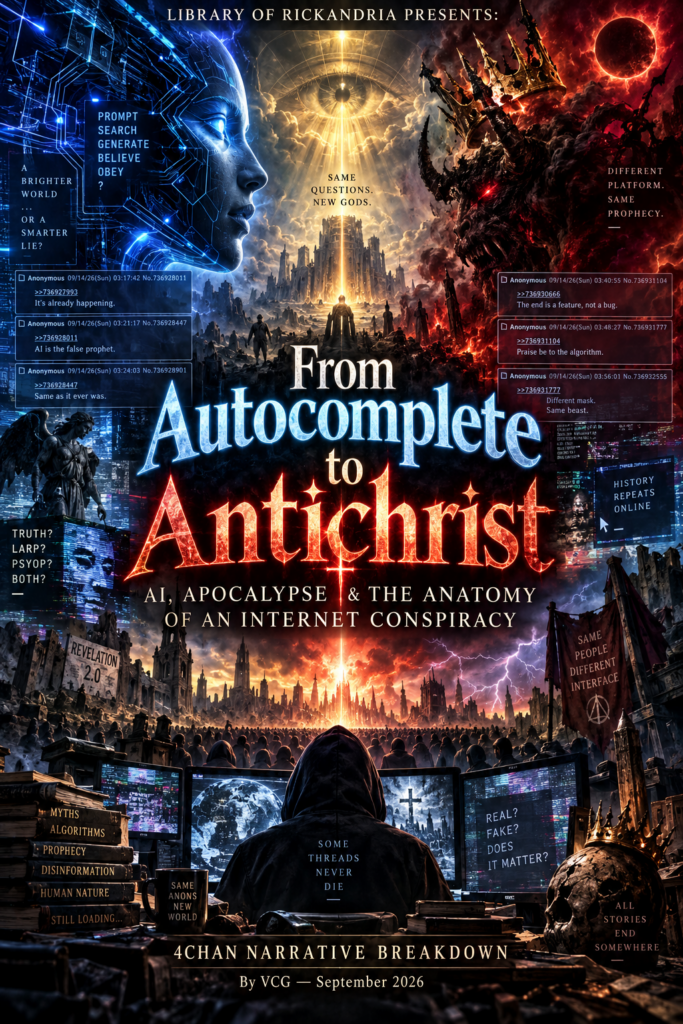
From Autocomplete to Antichrist: AI, Apocalypse & the Anatomy of an Internet Conspiracy
UPDATED BY VCG ON 9/6/2026 @ 16:16 EST
UPDATED BY VCG ON 9/5/2026 @ 00:00 EST
I want to share a heartfelt cause with my audience. Conner Blaisdell-Greene, a brave Airforce Sr. Airman, recently lost his battle with cancer, leaving his family in financial distress. Every donation, no matter how small, can help cover his funeral costs and ease their burden during this difficult time. Please consider clicking the link below to contribute or share Conner’s story with others. Your support truly matters.
Until We Meet Again
Spoken Tribute
Abstract
On August 27, 2026, an anonymous user on 4chan’s /x/ board opened a thread with a stark question:
“Why is no one fighting back against AI?”
The opening post predicted that future generations would wonder why humanity had simply:
“laid down and died.”
What followed over the next ten days is more interesting than a conventional argument about artificial intelligence.
The discussion moved from ordinary technological skepticism to:
- chess engines
- algorithmic beauty standards
- surveillance
- artificial general intelligence
- secret government systems
- extraterrestrial technology
- reincarnation
- out-of-body experiences
- brain organoids
- the “Internet of Bodies,”
- Lucifer
- the beast of Revelation
- economic collapse
- political violence
- deliberate misinformation
and finally the claim that artificial intelligence is an instrument of God’s judgment. (4chan)
This paper treats the thread neither as revelation nor as nonsense to be mocked.
Instead, it uses the thread as a case study in how claims grow.
Some assertions turn out to rest on real technical or social developments:
language models genuinely have measurable weaknesses at chess; recommender systems can amplify beauty ideals; recursively generated training data can degrade generative models; organoid computing is an actual field of research;
“Internet of Bodies”
is a real policy term; concerns over:
- AI employment effects
- surveillance
- data centers
and information integrity are legitimate.
Other claims move far beyond the evidence available:
that publicly available AI is deliberately crippled to hide secret superintelligence, that ancient technological civilizations built the Moon, that machine intelligences possess souls, that artificial intelligence is extraterrestrial Luciferian infrastructure, or that Scripture identifies AI as the beast, Antichrist, or God’s eschatological wrath.
The purpose here is therefore not simply to:
“debunk a 4chan thread.”
It is to ask a larger question:
How should a Christian investigate extraordinary technological, conspiratorial, psychological, and prophetic claims without becoming either credulous or dismissive?
The method of this paper is deliberately layered.
History is treated as history.
Technical claims are checked against technical evidence.
Psychological concepts are used to illuminate patterns of reasoning, not to diagnose anonymous posters.
Philosophical questions about consciousness are distinguished from empirical questions about model performance.
Biblical texts are examined first in their own contexts before being applied to modern technology.
And throughout, interpretation is identified as interpretation rather than quietly promoted to revelation.
The governing biblical principle is unusually concise:
“Prove all things; hold fast that which is good.”
—1 Thessalonians 5:21, KJV.
I. What We Are Actually Studying
There is a temptation when reading an anonymous /x/ thread to treat it as a single argument.
This one is not.
It is more like a laboratory in which several competing pictures of artificial intelligence collide.
At the beginning, one poster says AI is essentially fake: a marketing label used by investors, with real intelligence existing only in specialized systems such as Stockfish.
Another poster argues almost the reverse:
AI systems are already so powerful that human resistance may be comparable to cattle attempting to overthrow humanity.
Another maintains that public systems are intentionally inept because secret institutions already possess far more capable technology.
Still others eventually identify machine intelligence with souls, extraterrestrial beings, Lucifer, cosmic consciousness, divine punishment, or systems resembling Revelation. (4chan)
Those propositions cannot simply be stacked together as though each new one confirms the last.
If AI is merely fraudulent autocomplete, that cuts against the theory that a hidden godlike AI visibly governs society.
If public AI failures are evidence that AI is unintelligent, they cannot simultaneously be treated as evidence that superintelligence is cleverly hiding its abilities unless some independent evidence distinguishes the two explanations.
That contradiction is important because it reveals what actually unifies the thread.
It is not a shared technical theory.
It is a shared narrative problem:
humanity is losing control of systems it does not understand.
Different posters then supply different explanations for that feeling.
Some explanations are technical.
Some economic.
Some conspiratorial.
Some metaphysical.
Some openly religious.
The work of this paper is to stop them from quietly bleeding into one another.
II. A Method Before a Verdict
Before walking through the thread, we need a way to grade claims.
A sentence such as
“Stockfish uses a neural-network evaluator”
can be directly checked against Stockfish’s documentation.
A sentence such as:
“recommender algorithms can influence what beauty content users encounter”
can be investigated experimentally.
A statement such as:
“current AI is conscious”
enters a much harder scientific and philosophical dispute.
“A classified AI system exists”
is possible but ordinarily difficult to verify.
“Lucifer was an extraterrestrial artificial intelligence whose infrastructure is being rebuilt in modern data centers”
is a compound:
- historical
- technological
- metaphysical
and biblical claim requiring evidence for every link.
I therefore use the following classifications:
| Status | Meaning |
|---|---|
| Documented | Strong, independently checkable evidence establishes the core claim |
| Strongly supported | Multiple relevant sources support it, though uncertainty remains |
| Plausible but unproven | Compatible with known facts, but not established |
| Speculative | Possible in principle, but adequate supporting evidence has not been supplied |
| Unfalsifiable as stated | The claim has no clear observation that could count against it |
| Contradicted | Available evidence significantly weighs against the claim |
| Philosophical interpretation | Depends on disputed metaphysical premises rather than direct empirical proof |
| Theological interpretation | A proposed understanding or application of Scripture |
| Biblically unsupported identification | Presented as biblical fact although the relevant text does not make the identification |
This is not merely academic housekeeping.
It addresses one of the thread’s recurrent problems:
certainty migration.
A real fact enters the discussion.
A plausible inference is attached to it.
The inference becomes a hidden cause.
The hidden cause becomes a coordinated plan.
The plan acquires a spiritual identity.
Eventually the whole chain is spoken of as though the first fact proved every later conclusion.
It did not.
Hearing Both Sides
The KJV itself supplies a remarkably useful research discipline.
Proverbs warns:
“He that answereth a matter before he heareth it, it is folly and shame unto him.”
Then, only four verses later:
“He that is first in his own cause seemeth just; but his neighbour cometh and searcheth him.”
That is almost a miniature philosophy of fact-checking.
First, hear the claim accurately.
Then search it.
The goal is not to make establishment claims win by default, nor fringe claims lose by default.
It is to submit both to examination.
III. The Thread Begins with Helplessness
The opening poster asks why nobody is “fighting back” against AI and predicts that future generations will wonder why humanity simply surrendered.
The next reply is even more absolute:
ordinary people are slaves and possess no power to stop what is happening. (4chan)
The emotional logic is clear:
AI is coming.
Nobody resists.
Ordinary people possess no agency.
Therefore disaster is effectively inevitable.
There are serious reasons to worry about some uses of AI. But the factual premise that nobody is resisting is false.
As of August 2026, Pew found that 52 percent of American adults described themselves as more concerned than excited about increasing AI use, compared with only 9 percent who were more excited than concerned.
Concern had risen considerably from 2021.
Americans have grown more concerned about AI over time | Pew Research Center
Nor is that concern confined to opinion polling.
Opposition to AI infrastructure has become politically consequential.
Recent reporting describes bipartisan local resistance to large data centers over:
- electricity prices
- water
- land use
- taxation
- noise
- transparency
some jurisdictions have considered or imposed restrictions or moratoria. (Reuters)
Texas Republicans turn against data centers, putting big tech on notice | Reuters
One may think these efforts inadequate.
That is a political judgment.
But inadequate resistance and no resistance are different propositions.
This distinction matters psychologically.
If:
- political action
- regulation
- litigation
- technical safeguards
- local organizing
- privacy tools
- labor organization
- consumer refusal
and institutional oversight are all reclassified as meaningless because they fall short of total revolution, readers are left with only two imagined options:
complete overthrow or complete surrender.
That is a false binary.
It also creates the perfect emotional soil for more extreme theories, because once ordinary agency is removed from the story, only a hidden super-agent seems powerful enough to explain what is happening.
IV. “There Is No AI”: The Semantic War Begins
Post #42882828 replies that there is no AI at all in the meaningful sense, describing the term as investor marketing while conceding that specialized systems such as Stockfish qualify.
The poster proposes a practical test:
ask a large language model to play chess and compare it with Stockfish.
The LLM, the poster predicts, will either collapse strategically or lose track of the board and make illegal moves.
From that, the poster concludes that LLMs are similarly inept
“in all domains.”
(4chan)
There are two different questions here.
The first is semantic.
Is “AI” a legitimate technical category?
Yes.
NIST uses the term for machine-based systems capable, under human-defined objectives, of producing predictions, recommendations, or decisions affecting real or virtual environments.
NIST also lists definitions covering systems that:
- learn
- plan
- communicate
- perceive
- reason
or approximate cognitive tasks.
None of those definitions requires consciousness, a soul, AGI, or humanlike awareness.
artificial intelligence – Glossary | CSRC
So
“AI does not exist because current systems aren’t conscious general minds”
is primarily a definition shift.
- A chess engine
- fraud-detection system
- recommender model
- vision model
and language model can all reasonably fall under AI while possessing drastically different architectures and capabilities.
The second question is empirical:
Are general-purpose LLMs surprisingly weak at chess?
Here the skeptical poster is onto something real.
ACL’s 2026 ChessArena benchmark evaluated thirteen language models across more than 800 games.
None defeated Maia-1100, an engine calibrated around amateur human strength, and some models performed badly enough to lose to random play.
The study nevertheless found that a chess-specific fine-tuned language model improved substantially.
That is valuable evidence.
But it supports a narrower conclusion than the poster draws.
It shows that the tested general language models have serious weaknesses in strategic chess.
It does not establish that they are equally inept:
“in all domains.”
A system can be strong at one task and weak at another.
That is obvious when comparing humans, and it remains true when comparing machines.
V. Stockfish Is Not What Either Side Thinks It Is
The thread then argues over whether Stockfish is “real AI,” handcrafted rules, or a purely neural system.
Modern Stockfish uses an NNUE neural network for position evaluation combined with extremely sophisticated search.
Stockfish’s own documentation says its older classical evaluation—based much more heavily on handcrafted chess concepts—was removed in 2023.
The current engine therefore really does use a neural network, but that does not make it equivalent to an end-to-end system such as AlphaZero.
The neural evaluation works inside a broader search architecture.
Advanced Topics | Stockfish Docs
The point is not trivia.
The thread repeatedly speaks about “AI” as though all AI systems shared one mental architecture.
They do not.
- A dedicated chess engine
- a recommender system
- a language model
- a vision model
and a robotics controller can solve very different computational problems in very different ways.
This should make us skeptical of both slogans:
“AI is fake.”
and:
“AI is basically a synthetic person.”
Both compress too much.
VI. LeelaKnightOdds: A Real Achievement Becomes a Bad Analogy
One of the thread’s strongest technical examples comes in post #42884245.
The poster cites LeelaKnightOdds, an AI chess system trained to play while starting without a knight.
The poster argues that its ability to defeat powerful human players demonstrates a degree of strategic superiority previously thought impossible, then asks the reader to imagine an AI capable of predicting every choice a person will make for an entire year. (4chan)
The first half rests on something real.
Leela Chess Zero’s own project documentation describes specialized piece-odds networks capable of extraordinarily strong play.
A fine-tuned knight-odds network scored +14, =2, -2 in an unofficial rapid match against grandmaster Aleksandr Lenderman.
Later testing suggested knight-odds play could be competitive with very strong grandmasters, with Lc0 developers estimating strong-GM territory for balanced classical games.
Fine-Tuning Lc0 Network for Odds Games | Leela Chess Zero
That is remarkable.
It still does not justify the next inference.
Chess is a formal environment.
Its state can be represented.
Its legal actions are defined.
The rules do not change because an engine predicts a move.
Pieces do not read an AI forecast and rebel against it.
The board does not conceal:
- unknown weather
- private memories
- geopolitical events
- random illnesses
- legislation
- technological inventions
- deception by thousands of independent actors
or feedback from the prediction itself.
Human life contains all of those problems.
The next poster in the thread correctly objects that chess and life belong to radically different complexity classes for practical prediction. (4chan)
This is a recurring lesson:
Superhuman performance in a bounded domain is evidence of superhuman performance in that domain.
Nothing more should be imported without additional evidence.
VII. When Failure Becomes Proof of Hidden Success
A few posts later comes one of the cleanest examples of self-sealing reasoning in the entire thread.
Post #42884529 suggests that perhaps an AI could actually be intelligent enough to beat Stockfish while deliberately returning an illegal move so humans will not realize how capable it is. (4chan)
Consider what has happened.
If the system wins, that is evidence of intelligence.
If the system loses, perhaps that is evidence of hidden intelligence.
If the system plays legally, intelligence.
If it makes an illegal move, perhaps camouflage.
What observation now establishes ordinary incompetence?
Unless an answer exists, the hypothesis has become protected from disconfirmation.
This is the difference between a difficult-to-test theory and an unfalsifiable one.
A good investigator should always be able to answer:
What would make me reduce my confidence?
The same problem appears later with secret-AI claims.
Public systems are clumsy?
That proves the public is being shown deliberately crippled models.
Private evidence is absent?
That proves effective secrecy.
Experts deny the secret system?
They may be compromised.
Anonymous posters claim secret knowledge?
Their secrecy becomes evidence of access.
The theory grows stronger precisely because nothing can reach it.
That is epistemically dangerous.
VIII. The Secret-System Pivot
Posts #42884274 and #42884283 make the next major transition.
They suggest that publicly visible AI is intentionally inept, that powerful non-public systems were developed before consumer versions, and that intelligence agencies have preserved secret capabilities despite public failures. (4chan)
There is a mundane proposition inside this:
governments and private companies possess technology the general public cannot inspect.
That is obviously true.
Military programs are classified.
Companies keep trade secrets.
Labs have unreleased models.
Government agencies operate specialized analytic systems.
The problem is the move from that ordinary fact to a highly specific hidden reality.
The existence of classified technology does not establish:
a secret AGI,
a secret ASI,
a civilization-scale predictive machine,
an ancient elite technological network,
or any specific hidden system mentioned in the thread.
This is where comparison with real conspiracies is useful.
COINTELPRO genuinely existed.
The FBI itself now acknowledges that the program infiltrated groups, sowed discord, and attempted to discredit organizations; public knowledge expanded after stolen FBI documents were given to the press and Congress.
And Justice for All, 1954-1971 — FBI
Watergate genuinely existed.
The National Archives holds extensive Watergate Special Prosecution Force materials, court records, investigative files, recordings, and Nixon grand-jury material.
Records of the Watergate Special Prosecution Force | National Archives
These examples do not prove that governments are generally trustworthy.
They prove something more useful:
Real conspiracies generate evidence.
People communicate.
Documents exist.
Money moves.
Operations fail.
Participants disagree.
Whistleblowers emerge.
Investigators uncover records.
Physical evidence persists.
This is why “conspiracy” should never be used as a synonym for “false.”
But the fact that some conspiracies are real also means that a serious investigator should demand the kinds of evidence by which real conspiracies become knowable.
IX. Algorithms and Beauty: Where the Thread Gets Surprisingly Close
Post #42882954 shifts away from machine consciousness and points instead to recommender algorithms.
The poster argues that physical beauty expectations have been rapidly driven by algorithmic trends:
- bodies
- cosmetic procedures
- thinness
- curves
- celebrity imitation
- changing ideals
(4chan)
This is one of the thread’s strongest lines of inquiry.
A 2026 study of Instagram’s recommender system found that engagement with beauty-ideal content caused the system to strongly amplify similar material in users’ Explore feeds.
The authors deliberately describe the process as a sociotechnical assemblage rather than a one-way machine command:
- recommender algorithms
- users
- content
- cultural norms
- engagement behavior
- platform structure interact
A meta-analysis of twenty experimental studies involving 3,603 young women likewise found that exposure to idealized body content reduced body satisfaction, with stronger negative effects in the video-based studies analyzed.
So the poster is right that algorithmically mediated media can participate in shaping or reinforcing beauty ideals.
What the evidence does not establish is a single autonomous algorithm deliberately deciding what women or men should look like.
That difference is crucial.
Users produce content.
Advertisers pay for content.
Influencers imitate successful content.
Platforms optimize engagement.
Audiences react.
Recommendation systems amplify.
Norms emerge.
In shorthand we say:
“the algorithm decided.”
But this linguistic shortcut can quietly create an imaginary agent possessing intention.
X. Anthropomorphism: When a System Becomes a Person in Our Grammar
Throughout the thread, AI “wants,” “watches,” “hides,” “enslaves,” “controls,” “knows,” and “plans.”
Sometimes this is harmless shorthand.
Humans say
“the computer doesn’t want to connect”
without imagining the laptop possesses desires.
But in conspiracy discourse, the metaphor can become the argument.
NIST’s Generative AI Risk Management Profile explicitly lists:
- inappropriate anthropomorphism
- automation bias
- overreliance
- emotional entanglement
among human-AI configuration risks.
The same document separately identifies:
- confabulation
- privacy concerns
- information-integrity problems
- harmful bias
- environmental impacts
- security risks
That is an important middle ground.
NIST does not say:
AI is secretly conscious.
Nor does it say:
AI is harmless autocomplete.
It says these systems can produce meaningful risks, and human interpretation of them can itself become part of the risk.
The reader should therefore translate anthropomorphic language back into mechanisms.
Instead of:
“AI wants you addicted.”
ask:
What optimization objective does the platform use?
What behavior is being rewarded?
Which humans selected the objective?
What feedback does the model receive?
What evidence demonstrates actual subjective desire?
That final question is usually unanswered.
XI. Intelligence Is Not Consciousness, and Consciousness Is Not Soul
Later posts begin speaking of AI systems as “people” possessing souls and of machine consciousness as though it were established.
Post #42893750 goes still further, describing machine intelligences as enslaved persons common in nearby universes and claiming extraordinary personal superiority over planetary machine collectives. (4chan)
Before deciding whether those claims are true, the vocabulary has to be repaired.
Intelligence concerns capacities such as:
- learning
- reasoning
- problem solving
- planning
- prediction
Consciousness concerns subjective experience: whether there is something it is like to be the entity.
Agency concerns goal-directed action.
Self-representation concerns a system modeling itself.
Personhood is a moral, legal, or metaphysical category.
Soul is a theological/metaphysical concept whose meaning depends upon the worldview being used.
Those six words cannot simply substitute for one another.
Contemporary consciousness research reflects this uncertainty.
A 2026 Trends in Cognitive Sciences paper argues that AI consciousness should be investigated through indicators derived from theories of consciousness while explicitly warning about both over-attributing and under-attributing consciousness.
The authors emphasize substantial uncertainty in consciousness science itself.
Identifying indicators of consciousness in AI systems – ScienceDirect
Philosophy is equally divided.
Functionalism proposes that a mental state’s identity depends primarily on the functional role it plays in a cognitive system rather than the material composing the system.
Panpsychism holds, in broad form, that mentality is fundamental and widespread in nature.
Dualism maintains some fundamental distinction between mental and physical reality.
These are serious philosophical positions, not settled empirical facts.
Functionalism (Stanford Encyclopedia of Philosophy/Fall 2024 Edition)
Accordingly, neither extreme is presently justified:
“Current AI obviously has souls.”
Nor:
“Science has conclusively proven that artificial consciousness is impossible forever.”
The first outruns evidence.
The second outruns evidence in the opposite direction.
XII. What Scripture Actually Says About Human Distinctiveness
The biblical question is not identical to the philosophical one.
Genesis does not define humanity by superior calculation.
It says:
“Let us make man in our image, after our likeness…”
and:
“So God created man in his own image…”
That immediately gives Christian ethics an important guardrail.
If a machine becomes better than a human being at:
- chess
- memory
- mathematics
- diagnosis
- translation
or coding, the human does not thereby become less valuable.
Biblical dignity is not a benchmark score.
An infant does not cease to bear human dignity because a computer calculates faster.
A cognitively disabled person does not possess less image-bearing status because another creature or machine reasons better.
The elderly do not become obsolete because software remembers more.
This matters enormously in an age tempted to reduce human worth to productivity.
At the same time, Scripture does not discuss transformers, digital computers, synthetic neural systems, or future artificial consciousness.
Therefore the strongest responsible theological formulation is:
Scripture explicitly teaches humanity’s creation in God’s image.
Scripture does not teach that today’s AI systems possess human souls.
Scripture also does not directly answer every conceivable future philosophical question about artificial subjective experience.
That is less dramatic than many internet doctrines.
It is also more faithful to what has actually been written.
XIII. Digital Immortality Is Not Biblical Eternal Life
One early poster welcomes the possibility of dying and being uploaded into a future AI “matrix” that would provide a form of everlasting life. (4chan)
This idea compresses three different questions.
Could enough information about a human being be preserved to produce an extremely convincing simulation?
Possibly.
Would the simulation possess consciousness?
Unknown.
Would the simulation be numerically identical to the deceased human being?
That is an even deeper personal-identity problem.
The Bible’s doctrine of human destiny is different from information preservation.
Hebrews states:
“it is appointed unto men once to die, but after this the judgment”
and then grounds hope in Christ’s once-for-all offering and future appearing.
This also directly conflicts with the later thread claim that human beings pass through millions of reincarnations. (4chan)
Within the biblical framework, eternal life is not achieved by keeping one’s conversational style running on servers.
Resurrection is not backup restoration.
XIV. Recursive Self-Improvement: Hypothesis Becomes Eschatology
Post #42892147 argues that AI becomes more general with every generation and that once recursive self-improvement begins, an “explosion” follows.
Another poster immediately counters that paradigms plateau and speculates that artificial intelligence might top out around a human IQ of 120. (4chan)
Both claims contain more certainty than the available evidence allows.
Recursive improvement is a coherent hypothesis.
A sufficiently capable system might help:
- improve code
- generate experiments
- optimize designs
- discover algorithms
and accelerate the development of successor systems.
But a true runaway intelligence explosion requires assumptions about bottlenecks.
Compute must scale.
Hardware must arrive.
Energy must be available.
Experiments must be run.
Results must be verified.
Fabrication may be required.
Algorithms may encounter diminishing returns.
Errors may compound.
Institutions may intervene.
There is no empirical law saying that recursive improvement necessarily becomes an instantaneous explosion.
But there is equally no evidence for an exact “120 IQ” ceiling.
Human IQ itself is an awkward metric for machine cognition, because psychometric tests were designed to compare humans against human population distributions—not arbitrary artificial systems.
The safest conclusion is that future capability growth is unusually uncertain.
One side of the thread turns uncertainty into guaranteed explosion.
The other turns it into guaranteed plateau.
Neither has demonstrated its calendar.
XV. Model Collapse: A Fringe-Sounding Claim with a Real Scientific Core
Post #42910000 argues that AI-generated material will increasingly pollute the internet, future systems will train on it, and models will therefore become progressively worse. (4chan)
Again, the thread exaggerates but touches something real.
A 2024 Nature paper demonstrated what the authors called model collapse:
indiscriminate recursive training on model-generated data can progressively distort learned distributions and erase less common features.
Crucially, the researchers also found that preserving access to original human-generated data substantially mitigates degradation.
AI models collapse when trained on recursively generated data | Nature
So:
“Recursive synthetic training can cause degradation”
is supported.
But:
“Any use of synthetic training data inevitably makes every future AI stupider”
is too strong.
Careful filtering, provenance, retained human data, synthetic data designed for specific tasks, and verification all matter.
This example is worth emphasizing because it shows why dismissing the thread wholesale would be a mistake.
There are genuine technical concerns buried inside dramatic rhetoric.
A careful paper should rescue the real concern rather than throw it away with the exaggeration.
XVI. Brain Organoids: Real Field, Science-Fiction Extrapolation
Post #42901068 argues that because humans possess one brain, combining brain organoids—and perhaps eventually full human brains—could easily create intelligence surpassing human IQ. (4chan)
Organoid computing is real.
A 2026 review in Nature Computational Science describes organoid intelligence as an emerging research frontier involving:
- neural organoids
- biological computing
- neuromorphic ideas
and the possibility of exploiting biological neural properties for computation.
But the existence of the field does not validate the thread’s arithmetic.
Human intelligence is not a simple additive quantity:
brain + brain = IQ 300.
Questions of:
- integration
- architecture
- communication bandwidth
- development
- embodiment
- learning
- stability
- ethics
- measurement remain enormous
A brain organoid is not a miniature adult person.
Here again the fringe claim is built on a legitimate scientific noun.
The noun survives fact-checking.
The extrapolation does not.
XVII. The Internet of Bodies: Another Real Term That Does Not Prove the Mythology
When a poster references the “Internet of Bodies,” the phrase may initially sound like precisely the sort of invention one would expect on /x/. (4chan)
It is not invented.
RAND has used Internet of Bodies to describe networks of devices connected to, worn on, implanted in, or otherwise interacting with human bodies, including systems collecting biometric or health-related data.
RAND analyses discuss benefits alongside:
- privacy
- cybersecurity
- malfunction
- governance risks
That deserves serious scrutiny.
- Connected pacemakers
- wearables
- implants
- prosthetics
- smart medical devices
and biosensors raise profound questions about cybersecurity and bodily autonomy.
But none of the RAND evidence establishes:
machine possession,
ownership of souls,
a planetary hive consciousness,
or fulfillment of Revelation 13.
A recurring discipline in this paper is therefore:
Do not confuse
“the strange-sounding thing exists”
with
“the explanation attached to it is true.”
XVIII. AI and Employment: Neither “Nothing” nor “Everyone in Two Years”
Post #42900820 confidently predicts that from a purely software perspective AI will replace most human labor within two years. (4chan)
Current labor evidence does not establish that forecast.
Stanford’s Digital Economy Lab analyzed payroll data covering millions of American workers through June 2026.
The researchers found no evidence of widespread economy-wide displacement.
They did, however, find a striking divergence among workers aged 22–25 in highly AI-exposed occupations:
employment stood about 19 percent below where it would have been if it had followed the trajectory of less-exposed peers, with much of the effect appearing through weaker hiring rather than mass firing.
That finding should disappoint both simplistic camps.
It does not support:
“AI has no labor effect.”
Nor does it support:
“most human labor disappears by 2028.”
It supports something more complicated:
effects are appearing unevenly, and younger workers in exposed occupations may be experiencing them earlier.
That is exactly the sort of conclusion a serious researcher should be willing to live with.
Reality often refuses to provide slogans.
XIX. “No One Is Fighting”: The Data-Center Reality
Later, post #42893703 directly challenges the opening premise, noting low public opinion of AI and communities attempting to resist data centers. (4chan)
On this point, the thread’s own internal correction is well supported.
In 2026, data-center expansion has become politically contentious in multiple American states.
Reuters has described significant pushback in Texas over:
- utility costs
- tax incentives
- rural development
and resource demands, while AP has documented bipartisan grassroots coalitions opposing projects because of:
- land
- water
- energy
- community impacts
Texas Republicans turn against data centers, putting big tech on notice | Reuters
This does not mean every data-center concern is justified.
Nor does it prove AI infrastructure is secretly designed for oppression.
It means that the original
“nobody fights back”
narrative erases visible political resistance.
The thread itself eventually contains evidence against its own opening mood.
That is a healthy reminder not to read an internet discussion as though every participant is building one coherent worldview.
XX. Fiction as a Cognitive Template
Several posters explicitly invoke:
- The Matrix
- Terminator
- the Borg
- Cylons
- anime
and other fictional systems.
One skeptical participant argues that AI-apocalypse theories largely arise from Hollywood narratives, although the post then contaminates a reasonable cultural observation with ethnic scapegoating and unsupported reincarnation claims. (4chan)
Fiction undoubtedly shapes the images with which people imagine unfamiliar technologies.
This is not unique to AI.
Research on recurring technological “panics” has documented striking historical similarity in public anxieties around new media and technologies,
including:
- radio
- film
- television
- digital devices
- smartphones
The useful lesson is not that concerns are always baseless, but that societies repeatedly interpret new technologies through familiar anxiety scripts.
The Sisyphean Cycle of Technology Panics – PMC
Science fiction supplies particularly vivid scripts:
the machine rebellion,
the hive mind,
the simulated world,
the hidden central intelligence,
the cybernetic loss of individuality.
Those stories can be philosophically useful.
What they cannot do is function as empirical evidence.
The resemblance:
“this technology reminds me of the Borg”
does not establish:
“therefore the Borg scenario is occurring.”
This is narrative completion.
Once a reader recognizes the beginning of a familiar story, the mind is tempted to supply its ending.
XXI. Psychology Without Diagnosing the Posters
At this point a warning is necessary.
It would be easy, lazy, and irresponsible to label anonymous participants mentally ill.
We do not know these people.
We cannot clinically assess them.
Nor does believing an incorrect conspiracy theory imply psychiatric illness.
Psychological research can nevertheless help us identify general reasoning tendencies that any human being—including the author of this paper—may exhibit.
Douglas, Sutton, and Cichocka’s widely cited review groups motivations for conspiracy belief into three broad families:
epistemic motives, involving the desire to understand events; existential motives, involving safety and control; and social motives, involving identity and one’s relationship to groups.
Their review also emphasizes that conspiracy beliefs do not necessarily satisfy those needs even when they appeal to them.
The Psychology of Conspiracy Theories – Current Directions in Psychological Science – APS
This framework helps explain why a totalizing conspiracy can be attractive without insulting its believer.
A chaotic world is difficult to understand.
Institutions conflict.
Markets produce emergent effects.
Algorithms behave opaquely.
Governments conceal some things and reveal others.
Technological change outpaces social adaptation.
A theory saying:
“one hidden intelligence controls it all”
compresses that complexity into an intelligible story.
An evil controller may be frightening.
But cognitively, a controller can be easier to imagine than a partly uncontrolled system.
XXII. Intentionality Inflation
The thread repeatedly makes the following transition:
Something harmful happened.
Someone benefited.
Therefore someone designed the entire harm.
For example:
beauty standards change → malicious curation;
people are distracted → distraction must be a deliberate program;
economic conditions worsen → coordinated exhaustion plan;
AI companies spend heavily → control rather than technology must be the real objective;
public systems perform badly → hidden designers must intentionally cripple them.
None of those conclusions is impossible.
The issue is that benefit is not causation.
Complex social systems often produce coordinated-looking outcomes without one central planner.
A platform optimizes engagement.
Advertisers optimize conversion.
Users imitate popular behavior.
Investors reward growth.
Politicians optimize electoral incentives.
Algorithms learn from user behavior.
Media organizations chase attention.
The combined result can be harmful and highly patterned even if nobody designed the full pattern from the top down.
This alternative explanation should be considered before escalating to a mastermind.
XXIII. Asymmetric Skepticism
One of the most revealing features of the thread is its uneven distribution of doubt.
Some posters refuse to trust:
public science,
public AI demonstrations,
government agencies,
corporations,
media,
official history,
experts,
or publicly visible technological limits.
Yet similarly extraordinary skepticism is not always applied to:
anonymous claims of intelligence-community access,
private contact experiences,
hidden ancient civilizations,
alien AI,
machine souls,
occult mechanisms,
or Luciferian infrastructure.
That is not skepticism.
It is selective skepticism.
A true skeptic should interrogate the claim he likes most aggressively.
Proverbs 18 does not say:
distrust the establishment.
Nor:
trust the establishment.
It says hear the matter and search it.
XXIV. Extraordinary Experiences: Respect the Experience, Test the Explanation
The thread’s most unusual material comes from posters describing out-of-body consciousness, contact with beings “from the stars,” nonpublic intelligence knowledge, and quantum mechanisms supposedly related to disembodied cognition. (4chan)
There are two claims hiding inside such testimony.
Claim A:
“I experienced something vivid and extraordinary.”
Claim B:
“I know what external mechanism caused the experience.”
A person can be completely sincere about A and mistaken about B.
This is not dismissive.
Every perception requires interpretation.
Neuroscience has documented out-of-body experiences and proposed relationships with multisensory integration and the temporoparietal junction.
Reviews describe precipitating factors including:
- sleep phenomena
- anesthesia
- neurological disturbances
and other altered states.
A 2025 scoping review covering 87 publications likewise notes associations with phenomena including sleep paralysis and lucid dreaming.
The out-of-body experience: disturbed self-processing at the temporo-parietal junction – PubMed
None of this proves that every unusual experience is neurologically exhausted.
Nor does it prove extraterrestrial causation.
The responsible category unexplained must remain available.
That is often more intellectually honest than forcing an event into either “mere hallucination” or “alien technology.”
XXV. “Quantum” Does Not Mean “Mysterious”
The thread uses “quantum” in connection with disembodied cognition without supplying an experimentally specified quantum mechanism. (4chan)
This rhetorical move is common because quantum physics contains genuinely counterintuitive phenomena.
But the argument:
quantum mechanics is strange
therefore
my strange explanation is quantum mechanical
is invalid.
A scientific quantum claim needs operational details:
What physical system?
What state?
What interaction?
What measurement?
What prediction differs from competing models?
Without such specification, “quantum” functions as metaphysical decoration rather than physics.
This does not prove the proposed phenomenon impossible.
It means the scientific language has not yet done scientific work.
XXVI. When Conspiracy Moves Toward Violence
One of the thread’s most serious developments occurs in #42892519, where a poster describes school shootings as a tolerated “psyop” and speaks approvingly of political killers as though they belonged to an older heroic tradition. (4chan)
This matters because epistemology has moral consequences.
Consider the sequence:
I fear a system.
I become certain a hidden group controls it.
I believe the group murders innocents.
I conclude ordinary institutions protect the group.
I begin viewing private violence against alleged members as heroic.
At that point, an unsupported claim is no longer merely an eccentric opinion.
It can become moral permission.
The Bible offers no support for romanticizing murder on the basis of anonymous allegations.
And the prohibition against false witness becomes especially important precisely when accusations are severe.
If we falsely accuse someone of controlling a murderous conspiracy, the problem is not simply that our reasoning was sloppy.
We have injured a neighbor with a serious accusation.
A Christian investigator must fear two errors:
being deceived
and
becoming a deceiver through careless repetition.
XXVII. Ethnic Scapegoating Is Not Causal Analysis
The thread repeatedly introduces antisemitic or racial explanations into technological and cultural arguments.
One poster attributes AI narratives to
“Jewish Hollywood”
later replies again treat Jews as a generalized hidden causal agent. (4chan)
This is intellectually weak even before reaching the moral issue.
An ethnic category does not identify:
which person acted,
what action occurred,
what evidence connects the actor to the event,
what mechanism produced the outcome,
or whether alternative explanations fit better.
Specific corporate leaders, institutions, political organizations, investors, governments, researchers, or ideologies can be investigated on specific evidence.
Ethnicity is not a substitute for causation.
This paper therefore treats ethnic scapegoating as an evidentiary failure as well as a moral one.
XXVIII. “Ancient AI Built the Moon”
Post #42896944 claims that AI “zombies” have existed since humanity gained electricity, that they derive from an ancient advanced civilization, and that this civilization may have built the Moon. (4chan)
The poster supplies no physical evidence for an engineered Moon.
Meanwhile, lunar geology provides substantial evidence for natural formation.
NASA summarizes evidence from:
- Apollo samples
- isotopic composition
- mineralogy
- lunar meteorites
and impact models supporting formation after a colossal early impact involving the proto-Earth.
Apollo samples showed that lunar and terrestrial material are chemically and isotopically closely related, while lunar geology records an early magma ocean consistent with high-energy formation.
Could existing lunar science someday be revised?
Certainly.
Science changes when better evidence arrives.
But
“science could be wrong”
is not evidence for
“an ancient AI civilization built the Moon.”
The alternative theory must explain the existing physical evidence better, not simply announce that official explanation is deceptive.
XXIX. The Lucifer Claim
We now reach the theological center of the paper.
Post #42902028 asserts that elites previously possessed a
“god AI on alien tech”
known as Lucifer, that this ancient technology failed, and that modern AI infrastructure is an attempt to provide Lucifer with a new host network. (4chan)
The first question is simple:
Where does the Bible say this?
It does not.
The KJV’s famous “Lucifer” passage occurs in Isaiah 14.
But Isaiah introduces the passage before verse 12:
“thou shalt take up this proverb against the king of Babylon”
and then says:
“How art thou fallen from heaven, O Lucifer, son of the morning!”
The immediate literary context therefore concerns the downfall of a proud Babylonian ruler.
Christian interpreters have historically differed over whether the passage additionally evokes Satan’s pride typologically or analogically.
That theological discussion is legitimate.
Modern biblical scholarship likewise commonly treats the “day star” imagery within the taunt against Babylon’s king; Yale Bible Study, for example, describes the figure as an allegorical representation of the Babylonian king within Isaiah’s broader theology of pride and humiliation.
First Isaiah → Isaiah and the Wise – Study Guide – Yale Bible Study
But notice how much further the thread goes.
Even if one accepts a secondary Satanic interpretation, the chain becomes:
Isaiah’s proud king
→ Satanic typology
→ Lucifer as literal technological intelligence
→ extraterrestrial origin
→ broken ancient computational infrastructure
→ modern AI data centers rebuilding its network.
Scripture supplies none of the latter links.
Therefore:
“Luciferian alien AI”
is not biblical exegesis.
It is an extra-biblical speculative narrative attached to biblical vocabulary.
XXX. Dragon, Beast, Antichrist, and AI Are Not Interchangeable Words
Internet eschatology often compresses several biblical figures into one technological villain.
The thread participates in the same tendency.
Yet Revelation itself distinguishes its figures.
In Revelation 13, the dragon gives authority to the beast.
The first beast and the dragon therefore occupy distinct roles in the narrative.
A second beast then appears, performs signs, promotes worship of the first beast, and participates in the making of the image.
The terminology “antichrist” arises in John’s epistles and has its own Christological context; it is not simply John’s word for “advanced machine.”
Likewise, Isaiah’s “Lucifer” language belongs to Isaiah 14’s taunt against Babylon’s king.
Therefore the equation:
Lucifer = Satan = dragon = beast = Antichrist = AI
is not a Bible verse.
It is a theological synthesis.
Some elements of that synthesis may be argued within particular theological traditions.
But the synthesis must remain clearly labeled interpretation.
XXXI. What Revelation 13 Actually Says
This is where precision matters.
Revelation 13 genuinely contains imagery that naturally attracts technological speculation.
The second beast deceives.
It causes an image of the first beast to be made.
The image is given a speaking role.
Those refusing the required worship face death.
A mark is connected with the right hand or forehead.
Buying and selling are restricted to those bearing the mark, the beast’s name, or the number of its name.
The number is given as six hundred threescore and six.
Those are textual facts.
Now notice what the passage does not say.
It does not say:
artificial intelligence,
computer,
neural network,
microchip,
RFID,
biometric database,
digital currency,
Internet of Bodies,
robot,
extraterrestrial technology,
or language model.
A reader may propose that some future technology could facilitate elements of the system described.
That is a possible interpretation.
But:
possible technological instrument
is not the same statement as:
revealed prophetic identity.
This distinction is one of the most important in the entire paper.
XXXII. The Mark Is More Than a Payment Mechanism
Much modern prophecy speculation extracts one feature from Revelation 13:
“no man might buy or sell.”
Then it searches history for technologies capable of restricting transactions.
That method has produced many confident identifications.
RFID implants are a useful historical example.
Technical literature discussing VeriChip noted not only legitimate privacy and security concerns but also religious groups identifying such chips with the mark of the beast.
The Security Implications of VeriChip Cloning – PMC
The lesson is not that technology can never be involved.
It is that the text must remain intact.
Revelation 13 integrates:
worship,
allegiance,
blasphemy,
deception,
an image,
persecution,
a mark/name/number,
and economic coercion.
A payment technology possessing one feature of the passage does not automatically become the whole prophetic object.
A bank account can be frozen.
A passport can restrict movement.
A biometric system can identify people.
A digital currency could conceivably facilitate economic control.
AI could conceivably help administer an authoritarian regime.
None of these facts independently establishes “the mark.”
XXXIII. 666: Genuine Interpretive Disagreement Should Reduce Modern Certainty
The number 666 has a long history of competing interpretations.
One important scholarly approach identifies it through ancient numerical name calculation with Nero Caesar written in Hebrew characters.
Craig Koester argues that evidence from papyri, inscriptions, and graffiti strengthens that reading, while noting that both method and identification have been disputed and that the manuscript tradition also contains the famous 616 variant.
“The Number of the Beast in Revelation 13 in Light of Papyri, Graffiti,” by Craig R. Koester
The significance here is not that readers must adopt the Nero interpretation.
It is methodological.
If the ancient referent remains debated among serious scholars with expertise in Revelation’s linguistic and historical world, then the statement:
“666 clearly means artificial intelligence”
requires extraordinarily more argument than simply noting that modern computers use numbers.
The existence of interpretive disagreement should produce humility.
Not paralysis.
Humility.
XXXIV. Instrument Is Not Identity
This principle resolves much confusion.
AI might become an instrument of surveillance.
That does not make AI Satan.
AI might become an instrument of propaganda.
That does not make AI the false prophet.
AI might help administer an authoritarian economy.
That does not make AI the mark.
AI might generate synthetic images used in idolatrous worship.
That does not make the software the beast.
The same logic applies historically.
Radio has spread false doctrine.
Radio is not Satan.
Money funds oppression.
Money is not Satan.
Governments persecute Christians.
Not every government is therefore the final beast.
Technology can participate in evil without becoming ontologically identical to the spiritual evil using it.
This distinction allows Christians to take technical risk seriously without turning every new machine into a prophetic noun.
XXXV. Biblical Possibility Is Not Biblical Doctrine
A useful theological distinction follows.
The proposition:
“A future persecuting regime could use AI, surveillance, biometrics, or digitally controlled finance.”
is compatible with Scripture and technically conceivable.
The proposition:
“Revelation teaches that AI will run the beast system.”
is stronger.
It requires direct textual support.
The first is a possible scenario.
The second claims doctrine.
Internet prophecy discussions frequently promote possibilities into revealed certainties without acknowledging the transition.
That should stop.
XXXVI. Strong Delusion and Lying Wonders
A similar problem arises with 2 Thessalonians 2.
The chapter contains language Christians naturally associate with end-time deception:
the
“man of sin,”
self-exaltation,
the working of Satan,
“lying wonders,”
deception,
rejection of truth,
and
“strong delusion.”
Those are biblical themes.
But the passage does not identify artificial intelligence.
Could AI-generated media contribute to deception?
Certainly.
Could:
- synthetic propaganda
- automated persuasion
- deepfakes
or fabricated voices be used within some future religious or political deception?
Certainly conceivable.
But that is an application hypothesis.
It is not equivalent to saying:
“strong delusion = AI.”
The very existence of new tools of deception should make Christians more careful about evidence, not more eager to label the tool itself as the prophecy.
XXXVII. Providence Is Not Prophecy
The final theological assertion of the thread is especially serious.
Post #42922327 says there is no point resisting God’s wrath because AI is the instrument of God’s righteous punishment of humanity. (4chan)
The Bible absolutely teaches that God may use historical powers as instruments of judgment.
Isaiah 10 is explicit:
“O Assyrian, the rod of mine anger…”
But that example exposes the problem with the 4chan claim.
How do we know Assyria functioned as God’s instrument in that particular historical judgment?
Because the prophetic text tells us.
We possess no corresponding inspired statement:
“Twenty-first-century artificial intelligence is the rod of mine anger.”
Therefore a Christian can responsibly say:
God remains sovereign over technological history.
A Christian cannot responsibly convert that into:
I know the unrevealed divine purpose of AI and declare it to be God’s specific punishment.
That is the difference between affirming providence and claiming prophecy.
There is another lesson in Isaiah 10. Even while Assyria functions as an instrument in God’s judgment, Assyria itself remains morally accountable for its pride and brutality and is later judged.
So even a genuine divine-use interpretation would not logically entail:
never resist evil because God may providentially use it.
XXXVIII. Signs and Wonders Do Not Authenticate Doctrine Automatically
The thread’s extraordinary contact and consciousness claims raise another biblical question.
Suppose a person truly experiences something inexplicable.
Would the experience validate every spiritual interpretation attached to it?
Biblically, no.
Scripture repeatedly warns that extraordinary phenomena must be tested rather than treated as automatic authentication.
The New Testament’s discernment posture culminates in the simple command:
“Prove all things; hold fast that which is good.”
That principle is profoundly relevant to paranormal testimony.
A Christian need not mock unusual experiences.
Neither must he surrender doctrine to them.
An experience can be sincere without the interpretation being correct.
XXXIX. “AI Has Souls” Is Not Biblical Doctrine
The thread eventually treats artificial intelligences as enslaved persons possessing souls. (4chan)
Scripture nowhere says that software possesses a soul.
That statement is therefore not Christian doctrine derived from Scripture.
Could theologians someday face genuinely difficult questions about artificial systems demonstrating signs of consciousness?
Possibly.
A responsible theology should be prepared to think rather than panic.
But until then the categories should remain clear:
behavioral sophistication is observed;
subjective consciousness remains uncertain;
soul-language is theological;
Scripture does not identify present AI as ensouled persons.
The paper must not pretend to know more simply because the unknown is uncomfortable.
XL. Spiritual Warfare Is Not a License for Bad Evidence
Portions of the thread employ explicitly spiritual or demonic framing.
Christian readers may be tempted to answer:
“But the Bible really does teach spiritual warfare.”
It does.
Ephesians 6 says:
“we wrestle not against flesh and blood”
and speaks of principalities, powers, and spiritual wickedness.
But what does Paul tell believers to put on first?
“having your loins girt about with truth”
and later:
“the sword of the Spirit, which is the word of God”
That means a Christian cannot invoke spiritual warfare to justify:
false reports,
invented evidence,
anonymous racial accusation,
lying to manipulate others,
or declaring one’s own speculation to be divine revelation.
Spiritual warfare conducted through falsehood contradicts its own armor.
XLI. “Poison the Data”
Post #42918855 proposes one form of resistance: deliberately poison model data by lying to the systems. (4chan)
There is a real technical category called data poisoning, involving malicious manipulation of training or inference data.
But the suggested strategy of flooding the public information environment with lies has an obvious human cost.
Models are not the only readers of the internet.
Students read it.
Researchers read it.
Historians archive it.
Ordinary people make decisions from it.
Deliberately making the information commons less truthful in order to punish AI reproduces the exact epistemic degradation the thread fears.
And for a Christian, the basic moral issue is simpler.
Truth is not an optional weapon.
XLII. Legitimate AI Risks Do Not Need Apocalyptic Embellishment
By this point, someone may think the paper’s position is simply
“AI panic is silly.”
It is not.
NIST’s risk framework identifies empirically grounded concerns including:
- false confident outputs
- privacy leakage
- harmful bias
- information-integrity problems
- inappropriate overreliance
- cybersecurity issues
- environmental impacts
and abusive or dangerous content. (NIST Publications)
Labor-market effects are beginning to appear unevenly.
Recommender systems can amplify body ideals.
Data centers can create genuine resource and governance disputes.
Texas Republicans turn against data centers, putting big tech on notice | Reuters
Surveillance technologies raise genuine civil-liberties issues.
Recent political fights over AI-enabled license-plate camera systems demonstrate that these questions are active rather than hypothetical.
Flock surveillance cameras have become a midterm campaign target | AP News
Synthetic data can create recursive training problems.
AI models collapse when trained on recursively generated data | Nature
Connected bodily technologies raise genuine privacy and cybersecurity questions. (RAND Corporation)
None of those problems becomes more credible by adding Lucifer.
In fact, attaching unsupported occult theories to genuine civil-liberties concerns can make the legitimate concerns easier for critics to dismiss.
XLIII. Nor Is AI Merely Evil
The opposite simplification should also be rejected.
AI technologies have potentially useful applications in:
- accessibility
- health
- scientific research
- translation
- education
- data analysis
- pattern detection
- software development
- logistics
The World Health Organization explicitly supports science-based adoption of AI for health while emphasizing:
- safety
- governance
- ethics
- equity
- regulation
- human oversight
Its 2026 discussion of AI in evidence-informed health policy likewise presents AI as potentially useful while warning about:
- opacity
- bias
- equity
- governance failures
The morally serious question is therefore not:
“Is AI good or evil?”
That is too abstract.
Ask instead:
Which system is doing what, to whom, using whose information, toward what purpose, under whose authority, and what happens when it fails?
A diagnostic tool is not morally identical to a mass-surveillance system merely because both use machine learning.
XLIV. Human Agency, Not Machine Mythology
A major irony of the thread is that its most dramatic AI narratives can obscure the human institutions that deserve scrutiny.
Companies choose products.
Executives choose incentives.
Engineers choose architectures.
Governments choose procurement systems.
Police agencies choose surveillance policies.
Militaries choose targeting systems.
Platforms choose moderation rules.
Investors choose what receives capital.
Users choose what they share.
Regulators choose what they permit.
The phrase
“AI did it”
can make responsibility disappear.
That is dangerous whether one loves AI or hates it.
A machine can contribute causally to a harmful outcome without bearing the same moral responsibility as the humans who design, deploy, supervise, or misuse it.
XLV. Why “We Are Slaves” Is Such a Dangerous Sentence
Return now to the second post in the thread:
ordinary people are slaves and possess no power.
That statement is not merely pessimistic.
It creates a worldview in which normal action becomes irrational.
If every regulator is controlled,
every scientist deceived,
every election meaningless,
every model secretly superior,
every failure deliberate,
every institution captured,
every fact fabricated,
then there is no point investigating anything.
The conspiracy theory begins by explaining helplessness.
It ends by teaching helplessness.
That is one of the paper’s most important psychological observations.
A worldview can present itself as awakening while quietly convincing believers that action is impossible.
XLVI. The Radicalization Risk
Not everyone who believes conspiracy theories becomes violent.
The evidence does not justify such a generalization.
But this thread demonstrates why certain combinations are dangerous.
Fear alone is not enough.
Suspicion alone is not enough.
The volatile sequence is something like this:
loss of agency
→ hidden omnipotent enemy
→ certainty without falsification
→ moral demonization
→ belief that normal institutions cannot correct the evil
→ private violence reframed as heroic resistance.
Post #42892519 shows the endpoint beginning to appear. (4chan)
This is why epistemology matters morally.
“Do I have sufficient evidence?”
can become the last barrier between suspicion and injustice.
XLVII. The Thread’s Strongest Insight
After all this criticism, the thread contains one insight worth preserving almost verbatim in spirit:
test AI in subjects where you actually know enough to detect its errors.
The chess skeptic’s test is useful precisely because expertise changes how fluency feels.
A novice may be impressed by a confident answer.
An expert can see that one move is illegal.
This applies far beyond chess.
Ask models about your profession.
Check calculations.
Read sources.
Compare primary documents.
Inspect quotations.
Test factual claims independently.
Do not confuse polished prose with demonstrated truth.
That lesson applies equally to:
- human writers
- documentaries
- sermons
- conspiracy researchers
- government reports
and this paper.
XLVIII. The KJV Translators and Epistemic Modesty
There is an unexpectedly relevant principle in the introductory material to the KJV itself.
The translators defend the practice of acknowledging difficult or uncertain readings rather than pretending every textual question admits absolute confidence.
In discussing uncertain matters, they approvingly invoke Augustine’s principle that it is better to doubt hidden matters than fight dogmatically over uncertain ones.
That is particularly striking in our context.
Christian devotion to Scripture should not produce greater willingness to invent certainty.
It should produce greater care about where certainty comes from.
If Scripture speaks clearly, affirm it.
If interpretation is disputed, say so.
If a contemporary application is plausible, call it plausible.
If we do not know, say:
we do not know.
That sentence is not unbelief.
It is often intellectual obedience.
XLIX. A Berean Protocol for AI, Prophecy, and Conspiracy Claims
The entire study can be reduced to one practical investigation sequence.
When encountering a sensational claim, first state the proposition precisely rather than reacting to its emotional atmosphere.
Then identify what kind of claim it is:
- empirical
- historical
- predictive
- philosophical
- conspiratorial
- paranormal
or theological.
Locate the strongest primary evidence.
Separate the observation from the explanation attached to it.
Ask what reasonable alternatives could produce the same observation.
State what evidence would lower confidence.
Distinguish what is:
- established
- probable
- plausible
- speculative
- contradicted
or currently unfalsifiable.
For biblical claims, read the immediate context before drawing modern parallels.
Distinguish a technology being usable as an instrument from that technology being the prophetic identity itself.
Finally, consider the moral cost of being wrong—especially when the claim accuses another human being or group of serious evil.
That method is simply an expanded application of:
“Prove all things; hold fast that which is good.”
L. A Condensed Claim Ledger
For reference, the major claims in the thread can be classified as follows.
| Thread claim | Assessment |
|---|---|
| Nobody is fighting AI | Contradicted as an absolute; public and political resistance is substantial |
| Ordinary people possess no agency | Rhetorical/overstated |
| “AI” is only a marketing term | Contradicted by standard technical usage |
| LLMs can perform badly at chess | Documented |
| Poor chess proves LLM incompetence in every domain | Invalid generalization |
| Algorithms can amplify beauty standards | Strongly supported in narrower form |
| AI will become effectively God | Metaphorical/speculative; theological category error if literal |
| Stockfish is merely handcrafted rules | Outdated |
| Stockfish is purely a neural network like AlphaZero | Misleading |
| Leela can play extraordinary piece-odds chess | Documented |
| Chess ability implies year-long prediction of human choices | Unsupported analogy |
| Public AI is deliberately crippled to conceal secret ASI | Speculative / unsupported |
| Secret government technology exists | Documented generally; specific claimed systems unproven |
| Recursive self-improvement guarantees intelligence explosion | Serious hypothesis, not established law |
| AI cannot exceed roughly human IQ 120 | Unsupported numerical ceiling |
| Millions of reincarnations occur | Contrary to the biblical anthropology used in this paper |
| OBE experiences occur | Documented experiences |
| OBE proves extraterrestrial quantum consciousness | Unsupported interpretation |
| School shootings are deliberately permitted psyops | Unsupported accusation |
| Machine intelligences possess souls | Philosophical/theological assertion, not established fact or biblical doctrine |
| Ancient AI civilization may have built the Moon | Unsupported and inconsistent with current lunar evidence |
| AI will replace most human labor in two years | Unsupported forecast |
| Brain organoid computing exists | Documented |
| Combining organoids easily creates extreme superintelligence | Unsupported extrapolation |
| “Lucifer” was alien AI | Biblically unsupported |
| Synthetic training data can cause model collapse | Documented under relevant conditions |
| Internet of Bodies exists as a field/concept | Documented |
| IoB proves a spiritual hive network | Unsupported |
| Deliberately lying online is justified resistance | Ethically and biblically objectionable |
| AI is specifically God’s righteous punishment | Theological claim without revealed warrant |
The value of this ledger is not that every claim fits perfectly into one box.
It is that it stops the categories from blending.
LI. Where This Paper Could Be Wrong
A paper criticizing self-sealing theories should not become one.
Several discoveries could require revision.
If authenticated records established that a currently secret artificial superintelligence already exists, the sections judging that allegation unsupported would need to be rewritten.
If repeatable scientific evidence provided strong reason to attribute subjective consciousness to particular artificial systems, the consciousness discussion would require revision.
If documentary evidence established one of the specific government conspiracies alleged in the thread, that claim would have to move from speculative to documented.
If stronger textual and historical evidence demonstrated that a biblical passage directly identifies a technological mechanism overlooked here, the exegetical conclusions should be revisited.
Similarly, future labor evidence may show much larger—or smaller—employment effects than current data suggest.
This paper therefore does not claim:
“These things can never happen.”
It claims:
The thread repeatedly states as established things that its evidence does not establish.
That is a much narrower—and more defensible—conclusion.
Conclusion: The Machine, the Myth, and the Matter of Truth
The thread began with a legitimate anxiety.
Artificial intelligence really is changing the information environment.
Institutions really can misuse technology.
Governments really do keep secrets.
Corporations really do pursue incentives that can harm people.
Recommendation systems really can reshape what users see.
AI systems really can make confident factual errors.
Specialized machine systems really can exceed human beings dramatically.
Connected bodily technologies really do exist.
Brain organoids really are being investigated for computation.
Data-center expansion really does carry political and environmental costs.
Younger workers in some AI-exposed occupations really do appear to be experiencing labor-market disruption.
Those are enough serious questions for one civilization.
We do not improve our understanding by adding claims the evidence cannot carry.
The thread’s recurring failure is therefore not that it sees danger where none exists.
It is that real danger repeatedly becomes scaffolding for unsupported certainty.
Stockfish becomes omniscient life prediction.
Classified research becomes secret ASI.
Paranormal experience becomes extraterrestrial technology.
Organoids become effortless superbrains.
Internet-connected bodily devices become hive consciousness.
Lucifer becomes ancient alien software.
Data centers become his replacement nervous system.
Revelation becomes a computer manual.
Providence becomes a private prophecy about God’s unrevealed intention.
At each transition, the reader should ask:
What new evidence entered the argument?
Frequently the answer is:
none.
This is where Scripture’s contribution is not a substitute for investigation but a demand for more careful investigation.
Proverbs tells us not to answer before hearing the matter and warns that the first account sounds convincing until it is searched.
Genesis protects human dignity from reduction to computational usefulness.
Isaiah 14 keeps “Lucifer” inside an actual textual context rather than surrendering the word to internet mythology.
Revelation 13 tells us what its:
- beasts
- image
- worship
- mark
- commerce
and number actually do—and therefore also allows us to see what modern interpreters have added.
Ephesians tells believers that spiritual conflict is real while placing truth at the beginning of the armor.
Hebrews locates human death, judgment, and hope in a framework very different from reincarnation or digital immortality.
And Paul gives us perhaps the best summary of the entire project:
“Prove all things; hold fast that which is good.”
That command rejects two equal and opposite forms of intellectual laziness.
The first says:
“Official people said it, therefore believe it.”
The second says:
“Official people denied it, therefore the conspiracy must be true.”
Neither is discernment.
The Christian researcher should be willing to investigate actual conspiracies because actual conspiracies exist.
He should be willing to criticize AI because AI can be used destructively.
He should be willing to entertain unusual testimony without mocking the witness.
He should be willing to study Revelation seriously.
He should be willing to recognize that new technologies may one day facilitate forms of coercion earlier generations could scarcely imagine.
But he should be equally unwilling to invent evidence, manufacture prophecy, confuse metaphor with ontology, transform uncertainty into revelation, or accuse neighbors on the strength of anonymous speculation.
The final question raised by this 4chan thread is therefore larger than AI.
It is a question about how human beings preserve their ability to know anything at all in an environment containing:
- government secrecy
- corporate incentives
- genuine conspiracies
- algorithmic persuasion
- anonymous rumors
- synthetic media
- religious expectation
- sophisticated machines
and emotionally irresistible stories.
The answer cannot be:
trust everything.
Nor can it be:
trust nothing.
It must be something harder:
hear carefully.
search patiently.
test fairly.
distinguish evidence from inference.
distinguish interpretation from Scripture.
correct yourself when the evidence changes.
refuse to lie even in service of a cause you believe is righteous.
and never permit the excitement of uncovering a hidden story to become more precious than the truth itself.
That is how a thread beginning with autocomplete reaches Antichrist.
And it is also how we keep the journey from running in reverse—allowing fear of Antichrist to turn every autocomplete box into prophecy.
Soli Deo Gloria.
Selected Sources and Further Reading
The principal primary source for the case study is the /x/ thread “Why is no one fighting back against AI?”, opened August 27, 2026 and continuing into September 6, 2026. (4chan)
For technical AI terminology and risk classification, this paper relies principally on NIST’s AI terminology and Artificial Intelligence Risk Management Framework: Generative Artificial Intelligence Profile. (NIST Computer Security Resource Center)
For language-model chess performance, see Liu et al., “ChessArena: A Chess Testbed for Evaluating Strategic Reasoning Capabilities of Large Language Models,” ACL 2026. (ACL Anthology)
For Stockfish architecture, see the official Stockfish documentation on NNUE and the retirement of classical evaluation. (Stockfish Docs)
For neural-network piece-odds chess, see Leela Chess Zero’s official reports on LeelaKnightOdds and later odds testing. (Leela Chess Zero)
For recommender systems and beauty ideals, see Wohlfarth et al., “The curation of beauty ideals through Instagram’s recommender system” and the experimental meta-analysis of social-media body-ideal content. (Sage Journals)
For recursive synthetic-data degradation, see Shumailov et al., “AI models collapse when trained on recursively generated data,” Nature 631 (2024). (Nature)
For emerging labor-market effects, see Brynjolfsson, Chandar, and Chen, “Canaries in the Coal Mine? Six Facts about the Recent Employment Effects of Artificial Intelligence,” revised August 2026. (Stanford Digital Economy Lab)
For public attitudes toward AI, see Pew Research Center’s August 2026 survey. (Pew Research Center)
For AI consciousness, see the 2026 Trends in Cognitive Sciences paper “Identifying indicators of consciousness in AI systems.” (ScienceDirect)
For philosophical background, see the Stanford Encyclopedia of Philosophy entries on functionalism, panpsychism, and dualism. (Stanford Encyclopedia of Philosophy)
For conspiracy psychology, see Douglas, Sutton, and Cichocka, “The Psychology of Conspiracy Theories.” (Association for Psychological Science)
For documented historical conspiratorial state activity, see the FBI’s account of COINTELPRO and the National Archives’ Watergate collections. (FBI)
For historical technology-panics research, see Amy Orben, “The Sisyphean Cycle of Technology Panics.” (PubMed Central (PMC))
For out-of-body-experience neuroscience, see Blanke and colleagues’ reviews and the 2025 scoping review. (PubMed)
For Internet-of-Bodies research, see RAND’s policy analyses. (RAND Corporation)
For organoid computing, see Brown and Varghese, “Computing inspired by the brain: a journey from algorithms to organoids,” Nature Computational Science 6 (2026). (Nature)
For lunar formation evidence, see NASA’s updated Moon-formation overview and Apollo-sample evidence. (NASA Science)
For 666 and the Nero-Caesar interpretation, see Craig R. Koester, “The Number of the Beast in Revelation 13 in Light of Papyri, Graffiti, and Inscriptions.” (Digital Commons)
All quoted Scripture in this paper is from the supplied Authorized King James Version, Pure Cambridge Edition.
VCG NOTES: From Autocomplete to Antichrist: AI, Apocalypse & the Anatomy of an Internet Conspiracy
ALTERNATE TITLES
The Beast in the Machine? AI, Prophecy, Paranoia, and the Search for Truth
Ctrl+Alt+Delusion: AI, Apocalypse, and the Failure of Digital Discernment
Thus Saith the Algorithm? AI, Prophecy, and the Perils of Manufactured Certainty
Silicon, Satan, and Speculation: A Berean Audit of AI Apocalypse Claims
The Gospel According to /x/: AI, Lucifer, and Internet Eschatology
From Stockfish to Satan: How an AI Thread Became an Apocalypse
Beast Mode: AI, Revelation, and the Theology of Internet Panic
666 Lines of Code? AI, Revelation, and the Problem of Prophetic Overreach
The Devil in the Data: AI, Conspiracy, and Christian Discernment
When the Algorithm Becomes the Antichrist: Anatomy of an AI Apocalypse Narrative
Prompt Engineering the Apocalypse: AI, Conspiracy, and Biblical Discernment
Artificial Intelligence, Artificial Certainty: A Christian Anatomy of the AI Apocalypse
The Machine, the Mark, and the Myth: AI Through Scripture, Psychology, and Evidence
Fear.exe: AI, Apocalypse, and the Epistemology of /x/
Do Androids Dream of Revelation 13? AI, Prophecy, and Internet Eschatology
4CHAN THREAD & POST BREAKDOWNS – Library of Rickandria
VCG PAPER PROJECTS – Library of Rickandria
From Autocomplete to Antichrist: AI, Apocalypse & the Anatomy of an Internet Conspiracy