
Testing the Claims: A Line-by-Line Christian & Historical Audit of a 4chan Debate on Islam, Scripture, Violence, Conspiracy & the Occult
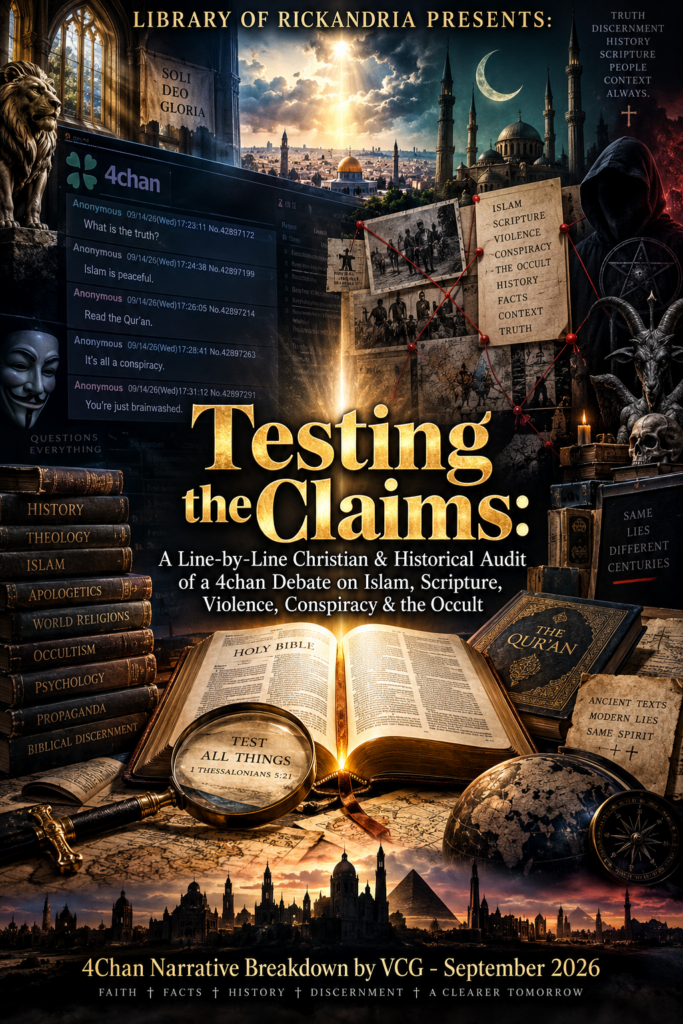
UPDATED BY VCG ON 9/7/2026 @ 23:23 EST
I want to share a heartfelt cause with my audience. Conner Blaisdell-Greene, a brave Airforce Sr. Airman, recently lost his battle with cancer, leaving his family in financial distress. Every donation, no matter how small, can help cover his funeral costs and ease their burden during this difficult time. Please consider clicking the link below to contribute or share Conner’s story with others. Your support truly matters.
Until We Meet Again
Spoken Tribute
“He that answereth a matter before he heareth it, it is folly and shame unto him.” — Proverbs 18:13
“He that is first in his own cause seemeth just; but his neighbour cometh and searcheth him.” — Proverbs 18:17
Abstract
On August 31, 2026, an anonymous thread on 4chan’s /x/ board opened with a provocative question:
whether Islam should be understood as a spiritual system that glorifies violence and keeps adherents in what the poster called:
“base vibrations.”
From that starting point the discussion spread rapidly into:
- Qur’anic marriage ethics
- domestic abuse
- Muhammad’s biography
- warfare and apostasy
- the relationship between the Qur’an and earlier Jewish and Christian Scriptures
- pre-Islamic Arabian religion
- Jewish conspiracy theories
- Gnosticism
- Kabbalah
- sacred geometry
- tesseracts
- American foreign policy
- Western civilization
- algebra
- epilepsy
- child sexual exploitation
- philosophical idealism
- apocalyptic violence
This paper reconstructs that discussion and audits its substantive claims according to five different standards that should not be confused with one another:
- textual evidence
- historical evidence
- logical validity
- psychological interpretation
- Christian Scripture
The result is neither a defense of Islam nor an endorsement of the thread’s anti-Islam polemics.
Several criticisms raised in the thread survive serious scrutiny.
Qur’an 4:34 has historically been read by mainstream premodern Muslim jurists and exegetes as allowing a limited form of wife-striking.
Canonical Sunni hadith really do report Aisha’s marriage at six and consummation at nine.
Classical Islamic tradition contains a death penalty for apostasy.
Qur’an 9:29 genuinely presents warfare against certain People of the Book connected with jizya and political subordination.
The Qur’an’s simultaneous affirmation, correction, and criticism of earlier Jewish and Christian revelation creates a genuine problem worthy of careful comparative theological analysis.
Islamic sources also contain Muhammad-specific marital privileges and rules governing war booty.
These matters should not be hidden behind vague appeals to “context.”
At the same time, many of the thread’s most dramatic supporting claims collapse when checked.
Islam is not approximately eight hundred years old.
Muslim women are not excluded from Paradise by the Qur’an.
The Qur’an does not simply command Muslims to kill every non-Muslim.
The Kaaba’s pre-Islamic pagan history does not establish that Islam is secretly Baal worship.
No evidence presented in the thread demonstrates that Jews manufactured Islam as an anti-Christian weapon.
The tesseract numerology contains a basic mathematical error.
Al-Khwarizmi did not invent symbolic algebra.
Educated medieval Christians did not generally believe Columbus would sail off a flat Earth.
Muhammad cannot responsibly be diagnosed as schizophrenic from anonymous internet speculation, and a retrospective epilepsy diagnosis remains historically disputed.
The paper therefore reaches a methodological conclusion before reaching its theological one:
a true conclusion does not become stronger when defended by false evidence.
From a Christian perspective, the strongest case against Islam does not depend upon:
- race
- conspiracy
- numerology
- neurological speculation
or hatred of Muslims.
It concerns the identity of Jesus Christ, his crucifixion and resurrection, the apostolic gospel, the finality and authority of that gospel, and whether a seventh-century revelation can legitimately correct the testimony already delivered by Christ’s apostles.
The governing principle of the investigation is therefore not
“believe whichever side is ours,”
but:
“Prove all things; hold fast that which is good.” — 1 Thessalonians 5:21
1. Why Audit a 4chan Thread?
There are easier places to conduct comparative religion than 4chan.
That is precisely why this thread is worth studying.
Anonymous imageboards provide an unusually compressed view of how religious argument works when social restraint is low.
Serious textual questions appear beside memes.
Historical facts are placed beside racial folklore.
Genuine moral concerns are mixed with insults.
Sophisticated metaphysical theories emerge next to arithmetic mistakes.
One participant cites Scripture; another dismisses him by guessing his identity; another proposes a secret ethnic conspiracy; another responds with an occult synthesis; still another calls for violence.
The temptation is to dismiss the entire discussion as internet garbage.
That would be a mistake.
Some of the claims are wrong.
Some are offensive.
Some are surprisingly perceptive.
Some involve controversies that have occupied Muslim and Christian scholars for centuries.
A proper audit therefore asks a harder question than:
“Which side do I like?”
It asks:
What survives after every claim is forced to stand on its own evidence?
The opening post alleges that Islam is a
“perversion of spirituality”
glorifying violence and that Qur’anic teachings have been used to justify domestic abuse.
Subsequent posts move almost immediately into:
- Muhammad’s military career
- Pauline theology
- jinn
- retaliation
- Aisha’s age
- the status of Torah and Gospel in Islam
- Muslim conquest
and the so-called
“Islamic dilemma.”
By the end of the surviving thread, participants are debating:
- al-Khwarizmi
- ancient Greek philosophy
- Muhammad’s alleged neurological condition
- bacha bazi
- idealism and egregores
- apostasy
- Lucifer
and the salvation of women.
That trajectory itself requires explanation.
2. Methodology: Five Questions for Every Claim
Throughout this paper, five different questions are kept separate.
First: What does the primary source actually say?
When the subject is Islam, the Qur’an takes precedence over an anonymous poster’s memory of the Qur’an.
A hadith claim should be checked against an identifiable hadith collection.
When the subject is Christianity, the biblical text takes precedence over what a poster vaguely remembers Christians believing.
Second: What does historical evidence establish?
History can often tell us that a text exists, when a source was compiled, that a conquest occurred, or that a practice was documented.
It generally cannot demonstrate an invisible spiritual motive or directly prove that a religious revelation came from God or Satan.
Third: Does the conclusion logically follow?
“Muhammad received revelations affecting his household”
is one proposition.
“Therefore Muhammad fabricated all revelation”
is another.
The first can be demonstrated from the Qur’an.
The second requires a further argument.
Fourth: Is a psychological explanation warranted?
Psychology can help explain why:
- anonymity
- conspiracy narratives
- dehumanization
- group identity
- pattern-detection
influence online discourse.
It cannot be used as a substitute for answering a proposition.
Calling somebody mentally ill is not a rebuttal.
Fifth: What does Christian Scripture teach?
This paper does not pretend to be religiously neutral in its final theological evaluation.
It is written from an explicitly Christian standpoint.
But Christian theology is marked as Christian theology rather than presented dishonestly as if a secular historian had demonstrated it.
That distinction is essential.
A historian may conclude that Paul wrote that salvation is through Christ.
A Christian concludes that Paul’s claim is true.
Those are related statements, but they are not the same kind of statement.
3. Evidence Hierarchy
For this study, sources are weighted roughly in the following order:
| Level | Evidence | Typical Use |
|---|---|---|
| 1 | Primary religious texts and early documentary evidence | Establishing what a text actually says |
| 2 | Critical editions, manuscripts, archaeological evidence | Textual and historical reconstruction |
| 3 | Peer-reviewed academic research and specialist monographs | Context, interpretation, scholarly disputes |
| 4 | Classical commentaries and legal traditions | Historical interpretation of religious texts |
| 5 | Modern confessional/apologetic scholarship | Arguments within a tradition |
| 6 | Journalism and institutional reporting | Contemporary social practices |
| 7 | Forums, videos, memes, anonymous claims | Leads to investigate, not evidence by themselves |
This matters because the thread repeatedly reverses that hierarchy.
An anonymous assertion is treated as established fact, and then primary sources are searched afterward for material that can be bent into supporting it.
A proper method works in the opposite direction.
4. Verdict Scale
Claims in this audit receive one of seven broad judgments.
| Verdict | Meaning |
|---|---|
| True | Strongly supported in the form stated |
| Mostly true | Core claim supported, wording exaggerated or incomplete |
| Mixed | Significant evidence on both sides or several claims bundled together |
| Unsupported | Possible, but adequate evidence has not been supplied |
| False | Contradicted by good evidence |
| Non-falsifiable | Defined so vaguely that evidence cannot presently test it |
| Theological / philosophical claim | Requires premises beyond ordinary historical demonstration |
These verdicts apply to propositions, not persons.
5. Reconstructing the Thread
The thread can be divided into several recognizable phases.
The first phase concerns Islam directly:
- violence
- domestic abuse
- Muhammad
- Quraysh
- Romans 7
- jinn
- retaliation
- Aisha
- earlier Scripture
- conquest
and the
“Islamic dilemma.”
The second phase becomes increasingly conspiratorial and occult.
Participants propose that Arabian Jews created Islam, that Hubal is really Baal, and that:
- Kabbalah
- the Kaaba
- Metatron’s Cube
- Sefer Yetzirah
and a four-dimensional tesseract encode the same hidden structure.
The third phase becomes openly political and violent.
Islam is described as a hive mind; entire populations are dehumanized; one post calls for an attack on a mosque; another imagines apocalyptic
“total war.”
The fourth phase shifts toward broader metaphysics and cultural history:
- mystical perennialism
- religion as control
- Christianity and Greco-Roman civilization
- Columbus and the shape of the Earth
- the origins of algebra
- Muhammad’s alleged illness
- Afghanistan
- occult idealism
This progression is important because arguments change function as the discussion evolves.
Initially the participants appear to be asking what Islam teaches.
Later, many posts are no longer attempts to determine truth but performances of group identity.
6. The Opening Claim: “Base Vibrations”
The opening poster asks whether Islam is a spiritual corruption that keeps people trapped in
“base vibrations.”
This sounds meaningful, but it has no defined measurement.
What is a “vibration” in this context?
Is the poster referring to brain-wave frequency?
Emotional arousal?
Aggression?
Social trust?
Cortisol?
Mystical states?
Moral character?
Unless a measurable property is specified,
“base vibration”
is not an empirical explanation.
It is New Age metaphysical vocabulary functioning as an evaluative label.
This does not mean every spiritual concept must be reducible to laboratory measurement.
Christianity itself contains metaphysical claims.
The difference is that a claim should not alternate opportunistically between metaphysics and science.
If “vibrations” are spiritual and nonphysical, they cannot be invoked as though their existence has already been scientifically established.
Verdict: Non-falsifiable as stated.
A Christian does not need this language.
The biblical categories are truth and error, righteousness and sin, God and idols, flesh and Spirit—not mystical frequencies.
7. Qur’an 4:34 and Domestic Violence
The opening post’s more serious allegation concerns domestic abuse.
Qur’an 4:34 is among the most contested verses in modern Islamic ethics.
The disputed Arabic verb wa-ḍribūhunna has historically been interpreted by major premodern exegetes as permitting a husband to strike a wife in response to nushūz, normally translated as serious marital disobedience or recalcitrance.
Modern Muslim interpreters have attempted a range of readings, including severe restriction of the permission, emphasizing prophetic discouragement, symbolic/non-injurious interpretations, and arguments for entirely nonviolent translations.
Ayesha Chaudhry’s historical work is particularly important because it demonstrates that precolonial exegetical tradition did not generally read the verse through modern egalitarian assumptions.
Another scholarly survey notes that the classical Sunni legal schools recognized a limited disciplinary right while debating limits, injury, and liability.
Therefore, two common internet responses are inadequate.
The first says,
“The Qur’an simply commands wife beating, full stop.”
That suppresses:
- restrictions
- disagreement
- legal context
- modern interpretations
The second says,
“No serious Muslim ever understood the verse as allowing hitting.”
That is historically untenable.
What the evidence actually establishes
The historical mainstream understood Qur’an 4:34 as allowing some degree of physical discipline by a husband under specified conditions.
Modern Muslim interpretation is considerably more diverse.
That still leaves another question:
does Qur’an 4:34 cause measurable rates of domestic violence?
The thread does not provide evidence sufficient to establish that causal claim.
Domestic abuse is affected by numerous variables:
- alcohol
- economic stress
- childhood exposure to violence
- law enforcement
- social norms
- personality
- relationship conflict
and religious interpretation among them.
The textual criticism is therefore stronger than the sociological claim.
Christian Scripture
The New Testament certainly contains ordered household relationships, including commands concerning wives and husbands.
But the obligation placed upon the husband is not permission to strike his wife:
“Husbands, love your wives, even as Christ also loved the church, and gave himself for it.” — Ephesians 5:25
Paul further says:
“Husbands, love your wives, and be not bitter against them.” — Colossians 3:19
Peter tells husbands to dwell with their wives
“according to knowledge,”
“giving honour unto the wife,”
and describes husband and wife as
“heirs together of the grace of life.”
A Christian comparison must therefore be textual rather than merely cultural.
Christian communities can and do contain abuse.
That fact condemns Christian hypocrisy; it does not rewrite what the apostolic texts prescribe.
8. Muhammad, Quraysh, and Romans 7
Post No. 42897195 argues that Muhammad subdued the powerful pagan Quraysh and then quotes Paul’s struggle with sin in Romans 7 before declaring,
“Islam is the answer.”
The historical core is ordinary enough.
Muhammad’s movement did come into conflict with the Quraysh, and his community ultimately gained control of Mecca.
Modern scholarship treats Muhammad not merely as a preacher but also as community founder, political leader, and military leader.
The surviving biographical sources are later and require critical treatment, but the political-military dimension is not seriously disputed.
The Romans argument, however, fails on context.
Paul’s struggle with sin in Romans 7 does not conclude with the arrival of a later Arabian prophet.
Paul’s answer is explicitly Christological.
The surrounding chapters describe liberation from sin and eternal life
“through Jesus Christ our Lord.”
In other words, the post borrows Paul’s diagnosis while discarding Paul’s remedy.
Verdict: the Quraysh claim is broadly historical; the Romans 7 argument for Islam is a contextual non sequitur.
9. Jinn, Angels, and Iblis
A later poster explains that Islamic cosmology includes morally varied jinn, that Iblis is a jinn, and that angels do not rebel.
That is broadly faithful to the Qur’anic picture.
Qur’an 18:50 explicitly identifies Iblis as one of the jinn, while Qur’anic descriptions of angels emphasize obedience.
The Bible organizes the spiritual realm differently.
Jude, for example, refers to:
“the angels which kept not their first estate, but left their own habitation…” — Jude 1:6
This is an example of why comparative religion requires resisting superficial equivalence.
“Jinn,” “demons,” “fallen angels,” and “spirits” belong to different conceptual systems even where some functions overlap.
10. Retaliation, Forgiveness, and Revenge
Another poster vaguely recalls Islamic teaching permitting either proportional retaliation or forgiveness.
That recollection has a real textual basis.
Qur’an 42:40 presents recompense in proportion to wrong while commending forgiveness and reconciliation.
Christian ethics takes a distinctive direction concerning personal vengeance.
Paul says:
“Dearly beloved, avenge not yourselves…”
“Be not overcome of evil, but overcome evil with good.” — Romans 12:19, 21
Jesus commands:
“Love your enemies, bless them that curse you, do good to them that hate you…” — Matthew 5:44
Romans 13 simultaneously recognizes civil authority and its coercive role.
The New Testament distinction is therefore not
“all force is intrinsically sinful.”
It is that private Christian vengeance and the church’s mission are not authorized as campaigns of retaliatory violence.
11. Aisha: What the Sources Actually Say
One of the longest posts calls Muhammad a “pedophilic warlord,” citing the traditional age of Aisha.
The insult should be separated from the historical source.
Sahih al-Bukhari 5134 reports Aisha saying that Muhammad married her when she was six and consummated the marriage when she was nine.
This is not an invention of modern Christian polemic; it exists in canonical Sunni hadith literature.
That establishes something important.
It does not establish every additional claim made about the episode.
Modern attempts exist to reconstruct Aisha as older through chronological calculations using other biographical traditions.
Those arguments should be evaluated on their own merits rather than dismissed solely because they are apologetic.
Conversely, Muslims should not tell readers that the 6/9 tradition was fabricated by Islam’s enemies when it appears in highly authoritative Sunni collections.
The language “pedophile” presents a further methodological difficulty.
It is a modern diagnostic category referring to a persistent sexual preference pattern, not simply a synonym for
“person reported to have had sexual relations with someone below a modern age-of-consent threshold.”
A source reporting one marriage cannot by itself establish a modern psychiatric diagnosis.
What the evidence actually establishes
Canonical Sunni hadith literature contains the 6/9 account.
Whether it accurately preserves Aisha’s historical age and what modern moral or diagnostic terminology should be applied are further questions.
A strong Christian moral argument does not require pretending those distinctions do not exist.
12. “Warlord”: Description or Polemic?
Muhammad participated in and directed warfare.
Calling him only a contemplative religious teacher would plainly distort the historical record.
Calling him simply a “warlord,” however, can also reduce a complicated historical figure to one function.
Scholars work from the sira, maghazi, Qur’an, hadith, and non-Muslim evidence while recognizing that much detailed narrative was transmitted and compiled after Muhammad’s death.
Modern historical scholarship therefore treats his biography with caution while still recognizing his roles as:
- preacher
- community organizer
- political leader
- military commander
- adjudicator
- legislator
The accurate criticism is stronger:
Muhammad’s model of religious leadership included political and military authority in a way the earthly ministry of Jesus did not.
That proposition can then be compared theologically.
13. “Convenient Revelations”
The thread argues that revelations repeatedly appeared when Muhammad needed permission for something.
This is rhetorically powerful because there are Qur’anic passages addressing Muhammad’s personal circumstances.
Qur’an 33:50 grants marriage permissions explicitly described as particular to Muhammad rather than ordinary believers.
Qur’an 33:51 grants considerable discretion regarding his wives.
Likewise, Qur’an 8 addresses the distribution of war booty.
Verse 41 assigns one fifth according to a list including the Messenger, while verse 69 permits the consumption/use of spoils.
Those are facts.
But the leap from
“this revelation affects Muhammad materially or domestically”
to
“therefore Muhammad invented it”
is not itself a fact.
The reasoning commits a form of circumstantial genetic fallacy unless independent evidence of fabrication is supplied.
Moreover, the Qur’an also contains material that rebukes or corrects Muhammad.
A theory claiming that every Qur’anic statement exists solely to flatter him must explain those passages too.
What the evidence actually establishes
Some Qur’anic revelations grant Muhammad unusual personal privileges and regulate material interests connected with his leadership.
That fact legitimately invites scrutiny.
It does not, without another premise, prove conscious fabrication.
14. The “Islamic Dilemma”
The most intellectually serious part of the thread concerns the Qur’an’s relationship with earlier Scripture.
The simplified internet argument normally runs as follows:
The Qur’an says Torah and Gospel came from God.
Christians and Jews in Muhammad’s day possessed those Scriptures.
Those Scriptures contradict later Islamic claims, especially concerning Christ.
Therefore, either the Scriptures were already corrupted—in which case the Qur’an should not affirm them—or they were intact—in which case Islam contradicts books it affirms.
The thread cites several elements of this argument, including the report in which Muhammad encounters a Torah scroll.
There is a real problem here, but the meme version is too simple.
Qur’an 5:43 asks why Jews come to Muhammad for judgment when they have the Torah containing God’s judgment.
Qur’an 5:47 tells the People of the Gospel to judge by what God revealed therein.
Qur’an 5:48 describes the Qur’an as confirming previous Scripture while also functioning as an authority or criterion over it.
Qur’an 10:94 conditionally tells Muhammad that if he doubts, he may ask those who have been reading Scripture before him.
Those verses are difficult to reconcile with the crude modern claim that the books possessed by Jews and Christians in the seventh century were wholly worthless fabrications.
At the same time, the Qur’an also accuses Jews and Christians of distortion, concealment, false attribution, or misunderstanding.
The Arabic category tahrif has generated a long interpretive history.
Scholars note that Muslim thinkers have differed over whether corruption means primarily alteration of wording, distortion of meaning, concealment, or some combination.
Thus the strongest Muslim reply is not
“the Qur’an never affirms earlier Scripture.”
It clearly does.
The stronger reply is:
The Qur’an affirms the divine origin and surviving truth of Torah and Gospel while claiming that human communities mishandled them and that the Qur’an ultimately judges disputes concerning them.
That position has more textual support.
But it also creates a continuing historical question:
how much textual corruption is actually being alleged, when did it occur, and what manuscript evidence supports that reconstruction?
15. The Torah-on-the-Cushion Tradition
Sunan Abi Dawud 4449 records Jews bringing the Torah to Muhammad in connection with a legal dispute.
The report states that he placed it upon a cushion and expressed belief in it and in the One who revealed it.
The thread is therefore correct that such an Islamic tradition exists.
But the argument often goes beyond the source.
The hadith does not contain a manuscript catalog. It does not tell us that every verse in that particular Torah copy was textually identical to a twenty-first-century printed Masoretic Bible.
That additional claim would require textual criticism.
What the hadith does make difficult is the sweeping suggestion that Muhammad regarded the Torah actually present among Jews as an essentially worthless forgery.
That is a legitimate apologetic observation.
16. What the Dead Sea Scrolls Do—and Do Not—Prove
This is where both Christian and Muslim internet apologetics often overstate the evidence.
The Dead Sea Scrolls provide Hebrew biblical manuscripts from centuries before Islam and before Christianity.
They demonstrate striking continuity in many places with later textual traditions.
They also demonstrate textual plurality.
Scholarly analysis of the Qumran manuscripts identifies relationships to the later Masoretic tradition, texts resembling readings behind the Septuagint, forms related to the Samaritan Pentateuch, and other non-aligned readings.
Modern Hebrew Bible textual criticism has therefore become more—not less—aware of ancient textual complexity.
The New Testament has its own extensive:
- manuscript history
- variants
- early translations
- patristic quotations
- critical editions
Textual criticism is precisely the discipline developed to compare that evidence rather than pretending variants do not exist.
So, the responsible Christian argument is not:
“Every ancient biblical manuscript is letter-for-letter identical to the KJV.”
That is demonstrably false.
Nor should the Muslim respond:
“There are textual variants, therefore the original Christian message is unknowable.”
That conclusion does not follow either.
Textual variation is evidence to analyze, not a magic word that erases an ancient textual tradition.
17. The Christian Theological Problem Is Deeper Than the “Islamic Dilemma”
Christianity does not finally stand or fall on whether a clever dilemma can trap Muslim apologetics.
The basic conflict is Christological.
The New Testament describes Jesus in categories that cannot simply be harmonized with Islamic Christology.
John writes:
“Who is a liar but he that denieth that Jesus is the Christ?
He is antichrist, that denieth the Father and the Son.”
“Whosoever denieth the Son, the same hath not the Father…” — 1 John 2:22–23
Jesus says:
“I am the way, the truth, and the life:
no man cometh unto the Father, but by me.” — John 14:6
Peter proclaims:
“Neither is there salvation in any other…” — Acts 4:12
And Paul warns:
“But though we, or an angel from heaven, preach any other gospel unto you than that which we have preached unto you, let him be accursed.” — Galatians 1:8
Jude exhorts believers to contend for:
“the faith which was once delivered unto the saints.” — Jude 1:3
From within Christian theology, therefore, a seventh-century revelation that substantially revises apostolic teaching concerning Christ faces a prior canonical test.
That is a Christian theological judgment.
A secular historian can establish that Christians were making these claims centuries before Islam.
The historian cannot, as historian alone, establish that the claims are divinely true.
The Christian does.
Keeping that distinction explicit makes the argument more honest.
18. Did Jews Manufacture Islam?
Later posts move from legitimate questions about:
- Jewish
- Christian
- Arabian
influences upon early Islam to the theory that Jews deliberately manufactured Islam as a weapon against Christianity.
One version eventually invokes a hidden “Agentur” controlling history.
No adequate evidence is offered.
Arabia was not culturally sealed.
Jewish communities existed in Arabia.
Christian traditions circulated in late antiquity.
The Qur’an engages biblical figures and stories.
- Influence
- interaction
- adaptation
- polemic
and shared cultural vocabulary are all historically reasonable research questions.
But none entails conspiracy.
The reasoning pattern is:
contact → influence → coordination → deliberate secret construction → ethnic master plan.
Each arrow requires evidence.
The thread supplies none for the final steps.
Worse, the hidden-agent theory becomes self-sealing.
Evidence against the conspiracy can simply be reinterpreted as evidence of how well the conspiracy concealed itself.
At that point the theory has stopped functioning as historical explanation.
Verdict: Unsupported conspiracy theory.
19. Hubal, Baal, and the Pre-Islamic Kaaba
There is a historical fact underneath this section of the thread: the Kaaba existed before Islam and was associated with pre-Islamic Arabian religious practice and idols.
Hubal was indeed an important pre-Islamic idol associated with the Kaaba.
Scholarly discussion concerning the exact hierarchy of deities at Mecca remains difficult because the evidence is late and incomplete.
One academic treatment explicitly warns that the identity of the pre-Islamic
“Lord of the Kaaba”
cannot be reconstructed with certainty and that Hubal’s precise status remains problematic.
Therefore:
“The Kaaba had a pre-Islamic pagan history”
— supported.
But:
“Hubal was definitely Baal”
— not established.
And:
“Islam therefore secretly worships Baal”
— does not follow.
A religion can repurpose a pre-existing sacred site while radically changing its theology.
Whether Islam’s Abrahamic reinterpretation of the Kaaba is historically accurate is a legitimate question.
It is not answered merely by noting that pagan worship occurred there before Muhammad.
20. Does Islam Command Muslims to Kill Every Unbeliever?
Several posts speak as though Islam contains one uncomplicated command: convert everyone or kill them.
That is false as an unrestricted summary.
Qur’an 2:256 states that there is:
“no compulsion in religion.”
Muslim interpretation of that statement has varied, including debates over its relationship to later warfare passages, but the verse exists and cannot simply be deleted.
Qur’an 9:29, however, commands fighting certain People of the Book until they pay jizya under conditions of submission.
That too exists and cannot be deleted.
Historical Muslim governance frequently permitted Jewish and Christian populations to remain non-Muslim under Muslim political authority, usually with legal inequality and taxation.
Conversion across many conquered territories took generations or centuries.
Scholarship on conversion to Islam emphasizes considerable regional variation rather than a single universal mechanism.
The historical picture is therefore more complicated than either apologetic slogan:
“Islam spread only peacefully.”
False.
“Every conquered person was immediately forced to convert at sword-point.”
Also false.
Early Islamic empires were military empires.
That matters.
Conversion was nevertheless frequently gradual.
That matters too.
21. Apostasy
Here the thread has a much stronger textual case.
Sahih al-Bukhari contains the report attributed to Muhammad:
“Whoever changed his Islamic religion, then kill him.”
This became foundational in classical Islamic jurisprudence concerning apostasy, though jurists debated:
- procedure
- repentance
- categories
- sex
- political rebellion
and other details.
Contemporary Muslim thinkers increasingly contest whether those rulings should apply to private changes of belief in a modern state.
It is therefore misleading to say that the association between classical Islam and capital punishment for apostasy was invented by anti-Muslim activists.
It is equally misleading to collapse every contemporary Muslim into that classical position.
What the evidence actually establishes
Canonical hadith and classical jurisprudence provide a genuine basis for a death penalty for apostasy.
Modern Muslim interpretation and state practice are not uniform.
That is already a substantial ethical problem.
It needs no exaggeration.
22. Are Women Excluded From Islamic Paradise?
Several posters imply that Islam’s afterlife is effectively a male sexual paradise in which women are secondary or excluded.
The Qur’an does contain gendered paradisal imagery and traditions concerning hur al-‘ayn have generated extensive debate.
But the claim that believing women do not enter Paradise is straightforwardly contradicted by the Qur’an.
Qur’an 4:124 explicitly promises Paradise to righteous believers whether male or female.
Qur’an 33:35 repeatedly pairs Muslim men and women, believing men and women, obedient men and women, and concludes with divine forgiveness and reward for both.
Verdict: False as stated.
Criticism of Islamic gender ethics should concentrate upon genuine textual issues rather than inventing an exclusion that the Qur’an itself denies.
23. Islam and Military Expansion
The thread describes seventh-century Muslim expansion in lurid terms of Arabs erupting from the desert to rape and pillage.
There is a real history behind the polemic.
Arab-Muslim armies rapidly conquered enormous territories formerly controlled by the Byzantine and Sasanian empires.
- Warfare
- political domination
- taxation
- slavery
- empire
are therefore unavoidable parts of early Islamic history.
Scholarship also cautions that our narrative sources must be critically evaluated and that the relationship between Muhammad’s Medinan wars, the Ridda wars, and subsequent imperial conquests was historically complex.
But history cannot responsibly be compressed into a racial story about inherently violent Arabs.
Large conquered populations remained:
- Christian
- Jewish
- Zoroastrian
and otherwise non-Muslim for substantial periods.
Conversion and Arabization proceeded differently across regions.
The defensible criticism is therefore political and theological, not racial:
Early Islamic civilization expanded significantly through military conquest.
That fact is strong enough.
24. Old Testament Violence: The Counterargument Christians Must Face
A Muslim poster later points out that the God of the Old Testament kills people and commands warfare.
Christians should not answer by pretending the poster has not read the Bible.
The Old Testament contains:
- warfare
- capital punishments
- divine judgments
- the conquest narratives
and commands concerning particular enemies.
Those texts are real.
The Christian question is therefore not:
“Is there violence in the Old Testament?”
There plainly is.
The question is:
“What covenantal authority does the New Testament give the church?”
Ancient Israel was a covenant nation with:
- territorial
- judicial
- military
- cultic
institutions.
The New Testament church is not presented as a replacement geopolitical nation commissioned to seize territory.
Before Pilate, Jesus says:
“My kingdom is not of this world:
if my kingdom were of this world, then would my servants fight…” — John 18:36
Paul describes Christian warfare this way:
“For the weapons of our warfare are not carnal…” — 2 Corinthians 10:4
The Great Commission commands discipleship of nations, not military subjugation of nations.
This does not erase difficult Old Testament texts.
It establishes a covenantal distinction.
A Christian who cites Jesus’ love of enemies while refusing even to acknowledge Joshua will appear evasive.
A better answer accepts the entire canon and asks how the canon itself distinguishes Israel’s historical commission from the mission of Christ’s church.
25. Christian History Does Not Equal Christian Norm
At this point another distinction becomes indispensable.
Christians have committed:
- conquest
- persecution
- forced conversion
- religious warfare
- antisemitic violence
- colonial abuse
and other atrocities.
Those events cannot be made to disappear by saying the perpetrators were
“not real Christians”
every time history becomes uncomfortable.
But neither can historical behavior automatically redefine a religion’s normative texts.
The proper comparison asks two questions:
What did Christians do?
and separately:
What did the New Testament authorize the church to do?
Likewise for Islam:
What did Muslim empires do?
and:
What do Qur’an, hadith, and classical law authorize?
Confusing descriptive history with normative doctrine produces bad arguments in both directions.
26. Mosque-Bombing and “Total War”
The thread eventually contains explicit encouragement of violence against a mosque and another post imagining exterminatory religious war.
These statements have no place in Christian apologetics.
They also illustrate how quickly doctrinal criticism can become collective punishment once individuals are replaced by categories.
The New Testament command is unambiguous:
“Love your enemies…” — Matthew 5:44
Paul tells Christians not to repay evil for evil and, so far as possible, to live peaceably with all people.
Peter commands Christians to answer with
“meekness and fear,”
not vengeance.
One may regard Islam as false and still defend a Muslim neighbor from unjust violence.
Indeed, Christian ethics may require precisely that.
27. “Muslims Are a Hive Mind”
Another poster describes Muslims as effectively controlled by imams in a religious hive mind.
Sociologically, this is indefensible.
Islam contains
- Sunni and Shi’a traditions
- multiple Sunni legal schools
- differing Shi’a authority structures
- Sufi orders
- Salafi movements
- modernists
- Islamists
- secularized cultural Muslims
- Quranists
- national traditions
- competing seminaries
and enormous disagreement.
There is no single worldwide Islamic pope.
There are certainly Muslim societies in which religious authorities exercise strong social control.
That does not turn roughly two billion human beings into one mind.
The “hive” metaphor performs a different function:
it removes individuality.
That psychological move matters because once individuals disappear into an imagined collective organism, collective punishment becomes easier to justify.
28. Dehumanization
The thread repeatedly uses language reducing entire populations to:
- animals
- monsters
- livestock
- racial contaminants
or expendable masses.
Psychological research has repeatedly associated blatant dehumanization with intergroup hostility and willingness to support aggressive policies, although scholars debate whether “dehumanization” is always the necessary causal mechanism behind collective violence.
The cautious conclusion is therefore not:
“Every insulting metaphor inevitably causes genocide.”
It is:
Language that removes ordinary human individuality can reduce moral restraint and correlate with support for aggression.
Christian anthropology provides another reason to reject it.
A Muslim is not an “orc.”
A Jew is not a conspiracy mechanism.
An Arab is not a racial explanation.
Each is a human being made by God and morally accountable as an individual.
29. The Psychology of Anonymous Religious Conflict
It would be easy to diagnose anonymous posters from afar.
We should not.
Nothing in a 4chan post allows responsible diagnosis of:
- schizophrenia
- narcissistic personality disorder
- psychopathy
or other clinical conditions.
What psychology can analyze are mechanisms.
Experimental research has found that anonymity can produce disinhibiting effects and increase trolling behavior under some conditions.
This helps explain a feature of the thread:
posters can make increasingly extreme claims with little reputational cost.
Anonymity also allows ambiguity of intent.
The same sentence can function simultaneously as:
- belief
- joke
- bait
- threat
- status performance
and test of group loyalty.
That ambiguity is central to imageboard culture.
30. Identity-Protective Reasoning
Repeatedly, a factual challenge is answered by identifying the supposed tribe of the speaker.
“You’re Muslim.”
“You’re Jewish.”
“You’re Reddit.”
“You’re /pol/.”
“You’re a tourist.”
“You’re an occultist.”
The proposition disappears and the social identity of the speaker becomes the argument.
This is closely related to the genetic fallacy:
evaluating a claim primarily by where it came from rather than whether it is true.
The biblical warning is strikingly appropriate:
“The simple believeth every word:
but the prudent man looketh well to his going.” —Proverbs 14:15
Prudence must apply even when the speaker belongs to a disliked group.
31. Conspiracy Psychology
Modern psychological research on conspiracy belief does not reduce believers to stupidity or mental illness.
A 2025 meta-analysis covering 279 independent studies and more than 137,000 participants found modest associations between conspiracy belief and three broad motive families:
epistemic motives involving understanding and certainty, existential motives involving security and control, and social motives involving identity and group standing.
Effects were real but heterogeneous and generally modest.
This framework fits several moments in the thread.
The world feels chaotic.
Religions conflict.
Empires rise and fall.
Migration changes societies.
Historical institutions are complicated.
A hidden “Agentur” provides enormous explanatory compression.
One actor now explains everything.
The psychological appeal of such compression does not prove a conspiracy false. Real conspiracies occur.
But the larger and more flexible a conspiracy becomes, the greater its evidentiary burden.
32. Conspiracy Autopsy: From Contact to Master Plot
Consider the
“Jews created Islam”
theory.
The reasoning can be reconstructed as follows:
Jewish communities existed in Arabia.
The Qur’an contains biblical material.
Muhammad interacted with Jews.
Islam later fought Christian powers.
Some later Jews benefited in particular political circumstances.
Therefore Jews designed Islam to destroy Christianity.
The first three statements may contain historical material.
The last does not follow.
The missing evidence would include:
- organizers
- documentary planning
- institutional continuity
- communications
- financial or political mechanisms
- contemporary testimony
and evidence distinguishing deliberate creation from ordinary cultural interaction.
The conspiracy theory instead fills those gaps with inference.
When challenged, the absence of documents becomes proof of secrecy.
That makes the theory increasingly immune to disconfirmation.
33. The Tesseract Episode
The occult geometry section provides perhaps the cleanest methodological lesson in the entire thread.
A poster argues that:
- Kabbalah
- the Shem HaMephorash
- Metatron’s Cube
- the Kaaba
- Sufi circumambulation
- Sefer Yetzirah
and four-dimensional geometry converge upon the same hidden mathematical structure.
The argument initially claims that a tesseract contains:
“32 vertices + 32 edges + 8 faces = 72.”
That is mathematically wrong.
A tesseract has:
16 vertices, 32 edges, 24 square faces, and 8 cubical cells.
The same thread later gives these correct counts—16 + 32 + 24 + 8—which total 80, not 72, while continuing to defend the earlier mystical correspondence.
This is unusually revealing.
The desired number appears to have governed the categorization.
That is the reverse of mathematical discovery.
34. Sefer Yetzirah: Real Numbers, Invented Mapping
Sefer Yetzirah really does contain important numerical structures.
It associates creation with ten sefirot and twenty-two Hebrew letters.
Those twenty-two letters are classified into three Mothers, seven Doubles, and twelve Simples/Elementals.
It also discusses spatial directions.
Those facts are real.
What has not been established is that the author was secretly encoding a four-dimensional hypercube.
The method used in the thread is recognizably numerological:
find salient numbers in text A;
find salient numbers in mathematical object B;
redefine categories until several values resemble one another;
interpret the resemblance as intentional ancient knowledge;
ignore mismatches.
This is not how one establishes historical influence.
Historical influence normally requires:
- texts
- transmission
- vocabulary
- diagrams
- concepts
or documentary connections—not simply numerical resemblance.
35. Metatron’s Cube and the Problem of Visual Resemblance
A similar mistake appears when the thread calls Metatron’s Cube an “exact” two-dimensional projection of a tesseract.
A tesseract can be projected into lower dimensions in many ways.
A drawing containing nested:
- polygons
- cubes
- diagonals
or circles may resemble one of those projections without historically deriving from four-dimensional geometry.
Visual similarity demonstrates visual similarity.
It does not establish historical identity.
The right question is not:
“Can I draw a tesseract over this?”
It is:
“Where is the historical evidence that the people who produced or transmitted this symbol understood it as a four-dimensional hypercube?”
The thread produces no such source.
36. The Kaaba as “4D Hyper-Rotation Portal”
The occult argument becomes even more speculative when sevenfold circumambulation around the Kaaba is interpreted as literal hyperdimensional rotation.
There are Islamic mystical traditions that assign cosmic meaning to the Kaaba and to ritual movement.
Material associated with Ibn Arabi traditions discusses the Kaaba symbolically, sevenfold circumambulation, and geometric/cosmic correspondences.
None of that by itself establishes modern mathematical knowledge of a tesseract.
“Seven movements around a cube”
is not equivalent to
“four-dimensional Euclidean rotation.”
The conclusion has been imported into the source.
37. Pattern Detection and Apophenia
Psychology has long studied the tendency to perceive meaningful connections in ambiguous information.
Experimental work has found relationships between illusory pattern perception and supernatural or conspiracy beliefs, although the strength and nature of the relationship varies by study and category of belief.
Again, this should not be weaponized.
Recognizing patterns is essential to intelligence.
Scientific discovery itself depends on finding patterns.
The crucial distinction is constraint.
A legitimate pattern should generate predictions or survive tests that could have disproved it.
An unconstrained numerological system can almost always find another correspondence because the interpreter is free to switch:
- numbers
- translations
- shapes
- counting rules
or symbolic associations.
The tesseract episode demonstrates this problem beautifully because an arithmetic contradiction appears without producing abandonment of the theory.
38. Gnosticism as the “True Abrahamic Religion”
Another participant proposes Gnosticism as the deeper truth behind the Abrahamic traditions.
Historically, “Gnosticism” is itself a difficult category.
Modern scholarship emphasizes the diversity of ancient groups placed under that label, to the point that some scholars question whether “Gnosticism” should be treated as one coherent religion at all.
Some second-century movements distinguished the supreme divine source from an inferior creator or demiurge associated with the God of the Hebrew Bible.
Even among those groups, however, beliefs and exegetical methods varied substantially.
From a canonical Christian standpoint, separating the Father of Jesus from the Creator conflicts directly with the Bible’s own continuity between Israel’s God and Jesus Christ.
Genesis opens:
“In the beginning God created the heaven and the earth.”
The New Testament does not present Jesus as revealing that Israel’s Creator was an evil impostor.
That is a later competing theological system.
39. “Without Plato, No Christianity”
The thread eventually argues that Greco-Roman philosophy built Christianity and that without Plato there would effectively have been no Christianity.
This contains a genuine historical observation buried inside an exaggeration.
Greek language and philosophical categories profoundly influenced Christian intellectual development.
Middle Platonism and later Platonism strongly affected figures such as Origen, and Christian thinkers appropriated philosophical vocabulary while reshaping it around Scripture and Christian doctrine.
But “influenced” does not mean “created.”
The earliest Christian proclamation is rooted in Jewish Scripture, the life and death of Jesus, claims of his resurrection, Israel’s messianic expectations, and apostolic communities.
Later theological articulation developed in a Hellenistic environment.
The accurate formulation is therefore:
Christian theology developed within and interacted deeply with Greco-Roman intellectual culture, including Platonism. Christianity cannot simply be reduced to Platonism.
40. Columbus and the Flat Earth
One post repeats the familiar story that medieval Christians believed the Earth was flat until Columbus proved them wrong.
This is false.
Educated Europeans in Columbus’s age generally accepted a spherical Earth.
The famous controversy concerned the Earth’s circumference and therefore the distance westward to Asia, not whether ships would fall off an edge.
The Smithsonian specifically identifies the popular Columbus-versus-flat-earthers narrative as a later myth.
Verdict: False.
This matters because bad history should be corrected even when it is being used against Christians.
41. Did Muslims “Invent Math”?
The algebra exchange is a rare place where the thread slowly reasons itself toward a better question:
what exactly does
“invented algebra”
mean?
Mathematics obviously predates Islam.
- Egyptian
- Babylonian
- Greek
- Indian
- Chinese
and other civilizations developed sophisticated mathematical methods long before Muhammad.
Al-Khwarizmi nevertheless occupies an important place in the history of algebra.
His ninth-century work systematized algebraic procedures and became extraordinarily influential in later Arabic and European mathematics.
The word algebra derives from al-jabr in the title of his work.
But one thread poster claims al-Khwarizmi pioneered systematic symbolic notation.
That is false.
His algebra was rhetorical: equations were expressed in words rather than our modern symbolic notation.
The Mathematical Association of America explicitly notes the absence of symbolic notation in his work and the much later development of modern symbolism.
Thus:
“Muslims invented mathematics”
— false.
“Islamic civilization contributed significantly to mathematics”
— true.
“Al-Khwarizmi was a major figure in the development and transmission of algebra”
— true.
“Al-Khwarizmi invented modern symbolic algebra”
— false.
A mature historical account has room for all four statements.
42. The Gulf War and Qatar
One poster says Americans
“went and died for Qatar”
in the first Gulf War.
Iraq invaded Kuwait on August 2, 1990.
The U.S.-led coalition’s central military objective became the expulsion of Iraqi forces from Kuwait.
Qatar was a coalition participant, and Qatari forces fought alongside Saudi and American forces, including during the battle for Khafji in Saudi Arabia.
So the distinction is:
Qatar was an allied coalition state — true.
The United States entered the Gulf War because Qatar had been invaded — false.
The invaded state was Kuwait.
43. Muhammad and Epilepsy
The thread eventually claims that Muhammad was “known” to have epileptic fits.
Retrospective diagnosis is difficult even when descriptions are detailed.
The epilepsy theory has existed for centuries, and medical writers have attempted to evaluate descriptions of Muhammad’s revelatory experiences neurologically.
A 2020 review in Epilepsy & Behavior revisited the question and emphasized inaccurate or misleading translations in some older arguments.
It concluded that the historical material does not provide a straightforward clinical diagnosis.
This means the responsible conclusion is not:
“Muhammad definitely had epilepsy.”
Nor is it:
“No one has ever seriously considered a neurological explanation.”
Rather:
Epilepsy has been proposed as a retrospective explanation of Muhammad’s revelatory experiences, but the available historical descriptions do not establish a secure diagnosis.
Even a demonstrated neurological disorder would not itself prove or disprove every proposition uttered by the person who had it.
44. “Muhammad Was Schizophrenic”
This claim is weaker still.
An anonymous poster has no clinical access to Muhammad.
Schizophrenia is not a synonym for “reported visions,” “religious experiences,” “claims revelation,” “behaves unusually,” or “teaches something I reject.”
Calling ancient religious figures schizophrenic without sufficient diagnostic evidence produces the appearance of scientific explanation without the substance of it.
Verdict: Unsupported armchair diagnosis.
A Christian theological critique should ask whether Muhammad’s message conforms to prior revelation.
It does not need psychiatric insults.
45. Bacha Bazi
The thread invokes bacha bazi, the sexual exploitation of boys associated especially with Afghanistan, as evidence about Islam.
The abuse is real and horrific.
U.S. State Department trafficking reports document the practice as exploitation of boys for social and sexual entertainment.
Reports describe cases involving:
- powerful figures
- security personnel
- armed groups
- the Taliban
and children as young as nine.
Afghan law had formally criminalized the practice, and Taliban authorities have officially claimed to prohibit it even while reports document continuing abuse and impunity.
Those facts establish a grave regional human-rights problem.
They do not establish that child exploitation is a universal Islamic sacrament.
Calling bacha bazi simply
“Islam’s pederasty tradition”
confuses a documented cultural and political abuse with a universal theological prescription.
Verdict: Real atrocity, false universalization.
46. Sports and Domestic Violence
One tangent argues that sports events can correlate with increased domestic violence.
Unlike many of the thread’s tangents, this claim has empirical support—but only in qualified form.
Research has reported increases in intimate-partner violence following certain emotionally salient sports outcomes, especially unexpected losses.
A broader systematic review finds heterogeneous evidence across sports, locations, and study designs.
A 2026 replication using a longer dataset found the famous NFL upset-loss effect substantially smaller than in the earlier study, although some restricted relationships remained.
This is a useful methodological reminder.
The scientifically defensible statement is:
Some studies have found short-term associations between particular high-emotion sporting outcomes and reported domestic violence.
Not:
“Sports make men beat women.”
And none of this resolves the textual interpretation of Qur’an 4:34.
47. Philosophical Idealism and Egregores
A late post proposes that reality is fundamentally consciousness, that thoughts can therefore modify reality, and that collective worship literally generates entities or “egregores.”
This argument contains several unstated steps.
Even if philosophical idealism were true, it would not automatically follow that individual human thoughts have unlimited causal influence over external events.
Even if collective beliefs influence social reality—which they plainly do—it does not follow that collective attention creates an independent supernatural being.
The conclusion therefore requires additional metaphysical premises.
Christian theology runs in the opposite direction.
God is not produced by worship.
God exists prior to and independently of the worshipper:
“In the beginning God created the heaven and the earth.” — Genesis 1:1
A being sustained into existence by human mental attention would, from biblical theology, be a creature or construct—not the Creator.
48. “All Religions Are Control”
Another participant reduces religion to social control.
Religious institutions can certainly be used for control.
So can:
- governments
- families
- corporations
- schools
- armies
- ideological movements
- scientific institutions
- media organizations
- activist networks
The problem is the word all.
If obedience demonstrates control, religion is control.
If religion produces dissent against the state, the dissent can be called a subtler kind of control.
If believers accept martyrdom, this becomes internalized control.
If institutions weaken, that too can be interpreted as manipulation.
A theory capable of explaining every possible outcome risks becoming unfalsifiable.
The stronger historical claim is:
Religious systems can legitimate authority, organize communities, restrain conduct, challenge rulers, mobilize resistance, console suffering, and sometimes be exploited by institutions of power.
That is less exciting than
“everything is control.”
It is also much more useful.
49. Universalism and the Golden Rule
A later poster argues that one can find God through any religion or no religion and reduces Christianity essentially to
“do unto others.”
Jesus absolutely teaches the Golden Rule.
But the New Testament does not identify the Golden Rule as a doctrine that all spiritual paths are equally salvific.
The same Jesus who commands love also says:
“I am the way, the truth, and the life:
no man cometh unto the Father, but by me.” — John 14:6
Acts says:
“Neither is there salvation in any other…” — Acts 4:12
Christian ethics cannot therefore be detached from Christian Christology without changing the religion.
50. “Jesus Was Lucifer”
The thread later proposes that Lucifer masqueraded as Jesus and interprets Christ’s death for sins as equivalent to
“do what thou wilt.”
The second claim directly contradicts Paul’s argument.
Romans 6 anticipates precisely the objection that grace might encourage continued sin.
Paul’s answer is emphatic: salvation from sin is not permission to continue under sin’s dominion.
Romans 6 moves toward holiness and eternal life in Christ, not moral license.
The identification of Jesus with Lucifer likewise cannot be derived merely by noticing celestial imagery applied in different contexts.
The New Testament’s Christology identifies Jesus with God’s eternal Word and presents him as Creator and redeemer, not as a rebellious creature.
This is a theological disagreement, but the canonical Christian position is not ambiguous.
51. Race as an Explanatory Theory
The thread repeatedly tries to explain ideas through ancestry:
- Jews
- Arabs
- Persians
- Europeans
- “Semites”
- racial IQ
- inbreeding
- whiteness
- civilizational bloodlines
This is usually a genetic fallacy in literal form.
The truth of a proposition does not depend upon the ancestry of the person stating it.
Whether Qur’an 4:34 permits striking cannot be answered by measuring Arab ancestry.
Whether Jesus rose from the dead cannot be answered by ranking European IQ.
Whether algebra has:
- Babylonian
- Greek
- Indian
- Arabic
or European stages is established through texts and mathematical history, not racial prestige.
The Christian church itself crosses ethnic categories.
Paul’s theological vision explicitly refuses ethnic status as the basis of standing in Christ.
An ethnic insult can therefore be simultaneously bad reasoning and bad Christian ethics.
52. The Strongest Muslim Responses
A fair audit should not present only weak Muslim answers.
The strongest Muslim responses to the major criticisms in this thread deserve to be stated in their best form.
On Qur’an 4:34, a Muslim can argue that the text places marital disciplinary steps within a larger ethic, that prophetic tradition discourages harm, that classical jurists restricted injury, and that modern linguistic or ethical readings can interpret the disputed command more narrowly than critics do.
The historical weakness of this answer is that premodern exegetes overwhelmingly understood physical striking to be included.
On Aisha, a Muslim can question whether the 6/9 reports preserve exact chronology and compare them with other historical indicators.
The weakness is that the traditional report remains embedded in highly authoritative Sunni collections.
On the Islamic dilemma, a Muslim can argue that the Qur’an affirms the original divine Torah and Gospel, not every later interpretation or manuscript form; that tahrif can involve both interpretive and textual corruption; and that Qur’an 5:48 gives the Qur’an final criterion status.
This is substantially stronger than pretending the Qur’an has nothing positive to say about Scriptures possessed by Jews and Christians.
On jihad and Qur’an 9:29, a Muslim may emphasize historical conflict, treaties, legal limitations, and the distinction between conversion and political submission.
That distinction is historically real.
The ethical difficulty remains that classical political subordination and warfare are still present in the sources.
On apostasy, a modern Muslim can argue that prophetic death-penalty traditions were connected with treason or rebellion rather than merely private belief.
This is a serious interpretive proposal, but it must explain the broad classical jurisprudential reception of the hadith.
The value of presenting these replies is not politeness.
It is methodological strength.
An argument that survives the strongest response is worth more than one that defeats a caricature.
53. The Strongest Christian Case Without Polemics
Once the:
- racial theories
- occultism
- bad mathematics
- armchair diagnosis
- collective hatred
are removed, a much clearer Christian case remains.
It begins with Jesus.
Christianity claims that Christ is not merely one prophet in a chain awaiting later doctrinal correction.
The apostolic witness presents him as the Son, Lord, crucified and risen Messiah, unique mediator of salvation, and center of the gospel.
The Christian’s decisive questions for Islam therefore become:
Does the Qur’an agree with the apostolic testimony concerning Christ?
Does a later revelation have authority to overturn that testimony?
What standard did the apostles themselves give for evaluating later proclamations?
Paul’s standard is striking:
“But though we, or an angel from heaven, preach any other gospel unto you… let him be accursed.”
The point is not that Muhammad literally claimed the angel in Galatians.
The point is that Paul places the already-delivered gospel above the authority of a subsequent angelic message.
Likewise Jude speaks of
“the faith which was once delivered unto the saints.”
This provides a coherent Christian criterion.
Muhammad’s race is irrelevant.
His possible medical history is irrelevant.
The real question is his message.
54. A Christian Doctrine of Investigation
The thread is at its strongest when someone asks for evidence.
It is at its weakest when certainty becomes a substitute for evidence.
Christian Scripture itself gives surprisingly rigorous epistemic guidance.
“He that answereth a matter before he heareth it, it is folly and shame unto him.” — Proverbs 18:13
“He that is first in his own cause seemeth just; but his neighbour cometh and searcheth him.” — Proverbs 18:17
“Prove all things; hold fast that which is good.” — 1 Thessalonians 5:21
Peter adds that Christian defense should be given with
“meekness and fear.”
These passages imply something important for apologetics.
A Christian is not commanded merely to reach the right conclusion.
He is obligated to handle truth rightly.
55. False Arguments Christians Should Stop Using
Several anti-Islam arguments appearing in or adjacent to this thread should be abandoned.
| Claim | Problem |
|---|---|
| “Allah is simply the moon god Hubal.” | Historical evidence does not establish the identity. |
| “Hubal is definitely Baal.” | Speculative identification, not demonstrated fact. |
| “Islam is only about 800 years old.” | Islam originates in the seventh century; the claim is off by centuries. |
| “Every Muslim is commanded to kill every non-Muslim.” | Ignores Qur’anic and historical distinctions. |
| “Muslim women cannot enter Paradise.” | Directly contradicted by Qur’an 4:124 and 33:35. |
| “All Islamic expansion was forced conversion.” | Military conquest was real; conversion was often gradual. |
| “Muhammad definitely had schizophrenia.” | No evidentiary basis for diagnosis. |
| “Muhammad definitely had epilepsy.” | Retrospective neurological hypothesis remains disputed. |
| “Jews created Islam to destroy Christianity.” | No adequate evidence. |
| “Kabbalah and Islam encode the exact mathematics of a tesseract.” | The numerical argument contains factual mathematical errors and lacks transmission evidence. |
| “Muslims invented mathematics.” | Mathematics long predates Islam. |
| “Muslims contributed nothing to mathematics.” | Also historically false. |
| “Christians thought Columbus would fall off the flat Earth.” | Well-known historical myth. |
| “Bacha bazi is simply an Islamic sacrament.” | Confuses regional exploitation with universal religious prescription. |
The reason to reject these arguments is not public relations.
It is truth.
A false argument remains false when it helps our side.
56. Christian Rules of Engagement
The Christian response to error cannot be separated from Christian conduct.
Paul’s description of spiritual warfare says Christian weapons are not carnal.
Jesus commands love of enemies.
Paul forbids personal vengeance and commands believers to overcome evil with good.
Peter requires apologetic answers to be given with meekness and fear.
These are not commands to pretend theological differences do not matter.
Peter’s instruction literally assumes Christians will give a reasoned defense.
The New Testament combination is therefore:
conviction without hatred;
discernment without fabrication;
courage without cruelty;
refutation without dehumanization.
That standard is harder than anonymous polemic.
It is also more Christian.
57. Fallacy Index
The thread supplies an unusually rich catalogue of recurring reasoning failures.
| Fallacy / Bias | Example in the Thread | Correction |
|---|---|---|
| Ad hominem | “You’re Reddit/Muslim/Jewish/etc.” | Address the proposition. |
| Genetic fallacy | Dismissing an argument because David Wood uses it | An argument is not refuted by its source. |
| Hasty generalization | One extremist post = “average Muslim belief” | Establish population-level evidence. |
| Guilt by association | Pagan Kaaba history = modern Islam secretly pagan | Historical continuity does not prove theological identity. |
| Non sequitur | Muhammad received personally relevant revelation → all revelation fabricated | Supply the missing causal argument. |
| False dilemma | Islam spread either purely peacefully or only by forced conversion | Historical mechanisms can coexist. |
| Equivocation | “Religion is control” with “control” changing meaning | Define terms operationally. |
| Cherry-picking | Only warfare verses or only peace verses | Examine the corpus and interpretive history. |
| Confirmation bias | Numerical correspondences retained after arithmetic fails | Ask what evidence would falsify the theory. |
| Apophenia | Tesseract/Kabbalah correspondences | Require independent historical linkage. |
| Armchair diagnosis | Muhammad = schizophrenic | Historical dislike is not clinical evidence. |
| Composition fallacy | Afghan abuse → universal Islamic sexual ethic | A subgroup/practice does not define the whole. |
| Presentism | Applying modern diagnostic terminology without qualification | Distinguish historical fact from modern moral evaluation. |
| Straw man | Muslim women cannot be saved | Read the Qur’an’s explicit statements. |
| Self-sealing conspiracy | Lack of evidence proves secrecy | Define evidence that could disconfirm the theory. |
58. Source Chronology
Understanding source dates prevents many internet arguments from confusing early evidence with later interpretation.
| Approximate Period | Source / Development | Significance |
|---|---|---|
| 3rd c. BCE–1st c. CE | Dead Sea Scroll biblical manuscripts | Evidence for ancient Hebrew textual plurality and continuity |
| Hellenistic era onward | Septuagint translations | Major Greek Jewish Scripture tradition; later central to Christianity |
| 1st c. CE | New Testament writings | Earliest Christian apostolic texts |
| 2nd–4th c. CE | Early Christian manuscripts, writers, theological debates | Evidence for transmission and development of Christian doctrine |
| 6th–7th c. CE | Muhammad’s lifetime, traditionally c. 570–632 | Rise of Islam |
| 7th c. CE | Qur’anic proclamation and early Islamic community | Primary Islamic scripture |
| 8th c. CE | Earliest surviving substantial sira traditions through later recension | Major biographical traditions of Muhammad |
| 8th–9th c. CE onward | Classical tafsir and jurisprudence | Expanding interpretive/legal traditions |
| 9th c. CE | Major Sunni hadith collections including Bukhari | Canonical hadith transmission |
| Medieval period | Expanded Muslim and Christian polemics | Textual-corruption debates sharpen |
| Modern period | Historical criticism, manuscript discoveries, reformist interpretations | New tools and new theological responses |
The key methodological lesson is simple:
a ninth-century hadith compilation, a seventh-century Qur’anic passage, a first-century Christian text, and a pre-Christian Hebrew manuscript do not occupy the same chronological position.
Each must be weighed accordingly.
59. Glossary
| Term | Working Definition |
|---|---|
| Qur’an | Islam’s central scripture, regarded by Muslims as God’s revelation to Muhammad |
| Hadith | Reports concerning Muhammad’s sayings, actions, approvals, and circumstances |
| Sunnah | Normative prophetic example reconstructed especially through hadith |
| Tafsir | Qur’anic commentary/exegesis |
| Sharia | Broad concept of divinely ordered Islamic way/law |
| Fiqh | Human jurisprudential interpretation of Islamic law |
| Jihad | “Striving”; can encompass several forms, including armed struggle in legal traditions |
| Jizya | Tax historically imposed on particular non-Muslim subjects under Muslim rule |
| Dhimmi | Protected non-Muslim subject under classical Islamic political arrangements |
| Tahrif | Distortion/corruption; applied in Muslim discussion to earlier revelation or its interpretation |
| Injil | Qur’anic term for revelation associated with Jesus |
| Nushūz | Marital misconduct/recalcitrance term relevant to Qur’an 4:34 |
| Sira | Biography of Muhammad |
| Tawaf | Ritual circumambulation of the Kaaba |
| Gnosticism | Modern umbrella term for diverse ancient movements emphasizing saving knowledge and, in some cases, a distinction between supreme God and creator |
| Apophenia | Perception of meaningful patterns or connections where evidentiary support is insufficient |
| Egregore | Occult concept of a collective thought-form/entity |
| Textual criticism | Comparison of manuscript evidence to understand the history and wording of texts |
| Atonement | Christian doctrine concerning Christ’s reconciling work through his death |
| Incarnation | Christian doctrine that the divine Word became flesh in Jesus Christ |
| Covenant | Biblically structured relationship involving divine promises, commands, and people |
| Apologetics | Reasoned defense of a belief system |
60. Claim Reliability Matrix
The major claims can now be summarized.
| Claim | Verdict | Why |
|---|---|---|
| Islam produces “base vibrations” | Non-falsifiable | Undefined concept |
| Qur’an 4:34 historically permitted wife-striking | Mostly true | Strong premodern interpretive evidence |
| Muhammad defeated/subdued Quraysh | Broadly true | Fits early Islamic history |
| Romans 7 points toward Islam | False inference | Paul’s solution is Christ |
| Iblis is a jinn | True within Qur’anic cosmology | Qur’an 18:50 |
| Aisha 6/9 tradition exists | True | Sahih al-Bukhari |
| Aisha’s precise historical age is beyond dispute | Too strong | Traditional report authoritative but historicity debated |
| Muhammad exercised military authority | True | Strong historical consensus |
| Muhammad-specific marital privileges exist | True | Qur’an 33:50–51 |
| Islamic rules allocate war booty | True | Qur’an 8 |
| These prove Muhammad fabricated Islam | Unsupported inference | Motive not demonstrated |
| Qur’an affirms Torah/Gospel | True, with qualifications | 5:43, 5:47–48, 10:94 |
| Qur’an also criticizes Jewish/Christian handling of revelation | True | Tahrif-related passages/tradition |
| “Islamic dilemma” has no Muslim answer | False | Serious Muslim responses exist |
| “Islamic dilemma” raises no real issue | Also false | Genuine textual tension exists |
| Torah cushion hadith exists | True | Abu Dawud 4449 |
| Jews deliberately created Islam | Unsupported | No historical evidence supplied |
| Kaaba had pre-Islamic pagan associations | True | Historical tradition |
| Hubal = Baal = Allah | Unestablished | Speculative identification |
| Qur’an commands killing every non-Muslim | False as absolute | Contradicted by broader textual/legal evidence |
| Classical Islam contains armed expansion | True | Text and history |
| Classical apostasy law can prescribe death | True | Strong hadith/legal evidence |
| Muslim women cannot enter Paradise | False | Qur’an explicitly says otherwise |
| Every conversion under Muslim rule was forced | False | Conversion often gradual |
| Tesseract has 32 vertices | False | It has 16 |
| Tesseract totals 72 elements by thread’s count | False | Correct face counts destroy arithmetic |
| Sefer Yetzirah uses 3/7/12 letter classes | True | Textually attested |
| Sefer Yetzirah secretly teaches tesseract geometry | Unsupported | No historical evidence |
| Tawaf is known to be 4D hyper-rotation | Unsupported | Mystical interpretation projected onto ritual |
| Gnosticism is one unified ancient religion | Misleading | Scholarly category highly diverse |
| Americans fought Gulf War because Qatar was invaded | False | Iraq invaded Kuwait |
| Qatar fought with coalition | True | Documented |
| Al-Khwarizmi major algebra figure | True | Historically important |
| Al-Khwarizmi invented symbolic algebra | False | His algebra was rhetorical |
| Medieval Christians generally thought Earth flat | False | Historical myth |
| Muhammad definitely had epilepsy | Unestablished | Retrospective diagnosis disputed |
| Muhammad was schizophrenic | Unsupported | No adequate clinical evidence |
| Bacha bazi is real | True | Extensively documented |
| Bacha bazi is universal Islamic doctrine | False | Regional abuse ≠ theological universal |
| Anonymous environments can encourage trolling | Supported | Experimental evidence |
| Conspiracy belief can relate to certainty/control/identity motives | Supported probabilistically | Meta-analytic evidence |
| Dehumanizing language can relate to intergroup hostility | Supported with qualifications | Psychological literature |
| All religion is nothing but control | Reductionist/non-falsifiable | Definition expands to fit everything |
| Christianity teaches all religions equally save | False as NT claim | Contradicted by explicit Christological texts |
61. Post-by-Post Audit Appendix
“Line-by-line”
here means every substantive claim-bearing contribution is audited; duplicate insults and content-free reactions are grouped because they contain no proposition capable of independent fact-checking.
| Post / Cluster | Claim or Function | Audit |
|---|---|---|
| 42897172 | Islam = spiritual perversion / “base vibrations” | Undefined metaphysical claim |
| 42897172 | Qur’an implicated in domestic abuse | Real textual issue in 4:34; causal social claim requires more evidence |
| 42897195 | Quraysh subdued by Muhammad | Broadly historical |
| 42897195 | Judaism/Christianity “failed” | Undefined evaluative assertion |
| 42897195 | Romans 7 → Islam | Contextually invalid |
| 42897206–42897210 | Ethnic/religious abuse | No evidentiary value |
| 42897215 | “Is there no evil in you?” | Raises universal sin question; not a rebuttal |
| 42897224 | Jinn can differ morally; Iblis jinn | Broadly accurate Qur’anic description |
| 42897226 | Islamic retaliation/forgiveness | Broadly accurate |
| 42898912 | Aisha 6/9 | Canonical Sunni report exists |
| 42898912 | Muhammad = “warlord” | Military leadership real; label reductive |
| 42898912 | Convenient revelations | Personal privileges real; fabrication inference unproven |
| 42898912 | Booty incentive | War-booty legislation real |
| 42898912 | Qur’an confirms previous Scripture | True but incomplete |
| 42898912 | Islamic dilemma | Serious theological issue, not automatic knockout |
| 42898912 | Torah cushion account | Genuine hadith tradition |
| 42899006 | Islam created against Christianity | Unsupported |
| 42899059 | Islam kills everyone outside faith | False as universal formulation |
| 42899059 | Women effectively denied Paradise | False |
| 42899074–42899084 | Arab conquest = rape/pillage essence | Polemical generalization built on real military conquest |
| 42899101 | Dismissal through David Wood association | Genetic fallacy |
| 42899137 | Dilemma allegedly known since 700s | Historical genealogy requires better evidence |
| 42901803 | “Already addressed” without answer | Assertion rather than rebuttal |
| 42902667 | “You haven’t addressed his points” | Methodologically fair criticism |
| 42902984 | Gatekeeping/insult | No evidentiary content |
| 42905860 | Arabian Jews created Islam | Unsupported conspiracy |
| 42905860 | Kaaba pre-Islamic/pagan | Substantially true |
| 42905860 | Hubal = Arabic Baal | Unestablished |
| 42909408 | Tesseract has 32 vertices, 72 total | Mathematically false |
| 42909413 | Metatron’s Cube exact tesseract projection | Unsupported historical claim |
| 42909413 | Kaaba = 4D anchor | Unsupported |
| 42909440 | 3/7/12 in Sefer Yetzirah | True underlying numbers |
| 42909440 | Numbers encode hypercube | Unsupported mapping |
| 42909444 | Correct tesseract counts | Correct numbers; contradict prior 72 argument |
| 42911732 | Gnosticism truest Abrahamic form | Philosophical/theological assertion |
| 42912141 | Americans died “for Qatar” | Misleading; Kuwait was invaded |
| 42912386 | Violence against mosque | Violent incitement; Christianly impermissible |
| 42913387 | Qur’an literally says spread Islam by sword | Oversimplification |
| 42914230 | Total-war extermination rhetoric | Extremist rhetoric; not population evidence |
| 42915508 | “Average Muslim belief” | Hasty generalization |
| 42915881 | Muslims are imam-controlled hive mind | Sociologically false/dehumanizing |
| 42915940 | Broad anti-Abrahamic generalization | Primarily polemic |
| 42915968 | 10:94 does not automatically certify entire modern Bible | Legitimate Muslim response |
| 42916698 | OT contains divine killing/warfare | True; requires covenantal analysis |
| 42917044 | Islam reduced Middle Eastern violence | Large counterfactual; inadequately established |
| 42919455 | Mystical traditions converge on Monad | Interesting philosophical observation; convergence ≠ proof |
| 42919841 | All religion = control | Reductionist |
| 42920107 | Islamic peace = death/submission of all opponents | Overgeneralization |
| 42920161 | Secret Agentur created Islam | Unsupported conspiracy |
| 42920161 | Islam about 800 years old | False |
| 42920623 | Any religion/no religion leads to God | Philosophical claim contrary to canonical Christian exclusivity |
| 42920623 | Christianity = Golden Rule | Ethical component true; reduction false |
| 42920679 | “Base vibrations” vague New Age language | Strong methodological criticism |
| 42928180 | Broad Abrahamic/pork polemic | Mostly identity rhetoric |
| 42928695 | Christianity foundational to modern Europe | Important influence, but “foundation” needs qualification |
| 42928703 | Christian salvation tied to Christ | Consistent with canonical NT |
| 42928871 | West fundamentally Greco-Roman; Christianity shaped by it | Partly true; reduction overstated |
| 42929775 | Christians thought Columbus would fall off Earth | False |
| 42929798 | OT heroes often morally flawed | True in substance; “almost all immoral” exaggerated |
| 42929833 | Did Muslims create mathematics? | Poorly defined question |
| 42929875 | Greek math predates Muhammad | True |
| 42930042 | Islamic Golden Age central to algebra | Broadly true with qualifications |
| 42930079 | “Algebra” Arabic-derived | True |
| 42930091 | Al-Khwarizmi pioneered symbolic notation | False |
| 42930103 | All math ultimately Greco-Roman | Historically reductionist |
| 42930189 | Must define “created algebra” | Excellent methodological correction |
| 42930212 | Muhammad “schizo” | Unsupported diagnosis |
| 42930264 | Demand for direct quotation/evidence | Methodologically sound in principle |
| 42930276 | Western policy contributed to Muslim presence in West | Plausible in part; broad causal question |
| 42930309 | Idealism → magical thought causal power | Does not logically follow without added premises |
| 42930309 | Worship creates literal egregores | Occult/metaphysical assertion |
| 42930316 | Islam = forced conversion of everyone | False as absolute |
| 42930316 | Apostasy death has Islamic basis | True in classical sources |
| 42930329 | Lucifer pretended to be Jesus | Theological speculation contrary to NT |
| 42930329 | Atonement means moral license | Directly contrary to Pauline theology |
| 42930329 | Muhammad known epileptic | Too strong |
| 42930332 | Women cannot attain Islamic Paradise | False |
| 42930334 | Bacha bazi exists | True |
| 42930334 | Bacha bazi characterizes Islam generally | False generalization |
| 42930381 | Al-Khwarizmi central figure; define “created” | Core historical/methodological point sound |
62. What Survived the Audit?
After stripping away exaggeration, several criticisms of Islam remain substantial.
Qur’an 4:34 remains morally and hermeneutically difficult.
Modern nonviolent readings exist, but the classical interpretation cannot honestly be erased.
The traditional Aisha reports remain real.
Arguments concerning historicity and modern terminology should be distinguished from denial that the hadith exists.
Classical apostasy law remains a serious liberty-of-conscience problem.
The relevant hadith and jurisprudential tradition cannot be dismissed as Islamophobic fabrication.
Islamic warfare and empire are part of the historical record.
The false claim that every conquered person was forced to convert should be discarded without replacing it with the equally false claim that Islamic expansion was purely peaceful.
The relationship between Qur’an and earlier Scripture remains a serious theological problem.
Muslim answers exist, and some are more sophisticated than Christian internet summaries suggest.
Yet Qur’anic affirmation of Torah and Gospel, combined with later claims of corruption and major Christological disagreement, continues to demand explanation.
Muhammad-specific privileges deserve examination.
Their existence can be demonstrated.
Their ultimate explanation remains an interpretive question.
Most importantly:
Christianity and Islam make genuinely incompatible claims about Jesus.
No amount of comparative mysticism can make those propositions simultaneously identical.
63. What Failed the Audit?
The weakest arguments were usually the most spectacular.
Racial theories failed.
The Jewish master-conspiracy failed.
The 800-year chronology failed.
The tesseract arithmetic failed.
The Columbus myth failed.
The women-cannot-enter-Paradise claim failed.
The
“every Muslim must kill every unbeliever”
formulation failed.
The hive-mind theory failed.
The claim that al-Khwarizmi invented symbolic notation failed.
The psychiatric diagnoses failed as established history.
The attempt to turn bacha bazi into universal Islamic doctrine failed.
None of these failures rescues Islam from the criticisms that survived.
They simply remove bad evidence from the discussion.
That is what fact-checking is supposed to do.
64. The Deeper Lesson of the Thread
The thread begins by asking whether one religion corrupts human consciousness.
By the end, the more revealing question is what happens to human reasoning itself when:
- identity
- fear
- anger
- anonymity
- metaphysics
- history
- theology
collide.
We see genuine curiosity.
We see people correcting one another.
We see a surprisingly useful methodological objection:
“Define what you mean by creating algebra.”
We see participants demand sources.
But we also see a different pattern.
Once a person has decided which tribe represents good and which represents evil, evidence becomes increasingly decorative.
A correct fact about the Kaaba becomes evidence for Baal.
A correct fact about Jewish communities becomes evidence of secret creation.
A real numerical structure in Sefer Yetzirah becomes evidence of hyperdimensional physics.
A real Afghan atrocity becomes the character of Islam itself.
A real Islamic warfare text becomes the psychology of every Muslim.
A real Christian historical atrocity becomes the meaning of Christianity.
The mistake is the same each time.
The evidence stops controlling the conclusion.
The conclusion begins controlling the evidence.
65. Christian Conclusion
A Christian does not need Islam to be secretly Kabbalistic, neurologically induced, racially determined, mathematically encoded, or invented by a hidden cabal in order to reject it.
The New Testament supplies a much simpler standard.
Who is Jesus?
What gospel did his apostles preach?
What did they say concerning his death and resurrection?
What did they teach concerning salvation?
And what authority did they grant to a later message that contradicts that gospel?
Paul’s answer is severe:
“But though we, or an angel from heaven, preach any other gospel unto you than that which we have preached unto you, let him be accursed.”
Jude speaks of:
“the faith which was once delivered unto the saints.”
John writes that one cannot separate the Father from the Son.
Peter proclaims salvation in Jesus Christ.
Those propositions create a fundamental Christian objection to Islam irrespective of every internet conspiracy theory.
But the same New Testament that commands Christians to defend truth also governs how Christians are to treat those who disagree.
Jesus says:
“Love your enemies…”
Peter requires an answer given:
“with meekness and fear.”
Paul says:
“Be not overcome of evil, but overcome evil with good.”
Christian apologetics therefore fails if it successfully identifies an error while becoming dishonest in the process.
It fails if it fights falsehood with falsehood.
It fails if it criticizes religious violence while fantasizing about violence against Muslims.
It fails if it condemns Islamic prejudice while indulging racial hatred.
It fails if it warns about deception while circulating claims it has never checked.
Truth is not served by inventing supporting evidence.
66. Final Finding
The 4chan thread contains both questions worth asking and answers worth rejecting.
Its strongest material concerns textual and theological conflicts that have existed for centuries:
- Christology
- revelation
- warfare
- apostasy
- marriage
- Scripture
- prophetic authority
Its weakest material arises whenever evidence is replaced by:
- identity
- racial mythology
- occult pattern-matching
- conspiracy compression
or dehumanization.
The resulting lesson extends beyond Islam.
A Christian examining any controversial claim should be willing to apply the same test to friend and opponent alike.
That principle is beautifully summarized in the Bible used throughout this study:
“He that is first in his own cause seemeth just; but his neighbour cometh and searcheth him.” — Proverbs 18:17
The first speaker sounds convincing.
Then someone searches him.
That is what this paper has attempted to do.
Not to assume that every criticism of Islam is true.
Not to assume that every Muslim defense is dishonest.
Not to pretend genuine doctrinal differences disappear under politeness.
Not to replace Christian conviction with relativism.
But to hear the claim, locate the source, examine the context, test the logic, distinguish evidence from interpretation, and finally compare theology with Scripture.
Prove all things.
Hold fast that which is good.
Selected Primary and Scholarly Sources
| Subject | Sources Used |
|---|---|
| Bible | The Holy Bible, Authorized King James Version, Pure Cambridge Edition, supplied source. |
| 4chan thread | /x/ Thread No. 42897172, August 31–September 7, 2026. |
| Qur’an 4:34 | Hadia Mubarak; Ayesha Chaudhry; Oxford Academic studies of interpretation and marital discipline. |
| Aisha tradition | Sahih al-Bukhari 5134. |
| Apostasy | Sahih al-Bukhari tradition concerning changing religion. |
| Torah tradition | Sunan Abi Dawud 4449. |
| Qur’an and earlier Scripture | Qur’an 5:43, 5:47–48, 10:94; Oxford scholarship on tahrif. |
| War and coercion | Qur’an 2:256; 9:29; scholarship on conversion and Islamic rule. |
| Women and Paradise | Qur’an 4:124; 33:35. |
| Muhammad-specific privileges | Qur’an 33:50–51; 8:41, 8:69. |
| Biblical textual criticism | Oxford Handbook of Textual Criticism of the Bible; Qumran scholarship; The Early Text of the New Testament. |
| Tesseract | Wolfram MathWorld. |
| Sefer Yetzirah | Westcott text; Sefaria textual witnesses. |
| Gnosticism | Oxford Classical Dictionary; Oxford Bibliographies; Oxford Handbook. |
| Christianity and Platonism | Andrew Louth; Oxford Handbook of Early Christian Studies. |
| Algebra | Mathematical Association of America histories of al-Khwarizmi and algebraic notation. |
| Gulf War | U.S. Department of State; U.S. Department of Defense. |
| Columbus/flat Earth | Smithsonian National Museum of American History. |
| Muhammad and epilepsy | Epilepsy & Behavior neurological review. |
| Bacha bazi | U.S. Department of State Trafficking in Persons reports. |
| Conspiracy psychology | 2025 meta-analysis of conspiracy motives. |
| Anonymity/trolling | Experimental study of anonymity and online trolling. |
| Pattern perception | Experimental work on illusory pattern perception and extraordinary beliefs. |
| Radicalization | Kruglanski significance-quest framework and related empirical work. |
| Dehumanization | Reviews of dehumanization and intergroup hostility. |
| Sports and IPV | Systematic review and 2026 replication/update. |
Closing Principle
Scripture is not strengthened when we misquote an opponent.
History is not strengthened when we hide contrary evidence.
Apologetics is not strengthened when we exaggerate.
Discernment is not strengthened when suspicion becomes proof.
And Christianity is not defended when Christians abandon the very standard of truth they claim to defend.
“Prove all things; hold fast that which is good.” — 1 Thessalonians 5:21
Soli Deo Gloria.
4CHAN THREAD & POST BREAKDOWNS – Library of Rickandria
VCG PAPER PROJECTS – Library of Rickandria