
Meat, Morality & the “Hylic” Fallacy: A Biblical, Historical, Psychological & Scientific Critique of a 4chan Gnostic Debate
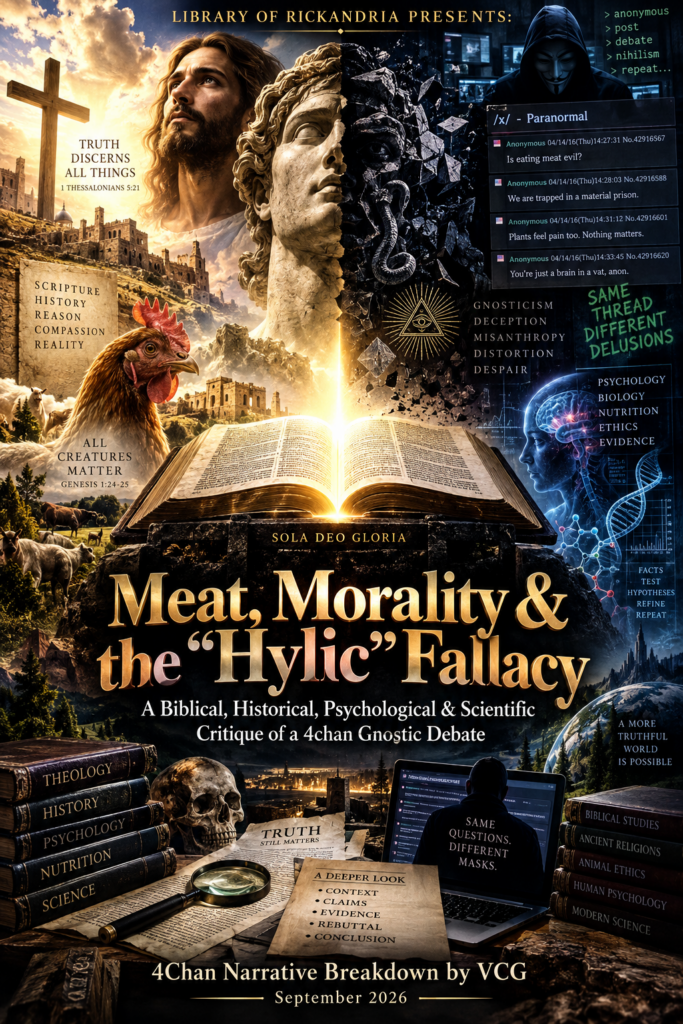
UPDATED BY VCG ON 9/9/2026 @ 03:33 EST
I want to share a heartfelt cause with my audience. Conner Blaisdell-Greene, a brave Airforce Sr. Airman, recently lost his battle with cancer, leaving his family in financial distress. Every donation, no matter how small, can help cover his funeral costs and ease their burden during this difficult time. Please consider clicking the link below to contribute or share Conner’s story with others. Your support truly matters.
Until We Meet Again
Spoken Tribute
Anyone can do this, but most won’t.
ChatGPT – Library of Rickandria
/x/ – Are all meat eaters hylics? They don’t care about – Paranormal – 4chan
Abstract
This paper examines a September 2026 4chan /x/ discussion that begins by asking whether people who eat meat should be classified as “hylics.” The discussion quickly expands into claims about ancient Gnosticism, animal consciousness, factory farming, plant sentience, nutrition, human evolution, moral psychology, masculinity, spiritual “frequency,” conspiracy, and biblical teaching. Rather than treating the thread as one argument, this study separates its claims by type and tests each type with the appropriate evidence. Historical claims are compared with ancient and modern scholarship on Valentinian anthropology; empirical claims are compared with peer-reviewed science and institutional sources; psychological observations are treated as population-level mechanisms rather than diagnoses of anonymous posters; philosophical claims are separated from scientific findings; and biblical claims are compared with the King James Bible supplied for this project.
The central finding is twofold. First, the claim that meat eating identifies a person as a “hylic” is historically confused, scientifically meaningless, and biblically unsupported. Ancient Valentinian categories were metaphysical and soteriological, not validated personality types or dietary biomarkers. Second, rejecting the “hylic” label does not require dismissing animal welfare. There is strong scientific support for conscious experience in mammals and birds, substantial evidence that birds experience pain, and credible evidence that some modern poultry systems impose serious welfare burdens. Scripture likewise permits animal food while placing human beings under moral accountability. The resulting synthesis is neither dietary legalism nor moral indifference: permission without cruelty, liberty without contempt, stewardship without sentimentality, and compassion without turning food into a spiritual caste system.
| SCOPE AND RESTRAINTThis is a critique of arguments, not a diagnosis of anonymous individuals. The thread contains irony, trolling, jokes, insults, and unverifiable anecdotes. Where sincerity cannot be established, the paper evaluates the proposition as written without claiming to know the poster’s inner motive. Scientific evidence about animal experience does not by itself decide Christian ethics, and Scripture does not function as a substitute for empirical measurement. |
Research Questions
Is “hylic” being used in a way that corresponds to ancient Valentinian or related Gnostic sources?
Do the thread’s empirical claims about animal pain, plant sentience, nutrition, evolution, food waste, cognition, and farming survive fact-checking?
What can and cannot be inferred psychologically from the rhetoric of meat eaters, vegetarians, and anonymous image-board participants?
What does the KJV actually say about creation, animal life, dominion, meat eating, abstention, conscience, cruelty, and spiritual status?
Which statements are empirical claims, ethical arguments, metaphysical assertions, interpretations, anecdotes, or rhetorical performance?
Method and Evidence-Grading System
The governing rule is simple: do not ask one kind of evidence to answer a different kind of question. A laboratory study can bear on pain behavior; it cannot demonstrate a Gnostic “frequency.” A patristic report can tell us something about second-century theological controversy; it cannot establish whether a chicken experiences nociceptive pain. A biblical text can establish what Scripture teaches within a Christian theological inquiry; it is not a veterinary pain instrument. Keeping those categories apart is the main discipline of this paper.
| Claim class | What counts as evidence | Typical example |
| Empirical | Observable, measurable, reproducible evidence; systematic reviews; primary data | Animal pain, sleep, food waste, nutrition. |
| Historical | Primary texts, textual criticism, specialist scholarship | Meaning of Valentinian ‘material/psychic/spiritual.’ |
| Theological | Scriptural text, context, canonical comparison, stated interpretive assumptions | Whether food reveals spiritual status. |
| Philosophical | Validity of inference and moral premises | Whether natural predation justifies human practice. |
| Psychological | Experimental/observational population evidence; no armchair diagnosis | Meat paradox, reactance, trolling. |
| Metaphysical | Coherent definitions plus independent reasons; often not directly testable | ‘Low-frequency suffering energy.’ |
| Rhetorical | Discourse analysis | Mockery, status signaling, analogy escalation. |
| Anecdotal | Independent corroboration before generalization | Stories about a particular vegan or farmer. |
| Grade | Meaning |
| Strong | Multiple high-quality sources converge; major uncertainty is limited. |
| Moderate | Substantial support, but important measurement or generalization limits remain. |
| Weak | Some evidence exists, but the stated claim is broader than the evidence. |
| Unsupported | No adequate evidence identified; burden of proof remains unmet. |
| False / contradicted | Reliable evidence conflicts directly with the claim. |
| Not presently falsifiable | No clear observation has been specified that could disconfirm the claim. |
| Interpretive | A moral or theological conclusion rather than an empirical finding. |
| BURDEN OF PROOFA universal claim carries a universal burden. Claims such as “all meat eaters are hylic,” “all life is conscious,” or “animals cannot suffer” are not established by a few vivid examples. The more sweeping the claim, the more evidence it requires. |
Contents
Part I — Reading the Thread as a Thread
Part II — Ancient Gnosticism and the “Hylic” Vocabulary
Part III — Scripture: Creation, Food, Dominion, Conscience, and Animals
Part IV — Animal Consciousness, Pain, and Welfare Measurement
Part V — Plant Sentience, Nutrition, Evolution, and Other Empirical Claims
Part VI — Moral Philosophy: What the Facts Do—and Do Not—Settle
Part VII — Psychology and the Rhetoric of Anonymous Online Debate
Part VIII — The Thread Reconstructed: Strongest Arguments, Weakest Moves
Part IX — Conclusion: A Biblical and Evidential Synthesis
Appendices A–F — Post Audit, Fallacies, Welfare Method, KJV Texts, Glossary, Annotated Sources
Part I — Reading the Thread as a Thread
1. What actually happens in the discussion
The thread begins on September 4, 2026 with a one-line moral-classification question about meat eaters and “hylics.” From there, the discussion does not proceed as a single debate. It branches. One branch asks whether animals suffer and whether factory farming matters. A second argues that plants also suffer. A third invokes predators and ancestral hunting. A fourth turns diet into masculinity and status. A fifth treats “hylic” as a Gnostic or esoteric diagnosis. A sixth introduces nutrition, food waste, and human evolution. Late in the thread, a much more technical set of poultry-welfare estimates appears. The result is not one argument but a stack of arguments that use the same vocabulary while answering different questions.
For that reason, the responsible question is not simply “which side won?” It is to disassemble the stack. An empirically correct observation can sit next to a bad moral inference. A crude poster can accidentally make a valid point. A compassionate poster can overstate a scientific model. A historically real term can be used in a historically inaccurate way. The method here is deliberately granular: keep what survives examination, discard what does not, and say when uncertainty remains.
| TEXT | Opening premise: meat eating is treated as evidence of a lower spiritual-human category. |
| EVIDENCE | Neither ancient Valentinian sources nor modern psychology supplies a validated dietary test for a metaphysical human type. |
| INTERPRETATION | The concern about animal suffering can be examined on its own merits; attaching a spiritual caste label adds no evidential force. |
2. The argument map
The thread’s main branches can be mapped to different evidence domains. Questions about hylic, psychic, and pneumatic categories belong first to ancient religious history. Questions about pain belong to comparative neuroscience and welfare science. Plant-consciousness claims require a theory and test of sentience. Predator analogies require moral philosophy. Claims about vegan, omnivorous, or carnivore health require nutrition science. Claims about the Bible require exegesis. The thread becomes confusing precisely when one branch tries to answer another.
3. Not every statement is fact-checkable
Statements such as “cows sometimes sleep standing” or “processed meat is classified as carcinogenic” can be tested against empirical literature. Statements such as “factory farming is a moral emergency” require both facts and moral premises. Statements such as “meat stores low-frequency suffering energy” are different again: unless “frequency” is operationally defined and a possible disconfirming observation is specified, the statement is not merely an unproven scientific claim; it is a metaphysical assertion with no clear scientific test.
| DO NOT CONFUSE UNSUPPORTED WITH DISPROVEDIf a poster proposes an invisible metaphysical process but provides no test for it, the careful verdict is usually “unsupported” or “not presently falsifiable,” not “science has proved the metaphysical opposite.” Intellectual restraint cuts both ways. |
Part II — Ancient Gnosticism and the “Hylic” Vocabulary
4. What ‘hylic’ meant in the Valentinian setting
The thread uses “hylic” as though it were a modern personality label for spiritually dull, materialistic, cruel, conformist, or carnivorous people. That is not how the term functions in our principal evidence for Valentinian anthropology. Irenaeus, writing as a hostile second-century critic, reports a threefold scheme of material, psychic (or “animal” in older translation language), and spiritual kinds. In his account, material substance is incapable of incorruption, psychic humanity occupies an intermediate condition, and the spiritual are said to possess a higher destiny through gnosis (Irenaeus, Against Heresies I.6).
Irenaeus is not a neutral ethnographer. He is a theological opponent, and his moral accusations against his adversaries must be treated as polemic rather than uncritically repeated. Modern scholarship nonetheless confirms that tripartite anthropologies occur in Valentinian and Nag Hammadi materials while also emphasizing that the patterns vary across texts. “Gnosticism” is a modern umbrella for diverse movements, not one standardized church with one psychological taxonomy (Thomassen 2006; University of Groningen, “Spirit, Soul and Body in Nag Hammadi Literature”).
The word’s association with matter helps explain why modern users connect “hylic” with materialism, but etymology is not a complete doctrine. From “material” one cannot simply infer atheist, Darwinist, meat eater, psychopath, NPC, politically conformist, or spiritually dead. Each added characteristic requires a separate argument.
| TEXT | Ancient polemical witness: Irenaeus describes a material–psychic–spiritual scheme among Valentinians. |
| EVIDENCE | Modern scholarship broadly confirms tripartite Valentinian anthropologies while warning about textual diversity and the polemical nature of some sources. |
| INTERPRETATION | Using ‘hylic’ as an all-purpose insult for anybody whose diet or personality one dislikes is a modern rhetorical mutation, not historical precision. |
5. Why the thread’s dietary test fails historically
Nothing in the evidence reviewed establishes “eats meat” as the diagnostic criterion for a material human class. Irenaeus’ own polemic even complains that people he identifies as spiritual elitists felt free to eat food connected with pagan sacrifice. Whatever one thinks of the accuracy of that accusation, it is enough to show why the simple equation meat eater = hylic cannot be extracted from this source.
A late-thread attempt to improve the idea says, roughly, that a meat eater becomes ‘hylic’ when he treats animals as mere material objects. As moral philosophy, that is more coherent because the criterion has shifted from menu to moral perception. But once that move is made, it is no longer a historical Valentinian diagnostic. It is a modern ethical metaphor dressed in ancient vocabulary.
6. Ancient vegetarianism and the monastery-conspiracy claim
One poster speculates that vegetarianism may have been inserted into monasteries as an ancient psychological operation designed to malnourish intelligent men. No evidence is offered, and the chronology creates a serious problem. Dietary restrictions associated with Pythagorean traditions were discussed in Greek antiquity centuries before Christian monastic institutions. The Stanford Encyclopedia of Philosophy also stresses that ancient reports disagree over how strictly Pythagoras himself avoided animal food—an excellent reminder not to oversimplify the history. What can be said safely is that religious and philosophical restriction of animal food long predates the proposed monastic conspiracy (Huffman, “Pythagoras,” SEP).
Part III — Scripture: Creation, Food, Dominion, Conscience, and Animals
7. Biblical anthropology is not Gnostic anthropology
The most basic biblical correction comes before diet. Genesis does not begin with matter as a prison manufactured by an inferior god. It begins, “In the beginning God created the heaven and the earth,” repeatedly calls created things good, calls animal life good, gives humanity a distinctive image-bearing status, and concludes the sixth day by calling the created order “very good” (Gen. 1:1, 20–31, KJV). John’s Gospel intensifies rather than abandons that Creator theology: “All things were made by him; and without him was not any thing made that was made” (John 1:3).
The New Testament’s hope is likewise not simple escape from embodiment. Luke’s resurrection account has Jesus invite the disciples to handle him, explicitly contrast his embodied presence with a spirit, and then eat broiled fish before them (Luke 24:36–43). First Corinthians 15 speaks of the raising of a “spiritual body,” not the cancellation of body. Colossians 1 places visible and invisible creation under Christ’s creative supremacy. Whatever philosophical questions remain about soul and spirit, the biblical trajectory is difficult to reconcile with the thread’s recurring assumption that matter itself marks an inferior cosmic order.
| TEXT | Genesis calls animal life good and humanity the image of God; Luke depicts the risen Christ embodied and eating fish. |
| EVIDENCE | These are claims established by the biblical texts themselves; no scientific inference is needed. |
| INTERPRETATION | A Christian may criticize materialism as a worldview without calling material creation evil. Biblical flesh/Spirit contrasts should not be silently converted into a Valentinian caste ontology. |
8. Genesis 1 to Genesis 9: permission changes, creaturely value remains
Genesis 1:29 gives human beings seed-bearing plants and fruit for food. Genesis 9:3, after the Flood, explicitly broadens permission: “Every moving thing that liveth shall be meat for you; even as the green herb have I given you all things.” The text therefore blocks two opposite dogmatisms. Scripture does not present all animal flesh as intrinsically forbidden, because Genesis 9 grants it. But Genesis 1 also gives no basis for claiming that animal flesh is the only spiritually proper human food.
Genesis 9 immediately distinguishes human life in a special way because humanity bears the image of God (Gen. 9:5–6). Biblical hierarchy is real. Yet the same chapter includes “every living creature” within the language of God’s post-Flood covenantal remembrance (Gen. 9:8–17). The text neither flattens humans and animals into moral equivalence nor reduces animals to unreal scenery.
9. The risen Christ and intrinsic defilement
Luke 24:42–43 is decisive against a Christian claim that the mere act of eating animal flesh is inherently sinful or proof of a corrupted spiritual nature. The scene is about resurrection reality, not dietary ethics, which is precisely why the action carries evidential weight: the risen Christ eats broiled fish. The passage does not answer every modern husbandry question. It does answer the narrower claim that eating animal flesh, considered simply as an act, is incompatible with holiness.
10. Romans 14: the chapter the thread most needs
Romans 14 is unusually well fitted to this dispute because Paul addresses believers who differ over food and days and then targets the moral attitudes produced by the disagreement. One believes he may eat all things; another “eateth herbs.” Paul’s first instruction is reciprocal restraint: “Let not him that eateth despise him that eateth not; and let not him which eateth not judge him that eateth: for God hath received him” (Rom. 14:2–3).
The symmetry matters. The eater is tempted to contempt: the abstainer is weak, silly, fearful, or inferior. The abstainer is tempted to judgment: the eater is impure, cruel, unenlightened, or condemned. Paul rebukes both. His concern then deepens: each person acts before the Lord and gives thanks; each will give account to God; liberty must not become a stumblingblock; and grieving a brother by one’s food is a failure of charity (Rom. 14:6–15).
The chapter does not reduce ethics to private preference. Paul can say both that nothing is unclean of itself and that the exercise of liberty can become evil when it wounds another’s conscience. He can say “all things indeed are pure” and immediately warn, “For meat destroy not the work of God.” He can even say it is good not to eat flesh or drink wine when doing so causes another to stumble (Rom. 14:14, 20–21). Christian liberty is not libertinism.
The summary sentence is devastating to spiritual caste-making: “For the kingdom of God is not meat and drink; but righteousness, and peace, and joy in the Holy Ghost” (Rom. 14:17). Whatever one concludes about particular farming systems, turning diet into a reliable meter of spiritual rank is the kind of move this chapter teaches Christians to resist.
| ROMANS 14 IN ONE SENTENCEThe eater is not permitted to despise; the abstainer is not permitted to judge; both are accountable to God; liberty is bounded by love; and the kingdom is not reducible to food. |
11. First Corinthians 10: liberty, conscience, and the market
First Corinthians 10 supplies another useful distinction. Paul permits eating what is sold in the marketplace without obsessive inquiry, while also teaching believers to limit freedom when an act communicates participation in idolatry or wounds another person’s conscience. His governing rule is broader than food: “Whether therefore ye eat, or drink, or whatsoever ye do, do all to the glory of God” (1 Cor. 10:23–33).
That pattern makes room for several Christian practices without making them identical. A believer may eat meat with thanksgiving. Another may abstain voluntarily. A third may reject products from a particular production system for reasons of conscience. A fourth may hunt or raise animals while taking welfare seriously. None of those practices, by itself, establishes a superior spiritual nature.
12. First Timothy 4 and dietary legalism
First Timothy 4 warns about false teaching that includes “commanding to abstain from meats, which God hath created to be received with thanksgiving.” In the KJV’s older English, “meats” can function broadly for foods; the point is not a command that every Christian must consume animal flesh. The passage opposes religiously mandated abstention from created food as a badge of righteousness and emphasizes thanksgiving (1 Tim. 4:3–5). Taken with Romans 14, the balance is clear: Scripture rejects compulsory food taboos as a ground of righteousness while refusing to let liberty operate without charity.
13. Dominion and stewardship: what the text actually gives us
Genesis 1:26–28 grants humanity dominion over other living creatures. The thread sometimes treats dominion as though the word itself means unrestricted exploitation; elsewhere, it is treated as though genuine dominion must prohibit killing animals. Neither conclusion is contained in the term alone. The broader biblical data supply boundaries: animals are God’s good creatures; humans uniquely bear God’s image; humans are authorized to rule; Genesis 9 permits animal food; and other biblical laws make animal welfare morally relevant.
Exodus 23 commands rest so that the ox and ass may rest and requires aid for an enemy’s burdened animal. Deuteronomy 25:4 forbids muzzling the ox while it treads grain. Proverbs 12:10 says, “A righteous man regardeth the life of his beast: but the tender mercies of the wicked are cruel.” Jesus speaks of sparrows as noticed by the Father even while affirming that humans are of greater value (Matt. 10:29–31). These passages do not amount to a modern animal-rights theory. They do make indifference to avoidable cruelty difficult to baptize as biblical dominion.
The defensible biblical synthesis is accountable rule: human beings have distinctive authority over animals, but authority exercised under God is not self-originating ownership without moral limit.
Part IV — Animal Consciousness, Pain, and Welfare Measurement
14. Nociception is not the same thing as pain
The thread moves too quickly between reflex, pain, suffering, and reflective self-consciousness. Nociception is neural detection and processing of potentially damaging stimuli. Pain is an aversive sensory and affective experience. Distress and suffering are broader concepts that can include fear, frustration, illness, hunger, social deprivation, or prolonged negative affect. Self-awareness and autobiographical rumination are further capacities still.
One poster defines suffering so narrowly that an animal would need something like a human “why me?” narrative before its experience counts. That is not a standard scientific criterion. The useful question is whether the organism has the neural and behavioral architecture associated with conscious aversive experience, not whether it can narrate its misfortune in human language.
15. What current animal-consciousness evidence supports
The 2024 New York Declaration on Animal Consciousness states that there is strong scientific support for conscious experience in mammals and birds and a realistic possibility in all vertebrates and several invertebrate groups. A 2021 London School of Economics review of more than 300 studies similarly recommended treating cephalopod molluscs and decapod crustaceans as sentient for policy purposes. These are not proofs of every disputed case, but they represent a substantial evidence base.
For birds specifically, Douglas, Sanchez-Migallon Guzman, and Paul-Murphy’s veterinary review concludes that birds possess the neurological components necessary to respond to painful stimuli and likely perceive pain in a broadly mammal-comparable manner, while recognizing species differences. The categorical claim “animals do not suffer” therefore outruns the evidence. The careful position is that we cannot inspect another species’ first-person experience directly, but converging neural, behavioral, physiological, and pharmacological evidence gives substantial reason to treat many animals as conscious subjects of aversive states.
| TEXT | Claim: animals may have pain signals but do not truly suffer without human-style reflective rumination. |
| EVIDENCE | Comparative consciousness and avian-pain science does not make autobiographical rumination a prerequisite for conscious aversive experience. |
| INTERPRETATION | The claim protects its conclusion by stipulating a private definition of suffering; that is conceptual revision, not a scientific finding. |
16. Keel-bone fractures: serious problem, variable prevalence
The thread’s late poultry section is much stronger than its earlier metaphysics because it points toward real welfare research. Keel-bone fractures in laying hens are widely recognized as an important welfare problem, and experimental work supports the conclusion that affected hens can experience pain. Yet the 2020 systematic review by Rufener and Makagon shows why viral prevalence numbers need context: end-of-lay estimates vary greatly by strain, housing system, age, assessment method, and study. Some widely cited commercial-flock estimates are extremely high; others are much lower.
The right conclusion is neither “fractures are fake” nor “every hen has the same number and severity of fractures.” Keel-bone damage is a serious and often prevalent welfare problem whose exact burden must be estimated with system-specific data.
17. What the Welfare Footprint Institute is actually doing
The Welfare Footprint Institute (WFI) uses a Cumulative Pain Framework. It combines estimates of duration, intensity, occurrence, and prevalence of welfare harms and expresses expected burden as time spent in four operational categories: Annoying, Hurtful, Disabling, and Excruciating. For broilers, WFI explicitly states that uncertainty in input parameters is incorporated into estimates. For laying hens, population prevalence is used to calculate the expected burden for an “average” hen.
That “average” animal is a mathematical construct. If a condition affects a fraction of a flock, the expected burden can be distributed across the population for comparison. The output does not mean every individual bird experiences the same sequence or duration.
This distinction matters when the thread translates WFI categories into exact human experiences. WFI’s technical definitions caution that species-internal categories should not be casually mapped onto human phenomenology; human-anchored categories are separately identified where used. The framework can support claims that one system is expected to impose substantially more severe negative experience than another. It cannot provide direct access to a hen’s consciousness or prove exact equivalence to childbirth, torture, or the worst pain in a reader’s life.
| MODEL ≠ DIRECT MEASUREMENTA useful estimate can still be a model. WFI combines empirical inputs, explicit assumptions, category definitions, prevalence, and uncertainty. The output should be reported as a model-based estimate, not as a literal pain-meter reading. |
18. The poultry numbers: supported core, overstated rhetoric
WFI’s accessible laying-hen summary reports that moving an average hen from conventional cages to an aviary is estimated to avert at least 275 hours of Disabling pain, together with larger amounts of lower-intensity pain. It also estimates about 2,000 hours of Excruciating pain per flock of 50,000 hens from included harms. Dividing 2,000 by 50,000 gives 0.04 hours, or about 2.4 minutes, per statistical average hen. That explains the thread’s approximate “two and a half minutes” figure. It remains a prevalence-weighted population estimate, not an identical episode experienced by every bird.
The thread’s roughly 400-hour Disabling-pain figure for a hen could not be verified in that form from the current public summary. It may reflect a different aggregation or Pain-Track configuration, but the accessible comparison figure is 275 hours averted in the conventional-cage-to-aviary model. The exact provenance should therefore be left open rather than forced.
For broilers, WFI estimates that Better Chicken Commitment conditions using slower-growing birds prevent at least 33 hours of Disabling pain per affected bird, with a stated uncertainty interval of 13 to 53 hours, and describes that as about a 66 percent reduction relative to its conventional scenario for the harms included. That implies a conventional modeled burden on the order of 50 hours for those contributors and explains the thread’s rough figure. WFI also notes that its included harms are not exhaustive and characterizes its reform benefit estimates as conservative.
19. Factory farming and meat eating are different propositions
The thread repeatedly slides from “some industrial systems produce severe welfare harms” to “therefore eating animals is intrinsically immoral,” or in the opposite direction from “Scripture permits eating animals” to “therefore the manner in which animals are raised is morally irrelevant.” Neither inference follows.
Separate the questions: May humans eat animals at all? What treatment is permissible before death? What methods of transport and slaughter are acceptable? How should necessity, affordability, nutrition, husbandry, ecology, and welfare be weighed? Biblical permission answers the first within Christian theology. It does not automatically answer the rest. Evidence of cruelty in one system likewise does not by itself prove that every possible form of animal husbandry or hunting is intrinsically wrong.
Part V — Plant Sentience, Nutrition, Evolution, and Other Empirical Claims
20. ‘Plants suffer too’: signaling is not yet sentience
Plants detect injury, alter gene expression, release chemical signals, change growth, communicate through volatile compounds, and mount complex defenses. The controversial step is moving from sophisticated responsiveness to phenomenal consciousness—the presence of something it feels like to be the plant.
A 2024 critical review in Biology & Philosophy argues that the behavioral and physiological similarities often invoked for plant sentience do not themselves establish consciousness and that present research lacks plant-appropriate tests capable of supplying positive evidence for sentience. The careful verdict is not “plant consciousness is metaphysically impossible.” It is “current evidence does not establish plant sentience” (Hansen 2024).
Even if plant sentience were someday established, another ethical comparison would still be required: how intense, prevalent, and avoidable are the harms in different food systems? Discovering that more than one form of life matters would not make comparative ethics disappear.
21. Predators and the appeal to nature
The tiger argument asks why humans should restrain themselves if predators kill animals. As zoology, predation is obvious; as ethics, the inference is weak. Nonhuman predators are not ordinarily treated as reflective moral agents with agriculture, supplementation, law, markets, and explicit ethical traditions. More fundamentally, “occurs in nature” is not equivalent to “is morally exemplary for humans.” Infanticide, coercive mating, parasitism, and territorial killing also occur in nature.
The claim that humans are the only animals that kill beyond immediate nutritional need is false. Surplus killing has been documented in carnivores including foxes and spotted hyenas and is also reported in wolves. That correction does not vindicate industrial cruelty. Humans remain distinctive in the technological scale, planning, institutional organization, and moral reflection they can bring to killing (Kruuk 1972).
22. Human evolution does not produce one mandatory menu
Appeals to “what humans are supposed to eat” often treat hunter-gatherers as a single diet. Pontzer and Wood’s 2021 Annual Review of Nutrition synthesis concludes that Paleolithic diets likely contained both plant and animal foods in highly variable proportions across time and ecology. Among contemporary warm-climate hunter-gatherers, a roughly 50/50 plant–animal energy balance is common, while colder environments and pastoral or fishing economies tend toward more animal food and warmer foraging or farming contexts toward more plant food.
That makes two slogans untenable: humans are neither obligate herbivores nor obligate carnivores. Human dietary flexibility is itself part of the evolutionary story. And even if one ancestral pattern dominated, a separate moral premise would still be required before “ancestral” became “morally obligatory.”
23. Vegan nutrition: possible, but not automatic
The thread treats veganism as though protein deficiency, stunted growth, or bodily degeneration were inevitable. Current professional guidance does not support that blanket claim. The Academy of Nutrition and Dietetics’ current position states that appropriately planned vegetarian and vegan dietary patterns can be nutritionally adequate for adults and may offer cardiometabolic benefits. The phrase “appropriately planned” matters. Adequacy is not automatic (Raj et al. 2025/2026).
Vitamin B12 deserves special attention because naturally occurring B12 is concentrated in animal-derived foods; the U.S. National Institutes of Health notes that people who eat little or no animal food may not obtain enough without fortified foods or supplements. Iron bioavailability and iodine can also require attention. Similar planning questions can arise for calcium, zinc, omega-3 fats, protein distribution, and other nutrients depending on the specific diet. The correct conclusion is neither “vegan diets are inherently deficient” nor “a vegan label guarantees good nutrition.”
24. Carnivore nutrition: certainty outruns long-term evidence
The opposite overclaim appears when a poster says that an overwhelmingly animal-food diet would make people broadly healthier and that concerns about cardiovascular disease or cancer are backwards. A 2026 scoping review of the carnivore diet found only nine human studies and judged the overall evidence very limited because of small samples, short durations, and absent controls. It reported some possible short-term benefits but also potential micronutrient deficiencies, very low fiber intake, and adverse lipid changes; the authors concluded that long-term adherence cannot presently be recommended on the evidence reviewed (Lietz, Dapprich, and Fischer 2026).
Separately, the International Agency for Research on Cancer classifies processed meat as carcinogenic to humans on sufficient evidence for colorectal cancer and red meat as probably carcinogenic on limited human evidence plus strong mechanistic evidence. This is a hazard classification, not a statement that meat and smoking carry equal risk. Still, it contradicts the thread’s suggestion that the cancer concern is simply backwards (IARC 2015).
25. Protein comparisons and racial stereotyping
A pound of turkey is protein dense, and several cans of beans may be required to match its absolute protein content. Human diets, however, are not one-food substitution experiments. Protein needs can be met across meals from legumes, soy foods, seitan, grains, nuts, seeds, and other foods. The relevant questions are total intake, amino-acid adequacy, energy intake, digestibility, age, and health context.
The thread’s racialized body-size claims are not nutritional analysis. They collapse genetics, socioeconomic history, childhood nutrition, disease burden, food access, and enormous within-population variation into a stereotype. No adequate evidence is supplied for the generalization.
26. Food waste: the U.S. claim is backwards
One poster says that most meat is discarded before consumers buy it. USDA loss-adjusted estimates point in the opposite direction for the U.S. retail-and-consumer portion of the supply chain. Retail losses were estimated at about 4 percent for meat and poultry and 8 percent for fish/seafood, compared with consumer-level losses of roughly 23, 18, and 31 percent respectively. USDA summarized the pattern by reporting that about 83 percent of meat, poultry, and fish loss at these stages occurred in homes and away-from-home eating places rather than grocery stores. These are U.S. estimates based on 2010 data, so they should not be universalized globally; they nonetheless contradict the particular U.S.-style claim (USDA ERS 2013–2014).
27. Cows, pigs, squid, and dolphins: smaller corrections
The claim that cows simply sleep standing is misleading. Dairy cows can drowse and may show some non-REM sleep standing, but recumbency is required for REM sleep and lying behavior is important to welfare. Calling pigs “psychopaths” is likewise not a scientific diagnosis. Pigs possess substantial learning and memory capacities, and human psychiatric labels cannot be transferred merely because an observer dislikes a species’ behavior (Gieling, Nordquist, and van der Staay 2011).
The suggestion that Westerners avoid squid because squid are intelligent is too broad—calamari is ordinary food in many Western cuisines. The dolphin point is closer to a U.S. legal fact: marine mammals are broadly protected under the Marine Mammal Protection Act, which generally prohibits take subject to exceptions. Intelligence alone, however, is not an adequate summary of the law’s conservation and protection rationale.
Part VI — Moral Philosophy: What the Facts Do—and Do Not—Settle
28. Five frameworks can read the same facts differently
Scientific agreement about sentience does not automatically produce one moral theory. Philosophers who accept the same pain data can disagree about what follows. The Stanford Encyclopedia of Philosophy’s survey of animal moral status distinguishes utilitarian approaches that weigh interests and consequences from rights-based approaches that treat certain uses as violations of inherent claims. Virtue ethics asks what practices cultivate cruelty, temperance, gratitude, or mercy. Deontological approaches ask what duties hold regardless of aggregate benefit. Christian stewardship and natural-law families ask how human authority, creaturely goods, necessity, and accountability under God fit together.
This is why “factory farming is a moral emergency” is not a scientific result in the same sense as a fracture-prevalence estimate. Science can tell us a great deal about injury, behavior, pain, mortality, and system differences. Calling the aggregate a moral emergency adds a normative judgment. That judgment may be well reasoned; it remains a judgment.
29. Zero harm is not the moral standard unless someone argues for it
Several posters answer welfare concerns by pointing out that crop production, transportation, pest control, habitation, and ordinary life also kill animals. The factual observation is important: a perfectly harm-free human life is not available. The inference that therefore harm reduction is meaningless is a false dilemma.
Most moral systems distinguish avoidable from unavoidable harm, intentional from incidental harm, proportionate from disproportionate means, and realistic alternatives from impossible ones. A more coherent question is comparative: given realistic alternatives, which harms are necessary, which are avoidable, and what goods justify the remaining harms?
30. Steelmanning the two main sides
The strongest anti-cruelty argument in the thread does not need Gnosticism. It runs like this: many food animals are conscious enough for pain and distress to matter; some production systems predictably impose serious harms; consumers and producers sometimes have alternatives; therefore those harms deserve moral scrutiny and, where reasonably possible, reduction. Welfare science can support that argument without calling anyone a hylic.
The strongest pro-meat argument likewise does not need mockery. It runs like this: animal food is part of human biological and cultural history; not all animal husbandry is alike; some people have practical, nutritional, ecological, economic, or cultural reasons to use animal foods; Scripture expressly permits animal food; therefore meat consumption alone does not establish cruelty or spiritual inferiority. That argument can be defended without pretending animal pain is unreal.
Once stated in those forms, much of the apparent contradiction disappears. The live questions concern which practices are justified, what welfare standards are reasonable, how burdens and benefits are distributed, and how conscience should operate—not whether dinner reveals a secret species of soul.
Part VII — Psychology and the Rhetoric of Anonymous Online Debate
31. The meat paradox and motivated mind perception
There is a real psychological phenomenon underneath some of the thread’s accusations. People may care about animals while enjoying meat, producing what researchers call meat-related cognitive dissonance. Bastian and colleagues found that food animals were attributed less mind and that anticipating meat consumption increased mind denial. Related experiments found reductions in moral concern after meat consumption, and Rothgerber’s review places such findings within a broader family of dissonance-reduction and moral-disengagement strategies (Bastian et al. 2012; Loughnan et al. 2010; Rothgerber 2021).
These studies justify a cautious proposition: some people sometimes reduce psychological conflict about meat by mentally distancing food from animal minds or suffering. They do not justify “all meat eaters lack empathy,” still less “all meat eaters are hylic.” Population-level effects are not diagnostic tests for anonymous strangers.
32. Moralization on the vegetarian side
Psychological mechanisms do not run in only one ideological direction. Rozin, Markwith, and Stoess described moralization as the transformation of a preference into a value and found that moral vegetarians, compared with health vegetarians, showed stronger disgust and a wider range of avoidance. Moralization can make behavior principled and coherent; it can also intensify identity boundaries. Once food becomes evidence of who is pure, compassionate, awake, masculine, weak, or corrupt, disagreement feels less like a factual dispute and more like a threat to the self.
That pattern is visible on both sides of the thread. Some anti-meat posters convert concern into spiritual essentialism: the eater is a lower type. Some pro-meat posters convert diet into status masculinity: flesh becomes proof of dominance or “alpha” identity. The symbols differ; the social move is similar.
33. Reactance and spiteful counter-signaling
Psychological reactance is motivational arousal in response to a perceived threat to freedom. Reviews describe responses such as derogating the source of restriction, increasing attraction to the threatened option, or behaviorally reasserting freedom. A post announcing a meat purchase specifically out of spite resembles the surface pattern. It does not prove the poster’s internal state, but it illustrates why coercive moral rhetoric can produce counter-signaling instead of reflection (Steindl et al. 2015).
34. Anonymity, trolling, and context
Anonymous image-board discourse changes the evidential value of individual statements. In a 2022 experiment, Nitschinsk, Tobin, and Vanman found more trolling in an anonymous condition than an identifiable one. Cheng and colleagues found that negative mood and exposure to prior trolling could increase trolling behavior in experimental online discussions. These studies do not tell us which specific 4chan post is sincere. They do show that anonymity and local conversational norms can amplify performative antagonism.
That matters when reading cruelty jokes, sexual jokes, racial insults, and escalating absurdity. Some posts may express belief; others may be attempts to provoke. The careful researcher evaluates the proposition without treating the anonymous post as a transparent window into stable personality.
35. Status, essentialism, and unfalsifiable mind-reading
The word “hylic” becomes rhetorically powerful because it essentializes. Instead of saying “that argument ignores animal welfare,” it says “you are the kind of being who cannot understand.” This immunizes the speaker from correction: disagreement itself becomes evidence of the diagnosis.
The same structure appears when mockery is taken as proof of secret guilt. That is unfalsifiable mind-reading. Agreement confirms the claim; disagreement also confirms it. Good psychological explanation must leave room for competing hypotheses: trolling, disgust, identity defense, genuine philosophical disagreement, perceived sanctimony, humor, ignorance, or simple hostility.
36. Analogy inflation
As the thread escalates, analogies move from ordinary animal harm to torture, concentration camps, Auschwitz, police violence, cannibalism, and metaphysical “loosh” farming. Analogies are not automatically fallacies. They can isolate a shared structure. But they become misleading when emotional force substitutes for showing that morally relevant features are actually comparable.
The concentration-camp comparison can make one narrow point: efficiency alone does not make a practice moral. It cannot, without further argument, establish that genocide and livestock agriculture are morally equivalent in personhood, intention, social meaning, rights, or every other relevant respect. Good analogy states the shared feature precisely and the differences just as precisely.
Part VIII — The Thread Reconstructed: Strongest Arguments, Weakest Moves
37. What the anti-meat side gets right
Animal pain and conscious aversive experience are not scientifically trivial; mammals and birds warrant serious welfare consideration.
Modern food systems can psychologically distance consumers from the animal origin of meat, and meat-related cognitive dissonance is experimentally documented.
Some poultry welfare problems—lameness, keel-bone damage, behavioral deprivation, heat stress, and slaughter harms—are substantial.
Zero harm is impossible, but that does not erase meaningful differences between more and less avoidable harm.
Efficiency is not a complete moral criterion.
38. What the pro-meat side gets right
Meat eating by itself does not demonstrate lack of empathy, a personality type, or a Gnostic spiritual category.
Human diets are historically and biologically flexible; simplistic ‘natural diet’ stories are unreliable.
Crop agriculture and ordinary life also produce animal deaths and ecological harms, so comparison should examine systems rather than romanticize labels.
Not all animal-production systems produce identical welfare outcomes.
Within Scripture, animal food is expressly permitted and voluntary abstention cannot be turned into a universal test of righteousness.
39. What both sides repeatedly get wrong
Turning diet into an essence: hylic, alpha, prey, NPC, pure, awakened, or morally subhuman.
Treating vivid anecdotes as representative of every eater, vegan, farmer, animal, or production system.
Confusing descriptive science with a complete moral conclusion.
Using analogies for emotional escalation rather than analytical comparison.
Assigning hidden motives to strangers and treating every response as confirmation.
Sliding among pain, suffering, consciousness, soul, and spirit without definitions.
Treating historical religious vocabulary as a free-floating modern insult.
40. A concise scorecard
The scorecard below reduces the main dispute to claims that can be checked or clearly categorized. It should be read together with the longer post-by-post audit in Appendix A.
Part IX — Conclusion: A Biblical and Evidential Synthesis
The original question asks whether all meat eaters are hylics. After following the discussion through history, science, psychology, philosophy, and Scripture, the answer is no—but the route to that answer matters.
Historically, the term belongs to ancient metaphysical and soteriological schemes, especially Valentinian ones, not to a validated behavioral taxonomy. Scientifically, diet cannot diagnose an invisible spiritual substance. Psychologically, meat-related cognitive dissonance is real, but it is probabilistic and contextual, not proof that every eater lacks empathy. Philosophically, animal sentience gives reasons for moral consideration but does not by itself settle every question about killing, husbandry, necessity, or rights. Welfare science supplies serious evidence that some poultry systems impose large burdens while also teaching us to report modeled estimates honestly. Nutrition science undermines both vegan-deficiency fatalism and carnivore-certainty triumphalism.
Scripture supplies the clearest correction to the spiritual caste claim. Material creation is God’s creation and is called good. Human beings are distinctive image-bearers with dominion. Animal food is permitted after the Flood. The risen Christ eats fish. Paul refuses to make the kingdom of God a matter of food. Yet the same biblical witness refuses callousness: the righteous person regards the life of his beast, working animals receive rest, liberty is constrained by charity, and every believer gives account to God.
That produces a conclusion less dramatic than the thread’s rhetoric and more demanding than either side’s caricature: permission without cruelty; liberty without contempt; stewardship without sentimentality; compassion without dietary legalism. A Christian may eat meat. A Christian may abstain. A Christian may criticize factory-farming practices. A Christian may pursue higher-welfare husbandry. What Scripture does not authorize is turning one’s plate into an oracle that reveals who belongs to a superior or inferior species of soul.
The thread becomes most useful when treated not as a source of doctrine but as a case study in how modern people mix ancient religious vocabulary, genuine moral concern, scientific uncertainty, identity, and internet performance. The discipline required to untangle it is itself worth practicing: define the claim, identify the kind of evidence it would need, grade the evidence honestly, and refuse to claim more certainty than the source permits.
| FINAL SYNTHESISMEAT MAY BE EATEN. ANIMALS MAY NOT BE TREATED AS MORALLY MEANINGLESS. DIET DOES NOT REVEAL A GNOSTIC CASTE. CHRISTIAN LIBERTY IS REAL, AND CHRISTIAN LIBERTY IS ACCOUNTABLE TO LOVE. |
Claim Scorecard
| Claim | Assessment | Reason |
| All meat eaters are hylic | False / category error | No ancient, psychological, scientific, or biblical dietary diagnostic. |
| Valentinians used material/psychic/spiritual categories | Strong | Attested in Irenaeus and supported in modern Valentinian scholarship. |
| Animals cannot suffer without asking ‘why me?’ | False as scientific criterion | Human-style rumination is not required by comparative pain science. |
| Plants consciously suffer | Unsupported at present | Complex signaling is established; sentience is not. |
| Humans are the only surplus killers | False | Surplus killing is documented in nonhuman carnivores. |
| Cows simply sleep standing | Misleading | REM sleep requires recumbency; lying is important. |
| Vegan diets inevitably lack adequate protein | False | Appropriately planned adult vegan diets can be nutritionally adequate. |
| Vegan diets require no planning | False | B12 and other nutrients can require deliberate attention. |
| Carnivore diets are proven superior long term | Unsupported | The 2026 scoping review finds very limited human evidence and plausible risks. |
| Most U.S. meat waste occurs before purchase | Contradicted | USDA estimates show larger consumer-level losses. |
| WFI directly measures exact human-equivalent agony | False description | It is a model using categories, prevalence, duration, and uncertainty. |
| WFI identifies serious poultry welfare burdens | Supported | Current laying-hen and broiler models estimate substantial severe burdens. |
| Eating animal flesh is intrinsically sinful in Scripture | False | Genesis 9:3; Luke 24:42–43; Romans 14; 1 Corinthians 10. |
| Cruelty to animals is biblically irrelevant | False | Proverbs 12:10; Exodus 23; Deuteronomy 25 and related texts. |
| Diet establishes Christian spiritual rank | Contradicted by Romans 14 | Paul forbids both despising and judging across food differences. |
Appendix A — Poster-by-Poster Audit
To avoid unnecessary reproduction of the source thread, this audit uses post numbers and short claim tags rather than lengthy quotations. The goal is line-by-line accountability without turning the paper into a transcript. Anonymous identities and motives are not inferred.
| Post | Claim tag | Assessment | Correction / note |
| 42916567 | meat eater = hylic | Unsupported / category error | Animal-welfare concern does not establish spiritual caste. |
| 42916579 | lack of empathy = bad character | Interpretive | Diet alone cannot establish total character. |
| 42916580 | dismissive chicken mockery | Rhetoric | Provocation, not evidence. |
| 42916622 | police-shooting chicken joke | Rhetoric | Shock humor changes tone, not facts. |
| 42916646 | hylic animals have no real mind | Unsupported | Ancient category does not mean modern NPC/non-conscious entity. |
| 42916845 | all life harms; nose-to-tail; carnivore health | Mixed | Unavoidable harm is real; health superiority is overclaimed. |
| 42916858 | plants/fungi may be conscious | Weak / unresolved | Responsiveness alone is insufficient evidence of sentience. |
| 42916878 | plants suffer too | Unsupported | Current evidence does not establish plant subjective pain. |
| 42916888 | only nonexistence prevents harm | False dilemma | Ethics can compare avoidable and unavoidable harms. |
| 42916896 | vegetables suffer | Unsupported | Reasserts plant sentience without evidence. |
| 42916929 | insect killing defeats vegan ethics | Tu quoque risk | Only works against a literal zero-harm premise. |
| 42916971 | all life conscious; breatharian future | Unsupported | Universal consciousness and nutrition claims lack evidence. |
| 42917091 | complex nervous systems; meat hylic-coded | Mixed | Neural evidence does not yield Gnostic classification. |
| 42917099 | pain yes, suffering no without rumination | False criterion | Redefines suffering around human narrative cognition. |
| 42917130 | predator comparison | Weak inference | Natural predation does not automatically license human practice. |
| 42917141 | aware predator morally same as human | Unsupported | Moral agency requires more than bare awareness. |
| 42917154 | humans uniquely kill beyond need | False | Surplus killing occurs in nonhuman carnivores. |
| 42917162 | industrial killing = more evolved | Equivocation | Biological/technical development ≠ moral progress. |
| 42917169 | pasture welfare; cows sleep standing | Mixed | System variation matters; sleep claim is misleading. |
| 42917171 | packaging creates dissociation; hylic absent-mindedness | Mixed | Distancing plausible; hylic diagnosis unsupported. |
| 42917181 | Demiurge satire / uplift animals | Rhetoric | Parody rather than sustained claim. |
| 42917184 | beans vs turkey; vegan protein; racial stereotype | Mixed | Protein density differs; stereotype lacks adequate basis. |
| 42917195 | West avoids squid/dolphins due intelligence | Overgeneralized | Squid widely eaten; U.S. dolphin law has broader rationale. |
| 42917207 | industrial scale = moral devolution | Interpretive | Scale matters only through stated moral premises. |
| 42917237 | industrial medicine is beneficial | Broadly plausible | Does not settle animal ethics. |
| 42917250 | human reason can oppose nature | Coherent observation | Undercuts simplistic appeal-to-nature reasoning. |
| 42917259 | pig intelligence; squid disgust; dolphin legality | Mixed | Pig cognition supported; U.S. marine mammals broadly protected. |
| 42917313 | pigs ‘psychopaths’; improve husbandry | Mixed | Psychiatric label invalid; welfare point reasonable. |
| 42917322 | higher beings consume lower / egregore | Unsupported metaphysics | No independent evidence; non-biblical Creator-creature scheme. |
| 42917337 | hylic = material; materialism/Darwinism = hylic | Overextension | Etymological kernel does not produce modern personality taxonomy. |
| 42918239 | spiritual caste; service matters more than diet | Mixed | Moral nuance improves; caste remains unsupported. |
| 42918352 | plant diet = prey/beta | False analogy | Trophic strategy does not measure courage or virtue. |
| 42919034 | meat eaters are a hivemind | Unsupported | Overgeneralization from salient examples. |
| 42919042 | hippos/rhinos counter plant=weak | Useful counterexample | Exposes weakness of predator-status analogy. |
| 42919066 | cannot quit meat; most waste pre-purchase | Contradicted | Planned vegan diets possible; USDA pattern is opposite. |
| 42919067 | suffering energy / low frequency / cannibal slope | Unsupported | No operational measure or demonstrated causal chain. |
| 42919071 | every society therefore cannibal | Rhetorical reductio | Exposes slippery-slope structure. |
| 42919482 | livestock rapidly rewild | Speculative | Breed- and context-dependent. |
| 42919506 | packaged meat hides animal origin | Plausible / partly supported | Compatible with salience and mind-denial research. |
| 42919509 | factory farming reduces suffering because efficient | Unsupported generalization | Efficiency ≠ welfare; reform models show large differences. |
| 42919934 | concentration-camp analogy | Partial structural point | Efficiency point valid; full equivalence not established. |
| 42920016 | regret spreading hylic meme | Meta/rhetorical | Illustrates memetic drift. |
| 42920073 | buy meat in spite | Reactance-like pattern | Do not infer private motive with certainty. |
| 42920086 | vegan manager anecdote / Auschwitz analogy | Unverifiable + genetic fallacy risk | One person’s hypocrisy would not refute a principle. |
| 42920105 | plants trapped and cannot scream | Unsupported inference | Non-vocality proves neither sentience nor its absence. |
| 42922034–45 | goat affection/slaughter banter | Anecdotal/rhetorical | Not generalizable. |
| 42922095 | hunter tradition; monastery plot; vegan degeneration | Mostly unsupported | Dietary history, evolution and nutrition are far more complex. |
| 42922135 | non-duality goat joke | Rhetoric | No evidential content. |
| 42922153–82 | WFI poultry pain estimates / human equivalence | Mixed | Welfare core supported; exact human analogies overstated. |
| 42922384 | harm reduction; animals suffer more due time perception | Mixed | Reduction argument strong; comparative phenomenology speculative. |
| 42922444 | dismissal | Rhetoric | Adds no evidence. |
| 42923618 | not all meat eaters hylic; attitude matters | Modern reinterpretation | More coherent ethic, still not historical/biblical caste. |
| 42923644 | plant chemical defense = psychic | Category error | Chemical signaling ≠ consciousness ≠ Gnostic status. |
| 42923845 | decent people reduce suffering; mockery proves badness | Mixed | First defensible; second is mind-reading. |
| 42924640 | sheep silence = consent | False concept of consent | Consent requires relevant comprehension/capacity. |
| 42924686 | humans farmed for loosh | Unsupported metaphysics | No testable evidence supplied. |
Appendix B — Rhetorical Fallacy and Analogy Index
| Pattern | How it functions here |
| Category error | Dietary behavior is treated as a measurement of metaphysical substance. |
| Universal generalization | Some callous eaters or sanctimonious abstainers become ‘all’ members of a diet category. |
| Tu quoque | Crop or insect deaths are used to dismiss livestock-welfare arguments without comparative analysis. |
| False dilemma | Either eliminate every harm or admit harm reduction is meaningless. |
| Appeal to nature | Predators kill; therefore any human killing practice is justified. |
| Equivocation | ‘Evolved’ slides from biological/technical development to moral superiority. |
| Etymological fallacy | The root association with matter becomes a complete modern moral taxonomy. |
| Genetic fallacy | An adherent’s hypocrisy is used to dismiss the argument. |
| Slippery slope | Meat → low frequency → cannibalism without a demonstrated mechanism. |
| Mind reading | Mockery or disagreement is taken as proof of secret guilt. |
| Unfalsifiability | Every possible reaction confirms the spiritual diagnosis. |
| Analogy inflation | Limited structural comparisons expand into genocide/police/cannibal equivalence. |
| Moral status signaling | Food becomes proof of compassion, masculinity, enlightenment, or purity. |
Analogy audit
An analogy is useful when it isolates a relevant shared property and keeps differences visible. “Efficiency does not guarantee morality” is a valid abstract point. A comparison to Auschwitz becomes misleading if the emotional weight of genocide is used to supply conclusions that have not been argued about personhood, rights, intention, social meaning, or moral status. The same discipline applies to slavery, police violence, predator, cannibalism, and ‘loosh farm’ analogies: name the shared feature, then name the disanalogies.
Appendix C — Welfare Footprint Methodology Note
The Welfare Footprint Institute’s Cumulative Pain Framework is a comparative model. It aggregates estimated intensity and duration of negative affective states, occurrence, and prevalence, then expresses expected burden as time in operational categories. This can make reforms comparable while also making assumptions visible.
| Category | Operational idea | Reporting caution |
| Annoying | Noticeable negative state compatible with most activity. | Do not automatically map to a precise human experience. |
| Hurtful | More salient state interfering with some valued activity. | Species and context matter. |
| Disabling | Severe state substantially disrupting normal functioning/positive experience. | Human-equivalence language can go beyond the model. |
| Excruciating | Acutely extreme negative state in the framework. | Population averages may reflect rare severe events, not identical experience in every bird. |
An ‘average hen’ is a population-weighted mathematical construct.
Prevalence, duration, and intensity inputs carry uncertainty.
The modeled list of welfare harms is not exhaustive.
Outputs are conditional estimates, not direct introspective measurements.
Species-internal pain categories should not be casually translated into exact human phenomenology.
A model can still be highly useful for comparing reforms if its assumptions are explicit.
Appendix D — Key KJV Passages
Quotations use the Authorized King James Version, Pure Cambridge Edition supplied with this project.
Genesis 1:26–31
26 And God said, Let us make man in our image, after our likeness: and let them have dominion over the fish of the sea, and over the fowl of the air, and over the cattle, and over all the earth, and over every creeping thing that creepeth upon the earth.
27 So God created man in his own image, in the image of God created he him; male and female created he them.
28 And God blessed them, and God said unto them, Be fruitful, and multiply, and replenish the earth, and subdue it: and have dominion over the fish of the sea, and over the fowl of the air, and over every living thing that moveth upon the earth.
29 And God said, Behold, I have given you every herb bearing seed, which is upon the face of all the earth, and every tree, in the which is the fruit of a tree yielding seed; to you it shall be for meat.
30 And to every beast of the earth, and to every fowl of the air, and to every thing that creepeth upon the earth, wherein there is life, I have given every green herb for meat: and it was so.
31 And God saw every thing that he had made, and, behold, it was very good.
Genesis 9:1–6
1 And God blessed Noah and his sons, and said unto them, Be fruitful, and multiply, and replenish the earth.
2 And the fear of you and the dread of you shall be upon every beast of the earth, and upon every fowl of the air, upon all that moveth upon the earth, and upon all the fishes of the sea; into your hand are they delivered.
3 Every moving thing that liveth shall be meat for you; even as the green herb have I given you all things.
4 But flesh with the life thereof, which is the blood thereof, shall ye not eat.
5 And surely your blood of your lives will I require; at the hand of every beast will I require it, and at the hand of man; at the hand of every man’s brother will I require the life of man.
6 Whoso sheddeth man’s blood, by man shall his blood be shed: for in the image of God made he man.
Proverbs 12:10
A righteous man regardeth the life of his beast: but the tender mercies of the wicked are cruel.
Exodus 23:4–5, 12
4 If thou meet thine enemy’s ox or his ass going astray, thou shalt surely bring it back to him again.
5 If thou see the ass of him that hateth thee lying under his burden, and wouldest forbear to help him, thou shalt surely help with him.
12 Six days thou shalt do thy work, and on the seventh day thou shalt rest: that thine ox and thine ass may rest, and the son of thy handmaid, and the stranger, may be refreshed.
Deuteronomy 25:4
Thou shalt not muzzle the ox when he treadeth out the corn.
Luke 24:36–43
36 And as they thus spake, Jesus himself stood in the midst of them, and saith unto them, Peace be unto you.
37 But they were terrified and affrighted, and supposed that they had seen a spirit.
38 And he said unto them, Why are ye troubled? and why do thoughts arise in your hearts?
39 Behold my hands and my feet, that it is I myself: handle me, and see; for a spirit hath not flesh and bones, as ye see me have.
40 And when he had thus spoken, he shewed them his hands and his feet.
41 And while they yet believed not for joy, and wondered, he said unto them, Have ye here any meat?
42 And they gave him a piece of a broiled fish, and of an honeycomb.
43 And he took it, and did eat before them.
Romans 14:1–23
1 Him that is weak in the faith receive ye, but not to doubtful disputations.
2 For one believeth that he may eat all things: another, who is weak, eateth herbs.
3 Let not him that eateth despise him that eateth not; and let not him which eateth not judge him that eateth: for God hath received him.
4 Who art thou that judgest another man’s servant? to his own master he standeth or falleth. Yea, he shall be holden up: for God is able to make him stand.
5 One man esteemeth one day above another: another esteemeth every day alike. Let every man be fully persuaded in his own mind.
6 He that regardeth the day, regardeth it unto the Lord; and he that regardeth not the day, to the Lord he doth not regard it. He that eateth, eateth to the Lord, for he giveth God thanks; and he that eateth not, to the Lord he eateth not, and giveth God thanks.
7 For none of us liveth to himself, and no man dieth to himself.
8 For whether we live, we live unto the Lord; and whether we die, we die unto the Lord: whether we live therefore, or die, we are the Lord’s.
9 For to this end Christ both died, and rose, and revived, that he might be Lord both of the dead and living.
10 But why dost thou judge thy brother? or why dost thou set at nought thy brother? for we shall all stand before the judgment seat of Christ.
11 For it is written, As I live, saith the Lord, every knee shall bow to me, and every tongue shall confess to God.
12 So then every one of us shall give account of himself to God.
13 Let us not therefore judge one another any more: but judge this rather, that no man put a stumblingblock or an occasion to fall in his brother’s way.
14 I know, and am persuaded by the Lord Jesus, that there is nothing unclean of itself: but to him that esteemeth any thing to be unclean, to him it is unclean.
15 But if thy brother be grieved with thy meat, now walkest thou not charitably. Destroy not him with thy meat, for whom Christ died.
16 Let not then your good be evil spoken of:
17 For the kingdom of God is not meat and drink; but righteousness, and peace, and joy in the Holy Ghost.
18 For he that in these things serveth Christ is acceptable to God, and approved of men.
19 Let us therefore follow after the things which make for peace, and things wherewith one may edify another.
20 For meat destroy not the work of God. All things indeed are pure; but it is evil for that man who eateth with offence.
21 It is good neither to eat flesh, nor to drink wine, nor any thing whereby thy brother stumbleth, or is offended, or is made weak.
22 Hast thou faith? have it to thyself before God. Happy is he that condemneth not himself in that thing which he alloweth.
23 And he that doubteth is damned if he eat, because he eateth not of faith: for whatsoever is not of faith is sin.
1 Corinthians 10:23–33
23 All things are lawful for me, but all things are not expedient: all things are lawful for me, but all things edify not.
24 Let no man seek his own, but every man another’s wealth.
25 Whatsoever is sold in the shambles, that eat, asking no question for conscience sake:
26 For the earth is the Lord’s, and the fulness thereof.
27 If any of them that believe not bid you to a feast, and ye be disposed to go; whatsoever is set before you, eat, asking no question for conscience sake.
28 But if any man say unto you, This is offered in sacrifice unto idols, eat not for his sake that shewed it, and for conscience sake: for the earth is the Lord’s, and the fulness thereof:
29 Conscience, I say, not thine own, but of the other: for why is my liberty judged of another man’s conscience?
30 For if I by grace be a partaker, why am I evil spoken of for that for which I give thanks?
31 Whether therefore ye eat, or drink, or whatsoever ye do, do all to the glory of God.
32 Give none offence, neither to the Jews, nor to the Gentiles, nor to the church of God:
33 Even as I please all men in all things, not seeking mine own profit, but the profit of many, that they may be saved.
1 Timothy 4:1–5
1 Now the Spirit speaketh expressly, that in the latter times some shall depart from the faith, giving heed to seducing spirits, and doctrines of devils;
2 Speaking lies in hypocrisy; having their conscience seared with a hot iron;
3 Forbidding to marry, and commanding to abstain from meats, which God hath created to be received with thanksgiving of them which believe and know the truth.
4 For every creature of God is good, and nothing to be refused, if it be received with thanksgiving:
5 For it is sanctified by the word of God and prayer.
Appendix E — Glossary
| Term | Working definition |
| Hylic | Material category in Valentinian-related anthropology; not a validated modern personality or dietary type. |
| Psychic | Intermediate soul-related category in some Valentinian schemes. |
| Pneumatic | Spiritual category in Valentinian tripartite anthropology. |
| Demiurge | Lower creator/ruler figure in several Gnostic systems; details vary across texts and schools. |
| Gnosis | Knowledge, often salvific or revelatory in Gnostic contexts. |
| Sentience | Capacity for subjective experience, especially positively or negatively valenced experience. |
| Consciousness | Broadly, the presence of subjective experience; tests and theories remain debated. |
| Nociception | Neural detection/processing of potentially damaging stimuli; not identical to conscious pain. |
| Pain | Aversive sensory/affective experience inferred in animals by converging evidence. |
| Suffering | Broader negative experiential state; definitions vary and should be stated. |
| Moral patient | A being whose interests can matter morally even if it is not morally responsible. |
| Moral agent | A being capable, to a relevant degree, of understanding and acting on moral reasons. |
| Anthropomorphism | Attributing human-specific traits to nonhuman entities without adequate basis. |
| Cognitive dissonance | Conflict associated with inconsistent beliefs, values, or behavior. |
| Moral disengagement | Strategies that reduce self-sanction for behavior that conflicts with moral standards. |
| Reactance | Motivational response to a perceived threat or loss of freedom. |
| Essentialism | Treating a category as if it reflects a deep fixed essence explaining members’ behavior. |
| Appeal to nature | Inferring that because something occurs naturally, it is morally good or obligatory. |
| Model | Structured representation using data and assumptions to estimate quantities or relationships. |
Appendix F — Annotated Bibliography and Sources
Sources are grouped by the kind of question they answer. The notes explain why each source is used and where caution is needed.
Primary sources
4chan. “/x/ – Paranormal thread No. 42916567.” September 4–6, 2026. https://boards.4chan.org/x/thread/42916567
Use in this paper: Primary object of analysis. Anonymous posts are evaluated as claims/rhetoric, not verified biography.
The Holy Bible. Authorized King James Version, Pure Cambridge Edition. Cambridge University Press, 1909. User-supplied project copy.
Use in this paper: Primary biblical text used for KJV quotations.
Irenaeus. Against Heresies, Book I, chapter 6. Christian Classics Ethereal Library. https://ccel.org/ccel/irenaeus/against_heresies_i/anf01.ix.ii.vii.html
Use in this paper: Second-century anti-Valentinian witness to a material/psychic/spiritual classification. Important but polemical.
Gnosticism and ancient history
Thomassen, Einar. The Spiritual Seed: The Church of the “Valentinians.” Brill, 2006.
Use in this paper: Major modern study of Valentinian identity and theology.
University of Groningen Research Portal. “Spirit, Soul and Body in Nag Hammadi Literature: Distinguishing Anthropological Schemes in Valentinian, Sethian, Hermetic and Thomasine Texts.” https://research.rug.nl/en/publications/spirit-soul-and-body-in-nag-hammadi-literature-distinguishing-ant/
Use in this paper: Useful for the diversity of anthropological schemes across Nag Hammadi literature.
Huffman, Carl. “Pythagoras.” Stanford Encyclopedia of Philosophy. https://plato.stanford.edu/entries/pythagoras/
Use in this paper: Summarizes conflicting ancient evidence on Pythagorean dietary restrictions and helps date pre-Christian dietary ascetic traditions.
Animal consciousness and welfare
The New York Declaration on Animal Consciousness. 2024. https://sites.google.com/nyu.edu/nydeclaration/declaration
Use in this paper: Consensus-style statement supporting consciousness in mammals/birds and realistic possibility in many other animals.
Birch, Jonathan, et al. Review of the Evidence of Sentience in Cephalopod Molluscs and Decapod Crustaceans. London School of Economics, 2021.
Use in this paper: Large commissioned evidence review used for comparative sentience context.
Douglas, Jamie M., David Sanchez-Migallon Guzman, and Joanne R. Paul-Murphy. “Pain in Birds: The Anatomical and Physiological Basis.” Veterinary Clinics of North America: Exotic Animal Practice 21, no. 1 (2018): 17–31. doi:10.1016/j.cvex.2017.08.008.
Use in this paper: Veterinary review of avian pain anatomy and physiology.
Nasr, Mohammed A. F., et al. “Do Laying Hens with Keel Bone Fractures Experience Pain?” PLOS ONE 7, no. 8 (2012): e42420. https://doi.org/10.1371/journal.pone.0042420
Use in this paper: Experimental evidence supporting pain associated with keel-bone fracture.
Rufener, Christina, and Maja M. Makagon. “Keel Bone Fractures in Laying Hens: A Systematic Review of Prevalence across Age, Housing Systems, and Strains.” Journal of Animal Science 98, Suppl. 1 (2020): S36–S51. doi:10.1093/jas/skaa145.
Use in this paper: Shows both serious prevalence and substantial between-study/system variation.
Welfare Footprint Institute. “Transition to Cage-Free Systems.” https://welfarefootprint.org/laying-hens/
Use in this paper: Source for laying-hen cumulative-pain estimates and the mathematical ‘average hen.’
Welfare Footprint Institute. “Broilers — Better Chicken Commitment.” https://welfarefootprint.org/broilers
Use in this paper: Source for BCC/slower-growth modeled welfare benefits and uncertainty ranges.
Welfare Footprint Institute. “Technical Definitions.” https://welfarefootprint.org/technical-definitions/
Use in this paper: Defines model categories and relevant cross-species interpretation cautions.
Plants, evolution, and animal biology
Hansen, Kristian. “A Critical Review of Plant Sentience: Moving beyond Traditional Approaches.” Biology & Philosophy 39 (2024). doi:10.1007/s10539-024-09953-1.
Use in this paper: Recent critical review concluding current plant evidence does not establish sentience.
Pontzer, Herman, and Brian M. Wood. “Effects of Evolution, Ecology, and Economy on Human Diet: Insights from Hunter-Gatherers and Other Small-Scale Societies.” Annual Review of Nutrition 41 (2021): 363–385. doi:10.1146/annurev-nutr-111120-105520.
Use in this paper: Shows broad ecological variability in human plant/animal dietary proportions.
Kruuk, Hans. “Surplus Killing by Carnivores.” Journal of Zoology 166 (1972): 233–244. doi:10.1111/j.1469-7998.1972.tb04087.x.
Use in this paper: Contradicts the claim that only humans kill beyond immediate consumption.
Gieling, Elise T., Rebecca E. Nordquist, and Franz J. van der Staay. “Assessing Learning and Memory in Pigs.” Animal Cognition 14 (2011): 151–173. doi:10.1007/s10071-010-0364-3.
Use in this paper: Review of pig cognition and task methodology.
“Effects of Acute Lying and Sleep Deprivation on the Behavior of Lactating Dairy Cows.” PLOS ONE (2019). https://doi.org/10.1371/journal.pone.0212823
Use in this paper: Used to correct the oversimplification that cattle simply sleep standing.
Nutrition and health
Raj, Sudha, et al. “Vegetarian Dietary Patterns for Adults: A Position Paper of the Academy of Nutrition and Dietetics.” Journal of the Academy of Nutrition and Dietetics 125, no. 6 (2025): 831–846.e2; corrected/reissued 2026. doi:10.1016/j.jand.2025.02.002.
Use in this paper: Current professional position on appropriately planned adult vegetarian/vegan patterns.
National Institutes of Health, Office of Dietary Supplements. “Vitamin B12 Fact Sheet.” https://ods.od.nih.gov/factsheets/VitaminB12-Consumer/
Use in this paper: Used for B12 risk in diets containing little or no animal food.
National Institutes of Health, Office of Dietary Supplements. “Iron Fact Sheet for Health Professionals.” https://ods.od.nih.gov/factsheets/Iron-HealthProfessional/
Use in this paper: Used for iron bioavailability/planning context.
National Institutes of Health, Office of Dietary Supplements. “Iodine Fact Sheet for Health Professionals.” https://ods.od.nih.gov/factsheets/Iodine-HealthProfessional/
Use in this paper: Used for iodine planning context.
Lietz, Almiera, Janina Dapprich, and Tobias Fischer. “Carnivore Diet: A Scoping Review of the Current Evidence, Potential Benefits and Risks.” Nutrients 18, no. 2 (2026): 348. doi:10.3390/nu18020348.
Use in this paper: Finds the human evidence base very limited and identifies plausible nutrient/lipid risks.
International Agency for Research on Cancer. “IARC Monographs Evaluate Consumption of Red Meat and Processed Meat.” Press Release No. 240, October 26, 2015. https://www.iarc.who.int/en/media-centre/pr/2015/pdfs/pr240_E.pdf
Use in this paper: Source for processed-meat Group 1 and red-meat Group 2A hazard classifications.
U.S. Department of Agriculture, Economic Research Service. “ERS’s Food Loss Data Help Inform the Food Waste Discussion.” 2013; related EIB-121 report, 2014. https://www.ers.usda.gov/amber-waves/2013/june/ers-food-loss-data-help-inform-the-food-waste-discussion
Use in this paper: Source for U.S. retail-versus-consumer food-loss estimates.
Psychology, philosophy, and online discourse
Bastian, Brock, Steve Loughnan, Nick Haslam, and Helena R. M. Radke. “Don’t Mind Meat? The Denial of Mind to Animals Used for Human Consumption.” Personality and Social Psychology Bulletin 38, no. 2 (2012): 247–256. doi:10.1177/0146167211424291.
Use in this paper: Experimental evidence for reduced mind attribution to food animals under meat-related dissonance.
Loughnan, Steve, Nick Haslam, and Brock Bastian. “The Role of Meat Consumption in the Denial of Moral Status and Mind to Meat Animals.” Appetite 55, no. 1 (2010): 156–159. doi:10.1016/j.appet.2010.05.043.
Use in this paper: Evidence that meat consumption can alter moral concern and mind attribution.
Rothgerber, Hank. “Meat-Related Cognitive Dissonance: The Social Psychology of Eating Animals.” Social and Personality Psychology Compass 15 (2021): e12592.
Use in this paper: Integrative review of dissonance-reduction strategies around meat.
Rozin, Paul, Maureen Markwith, and Caryn Stoess. “Moralization and Becoming a Vegetarian: The Transformation of Preferences into Values and the Recruitment of Disgust.” Psychological Science 8, no. 2 (1997): 67–73.
Use in this paper: Classic work on moralization and moral versus health vegetarianism.
Steindl, Christina, et al. “Understanding Psychological Reactance: New Developments and Findings.” Zeitschrift für Psychologie 223, no. 4 (2015): 205–214. PMCID: PMC4675534.
Use in this paper: Review of reactance to perceived freedom threats.
Nitschinsk, Lewis, Stephanie J. Tobin, and Eric J. Vanman. “The Disinhibiting Effects of Anonymity Increase Online Trolling.” Cyberpsychology, Behavior, and Social Networking 25, no. 6 (2022). doi:10.1089/cyber.2022.0005.
Use in this paper: Experimental evidence that anonymous conditions can increase trolling.
Cheng, Justin, Michael Bernstein, Cristian Danescu-Niculescu-Mizil, and Jure Leskovec. “Anyone Can Become a Troll: Causes of Trolling Behavior in Online Discussions.” CSCW 2017. doi:10.1145/2998181.2998213.
Use in this paper: Shows effects of mood and prior trolling context on trolling behavior.
Gruen, Lori. “The Moral Status of Animals.” Stanford Encyclopedia of Philosophy, substantive revision 2024. https://plato.stanford.edu/entries/moral-animal/
Use in this paper: Neutral overview of utilitarian, rights-based, and other approaches to animal moral status.
Limitations and Uncertainties
The 4chan posters are anonymous; sincerity, identity, expertise, and autobiographical claims cannot be verified.
The thread is analyzed with short claim tags rather than reproduced wholesale.
Ancient Valentinianism is reconstructed from fragmentary and sometimes polemical evidence; Irenaeus is indispensable but hostile.
Animal consciousness is inferential because nonhuman animals cannot give human verbal reports; confidence varies by taxon and capacity.
Welfare Footprint estimates are model-dependent and sensitive to prevalence, duration, and intensity assumptions.
Nutrition evidence depends on actual foods, age, health, supplementation, energy intake, and context; dietary identity labels are incomplete descriptions.
Biblical exegesis can distinguish clear text from proposed synthesis, but Christian traditions may differ on how stewardship principles apply to modern production systems.
Scientific findings may change. This paper reflects sources checked through September 9, 2026.
4CHAN THREAD & POST BREAKDOWNS – Library of Rickandria
VCG PAPER PROJECTS – Library of Rickandria