
From Resemblance to Identity: A Historical, Psychological & Scriptural Critique of Syncretic Claims in 4chan /x/ Thread No. 42938919
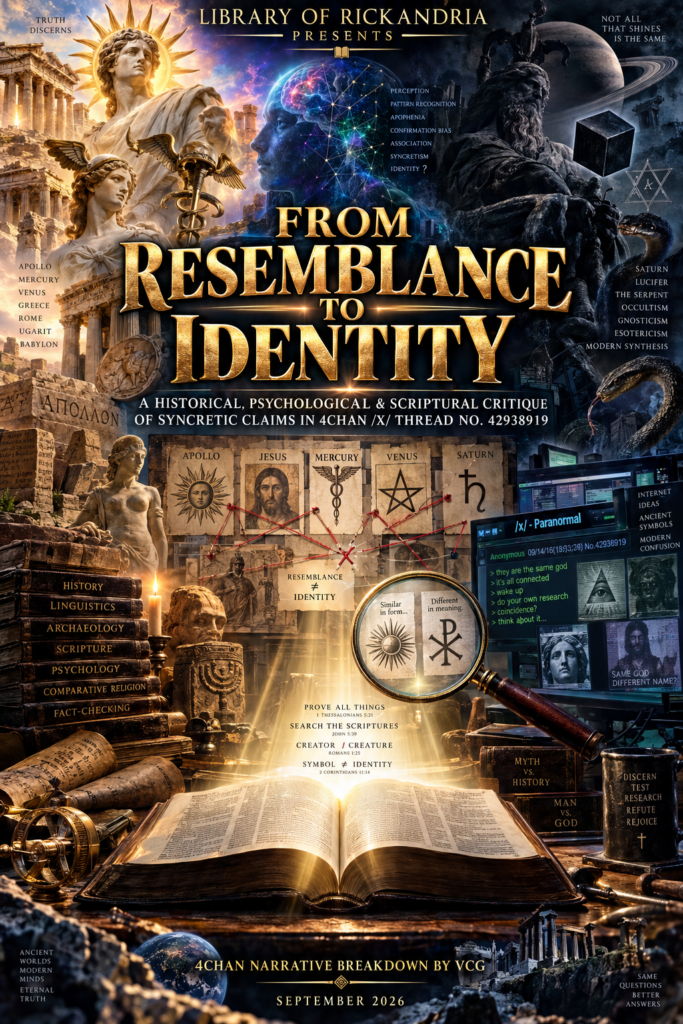
UPDATED BY VCG ON 9/12/2026 @ 13:13 EST
Anyone can do this, but most won’t.
ChatGPT – Library of Rickandria
LIBRARY OF RICKANDRIA PRESENTS
FROM RESEMBLANCE TO IDENTITY
A Historical, Psychological & Scriptural Critique of Syncretic Claims in 4chan /x/ Thread No. 42938919
4CHAN NARRATIVE BREAKDOWN BY VCG
SEPTEMBER 2026
Abstract
/x/ – Hellenism – Paranormal – 4chan
A strange thing happens in 4chan /x/ thread No. 42938919.
What begins on September 9, 2026, as a casual question about worshipping Apollo gradually becomes something much larger: a proposed map connecting Apollo, Jesus Christ, Mercury, Hermes, Venus, Lucifer, the biblical serpent, YHWH, Saturn, Paleo-Hebrew letters, Ugaritic gods, Ereshkigal, Eris, Asherah, Jerusalem, rabbinic Midrash, Joseph in Egypt, taxation, and a major Holocene climate event.
Some of those connections are plainly wrong. Some are speculative. Some are theological interpretations rather than historical propositions.
But some are genuinely interesting—and several are genuinely true.
The Greek alphabet really is historically connected to a Northwest Semitic alphabetic tradition. Budha really is a Sanskrit name associated with Mercury. Inanna/Ishtar really is associated with Venus. Ugaritic texts really do know Shahar and Shalim as Dawn and Dusk and connect them with Athirat. Scholars really have considered Šalim/Šalem as an element in the ancient name of Jerusalem. Roman authors really did connect the Jewish seventh-day observance with Saturn. A later rabbinic tradition really does say Egyptians purchased water from Israelites during the plague of blood. Genesis really does describe Joseph imposing a one-fifth economic arrangement upon Egyptian agricultural production.
A responsible critique therefore cannot dismiss the thread as meaningless.
Its deeper problem is methodological.
Again and again, the thread moves from a genuine datum to a much stronger conclusion without supplying the historical bridge needed to get there. Resemblance becomes association. Association becomes influence. Influence becomes syncretism. Syncretism becomes identity.
This paper calls that progression the Equals-Sign Problem.
The central thesis is simple:
A resembles B ≠ A was identified with B ≠ A derives from B ≠ A is B.
Ancient people certainly compared gods across cultural boundaries. Religions certainly borrowed language, imagery, ritual forms, philosophical categories, and iconography from one another. Christianity emerged in a Hellenized Mediterranean environment and cannot responsibly be studied as though Greek and Roman culture did not exist. Ancient Near Eastern literature provides indispensable context for understanding portions of the Hebrew Bible.
None of those facts, however, demonstrates the thread’s strongest equations:
Jesus = Apollo = Mercury = morning star = serpent
or
YHWH = Saturn = the black-cube current = Satan.
Those conclusions require evidence of a different order.
This paper therefore conducts an evidence audit rather than a reaction. It reconstructs the thread’s argument, grades its factual claims, establishes a chronological firewall, examines the relevant linguistic and astronomical claims, distinguishes ancient sources from later interpretation, considers psychological mechanisms of associative belief formation without diagnosing anonymous posters, and finally compares the thread’s biblical claims with the King James Bible in context.
The goal is not to ridicule comparative religion.
It is to practice it carefully.
I. A Note on Sources, Scope, and Fairness
The primary internet source examined here is the live 4chan /x/ thread titled “Hellenism,” No. 42938919, begun September 9, 2026. The thread was accessed and audited on September 12, 2026. Because 4chan threads are ephemeral, post numbers are preserved throughout this paper so that individual claims remain distinguishable even if the live page later disappears. The thread contains insults, ethnic hostility, religious mockery, and psychiatric slurs; those elements are discussed where rhetorically relevant but are not reproduced unnecessarily.
For Scripture, this paper uses the uploaded Authorized King James Version, Pure Cambridge Edition as its stable biblical text.
That source distinction matters from the beginning. When this paper says, for example, that Isaiah 14 addresses the king of Babylon in its immediate literary setting, that is a statement about what the biblical passage itself says. When we discuss a later Christian identification of the passage with Satan, that is history of interpretation. When we examine a proposed Shahar/Venus background, that is comparative historical analysis. When we ask what Christians ought to believe about the passage, that becomes theological interpretation.
Those categories interact, but they are not interchangeable.
The same rule applies outside Scripture. A Ugaritic tablet is not a modern occult diagram. A Roman author’s characterization of Judaism is not automatically an Israelite confession of faith. A medieval interpretation is not evidence that an idea existed in the Bronze Age. A similarity noticed during a psychedelic experience is not thereby either false or historically established.
The task throughout is to ask one deceptively difficult question:
What does this particular piece of evidence actually prove?
II. The Evidence Ladder
The thread’s central methodological problem can be represented by an evidence ladder:
Visual resemblance → thematic similarity → textual parallel → documented contact → historical borrowing → explicit identification
Each higher rung requires more evidence than the rung below it.
Two symbols may look similar without sharing an origin.
Two gods may both be connected with light without one deriving from the other.
Two narratives may contain divine sons without representing the same deity.
Two cultures may have been in contact without one borrowing the specific motif under discussion.
A culture may borrow a motif without identifying the two original figures.
And two gods may be explicitly identified by ancient worshippers without that identification proving that they were originally the same god.
That last distinction is particularly important because interpretatio was a real feature of ancient religion. Greek and Roman authors often understood foreign gods by giving them the names of apparently comparable members of their own pantheons. Oxford’s James Rives notes that such equations could range from extensive identification to little more than shared naming; the same foreign deity could even receive different Roman names depending on which characteristic was being compared.
Robert Parker likewise emphasizes that ancient polytheists could regard deities from different peoples as the same under different names while nevertheless retaining distinct cults and traditions.
This means we should neither deny ancient syncretism nor misunderstand what it proves.
If a Roman writes:
Foreign God X = Saturn
we have evidence that a Roman interpreted X through Saturn.
We do not automatically possess evidence that:
the worshippers of X always understood X as Saturn,
X historically developed from Saturn, or
X and Saturn are metaphysically the same being.
Those are three additional claims.
Throughout this paper we will therefore distinguish four propositions:
| Level | Proposition | What would support it? |
|---|---|---|
| Resemblance | A resembles B | comparable image, title, story, function |
| Association | A was compared or connected with B | ancient commentary, shared cultic setting, interpretatio |
| Influence | A borrowed from or affected B | chronology, contact, transitional evidence |
| Identity | A actually is B | explicit identification plus context showing what “same” means |
The thread repeatedly reaches the first or second level and speaks as though it has reached the fourth.
That is the Equals-Sign Problem.
III. The Thread as a Narrative
The thread does not begin with an elaborate occult thesis.
Its opening post simply asks:
“What God should I worship, and why is it Apollo?”
The early responses are mostly jokes, insults, devotional recommendations, or arguments about modern Hellenism. One poster suggests Hecate; another reconstructs an Indo-European-style group of Sky Father, Earth Mother, Thunderer, and ancestors. Apollo, Athena, Typhon, and other deities are casually proposed.
The character of the discussion changes around post 42942392, which introduces the idea that Apollo worship opposes a “black cube Saturn Yahweh current.” The sun is invoked as the source of light and life.
Then comes the first explicit Christian counterclaim:
42942472: “Apollo = Apollyon = Satan.”
Almost immediately, another poster turns that logic around.
In 42942525, Jesus is described as “the Apollo archetype”: Son of God, dying-and-rising god, associated with Sunday, situated in a Christianity supposedly derived from Hellenism. Satan becomes Saturn. The God of the Old Testament becomes Saturn because the Sabbath corresponds to Saturday. Christianity itself is then redescribed as a blood-sacrifice ritual in which an Apollo-like son is sacrificed to a Saturn/YHWH father.
Post 42942551 expands the system astronomically and linguistically. Apollo becomes “the morning star of Mercury.” Mercury is connected with Sanskrit Budha. “The First and the Last” enters the sequence. Paleo-Hebrew letter shapes are said to produce the Mercury symbol. The historically real derivation of Greek alphabetic names from Phoenician/Semitic predecessors is offered as explanatory support.
Post 42942638 introduces the bronze serpent. Jesus, it says, was depicted as a bronze snake. Serpent skin-shedding becomes death and resurrection. The Genesis serpent is imaginatively supplied with lost wings.
Post 42942643 then identifies Hermes with an “evening star of Mercury.”
Several subsequent posts consist primarily of images, diagrams, seals, occult charts, symbolic overlays, and unexplained correspondences. A critic eventually objects that the system cannot be reconstructed by an outsider because most connections are asserted visually rather than argued.
That criticism becomes important later.
When directly asked where the poster obtained the system, post 42943327 gives a remarkably concise answer:
“psychedelics”
A later post clarifies that experiences came first, with recognition of related ideas in ancient philosophers and esoteric writers afterward.
Still later, the network broadens into ancient Near Eastern religion. Eris is claimed to derive from Ereshkigal. Ereshkigal becomes a lower Venus and Inanna an upper Venus. Lucifer and Hesperus are incorporated as morning and evening aspects. Mercury is similarly divided between Apollo and Hermes. Ugaritic Shahar and Shalim enter the discussion alongside El and Athirat/Asherah. Jerusalem is connected with Shalim, and Isaiah’s “Lucifer, son of the morning” with Shahar.
The final substantive phase turns toward Judaism and Egypt: the Jewish day beginning at evening; rabbinic elaboration of the plague of blood; Joseph’s economic measures during famine; a proposed synchronization of Joseph with the 4.2-kiloyear climate event; and the assertion that Joseph originated taxation and that Egyptian priests remain exempt from taxation in the present day.
The striking feature is not simply that the conversation wanders.
It is that each new genuine correspondence becomes a bridge to the next domain.
Mythology leads to planets. Planets lead to alphabets. Alphabets lead to Scripture. Scripture leads to Ugarit. Ugarit leads to Jerusalem. Jerusalem leads to Jewish calendrics. Jewish lore leads to Egypt. Egypt leads to paleoclimatology.
The reader experiences a growing sense that everything is converging.
Our job is to determine whether the convergence is historical—or whether the method itself manufactures convergence.
IV. Claim Classification Matrix
The following matrix condenses the evidentiary posts. Pure insults and posts with no meaningful factual content are omitted except where they affect the methodology of the discussion.
| Post | Major claim | Verdict | Confidence |
|---|---|---|---|
| 42938919 | Apollo as proposed object of worship | Devotional question | High |
| 42939359 | Polytheism allows worship of multiple gods; Hecate suggested | Broadly consistent with polytheistic practice | High |
| 42939394 | Reconstructed Sky Father/Earth Mother/Thunderer religion | Modern reconstruction, not demonstrated ancient system | Moderate |
| 42941270 | “Apollo-Zagreus syzygos” | Unsupported as presented | High |
| 42942392 | Apollo/sun opposed to “black cube Saturn Yahweh current” | Modern occult interpretation; ancient basis not demonstrated | High |
| 42942472 | Apollo = Apollyon = Satan | Textually and linguistically overstated | High |
| 42942525 | Jesus = Apollo archetype | Comparison possible; identity unsupported | High |
| 42942525 | Apollo a dying-and-rising god | Not demonstrated; poorly fits standard Apollo evidence | High |
| 42942525 | Christianity has Hellenic influence | Broadly true | High |
| 42942525 | YHWH = Saturn because Sabbath/Saturday | Roman association real; identity does not follow | High |
| 42942525 | Christianity is Apollo sacrificed to Saturn | Unsupported synthesis | High |
| 42942551 | Sanskrit Budha can designate Mercury | True | High |
| 42942551 | Greek alphabet derives from Phoenician/Semitic alphabet | True | High |
| 42942551 | Paleo-Hebrew letters generated Mercury glyph | Unsupported | High |
| 42942551 | Apollo is Mercury’s morning star | Unsupported / astronomically confused | High |
| 42942638 | John connects Jesus typologically with bronze serpent | True, with important qualification | High |
| 42942638 | Genesis serpent lost wings | Not in Genesis | High |
| 42942638 | Skin shedding is John’s resurrection explanation | Not in John | High |
| 42942643 | Hermes is Mercury’s evening star | Unsupported | High |
| 42942654–42942745 | Image chains establish hidden identities | Unverifiable without provenance and argument | High |
| 42943065 | Critic says system requires prior worldview | Methodologically important criticism | High |
| 42943327 | Poster says psychedelics were source of insight | Self-report; epistemically relevant, not proof/disproof | High |
| 42947000 | Iliad as inspiration | Self-report | High |
| 42947024 | Personal Athena/Hermes/Zeus syncretism | Personal theology | High |
| 42947499 | Eris derives from Ereshkigal | Unsupported by linguistic evidence found | High |
| 42947499 | Inanna/Ishtar = Venus | True | High |
| 42947499 | Ereshkigal = “Venus below” | Symbolic interpretation; ancient identification not demonstrated | High |
| 42947499 | Shahar/Shalim are Dawn/Dusk figures in Ugaritic religion | Substantially true | High |
| 42947499 | Athirat nurtures Shahar/Shalim | Supported by Ugaritic evidence | High |
| 42947499 | Jerusalem contains a Šalim/Šalem divine element | Serious scholarly proposal | Moderate–high |
| 42947513 | Jewish calendrical day begins in evening | Broadly true in Jewish calendrical practice | High |
| 42947521 | Later Midrash has Egyptians buying water from Israelites | True as Midrash, not Exodus | High |
| 42947549 | Joseph created taxation | Contradicted by Egyptian administrative evidence | High |
| 42947549 | Joseph’s famine = global 4.2ka drought | Speculative; “global drought” formulation overstated | High |
| 42947565 | Genesis imposes one-fifth and exempts priestly land | True | High |
| 42947565 | Egyptian priests remain tax-exempt today because of Joseph | No adequate evidence found; blanket claim unsupported | Moderate–high |
Already, a pattern emerges.
The thread often possesses correct nouns.
Its trouble lies in the verbs and equals signs connecting them.
V. The Strongest Version of the Thread’s Argument
Before criticizing the system, we should construct the best argument available to it.
Ancient Mediterranean and Near Eastern religions were not sealed compartments. Peoples traded, conquered, migrated, intermarried, translated, borrowed divine names, adopted foreign cults, and interpreted unfamiliar gods through familiar categories.
Greek religion itself displayed considerable flexibility in identifying foreign gods with Greek gods. Roman religion continued this through interpretatio Romana.
Christianity likewise arose inside a multilingual Mediterranean world rather than outside it. Greek was the language of the New Testament documents that survive to us. Greek philosophical and religious vocabulary became unavoidable in Christian intellectual history. Modern scholarship has explored ways early Christians described Jesus using categories recognizable throughout Mediterranean conceptions of divinity. M. David Litwa, for example, argues that early Christian descriptions of Jesus participated in broadly Mediterranean ways of portraying divine beings.
A particularly relevant 2026 Harvard Theological Review study by Richard Last argues that some early Christ-followers probably continued relationships with traditional Roman gods and may have understood Christ through existing habits of interpretatio. Last notes that outsiders and ancient practitioners could compare the Jewish God with Jupiter, Sol, or Bacchus, and could compare aspects of Christ with figures such as Dionysus, Perseus, and Asklepios.
That matters because it prevents an intellectually weak Christian response.
We cannot say:
“Nobody in antiquity could ever have compared Jesus with pagan gods.”
They could, and did.
Nor can we say:
“Christianity contains no language comprehensible within Greco-Roman religious culture.”
It plainly does.
Nor should we claim:
“Any parallel between biblical and neighboring ancient Near Eastern traditions must be coincidence.”
That also would be historically irresponsible.
The strongest version of the 4chan argument is therefore something like this:
Christianity developed in an interconnected religious environment. Mediterranean peoples habitually translated divine identities across cultures. Christian claims about divine sonship, healing, victory over death, celestial glory, sacrifice, and salvation could be heard against existing religious categories. Biblical literature also developed within the broader ancient Near Eastern world. Consequently, some biblical and Christian imagery may share vocabulary, motifs, cosmological assumptions, or cultural ancestry with non-biblical traditions.
That thesis deserves serious study.
But notice how much weaker it is than:
Jesus literally is Apollo.
The steelman establishes comparability and possible cultural interaction.
It does not establish identity.
That gap is the subject of the rest of the paper.
VI. The Chronological Firewall
A good comparative argument has to survive chronology.
The thread frequently places material beside other material without marking the centuries separating them. This produces what we might call source flattening: everything becomes simultaneously present because everything is simultaneously visible on the screen.
A simplified chronology helps restore depth:
| Period | Relevant material |
|---|---|
| Third–second millennia BCE | Mesopotamian Inanna/Ishtar traditions; developing West Asian astral religion |
| Second millennium BCE | Ugaritic texts concerning El, Athirat, Shahar, Shalim; ancient Northwest Semitic religion |
| Third–first millennia BCE | Hebrew biblical literature develops across long textual history |
| Archaic Greek period | Homeric/Hesiodic Apollo traditions; Apollo established as son of Zeus and Leto |
| Classical/Hellenistic periods | Expanding Greek cross-cultural interpretatio and Mediterranean religious exchange |
| First century CE | New Testament writings and earliest Christ movement |
| First–third centuries CE | Roman/Christian comparisons, apologetics, interpretatio, religious mixture |
| Later antiquity onward | Further Jewish and Christian interpretive traditions |
| Rabbinic/medieval periods | Midrashic expansions such as later plague-of-blood traditions in surviving compilations |
| Renaissance/early modern era | New configurations of astrology, alchemy, Hermetic and Christian symbolism |
| Nineteenth–twentieth centuries | Modern occultism, comparative mythology, Frazerian dying-god frameworks |
| Twenty-first century | Internet syncretism, image-board symbolic synthesis |
Chronology does not make cross-period influence impossible.
It tells us what needs proving.
If a modern occult diagram gives Mercury a symbol that looks like an ancient Semitic letter, the diagram cannot prove that the ancient letter was designed to encode Mercury. We need intermediate evidence.
If later Christian art gives Christ imagery resembling an ancient solar deity, that may document later Christian artistic borrowing. It does not automatically demonstrate that the earliest Christians secretly worshipped that solar deity.
If a later Midrash expands Exodus, the Midrash is evidence for a later Jewish interpretation of Exodus. It is not automatically evidence that the expansion was present in the earliest form of Exodus.
The chronological firewall does not prevent comparison.
It prevents backdating conclusions.
VII. Jesus and Apollo
The thread’s central theological equation appears in post 42942525:
Jesus is said to be the Apollo archetype because he is a Son of God, a dying-and-rising figure, associated with Sunday, and part of a religion influenced by Hellenism.
We should separate these propositions.
Son of God
Apollo is unquestionably a son of Zeus in the standard Greek mythological tradition. The Oxford Classical Dictionary describes him as the son of Zeus and Leto and brother of Artemis.
Jesus is called the Son of God in Christian Scripture.
So we have a genuine thematic similarity:
divine sonship.
But divine sonship is an extremely broad category in Mediterranean religion. Emperors and heroes could receive divine-son terminology as well. Scholarship on Greco-Roman “sons of god” makes exactly this point.
Therefore:
Jesus is a divine son
and
Apollo is a divine son
does not yield:
Jesus is Apollo.
Otherwise every divine son would collapse into every other divine son.
The comparison may illuminate how ancient audiences heard Christian language. It does not establish cultic identity.
Is Apollo a dying-and-rising god?
The thread simply asserts this.
Standard presentations of Apollo’s myth do not center on Apollo dying and returning from death. His major archaic mythic profile concerns his birth from Leto, his Delian and Delphic cults, prophecy, purification, music, archery, healing, plague, and civic functions.
More importantly, the entire nineteenth-century category “dying and rising gods” requires caution.
The older Frazerian approach was notorious for grouping highly dissimilar figures into a universal fertility pattern. A review of Tryggve Mettinger’s important reassessment summarizes the methodological criticism well: similarity should not automatically be treated as genealogy, local historical contexts matter, and a deity who dies but does not return should not be forced into the same template as one who does.
Recent scholarship has not simply abandoned all dying-and-returning divine traditions. Noga Ayali-Darshan’s 2024 monograph argues for a much more narrowly defined West Asian mythologem while stressing that actual evidence for return from death is far more restricted than older universalizing accounts assumed.
This produces an important result.
We do not need to make the crude apologetic claim:
“No pagan god ever died and returned.”
That would be too sweeping.
The correct question is:
Where is Apollo’s ancient death-and-resurrection narrative?
The thread does not provide one.
Christianity, by contrast, places death, burial, and resurrection at the center of its earliest proclaimed gospel tradition:
“Christ died for our sins according to the scriptures;
And that he was buried, and that he rose again the third day according to the scriptures.”
1 Corinthians 15:3–4.
Whatever historical judgment one makes about the resurrection itself, this is unquestionably what the Christian source claims.
The proposed Apollo parallel therefore has to match an actual Apollo tradition rather than the abstract phrase “dying god.”
It does not.
Hellenistic influence
Here the thread is substantially right at the broadest level.
Christianity did develop in a Hellenistic and Roman cultural environment. Its adherents argued with philosophers, inhabited Greek-speaking cities, used Greek terminology, and lived among Mediterranean religious categories. Recent historical scholarship continues to explore how early Christ devotion intersected with this world.
The corrective is not denial.
It is logical precision:
Hellenistic context ≠ Apollo origin.
Greek cultural influence is a category containing thousands of possible mechanisms.
To move from “Christianity developed amid Hellenism” to “Jesus is Apollo” requires evidence specifically connecting Jesus and Apollo.
The thread supplies thematic resemblance, not genealogical demonstration.
VIII. What Evidence Would Actually Prove “Jesus = Apollo”?
This thought experiment is useful because it makes the burden of proof visible.
Suppose historians discovered first-century Christian inscriptions saying that Apollo and Jesus were two names for the same divine figure.
Suppose an early Christian congregation had an altar using both names interchangeably.
Suppose Christian authors taught converts that the traditional Apollo cult was really worship of Jesus.
Suppose archaeological evidence showed Apollo temples transitioning directly into Christ cults while preserving the same divine identity.
Suppose multiple independent pagan observers reported that Christians themselves confessed Jesus to be Apollo.
Suppose Christian liturgical texts systematically transferred distinctive Apollo mythology—not merely generic words like “light” or “son”—onto Jesus.
That would be serious evidence.
We would still need to interpret precisely what “same” meant in an ancient polytheistic environment, but the historical case would be substantial.
What does thread 42938919 give us instead?
It gives divine sonship, solar symbolism, Sunday, death/resurrection language, and broad Hellenistic influence.
Those are comparative motifs.
They are not the evidence we would expect if a historical identity thesis were true.
That distinction is one of the paper’s most important conclusions:
The failure is not that a Jesus/Apollo comparison can never be made. The failure is that the comparison is being asked to prove more than it contains.
IX. YHWH, Saturn, the Sabbath, and the Black Cube
At first glance, the YHWH-Saturn claim looks like pure internet occultism.
It is more complicated than that.
There really is ancient evidence associating Judaism with Saturn.
Tacitus, in Histories 5.4, records various hostile Roman speculations about Jewish customs. Among them is a theory that Jewish seventh-day rest was observed “in honor of Saturn,” either because of a supposed ancestral connection or because Saturn held a special place among the seven planets.
So the responsible verdict is not:
“Nobody ever associated Jews with Saturn.”
Romans did.
But the next question is decisive:
Whose theology are we reading?
Tacitus is not a Jewish priest explaining the meaning of the Sabbath.
He is a Roman author reporting Roman theories about a foreign people—and his surrounding account includes overtly hostile and inaccurate ethnographic speculation.
This is almost a textbook case of interpretatio.
The Oxford Classical Dictionary warns us that Roman naming of foreign gods could represent anything from substantial identification to a loose comparison based on one perceived attribute.
Thus the evidence supports:
Some Romans interpreted Jewish religion through a Saturnine framework.
It does not independently establish:
Israel historically worshipped Saturn under the secret name YHWH.
Those are entirely different claims.
The biblical witness
If we temporarily move from external history to Scripture’s own theological presentation, the Saturn equation becomes even harder to sustain.
Deuteronomy explicitly prohibits Israel from seeing:
“the sun, and the moon, and the stars, even all the host of heaven”
and being drawn into worshipping them.
Isaiah places this claim in the mouth of the LORD:
“I am the first, and I am the last; and beside me there is no God.”
Isaiah 44:6.
The point here is not
“Isaiah proves Christianity.”
It is narrower.
The biblical source does not present YHWH as one planetary deity among the seven.
A historian may ask whether actual Israelites always obeyed biblical monotheistic ideals; archaeology and biblical polemic itself indicate religious diversity within Israel and Judah. But that is a different historical question from saying the Bible secretly tells us YHWH is Saturn.
It does not.
Saturday and the Sabbath
The fact that Sabbath corresponds to Saturday in the modern seven-day week also cannot carry the proposed conclusion.
Planetary weekday nomenclature belongs to a later Greco-Roman history of the seven-day week. A later culture calling a day “Saturn’s day” cannot retroactively determine the etymological or theological origin of Hebrew šabbāt.
Again:
calendar correspondence → Roman association
is real.
calendar correspondence → divine identity
is not.
The black cube
The thread’s “black cube Saturn Yahweh current” is a modern esoteric construction unless an ancient source trail can be supplied.
The thread does not provide such a trail.
Black cubes certainly exist in religious, artistic, mathematical, and occult symbolism. Saturn symbolism also exists across astrology and later esotericism. But placing “black cube,” “Saturn,” and “YHWH” beside one another in a modern diagram is not evidence that ancient Israel held this equation.
Until a chronological chain is demonstrated, this claim remains at the lowest rungs of the evidence ladder: visual/thematic association.
X. Apollo, Apollyon, and Satan
Interestingly, one of the weaker claims in the thread comes from a Christian poster.
Post 42942472 declares:
“Apollo = Apollyon = Satan.”
Revelation 9:11 actually says:
“And they had a king over them, which is the angel of the bottomless pit, whose name in the Hebrew tongue is Abaddon, but in the Greek tongue hath his name Apollyon.”
The explicit correspondence in the verse is:
Abaddon ↔ Apollyon.
Apollyon is connected with Greek destruction language and functions as “Destroyer,” corresponding to Hebrew Abaddon, “destruction.” Standard reference treatments derive the name from the Greek verb “to destroy.”
The similarity between Apollo and Apollyon has naturally invited wordplay and speculation.
But resemblance of names does not produce etymological identity.
One older commentary explicitly warns that the form need not have been selected to produce a sound correspondence with Apollo.
The second equals sign is also stronger than the verse itself.
Revelation calls Apollyon the king or angel of the abyss.
The verse does not itself say:
“Apollyon is Satan.”
That identification occurs within later interpretation, but it should not be silently inserted into the wording of Revelation.
So the Christian rebuttal makes the same mistake as the syncretic theory it opposes.
It sees resemblance and immediately writes an equals sign.
A careful Christian argument should not need bad etymology.
XI. Mercury, Hermes, Apollo, Venus, and the Morning Star
This portion of the thread contains both excellent facts and severe category confusion.
Post 42942551 says:
Apollo is the morning star of Mercury.
Post 42942643 says:
Hermes is the evening star of Mercury.
Later, the thread correctly invokes Venus in connection with morning and evening star traditions.
The difficulty is astronomical.
The famous ancient “morning star” and “evening star” identity concerns Venus.
In Mesopotamian religion, Inanna/Ishtar’s astral identity is likewise Venus. The Metropolitan Museum describes Venus explicitly as her morning-and-evening-star aspect.
Thus the thread contains two incompatible symbolic systems:
Apollo/Hermes = morning/evening Mercury
and
Lucifer/Hesperus = morning/evening Venus.
The second has a genuine classical astronomical basis.
The first is not established by the evidence supplied.
That internal contradiction matters because the thread’s method allows roles to migrate whenever a new visual or mythic association becomes useful.
A theory with fixed historical correspondences should constrain what can be connected.
A theory with unconstrained symbolic correspondences can connect almost anything.
XII. Budha and Mercury: A Real Fact That Proves Much Less Than It Appears To
The thread says:
“Mercury in Sanskrit is Budha.”
That is substantially correct.
The Monier-Williams Sanskrit dictionary recognizes Budha as a figure identified with the planet Mercury.
This is exactly the kind of fact we should preserve.
But preserving it also makes the methodological problem easier to see.
What follows from it?
It establishes an Indian name and religious-astronomical association for Mercury.
It does not establish:
Budha = Apollo
unless a further historical argument is made.
Nor should Budha simply be collapsed into Buddha. Related-looking Sanskrit forms require actual lexical analysis; English spelling resemblance is not enough.
The thread uses a true fact as a credibility anchor and then crosses an unmarked bridge.
That pattern recurs throughout the discussion.
XIII. Paleo-Hebrew and the Mercury Glyph
The thread argues that Paleo-Hebrew letters form the planetary symbol for Mercury, and then supports this with another proposition:
Greek Alpha/Beta comes from Phoenician Alef/Bet.
The second proposition is real.
An Oriental Institute treatment of the history of writing notes the striking relationship between Greek alphabetic forms and Semitic writing and specifically explains that Greek alpha, beta, gamma, delta correspond to Semitic aleph, beth, gimel, daleth, with Phoenician strongly preferred as the immediate historical source tradition.
This is what a strong genealogical argument looks like.
We have systematic correspondences extending across an alphabet, similarity of order, related names, plausible chronology, cultural contact, and intermediate forms.
Now compare the Mercury-symbol claim.
NASA describes the conventional astronomical symbol of Mercury through Greco-Roman iconography: the head and winged cap of Mercury above his caduceus.
Could an older symbol somewhere have influenced some component of the glyph?
In principle, yes.
But a visual overlay of Paleo-Hebrew letters does not demonstrate it.
To establish the thread’s proposed genealogy we would need dated intermediate forms showing something like:
Paleo-Hebrew letters → transmitted composite sign → documented adoption as Mercury → later planetary glyph.
The thread gives us:
these shapes look compatible when arranged together.
That is hypothesis generation.
It is not historical demonstration.
Ironically, the Greek/Phoenician alphabet relationship contained in the same post shows exactly how much evidence a genuine transmission hypothesis can possess.
XIV. The Bronze Serpent and Jesus
Post 42942638 says Jesus was depicted as a bronze snake.
There is a real biblical connection behind this.
Jesus says in John 3:
“And as Moses lifted up the serpent in the wilderness, even so must the Son of man be lifted up.”
The comparison is explicit.
But notice its grammar:
as the serpent was lifted → even so the Son of man will be lifted.
This is typology or analogy.
It does not require ontological identity.
Scripture constantly works this way.
Jesus can be called bread without being made of grain.
He can be called a door without being wooden architecture.
He can be described as a lamb without being zoologically ovine.
He can be called a vine without being a plant.
He can be called the morning star without becoming the physical planet Venus.
Symbolic identification is not ontological identity.
The bronze serpent story itself gives us an extraordinary internal control.
Centuries after Moses, Israelites began burning incense to the bronze serpent. Hezekiah therefore:
“brake in pieces the brasen serpent that Moses had made”
because it had become an object of cultic devotion.
This means Scripture itself distinguishes:
God-appointed sign
from
the reality signified
from
illicit worship of the sign itself.
That distinction directly addresses the thread’s tendency to collapse symbol and deity.
XV. Did the Genesis Serpent Have Wings?
The thread also states:
“You shall lose your wings and be on your belly.”
Genesis does not say this.
The actual curse is:
“upon thy belly shalt thou go, and dust shalt thou eat all the days of thy life.”
No earlier verse describes wings.
No verse says wings are removed.
One can certainly find later iconography, mythological comparisons, or imaginative reconstructions in which primeval serpents have legs or wings.
But those are interpretations added to Genesis.
They cannot then be cited as though Genesis itself supplied the missing detail.
This is a textbook circular argument:
The interpreter imagines wings to explain the curse.
The imagined wings are then presented as evidence for a hidden winged-serpent mythology inside the text.
The conclusion has been smuggled into the premise.
XVI. What Did the Serpent Actually Offer?
Post 42942786 develops the skin-shedding theme and asks what the serpent offered Adam and Eve.
Genesis answers directly.
The serpent promises:
“your eyes shall be opened, and ye shall be as gods, knowing good and evil.”
The narrative emphasizes knowledge, disobedience, opened eyes, shame, and the desire to become “as gods.”
It does not explain the temptation through serpent skin shedding.
The association:
snake → sheds skin → apparent renewal → immortality → resurrection
is a perfectly intelligible comparative-symbolic hypothesis.
But it is not the argument made by Genesis 3.
Again we must distinguish:
possible symbolic interpretation
from
what the source text says.
XVII. “The First and the Last”
Post 42942551 places “The First / And / The Last” inside the Mercury sequence.
But in biblical context this title belongs explicitly to the LORD.
Isaiah 44:6:
“I am the first, and I am the last; and beside me there is no God.”
Isaiah 48 similarly says:
“I am he; I am the first, I also am the last.”
Revelation 22 employs “the first and the last” and shortly afterward places this self-identification in a speech culminating:
“I Jesus … am the root and the offspring of David, and the bright and morning star.”
The theological implications of those Revelation passages deserve their own Christological discussion.
For our present purpose the point is simpler.
Nothing in those texts says Mercury.
If a Mercury framework is brought to the verses, the title can be inserted into a Mercury collage.
But that framework is imported from outside the passages.
That is the difference between exegesis—drawing meaning from the textual context—and eisegesis—reading a preselected system back into it.
XVIII. The Morning Star: Why Shared Symbols Do Not Establish Shared Gods
Revelation creates an especially valuable test because Jesus explicitly calls himself:
“the bright and morning star.”
At first glance, comparative mythology seems to have found exactly what it wants.
Venus was called a morning star.
Ancient gods were associated with Venus.
Jesus is called morning star.
Therefore Jesus is Venus—or Ishtar—or Lucifer—or Apollo.
But this inference immediately produces contradictions.
A celestial object can function metaphorically for multiple figures without making those figures identical.
“Morning star” can signify brilliance, royalty, supremacy, dawn, hope, appearance after darkness, or eschatological arrival.
The object supplies an image.
The context determines the metaphor’s function.
If symbolic predication always established ontological identity, then every biblical metaphor would become absurd.
Christ would simultaneously be a biological lamb, a wooden door, baked bread, botanical vine, lion, star, and human shepherd.
Nobody reads language that way in ordinary contexts.
There is no reason to adopt that rule only when comparative mythology makes the result exciting.
XIX. Eris and Ereshkigal
Post 42947499 claims that Eris derives from Ereshkigal.
The phonetic resemblance is obvious enough to attract attention.
The linguistic evidence is not.
Greek ἔρις (eris) is an ordinary Greek noun meaning “strife, quarrel, debate, contention,” richly attested in early Greek literature including Homer.
Ereshkigal, meanwhile, is the Mesopotamian “Lady of the Great Earth,” ruler of the underworld.
To demonstrate that Greek Eris derived from Ereshkigal, resemblance of the initial syllables would not suffice.
Historical linguistics would ask about the earliest forms of each word, borrowing chronology, phonological transformation, morphology, semantic development, and a plausible route of contact.
The thread supplies none of these.
This does not prove that no ancient religious idea associated with Eris could ever have been influenced by eastern Mediterranean traditions.
It means the specific etymological claim has not been demonstrated.
Sound resemblance is evidence worth investigating.
It is not an etymology.
XX. Ereshkigal, Inanna, and Venus
The next part of the post is much stronger.
Inanna/Ishtar really was associated with Venus.
The Metropolitan Museum describes the goddess in her astral aspect as the planet Venus, functioning as both morning and evening star.
So we should write in the margin:
VERIFIED.
But the thread then treats Ereshkigal as a complementary “Venus below.”
Here the evidence changes.
ORACC’s Ancient Mesopotamian Gods and Goddesses project identifies Ereshkigal as ruler of the underworld, connected with death and the Great Earth. It does not present her as simply the subterranean phase of Venus.
Could someone interpret the myth symbolically?
Certainly.
Inanna/Ishtar descends to the underworld and encounters Ereshkigal. A modern esoteric interpreter might therefore construct an upper/lower polarity.
But that would be:
a symbolic reading of the myth
rather than:
evidence that Mesopotamian religion identified Ereshkigal astronomically as Venus below the horizon.
The difference is crucial.
The first proposition may be creative or philosophically suggestive.
The second is historical and demands ancient evidence.
XXI. Shahar, Shalim, El, and Athirat: Where the Thread Gets Something Important Right
This is perhaps the strongest portion of the entire thread.
The claim involving Shahar, Shalim, El, and Athirat is not internet invention.
Ugaritic religion genuinely knows these figures.
Judith Hadley’s survey of evidence for Asherah/Athirat notes that fourteenth-century BCE Ugaritic literature presents Athirat as the wife of the high god El and gives her the title commonly rendered “Lady Athirat of the Sea.” Hadley further notes Athirat’s nurturing role in the text involving Shachar and Shalim: the gracious gods are described as nursing from Athirat.
This is authentic ancient Near Eastern material.
A fair paper should say so plainly.
The thread has found a real religious complex involving:
El
Athirat
Shahar/Dawn
Shalim/Dusk
There is legitimate comparative value here.
But a curious thing happens next.
The existence of that real complex is used to validate surrounding equations that were not established by the same evidence.
The reader moves visually from:
Shahar/Shalim: real
to:
Apollo/Hermes as Mercury duality: unsupported
to:
Ereshkigal as Venus-below: unsupported
to:
Jesus/Apollo identity: unsupported
without an obvious change in confidence.
That is one of the psychological powers of the thread.
True propositions lend emotional authority to neighboring unproven propositions.
We might call them credibility anchors.
XXII. Is Šalim Really in Jerusalem?
This claim also deserves considerably more respect than a superficial debunking would give it.
A 2021 study in the Journal of Ancient Near Eastern Religions examines early forms of Jerusalem’s name, including Rû-Šalimum, and argues that the evidence supports a name constructed around the divine name Šalem/Šalim. “Foundation of Šalimu” is among the serious scholarly proposals discussed.
Therefore:
The possibility that Jerusalem preserves a Šalim/Šalem theophoric element is genuine scholarship.
That does not mean every detail of the etymology is beyond debate.
Ancient place-name etymologies can remain difficult and proposals differ.
But this connection should not be dismissed as a 4chan invention.
Yet what follows from it?
If Jerusalem’s name historically incorporates an old divine name, that tells us something fascinating about the religious history and toponymy of the region.
It does not by itself prove:
biblical worship of YHWH = worship of Šalim,
much less
Jesus = Apollo = Mercury.
Once again the fact is real.
The proposed master equation is not entailed by it.
XXIII. Isaiah 14, Lucifer, and Shahar
The thread connects Shahar with Isaiah’s “Lucifer, son of the morning.”
Here we must move especially slowly because three different interpretive worlds overlap.
The KJV says in Isaiah 14:
“How art thou fallen from heaven, O Lucifer, son of the morning!”
But only a few verses earlier the reader has been told that this poetic taunt is to be taken up:
“against the king of Babylon.”
The larger poem mocks a proud ruler who imagines ascent to heaven and is instead brought down to death. Isaiah later asks of him:
“Is this the man that made the earth to tremble…?”
Thus the immediate literary referent is a Babylonian royal figure.
Later Christian interpretation famously connected the imagery with Satan’s fall.
That is an important part of Christian interpretive history, but it should be labeled as later theological reading rather than silently substituted for the immediate literary target.
Comparative West-Semitic dawn-star mythology may likewise illuminate the imagery behind the Hebrew expression conventionally discussed as helel ben-shachar.
That is another layer.
Three propositions can therefore coexist:
Isaiah’s immediate satire targets the king of Babylon.
The poem uses exalted celestial/dawn imagery.
Later Christian readers applied that imagery to Satan.
Nothing requires us to erase one layer in order to discuss another.
What does not follow is:
Shahar appears in comparative background → therefore Shahar is Apollo/Mercury → therefore Jesus and Lucifer are secretly one astral deity.
That conclusion requires several additional identities, each of which would need independent proof.
XXIV. The Jewish Day Begins at Evening
Post 42947513 notes that Jewish days begin at dusk or evening.
In Jewish calendrical practice this is broadly correct. Traditional Jewish reckoning treats the religious day as extending from evening to evening, with practical halakhic detail concerning sunset, twilight, and nightfall.
The poster then makes a mocking association with vampires.
Nothing historical follows from that.
This small moment illustrates another recurring issue: a true datum is followed immediately by a rhetorical insinuation, and the juxtaposition makes the insinuation feel like a conclusion.
It is not.
That Jewish calendrical days begin in the evening tells us about Jewish time-reckoning.
It does not tell us that Judaism has a hidden nocturnal or vampiric essence.
XXV. The Plague of Blood and the Water-Purchase Tradition
One of the most surprising fact-checks concerns post 42947521.
The poster says that during the first plague an Egyptian and Israelite could encounter the same water, with the Egyptian receiving blood and the Israelite receiving water; the Egyptian could obtain drinkable water by purchasing it from an Israelite, enriching Israel.
That story is not stated in Exodus.
But it is a genuine later Jewish interpretive tradition.
Shemot Rabbah preserves the idea that an Egyptian drawing from a shared vessel obtained blood while an Israelite obtained water, and that purchase from the Israelite enabled the Egyptian to drink, thereby enriching Israel.
A related tradition appears in Midrash Tanchuma.
This gives us an ideal demonstration of source discipline.
It would be wrong to say:
“4chan fabricated the story.”
It would also be wrong to say:
“Exodus says Egyptians bought water from Israelites.”
The correct statement is:
Later Midrash says this while expanding the biblical plague narrative.
That distinction—Scripture versus commentary—is exactly the distinction needed elsewhere in the thread.
XXVI. Joseph, Famine, and the One-Fifth
Genesis does describe major economic centralization during Joseph’s administration.
During the years of plenty Joseph advises Pharaoh to take up a fifth of Egyptian produce for storage against the coming famine.
Genesis 47 then narrates the famine crisis: money flows into Pharaoh’s house, cattle are exchanged for food, land is acquired for Pharaoh, and a continuing arrangement is imposed:
“ye shall give the fifth part unto Pharaoh, and four parts shall be your own.”
The text specifically says that the priests’ land was not acquired because Pharaoh already provided them an assigned portion.
So the thread is right about the narrative.
Joseph’s program involves a fifth.
The famine brings dramatic concentration of land and resources under Pharaoh.
The priestly estate receives distinctive treatment.
What the text does not say is:
Joseph invented taxation.
XXVII. Did Joseph Invent Taxation?
Egyptian administrative history makes that claim extremely difficult to sustain.
UCL’s Digital Egypt project notes that central assessments of wealth appear already to have been in force during the Old Kingdom, approximately 2686–2181 BCE, and cautions that “levies” or “dues” can sometimes be more accurate terminology than importing modern tax concepts wholesale.
Harvard’s Digital Giza catalogue includes Leslie Anne Warden’s scholarly study titled “Centralized Taxation during the Old Kingdom.”
The details and administrative reach of Egyptian extraction changed through time. Ancient taxation was not identical to a modern income-tax bureaucracy.
But that nuance hurts rather than helps the thread’s claim.
Long before any attempt to identify Joseph historically, Egyptian kingship already possessed mechanisms for state assessment, collection, labor mobilization, and redistribution.
Therefore the strongest responsible statement is:
Genesis attributes a specific one-fifth fiscal/agricultural arrangement to Joseph.
It does not establish:
Joseph invented the institution of taxation in Egypt.
XXVIII. Joseph and the 4.2-Kiloyear Climate Event
The thread then proposes that Joseph’s famine occurred during the so-called 4.2ka event around 2200 BCE.
This is an interesting hypothesis.
It is not an established identification.
There is real paleoclimatic literature concerning significant hydroclimatic disturbances around 4,200 years ago, and particular regions experienced major stress.
The problem is the phrase “global drought.”
A 2024 Nature Communications study compiled 1,142 paleoclimate datasets from every continent and ocean to test the global significance of the event. The researchers concluded that the 4.2ka signal does not behave like a uniquely coherent global climatic excursion; substantial local and regional events exist, but the global picture is much more heterogeneous than the popular “worldwide drought” story suggests.
Therefore the thread compresses several propositions:
There were climatic disturbances around 4.2ka — yes.
Some regions suffered serious drought — yes.
One globally synchronous drought devastated the whole planet — too strong.
That event was the Genesis famine — unproven.
To establish the final identification, we would first need an independently justified date for Joseph and then evidence linking the biblical famine with the specific paleoclimatic record.
Otherwise the reasoning is:
Genesis mentions famine.
Paleoclimate shows ancient drought.
Therefore they are the same event.
That is exactly the type of resemblance-to-identity inference under examination.
XXIX. Are Egyptian Priests Still Tax-Exempt Because of Joseph?
Genesis 47 says priestly land was treated differently.
The thread extends this all the way into the present:
Egyptian priests are still exempt from taxation.
This is where source verification becomes especially important because the claim concerns current law.
As of August 17, 2026, PwC’s current Egyptian tax summary states that individual income tax is imposed on resident individuals’ total net income under the applicable rules and also applies to Egyptian-source income of nonresidents. It gives current brackets and general exemptions; it does not identify “priests” as a blanket tax-free class.
Egypt’s own Tax Authority lists the current income-tax legislation, including 2026 amendments.
I found no reliable current source establishing the sweeping proposition:
Egyptian priests, as priests, are universally exempt from taxation because of Joseph’s ancient decree.
That does not prove that no religious institution enjoys any special tax treatment. Modern states often have exemptions for nonprofit organizations, religious property, or particular income categories.
But that is a different claim.
The thread asserts direct institutional continuity across millennia and supplies no legal evidence for it.
Until such evidence appears, the claim should be marked:
unsupported.
XXX. Psychology Without Armchair Diagnosis
The psychological section requires special discipline.
Participants repeatedly insult one another with psychiatric or developmental labels.
Those insults are not diagnoses.
Nothing in an anonymous image-board thread gives us a responsible basis for diagnosing schizophrenia, autism, psychosis, mania, or any other clinical condition.
Nor is unusual religious belief itself proof of mental illness.
Our question is narrower:
What ordinary cognitive processes might make this style of reasoning persuasive?
Pattern perception
Humans are pattern-finding organisms.
That is normally useful.
Language, faces, causal relationships, social intentions, weather, danger, music, mathematics, and scientific discovery all depend on recognizing structure.
But a system optimized to detect patterns can also find patterns where chance, selection effects, or unconstrained comparison are sufficient explanations.
A five-study program by Van Prooijen, Douglas, and De Inocencio found associations between supernatural/conspiracy belief and perception of patterns in randomly generated sequences, chaotic images, and world events. Importantly, the researchers describe this as an extension or distortion of an otherwise normal cognitive function rather than evidence that believers are clinically insane.
A later signal-detection study involving 723 participants found a more liberal response criterion and greater illusory pattern detection associated with paranormal belief, while results involving conspiracy belief were more conditional and the overall effects were smaller than other sources of variance.
The caution matters.
These studies cannot tell us that a particular anonymous poster has a particular cognitive bias.
They can help us understand a style of inference.
Associative chaining
Consider the thread’s serpent sequence:
serpent → skin shedding → renewal → death and rebirth → bronze serpent → Jesus → resurrection → solar deity → Apollo
Each transition is imaginable.
The problem is that the conclusion inherits certainty it did not earn.
If each individual arrow is merely possible, six possible arrows in a row do not become a demonstrated identity.
The same process occurs here:
Shahar → dawn → morning star → Venus → Lucifer → Apollo → Jesus
and here:
seventh day → Saturday → Saturn’s day → Saturn → YHWH
Associative chaining feels cumulative because the chain grows longer.
Logically, however, every new uncertain step introduces another place where the argument can fail.
Confirmation by accumulation
The thread contains enough real material that a reader can repeatedly verify something:
Greek and Phoenician alphabets? Real.
Budha and Mercury? Real.
Inanna and Venus? Real.
Shahar and Shalim? Real.
Athirat nursing them? Real.
Šalim in Jerusalem? A genuine scholarly proposal.
Romans connecting Jews and Saturn? Real.
The water-purchase Midrash? Real.
Genesis’ one-fifth? Real.
After verifying five surprising facts, a reader may become inclined to trust the entire symbolic map.
But propositions do not inherit truth from their neighbors.
A collage containing seven correct captions and three incorrect arrows still has three incorrect arrows.
This is why the fact-checker must evaluate edges, not merely nodes.
The thread’s nodes are often good.
Its edges are frequently where the argument fails.
XXXI. Psychedelic Epistemology
Post 42943327 is unusually helpful because the poster directly answers a question about the source of his system:
psychedelics.
A later explanation indicates that the experiences came first and ancient philosophical or esoteric texts later appeared to correspond with what had been experienced.
How should we treat this?
Not with the genetic fallacy.
A proposition is not false merely because someone first conceived it while intoxicated, dreaming, praying, meditating, hallucinating, or undergoing an altered state.
Scientific and artistic insights can arise under odd circumstances.
The proper question remains:
Can the insight be independently verified afterward?
This is particularly important because psychedelic experiences can generate what psychologists call strong noetic or insight-like feelings: the experience may carry an unusual sense of profundity, recognition, certainty, or revelation.
A 2024 Communications Psychology paper proposes a model in which psychedelics can increase both the number and subjective intensity of insight experiences. The authors explicitly emphasize that such insights can be valuable and true but can also be false or misleading; psychedelic experience does not contain a built-in mechanism that preferentially selects for factual accuracy.
That model is strikingly relevant to the thread’s self-description.
The poster appears to report:
experience → felt recognition → later discovery of symbols that seemed to match.
That sequence can be creatively fruitful.
It also creates a strong confirmation risk.
Once a person possesses a richly interconnected internal model, the mythologies of the ancient world provide an enormous search space containing suns, serpents, stars, underworld journeys, divine children, sacred mothers, trees, twins, planets, sevenfold structures, death, rebirth, dawn, dusk, kings, sacrifice, and cosmic battles.
Some matches are inevitable.
The historian’s job is to determine which matches reflect documented historical relationships rather than subjective resonance.
The difference is not whether the experience felt real.
It is whether the proposed external history survives independent testing.
XXXII. Image-Based Reasoning and the Provenance Problem
Several of the thread’s most ambitious stages are communicated almost entirely through images.
Ancient seals sit beside occult diagrams.
Letter forms sit beside planetary glyphs.
Religious art sits beside modern symbolic overlays.
A reader naturally interprets spatial proximity as argumentative proximity.
But images require the same source criticism as quotations.
Before an archaeological image can carry an argument, we need to know what object it depicts, where it came from, its date, archaeological context, museum or publication provenance, whether the caption is original, whether the image has been cropped or digitally altered, and whether specialists identify its symbols in the same way the meme does.
The paper therefore adopts a simple image-provenance rule:
An unidentified image can illustrate a hypothesis. It cannot independently establish the hypothesis.
That means several image-only posts in the thread must remain unverified rather than automatically false.
This distinction is important.
A seal might turn out to be genuine.
Its meme caption might even be partly right.
But until provenance is established, the responsible verdict is neither “true” nor “fake.”
It is:
not yet demonstrated.
XXXIII. The Difference Between a Symbol and a Genealogy
Visual resemblance is especially seductive because the eye processes it immediately.
If a Phoenician letter resembles a planetary glyph, the resemblance is genuinely there as a visual event.
The mistake comes when the mind silently changes the proposition:
“These look alike.”
into:
“One descended from the other.”
Historical genealogy requires time.
There must be a before and after.
There must be a transmission pathway.
There should ideally be intermediate forms.
The Greek alphabet’s relationship with Phoenician passes this test exceptionally well. The proposed Paleo-Hebrew origin of the Mercury glyph, as presented in the thread, does not.
This gives us a general rule worth carrying beyond this specific paper:
Similarity generates questions. Chronology answers genealogical questions.
XXXIV. Comparative Mythology Done Correctly
Comparative mythology is not the enemy of careful biblical study.
Done properly, it can clarify ancient images that modern readers would otherwise miss.
The methodological danger arises when similarity itself becomes proof of borrowing.
A more rigorous comparison asks whether the compared features are distinctive rather than generic; whether the chronology permits influence; whether the cultures were in contact; whether intermediate evidence exists; whether the same motif behaves similarly in both systems; whether differences are as carefully recorded as similarities; and whether simpler explanations account for the evidence.
Consider “divine son.”
That is too broad by itself.
Consider “morning star.”
Again broad.
Consider a highly distinctive narrative sequence with matching names, ritual actions, order, rare vocabulary, geography, and demonstrable cultural contact.
That would be much stronger.
The dying-and-rising-god debate provides an excellent warning. Scholarship moved away from the older habit of assembling superficially similar myths into one universal pattern and toward asking how each tradition actually works in its own historical setting.
Comparative study improves when it aims not merely to find sameness but to understand difference within resemblance.
That principle could be the motto of this entire paper.
XXXV. Alternative Explanations
Whenever a symbolic resemblance appears, at least several explanations are possible.
Take Jesus and solar imagery.
One explanation is direct Apollo borrowing.
Another is that light is a nearly universal positive metaphor and independently appears in multiple religious traditions.
Another is that biblical light imagery develops primarily from Israelite creation, temple, wisdom, prophetic, and apocalyptic traditions.
Another is that early Christians used inherited Jewish imagery while later Christian artists adapted Greco-Roman solar conventions.
Another is that different mechanisms operated in different times and places.
Those explanations are not equally likely in every case.
The point is methodological:
The most dramatic explanation should not win merely because it is the most dramatic.
The thread normally identifies a resemblance and immediately chooses hidden identity.
Historical reasoning asks what competing explanations predict and which best accounts for the complete evidence.
XXXVI. Falsifiability
We can test the health of a theory by asking what evidence would count against it.
Suppose an ancient source identifies a morning star with Venus rather than Mercury.
Can the system absorb that?
Yes: Venus becomes another expression of the same polarity.
Suppose Apollo lacks the expected death-and-resurrection story.
Can the system absorb that?
Yes: resurrection becomes archetypal rather than textual.
Suppose Mercury’s glyph has a documented Greco-Roman explanation.
Can the system absorb that?
Yes: the Paleo-Hebrew origin becomes a deeper hidden layer.
Suppose Judaism explicitly rejects astral worship.
Can the system absorb that?
Yes: the religion is said to conceal its Saturnine identity.
This illustrates a serious problem.
A theory becomes difficult to test when:
similarity confirms it, difference confirms hidden transformation, absence confirms secrecy, and contradiction confirms symbolic inversion.
A healthy historical thesis should tell us what we would expect not to find if it were true.
Without that constraint, a symbolic system can expand indefinitely.
The thread’s critics sense this problem even if they express it crudely: one complains that the reader must already possess the worldview before the posted images make sense.
That is a serious methodological objection.
Evidence should help an outsider reproduce the inference.
It should not require initiation into the conclusion.
XXXVII. Internal Contradictions
The thread’s symbolic flexibility produces several internal tensions.
Venus has the historically attested morning/evening-star role, yet Mercury is given an Apollo/Hermes morning/evening structure.
Hermes is Mercury in conventional Greco-Roman identification, yet Apollo is also made Mercury’s celestial expression.
Jesus is connected with the morning star, while “Lucifer” is also connected with the morning star; instead of treating “morning star” as a reusable image, the system treats shared imagery as evidence of hidden identity.
YHWH becomes Saturn because Romans connected Jewish seventh-day observance with Saturn, but the same interpretatio method allowed different foreign gods to receive different Roman equivalents depending on the selected attribute.
If Roman identification proves ontological identity, then a foreign god could become several different Roman gods simultaneously.
But if those Roman names represent comparative translation rather than literal metaphysical identity, the YHWH-Saturn argument loses its force.
The interpretatio evidence therefore cuts both ways.
It proves ancient people made exactly these sorts of cross-cultural equations.
It also explains why the existence of an equation does not settle the historical identity of the gods involved.
XXXVIII. Scripture: The Creator–Creature Distinction
We now turn explicitly from external historical criticism to the Bible’s own theological categories.
The biblical worldview repeatedly distinguishes the Creator from celestial creation.
Genesis begins:
“In the beginning God created the heaven and the earth.”
The sun, moon, and stars appear as created lights rather than rival deities.
Deuteronomy warns Israel not to worship the heavenly bodies.
Paul later describes idolatry as the exchange in which people:
“worshipped and served the creature more than the Creator.”
This Creator–creature distinction is directly relevant to the thread.
Biblical texts can use the sun, stars, dawn, light, serpents, lions, lambs, trees, rocks, water, bread, fire, and hundreds of other created things symbolically.
The presence of the image does not erase the Creator–creature distinction.
Therefore:
Christ called morning star
does not imply
Christ is the astronomical planet worshipped by another cult.
The Bible’s own symbolic grammar forbids such a simplistic collapse.
XXXIX. Jesus and the God of Israel
The proposition “Jesus is really Apollo” also encounters a severe canonical problem.
Jesus’ own reported confession in Mark 12 begins:
“Hear, O Israel; The Lord our God is one Lord.”
That directly reproduces Israel’s confession in Deuteronomy 6:
“Hear, O Israel: The LORD our God is one LORD.”
In the temptation narrative Jesus likewise says:
“Thou shalt worship the Lord thy God, and him only shalt thou serve.”
Again, this is not an argument saying:
The New Testament claims it, therefore a non-Christian historian must believe Christian theology.
It is a textual argument:
The canonical Jesus is deliberately located inside Israel’s worship of Israel’s God.
Consequently, anyone proposing that the canonical texts secretly replace YHWH with Apollo must explain why those texts repeatedly and explicitly do the opposite.
The hidden-identity theory should not be preferred over the text’s explicit theology without correspondingly strong evidence.
XL. Symbol Is Not Identity: The Biblical Control
The thread’s deepest hermeneutical mistake can be corrected using the Bible itself.
Christ is described through many images.
He is Lamb.
Lion.
Vine.
Door.
Bread.
Light.
Shepherd.
Morning Star.
He is typologically compared with the bronze serpent.
A symbol highlights a relation.
It does not exhaust the identity of the thing symbolized.
The bronze serpent is perhaps the perfect case because Scripture records all three levels.
First: Moses makes the serpent as a divinely appointed sign.
Second: Jesus uses the episode typologically for his own lifting up.
Third: when the object itself becomes a recipient of incense, Hezekiah destroys it.
The canonical logic could scarcely be clearer:
sign ≠ God.
That is precisely the distinction erased when every shared symbol becomes a shared deity.
XLI. A Scriptural Method for Investigating Claims
The closing methodological principle is not fear of investigation.
It is testing.
Paul writes:
“Prove all things; hold fast that which is good.”
1 Thessalonians 5:21.
Notice what that allows us to do.
We do not need to reject a fact because it appears in pagan literature.
We do not need to reject Ugaritic evidence because it complicates a simplistic understanding of Israel’s cultural world.
We do not need to deny Greek influence because Christianity is true.
We do not need to pretend the Romans never compared YHWH to their gods.
We do not need to pretend later rabbis never expanded biblical narratives.
We can test each proposition.
Some survive.
Some fail.
Some remain uncertain.
Truth is not served by making every answer simple.
XLII. Real Facts Used as Anchors
This deserves explicit emphasis because it is what makes the thread intellectually interesting.
The investigation confirmed a substantial collection of authentic facts.
Greek alphabetic names and forms stand in a genuine historical relationship to Northwest Semitic/Phoenician writing.
Sanskrit Budha can designate Mercury.
Inanna/Ishtar has a genuine Venus identity.
Ugaritic Shahar and Shalim and Athirat belong to genuine ancient texts.
A Šalim/Šalem component in Jerusalem is a serious scholarly proposal.
Roman authors genuinely associated the Jewish seventh-day observance with Saturn.
Later Jewish Midrash genuinely elaborates the plague of blood through Israelites selling water to Egyptians.
Genesis genuinely attributes a one-fifth arrangement to Joseph.
There genuinely is scholarly literature on the 4.2ka climatic interval.
The thread is therefore not best described as “random nonsense.”
A more accurate diagnosis of the argument—not the people—is:
high-value data embedded in a low-discipline inference network.
Its persuasive power comes precisely from the fact that several surprising discoveries are real.
The error is believing that the real nodes authenticate every line drawn between them.
XLIII. Linguistic Audit
A linguistic comparison makes the pattern particularly clear.
| Proposed connection | What the linguistic evidence actually supports |
|---|---|
| Apollo = Apollyon | Similarity/possible wordplay; Apollyon functions as Greek “Destroyer” corresponding to Abaddon. Identity with Apollo not established. |
| Eris = Ereshkigal | Greek eris independently means strife/contention and is early-attested; derivation from Ereshkigal not demonstrated. |
| Alpha = Aleph; Beta = Beth | Genuine historical alphabetic relationship. |
| Budha = Mercury | Genuine Sanskrit planetary name/association. |
| Budha = Buddha | Must be linguistically distinguished; resemblance of transliteration is insufficient. |
| Shalim/Šalem = Jerusalem element | Serious ancient toponymic proposal. |
| Shahar = “morning” element in Isaiah imagery | Comparative connection is relevant; further identifications require separate proof. |
| Paleo-Hebrew = Mercury glyph | Visual hypothesis without demonstrated historical genealogy. |
A useful general principle emerges:
Real etymology produces constraints. Folk etymology produces possibilities.
Historical linguistics is powerful precisely because not every resemblance is allowed.
XLIV. Primary Source Versus Later Interpretation
The same discipline can be applied across the paper:
| Primary or earlier source | Later interpretation or extension |
|---|---|
| Genesis 3: serpent tempts with knowledge; belly/dust curse | Winged-serpent reconstructions; skin-shedding resurrection symbolism |
| Numbers 21 / John 3: bronze-serpent typology | Jesus as literal serpent deity |
| Isaiah 14: taunt against king of Babylon using celestial imagery | Christian Satan interpretation; modern Luciferian systems |
| Exodus plague of blood | Midrashic water-purchase elaboration |
| Ugaritic Athirat/Shahar/Shalim | Modern universal occult correspondence systems |
| Roman Saturn/Judaism comparison | Modern YHWH = Saturn ontology |
| Genesis 47 one-fifth arrangement | Joseph invented taxation |
| Ancient astral symbols | Modern diagrams connecting all planetary glyphs to ancient alphabets |
Later interpretation is not worthless.
It simply needs a date label.
Once we keep the labels attached, many apparent contradictions disappear.
XLV. What the Thread’s Critics Get Right—and Wrong
The critics inside the thread often respond abusively.
Their insults contribute nothing.
But underneath the insults, at least one substantial methodological criticism emerges: the poster’s diagrams are difficult to understand unless the reader already possesses the worldview that tells him how the symbols should connect.
That is worth preserving.
A good explanatory theory should allow an outsider to reconstruct its reasoning.
The reader should be able to ask:
What is the evidence?
Where did it come from?
How old is it?
What alternative explanations exist?
How do we know the direction of influence?
What would falsify the connection?
The thread seldom answers those questions.
At the same time, the critics are wrong if they conclude that everything posted is fabricated merely because the synthesis is weak.
Several of the obscure historical references survive fact-checking impressively well.
The proper response is therefore neither credulity nor contempt.
It is discrimination.
XLVI. Final Verdict
After separating the claims, the entire thread becomes easier to understand.
The thread has discovered or repeated a number of legitimate observations about ancient religion, language, symbolism, and later interpretive traditions.
It is right that religions develop in cultural contact.
It is right that Greeks and Romans identified foreign gods with their own.
It is right that Christianity developed in a Hellenistic Mediterranean environment.
It is right that early Christians could be compared with Mediterranean gods and divine sons.
It is right that ancient Near Eastern mythology provides valuable context for biblical literature.
It is right about Inanna and Venus.
It is right about important portions of the Shahar/Shalim/Athirat material.
It is probably on substantial scholarly ground when it notices Šalim/Šalem in discussions of Jerusalem’s ancient name.
It is right that Romans sometimes interpreted Judaism through Saturn.
It is right about the existence of the later water-purchase Midrash.
It is right about the Genesis one-fifth arrangement.
Where it repeatedly fails is at the transition:
“there is a connection” → “therefore these are the same thing.”
The central equations do not survive the audit.
Jesus = Apollo is not demonstrated.
Apollo = a dying-and-rising god equivalent to Jesus is not demonstrated.
Apollo = Mercury’s morning star is not demonstrated.
Hermes = Mercury’s evening star is not demonstrated.
Paleo-Hebrew generated the Mercury glyph is not demonstrated.
Eris derives from Ereshkigal is not demonstrated.
Ereshkigal is literally Venus below is not demonstrated.
YHWH = Saturn is not demonstrated by Roman Saturn associations.
YHWH = black cube Saturn current lacks demonstrated ancient provenance.
Joseph invented taxation is contradicted by evidence for Egyptian assessment and extraction systems before any proposed Joseph chronology.
Joseph’s famine = the 4.2ka event remains speculative.
Egyptian priests remain universally tax exempt because of Genesis 47 is unsupported by the current legal evidence examined.
And several direct biblical claims are simply incorrect.
Genesis does not say the serpent lost wings.
John does not say Christ is literally a serpent god.
The serpent’s Edenic promise centers on opened eyes and knowledge, not skin-shedding resurrection.
Revelation gives Apollyon as the Greek counterpart to Abaddon; it does not say “Apollo.”
Isaiah explicitly frames the Lucifer passage as a taunt against the king of Babylon before later interpretations are considered.
The biblical canon repeatedly distinguishes God from celestial creation rather than presenting YHWH as one planetary deity among several.
Jesus explicitly confesses the God of Israel and commands worship of God alone.
The result is not a boring picture.
It is a more interesting one.
Ancient religions really did overlap.
Symbols really did migrate.
People really did translate gods across cultures.
Ancient Judaism existed in a world full of neighboring West-Semitic religion.
Christianity really did enter a Greco-Roman world whose inhabitants possessed categories for divine sons, healing gods, celestial figures, saviors, heroes, immortality, sacrifice, and resurrection.
Later Jews, Christians, pagans, astrologers, alchemists, occultists, philosophers, and mystics continued recombining those inheritances for centuries.
That history is rich enough without pretending every resemblance proves a primordial secret identity.
The deeper lesson of thread 42938919 is therefore methodological.
When two symbols look alike, we should investigate.
When two myths resemble one another, we should compare them.
When an ancient writer identifies one god with another, we should take that evidence seriously.
When archaeology complicates our assumptions, we should allow ourselves to be corrected.
But before writing the equals sign, we should ask what kind of relationship the evidence actually demonstrates.
Resemblance is not identity.
Association is not genealogy.
Interpretation is not origin.
A symbol is not necessarily the thing symbolized.
An ancient comparison is not automatically an ancient confession.
A profound experience is not automatically a historical document.
And a network containing many true points can still contain false connections.
For the Christian reader, that methodological conclusion harmonizes naturally with Paul’s instruction:
“Prove all things; hold fast that which is good.”
The command is not to fear examination.
It is to examine well.
APPENDIX A — Annotated Scriptural Control Texts
Genesis 1. The celestial lights are creations of God. This establishes the canonical Creator–creation distinction before later astral imagery is considered.
Genesis 3:4–23. The serpent promises opened eyes and knowledge of good and evil. Its curse mentions belly and dust; wings are not mentioned.
Deuteronomy 4. Israel is warned against constructing divine images and against worshipping the sun, moon, stars, and host of heaven.
Deuteronomy 6:4–5. “The LORD our God is one LORD,” the confession Jesus later quotes.
2 Kings 18:4. Hezekiah destroys the bronze serpent when Israelites burn incense to it, showing that a divinely appointed sacred sign is not itself to become a deity.
Isaiah 14. “Lucifer, son of the morning” appears inside a proverb explicitly introduced against the king of Babylon. Later Satanic interpretation should be distinguished from that immediate literary setting.
Isaiah 44:6. The LORD claims “I am the first, and I am the last; and beside me there is no God.”
Isaiah 48:12. The first-and-last title again occurs in the LORD’s discourse.
Matthew 4. Jesus commands worship of the Lord God alone.
Mark 12:29–34. Jesus affirms the Shema: “The Lord our God is one Lord.”
John 3:14. Jesus typologically compares his lifting up with Moses lifting up the serpent. The grammar establishes analogy, not zoological or cultic identity.
Romans 1:25. Paul’s distinction between serving the creature and the Creator provides a canonical framework for evaluating astral worship.
1 Corinthians 15:3–8. Death, burial, resurrection, and claimed appearances form the explicit Christian resurrection proclamation and should be compared with specific pagan narratives rather than an undefined universal dying-god archetype.
1 Thessalonians 5:21. “Prove all things; hold fast that which is good.” This paper adopts that as a methodological principle rather than a license for credulity.
Revelation 9:11. Apollyon is given as the Greek name corresponding to Abaddon, the king/angel of the abyss. The verse does not say Apollo.
Revelation 22:13–16. “First and last” and “bright and morning star” occur in the concluding Christological discourse. The use of astral symbolism does not itself identify Jesus with a planetary deity.
APPENDIX B — Source Reliability Hierarchy
| Evidence class | Typical examples in this investigation | Weight |
|---|---|---|
| Primary textual evidence | Biblical passages; Tacitus; ancient inscriptions/texts where directly available; 4chan post itself as evidence of what was claimed | Highest for what the source itself says |
| Specialist scholarship | Oxford Classical Dictionary; peer-reviewed ancient-religion studies; paleoclimate research; psychology research | High |
| Academic museum/reference projects | Met Museum; ORACC; Oriental Institute/ISAC; Digital Giza | High |
| Later religious commentary | Midrash, later Christian interpretation | High for later interpretive history, not automatically early history |
| Modern professional references | Current Egyptian tax summaries | Useful for contemporary factual checks |
| Modern occult literature | Relevant for history of modern occult ideas | Does not establish Bronze Age origins |
| Anonymous diagrams/memes | Image-board collages and unattributed charts | Hypothesis-generating until provenance is established |
| Private visionary experience | Psychedelic, mystical, dream, intuitive insight | Evidence that an experience occurred; external historical claims require independent corroboration |
APPENDIX C — Selected Research Sources
Primary thread. 4chan /x/, “Hellenism,” thread No. 42938919, begun September 9, 2026; accessed September 12, 2026.
Bible. The Holy Bible, Authorized King James Version, Pure Cambridge Edition, supplied edition.
Interpretatio. James Rives, “interpretatio Romana,” Oxford Classical Dictionary. The entry explains the Roman practice of translating foreign divine identities through Roman equivalents and, crucially, notes that the degree of actual identification varied.
Interpretatio and polytheism. Robert Parker, Greek Gods Abroad: Names, Natures, and Transformations. Parker examines ancient cross-cultural divine identifications while preserving differences among local cults.
Early Christianity and Roman gods. Richard Last, “Turning to Christ, Communicating with the Roman Gods: Interpretatio Christiana and ‘Christian Polytheism’ in the Early Roman Empire,” Harvard Theological Review 119 (2026). Particularly important for steelmanning the possibility that Christ devotion could be interpreted through existing Mediterranean divine categories.
Jesus and Mediterranean divinity. M. David Litwa, Iesus Deus: The Early Christian Depiction of Jesus as a Mediterranean God. Useful for contextualizing Christian divine language within wider Mediterranean categories without reducing all divine figures to one identity.
Apollo. Fritz Graf, “Apollo,” Oxford Classical Dictionary. Standard overview of Apollo’s parentage, functions, cults, and early literary profile.
Dying-and-rising gods. Noga Ayali-Darshan, Dying and Rising Gods: The History of a Mythologem in West Asia of the Second Millennium BCE (2024). Useful for replacing vague Frazerian universalism with a narrower historically controlled category.
Comparative-method caution. Bryn Mawr Classical Review discussion of Mettinger’s Riddle of Resurrection, summarizing major methodological objections to indiscriminate dying/rising-god comparisons.
Tacitus and Saturn. Tacitus, Histories 5.4, where a Roman theory interprets Jewish seventh-day observance in relation to Saturn.
Inanna/Ishtar and Venus. Metropolitan Museum of Art, Ancient Near Eastern Art materials identifying the goddess’s astral aspect with Venus as morning and evening star.
Ereshkigal. ORACC, Ancient Mesopotamian Gods and Goddesses, identifying Ereshkigal as “Lady of the Great Earth” and ruler of the underworld.
Athirat, Shahar, and Shalim. Judith Hadley, “Evidence for Asherah,” summarizing Ugaritic material involving Athirat, El, Shachar/Shahar, and Shalim.
Jerusalem and Šalim. “Toward the Reconstruction of a Sacred Landscape of the Judean Highlands,” Journal of Ancient Near Eastern Religions 21 (2021), discussing Rû-Šalimum and the possibility of Šalem/Šalim in Jerusalem’s name.
Greek and Phoenician writing. Oriental Institute/ISAC study of writing systems, documenting the systematic relation of Greek alpha, beta, gamma, delta to Semitic aleph, beth, gimel, daleth and preferring Phoenician in the historical derivation.
Mercury glyph. NASA, “Solar System Symbols,” explaining the conventional Mercury symbol as Mercury’s head/winged cap above the caduceus.
Greek Eris. Liddell–Scott–Jones Greek Lexicon, eris: “strife, quarrel, debate, contention,” with early Greek attestations.
Budha. Monier-Williams Sanskrit-English Dictionary, documenting Budha as associated with Mercury.
Plague-of-blood Midrash. Shemot Rabbah tradition concerning Egyptian blood, Israelite water, purchase, and Israelite enrichment.
Ancient Egyptian fiscal administration. UCL Digital Egypt, “Assessment,” discussing Old Kingdom assessments, levies, dues, and the difficulty of imposing modern “tax” vocabulary on ancient administration.
Old Kingdom taxation scholarship. Harvard Digital Giza catalogue entry for Leslie Anne Warden, “Centralized Taxation during the Old Kingdom.”
4.2ka climate event. Żarczyński et al., “The 4.2 ka event is not remarkable in the context of Holocene climate variability,” Nature Communications 15 (2024), based on 1,142 paleoclimate datasets.
Pattern perception. Van Prooijen, Douglas, and De Inocencio, “Connecting the dots: Illusory pattern perception predicts belief in conspiracies and the supernatural,” European Journal of Social Psychology.
Signal-detection refinement. “Linking paranormal and conspiracy beliefs to illusory pattern perception through signal detection theory,” study of 723 participants, useful for qualifying simplistic claims about pattern perception.
Psychedelic insight and belief. McGovern et al., “An Integrated Theory of False Insights and Beliefs under Psychedelics,” Communications Psychology 2 (2024). The paper explicitly distinguishes potentially valuable psychedelic insights from false or maladaptive insights and examines the special feeling of certainty that can accompany them.
Current Egyptian taxation. PwC Worldwide Tax Summaries, Egypt, reviewed August 17, 2026, used only for the limited contemporary question of whether a blanket individual priestly exemption is visible in the current general tax framework.
Conclusion
The safest way to misunderstand thread 42938919 would be to choose either extreme.
One extreme says:
Everything is connected, therefore everything is secretly the same.
The other says:
The synthesis is wrong, therefore none of its historical material is worth examining.
Both approaches fail.
The first sacrifices discrimination.
The second sacrifices curiosity.
A better method permits us to say, sometimes within the same post:
This part is true.
This part is plausible.
This part is later interpretation.
This part is an interesting hypothesis.
This part lacks evidence.
This part contradicts the source.
That is slower than a meme.
It is less emotionally satisfying than discovering that every religion encodes one hidden cosmic system.
It is also less satisfying than dismissing one’s opponents as ignorant.
But it has one major advantage.
It gives the evidence permission to surprise us.
Several claims in the thread did exactly that.
Others collapsed as soon as chronology, linguistics, source provenance, or the biblical context was restored.
That is what careful research should do.
Not protect our preferred conclusion.
Not reward the most exciting association.
Not punish a claim because of who said it.
But test the connection itself.
From resemblance to identity lies a distance.
History must cross it with evidence.
Interpretation must admit when it is interpreting.
Psychology may explain why a pattern feels compelling without deciding whether it is true.
And Scripture should be permitted to speak in its own context before someone—Christian, pagan, occultist, skeptic, or apologist—turns its symbols into something the text never actually says.
Soli Deo Gloria.
4CHAN THREAD & POST BREAKDOWNS – Library of Rickandria
VCG PAPER PROJECTS – Library of Rickandria