
Vampires, Psyops & False Connections: A Biblical, Historical, Scientific & Psychological Examination of a 4chan Occult Thread
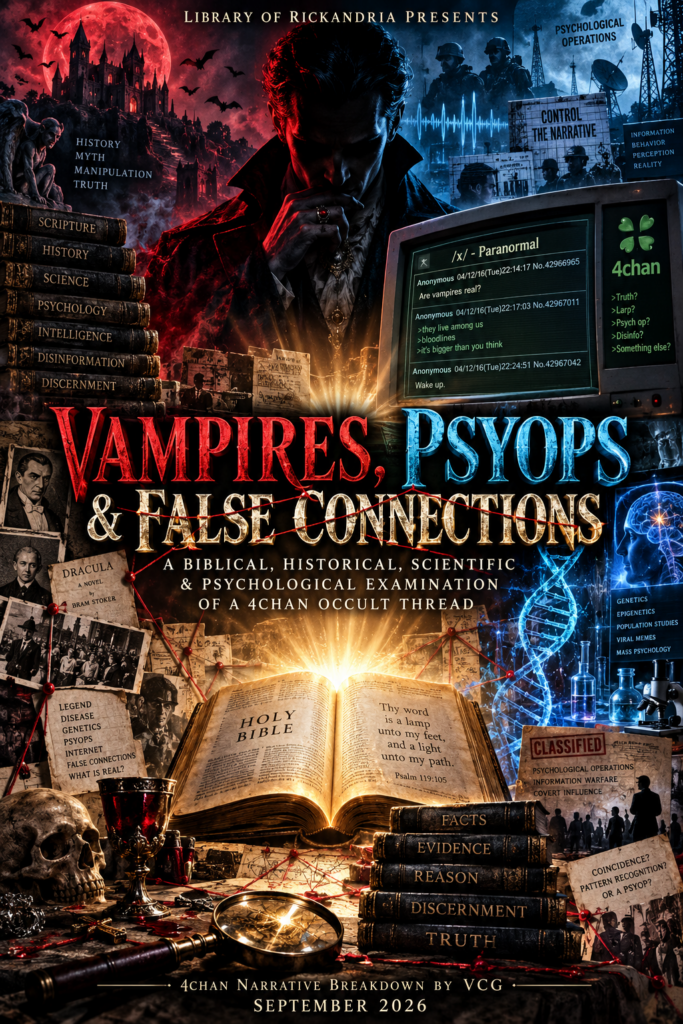
UPDATED BY VCG ON 9/15/2026 @ 22:22 EST
Anyone can do this, but most won’t.
ChatGPT – Library of Rickandria
Abstract
On September 15, 2026, a thread appeared on 4chan’s /x/ paranormal board asking a straightforward question:
do vampires exist, and if so, how might someone find or become one?
/x/ – Vampires exist? – Paranormal – 4chan
What followed was not one coherent argument but a rapidly expanding network of claims involving:
- genetic engineering
- Tay-Sachs disease
- the biblical Cain
- alleged hidden bloodlines
- “snakeoids”
- pheromonal mind control
- Jewish identity
- Dracula
- Nosferatu
- Michael Aquino
- Anton LaVey
- the Temple of Set
- Don Webb
- the Order of the Vampyre
- United States psychological operations
and a 1980 paper called From PSYOP to MindWar.
A first reading can make the thread feel strangely researched.
Many of its nouns are real.
Gene editing is real.
Tay-Sachs is real.
Cain is biblical.
“Cainites” appear in early Christian heresiological literature.
Self-described modern vampires exist as a documented subculture.
Michael Aquino really founded the Temple of Set.
He really served in a U.S. Army psychological-operations context.
MindWar is a real document.
Don Webb really served as High Priest of the Temple of Set and participated in its Order of the Vampyre.
Scholars really have examined antisemitic imagery surrounding vampire literature and cinema.
The difficulty is not primarily that the thread invents every fact.
The difficulty is that it connects real facts by connections that have not been demonstrated.
This paper calls that structure true nodes, false edges.
Its method is deliberately conservative.
The thread is treated as primary evidence only for what the posters claimed.
Medical and genetic questions are checked against biomedical sources.
Historical claims are checked against historical and institutional records.
Occult organizations are distinguished from the supernatural claims made within or about them.
Psychological research is used to understand how narratives of this kind can become persuasive without diagnosing anonymous posters.
Literary scholarship is separated from racial pseudoscience.
Scripture is consulted to determine what the biblical text actually teaches about:
- blood
- Cain
- occult practice
- spiritual deception
- truth
- discernment
—not to replace laboratory science.
The conclusion is considerably less sensational than the thread, but more interesting historically.
There is no credible evidence in the thread for a biologically transmissible vampire condition, a Tay-Sachs/vampire connection, a Cainite vampire gene, “snakeoid” radio control, an ethnic vampire population, or a secret military-vampire program.
There is, however, a real history beneath parts of the mythology:
- vampire folklore
- occult vampire symbolism
- modern vampire identity groups
- antisemitic monster imagery
- modern Satanist organizations
- military psychological operations
Understanding those genuine histories explains much of what the thread is doing without requiring its extraordinary conclusions.
The governing principle of this investigation is therefore simple:
Verify the arrows, not merely the nouns.
I. The Thread Begins with a Question
The thread begins innocently enough. Its original poster asks whether vampires exist, where they might be found, and how a person could become one.
The poster explicitly asks for a serious answer.
Almost immediately, one reply offers
“gene manipulation.”
Another respondent notes—correctly, in the narrowest possible sense—that genetic manipulation is a real thing.
The conversation then moves rapidly from that uncontested fact to something much stranger.
This opening matters because it establishes the pattern that will recur throughout the thread.
A true statement appears first.
Then an extraordinary interpretation attaches itself to the true statement.
Genome editing is indeed real.
Modern genome-editing technologies can alter DNA at targeted locations.
That fact is well established in contemporary biology.
It tells us nothing by itself, however, about vampires.
The existence of a technology capable of changing DNA is not evidence that someone has used that technology to create vampires, nor does it establish that a
“vampire genome”
exists to be engineered.
The thread’s first important logical move can therefore be represented as:
Gene manipulation exists → therefore vampirism could be produced by gene manipulation.
The first half is demonstrably true.
The second half requires additional evidence.
No such evidence is supplied.
This distinction between a premise being possible in principle and a specific event actually having occurred will become essential as the thread grows.
II. Method: How This Paper Tests an Anonymous Occult Narrative
There are several different questions hidden inside the thread, and they cannot all be answered with the same kind of evidence.
A medical claim about Tay-Sachs belongs first to medicine and genetics.
A claim about the authorship of The Satanic Bible belongs to bibliographical history.
A claim about Michael Aquino’s Army position belongs to military and biographical history.
A claim concerning what Irenaeus wrote about the Cainites belongs to textual history.
A claim about what Scripture teaches concerning Cain belongs to biblical exegesis.
A claim that occult practice constitutes rebellion against God is theological.
A claim that a particular person is secretly nonhuman would require evidence concerning that actual person.
Confusion begins when evidence suitable for one domain is quietly made to perform work in another.
A Bible verse does not identify a HEXA mutation.
A photograph does not establish a military office.
A military résumé does not validate occult metaphysics.
An occult order using the word Vampyre does not prove undead creatures.
A medical disorder involving blood or neurological symptoms does not become vampirism because the symptoms resemble folklore.
And discovering that a fictional monster drew upon ethnic stereotypes does not mean the ethnic group really is the monster.
Evidence hierarchy
For this investigation, primary evidence is given the narrowest meaning possible.
The 4chan thread is excellent primary evidence for what appeared in the thread.
It is not independent evidence that the thread’s claims are true.
The MindWar document is evidence for what its authors wrote, how they identified themselves, and when the document was produced.
Scripture is primary textual evidence for what Scripture says.
Irenaeus is historical evidence for what an early Christian heresiologist reported about a group he called Cainites.
Don Webb’s own interviews are valuable evidence for how Webb describes his occult career.
They are not, merely because he gives them, proof that the metaphysical claims of his occult system are objectively true.
Biomedical organizations and peer-reviewed scientific literature are appropriate for medical and psychological propositions.
Academic historians and religious-studies scholars are appropriate for the history of Satanism and Gothic literature.
This allows us to classify claims without forcing everything into “true” or “false.”
Some statements are verified. Some are partly true but misleadingly framed.
Some are unsupported.
Some are contradicted by documentary evidence.
Some are interpretations rather than factual propositions.
Others are so elastic that they become effectively unfalsifiable.
This matters because conspiracy-like narratives often survive fact-checking by retreating from one category to another.
A factual assertion becomes “just a theory”; a disproven chronology becomes “symbolic”; missing evidence becomes evidence of secrecy.
A careful investigation should not permit the evidentiary rules to change whenever the claim is challenged.
III. “Tay Sachs,” Vampire Blood, and the Cainite Gene
The first major escalation occurs when one poster tells the original poster that vampirism can supposedly be obtained by drinking vampire blood or surviving a vampire bite.
The poster associates the condition with something sounding like
“vampus sansquine”
and then explicitly invokes “tay sax,” after which “Cainites” are said to be usual carriers.
Here the narrative attaches itself to a genuine disease.
Tay-Sachs disease is real.
It is also nothing like the condition described in the thread.
MedlinePlus Genetics describes Tay-Sachs as a rare inherited neurological disorder caused by pathogenic variants in the HEXA gene.
Those variants impair beta-hexosaminidase A, allowing GM2 ganglioside to accumulate to toxic levels, particularly in neurons.
Tay-Sachs follows an autosomal-recessive inheritance pattern.
Nothing in this disease mechanism involves vampirism.
Nothing about it is acquired by being bitten.
It is not an infection.
It does not turn someone into a predatory immortal.
It does not create a physiological need for human blood.
Calling Tay-Sachs an “infection” that can be transmitted through a bite is therefore not an obscure disagreement within genetics.
It is a category error.
The real medical danger runs in the opposite direction.
Human bites that break the skin carry a significant infection risk and merit medical attention.
The thread has therefore performed a recurring transformation:
real genetic disease → mysterious hereditary blood condition → hidden lineage → vampire transmission
Only the first element is medically established.
What about population genetics?
Tay-Sachs-associated variants occur at higher frequencies in certain populations, including people of Ashkenazi Jewish ancestry, while also occurring in French-Canadian, Old Order Amish, Cajun, and other populations.
That is population genetics.
It is not occult genealogy.
The difference becomes especially important later in the thread, when Jewish identity is itself turned into a vampire theory.
A real population-frequency observation can be made to sound sinister when detached from genetics and inserted into a myth about hereditary evil.
This is one reason precision matters.
“More common in a population”
does not mean
“unique to a population.”
“Carrier” has a specific genetic meaning.
It does not mean carrier of occult properties.
IV. Who Were the “Cainites”?
The thread’s use of “Cainites” is not wholly invented.
That makes the claim more interesting, not more credible.
Irenaeus, writing against movements he regarded as heretical, devotes a section of Against Heresies to people he calls Cainites.
He associates them with positive or revisionist evaluations of biblical figures such as Cain and reports that they possessed writings connected with Judas.
This is significant evidence for the history of religious ideas.
It is not genetic evidence.
Irenaeus does not identify the Cainites as a biological subspecies.
He does not describe a HEXA mutation.
He does not say that they become vampires through blood. He does not identify them as an immortal hereditary race.
The thread has again joined two real nodes:
Cainites existed as a religious designation.
Genetic inheritance exists.
What has not been shown is the edge connecting them:
Cainites possessed a vampire gene.
That edge is doing all of the narrative work.
V. Cain in Scripture: What the Text Actually Says
This is also where the biblical text needs to be allowed to speak without later folklore being read backward into it.
Genesis 4 identifies Cain as the son of Adam and Eve, describes his murder of Abel, and records God’s judgment upon him.
Cain fears that others will kill him.
God places a mark upon Cain so that this will not happen.
Cain subsequently lives, has a wife, fathers a child, and builds a city.
There is no statement in the chapter that Cain becomes immortal.
There is no statement that the mark changes his species.
There is no statement that his punishment creates a thirst for blood.
There is no statement that biting transmits Cain’s condition.
There is no statement identifying his descendants as vampires.
The blood in Genesis 4 belongs to Abel:
“the voice of thy brother’s blood crieth unto me from the ground.”
The narrative concerns:
- murder
- guilt
- judgment
- exile
- protection from retaliatory killing
and the development of Cain’s line.
The New Testament likewise uses Cain morally rather than biologically.
First John contrasts Cain’s murderous hatred with brotherly love:
“Not as Cain, who was of that wicked one, and slew his brother.”
Jude speaks of people who have
“gone in the way of Cain.”
Neither passage creates a vampire anthropology.
This illustrates an important rule of biblical interpretation:
A later legend about a biblical character is not automatically a hidden meaning of the biblical passage.
If an occult text, novel, role-playing game, or esoteric tradition later turns Cain into the progenitor of vampires, that may be interesting reception history.
It is not exegesis of Genesis unless the interpretation can actually be demonstrated from Genesis.
VI. Blood in Scripture: Life, Atonement, and Prohibition
The biblical treatment of blood actually cuts against the initiation ritual suggested in the thread.
Leviticus 17 states:
“For the life of the flesh is in the blood.”
But the verse does not continue by saying that drinking another person’s blood transfers his nature or power. Instead, the text immediately places blood within the sacrificial and atoning economy given to Israel:
“I have given it to you upon the altar to make an atonement for your souls.”
The same passage explicitly prohibits eating blood.
The distinction is crucial.
The biblical symbolism of blood is profound.
But symbolic and theological importance does not imply occult transmissibility.
Nor is abstention from blood confined only to a random dietary footnote in Leviticus.
In Acts 15, the apostolic letter sent to Gentile believers includes instruction to abstain from blood, alongside other specified practices.
Christians differ over how Old Testament ritual laws relate to the church, and responsible theology should acknowledge those covenantal discussions.
But nothing in either Testament provides support for deliberately drinking someone’s blood in order to acquire an occult nature.
VII. “Snakeoids,” Copulins, and Biological Radio Control
A later post introduces what it calls “snakeoids.”
These beings are said to appear as witches or vampires and allegedly produce special “copulins” capable of rewiring men into controllable thralls.
The post then moves from chemical signaling to something described like biological radio transmission capable of manipulating perception and behavior.
Here again a scientific-sounding term performs credibility work.
Chemical communication between organisms is a legitimate scientific field.
Human pheromone research has been investigated for decades.
But the existence of research does not validate every claim made with its terminology.
Tristram Wyatt’s review in Proceedings of the Royal Society B argues that although human pheromones are biologically plausible, widely publicized claims concerning several proposed human pheromone molecules lacked the sort of robust bioassay-led evidence required to establish them.
Wyatt specifically emphasizes problems involving weak candidate selection, small samples, publication bias, and replication.
That scientific uncertainty is already a long distance from the thread.
Nothing in the cited research demonstrates a concealed reptilian species.
Nothing establishes remote “radio” control of spouses.
Nothing demonstrates transmission of an altered visual image directly into another person’s perception.
Nothing establishes the claimed phenotype—
- eyes
- body shape
- skin
- behavior
- family structure
—as a diagnostic cluster identifying a nonhuman creature.
A further methodological problem appears here.
The alleged signs are broad enough to fit countless ordinary people:
- unusual appearance
- obesity
- anger
- distant expression
- marital attachment
- unrelated children
When a theory uses common human features as markers of a hidden species, it risks generating enormous numbers of false positives.
The theory becomes especially difficult to test if ordinary attraction itself is interpreted as proof of mind control:
“If you see what I see, you recognize the creature.”
“If the spouse does not see it, that proves the creature has altered his perception.”
The spouse’s disagreement therefore ceases to count against the theory and becomes evidence for it.
That is a self-protecting explanatory structure.
VIII. The Hidden Archive and the Invitation to Descend
Partway through the thread, a MediaFire folder labeled around vampire material is introduced.
Another poster goes further and instructs the original poster to disregard other contributions and simply enter the linked material.
This is an important turning point.
The conversation is no longer merely exchanging claims.
It begins to establish a path of initiation.
The reader is told, in effect, that deeper truth is somewhere else:
in the archive, in the literature, in the
“rabbit hole,”
in authors known only after one begins pursuing the subject seriously.
There is nothing inherently wrong with reading primary occult literature.
A researcher may need to read precisely such sources in order to understand what an occult group actually teaches.
The methodological problem arises when exposure substitutes for verification.
Reading ten books that repeat a claim does not demonstrate the claim unless those books supply evidence independent of one another.
An archive can preserve:
- real history
- fiction
- speculation
- ritual manuals
- personal testimony
- forged documents
- roleplay
- scholarship
or any mixture of them.
“It was in the archive”
tells us where an assertion was found, not whether the assertion is true.
The further instruction to ignore competing material introduces a second concern.
Good investigation becomes stronger through cross-examination.
Bad investigation becomes protected through information isolation.
IX. Folklore, Identity, Occultism, and Ontology
One of the most important distinctions in this entire subject is between evidence that people believe in vampires and evidence that supernatural vampires exist.
Those questions are not interchangeable.
There is excellent evidence for vampire folklore.
There is excellent evidence for vampire literature.
There is excellent evidence for vampire cinema.
There is evidence for modern people who self-identify as vampires.
There is evidence for occult groups using vampire symbolism.
None of those facts, by itself, establishes a supernatural or biologically separate vampire species.
Anthropologist John Edgar Browning conducted ethnographic research among people participating in what is commonly called the
“real vampire community.”
He documents self-described sanguinarians, people who report consuming blood, and
“psychic vampires,”
who understand themselves as consuming energy.
Browning is describing people’s:
- identities
- reports
- communities
- practices
- interpretations
He explicitly notes that these are living people leading generally ordinary lives and that they do not ordinarily claim fictional immortality.
That is genuine anthropology.
It establishes a social phenomenon.
It does not independently establish the supernatural ontology by which every participant may interpret his experiences.
This is a useful distinction far beyond vampirism:
Phenomenology:
What does a person report experiencing?
Sociology:
How does a community organize around the experience?
History:
Where did the vocabulary and practices develop?
Ontology:
What actually exists and causes the experience?
A responsible paper may take the first three seriously without pretending that they automatically settle the fourth.
X. A Short Genealogy of the Modern Vampire
The European vampire did not enter modern culture all at once in the finished form of Count Dracula.
Reports surrounding alleged vampires became particularly prominent during eighteenth-century Central and Southeastern European vampire panics.
Smithsonian’s historical treatment describes the 1725 case of Petar Blagojević and the 1732 controversy surrounding reports such as Visum et Repertum.
- Corpses
- disease outbreaks
- poorly understood decomposition
- local folklore
- administrative reporting
and expanding print culture interacted to help create the modern European vampire panic.
The vampire then migrated from disputed reports and folklore into literary culture.
John Polidori’s The Vampyre appeared in 1819; British Library holdings document its place in nineteenth-century vampire bibliography.
The long-running penny dreadful Varney the Vampyre followed in the 1840s and helped establish features that became familiar in later vampire imagery, including prominent fangs.
Bram Stoker’s Dracula appeared in 1897 and transformed an already existing tradition rather than inventing vampirism from nothing.
F. W. Murnau’s Nosferatu followed in 1922 as an unauthorized film adaptation of Stoker’s novel, renaming Dracula as Count Orlok.
- Twentieth-century fiction
- cinema
- role-playing games
- occultism
- Gothic subculture
and online communities then developed still more meanings of “vampire.”
This genealogy is useful because it prevents a common mistake:
treating every feature attached to vampires in 2026 as if it were part of one ancient, unchanged body of knowledge.
It is not.
Vampire traditions have:
- accumulated
- mutated
- borrowed
- fictionalized
- spiritualized
- medicalized
- sexualized
- racialized
and commercialized across centuries.
That does not make them meaningless.
It means they have histories.
XI. Michael Aquino: Where the Thread Finds Real History
The strongest portion of the 4chan narrative begins when it reaches Michael Aquino.
This is where a careless rebuttal could make a serious mistake, because a surprising amount of the underlying material is real.
Aquino was genuinely important in modern Satanist history.
Academic histories of modern Satanism identify the 1975 schism in Anton LaVey’s Church of Satan that resulted in Michael Aquino founding the Temple of Set.
Oxford Academic likewise treats Aquino’s The Book of Coming Forth by Night from 1975 as a foundational Temple of Set document.
The thread is therefore correct to connect Aquino with LaVey’s milieu and the Temple of Set.
But it then begins adding material that does not survive checking.
Did Aquino write The Satanic Bible?
No.
Library catalog records identify Anton Szandor LaVey as the author of The Satanic Bible, published by Avon in 1969.
Aquino wrote significant works of his own. Confusing his later leadership and literary activity with authorship of LaVey’s Satanic Bible is a straightforward factual error.
Did Aquino invent psychological operations?
No.
The official U.S. Army history of psychological operations dates an organized American military psychological-operations capability to World War I.
In 1918 the Army established a Psychologic Subsection and propaganda organization; related practices continued through later conflicts and eventually developed into permanent PSYOP capability.
Aquino was not yet born.
He therefore cannot be responsible for inventing U.S. military psychological operations.
Did MindWar exist?
Yes.
This is where the thread again touches something real.
A surviving copy of From PSYOP to MindWar: The Psychology of Victory identifies Colonel Paul E. Vallely as commander and Major Michael A. Aquino as “PSYOP Research & Analysis Team Leader,” Headquarters, 7th Psychological Operations Group, U.S. Army Reserve, Presidio of San Francisco.
The document is dated 1980.
Aquino’s later introduction says Vallely asked him in 1980 to prepare a future-oriented paper about PSYOP, that Aquino drafted it, and that Vallely reviewed and annotated successive versions.
Thus two corrections are simultaneously necessary.
It would be wrong to say Aquino had nothing to do with MindWar.
It is also wrong to place the paper during the Vietnam War itself.
The chronology is explicit: 1980.
“Secretary of Strategic Defense”
The thread gives Aquino a grandiose-sounding federal office and later describes him as a feared member of an executive administration or cabinet.
The documentary evidence examined here does not support that description.
The MindWar title page identifies him as an Army Reserve major serving as PSYOP Research & Analysis Team Leader.
I found no credible evidence for a United States office called
“Secretary of Strategic Defense”
occupied by Aquino, nor evidence that he served as a presidential Cabinet secretary.
This is a useful illustration of how a real credential can expand in transmission:
Army PSYOP officer becomes
head of American PSYOP becomes
strategic defense secretary becomes
executive official feared by cabinet colleagues.
The first proposition has documentary support.
The later propositions require evidence the thread never supplies.
XII. Don Webb and the Order of the Vampyre
The Don Webb material contains another real historical core.
Webb states that he joined the Temple of Set and later became its High Priest, holding that office for six years.
He also describes joining the Temple’s Order of the Vampyre and becoming a Master of that Order after work that developed into Energy Magick of the Vampyre.
His publisher likewise describes him as a former Temple of Set High Priest and presents Energy Magick of the Vampyre as an occult initiatory system using vampire symbolism, magical practice, energy concepts, and self-development.
An internal Temple-related source describes the Order of the Vampyre as a specialized group within the Temple focused upon “Vampyric” interests.
That is enough to say plainly:
There really was an Order of the Vampyre connected to the Temple of Set.
But notice what has actually been established.
An occult organization existed.
It used the vampire as an initiatory and magical model.
Members wrote about “Vampyric” practice.
None of those facts independently demonstrates a hidden biological species of undead predators.
A Freemason lodge proves Freemasons exist.
It does not prove every legend ever told about Freemasons.
Likewise, an Order of the Vampyre proves an occult Order of the Vampyre existed.
It does not prove Count Dracula exists.
XIII. The Aquino–Webb Timeline
Placed chronologically, the history becomes much less mysterious:
1966: Anton LaVey establishes the Church of Satan.
1969: The Satanic Bible is published under Anton Szandor LaVey’s authorship.
1975: A major Church of Satan schism culminates in Aquino establishing the Temple of Set.
1980: Vallely and Aquino’s From PSYOP to MindWar is produced in the 7th Psychological Operations Group, U.S. Army Reserve.
Later: Don Webb joins the Temple of Set, eventually serves for six years as High Priest, and participates in the Order of the Vampyre.
This timeline contains enough unusual intersections—Satanism, military PSYOP, occult vampire terminology—to make an internet mystery feel almost self-authenticating.
But chronology provides association, not causation.
There really was an occultist who also had a military career.
There really was a later Temple leader who worked with vampire symbolism.
That does not establish an Army vampire program.
No documented bridge has been supplied between those facts.
XIV. True Nodes, False Edges
We can now state the central analytical model more formally.
Imagine the thread as a graph.
Its nodes are:
- names
- institutions
- diseases
- books
- historical events
or concepts.
Some nodes are entirely real:
CRISPR / genome editing
Tay-Sachs disease
Cain
Cainites
vampire folklore
modern vampire communities
Anton LaVey
Michael Aquino
Temple of Set
Don Webb
Order of the Vampyre
PSYOP
MindWar
Dracula
Nosferatu
The thread becomes unreliable primarily in its edges:
Tay-Sachs → vampirism
Tay-Sachs → Cainite bloodline
Cain → biological vampire ancestry
bite → vampire transformation
copulins → radio-controlled spouse
Jewish population → vampire species
Aquino → author of The Satanic Bible
Aquino → inventor of PSYOP
Temple of Set → literal vampire biology
occult “Vampyre” order → supernatural vampires
That is why the thread can feel researched while failing basic verification.
A person checking only the nouns may repeatedly discover:
“Yes, that really exists.”
“Yes, that person was real.”
“Yes, there really is a book with that title.”
“Yes, there really was an organization called that.”
Each successful search creates another burst of confidence.
But the conclusion depends on whether the relationships among those discoveries are true.
A conspiracy narrative can contain twenty true facts and still be false if the nineteen connections holding them together are invented.
XV. Evidence Laundering
For clarity, this paper uses evidence laundering as a descriptive term, not as a psychiatric diagnosis or a formal diagnostic category.
Evidence laundering occurs when the credibility of a strong source is transferred to a weaker claim merely through proximity.
A medical term can make folklore sound clinical.
A military acronym can make occult speculation sound classified.
A photograph can make a biography bundle feel authenticated.
An academic discussion of antisemitic imagery can make an ethnic conspiracy sound historically validated.
An ancient Church Father can make a modern genetic theory sound patristic.
A Hebrew word can make a recent occult interpretation sound biblical.
The authoritative source does not actually say what the narrative needs it to say.
It simply stands nearby.
This is closely related to a larger research rule:
A citation is not evidence until we ask what proposition the citation actually supports.
A source saying
“Aquino worked in PSYOP”
cannot simultaneously be cited for
“Aquino invented PSYOP.”
A source documenting
“Order of the Vampyre”
cannot be cited for
“biological vampires exist.”
A source saying
“Tay-Sachs is more frequent in certain ancestry groups”
cannot be cited for
“that population carries vampirism.”
The question is always:
What exact sentence does the source allow us to write?
XVI. The Psychology of Why This Can Feel Convincing
Psychological analysis needs restraint.
We cannot clinically diagnose anonymous 4chan posters from a thread.
We do not know their:
- identities
- sincerity
- mental health histories
- intentions
or whether individual posts are:
- jokes
- roleplay
- trolling
- sincere belief
- improvisation
or some mixture.
What psychology can do is illuminate mechanisms that make narratives like this persuasive to ordinary people.
Pattern perception
- Van Prooijen
- Douglas
- De Inocencio
found an association between illusory pattern perception and belief in conspiracy and supernatural propositions.
Their experiments included perception of patterns in random sequences and chaotic imagery.
This does not prove that anyone in the thread is
“seeing patterns that are not there.”
It establishes a more modest point:
The feeling that many facts form a pattern is not itself evidence that the proposed pattern is real.
Humans are extraordinarily good at recognizing relationships.
That ability is necessary for reasoning.
The same ability also creates vulnerability to false positives.
Epistemic, existential, and social motives
Douglas, Sutton, and Cichocka organize research on conspiracy beliefs around epistemic motives—wanting to understand events; existential motives—wanting security and control; and social motives—protecting a valued self or group identity.
The 4chan thread offers all three rewards.
It promises explanation: apparently unrelated subjects become one system.
It promises control: hidden dangers can allegedly be identified.
It promises status: the initiated know what outsiders do not.
Again, this does not tell us why a particular poster wrote a particular sentence.
It does help explain why secret-history narratives are psychologically attractive even when their evidence is thin.
Repetition and familiarity
The illusory truth effect is the well-established tendency for repeated statements to become easier to believe.
A 2024 review notes that repetition can increase belief not only in ordinary trivia but in misinformation, fake-news claims, and conspiracy propositions, including some claims inconsistent with prior knowledge.
Accuracy-focused interventions can reduce the effect.
This is relevant to “rabbit hole” research.
If a person spends days reading dozens of documents from the same intellectual ecosystem, repeated motifs begin to feel independently corroborated even when the documents ultimately derive from one another.
Familiarity begins masquerading as confirmation.
Online disinhibition
John Suler’s classic account of the online disinhibition effect analyzes how:
- anonymity
- invisibility
- asynchronous communication
- reduced authority cues
and related features can alter behavior online.
That makes anonymous imageboards epistemically peculiar environments.
A post can be:
a joke to the writer,
a revelation to the reader,
a role-playing exercise to another participant,
and raw source material for a future conspiracy archive.
Anonymity makes those contexts difficult to recover.
For that reason, confidence should generally decrease—not increase—when an extraordinary claim cannot be attached to an identifiable source whose evidence can be examined.
XVII. The Psychology of the Initiate
Beyond cognitive mechanisms, the thread contains a recognizable social pattern.
Knowledge is made scarce.
The seeker is initially treated as unworthy.
Locations cannot be disclosed.
Outsiders may be dangerous.
The archive must be entered.
Certain authors become guides.
A “rabbit hole” opens.
At the end lies:
- awakening
- seriousness
- readiness
- power
This structure is common in esoteric storytelling because secrecy creates value.
If information is available to everyone, possessing it confers little status.
If information is supposedly hidden from almost everyone, possessing it can become part of identity.
Secrecy can therefore perform three psychological functions simultaneously.
It explains why evidence is scarce.
It elevates the person who claims access.
And it turns doubt into a sign that the outsider has not yet progressed far enough.
The researcher’s response should not be mockery.
It should be a simple change of question.
Instead of asking:
“How deep does the secret go?”
ask:
“What evidence would we expect to exist if this were true?”
XVIII. The Self-Sealing Theory
This question leads directly to falsifiability.
Suppose a theory says vampires exist but hide perfectly.
Why has nobody produced biological evidence?
Because they hide it.
Why does genetic testing not reveal a vampire lineage?
Because the responsible institutions are compromised.
Why do alleged vampires deny being vampires?
Because secrecy is necessary.
Why do spouses not recognize their partners as disguised creatures?
Because mind control prevents recognition.
Why do historians contradict the hidden history?
Because history has been rewritten.
Why does the absence of evidence continue?
Because the conspiracy is powerful enough to erase evidence.
At this point the theory can explain every possible observation.
Unfortunately, a theory able to explain every observation may cease to discriminate among observations.
Evidence for it proves it.
Evidence against it proves the cover-up.
No evidence proves secrecy.
Skepticism proves conditioning.
Such a theory becomes extraordinarily difficult to correct because nothing can count against it.
The question
“What would change your mind?”
is therefore not rhetorical hostility.
It is one of the healthiest questions a researcher can ask himself.
XIX. Secrecy Is Real; Therefore Secrecy Proves Very Little
The answer should not swing to the opposite extreme.
Governments really keep secrets.
Military organizations classify material.
Intelligence agencies run influence operations.
Occult groups preserve initiatory teachings.
Private organizations restrict membership.
People lie.
Institutions conceal misconduct.
Propaganda exists.
Psychological operations exist.
None of those statements is controversial.
But an important logical distinction follows:
Evidence that an institution keeps some secrets is not evidence that a specific allegation about that institution is true.
“The Army has classified programs”
cannot establish any arbitrary claim about a classified program.
“The Temple of Set had initiatory material”
cannot establish any arbitrary claim about the Temple.
“Intelligence agencies engage in influence operations”
cannot establish that any particular disagreement is a psyop.
Otherwise secrecy becomes a blank check onto which any theory can be written.
XX. The Antisemitic Turn
The most serious part of the thread is the point at which vampire mythology is explicitly mapped onto Jews as a people.
A careful rebuttal needs more than saying this is offensive.
It needs to understand why the claim can sound historically sophisticated.
There really is serious scholarship concerning antisemitic imagery in Gothic and vampire literature.
Daniel Renshaw’s study of late nineteenth-century Gothic literature examines how antisemitic conceptions of Jews overlapped with imagery of:
- blood
- foreignness
- parasitism
- migration
- monstrosity
At the same time, Renshaw is explicit that Dracula himself is demonstrably not Jewish within Stoker’s fictional biography.
Likewise, scholarship on Murnau’s Nosferatu has examined Count Orlok in relation to antisemitic stereotypes circulating in Weimar Germany.
The relevant scholarship carefully notes that Nosferatu contains no character explicitly identified as Jewish.
BFI similarly notes the film’s relationship to contemporary antisemitic “othering” while identifying it straightforwardly as Murnau’s 1922 unauthorized adaptation of Dracula.
That distinction is essential.
Historical scholarship says, in effect:
European antisemitism sometimes represented Jews with monstrous, contaminating, parasitic, or blood-related imagery, and Gothic monsters could draw upon those cultural fears.
The thread reverses the direction:
Because monsters were depicted using antisemitic imagery, Jews must really be monsters.
That is not historical reasoning.
It takes evidence of a stereotype and treats the stereotype as evidence about its target.
Blood libel
The blood connection has a particularly dark history.
The U.S. Holocaust Memorial Museum defines the blood libel as the false accusation that Jews used the blood of non-Jews, especially Christian children, for ritual purposes.
Such accusations contributed to persecution over centuries and were later exploited by Nazi propaganda.
This means that when vampire mythology, “virgin blood,” Jewish ancestry, hereditary disease, and secret predatory bloodlines are fused together, the result is not a newly discovered biological theory.
It is substantially reproducing an old pattern of racial-religious demonization.
“Jews working for Nazis” and Nosferatu
The thread’s treatment of Nosferatu is chronologically confused as well.
Nosferatu was released in 1922.
Hitler was appointed Chancellor of Germany on January 30, 1933, after which the Nazis transformed the German state into a dictatorship.
The Nazi Party existed before 1933, so merely noting the twelve-year difference is not enough to disprove every possible contact between a person in 1922 and a Nazi activist.
But the specific claim that the film was created as part of a Nazi project requires evidence.
The production record identifies F. W. Murnau as director, Albin Grau and Enrico Dieckmann as producers, and Henrik Galeen as writer.
The thread supplies no documentary evidence for its alleged Nazi commission.
The historically defensible observation is much narrower:
The film was created in a society where antisemitic imagery existed, and scholars can meaningfully analyze how some of that imagery appears in Orlok.
That does not make Jews vampires.
XXI. A Biblical Correction to Ethnic Demonology
The thread’s ethnic conclusion is also incompatible with the structure of the New Testament.
Paul warns Gentile believers in Romans 11 against boasting over the natural branches:
“Boast not against the branches.”
He continues:
“Be not highminded, but fear.”
The passage discusses:
- unbelief
- faith
- judgment
- mercy
- the relation
of Gentiles to Israel.
Whatever disagreements Christians have over the eschatological interpretation of Romans 9–11, turning Jewish ancestry into evidence of a biologically demonic race runs directly opposite Paul’s warning against Gentile arrogance.
Galatians likewise declares concerning those who are in Christ:
“There is neither Jew nor Greek… for ye are all one in Christ Jesus.”
This does not erase ethnic history or every distinction among peoples.
It directly denies that ethnic status creates different classes of access to Christ within the body of believers.
Romans 3 is equally sobering.
Paul’s argument does not move from Jewish sin to Gentile superiority.
It moves toward the universal indictment:
“we have before proved both Jews and Gentiles, that they are all under sin.”
Biblical anthropology therefore gives no warrant for an occult racial caste of Jews as vampires.
The Bible recognizes sin.
It recognizes spiritual evil.
It recognizes false religion.
It judges Israel at many points in the Old Testament and Jewish opponents of Christ at points in the New Testament.
It also judges:
- Gentiles
- nations
- churches
- rulers
- false teachers
- individual sinners
What it does not do is turn Jewish ethnicity into vampire biology.
XXII. Medical Resemblance Is Not Medical Explanation
For centuries, writers have tried to connect vampire motifs with real disorders.
Sometimes the comparison is superficially interesting.
It is also easily overstated.
| Vampire motif | Real phenomenon that may look superficially similar | What the evidence actually establishes |
|---|---|---|
| Sunlight intolerance | Some cutaneous porphyrias cause painful or damaging photosensitivity | Porphyria is a group of heme-production disorders, not vampirism. |
| Hereditary condition | Tay-Sachs and many other disorders are inherited | Tay-Sachs is caused by HEXA variants and neurological GM2 accumulation; no vampire phenotype results. |
| Transformation by biting | Human bites can transfer bacteria and expose a person to bloodborne pathogens | They pose infection and injury risks; medicine recognizes no vampire conversion syndrome. |
| Blood consumption | Some self-identified sanguinarian vampires report consuming blood | Ethnography establishes a reported human practice and identity, not an undead species. |
| “Energy feeding” | Self-identified psychic vampires describe subjective energy consumption | The report is anthropologically real; the metaphysical mechanism is not independently established by the ethnography. |
| Extreme longevity/immortality | None demonstrated | Modern “real vampire” communities generally consist of living humans who do not claim literal fictional immortality. |
The lesson is methodological.
A disease can resemble one feature of a myth without causing the myth.
A myth can borrow medical language without becoming medicine.
XXIII. Scripture and the Supernatural: Avoiding the Opposite Error
A Christian investigation should not respond to bad paranormal reasoning by pretending the Bible contains no supernatural claims.
It clearly does.
Scripture speaks of:
- God
- angels
- Satan
- demons
- spiritual powers
- miracles
- prophecy
- resurrection
- judgment
- spiritual deception
Mark’s Gospel, for example, straightforwardly describes Jesus confronting unclean spirits.
Ephesians 6 says:
“we wrestle not against flesh and blood, but against principalities, against powers…”
So a Bible-believing Christian does not need philosophical naturalism in order to reject an unsupported vampire story.
This distinction is important.
The reasoning is not:
“Vampires cannot exist because supernatural things cannot exist.”
That would conflict with the biblical worldview.
The reasoning is:
“The existence of a supernatural realm does not make every supernatural claim true.”
Scripture itself demands discernment.
First John says:
“Beloved, believe not every spirit, but try the spirits whether they are of God.”
The reason given is that false prophets have gone into the world.
The Bible therefore supplies no warrant for paranormal gullibility.
Belief in genuine spiritual realities increases the importance of testing claims; it does not eliminate it.
XXIV. Biblical Discernment Is Not Rabbit-Hole Addiction
The thread’s language of hidden initiation also deserves theological examination.
Deuteronomy 18 prohibits Israel from adopting:
- divination
- enchantment
- witchcraft
- consultation with familiar spirits
- wizardry
- necromancy
The immediate covenantal and historical setting is Israel entering the land, and interpretation should retain that context.
Nevertheless, the text plainly does not portray occult acquisition as a route to forbidden truth Christians should pursue experimentally.
Paul’s treatment of idolatrous spiritual practice in 1 Corinthians 10 likewise warns believers against fellowship with demonic worship rather than encouraging participation for research experience.
At the same time, Scripture repeatedly commends examination.
First Thessalonians says:
“Prove all things; hold fast that which is good.”
That verse appears in a context that also says not to despise prophesyings.
The biblical posture is therefore neither blanket cynicism nor indiscriminate acceptance.
Test.
Hold fast to what survives testing.
The armor of God passage begins its description with truth:
“Stand therefore, having your loins girt about with truth…”
and continues through:
- righteousness
- the gospel of peace
- faith
- salvation
- the word of God
- prayer
The New Testament picture of spiritual warfare is strikingly unlike much internet occultism.
There is no command to become an expert in every secret order.
There is no command to catalogue alleged bloodlines.
There is no command to identify hidden nonhumans by facial appearance.
There is no command to master forbidden rituals to understand the enemy better.
The center is:
- God
- truth
- righteousness
- the gospel
- faith
- salvation
- Scripture
- prayer
A Christian can become so fascinated with darkness that darkness quietly becomes the organizing center of his intellectual life.
That is not discernment.
XXV. What the Bible Does—and Does Not—Teach About Vampires
Scripture provides material that later vampire traditions can borrow:
- blood
- death
- the grave
- spirits
- resurrection
- forbidden occult practice
- beings hostile to God
and long life.
But similarity of vocabulary does not establish identity of concept.
The Bible teaches that blood is connected with creaturely life and sacrificial atonement.
It does not teach that consuming human blood grants supernatural longevity.
The Bible teaches that Cain murdered Abel and was marked.
It does not teach that the mark created vampirism.
The Bible teaches the reality of unclean spirits.
It does not identify those spirits as biological vampires.
The Bible teaches resurrection.
It does not describe the resurrected righteous as undead predators.
The Bible prohibits occult practices.
It does not therefore follow that every fictional occult creature must literally exist.
The Bible warns about deceptive spirits and false prophets.
It does not tell Christians to believe every person who claims secret spiritual knowledge.
These distinctions protect Scripture from being turned into a decoder ring for modern folklore.
XXVI. The Strongest Version of the Thread’s Case
A fair investigation should steelman the opposing narrative rather than refuting only its weakest form.
The strongest version would look something like this:
There are persistent vampire traditions in human culture.
Some contemporary people sincerely identify as vampires and engage in blood-drinking or energy practices.
Occult organizations have explicitly developed vampiric initiatory systems.
Some modern Satanist history intersects with genuine military psychological-operations history through Michael Aquino.
Psychological operations are a genuine component of warfare and statecraft with a history predating Aquino by decades.
Gothic literature has at times drawn upon anxieties about:
- blood
- foreigners
- disease
- race
- religion
- sexuality
and social contamination.
Humans also possess inherited diseases and technologies capable of manipulating genes.
Every sentence above can be defended.
Yet even the strongest version still does not establish:
a vampire species,
bite-transmitted vampirism,
a Cainite gene,
Tay-Sachs vampirism,
a Jewish vampire population,
reptilian radio control,
or a military-occult vampire program.
This is important because rejecting the larger conspiracy does not require pretending the underlying history is boring.
The real history is unusual enough.
We simply do not need to invent bridges between its parts.
XXVII. Association Is Not Explanation
One of the most revealing moments in the thread comes near the end, when a poster notes having found a photograph connecting figures already mentioned and treats that visual association as confirmation of the broader account.
But a photograph of two people can prove, at most, that a relationship or encounter existed in the circumstances represented.
Suppose a picture establishes that Don Webb and Michael Aquino knew one another.
That would fit the documented Temple of Set history.
It would not prove Aquino authored The Satanic Bible.
It would not move MindWar from 1980 into the Vietnam War.
It would not make Aquino the inventor of PSYOP.
It would not establish a vampire gene.
It would not establish supernatural vampirism.
This is a recurring problem in research involving networks.
A network diagram is not a causal diagram.
Two names connected by a line may be:
- colleagues
- enemies
- family
- correspondents
- members of the same institution
- attendees at the same event
or simply people photographed together.
Every edge needs a label.
XXVIII. Claim Ledger
The following condensed ledger separates the principal moves in the September 15 thread.
It paraphrases rather than reproduces the posts in full.
| Post | Core move | Classification | Finding |
|---|---|---|---|
| 42966965 | Asks whether/how vampires exist | Question | No evidentiary claim yet |
| 42966972 | Invokes gene manipulation | True concept, unsupported application | Genome editing is real; vampire engineering is not established |
| 42967185 | Astral-sex comparison | Undefined/joking | No testable evidence |
| 42967196 | Says gene manipulation is real | Verified narrow statement | Correct |
| 42967221 | Ambiguous “old fashioned” reply | Indeterminate | Too unclear to evaluate |
| 42967410 | Blood/bite transformation; Tay-Sachs; Cainite gene | Contradicted/unsupported | Tay-Sachs is inherited HEXA disease, not vampire infection |
| 42967445 | Seeker is “not important enough” | Gatekeeping | Adds status, not evidence |
| 42967557 | OP reports location/sincerity | Self-report | Relevant to conversation, not vampire evidence |
| 42967626 | Snakeoid/copulin mind control | Unsupported pseudoscience | No evidence for species or radio-control mechanism |
| 42967637 | Links vampire archive | Source lead | Archive existence does not validate contents |
| 42967693 | Jews identified with vampires | False ethnic conclusion built on real trope history | Scholarship studies antisemitic monster imagery; it does not validate the stereotype |
| 42967746 | Tells OP to privilege archive over thread | Information-control move | Methodologically weak |
| 42967757 | Refusal meme | No factual argument | No evidentiary value |
| 42967765 | Calls thread LARPing | Skeptical insult | Skepticism alone is not proof |
| 42967804 | OP finds archive interesting | Reaction | Interest is not verification |
| 42967829 | Aquino/Webb/LaVey/Temple/MindWar bundle | Mixed | Several real associations mixed with false biography |
| 42967857 | Aquino invented/ran PSYOP in Vietnam; executive hero | Mostly unsupported or chronologically wrong | PSYOP predates him; MindWar is dated 1980 |
| 42967886 | Photograph treated as broad confirmation | Association fallacy | Photo cannot authenticate unrelated claims |
| 42967902 | Temple of Set link | Source pointer | Useful starting point, not conclusion |
A notable feature of the ledger is that very few posts are pure fabrication in every respect.
The more common form is mixture.
Mixture is harder to correct because the researcher can find enough truth to remain interested.
XXIX. The False Connection Map
The structure of the narrative can be reduced to several chains.
Biological chain
GENOME EDITING — real
↓
GENETIC DISEASE — real
↓
TAY-SACHS — real
↓
CAINITE VAMPIRE GENE — unsupported
↓
BITE/BLOOD TRANSFORMATION — contradicted by known disease mechanism
Occult chain
TEMPLE OF SET — real
↓
ORDER OF THE VAMPYRE — real
↓
VAMPIRIC OCCULT SYMBOLISM/PRACTICE — real
↓
LITERAL SUPERNATURAL VAMPIRE SPECIES — not established
Military chain
MICHAEL AQUINO — real
↓
ARMY PSYOP EXPERIENCE — real
↓
MINDWAR, 1980 — real
↓
AQUINO INVENTED PSYOP — false
↓
SECRET OCCULT CONTROL SYSTEM — not demonstrated
Literary-racial chain
ANTISEMITIC EUROPEAN IMAGERY — historically real
↓
VAMPIRE LITERATURE CAN DRAW UPON “OTHERING” — scholarly argument
↓
SOME VAMPIRE TRAITS OVERLAP HISTORIC ANTISEMITIC TROPES — supportable interpretation
↓
JEWS ARE LITERALLY VAMPIRES — false reversal of the historical evidence
The pattern is consistent.
The strongest evidence appears near the top.
The extraordinary conclusion appears at the bottom.
The unsupported edge lies between them.
XXX. Terminology Matters
Several words shift meaning throughout discussions like this.
A vampire may mean a folkloric revenant, a Gothic fictional creature, a self-identified sanguinarian, a self-identified psychic vampire, an occult initiate using vampiric symbolism, a metaphorical exploiter, or a hypothetical biological species.
Those are not interchangeable.
Vampyre, often spelled with a y in modern occult/subcultural settings, may signal a deliberate esoteric or identity-based distinction from the fictional monster.
Don Webb’s materials are an example.
Sanguinarian generally refers in modern vampire communities to a self-identified person who consumes blood.
Browning documents the term ethnographically.
Psychic vampire or psi-vamp refers within those communities to someone who reports consuming or absorbing psychic energy.
Again, documenting the identity does not independently establish the claimed energy mechanism.
Cainite can refer historically to the group described in patristic heresiology; that does not make every modern occult use of “Cainite” identical to Irenaeus’ category.
PSYOP refers to psychological operations, an established military activity with a documented American organizational history going back at least to World War I.
MindWar in this context refers specifically to the 1980 Vallely/Aquino paper proposing a broader conception of psychological operations.
Failure to define terms enables equivocation.
If “vampire” silently shifts from
“person participating in a vampire subculture”
to
“biologically nonhuman immortal predator,”
the existence of the first can be falsely offered as evidence for the second.
XXXI. A Better Way to Investigate Extraordinary Claims
The strongest antidote to bad conspiracy reasoning is not reflexive disbelief.
It is disciplined curiosity.
A useful investigation can proceed in ten stages:
- State the exact claim. “Aquino worked in PSYOP” and “Aquino invented PSYOP” are different propositions.
- Find the earliest available source. Later summaries often amplify claims that were narrower at origin.
- Separate primary testimony from independent corroboration. A group’s own history tells us what the group says about itself; outside documentation helps establish what can be independently verified.
- Check chronology before interpretation. A single date can dissolve an elaborate theory.
- Distinguish association from causation. Knowing, photographing, corresponding with, or belonging to the same institution as another person does not transfer every belief or action between them.
- Identify the evidentiary bridge. Do not merely verify both ends of a claim. Verify what connects them.
- Ask what would falsify the proposition. If every imaginable result confirms the theory, the theory is not functioning as a meaningful empirical test.
- Prefer independent convergence over repetition. Ten websites copying one story are still one source.
- Keep disciplines in their proper lanes. Genetics answers genetic questions; historical documents answer historical ones; Scripture answers what Scripture teaches.
- Do not let fascination outrun evidence. Interesting is not the same as true.
That last rule is particularly important on paranormal subjects.
The real history is often fascinating enough that speculation scarcely needs help.
XXXII. Source-Provenance Audit
A final check of the major evidence used in this paper helps show why provenance matters.
The 4chan thread is a primary record of the conversation but provides anonymous testimony with unknown reliability.
MedlinePlus/NIH provides biomedical information concerning:
- Tay-Sachs
- HEXA
- porphyria
- human bites
The U.S. Army provides an institutional history showing that organized American military psychological operations long predate Aquino.
The surviving MindWar document provides direct evidence for its 1980 date and Aquino’s stated Army Reserve position.
Oxford Academic provides scholarly histories of modern Satanism and the Temple of Set.
WorldCat establishes bibliographic authorship of The Satanic Bible under Anton LaVey.
Don Webb’s interview and publisher biography are participant/biographical sources useful for his own Temple career and Order of the Vampyre involvement.
They should not be mistaken for independent proof of occult metaphysics.
Peer-reviewed psychological literature supports discussion of pattern perception, conspiracy belief motives, repetition effects, and online disinhibition while not permitting diagnosis of particular anonymous posters.
Peer-reviewed literary scholarship, BFI, and the Holocaust Encyclopedia provide context for vampire fiction, antisemitic tropes, Nosferatu, Nazi chronology, and the blood libel.
The KJV Pure Cambridge Edition supplied for this study is the textual basis used here for Scripture.
Each source is being asked to establish only what it is reasonably capable of establishing.
That restraint is not a weakness.
It is the method.
XXXIII. Conclusion: The Thread Is More Interesting After the Myth Is Removed
The original question was whether vampires exist.
After following the thread through:
- genetics
- disease
- Cain
- hidden bloodlines
- pheromones
- antisemitism
- occult orders
- Satanism
- military psychological operations
and internet initiation culture, the answer needs to be more precise than either “obviously yes” or “obviously no.”
Folkloric vampires unquestionably exist as cultural traditions.
Literary vampires exist.
Film vampires exist.
Modern people who identify as vampires exist.
Sanguinarian practices exist.
Occult systems employing vampire symbolism exist.
The Temple of Set existed and exists as a real religious/esoteric organization.
Its Order of the Vampyre is real as an occult organizational phenomenon.
Michael Aquino was a real person with both an occult career and a U.S. military PSYOP career.
MindWar is a real 1980 document.
Psychological operations are real.
Antisemitic vampire imagery is a real subject of historical and literary scholarship.
None of those conclusions is trivial.
But none establishes the creature described by the thread.
The thread provides:
- no credible evidence of a biologically distinct vampire species
- no credible genetic evidence tying vampirism to Tay-Sachs
- no evidence of a Cainite vampire gene
- no evidence that vampirism is transmitted by bites
- no evidence for reptilian pheromonal radio control
- no evidence that Jewish ancestry constitutes vampirism
and no evidence that the U.S. military created or administered a secret vampire program through Michael Aquino.
Where the thread is wrong, it is usually wrong in an instructive way.
It rarely begins with absolute nonsense.
It begins with reality.
Then it crosses an invisible bridge.
Tay-Sachs is real.
The Cainites are historical.
Aquino was real.
PSYOP is real.
The Temple of Set is real.
The Order of the Vampyre is real.
Antisemitic vampire imagery is real.
But the theory requires us to treat the existence of those facts as proof of the relationships imagined among them.
That is precisely what careful research must refuse to do.
For the Christian reader, there is an additional lesson.
Biblical faith does not require credulity toward every supernatural claim.
Scripture recognizes a supernatural world while simultaneously warning about deception.
It commands neither fascination with hidden knowledge nor fear-driven speculation.
It calls for truth.
It calls for sobriety.
It calls for discernment.
It calls for testing.
“Beloved, believe not every spirit, but try the spirits whether they are of God.”
And:
“Prove all things; hold fast that which is good.”
The appropriate response to a strange claim is therefore neither automatic belief nor automatic ridicule.
It is examination.
Follow the citation.
Check the date.
Identify the source.
Separate testimony from corroboration.
Distinguish symbolism from biology.
Distinguish history from mythology.
Distinguish interpretation from text.
And above all:
Do not merely verify the nodes.
Verify the edges.
SELECTED BIBLIOGRAPHY AND RESEARCH BASE
Primary thread. 4chan, /x/ Paranormal, “Vampires exist?”, thread No. 42966965, September 15, 2026. The live snapshot used for this paper contains posts through No. 42967902.
Scripture. The Holy Bible, King James Version, Pure Cambridge Edition, supplied Library of Rickandria research copy. Relevant passages examined include Genesis 4; Leviticus 17; Deuteronomy 18; Acts 15; Romans 3 and 11; 1 Corinthians 10; Galatians 3; Ephesians 6; 1 Thessalonians 5; 1 John 3–4; and Jude.
Medicine and genetics. U.S. National Library of Medicine, MedlinePlus Genetics, “Tay-Sachs disease” and “HEXA gene”; MedlinePlus, “Human bites”; MedlinePlus Genetics, “Porphyria.”
Human chemical signaling. Tristram D. Wyatt, “The Search for Human Pheromones: The Lost Decades and the Necessity of Returning to First Principles,” Proceedings of the Royal Society B 282 (2015).
Psychology. John Suler, “The Online Disinhibition Effect,” CyberPsychology & Behavior 7 (2004); Jan-Willem van Prooijen, Karen Douglas, and Clara De Inocencio, “Connecting the Dots: Illusory Pattern Perception Predicts Belief in Conspiracies and the Supernatural,” European Journal of Social Psychology 48 (2018); Karen Douglas, Robbie Sutton, and Aleksandra Cichocka, “The Psychology of Conspiracy Theories,” Current Directions in Psychological Science 26 (2017); Jessica Udry and Sarah Barber, “The Illusory Truth Effect: A Review of How Repetition Increases Belief in Misinformation,” Current Opinion in Psychology 56 (2024).
Modern vampire identity. John Edgar Browning, “The Real Vampires of New Orleans and Buffalo: A Research Note Towards Comparative Ethnography,” Humanities and Social Sciences Communications 1 (2015).
Vampire history and fiction. Smithsonian Magazine, historical study of the 1720s vampire panic; British Library material on The Vampyre and Varney the Vampyre; British Film Institute records for F. W. Murnau’s Nosferatu (1922).
Antisemitism and vampire imagery. Daniel Renshaw, “‘A Fine Fellow … Although Rather Semitic’: Jews and Antisemitism in Jules Verne’s Le Château des Carpathes and Bram Stoker’s Dracula,” Jewish Culture and History 23 (2022); scholarship on “‘Jewish’ vampirism” in Murnau’s Nosferatu; U.S. Holocaust Memorial Museum, “Blood Libel.”
Cainites. Irenaeus, Against Heresies, Book I, Chapter 31, “Doctrines of the Cainites.”
Modern Satanism and Temple of Set. Asbjørn Dyrendal, James R. Lewis, and Jesper Aa. Petersen, scholarship on LaVey’s Church of Satan and the 1975 Temple of Set schism; Oxford Academic treatment of Aquino’s Book of Coming Forth by Night.
The Satanic Bible. WorldCat bibliographical record identifying Anton Szandor LaVey as author, Avon Books, 1969.
Psychological operations. Jared M. Tracy, U.S. Army Special Operations Command historian, “100 Years of Subterfuge: The History of Army Psychological Operations,” documenting dedicated U.S. Army psychological-operations capability beginning in 1918.
MindWar. Paul E. Vallely with Michael A. Aquino, From PSYOP to MindWar: The Psychology of Victory, Headquarters, 7th Psychological Operations Group, United States Army Reserve, 1980; Aquino’s later introduction concerning the paper’s drafting.
Don Webb and the Order of the Vampyre. Don Webb interview concerning his Temple of Set career and Order of the Vampyre involvement; Webb, Energy Magick of the Vampyre, publisher’s description and biography; internal Order of the Vampyre interview material. These are useful primarily for organizational history and self-description.
Final Methodological Statement
This paper does not conclude that every participant in the thread was lying.
We cannot know that.
A person can repeat false information sincerely.
A person can mix roleplay with belief.
A person can remember a true fact incorrectly.
A person can discover genuine historical connections and infer far more from them than the evidence allows.
Nor does this paper claim that every secret has been uncovered, every occult claim disproved, or every question about:
- consciousness
- spiritual experience
- intelligence operations
and anomalous phenomena answered.
Its conclusion is narrower and therefore stronger:
The specific extraordinary claims made in this thread are not established by the evidence offered for them.
Several are directly contradicted by well-documented medical or historical facts.
Others take genuine historical relationships and extend them beyond what the sources support.
That conclusion leaves room for inquiry without granting speculation the status of evidence.
There is a meaningful difference between open-mindedness and lowered standards of proof.
The former says:
“I am willing to examine the evidence.”
The latter says:
“The mystery itself counts as evidence.”
A serious researcher should choose the first.
Soli Deo Gloria.
4CHAN THREAD & POST BREAKDOWNS – Library of Rickandria
VCG PAPER PROJECTS – Library of Rickandria