
The Regulus–Sphinx Prophecy: A Biblical, Astronomical, Historical & Psychological Examination of the Chris Bledsoe October 2026 Claim
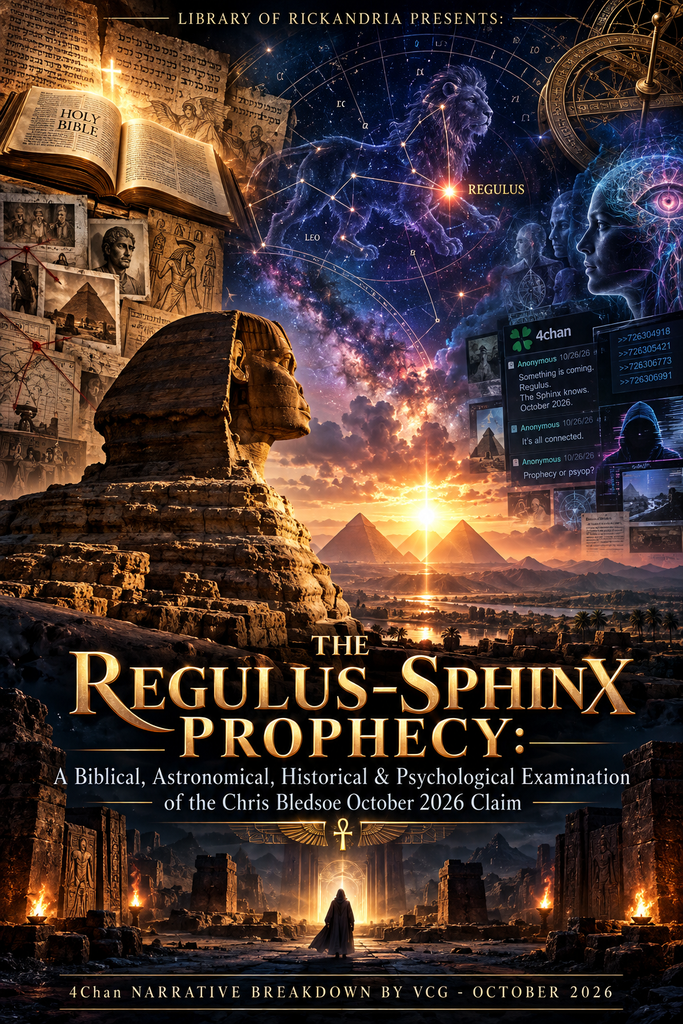
UPDATED BY VCG ON 10/06/2026 @ 06:14 EST
Anyone can do this, but most won’t.
ChatGPT – Library of Rickandria
LIBRARY OF RICKANDRIA PRESENTS
THE REGULUS–SPHINX PROPHECY
A Biblical, Astronomical, Historical & Psychological Examination of the Chris Bledsoe October 2026 Claim
4Chan Narrative Breakdown by VCG — October 2026
A pre-event source audit written October 6, 2026
Abstract
On October 5, 2026, an anonymous poster on 4Chan’s /x/ board announced that:
“The Bledsoe prophecy hits Florida at 10:35 PM tomorrow night.”
/x/ – Who else hyped for tomorrow?? – Paranormal – 4chan
What followed was a miniature version of the larger internet debate surrounding North Carolina UFO experiencer Chris Bledsoe:
one poster summarized his prophecy, several predicted that nothing would happen, another joked about the 2024 Bayside Marketplace “aliens,” and a final skeptic accused Bledsoe of moving a failed April prediction to October in order to continue profiting from believers.
This paper examines that thread without assuming either that extraordinary experiences are impossible or that extraordinary claims should be believed merely because they are spiritually impressive.
The investigation distinguishes five separate questions that are often collapsed into one:
What did Bledsoe actually claim?
How did the date develop historically?
Does the proposed astronomical geometry work?
What psychological processes may shape interpretation?
And how should a Christian evaluate an alleged supernatural messenger according to Scripture?
The principal findings are these.
The Regulus–Sphinx wording attributed to Bledsoe is real.
A publicly available excerpt of his 2023 book UFO of God reproduces the statement:
“When the red star of Regulus aligns just before dawn in the gaze of the Sphinx, a new knowledge shall come into the world.”
The same excerpt associates Bledsoe’s interpretation with Easter 2026.
However, the common skeptical claim that Easter failed and Bledsoe therefore invented October afterward is not supported by the chronology.
In an interview published before Easter, October 7 at approximately 5:30 a.m. Egyptian time was already being discussed, and Bledsoe stated that although he had written Easter in the book, he had never been certain of the astronomical date and was relying upon other people to calculate the alignment.
That correction does not establish the prophecy.
It establishes something subtler:
the celestial condition and the calendar interpretation must be kept separate.
Astronomically, a strict reading of the Regulus–Sphinx claim encounters a substantial problem.
The Great Sphinx faces east.
Using the Sphinx’s published coordinates, Regulus’s catalogued position, and standard U.S. Naval Observatory spherical-astronomy equations, Regulus rises at Giza on October 7 at approximately 76.3° azimuth, about 13.7° north of due east.
When Regulus later reaches due east—our strict operational definition of the Sphinx’s eastward “gaze”—it is already approximately 24.2° above the horizon.
Thus Regulus can be on the horizon, or it can be due east, but under the literal interpretation tested here it cannot be both simultaneously.
There is nevertheless a genuine and visually interesting celestial event on October 7:
the waning crescent Moon passes very close to Regulus, producing a lunar occultation from portions of Africa.
That is real astronomy, but the Moon is not part of the preserved Regulus–Sphinx prophecy and should not be added retrospectively as fulfillment.
Psychology provides useful tools for understanding how ambiguous events become meaningful narratives, including:
- pattern perception
- agency detection
- numerical precision
- confirmation processes
- post-disconfirmation reinterpretation
Those mechanisms are relevant to believers and skeptics alike.
They do not prove that any specific extraordinary claim is false.
Finally, Scripture establishes a stricter theological test than astronomical success.
Deuteronomy 13 explicitly describes a case in which a sign comes to pass yet the messenger is not therefore to be trusted.
Galatians 1 similarly refuses to make even an apparent:
“angel from heaven”
an authority above the received gospel.
And 1 John commands Christians not simply to believe spiritual manifestations but to:
“try the spirits whether they are of God.”
The governing principle of this investigation is therefore neither automatic belief nor automatic ridicule:
“Prove all things; hold fast that which is good.”— 1 Thessalonians 5:21, KJV/PCE
1. Why Study a Tiny 4Chan Thread This Carefully?
At first glance, Thread No. 43047277 hardly appears worthy of a research paper.
It contains eight substantive posts.
There is an excited opening prediction, one genuine question, one explanatory reply, several dismissive comments, two jokes, and one accusation of fraud.
But precisely because the thread is short, it gives us a clean example of how extraordinary claims move through the internet.
A complicated story involving:
- a claimed supernatural encounter
- a 2023 book
- an Egyptian monument
- stellar astronomy
- interpretations supplied by third parties
- religious language
and years of retelling becomes compressed into:
“The Bledsoe prophecy hits Florida at 10:35 PM.”
The skeptic then compresses it again:
He predicted April.
April failed.
He moved it to October.
He is a grifter.
Neither compression is adequate.
The purpose of this study is therefore larger than deciding whether one anonymous /x/ post is correct.
We are asking how to investigate claims at the intersection of:
- religion
- anomalous experience
- astronomy
- folklore
- social media
- prophecy
without letting either excitement or contempt perform the work of evidence.
2. Method: What Counts as Evidence?
The basic rule of this paper is simple:
Move backward toward the earliest recoverable source.
A 4Chan paraphrase does not carry the same evidentiary weight as Bledsoe’s own book.
A podcast host’s astronomical calculation is not automatically something “the Lady” said.
A later recollection that something was predicted in 2012 is not equivalent to a document demonstrably written in 2012.
Our working source hierarchy is therefore:
| Evidence type | Weight in this study |
|---|---|
| Contemporaneous recording, document, manuscript, astronomical catalogue | Highest |
| Bledsoe’s published book / direct recorded interview | High for establishing what Bledsoe says |
| Bledsoe-family podcast or later personal recollection | Useful but retrospective |
| Interviewer or podcast-host interpretation | Secondary |
| News or independent reporting | Good for externally verifiable events |
| Social-media summary | Contextual |
| Anonymous message-board paraphrase | Lowest for establishing original claims |
This distinction matters immediately.
Chris Bledsoe’s own website identifies him as:
- a North Carolina author
- speaker
- UFO experiencer
and former construction contractor whose 2023 book recounts his reported 2007 experience and its spiritual aftermath.
That establishes who he is and what he publicly claims; it does not independently verify the supernatural interpretation of those claims.
That difference—between
“Bledsoe reports X”
and
“X therefore happened exactly as interpreted”
—will be maintained throughout.
3. Claim Ledger
Before interpreting anything, we can reduce the controversy to discrete propositions.
| Claim | Present status |
|---|---|
| Chris Bledsoe was a North Carolina construction contractor | Verified from his official biography. |
| UFO of God contains the Regulus/Sphinx/new-knowledge prophecy | Verified through publicly reproduced book excerpt. |
| Bledsoe associated it with Easter 2026 | Verified. |
| October 7 was invented only after Easter failed | Contradicted by pre-Easter interview evidence. |
| Bledsoe depended on others to calculate the astronomical date | Supported by his own pre-Easter remarks. |
| The Great Sphinx faces east | Verified. |
| Regulus is intrinsically a red star | False. SIMBAD classifies it B8IVn; it is a hot B-type star. |
| A star can appear more reddish near the horizon | Physically plausible through atmospheric extinction/scattering. |
| Regulus is simultaneously on the horizon and due east from Giza on October 7 | Contradicted under a strict geometric definition. |
| 5:30–5:35 a.m. Giza corresponds to about 10:30–10:35 p.m. in most of Florida the prior evening | Verified by time zones. |
| 10:35 p.m. applies to all Florida | False. Florida occupies two time zones. |
| A real Moon–Regulus event occurs October 7 | Verified. |
| “New knowledge” has a precise publicly fixed definition | Not established. |
| Bledsoe intentionally fabricated the prophecy for money | Not established by the evidence reviewed. |
| A successful astronomical sign would biblically prove the messenger is from God | Explicitly false under Deuteronomy 13’s test. |
This ledger is important because different conclusions carry different levels of confidence.
We can strongly conclude that a calculation is geometrically inconsistent while remaining unable to conclude whether someone is lying about an experience.
Those are different claims.
4. Reconstructing the Prophecy Before Debating It
The core wording appears in a publicly available excerpt from UFO of God:
“When the red star of Regulus aligns just before dawn in the gaze of the Sphinx, a new knowledge shall come into the world.”
Immediately afterward, Bledsoe says that he had come to understand the timing as around Easter 2026.
That distinction is the first major key to the entire case.
There are at least two layers here:
Layer one:
the claimed message concerning Regulus, dawn, the Sphinx and “new knowledge.”
Layer two: Bledsoe’s interpretation that this refers to around Easter 2026.
Those should not automatically be fused into one statement.
Later interviews make this distinction even clearer.
In a pre-Easter 2026 interview, host AJ Gentile proposed October 7 at approximately 5:30 a.m. in connection with the Sphinx alignment.
Bledsoe responded that he had written Easter but had not been certain of the date and was dependent upon astronomical experts for the calculation.
A later discussion records Bledsoe saying that different people had at various times proposed fall, Easter, and then October calculations.
We therefore have an interpretive chain:
Claimed Lady-message → Bledsoe’s recollection → Bledsoe’s interpretation → third-party astronomy → podcast interpretation → social media → 4Chan.
At every stage, information can become more specific than the previous stage.
That is exactly what seems to have happened with 10:35 PM.
5. The Date Problem: Did Bledsoe Simply Move the Goalposts?
The strongest hostile post in the thread says:
“he said it was gonna happen in april 2026.”
It then argues that because nothing happened, Bledsoe simply moved the date forward and is therefore a grifter.
The first sentence has a factual basis.
Bledsoe’s book does associate the prophecy with Easter 2026.
The second conclusion is too simple.
The pre-Easter Why Files interview already contains the October 7 calculation.
In that conversation, Bledsoe plainly distinguishes the published Easter interpretation from his uncertainty concerning the actual astronomical alignment.
Therefore this chronology:
April fails → Bledsoe invents October
is not accurate.
A more defensible chronology is:
A claimed celestial message existed → various people attempted to calculate its date → Easter was published in the book → doubts and alternative calculations existed before Easter → October 7 became a later favored calculation.
That is much less satisfying as a one-line internet accusation, but it is what the evidence supports.
Yet this correction does not make the evidentiary problem disappear.
It changes the problem.
If a prophecy is publicly presented with an exact celestial fulfillment but the date must repeatedly be supplied or revised by outside calculators, then its chronological specificity comes increasingly from human interpretation, not necessarily from the claimed revelation.
That is weaker evidence than an unambiguous prediction saying beforehand:
October 7, 2026, 5:30 a.m., at these coordinates, Regulus will occupy this defined position and event X will follow.
We do not possess such a source.
6. What Does “Alignment” Actually Mean?
This is where the investigation becomes much more interesting.
“Regulus aligns in the gaze of the Sphinx”
sounds precise.
But geometrically, it is incomplete.
What counts as the Sphinx’s “gaze”?
Archaeological work from the Ancient Egypt Research Associates states straightforwardly that the Sphinx faces east.
For a strict prospective test, this paper operationalizes east as the cardinal azimuth of 90° measured clockwise from true north.
That does not mean every poetic use of “gaze” must be a mathematical laser line.
It means that if we are going to call something a specific astronomical alignment, we need a reproducible definition.
If a proponent instead means anything broadly in the eastern sky—say 60° to 120°—that is a possible interpretation, but it is much less specific and should be stated beforehand.
Without an angular tolerance, “alignment” can expand indefinitely.
That creates an interpretation problem rather than an astronomy problem.
7. The Regulus–Sphinx Geometry
The Great Sphinx’s published coordinates are approximately 29.9753° N, 31.1372° E.
SIMBAD lists Regulus as Alpha Leonis, with J2000 coordinates near right ascension 10h 08m 22s and declination +11°58′, together with measurable proper motion.
Using the coordinates propagated to 2026 gives a declination close to +11.84°.
The exact sub-arcminute refinements do not materially affect the conclusion below.
For an object on the geometric horizon, its rising azimuth can be obtained from:
\cos A = \frac{\sin\delta}{\cos\phi}
where:
(A) = azimuth measured from true north,
(\delta) = stellar declination,
(\phi) = observer latitude.
Substituting approximately:
\phi = 29.9753^\circ
and
\delta = 11.84^\circ
gives:
A \approx 76.3^\circ
Due east is:
90^\circ
So when Regulus is actually on the geometric horizon at Giza, it lies about:
90^\circ – 76.3^\circ = 13.7^\circ
north of due east.
That is not a microscopic discrepancy.
It is nearly fourteen degrees.
Now reverse the question.
Instead of asking,
“Where does Regulus rise?”
ask:
How high is Regulus when it reaches due east?
For azimuth (A=90^\circ), the spherical geometry reduces to approximately:
\sin h=\frac{\sin\delta}{\sin\phi}
yielding:
h \approx 24.2^\circ
So when Regulus is aligned with strict due east, it is already roughly 24 degrees above the horizon.
The same result can be reproduced through the U.S. Naval Observatory’s published altitude-and-azimuth equations using local hour angle, latitude, right ascension and declination.
This gives us the central astronomical finding:
Regulus cannot simultaneously be both “on the horizon” and on a strict due-east Sphinx sightline from Giza on October 7, 2026.
Near the horizon: wrong azimuth.
At due east: wrong altitude.
That is not an argument from skepticism. It is geometry.
8. What Happens at the Famous 5:30–5:35 a.m. Time?
Our calculation places Regulus’s geometric rise at approximately 3:35 a.m. Egyptian summer time on October 7.
It reaches approximately due east around 5:27 a.m.
At approximately 5:35 a.m., Regulus is roughly:
Altitude: 25.9°
Azimuth: 91.0°
So 5:30–5:35 a.m. really does have an astronomical property:
Regulus is approximately east of the observer at that time.
But by then it is nowhere near the geometric horizon.
This is why two people can use astronomical software, obtain real numbers, and still talk past one another.
One person may be testing:
“When is Regulus on the horizon?”
Another may be testing:
“When is Regulus due east?”
Those are different events.
The prophecy wording appears to combine them.
9. Could Atmospheric Refraction Save the Alignment?
No—not under the strict geometry.
Earth’s atmosphere bends light near the horizon.
The U.S. Naval Observatory uses approximately 34 arcminutes, or about 0.57°, as a conventional average horizontal refraction value.
Actual refraction varies with temperature, pressure and local atmospheric conditions.
That can alter an observed rise time and apparent altitude.
It cannot reasonably turn a 13.7° azimuth discrepancy into a due-east alignment.
Nor can ordinary refraction transform an object approximately 24° high into a horizon object.
Local topography can change when a star becomes visible above the physical landscape, but once again it does not solve the basic geometrical mismatch.
10. What About the “Red Star”?
Regulus is not intrinsically red.
SIMBAD currently classifies it as a B8IVn star.
B-type stars are hot and visually blue-white.
But Bledsoe’s claim need not necessarily mean that Regulus physically changes stellar type.
A bright blue-white star close to the horizon can appear warmer or redder because the observer is looking through vastly more atmosphere.
Sky & Telescope’s atmospheric-extinction guide gives a useful sense of scale:
an object at 30° altitude is seen through roughly two airmasses, at 10° through roughly 5.6, while an object near the horizon can involve an effective path approaching roughly 40 airmasses.
Therefore:
“Regulus could appear reddish when extremely low”
is physically plausible.
But the explanation creates the same conflict we have already identified.
When Regulus is extremely low, atmospheric reddening is strongest—but the star is around 14° north of strict due east.
When Regulus is due east, it is approximately 24° high, where the atmospheric path is dramatically smaller.
- Dust
- haze
- aerosols
or unusual weather could still affect its apparent color at 24°.
What we cannot say ahead of time is that October 7 necessarily produces a uniquely red Regulus at the exact eastward moment.
“Red” therefore also requires an operational definition.
Does it mean visibly orange-red to the unaided eye?
A photograph showing enhanced red?
A color-index threshold?
Any warmer appearance than normal?
Without specifying that beforehand, color becomes another elastic fulfillment condition.
11. October 7 Is Not Astronomically Empty
This matters because skeptics should not overstate their case either.
There really is a noteworthy October 7 celestial event involving Regulus.
The waning crescent Moon passes extremely close to the star, and an actual lunar occultation of Regulus is visible from parts of Africa.
Published astronomical guides give the global occultation window beginning around 01:14 GMT and ending around 05:04 GMT, with the Moon and Regulus separated by roughly half a degree near closest approach.
McDonald Observatory likewise notes the Moon-Regulus pairing for the October 7 dawn sky.
This could produce striking photographs.
It should not, however, be retroactively inserted into the prophecy unless an earlier source establishes that the Moon was part of the predicted sign.
The preserved sentence mentions:
Regulus.
Redness.
Before dawn.
The Sphinx.
New knowledge.
It does not mention the Moon.
A genuine Moon-Regulus conjunction is therefore context, not automatic fulfillment.
12. Where Does “10:35 PM Florida” Come From?
The opening 4Chan post says:
“The Bledsoe prophecy hits Florida at 10:35 PM tomorrow night.”
The phrase sounds as though Florida itself has prophetic significance.
There is no evidence of that in the source material reviewed here.
On October 7, Cairo is observing Eastern European Summer Time, UTC+3.
Most of Florida is observing Eastern Daylight Time, UTC−4.
Cairo is therefore seven hours ahead.
Thus:
5:35 a.m. October 7 in Egypt
becomes:
10:35 p.m. October 6 in most of Florida.
The apparent prophetic precision is simply a time zone conversion.
Florida also contains a Central Time region.
TimeAndDate lists both EDT and CDT currently operating within the state.
So in parts of the Panhandle, the corresponding clock time would be 9:35 p.m., not 10:35.
This is a good example of what might be called derived precision.
A highly exact number can feel evidentially impressive even when that exactness is inherited from a later calculation rather than independently predicted.
Experimental research by Zhang and Schwarz found that precise numbers can exert stronger influence on subsequent quantitative judgments than rounded numbers in contexts where people treat the communicator’s precision as meaningful.
That study was not about prophecy, so it should not be stretched into one.
It simply demonstrates that numerical precision can itself carry communicative weight.
The proper lesson is modest:
10:35 sounds more prophetic than “sometime tonight,” but the evidential value depends entirely upon where the number came from.
Here, it appears downstream from an astronomical calculation.
13. The “New Knowledge” Problem
The hardest part of the prophecy to test may not be Regulus.
It may be “new knowledge.”
What would count?
A scientific discovery?
Government disclosure concerning UAPs?
A new theological revelation?
A technological breakthrough?
A geopolitical event?
A spiritual awakening experienced by individuals?
The beginning of a cultural process lasting years?
An announcement made October 7?
Something discovered secretly that day and revealed years later?
These are not equivalent claims.
In the pre-Easter interview, the anticipated change is described in ways that allow for something subtle rather than a spectacular switch-like event.
That may accurately represent Bledsoe’s understanding.
But the broader the fulfillment condition becomes, the harder it is to falsify.
There will almost certainly be some:
- new discovery
- publication
- political announcement
- scientific result
or personal revelation somewhere in the world on October 7.
Therefore:
“something new became known”
cannot by itself establish fulfillment.
A meaningful prospective test requires that the new knowledge be identifiable independently of our desire to find it.
14. The Prospective Falsifiability Protocol
Because this paper is being written on October 6, 2026, before the proposed Egyptian observation, we have an unusual opportunity.
We can write the rules before seeing the result.
Under the strict literal reading used in this paper, the celestial component would require Regulus to satisfy, at minimum, all of the following concepts at once:
meaningful proximity to the eastern Sphinx sightline, meaningful proximity to the horizon, predawn visibility, and meaningful red appearance.
Our calculations already indicate that strict horizon and strict east cannot coincide.
A weaker interpretation may call a star 24° high
“in the gaze of the Sphinx.”
That is semantically possible, but then
“on the horizon”
must be relinquished or treated nonliterally.
Conversely, one may prioritize the horizon condition at 3:35 a.m., but then the strict eastward gaze must be relinquished.
The outcome claim requires similar discipline.
For this study, “new knowledge” should not be counted as fulfilled merely because some unrelated news becomes available.
A strong fulfillment would require an identifiable development that is both unusually relevant to the content of the prophecy and temporally connected in a manner established before the event rather than invented afterward.
Anything less can be discussed as suggestive or interesting, but not presented as demonstrated fulfillment.
15. What Would Change This Paper’s Conclusion?
A fair investigation should say what evidence could prove it wrong.
Our assessment would materially change if an authenticated earlier source were produced that clearly specifies October 7 independently of later calculations.
It would change if a contemporaneous description from the original Lady encounter precisely defined “gaze,” “horizon,” “red,” and “new knowledge” in a manner that matches the observation.
It would change if archaeological evidence showed that the intended Sphinx sightline was not being used in the ordinary eastward sense adopted here.
It would change if our astronomical inputs or equations were shown to be incorrect and a reproducible calculation demonstrated simultaneous horizon and sightline alignment.
And the theological assessment would require reconsideration of particular claims if substantially fuller source material showed that we had misrepresented what Bledsoe says about:
- Christ
- the gospel
- the Holy Spirit
or the nature of the Lady.
That openness is important.
A conclusion that no possible evidence could alter is not an investigation.
16. Line-by-Line Examination of the 4Chan Thread
Post No. 43047277: “The Bledsoe prophecy hits Florida at 10:35 PM”
This is the thread’s opening frame.
Its chief problem is not that the time is mathematically wrong.
For most of Florida, the time zone conversion is essentially correct.
Its problem is what the wording implies.
Nothing in the underlying prophecy makes Florida the target of an event.
Florida appears because somebody converted an Egyptian morning time into Eastern Daylight Time.
So “hits Florida” turns a time zone calculation into dramatic narrative language.
Likewise, “10:35 PM” feels like a revealed appointment even though our source trail indicates that the exact timing is downstream from astronomical interpretation.
The OP is therefore best described as dramatically framed but not wholly fabricated.
Scripture correction
The existence of a striking celestial configuration does not itself establish divine revelation.
The Christian posture is neither immediate acceptance nor ridicule:
“Despise not prophesyings.
Prove all things; hold fast that which is good.”
The order is important.
Do not automatically despise.
Do not automatically believe.
Test.
Post No. 43047352: “What’s the Bledsoe prophecy?”
There is nothing to rebut.
It is arguably the methodologically best post in the thread.
Before accepting or rejecting a claim, the poster asks what the claim actually is.
That is exactly what a careful investigation should do.
Post No. 43047364: The explanatory post
The response describes Bledsoe as a North Carolina contractor who says a divine feminine entity called “The Lady” revealed that new knowledge would accompany a 2026 celestial alignment involving Regulus, the Sphinx, the horizon and dawn.
Much of that broad outline is real.
Bledsoe’s official biography confirms his construction background.
The Regulus/Sphinx/new-knowledge wording is preserved in the publicly available book excerpt.
And later Bledsoe-related material does use divine-feminine language.
More importantly for theological analysis, Bledsoe himself stated in an August 2026 interview that his understanding of the Lady is:
“The Holy Spirit.”
Where the 4Chan summary becomes misleading is compression.
The celestial statement, the exact calendar date, and later theological interpretations do not all come from the same evidentiary layer.
That distinction must remain visible.
Post No. 43047379: The obscene skeptical counter-prophecy
The poster predicts that nothing will happen and mocks Bledsoe.
This contributes essentially no evidence.
It happens to point toward a proposition that can be tested, but ridicule is not the test.
A better skeptical statement would be:
“The literal horizon-plus-due-east alignment does not occur under a strict geometric reading.”
That claim can be shown.
Insult cannot.
There is a second problem with:
“nothing will happen.”
Something will happen astronomically:
the Moon will be extremely close to Regulus, and parts of Africa will see an occultation.
So careless skepticism can accidentally create an easy rhetorical victory for proponents.
The relevant question is never whether anything whatsoever happens.
It is whether the specified claim occurs.
Posts No. 43047693 and 43047862: “Nothing will happen”
These repeat the same basic skeptical expectation.
They may eventually turn out to be directionally correct concerning prophetic fulfillment, but they are too vague to function as analysis.
A critic should demand precision from himself as well as from the claimant.
“Nothing happens”
is almost certainly false in the literal sense.
“Nothing matching the pre-specified prophecy occurs”
is testable.
Those are different propositions.
Post No. 43047956: “Aliens are going to the Bayside Mall again?”
This references the January 1, 2024 incident at Miami’s Bayside Marketplace.
That incident produced a large police response and viral social-media claims involving enormous:
“shadow aliens.”
Contemporaneous reporting documents a large juvenile disturbance involving fighting and fireworks.
Four teenagers were arrested.
Miami Police later explicitly denied that aliens, UFOs or extraterrestrials were involved.
Therefore the post is referencing an established internet legend, not an established prior alien visitation.
It has no evidential bearing on Bledsoe’s prophecy.
But culturally it is revealing:
the thread immediately links one ambiguous paranormal narrative to another familiar paranormal meme.
That is how internet folklore networks itself.
Post No. 43047979: The parody prophecy
Another poster predicts his own drinking and sexual behavior at approximately 10:35–11:00 p.m.
Buried beneath the vulgarity is a legitimate logical point:
Exact timing is not the same thing as supernatural foreknowledge.
A person can announce an exact time for an ordinary or planned event.
But the parody does not directly rebut the Regulus claim because stellar motion is independently calculable.
The stronger critique is not:
“exact times are meaningless.”
It is:
The exact time in this case appears to come from ordinary celestial calculation, not independently revealed supernatural information.
Post No. 43048244: April, date-pushing, grifting and money
This is the thread’s most substantive skeptical post.
It also mixes one strong point with several unsupported leaps.
The strong point is that Easter 2026 genuinely appears in Bledsoe’s published interpretation.
The weak point is presenting October as something invented only after Easter failed.
The pre-Easter interview already documents October 7 as a proposed alternative.
The accusation of being a “grifter” goes further still.
Bledsoe sells books, appears at events, gives interviews and participates in a public media ecosystem.
His official website openly advertises those activities.
Commercial activity creates possible incentives worth noting.
It does not establish conscious fabrication.
To demonstrate fraud, we would need evidence not merely that a claim is mistaken, flexible or monetized, but that the claimant knows it is false and presents it as true for gain.
The reviewed thread does not supply that evidence.
Calling him a grifter may eventually prove correct or incorrect.
At present it is a motive attribution beyond the demonstrated facts.
A fact-check should not answer one speculative claim by creating another.
17. Psychology: Why Prophecy Narratives Become Persuasive
Psychological explanation must be handled carefully.
If we say,
“Believers perceive patterns, therefore the prophecy is false,”
we have committed a genetic fallacy.
A belief can arise through biased cognition and still accidentally be true.
Likewise, a skeptic can be motivated by identity, mockery, prior assumptions or group conformity and still be correct.
Psychology tells us about how people process evidence, not whether Regulus occupies a particular coordinate.
That is astronomy’s job.
Pattern perception
Van Prooijen, Douglas and De Inocencio conducted five studies examining relationships between illusory pattern perception and conspiracy or supernatural beliefs.
Their experiments included random coin-toss sequences, chaotic paintings and interpretations of world events.
They found meaningful associations between seeing patterns in ambiguous material and endorsement of conspiracy or supernatural claims.
That research helps explain why loosely connected facts—
- Regulus
- Leo
- Egypt
- the Sphinx
- a crescent Moon
- world events
and an exact time—can begin to feel like one coherent structure.
It does not prove this structure is false.
It tells us why independent verification is necessary.
Agency detection
Michiel van Elk’s 2013 experiment found that paranormal believers in his sample displayed a greater tendency toward reporting agency in ambiguous biological-motion stimuli than skeptics.
Importantly, the result was qualified by stimulus ambiguity and was not simply identical with conventional religious belief.
Again, this is not a diagnosis of Bledsoe or anyone in the thread.
No responsible paper can clinically characterize anonymous posters or a public figure from afar.
The relevance is methodological: human perception does not passively photograph reality.
It interprets.
Precision as persuasion
“10:35 PM” has an aura that “sometime tonight” does not.
Research on numeric precision demonstrates that precise numbers can receive greater weight in human judgment when hearers assume the precision is communicatively meaningful.
This helps explain why derived precision deserves special scrutiny.
The question should always be:
What measurement produced that decimal, minute or degree?
18. Failed Prophecy Psychology: More Complicated Than the Meme
There is a familiar popular story about failed prophecy:
A group predicts an event.
It fails.
Cognitive dissonance becomes unbearable.
The believers double down.
That story was famously associated with the 1956 book When Prophecy Fails.
But recent historical work requires caution.
Thomas Kelly’s 2025/2026 archival reanalysis argues that the famous UFO group at the center of the classic study did not behave as the canonical account claimed:
according to the recovered record, the leader recanted, the group dissolved, and the supposed post-failure proselytizing narrative was seriously misrepresented.
That does not mean cognitive dissonance is imaginary.
Other failed-prophecy cases clearly show reinterpretation.
A 2015 content analysis of Harold Camping’s radio program after his failed May 21, 2011 Judgment Day prediction found that he frequently preserved the essential truth of the original framework by moving toward less falsifiable components and theological rationalization.
The scientifically responsible conclusion is therefore not:
“When prophecy fails, believers always double down.”
It is:
Different people and groups respond to failed expectations by abandoning, modifying, spiritualizing, rationalizing, fragmenting, or retaining beliefs under different conditions.
That is what we should watch for here.
19. What to Watch For After October 7
If the literal expectations become difficult to defend, several interpretive moves would be methodologically important.
“Horizon” might broaden into “eastern sky.”
“Gaze” might broaden from a sightline into almost any part of Leo.
“Red” might become symbolic rather than visible.
The nearby Moon might become part of the sign despite not appearing in the preserved sentence.
“New knowledge” might become an invisible spiritual process.
The relevant date might expand from a moment to months or years.
None of those reinterpretations is automatically dishonest.
Language can genuinely be misunderstood.
But every post-event expansion makes the original claim harder to test.
For that reason, any change should be documented as a change in interpretation, not silently substituted for what readers understood beforehand.
The same rule applies to skeptics.
If a startling but ordinary Moon-Regulus event occurs, a skeptic should not pretend the sky was empty.
If Bledsoe produces an authenticated earlier source that changes the chronology, critics should update.
The point is not to win.
The point is to preserve the evidence.
20. 4Chan as a Narrative Machine
The /x/ thread is also interesting as media.
Anonymous image boards combine low reputational cost, rapid reply, irony, meme language, compressed storytelling and communal speculation.
Those features make them excellent places for a complicated narrative to mutate quickly.
In only eight substantive posts, this thread moves through:
prophecy,
astronomy,
alien folklore,
sexual parody,
failed prediction,
fraud accusation,
and financial motive.
No single poster has to construct the complete narrative.
The community assembles it collectively.
That is why anonymous threads can be excellent leads but poor final authorities.
They reveal what people are saying.
They do not automatically establish whether what people are saying is true.
21. Steelmanning the Bledsoe Position
A serious rebuttal should present the strongest reasonable version of the position it critiques.
The strongest defense of Bledsoe is not that every internet formulation is literally correct.
It is something like this:
Bledsoe reports receiving a symbolic celestial condition, not a modern astronomical timestamp.
The original message may have concerned Regulus, dawn, redness and the Sphinx in a looser phenomenological sense.
Bledsoe himself did not possess the expertise to calculate the date and relied upon outside astronomers or astrologers.
Therefore erroneous Easter calculations would be human interpretive failures rather than failures of the underlying message.
October 7 may represent a better approximation because Regulus passes the eastward axis while still visible in the predawn sky.
“New knowledge” may describe the beginning of a process rather than an instantaneous spectacle.
That formulation deserves to be taken seriously as the best version of the argument.
But notice its price.
The more we move from exact celestial prophecy to symbolic approximation, the less evidential weight can be placed on the apparent exactness of October 7 at 5:30 or 5:35 a.m.
One cannot simultaneously claim astonishing mathematical specificity and retreat to broad symbolic language whenever the mathematical conditions conflict.
The defense preserves the possibility of meaning.
It weakens the claim of precise prediction.
22. Steelmanning the Skeptical Position
The best skeptical case is also stronger than the 4Chan version.
It does not need to call anyone stupid or dishonest.
It can say:
The published interpretation associated the event with Easter 2026, which did not satisfy the literal predawn eastern geometry.
The favored date subsequently changed as outside interpreters recalculated it.
October 7 itself does not satisfy simultaneous horizon and due-east conditions.
The meaning of “red,” “gaze,” “alignment,” and especially “new knowledge” lacks sufficiently narrow prospective criteria.
This creates numerous routes by which ordinary celestial events or unrelated world developments could be matched to the prophecy after the fact.
Therefore the prophecy, as publicly transmitted, currently lacks the specificity required for strong evidential confirmation.
That is a much more powerful critique than:
“lol nothing will happen.”
23. Alternative Explanatory Models
We should resist a false choice between:
“Everything happened exactly as a supernatural being revealed it”
and
“Bledsoe consciously invented everything.”
Several explanatory models remain possible.
| Model | What it explains well | What it does not establish |
|---|---|---|
| Genuine divine revelation | Bledsoe’s reported spiritual certainty and meaningful experiences | Requires theological and evidential authentication |
| Genuine anomalous phenomenon, mistaken interpretation | Allows unusual experiences while explaining unstable symbolism/date interpretation | Does not identify the phenomenon |
| Sincere visionary/religious experience | Explains conviction without requiring conscious deception | Cannot by itself determine external reality |
| Narrative/folklore accretion | Explains increasing specificity through retelling | Does not prove the original experience was unreal |
| Cognitive/perceptual interpretation | Explains pattern and agency attribution | Psychology alone cannot falsify the external claim |
| Religious syncretism | Explains mixture of Christian and divine-feminine concepts | Requires careful source comparison |
| Deliberate fabrication | Could explain flexibility and commercialization | Requires evidence of knowing deception not presently established |
| Mixed model | Allows genuine experiences, memory, symbolism, incentives and reinterpretation to coexist | Harder to simplify into a single verdict |
At present, the evidence examined here is substantially better at testing the astronomical interpretation than identifying the ontological nature of Bledsoe’s experiences.
That limitation should be admitted.
24. The Lady: What Exactly Is Being Claimed?
This is where the paper moves from history and astronomy into theology.
Bledsoe’s later public interpretation is explicit.
Asked directly in an August 2026 interview who he understands the Lady to be, he answers:
“The Holy Spirit.”
Related Bledsoe-family discussion goes further into divine-feminine language, describing the Lady in terms of Mother, Holy Spirit, Comforter and a suppressed feminine dimension.
Those statements are theologically significant.
But again, we must distinguish three claims:
Bledsoe experienced something.
Bledsoe interprets that something as the Holy Spirit.
The something actually is the Holy Spirit.
The first is testimony.
The second is interpretation.
The third is a theological conclusion requiring independent testing.
Scripture does not instruct Christians to identify a spirit by:
- luminosity
- emotional power
- advanced knowledge
- apparent benevolence
- astronomical prediction
or even miraculous ability.
It supplies other criteria.
25. The Biblical Test Begins With Testing, Not Scoffing
The most balanced New Testament text for this investigation may be 1 Thessalonians 5:
“Quench not the Spirit.
Despise not prophesyings.
Prove all things; hold fast that which is good.”
That sequence guards against two opposite errors.
One error is reflexive unbelief:
“Anything supernatural is nonsense.”
The other is reflexive credulity:
“Anything supernatural must be from God.”
Paul permits neither.
Claims are to be tested.
This makes careful historical sourcing and astronomy entirely appropriate within a Christian investigation.
The Bereans are praised because they:
“searched the scriptures daily, whether those things were so.”
Investigation is not hostility to truth.
It is one means of honoring truth.
26. Deuteronomy 13: A Successful Sign Is Not Enough
This is probably the single most important biblical correction to the entire prophecy discussion.
Deuteronomy 13 presents a hypothetical prophet or dreamer who gives a sign.
And then Scripture explicitly says:
“And the sign or the wonder come to pass…”
Yet Israel is still told not to follow the messenger if the message draws them after other gods.
That means Scripture itself rejects the equation:
\text{accurate supernatural prediction} = \text{divine authentication}
Even if Regulus turned spectacularly crimson tomorrow morning…
Even if an impossible-looking object appeared over Giza…
Even if Bledsoe accurately predicted something no conventional model seemed capable of forecasting…
the biblical identity of the messenger would still require testing.
That is not skepticism imposed upon Scripture.
It is Scripture’s own standard.
27. Deuteronomy 18: Failed Prediction, Applied Carefully
Deuteronomy 18 gives the familiar test:
“When a prophet speaketh in the name of the LORD, if the thing follow not, nor come to pass, that is the thing which the LORD hath not spoken…”
This text matters.
But we should not weaponize it imprecisely.
The passage specifically addresses someone claiming to speak in the name of the LORD.
If Bledsoe’s position is that the Lady supplied only a symbolic celestial condition while human astronomers supplied the wrong date, then an erroneous Easter calculation is not automatically identical to a direct failed oracle from God.
We must distinguish:
failed revelation
from
failed interpretation of a claimed revelation.
However, repeated interpretive failure still matters evidentially.
If the only way to know when the prophecy occurs is through calculations that repeatedly change, then confidence in claims of exact prophetic timing should decrease accordingly.
Deuteronomy 18 also contrasts Israel with nations that listened to “observers of times” and diviners.
That leads to an important distinction.
Astronomy is not the same thing as divination.
Calculating where Regulus will be at 5:30 a.m. is measurement.
Treating stellar positions as autonomous spiritual authorities revealing hidden divine knowledge is another category entirely.
We should not fight astrology with bad astronomy.
28. Genesis 1:14 — Aren’t the Heavenly Lights “for Signs”?
Yes.
Genesis 1:14 says:
“Let there be lights in the firmament of the heaven to divide the day from the night; and let them be for signs, and for seasons, and for days, and years.”
That verse should not be ignored.
The biblical text plainly permits celestial bodies to serve as signs and markers.
But the verse does not say:
Every striking conjunction is a private prophecy.
Nor does it teach that humans may assign any desired spiritual meaning to planetary or stellar configurations.
Within Scripture itself, legitimate celestial signs occur under divine revelation.
The existence of biblical signs therefore does not remove the need to test a modern claimed sign.
Genesis 1:14 establishes possibility.
It does not establish this particular interpretation.
29. Isaiah 8: Where Should Spiritual Knowledge Be Sought?
Isaiah 8 addresses people being directed toward familiar spirits and wizards.
The prophet responds:
“should not a people seek unto their God?”
and then:
“To the law and to the testimony…”
The principle is relevant.
When a claimed entity offers religious knowledge, the Christian is not instructed to suspend prior revelation because the experience is impressive.
The claimed revelation is measured against what God has already given.
That moves our investigation away from:
“Was the light beautiful?”
or
“Did the prophecy know astronomy?”
toward:
“What doctrine is being communicated, and how does it relate to Scripture?”
30. 1 John 4: “Try the Spirits”
John is extraordinarily direct:
“Beloved, believe not every spirit, but try the spirits whether they are of God…”
He immediately grounds the test in confession concerning Jesus Christ come in the flesh.
This means the category:
“spiritual experience”
is not enough.
Nor is:
“loving message.”
Nor is
“healing.”
Nor is
“advanced knowledge.”
Nor is
“appeared during prayer.”
The spirit is to be tested.
A Christian paper therefore cannot simply accept Bledsoe’s later identification:
Lady = Holy Spirit
because he reports experiencing her that way.
That proposition itself is one of the things requiring examination.
31. Galatians 1: Even an Angel Is Not the Final Authority
Paul makes the hierarchy unmistakable:
“But though we, or an angel from heaven, preach any other gospel unto you than that which we have preached unto you, let him be accursed.”
Notice the force of the argument.
Paul does not say:
“If an angel appears, believe it because angels are supernatural.”
He places the apostolic gospel above the apparent rank of the messenger.
Therefore even if someone could establish beyond reasonable doubt that an encounter involved a nonhuman spiritual intelligence, the biblical discernment process would not be finished.
Nonhuman is not synonymous with divine.
Powerful is not synonymous with truthful.
Accurate is not synonymous with holy.
32. Matthew 24: Spectacle Is Not Self-Authenticating
Jesus warns that false Christs and false prophets may show:
“great signs and wonders.”
This passage should not be abused to declare Bledsoe a particular fulfillment of Matthew 24.
The text does not give us permission to assign identities casually.
Its relevance is narrower and stronger:
Biblically, spectacular phenomena do not authenticate themselves.
That principle agrees with Deuteronomy 13.
The more impressive a claimed sign becomes, the more—not less—important discernment becomes.
33. Does the Lady’s “Divine Feminine” Framing Match Scripture?
This requires caution.
The phrase “divine feminine” covers many different traditions, and internet critics often lump:
- Marian devotion
- ancient goddesses
- Sophia traditions
- occultism
- modern New Age spirituality
together without sufficient historical discrimination.
We should not do that.
What can be established is that Bledsoe-related material publicly uses divine-feminine categories and that Bledsoe himself identifies the Lady with the Holy Spirit.
The biblical text, however, presents the Holy Ghost in relation to the Father and the Son and does not identify the Holy Ghost as a suppressed goddess, missing feminine member of the Trinity, Hathor, Isis or an equivalent ancient deity.
Therefore those additional identifications cannot simply be imported into Christian doctrine on the authority of a modern apparition.
At minimum, they require independent biblical argument.
If the claim is that the church has fundamentally misunderstood the identity of the Holy Spirit and a modern entity is restoring the missing truth, then the issue is no longer merely UFO phenomenology.
It becomes a competing theological revelation.
Galatians 1 and 1 John 4 become especially relevant at that point.
34. Biblical Verdict: Even Fulfillment Would Not End the Investigation
This point deserves emphasis because it separates the Christian analysis from ordinary debunking.
Suppose our astronomical interpretation is too strict.
Suppose tomorrow morning observers photograph Regulus brilliantly red in a position they reasonably describe as the Sphinx’s gaze.
Suppose an extraordinary global disclosure follows.
Would that prove that the Lady is the Holy Spirit?
According to Scripture:
No.
Deuteronomy 13 already establishes that even a sign that comes to pass does not supersede doctrinal fidelity.
Galatians 1 says even an angelic messenger is subordinate to the gospel.
1 John says spiritual beings are to be tested.
So astronomy can test the astronomical proposition.
It cannot confer theological authority.
That is probably the most important conclusion in this entire paper.
35. Archival Protocol
Because online narratives change rapidly, future versions of this investigation should preserve rather than overwrite evidence.
The present 4Chan thread was accessed on October 6, 2026 while it remained live.
Its post numbers and timestamps should be preserved exactly as they appeared.
Likewise, future research should retain:
the 2023 book wording;
pre-Easter interview recordings/transcripts;
post-Easter explanations;
astronomical calculations;
screenshots of how October 7 was described before the event;
and any subsequent reinterpretations.
This matters because memory is not an archive.
Once an event becomes culturally important, people often remember earlier statements as more specific—or less specific—than they actually were.
Preserving the source solves that problem.
36. Calculation Appendix
For reproducibility, the principal inputs are:
Sphinx location: approximately 29.9753° N, 31.1372° E. Getty TGN.
Regulus: Alpha Leonis, SIMBAD position approximately RA 10h08m22s, Dec +11°58′, with proper motion listed in the catalogue.
Sphinx orientation: east. AERA.
Altitude/azimuth equations: U.S. Naval Observatory.
For altitude:
\sin a =
\cos(H)\cos(\delta)\cos(\phi)
+
\sin(\delta)\sin(\phi)
where (H) is local hour angle.
For geometric rising, (a=0^\circ).
That produces a rising azimuth near:
76.3^\circ
For a strict due-east crossing:
A=90^\circ
which produces altitude near:
24.2^\circ
Using sidereal time gives approximate local Egyptian summer times:
| Event | Approximate Giza time | Regulus position |
|---|---|---|
| Geometric rise | 03:35 | Az ≈ 76.3°, Alt ≈ 0° |
| Due-east crossing | 05:27 | Az ≈ 90°, Alt ≈ 24.2° |
| Frequently cited time | 05:35 | Az ≈ 91°, Alt ≈ 25.9° |
Atmospheric refraction changes apparent altitude and rise timing modestly but cannot erase the approximately 13.7° difference in azimuth.
USNO adopts about 34′ average horizontal refraction for ordinary sea-level computations.
Independent reproduction is encouraged.
If another calculation using defensible astronomical inputs materially differs, that should be incorporated rather than ignored.
37. The Easter 2026 Astronomy
Easter Sunday in 2026 fell on April 5.
A literal predawn eastward Regulus/Sphinx alignment does not work for that date.
At that season, Regulus is an evening/night object; by predawn at Giza it is in the western part of the sky and sets rather than rising eastward.
Our application of the same coordinate and sidereal-time method places Regulus below the western/northwestern horizon by the later predawn period.
So the published Easter interpretation was not a good match for the literal astronomical wording.
That makes Bledsoe’s admitted reliance upon outside calculations historically important.
It also means that moving away from Easter was not astronomically unreasonable.
But a corrected human calculation should not be mistaken for independent verification of a supernatural prediction.
38. Final Verdict Matrix — Before the Claimed Event
| Question | Pre-event assessment |
|---|---|
| Does the Regulus/Sphinx prophecy exist in Bledsoe-related source material? | Yes. |
| Did Bledsoe associate it with Easter 2026? | Yes. |
| Was October discussed only after Easter failed? | No. |
| Is the dating history stable? | No. |
| Does Regulus rise in the eastern part of the sky from Giza? | Yes. |
| Does the Sphinx face east? | Yes. |
| Is Regulus intrinsically red? | No. |
| Can it appear warmer/redder through atmospheric effects? | Yes, especially low in the sky. |
| Is Regulus on the horizon while simultaneously due east October 7? | No under the strict geometric test. |
| Is Regulus approximately due east around 5:30 a.m.? | Yes, but about 24–25° high. |
| Is there a genuine Moon–Regulus event October 7? | Yes. |
| Was that Moon event specified in the preserved prophecy? | Not in the wording located. |
| Is 10:35 p.m. a separately revealed prophetic time? | No evidence found; it appears to be timezone conversion. |
| Is “new knowledge” sufficiently defined for a strong falsification test? | No. |
| Does the evidence establish deliberate fraud? | No. |
| Would successful fulfillment alone biblically prove the Lady is the Holy Spirit? | No. |
39. Post-Event Addendum Protocol
This section is intentionally not filled in.
The present paper should remain frozen as an October 6, 2026 pre-event analysis.
After the proposed observation window passes, a separate dated addendum can compare what actually happened with the criteria written here.
The original paper should not be silently rewritten.
The addendum should record, separately:
observed weather at Giza;
photographs or video with original metadata if available;
measured Regulus altitude and azimuth;
reported naked-eye coloration;
what Bledsoe and his associates said immediately afterward;
whether any “new knowledge” was specifically identified;
and whether later interpretations differ from those documented before the event.
This creates an audit trail.
It also prevents us from doing to the evidence what we are warning others not to do.
40. Neither Scoffing nor Credulity
The 4Chan thread begins with excitement and ends with contempt.
Neither reaction is adequate.
The OP takes a complicated and changing interpretive history and compresses it into a precise Florida countdown.
The harshest skeptic takes a genuine Easter association, overlooks pre-Easter evidence concerning October, and converts uncertainty into an accusation of deliberate financial fraud.
Between those two extremes sits the evidence.
Chris Bledsoe really did publish a Regulus–Sphinx prophecy.
He really did associate it with Easter 2026.
The dating interpretation really did become unstable.
October really was being discussed before Easter failed.
The Sphinx really does face east.
Regulus really will occupy the eastern predawn sky.
A genuine Moon-Regulus celestial event really does occur on October 7.
A blue-white star really can undergo atmospheric color alteration.
And yet—
the literal astronomical conditions commonly bundled together do not coincide.
At the horizon, Regulus is roughly 13.7° north of strict due east.
At due east, Regulus is roughly 24.2° above the horizon.
The impressive-looking 10:35 p.m. Florida time appears to be a converted astronomical clock time rather than an independently revealed datum.
And “new knowledge” remains broad enough that almost any later development could potentially be interpreted as fulfillment unless the criterion is fixed beforehand.
Those observations substantially weaken the prophecy as a precise testable astronomical prediction.
They do not prove that Bledsoe consciously fabricated his experiences.
They do not prove that anomalous phenomena do not exist.
They do not prove that every claimed spiritual experience is psychological.
They do not permit us to diagnose Bledsoe.
And they certainly do not justify inventing motives for which we lack evidence.
The biblical conclusion goes deeper still.
Christian discernment does not finally depend upon whether a strange light can perform something impressive.
Deuteronomy 13 deliberately imagines the harder case: the sign happens.
The sign still does not become the final authority.
John says:
“believe not every spirit, but try the spirits whether they are of God.”
Paul says that even an angel from heaven does not possess authority to replace the received gospel.
And the Thessalonian command avoids both gullibility and reflexive mockery:
“Prove all things; hold fast that which is good.”
That is the appropriate method here.
Not fear.
Not excitement.
Not contempt.
Not internet consensus.
Not the prestige of government interest.
Not the beauty of an apparition.
Not even an accurate prediction by itself.
Test the history.
Test the astronomy.
Test the reasoning.
Test the sources.
Test the spiritual claim by Scripture.
Then retain only what survives.
Selected External Sources
The original 4Chan thread: Thread No. 43047277 on /x/
Chris Bledsoe’s official biography: UFO of God — About Chris Bledsoe
Publicly reproduced UFO of God quotation: Goodreads — UFO of God quotations
Pre-Easter interview discussing October 7: Why Files / Chris Bledsoe transcript
Later discussion of Easter/fall/October dating: Vetted transcript — Chris Bledsoe 2026 prophecy discussion
Bledsoe identifying the Lady as the Holy Spirit: Mayim Bialik’s Breakdown transcript
Great Sphinx archaeological orientation: Ancient Egypt Research Associates — Who Built the Sphinx?
Great Sphinx coordinates: Getty Thesaurus of Geographic Names — Great Sphinx
Regulus catalogue data: SIMBAD — Regulus / Alpha Leonis
Altitude and azimuth methodology: U.S. Naval Observatory — Computing Altitude and Azimuth
Atmospheric refraction: U.S. Naval Observatory — Rise, Set and Twilight Definitions
Atmospheric extinction/airmass: Sky & Telescope — Transparency and Atmospheric Extinction
Cairo timezone: TimeAndDate — Cairo time zone
Florida’s two time zones: TimeAndDate — Florida time zones
October 7 Moon-Regulus event: Regulus lunar occultation and conjunction details
Illusory pattern perception: van Prooijen, Douglas & De Inocencio — Connecting the Dots
Illusory agency detection: van Elk — Paranormal believers and agency detection
Numerical precision psychology: Zhang & Schwarz — The Power of Precise Numbers
Failed prophecy and Harold Camping: Sarno et al. — Rationalizing Judgment Day
Recent reassessment of When Prophecy Fails: Thomas Kelly — Debunking When Prophecy Fails
Bayside Marketplace reporting: NBC South Florida — Police response to Bayside alien rumors
Pre-event conclusion, October 6, 2026
Historically: the Regulus–Sphinx claim is authentic to Bledsoe’s published narrative, but the timing history is more complicated than either side of the 4Chan thread suggests.
Astronomically: October 7 gives a real predawn Regulus configuration, but the strict horizon-plus-due-east geometry is internally incompatible.
Psychologically: several well-studied mechanisms can facilitate pattern construction and post-hoc reinterpretation, but none of them proves Bledsoe’s experiences false.
Ethically: deliberate fraud and “grifting” have not been demonstrated by the evidence examined here.
Theologically: no astronomical outcome, however impressive, can by itself establish that a claimed spiritual entity is the Holy Spirit.
Scripture requires the messenger and message to be tested independently of the spectacle.
Methodologically: the strongest course is to preserve the pre-event claim exactly, observe what actually occurs, permit no silent goalpost changes by either proponents or skeptics, and follow the standard of 1 Thessalonians 5:21:
“Prove all things; hold fast that which is good.”
4CHAN THREAD & POST BREAKDOWNS – Library of Rickandria
VCG PAPER PROJECTS – Library of Rickandria