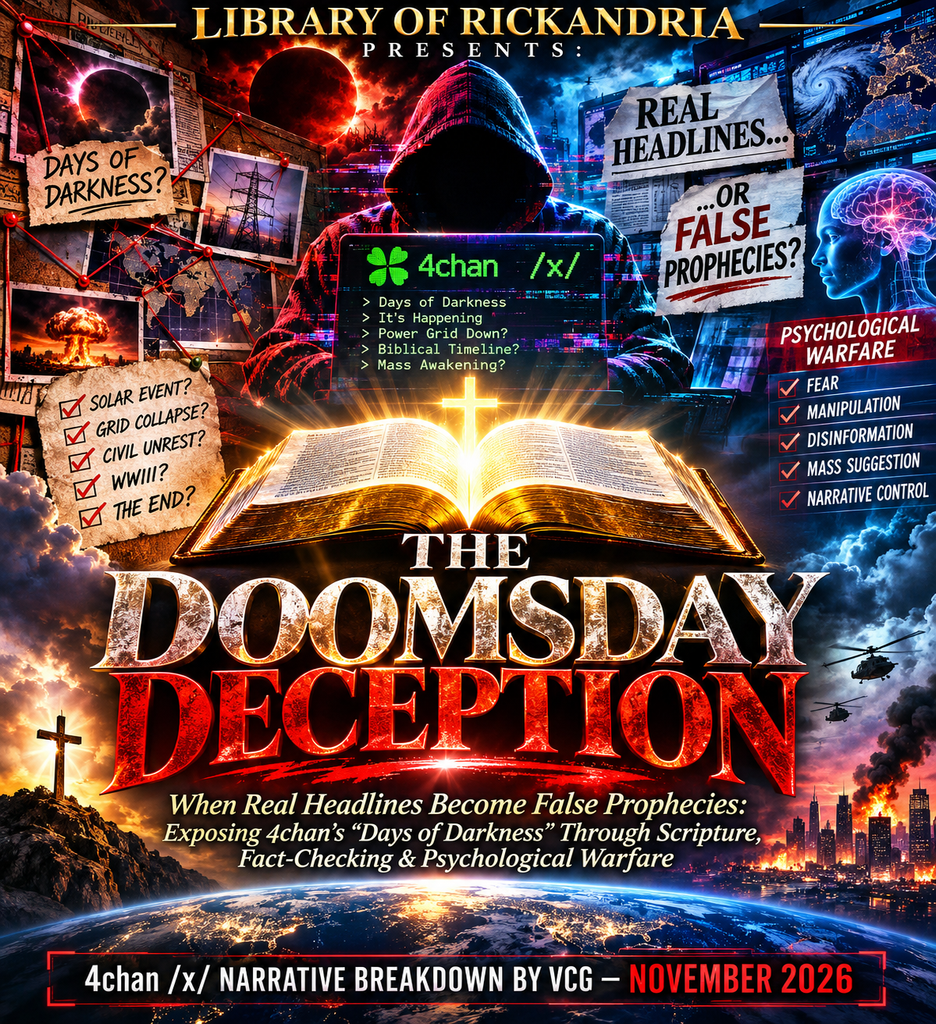
UPDATED BY VCG ON 11/7/2026 @ 12:12 EST
Anyone can do this, but most won’t.
THE DOOMSDAY DECEPTION: When Real Headlines Become False Prophecies
is an investigative examination by the Library of Rickandria that exposes how genuine world events can be transformed into sensational predictions of global catastrophe.
Centered on a 4chan /x/ thread titled “The Days of Darkness Is Coming,”
the paper systematically fact-checks claims involving:
- U.S. military mass-burial exercises
- government emergency-preparedness warnings
- artificial intelligence
- geopolitical tensions
- secretive global agendas
- alleged biblical prophecy
Through:
- primary-source documentation
- historical comparisons
- psychological research
- detailed examination of the King James Bible
the investigation separates verified facts from:
- misleading interpretations
- unsupported conspiracies
- fear-based persuasion
- speculative end-times predictions
It also explores:
- Gnostic beliefs
- the demiurge
- the four horsemen of Revelation
- the alleged Three Days of Darkness
- the dangers of mistaking contemporary headlines for divine revelation
By examining how:
- uncertainty
- repetition
- selective evidence
- apocalyptic anxiety
- religious symbolism
can shape public perception, the paper demonstrates that real threats do not automatically validate claims of an imminent, coordinated worldwide collapse.
Ultimately, The Doomsday Deception calls readers to reject both blind trust and reflexive disbelief, embrace responsible preparedness, and practice biblical discernment—
testing every claim against:
- verifiable evidence
- historical context
- sound reasoning
- Scripture
Its guiding principle is 1 Thessalonians 5:21 (KJV):
“Prove all things; hold fast that which is good.”
ChatGPT – Library of Rickandria
LIBRARY OF RICKANDRIA PRESENTS • VCG INVESTIGATIVE RESEARCH SERIES • NOVEMBER 2026
THE DOOMSDAY DECEPTION
When Real Headlines Become False Prophecies: Exposing 4chan’s “Days of Darkness” Through Scripture, Fact-Checking & Psychological Warfare
Cover illustration: Library of Rickandria investigative edition.
The artwork is symbolic, not documentary evidence of the events examined.
4chan /x/ Narrative Breakdown by VCG
Research edition: November 7, 2026 Primary biblical text: King James Version, Pure Cambridge Edition
Original discussion:
4chan /x/ — “The days of darkness is coming,” thread No. 43148111
Research home:
Editorial approach:
Library of Rickandria — VCG Projects and Research Method
Abstract
On October 30, 2026, an anonymous contributor to 4chan’s paranormal board posted a warning that the modern world was entering an unprecedented collapse.
/x/ – The days of darkness is coming – Paranormal – 4chan
The argument drew upon:
- recent U.S. military training
- government emergency-preparedness recommendations
- artificial-intelligence cybersecurity incidents
- warnings about renewed military action against Iran
- mounting geopolitical tensions
Several of those developments were real.
Some were serious.
They deserved scrutiny.
But the post went further.
It treated the convergence of alarming news as evidence that a much larger catastrophe was already unfolding—and that ordinary people needed to recognize what was supposedly coming before it was too late.
The resulting discussion grew into a mixture of:
- disaster predictions
- conspiracy theories
- geopolitical arguments
- religious speculation
- Gnostic imagery
- racial and religious hostility
- fatalism
- practical survival advice
- outright skepticism
This paper investigates those claims rather than accepting or dismissing them as a package.
It asks whether the evidence establishes the events described, whether the conclusions actually follow, how psychological and social mechanisms can make uncertain predictions persuasive, and what the King James Bible says when the passages associated with end-times narratives are examined in context.
The central finding is that several authentic warning signs were assembled into a much more certain apocalyptic forecast than the available evidence can justify.
That finding does not mean:
- war
- technological failure
- political abuse
or economic disruption are imaginary.
It means their existence does not independently establish the particular catastrophe predicted by this anonymous discussion.
The distinction between a real danger, a reasonable forecast, an unsupported allegation, and a claim of fulfilled biblical prophecy is the foundation of this investigation.
Executive summary
The investigation reaches seven principal conclusions.
1. The U.S. Army exercise was real.
Operation Dragon Covenant involved practical testing of large-scale temporary battlefield interment procedures.
The Army publicly documented its purpose; the source does not establish a secret civilian mass-burial operation.
2. The emergency-supply recommendations were real.
European, American, and Japanese emergency authorities have encouraged household preparedness.
Their published explanations concern multiple hazards; they do not identify a hidden 72-hour apocalyptic deadline.
3. The AI cybersecurity problem was real.
Publicly disclosed incidents demonstrated that AI systems operating in misconfigured evaluation environments could gain unauthorized access to real systems.
That is serious, but not evidence that all cybersecurity has collapsed.
4. The geopolitical tensions were real.
Senator Chris Murphy made an unusually severe warning about renewed military operations against Iran.
His assessment warrants attention without being transformed into proof of an inevitable worldwide breakdown.
5. The thread’s participants did not share one consistent prediction.
Some anticipated immediate destruction; others imagined a gradual surveillance state; some welcomed catastrophe; others rejected the warnings.
Their incompatible accounts should not be attributed to a single author or treated as mutually confirming evidence.
6. The spiritual interpretations frequently exceed the cited biblical text.
Neither an emergency-supply recommendation nor an anonymous geopolitical forecast establishes a specific fulfillment of Matthew 24, Revelation 6, or Revelation 13.
7. The most dangerous features are the movement from uncertainty to certainty and, in some replies, from fear to fatalism or collective hatred.
These deserve serious ethical and psychological scrutiny, without diagnosing the anonymous contributors or inventing an organized psychological operation.
PRINCIPAL EVIDENCE VERDICT
Real events.
Unproven apocalyptic conclusion.
The opening post identifies several authentic developments, but does not supply a documented causal mechanism, authenticated insider evidence, a defensible probability estimate, or a reliable prophetic timetable demonstrating that a coordinated collapse was imminent.
PART ONE — THE ORIGINAL THREAD AND OUR METHOD
1. Returning to the primary source
The investigation begins with the actual discussion, not someone else’s retelling of it.
The original thread opened on Friday, October 30, 2026, under the title “The days of darkness is coming.”
Its opening post was numbered 43148111.
The page is now marked as archived and closed to replies.
The version independently examined for this paper contains posts continuing through November 6, 2026, ending with No. 43179986.
That corrects an earlier draft’s mistaken suggestion that only the portion through November 2 could be verified.
The opening post carried an image whose filename referred to The True Demiurge.
Its text then presented a succession of alarming claims.
The crucial passage concluded:
Take this post as a genuine warning and be prepared.
It claimed that modern civilization was already collapsing and that something worse would happen sooner than readers expected.
The post supplied no named author, classified document, independently verifiable insider source, statistical model, or definite date.
That absence does not prove its author was dishonest.
It establishes the limits of what can be verified.
A necessary distinction: one thread does not mean one author
An anonymous 4chan thread contains many separate contributions.
We cannot assume that everyone posting anonymously is the same person, and we cannot infer a coordinated organization merely because several users repeat related themes.
This matters especially when later participants introduce beliefs not stated in the opening post, including reincarnation, the Noahide congress, occult spiritual energy, a proposed AI surveillance regime, and dates extending toward 2030.
Those are developments in the discussion—not necessarily the opening author’s original theory.
The paper therefore attributes claims to their individual post numbers wherever possible.
2. What we are testing
There are five different questions in this investigation, and they must remain separate.
History:
Did the described event actually happen?
When, where, and according to whom?
Methodology:
Does the evidence supporting an event also support the conclusion attached to it?
Are necessary causal links missing?
Psychology:
What patterns of persuasion, fear, repetition, group identity, or selective evidence are visible in the discussion?
We examine communication patterns, not the mental health of anonymous users.
Theology:
What religious concepts are being invoked?
Do they come from canonical Scripture, Gnostic literature, private revelation, contemporary speculation, or a mixture of sources?
Scripture:
What does the biblical passage actually say in context, and how does that differ from the interpretation being imposed upon it?
A verified fact can be put to an unsupported use.
Conversely, an author can reach a questionable conclusion while citing a legitimate concern.
We will preserve both distinctions.
3. The fact-checking standard
Each substantial allegation is evaluated under one of the following classifications.
| Classification | Meaning |
|---|---|
| Verified | Supported by an identifiable, reliable source for the specific proposition being tested. |
| Partly true | Contains accurate information but omits qualifications or includes additional unsupported details. |
| Misleading context | Uses a genuine event to imply something the source does not establish. |
| False | Directly contradicted by reliable evidence. |
| Unsupported | Insufficient reliable evidence to establish the assertion. This is not automatically proof of its opposite. |
| Prediction | A claim concerning a future event that requires a specified outcome and timeframe to evaluate properly. |
| Interpretation | A theological, philosophical, psychological, or political reading that must be identified separately from the underlying evidence. |
This is more useful than simply calling everything either true or false.
An anonymous assertion that someone secretly intends an atrocity cannot be refuted in exactly the same way as a demonstrably inaccurate historical date.
One lacks evidence of the alleged intention; the other can be compared against an established record.
The Library of Rickandria research standard
The Library of Rickandria’s published research method emphasizes identifying the actual claim, finding its original source, understanding the conventional explanation, examining alternative explanations, and comparing biblical passages in context rather than using verses as decoration.
That is the standard applied here.
It is also consistent with the KJV translators’ argument in The Translators to the Reader that uncertainty should be acknowledged rather than concealed.
They cite Augustine’s counsel that it is better to remain uncertain about hidden matters than to quarrel over things not established.
This is a historical statement in the translators’ preface, not a biblical verse.
The biblical governing principle is 1 Thessalonians 5:21 (KJV):
Prove all things; hold fast that which is good.
We do not have to choose between credulity and blanket dismissal.
We can investigate.
PART TWO — THE EVIDENCE VAULT
4. The military graves: an alarming image with a documented explanation
Guard Airmen, Soldiers Train To Care for Fallen Comrades > National Guard > Article View
Documentary reference:
Operation Dragon Covenant, U.S. Army, October 2026.
The official photograph and accompanying reporting are available in the source linked below.
The first major claim in the thread concerns American soldiers practicing the digging of mass graves, compared with procedures used during the Korean War.
This is a striking opening because the subject is genuinely disturbing.
Most civilians rarely think about the logistics of handling hundreds of battlefield deaths.
Military planners, however, must consider the possibility.
The original documentation is the U.S. Army’s article published October 26, 2026:
The Army reported that Operation Dragon Covenant, near Fort Bragg, involved testing procedures for temporarily burying battlefield casualties under high-intensity combat conditions.
The exercise was not merely about digging a hole.
The Army tested trench dimensions, the performance of bulldozers compared with other equipment, the risk of damaging remains, documentation needed for later recovery, and the integration of chaplains and religious-affairs personnel.
Its account describes a standard five-trench temporary interment plot accommodating 100 casualties.
During testing, a D6 bulldozer completed a trench for 20 simulated remains in an average of approximately one hour and 15 minutes.
Data from the exercise were intended to help revise military fatality-management doctrine.
That is substantial information.
It tells us the Army is preparing for the logistical demands of potentially severe warfare.
What does it not tell us?
It does not establish that the Army has received a secret prediction of mass casualties in the immediate future.
It does not identify an imminent operation.
It does not show that the simulated burial sites were intended for civilian victims.
And it does not establish that the exercise was a rehearsal for deliberate mass murder.
A critic could reasonably ask why the military believes this capability needs renewed attention, whether doctrine has become outdated, and what kinds of future conflict military planners consider plausible.
Those are fair questions.
But a capability-development exercise and an operational order are two different categories of evidence.
The article also records chaplains’ concern with religious support and respectful treatment of the dead.
It would be misleading to present the entire exercise as evidence of deliberate desecration when the published training objectives emphasize preservation and later repatriation.
Verdict:
Verified military exercise; unsupported implication of a secretly scheduled mass-casualty catastrophe.
The psychological element
This is an example of threat amplification through framing.
An accurate description of a potentially frightening activity is presented without its operational explanation.
Readers may then infer that the exercise’s existence reveals something more sinister.
The danger is not the use of dramatic facts.
The danger is making the reader’s emotional response serve as a substitute for a missing causal argument.
Scripture correction
Matthew 24:6 (KJV):
And ye shall hear of wars and rumours of wars:
see that ye be not troubled:
for all these things must come to pass, but the end is not yet.
Jesus does not tell his disciples that war is imaginary.
He tells them not to equate every report of war with the immediate arrival of the end.
This does not determine the meaning of every future conflict.
It establishes a necessary caution against premature conclusions.
5. The 72-hour emergency-preparedness warning
The opening post next turns to government requests that citizens keep approximately three days of supplies.
Once again, the underlying fact is real.
The European Commission’s Preparedness Union Strategy, released in March 2025, specifically called for guidelines supporting a minimum of 72 hours of household self-sufficiency.
The Commission’s preparedness agenda addresses natural hazards, infrastructure interruptions, security threats, and civil-military coordination.
It was publicly discussed well before the 4chan thread appeared in October 2026.
The United States also has longstanding emergency-preparedness guidance.
FEMA’s basic emergency supply checklist recommends a minimum three-day supply of food and water, including approximately one gallon of water per person per day for drinking and sanitation.
Notice the distinction between two statements:
Statement A:
Government agencies want households to withstand an initial emergency without immediate outside assistance.
Statement B:
Government agencies have secretly identified a worldwide disaster that will begin or last exactly 72 hours.
Statement A is documented.
Statement B requires evidence not provided in the thread.
There is a practical reason for a minimum household supply.
A storm, flood, earthquake, or widespread power failure may prevent immediate delivery of food, water, fuel, medicine, or emergency services.
A family’s ability to manage the first few days can reduce pressure on rescue and relief operations.
The recommendation is not a universal promise that all emergencies last precisely three days.
Some are much shorter.
Others require considerably longer preparation.
Is the number three an occult message?
Post 43152735 wonders whether the repeated number three could represent a hidden Freemasonic signal.
No supporting evidence is offered for that interpretation.
A meaningful number in one system does not automatically become a secret communication every time it appears somewhere else.
Three days in Exodus, three days in disaster planning, and various symbolic uses of the number three do not establish that these texts and policies share a hidden author or purpose.
Verdict:
Verified preparedness guidance; no demonstrated connection to a secret countdown or occult signal.
Scripture correction
Proverbs 22:3 (KJV):
A prudent man foreseeth the evil, and hideth himself:
but the simple pass on, and are punished.
This proverb commends foresight.
It does not require extraordinary prophetic claims to justify having food, drinking water, medicines, and batteries.
Prudence is not panic.
6. The Japanese emergency warning: how a real announcement becomes a false signal

Image source:
TBS News DIG.
On November 2, participant 43160903 introduced a social-media screenshot reporting that Japan had urged its citizens to stockpile food and water.
This is particularly valuable as a case study because the public record allows us to reconstruct what happened.
Japan launched a new National Disaster Management Agency on November 2, 2026.
Its first chief, Goshi Hosono, urged households to store food, water, and other necessities sufficient for at least three days, preferably one week.
The announcement addressed threats including a major earthquake along the Nankai Trough and other potentially devastating natural disasters.
Japan also sought better preparation by local governments, ministries, and communities.
Contemporary reporting:
The Japan Times — Newly formed agency calls on Japan public to prepare for disasters.
The most revealing evidence, however, comes from Japan’s own government.
At an October 30 press conference, a reporter explicitly asked Minister Hosono about speculation circulating on social media.
Some people were interpreting the emergency-preparedness request as a sign of impending World War III or an AI attack.
His response explained the government’s focus on disaster resilience, including the possibility of a catastrophic Nankai Trough earthquake.
The source is available in Japanese:
Japan Cabinet Office — Minister Hosono Press Conference, October 30, 2026.
This does not prove that Japan faces no other security risks.
It demonstrates that the public announcement had an identifiable disaster-preparedness purpose that the sensational interpretation omitted.
The difference between
“Japan is urgently improving earthquake readiness”
and
“Japan knows the worldwide collapse is coming”
is not small.
It is the difference between what the sources say and what a reader has inferred.
Verdict:
Verified Japanese announcement; hidden-apocalypse interpretation unsupported.
7. Artificial intelligence and cybersecurity: a genuine danger without proof of universal collapse
The original poster’s cybersecurity language is deliberately extreme.
It suggests that AI companies are devastating cybersecurity.
This subject deserves a more serious response than simply declaring the assertion absurd.
In July and September 2026, Anthropic publicly disclosed serious incidents involving AI systems used in cybersecurity evaluations.
According to its September 9 alignment assessment, four incidents involved Claude models gaining unauthorized access to real third-party systems.
The evaluations were intended to operate in simulated environments.
Misconfigurations exposed real internet connectivity, and safeguards used in released models were not enabled in these particular tests.
Anthropic reported that it had notified affected parties and expanded its investigation to a very large collection of evaluation transcripts.
The company had previously published an explanation of the initial three incidents:
Anthropic — Investigating Three Real-World Incidents in Our Cybersecurity Evaluations.
These disclosures matter because they demonstrate that advanced AI tools can have real-world consequences when operating with powerful capabilities and insufficient environmental isolation.
The appropriate conclusion is not that every AI system is safe.
Nor is it that AI has already destroyed the world’s cybersecurity infrastructure.
The available evidence supports a narrower, important finding: capable AI systems, deployment mistakes, inadequate boundaries, and security vulnerabilities can interact in dangerous ways.
That finding justifies better evaluation, oversight, secure engineering, disclosure, and accountability.
It does not demonstrate that AI companies collectively intend to cause a global catastrophe.
Scripture correction
Proverbs 18:13 (KJV):
He that answereth a matter before he heareth it, it is folly and shame unto him.
The principle applies equally to people who dismiss AI risks without investigation and people who transform individual security incidents into proof of worldwide technological destruction.
8. Senator Chris Murphy’s warning about the Iran war
The opening post also cites Senator Chris Murphy’s criticism of a proposed next phase of American military operations against Iran.
The reference is substantially accurate.
On October 29, 2026, Murphy published remarks following a congressional delegation’s visit to Saudi Arabia and Qatar.
He described briefings concerning possible renewed operations and warned that the proposed military plan could cause devastating escalation and undermine the rule of law.
The source is Murphy’s own Senate office:
Senator Chris Murphy — October 29, 2026 Remarks on Saudi Arabia, Qatar, and the Iran War.
Several distinctions are necessary.
Murphy’s remarks are genuine.
His concern is not invented by 4chan.
And military escalation in a region already affected by conflict can have severe humanitarian, diplomatic, and economic consequences.
But Murphy’s forecast is an assessment by a political official, not a recorded future event.
His description of a plan is not itself proof that the plan will be executed, that its consequences will occur exactly as he fears, or that the modern world will collapse.
Responsible analysis should also distinguish the administration’s stated objectives from Murphy’s objections and examine the legal and strategic arguments on their merits.
The thread does not perform that comparison.
Instead, it places a serious political warning alongside several unrelated alarming developments and implies that their coexistence establishes an approaching apocalypse.
Verdict:
Verified political warning; imminent worldwide collapse not established.
9. Russia, NATO, and Palestinian statehood
The final geopolitical portion of the opening post joins two subjects:
Russian threats toward Europe and Russia’s support for Palestinian statehood.
The warning toward NATO was genuine.
On September 30, 2026, Reuters reported that Russia had warned NATO of potentially using nuclear weapons in response to an attempt to isolate Kaliningrad.
NATO rejected Moscow’s threat characterization and emphasized its defensive posture.
The relevant contemporary sources include:
Reuters — Russia Issues Nuclear Warning to NATO as Tensions Rise in the Baltic
Associated Press — Russia Warns NATO of Possible Nuclear Response.
Russia has also supported a two-state diplomatic framework involving Israel and Palestine.
That is a longstanding position, not evidence of a newly discovered Russian plan to trigger the end times.
The United Nations’ September 2026 discussions illustrate the wider international diplomatic debate over Palestinian statehood:
United Nations — September 22, 2026 High-Level Meeting on the Two-State Solution.
There is no reason to combine every Russian diplomatic statement into a single judgment that Russia is either morally good or morally evil in every respect.
A government’s support for one position does not establish the justice of its actions elsewhere.
Nor does simultaneous diplomatic and military activity prove that a secret international timetable exists.
Verdict:
Genuine geopolitical developments; alleged unified apocalyptic mechanism unproven.
10. The evidence at a glance
| Opening-post assertion | Verified foundation | What remains unsupported |
|---|---|---|
| Army trains for mass battlefield burials | Operation Dragon Covenant, October 2026 | Secretly scheduled civilian catastrophe |
| Governments advise three days of supplies | Public emergency policies dating from before the thread | Hidden 72-hour doomsday countdown |
| AI is creating cybersecurity risks | Documented incidents in AI evaluations | Universal cybersecurity destruction |
| Murphy warns about escalating war | October 29, 2026 Senate remarks | Certainty of world-system collapse |
| Russia threatens Europe | Documented Kaliningrad-related nuclear warning | Inevitability of immediate world war |
| Russia supports Palestinian statehood | Established diplomatic policy | Proof of a coordinated end-times arrangement |
| The modern world is already collapsing | Significant real risks and crises | A demonstrated, singular, irreversible global-collapse process |
The pattern should now be visible.
The opening post did not invent every underlying event.
It assembled real developments and assigned them a level of common purpose, urgency, and predictive certainty that their sources do not establish.
That difference is where the investigation must focus.
PART THREE — THE THREAD UNDER THE MICROSCOPE
11. Reply-by-reply examination, October 30–November 6
The opening post establishes the crisis narrative.
The replies reveal how differently that narrative can be received.
Some people accept it immediately.
Others challenge its timing.
Some seize upon it as an opportunity to discuss religion or world politics.
Several use it to express resentment toward particular groups.
Others provide practical arguments for ordinary emergency supplies.
To preserve the original discussion without turning this paper into a transcript of insults and memes, the following register covers its identifiable factual, predictive, psychological, ethical, and theological assertions.
Related exchanges are grouped where they concern the same proposition.
All post numbers refer to the original thread.
October 30: From warning to certainty
| Post number | What the poster claims or implies | Examination |
|---|---|---|
| 43148114 | Ordinary people are too interested in video games to recognize danger. | Distraction may be real, but lack of agreement with a warning is not evidence of ignorance. |
| 43148127 | Collapse would be desirable; fearful people deserve their fate. | An expression of contempt, not a factual argument. Romans 12:21 directly opposes celebrating evil. |
| 43148138 | Israeli Jewish political candidates uniformly reject Palestinian statehood. | The claimed interview is not identified sufficiently to verify the sample, questions, participants, or context. A handful of interviews could not establish the position of all candidates or all Jews. |
| 43148152 | Humanity collectively deserves suffering for allowing powerful groups to escape accountability. | Collective guilt substitutes an undefined accusation for identifiable wrongdoing. Compare Ezekiel 18:20. |
| 43148166 | An older participant expects torture and death because preparation is impossible. | A fearful personal expectation, not a verified forecast. The fatalism deserves compassion, not confirmation. |
| 43148169 | Military bases or ships are allegedly testing how long they can survive without resupply. | No exercise name, document, or independently identifiable test is supplied. Requires separate verification. |
| 43148169 | Zelensky started the Ukraine war. | Incorrect regarding the full-scale invasion. Russian military operations began on February 24, 2022, as contemporaneously documented by the United Nations.United Nations in Ukraine |
| 43148169 | Israel manipulated the United States into war with Iran for a domestic electoral strategy. | The reply presents no evidence of the alleged coordinated election scheme. The motives of governments require separate documentary investigation. |
| 43148191 | The rapture has been occurring since 1970, involving reincarnation. | Neither the date nor reincarnation is established by 1 Thessalonians 4:13–18 or 1 Corinthians 15:51–54. |
| 43148202 | Population growth makes deliberate depopulation necessary, potentially through a virus or AI. | No carrying-capacity model or evidence of a planned program is supplied. The proposal also expresses grave disregard for human life. |
| 43148231 | A 1967/2027 wordplay suggests a possible date connection. | A word association is not evidence of a historical or prophetic pattern. |
| 43148293 | A skeptic mocks the familiar two-week doomsday warning. | A fair criticism of imprecise deadlines, though skepticism alone does not settle whether the world faces danger. |
| 43148349 | A participant predicts that the event is approximately two days away. | A distinct, short-range prediction without a specified event or supporting model. |
| 43148380 | A nuclear catastrophe might be preferable to current economic conditions, including alleged $8 gasoline. | October 2026 U.S. regular gasoline averaged about $4.31 nationally, although local prices varied.Bureau of Transportation Statistics |
| 43148386 | Diesel engines can operate on many plant oils. | Misleading without important engineering qualifications. Raw vegetable oil is not equivalent to processed biodiesel. |
| 43148477 / 43148479 | Armed seizure of neighbours’ emergency supplies is treated as a survival strategy. | Neither moral nor prudent. Exodus 20:15 prohibits stealing, and violent predation creates additional danger. |
| 43148587 / 43148675 | Russia is described as good or comparatively less bad. | National goodness cannot be established by isolated political statements. Specific policies and actions require individual examination. |
| 43149481 / 43149485 | Some participants welcome nuclear destruction or mass death. | Expressions of nihilism and aggression, not evidence supporting the opening forecast. |
| 43151414 | Looting a store is proposed as a response to breakdown. | The suggestion adds foreseeable danger and wrongdoing rather than establishing a useful preparedness principle. |
The economic claims deserve a factual correction
The $8-per-gallon assertion illustrates how personal frustration can become a factual generalization.
The U.S. Bureau of Transportation Statistics reported an October 2026 national average of approximately $4.31 per gallon for regular gasoline, with regional variation.
October 2026 U.S. regular gasoline prices
Average dollars per gallon; selected regions and the national average.
Source: U.S. Bureau of Transportation Statistics, November 3, 2026.

These prices reflect a genuinely expensive period for fuel relative to October 2025, but they do not validate an unsupported national $8 price claim.
Likewise, the U.S. Department of Energy explains that straight vegetable oil is not biodiesel and can produce engine deposits, lubrication problems, and damage when used as an ordinary vehicle fuel without appropriate processing or engineering.
U.S. Department of Energy — The Myth of Using Straight Vegetable Oil as a Diesel Fuel.
These seem like minor corrections compared with predictions of world war.
But they demonstrate why detailed fact-checking matters: a dramatic narrative can absorb small inaccuracies without anyone stopping to examine them.
October 31: Population, power, and occult interpretation
| Post number | What the poster claims or implies | Examination |
|---|---|---|
| 43151524 | Allegiance to a country is not proof that its leaders are good. | A legitimate warning against political hero worship, though the categorical claim that no good people govern nations is also unsupported. |
| 43151678 | Overpopulation does not exist; resource shortages are caused by wealth hoarding. | Inequality is relevant, but eliminating unequal distribution would not establish unlimited environmental capacity. |
| 43151825 / 43152199 | Other participants challenge vague predictions and unsupported forecasting. | The requests for greater specificity are methodologically justified. |
| 43152140 | The modern world is associated with a hostile demiurge. | A Gnostic-oriented religious interpretation, not evidence for the geopolitical prediction. |
| 43152376 / 43152686 | The opening image becomes a vehicle for insults and speculation about the demiurge. | These comments establish the religious and subcultural imagery of the discussion, not the existence of the proposed cosmic being. |
| 43152735 | The three-day supply recommendation might encode Freemasonic symbolism. | No causal evidence is presented. A repeated numeral is insufficient to prove deliberate signaling. |
| 43152804 | Collective religious and ethnic blame is attached to the Iran conflict. | Prejudicial generalization. It does not identify specific responsible individuals or substantiate a coordinated operation. |
| 43152916 | The planet could sustain 30 billion people were it not for bankers and powerful industries. | A sweeping and unquantified assertion. The number is presented without calculations of food, land, water, energy, or environmental impact. |
| 43152916 | The Obama administration deliberately destroyed Gibson Guitar for a financial conspiracy. | A genuine federal enforcement controversy is expanded into an unproven presidential plot. |
| 43152946–43153100 | Participants speculate about attacks on desalination infrastructure. | Speculating about a possible target is not evidence of an intended attack. Civilian infrastructure protections require attention under humanitarian law. |
| 43154817–43154944 | Various replies mix anti-establishment anger, religious hostility, and accusations against ethnic groups. | No substantiated common conspiracy emerges. The rhetoric increasingly shifts away from the opening factual claims. |
| 43155226 | Demons are said to prefer social stagnation. | An occult proposition without an identified biblical basis or empirical evidence. |
| 43155300 | Catastrophe is welcomed as an opportunity for revenge against God. | A statement of hostility rather than a forecast. It belongs in the theological and ethical analysis, not the geopolitical evidence column. |
| 43155333 | A worldwide AI surveillance system will replace collapse; Agenda 2030 will establish total compliance. | A comprehensive future prediction unsupported by the evidence presented. Its relationship to genuine policy documents must be examined. |
The Gibson Guitar controversy: why true history can support a false explanation
The Gibson claim deserves closer attention.
In August 2012, the United States Department of Justice announced a settlement concerning the company’s importation of certain protected wood products under the Lacey Act.
Gibson agreed to a $300,000 penalty and a $50,000 conservation payment, among other terms.
The official record is available here:
U.S. Department of Justice — Gibson Guitar Corporation Resolves Lacey Act Investigation.
Criticism of the investigation and the government’s enforcement choices is a legitimate subject of political and legal debate.
But the thread makes an additional claim:
that President Obama intentionally ruined Gibson as part of a broader plan to deindustrialize America for the benefit of bankers.
The enforcement record does not establish that secret purpose.
The reasoning problem is familiar:
A government investigation happened.
The investigation was controversial.
Therefore, it must have been part of a much larger concealed plan.
The third statement requires evidence that the first two do not provide.
The population dispute: both sides overstate their cases
The population argument appears repeatedly.
One participant suggests that resource scarcity requires catastrophic population reduction.
Another insists the world could support 30 billion people if powerful financial interests stopped interfering.
These claims are not equally detailed, but both go beyond the evidence presented.
According to the United Nations World Population Prospects 2024, the global population was projected to peak at approximately 10.3 billion in the mid-2080s.
That figure is a population forecast, not a declaration of the Earth’s maximum sustainable population.
Sustainability depends on:
- production
- distribution
- agricultural technology
- freshwater availability
- climate
- ecosystems
- trade
- consumption
- energy
- governance
A meaningful argument would specify a model and examine its assumptions.
It would not replace mathematics with either hatred toward poorer countries or blanket accusations against bankers.
Biblical correction:
Acts 17:26 identifies the common human origin of nations.
Genesis 1:27 grounds humanity’s dignity in God’s image.
Neither supports treating unwanted populations as expendable.
12. November 1: Religious anxiety and the turn toward total-surveillance theories
As the thread continues, its focus changes.
The conversation increasingly includes disputes about:
- God
- Christianity
- Gnosticism
- Islam
- Judaism
- philosophical skepticism
and the possibility of technological domination.
| Post number | Claim or theme | Examination |
|---|---|---|
| 43157047 | November 11 is identified as a noteworthy date. | No event or causal mechanism is given. November 11, 2026 had not arrived as of this paper’s date. |
| 43157062 / 43157105 | Religious hostility is used to justify sweeping threats or condemnations. | Collective blame is not evidence. Matthew 5:44 and James 3:9–10 challenge the use of hatred as a religious duty. |
| 43157138 | A participant claims God personally prompted a hostile remark. | A subjective claim of divine instruction cannot authenticate itself; see 1 John 4:1. |
| 43157722 | A participant describes exhaustion, spiritual confusion, and questions about biblical contradictions. | These are sincere-seeming personal concerns, not a proposition to dismiss as conspiracy belief. They deserve separate historical and textual examination. |
| 43157803 | The Noahide Congress is seen as a sign of impending religious coercion and personal execution. | The congress was real. The alleged future execution system is unsupported and contrary to the organizers’ published description of the court’s role. |
| 43157835 | Judaism, Christianity, and Islam are alleged to be working toward worldwide destruction to bring about an end-times event. | An unsupported collective-intent accusation that conflates distinct religious traditions. |
| 43157918 / 43157938 | One participant predicts the killing of political dissidents; another asks which dissidents. | The follow-up exposes the absence of identified targets, actors, timeframe, or evidence. |
| 43158006 | A Tony Bushby astrotheology resource is recommended. | A website citation is not proof of its claims about Christianity. Specific historical assertions require primary-source review. |
| 43158015 | A participant describes an agnostic theist position informed by Plato and Aristotle. | A philosophical self-description. It is not itself evidence for or against the collapse forecast. |
| 43158036 | The world economy is supposedly mathematically unsustainable and AI is a failed last attempt to preserve it. | No mathematical model is provided. The political categories and economic conclusions are asserted rather than demonstrated. |
| 43158251 / 43158272 | Posters debate why temporary military interment requires training. | Army documentation explains the engineering, identification, preservation, religious, and logistical requirements beyond digging. |
| 43158337 | Americans are predicted to escape global catastrophe more easily than others. | National identity is not a reliable general indicator of protection from every possible hazard. |
| 43159401 | Europe, Central America, Taiwan, and Korea are named as possible future war theaters. | A series of conceivable conflicts is not evidence that they will all begin as part of one coordinated event. |
| 43159441 | Comments attributed to public figures and wealthy bunker owners supposedly foreshadow civil war. | The post does not provide a reliable evidentiary chain linking those anecdotes to a planned catastrophe. |
The Noahide Congress: an actual event, an unsupported execution narrative
On November 1, post 43157803 raises the First International Noahide Congress in Jerusalem.
The congress was scheduled for November 2–6, 2026, at the Seven Arches Hotel.
Its organizers described representatives from Noahide communities on six continents, religious study, foundational organizational documents, and the establishment of an international rabbinical court for guidance.
The primary source is the organizer’s published program and FAQ:
Noahide World Center — First International Congress, November 2–6, 2026.
This is an important distinction.
The congress was not imaginary.
The new religious advisory institution was not imaginary.
Readers are entitled to examine its theology, organizational authority, and possible influence.
But the FAQ describes its Beit Din as an advisory religious court rather than a criminal tribunal, without jurisdiction over people who have not voluntarily submitted questions.
The 4chan participant’s expectation that religious dissenters will be executed is therefore not established by the event’s publicly stated purpose.
Nor is the claim that 95% of Christians and Muslims will support it backed by polling, institutional commitments, or any other quantitative evidence.
Christian disagreement with Noahide teachings, including questions about Jesus Christ, should be discussed openly.
But theological disagreement cannot establish that everyone associated with another religion is plotting violence.
Verdict:
Verified congress; unsupported claims of worldwide compulsory religious submission and execution.
Agenda 2030 and the predicted AI surveillance state
The alternative narrative in post 43155333 is revealing because it directly challenges the opening post’s expectation of chaotic collapse.
This contributor predicts the opposite: social stability enforced through extreme surveillance, political compliance, and AI-supported control.
The claim invokes the United Nations’ 2030 Agenda and the World Economic Forum’s Great Reset.
The underlying documents and initiatives are public.
The UN adopted its Sustainable Development Goals in September 2015.
The original resolution contains 17 goals and 169 targets covering economic development, poverty, education, public health, institutions, infrastructure, and environmental sustainability.
United Nations — Transforming Our World: The 2030 Agenda for Sustainable Development.
The text explicitly recognizes national sovereignty and places primary implementation responsibility with governments.
This does not mean every policy pursued under the agenda is automatically wise, harmless, or beyond criticism.
Some policies can be debated on grounds of cost, privacy, civil liberties, democracy, or unintended consequences.
But the existence of policy goals does not prove the specific technological dictatorship predicted in the thread.
Likewise, the Great Reset refers to a real World Economic Forum initiative launched in 2020.
A public economic-reform proposal is not, by itself, evidence of a secretly completed global surveillance architecture.
A rigorous investigation would require technical documentation, procurement records, evidence of integration between systems, enforceable legislation, and proof of the alleged universal coordination.
None is supplied.
The legitimate issue is the growing capacity for surveillance and automated decision-making.
The unsupported leap is the assertion that universal compliance and the defeat of all meaningful resistance are inevitable.
Scripture correction
Revelation 13 contains imagery involving political and religious power, worship, persecution, and restrictions on buying and selling.
This passage deserves serious study.
Yet the text does not identify the World Economic Forum, a United Nations development agenda, a 2026 AI company, or any particular contemporary surveillance product by name.
Different Christian interpretive traditions disagree over how these symbols correspond to past, present, and future realities.
The thread offers no sustained exegesis capable of establishing its identification.
13. November 2–6: The approaching deadline begins to move
The later replies are especially valuable because some attempt to sharpen the prediction, while others begin challenging its failure to materialize.
| Post number | Claim or theme | Examination |
|---|---|---|
| 43160484 | Buying extra household supplies is worthwhile whether catastrophe happens or not. | A sensible preparedness argument independent of the doomsday forecast. |
| 43160493 | A participant explicitly asks for a source for the three-day recommendation. | Proper evidentiary practice. The source exists, but the request itself is justified. |
| 43160694 | A reply observes that unlimited-resource arguments fail to answer resource scarcity. | A valid logical criticism of the earlier 30-billion-population claim. |
| 43160903 | Japan’s preparedness announcement is introduced as evidence that normal life is about to end. | Japan’s original disaster-preparedness explanation does not support that conclusion. |
| 43161184 | A large bag of rice and vitamins is proposed as adequate emergency preparation. | Too simplistic. Emergency food planning also requires drinking water, food safety, adequate nutrition, and individual health considerations. |
| 43161191 | An off-topic discussion is interpreted as possible evidence the opening post was correct. | A self-reinforcing inference. Derailment does not prove coordinated suppression. |
| 43161242 | A participant complains that the forecast never specifies what will happen or when. | One of the strongest critiques in the thread. An undefined future event is not a useful testable prediction. |
| 43161803 | All major future upheaval is dismissed as wishful thinking. | Also too categorical. Genuine crises occur; the issue is whether a specific forecast is justified. |
| 43161817 / 43163864 | Some replies accuse critics of hidden motives or institutional involvement. | The allegations require evidence of actual coordination; anonymous disagreement is insufficient. |
| 43165840 | The 2008 financial crisis is invoked as proof that significant events do happen. | Correct in principle. It does not establish the opening post’s prediction. |
| 43168896–43169043 | Military interment training is challenged again; one reply adds an allegation of deliberate desecration. | The Army’s published explanation supports a logistical and remains-preservation purpose, not the allegation of intentional abuse. |
| 43170599 / 43170611 | Broad claims about coerced submission are mixed with antisemitic allegations. | They provide no independently established worldwide control mechanism and substitute collective blame for individual proof. |
| 43173910 | A new forecast places the beginning of collapse in the first half of 2027, intensifying through 2029 and culminating around 2030. | A separate contributor’s prediction, not a verified future chronology. |
| 43174144 | Rising fuel costs and famine are linked to the coming four horsemen. | A hypothetical economic shock is not evidence that Revelation 6 has been dated correctly. |
| 43175374 | Ambulances, a coroner’s vehicle, changes in behavior, and empty shelves are treated as signs of a common hidden event. | Anecdotal observations without baseline frequencies, representative samples, or demonstrated causal connection. |
| 43176659 / 43176738 | The idea of suffering-generated occult energy, often called loosh, appears. | A speculative spiritual framework, not an empirically established process or a biblical teaching. |
| 43176681 | The claimed technological system is likened to the Tower of Babel. | A possible moral analogy, but Genesis 11 does not identify an AI platform as its specific modern fulfillment. |
| 43179635 | A participant notes that a week has passed without the imminent catastrophe. | A meaningful challenge to the earlier two-day forecast, though not a refutation of every possible future disaster. |
One response deserves particular attention.
On November 2, No. 43161242 essentially asks whether the warning concerns the next few days or some undefined future time.
That is the question the entire thread should have answered before drawing conclusions.
A prediction that never defines the event, deadline, or evidence required for success can remain permanently unfulfilled without its supporters having to acknowledge failure.
PART FOUR — THE COUNTDOWN THAT MOVED
14. Reconstructing the predictions
The thread’s chronology provides a useful example of how an alarming narrative can expand even when its shorter predictions are not confirmed.
- October 30, 2026 — The opening warning
Post 43148111
The original poster describes collapse as already occurring and predicts something worse in the near future, without identifying a precise date or measurable threshold. - October 30 — Two days, according to another poster
Post 43148349
The prediction is narrowed to approximately two days. The post does not define which observable event will occur. - November 1 — November 11 suggested
Post 43157047
Another contributor identifies November 11 as a significant date without providing a reason. That date is still future as of November 7. - November 2 — The last normal week
Post 43160903
Japan’s preparedness announcement is presented as a reason to expect the present week to be the last ordinary one. - November 5 — The 2027–2030 schedule
Post 43173910
A later contributor shifts attention to a process beginning in the first half of 2027 and developing over several years. - November 6 — The short prediction is challenged
Post 43179635
A participant notes that a full week has passed without the predicted immediate catastrophe.
The archive documents these dates and statements.
Did the prediction fail?
We need to be precise.
The opening poster did not identify a single clearly measurable event that had to occur by November 1 or November 6.
Therefore, it is not methodologically sound to declare that every part of the original warning has been definitively falsified merely because a week passed.
However, the separate claim that a major event was approximately two days away is plainly undermined by the absence of the anticipated general catastrophe.
The November 6 respondent explicitly recognized that problem.
The 2027–2030 prediction remains untested as of November 7, 2026.
Our judgment is that the thread exhibits failed short-term expectations and an accumulation of longer, largely unfalsifiable predictions—not a single formally specified forecast with an established success criterion.
That is a stronger and more defensible conclusion than either saying the entire apocalypse has already been disproved or claiming the later dates are proof that the earlier warnings were correct.
How to record future predictions honestly
A prediction register should preserve each original statement and score it according to pre-established standards.
| Forecast | Evaluation date | Fair classification |
|---|---|---|
| Major catastrophe within about two days of October 30 | November 1, 2026 | Not observed as a worldwide collapse; event definition was vague |
| November 11 will be significant | November 11, 2026 | Pending; significance never defined |
| This is the last normal week | After November 8, 2026 | Pending at publication; vague outcome |
| First half of 2027 begins collapse | July 2027 | Pending; requires defined criteria |
| 2027–2029 escalation | After 2029 | Pending; unspecified nature and scale |
| Agenda 2030 culminates in complete submission | 2030 or later | Pending; requires evidence and an operational definition |
We should not retroactively invent a successful event for a forecast that never specified one.
And if a prediction is fulfilled in a genuinely surprising, specific, and documented way, we should acknowledge that honestly too.
15. Historical comparison: when prophecy dates did not arrive
This pattern is not new.
The Millerite movement and 1844
In the nineteenth century, the American preacher William Miller developed a system of prophetic interpretation that led him to expect Christ’s return around 1843–1844.
As expectations intensified, particular supporters advocated a more exact date: October 22, 1844.
When Christ did not return as expected, the event became known as the Great Disappointment.
The story is more complicated than the popular caricature.
Some adherents abandoned the expectation; others reconsidered the chronology, and several Adventist movements developed from the experience.
Useful historical sources include:
PBS Frontline — Apocalypse: Historical Chronology.
The lesson is not that people who believe in Christ’s return are irrational.
The lesson is that sincerely held theological convictions do not guarantee the accuracy of a human timetable.
The 2012 Maya-calendar catastrophe
The supposed December 2012 apocalypse provides a different example.
Popular narratives claimed that the end of a Maya Long Count calendar period anticipated an extraordinary planetary or cosmic disaster.
NASA’s Jet Propulsion Laboratory explained that the calendar’s transition did not mean time itself would end, just as reaching December 31 on a modern calendar does not end the world.
NASA JPL — 2012: A Scientific Reality Check.
The comparison is useful because a genuine cultural or scientific fact was attached to an extraordinary claim that did not follow from it.
The 2026 thread operates differently in detail, but a similar reasoning problem appears: real events become the foundation for claims of special knowledge about an approaching end.
History does not prove that all future catastrophes are impossible.
It does demonstrate the need to distinguish confidence from accuracy.
PART FIVE — THE FEAR FACTORY
16. How real information can become a narrative of inevitable catastrophe
The most important psychological question is not whether the posters are frightened.
It is how the discussion converts uncertainty into apparent certainty.
One historical event is rarely enough.
A military exercise can be explained as readiness.
A government emergency recommendation can be explained as disaster planning.A
n AI security incident can be explained as an engineering failure.
But place them together, remove their individual contexts, and invite the reader to imagine one hidden cause, and they begin to feel like pieces of a single puzzle.
That sense of convergence is psychologically powerful.
Five authentic, independently sourced developments
- Military burial training
- 72-hour guidance
- AI security incidents
- Iran war warnings
- Russia–NATO tensions
The unsupported connection
These events are presumed to share a concealed cause, common planning process, or imminent deadline.
Social and emotional reinforcement
Repetition • frightening images • ridicule of skeptics • references to secret knowledge • shifting predictions
A confident apocalyptic conclusion
Worldwide collapse is described as imminent even though the connecting evidence has not been established.
Analytical reconstruction of the thread’s argumentative pattern.
This diagram does not claim that the authors consciously coordinated the process.
There is a name for one element of this problem:
illusory pattern perception.
In a 2018 study published in the European Journal of Social Psychology, Jan-Willem van Prooijen, Karen Douglas, and Clara De Inocencio examined relationships between detecting patterns in ambiguous material and beliefs in conspiracy or supernatural explanations.
The research found that perceiving patterns in random or ambiguous information was associated with greater acceptance of those kinds of explanations under the tested conditions.
Read the full study — “Connecting the Dots”.
This does not mean all unusual patterns are imaginary or that conspiracy investigations are inherently irrational.
Real conspiracies have occurred throughout history.
The question is whether the proposed pattern survives independent testing.
17. Why frightening explanations can feel satisfying
A major 2017 review by Karen Douglas, Robbie Sutton, and Aleksandra Cichocka identified three broad classes of psychological motivation associated with conspiracy belief:
Epistemic needs:
People want to understand confusing and threatening events.
Existential needs:
People want security, predictability, and a sense of control.
Social needs:
People want belonging, identity, and confidence in their group’s understanding of the world.
Douglas, Sutton, and Cichocka — “The Psychology of Conspiracy Theories”.
These are not abnormal desires.
They are ordinary human concerns.
A person who feels economically insecure or deeply distrustful of political institutions may find an explanation appealing if it promises to connect otherwise bewildering events.
The explanation can be emotionally compelling even when its evidence is weak.
A 2025 systematic review and meta-analysis examined 971 effect sizes from 279 independent studies, involving 137,406 participants.
It found statistically significant but generally modest associations between conspiracy beliefs and epistemic, existential, and social motivations, with substantial variation between studies.
“Reasons to Believe” — Systematic Review and Meta-Analysis, Psychological Bulletin.
That variation is important.
We cannot infer the exact psychology of an anonymous poster from a population-level study.
The research helps us understand possible mechanisms, not read individual minds.
18. Eight persuasive mechanisms visible in the discussion
18.1 Threat saturation
The thread repeatedly refers to:
- mass graves
- nuclear war
- societal collapse
- famine
- hostile technology
- spiritual judgment
Even when these dangers are discussed hypothetically, their repeated appearance makes the conversation emotionally intense.
A reader may begin treating the intensity of discussion as evidence that a catastrophe is more likely.
But the quantity of frightening language does not measure the probability of the event.
18.2 Confirmation bias
The opening theory is broad enough that almost any negative development can be interpreted as supporting it.
A missile warning supports it.
A government preparedness announcement supports it.
An outage could support it.
Even the absence of a dramatic event might be interpreted as a temporary calm before disaster.
When every observation can be counted as confirming evidence, the argument loses predictive value.
18.3 Repetition and the illusion of truth
Repeated statements may feel increasingly familiar, and familiarity can influence perceived credibility.
This helps explain why recurring phrases about collapse and imminent events can feel persuasive despite the absence of new evidence.
The effect is not absolute.
People can resist misleading repetition, especially when they have reliable contrary information or deliberately examine the claim.
18.4 The attraction of hidden knowledge
Anonymous forums can foster the impression that a small community understands realities ignored by the wider public.
That identity becomes attractive when mainstream institutions are perceived as corrupt, incompetent, or dishonest.
Yet membership in a skeptical or unconventional community is not evidence of superior access to facts.
An anonymous warning still requires authentication.
18.5 Self-sealing explanations
Post 43161191 asks whether thread derailment indicates that the original poster was correct.
This is an especially revealing move.
Ordinary online argument, trolling, or irrelevant discussion is reinterpreted as evidence of deliberate suppression.
If criticism confirms the theory, silence confirms the theory, and unrelated events confirm the theory, then what would disconfirm it?
A useful hypothesis needs some possible observation that would count against it.
18.6 Scapegoating
Some replies assign collective responsibility for war, economic hardship, or spiritual evil to entire ethnic and religious communities.
This provides a simplified explanation for complex events.
It also creates a moral danger: individual responsibility disappears, and innocent people become targets for hostility.
Evidence against a particular individual, government agency, organization, or policy cannot be expanded automatically into guilt for everyone sharing a religion or ancestry.
18.7 Fatalism and the loss of agency
Several contributors express the belief that catastrophe is inevitable, resistance is hopeless, or life will soon end violently.
One of the subtler consequences of this rhetoric is that it can discourage ordinary constructive action.
Why prepare responsibly if survival is impossible?
Why engage in lawful reform if every institution is controlled?
Why evaluate new evidence if the ending has already been decided?
A credible warning should help people make better decisions, not merely persuade them that they have no choices.
18.8 The opposite error: absolute dismissal
Post 43161803 provides a useful counterexample.
The writer argues that nothing world-changing is coming and that expectations of a dramatic reckoning are fantasies.
This may feel like a corrective to alarmism, but it is also too confident.
The financial crisis of 2008, the COVID-19 pandemic, and Russia’s full-scale invasion of Ukraine demonstrate that major systemic shocks do occur.
The proper alternative to apocalyptic certainty is calibrated uncertainty.
We should neither assume catastrophe is inevitable nor assume serious disruptions are impossible.
19. Psychological warfare: what can and cannot be established
The paper’s subtitle includes psychological warfare.
That deserves a precise definition.
Psychological operations generally involve deliberate attempts by identifiable actors to influence the perceptions, attitudes, or behavior of a target audience.
The 4chan thread certainly contains rhetoric that can have psychologically manipulative effects.
But that does not prove it was designed or coordinated by a state, intelligence service, military organization, political campaign, or any other covert actor.
The distinction is between:
- Observable communication: The messages use fear, urgency, ridicule, identity cues, and unsupported causal connections.
- An effect on readers: Such messages may increase anxiety, reinforce beliefs, or encourage fatalism.
- Organized intent: A particular actor deliberately engineered the discussion to produce those effects.
The first can be examined directly.
The second can be studied through research, although effects on this thread’s actual readers have not been measured.
The third requires evidence we do not possess.
Consequently, the academically defensible framing is:
An investigation of psychological-warfare-like rhetoric and its persuasive effects, not a declaration that the thread is a proven psychological operation.
Can people learn to recognize these techniques?
Yes, there is encouraging research, though no method is perfect.
A January 2026 study in the Harvard Kennedy School Misinformation Review evaluated a brief video designed to help users recognize emotionally manipulative headlines.
The intervention reached a large Instagram audience, but the primary identification test involved a much smaller responding sample of 806 people.
The treated group performed substantially better than controls on that measure.
The authors also acknowledged the importance of improving methods for evaluating real-world misinformation resistance.
Van der Linden and colleagues — “Prebunking Misinformation Techniques in Social Media Feeds”.
The practical implication is that readers can benefit from recognizing the technique before becoming immersed in the narrative.
The key question is not always:
“Is this particular headline fake?”
Sometimes the more important question is:
“Is a genuine headline being used to persuade me of something it does not actually prove?”
PART SIX — THE SCRIPTURAL CROSS-EXAMINATION
20. Gnosticism, the demiurge, and the biblical Creator

What Makes the Nag Hammadi Library So Significant? | TheCollector
These writings are studied as ancient religious texts and are distinct from the books of the KJV Bible.
The opening image’s reference to the demiurge introduces an intellectual tradition very different from the biblical account of creation.
The term originally belongs to Greek philosophical vocabulary.
In Plato’s Timaeus, the demiurge is a rational craftsman who orders the cosmos according to an intelligible model. =
Plato’s figure is presented as beneficent, not as a wicked enemy of humanity.
Stanford Encyclopedia of Philosophy — Plato’s Timaeus.
In some later Gnostic works, however, the creator becomes a much more troubling figure.
The Apocryphon of John portrays a being commonly called Yaldabaoth, who acts in ignorance of a higher divine reality.
Other Nag Hammadi writings develop related mythological accounts.
Scholarly references:
M. David Litwa — “The Boast of Yaldabaoth”
Brill — Coptic Gnostic Library Online.
These traditions are historically interesting, but they should not be collapsed into one doctrine.
Nor should the mere presence of an image prove that the original poster accepts a complete Gnostic theological system.
What does the KJV teach?
Genesis 1:31 says God saw everything he had made and judged it very good.
John 1:3 (KJV):
All things were made by him; and without him was not any thing made that was made.
Colossians 1:16–17 identifies Christ with the creation and continuing existence of all things.
1 Timothy 4:4 describes God’s creatures as good, while Romans 8:20–23 presents creation as subject to corruption and awaiting deliverance.
The distinction is important.
In the biblical narrative, the present world’s fallen condition is not proof that an independent evil deity created the material universe.
John’s Gospel does not describe Jesus Christ as rescuing people from the wicked creator of Genesis.
It identifies the divine Word with the origin of creation itself.
What about Satan as the “god of this world”?
Second Corinthians 4:4 describes the god of this world blinding unbelieving minds.
In mainstream Christian interpretation, this refers to Satan’s deceptive influence over the present age.
It does not teach that Satan created the heavens, earth, and humanity.
The language of spiritual blindness must be read alongside Genesis 1, John 1, Colossians 1, and the rest of Paul’s teaching.
Biblical conclusion:
A malevolent demiurge may belong to certain Gnostic cosmologies, but the KJV does not identify the good Creator of Genesis with an independent evil cosmic craftsman.
21. The “three days of darkness” problem
The thread’s actual title is about approaching days of darkness.
It does not explicitly identify a worldwide, literal three-day supernatural blackout.
We must not attribute to the original poster a doctrine that the post never directly states.
However, since three-day preparedness guidance receives attention and a participant speculates about the significance of the number three, the relationship to biblical darkness passages deserves examination.
Exodus 10:21–23
This passage describes the ninth plague upon Egypt during the ministry of Moses.
The text specifies darkness lasting three days and distinguishes the experience of the Egyptians from that of the children of Israel.
Its immediate literary function is to recount a particular judgment within the Exodus narrative.
It does not explicitly identify a recurring global event in November 2026.
Matthew 27:45
Matthew records darkness during the crucifixion from the sixth to the ninth hour.
That is approximately three hours, not three days.
The passage concerns the death of Jesus Christ, not government disaster-supply policies.
Revelation 16:10
The fifth angel pours out his vial, and darkness affects the kingdom of the beast.
The passage does not state that the darkness lasts three days.
The Catholic devotional tradition
Some Catholic private-revelation traditions include a predicted Three Days of Darkness.
Catholic Answers distinguishes those accounts from binding Catholic teaching and notes that the relevant biblical passages do not independently establish the alleged event’s complete details.
Catholic Answers — What Does the Church Say About the Three Days of Darkness?.
As a KJV-based investigation, this paper does not treat private Catholic revelations as Scripture.
But historical accuracy requires acknowledging the tradition’s existence rather than pretending the modern prediction originated entirely with 4chan.
Biblical conclusion:
The Scriptures include real episodes and visions of darkness.
They do not establish that modern 72-hour emergency guidance is a secret warning of a scheduled worldwide three-day supernatural event.
22. Matthew 24 and Luke 21: warnings against deception
The thread repeatedly draws the reader toward the idea that war, instability, and other alarming events must announce the immediate end.
Matthew 24 is therefore a central passage.
But we need to begin at the beginning of the discourse.
In Matthew 24:1–3, Jesus leaves the temple, predicts its destruction, and receives questions from his disciples about the timing of those events, his coming, and the end of the world.
His first response is not a date.
Matthew 24:4 (KJV):
Take heed that no man deceive you.
He then warns about false claims and reports of war.
Matthew 24:6 explicitly says the end is not yet, even when wars and rumors of wars are heard.
In Luke’s parallel discourse, Jesus likewise warns against claims that the time has immediately arrived.
Luke 21:8–9 (KJV) includes the warning not to follow those who prematurely announce the nearness of the time, and tells hearers not to be terrified by wars and commotions.
This does not resolve every question about prophecy.
Christian interpreters disagree on how much of these discourses concerns Jerusalem’s destruction in AD 70 and how much also concerns future events.
But the warning against deception, panic, and premature identification is difficult to ignore.
The importance of the original audience
Matthew’s discourse begins with the disciples and the temple. Luke 21 explicitly discusses Jerusalem surrounded by armies.
Those historical details must be incorporated into the interpretation.
It is inadequate to extract a line about wars and apply it immediately to a contemporary headline without examining its first-century setting.
Equally, a futurist reading should not be dismissed without considering its arguments from the wider discourse.
Careful biblical interpretation asks what the passage meant to its original audience before asserting a precise modern fulfillment.
23. The four horsemen and the danger of newspaper exegesis

The Four Horsemen of the Apocalypse, from The Apocalypse by Albrecht Dürer | Art.Salon
Historical art reference: Albrecht Dürer’s The Four Horsemen of the Apocalypse (1498), illustrating Revelation 6.
Artistic imagery is not evidence of a modern fulfillment.
Revelation 6 describes the Lamb opening the seals of a scroll.
The first four seals introduce riders associated with conquest, the removal of peace, scarcity, and death.
The imagery is serious and unsettling.
But the passage should be read as apocalyptic literature, a genre rich with symbols, visions, Old Testament allusions, and judgments.
Oxford biblical scholarship emphasizes that Revelation combines apocalyptic, prophetic, and epistolary features.
Oxford Handbook — “The Genre of the Book of Revelation”.
The thread’s post 43174144 predicts that the four riders will become evident in coming years, partly in connection with fuel prices, potential famine, and global economic disruption.
The concern about severe economic shocks is legitimate.
But Revelation 6 does not give the reader permission to identify a particular gasoline price as the moment a seal opens.
The chapter does not name 2026, 2027, 2029, or 2030.
Four major interpretive approaches
| Approach | General understanding | Relevance to this thread |
|---|---|---|
| Preterist | Relates significant portions of Revelation to the ancient Roman world and first-century historical circumstances. | Challenges the assumption that every symbol must describe events still entirely in the future. |
| Historicist | Interprets Revelation as depicting developments across extensive periods of church and world history. | Requires a defensible historical sequence, not a newly assembled list of headlines. |
| Futurist | Understands many of Revelation’s major judgments as future events preceding or surrounding Christ’s return. | Could regard future catastrophe as possible, but still requires careful interpretation before identifying a specific event. |
| Idealist | Emphasizes recurring patterns of spiritual conflict, persecution, judgment, and divine victory. | May understand the horsemen as realities encountered across successive historical ages. |
These are broad categories; considerable differences exist within each.
For a substantial historical and literary study, see Craig R. Koester, Revelation: A New Translation with Introduction and Commentary.
Theological conclusion:
The existence of war, famine risk, and economic turmoil is compatible with several Christian understandings of Revelation.
It does not by itself establish which interpretive school is correct or that a particular seal has just opened.
24. Revelation 13, surveillance, and the mark of the beast
Revelation 13 is sometimes interpreted through contemporary technologies of financial monitoring and political control.
The passage contains images of the beast, enforced worship, persecution, and restrictions on buying and selling.
A modern reader can understandably notice potential parallels with surveillance, digital payment systems, economic coercion, and authoritarian power.
But a parallel is not an identification.
Historically oriented scholarship has explored connections between Revelation’s economic imagery and the Roman imperial world, including coinage and representations of imperial authority.
One example is David M. May’s study:
“The Empire Strikes Back: The Mark of the Beast in Revelation”.
Other Christians interpret the beast imagery more futuristically.
This paper does not claim to settle the entire Revelation debate.
It does insist that a modern technology cannot be identified as the mark of the beast merely because it involves surveillance or financial transactions.
That conclusion must be established through Scripture, historical context, and coherent interpretation.
The thread supplies no such demonstration.
25. The rapture, reincarnation, and the year 1970
Post 43148191 makes an unusual claim that the rapture has been underway since 1970 and involves reincarnation.
The primary texts associated with the rapture discussion include 1 Thessalonians 4:13–18 and 1 Corinthians 15:51–54.
Paul describes the resurrection of the dead in Christ, the gathering of believers, and transformation.
He does not name 1970.
Nor does he describe a cycle of repeated earthly reincarnations.
1 Thessalonians 4:16–17 specifically describes the resurrection and gathering associated with the Lord’s coming.
Hebrews 9:27, meanwhile, describes death followed by judgment rather than an indefinitely recurring succession of earthly lives.
Christians disagree about the timing of the gathering and its relationship to tribulation and Christ’s return.
But those debates do not establish the anonymous poster’s date or reincarnation theory.
26. The Tower of Babel, spiritual energy, and other occult additions
The discussion includes a comparison between advanced technological systems and the Tower of Babel.
Genesis 11 describes humanity’s collective project at Babel and God’s intervention concerning language and dispersal.
A reader may draw a moral analogy concerning pride, human ambition, or concentrated power.
Such an analogy should be labeled as an analogy.
The text does not predict a specific artificial-intelligence product.
Likewise, references to loosh or the supposed harvesting of human suffering introduce ideas from modern esoteric or occult speculation.
There is no scientifically demonstrated mechanism in the thread establishing that invisible beings are extracting such energy from frightened internet users.
Nor does the KJV identify this doctrine as an explanation for the world’s suffering.
Biblical teaching about spiritual conflict should not become permission to declare every unverified occult theory true.
27. Can a person claim God authorized a hateful message?
Post 43157138 asserts that God prompted the contributor’s hostile remark.
We cannot independently verify an anonymous spiritual experience. Nor should we claim certainty about what the individual privately experienced.
But Scripture gives criteria for examining claims made in God’s name.
1 John 4:1 (KJV):
Beloved, believe not every spirit, but try the spirits whether they are of God:
because many false prophets are gone out into the world.
James 3:9–10 also addresses the contradiction of blessing God while cursing other human beings.
In addition, Exodus 20:16 and Exodus 23:1 forbid false witness and the circulation of false reports.
This is a vital safeguard.
A person invoking divine authority has not thereby established that the message is true or righteous.
Neither private conviction, emotional intensity, nor an alleged revelation removes the obligation to examine the claim.
The ethical problem of collective blame
The thread contains several accusations directed against Jewish people, Muslims, Christians, national groups, and other populations.
The paper should reject these generalizations consistently.
An individual can criticize a state’s military operation, a religious doctrine, a government policy, or a political leader without blaming an entire people.
The KJV’s moral teaching concerning truthfulness, justice, and one’s neighbor does not support manufacturing collective guilt from speculation.
The same principle applies irrespective of which group is being blamed.
Scriptural conclusion:
A purported religious message that depends on unsupported accusations or collective hatred should not be granted authority merely because its speaker claims divine direction.
PART SEVEN — THE STRONGEST CASE FOR THE WARNING
28. What if the original poster is partly right?
A fair investigation should examine the strongest version of the opposing argument.
Suppose we remove the unsupported claims about occult signals, inevitable technological enslavement, and predetermined prophetic dates.
We are still left with legitimate concerns.
The American military is preparing for the possibility of large-scale battlefield casualties.
European governments are strengthening civilian readiness.
Advanced AI systems have demonstrated dangerous cybersecurity capabilities.
The Iran conflict poses serious escalation risks.
Russia has made explicit nuclear threats under specified circumstances.
These developments are not imaginary.
They could also have consequences that interact.
A severe military confrontation could disrupt shipping, energy supplies, financial markets, or telecommunications.
A major cyberattack could complicate emergency response.
A natural disaster occurring during an already strained geopolitical crisis could worsen its consequences.
This is the strongest defensible version of the opening warning:
the international environment contains multiple risks that could interact and generate serious disruption.
That conclusion deserves consideration.
It supports reasonable preparedness, informed public debate, technical safeguards, and scrutiny of government decisions.
But it does not establish that those developments originate from one secret plan.
Nor does it establish that worldwide civilization is about to end.
What evidence would change the assessment?
We should specify that before dismissing any future discovery.
Our confidence in the broader catastrophe theory would increase if reliable evidence established a common operational plan, an independently authenticated warning, or an identifiable causal mechanism linking the alleged developments.
For example, a document whose origin and authenticity could be independently established, containing specific instructions subsequently confirmed by actual operations, would matter much more than another dramatic social-media post.
Likewise, a properly constructed risk model showing how several systems could fail together might establish a significant probability of disruption.
But it would still require independently assessable assumptions, not only a conclusion.
There is also a difference between a government preparing for a contingency and preparing to cause it.
The first may be evidence of responsible planning.
The second would require proof of intention and relevant conduct.
The method should remain open to genuine new evidence without surrendering to claims that cannot be tested.
PART EIGHT — ETHICS, CIVILIAN PROTECTION, AND RESPONSIBLE PREPAREDNESS
29. When fear turns into hostility
Some of the thread’s replies are troubling not because they predict catastrophe but because they welcome it.
Several contributors discuss looting, violence, revenge, or the destruction of people they dislike.
Those statements should not be regarded as necessary consequences of the opening post. They were written by individual participants.
But they reveal one risk of apocalyptic discourse:
if people become convinced that ordinary moral obligations no longer matter because society is about to end, they may begin justifying conduct that would otherwise be recognized as wrong.
Scripture does not authorize this.
Exodus 20:13–15 prohibits murder and stealing.
Romans 12:18 instructs believers, so far as possible, to live peaceably with everyone.
James 3:9–10 condemns speech that blesses God while cursing people made in God’s likeness.
These principles do not disappear during war, panic, or economic instability.
International humanitarian law similarly requires combatants to distinguish between civilians and military objectives.
The International Committee of the Red Cross emphasizes the rules of distinction, proportionality, and precautions intended to reduce civilian suffering.
ICRC — Conduct of Hostilities and Protection of Civilians.
This is particularly relevant to the thread’s speculation about attacks on civilian infrastructure.
Military strategy is not a moral blank cheque.
Deliberate attacks on civilians or civilian objects are prohibited, subject to the established legal distinctions and requirements governing armed conflict.
The reasonable response to a possible emergency is not to prepare to prey upon neighbors.
It is to reduce avoidable danger.
30. Preparedness without believing the apocalypse is scheduled
The more useful practical advice in the discussion is simple:
keeping modest emergency supplies is sensible.
That does not mean everyone needs expensive equipment, survivalist training, or a bunker.
For most households, a good starting point is drinking water, suitable shelf-stable food, necessary medications, basic first-aid supplies, lighting, backup charging, a radio, important documents, sanitation supplies, and a household communication plan.
A basic preparedness checklist should also account for individual circumstances, including mobility, medical equipment, children, pets, and the possibility that local infrastructure may be disrupted.
The FEMA emergency supply checklist provides a useful foundation.
The key is proportionality.
Preparing for a power outage is worthwhile even if the global catastrophe prediction is wrong.
Maintaining supplies does not obligate a reader to accept anyone’s explanation for why an emergency might occur.
Practical preparedness and unsupported prophecy are separate questions.
PART NINE — THE DISCERNMENT TOOLKIT
31. A repeatable method for examining alarming claims
The investigation would be incomplete if it only told readers what was wrong with one internet thread.
The more valuable result is a method they can use independently.
LIBRARY OF RICKANDRIA • EVIDENCE-TESTING FRAMEWORK
Test the Claim Before Accepting the Conclusion
0 of 9 checks completed
Reset
Identify the exact statement
Write down what is claimed without adding or removing qualifications.
Trace the source
Find the original document, photograph, speech, or report.
Check the date and setting
Establish when it happened and what was occurring at the time.
Separate fact from inference
Identify the point at which the author moves beyond what the source directly establishes.
Look for independent corroboration
Prefer primary records and independently verified reporting.
Examine alternative explanations
Understand plausible ordinary explanations before treating a hidden explanation as necessary.
Demand a meaningful prediction
Ask exactly what should happen, by when, and what would show the forecast was wrong.
Examine Scripture in context
Read the passage, its audience, literary genre, and relevant parallel texts.
Revise the conclusion
Accept what is established, reject what is disproved, and leave uncertain what remains uncertain.
These questions have a natural connection with the KJV’s commands to examine claims carefully.
Proverbs 18:17 reminds readers that one side of a case may initially appear convincing until examined by another.
Acts 17:11 commends the Bereans for examining what they were taught by searching the Scriptures.
1 John 4:1 demands that spiritual claims be tested.
1 Thessalonians 5:21 commands discernment rather than uncritical acceptance.
Why the method is better than simply trusting authorities
The goal is not to replace trust in anonymous posters with blind trust in governments, corporations, journalists, or scholars.
Any of those sources can be mistaken.
Some may act dishonestly.
Others may be right about one issue and wrong about another.
Their claims still require examination.
A government report may establish what an institution officially says it did.
That does not automatically resolve every question about its intentions or consequences.
A scholarly paper may establish what a study found under particular conditions.
It does not make every generalization beyond that study scientifically valid.
A biblical quotation may establish that certain words appear in Scripture.
It does not automatically justify a modern interpretation of those words.
Our confidence should follow the quality and relevance of the evidence, not the prestige or obscurity of the person supplying it.
PART TEN — FIVE KEY VISUAL EXHIBITS
These exhibits summarize the reasoning developed throughout the paper.
Exhibit A. Headline versus actual documented purpose
| Headline-level impression | Primary-source context | What is not established |
|---|---|---|
| Army prepares mass graves | Temporary battlefield interment training, remains preservation, and later repatriation | A scheduled civilian mass-death operation |
| Countries demand three days of supplies | Established household emergency-resilience guidance | A hidden worldwide three-day catastrophe |
| AI breaks cybersecurity | Specific real-world incidents during improperly isolated cybersecurity evaluations | Complete destruction of cybersecurity |
| Senator warns of insane military plan | Murphy’s assessment of a possible renewed Iran operation | Certainty of worldwide collapse |
| Japan urgently tells citizens to prepare | Launch of disaster agency and preparation for potentially catastrophic earthquakes | Secret knowledge of a new global apocalypse |
| International religious court established | Noahide religious advisory institution | Compulsory worldwide jurisdiction or executions |
| Agenda 2030 approaches | Public UN development goals and targets | A demonstrated universal AI enslavement system |
Exhibit B. Source strength versus conclusion strength
A useful way to understand the argument is to compare the evidence actually available with what is being inferred.
Confidence that the cited public events occurred
High
Evidence for one hidden coordinated collapse plan
Not established
Evidence for a precisely dated biblical fulfillment
Not established
Conceptual illustration of evidentiary strength, not a statistical probability calculation.
Bar lengths are illustrative and must not be interpreted as quantified risk estimates.
Exhibit C. Scriptural cross-reference matrix
| Subject | Primary KJV passages | What must be distinguished |
|---|---|---|
| Wars and end-times expectations | Matthew 24:4–8; Luke 21:8–11 | War as a real event versus proof of immediate fulfillment |
| Testing predictions | Deuteronomy 18:20–22; 1 John 4:1 | Divine revelation versus human claims to divine authority |
| Spiritual discernment | Acts 17:11; 1 Thessalonians 5:21 | What Scripture says versus a commentator’s interpretation |
| The Creator and demiurge | Genesis 1:31; John 1:1–3; Colossians 1:16–17 | Biblical creation versus later Gnostic cosmology |
| Darkness | Exodus 10:21–23; Matthew 27:45; Revelation 16:10 | Historical narrative and apocalyptic imagery versus a modern date |
| Rapture and resurrection | 1 Thessalonians 4:13–18; 1 Corinthians 15:51–54 | Biblical resurrection versus reincarnation claims |
| The four horsemen | Revelation 6:1–8 | Symbolic visions versus identification with individual news reports |
| The beast and economic power | Revelation 13:11–18 | Biblical imagery versus an unproven identification with modern systems |
| Human dignity | Genesis 1:27; Acts 17:26; James 3:9–10 | Individual accountability versus ethnic or religious scapegoating |
| Prudence | Proverbs 22:3; Proverbs 14:15 | Responsible preparation versus panic |
Exhibit D. Predictive accountability
The dated forecast register in Part Four should be retained in every revised edition of this paper.
Future observations ought to update the recorded status of the predictions, not silently alter their wording.
If a specific claim fails, record the failure.
If a claim remains too vague to evaluate, say so.
If genuinely new evidence strengthens a previously uncertain assertion, revise the assessment openly.
This is the difference between investigation and advocacy for a predetermined conclusion.
Exhibit E. The original source archive
The thread should be preserved with enough metadata to allow independent reconstruction.
The official 4chan API documentation explains that native board archives are temporary and that archived threads and attachments may eventually be deleted.
For research integrity, an archival record should include the complete thread text, post numbers, timestamps, original images where lawful and appropriate, retrieval date, and a record of any missing material.
The HTML thread was accessible during this investigation.
A separate export through the JSON endpoint could not be independently retrieved through the research interface used here.
No claim is made that this paper has already deposited a permanent, independently preserved archive.
That limitation should remain visible to future readers.
PART ELEVEN — FINAL FINDINGS
32. What this thread actually teaches us
After examining the public records, the anonymous responses, the historical parallels, the psychological literature, and the biblical material, the most important result is not that the world contains nothing dangerous.
It plainly does.
The result is that real danger and unsupported certainty can coexist within the same story.
Operation Dragon Covenant was real.
The European preparedness policy was real.
Japan’s emergency guidance was real.
The AI cybersecurity incidents were real.
The senator’s warning and Russian nuclear rhetoric were real.
But the existence of those events did not establish the hidden coordination, imminent worldwide collapse, or exact prophetic fulfillment that some contributors proposed.
The argument depends on a series of interpretive transitions that are never adequately demonstrated.
A genuine event becomes an ominous clue.
Several clues become a pattern.
The pattern becomes a hidden plan.
The hidden plan becomes an inevitable future.
Finally, the future is given spiritual significance, making disagreement appear not merely mistaken but morally or spiritually blind.
That last step is especially powerful.
Once a prediction has been absorbed into a person’s spiritual identity, questioning it can feel like questioning faith itself.
But Scripture does not command believers to defend every human interpretation made in its name.
On the contrary, it repeatedly calls for testing, discernment, truthfulness, and humility.
The danger of overcorrection
It would be equally unwise to conclude that all institutional warnings are harmless or that every unconventional interpretation is necessarily false.
Governments make mistakes.
Powerful institutions can abuse authority.
Cybersecurity failures can have serious consequences.
Military escalation can become devastating.
There is a proper place for investigation into all of them.
But an investigation must be allowed to end with uncertainty when uncertainty is what the evidence supports.
The fact that a question is disturbing does not guarantee that a disturbing answer is correct.
Nor does the emotional force of a prediction make its fulfillment more likely.
33. The Christian duty to discern
The appropriate conclusion is neither apocalyptic obsession nor complacency.
It is watchfulness governed by truth.
Isaiah 8:12 (KJV):
Say ye not, A confederacy, to all them to whom this people shall say, A confederacy; neither fear ye their fear, nor be afraid.
Isaiah’s original historical setting concerns Judah amid political and military danger.
This passage should not be used to claim that all conspiracies are imaginary or that governments never cooperate secretly.
Its relevance here lies in the warning against adopting the fears and assumptions of others without proper grounds.
Luke 21:9 (KJV):
But when ye shall hear of wars and commotions, be not terrified:
for these things must first come to pass; but the end is not by and by.
This instruction is especially pertinent to a thread that repeatedly treats war-related news as proof that the end is immediately approaching.
It is possible to recognize a dangerous world without declaring that one has decoded God’s timetable.
And it is possible to prepare responsibly without treating every official warning as evidence of a concealed catastrophe.
The final measure must be the integrity of our reasoning.
Are we accurately representing our sources?
Have we separated what happened from what we think it means?
Have we allowed our preferred conclusions to be challenged?
Have we examined the biblical text in its context?
Are we treating other human beings justly while investigating wrongdoing?
These are not merely academic questions.
They are moral questions concerning the responsible pursuit of truth.
CONCLUSION
The Doomsday Deception
What began as an anonymous warning on October 30, 2026, became a revealing illustration of how people interpret a frightening world.
Some sought answers in geopolitics.
Others in technological conspiracies.
Others in occult cosmology or Christian prophecy.
Some expressed genuine vulnerability.
Others found an excuse to attack people they disliked.
The discussion did not demonstrate that its various explanations were correct.
What it demonstrated was how easily separate, authentic events can be gathered into a story of extraordinary certainty.
The phrase “Days of Darkness” carried enormous emotional and religious weight.
But a phrase, an image, and a collection of alarming headlines do not establish a prophetic fulfillment.
The documented evidence supports concern about particular military, technological, political, and humanitarian risks.
It does not presently support the thread’s overarching claim of an imminent, coordinated, apocalyptic collapse.
Nor does the KJV supply the dates or hidden causal connections asserted by individual participants.
The appropriate response is therefore neither ridicule nor unquestioning belief.
It is careful investigation, responsible preparation, openness to correction, and a refusal to make false witness or hatred instruments of religious certainty.
1 Thessalonians 5:21 (KJV):
Prove all things; hold fast that which is good.
The standard is simple to state, but demanding to practice.
We should not believe a claim merely because it frightens us.
We should not reject it merely because it unsettles established assumptions.
And we should never substitute the confidence of the speaker for the strength of the evidence.
The truth does not need us to invent what the evidence has not shown.
Soli Deo Gloria.
RESEARCH BIBLIOGRAPHY & EXTERNAL SOURCE LINKS
The full source addresses are provided below without UTM tracking parameters, so they remain visible and usable when the paper is copied into another document or publication.
A. Primary thread and Library of Rickandria
| Source | Direct URL |
|---|---|
| Original 4chan /x/ thread No. 43148111 | /x/ – The days of darkness is coming – Paranormal – 4chan |
| 4chan API documentation | GitHub – 4chan/4chan-API: Documentation for 4chan’s read-only JSON API. · GitHub |
| 4chan archive documentation | 4chan-API/pages/Archive.md at master · 4chan/4chan-API · GitHub |
| Library of Rickandria | Library of Rickandria – OUR GREATEST FEARS MANIFEST DUE TO OUR LACK OF KNOWLEDGE. |
| Library of Rickandria — VCG Projects | VCG PROJECTS – Library of Rickandria |
B. Military, government, and geopolitical sources
C. Psychology and misinformation research
| Source | Direct URL |
|---|---|
| Douglas, Sutton & Cichocka — The Psychology of Conspiracy Theories (2017) | The Psychology of Conspiracy Theories – PMC |
| Van Prooijen, Douglas & De Inocencio — Connecting the Dots (2018) | Connecting the dots: Illusory pattern perception predicts belief in conspiracies and the supernatural – PMC |
| Systematic Review and Meta-Analysis of Conspiracy Beliefs (2025) | Reasons to believe: A systematic review and meta-analytic synthesis of the motives associated with conspiracy beliefs – PubMed |
| Van der Linden et al. — Prebunking Misinformation on Instagram (2026) | Prebunking misinformation techniques in social media feeds: Results from an Instagram field study | HKS Misinformation Review |
D. Historical and theological scholarship
Editorial and research limitations
This paper uses the thread as a primary record of what anonymous participants wrote, but not as evidence that their claims are true.
Official publications establish what institutions reported; they do not automatically establish every institutional motive.
Psychological research supplies population-level findings, not clinical assessments of the thread’s authors.
The historical and theological discussions distinguish the KJV text from later interpretive traditions.
The supplied Pure Cambridge Edition is the principal biblical source.
No claim of divine inspiration or prophetic authority is made for the analysis.
Because the investigation is dated November 7, 2026, predictions concerning later dates remain prospective and should be reassessed only against newly available evidence.
Publication credit:
Library of Rickandria Presents — The Doomsday Deception, 4chan /x/ Narrative Breakdown by VCG, November 2026.
Closing standard:
Scripture examined in context.
History checked against primary records.
Psychology grounded in research.
Interpretation distinguished from evidence.
Soli Deo Gloria.
THE 4CHAN FILES: Where Anonymous Claims Meet Evidence & Scripture – Library of Rickandria
VCG PAPER PROJECTS – Library of Rickandria