UPDATED BY VCG ON 11/21/2026 @ 17:17 EST
Anyone can do this, but most won’t.
ChatGPT – Library of Rickandria
LIBRARY OF RICKANDRIA PRESENTS
4 Featured Investigations • Research & Investigations by VCG • 2026
“Prove all things; hold fast that which is good.” — 1 Thessalonians 5:21, KJV
INTRODUCTION — A COUNTRY BIGGER THAN THE HEADLINES
What happens when an ancient civilization, a revolutionary government, widespread public protests, international military conflict, and global economic uncertainty collide?
To understand Iran, we must look beyond the headlines.
Modern Iran is not simply a country defined by its nuclear program, its confrontation with the United States and Israel, or the actions of its government. It is the inheritor of a civilization stretching back thousands of years, shaped by Persian empires, religious transformation, foreign intervention, revolution, sanctions, and persistent struggles over sovereignty.
Its modern story is also a story of ordinary people.
Behind the political speeches, military threats, government announcements, and economic statistics are families confronting inflation, restricted freedoms, loss, uncertainty, and the consequences of decisions made by powerful institutions.
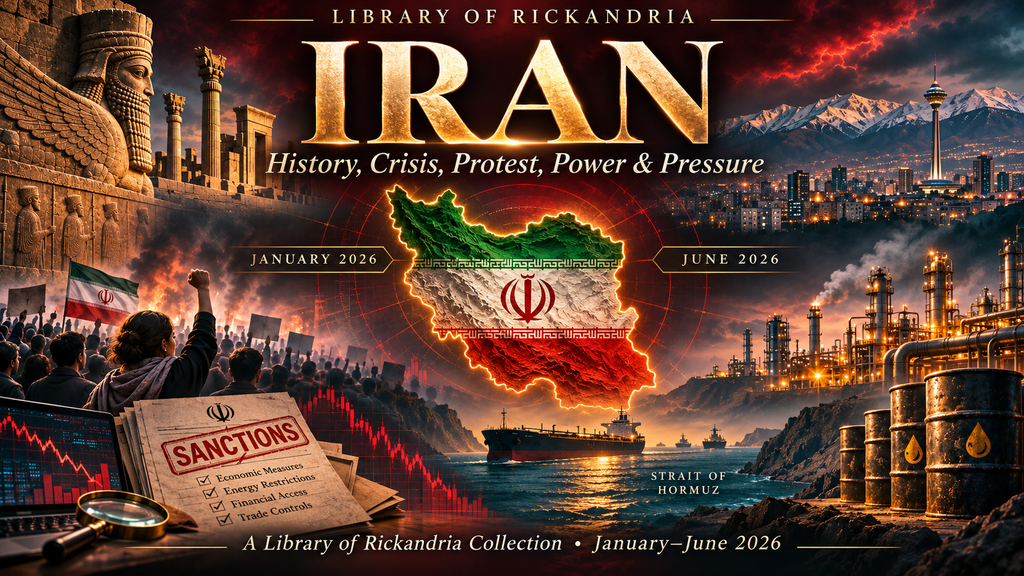
The Library of Rickandria’s Iran Research Hub brings together four investigations by VCG examining the historical foundations of Iran’s political system, the warnings that preceded the 2026 military escalation, disputed protest casualties amid an internet blackout, and the financial consequences of war.
This collection asks difficult questions.
Why has Iran repeatedly endured external pressure without achieving political resolution?
How can military warnings evolve into regional warfare?
What happens to the truth when communications are restricted and casualty figures become politically contested?
And when war drives energy prices higher, who bears the costs—and how accurately do politicians and journalists explain them?
The purpose is not to defend a government, promote a war, or endorse a political faction. It is to investigate what the evidence supports, what remains disputed, and what the human consequences reveal.
PART I — THE HISTORY BEHIND THE HEADLINES
01. IRAN WITHOUT RESOLUTION: POWER, CRISIS & THE LIMITS OF PRESSURE
Originally published January 14, 2026
READ THE COMPLETE INVESTIGATION
This extensive historical study examines the foundations of Iranian civilization and the development of the modern state.
Beginning with ancient Persia, it explores the Achaemenid Empire, the arrival of Islam, the development of Shi’a religious identity, the Safavid dynasty, foreign intervention, and the struggle for national sovereignty.
The investigation then considers the Pahlavi monarchy, the 1953 overthrow of Prime Minister Mohammad Mossadegh, the 1979 Islamic Revolution, and the institutions of the Islamic Republic.
Later sections examine Iran’s regional strategy, sanctions, political repression, economic pressure, and recurring waves of protest.
Its central argument is that political systems can survive repeated crises without resolving the conditions that produced them.
Central question:
How does a state endure pressure while the tensions between government authority and public legitimacy remain unresolved?
This paper establishes the historical foundation for understanding the rest of the collection.
PART II — THE WARNINGS BEFORE THE WAR
02. THE RUMORS OF WAR: IRAN’S CRISIS & THE SHAKING OF THE REGION
Originally published January 19, 2026
READ THE WAR-WARNING INVESTIGATION
This investigation examines the dangerous escalation of tensions surrounding Iran in January 2026.
It explores Iranian warnings that attacks on the country’s supreme leader would be interpreted as a declaration of war, alongside U.S. statements, regional security concerns, protests, and the risks of miscalculation.
The research distinguishes diplomatic threats, political rhetoric, military signaling, and actual acts of warfare.
That distinction is especially important because the article was written before the U.S.–Israeli military strikes of February 28, 2026.
Its historical value lies in documenting the rhetoric and warnings circulating before the conflict escalated.
Central question:
When does a warning of war become an actual military confrontation, and how can investigators recognize the difference?
This study also provides an opportunity to examine Matthew 24:6, in which Jesus speaks of wars and rumors of wars. That passage should be considered in its biblical context rather than automatically treated as proof of a particular modern prophetic fulfillment.
PART III — THE BLACKOUT, THE DEAD & THE DISPUTED NUMBERS
03. IRAN PROTEST DEATH TOLL DISPUTED AS INTERNET BLACKOUT OBSCURES INDEPENDENT VERIFICATION
Originally published January 25, 2026
READ THE PROTEST-DEATH-TOLL INVESTIGATION
Among the most serious challenges in investigating political repression is determining what happened when independent witnesses cannot communicate freely.
This study examines conflicting reports concerning deaths during Iran’s protest crackdown.
At the time of publication, Iranian official statements reported 3,117 deaths, while an activist count reported by the Associated Press had reached at least 5,002. Other claims were considerably higher.
These were disputed figures reported in January, not a final independently verified count.
The investigation explores internet restrictions, difficulties corroborating witness testimony, reporting by human-rights organizations, and the dangers of presenting unverified numbers as established facts.
The existence of uncertainty does not mean deaths did not occur. It means the precision and scope of a particular claim must be supported by appropriate records.
Central question:
How can the human cost of political repression be documented when access to reliable information is restricted?
The study underscores the importance of treating victims with dignity while refusing to exaggerate or minimize casualty reports for political purposes.
PART IV — FOLLOWING THE MONEY: WHO PAYS FOR WAR?
04. FOLLOWING THE MONEY: FACTCHECKING CLAIMS ABOUT TRUMP, IRAN & RISING HOUSEHOLD COSTS
Originally published June 2, 2026
READ THE ECONOMIC INVESTIGATION
War does not remain confined to the battlefield.
Military escalation can disrupt international shipping, energy supplies, business confidence, transportation costs, and household finances.
This investigation evaluates claims connecting the Iran conflict to higher American living costs, examining reported gasoline prices, household savings data, energy-market disruptions, and economic modeling.
It pays particular attention to the Strait of Hormuz, a strategically important route for international oil and natural gas shipments.
The study distinguishes measured economic data from modeled estimates and politically framed interpretations.
A reported estimate of household losses is not necessarily an audited total. A price recorded in June does not establish the price months later. And attributing every economic consequence to one government decision oversimplifies the interaction among military operations, shipping disruptions, insurance, supply, demand, and national economic policy.
Central question:
When the economic effects of war reach ordinary households, what can be measured—and how should responsibility be assessed?
The investigation encourages readers to retain reliable evidence while challenging unsupported causal certainty.
THE ROAD TO 2026 — WHY HISTORY MATTERS
Iran’s current crisis cannot be understood without recognizing several major historical turning points.
Ancient Persia:
The Achaemenid Empire established one of the ancient world’s major systems of imperial administration, influencing a vast geographical region.
The Islamic transformation:
Beginning in the seventh century, Muslim conquests transformed Persia’s religious and political environment, while Persian culture and scholarship continued to influence the Islamic world.
The Safavid transformation:
In the early sixteenth century, the Safavid dynasty established Twelver Shi’ism as Iran’s state religion.
The Constitutional Revolution:
From 1905 to 1911, Iranians attempted to establish constitutional limitations on royal power amid foreign interference and internal conflict.
The 1953 coup:
The overthrow of Mohammad Mossadegh, supported by British and American intelligence, became a lasting symbol of intervention in Iran’s political affairs.
The 1979 Islamic Revolution:
The monarchy fell and a new political system developed around revolutionary institutions and clerical authority.
The Iran–Iraq War:
From 1980 to 1988, a devastating conflict shaped Iran’s military, political, and strategic thinking.
The 2025–2026 protests:
Economic grievances and wider political dissatisfaction contributed to major demonstrations, repression, communications restrictions, and disputed casualty reports.
The 2026 regional war:
The U.S.–Israeli strikes beginning February 28 transformed an already dangerous confrontation into direct military conflict.
These events do not explain every Iranian decision. They provide the historical setting in which modern claims and policies must be assessed.
NOVEMBER 2026 — AN UNRESOLVED CONFRONTATION
The four featured Library investigations were published in January and June. Readers should not treat their original descriptions as if they were updated continuously.
As of November 21, 2026, external reporting continued to describe an unresolved confrontation involving Iran, the United States, Israel, regional security, and maritime disruption.
The UK House of Commons Library documented the February military escalation and subsequent diplomatic difficulties.
Reuters reported continuing diplomatic activity involving Qatar and Iran in November, alongside concerns over the unresolved conflict.
These newer reports offer essential context, but they do not erase the publication dates of the original research.
For updated evidence, consult:
UK House of Commons Library — Iran in 2026
Council on Foreign Relations — Conflict With Iran
Reuters — November 17, 2026: Iran War Stalemate
Reuters — November 21, 2026: Qatari Delegation Visits Tehran
BIBLICAL DISCERNMENT — WAR, TRUTH & JUSTICE
Wars and rumors of wars
“And ye shall hear of wars and rumours of wars: see that ye be not troubled…” — Matthew 24:6, KJV
Jesus spoke these words in a larger prophetic discourse. Their existence in Scripture does not establish that any particular modern military event fulfills a specific prophecy.
Examine competing claims
“He that is first in his own cause seemeth just; but his neighbour cometh and searcheth him.” — Proverbs 18:17, KJV
Conflicting political statements should be examined against available records rather than accepted simply because they support a preferred position.
Do not bear false witness
“Thou shalt not bear false witness against thy neighbour.” — Exodus 20:16, KJV
This principle applies when discussing casualties, alleged atrocities, government statements, political opponents, and people accused of wrongdoing.
Remember justice and mercy
“…to do justly, and to love mercy, and to walk humbly with thy God…” — Micah 6:8, KJV
The biblical call to justice and mercy provides an ethical perspective on suffering, human dignity, and the responsibility to avoid falsehood.
Scripture can guide moral judgment; it does not replace historical evidence, medical records, economic data, or independent reporting.
THE RICKANDRIA EVIDENCE TEST
| Investigative question | Why it matters |
|---|---|
| Who is making the claim? | Sources have different access, expertise, interests, and limitations. |
| When was it reported? | A January warning is not a November battlefield update. |
| What is independently confirmed? | Allegations should not automatically be presented as established facts. |
| Are numbers being compared fairly? | Casualty counts and economic statistics require dates and definitions. |
| Is causation demonstrated? | Correlation does not establish that one decision explains every consequence. |
| What remains uncertain? | Investigative integrity requires acknowledging limitations. |
The four featured investigations demonstrate why readers should resist turning complex geopolitical events into simplistic narratives.
RECOMMENDED READING ORDER
Begin with Iran Without Resolution to understand the historical foundations of the modern state.
Continue with The Rumors of War to examine the January warnings and the risks of regional escalation.
Next, read Iran Protest Death Toll Disputed to consider the human consequences of repression and the difficulties of independent verification.
Finish with Following the Money to study the economic consequences of the conflict and the difference between reliable data and political interpretation.
Then consult recent external reporting for developments after the original studies were published.
FREQUENTLY ASKED QUESTIONS
Is Iran the same as the Islamic Republic?
No. Iran is a country and civilization with a history extending thousands of years. The Islamic Republic is the political system established after the 1979 revolution.
Why do Iranian officials emphasize foreign intervention?
Foreign intervention has played a significant role in Iran’s modern history, including the 1953 coup. Historical experience influences political perceptions, although it does not independently justify contemporary government actions.
Were January’s warnings a declaration of war?
The January research examined threatening statements and deterrence rhetoric. It distinguished political warnings from the legal and military realities of actual conflict.
Can the protest death toll be stated with certainty?
The featured January investigation documents differing reported figures and serious verification problems. Those figures should not be treated as final or current totals without updated corroboration.
Why does the Strait of Hormuz matter?
It is an important international shipping route for oil and natural gas. Disruption can affect global energy markets, transportation, insurance, and consumer costs.
Is the conflict proof of biblical end-times prophecy?
The fact that a conflict exists does not, by itself, prove a particular interpretation of biblical prophecy. Passages should be examined in their literary and theological contexts.
PRIMARY RESEARCH COLLECTION
IRAN WITHOUT RESOLUTION: POWER, CRISIS & THE LIMITS OF PRESSURE
THE RUMORS OF WAR: IRAN’S CRISIS & THE SHAKING OF THE REGION
IRAN PROTEST DEATH TOLL DISPUTED AS INTERNET BLACKOUT OBSCURES INDEPENDENT VERIFICATION
FOLLOWING THE MONEY: FACTCHECKING CLAIMS ABOUT TRUMP, IRAN & RISING HOUSEHOLD COSTS
FINAL PERSPECTIVE — THE PRICE OF POWER IS PAID BY PEOPLE
The story of Iran is more complex than any political slogan.
It is a story of ancient civilization and modern revolution, sovereignty and foreign intervention, religious authority and political dissent, military power and civilian vulnerability.
It is also a story about information—how it is reported, restricted, interpreted, challenged, and sometimes distorted.
The Library of Rickandria’s four featured investigations invite readers to examine each layer carefully.
History should be documented rather than rewritten to fit a preferred narrative.
Casualty figures should be investigated rather than manipulated.
Economic claims should be measured rather than exaggerated.
And Scripture should be interpreted in context rather than used to declare certainty about events the text does not specifically identify.
Above all, the suffering of ordinary people should never disappear behind geopolitical arguments.
“Prove all things; hold fast that which is good.” — 1 Thessalonians 5:21, KJV
TRUTH BEFORE RHETORIC. EVIDENCE BEFORE CERTAINTY. HUMAN DIGNITY BEFORE SPECTACLE.
Soli Deo Gloria — To God alone be the glory.
LIBRARY OF RICKANDRIA | RESEARCH & INVESTIGATIONS BY VCG | 2026