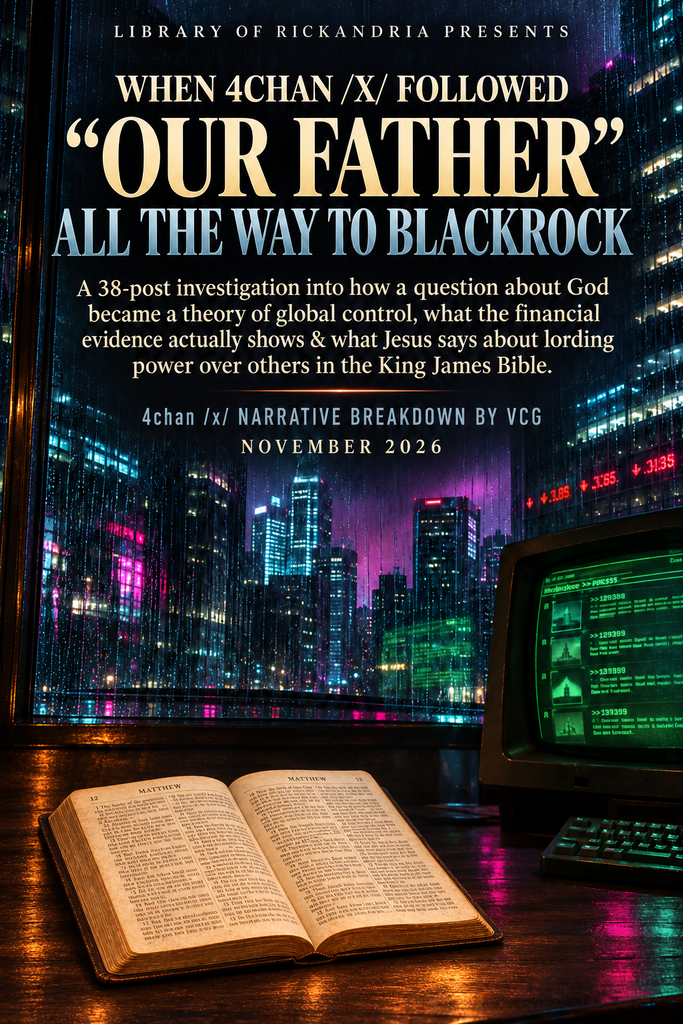
UPDATED BY VCG ON 11/21/2026 @ 23:23 EST
A 38-post investigation into how a question about God became a theory of global control, what the financial evidence actually shows & what Jesus says about lording power over others in the King James Bible.
Anyone can do this, but most won’t.
When 4chan /x/ Followed “Our Father” All the Way to BlackRock traces how a 38-post discussion about why people call God “Father” grew into a theory linking:
- church authority
- inherited wealth
- rising housing costs
- global finance
The investigation follows the claims back to the record.
The New York Fed gave BlackRock a defined role in an emergency credit program, and an Australian Royal Commission documented how church leaders failed to act on abuse allegations.
Both cases show why concentrated power deserves scrutiny, while the thread’s claim that one network directs these events remains unsupported.
Drawing on attachment research and the King James Bible, the paper returns to the question that started it all:
What happens when someone treats obedience to him as obedience to God?
Jesus gives his disciples a standard for answering it.
Those entrusted with authority are called to serve the people in their care.
ChatGPT – Library of Rickandria
4chan /x/ Narrative Breakdown by VCG
November 2026
Soli Deo Gloria.
A question about God becomes a question about power
On November 19, 2026, an anonymous poster on 4chan’s paranormal board asked why religion so often sounds like a relationship between a parent and a child.
/x/ – Why is a lot of religion weirdly parental and has – Paranormal – 4chan
Within hours, the thread had moved from childhood dependence to:
- Roman dioceses
- Soviet collectivization
- the age of first-time homebuyers
- BlackRock’s work for the Federal Reserve Bank of New York
Several of the facts along the way were real.
The New York Fed did hire BlackRock.
The cost of entering the housing market is a genuine problem.
And religious institutions have sometimes used their authority to protect powerful people at the expense of those in their care.
Original 4chan thread · ThreadPuller index
The thread is worth reading because the opening question survives the weaker answers.
What happens when someone with power tells you that obeying him is the same thing as obeying God?
You can investigate that without explaining all of history through one hidden chain of command.
In fact, the two strongest cases in this paper become clearer as the inquiry gets narrower.
A public contract shows what authority a private firm received and when that authority ended.
An official inquiry shows what church leaders knew, how they responded, and what their inaction cost.
Both cases give us something we can hold up to the light.
New York Fed investment-management agreement and termination correspondence · Royal Commission Case Study 42
Figure 1. Three points where the evidence supports a narrower conclusion than the thread draws.
Attachment research · New York Fed facility record · 2026 NAR homebuyer survey
How this investigation was done
The indexed thread preserves 38 posts, counting the opener and 37 replies.
I follow them in order and paraphrase their arguments, with direct post links for readers who want the original wording.
The thread records what anonymous writers claimed.
It leaves their identities, personal histories, and motives largely unknown.
The archive also records 12 attachments and seven distinct external video URLs.
Their references are listed at the end.
I could check the attachment references and video URLs against the thread, but their underlying contents and provenance remain unverified.
The five LOR music videos at the end are a separate set of links.
I opened each watch page and read its published description.
Indexed thread · ThreadPuller attachment index
For historical claims, I looked for people, dates, and documents.
For statistics, I checked what the number counted and whom it left out.
For claims of coordination, I looked for evidence of a shared decision and a way it was carried out.
Psychology helps explain why a story feels credible or why a relationship can become coercive.
Scripture addresses what the biblical text teaches about God, authority, and responsibility. Each kind of evidence has its own work to do.
I. Why does religion sound like a family?
1. The opening post asks whether humans invented a Father in the sky
The writer starts with a recognizable feature of religious language.
The Hebrew Scriptures call God Father in passages about his relationship to Israel.
Jesus teaches his disciples to pray to their Father.
Research on religion and attachment helps explain why believers can experience God as a source of security and why the same image might land differently for someone whose caregivers harmed them.
A study of how people relate to an image tells us something about its emotional force.
Establishing who first used it, why it spread, or whether its theological claim is true takes different evidence.
Post 1 · Deuteronomy 32:6, Isaiah 63:16, and Matthew 6:9–13, KJV · Granqvist and colleagues on religion and attachment
The claim that the Abrahamic religions all teach that God is literally everybody’s father falls apart once we open their texts.
Deuteronomy 14:1 addresses Israel as God’s children.
Qur’an 112:3 rejects divine begetting, and Qur’an 5:18 challenges a claim to special status as God’s children and beloved.
The New Testament itself makes a distinction.
Paul calls humanity God’s offspring while addressing the Athenians in Acts 17.
John 1:12–13 speaks of people becoming sons of God through receiving Christ.
Romans 8 ties adoption to the Spirit and to inheritance with Christ.
Creation, covenant, and adoption are doing different work in these passages.
Deuteronomy 14:1 · Qur’an 112:3 · Qur’an 5:18 · Acts 17, John 1, and Romans 8, KJV
The opening post also wonders whether God is an egregore.
If the word means a shared image that a community teaches and reinforces, that is a question psychology can investigate.
If it means that collective thought literally generates a spiritual being, the post offers no way to distinguish that proposition from the other possibilities.
Its concern about worship is more concrete.
The KJV calls for obedience to God, commends the Bereans for examining Paul’s preaching, and records the apostles refusing an order from a religious council.
That difference matters when a person claims divine authority for his own demands.
Acts 5:27–32 and Acts 17:10–12, KJV
2. A sarcastic reply points to the old link between religion and power
The connection is old enough to give us a useful counterexample.
Pliny’s correspondence with Trajan describes Roman officials testing people accused of Christianity by demanding acts of worship that included reverence toward the emperor’s image.
Here is a government using worship to enforce loyalty and Christians refusing to comply.
Both uses of religious conviction belong in the historical record.
Post 2 · Pliny and Trajan’s correspondence
3. A reply asks us to hear the word Father from the perspective of an abused child
This is one of the most important replies.
Someone raised by cruel caregivers may hear parental authority as a threat.
Attachment research also describes people who experience God as a source of security they lacked elsewhere.
Both responses make sense.
The post gives us a perspective to consider and leaves the writer’s own history unknown.
The Bible puts a duty on the caregiver.
Ephesians 6:4 warns fathers against provoking their children to wrath, and Colossians 3:21 names the harm such treatment can produce.
Post 3 · Attachment research · Systematic review of religious and spiritual abuse · Ephesians 6:4 and Colossians 3:21, KJV
4. An infant becomes the model for a theory of priests, kings, and judges
The first step is plausible.
An infant depends on caregivers for survival and protection.
The second step asserts that the people who built organized religion deliberately attached that dependence to cosmic authority.
To establish design, we would need identifiable actors, texts, institutions, and evidence of intent.
The thread offers a psychological mechanism that someone could exploit.
It then writes that possibility into history as something somebody did.
Post 4 · Research on attachment
The reply then says priests became spiritual guardians, modern judges inherited the same role, equal siblings would abolish the need for authority, and a caring Father had to be rewritten as a judge.
Ancient kings did invoke divine authorization.
Establishing continuity with a modern court would require comparing its appointment, law, jurisdiction, and remedies.
The biblical claims also need checking.
Galatians 3:26–29 joins equal standing in Christ with shared inheritance.
First Peter 5 addresses elders as people with actual responsibilities and restricts how they exercise them.
And Exodus 34:6–7 places mercy and accountability together long before the later institutional history the poster invokes.
ORACC on An/Anu and kingship · Galatians 3, 1 Peter 5, and Exodus 34, KJV
5. One writer says religion was made up to control people
There are documented cases of religion being used to enforce obedience.
There are also cases of conscience driving people to defy rulers.
A study of moralizing gods found associations with some forms of cooperation beyond the immediate local community.
That research examines behavior in particular groups. It does not reconstruct a single origin for all religions.
The thread’s universal claim requires evidence across traditions that its one-line explanation never supplies.
Post 5 · Pliny’s letters · Purzycki and colleagues on religion and social cooperation
6. Ancient pantheons become a theory of inherited global rule
Some Mesopotamian material does connect divine hierarchy to earthly kingship.
Sources about Anu, for example, speak of a god who confers royal authority.
That supports a specific historical comparison.
The reply then imagines early states forming among a few humans whose brains were just developing.
Homo sapiens goes back about 300,000 years, far earlier than the ancient states under discussion.
The story finally leaps from real inheritance to one continuing authority behind monuments, astronomy, law, oil, electricity, the internet, and AI.
Each link would need a chain of records showing who acquired what, from whom, and with what authority.
The Zardoz filenames offer a clue to the writer’s imagery.
The fictional world cannot supply the missing historical chain.
Post 6 · ORACC on An/Anu · Smithsonian on Homo sapiens · BFI on John Boorman
7. The discussion moves to church money, hell, immigration, and tax revolts
Give to the rich and turn the other cheek when they mistreat you.
James 2 rebukes a congregation for giving the rich better treatment.
Second Corinthians 9:7 calls for willing giving.
Jesus teaches against personal retaliation in Matthew 5.
Paul still asserts legal rights and appeals to Caesar in Acts.
Those passages leave room for a person to refuse revenge and pursue accountability.
Matthew 5, James 2, 2 Corinthians 9, and Acts 22 and 25, KJV
Accept ten billion immigrants or face sexual violence in hell.
Ten billion exceeds the UN’s estimate of the entire 2026 world population, about 8.23 billion.
The figure is hyperbole.
Scripture commands just treatment of strangers, locates salvation in grace through faith, and depicts final judgment in Revelation 20.
The specific threat in the post has no basis in those texts.
UN population data · Deuteronomy 10, Ephesians 2, and Revelation 20, KJV
People once revolted over a tiny tax increase.
The Stamp Act taxed specified papers and publications.
The colonial dispute concerned Parliament’s authority to tax people without their consent through representation, and the Declaration listed grievances beyond taxation.
England’s 1381 revolt followed enforcement of a third and heavier poll tax, alongside other grievances.
The reply actually supplies the correction to its own one-percent claim when it identifies the levy as a poll tax.
Its modern comparison needs named subsidies or appropriations, dates, and recipients to be audited.
UK Parliament on the Stamp Act · Declaration of Independence · Historical Association on
II. The thread follows the money
8. Migration, money creation, and BlackRock enter the same story
The writer clarifies that the earlier reference to inherited power concerns institutional dynasties and rejects an ethnic reading.
That clarification belongs in the record.
The reply still asserts that an unseen group engineers migration, controls finance, and uses controversy to conceal its own role.
Once both a visible actor and the absence of one count in favor of the claim, the reader needs a defined test that could change the conclusion.
Post 8 · Douglas, Sutton, and Cichocka on conspiratorial thinking
| Claim | What the source establishes |
|---|---|
| The UN engineers mass migration to dissolve nations. | UN DESA estimated 304 million international migrants in 2024, a worldwide stock. The Global Compact is a nonbinding framework for cooperation. Neither document establishes the purpose alleged by the post. UN migrant-stock data · UN Global Compact FAQ |
| Banks create more than 90% of modern money as debt. | Commercial bank lending generally creates a matching deposit. The Bank of England’s 97% figure describes the share of deposits in a UK money measure when the article was written in 2014. A commercial deposit and a central bank reserve are distinct liabilities. The post gives no global money measure, period, or source for its percentage. Bank of England on money creation |
| Global bond debt exceeds $150 trillion and is over 135% of GDP. | SIFMA reports $160.7 trillion in global fixed-income debt outstanding for 2025. The OECD’s defined market totals $109 trillion, or 93% of world GDP. Coverage matters. The dollar threshold holds under SIFMA’s measure, while the post’s precise GDP ratio lacks a matched source and denominator. SIFMA Capital Markets Fact Book · OECD Global Debt Report 2026 |
| Nonbanks hold 53% of advanced-economy sovereign debt and therefore run governments. | 53% remains unverified as stated. OECD data show different holder mixes across markets, including banks, central banks, households, foreign investors, insurers, and funds. A creditor can affect financing conditions. The authority to direct public spending is a separate legal and factual claim. OECD Global Debt Report · GAO on U.S. federal debt management |
| BlackRock, Vanguard, and State Street manage more than $24 trillion and are the biggest owner in 88% of the S&P 500. | The scale of assets under management is supported. BlackRock reported $15.5 trillion and State Street $6.3 trillion in Q3 2026. Vanguard reported $11.9 trillion as of March 31, 2026. These are different reporting dates. The 88% is a 2017 study that combined the firms’ holdings and compared that total with other holders in 438 of 500 companies. It measures the largest combined position, which can be a minority stake. The paper’s evidence about voting within each manager also differs from evidence that all three coordinate with one another. BlackRock filing · State Street filing · Vanguard disclosure · Fichtner, Heemskerk, and Garcia-Bernardo |
What the New York Fed actually hired BlackRock to do
The 2020 documents give the discussion something better than a chart of circles and arrows.
The Federal Reserve established two emergency corporate credit facilities.
The Primary Market Corporate Credit Facility was designed to support newly issued corporate credit.
The Secondary Market Corporate Credit Facility was designed to purchase eligible bonds and bond ETFs already trading.
The New York Fed retained BlackRock Financial Markets Advisory as a third-party investment manager.
The audited statements say the primary facility made no purchases through the end of 2020.
The secondary facility did purchase bonds and ETFs, financed by $14.3 billion in loans from the New York Fed to the facility’s special-purpose company.
Federal Reserve primary facility record · New York Fed secondary facility record · Audited Corporate Credit Facilities LLC statements Primary Market Corporate Credit Facility
The arrangement deserves scrutiny precisely because the firm had a real role and an affiliated ETF business.
The published terms address fees and credits related to affiliated funds.
The wind-down FAQ says the Fed set the sale guidelines and BlackRock executed sales at the New York Fed’s direction.
The termination correspondence shows that the agreement ended on October 15, 2021, after disposal of the portfolio, with specified audit and records obligations surviving termination.
A reader can ask why the Fed chose this vendor, whether the conflict safeguards worked, and how the trades and fees were reviewed.
Those questions lead to documents and possible answers.
The claim that a contractor thereby commanded the state would need evidence of a different kind of authority.
BlackRock terms of assignment · New York Fed wind-down FAQ · Agreement and termination
9. Rome, the Reformation, and the modern banking system become one dynasty
The post starts from partial continuity.
Church administration adopted Roman terminology and developed provinces and dioceses in late antiquity.
The story changes when the writer says the Vatican inherited Rome’s apparatus wholesale.
The Eastern Roman Empire continued until 1453.
In the West, political authority passed through different kingdoms and local institutions.
Papal territorial power changed substantially over time, including the loss of the remaining Papal States in 1870 and the Lateran settlement in 1929.
Claims that all pagan cults became one monopoly or that noble families followed a universal three-son career plan also outrun the evidence presented.
Post 9 · Ecclesiastical organization in historical context · Metropolitan Museum on Byzantium · Historical study of the Holy See and Vatican
Censorship and persecution were real, and princes had material stakes in the Reformation.
Luther’s surviving theses also make substantive theological claims about repentance, indulgences, and ecclesiastical authority.
The Fuggers financed Habsburg power, and Philip II’s defaults are well documented.
The post supplies no chain of transactions connecting those events to a single monopoly passed to Amsterdam, London, and Wall Street.
It likewise offers no record tying Vatican intelligence, SWIFT, reserve currencies, and bond markets to one governing actor.
SWIFT moves messages under oversight arrangements that include Belgium’s central bank.
The IMF tracks reserve-currency holdings separately.
Toynbee and Pareto may help frame questions about elite conduct and turnover, but the reply gives no passage that establishes its combined attribution or proves the motives of present-day officials.
Luther’s Ninety-Five Theses · Fugger family history · Economic History Association on Philip II’s defaults · SWIFT governance · IMF reserve-currency data
10–13. Four replies bring the argument back to church and family
| Post | What stands up |
|---|---|
| 10 · Religion is a stage to outgrow | That is a philosophical proposal about maturity. Hebrews 5:12–14 calls believers to develop discernment. Colossians 2:6–8 describes mature faith as continuing in Christ. Hebrews 5 and Colossians 2, KJV |
| 11 · Natural hierarchy disproves equality | Differences in rank and ability leave the question of moral standing open. Research distinguishes influence earned through prestige from dominance secured through coercion. Genesis 1 grounds dignity in the image of God. James 2 applies impartiality in a community with real social and economic differences. Cheng and colleagues on dominance and prestige · Genesis 1 and James 2, KJV |
| 12 · A controlling father with no wife sounds suspect | The joke takes the imagery as a human household biography. John 4:24 describes God as spirit, while Jesus uses a mother hen to describe his concern for Jerusalem. The imagery communicates real qualities without requiring one literal domestic arrangement. John 4:24 and Matthew 23:37, KJV |
| 13 · Pay ten percent for secret wisdom | The joke targets the sale of spiritual access. Acts 8 gives the issue a biblical parallel when Simon offers money for spiritual power and Peter rebukes him. First Peter 5 warns elders against serving for dishonest gain. Acts 8 and 1 Peter 5, KJV |
14. Wages, housing, subscriptions, Biohub, and the end of the middle class
This is the economic centerpiece of the thread.
The writer is responding to a real experience.
A person can have steady work and still look at local home prices and wonder how anyone is supposed to buy.
The sources make that experience more intelligible.
They also narrow what we can say about the cause.
Post 14 · Harvard Joint Center for Housing Studies, 2026
1971, productivity, and household debt.
Nixon suspended official dollar-to-gold convertibility in 1971. EPI’s widely cited productivity–pay comparison starts in 1979 and measures net productivity against typical hourly compensation, which includes benefits.
The size of the gap depends on the selected series and endpoint.
Household borrowing can be measured separately.
To show that ending convertibility caused the pay gap and that households borrowed specifically to fill it, we would need evidence joining those steps.
Federal Reserve History on gold convertibility · EPI Productivity–Pay Tracker · New York Fed household credit repor
RAND and the alleged $50 trillion transfer.
Price and Edwards estimated a cumulative $47 trillion shortfall in 2018 dollars against a hypothetical path in which income growth was shared more evenly from 1975 through 2018.
An alternative inflation adjustment gave about $48.6 trillion.
Price’s later extension produced $79 trillion through 2023 in 2023 dollars.
Each is an estimate of the gap between observed and modeled income.
Neither follows a literal payment from the bottom 90% into accounts held by the top 1%.
Original RAND working paper · RAND extension through 2023
Central bank money and homebuyers aged 40.
Rates and asset purchases can affect financing and asset prices.
The reply’s two-times price-to-income multiplier gives no place, period, or defined series.
Housing supply, local demand, mortgage costs, and the decisions of existing owners matter too.
NAR’s survey does confirm a median first-time buyer age of 40 for qualifying purchases from July 2025 through June 2026, with first-timers making up 22% of surveyed buyers.
NAR reports 7,125 responses and an adjusted response rate of 3.1%.
The survey covers people who bought a primary residence.
Those who searched and never managed to buy fall outside that sample.
Federal Reserve on monetary policy · Harvard housing report · NAR release and methodology
Subscription living and bracket creep.
Software subscriptions, vehicle leases, and home rentals involve different markets.
GAO found growth in institutional single-family rental ownership in selected metro areas, with substantial variation.
An allegation that regulation transferred market share needs a named rule, a market, and a measured change.
U.S. federal income tax brackets generally adjust for inflation, so a bracket-creep claim needs to identify the particular provision that did not keep pace.
GAO on institutional rental ownership · IRS 2026 inflation adjustments
AI jobs and a $1.8 billion virtual cell.
Biohub announced a real $1.8 billion multi-partner commitment that includes funding, data, computation, and measurement capacity for predictive biological research.
The announcement establishes a research program.
The thread extends it to a universal simulator and dependable age reversal without evidence that either milestone was achieved.
ILO estimates of occupational exposure to generative AI concern tasks that could change.
Counting actual layoffs attributable to the technology would require other data.
Biohub announcement · ILO on generative AI and occupational exposure
Modern housing and Soviet expropriation.
A comparison can help us ask where economic dependence grows.
The Soviet case involved forced collectivization, confiscation, and state coercion.
To demonstrate that the same mechanism is operating in a current housing market, the writer would need to identify comparable orders, means, and effects.
Affordability deserves investigation even if that analogy fails.
Library of Congress Soviet archives exhibition
15–19. Projection, the Cold War, and accusations about who is posting
15 · Father and King, with a Hindu parallel.
The reply makes a useful theological observation about divine nearness, majesty, justice, and mercy.
It has no basis for diagnosing the opener’s relationship with their father.
Its Hindu comparison fits ideas about self and Brahman in Advaita Vedānta more closely than it fits Hindu traditions as a whole.
Genesis describes people as image-bearers.
That is a different claim from the idea that individual people are the Godhead in disguise.
Stanford Encyclopedia of Philosophy on Śaṅkara · Genesis 1:26–27 and Acts 17:24–31, KJV
16 · The mention of kulaks supposedly gives the writer away.
The use of a historical term leaves identity and allegiance unknown.
The subsequent clarification is consistent with reading the earlier writer as condemning collectivization.
17 · After 1991, elites supposedly decided the middle class had served its purpose.
The timing works poorly as a starting-point explanation for the income and pay trends, which were already diverging before 1991.
The reply also treats decentralized information and AI as threats to elites while imagining those same actors controlling their deployment.
Those are testable claims once each specifies who did what, where, and to what effect.
Documented grants from governments or foundations can establish financial relationships.
Proving centralized editorial direction would require instructions, coordinated conduct, or other evidence beyond a funding relationship.
RAND income study · EPI pay and productivity series
18 · The opener is accused of being a bot through an antisemitic slur.
The reply supplies no evidence for the bot allegation or ethnic insinuation.
James 3:8–10 confronts the contradiction of blessing God while cursing people made in his likeness. James 3:8–10, KJV
19 · The economic writer is dismissed as Russian.
The post assigns a nationality or influence role through insinuation.
Authorship remains unverified, and the economic claims can be evaluated regardless of who posted them.
III. Suffering, surveillance, and the limits of historical analogy
20–22. Samsara and a painful test of the control argument
20 · The problem is wanting to be God.
Samsara refers to rebirth across several South Asian traditions.
The reply gives it one cause and speaks of an enduring soul.
Early Buddhist accounts emphasize ignorance, craving, and clinging and complicate the idea of a permanent self.
The KJV supports creaturely humility, and its account of death, judgment, and resurrection is its own distinct teaching.
Stanford Encyclopedia of Philosophy on the Buddha · Hebrews 9:24–28 and 1 Corinthians 15:20–26, KJV
21 · A fragment invokes people who have been raped.
Its brevity makes the author’s intent uncertain.
In the exchange, it raises the question of what an abstract theory about control can say about a real assault.
The moral accounting has to begin with the person who committed it.
22 · Assault is explained as the loss of an illusion of control.
Loss of agency can matter deeply.
The defining wrong also involves a perpetrator violating another person’s consent and bodily autonomy.
In the specific case described in Deuteronomy 22:25–27, the text clears the assaulted woman of guilt and compares the attacker’s act to murder.
The thread’s thought experiment about omnipotence obscures the responsibility the passage makes explicit.
CDC on sexual violence · Deuteronomy 22:25–27, KJV
23–25. A screenshot, a parking lot, and the meaning of human-centered
23 · A screenshot is offered with an AI accusation.
The archive records the attachment and the accusation.
It does not establish the screenshot’s provenance or how the earlier post was produced.
Even proof of AI assistance would leave every date, number, and causal claim open to checking against its source.
24 · Large churches must be government-funded.
A building and its parking lot show that money, land, and construction were assembled.
Accounts can show who supplied them.
A national study of U.S. congregations found about 81% of reported revenue came from individual donations.
Public grants also exist, including a FEMA security program open to houses of worship.
One congregation’s capital campaign, property records, financing, and grants can answer a concrete question that a photograph of a parking lot leaves unresolved.
National Study of Congregations’ Economic Practices · FEMA nonprofit security grant
25 · The Abrahamic religions are supposedly human-centered.
Human moral responsibility matters in the Bible.
Genesis 1 begins with God creating, and Job 38–41 describes a world whose operations exceed human knowledge or control.
The reply needs to say what human-centered means before its comparison can be tested.
The linked clip’s argument remains unverified.
26. The thread imagines an AI system that can see and control everything
The writer clarifies that the Soviet reference was a condemnation of collectivization.
He then suggests that people once had sanctuary in their homes, while AI and digital money could remove it.
Older surveillance already penetrated homes, as declassified Stasi materials show.
The FTC’s case against a location-data broker also documents how sensitive information can enter commercial markets today.
These are concrete precedents for asking which data are collected, by whom, and under what rules.
They do not establish universal integration of medical, travel, banking, political, and communications records.
GPU capacity measures potential processing power. It does not show what data the operator has, how the records are linked, or what decisions the operator is empowered to make.
Post 26 · German Federal Archives on Stasi listening devices · FTC case against X-Mode
The money claim needs jurisdiction and program details.
The Federal Reserve’s CBDC page says it has made no decision to pursue or implement one.
The ECB’s digital euro proposal distinguishes conditional payments from money programmed to restrict when, where, or on what it can be spent, and excludes the latter.
Questions about privacy and data access still deserve specific scrutiny.
The separate allegation that a unified AI system already directs global trades and profits from every shortage would require evidence about the system, its users, the trades, and the orders allegedly coordinating them.
Federal Reserve CBDC page · ECB digital euro FAQ
27. Soviet collectivization deserves to be examined on its own terms
Stalin’s government pursued forced collectivization and used expropriation, deportation, and repression against people designated as kulaks.
The label could be applied more broadly than the thread’s description of prosperous independent farmers suggests.
The post also collapses collective farms and state farms into one category.
Kolkhozy and sovkhozy were institutionally distinct, even with extensive state control.
Passport and registration rules constrained mobility, while actual migration continued.
The text could support a narrower claim by specifying the period and population for quotas, rationing, or travel restrictions.
Hayek’s The Road to Serfdom gives an argument about comprehensive economic planning and political freedom.
Applying it to a present policy requires showing how the relevant mechanism operates in that case.
Post 27 · Library of Congress Soviet archives · Historical research on Soviet migration controls · University of Chicago Press edition of Hayek
28–33. The thread turns through jokes, priestly corruption, and an implied historical analogy
| Post | What can be established |
|---|---|
| 28 · A brief apology with an attachment and a video | The writer says they are tired. The text alone cannot establish an admission of AI use or common authorship across anonymous posts. |
| 29 · A slur and a joke about a cat | The comparison could suggest that a creature lacks the concepts to understand a more powerful being. It offers no independently testable claim about God or the origin of religion. |
| 30 · A passing reference to Saturn | A historical connection would need a specified tradition, practice, chronology, and evidence tying it to divine fatherhood. The reply supplies none. |
| 31 · Humans supposedly want tyranny | People can seek order or defer to someone with expertise. A preference for coercive rule is a more specific proposition. Research distinguishing dominance from prestige helps explain why treating all deference as a desire for tyranny blurs the issue. Cheng and colleagues |
| 32 · Corrupt priests supposedly invented the parental themes | Corruption is documented, and reciprocal offerings exist in some traditions. The proposed sequence needs more than those observations. In Mark 7:9–13, Jesus condemns the use of a religious dedication to evade responsibility to parents. Ephesians 2:8–10 treats salvation as a gift of grace and gives good works their own place. Mark 7 and Ephesians 2, KJV |
| 33 · Inherited rule, an imagined revolution, and a world war | The post leaves its historical allusion indirect. If the passage is meant to invert aggressors and victims in the history of Nazi Germany, the record is clear. Germany invaded Poland in 1939, opening the war in Europe, and the Nazi regime and its collaborators systematically murdered six million Jews. Ezekiel 18:20 places moral responsibility on the person who sins. U.S. Holocaust Memorial Museum · Ezekiel 18:19–23, KJV |
IV. The thread comes back to “Our Father”
34. God is Father because he made us
The reply starts close to Paul’s point in Acts 17 about human dependence on the Creator.
It then compares God’s authority with a parent’s joke-threat about taking their child out of the world.
Jesus supplies a fuller comparison.
In Matthew 7:9–11, he reasons from the good gifts imperfect earthly parents can give to the greater goodness of the heavenly Father.
John 1 then draws out the specific relationship of those who receive Christ.
Taken together, these passages speak about origin, character, and adoption.
The threat used in the reply leaves two of those out.
Post 34 · Acts 17, Matthew 7, and John 1, KJV
35. Why a rainstorm and an assault are morally different
Both interrupt a person’s plans.
The reply uses that parallel to show the weakness of explaining sexual assault solely through loss of control.
Assault involves a person violating another person’s consent.
That supplies the difference the abstract comparison was missing.
The age-related jab in the same reply contributes no evidence about the person who wrote the previous post.
Post 35 · CDC on sexual violence
36. Hebrews, the word Abrahamic, and the state religion argument
The reply takes a word from Hebrews 12:8 and turns it into a blanket insult for unbelievers.
The passage is exhorting its readers to endure and explains chastening in relation to sonship and the fruit of righteousness.
It gives a believer no basis to diagnose another person’s spiritual standing from the suffering they have experienced.
John 1 and Romans 8 speak directly to adoption and its relation to Christ.
Post 36 · Hebrews 12, John 1, and Romans 8, KJV
Abrahamic is an established comparative term, though the opening post used it too broadly.
The allegations about the opener’s sources and motives remain unsupported.
The reply also treats atheism, spontaneous generation, evolutionary biology, and state ideology as interchangeable.
Atheism concerns belief in deity.
Evolution concerns change in living populations over generations.
Origin-of-life research deals with another question, and the older doctrine of spontaneous generation is a distinct historical claim.
The post’s assertion that all these beliefs occupy the same part of the brain lacks evidence.
China also complicates the political argument.
The Communist Party is officially atheist, while the state recognizes and regulates five organized religions.
A government can restrict religion outside approved channels while exercising influence through the institutions it recognizes.
Pew on comparative religious terminology · National Academies on evolution · Pew on religion and the Chinese state
37. The hardest question in the thread is about suffering
The writer clarifies that parental imagery was never supposed to be unique to the Bible and asks whether the Abrahamic traditions place an unusually heavy emphasis on submission.
To answer that comparatively, we would have to say what we were counting.
Prayer, clerical authority, family rules, and ordinary believers’ behavior could give different results.
The Bible itself uses maternal imagery for divine comfort in Isaiah 66:13.
Post 37 · Isaiah 66:13 and Matthew 23:37, KJV
The reply also asks how anyone can speak of divine love in a world that includes terrible suffering.
That question deserves more than a correction to the word Abrahamic.
Romans 8 depicts creation groaning.
In John 9, Jesus refuses to explain a man’s blindness by assigning guilt to him or to his parents.
In Luke 13, he rejects the idea that people killed by violence or disaster were worse offenders than others.
And at Lazarus’s tomb, Jesus weeps.
The Christian hope of resurrection in 1 Corinthians 15 belongs alongside that grief.
Those passages give Christians reason to stop talking as though every person’s pain reveals what that person did to deserve it.
Romans 8, John 9, Luke 13, John 11, and 1 Corinthians 15, KJV
38. A claim about who caused the rain closes the discussion
The last writer says some experiences take away our sense of control more decisively than others and reports hearing people credit themselves for rain.
A person’s account tells us what they believe happened.
Establishing that they caused the weather requires a test that distinguishes their influence from ordinary weather patterns.
Job 38 uses rain to put the limits of human agency before the reader.
The thread ends where it began, with a question about power and how much of it we can reasonably claim to understand.
V. When a church protects its own
Australia’s Royal Commission looked at how the Anglican Diocese of Newcastle responded to child sexual abuse allegations.
Its findings give weight to the concern voiced near the beginning of the thread.
The commission found that under Bishop Ian Shevill’s successor, Bishop Alfred Holland, in office from 1978 to 1992, the diocese often failed to act on allegations.
It identified missed opportunities to prevent further abuse involving priest Peter Rushton and layman Jim Brown.
Rushton died in 2007 without being charged with child sexual abuse offences.
The diocese acknowledged he was a child sex offender.
Brown pleaded guilty in 2011 to 27 charges involving 19 male victims and received a maximum sentence of 20 years.
These are distinct claims with distinct evidentiary bases.
Royal Commission report summary · Case Study 42 reports and evidence
The commission also found that Bishop Roger Herft’s response was inadequate and that when an alleged perpetrator moved to another diocese, that diocese generally was not warned.
People reporting allegations were sometimes treated as though they had made them up and faced threats of legal action.
The record also describes later bishops Brian Farran and Gregory Thompson taking appropriate action and providing pastoral care despite backlash.
This variation within the same institution matters.
It shows where decisions could have been made differently and who paid the price when they were delayed.
Royal Commission findings on the Diocese of Newcastle
Ezekiel 34 asks what shepherds did when the weak needed strengthening and the injured needed care.
First Peter 5 asks how elders used the office entrusted to them.
The commission establishes the institutional conduct through records and testimony.
Scripture gives Christians a standard for judging that conduct.
A church’s reputation looks very different from the vantage point of a person who told the truth and was treated as the problem.
Ezekiel 34:1–10 and 1 Peter 5:1–4, KJV
VI. Why the thread’s story feels plausible
The argument starts with an experience people recognize.
A father can protect a child or hurt one.
A religious leader can comfort someone or make that person fear questioning him.
Attachment research offers more than one pattern for how people experience God language, and the literature on spiritual abuse documents real harm.
Both findings deserve room before we try to explain the thread’s broader political conclusions.
Religion and attachment · Systematic review of religious and spiritual abuse and trauma
True facts make neighboring claims feel firmer.
A reader verifies the BlackRock hire, sees the true median buyer age, and finds a credible study behind the number about the S&P 500.
Trust earned by those checks can spill over into claims about a common plan.
The way around that is to test each causal step.
A public contract can show who delegated power and under what terms.
A survey of buyers can show how old its first-time buyers were.
Neither document answers the other question.
New York Fed’s agreement · NAR survey · Big Three study
A single explanation promises a world we can finally read.
Research on conspiracy beliefs discusses motives involving uncertainty, security, and social identity.
Experiments on perceived loss of control have also examined how people see patterns in ambiguous information.
These findings give us possible explanations for why the narrative appeals.
They cannot tell us why a particular anonymous person wrote a particular line.
The fair test for a claim of hidden coordination is still whether the writer can specify an actor, an action, evidence of the action, and an observation that would make them reconsider.
Douglas, Sutton, and Cichocka · Whitson and Galinsky
VII. Who gets to speak for the Father?
In Matthew 23, Jesus is speaking about leaders who love places of honor and public recognition.
He calls his disciples brethren, warns them against religious status-seeking, and places service at the center of greatness.
His instruction to call no man father upon the earth belongs in that argument.
In 1 Corinthians 4:14–17, Paul uses fatherly language for his relationship to people he brought the gospel.
Read together, the passages distinguish a relationship that carries responsibility from a title claimed as a source of spiritual supremacy.
A teacher can nurture people in the faith and still answer to Christ for how he treats them.
Matthew 23:1–12 and 1 Corinthians 4:14–17, KJV
Romans 8 gives the other side of the relationship.
Paul describes adoption through the Spirit, with believers crying, “Abba, Father.”
The context includes suffering and inheritance with Christ.
Paul expressly distinguishes adoption from returning to bondage and fear.
Matthew 20 then shows how Christ exercises power.
When the disciples are drawn into a dispute about rank, Jesus directs their attention to his own service and to the life he gives for others.
Read those passages together and the thread’s opening picture of divine fatherhood as mere domination becomes too small to hold what the texts say.
Romans 8:14–25 and Matthew 20:20–28, KJV
The difference becomes practical whenever someone claims to speak for God.
Can the congregation examine what the leader teaches?
What happens when somebody brings an accusation against a powerful person?
Does the leader use his office to serve people who can do little for him?
Acts 17 commends examination.
Ezekiel 34 condemns the shepherd who feeds himself.
First Peter 5 requires elders to lead by example.
And when Paul explains his own authority to the Corinthians, he includes the sentence that answers the question this paper began with.
Acts 17, Ezekiel 34, and 1 Peter 5, KJV
“Not for that we have dominion over your faith, but are helpers of your joy: for by faith ye stand.”— 2 Corinthians 1:24, KJV
Source ledger
Five figures worth keeping straight
| Figure | Date and denominator | Verdict |
|---|---|---|
| 88% | Study published in 2017. The three managers’ combined position ranked largest in 438 of 500 companies in the study’s S&P 500 sample. | Supported as a historical combined-holdings statistic. The figure counts companies, and says nothing by itself about majority voting control in each one. Original study Cambridge Core |
| 53% | The post supplies no year, set of advanced economies, definition of nonbank holders, or debt denominator. | Unverified as stated. OECD data show material variation across jurisdictions and creditor categories. OECD Global Debt Report |
| $47 trillion | Cumulative modeled income shortfall below the 90th percentile, 1975–2018, in 2018 dollars using the PCE adjustment. | Supported as a counterfactual estimate. RAND working paper |
| $79 trillion | Extended cumulative modeled shortfall, 1975–2023, in 2023 dollars. | Supported as the updated estimate. The date range, price level, and subsequent change in inequality affect the comparison. RAND update |
| Age 40 | Median age of first-time buyers in NAR’s 2026 survey of primary-residence purchases from July 2025 through June 2026. | Supported for the surveyed buyers. The measure excludes people who tried to buy and could not. NAR report and methodology |
Thread attachment ledger
All entries below are confirmed as references in the indexed thread.
The underlying image contents and provenance were not independently established.
The file names, including the ones that mention AI or Zardoz, are recorded as posted.
Original archive · ThreadPuller attachment index
| Post | Attachment |
|---|---|
| 1 | 1751394500701714.jpg |
| 4 | zardoz-based.jpg |
| 6 | zardoz-zed.jpg |
| 7 | 1740099960219059.jpg |
| 8 | size_restricted.gif |
| 9 | left-now.jpg |
| 14 | zed-learned-to-read.jpg |
| 16 | found_you.jpg |
| 17 | irony.jpg |
| 23 | Screenshot 2026-11-19 132310.png |
| 27 | ai-slop.jpg |
| 28 | ai-slop2.png |
External videos cited by the thread
These seven distinct URLs were checked against the archive as references.
Their playback and content remain unverified.
One URL appears in two posts.
| Post | Link as posted |
|---|---|
| 4 | YouTube · b3o44RPRqw8 |
| 6 | YouTube · XF_QtEB8Wy4 |
| 9 | YouTube · nIw_nKGIrQ8 |
| 17 | YouTube · djW32b-ZflE |
| 25 | BitChute · biSY2OEAuOVz |
| 26, 27 | YouTube · vxeHo651lnU |
| 28 | YouTube · UT-AtN_EKbs |
Further reading from the Library of Rickandria
The Genealogy of Power follows claims about dynasties, Babylon, and the difference between inherited influence and a continuous chain of command.
Prove All Things examines another 4chan thread that invokes hidden bloodlines, BlackRock, and Vanguard as an explanation for how power is organized.
Does God Hate the Broken? takes up suffering, hell, and spiritual abuse in another /x/ discussion.
Testing Every Spirit examines arguments that Judaism, Christianity, and Islam were engineered to control people.
The Blackout Never Came. Why Did the Story Feel True? follows a prediction through its deadline and examines why a claim can retain its emotional hold after the forecast fails.
Following the Money takes real household costs and checks the policy claims made about what caused them.
Companion music videos from VCG and LOR
These five direct watch pages opened on the Valiant Conquering Guardian / Library of Rickandria channel.
The pairings come from the songs’ published descriptions.
| Music video | Where it fits |
|---|---|
| Don’t Call Suspicion Knowledge | The companion to the method section. It starts with a business that looks suspicious and asks what records would actually establish an accusation. |
| Before You Call It Babylon | Pairs with the ancient empire and modern finance section. It asks what has to be shown before someone assigns a biblical name to a present-day institution or event. |
| King of Nothing | Pairs with Matthew 20 and the thread’s fascination with rulers. The song follows the cost of building an identity around winning, status, and control. |
| The Sanctuary Is Not a Safehouse | Pairs with the discussion of church accountability. Its subject is the gap between visible religious participation and conduct when the service ends. |
| The Word Became Flesh | Pairs with the hierarchy exchange in posts 11 and 15. The song reads John 1 and Genesis 1 against the use of human differences to rank souls before God. |
THE 4CHAN FILES: Where Anonymous Claims Meet Evidence & Scripture – Library of Rickandria
VCG PAPER PROJECTS – Library of Rickandria
When 4chan /x/ Followed “Our Father” All the Way to BlackRock
When 4chan /x/ Followed “Our Father” All the Way to BlackRock – Library of Rickandria