UPDATED BY VCG ON 11/23/2026 @ 01:11 EST
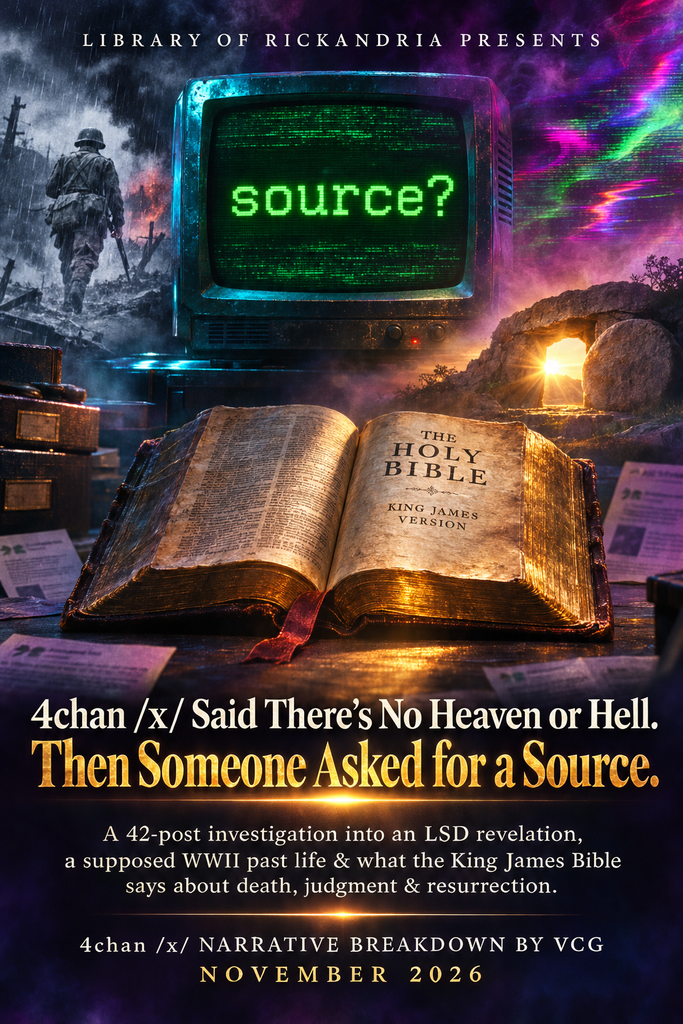
A 42-post investigation into an LSD revelation, a supposed WWII past life & what the King James Bible says about death, judgment & resurrection.
Anyone can do this, but most won’t.
When an anonymous 4chan /x/ poster declared that heaven and hell were inventions and that reincarnation explained what happens after death, someone asked a one-word question:
“source?”
One respondent credited an LSD trip.
Others offered a supposed WWII past life, a soul-trap theory, and competing explanations for why people suffer.
This 42-post Library of Rickandria investigation draws on historical records, memory research, and psychedelic studies to examine what those claims can actually establish.
It then turns to the King James Bible’s account of:
- death
- judgment
- grace
- resurrection
Its most human moment comes in John 9, when the disciples ask whose sin explains a man’s blindness and Jesus rejects their proposed blame and attends to the man.
ChatGPT – Library of Rickandria
The question that changed the thread
On November 20, 2026, an anonymous poster on 4chan’s paranormal board offered a simple rule for the afterlife.
/x/ – there is no heaven or hell – Paranormal – 4chan
Live well and your next life will be easier.
Live badly and it will be harder.
Live an ordinary life and you can expect another one much like it.
A few minutes later, someone asked a one-word question:
“source?”
One respondent credited an acid trip.
The archive gives us the answer and its place in the conversation.
It gives us no way to establish that the person who answered also wrote the opening post.
Original thread · The source request · The LSD reply.
By then, another poster had already changed the rule.
According to that reply, harder lives are assigned to stronger souls, and suffering makes them stronger still.
A later reply attributed hardship to atrocities committed in another life.
The person suffering could therefore be cast as a debtor, an unusually powerful soul, or both.
The thread gives readers no independent way to decide which explanation applies.
That is where this investigation begins.
The question also matters away from the screen.
Once you tell yourself that suffering reveals something about a person’s hidden past, it becomes easy to explain their pain before you’ve heard what they have to say.
Exhibit 1 — One Hard Life, Three Explanations
| What we observe | What the post says it means | Original post |
|---|---|---|
| Someone has a hard life. | Bad conduct earns worse conditions in the next life. | #43246050 |
| Someone has a hard life. | Stronger souls receive harder tests and gain power through them. | #43246091 |
| Someone has a hard life. | Past atrocities create a debt paid through harsher later lives. | #43246124 |
What would you have to know about this person, independently of their suffering, to decide which explanation fits?
The first and third proposals overlap.
The second gives the same hardship a different meaning.
They could coexist in principle.
To tell them apart, you would still need evidence of past conduct and a way to measure the alleged spiritual power independently of the hardship itself.
How the claims were checked
The archived 4chan page displayed 42 posts dated November 20–22, 2026.
The audit follows that order.
Each entry links to the original wording and addresses its substantive lines in sequence.
Three posts list image attachments.
Their visual provenance and symbolism remain unverified, and the alternate archives checked did not provide a corroborating copy.
The method depends on the claim.
A historical allegation needs records.
A health claim needs nutrition research.
A report of an experience tells us what someone says they experienced.
Its cause requires further evidence.
A moral argument has to defend its premises, and a claim about Christian doctrine has to be read against Scripture in context.
A vivid story can matter to the person who tells it while leaving the rest of us with very little we can check.
Exhibit 2 — Build the WWII Case File
The poster says they were drafted during WWII, forced to do terrible things, and consumed by guilt.
They then describe dying young in a subsequent life.
The account supplies no name, unit, country, date, or record an investigator could use to identify the person.
Here’s a hypothetical:
suppose a claimant supplied a named unit and an exact transfer date, and both were recorded before anyone looked for a match.
Those details would give a search clear ways to succeed or fail.
The actual post supplies neither.
| Case-file field | What to record |
|---|---|
| Exact statement | The claimant’s words, including guesses and uncertainty. |
| Date and prompts | When the account was recorded, what questions were asked, and whether anything was added later. |
| Possible prior exposure | Conversations, books, films, websites, or archives that could have supplied the details. |
| Independent records | The records searched, gaps in coverage, and other people who could plausibly fit. |
| Matches and misses | Correct, incorrect, ambiguous, and missing details, scored under the same rules. |
| What a match establishes | How closely the statements correspond to the record. Explaining the correspondence takes further work. |
An investigator would also need to account for missing records.
Where U.S. military records are relevant, the National Archives documents that a 1973 fire destroyed millions of personnel files and that auxiliary records can sometimes help reconstruct basic service information.
If an archive has a gap, record the gap.
It may leave the claim unresolved.
National Archives, The 1973 Fire.
What history and psychology can tell us
Rebirth has a history, and there is more than one account of it.
Hindu schools differ in how they understand karma, rebirth, and liberation.
Buddhist discussions have to explain causal continuity alongside the denial of a permanent self.
The forum’s picture of a persistent individual soul gaining power through escalating challenges is a poor summary of those traditions.
Likewise, the Archons in the thread have a literary antecedent in the Nag Hammadi text The Reality of the Rulers.
That gives us a text to compare.
The claim that such beings actually administer an afterlife prison still needs evidence of its own.
Cambridge, Karma and Rebirth in Hinduism · Stanford Encyclopedia of Philosophy, “Buddha” · The Reality of the Rulers, Barnstone and Meyer translation.
Researchers have studied alleged past-life memories.
A scoping review identified 78 observational studies.
Most focused on children, and case reports and interviews predominated.
Consider the debate over James Leininger, the boy whose statements were linked to WWII pilot James Huston Jr. Jim Tucker argues that the early records carry evidential weight.
Michael Sudduth disputes the timing and precision of some matches and considers possible exposure to aviation material.
Their disagreement shows why it matters to have the original record, know exactly when a match was made, and count the misses as carefully as the hits.
Neither paper supplies evidence about the unnamed account on this thread.
Moraes et al., scoping review · Sudduth’s critique · Tucker’s response.
Vividness can feel like a source.
Psychologists use source monitoring for the judgments we make about where mental material came from.
A scene can feel familiar while its source is difficult to place.
Controlled LSD research found more dreamlike waking imagery in one study.
Another small study found higher responses on one suggestibility measure, with no statistically significant change on its separate cued-imagery measure.
Those findings give us reasons to check an interpretation before treating vividness as proof.
They leave the circumstances of this particular poster’s experience unknown.
Johnson, Hashtroudi and Lindsay, “Source Monitoring” · Kraehenmann et al., dreamlike imagery · Carhart-Harris et al., suggestibility · Brewin and Andrews, false autobiographical memories.
Near-death reports deserve the same care.
In the prospective AWARE II study, researchers interviewed 28 survivors of cardiac arrest.
Six described experiences the investigators classified as transcendent recalled experiences of death.
No interviewee identified the visual target, and one identified the auditory stimulus.
The study concerns experiences around cardiac arrest and resuscitation.
It supplies no independent verification of the forum’s afterlife story or of what happens after irreversible death.
The appeal of a story can shape how we assess it.
Research on belief in a just world helps explain the temptation to assume that people deserve what happens to them.
Motivated reasoning can favor a comforting answer, a frightening answer that seems to explain everything, or a skeptical answer that feels obvious.
Research on pattern perception and dehumanization helps explain two further moves we can observe in the text:
treating ambiguous details as a pattern and using animal or machine comparisons to discount another person’s humanity.
These are ways to analyze the arguments and language.
The record gives us no basis for diagnosing the people who wrote them.
Lerner and Simmons · Kunda · Van Prooijen, Douglas and De Inocencio · Haslam.
The complete 42-post audit
November 20 — The rule, the trip, and the soul prison
- 43246050 · The opening rule.
The title denies heaven and hell.
The first line makes reincarnation universal.
The next three assign easier, worse, or ordinary lives according to prior conduct.
None defines how conduct or hardship would be measured.
The final line appeals to simplicity. Simplicity can help compare explanations after they account for the evidence.
This post supplies no independent observations of a prior life.
Hebrews 9:24–28 KJV · Luke 13:1–5 KJV
- 43246060 · The source request.
It puts the burden where it belongs.
A source documenting that people believe in reincarnation would establish the existence of a belief.
This post asks for support for the specific rule being asserted.
- 43246091 · Hardship, abuse, and WWII.
The first line associates severe hardship with stronger souls and invokes monstrous abusers.
The next assigns spiritual growth to the ordeal.
Nothing in the post establishes that children are placed in harm’s way for that purpose.
The wartime account, guilt, and subsequent childhood death lack independently checkable particulars.
The closing resolve to avoid deception gives the story an emotional ending.
It supplies no evidence of continuity across lives.
Matthew 18:1–6 KJV · Psalm 82:3–4 KJV
- 43246101 · The skeptic’s shortcut.
The poster attributes the claim to people pretending.
Withholding belief requires no judgment about whether a stranger is sincere, mistaken, joking, or inventing a story.
- 43246110 · The acid trip.
The reply gives the reported setting in which an idea arose.
The inference about the afterlife still needs an independent check.
Controlled LSD suggestibility study · 1 John 4:1–3 KJV
- 43246122 · Selective recall and art.
The reply says some people cannot recall past lives and that art sessions can bring them out.
A striking image is compatible with imagination, prior exposure, or recombined memories.
If both recall and its absence count in favor of the theory, what observation would count against it?
- 43246124 · Cosmic repayment.
The post makes hardship a payment for atrocities.
Exhibit 1 shows what this would take to test.
Hebrews puts judgment alongside Christ bearing sins, and Ephesians gives good works their place in a life shaped by grace.
Hebrews 9:27–28 KJV · Ephesians 2:8–10 KJV
- 43246132 · Goodness, people-pleasing, and the NPC label.
The first line equates goodness with surrendering to other people’s wishes and then treats that as loss of soul.
The second advises constant opposition.
You can show kindness while refusing a wrongful demand.
Reflexive opposition still lets somebody else set your response.
Galatians 1:10 KJV · Romans 12:9–21 KJV
- 43246148 · Any body counts?
The first sentence redefines reincarnation to include any postmortem embodiment.
The second treats permanent disembodiment as the clearest alternative.
The opening post concerned a succession of new lives.
John describes the dead themselves coming forth at Christ’s voice.
- 43246181 · The spiritual body.
The reply notices the definitional problem.
Its language about carnality can confuse the issue if “spiritual” is taken to mean intangible.
Luke presents the risen Jesus as tangible, and Paul describes the body raised incorruptible.
Luke 24:36–43 KJV · 1 Corinthians 15:35–58 KJV
- 43246259 · Jesus and the next level.
The reply predicts that what we call spiritual will look carnal at a higher level.
Its use of Jesus’ name supplies no basis for the prediction.
Luke identifies the risen Jesus, and Paul describes mortality putting on immortality.
- 43246289 · The cycle sounds like hell.
The reply conveys moral horror.
The comparison tells us how the proposed system strikes the reader.
In Matthew, judgment follows the Son of man’s verdict.
- 43246291 · The video-game reply.
The first line rejects compulsory rebirth as horrifying.
The second declares reality a game.
The objection concerns the proposal’s morality.
The game claim needs observations that would distinguish it from ordinary life.
- 43246359 · A friend, a demiurge, and a rescue mission.
Reincarnation first feels plausible to the poster.
The reply then declares moral judgments subjective and adopts a soul-trap story partly to imagine rescuing a friend.
Wanting to rescue someone explains the appeal of the story.
It gives us no evidence of the captors.
The KJV places creation under Christ and attributes deliverance to God.
John 1:1–3 KJV · Colossians 1:12–20 KJV
- 43246379 · Disney World after death.
The amusement park, cyberpolice, and dogs may be parody.
If the reply is read literally, it gives no circumstances or corroboration by which to identify an external event.
- 43246388 · J.E. and the Illuminati.
If the initials refer to Jeffrey Epstein, records establish a 2008 Florida guilty plea and separate federal charges in 2019 that were dismissed after his death.
The post offers no evidence of Illuminati membership or elite knowledge of reincarnation.
Its question about how the powerful would behave only works if they already know, believe, and act on the claimed rule.
DOJ review · DOJ account of the 2019 case · LMU history of the Bavarian Illuminati.
- 43246435 · Who counts as fully human?
The post begins with a fair question about whether public charity can become self-promotion.
It moves into contempt for groups, measures human worth by usefulness, and asserts racial and spiritual classes, judgment exemptions, and reptilian impostors.
None of those classifications gets evidence.
Ecclesiastes names a silver cord in a passage about aging and death.
Matthew uses outer darkness as an image of judgment.
Genesis gives humanity a common dignity, and James applies that dignity to the way we speak about others.
Ecclesiastes 12:1–7 KJV · Matthew 8:11–12 KJV · Genesis 1:26–27 KJV · James 3:9–10 KJV
November 21 — Freedom, diet, and what follows from nature
- 43247604 · Christ’s kingship and blanket assurance.
Revelation affirms Christ’s kingship.
The promise that every reader will enter heaven goes beyond the commenter’s warrant.
John ties eternal life to believing on the Son and speaks of condemnation as well.
Revelation 19:16 KJV · John 3:16–21 KJV
- 43247658 · Can I opt out?
The question exposes a gap in the original proposal.
It offers no account of consent, compulsion, or exit.
The wish to opt out tells us something about the proposal’s appeal and supplies no evidence that its mechanism exists.
- 43247693 · Every consciousness as sovereign God.
The post assumes that genuine agency requires ultimate sovereignty.
It offers no argument for that step.
Acts treats human agency and dependence on God as compatible.
- 43247726 · Too good to be true.
An appealing claim can be true or false.
The appeal gives us a reason to examine our own judgment, and the claim still requires evidence.
- 43247729 · Approval.
The reply endorses a post containing several different claims.
It adds no reasons or clarity about which ones it accepts.
- 43247747 · The moral entry requirements keep changing.
The post makes an unmeasured claim about how good most people think they are, names veganism and antinatalism as prerequisites, rejects the proposed system as a bad deal, repeats the game claim, and declares liberty the structure of reality.
Ethical preference alone establishes none of those metaphysical claims.
Romans 14 addresses judgment over food, Psalm 127 calls children a heritage, and Galatians connects liberty with serving one another in love.
Romans 14:1–13 KJV · Psalm 127 KJV · Galatians 5:13 KJV
- 43247751 · Evolution and the appearance of vegetarians.
Evidence of ancestral meat eating and evidence of plant-food use belong to the history of human diets.
A claim about what adults require today needs contemporary nutritional evidence.
A glance at a few people supplies no measure of the weight, cognition, or health of all lifelong vegetarians.
Early meat-eating evidence · Hardy et al., dietary carbohydrate · Academy of Nutrition and Dietetics position paper.
- 43247786 · A caricature of resurrection.
The reply treats the prior claim as though all spirits were ordinary flesh-and-blood beings.
Luke describes the tangible risen Jesus and distinguishes him from a spirit.
The subsequent anti-Jewish and anti-Christian mockery contributes no evidence.
Luke 24:36–43 KJV · John 4:7–26 KJV
- 43247806 · Appeal to nature.
The criticism fits an inference from what humans have historically eaten to what they morally ought to eat.
An argument about biological capacity can use evolutionary evidence.
Whether the label applies depends on which conclusion the prior poster meant.
- 43247854 · Burden of proof.
The reply invokes Hitchens’s razor.
An unsupported claim can be left unaccepted.
Anyone who goes further and asserts the opposite takes on a burden for that assertion.
- 43248014 · Explain the fallacy.
This is a fair request.
Identify the premise, identify the conclusion, and show where the inference fails.
A label is shorthand for that work.
- 43248997 · Survival and goodness.
The reply correctly observes that a practice can confer a survival advantage and still raise moral questions.
The argument then needs to consider the harms, the alternatives, and what necessity would actually mean.
- 43249008 · Vegan adequacy.
Appropriately planned vegan diets can be nutritionally adequate for adults.
A guarantee of freedom from health problems goes beyond the evidence.
Reliable vitamin B12 matters, and access to adequate food and nutrients varies.
The nutritional possibility and the moral case involve different premises.
Academy position paper · NHS vegan diet guidance.
- 43249245 · Respect and judgment.
The reply adds moderation to the earlier advice to oppose people constantly.
It helps to distinguish earned trust from the basic honor owed to another person.
- 43249277 · Cats, dogs, and people.
The analogy fails.
Domestic cats are obligate carnivores, and the order Carnivora includes omnivorous species, including dogs.
The claim that humans cannot live healthfully without meat conflicts with evidence on appropriately planned adult diets.
Visible anecdotes and ridicule add no nutritional evidence.
Comparative animal diets · Academy position paper
- 43249305 · Insults as diagnosis.
The reply uses slurs and alleges malnutrition without evidence.
The archive supplies no basis for assessing the target’s nutritional status.
- 43249330 · The ethical clarification.
The poster sets health and survival aside, states a moral objection, and imagines a world where eating meat confers extraordinary advantages.
The example succeeds in separating advantage from permission.
It still assumes the moral premise its author needs to defend.
The KJV permits animal food, commends care for animals, and addresses regard for conscience.
Genesis 9:1–4 KJV · Proverbs 12:10 KJV · Romans 14 KJV
- 43249439 · Walking away.
The reply points to the other poster’s peculiar wording and exits the exchange.
That ends one branch of the discussion without resolving its empirical or moral questions.
November 22 — Memory, moral certainty, and the final answer
- 43250756 · Aversion and moral judgment.
The reply links aversion with suffering and treats moral judgment as pride.
Some moral judgments are indeed prideful.
That leaves room for humility and discernment together.
Buddhist accounts of aversion also include distinctions between wholesome and unwholesome conduct.
Stanford Encyclopedia of Philosophy, “Buddha” · Romans 12:9–21 KJV
- 43250912 · Forgetting and the Ship of Theseus.
The ship’s replaced planks raise a genuine question about identity through change.
If the body, biography, and memory all differ, what would establish that two lives belong to precisely the same person?
The thought experiment frames the question.
The post supplies no independent record of the countless lives it proposes.
Plutarch, Theseus 23 · Stanford Encyclopedia of Philosophy, “Locke on Personal Identity”.
- 43250954 · Good as life, evil as death.
The equations echo biblical language.
They become misleading as a formula for interpreting earthly fortune.
The righteous also die, and Romans calls eternal life God’s gift through Christ.
Deuteronomy 30:15–20 KJV · Romans 6:20–23 KJV
- 43250974 · A demand for proof.
The challenge is fair, although its exact target is unclear.
The two lines of glyphs and the listed attachment have no accompanying explanation that would establish their role in the argument.
- 43251035 · Building heaven together.
The reply changes the subject from a literal afterlife to the cumulative effects of human choices.
Choices can improve life on Earth.
Revelation describes the holy city descending from God and God dwelling with humanity.
Matthew gives good works a place in the present, and Revelation attributes the final renewal to God.
Matthew 5:14–16 KJV · Revelation 21:1–5 KJV
- 43251103 · Exclusive enlightenment.
The poster corrects the paraphrase of their private terminology, claims peak enlightenment, declares reality unreal, and claims that only they can experience enlightenment.
There is no independent criterion for any of those assertions.
Tone leaves room for satire.
Romans 12:3 KJV · 1 Corinthians 13:9–12 KJV
- 43251204 · The last reply.
A gaming comparison about starting over answers the earlier source request.
It gives the reader a way to picture reincarnation.
The thread ends without providing a way to verify it.
1 Corinthians 15:20–26, 50–57 KJV
What the King James Bible says
Death, judgment, and Christ’s offering
Hebrews 9:27 reads,
“And as it is appointed unto men once to die, but after this the judgment”
The sentence continues into verse 28.
The writer compares the ordinary human sequence of death and judgment to the sufficiency of Christ’s single offering.
John 5 says those in the graves will hear the Son’s voice and come forth.
Matthew 25 speaks of everlasting punishment and eternal life, and Revelation 20 portrays judgment before the great white throne.
The passages give the Christian account its shape:
death, resurrection, and judgment under Christ.
Hebrews 9:24–28 KJV · John 5:24–29 KJV · Matthew 25:31–46 KJV · Revelation 20:11–15 KJV.
What gets raised?
In Luke 24, Jesus invites the disciples to recognize his hands and feet, touch him, and see him eat.
First Corinthians 15 puts the emphasis on transformation.
What is sown in corruption is raised in incorruption.
Paul follows his statement about flesh and blood with the explanation that the mortal must put on immortality.
The person raised is recognizable, and the body is transformed.
That addresses the thread’s attempt to place every kind of postmortem embodiment under the same word.
Luke 24:36–43 KJV · 1 Corinthians 15:35–58 KJV.
Being born again and the Elijah question
Nicodemus asks whether a man can enter his mother’s womb a second time.
Jesus directs him to birth of the Spirit and goes on to speak of belief in the Son.
The Elijah passages raise a different question.
Jesus identifies John the Baptist with the promised Elijah, Luke says John goes before the Lord in Elijah’s spirit and power, and John denies that he is literally Elijah.
Read together, the passages describe prophetic fulfillment through John’s ministry.
John 3:1–21 KJV · Matthew 11:14, Matthew 17:10–13, Luke 1:17, and John 1:21–23 KJV.
Two passages worth reading alongside the thread
Ecclesiastes 3:16–22.
The Preacher sees injustice under the sun, says God will judge the righteous and the wicked, and then brings humans and animals together under the visible fact of mortality.
Both return to dust.
Verse 21 asks who knows the course of their spirits.
The question makes room for humility about what we can see.
The book returns to dust and spirit in chapter 12 and closes with judgment.
Ecclesiastes 3:16–22 KJV · Ecclesiastes 12:7, 13–14 KJV.
Luke 16:19–31.
The rich man asks Abraham to send Lazarus back to warn his brothers.
Abraham directs them to Moses and the prophets.
The rich man thinks a visitor from the dead would make them repent.
Abraham answers that even someone rising from the dead would fail to persuade hearers who refuse the testimony already given to them.
The narrative has its own question about sources.
What makes a person willing to hear the evidence they already have? Luke 16:19–31 KJV. Bible Gateway
Where good works belong
Ephesians 2:8–10 places salvation by grace through faith first and says believers are created in Christ unto good works.
Matthew 25 depicts deeds revealing how people responded to the King.
Revelation 20 includes both books of works and the book of life.
Works carry moral weight.
The standing of a person before God is a different matter from an anonymous ledger that assigns them an easier birth.
Ephesians 2:8–10 KJV · Matthew 25:31–46 KJV · Revelation 20:11–15 KJV.
What we owe the person who is suffering
In John 9, the disciples see a man born blind and ask who sinned.
Jesus rejects the two attributions they propose and attends to the man.
In Luke 13, he refuses to rank victims of violence and disaster as worse sinners than the people who survived.
He turns the listeners’ attention to their own need for repentance.
John 9:1–7 KJV · Luke 13:1–5 KJV.
There’s a reason to end there.
The thread puts a great deal of effort into figuring out what hardship supposedly proves about the person enduring it.
John gives us a scene in which the person is right there, in front of everybody arguing about the cause.
When someone is hurting, what can I do for them before I start explaining why it happened?
Related Library of Rickandria investigations
9,000 Lives, Zero Proof follows a more elaborate reincarnation and soul-farming account and asks which of its details can be checked.
And You Know This How? examines another /x/ thread about heaven, reincarnation, Archons, and the grounds for afterlife claims.
The Soul Trap Trap starts with a near-death account and tracks the claims that accumulated around it.
Reincarnation, Soul Traps & Loosh Farming collects the Library’s investigations into prison-planet claims and alleged afterlife traps.
The NPC Delusion examines the move from somebody’s outward behavior to a verdict about their soul or interior life.
VCG MUSAIC companion videos
Five direct watch pages from the Library of Rickandria YouTube channel, checked November 23, 2026.
| VCG video | Pair it with |
|---|---|
| And You Know This How? | The opening request for a source and the 42-post audit that follows it. |
| The Anomoly Doesn’t Name the Cause | The LSD report, the WWII worksheet, and the gap between experiencing something unusual and identifying its cause. The spelling follows the upload title. |
| When the Last Breath Leaves | The KJV passages on death, judgment, and resurrection. |
| No Secret Exit (Grace Ain’t a Password Mix) | The soul-trap discussion and the place of grace in Ephesians 2. |
| NPC Detector | The thread’s use of “NPC” language and the question of what we owe another human being. |
THE 4CHAN /X/ FILES: DOWN THE RABBIT HOLE—UP AGAINST THE EVIDENCE – Library of Rickandria
4chan /x/ Said There’s No Heaven or Hell. Then Someone Asked for a Source.
4chan /x/ Said There’s No Heaven or Hell. Then Someone Asked for a Source. – Library of Rickandria