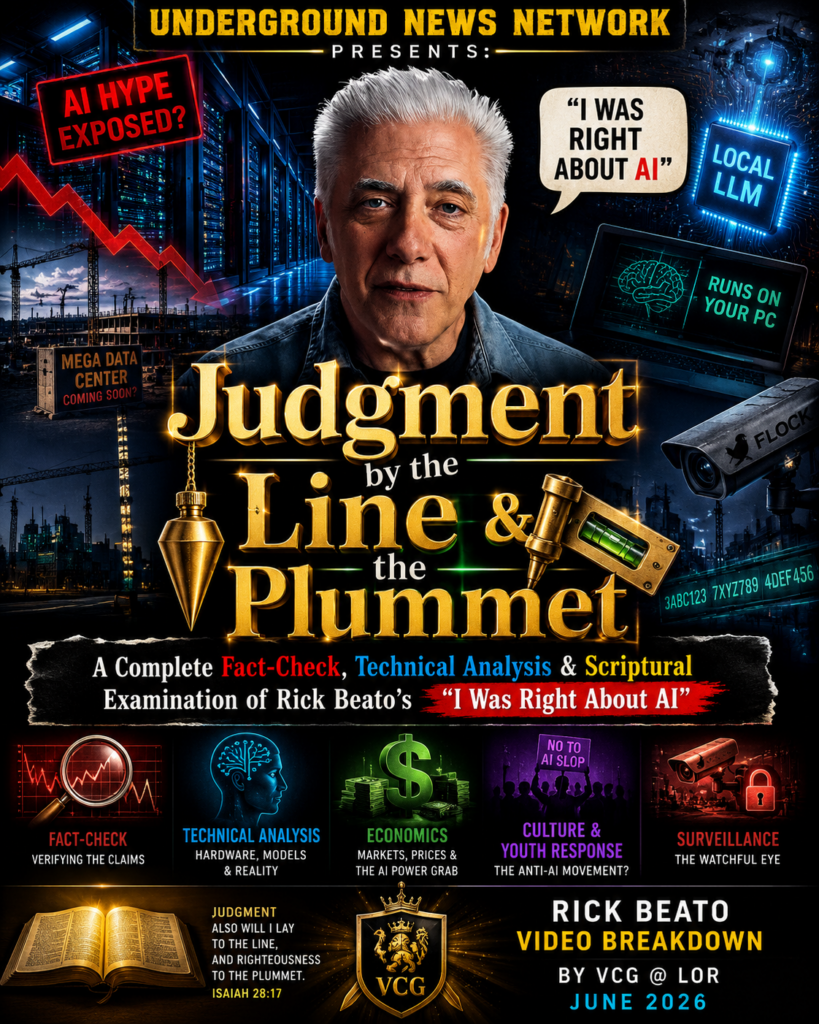
BY VCG @ LOR 6/18/2026
Soli Deo Gloria.
Overall verdict:
Rick is partly right on symptoms—AI demand is pressuring memory/storage markets, local LLM machines are real, and surveillance concerns are legitimate.
But his main conclusion—
“therefore many AI data centers won’t be needed”
—is not proven and is likely overstated.
Methodology
I checked:
- transcript claims
- current hardware announcements
- memory/storage market reporting
- AI/data-center energy forecasts
- local LLM memory math
- surveillance facts
Line-by-line rebuttal
| Video claim | Fact-check | Rebuttal |
|---|---|---|
| “Many data centers… will never get finished… local LLMs won’t need them.” | Local AI PCs are real, but data-center demand is still projected to rise sharply. IEA projects data-center electricity use roughly doubling to about 945–950 TWh by 2030. (IEA) | False leap. Local inference reduces some cloud use; it does not remove training, enterprise inference, video generation, search, recommendation, storage, redundancy, SaaS, and surveillance workloads. |
| “Same thing happened in music studios.” | Home recording did decentralize production, but streaming/cloud distribution centralized delivery. | Bad analogy. Music creation moved local; distribution became more cloud-dependent. AI may do both: local assistants plus massive cloud systems. |
| “4 TB SSD $2,000 / 8 TB $4,000… up 1,000%.” | SSD/RAM shortages are real; retail SSD supply has tightened due to AI/data-center demand. (Tom’s Hardware) | Direction true, numbers need caution. His anecdote may be a specific store, SKU, or markup. It should not be treated as market-wide proof without price history. |
| “They’re using them in data centers.” | AI data centers are absorbing DRAM/NAND supply; reporting attributes shortages and price hikes to AI infrastructure demand. (Tom’s Hardware) | Mostly true. But data centers typically use enterprise SSDs/HDDs and specialized supply chains, not simply consumer Samsung drives from retail shelves. |
| “New computers are built to run local LLMs.” | AMD advertises Ryzen AI Halo developer systems for local AI with 128 GB memory; NVIDIA/Microsoft announced RTX Spark Windows PCs with 1 PFLOP AI performance and up to 128 GB unified memory. (AMD) | True. Local AI is a real trend. |
| “200B / 120B models locally.” | Official claims support local large-model capability on specialized systems, usually with quantization and constrained context/performance. (AMD) | True but incomplete. “Can run” does not mean cloud-equivalent speed, context length, multimodal capability, reliability, or enterprise scale. |
| “A trillion parameter LLM needs 512 GB minimum; better 1–4 TB RAM.” | Hugging Face explains memory is dominated by model weights; FP16 is roughly 2 bytes/parameter, while quantization can reduce memory greatly. (Hugging Face) | Approximately right depending on quantization. 1T parameters at FP16 is about 2 TB just for weights; INT4 is about 500 GB before overhead. |
| “90% of what most people need can run locally.” | No sourced evidence in the video. | Unsupported statistic. It may be plausible for simple writing, coding help, summarization, and private search; not for frontier reasoning, real-time knowledge, large context, media generation, or enterprise workflows. |
| “Kids hate AI… real anti-AI movement.” | There is documented student backlash, including AI-related commencement boos. (Axios) | Partly true. But dislike of AI slop or job threat is not the same as refusal to use AI. |
| “If kids don’t want AI and AI runs locally, what are data centers for?” | Big Tech AI capex remains enormous; Goldman’s baseline model estimated $765B AI capex in 2026, rising later. (Goldman Sachs) | False dilemma. Data centers serve training, inference at scale, cloud apps, memory/storage, video, enterprise security, model updates, and surveillance databases. |
| “Flock cameras gather license plates; we are surveilled everywhere.” | Flock says default plate-reader retention is 30 days; recent reporting shows serious public concern and misuse/compliance issues in some cities. (Flock Safety) | Concern justified. But “everywhere” is rhetorical. The right rebuttal is legal scope, retention, access controls, audit logs, and warrant policy. |
Psychology of the video
Rick uses a strong pattern:
personal shock → market anecdote → prediction validation → cultural anxiety → surveillance warning.
That is persuasive,
but it blends four different issues:
- consumer SSD prices
- local LLM hardware
- youth distrust of AI
- surveillance infrastructure
The danger is confirmation bias: each new fact is treated as proof that the original prediction was right.
Scripture correction
On boastful prediction:
“Whereas ye know not what shall be on the morrow… For that ye ought to say, If the Lord will, we shall live, and do this, or that.”
On truth-testing:
“The simple believeth every word:
but the prudent man looketh well to his going.” — Proverbs 14:15
On surveillance and hidden works:
“The eyes of the LORD are in every place, beholding the evil and the good.” — Proverbs 15:3
On deception:
“Judgment also will I lay to the line, and righteousness to the plummet.”
Bottom line:
Rick rightly warns about:
- AI hype
- market distortion
- surveillance
But:
“local LLMs make data centers unnecessary”
is not established.
The stronger truth is:
AI is decentralizing at the edge while centralizing power, data, capital, and surveillance in the cloud.
Part 2: The Core Error in Rick Beato’s Thesis
The central problem is not whether Rick correctly observes trends.
He does.
The problem is that he repeatedly commits a category error:
He assumes because local AI is growing, centralized AI infrastructure must shrink.
Those are not opposites.
Historically they grow together.
Claim #1:
“You can run AI locally; therefore, you don’t need data centers.”
Transcript:
“90% of what most people need to do, they can just run on their computer on a local LLM.
You don’t need a data center to do that.”
The Hidden Assumption
Rick assumes:
Local AI = replacement
instead of
Local AI = extension
What actually happened with computers?
1980s
Mainframes existed.
1990s
Personal computers exploded.
Did IBM data centers disappear?
No.
They grew.
What happened with the internet?
People got computers.
Then laptops.
Then smartphones.
Then tablets.
Then local storage.
Then cloud storage.
Did cloud disappear?
No.
Cloud became larger than ever.
The pattern:
New local capability
does not replace
centralized infrastructure.
It creates more demand.
Example
A teenager today:
Runs a local AI assistant.
Uses YouTube.
Uses TikTok.
Uses Discord.
Uses Spotify.
Uses cloud backup.
Uses online gaming.
Uses Google Docs.
Uses AI image generation.
Uses ChatGPT.
Uses cloud email.
Uses cloud photos.
Uses cloud search.
Uses cloud navigation.
Uses cloud payments.
Uses cloud banking.
Uses cloud authentication.
Uses cloud surveillance.
Uses cloud advertising.
Uses cloud recommendation systems.
Uses cloud social media.
Uses cloud storage.
Uses cloud updates.
Uses cloud sync.
Uses cloud security.
Uses cloud machine learning.
Uses cloud everything.
Local AI does not eliminate any of these.
It adds another layer.
Claim #2:
“Kids Hate AI”
Transcript:
“Kids hate AI… They hate the concept of AI.”
This is classic anecdotal reasoning.
Rick’s evidence:
“My kids.”
“My kids’ friends.”
“People I’ve talked to.”
That is not data.
That is sampling bias.
He is describing a social circle.
Not a civilization.
Reality:
Young people are simultaneously:
- mocking AI
- using AI
- depending on AI
at unprecedented rates.
The same generation saying:
“AI is cringe.”
is also using:
- ChatGPT
- Claude
- Midjourney
- Character AI
- TikTok recommendation engines
- Snapchat AI
- YouTube AI
daily.
This is similar to:
“People hate social media.”
while spending 8 hours a day on it.
What they hate is not AI.
They hate:
- AI slop
- AI spam
- AI propaganda
- AI replacing human creativity
Those are different things.
Psychology
Rick commits what psychologists call:
Availability Heuristic
The most visible examples become the whole reality.
He sees:
Students booing AI speakers.
Therefore:
“Kids hate AI.”
But millions of students are simultaneously using AI every day.
Those users are invisible.
Therefore, he ignores them.
Claim #3:
“Look at all these local AI computers.”
This is one of the strongest parts of the video.
Because he is actually correct.
AMD.
Apple.
NVIDIA.
Microsoft.
HP.
Lenovo.
ASUS.
Dell.
Everyone is building AI PCs.
This is real.
However—
Rick misses WHY.
The reason companies want local AI:
Privacy
Companies don’t want sensitive data leaving machines.
Latency
Local response is instant.
Cost
Cloud inference costs money.
Offline operation
Military.
Industrial.
Medical.
Remote locations.
None of those eliminate cloud AI.
They complement it.
What Rick Misses About AI Economics
The largest AI companies are not spending hundreds of billions because they think consumers cannot run local models.
They know consumers can.
The money is being spent on:
Frontier Model Training
GPT
Gemini
Claude
Grok
Llama
DeepSeek
etc.
Training remains overwhelmingly centralized.
A laptop is not training GPT-6.
A laptop is not training Gemini.
A laptop is not training Claude.
A laptop is not training frontier multimodal systems.
That still requires:
- giant clusters
- giant memory pools
- giant networking
- giant power plants
Claim #4:
The Surveillance Question
This is where Rick becomes strongest.
Transcript:
“We are being surveilled everywhere.”
This is not an AI claim.
This is a surveillance claim.
And it deserves separate treatment.
Because:
License plate readers.
Facial recognition.
Behavior prediction.
Pattern analysis.
Identity resolution.
Data aggregation.
Geo-tracking.
These absolutely benefit from massive centralized storage.
This is where data centers make perfect sense.
Ironically:
Rick accidentally provides one of the best arguments FOR more data centers.
If governments and corporations are collecting:
- images
- faces
- license plates
- purchases
- locations
- biometrics
then enormous storage systems are exactly what would be required.
Scriptural Correction
The deepest error is not technical.
It is prophetic speculation.
Rick repeatedly argues:
“I was right.”
Scripture warns against confidence in forecasts.
James 4:13-14 (KJV)
“Go to now, ye that say, To day or to morrow we will go into such a city, and continue there a year, and buy and sell, and get gain:
Whereas ye know not what shall be on the morrow.”
The Biblical position is not:
“I was right.”
The Biblical position is:
“If the Lord will.”
James 4:15 (KJV)
“For that ye ought to say, If the Lord will, we shall live, and do this, or that.”
Interim Conclusion
Rick Beato is:
✅ Correct that local AI is exploding.
✅ Correct that memory demand is surging.
✅ Correct that surveillance infrastructure is expanding.
✅ Correct that many people dislike AI culture.
But he has not demonstrated:
❌ that local AI replaces cloud AI.
❌ that data centers become unnecessary.
❌ that anti-AI sentiment reduces AI adoption.
❌ that current hardware trends prove his March prediction.
His strongest evidence supports a different conclusion:
AI is becoming both more decentralized at the edge and more centralized in infrastructure at the same time.
That is the pattern repeatedly seen throughout computing history.
Part 3: The Data Center Question Rick Never Actually Answers
The biggest weakness in the entire video is that Rick never defines:
What exactly is a data center?
Instead, the viewer is encouraged to think:
Data Center = AI
which is not true.
What Data Centers Actually Do
A modern hyperscale data center is not merely an AI warehouse.
It handles:
- Cloud storage
- Streaming
- Video delivery
- Search
- Banking
- Authentication
- Maps
- Medical systems
- Government systems
- Military systems
- Telecommunications
- Backups
- Enterprise software
- Advertising
- AI training
- AI inference
and thousands of other services.
When Rick asks:
“What are these data centers for?”
he is unconsciously reducing an entire civilization’s digital infrastructure to AI.
That is a massive oversimplification.
The YouTube Contradiction
One irony in the video is almost invisible.
Rick uploads videos to YouTube.
Every Rick Beato video exists because of:
- Google data centers
- Google networking
- Google storage
- Google content delivery networks
His channel literally depends upon the infrastructure he is questioning.
The moment a video gets:
- 1 million views
- 5 million views
- 10 million views
the bandwidth requirements become enormous.
No local LLM changes this.
Nobody is serving a Rick Beato video to 200 countries from their laptop.
The Storage Argument
Rick tells the story of expensive SSDs.
Transcript:
“Anything with storage have gone insanely through the roof in price.”
This is probably the most persuasive part of the video.
Because it is rooted in a real-world observation.
But even if his pricing anecdote is accepted completely—
it proves demand.
It does not prove the reason for demand.
This is a common reasoning mistake.
Correlation vs Causation
Storage prices rise.
↓
AI is growing.
↓
Therefore, AI data centers are causing all shortages.
Maybe.
Maybe not.
Many factors affect:
- NAND supply
- DRAM supply
- fabrication capacity
- inventory cycles
- geopolitical restrictions
- manufacturing shifts
- enterprise purchasing
Rick assumes one explanation.
But evidence requires more.
The “Music Industry” Analogy
This is the foundation of the whole video.
Transcript:
“The same thing happened in the music industry 25 years ago.”
Let’s test that.
What Rick Says Happened
Recording studios
↓
Home recording
↓
Studios became less important
↓
AI data centers will become less important
This sounds persuasive.
Until you examine what actually happened.
What Really Happened
Music production decentralized.
Yes.
But music distribution centralized.
Massively.
Before:
Local radio
Local stores
Physical CDs
Regional audiences
Now:
Spotify
Apple Music
YouTube
Amazon
TikTok
The industry became more centralized than ever.
Production moved local.
Distribution moved global.
The result was:
Both.
Exactly what we may be seeing with AI.
Local inference.
Centralized training.
Local assistants.
Centralized updates.
Local models.
Centralized infrastructure.
The music analogy actually supports the opposite conclusion.
The Missing Historical Pattern
Throughout history:
New technology rarely eliminates previous infrastructure.
It usually multiplies layers.
Example:
Books did not eliminate speech.
Radio did not eliminate books.
Television did not eliminate radio.
Internet did not eliminate television.
Smartphones did not eliminate computers.
Instead:
They stack.
Technology accumulates.
AI may do the same.
The Power Question
Rick notices enormous construction projects.
He sees:
- massive campuses
- giant power requirements
- huge data facilities
What he does not discuss is power.
Power is actually the bottleneck.
Not SSDs.
Not RAM.
Power.
The AI race is increasingly becoming:
Who can generate electricity?
Who can cool systems?
Who can maintain grid stability?
This is why:
- nuclear discussions have returned
- small modular reactors are being discussed
- natural gas demand is increasing
- utility companies are expanding forecasts
The battle is becoming electrical.
Not computational.
The Real Question
The real question is not:
Will local AI exist?
It already does.
The real question is:
Can local AI replace frontier intelligence?
Currently:
No.
A local model can:
- summarize
- answer questions
- assist coding
- write text
- analyze documents
But frontier systems increasingly combine:
- reasoning
- web retrieval
- multimodal inputs
- agent workflows
- giant context windows
- distributed computation
Those remain difficult to replicate locally.
Biblical Discernment
One thing Scripture repeatedly warns about is false certainty.
Not merely falsehood.
Certainty.
Ecclesiastes 8:17 (KJV)
“Then I beheld all the work of God, that a man cannot find out the work that is done under the sun.”
Proverbs 27:1 (KJV)
“Boast not thyself of to morrow; for thou knowest not what a day may bring forth.”
Notice:
The issue is not observation.
The issue is confidence beyond evidence.
Rick sees several trends.
Some are real.
Some are important.
But then he leaps from:
“I observe.”
to
“Therefore, I was right.”
That leap has not been demonstrated.
Deeper Spiritual Layer
There is another subtle issue.
The entire modern AI debate is often framed as:
- AI saves us
- AI destroys us
- AI replaces us
- AI controls us
The focus remains on machines.
Scripture consistently places responsibility elsewhere.
Not in tools.
In men.
Luke 16:10 (KJV)
“He that is faithful in that which is least is faithful also in much.”
Technology amplifies the heart already present.
A righteous man with AI remains accountable.
A wicked man with AI remains accountable.
A corrupt government with AI becomes more dangerous.
A righteous government with AI remains accountable before God.
The machine is not the moral agent.
The human is.
Part 3 Conclusion
Rick correctly identifies:
✓ Local AI growth
✓ Infrastructure strain
✓ Hardware demand
✓ Surveillance expansion
But he still has not established:
✗ that local AI eliminates cloud AI
✗ that data centers become unnecessary
✗ that current shortages validate his prediction
✗ that the music-industry analogy predicts AI’s future
The strongest evidence increasingly suggests:
AI is producing simultaneous decentralization and centralization.
Local capability is growing.
Centralized power is growing.
Both can be true at once.
And that is precisely why discernment is needed. Proverbs 14:15. KJV.
Part 4: The Surveillance Thread — Where Rick May Be Closer to the Truth Than He Realizes
Up to this point we have examined Rick’s claims about:
- local LLMs
- data centers
- storage shortages
- anti-AI sentiment
But there is one section where the discussion suddenly changes.
Most viewers probably missed it.
Around the six-minute mark Rick shifts from:
AI
to
surveillance
Transcript:
“We are being surveilled everywhere.”
This statement is fundamentally different from everything else in the video.
The Strange Pivot
Notice the progression.
Rick begins discussing:
- SSD prices
- RAM prices
- local AI computers
Then suddenly:
- Flock cameras
- facial recognition
- airports
- license plates
- surveillance databases
This is not the same subject.
What happened?
Subconsciously he begins asking a deeper question.
Not:
Why do we need AI?
But:
Why are they collecting so much data?
These are completely different questions.
The Real Fuel of AI
People often say:
AI runs on GPUs.
Not exactly.
AI runs on:
Data
Without data:
No training.
No predictions.
No surveillance.
No recommendations.
No profiling.
No targeting.
Data is the fuel.
Compute is the engine.
This distinction matters enormously.
Because many discussions focus only on:
- chips
- memory
- storage
while ignoring:
- collection
- ownership
- access
- control
The Data Harvesting Civilization
Think about modern life.
Every day people generate:
- GPS locations
- purchases
- searches
- messages
- photos
- voice recordings
- browsing histories
- facial images
Most people voluntarily contribute these.
Often for convenience.
The result is a civilization built on continuous data extraction.
Rick intuitively notices this.
When he sees Flock cameras.
When he sees airport scanners.
When he sees facial recognition.
When he sees license plate databases.
He is observing a larger phenomenon.
What Is Surveillance Capitalism?
The basic idea:
Human behavior becomes the product.
Historically companies sold:
- food
- cars
- tools
Now increasingly companies sell:
- predictions
- behavioral models
- advertising profiles
- influence
The more accurately human behavior can be predicted:
The more valuable the data becomes.
This is one reason data centers continue growing.
Not because everyone is asking ChatGPT questions.
Because entire industries depend upon information aggregation.
What Scripture Says About Watching
The Bible speaks repeatedly about observation.
But there is a critical distinction.
God’s observation is righteous.
Man’s observation often is not.
Psalm 33:13-15 (KJV)
“The LORD looketh from heaven; he beholdeth all the sons of men.
From the place of his habitation he looketh upon all the inhabitants of the earth.
He fashioneth their hearts alike; he considereth all their works.”
God sees all.
Because God is Judge.
Governments and corporations increasingly seek similar visibility.
But they are not God.
That distinction matters.
The Tower of Babel Pattern
Genesis 11 presents an interesting framework.
The people sought:
- unity
- coordination
- centralization
They said:
“let us make us a name”
Genesis 11:4.
Notice the impulse.
Centralized power.
Centralized communication.
Centralized identity.
Centralized control.
God scattered them.
Why?
Because concentration of power in fallen hands always produces corruption.
This is one reason Christians should be cautious whenever enormous information power accumulates in few institutions.
Not because technology itself is evil.
But because fallen men remain fallen.
Rick’s Blind Spot
Here is the irony.
Rick senses the surveillance issue.
But then he immediately circles back to storage drives.
The storage drives are not the main story.
The data collection is.
The real question is not:
Why is RAM expensive?
The real question is:
Why is unprecedented behavioral data being collected?
One question concerns hardware.
The other concerns power.
The second question is far more important.
The AI + Surveillance Convergence
Historically surveillance systems were limited.
Humans had to analyze information manually.
Today:
AI can process:
- faces
- voices
- movement patterns
- social networks
- financial activity
at scales impossible a generation ago.
This changes everything.
A camera no longer merely records.
It can identify.
A microphone no longer merely listens.
It can classify.
A database no longer merely stores.
It can predict.
This is the true significance of AI for surveillance.
Not consciousness.
Not superintelligence.
Not robots.
Pattern recognition.
The Prophetic Temptation
Many Christians immediately jump to:
“This is definitely the Mark of the Beast.”
That conclusion should be approached carefully.
Scripture says what Scripture says.
No more.
No less.
Revelation describes:
- buying and selling restrictions
- centralized authority
- enforcement mechanisms
But faithful interpretation requires caution.
Not sensationalism.
We should avoid:
- newspaper exegesis
- fear-based speculation
- forcing current events into prophecy
At the same time:
Believers should not ignore obvious trends.
Discernment requires balance.
The Heart of the Matter
Rick asks:
Why do they need all these data centers?
The deeper answer may be:
Because modern civilization increasingly runs on information extraction.
Whether AI succeeds or fails.
Whether local models grow or not.
Whether GPT-10 exists or does not.
The demand for data itself remains enormous.
And that reality alone may justify massive infrastructure expansion.
Scriptural Correction
The Christian response is neither:
“Trust the system.”
Nor:
“Panic.”
Psalm 146:3 (KJV)
“Put not your trust in princes, nor in the son of man, in whom there is no help.”
Nor should we trust corporations as saviors.
Nor technology as savior.
Nor AI as savior.
Christ remains King.
Not algorithms.
Not governments.
Not billionaires.
Not machines.
Part 4 Conclusion
Rick’s strongest observation may not be his AI prediction.
It may be his uneasy recognition that:
Massive infrastructure increasingly accompanies massive data collection.
That concern deserves investigation.
However:
He never fully develops the argument.
He notices the symptom.
But not the underlying system.
And until that distinction is understood, the SSD story, the RAM story, and the AI story will continue to obscure the much larger question:
Who collects the data, who controls the data, who profits from the data, and what limits—if any—exist upon that power?
Part 5: The Cult of AI — Why the Evangelists and the Doomers Often Mirror Each Other
One of the most fascinating aspects of Rick Beato’s video is that it reveals a deeper cultural phenomenon.
Not AI itself.
But how people think about AI.
Most discussions today fall into two camps.
Camp 1: AI Evangelists
These people say:
AI will save humanity.
AI will solve disease.
AI will eliminate poverty.
AI will create abundance.
AI will make everyone smarter.
AI will unlock a new age.
Camp 2: AI Doomers
These people say:
AI will destroy humanity.
AI will eliminate jobs.
AI will enslave mankind.
AI will end civilization.
AI will replace people.
AI is the apocalypse.
Notice something strange.
The conclusions differ.
But the structure is identical.
Both groups attribute near-divine power to technology.
One worships it.
One fears it.
Both exaggerate it.
The Forgotten Variable
In both narratives there is a missing variable:
Human Nature
Scripture never teaches:
Technology saves mankind.
Nor does Scripture teach:
Technology destroys mankind.
Scripture teaches:
Sin destroys mankind.
Romans 3:23
“For all have sinned, and come short of the glory of God.”
The problem was present:
Before electricity.
Before computers.
Before smartphones.
Before AI.
The machine changes.
The heart does not.
Why AI Creates Religious Thinking
Humans naturally create idols.
Psalm 115 describes idols.
Not merely statues.
But substitutes.
Anything elevated above God becomes an idol.
Today many people have replaced God with:
- Science
- Government
- Progress
- Technology
AI has become the newest candidate.
Notice the language used.
People speak of AI as though it were:
- omniscient
- omnipresent
- infallible
The rhetoric sounds theological.
“AI knows.”
“AI understands.”
“AI can solve it.”
“AI sees everything.”
Those are attributes historically reserved for deity.
Rick’s Position
Rick is not in the evangelist camp.
He is closer to the skeptic camp.
But sometimes skeptics create the opposite idol.
Instead of:
AI saves everything.
They believe:
AI ruins everything.
Both views give AI too much power.
What AI Actually Is
At its core:
AI is statistical pattern recognition.
Extremely sophisticated?
Yes.
Impressive?
Absolutely.
Useful?
Often.
But it remains:
- software
- mathematics
- prediction systems
It is not:
- God
- consciousness itself
- morality
- wisdom
This distinction matters.
Because modern society increasingly confuses intelligence with wisdom.
Intelligence vs Wisdom
A machine may possess vast information.
That does not make it wise.
Scripture draws a sharp distinction.
1 Corinthians 8:1
“Knowledge puffeth up, but charity edifieth.”
Knowledge alone is insufficient.
A system can know:
- every law
- every language
- every medical textbook
and still possess no righteousness.
Wisdom includes:
- truth
- morality
- judgment
- discernment
These are not identical to computation.
The Silicon Valley Gospel
Many AI advocates unknowingly preach a secular gospel.
The structure often looks like this:
Problem
Human limitations.
Savior
Technology.
Redemption
AI transformation.
Heaven
Post-scarcity society.
Prophets
Tech leaders.
Revelation
Product launches.
Faith
Trust the experts.
Heresy
Questioning progress.
Notice how religious the structure becomes.
The names change.
The framework remains.
Scripture’s Alternative
Christianity begins somewhere entirely different.
The problem is not:
Insufficient intelligence.
The problem is:
Sin.
Jeremiah 17:9
“The heart is deceitful above all things, and desperately wicked: who can know it?”
That diagnosis is far deeper than any AI forecast.
No increase in processing power solves that.
Why AI Hype Cycles Repeat
This is not the first time society has behaved this way.
History shows similar excitement around:
- railroads
- electricity
- radio
- television
- nuclear power
- the internet
Each generation believes:
This changes everything forever.
Sometimes it does.
But rarely in the way predicted.
The future usually arrives:
Messier.
Slower.
More complicated.
Rick’s Emotional Appeal
A subtle feature of the video is emotional framing.
He presents himself as:
The outsider.
The observer.
The man who saw it coming.
This is persuasive.
Because audiences love contrarian narratives.
Psychologically it triggers:
“Everyone else missed it.
He understands what’s really happening.”
Sometimes contrarians are correct.
Sometimes they simply become another form of crowd.
The wise response is neither automatic belief nor automatic dismissal.
Proverbs 18:17
“He that is first in his own cause seemeth just; but his neighbour cometh and searcheth him.”
This verse is almost a perfect framework for evaluating AI claims.
Every side sounds convincing until examined.
The Danger of Technological Determinism
A recurring assumption throughout the AI debate is:
Technology determines destiny.
But history shows something else.
The same technology can be used for:
- good
- evil
- truth
- deception
- healing
- destruction
Printing presses spread Bibles.
Printing presses spread propaganda.
Radio spread sermons.
Radio spread tyranny.
The internet spread knowledge.
The internet spread lies.
AI will likely do both.
What Christians Should Actually Fear
Many believers focus on:
- AI consciousness
- AI takeover
- robot domination
Scripture repeatedly focuses elsewhere.
It warns about:
- deception
- pride
- idolatry
- corruption
- false worship
These dangers existed long before AI.
Technology often amplifies them.
It does not create them.
Part 5 Conclusion
The AI evangelists and AI doomers often share the same hidden belief:
AI is the central force that determines humanity’s future.
Scripture disagrees.
The central issue has always been:
The condition of the human heart.
Rick correctly questions AI hype.
But he sometimes risks creating a reverse distortion:
granting AI too much explanatory power, even while criticizing it.
The Biblical position is neither techno-utopian nor techno-apocalyptic.
It is sober.
Watchful.
Discerning.
Testing all things.
Holding fast that which is good.
(1 Thessalonians 5:21)
Part 6: The Economics of AI — Who Actually Profits and Why the Spending Continues
One of the biggest problems in Rick Beato’s video is that he treats AI primarily as a technological story.
But AI is not primarily a technology story.
It is an economic story.
Always follow the money.
The Question Beneath the Question
Rick repeatedly asks:
Why are they building all these data centers?
The better question is:
Who believes they will make money from them?
Because nobody spends hundreds of billions of dollars simply because technology is interesting.
Capital seeks return.
If trillions are being allocated toward:
- GPUs
- data centers
- power plants
- transmission lines
- networking infrastructure
then investors believe future revenue exceeds present cost.
Whether they are right is a different question.
The Railroad Parallel
History offers an interesting comparison.
In the 1800s:
Railroads transformed civilization.
The believers were correct.
Railroads changed everything.
Yet many railroad companies collapsed.
The technology succeeded.
The investors failed.
This distinction is critical.
A technology can be revolutionary while simultaneously creating a financial bubble.
Those are not mutually exclusive.
The Dot-Com Parallel
The internet provides another example.
Late 1990s:
People proclaimed:
The internet changes everything.
Many skeptics mocked the claim.
The believers were largely correct.
The internet changed nearly everything.
Yet:
Thousands of companies collapsed.
Pets.com vanished.
Countless startups disappeared.
Massive capital was destroyed.
The technology succeeded.
The speculation failed.
This is the historical pattern many people miss.
Could AI Be Similar?
Possibly.
Two things may simultaneously be true.
Statement One:
AI becomes foundational.
Statement Two:
Many AI investments fail.
These are perfectly compatible.
Rick sometimes frames the issue as though one outcome excludes the other.
It does not.
Why the Giants Keep Spending
Consider the major players.
Microsoft.
Google.
Amazon.
Meta.
NVIDIA.
Apple.
OpenAI.
xAI.
Anthropic.
Why are they spending extraordinary sums?
Because they fear being left behind.
This is not merely optimism.
It is competition.
Imagine Google stops investing.
If AI becomes transformative:
Google loses.
Imagine Microsoft stops investing.
If AI becomes transformative:
Microsoft loses.
Imagine Meta stops investing.
If AI becomes transformative:
Meta loses.
The downside risk of inaction is enormous.
The Arms Race Dynamic
This creates a self-reinforcing cycle.
Company A spends.
↓
Company B responds.
↓
Company C responds.
↓
Company D responds.
Soon nobody can stop.
The spending becomes strategic.
Not merely economic.
This is similar to military competition.
Nobody wants to be the nation that falls behind.
What Rick Correctly Senses
There is something unhealthy about the current scale.
Many observers feel it.
The rhetoric often sounds extreme.
“Transform everything.”
“Change civilization.”
“Rewrite humanity.”
“Create superintelligence.”
Whenever language becomes grandiose, caution is warranted.
Because hype often accompanies bubbles.
What Is a Bubble?
A bubble occurs when expectations outrun reality.
Not when technology fails.
When expectations exceed achievable outcomes.
This distinction matters.
Many people misunderstand bubbles.
A bubble does not mean:
Nothing valuable exists.
A bubble means:
Valuations become detached from fundamentals.
Biblical Example
The Tower of Babel offers a useful framework.
Genesis 11:4
“Go to, let us build us a city and a tower, whose top may reach unto heaven; and let us make us a name.”
Notice the psychology.
Human ambition.
Human confidence.
Human centralization.
Human self-exaltation.
The problem was not brick-making.
The problem was pride.
Technology was not the sin.
The heart behind it was.
Pride and AI
One of the recurring themes in AI discourse is human self-confidence.
Statements such as:
We will solve intelligence.
We will transcend limitations.
We will redesign humanity.
We will conquer death.
These statements increasingly resemble Babel.
Not because computers are evil.
Because pride remains pride.
The NVIDIA Phenomenon
No company better illustrates this than NVIDIA.
A few years ago:
Mostly known among gamers.
Today:
One of the most valuable companies in human history.
This occurred because AI created extraordinary demand for compute.
But here’s the key point.
Demand today does not guarantee demand tomorrow.
Markets routinely overshoot.
History repeatedly demonstrates this.
The Missing Risk
Rick discusses shortages.
But shortages can become surpluses.
History shows:
Booms often create overbuilding.
Railroads.
Telecom.
Housing.
Shipping.
Oil.
Companies see demand.
↓
They build aggressively.
↓
Supply eventually catches up.
↓
Prices collapse.
Could some AI infrastructure become overbuilt?
Possibly.
This is actually one of Rick’s strongest points.
Not because local LLMs eliminate demand.
But because overenthusiastic capital allocation can create excess capacity.
Those are different arguments.
Where Rick’s Thesis Should Have Gone
A stronger argument would be:
AI may remain important while investors simultaneously overbuild infrastructure.
That position is defensible.
Instead he argues:
Local AI means data centers may not be needed.
That leap remains unsupported.
The Spiritual Dimension
Scripture repeatedly warns against trust in wealth.
Psalm 49:6
“They that trust in their wealth, and boast themselves in the multitude of their riches.”
The modern AI race increasingly reflects faith in capital.
Build more.
Spend more.
Scale more.
Expand more.
Yet history repeatedly humbles such confidence.
James 4:16
“But now ye rejoice in your boastings: all such rejoicing is evil.”
The issue is not investment.
The issue is certainty.
The Real Economic Question
The future of AI may depend less upon:
- model intelligence
- parameter counts
- benchmark scores
and more upon:
- energy costs
- profitability
- regulation
- infrastructure utilization
- actual business value
Those factors determine sustainability.
Part 6 Conclusion
Rick correctly senses that something unusual is happening.
The scale of spending is extraordinary.
The enthusiasm is unprecedented.
The infrastructure buildout is immense.
However, the strongest economic critique is not:
AI is unnecessary.
It is:
Markets may be pricing AI as though success is guaranteed.
History suggests caution.
Some AI companies may become the next Microsoft.
Some may become the next Pets.com.
Some infrastructure may be indispensable.
Some may become stranded assets.
The wise observer should resist both extremes:
Neither blind optimism nor blind pessimism.
Proverbs 22:3 (KJV)
“A prudent man foreseeth the evil, and hideth himself:
but the simple pass on, and are punished.”
Part 7: The Technical Reality Check — What Local LLMs Can Actually Do (and Cannot Do)
This is the section where Rick’s argument encounters its greatest technical difficulty.
Because his entire prediction depends upon one foundational claim:
Most people can do 90% of what they need locally.
That sounds plausible.
But when examined carefully, the statement begins to collapse.
First Problem:
What Does “90%” Mean?
Ninety percent of:
- Time?
- Tasks?
- Compute?
- Business value?
- User requests?
Rick never defines it.
This matters.
Because a statistic without a definition is not evidence.
It is rhetoric.
Example
Suppose:
95% of my driving is local.
Does that mean I don’t need highways?
No.
The remaining 5% may be the most important journeys.
Similarly:
Many AI tasks are small.
But the difficult tasks often generate most of the value.
What Local Models Do Well
Let’s be fair.
Local LLMs are genuinely impressive.
Modern local models can:
Writing Assistance
- emails
- summaries
- outlines
- notes
Coding
- debugging
- code generation
- explanations
Research Support
- document analysis
- organization
- extraction
Offline Knowledge
- manuals
- textbooks
- personal archives
Privacy-Sensitive Work
- legal drafts
- medical notes
- internal business data
These are significant capabilities.
Rick is right to point this out.
Why Local AI Is Growing
There are four major reasons.
Privacy
Many organizations do not want confidential information leaving their systems.
Cost
Cloud inference costs money.
Local inference eventually becomes cheaper.
Speed
Local models eliminate network latency.
Reliability
Local systems continue working when disconnected.
These are powerful advantages.
Where Rick Begins to Overreach
The existence of advantages does not imply cloud replacement.
It implies coexistence.
What Local Models Struggle With
Now we move into the difficult territory.
Frontier Reasoning
The largest models generally outperform smaller local systems on:
- difficult reasoning
- multi-step analysis
- advanced planning
Not always.
But often.
Massive Context Windows
Cloud systems increasingly process enormous quantities of information simultaneously.
Entire books.
Entire codebases.
Massive document collections.
Local machines often struggle here.
Multimodal Workflows
Advanced systems increasingly combine:
- text
- images
- audio
- video
simultaneously.
These workloads remain computationally expensive.
Continuous Updating
A local model is frozen.
A cloud model can:
- update
- retrieve information
- connect to databases
- access tools
This difference is enormous.
The Internet Problem
Rick repeatedly emphasizes:
Not connected to the internet.
This sounds appealing.
Especially to privacy-conscious users.
But many AI use cases depend on connectivity.
Questions such as:
- current events
- weather
- stock prices
- regulations
- scientific discoveries
require fresh information.
An offline model cannot know what happened yesterday.
This limitation never disappears.
The Agent Revolution
A major trend Rick barely addresses:
Agents.
Modern AI increasingly interacts with:
- browsers
- databases
- APIs
- software tools
The value is not merely generating text.
The value is taking action.
Action requires connections.
Connections require infrastructure.
Infrastructure requires servers.
Servers require data centers.
The chain remains intact.
The Trillion Parameter Discussion
Rick correctly notes:
Trillion parameter models require enormous memory.
This is largely true.
But this observation creates a contradiction.
If the most powerful systems require:
- vast memory
- vast compute
- vast networking
Then local machines cannot fully replace them.
The argument undermines itself.
The Smartphone Analogy
The best comparison may be smartphones.
Your phone today is extraordinarily powerful.
Yet cloud usage continues increasing.
Why?
Because:
Local capability increased.
Cloud capability increased.
Both grew simultaneously.
History repeatedly shows this pattern.
The Hidden Assumption
Rick implicitly assumes:
Computing is a zero-sum game.
Meaning:
More local
=
Less cloud
Historically this has rarely been true.
Instead:
Local expands.
Cloud expands.
Total computing expands.
The pie grows.
Why Data Centers Continue Growing
Suppose local AI becomes fantastic.
What happens?
People use more AI.
Not less.
This is called:
Jevons Paradox
When efficiency increases, usage often increases.
Example:
Fuel-efficient cars.
People drive more.
Example:
Cheaper computing.
People compute more.
Example:
Better local AI.
People perform more AI tasks.
The result can actually increase total demand.
The Missing Consumer Behavior Question
Rick assumes consumers optimize for independence.
Most consumers optimize for convenience.
This distinction is crucial.
People routinely choose:
- convenience over privacy
- speed over control
- simplicity over ownership
This is why:
- streaming beat DVDs
- cloud storage beat local storage
- Spotify beat MP3 collections
Many users simply do not want to manage local models.
They want:
Open app.
Ask question.
Receive answer.
Cloud systems excel at this.
Theological Reflection
One subtle issue in AI discussions is the temptation to place trust in tools.
Some trust cloud AI.
Others trust local AI.
Both can become forms of misplaced confidence.
Psalm 20:7 (KJV)
“Some trust in chariots, and some in horses:
but we will remember the name of the LORD our God.”
The principle remains timeless.
Technology changes.
Human dependence shifts.
But ultimate trust belongs to God alone.
Rick’s Strongest Technical Point
If Rick had argued:
Local AI will become far more important than many experts realize.
That would be a strong thesis.
Evidence supports it.
Instead, he argues:
Local AI means many data centers may never be needed.
That conclusion remains unsupported.
Part 7 Conclusion
Rick correctly identifies:
✓ explosive growth in local AI
✓ increasing local hardware capability
✓ rising memory requirements
✓ growing demand for privacy and offline tools
However, he does not demonstrate:
✗ that local AI replaces cloud AI
✗ that local AI eliminates infrastructure demand
✗ that local AI invalidates hyperscale investment
✗ that “90%” of AI needs are local
The most likely outcome is not replacement.
It is layering.
Local AI grows.
Cloud AI grows.
Enterprise AI grows.
Infrastructure grows.
Power demand grows.
Data demand grows.
The future appears additive rather than subtractive.
Which is precisely why Rick’s central prediction remains unproven.
Part 8: The Propaganda Layer — How AI Narratives Are Manufactured and Why Fear Sells as Well as Hope
One of the most overlooked aspects of Rick Beato’s video is that it is not merely discussing AI.
It is participating in the AI narrative war.
Most people assume propaganda means:
- governments
- political campaigns
- state media
Historically that was often true.
Today propaganda is broader.
It includes:
- corporations
- influencers
- media outlets
- think tanks
- venture capital
- technology companies
Every major institution has incentives.
And incentives shape narratives.
The AI Narrative Industry
Think about the stories constantly being repeated.
Story #1
AI changes everything.
Story #2
AI destroys jobs.
Story #3
AI creates abundance.
Story #4
AI ends civilization.
Story #5
AI replaces creativity.
Story #6
AI liberates creativity.
Notice something.
Most headlines are extreme.
Why?
Because attention follows emotion.
Fear.
Hope.
Excitement.
Outrage.
These emotions generate clicks.
And clicks generate revenue.
The Business Model of Attention
Modern media increasingly operates on:
Attention
↓
Engagement
↓
Revenue
The more emotionally charged the message:
The more attention it receives.
This creates an incentive structure.
Moderate analysis struggles.
Extreme predictions thrive.
A headline saying:
AI May Gradually Alter Certain Industries
does not spread.
A headline saying:
AI Will End Human Work Forever
spreads everywhere.
Rick’s Position in the Narrative Market
Rick occupies an interesting middle ground.
He is not an AI evangelist.
He is not a hardcore doomer.
But he benefits from the same attention mechanics.
Consider the title:
I Was Right About AI
Psychologically this is powerful.
It immediately creates:
- curiosity
- conflict
- anticipation
The audience wants to know:
Was he right?
This is not deception.
It is attention optimization.
Every content creator learns this.
The Contrarian Advantage
Rick’s brand has increasingly become:
The experienced outsider.
The person who:
- notices trends
- challenges consensus
- questions industry narratives
Sometimes this is valuable.
But it carries risks.
Because once an audience rewards contrarianism:
There is pressure to remain contrarian.
Even when evidence becomes mixed.
The Psychology of Confirmation
A subtle phenomenon appears throughout the video.
Rick notices events supporting his prediction.
Examples:
- expensive SSDs
- local AI hardware
- AI skepticism
Each observation is interpreted as validation.
But what about contrary evidence?
Massive AI investment.
Growing cloud usage.
Increasing enterprise adoption.
Expanding energy demand.
These receive far less attention.
This is classic confirmation bias.
Not unique to Rick.
Human nature.
Scripture and Confirmation Bias
The Bible repeatedly warns against one-sided judgment.
Proverbs 18:13 (KJV)
“He that answereth a matter before he heareth it, it is folly and shame unto him.”
And:
Proverbs 18:17 (KJV)
“He that is first in his own cause seemeth just; but his neighbour cometh and searcheth him.”
These verses are almost tailor-made for modern media analysis.
Every side presents evidence.
The wise person examines all of it.
Why AI Fear Spreads So Easily
Fear narratives have enormous advantages.
Humans evolved to notice threats.
If ten headlines say:
Nothing unusual happened today.
and one says:
Civilization is about to collapse.
The collapse headline wins.
This tendency affects:
- politics
- economics
- health
- technology
And especially AI.
Why AI Hope Spreads Equally Fast
Hope triggers another mechanism.
People desire:
- prosperity
- solutions
- advancement
- security
Thus, promises spread rapidly.
Statements such as:
AI will cure cancer.
AI will solve climate change.
AI will eliminate poverty.
These appeal to human longing.
So, fear sells.
Hope sells.
Reality often sells less.
The Mirror Effect
Here is one of the most important observations.
The AI evangelist and AI doomer often mirror each other.
Both assume:
AI is the central force shaping history.
One says:
It saves us.
The other says:
It destroys us.
Both elevate AI beyond its actual role.
The Missing Actor
Throughout nearly every AI debate there is a missing actor.
Human beings.
People speak as though technology acts independently.
But technologies are:
- built by people
- funded by people
- deployed by people
- governed by people
This matters.
Because moral responsibility remains human.
The Propaganda of Inevitability
One of the strongest narratives in the AI era is:
This is inevitable.
You hear it constantly.
“AI is coming.”
“Resistance is futile.”
“Adapt or perish.”
This language creates psychological surrender.
The implication:
Choices no longer matter.
But history does not support this.
Societies make choices.
Laws matter.
Culture matters.
Institutions matter.
Morality matters.
Technology influences outcomes.
It does not dictate them absolutely.
Scripture and Inevitability
The Bible rejects fatalism.
Deuteronomy repeatedly presents choices.
Joshua 24:15 (KJV)
“Choose you this day whom ye will serve.”
Human responsibility remains.
Technology never removes accountability.
What Rick Gets Right
Rick correctly senses manipulation.
He notices:
- corporate narratives
- AI marketing
- infrastructure hype
His skepticism is often healthy.
The problem arises when skepticism becomes selective.
When evidence supporting one’s thesis is amplified while contrary evidence is minimized.
That is the same error committed by AI promoters.
Different conclusion.
Same mechanism.
The Deeper Lesson
The goal is not:
Trust AI.
Nor:
Fear AI.
The goal is:
Discern AI.
1 Thessalonians 5:21 (KJV)
“Prove all things; hold fast that which is good.”
That verse may be one of the best principles for evaluating every AI claim ever made.
Part 8 Conclusion
Rick’s video reveals something larger than AI.
It reveals how modern narratives are constructed.
People are pulled toward:
- hype
- fear
- certainty
- tribal allegiance
Yet truth usually resides in careful examination rather than emotional reaction.
The wise observer should question:
- AI evangelists
- AI doomers
- corporations
- governments
- influencers
including Rick himself.
Not because everyone is lying.
But because everyone has blind spots.
And the first step toward wisdom is recognizing that we do as well.
Part 9: The Biblical Worldview Test — What Rick Gets Wrong Because His Framework Begins with Technology Instead of Scripture
This is where the analysis moves beyond economics, beyond data centers, beyond SSDs, beyond AI.
Because the deepest issue in Rick’s video is not technological.
It is foundational.
Every worldview begins somewhere.
Some begin with:
- science
- politics
- economics
- psychology
- technology
The Christian begins somewhere else.
With God.
The Foundational Question
Rick asks:
What are these data centers for?
That is a legitimate question.
But Scripture asks a deeper one.
Not:
What are men building?
But:
Why are men building?
That difference changes everything.
Technology explains machinery.
Scripture explains motives.
The Babel Principle
Genesis 11 remains one of the most relevant chapters for understanding modern technological civilization.
The builders said:
“Let us build us a city and a tower…” (Genesis 11:4 KJV)
Notice carefully.
The sin was not architecture.
The sin was not engineering.
The sin was not innovation.
The sin was:
Self-exaltation
The verse continues:
“…let us make us a name.”
That is the key.
The problem was not the tower.
The problem was the heart.
Modern AI and Babel
Listen carefully to many AI leaders.
The language often sounds familiar.
“We will transcend limitations.”
“We will solve intelligence.”
“We will redesign humanity.”
“We will conquer death.”
“We will create superintelligence.”
The terminology changes.
The impulse remains.
Man attempting to elevate himself.
Genesis 3.
Genesis 11.
Romans 1.
The pattern repeats.
What Rick Sees
Rick sees:
- data centers
- AI companies
- hardware shortages
- surveillance systems
These observations are real.
But Scripture asks:
What drives them?
The answer is not AI.
The answer is the human heart.
The Human Problem
Jeremiah 17:9 (KJV)
“The heart is deceitful above all things, and desperately wicked:
who can know it?”
This verse explains more about AI than many technical white papers.
Why?
Because every AI system is ultimately designed, trained, deployed, funded, and governed by human beings.
The machine reflects its makers.
The Error of Technological Determinism
One recurring assumption throughout modern discussions is:
Technology determines destiny.
Scripture rejects this.
The Bible repeatedly attributes outcomes to:
- obedience
- rebellion
- righteousness
- wickedness
Not merely tools.
The same technology can serve radically different purposes depending on who controls it.
A printing press produced:
- Bibles
- heresies
Radio produced:
- sermons
- propaganda
The internet produced:
- education
- pornography
AI will do the same.
Technology magnifies.
It does not sanctify.
The False Savior Problem
One of the greatest dangers of the AI age is not AI itself.
It is the search for salvation through technology.
Throughout history mankind has repeatedly sought redemption through:
- politics
- science
- government
- revolution
- economics
Now increasingly:
AI.
But Scripture declares:
Acts 4:12 (KJV)
“Neither is there salvation in any other:
for there is none other name under heaven given among men, whereby we must be saved.”
No algorithm changes this.
No model changes this.
No machine changes this.
The False Fear Problem
Yet there is an equal danger on the opposite side.
Some believers treat AI as though it possesses near-supernatural power.
Everything becomes:
- the Beast
- the Mark
- the End
This creates another distortion.
Fear can become an idol just as easily as optimism.
Christ’s Command
Luke 21:28 (KJV)
“And when these things begin to come to pass, then look up, and lift up your heads…”
Notice.
Not panic.
Not hysteria.
Not obsession.
Confidence in Christ.
The Surveillance Issue Revisited
Rick’s concerns about surveillance deserve serious consideration.
Because power concentrated in fallen hands is dangerous.
Scripture repeatedly warns about rulers abusing authority.
Yet the Bible never presents surveillance technology itself as the primary threat.
The threat is wicked rulers.
Wicked institutions.
Wicked hearts.
Remove the technology.
The sin remains.
Add the technology.
The sin becomes more efficient.
The root remains unchanged.
The AI Idol
One reason AI discussions become so emotional is because AI touches a uniquely human area.
Intelligence.
People often define humanity by intelligence.
Therefore:
When machines appear intelligent,
people become unsettled.
But Scripture never defines man primarily by intelligence.
Man is created:
“in the image of God” (Genesis 1:27)
That image is not reducible to computation.
Not memory.
Not prediction.
Not language generation.
Not processing speed.
This distinction is critical.
Why Rick’s Framework Stops Short
Rick approaches AI primarily as:
- a musician
- a consumer
- a technology observer
These perspectives provide valuable insights.
But they cannot answer ultimate questions.
Questions such as:
- What is man?
- What is truth?
- What is wisdom?
- What is morality?
- What is purpose?
Those require a different authority.
Scripture.
The Wisdom Problem
The AI industry increasingly confuses:
Knowledge
with
Wisdom.
The Bible never does.
Proverbs 9:10 (KJV)
“The fear of the LORD is the beginning of wisdom.”
Not computation.
Not parameter count.
Not benchmark performance.
The beginning of wisdom is fear of the Lord.
That remains true in 2026 as surely as it was when Solomon wrote it.
The Real Question
Rick asks:
Do we need all these data centers?
The Biblical question is:
What kind of men will control them?
That question is far more important.
Because righteous men can misuse technology less.
Wicked men can misuse technology more.
The moral variable remains primary.
Final Biblical Assessment of Rick’s Video
Rick is correct to question:
✓ hype
✓ surveillance
✓ centralized power
✓ corporate narratives
✓ technological excess
But he ultimately analyzes symptoms more than causes.
He sees:
- the tower
- the wires
- the chips
- the cameras
- the servers
Scripture directs attention deeper.
To:
- pride
- greed
- fear
- idolatry
- ambition
- rebellion
Those forces existed before AI.
They will exist after AI.
And they explain far more about the future than any forecast about data centers ever could.
Ecclesiastes 1:9 (KJV)
“The thing that hath been, it is that which shall be…”
The machinery changes.
The human heart does not.
And that is the greatest weakness in Rick Beato’s analysis.
He examines the machine.
Scripture examines the man operating it.
ALTERNATE TITLES
Rick Beato’s “I Was Right About AI” Examined: A Complete Fact-Check, Technical Analysis, and Biblical Response
Local LLMs, Data Centers, and the AI Narrative: A Line-by-Line Analysis of Rick Beato’s “I Was Right About AI”
Testing the Claims: A Forensic Breakdown of Rick Beato’s AI Predictions Through Technology, Economics, and Scripture
Separating Fact from Speculation: A Deep Examination of Rick Beato’s AI Thesis
Was Rick Beato Right About AI? A Comprehensive Rebuttal, Fact-Check, and Biblical Correction
The Local AI Myth: Examining Rick Beato’s Claims About Data Centers, Surveillance, and the Future of AI
AI Hype, Fear, and Reality: Exposing the Weaknesses in Rick Beato’s “I Was Right About AI”
When a Correct Observation Leads to a Wrong Conclusion: A Biblical and Technical Critique of Rick Beato’s AI Argument
Prove All Things: A Biblical and Technical Examination of Rick Beato’s “I Was Right About AI”
Judgment by the Line and the Plummet: Fact-Checking Rick Beato’s AI Predictions Through Scripture and Evidence
Testing the Spirits of the AI Age: A Scriptural Analysis of Rick Beato’s “I Was Right About AI”
Truth, Technology, and Discernment: A Christian Response to Rick Beato’s AI Forecast